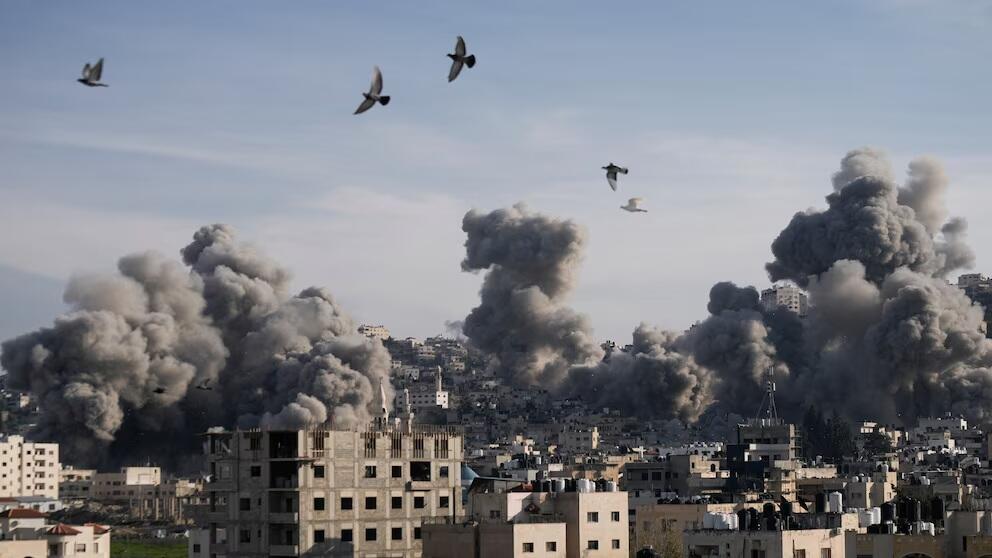
State Department Sanctions Palestinian Authority Officials, PLO Members

State Department Sanctions Palestinian Authority Officials, PLO Members

Authored by Jack Phillips via The Epoch Times,

The State Department on Thursday imposed sanctions on Palestinian Authority (PA) officials and members of the Palestine Liberation Organization (PLO). This comes as U.S. officials arrived in Israel to hold further cease-fire talks.

“It is in our national security interests to impose consequences and hold the PLO and PA accountable for not complying with their commitments and undermining the prospects for peace,” a State Department spokesperson said in a statement.

The department further said that the PA and PLO aren’t “in compliance with their commitments under the PLO Commitments Compliance Act of 1989,” as well as the Middle East Peace Commitments Act of 2002, because they have taken “actions to internationalize its conflict with Israel, such as through the International Criminal Court [ICC],” and other means.
The statement also accused both organizations of “continuing to support terrorism, including incitement and glorification of violence (especially in textbooks),” and “providing payments and benefits in support of terrorism to Palestinian terrorists and their families.”

The sanctions come as special envoy Steve Witkoff arrived in Israel on Thursday in a bid to save the Gaza cease-fire talks and tackle a humanitarian crisis in the Palestinian enclave. Israel faces growing world pressure over the war in Gaza, and several Western powers have said they will recognize a Palestinian state.

In the statement, the State Department did not say what individuals associated with the PLO or PA would face sanctions.

Earlier in July, the State Department announced it had placed sanctions on Francesca Albanese, the United Nations special rapporteur on human rights in the area, over efforts to have the ICC act against the United States and Israel, along with officials, executives, and companies.

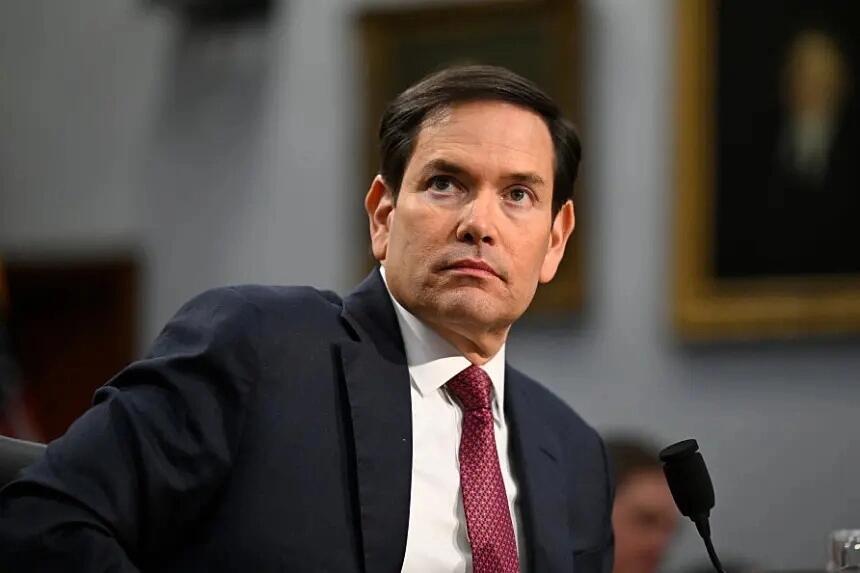
“Albanese’s campaign of political and economic warfare against the United States and Israel will no longer be tolerated,” Secretary of State Marco Rubio said on July 9 in a post on X.

Last year, the ICC issued arrest warrants against Israeli Prime Minister Benjamin Netanyahu and former Defense Minister Yoav Gallant for alleged war crimes and crimes against humanity during the Gaza conflict.

In a post on Truth Social, President Donald Trump wrote that the nearly two-year Israel–Hamas conflict could be ended if Hamas surrenders and releases the remaining hostages the terrorist group took during its October 2023 attack on Israel.

“The fastest way to end the Humanitarian Crises in Gaza is for Hamas to SURRENDER AND RELEASE THE HOSTAGES!!!” Trump wrote, referring to international concerns over reports of mass starvation in Gaza.

The president has said that he was impacted by watching footage of starving children in Gaza, telling reporters during his visit to Scotland this week that “there’s nothing you can say other than it’s terrible when you see the kids,” adding in another interview that the United States would set up food centers in the area.

It comes as the top leaders in Canada, the United Kingdom, and France have said they would recognize a Palestinian state separate from Israel.

On Wednesday, Canadian Prime Minister Mark Carney said in a statement that the country would recognize a Palestinian state in September at the U.N. General Assembly.

The Israeli Foreign Ministry denounced Canada’s move in a post on Wednesday, saying it would boost Hamas.

Trump also suggested that the move could make it difficult for the United States and Canada to reach a tariff agreement.

Tyler Durden
Thu, 07/31/2025 – 19:15

via ZeroHedge News https://ift.tt/CpQ2UOE Tyler Durden

Mainstream Naysayers Gather As Hopes Rise For 4th Year Of Record Coral On The Great Barrier Reef

Mainstream Naysayers Gather As Hopes Rise For 4th Year Of Record Coral On The Great Barrier Reef

Authored by Chris Morrison via DailySceptic.org,

In the next few days, the Australian Institute of Marine Science (AIMS) will issue its annual report on the state of the Great Barrier Reef (GBR). For alarmists promoting the Net Zero fantasy the news has been dire over the last three years, with record coral reported across the largest reef in the world.

Such is the obvious despair even daft excuses suggesting it is the wrong type of coral have been heard.

Faced with inconvenient facts, the usual groomed game plan in mainstream media has been to issue dire warnings of possible imminent collapse and then keep schtum when the sensational figures surface.

Recently the BBC gave us its “’underwater bushfire’ cooking Australia’s reefs”. Alas, the Australian Government’s Reef Authority is less cataclysmic in its reporting, noting indications in June this year that there were “no current heat stresses across the Reef”. Between April 14th and May 31st, 342 impact inspections were carried out which found coral bleaching on just three of the 34 reefs surveyed.

We must wait for a fuller picture from the upcoming 2024/25 AIMS survey but available details suggest another healthy year for the GBR. The BBC agitprop reported on dire conditions at the Ningaloo Reef off the Australian north-west coast, but it linked the GBR by noting a “worrying superlative”. Reefs on both sides of the continent have been bleached for what is claimed to be the first time. “It’s like a raging bushfire that has persisted for months now, wreaking harm right across the coast”, said Paul Gamblin, who heads up the Australian Marine Conservation Society. “It’s an absolutely devastating event and people are reeling from it. It is enormous. It’s unprecedented. It’s absolutely not normal”.

Quite how the BBC can witness a current underwater “bush fire” raging across the GBR is not immediately clear. Nor is it clear how the BBC can report first time bleaching across all of Australia’s main reefs when the process is a natural event that has certainly occurred over hundreds of millions of years of coral development. The BBC reports that the “heatwaves” in Australia are all part of something called the “fourth global bleaching event” which “experts say” has swept across large areas of the globe affecting more than 80% of the world’s coral reefs.

Meanwhile, back in the world of observational science, the Reef Authority reports that in June 2025 most of the observed GBR coral bleaching was at low levels of 1–10% and only in the northern region. No bleaching was observed in the central and southern regions. The biggest current threat appears to be the ever-lurking crown-of-thorns starfish, with outbreaks impacting a number of regions. Work continues on culling operations. Drops in ocean temperatures have been reported across the Reef, although they are still said to be above average – an average, of course, based on just a few decades of measurement. Short-term rises in temperature can induce coral bleaching but they appear to quickly recover. Tropical coral grows in waters between 24°C and 32°C, and growth is generally quicker in warmer seas. Short-term natural spikes come and go, leaving a politicised trail of shrieking headlines in their wake.

The AIMS annual survey usually runs up to June so it is of interest to observe what the Reef Authority has been reporting during the year. In February, summer sea temperatures were falling across most of the Reef with impact surveys showing low levels of bleaching across almost the entire area. Back in September 2024, the surveys revealed that most of the 31 individual reefs observed “showed no signs of coral bleaching, with very few cases of minor bleaching reported in each region”. In October, it was noted that temperatures across the marine park were around 0.6°C higher than average but they were “not at levels that typically cause impacts such as coral bleaching”.

The mainstream grooming over coral on the Great Barrier Reef, once a poster event for inducing mass climate psychosis, is plain for all to see. Ahead of 2024’s third record-breaking growth year, a convenient non-story appeared in Nature that claimed “climate change” posed an “existential threat” to the GBR. “The science tells us that the GBR is in danger – and we should be guided by the science”, Professor Helen McGregor from the University of Wollongong told Victoria Gill of BBC News. The existential threat is “now realised” reported the gibbering Guardian. In fact the Nature paper used proxy temperatures and climate models to suggest temperatures around the vast reef area were the highest recorded in 400 years.

Your correspondent might have missed subsequent reports in both the Guardian and BBC about the three record-breaking years of coral growth. I asked Grok for help and the reply came back: “I couldn’t find reports from the Guardian and the BBC specifically stating that the Great Barrier Reef has shown ‘three record-breaking years of growth’.” Grok further noted that there was no coverage of last year’s performance but rather it focused on challenges due to “global heating”. Just four months before last year’s announcement, the Guardian noted that the GBR faced its worst summer on record with widespread bleaching.

Will this be a record fourth year of a news blackout on the amazing resilience of one of the great wonders of the natural world?

Tyler Durden
Thu, 07/31/2025 – 18:25

via ZeroHedge News https://ift.tt/lkXo3qu Tyler Durden

Israel Gives Hamas Annexation Ultimatum Despite Increased Criticism From West

Israel Gives Hamas Annexation Ultimatum Despite Increased Criticism From West

Israeli officials have reportedly warned Hamas that if it rejects the latest ceasefire proposal, Israel will begin annexing parts of Gaza, according to a fresh Times of Israel report.

The report cites Israel’s Channel 12 which indicated Israel submitted its response to Hamas’s latest counteroffer on Tuesday night, but does not expect the group to accept the terms. Already talks based in Doha had been stalled or essentially called off, after Prime Minister Netanyahu earlier this month recalled his negotiating team.

ABC News

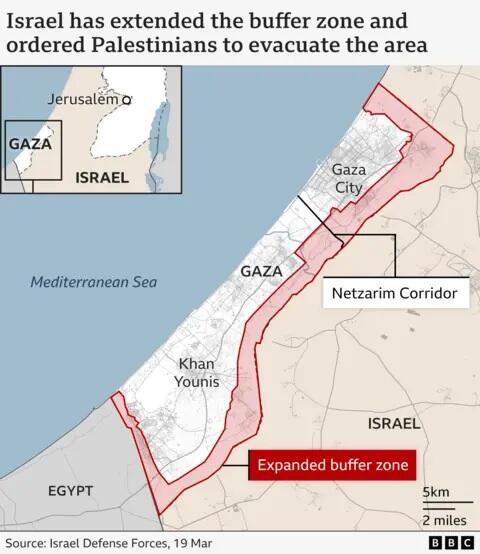
Israeli forces have established and for many months overseen a de facto ‘buffer zone’ in Gaza which cuts deep into the Palestinian territory.

“Israel will not be patient for much longer, a senior Israeli official was quoted in the report as saying.

The Times of Israel report spells out, “With negotiations for a ceasefire and hostage release deal having stalled, Israel has sent a message to Hamas that if it doesn’t accept the proposal on the table in the coming days, Jerusalem will begin to take punitive measures against it, including the annexation of territory on Gaza’s outer perimeter,” citing senior Israeli officials.

As for specifics on where this threatened annexation could begin, the report says:

According to the report, Israel told Hamas that it will not leave the Phildelphi Corridor along the Gaza-Egypt border or the buffer zone around the Gaza border; will not allow the opening of the Rafah Crossing; and will not agree to Hamas demands for a prisoner release so far-reaching it will leave few bargaining chips in Jerusalem’s hands to compel Hamas to release the last batch of hostages in a potential ceasefire.

This would effectively ensure that remaining hostages wouldn’t be returned through a deal, as Israel would shut the door on having anything more to offer in terms of enticing Hamas to reach a new exchange agreement.

Channel 12 has observed of the US stance that there is currently “no appetite” within the White House to approve any big Israeli move to formally annex parts of Gaza.

France, the UK, and most recently Canada have said they plan to recognize a Palestinian state at the upcoming UN assembly meeting in September, in a diplomatic blow to the Netanyahu government.

Still, there’s there’s as yet no indication Washington is pressuring Israel to make concessions, and if anything Trump’s earlier rhetoric on turning Gaza into the ‘Riviera of the Middle East’ could easily be taken as a green light to annex from Tel Aviv’s point of view.

But at the moment the majority of countries and leaders throughout the world have lambasted Israeli actions in Gaza, particularly for the lack of aid getting in amid the worsening humanitarian catastrophe as civilians starve to death.

Tyler Durden
Thu, 07/31/2025 – 18:00

via ZeroHedge News https://ift.tt/tC3jrLI Tyler Durden

Today’s Federal Circuit Oral Argument in Our Tariff Case

NA

Today, the en banc US Court of Appeals for the Federal Circuit hear oral arguments in VOS Selections, Inc. v. Trump, the case challenging Trump’s massive “Liberation Day” tariffs brought by the Liberty Justice Center and myself on behalf of five small businesses seriously harmed by the tariffs. You can listen to the argument here. Leading appellate litigator and Georgetown law Prof. Neal Katyal argued for us.

The case is consolidated with a similar one brought by twelve state governments, led by Oregon. We are defending a unanimous ruling in our favor by the US Court of International Trade, which held that the International Emergency Economic Powers Act of 1977 (IEEPA) does not grant the president anything approaching unlimited tariff authority, and if it did it would be an unconstitutional delegation of legislative power to the executive.

It is difficult to predict case outcomes based on oral arguments, particularly one with eleven judges that have a diversity of views and interests. Still, I can make a few tentative observations.

First, there seems little, if any, support for the idea that IEEPA grants the president unlimited tariff authority of the kind the administration claims. Multiple judges expressed skepticism that the law gives him the authority to rewrite the tariff schedule or to claim “unbounded authority.” Several judges emphasized, as Judge Reyna noted, that “IEEPA doesn’t even mention the word tariffs.” From the beginning of this litigation, we have emphasized that IEEPA delegates authority to “regulate” importation, but regulation is distinct from taxation.

Even if IEEPA does allow some tariff authority, as the predecessor court to Federal Circuit ruled in United States v. Yoshida International Inc. (1975), with respect to the Trading with the Enemy Act (predecessor statute for IEEPA), it doesn’t follow that authority is unlimited. Yoshida held it was not endorsing unlimited tariff authority. It emphasized that the Nixon tariffs were linked to the preexisting tariff schedule set by Congress, and that “[t]he declaration of a national emergency is not a talisman enabling the President to rewrite the tariff schedules.” It even noted that to “sanction the exercise of an unlimited [executive] power” to impose tariffs  “would be to strike a blow to our Constitution.” A number of judges noted today that, if Yoshida applies to IEEPA (thereby authorizing some tariffs), so too do its limitations on the scope of permissible tariff authority.

Some judges also suggested that unconstrained tariff authority would run afoul of the major questions doctrine and constitutional constraints on delegation of legislative power to the executive. The CIT based its ruling in part on these considerations.

Even if IEEPA does allow the use of tariffs, the law can only be invoked in the event of an “emergency” that poses an “unusual and extraordinary threat” to the US economy and national security. Those judges who raised this issue seemed skeptical of claims that what qualifies and an “unusual and extraordinary threat” is left to the unreviewable discretion of the president. Otherwise, IEEPA (assuming it allows tariffs at all) would be a blank check for the president, thereby exacerbating major questions and nondelegation problems.

There is nothing unusual or extraordinary about trade deficits, the supposed threat targeted by the Liberation Day tariffs. We have had them for decades, and today’s deficits are well in line with historical norms.

A number of judges raised an issue that was given little consideration by the lower court, and in briefing by the parties: even if trade deficits are not an “unusual and extraordinary threat,” perhaps some of their supposed consequences do. Those possible effects include damage to US manufacturing, decline of the defense industrial base or the like.

Claims that trade damages US manufacturing and defense industries are – like trade deficits – far from unusual. Protectionists have advanced such arguments for decades. Far from atrophying or “hollowing out,” US manufacturing output has actually grown in recent decades, more than doubling since 1997. While it has declined as a percentage of GDP, that’s largely because other industries (such as services) have grown even more. Perhaps we should have still more manufacturing. But there is nothing “unusual and extraordinary” about its current level. Whatever danger trade deficits pose to manufacturing or defense is not an unusual and extraordinary threat, but a normal policy issue that cannot be addressed through a statute limited to emergency situations. Moreover, as the amicus brief by leading economists points out, trade deficits, as such do not cause decline in manufacturing.

Finally, it is worth noting that IEEPA only authorizes measures that “deal with” the emergency and unusual and extraordinary threat that justifies its invocation. Trump’s imposition of 10% or higher tariffs on virtually every nation in the world goes far beyond merely targeting imports that might plausibly be said to undermine manufacturing or defense.

In sum, it is hard to predict what exactly the Federal Circuit will do here. But I am tentatively optimistic that the court will at least reject claims that IEEPA gives the president virtually unlimited, unreviewable tariff authority.

The post Today's Federal Circuit Oral Argument in Our Tariff Case appeared first on Reason.com.

from Latest – Reason.com https://ift.tt/yEHfLTn
via IFTTT

Montreal Fines Church $2,500 for Hosting a Controversial American Singer

On Friday, Sean Feucht, a contemporary Christian worship music artist known for his support of conservative political causes and the MAGA movement, led a worship service at the Spanish-speaking Église MR church in Montreal as part of his Revive in 25 tour. While a seemingly innocuous event, the service has drawn attention to the limits of religious freedom in Canada.

Feucht’s arrival at the church was met with protesters, one of whom threw two smoke bombs at Feucht upon entering the church, where “despite a police presence, the suspect was not detained,” reports Rebel News’ Alexandra Lavoie. The Gazette reported that the scene inside the church was more peaceful: “A few dozen people sang and prayed while a row of police officers kept watch outside.” 

After the service was over, the city of Montreal issued a $2,500 fine to the church for organizing what they called “a concert” without a proper permit. City spokesperson Catherine Cadotte said the fine was issued after the city’s borough inspectors had already warned the church, reports The Gazette. The Democracy Fund, a Canadian charity dedicated to constitutional rights, has agreed to provide legal defense to the church.

The event in Montreal isn’t the first time that Feucht or his tour has faced controversy in Canada. Dave Eby, the premier of British Columbia, recently called Feucht’s political views “pretty reprehensible.” Many Canadian leaders have outright revoked or denied permits for Feucht throughout Canada, reports The Gazette. The situation has forced the singer to find new venues for all six of his most recent shows, with Feucht saying in a Facebook post that a last-minute performance was even rescheduled to a remote farming field. 

Feucht believes the Canadian government is unfairly targeting his political and religious beliefs. “Here’s the hard truth: If I had shown up with purple hair and a dress, claiming to be a woman, the government wouldn’t have said a word. But to publicly profess deeply held Christian beliefs is to be labeled an extremist and to have a free worship event classified as ‘public safety risks,’ Feucht wrote in an X post in response to the recent incidents. 

Henry Hildebrandt, a Canadian pastor who paid legal fines for hosting in-person church services during the COVID-19 lockdowns, appears to agree. He argues that the Canadian government’s response to Feucht’s performance directly violates Section 176 of the Criminal Code of Canada. The law states that “every one who wilfully disturbs or interrupts an assemblage of persons met for religious worship or for a moral, social or benevolent purpose is guilty of an offence punishable on summary conviction.” 

A worship service shouldn’t need government approval. Regardless of Feucht’s politics, Canada’s government shouldn’t be infringing on freedom of religion. 

The post Montreal Fines Church $2,500 for Hosting a Controversial American Singer appeared first on Reason.com.

from Latest – Reason.com https://ift.tt/g6p5wxa
via IFTTT

The Senate Inches Closer To Taking Away Israel’s Blank Check

U.S. support for Israel used to go without question. “You see this napkin? In 24 hours, we could have the signatures of 70 senators on this napkin,” Steven Rosen, a top American Israel Public Affairs Committee official, joked to a reporter at The New Yorker over dinner in the early 2000s.

Israel enjoyed guaranteed access to American-made weapons, and it enjoyed the largest disbursement of U.S. taxpayer aid since World War II to pay for those weapons. (U.S. aid has covered 70 percent of the war in Gaza, according to the Israeli newspaper Calcalist.) When push came to shove, the U.S. military was even willing to step in directly to fight Israel’s wars.

But the consensus is no longer automatic. The Israeli army’s conduct towards Palestinian civilians after the Hamas attack of October 2023, and the Israeli leadership’s decision to strike Syria and Iran while the U.S. was trying to negotiate with both countries, has led to unprecedented debates in Congress over support for the Middle Eastern republic.

Israel’s supporters now have to make an affirmative case for U.S.-funded weapons. Although they still hold a majority, it is shrinking fast. In April 2025, only 15 senators voted to disapprove of American weapons shipments to Israel. On Wednesday night, 27 senators voted to block a shipment of rifles to Israel. A majority of the Democratic caucus voted against the shipment.

Many senators cited the growing famine in Gaza as the reason for their changing votes. “I had just had it. I kept expecting that Israel would wake up and realize what an awful thing they were perpetuating, and that surely they would at least open up humanitarian aid. They just continued to not do it, and I just reached the point where enough was enough,” Sen. Angus King (I–Maine) told Politico.

Sen. Bernie Sanders (I–Vt.) had put forward two separate resolutions on Wednesday, one on a shipment of rifles and another on a shipment of bombs. Strangely, the shipment of rifles—which have a more plausible defensive purpose—garnered more disapproval than the shipment of purely offensive bombs.

“Israel’s capacity to strike those who would launch missiles and rockets at Israeli civilians depends upon the deterrence provided by the Israeli Air Force,” Sen. Jon Ossoff (D–Ga.) said in a press release explaining his vote to block rifles but not bombs. He added that the rifles “would likely have been allocated to police forces under the control of Itamar Ben-Gvir,” the hardline Israeli National Security Minister.

Senate Armed Services Committee Ranking Member Jack Reed and Sen. Sheldon Whitehouse, both Democrats from Rhode Island, also voted to block rifles and not bombs. Neither immediately responded to Reason‘s questions by email.

Republicans, meanwhile, all voted to keep the weapons flowing. Senate Foreign Relations Committee Chairman Jim Risch said on the Senate floor that cutting off weapons to Israel “would mean abandoning America’s closest ally in the Middle East” and that “it is in the interest of America and the world to see this terrorist group [Hamas] destroyed.”

Sanders countered that Israel is not carrying out “an effort to win a war. It is an effort to destroy a people…American taxpayer dollars being used to starve children, bomb schools, kill civilians, and support the cruelty of [Israeli Prime Minister Benjamin] Netanyahu and his criminal ministers.”

In March 2025, the Israeli government completely closed all border crossings into Gaza. “We’ve done that because Hamas steals the supplies,” Israeli Prime Minister Benjamin Netanyahu declared at the time. In May 2025, the Israeli government handed over control of food distribution to a new American-run organization known as the Gaza Humanitarian Foundation (GHF). 

Since then, the Integrated Food Security Phase Classification, a partnership between the United Nations and several non-governmental charities, has found that the amount of food getting to Palestinians in Gaza has reached “famine thresholds.” And the distribution of that food has been marred by chaos and violence. More than a thousand people have been reported killed while trying to obtain food. Whistleblowers and leaked video footage indicate that Israeli troops and GHF guards have shot at crowds of aid seekers. (The GHF denies the reports and blames Hamas for the killings.)

Even President Donald Trump, whose administration supports the GHF and who insists that the war should end with Hamas’ unconditional surrender, admits that there has been mass starvation in Gaza. He told reporters on Tuesday that anyone denying the starvation is “pretty coldhearted or, worse than that, nuts,” and he promised to get more food in. The Israeli army promised on Saturday that it would open “humanitarian corridors” and airdrops without offering details.

Foreign supporters who were otherwise willing to cosign most Israeli military action seem to have taken starvation as a bridge too far. France declared last week that it would officially recognize an independent state of Palestine. Canada followed suit, and Britain said that it would recognize Palestine if no ceasefire is reached in Gaza by September. They are all demanding a demilitarized Palestine with political reforms.

The Trump administration has joined Israel in denouncing the Palestinian statehood push. Secretary of State Marco Rubio announced sanctions against the Palestinian Authority, the historically U.S.-backed rival to Hamas, for “internationalizing” the conflict by seeking independence. Trump threatened Canada that Palestinian recognition would make it “very hard for us to make a Trade Deal with them.”

But the Republican coalition has seen some defections. Earlier this month, Reps. Thomas Massie (R–Ky.) and Marjorie Taylor Greene (R–Ga.) supported a bill to cut $500 million from U.S. aid to Israel and all U.S. aid to Ukraine. The bill failed overwhelmingly.

According to the Financial Times, Trump privately told a donor that “my people are starting to hate Israel.” The Israeli foreign ministry, uneasy about these trends, is beginning an outreach program aimed specifically at young America First influencers.

Indeed, the recent votes in Congress are a lagging indicator of where public opinion has been moving. A recent Gallup poll shows that 60 percent of Americans disapprove of the Israeli campaign in Gaza, including 83 percent of Democrats. While a solid majority of Republicans approve, their disapproval rate—22 percent—is larger than the dissent bloc in Congress would suggest.

And only 9 percent of Americans below the age of 34, regardless of party, approve of the war. There is an enormous generational gap, perhaps more significant than the partisan gap, over this issue. Although that kind of shift takes a while to be felt in elections and staffing, current politicians’ attempts to catch up are leading them to unexpected places.

The post The Senate Inches Closer To Taking Away Israel's Blank Check appeared first on Reason.com.

from Latest – Reason.com https://ift.tt/oA4Baxd
via IFTTT

Patrick Eddington: How to ‘Tyranny-Proof’ America

Do you ever feel like you’re being watched? Just asking questions. 

We’re told modern surveillance tech will track criminals, illegal aliens, and terrorists while protecting the privacy of innocent Americans. You’ve got nothing to worry about if you’ve got nothing bad to hide. 

Today’s guest says that’s not true. His latest book, The Triumph of Fear, documents the history of the modern surveillance state and the ways in which it’s been leveraged since its inception to target not just terrorists and criminals, but political dissidents.

Patrick Eddington was a CIA analyst from 1988 to 1996, but resigned and wrote Gassed in the Gulf, a book alleging that the agency helped cover up the existence of Gulf War syndrome, caused by exposure to chemical weapons. 

He joins Just Asking Questions today to talk about the power and reach of the modern surveillance state, the growing influence of the AI-powered data firm Palantir—cofounded by Peter Thiel—in the Trump administration, and what can be done to “tyranny-proof” America. 

Mentioned in this episode:

Stopping Waste, Fraud, and Abuse by Eliminating Information Silos,” The White House

Palantir contract modification with ICE

The Scouring of the Shire,” an open letter by a Palantir ex-employee

Palantir Is Not a Data Company,” by Palantir

American Big Brother,” by the Cato Institute

The Triumph of Fear: Domestic Surveillance and Political Repression From McKinley to Eisenhower,” by Patrick Eddington

Alex Karp, director of Palantir, address to the Economic Club of Chicago on May 22, 2025

Why This Palantir Cofounder Left California for Texas,” The Reason Interview With Nick Gillespie

Purpose-Based Access Controls at Palantir (Part 1),” by Palantir

Davos 2023: A conversation with Palantir’s Alex Karp


Chapters:

0:00—Introduction

2:20—President Donald Trump’s executive order “eliminating information silos” is paving the way for a national, unified surveillance database

3:58—Did the Department of Government Efficiency have a “hidden motive”?

12:08—Why the surveillance bureaucracy keeps expanding with little resistance

14:04—Ex-employees have signed an open letter against Palantir. What does it mean?

25:34—What does Palantir actually do?

27:55—Could Palantir actually protect civil liberties?

29:02—What could happen if Palantir’s tools fall into the wrong hands?

37:52—Why creating a centralized database is a civil liberties nightmare

42:53—Palantir’s CEO Alex Karp on why they defend the West

47:00—Why Eddington wants to take federal law enforcement out of the executive branch

50:32 – Why federal law enforcement has always been politicized

55:17 – The lessons of COINTELPRO’s surveillance of activists

55:17 – What was “total information awareness”?

1:10:28 – What is a question Patrick Eddington thinks more people should be asking?

The post Patrick Eddington: How to 'Tyranny-Proof' America appeared first on Reason.com.

from Latest – Reason.com https://ift.tt/QyjWdE0
via IFTTT

My New Dispatch Article on Judicial Review of Emergency Powers

NA

Today, The Dispatch published my article “Not Everything is an Emergency” (gift link). Here is an excerpt:

The Trump administration has attempted to make sweeping use of emergency powers in the areas of immigration, trade, and domestic use of the military. In each case, President Donald Trump has tried to use powers legally reserved for extreme exigencies—invasion, war, grave threats to national security—to address essentially normal political challenges. If he is allowed to get away with them, these abuses would set dangerous precedents and gravely threaten civil liberties and the structure of our constitutional system.

Each of these efforts has resulted in litigation, and in each case the administration claims the issues in question are left to virtually  unreviewable executive discretion. The president alone supposedly gets to determine whether an emergency exists and (with few or no limitations) what should be done about it. Courts have mostly rejected the argument that the president has the power to define terms such as “invasion.” But they have often been overly deferential to presidential determinations about relevant facts, such as whether an “invasion” (correctly defined) has actually occurred. At least one judge has also embraced the view that these issues are unreviewable “political questions.” It is vital that courts engage in full, nondeferential review of administration invocations of emergency powers. None of the arguments against doing so outweigh the immense dangers of letting the president invoke these powers at will…..

The Trump administration has attempted to make sweeping use of emergency powers in the areas of immigration, trade, and domestic use of the military. In each case, President Donald Trump has tried to use powers legally reserved for extreme exigencies—invasion, war, grave threats to national security—to address essentially normal political challenges. If he is allowed to get away with them, these abuses would set dangerous precedents and gravely threaten civil liberties and the structure of our constitutional system.

Each of these efforts has resulted in litigation, and in each case the administration claims the issues in question are left to virtually  unreviewable executive discretion. The president alone supposedly gets to determine whether an emergency exists and (with few or no limitations) what should be done about it. Courts have mostly rejected the argument that the president has the power to define terms such as “invasion.” But they have often been overly deferential to presidential determinations about relevant facts, such as whether an “invasion” (correctly defined) has actually occurred. At least one judge has also embraced the view that these issues are unreviewable “political questions.” It is vital that courts engage in full, nondeferential review of administration invocations of emergency powers. None of the arguments against doing so outweigh the immense dangers of letting the president invoke these powers at will….

Nondeferential judicial review of invocations of emergency powers is an application of the judiciary’s normal role in interpreting the law and applying it to the relevant facts. Moreover, the use of terms denoting extraordinary dangers (such as “invasion,” “rebellion,” or “emergency”) counsels against interpreting them in ways that allow invocation of these powers in normal times. Otherwise, these words become superfluous, and emergency powers turn into blank checks for executive power grabs.

The same point applies to factual deference. Courts routinely assess whether the factual prerequisites for applying a law are present. Emergency powers should not be an exception. Otherwise, the government could get around constitutional and other constraints on its authority simply by engaging in lying and misrepresentation about the facts on the ground.

In litigation over all three of its major invocations of emergency powers—immigration, tariffs, and domestic use of the military—the administration has also invoked the “political questions” doctrine, which holds that some issues are off limits to the judiciary, because they have been left to the political process…. But there is no general principle holding that invocations of emergency powers are exempt from judicial scrutiny….

Some defenders of the administration’s position argue that courts should defer to the executive’s specialized expertise on emergency power issues. But a genuine emergency does not require much expertise to detect. You don’t have to be an expert to understand that Russia’s assault on Ukraine is an “invasion” or that the COVID pandemic was an “emergency.” The very enormity of true emergencies generally makes detection easy.

In rare cases where specialized knowledge is required, courts can take expert testimony and consider scientific evidence, as they routinely do in other situations. Courts also have procedures for considering classified information, when necessary….

Elsewhere in the article, I discuss the enormous issues at stake in cases involving dubious invocations of emergency powers:

Advocates of judicial deference claim it is important to give the president discretion to combat  threats. But the enormous risks such deference poses easily outweigh any possible advantage of increased executive flexibility. If illegal migration and drug smuggling qualify as an “invasion,” the federal government, under the Constitution, could suspend the writ of habeas corpus whenever it wants, thereby gaining the authority to detain people without due process or filing charges. If properly invoked, the AEA allows detention and deportation even of legal immigrants.

In addition, the weak due process protections mean U.S. citizens may get ensnared in the process, as often happens even with ordinary deportations….

Likewise, normalizing domestic use of the military poses obvious dangers to civil liberties and social order. Routine use of the military for such purposes is a grave menace, and a hallmark of authoritarian regimes.

The stakes with Trump’s IEEPA tariffs are also very high. If not struck down, they are expected to impose some $1.9 trillion in tax increases on Americans over the next decade, costing the average household some additional $1,000 per year, while also raising prices and greatly diminishing economic growth. In addition, giving one man total control over tariffs undermines the rule of law and the expectations of stability on which the international economy depends.

The post My New Dispatch Article on Judicial Review of Emergency Powers appeared first on Reason.com.

from Latest – Reason.com https://ift.tt/E9FLqcs
via IFTTT

Veteran With PTSD Can Sue the Cops Who Arrested Him for Panhandling and Tased His Service Dog, Court Rules

A homeless veteran arrested for panhandling—and whose service dog was tased by law enforcement—can move forward with his lawsuit against police and the city, a federal court ruled this week.

Apart from the individual implications, the case also raises broader questions about the constitutionality of anti-panhandling ordinances, which have suffered defeats in various courts in recent years.

In October 2021, law enforcement in Gastonia, North Carolina, arrived at an intersection where Joshua Rohrer was standing on a median after a 911 caller phoned in to report Rohrer was “using [his] dog to make people feel sorry” for him. An officer requested backup from the Gastonia Police Department (GPD), and the scene quickly became somewhat of a circus, with several patrol cars and a slew of officers dispatched to address an alleged panhandler.

An officer demanded to see Rohrer’s identification, after which he furnished his Veteran ID card. Police said that did not suffice, promptly arresting him and ultimately booking him for solicitation and resisting arrest. (You can watch the bodycam footage here and decide for yourself if he resisted arrest.)

During that interaction, an officer tased Rohrer’s service dog, Sunshine, who ran off and was later hit by a car, killing her.

The government would ultimately drop the charges against Rohrer. But even after the ordeal, law enforcement has continued to subject him “to a relentless campaign of harassment” according to his complaint against the City of Gastonia and several officers with the GPD. It alleges violations of his First and Fourth Amendment rights, including for excessive force and the unreasonable seizure of his service animal.

Rohrer’s complaint also notes that the GPD has posted “hundreds of statements that belittle and disparage Mr. Rohrer and spread false and misleading information about the incident” on social media.

“You also know that two grand juries supported the charges and that Mr Rohrer and his private legal team could have challenged the charges in court but that’s not what they chose to do now was it?”the city posted on its official GPD page. “Instead they accepted the plea deal that was offered to him. Perhaps to avoid having an actual court date where evidence and testimony would have been presented. Who knows why they chose to accept the deal offered.” Rohrer did not, in fact, plead guilty to anything tied to the October arrest.

His suit this week survived the government’s attempt to have it dismissed. The officers involved are not entitled to qualified immunity, the U.S. District Court for the Western District of North Carolina ruled, depriving police of the legal protection that prevents plaintiffs like Rohrer from suing if they cannot prove the government’s alleged misconduct was “clearly established” as unconstitutional at the time of the offense.

Nor is the city of Gastonia entitled to protection under the Monell doctrine, the court said, which shields municipalities from such suits unless a plaintiff can sufficiently allege that the misconduct was a result of an official government policy, custom, practice, or lack of training. According to Rohrer’s complaint, the city of Gastonia “aggressively arrests and seeks prolonged detention” for homeless people over “trivial or fabricated offenses.” (Though qualified immunity has commanded most of the attention in the national dialogue around such issues, Monell in many ways can be even more difficult to overcome.)

Whether or not Gastonia’s ordinances against panhandling are themselves unconstitutional is an open question. Similar laws have failed to withstand scrutiny when they are found to be content-based. A prohibition against asking for donations is a prohibition against a very particular type of speech, making it difficult to square with the First Amendment. Though there have been many such cases, the U.S. Court of Appeals for the 11th Circuit just this year struck down Alabama’s anti-panhandling laws and confirmed that begging is, in fact, protected speech.

Had that been the case in Gastonia, the confrontation with Rohrer—who struggles with service-related post-traumatic stress disorder—over his alleged panhandling would likely never have happened. And his dog, in that case, might still be alive.

The post Veteran With PTSD Can Sue the Cops Who Arrested Him for Panhandling and Tased His Service Dog, Court Rules appeared first on Reason.com.

from Latest – Reason.com https://ift.tt/cDRMKC1
via IFTTT

Today’s Federal Circuit Oral Argument in Our Tariff Case

NA

Today, the en banc US Court of Appeals for the Federal Circuit hear oral arguments in VOS Selections, Inc. v. Trump, the case challenging Trump’s massive “Liberation Day” tariffs brought by the Liberty Justice Center and myself on behalf of five small businesses seriously harmed by the tariffs. You can listen to the argument here. Leading appellate litigator and Georgetown law Prof. Neal Katyal argued for us.

The case is consolidated with a similar one brought by twelve state governments, led by Oregon. We are defending a unanimous ruling in our favor by the US Court of International Trade, which held that the International Emergency Economic Powers Act of 1977 (IEEPA) does not grant the president anything approaching unlimited tariff authority, and if it did it would be an unconstitutional delegation of legislative power to the executive.

It is difficult to predict case outcomes based on oral arguments, particularly one with eleven judges that have a diversity of views and interests. Still, I can make a few tentative observations.

First, there seems little, if any, support for the idea that IEEPA grants the president unlimited tariff authority of the kind the administration claims. Multiple judges expressed skepticism that the law gives him the authority to rewrite the tariff schedule or to claim “unbounded authority.” Several judges emphasized, as Judge Reyna noted, that “IEEPA doesn’t even mention the word tariffs.” From the beginning of this litigation, we have emphasized that IEEPA delegates authority to “regulate” importation, but regulation is distinct from taxation.

Even if IEEPA does allow some tariff authority, as the predecessor court to Federal Circuit ruled in United States v. Yoshida International Inc. (1975), with respect to the Trading with the Enemy Act (predecessor statute for IEEPA), it doesn’t follow that authority is unlimited. Yoshida held it was not endorsing unlimited tariff authority. It emphasized that the Nixon tariffs were linked to the preexisting tariff schedule set by Congress, and that “[t]he declaration of a national emergency is not a talisman enabling the President to rewrite the tariff schedules.” It even noted that to “sanction the exercise of an unlimited [executive] power” to impose tariffs  “would be to strike a blow to our Constitution.” A number of judges noted today that, if Yoshida applies to IEEPA (thereby authorizing some tariffs), so too do its limitations on the scope of permissible tariff authority.

Some judges also suggested that unconstrained tariff authority would run afoul of the major questions doctrine and constitutional constraints on delegation of legislative power to the executive. The CIT based its ruling in part on these considerations.

Even if IEEPA does allow the use of tariffs, the law can only be invoked in the event of an “emergency” that poses an “unusual and extraordinary threat” to the US economy and national security. Those judges who raised this issue seemed skeptical of claims that what qualifies and an “unusual and extraordinary threat” is left to the unreviewable discretion of the president. Otherwise, IEEPA (assuming it allows tariffs at all) would be a blank check for the president, thereby exacerbating major questions and nondelegation problems.

There is nothing unusual or extraordinary about trade deficits, the supposed threat targeted by the Liberation Day tariffs. We have had them for decades, and today’s deficits are well in line with historical norms.

A number of judges raised an issue that was given little consideration by the lower court, and in briefing by the parties: even if trade deficits are not an “unusual and extraordinary threat,” perhaps some of their supposed consequences do. Those possible effects include damage to US manufacturing, decline of the defense industrial base or the like.

Claims that trade damages US manufacturing and defense industries are – like trade deficits – far from unusual. Protectionists have advanced such arguments for decades. Far from atrophying or “hollowing out,” US manufacturing output has actually grown in recent decades, more than doubling since 1997. While it has declined as a percentage of GDP, that’s largely because other industries (such as services) have grown even more. Perhaps we should have still more manufacturing. But there is nothing “unusual and extraordinary” about its current level. Whatever danger trade deficits pose to manufacturing or defense is not an unusual and extraordinary threat, but a normal policy issue that cannot be addressed through a statute limited to emergency situations. Moreover, as the amicus brief by leading economists points out, trade deficits, as such do not cause decline in manufacturing.

Finally, it is worth noting that IEEPA only authorizes measures that “deal with” the emergency and unusual and extraordinary threat that justifies its invocation. Trump’s imposition of 10% or higher tariffs on virtually every nation in the world goes far beyond merely targeting imports that might plausibly be said to undermine manufacturing or defense.

In sum, it is hard to predict what exactly the Federal Circuit will do here. But I am tentatively optimistic that the court will at least reject claims that IEEPA gives the president virtually unlimited, unreviewable tariff authority.

The post Today's Federal Circuit Oral Argument in Our Tariff Case appeared first on Reason.com.

from Latest – Reason.com https://ift.tt/yEHfLTn
via IFTTT