Watch Live: Biden G7 Press Conference

Watch Live: Biden G7 Press Conference

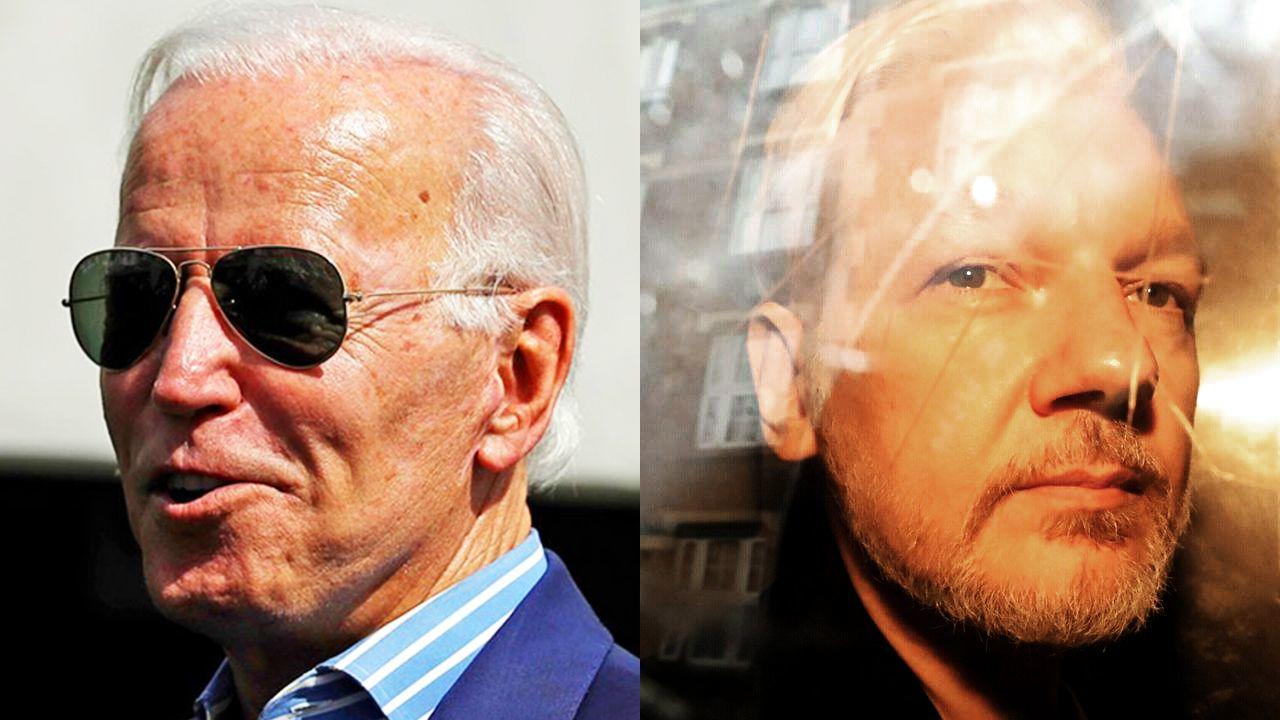
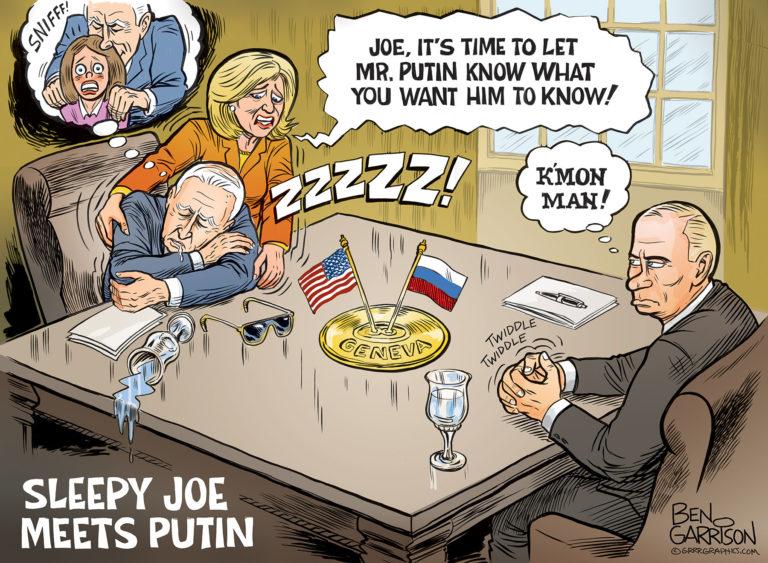
Joe Biden is set to hold a press conference on the final day of the G-7 summit. The event, which s is scheduled to begin at 9:40 a.m. ET, is already delayed until Biden gets his jetlagged bearings.

Watch live in the video player above.

Tyler Durden
Sun, 06/13/2021 – 09:56

via ZeroHedge News https://ift.tt/3pQ0ytG Tyler Durden

Invesco Launches 2 “Zero Fee” ETFs As Sponsors Compete To Offer Cheapest Funds

Invesco Launches 2 “Zero Fee” ETFs As Sponsors Compete To Offer Cheapest Funds

Prices are rising on all types of goods and services across the US. Yet even with retail market participation at all-time highs, fee competition among asset managers and ETF sponsors – which has always been particularly fierce – is heating up once again. The biggest ETF providers like BlackRock and State Street already charge fractions of a penny on the dollar for some of the most popular ETFs (which enjoy AUMs in the hundreds of billions of dollars), so how much lower can the bar go?

Well, Bloomberg reported Friday that Atlanta-based Invesco is launching two new ETFs that will have all management fees waived for the rest of the year, further aggravating the industry’s price war. The funds are focused on two of speculators’ favorite industries: biotechnology and semiconductors. Even after the end of the year, investors will only need to pay 19 basis points.

The Invesco Nasdaq Biotechnology ETF (IBBQ) and Invesco PHLX Semiconductor ETF (SOXQ) will effectively cost nothing until Dec. 17, after which each will carry an expense ratio of 19 basis points, according to a press release from the firm.

Competition across the fund industry has been heating up this year, with BlackRock and State Street both slashing fees. Still, zero-fee offerings are relatively uncommon.

BNY Mellon Investment Management released the first zero-fee bond fund last year as well as another zero-fee product tracking big American companies. But so far no other large asset managers have made comparable moves.

In total, Invesco has about $340 billion under management for its ETF business, comprising roughly 5.5% of the total US market, according to Bloomberg data.

According to the prospectus, IBBQ will provide exposure to some 270 biotechnology companies, including some that were involved in producing COVID vaccines and treatments. This week has already been a big one for the biotech industry, after Biogen secured approval for a controversial Alzheimer’s treatment, the first of its kind (thought some critics question its efficacy). Meanwhile, SOXQ will include 30 semiconductor firms.

With Robinhood set to go public this summer, investors will be paying closer attention to the ETFs that are increasingly popular among America’s growing army of retail speculators.

Tyler Durden
Sun, 06/13/2021 – 09:55

via ZeroHedge News https://ift.tt/3cyXcWP Tyler Durden

Doctor Who Wants Indefinite UK Lockdown Says “Sadly, It Can’t Be Forever”

Doctor Who Wants Indefinite UK Lockdown Says “Sadly, It Can’t Be Forever”

Authored by Paul Joseph Watson via Summit News,

A doctor who argued that the UK’s COVID-19 lockdown should remain in place indefinitely may have inadvertently revealed his true thoughts by letting slip the comment, “sadly, it can’t be forever.”

Yes, really.

The remark was made by National Health Action Party’s Doctor Richard Taylor during a fiery interview hosted by Julia Hartley-Brewer on TalkRADIO.

Hartley-Brewer challenged Taylor’s ‘zero COVID’ argument after the doctor suggested that some form of lockdown should remain in place until the virus is entirely eradicated, which is a scientific impossibility.

“I think the lockdown should continue indefinitely until we have got rid of this retched bug,” said Taylor.

“Millions of other people want to live their lives,” said Hartley-Brewer, adding, “Children want to be at school they don’t want to wear a mask on public transportation, they want to go on holiday.”

“They want to meet people they want to have parties and weddings and enjoy their lives and go to the pub, and live a normal life.”

Taylor insisted that the country must stay in lockdown until the virus is “no longer spreading and it’s not going round the rest of the world,” which again is scientifically impossible within a time span of years or decades since the virus will always exist in some form.

“Richard, that’s forever!” responded Hartley-Brewer.

“Well, sadly, it can’t be forever,” said Taylor.

He then attempted to clarify that he meant it’s sad the “bug can’t be controlled.”

Dubious. Did Taylor perform a verbal slip-up or a Freudian slip?

As we highlighted yesterday, UK government adviser and former Communist Party member Susan Michie said that mask mandates and social distancing should continue “forever” and that people should adopt such behaviour just as they did with wearing seatbelts.

*  *  *

Brand new merch now available! Get it at https://www.pjwshop.com/

*  *  *

In the age of mass Silicon Valley censorship It is crucial that we stay in touch. I need you to sign up for my free newsletter here. Support my sponsor – Turbo Force – a supercharged boost of clean energy without the comedown. Also, I urgently need your financial support here.

Tyler Durden
Sun, 06/13/2021 – 09:20

via ZeroHedge News https://ift.tt/3xndUR1 Tyler Durden

​​​​​​​Lumber Prices Record Biggest Weekly Drop Ever As Supply Increases 

​​​​​​​Lumber Prices Record Biggest Weekly Drop Ever As Supply Increases 

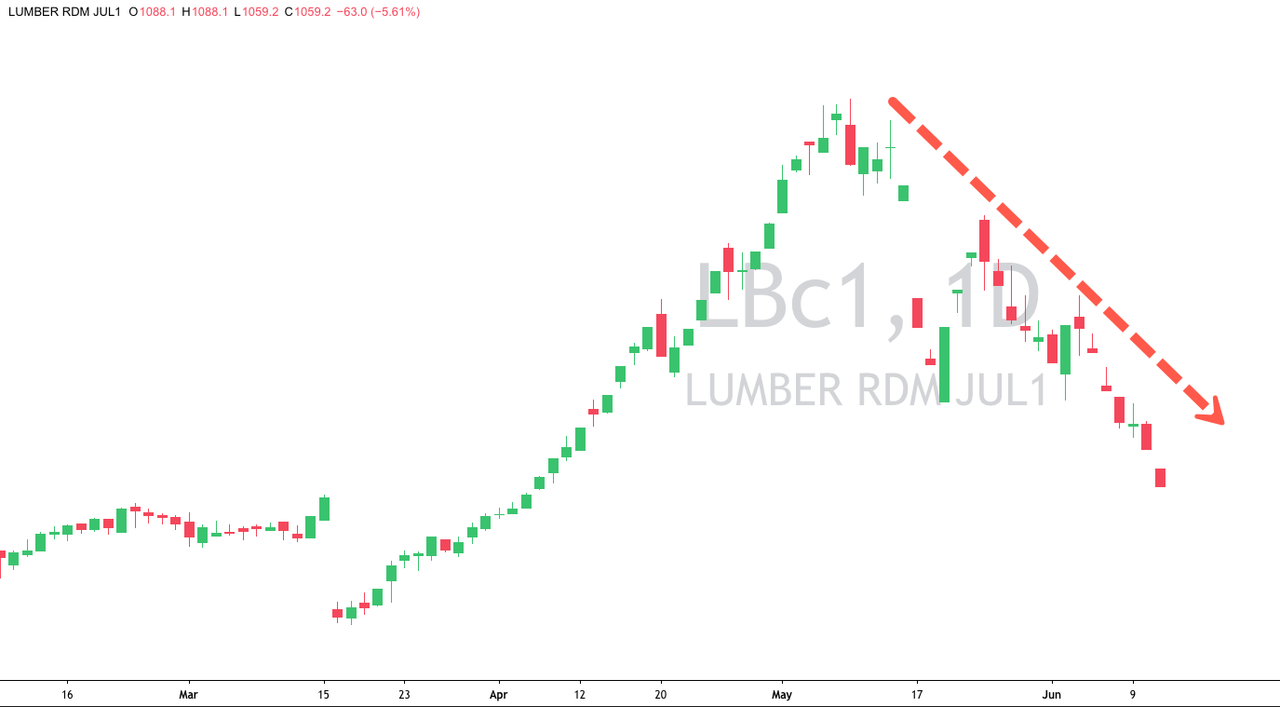
Lumber futures on Chicago Mercantile Exchange posted their largest-ever weekly loss, extending a multi-week decline as sawmill output increases and buyers hold off on purchases, according to Bloomberg

On Friday, lumber futures fell 5.61% to $1,059.20 per thousand board feet. For the week, prices plunged 18%, the most significant decline since 1986, one year before the 1987 stock market crash. 

Lumber prices have crashed 40% from the record high in May of around $1,711.

Lumber prices have catapulted into the stratosphere in the last year, hitting renovators, home builders, buyers, and anyone else extremely hard. The National Association of Home Builders (NAHB) has noted lumber prices have added at least $36,000 to the costs of a new single-family home. 

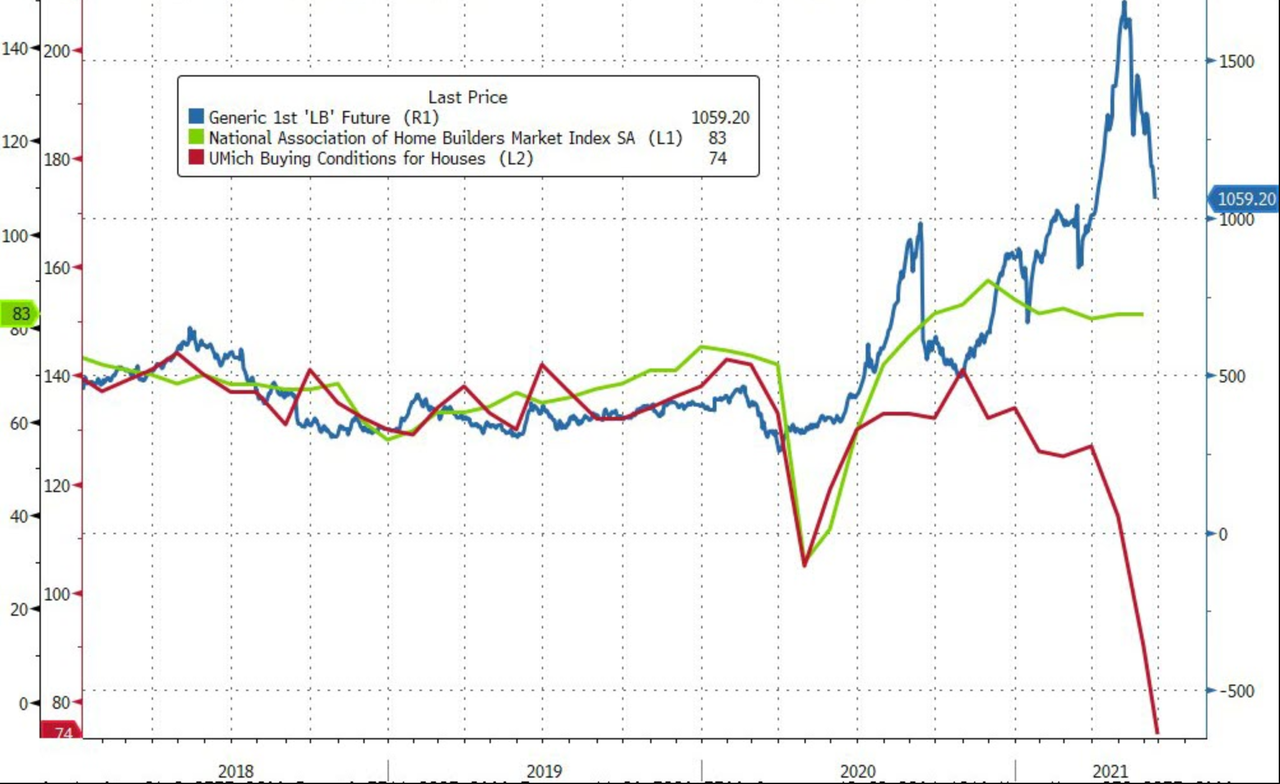
For the last several months, we have warned about the pernicious effects of soaring prices on consumers. For instance, the University of Michigan economic sentiment survey shows the number of people who say it’s a good time to purchase a house has collapsed as the price of lumber, copper, concrete, roofs, labor, land, and almost everything scream higher. Shown below is the survey matched up against NAHB’s survey (a homebuilder survey that rates market conditions for the sale of new homes) and lumber prices. It’s easy to spot as lumber prices soared, the homebuyer sentiment survey crashed. 

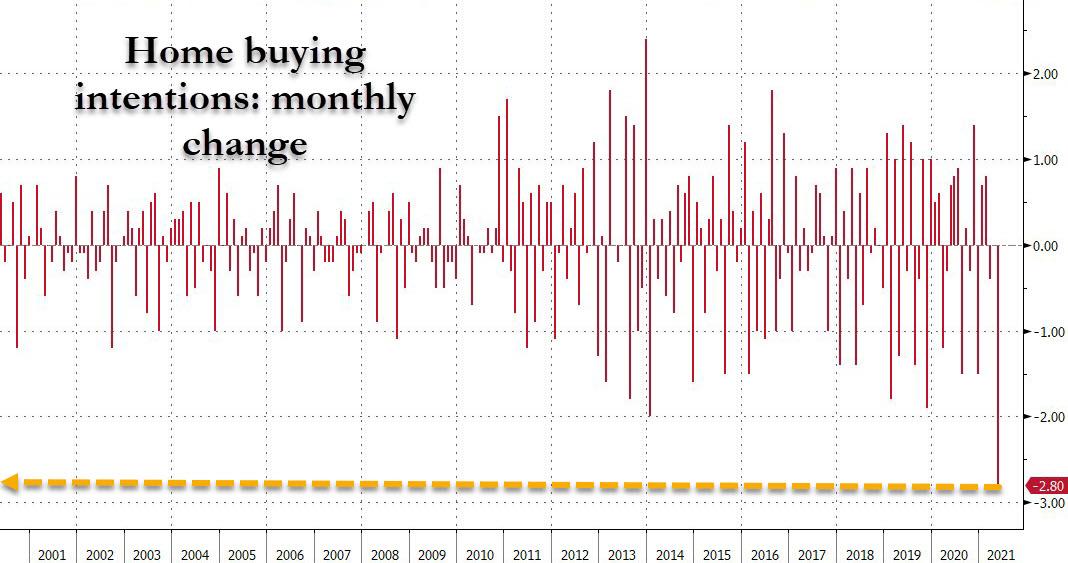
In another way, home buying intentions on a monthly change have plunged to the lowest levels in two decades. 

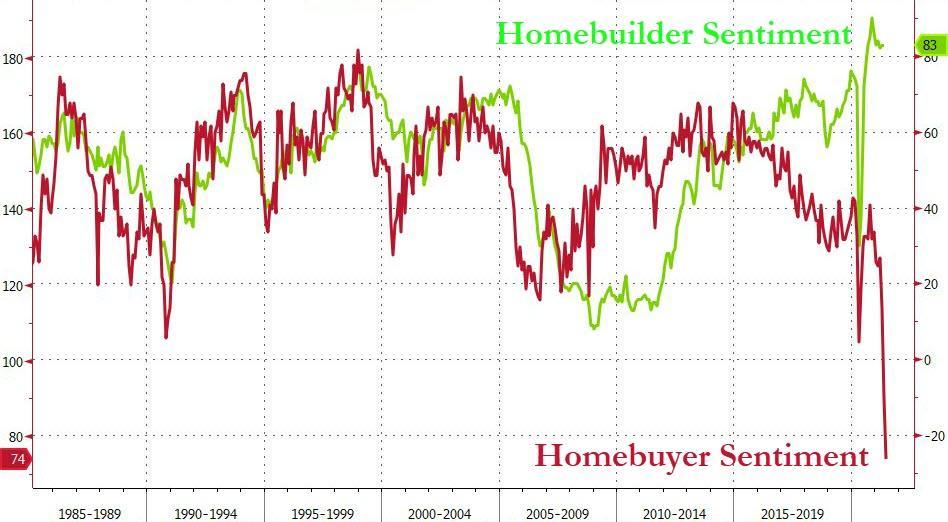
This confirms what we noted earlier, namely a record divergence between crashing homebuyer confidence (due to record home prices) and soaring homebuilder confidence (also due to record home prices). Guess which one will matter in the end.

As buyers balk at unprecedented lumber prices, sawmills appear to be catching up with the demand that has been fueled by massive home-building demand in North America (thanks Powell) and so-called “supply shortages” at lumberyards. 

“Activity yesterday was brisk to start, turned lethargic and ended quite subdued,” William Giguere, who buys and sells eastern spruce with mills for Sherwood Lumber in Massachusetts, wrote in a note Friday.

“There was plenty of lumber available from the mills and enough ambition to sell. Missing was the sense of urgency from buyers.”

U.S. lumber production has increased 5% over the past 12 months to meet the new demand, according to Domain Timber Advisors LLC, a subsidiary of Domain Capital Group, in Atlanta, Georgia, which adds another increase of 5% is coming soon, or roughly 1 billion board feet. 

Even as lumber prices pull back from stratospheric highs, BMO Capital Markets warns that prices may not return to pre-pandemic levels any time soon. 

“‘Nosebleed’ prices won’t last, but strong demand, a limited supply response and a rising cost curve all point to above-trend prices for at least the next 12-24 months,” BMO analyst Mark Wilde wrote in a recent note. 

Devin Stockfish, the CEO of Weyerhaeuser, one of the top lumber producers in the U.S., said lumber prices over $1,000 aren’t expected to continue. He spoke at a recent Nareit conference but added home-building and renovation boom could keep lumber prices somewhat elevated. 

“I don’t think $1,000 lumber prices are the new normal,” Stockfish told the conference.

“With that being said, when you think about the amount of housing we’re going to have to build in the U.S. over the next three, five, 10 years, that’s a significant amount of demand for wood products.”

Meanwhile, Capital Economics commodities analyst Samuel Burman told clients a couple of months ago that lumber prices may tumble to $600 even as demand for the commodity remains robust due to increasing supply. Even at $600, it’s nearly double the prices from 2016. 

“Even though we expect lumber demand to hold up well for some time, we still think that a rebound in supply will lead to a sharp fall in the price of U.S. lumber over the next eighteen months,” Burman wrote.

So clearly, explosive inflation in lumber prices likely topped out prices around $1,700 as supply now floods the market even as demand remains robust. 

In terms of output, the lumber industry is controlled by just a handful of firms, including Weyerhaeuser Co., Georgia-Pacific LLC, West Fraser Timber Co., Ltd., among others, which makes it easier for capacity to be controlled. It makes you wonder if the lumber shortage was artificially induced

Tyler Durden
Sun, 06/13/2021 – 08:45

via ZeroHedge News https://ift.tt/3zqv0Ps Tyler Durden

With Biden In UK, 24 Members Of Parliament Demand He Let Assange Go

With Biden In UK, 24 Members Of Parliament Demand He Let Assange Go

Authored by Joe Lauria via Consortium News,

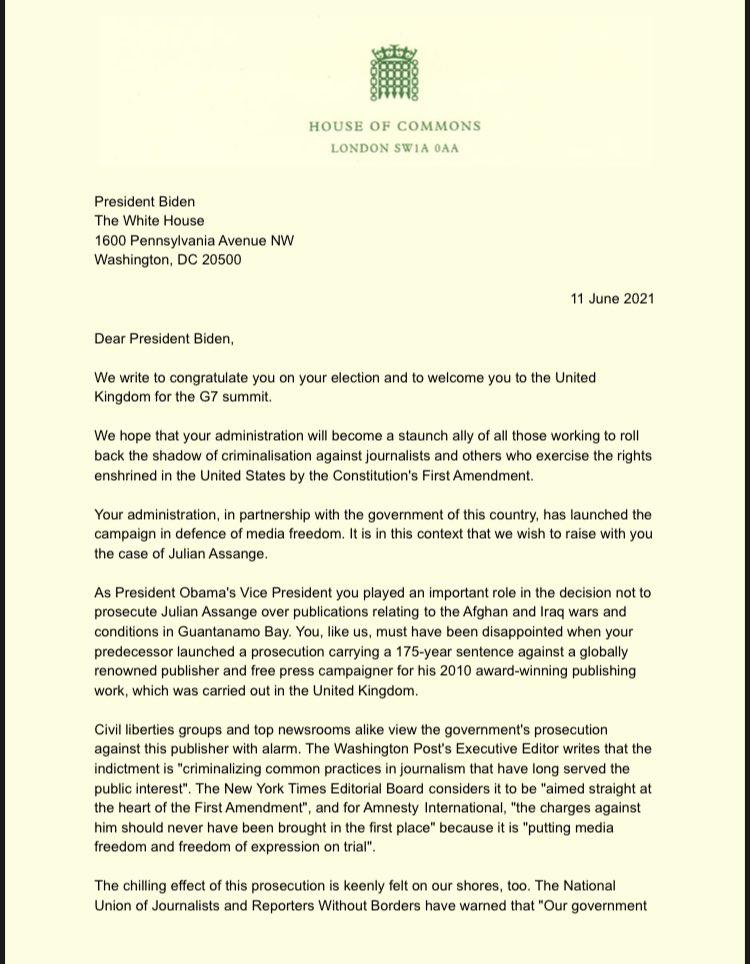
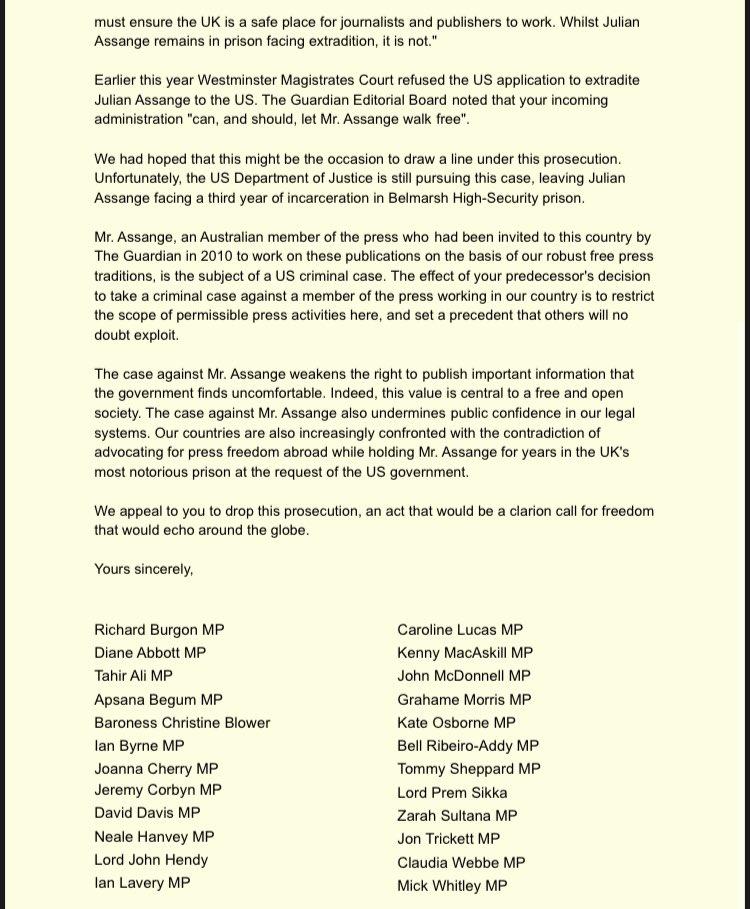
Twenty-four members of UK Parliament have called on President Joe Biden to drop the US pursuit of imprisoned WikiLeaks publisher Julian Assange. A letter from the MPs was sent to Biden on Friday as the president attends the G-7 summit in Cornwall.

It takes aim at Biden’s predecessor for indicting Assange and calls on the president “to drop this prosecution.”

“We hope that your administration will become a staunch ally of all those working to roll back the shadow of criminalization against journalists,” the letter says, citing the US First Amendment.

The letter points out that as vice president in 2011 Biden opposed Assange’s prosecution.

“You, like us, must have been disappointed when your predecessor launched a prosecution carrying a 175-year sentence against a globally renowned publisher,” the MPs wrote.

They told Biden Assange’s case “weakens the right to publish.”

“Our countries are … increasingly confronted with the contradiction of advocating for press freedom abroad while holding Mr. Assange for years in the UK’s most notorious prison at the request of the US government,” the letter says. “We appeal to you to drop this prosecution, an act that would be a clarion call for freedom that would echo around the globe.”

* * *

The text of the letter: 

Tyler Durden
Sun, 06/13/2021 – 08:10

via ZeroHedge News https://ift.tt/3ggGSfs Tyler Durden

RCEP Explained: The World’s Biggest Trading Bloc Will Soon Be In Asia-Pacific

RCEP Explained: The World’s Biggest Trading Bloc Will Soon Be In Asia-Pacific

Trade and commerce are the lifeblood of the global economy. Naturally, agreements among nations in a certain geographical area help facilitate relationships in ways that are ideally beneficial for everyone involved.

In late 2020, the Regional Comprehensive Economic Partnership (RCEP) was signed, officially creating the biggest trade bloc in history. Here, Visual Capitalist’s Iman Ghosh breaks down everything you need to know about it, from who’s involved to its implications.

Who’s in the RCEP, and Why Was it Created?

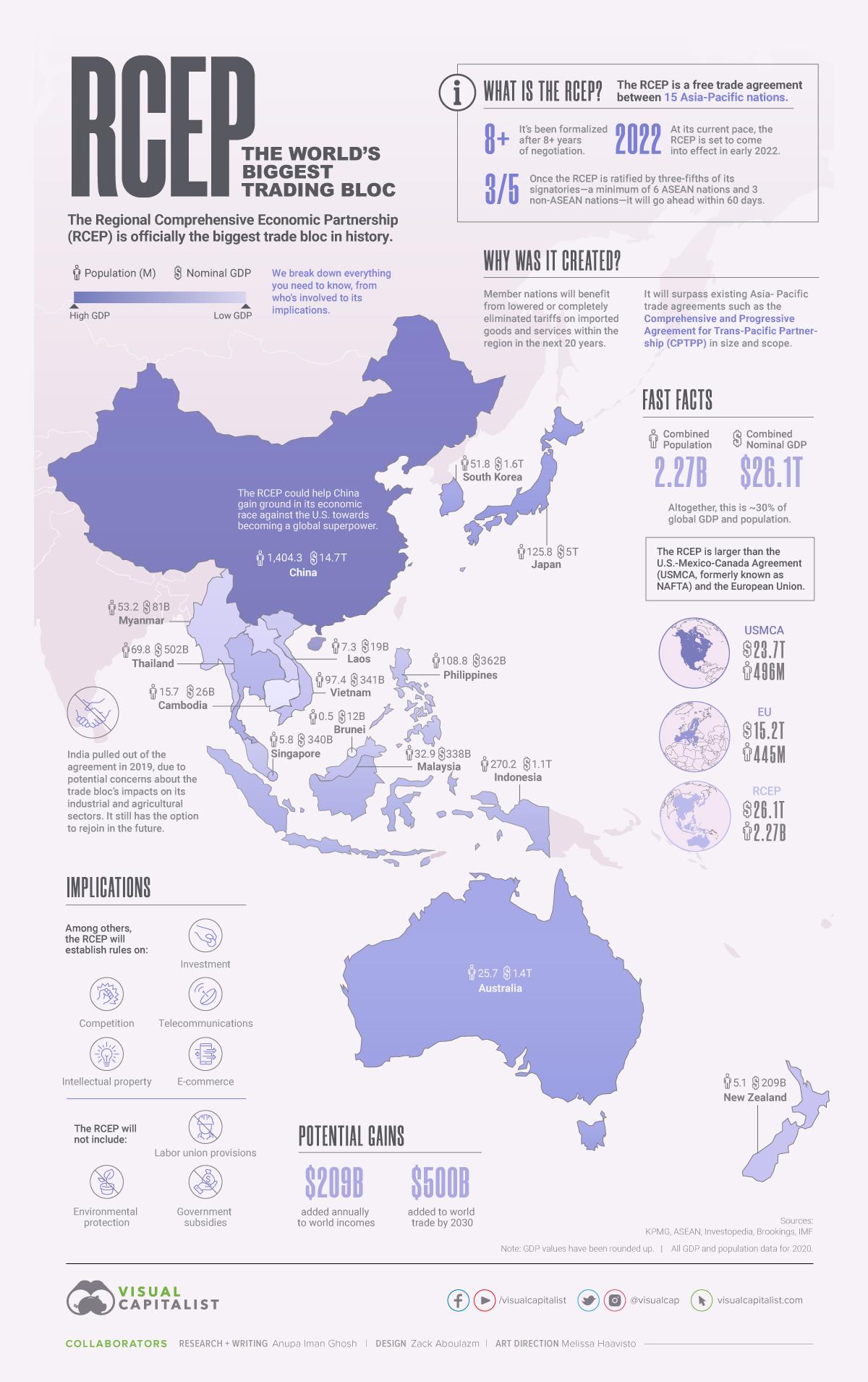
The RCEP is a free trade agreement between 15 nations in the Asia-Pacific region, and has been formalized after 28 rounds of discussion over eight years.

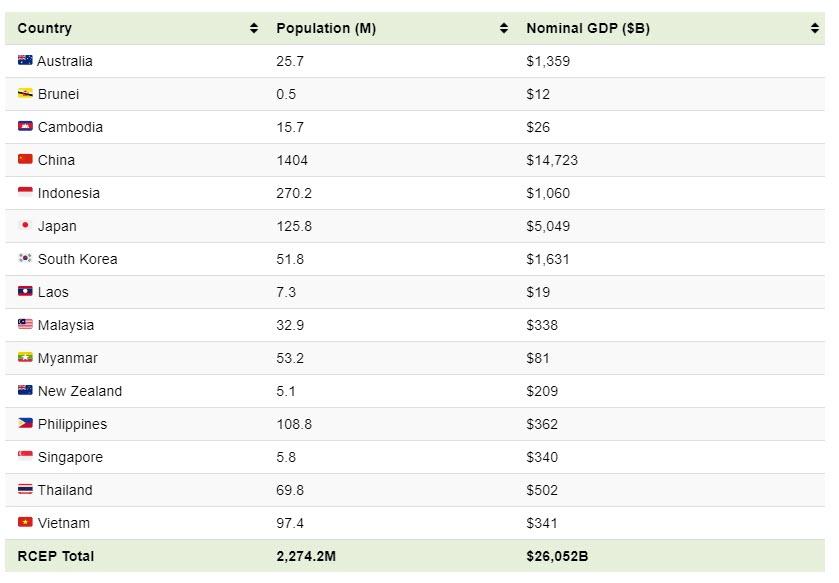
Member nations who are a part of the RCEP will benefit from lowered or completely eliminated tariffs on imported goods and services within the region in the next 20 years. Here are the countries which have signed on to be member nations:

But there is still some work to do to bring the trade agreement into full effect.

Signing the agreement, the step taken in late 2020, is simply an initial show of support for the trade agreement, but now it needs to be ratified. That means these nations still have to give their consent to be legally bound to the terms within the RCEP. Once the RCEP is ratified by three-fifths of its signatories—a minimum of six ASEAN nations and three non-ASEAN nations—it will go ahead within 60 days.

So far, it’s been ratified by China, Japan, Thailand, and Singapore as of April 30, 2021. At its current pace, the RCEP is set to come into effect in early 2022 as all member nations have agreed to complete the ratification process within the year.

Interestingly, in the midst of negotiations in 2019, India pulled out of the agreement. This came after potential concerns about the trade bloc’s impacts on its industrial and agricultural sectors that affect the “lives and livelihoods of all Indians”. India retains the option to rejoin the RCEP in the future, if things change.

The Biggest Trading Blocs, Compared

When we say the Regional Comprehensive Economic Partnership is the biggest trade bloc in history, this statement is not hyperbole.

The RCEP will not only surpass existing Asia-Pacific trade agreements such as the Comprehensive and Progressive Agreement for Trans-Pacific Partnership (CPTPP) in size and scope, but also other key regional partnerships in advanced economies.

This includes the European Union and the U.S.-Mexico-Canada Agreement (USMCA, formerly known as NAFTA). How does the trio stack up?

With the combined might of its 15 signatories, the RCEP accounts for approximately 30% of global GDP and population. Interestingly, the total population covered within the RCEP is near or over five times that of the other trade blocs.

Another regional agreement not covered here is the African Continental Free Trade Area (AfCFTA), which is now the largest in terms of participating countries (55 in total), but in the other metrics, the RCEP still emerges superior.

Implications of the Regional Comprehensive Economic Partnership

The potential effects of the RCEP are widespread. Among others, the agreement will establish rules for the region around:

  • Investment

  • Competition

  • E-commerce

  • Intellectual property

  • Telecommunications

However, there are some key exclusions that have raised critics’ eyebrows. These are:

  • Labor union provisions

  • Environmental protection

  • Government subsidies

The RCEP could also help China gain even more ground in its economic race against the U.S. towards becoming a global superpower.

Last, but most importantly, Brookings estimates that the potential gains from the RCEP are in the high billions: $209 billion could be added annually to world incomes, and $500 billion may be added to world trade by 2030.

Tyler Durden
Sun, 06/13/2021 – 07:35

via ZeroHedge News https://ift.tt/3zym2jw Tyler Durden

Biden-Putin Summit: Boon Or Bust?

Biden-Putin Summit: Boon Or Bust?

Authored by Ray McGovern via AntiWar.com,

Reading the tea leaves a week before Presidents Joe Biden and Vladimir Putin meet in Geneva puts a premium on the kind of media analysis we old-school Kremlinologists had to rely on back in the day. Not all rhetoric is equal though; it is just as important to make an honest attempt to reconstruct the circumstances surrounding a major initiative like the summit proposal. The weird timing of the invitation cries out for explanation.

You Asked For It, Joe

Lest we forget, President Biden suggested a summit with Putin in the midst of very high tension over Ukraine. On March 24 Ukrainian President Volodymyr Zelensky issued an official decree that Ukraine would take Crimea back from Russia; Kiev’s strategy includes “military measures” to achieve “de-occupation.” U.S. and NATO voice “unwavering” (rhetorical) support for Zelensky, who sends tons of military equipment south and east. Russia sends troops and arms south and west into Crimea and the border area opposite Luhansk and Donetsk in the eastern Ukraine.

One Day in April

The following refresher on what all went down on April 13 may throw some light on why – in such tense circumstances – Biden proposed a summit with Putin.

  • NATO’s Secretary General Jens Stoltenberg slams Russia for sending “thousands of combat-ready troops to Ukraine’s borders.”

  • Russian Defense Minister Sergey Shoigu says, in effect, Yes, Stoltenberg has that right; Moscow has sent “two armies and three airborne formations to western regions” over the prior three weeks.

  • Deputy Foreign Minister Sergey Ryabkov criticizes NATO and the US for “deliberately turning Ukraine into a powder keg.” Strongly advises cancellation of plans for imminent passage of two US guided-missile destroyers into Black Sea. (The plans were canceled.)

  • President Biden calls President Putin, later calls the conversation “candid and respectful.” Putin spokesman describes it as “businesslike and rather long.” Biden proposes “a summit meeting in a third country in the coming months to discuss the full range of issues facing the United States and Russia,” according to the White House.

“Stable and Predictable”

In broaching a summit meeting to Putin, Biden “reaffirmed his goal of building a stable and predictable relationship with Russia consistent with US interests,” according to the White House. The White House readout gave pride of place to their discussion of “a number of regional and global issues, including the intent of the United States and Russia to pursue a strategic stability dialogue on a range of arms control and emerging security issues, building on the extension of the New START Treaty.”

It is a safe bet that Biden and his advisers learned a valuable lesson in barely avoiding being mousetrapped into facing open hostilities (or an embarrassing backdown) in Ukraine – an area in which Russia has an “asymmetric” (as Putin later described it) preponderance of power. Thus, beneath all the gratuitous insults and asymmetrically harsh Western media rhetoric, Biden and co. might see a priority interest in heading off such misadventures in the future.

If Not Yet Trust, Then Mutual Interest

Biden and Putin might see at least a modicum of common interest in developing a useful dialogue on regional issues (like Ukraine), as well as a more obvious strategic interest in avoiding mutual annihilation. On Monday, national security adviser Jake Sullivan defended Biden’s summit initiative, stressing the need for “strategic stability and progress on arms control.” Sullivan described Putin as “a singular kind of personalized leader, so a chance “to come together at a summit will allow us to manage this relationship … most effectively.”

For his part, President Putin commenting in St. Petersburg on Friday on what issues will enjoy pride of place at the summit, also spoke of “strategic stability [and] settling international conflicts in the hottest spots,” disarmament and terrorism. Acknowledging the political pressures any US president faces in trying to carve out a more sensible relationship with Russia, Putin conceded that “to a certain extent, Russian-American relations have become hostage to internal political processes in the United States itself.” He added:

“I hope it ends someday. I mean the fundamental interests in the field of at least security, strategic stability and the reduction of weapons dangerous for the whole world are still more important than the current domestic political situation in the United States itself.”

Taking a more conventional tack regarding current US policy, Putin lamented:

US leaders “want to hold back our development and they talk about this openly. Everything else is a derivative [including] an attempt to influence the internal political processes in our country, relying on the forces that they consider to be their own in Russia.”

In a separate interview on Russia’s Channel 1, Putin described Biden as “an experienced, balanced, and accurate” politician, and expressed the hope that those qualities would have a positive effect on the upcoming negotiations. Putin said, “I am not expecting anything that could become a breakthrough in U.S.-Russia relations,” but added that the Geneva talks may well create the right conditions for taking further steps toward normalizing Russia-U.S. ties, which would in itself be “a positive result.”

A Senior Among Sophomores

If Biden can shake himself free from his more extreme Russophobe advisers and the arms merchants who thrive on tension with Moscow, he has a mentor at hand to help him navigate the shoals. CIA chief William Burns has as much experience in foreign affairs as the rest of Biden’s wet-behind-the-ears rising sophomores (Sullivan, Secretary of State Antony Blinken, et al.) put together. Indeed, Burns happened to be Ambassador to Russia when plans were afoot to make Ukraine and Georgia members of NATO.

On February 1, 2008, Russian Foreign Minister Sergey Lavrov, explained to Burns precisely what the US should expect from Russia were NATO to move to incorporate Ukraine. (To his credit, Burns played it straight, titling his cable “NYET MEANS NYET: RUSSIA’S NATO ENLARGEMENT REDLINES,” and sending it to then-Secretary of State Condoleezza Rice with IMMEDIATE precedence.

Burns reported that “Lavrov and other senior officials have reiterated strong opposition, stressing that Russia would view further eastward expansion as a potential military threat. NATO enlargement, particularly to Ukraine, remains ‘an emotional and neuralgic’ issue for Russia, but strategic policy considerations also underlie strong opposition to NATO membership for Ukraine and Georgia. In Ukraine, these include fears that the issue could potentially split the country in two, leading to violence or even, some claim, civil war, which would force Russia to decide whether to intervene.”

I believe I can detect the fine, experienced hand of now CIA Director Burns in the “2021 Annual Threat Assessment of the US Intelligence Community” published in early April. I found it remarkedly balanced and candid on how Russia sees threats to its security:

We ‪assess that Russia does not want a direct conflict with US forces. Russian officials have long believed that the United States is conducting its own ‘influence campaigns’ to undermine Russia, weaken President Vladimir Putin, and install Western-friendly regimes in the states of the former Soviet Union and elsewhere. Russia seeks an accommodation with the United States on mutual noninterference in both countries’ domestic affairs and US recognition of Russia’s claimed sphere of influence over much of the former Soviet Union.‬

Such candor has not been seen since the DIA (the Defense Intelligence Agency) wrote, in its “December 2015 National Security Strategy” over the signature of DIA Director Lieutenant General Vincent Stewart:

The Kremlin is convinced the United States is laying the groundwork for regime change in Russia, a conviction further reinforced by the events in Ukraine. Moscow views the United States as the critical driver behind the crisis in Ukraine and believes that the overthrow of former Ukrainian President Yanukovych is the latest move in a long-established pattern of U.S.-orchestrated regime change efforts.

What If Things Go Bump in the Night?

The analysis above is heavily dependent on fragile tea leaves. Other straws in the wind point to a disaster at the June 16 summit in Geneva.

Let’s say that the NATO summit, in which Biden will take part on June 14, issues a Declaration (as it did in April 2008, two months after Lavrov’s loud Nyet) that Ukraine and Georgia “will become members of NATO.”

Or let’s say Biden keeps ringing changes on the theme of “democratic values” to contrast the West with Russia and China, and feels compelled to talk to Putin “from a position of strength” (as Biden did in his Washington Post op-ed Sunday); or he harps on “Russian aggression” in Ukraine, without any acknowledgment of his own complicity (or at least guilty knowledge of) the Victoria Nuland-orchestrated coup in Kiev in Feb. 2014.

Or let’s say the US Department of Justice indicts a bunch of Russians for hacking (as happened three days before former President Donald Trump met with Putin in July 2018).

There are a number of things that could go bump in the night, so to speak, and either cancel the summit or turn it into an acerbic exchange like the March 18 meeting in Anchorage between Anthony Blinken/Jake Sullivan and their Chinese counterparts – Yes, you remember, the ones who warned their interlocutors not to not speak to China in a “condescending way” or from a claimed “position of strength.”

Should that kind of debate ensue in Geneva, the US team will have to have their loins girded on the chance the following questions are asked:

  • Do you now regret greasing the Senate skids for the attack on Iraq?

  • Did you have a chance to watch the Dr. Strangelove dvd that Oliver Stone gave Mr. Putin? Do you have any Air Force generals like that still on active duty. What about the commander of STRATCOM who talks nonchalantly about using nuclear weapons?

  • What do you think about the sworn testimony of the head of the cyber-firm CrowdStrike that no one – not Russia, not anyone – hacked those DNC emails that WikiLeaks published? Why has the NY Times turned that into a state secret?

  • Does your Democratic colleague, Rep. Jason Crow, really believe that “Vladimir Putin wakes up every morning and goes to bed every night trying to figure out how to destroy American democracy.” And what does Speaker Nancy Pelosi mean exactly, as she keeps repeating “All roads lead to Putin”? Are we correctly informed that Hillary Clinton suggested President Putin was giving President Trump instructions on Jan. 6 as your Capitol building was attacked?

Finally, here is Putin in his own words. He has long had an allergy to “exceptionalism.” After he pulled President Barack Obama’s chestnuts out of the fire by persuading the Syrians to give up their chemical weapons in early September 2013, Putin had high hopes, and set them down at the end of a New York Times op-ed on Sept. 11, 2013:

If we can avoid force against Syria, this will improve the atmosphere … and strengthen mutual trust. It will be our shared success and open the door to cooperation on other critical issues.

My working and personal relationship with President Obama is marked by growing trust. I appreciate this. I carefully studied his address to the nation on Tuesday. And I would rather disagree with a case he made on American exceptionalism, stating that the United States’ policy is “what makes America different. It’s what makes us exceptional.”

It is extremely dangerous to encourage people to see themselves as exceptional, whatever the motivation. There are big countries and small countries, rich and poor, those with long democratic traditions and those still finding their way to democracy. Their policies differ, too. We are all different, but when we ask for the Lord’s blessings, we must not forget that God created us equal.

I was told at the time that Putin dictated those paragraphs himself. That report garnered additional credence in early 2020, when President Putin said the same thing during an interview with Andrey Vandenko:

VANDENKO: But things did not go well [in your relationship] with Obama … Did somebody put you at odds with him?

PUTIN: No, it has nothing to do with ‘being at odds’. It’s just that when a person says that the US is an exceptional nation, with special, exclusive rights to practically the entire world, I cannot go along with that. God created us all equal and gave us equal rights.

It seems it would be good to be aware of this and to take it into account.

Tyler Durden
Sun, 06/13/2021 – 07:00

via ZeroHedge News https://ift.tt/35fTT2F Tyler Durden

The $2 Drug Test Keeping Inmates in Solitary


featuredrug1

Billy Steffey is determined not to eat the shot.

Steffey is a former federal inmate, and a “shot” is federal prison slang for a disciplinary infraction—as in, “They gave him a shot.” When you can’t dodge it, a shot is, like a punch in the mouth, something you have to eat.

According to the federal Bureau of Prisons (BOP), Steffey conspired to smuggle drugs into prison in the form of a sheaf of legal papers laced with an illicit substance. The evidence against Steffey is a string of suspicious emails and two field tests, which you can buy off the internet for about $2 apiece, that came back “presumptive positive” for amphetamines.

Steffey is no longer incarcerated, but he is still trying to fight the BOP for stripping him of good behavior credits and throwing him in solitary confinement for five months based on what he says is an unverified test with a well-established track record of leading to wrongful arrests.

“It appears that the Bureau of Prisons regularly deprives prisoners of good conduct time credit, thereby lengthening their time in prison, based on a testing protocol known for its high rate of error, without even minimal procedures to ensure that the tests are conducted correctly and that questionable test results are subject to confirmation,” Steffey’s appeal to the 9th Circuit, filed last August, argued.

Incredulous readers may roll their eyes—prisons are full of both drugs and liars—but hundreds of botched cases across the country have raised serious concerns about law enforcement’s reliance on these types of test kits. Forensic experts say the tests can’t be relied on alone; they’re not admissible evidence in court; and the manufacturers explicitly warn that all tests should be sent to crime labs to be verified. New York’s prison system suspended the use of similar tests last summer because of such worries. Yet the federal Bureau of Prisons relies solely on such tests to put inmates in solitary confinement, take away good behavior credits that count toward early release, and strip them of visitation rights. Meanwhile, low evidence standards make it just about impossible for federal inmates to challenge the results of these tests in court. Steffey and other formerly incarcerated people say inmates are being jammed up on bad evidence with virtually no avenue for recourse. The BOP did not respond to a request for comment for this story.

The issues with these tests have been known for decades and are easily verifiable. Reason bought two packs of field drug tests and got positive results for several common, legal substances. But Steffey says the current system gives correctional officers an easy way to gin up shots against inmates.

“They don’t want to hear that, because it’s one of their tools that they have in their toolbox to get rid of people without question,” he says. “They give them a shot, they send it to [regional headquarters] and say, ‘Hey, we got to transfer this guy to a higher-security prison.'”

How the Tests Work, and Don’t

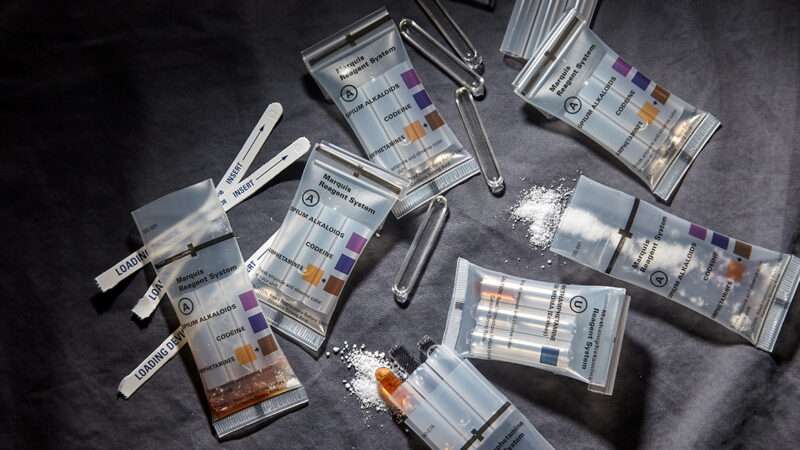
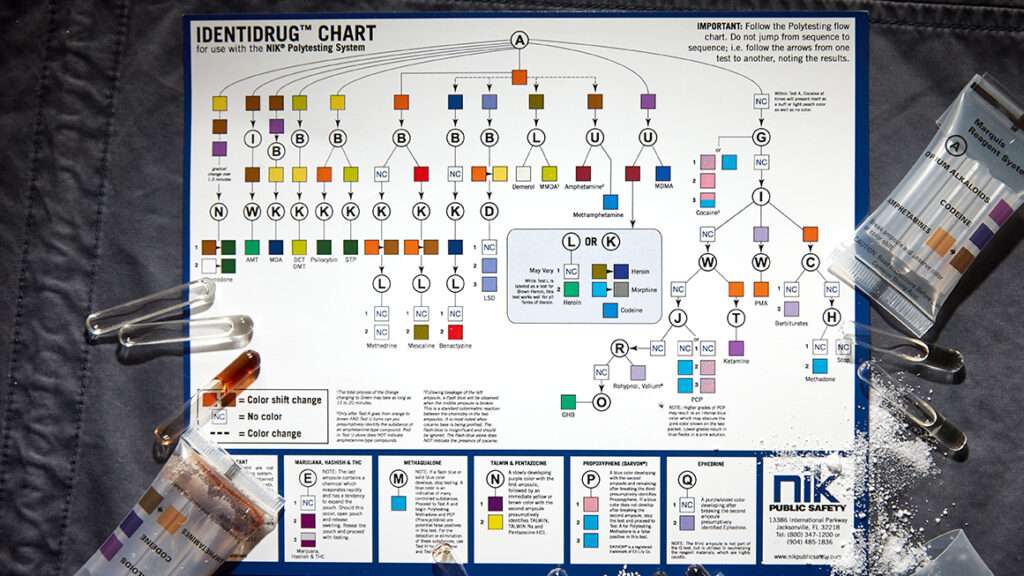
These test kits—plastic baggies with small glass vials inside—use basic chemical reactions to produce colors indicating the presence of various compounds. The user puts a small amount of the suspect substance into the baggie, cracks the vials, gently shakes, and watches to see what color results.

The Bureau of Prisons uses drug field tests manufactured by Safariland. Several companies make similar kits, but they all rely on the same underlying chemical reactions.

Heather Harris is an assistant professor of forensic science at Arcadia University who trains future chemists to use these color tests. “Atoms can combine together in groups—we call them functional groups—and these color tests are simply looking for the presence of a particular group,” Harris says. “When they find that group, they then proceed to go through a reaction that has a color as its product.”

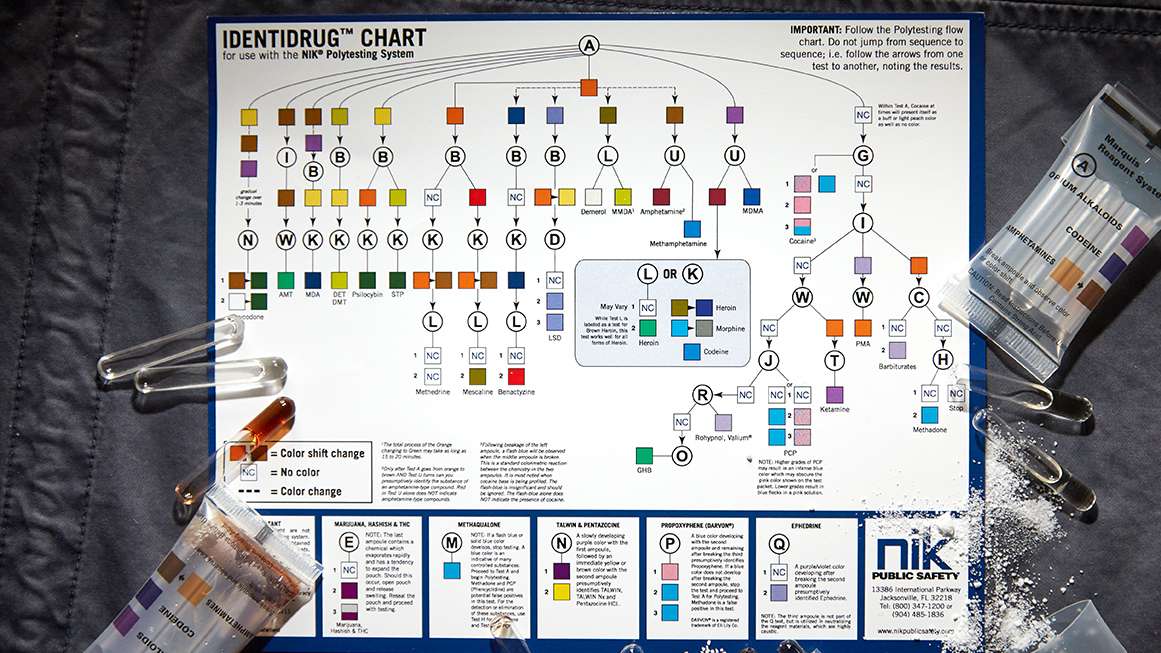
A police officer or prison guard who comes across a suspicious substance could use Safariland’s NIK Test A, a general screening test that can turn a variety of colors, to see what the substance might be. If the clear liquid turns orange, then brown, the substance might be methamphetamines or amphetamines. The officer then moves on to NIK Test U, which either turns blue to indicate a presumptive positive result for methamphetamines, or burgundy. A burgundy result on Test U, in conjunction with the orange-brown result in Test A, is considered presumptive positive for amphetamines.

These tests alone aren’t admissible evidence in almost any court in the U.S., but they are considered probable cause for a police officer to arrest someone. And in prison, a “positive” field test can be enough to get inmates thrown in solitary confinement and stripped of other privileges.

The advantages of such tests for law enforcement are that they’re cheap, they’re portable, and they don’t require a chemistry degree to use. The disadvantage is that, as simple as the tests are, they’re far from immune to user error. The vials can be broken in the wrong order, for example. Colors are subjective. And the compounds that the tests screen for aren’t exclusive to the illegal drugs the tests are supposed to indicate.

“A methamphetamine test might be targeting a functional group that is present on methamphetamine,” Harris says. “That functional group, however, is not specific to methamphetamine. It’s common in the world, so there’s a variety of substances—some of which we know, but some of which we don’t know—that are going to possess this group and allow this color test to produce a color.”

Harris says the over-the-counter cold medicine Benadryl can produce positive results in field tests for several types of illicit drugs. And the list of known substances that can trigger a positive result in these tests is ever-expanding. Last year in Georgia, a college football quarterback was arrested after bird poop on his car tested presumptive positive for cocaine.

Reason bought packs of both NIK Test A and NIK Test U to experiment with. They can be easily purchased online, and they’re simple to use. Yet the results are up for interpretation.

A small piece of rosemary turned NIK Test A a light yellow-brown color, which could pass as a presumptive positive result if one really wanted it to. Coffee grounds also turned the solution in NIK Test A a dark brown, although it was unclear whether that was the result of a chemical reaction or just the color of the grounds themselves. Various types of paper seemed to have little effect on NIK Test A, though the solution turned the paper brown.

In addition, NIK Test U, the follow-up test for methamphetamines and amphetamines, turns burgundy when the ampule is cracked and shaken, regardless of whether anything is placed in the pouch. Steffey has put out a YouTube video demonstrating that a plain piece of paper will yield a burgundy result. This means that a presumptive positive for amphetamines in NIK Test A would be confirmed by NIK Test U by default.

This is not an error. Safariland’s instructions note that “only after Test A goes from orange to brown AND Test U turns can you presumptively identify the substance of an amphetamine-type compound. Red in Test U alone does NOT indicate amphetamine-type compounds.” The company did not return requests for comment for this story.

Steffey’s Story

In 2017, Steffey was serving a nine-year sentence at Federal Correctional Institution (FCI) Lompoc, a low-security federal prison in California, for his role in an online identity theft ring. He says it took him about four years to work his way down to that security level, and he was three months away from a possible transfer to a minimum-security federal prison camp. Although they’re not “Club Fed,” as tabloid headlines like to joke, the camps are as good as it gets in the BOP system.

“It would have been a night-and-day difference,” even coming from a low-security prison, Steffey says. “You get furloughs to go home and see your family. There’s a lot more freedom.”

Steffey says he got on the bad side of a couple of correctional officers, who began regularly searching his cell and generally making his life difficult.

In December of that year, a BOP mailroom staffer opened a package “of what appeared to be unfilled legal work” addressed to another inmate. The staffer noted that the papers felt “unusually thick” and gritty and looked discolored.

Contraband is a major problem for federal and state prison systems—especially synthetic marijuana, commonly called K2 or “spice,” and suboxone, a synthetic opioid. Inmates have figured out novel ways of smuggling the drugs in, such as lacing paper with liquid K2. The paper is then cut up into small pieces and smoked.

They smoke it “and then they flip out,” Steffey says. “They have seizures; get super high. They just do dumb shit. It’s a big epidemic in prison.”

To combat the flood of drugs, many state prisons have taken steps like banning physical mail and used book donations, which they claim are a major source of contraband. The BOP uses Safariland’s NIK field kits to check for suspected drugs.

A BOP investigator tested the legal papers addressed to the inmate with NIK Test A, the general screening test, and noted that it “had an immediate orange rapidly turning brown color, indicating Amphetamines,” according to court records. The investigator then tested another piece of the paper with NIK Test U, which “turned an immediate dark burgundy color, indicating Amphetamines.”

The investigator linked the package to Steffey after finding an email sent to him that included the tracking number of the package. BOP investigators also discovered a chain of email messages that appeared to be thinly veiled code about money transactions and deliveries.

Steffey says he was in fact having federal court records sent to another inmate, sandwiched between some blank divorce forms downloaded off a court website. The BOP submitted pictures of the papers as exhibits in Steffey’s lawsuit, but they are too low-resolution to read.

In prison, inmates often demand to see each other’s paperwork to verify what they’re in for and whether they’ve snitched. Prison has a strictly enforced social order, and sex criminals, especially those whose crimes involve children, are at the very bottom of it—shunned at best. So inmates sometimes run background checks on each other to make sure no one is lying. Getting another inmate’s paperwork in the mail isn’t allowed, but legal mail from an attorney is supposed to be privileged. Steffey says a contact of his was using a real lawyer’s name to send someone else’s court records to another inmate. He insists it had nothing to do with drugs.

“From Day One, I denied it,” Steffey says. “I was like, you guys are crazy. Let’s see the test. I’ll pay my own money to have it sent to a lab.”

Instead, a BOP disciplinary hearing officer found Steffey guilty of introducing contraband narcotics into the prison. The officer threw him in the Special Housing Unit (SHU)—a sanitized term for solitary confinement—for five months, where he was held in a cell for at least 23 hours a day.

“That was really tough on me,” Steffey says.

In 2011, a United Nations Special Rapporteur on torture concluded that solitary confinement beyond 15 days constituted cruel and inhumane punishment. But tens of thousands of incarcerated people in the U.S. are subjected to it for months, sometimes years, at a time.

The incident meant Steffey also lost any shot of going to a minimum-security camp. Instead, he was transferred to FCI Sheridan, a medium-security prison in Oregon. The BOP also stripped him of 41 days of “good time” credit for keeping a clean disciplinary record. There is no parole in the federal prison system, so accruing good time credit is one of the only ways that inmates can shave time off their sentences.

All of these steps were taken based on flawed physical evidence.

Safariland’s NIK kits, as well as those produced by other companies, aren’t supposed to be used on impure materials. Harris says the dyes and other chemicals in paper make it unreliable for color tests. “It’s just not designed to work that way. Right off the bat, when you have a piece of paper and you pull out your field test kit, you’ve made the wrong decision,” she says. “That’s not going to give you a reliable result.”

After he exhausted his appeals within the BOP bureaucracy—all denied—Steffey filed a petition for writ of habeas corpus in federal court in January 2019. He argued that the NIK tests were being improperly used and requested that his good time credits be restored.

While his case was dragging through court, though, Steffey got an unexpected reprieve. In July 2020, he was among the thousands of federal inmates granted compassionate release by federal judges because of the COVID-19 pandemic.
Field Tests Under Fire

Roughly two months after Steffey’s release, the New York Department of Corrections and Community Services (DOCCS) suddenly suspended use of drug field tests produced by another company, Sirchie.

“Effective immediately and until further notice, all SIRCHIE NARK II drug testing will be suspended and no misbehavior report will be issued, nor any adverse action taken against an incarcerated individual for suspected contraband drugs where a test is necessary,” a leaked DOCCS memo obtained by Gothamist read.

The New York State Correctional Officers & Police Benevolent Association, a union of state correctional workers, told local news outlets that DOCCS found there were false-positive results with the testing kits being used to identify contraband drugs. “Inmates who were penalized for contraband drugs have been released from special housing units and their records were expunged,” The Auburn Citizen reported last August.

A spokesperson for the DOCCS says the agency “is reviewing its current procedure for the testing of suspected contraband drugs. During this review, we have suspended testing. As part of the review, DOCCS is working with the Office of the Inspector General, and cannot comment further at this time.”

The New York Offices of the Inspector General declined to comment on the investigation.

Prison advocates are calling for a similar suspension of the use of NARK II tests in Massachusetts prisons after more than a dozen attorneys said they were falsely accused of sending drugs to their incarcerated clients, who were then put in solitary confinement for receiving legitimate legal mail. Unlike in the federal prison system, Massachusetts prisons send all field tests to outside labs for confirmation. This at least captures the bogus results, although it still leaves inmates to suffer in solitary in the meantime.

“That’s how [these tests] were integrated into forensic science in the first place, to be followed up with confirmatory tests,” Harris says. “The prisons have really gone off on their own to use it as this kind of one and only definitive test for whatever punishment or other purposes they’re using it for. They’re doing this outside of what I would say is the generally accepted use in the community.”

This is why Sirchie’s webpage for the NARK II test specifically warns, “NOTE: ALL TEST RESULTS MUST BE CONFIRMED BY AN APPROVED ANALYTICAL LABORATORY! The results of this test are merely presumptive. NARK® only tests for the possible presence of certain chemical compounds. Reactions may occur with, and such compounds can be found in, both legal and illegal products.”

Sirchie did not return requests for comment for this story.

Cotton Candy, Baking Soda, and Other Narcotics

Although police departments must rely on crime labs to confirm or invalidate field tests, that doesn’t stop innocent people from being arrested and jailed based on preliminary test kits.

In 2016, sheriff’s deputies in Monroe County, Georgia, arrested Macon resident Dasha Fincher after a search of her car turned up a plastic baggie of blue crystals. A NARK II field test of the substance returned a presumptive positive for methamphetamines, and Fincher was charged with trafficking and possession of meth with intent to distribute.

Fincher’s bail was placed at $1 million. She sat in jail for three months until a state crime lab determined that the -substance was exactly what Fincher had claimed it was when she was arrested: blue cotton candy. A follow-up investigation by a Georgia news station found that the NARK II test kit produced 145 false positives in Georgia in 2017.

Fincher sued the Monroe County Sheriff’s Office and Sirchie, but a federal judge dismissed the suit in May 2020. The judge ruled that Fincher hadn’t shown that Sirchie’s product was defective or that the company had failed to warn law enforcement officers of the tests’ shortfalls. And the judge ruled that because the deputies reasonably believed the tests they used were reliable, they had both sovereign and qualified immunity from Fincher’s lawsuit.

Similar cases abound. In 2016, an Arkansas couple spent two months in jail after a sandwich bag of baking soda in their truck tested “positive” for cocaine. “We tested it three different times out of two different kits to make sure that we weren’t having any issue, and each time we got a positive for controlled substance,” the Fort Chaffee police chief told a local news outlet.

A Florida man was wrongfully jailed in 2017 after a field test confused his donut glaze with meth. A 2018 drug seizure in North Carolina originally touted as “$2 million worth of ‘the deadly opioid fentanyl'” turned out to be white sugar.

In 2019, Reason obtained body camera footage showing a former Florida sheriff’s deputy arresting an innocent man after the deputy allegedly found methamphetamines in the man’s car. The footage shows the officer performing a NARK II test for methamphetamines, which turned dark red instead of blue, indicating a negative result, according to the manufacturer. That deputy has since been indicted on more than 50 criminal charges related to framing innocent people.

Some defendants—facing an extended stay in jail and threats from prosecutors about the sentences they’ll get if they turn down a deal—plead guilty to crimes they know they didn’t commit. Presumptive positive drug tests give the prosecutors leverage with which to pressure defendants in this way.

A 2016 ProPublica/New York Times investigation found that 212 people pleaded guilty between January 2004 and June 2015 to drug possession based on Houston Police Department field tests that were later invalidated by crime labs.

‘No Controlled Substance…Identified’

Outside of prison, those accused of drug possession based on a field test at least have some recourse to the criminal court system, where the high standards of evidence require presumptive positive field tests to be confirmed by crime labs. But inside, incarcerated people are at the mercy of bureaucracies even more strongly tilted against them.

Alberto Abarca, a former federal inmate, says he, like Steffey, was punished for drug contraband based on a bogus NIK test. In 2017, correctional officers at FCI Sheridan put Albarca and his cellmate, Carlos Vasquez-Maldonado, in the SHU and accused the two of possessing drugs in their cell. The guards had found an ink pen with a suspicious orange substance inside. NIK Tests A and U both came back “presumptive positive” for amphetamines.

Albarca says what the officers found was an empty Pilot G2 pen, and the suspicious substance was simply the stopper fluid that keeps the ink in gel pens from leaking or drying out. The fluid is typically grease or oil with other proprietary substances added to thicken it.

“I had been in the HVAC apprenticeship program for four years, and I was risking losing all that over this faulty NIK test kit,” Abarca says. “My cellie, we said, ‘Please, just send it to the lab. We’ll pay for it.'”

Although the BOP requires all positive urinalysis screenings for drugs to be verified by forensic labs, it has no similar policy for contraband tests. Courts have ruled that inmates have no right to demand independent verification of drug tests.

According to documents filed by the BOP in a 2019 lawsuit by Vasquez-Maldonado challenging his punishment, a BOP officer tested a fresh ink cartridge to see if a false positive resulted, but it did not. Vasquez-Maldonado’s lawsuit was dismissed.

Because the BOP does not require NIK tests for contraband to be independently verified, it’s impossible to say how often it happens, but Reason found at least one case where a federal inmate was punished based on the results of a NIK test that was later invalidated by a crime lab.

Brett Blaisure was incarcerated at FCI Beaumont, a federal prison in Texas. Blaisure practiced Wicca, and as part of his observance he wore a leather pouch around his neck with sage, frankincense, salt, and myrrh inside it. On December 4, 2014, he says, a correctional officer confiscated his pouch and tested its contents for drugs.

The disciplinary report says that using NIK Test A, Blaisure’s pouch “tested positive for Amphetamine.” The report makes no mention of NIK Test U, which is supposed to follow Test A.

As a result of the infraction, Blaisure spent 30 days in the SHU. He also lost 41 days of good time credits and had visitations suspended for nearly six months.

After he got out of solitary, Blaisure says he convinced BOP staffers to send the alleged narcotics to a local crime lab to be tested. After waiting six or seven weeks, he asked about the results. Blaisure says a BOP official told him, “‘Look, we’re not going to go with the lab results. We’re going to go with what happened in the office. We used NIK Test A, and it was positive, so don’t come bother us. Don’t come and ask us about it anymore. Your shot is staying the way it is.”

After spending two years going through the Bureau of Prisons’ grievance process and appealing his disciplinary sanctions, fruitlessly, Blaisure filed a petition in federal court in July 2016 seeking to restore his lost good time credits. (Federal inmates must exhaust their administrative appeals before they can file a lawsuit, and the exhaustion process often lives up to its name.)

When a federal judge ordered the BOP to respond to Blaisure’s claims, the government lawyer preparing the response found the nearly two-year-old results of the Jefferson County Regional Crime Laboratory’s test of the contents from Blaisure’s pouch: “No controlled substance or dangerous drug identified,” the lab had concluded.

“The whole time they had had a negative result from the lab saying that what I possessed was plant matter, period,” Blaisure says. “They had this paperwork and knowledge that I wasn’t allowed to possess for two years, and they made me suffer the consequences.”

The BOP disciplinary hearing officer submitted a sworn affidavit that he was unaware of the test. The BOP then expunged the violation from Blaisure’s record, making his lawsuit moot.

“I can’t even count how many people I saw that happen to,” Blaisure says of inmates being hit with bogus contraband accusations, “but I can guarantee you I’m one of the very few that I know of that took it all the way to federal court and won.”

‘All the Process Due Them’

Blaisure has reason to sound proud of beating the rap. Almost no one else ever does.

Courts give wide latitude to prisons to manage their daily affairs and security, and that extends to prison disciplinary hearings. In 1985, the U.S. Supreme Court ruled in Superintendent v. Hill that the BOP needs to show only “some evidence” to support a disciplinary sanction revoking an inmate’s good time credits—a far lower bar than both the “beyond a reasonable doubt” standard that applies in criminal court and the “preponderance of evidence” standard used in civil cases.

“We hold that the requirements of due process are satisfied if some evidence supports the decision by the prison disciplinary board,” the Court wrote. “The relevant question is whether there is any evidence in the record that could support the conclusion reached by the disciplinary board.”

Lower federal courts, building on Hill‘s precedent, have held that a single positive drug test is sufficient to support disciplinary action; that those tests do not have to have a 100 percent confidence factor; and that inmates have no due process right to have those tests verified by an outside lab.

In 1989, a 4th Circuit Court of Appeals panel rejected an inmate’s argument that relying solely on unconfirmed positive results to impose sanctions violated the right to procedural due process. It ruled that the single field test afforded to many incarcerated people is “all the process due them under the Constitution and interpreting case law.”

Roger Terry, an inmate in a Maryland state prison, filed a lawsuit in 2011 after he was put in solitary confinement for nearly 200 days following a positive NIK test of coffee grounds that was later invalidated by a crime lab. Such is the majesty of the law that a U.S. District Court judge dismissed his suit, ruling that he had suffered no deprivation of due process or cruel or unusual punishment.

Some state courts have been more skeptical. In 2018, the Superior Court of Imperial County, California, ruled in the case People v. Chacon that unverified NIK tests were not admissible evidence in grand jury proceedings.

The court held a lengthy evidentiary hearing, where it became clear that the local district attorney’s office frequently used NIK test kits as evidence to obtain grand jury indictments, despite a number of innocent people having been indicted and clear warnings from Safariland that the tests should be verified.

“When confirmatory testing is done by the Department of Justice [in] some Grand Jury charged cases there turns out to be no controlled substances,” the court noted.

The testimony in Chacon also established that the term “presumptive positive,” as used by law enforcement and prosecutors, was largely meaningless, since the tests can’t discriminate between illicit substances and the dozens of known licit substances that also trigger color reactions.

“One of the many examples of the NIK testing errors was a case where heroin was identified using a NIK colorimetric test and a second Valtrox colorimetric test,” the court wrote in its ruling. “The substance was determined to be chocolate. So, if one were to accept the logic proffered by the People that the NIK heroin test is presumptive positive for heroin it would also be true that it is a presumptive positive test for chocolate. Likewise, if the NIK colorimetric test for methamphetamine is presumptive the same colorimetric test would be a presumptive test for ‘Equal,’ the sugar substitute. The NIK Color test for heroin does not meet any recognized forensic scientific standard.”

Testifying in the case, Allison Baca, a criminalist at the California Department of Justice, said that the agency does not use the term “false positive” when talking about color tests, because they do not consider such tests to be either positive or negative. The kits are screening tests that help the user determine what a substance might be.

And this is the rub of Steffey’s argument in his lawsuit. He isn’t saying that NIK tests are producing false positives—that is, incorrectly indicating the presence of drugs. He’s saying that the tests don’t provide reliable positive or negative evidence in the first place and that untrained BOP staffers are misusing and misinterpreting the tests.

Caught in a Bind

Unlike in Chacon, however, the federal district court that eventually heard Steffey’s lawsuit dismissed his case in May 2020 and denied his motion to hold an evidentiary hearing on the reliability of NIK tests. Without that hearing or additional records from the BOP, Steffey and his public defender weren’t able to put together a strong record to back up his appeal.

Federal inmates trying to fight NIK test determinations are caught in a bind: They have no procedural grounds to challenge their punishment as long as these tests are considered “some evidence,” but none of them can get far enough in court to challenge the validity of that evidence, even though there is an ample record to support their claims—including from the government itself. As early as 1978, the U.S. Department of Justice published standards for using drug field tests that advised the tests “should not be used for evidential purposes.”

Other law enforcement agencies have changed their policies over the last decade. In 2013, Travis County, Texas, stopped accepting guilty pleas for low-level drug possession before official crime lab results came in. The move followed the discovery of a dozen false positives linked to field tests. Harris County, Texas, and Portland, Oregon, did the same in 2016. The Houston Police Department discontinued the use of drug field tests in 2017.

As for Steffey, the grant of compassionate release that got him out of prison early also messed up his case, because the government was able to argue that he’d already received the relief he was seeking. He voluntarily dismissed his 9th Circuit appeal in December. But Steffey, still insistent on dodging the shot, says he plans on refiling the case as a civil rights lawsuit instead of a habeas petition.

The fact is, even if Steffey is lying about his own conduct, he’s right about the unreliability of these field tests.

“It seems like it would be simple enough to prove my case, but no one will listen because no one gives a fuck about what happens to inmates,” Steffey says. “But I promise you, it happens to people on the street too. I guarantee it.”

from Latest – Reason.com https://ift.tt/3wjGySY
via IFTTT
The $2 Drug Test Keeping Inmates in Solitary


featuredrug1

Billy Steffey is determined not to eat the shot.

Steffey is a former federal inmate, and a “shot” is federal prison slang for a disciplinary infraction—as in, “They gave him a shot.” When you can’t dodge it, a shot is, like a punch in the mouth, something you have to eat.

According to the federal Bureau of Prisons (BOP), Steffey conspired to smuggle drugs into prison in the form of a sheaf of legal papers laced with an illicit substance. The evidence against Steffey is a string of suspicious emails and two field tests, which you can buy off the internet for about $2 apiece, that came back “presumptive positive” for amphetamines.

Steffey is no longer incarcerated, but he is still trying to fight the BOP for stripping him of good behavior credits and throwing him in solitary confinement for five months based on what he says is an unverified test with a well-established track record of leading to wrongful arrests.

“It appears that the Bureau of Prisons regularly deprives prisoners of good conduct time credit, thereby lengthening their time in prison, based on a testing protocol known for its high rate of error, without even minimal procedures to ensure that the tests are conducted correctly and that questionable test results are subject to confirmation,” Steffey’s appeal to the 9th Circuit, filed last August, argued.

Incredulous readers may roll their eyes—prisons are full of both drugs and liars—but hundreds of botched cases across the country have raised serious concerns about law enforcement’s reliance on these types of test kits. Forensic experts say the tests can’t be relied on alone; they’re not admissible evidence in court; and the manufacturers explicitly warn that all tests should be sent to crime labs to be verified. New York’s prison system suspended the use of similar tests last summer because of such worries. Yet the federal Bureau of Prisons relies solely on such tests to put inmates in solitary confinement, take away good behavior credits that count toward early release, and strip them of visitation rights. Meanwhile, low evidence standards make it just about impossible for federal inmates to challenge the results of these tests in court. Steffey and other formerly incarcerated people say inmates are being jammed up on bad evidence with virtually no avenue for recourse. The BOP did not respond to a request for comment for this story.

The issues with these tests have been known for decades and are easily verifiable. Reason bought two packs of field drug tests and got positive results for several common, legal substances. But Steffey says the current system gives correctional officers an easy way to gin up shots against inmates.

“They don’t want to hear that, because it’s one of their tools that they have in their toolbox to get rid of people without question,” he says. “They give them a shot, they send it to [regional headquarters] and say, ‘Hey, we got to transfer this guy to a higher-security prison.'”

How the Tests Work, and Don’t

These test kits—plastic baggies with small glass vials inside—use basic chemical reactions to produce colors indicating the presence of various compounds. The user puts a small amount of the suspect substance into the baggie, cracks the vials, gently shakes, and watches to see what color results.

The Bureau of Prisons uses drug field tests manufactured by Safariland. Several companies make similar kits, but they all rely on the same underlying chemical reactions.

Heather Harris is an assistant professor of forensic science at Arcadia University who trains future chemists to use these color tests. “Atoms can combine together in groups—we call them functional groups—and these color tests are simply looking for the presence of a particular group,” Harris says. “When they find that group, they then proceed to go through a reaction that has a color as its product.”

A police officer or prison guard who comes across a suspicious substance could use Safariland’s NIK Test A, a general screening test that can turn a variety of colors, to see what the substance might be. If the clear liquid turns orange, then brown, the substance might be methamphetamines or amphetamines. The officer then moves on to NIK Test U, which either turns blue to indicate a presumptive positive result for methamphetamines, or burgundy. A burgundy result on Test U, in conjunction with the orange-brown result in Test A, is considered presumptive positive for amphetamines.

These tests alone aren’t admissible evidence in almost any court in the U.S., but they are considered probable cause for a police officer to arrest someone. And in prison, a “positive” field test can be enough to get inmates thrown in solitary confinement and stripped of other privileges.

The advantages of such tests for law enforcement are that they’re cheap, they’re portable, and they don’t require a chemistry degree to use. The disadvantage is that, as simple as the tests are, they’re far from immune to user error. The vials can be broken in the wrong order, for example. Colors are subjective. And the compounds that the tests screen for aren’t exclusive to the illegal drugs the tests are supposed to indicate.

“A methamphetamine test might be targeting a functional group that is present on methamphetamine,” Harris says. “That functional group, however, is not specific to methamphetamine. It’s common in the world, so there’s a variety of substances—some of which we know, but some of which we don’t know—that are going to possess this group and allow this color test to produce a color.”

Harris says the over-the-counter cold medicine Benadryl can produce positive results in field tests for several types of illicit drugs. And the list of known substances that can trigger a positive result in these tests is ever-expanding. Last year in Georgia, a college football quarterback was arrested after bird poop on his car tested presumptive positive for cocaine.

Reason bought packs of both NIK Test A and NIK Test U to experiment with. They can be easily purchased online, and they’re simple to use. Yet the results are up for interpretation.

A small piece of rosemary turned NIK Test A a light yellow-brown color, which could pass as a presumptive positive result if one really wanted it to. Coffee grounds also turned the solution in NIK Test A a dark brown, although it was unclear whether that was the result of a chemical reaction or just the color of the grounds themselves. Various types of paper seemed to have little effect on NIK Test A, though the solution turned the paper brown.

In addition, NIK Test U, the follow-up test for methamphetamines and amphetamines, turns burgundy when the ampule is cracked and shaken, regardless of whether anything is placed in the pouch. Steffey has put out a YouTube video demonstrating that a plain piece of paper will yield a burgundy result. This means that a presumptive positive for amphetamines in NIK Test A would be confirmed by NIK Test U by default.

This is not an error. Safariland’s instructions note that “only after Test A goes from orange to brown AND Test U turns can you presumptively identify the substance of an amphetamine-type compound. Red in Test U alone does NOT indicate amphetamine-type compounds.” The company did not return requests for comment for this story.

Steffey’s Story

In 2017, Steffey was serving a nine-year sentence at Federal Correctional Institution (FCI) Lompoc, a low-security federal prison in California, for his role in an online identity theft ring. He says it took him about four years to work his way down to that security level, and he was three months away from a possible transfer to a minimum-security federal prison camp. Although they’re not “Club Fed,” as tabloid headlines like to joke, the camps are as good as it gets in the BOP system.

“It would have been a night-and-day difference,” even coming from a low-security prison, Steffey says. “You get furloughs to go home and see your family. There’s a lot more freedom.”

Steffey says he got on the bad side of a couple of correctional officers, who began regularly searching his cell and generally making his life difficult.

In December of that year, a BOP mailroom staffer opened a package “of what appeared to be unfilled legal work” addressed to another inmate. The staffer noted that the papers felt “unusually thick” and gritty and looked discolored.

Contraband is a major problem for federal and state prison systems—especially synthetic marijuana, commonly called K2 or “spice,” and suboxone, a synthetic opioid. Inmates have figured out novel ways of smuggling the drugs in, such as lacing paper with liquid K2. The paper is then cut up into small pieces and smoked.

They smoke it “and then they flip out,” Steffey says. “They have seizures; get super high. They just do dumb shit. It’s a big epidemic in prison.”

To combat the flood of drugs, many state prisons have taken steps like banning physical mail and used book donations, which they claim are a major source of contraband. The BOP uses Safariland’s NIK field kits to check for suspected drugs.

A BOP investigator tested the legal papers addressed to the inmate with NIK Test A, the general screening test, and noted that it “had an immediate orange rapidly turning brown color, indicating Amphetamines,” according to court records. The investigator then tested another piece of the paper with NIK Test U, which “turned an immediate dark burgundy color, indicating Amphetamines.”

The investigator linked the package to Steffey after finding an email sent to him that included the tracking number of the package. BOP investigators also discovered a chain of email messages that appeared to be thinly veiled code about money transactions and deliveries.

Steffey says he was in fact having federal court records sent to another inmate, sandwiched between some blank divorce forms downloaded off a court website. The BOP submitted pictures of the papers as exhibits in Steffey’s lawsuit, but they are too low-resolution to read.

In prison, inmates often demand to see each other’s paperwork to verify what they’re in for and whether they’ve snitched. Prison has a strictly enforced social order, and sex criminals, especially those whose crimes involve children, are at the very bottom of it—shunned at best. So inmates sometimes run background checks on each other to make sure no one is lying. Getting another inmate’s paperwork in the mail isn’t allowed, but legal mail from an attorney is supposed to be privileged. Steffey says a contact of his was using a real lawyer’s name to send someone else’s court records to another inmate. He insists it had nothing to do with drugs.

“From Day One, I denied it,” Steffey says. “I was like, you guys are crazy. Let’s see the test. I’ll pay my own money to have it sent to a lab.”

Instead, a BOP disciplinary hearing officer found Steffey guilty of introducing contraband narcotics into the prison. The officer threw him in the Special Housing Unit (SHU)—a sanitized term for solitary confinement—for five months, where he was held in a cell for at least 23 hours a day.

“That was really tough on me,” Steffey says.

In 2011, a United Nations Special Rapporteur on torture concluded that solitary confinement beyond 15 days constituted cruel and inhumane punishment. But tens of thousands of incarcerated people in the U.S. are subjected to it for months, sometimes years, at a time.

The incident meant Steffey also lost any shot of going to a minimum-security camp. Instead, he was transferred to FCI Sheridan, a medium-security prison in Oregon. The BOP also stripped him of 41 days of “good time” credit for keeping a clean disciplinary record. There is no parole in the federal prison system, so accruing good time credit is one of the only ways that inmates can shave time off their sentences.

All of these steps were taken based on flawed physical evidence.

Safariland’s NIK kits, as well as those produced by other companies, aren’t supposed to be used on impure materials. Harris says the dyes and other chemicals in paper make it unreliable for color tests. “It’s just not designed to work that way. Right off the bat, when you have a piece of paper and you pull out your field test kit, you’ve made the wrong decision,” she says. “That’s not going to give you a reliable result.”

After he exhausted his appeals within the BOP bureaucracy—all denied—Steffey filed a petition for writ of habeas corpus in federal court in January 2019. He argued that the NIK tests were being improperly used and requested that his good time credits be restored.

While his case was dragging through court, though, Steffey got an unexpected reprieve. In July 2020, he was among the thousands of federal inmates granted compassionate release by federal judges because of the COVID-19 pandemic.

Field Tests Under Fire

Roughly two months after Steffey’s release, the New York Department of Corrections and Community Services (DOCCS) suddenly suspended use of drug field tests produced by another company, Sirchie.

“Effective immediately and until further notice, all SIRCHIE NARK II drug testing will be suspended and no misbehavior report will be issued, nor any adverse action taken against an incarcerated individual for suspected contraband drugs where a test is necessary,” a leaked DOCCS memo obtained by Gothamist read.

The New York State Correctional Officers & Police Benevolent Association, a union of state correctional workers, told local news outlets that DOCCS found there were false-positive results with the testing kits being used to identify contraband drugs. “Inmates who were penalized for contraband drugs have been released from special housing units and their records were expunged,” The Auburn Citizen reported last August.

A spokesperson for the DOCCS says the agency “is reviewing its current procedure for the testing of suspected contraband drugs. During this review, we have suspended testing. As part of the review, DOCCS is working with the Office of the Inspector General, and cannot comment further at this time.”

The New York Offices of the Inspector General declined to comment on the investigation.

Prison advocates are calling for a similar suspension of the use of NARK II tests in Massachusetts prisons after more than a dozen attorneys said they were falsely accused of sending drugs to their incarcerated clients, who were then put in solitary confinement for receiving legitimate legal mail. Unlike in the federal prison system, Massachusetts prisons send all field tests to outside labs for confirmation. This at least captures the bogus results, although it still leaves inmates to suffer in solitary in the meantime.

“That’s how [these tests] were integrated into forensic science in the first place, to be followed up with confirmatory tests,” Harris says. “The prisons have really gone off on their own to use it as this kind of one and only definitive test for whatever punishment or other purposes they’re using it for. They’re doing this outside of what I would say is the generally accepted use in the community.”

This is why Sirchie’s webpage for the NARK II test specifically warns, “NOTE: ALL TEST RESULTS MUST BE CONFIRMED BY AN APPROVED ANALYTICAL LABORATORY! The results of this test are merely presumptive. NARK® only tests for the possible presence of certain chemical compounds. Reactions may occur with, and such compounds can be found in, both legal and illegal products.”

Sirchie did not return requests for comment for this story.

Cotton Candy, Baking Soda, and Other Narcotics

Although police departments must rely on crime labs to confirm or invalidate field tests, that doesn’t stop innocent people from being arrested and jailed based on preliminary test kits.

In 2016, sheriff’s deputies in Monroe County, Georgia, arrested Macon resident Dasha Fincher after a search of her car turned up a plastic baggie of blue crystals. A NARK II field test of the substance returned a presumptive positive for methamphetamines, and Fincher was charged with trafficking and possession of meth with intent to distribute.

Fincher’s bail was placed at $1 million. She sat in jail for three months until a state crime lab determined that the -substance was exactly what Fincher had claimed it was when she was arrested: blue cotton candy. A follow-up investigation by a Georgia news station found that the NARK II test kit produced 145 false positives in Georgia in 2017.

Fincher sued the Monroe County Sheriff’s Office and Sirchie, but a federal judge dismissed the suit in May 2020. The judge ruled that Fincher hadn’t shown that Sirchie’s product was defective or that the company had failed to warn law enforcement officers of the tests’ shortfalls. And the judge ruled that because the deputies reasonably believed the tests they used were reliable, they had both sovereign and qualified immunity from Fincher’s lawsuit.

Similar cases abound. In 2016, an Arkansas couple spent two months in jail after a sandwich bag of baking soda in their truck tested “positive” for cocaine. “We tested it three different times out of two different kits to make sure that we weren’t having any issue, and each time we got a positive for controlled substance,” the Fort Chaffee police chief told a local news outlet.

A Florida man was wrongfully jailed in 2017 after a field test confused his donut glaze with meth. A 2018 drug seizure in North Carolina originally touted as “$2 million worth of ‘the deadly opioid fentanyl'” turned out to be white sugar.

In 2019, Reason obtained body camera footage showing a former Florida sheriff’s deputy arresting an innocent man after the deputy allegedly found methamphetamines in the man’s car. The footage shows the officer performing a NARK II test for methamphetamines, which turned dark red instead of blue, indicating a negative result, according to the manufacturer. That deputy has since been indicted on more than 50 criminal charges related to framing innocent people.

Some defendants—facing an extended stay in jail and threats from prosecutors about the sentences they’ll get if they turn down a deal—plead guilty to crimes they know they didn’t commit. Presumptive positive drug tests give the prosecutors leverage with which to pressure defendants in this way.

A 2016 ProPublica/New York Times investigation found that 212 people pleaded guilty between January 2004 and June 2015 to drug possession based on Houston Police Department field tests that were later invalidated by crime labs.

‘No Controlled Substance…Identified’

Outside of prison, those accused of drug possession based on a field test at least have some recourse to the criminal court system, where the high standards of evidence require presumptive positive field tests to be confirmed by crime labs. But inside, incarcerated people are at the mercy of bureaucracies even more strongly tilted against them.

Alberto Abarca, a former federal inmate, says he, like Steffey, was punished for drug contraband based on a bogus NIK test. In 2017, correctional officers at FCI Sheridan put Albarca and his cellmate, Carlos Vasquez-Maldonado, in the SHU and accused the two of possessing drugs in their cell. The guards had found an ink pen with a suspicious orange substance inside. NIK Tests A and U both came back “presumptive positive” for amphetamines.

Albarca says what the officers found was an empty Pilot G2 pen, and the suspicious substance was simply the stopper fluid that keeps the ink in gel pens from leaking or drying out. The fluid is typically grease or oil with other proprietary substances added to thicken it.

“I had been in the HVAC apprenticeship program for four years, and I was risking losing all that over this faulty NIK test kit,” Abarca says. “My cellie, we said, ‘Please, just send it to the lab. We’ll pay for it.'”

Although the BOP requires all positive urinalysis screenings for drugs to be verified by forensic labs, it has no similar policy for contraband tests. Courts have ruled that inmates have no right to demand independent verification of drug tests.

According to documents filed by the BOP in a 2019 lawsuit by Vasquez-Maldonado challenging his punishment, a BOP officer tested a fresh ink cartridge to see if a false positive resulted, but it did not. Vasquez-Maldonado’s lawsuit was dismissed.

Because the BOP does not require NIK tests for contraband to be independently verified, it’s impossible to say how often it happens, but Reason found at least one case where a federal inmate was punished based on the results of a NIK test that was later invalidated by a crime lab.

Brett Blaisure was incarcerated at FCI Beaumont, a federal prison in Texas. Blaisure practiced Wicca, and as part of his observance he wore a leather pouch around his neck with sage, frankincense, salt, and myrrh inside it. On December 4, 2014, he says, a correctional officer confiscated his pouch and tested its contents for drugs.

The disciplinary report says that using NIK Test A, Blaisure’s pouch “tested positive for Amphetamine.” The report makes no mention of NIK Test U, which is supposed to follow Test A.

As a result of the infraction, Blaisure spent 30 days in the SHU. He also lost 41 days of good time credits and had visitations suspended for nearly six months.

After he got out of solitary, Blaisure says he convinced BOP staffers to send the alleged narcotics to a local crime lab to be tested. After waiting six or seven weeks, he asked about the results. Blaisure says a BOP official told him, “‘Look, we’re not going to go with the lab results. We’re going to go with what happened in the office. We used NIK Test A, and it was positive, so don’t come bother us. Don’t come and ask us about it anymore. Your shot is staying the way it is.”

After spending two years going through the Bureau of Prisons’ grievance process and appealing his disciplinary sanctions, fruitlessly, Blaisure filed a petition in federal court in July 2016 seeking to restore his lost good time credits. (Federal inmates must exhaust their administrative appeals before they can file a lawsuit, and the exhaustion process often lives up to its name.)

When a federal judge ordered the BOP to respond to Blaisure’s claims, the government lawyer preparing the response found the nearly two-year-old results of the Jefferson County Regional Crime Laboratory’s test of the contents from Blaisure’s pouch: “No controlled substance or dangerous drug identified,” the lab had concluded.

“The whole time they had had a negative result from the lab saying that what I possessed was plant matter, period,” Blaisure says. “They had this paperwork and knowledge that I wasn’t allowed to possess for two years, and they made me suffer the consequences.”

The BOP disciplinary hearing officer submitted a sworn affidavit that he was unaware of the test. The BOP then expunged the violation from Blaisure’s record, making his lawsuit moot.

“I can’t even count how many people I saw that happen to,” Blaisure says of inmates being hit with bogus contraband accusations, “but I can guarantee you I’m one of the very few that I know of that took it all the way to federal court and won.”

‘All the Process Due Them’

Blaisure has reason to sound proud of beating the rap. Almost no one else ever does.

Courts give wide latitude to prisons to manage their daily affairs and security, and that extends to prison disciplinary hearings. In 1985, the U.S. Supreme Court ruled in Superintendent v. Hill that the BOP needs to show only “some evidence” to support a disciplinary sanction revoking an inmate’s good time credits—a far lower bar than both the “beyond a reasonable doubt” standard that applies in criminal court and the “preponderance of evidence” standard used in civil cases.

“We hold that the requirements of due process are satisfied if some evidence supports the decision by the prison disciplinary board,” the Court wrote. “The relevant question is whether there is any evidence in the record that could support the conclusion reached by the disciplinary board.”

Lower federal courts, building on Hill‘s precedent, have held that a single positive drug test is sufficient to support disciplinary action; that those tests do not have to have a 100 percent confidence factor; and that inmates have no due process right to have those tests verified by an outside lab.

In 1989, a 4th Circuit Court of Appeals panel rejected an inmate’s argument that relying solely on unconfirmed positive results to impose sanctions violated the right to procedural due process. It ruled that the single field test afforded to many incarcerated people is “all the process due them under the Constitution and interpreting case law.”

Roger Terry, an inmate in a Maryland state prison, filed a lawsuit in 2011 after he was put in solitary confinement for nearly 200 days following a positive NIK test of coffee grounds that was later invalidated by a crime lab. Such is the majesty of the law that a U.S. District Court judge dismissed his suit, ruling that he had suffered no deprivation of due process or cruel or unusual punishment.

Some state courts have been more skeptical. In 2018, the Superior Court of Imperial County, California, ruled in the case People v. Chacon that unverified NIK tests were not admissible evidence in grand jury proceedings.

The court held a lengthy evidentiary hearing, where it became clear that the local district attorney’s office frequently used NIK test kits as evidence to obtain grand jury indictments, despite a number of innocent people having been indicted and clear warnings from Safariland that the tests should be verified.

“When confirmatory testing is done by the Department of Justice [in] some Grand Jury charged cases there turns out to be no controlled substances,” the court noted.

The testimony in Chacon also established that the term “presumptive positive,” as used by law enforcement and prosecutors, was largely meaningless, since the tests can’t discriminate between illicit substances and the dozens of known licit substances that also trigger color reactions.

“One of the many examples of the NIK testing errors was a case where heroin was identified using a NIK colorimetric test and a second Valtrox colorimetric test,” the court wrote in its ruling. “The substance was determined to be chocolate. So, if one were to accept the logic proffered by the People that the NIK heroin test is presumptive positive for heroin it would also be true that it is a presumptive positive test for chocolate. Likewise, if the NIK colorimetric test for methamphetamine is presumptive the same colorimetric test would be a presumptive test for ‘Equal,’ the sugar substitute. The NIK Color test for heroin does not meet any recognized forensic scientific standard.”

Testifying in the case, Allison Baca, a criminalist at the California Department of Justice, said that the agency does not use the term “false positive” when talking about color tests, because they do not consider such tests to be either positive or negative. The kits are screening tests that help the user determine what a substance might be.

And this is the rub of Steffey’s argument in his lawsuit. He isn’t saying that NIK tests are producing false positives—that is, incorrectly indicating the presence of drugs. He’s saying that the tests don’t provide reliable positive or negative evidence in the first place and that untrained BOP staffers are misusing and misinterpreting the tests.

Caught in a Bind

Unlike in Chacon, however, the federal district court that eventually heard Steffey’s lawsuit dismissed his case in May 2020 and denied his motion to hold an evidentiary hearing on the reliability of NIK tests. Without that hearing or additional records from the BOP, Steffey and his public defender weren’t able to put together a strong record to back up his appeal.

Federal inmates trying to fight NIK test determinations are caught in a bind: They have no procedural grounds to challenge their punishment as long as these tests are considered “some evidence,” but none of them can get far enough in court to challenge the validity of that evidence, even though there is an ample record to support their claims—including from the government itself. As early as 1978, the U.S. Department of Justice published standards for using drug field tests that advised the tests “should not be used for evidential purposes.”

Other law enforcement agencies have changed their policies over the last decade. In 2013, Travis County, Texas, stopped accepting guilty pleas for low-level drug possession before official crime lab results came in. The move followed the discovery of a dozen false positives linked to field tests. Harris County, Texas, and Portland, Oregon, did the same in 2016. The Houston Police Department discontinued the use of drug field tests in 2017.

As for Steffey, the grant of compassionate release that got him out of prison early also messed up his case, because the government was able to argue that he’d already received the relief he was seeking. He voluntarily dismissed his 9th Circuit appeal in December. But Steffey, still insistent on dodging the shot, says he plans on refiling the case as a civil rights lawsuit instead of a habeas petition.

The fact is, even if Steffey is lying about his own conduct, he’s right about the unreliability of these field tests.

“It seems like it would be simple enough to prove my case, but no one will listen because no one gives a fuck about what happens to inmates,” Steffey says. “But I promise you, it happens to people on the street too. I guarantee it.”

from Latest – Reason.com https://ift.tt/3wjGySY
via IFTTT
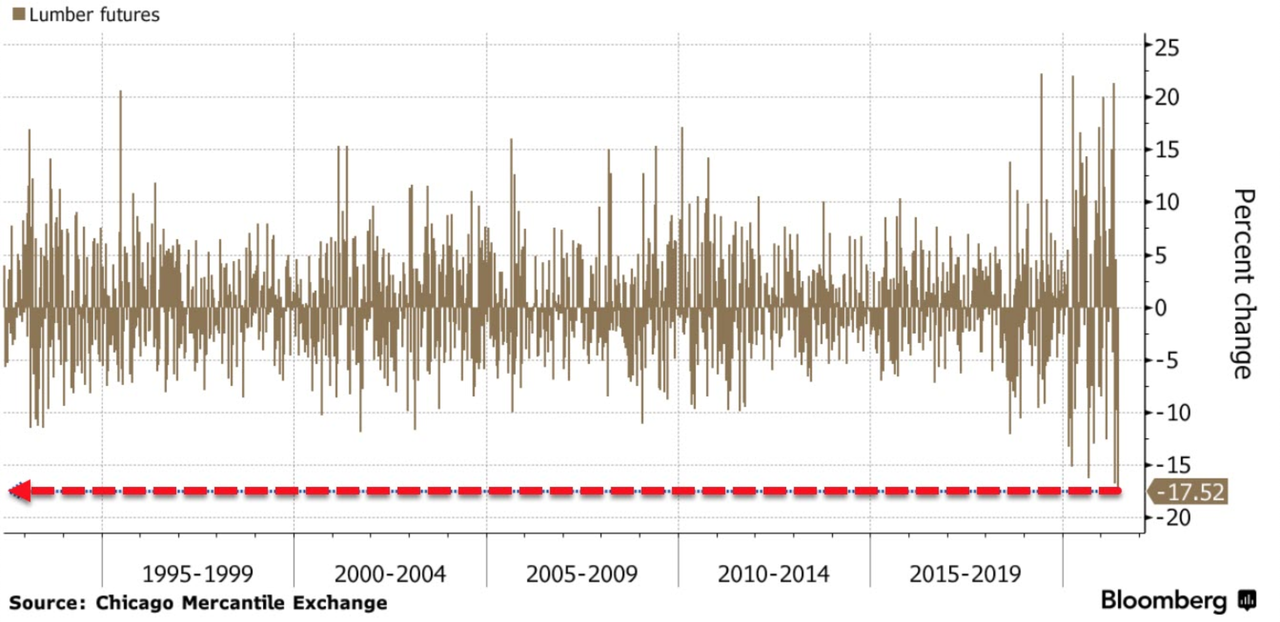
“It Won’t Be Pleasant” – Mark Carney Unveils Dystopian New World To Combat Climate ‘Crisis’

“It Won’t Be Pleasant” – Mark Carney Unveils Dystopian New World To Combat Climate ‘Crisis’

Authored by Peter Foster via NationalPost.com,

What Carney ultimately wants is a technocratic dictatorship justified by climate alarmism…

In his book Value(s): Building a Better World for All, Mark Carney, former governor both of the Bank of Canada and the Bank of England, claims that western society is morally rotten, and that it has been corrupted by capitalism, which has brought about a “climate emergency” that threatens life on earth. This, he claims, requires rigid controls on personal freedom, industry and corporate funding.

Carney’s views are important because he is UN Special Envoy on Climate Action and Finance. He is also an adviser both to British Prime Minister Boris Johnson on the next big climate conference in Glasgow, and to Canadian Prime Minister Justin Trudeau.

Since the advent of the COVID pandemic, Carney has been front and centre in the promotion of a political agenda known as the “Great Reset,” or the “Green New Deal,” or “Building Back Better.” All are predicated on the claim that COVID, and its disruption of the global economy, provides a once-in-a-lifetime opportunity not just to regulate climate, but to frame a more fair, more diverse, more inclusive, more safe and more woke world.

Carney draws inspiration from, among others, Marx, Engels and Lenin, but the agenda he promotes differs from Marxism in two key respects. First, the private sector is not to be expropriated but made a “partner” in reshaping the economy and society. Second, it does not make a promise to make the lives of ordinary people better, but worse. Carney’s Brave New World will be one of severely constrained choice, less flying, less meat, more inconvenience and more poverty: “Assets will be stranded, used gasoline powered cars will be unsaleable, inefficient properties will be unrentable,” he promises.

The agenda’s objectives are in fact already being enforced, not primarily by legislation but by the application of non-governmental — that is, non-democratic — pressure on the corporate sector via the ever-expanding dictates of ESG (environmental, social and corporate governance) and by “sustainable finance,” which is designed to starve non-compliant companies of funds, thus rendering them, as Carney puts it, “climate roadkill.” What ESG actually represents is corporate ideological compulsion. It is a key instrument of “stakeholder capitalism.”

Carney’s Agenda is promoted by the United Nations and other international bureaucracies and a vast and ever-growing array of non-governmental organizations and fora, especially the World Economic Forum (WEF), where Carney is a trustee. Also, perhaps most surprisingly, by its corporate victims. No one wants to become climate roadkill.

Carney clearly feels himself to be a man of destiny. “When I worked at the Bank of England,” he writes in Value(s), “I would remind myself each morning of Marcus Aurelius’ phrase ‘arise to do the work of humankind’.” One is reminded of French aristocrat and social reformer Henri de Saint-Simon, the “grand seigneur sans-culotte,” who ordered his valet to wake him with similar words: “Remember, monsieur le comte, that you have great things to do.”

That is not the only thing Carney has in common with Saint-Simon, who believed that society should be ruled by savants such as himself; an alliance of engineers and other technocratic intellectuals, along with bankers. Carney is very much a banker technocrat, not merely at ease gliding along the corridors of global bureaucratic power, but expert at framing arguments that support an ever-expanding role for his class.

His expansive pretensions first appeared at the Bank of Canada. If the economy is like a game of ice hockey, then central bankers should, ideally, be like Zamboni drivers, whose job is to keep the ice flat (Carney had in fact been a goalie during his academic years at both Harvard and Oxford). At the Bank of Canada, he often seemed like the Zamboni driver who thought he was Wayne Gretzky. He could never resist lecturing private businesses to stop sitting on “dead money,” or telling them they were too timid in the international arena, or advising consumers that they were spending too little, or borrowing too much. He promoted “macroprudence,” the idea that regulators, in their panoptic wisdom, would focus on the forest, not the trees. Now, he wants to establish himself as an intellectual.

Carney has a lot to put straight with the world. According to his new book, and the related BBC Reith Lectures that Carney delivered last year, the three great crises of credit (2008–09 version), COVID and climate are all rooted in a single problem: People in general, and markets in particular, are not as wise, moral or far-seeing as Mark Carney. He sums up this failing as the “Tragedy of the Horizon,” a phrase he concocted for a speech ahead of the 2015 Paris climate conference.

However, Carney is sophistic when it comes to the alleged moral shortcomings of capitalism. It has been one of the most tedious tropes of the left since at least The Communist Manifesto that the rise of commerce would drive out all that is virtuous in society, leaving nothing but the “cash nexus” of trade. One of Carney’s favourite philosophers is Harvard’s Michael Sandel, who produces endless trivial examples suggesting that we have moved from a “market economy” to a “market society.”

“Should sex be up for sale?” Carney thunders, following Sandel. “Should there be a market in the right to have children? Why not auction the right to opt out of military service? Why shouldn’t universities sell admission to raise money for worthy causes?” But the very fact that people reflexively feel uneasy about — or outright reject — such notions entirely disproves his point. People do not believe that everything is, or should be, for sale.

Carney notes the long debate, going back to classical times, on the nature of commercial value. This was theoretically resolved by the “marginalist revolution,” which put paid to the “paradox of value” that puzzled over the (usually) low price of useful water and the (usually) high price of useless diamonds. The marginalists pointed out that commercial value isn’t determined by usefulness or labour input. It is inevitably subjective, based on personal preferences and available resources. There is no paradox. Someone dying of thirst in the middle of the desert might be more than willing to offer a bucket of diamonds for a bucket of water.

Mark Carney is a UN Special Envoy on Climate Action. PHOTO BY TOLGA AKMEN/POOL VIA REUTERS/FILE

However, market valuations are essentially different from moral values, a distinction Carney continually muddles. He misrepresents the marginalist/subjectivist perspective, claiming that it implies that anything not commercially priced is not considered valuable. “Market value,” he writes, “is taken to represent intrinsic value, and if a good or activity is not in the market, it is not valued.” But who holds such an idiotic view? Nobody “prices” their family, children, friends, community spirit or the beauties of nature, although there is certainly lots of calculation going on in the background. Carney constantly berates “market fundamentalist” straw men who employ “standard economic reasoning” and who believe that people are rational and markets perfect.

He incorrectly claims that Adam Smith — in his first great book, The Theory of Moral Sentiments— said that a sense of morality was “not inherent.” In fact, Smith believed that we are born with such a sense, which is then fine-tuned by the society in which we grow up. However, Carney — like all leftists — leans towards the blank slate, nurture-over-nature perspective because it suggests that human nature might be beneficially reformed under the right (that is, left) social arrangements.

Carney believes our moral sentiments started going astray around the time of the publication of Smith’s better-known book, The Wealth of Nations, in 1776, when the Industrial Revolution was beginning to take off. He rightly suggests that one should read both books to gain a full appreciation of Smith’s insights, but he seems to have missed the significance of Smith’s putdown of “whining and melancholy moralists,” his cynicism about “insidious and crafty” politicians, and his thoroughgoing skepticism about those who would “trade for the public good” (that is, the ESG crowd). Moreover, Smith noted that the greatest corrupter of moral sentiments was not commerce but “faction and fanaticism,” that is, politics and religion, which come together in the toxic stew of climate alarmism and ESG.

ESG used to be called Corporate Social Responsibility, or CSR. The Nobel economist Milton Friedman warned against its subversive nature 50 years ago. He noted that taking on externally dictated “social responsibilities” beyond those directly related to a company’s business opened the floodgates to endless pressure and interference. The big questions are responsibility to whom? And for what?

Carney also typically misrepresents Friedman, suggesting that he claimed that shareholders should rank “uber alles,” and to the exclusion of other legitimate stakeholders such as employees and local communities. Carney claims that “At times, large positive gains could accrue to society if small sacrifices were made on behalf of shareholders.” But by what right would management “sacrifice” shareholders, and who would decide which sacrifices should be made?

Carney admits that the “integrated reporting” required by ESG is a morass: “ESG ratings consider hundreds of metrics, with many of them qualitative in nature… Putting values to work is hard work, but as with virtue, it should become easier with sustained practice.” No need to ask whose version of values and virtue is to prevail.

*  *  *

Despite his thorough castigation of market society, Carney somehow also believes this “corroded” society is clamouring to make great personal sacrifices for draconian climate actions and the UN’s Sustainable Development Goals.

Carney has been a prime pusher of “net-zero,” the notion that climate-related human emissions must be entirely eradicated, buried or offset by 2050 if the world is to avoid climate Armageddon. He claims that net-zero is “highly valued by society.” In reality, the vast mass of people have no clue what it entails; when Carney talks about this version of “society,” he is talking about a small, radical element of it.

Carney peddles the non-sequitur that because the world wasn’t ready for COVID, this confirms that the world is being short-sighted about climate catastrophe. But COVID is an obvious reality; an existential climate catastrophe is a hypothesis (frequently promoted — admittedly with great success — by those with agendas). He claims that “A good introduction to this subject can be found in journalist David Wallace-Wells’ The Uninhabitable Earth,” a work heavily criticized even by prominent climate-change scientists for its factual errors and exaggerations. Indeed, even its author admitted its tendentious purpose.

Carney also commends the knowledge and wisdom of Swedish teenager Greta Thunberg: “The power of Greta Thunberg’s message lies in the way she drives home both the cold logic of climate physics and the fundamental unfairness of the climate crisis.”

Anybody who cites an anxious 17-year-old as an authority on climate science and moral philosophy should be an object of deep suspicion, but then, according to Carney, climate science is easy. Greta’s “basic calculations” are ones that she could “easily master and powerfully project.” (Carney says he once gave Greta a tour of the Bank of England’s gold vaults. One wonders if she also offered up tips on monetary policy.) But then, in early 2020, Greta demonstrated her complete disconnect from reality when, at the WEF in Davos, she called for an immediate cessation of emissions, which would tank the world economy and potentially kill millions. Even Carney admits deviating from her wisdom on that point.

Far from demonstrating a firm knowledge of the climate system himself, Carney cites scary but misleading statistics. “Since the 1980s,” he writes, “the number of registered weather-related loss events has tripled, and the inflation-adjusted losses have increased fivefold. Consistent with the accelerated pace of climate change, the cost of weather-related insurance losses has increased eightfold in real terms over the past decade to an annual average of $60 billion.”

I asked Professor Roger Pielke, Jr., an expert on climate and economics at the University of Colorado, to comment. He replied “(Carney) has confused economics with weather. The increase in losses he describes is well understood to occur for two main reasons: more wealth and property exposed to loss and better accounting of those losses. To assess trends in extreme weather one should look at weather data, not economic loss data.”

Among Mark Carney’s current responsibilities since leaving the Bank of England as its governor is advising Prime Minister Justin Trudeau. PHOTO BY SEAN KILPATRICK/THE CANADIAN PRESS/FILE

Carney’s confusion is hardly innocent since his Agenda depends on incessantly claiming that “What had been biblical is becoming commonplace.”

Fortunately, Carney has been making claims about worsening weather for long enough that we can assess some of his predictions. In his recent book Unsettled: What Climate Science Tells Us, What It Doesn’t, and Why It Matters, Steven Koonin, former undersecretary for science at the Obama-era U.S. Energy Department, cites the speech Carney made to Lloyd’s of London before the Paris climate conference in 2015. The speech was designed to frighten the insurance industry into divestment from fossil fuels, on the basis that many oil and gas reserves would be “stranded” as we exhaust our allowable carbon “budget.” Carney pointed out that the previous U.K. winter had been the “wettest since the time of King George III.” He went on to say, “forecasts suggest we can expect at least a further 10% increase in rainfall during future winters.” For support he cited the U.K. Met Office’s forecast for the next five years. It turned out to be dead wrong. The six winters after 2014 averaged 39-per-cent less rainfall than the 2014 record. Meanwhile a Met Office report in 2018 acknowledged that the “largest source of variability in U.K. extreme rainfalls during the winter months was the North Atlantic Oscillation mode of natural variability, not a changing climate.”

“(I)t’s surprising,” notes Koonin, “that someone with a PhD in economics and experience with the unpredictability of financial markets and economies as a whole doesn’t show a greater respect for the perils of prediction — and more caution in depending upon models.”

During his BBC Reith Lectures last year, on the topic of “How We Get What We Value,” Carney received few challenges from his handpicked questioners, but a couple came from eminent historian Niall Ferguson. Ferguson asked Carney why, in his discussion of the climate issue, he made no reference to Bjorn Lomborg (a much more knowledgeable Scandinavian than Greta), and in particular to Lomborg’s book, False Alarm, in which Lomborg establishes — using “official” science — that there is no existential climate crisis, that adapting to climate change is manageable, and that the kinds of policies promoted by Carney are likely to be far more costly than any impact from extreme weather.

Carney of course hadn’t read that book, but he dismissed Lomborg by saying that “it’s 15 or 20 years ago when he first came out with his ‘Don’t worry about the climate.’ How’s that working out for us?” But Lomborg never said “Don’t worry about the climate,” he just suggested that we had to put risks into perspective. Meanwhile Lomborg’s non-alarmist thesis is working out much better than that of doomsayers such as Carney.

This offhand rejection of someone as widely respected as Lomborg exposes the hypocrisy of Carney’s statement in Value(s) that “experts need to listen to all sides…All of us as individuals have a responsibility to be more open and to engage respectfully with different views if we want constructive political debates and to make progress on important issues.” Except, climate-catastrophe dissenters don’t make it into the debate. There can be zero diversity of views on net-zero.

Ferguson put another thorny question to Carney at that Reith lecture: He pointed out that since the 2015 Paris agreement, China had been responsible for almost half the increase in global carbon emissions, and it was building more coal capacity in the current year than existed in the entire United States. What did China’s promises of net-zero by 2060 mean, Ferguson asked, if it was “actually leading the pollution charge”? Carney’s non response was that China is the largest manufacturer of zero-emission cars, and the leading producer of renewable energy.

Koonin notes in his book that Carney “is probably the single most influential figure in driving investors and financial institutions around the world to focus on changes in climate and human influences upon it…. So it’s important to pay close attention to what he says.”

*  *  *

Mark Carney cries crocodile tears at the possible viability of the Marxist perspective in today’s political environment. But if there is one sure sign of a Marxist, it’s a belief that capitalism is — or is about to be – in “crisis.” His new book has an appendix on Marx’s theory of surplus value: that all profits are wrung from the hides of labour. He also cites Marx’s collaborator, Friedrich Engels. In particular he notes “Engels’ pause,” the one period in capitalist history, early in the 19th century, when workers may not have shared the increases in productivity brought about by industrialization.

Carney projects that the “Fourth Industrial Revolution” (a phenomenon much invoked by the WEF) might bring about a similar period, thus providing a source of political unrest. “(I)t could be generations before the gains of the Fourth Industrial Revolution are widely shared,” he writes. “In the interim, there could be a long period of technological unemployment, sharply rising inequalities and intensifying social unrest… If this world of surplus labour comes to pass, Marx and Engels could again become relevant.”

He rather seems to hope so.

Carney claims powerful parallels between Marx’s time and our own. “Substitute platforms for textile mills, machine learning for the steam engine, and Twitter for the telegraph, and current dynamics echo those of that era. Then, Karl Marx was scribbling the Communist Manifesto in the reading room of the British Library. Today, radical viral blogs and tweets voice similar outrage.”

In fact, Marx wrote The Communist Manifesto, based on a tract by Engels, in Brussels, not at the British Library, but it’s more important to remember where Marx’s misguided and immutable outrage led: to a disastrous economic and political model that generated poverty and mass murder on an unprecedented scale. Meanwhile “outrage” is surely a dubious basis for policy. The outraged are certainly a useful constituency for those seeking power, however, which brings us to the influence on Carney of the man who first tried to put Marxism into practice.

When it comes to the COVID crisis, writes Carney, “We are living Lenin’s observation that there are ‘decades when nothing happens and weeks when decades happen’.” Strange that Carney would cite one of the most ruthless murderers in history for this rather bland insight, but then Carney’s Agenda is not without its own parallels to Lenin (minus, one presumes, the precondition of rampant bloodshed).

Although Vladimir Lenin didn’t know much about business or economics, he declared that “’Communism is Soviet power plus the electrification of the whole country.” Carney’s plan is global. “We need,” he claims, “to electrify everything and turn electricity generation green.” The problem is that wind- and solar-powered electricity needs both hefty government subsidies and fossil-fuel backup for when the wind doesn’t blow and the sun doesn’t shine. Green electricity is inflexible, expensive and disruptive to grids.

Carney cites Joseph Schumpeter’s concept of “creative destruction,” but his own version involves not the metaphorical and benign process of market innovation making old technologies redundant, but a deliberate suppression of viable technologies to make way for less reliable and less economic alternatives.

When Lenin wrecked the Russian economy after brutally seizing power in 1917, he was forced to backtrack and allow some private enterprise to prevent people starving. However, he assured his radical comrades that he would retain control of “the commanding heights” of heavy industry. Carney’s plan is to control the global economy by seizing the commanding heights of finance, not by nationalization but by exerting non-democratic pressure to divest from, and stop funding, fossil fuels. The private sector is to become a partner in imposing its own bondage. This will be do-it-yourself totalitarianism. Indeed, companies in our one-party ESG state are already pleading like show-trial defendants, making suicidal net-zero commitments, lest banks cut them off.

Left: A portrait of Karl Marx. Top right: Vladimir Lenin makes a speech in Red Square on the first anniversary of the Bolshevik Revolution. Below right: Teenage Swedish climate activist Greta Thunberg delivers brief remarkssurrounded by other student environmental advocates in 2019. Mark Carney draws on all three in his agenda to address the “climate emergency,” writes Peter Foster. PHOTO BY FILE; HULTON-DEUTSCH COLLECTION/CORBIS/CORBIS VIA GETTY IMAGES; SARAH SILBIGER/GETTY IMAGES/FILE

To further that end, Carney has helped to start a key organization, the Network for Greening the Financial System (NGFS), a collection of central banks and regulators. He has also signed up an ever-growing constituency of activist policy wonks who peddle emissions measurement and certification, eco audits and ESG rankings. This agenda is inevitably appealing to transnational organizations such as the International Energy Agency (IEA), the IMF, the World Bank and the OECD, whose empires are all lucratively intertwined with the global governance thrust. In May, the IEA issued a report calling for an immediate end to fossil fuel investment to get to net-zero.

Part of Carney’s strategy is to force “voluntary” standards on banking and industry, then have governments make those standards compulsory. The major accounting firms appear keen to promote the possibility of endless auditing extensions, under which the relatively straightforward metric of money is to be replaced by the infinitely malleable concepts of “purpose” and “impact.”

Carney has also helped turn the accounting screw though “carbon disclosure.” Companies are pressured to make explicit the kind of damage they might suffer if the alarmists’ worst nightmares are realized. Such disclosure is a variant on that famous loaded question “When did you stop beating your spouse?” Instead, carbon disclosure asks the climate equivalent of “If you were to beat your spouse, what sort of injuries might he/she suffer?” Companies must also disclose their plans to deal with the presumed crisis. No company dares to say “We do not believe your apocalyptic forecasts.” They meekly regurgitate the required climate porn about floods and droughts and hurricanes, and make elaborate fingers-crossed emissions-reductions commitments. This in turn leads them into arrangements such as buying emissions offsets, a complex scheme analogous to the medieval Catholic Church’s sale of indulgences. Carbon markets have inevitably led to a surge in work for offset generators, certifiers and auditors. Carney projects this market could be worth $100 billion.

Ironically, earlier this year Carney found himself tangled in the murky metrics of offsets. In 2020, he was appointed a vice chairman with Toronto-based Brookfield Asset Management, where he is in charge of “impact investing.” As historian Tammy Nemeth points out in her critical study of the “Transnational Progressive Movement,” of which Carney is a leading light: “(I)t is perhaps ethically murky for someone who is actively working within the UN and advising two different governments on how to change national and global financial rules to be working for a company that will be a direct beneficiary of those rule changes.” Still, who better to lead your company through a minefield than the person who planted the mines?

Except that Carney was hoist with his own petard when he claimed that Brookfield, which has major investments in fossil fuels and pipelines, was already “net-zero” due to emissions “avoided” as a result of its investing in renewable energy. Carney’s claim produced instant refutation and accusations of greenwashing. The Financial Times called it a “major stumble.” A representative of CDP (formerly the Carbon Disclosure Project) castigated those who attempt to hide “dirty coal issues.” Carney subsequently issued a qualified mea culpa on Twitter: “I have always been — and will continue to be — a strong advocate for net zero science-based targets, and I also recognize that avoided emissions do not count towards them.”

*  *  *

H. L. Mencken observed that “The urge to save humanity is almost always a false-front for the urge to rule.” So, just how big a threat is the agenda of Mark Carney and his fellow “transnational progressives”?

In his book, Value(s), Carney lays out rationalizations and autocratic pretensions, although he is less forthcoming about his motivations. He writes that “Leaders need to renounce power for its own sake and discern the power of service.” Mencken would be amused.

The shambolic response to COVID of many governments, not least in Canada, and the distinctly unsettled nature of pandemic “science,” have not done much for the credibility of either governments or experts. The Carney-backed agenda is not predicated on working through democratic institutions but on circumventing them. Still, he is also reported to have more conventional political aspirations, namely to join the federal Liberal party and rise within it, very possibly to prime minister. (Carney recently gave a speech at the Liberal national convention, where he pledged his full support.)

He thus has a rather ill-fitting section in Value(s) on “How Canada Can Build Value for All.” It reads like a Liberal party stump speech. According to Carney “We (in Canada) routinely transcend the limitations of our size to model values and policies for other countries.” It’s the old chestnut that no progressive Canadian leader ever seems to tire of: The world needs more Canada.

Carney is a classic example of what Friedrich Hayek called the “fatal conceit” of constructivist rationalism: the belief that the largely spontaneous institutions of the market order should be rejected in favour of more deliberately planned arrangements. Carney is undoubtedly an intelligent man, but Hayek stressed that the thing that intelligent people tend most to overestimate is the power of intelligence — particularly if they happen to be socialists.

Carney is also of the class that philosopher Karl Popper described as “enemies” of an “open society.” Popper noted that social upheavals tend to bring forth prophets who claim to understand the forces shaping the future, and promise salvation if they are given absolute power. Such was Plato’s model — in response to the upheavals of the Peloponnesian War and the first wave of democracy — of a necessary dictatorship in which the rulers lived as communists, using a specially bred military to control a cattle-like populace. Similarly, Marx’s communism was a response to the turmoil of the Industrial Revolution.

Considering the squalor of Manchester in the 1840s, one might forgive Marx and Engels for thinking a radical response was in order. But given the success of capitalism and the horrors of autocratic systems in the intervening period, it takes considerable chutzpah to be promoting net-zero totalitarianism.

Still, Carney claims that great crises demand great plans. He cites Timothy Geithner, secretary of the U.S. Treasury under president Obama, saying “plan beats no plan.” But Geithner was talking about the very real and immediate 2008–09 financial crisis. Carney’s climate plan is much closer to the notion of Soviet central long-term planning. Clearly, when it came to the subsequent welfare of the Russian people, “no plan” would certainly have beaten “plan.”

What Carney ultimately wants, like Saint-Simon, is a technocratic dictatorship justified by climate alarmism. He suggests that “governments can delegate certain aspects of the calibration of specific instruments… to Carbon Councils in order to improve the predictability, credibility and impact of climate policies.” These carbon councils will be able to demand that national governments “comply or explain” when they inevitably fall short of targets. How these commissars will bring governments into line is unclear, although Nobel economist William Nordhaus has suggested “Climate Clubs” that will punish recalcitrants with punitive tariffs.

The threat of punishment will clearly be necessary because governments are doing little more than hypocritical tinkering on climate policy. China and India are hardly even playing lip service to the “climate emergency.” Nevertheless, according to Carney “political technology” is needed to “build a broad consensus around the right goals.” No question of debating the goals, or the science, just building a consensus to support them.

Carney is a man on a mission to change global society. “Business as usual” — the most hated phrase in the socialist lexicon — is “ultimately catastrophic,” he writes. There is too much “misplaced acceptance of the status quo.” But somehow the new socialism will not be socialism as usual. This time it’s different. We can because we must. The threat is too great to permit any argument. It’s surprising that as he was picking out choice quotes from Lenin for his book, Carney missed this one: “No more opposition now, comrades! The time has come to put an end to opposition, to put the lid on it. We have had enough opposition!”

Tyler Durden
Sat, 06/12/2021 – 23:30

via ZeroHedge News https://ift.tt/3vkouXe Tyler Durden