Biden Chooses Cronyism Over Letting Puerto Rico Rebuild


topicsregulation

Not long after taking office, President Joe Biden released an executive order to fight climate change and called for evaluating the impact of environmental policies on the poor. Yet in a separate executive order, Biden affirmed his support for the 1920 Jones Act, a maritime law that harms both the environment and disadvantaged communities. It seems the residents of Hawaii, Puerto Rico, and Alaska are no match for an entrenched industry and union cronyism.

The Jones Act—technically the Merchant Marine Act of 1920—shields the American shipping industry from foreign competition by requiring that ships engaging in trade between multiple U.S. ports be made in America and owned and crewed by American citizens. Supporters say the Jones Act is necessary for national security, but research from the Cato Institute has shown the law’s biggest impact is driving up consumer prices for many Americans by forcing isolated states and territories to import necessities from other countries.

The cost of complying with the Jones Act encourages American businesses to transport goods between U.S. states on trains and trucks. In Europe, 40 percent of freight is moved by sea. Within the United States, that share is only 2 percent. Ships generally require less energy per mile and therefore produce less pollution.

The Jones Act pushes freight transportation onto highways across America, thereby increasing pollution and congestion. Ironically, the law has even led to a decline in the number of ships America builds domestically.

In other words, a small number of Americans benefit financially from the Jones Act at the expense of the rest of us. “Supporting the Jones Act is in direct contradiction of the Biden administration’s stated desire to both fight climate change and promote Puerto Rico’s economic recovery,” says Colin Grabow, a Cato policy analyst. “By dramatically raising the cost of domestic waterborne transport, the Jones Act discourages the use of this carbon-friendly means of transport while imposing a significant economic burden on an island that suffers from a painful 43 percent poverty rate.”

On the campaign trail, Biden and Pete Buttigieg, who has since become secretary of transportation, promised better representation for Puerto Rico. But because of the Jones Act, shipping a container from the continental U.S. to the island territory can cost twice as much as sending the same container to a nearby island nation, where Jones Act rules don’t apply. That’s not a recipe for lifting Puerto Rico out of poverty or helping it recover from the devastation caused by Hurricane Maria in 2017.

Biden’s embrace of this archaic law undercuts his economic, environmental, and transportation policy goals.

from Latest – Reason.com https://ift.tt/3sxtBSG
via IFTTT

Biden Chooses Cronyism Over Letting Puerto Rico Rebuild


topicsregulation

Not long after taking office, President Joe Biden released an executive order to fight climate change and called for evaluating the impact of environmental policies on the poor. Yet in a separate executive order, Biden affirmed his support for the 1920 Jones Act, a maritime law that harms both the environment and disadvantaged communities. It seems the residents of Hawaii, Puerto Rico, and Alaska are no match for an entrenched industry and union cronyism.

The Jones Act—technically the Merchant Marine Act of 1920—shields the American shipping industry from foreign competition by requiring that ships engaging in trade between multiple U.S. ports be made in America and owned and crewed by American citizens. Supporters say the Jones Act is necessary for national security, but research from the Cato Institute has shown the law’s biggest impact is driving up consumer prices for many Americans by forcing isolated states and territories to import necessities from other countries.

The cost of complying with the Jones Act encourages American businesses to transport goods between U.S. states on trains and trucks. In Europe, 40 percent of freight is moved by sea. Within the United States, that share is only 2 percent. Ships generally require less energy per mile and therefore produce less pollution.

The Jones Act pushes freight transportation onto highways across America, thereby increasing pollution and congestion. Ironically, the law has even led to a decline in the number of ships America builds domestically.

In other words, a small number of Americans benefit financially from the Jones Act at the expense of the rest of us. “Supporting the Jones Act is in direct contradiction of the Biden administration’s stated desire to both fight climate change and promote Puerto Rico’s economic recovery,” says Colin Grabow, a Cato policy analyst. “By dramatically raising the cost of domestic waterborne transport, the Jones Act discourages the use of this carbon-friendly means of transport while imposing a significant economic burden on an island that suffers from a painful 43 percent poverty rate.”

On the campaign trail, Biden and Pete Buttigieg, who has since become secretary of transportation, promised better representation for Puerto Rico. But because of the Jones Act, shipping a container from the continental U.S. to the island territory can cost twice as much as sending the same container to a nearby island nation, where Jones Act rules don’t apply. That’s not a recipe for lifting Puerto Rico out of poverty or helping it recover from the devastation caused by Hurricane Maria in 2017.

Biden’s embrace of this archaic law undercuts his economic, environmental, and transportation policy goals.

from Latest – Reason.com https://ift.tt/3sxtBSG
via IFTTT

The Political Economy Of Fear

The Political Economy Of Fear

Authored by Robert Higgs via The Mises Institute,

[This article was originally published May 16, 2005… but seems ominously prophetic given our current age of rage and unreason.]

[S]ince love and fear can hardly exist together, if we must choose between them, it is far safer to be feared than loved. 

– Niccolò Machiavelli, The Prince, 1513

All animals experience fear – human beings, perhaps, most of all. Any animal incapable of fear would have been hard pressed to survive, regardless of its size, speed, or other attributes. Fear alerts us to dangers that threaten our well-being and sometimes our very lives. Sensing fear, we respond by running away, by hiding, or by preparing to ward off the danger.

To disregard fear is to place ourselves in possibly mortal jeopardy. Even the man who acts heroically on the battlefield, if he is honest, admits that he is scared. To tell people not to be afraid is to give them advice that they cannot take. Our evolved physiological makeup disposes us to fear all sorts of actual and potential threats, even those that exist only in our imagination.

The people who have the effrontery to rule us, who call themselves our government, understand this basic fact of human nature. They exploit it, and they cultivate it. Whether they compose a warfare state or a welfare state, they depend on it to secure popular submission, compliance with official dictates, and, on some occasions, affirmative cooperation with the state’s enterprises and adventures. Without popular fear, no government could endure more than twenty-four hours. David Hume taught that all government rests on public opinion, but that opinion, I maintain, is not the bedrock of government. Public opinion itself rests on something deeper: fear.

Hume recognizes that the opinions that support government receive their force from “other principles,” among which he includes fear, but he judges these other principles to be “the secondary, not the original principles of government” ([1777] 1987, 34). He writes: “No man would have any reason to fear the fury of a tyrant, if he had no authority over any but from fear” (ibid., emphasis in original). We may grant Hume’s statement yet maintain that the government’s authority over the great mass of its subjects rests fundamentally on fear. Every ideology that endows government with legitimacy requires and is infused by some kind(s) of fear. This fear need not be fear of the government itself and indeed may be fear of the danger from which the tyrant purports to protect the people.

The Natural History of Fear

Thousands of years ago, when the first governments were fastening themselves on people, they relied primarily on warfare and conquest. As Henry Hazlitt ([1976] 1994) observes,

There may have been somewhere, as a few eighteenth-century philosophers dreamed, a group of peaceful men who got together one evening after work and drew up a Social Contract to form the state. But nobody has been able to find an actual record of it. Practically all the governments whose origins are historically established were the result of conquest—of one tribe by another, one city by another, one people by another. Of course there have been constitutional conventions, but they merely changed the working rules of governments already in being.

Losers who were not slain in the conquest itself had to endure the consequent rape and pillage and in the longer term to acquiesce in the continuing payment of tribute to the insistent rulers—the stationary bandits, as Mancur Olson (2000, 6–9) aptly calls them. Subjugated people, for good reason, feared for their lives. Offered the choice of losing their wealth or losing their lives, they tended to choose the sacrifice of their wealth. Hence arose taxation, variously rendered in goods, services, or money (Nock [1935] 1973, 19–22; Nock relies on and credits the pioneering historical research of Ludwig Gumplowicz and Franz Oppenheimer).

Conquered people, however, naturally resent their imposed government and the taxation and other insults that it foists on them. Such resentful people easily become restive; should a promising opportunity to throw off the oppressor’s dominion present itself, they may seize it. Even if they mount no rebellion or overt resistance, however, they quietly strive to avoid their rulers’ exactions and to sabotage their rulers’ apparatus of government. As Machiavelli observes, the conqueror “who does not manage this matter well, will soon lose whatever he has gained, and while he retains it will find in it endless troubles and annoyances” ([1513] 1992, 5). For the stationary bandits, force alone proves a very costly resource for keeping people in the mood to generate a substantial, steady stream of tribute.

Sooner or later, therefore, every government augments the power of its sword with the power of its priesthood, forging an iron union of throne and altar. In olden times, not uncommonly, the rulers were themselves declared to be gods—the Pharaohs of ancient Egypt made this claim for many centuries. Now the subjects can be brought to fear not only the ruler’s superior force, but also his supernatural powers. Moreover, if people believe in an afterlife, where the pain and sorrows of this life may be sloughed off, the priests hold a privileged position in prescribing the sort of behavior in the here and now that best serves one’s interest in securing a blessed situation in the life to come. Referring to the Catholic Church of his own day, Machiavelli takes note of “the spiritual power which of itself confers so mighty an authority” ([1513] 1992, 7), and he heaps praise on Ferdinand of Aragon, who, “always covering himself with the cloak of religion, … had recourse to what may be called pious cruelty” (59, emphasis in original).

One naturally wonders whether President George W. Bush has taken a page from Ferdinand’s book (see, in particular, Higgs 2003a and, for additional aspects, Higgs 2005b).

Naturally, the warriors and the priests, if not one and the same, almost invariably come to be cooperating parties in the apparatus of rule. In medieval Europe, for example, a baron’s younger brother might look forward to becoming a bishop.

Thus, the warrior element of government puts the people in fear for their lives, and the priestly element puts them in fear for their eternal souls. These two fears compose a powerful compound—sufficient to prop up governments everywhere on earth for several millennia.

Over the ages, governments refined their appeals to popular fears, fostering an ideology that emphasizes the people’s vulnerability to a variety of internal and external dangers from which the governors—of all people!—are said to be their protectors. Government, it is claimed, protects the populace from external attackers and from internal disorder, both of which are portrayed as ever-present threats. Sometimes the government, as if seeking to fortify the mythology with grains of truth, does protect people in this fashion—even the shepherd protects his sheep, but he does so to serve his own interest, not theirs, and when the time comes, he will shear or slaughter them as his interest dictates.

Olson (2000, 9–10) describes in simple terms why the stationary bandit may find it in his interest to invest in public goods (the best examples of which are defense of the realm and “law and order”) that enhance his subjects’ productivity. In brief, the ruler does so when the present value of the expected additional tax revenue he will be able to collect from a more productive population exceeds the current cost of the investment that renders the people more productive. See also the interpretation advanced by Bates (2001, 56–69, 102), who argues that in western Europe the kings entered into deals with the merchants and burghers, trading mercantilist privileges and “liberties” for tax revenue, in order to dominate the chronically warring rural dynasties and thereby to pacify the countryside. Unfortunately, as Bates recognizes, the kings sought this enlarged revenue for the purpose of conducting ever-more-costly wars against other kings and against domestic opponents. Thus, their “pacification” schemes, for the most part, served the purpose of funding their fighting, leaving the net effect on overall societal well-being very much in question. Both Olson and Bates argue along lines similar to those developed by Douglass C. North in a series of books published over the past four decades; see especially North and Thomas 1973, and North 1981 and 1990.

When the government fails to protect the people as promised, it always has a good excuse, often blaming some element of the population–scapegoats such as traders, money lenders, and unpopular ethnic or religious minorities. “[N]o prince,” Machiavelli assures us, “was ever at a loss for plausible reasons to cloak a breach of faith” ([1513] 1992, 46).

The religious grounds for submission to the ruler-gods gradually transmogrified into notions of nationalism and popular duty, culminating eventually in the curious idea that under a democratic system of government, the people themselves are the government, and hence whatever it requires them to do, they are really doing for themselves—as Woodrow Wilson had the cheek to declare when he proclaimed military conscription backed by severe criminal sanctions in 1917, “it is in no sense a conscription of the unwilling: it is, rather, selection from a nation which has volunteered in mass” (qtd. in Palmer 1931, 216–17).

Not long after the democratic dogma had gained a firm foothold, organized coalitions emerged from the mass electorate and joined the elites in looting the public treasury, and, as a consequence, in the late nineteenth century the so-called welfare state began to take shape. From that time forward, people were told that the government can and should protect them from all sorts of workaday threats to their lives, livelihoods, and overall well-being—threats of destitution, hunger, disability, unemployment, illness, lack of income in old age, germs in the water, toxins in the food, and insults to their race, sex, ancestry, creed, and so forth. Nearly everything that the people feared, the government then stood poised to ward off. Thus did the welfare state anchor its rationale in the solid rock of fear. Governments, having exploited popular fears of violence so successfully from time immemorial (promising “national security”), had no difficulty in cementing these new stones (promising “social security”) into their foundations of rule.

The Political Economy of Fear

Fear, like every other “productive” resource, is subject to the laws of production. Thus, it cannot escape the law of diminishing marginal productivity: as successive doses of fear-mongering are added to the government’s “production” process, the incremental public clamor for governmental protection declines. The first time the government cries wolf, the public is frightened; the second time, less so; the third time, still less so. If the government plays the fear card too much, it overloads the public’s sensibilities, and eventually people discount almost entirely the government’s attempts to frighten them further.

Having been warned in the 1970s about catastrophic global cooling (see, for example, The Cooling World 1975), then, soon afterward, about catastrophic global warming, the populace may grow weary of heeding the government’s warnings about the dire consequences of alleged global climate changes—dire unless, of course, the government takes stringent measures to bludgeon the people into doing what “must” be done to avert the predicted disaster.

Recently the former Homeland Security czar Tom Ridge revealed that other government officials had overruled him when he wanted to refrain from raising the color-coded threat level to orange, or “high” risk of terrorist attack, in response to highly unlikely threats. “You have to use that tool of communication very sparingly,” Ridge astutely remarked (qtd. by Hall 2005).

Fear is a depreciating asset. As Machiavelli observes, “the temper of the multitude is fickle, and … while it is easy to persuade them of a thing, it is hard to fix them in that persuasion” ([1513 1992, 14). Unless the foretold threat eventuates, the people come to doubt its substance. The government must make up for the depreciation by investing in the maintenance, modernization, and replacement of its stock of fear capital. For example, during the Cold War, the general sense of fear of the Soviets tended to dissipate unless restored by periodic crises, many of which took the form of officially announced or leaked “gaps” between U.S. and Soviet military capabilities: troop-strength gap, bomber gap, missile gap, antimissile gap, first-strike-missile gap, defense-spending gap, thermonuclear-throw-weight gap, and so forth (Higgs 1994, 301–02).4

One of the most memorable and telling lines in the classic Cold War film Dr. Strangelove occurs as the president and his military bigwigs, facing unavoidable nuclear devastation of the earth, devise a plan to shelter a remnant of Americans for thousands of years in deep mine shafts, and General “Buck” Turgidson, still obsessed with a possible Russian advantage, declares: “Mr. President, we must not allow a mine-shaft gap!”

Lately, a succession of official warnings about possible forms of terrorist attack on the homeland has served the same purpose: keeping the people “vigilant,” which is to say, willing to pour enormous amounts of their money into the government’s bottomless budgetary pits of “defense” and “homeland security” (Higgs 2003b).

This same factor helps to explain the drumbeat of fears pounded out by the mass media: besides serving their own interests in capturing an audience, they buy insurance against government punishment by playing along with whatever program of fear-mongering the government is conducting currently. Anyone who watches, say, CNN’s Headline News programs can attest that a day seldom passes without some new announcement of a previously unsuspected Terrible Threat—I call it the danger du jour.

By keeping the population in a state of artificially heightened apprehension, the government-cum-media prepares the ground for planting specific measures of taxation, regulation, surveillance, reporting, and other invasions of the people’s wealth, privacy, and freedoms. Left alone for a while, relieved of this ceaseless bombardment of warnings, people would soon come to understand that hardly any of the announced threats has any substance and that they can manage their own affairs quite well without the security-related regimentation and tax-extortion the government seeks to justify.

Large parts of the government and the “private” sector participate in the production and distribution of fear. (Beware: many of the people in the ostensibly private sector are in reality some sort of mercenary living ultimately at taxpayer expense. True government employment is much greater than officially reported [Light 1999; Higgs 2005a] .) Defense contractors, of course, have long devoted themselves to stoking fears of enemies big and small around the globe who allegedly seek to crush our way of life at the earliest opportunity. Boeing’s often-shown TV spots, for example, assure us that the company is contributing mightily to protecting “our freedom.” If you believe that, I have a shiny hunk of useless Cold War hardware to sell you. The news and entertainment media enthusiastically jump on the bandwagon of foreign-menace alarmism—anything to get the public’s attention.

Consultants of every size and shape clamber onboard, too, facilitating the distribution of billions of dollars to politically favored suppliers of phoney-baloney “studies” that give rise to thick reports, the bulk of which is nothing but worthless filler restating the problem and speculating about how one might conceivably go about discovering workable solutions. All such reports agree, however, that a crisis looms and that more such studies must be made in preparation for dealing with it. Hence a kind of Say’s Law of the political economy of crisis: supply (of government-funded studies) creates its own demand (for government-funded studies).

Truth be known, governments commission studies when they are content with the status quo but desire to write hefty checks to political favorites, cronies, and old associates who now purport to be “consultants.” At the same time, in this way, the government demonstrates to the public that it is “doing something” to avert impending crisis X.

At every point, opportunists latch onto existing fears and strive to invent new ones to feather their own nests. Thus, public-school teachers and administrators agree that the nation faces an “education crisis.” Police departments and temperance crusaders insist that the nation faces a generalized “drug crisis” or at times a specific drug crisis, such as “an epidemic of crack cocaine use.” Public-health interests foster fears of “epidemics” that in reality consist not of the spread of contagious pathogens but of the lack of personal control and self-responsibility, such as the “epidemic of obesity” or the “epidemic of juvenile homicides.” By means of this tactic, a host of personal peccadilloes has been medicalized and consigned to the “therapeutic state” (Nolan 1998, Szasz 2001, Higgs 1999).

In this way, people’s fears that their children may become drug addicts or gun down a classmate become grist for the government’s mill—a mill that may grind slowly, but at least it does so at immense expense, with each dollar falling into some fortunate recipient’s pocket (a psychiatrist, a social worker, a public-health nurse, a drug-court judge; the list is almost endless). In this way and countless others, private parties become complicit in sustaining a vast government apparatus fueled by fear.

Fear Works Best in Wartime

Even absolute monarchs can get bored. The exercise of great power may become tedious and burdensome—underlings are always disturbing your serenity with questions about details; victims are always appealing for clemency, pardons, or exemptions from your rules. In wartime, however, rulers come alive. Nothing equals war as an opportunity for greatness and public acclaim, as all such leaders understand (Higgs 1997). Condemned to spend their time in high office during peacetime, they are necessarily condemned to go down in history as mediocrities at best.

Upon the outbreak of war, however, the exhilaration of the hour spreads through the entire governing apparatus. Army officers who had languished for years at the rank of captain may now anticipate becoming colonels. Bureau heads who had supervised a hundred subordinates with a budget of $1 million may look forward to overseeing a thousand with a budget of $20 million. Powerful new control agencies must be created and staffed. New facilities must be built, furnished, and operated. Politicians who had found themselves frozen in partisan gridlock can now expect that the torrent of money gushing from the public treasury will grease the wheels for putting together humongous legislative deals undreamt of in the past. Everywhere the government turns its gaze, the scene is flush with energy, power, and money. For those whose hands direct the machinery of a government at war, life has never been better.

Small wonder that John T. Flynn (1948), in writing about the teeming bureaucrats during World War II, titled his chapter “The Happiest Years of Their Lives”:

Even before the war, the country had become a bureaucrat’s paradise. But with the launching of the war effort the bureaus proliferated and the bureaucrats swarmed over the land like a plague of locusts. … The place [Washington, D.C.] swarmed with little professors fresh from their $2,500-a-year jobs now stimulated by five, six and seven-thousand-dollar salaries and whole big chunks of the American economy resting in their laps. (310, 315)

Sudden bureaucratic dilation on such a scale can happen only when the nation goes to war and the public relaxes its resistance to the government’s exactions. Legislators know that they can now get away with taxing people at hugely elevated rates, rationing goods, allocating raw materials, transportation services, and credit, authorizing gargantuan borrowing, drafting men, and generally exercising vastly more power than they exercised before the war.

Although people may groan and complain about the specific actions the bureaucrats take in implementing the wartime mobilization, few dare to resist overtly or even to criticize publicly the overall mobilization or the government’s entry into the war—by doing so they would expose themselves not only to legal and extralegal government retribution but also to the rebuke and ostracism of their friends, neighbors, and business associates. As the conversation stopper went during World War II, “Don’t you know there’s a war on?” (Lingeman 1970).

Because during wartime the public fears for the nation’s welfare, perhaps even for its very survival, people surrender wealth, privacy, and liberties to the government far more readily than they otherwise would. Government and its private contractors therefore have a field day. Opportunists galore join the party, each claiming to be performing some “essential war service,” no matter how remote their affairs may be from contributing directly to the military program. Using popular fear to justify its predations, the government lays claim to great expanses of the economy and the society. Government taxation, borrowing, expenditure, and direct controls dilate, while individual rights shrivel into insignificance. Of what importance is one little person when the entire nation is in peril?

Finally, of course, every war ends, but each leaves legacies that persist, sometimes permanently. In the United States, the War between the States and both world wars left a multitude of such legacies (Hummel 1996, Higgs 1987, 2004). Likewise, as Corey Robin (2004, 25) writes, “one day, the war on terrorism will come to an end. All wars do. And when it does, we will find ourselves still living in fear: not of terrorism or radical Islam, but of the domestic rulers that fear has left behind.” Among other things, we will find that “various security agencies operating in the interest of national security have leveraged their coercive power in ways that target dissenters posing no conceivable threat of terrorism” (189). Not by accident, “the FBI has targeted the antiwar movement in the United States for especially close scrutiny” (189).

Such targeting is scarcely a surprise, because war is, in Randolph Bourne’s classic phrase, “the health of the state,” and the FBI is a core agency in protecting and enhancing the U.S. government’s health. Over the years, the FBI has also done much to promote fear among the American populace, most notoriously perhaps in its COINTELPRO operations during the 1960s, but in plenty of others ways, too (Linfield 1990, 59–60, 71, 99–102, 123–28, 134–39). Nor has it worked alone in these endeavors. From top to bottom, the government wants us to be afraid, needs us to be afraid, invests greatly in making us afraid.

Conclusion

 Were we ever to stop being afraid of the government itself and to cast off the phoney fears it has fostered, the government would shrivel and die, and the host would disappear for the tens of millions of parasites in the United States—not to speak of the vast number of others in the rest of the world–who now feed directly and indirectly off the public’s wealth and energies. On that glorious day, everyone who had been living at public expense would have to get an honest job, and the rest of us, recognizing government as the false god it has always been, could set about assuaging our remaining fears in more productive and morally defensible ways.

Tyler Durden
Sun, 04/18/2021 – 00:00

via ZeroHedge News https://ift.tt/2RIqXgi Tyler Durden

Watch: Sikorsky’s S-97 Raider Performs Impressive First Flight Demo 

Watch: Sikorsky’s S-97 Raider Performs Impressive First Flight Demo 

For the first time, the Sikorsky S-97 Raider flew multiple flight demonstrations this week for service leaders and soldiers at the company’s test center at Redstone Arsenal in Huntsville, Alabama.

Defense giant Lockheed Martin, who owns Sikorsky, released a press release on Thursday detailing the demonstrations on Tuesday and Thursday. 

“The events offered a glimpse at Sikorsky, a Lockheed Martin company’s bid for the Future Attack Reconnaissance Aircraft (FARA) program, part of the U.S. Army’s Future Vertical Lift (FVL) effort to revolutionize its aircraft fleet,” the press release said.

The Sikorsky S-97 Raider is based on its X2 coaxial-rotor technology, making it a fast and agile aircraft, well suited for the modern battlefield. The new FVL is expected to fill a capability gap left by the retirement of the Bell OH-58 Kiowa helicopter. 

“Since the first Black Hawk took to the skies in the 1970s, to when our teams broke helicopter speed records with X2 Technology in 2010, we have been working with our Army partners to develop and deliver low-risk, transformational, affordable and sustainable aircraft to support the warfighters’ missions,” said Sikorsky President Paul Lemmo, who was at the demonstrations. 

Lemmo continued: “This is the first of what we believe will be many times our X2 Future Vertical Lift aircraft will fly at Redstone.”

Sikorsky test pilots Christiaan Corry and Bill Fell piloted the S-97 at both demonstrations, highlighting the aircraft’s new capabilities. 

Flying RAIDER continues to amaze me,” said Corry, a former U.S. Marine with more than 4,500 flight hours in 25 different types of aircraft, including numerous helicopters. 

“The combination of the coaxial rotors and the propulsor are really the enablers for this transformational technology. As we demonstrated today, in low-speed flight we are as capable as a conventional helicopter, but when we engage the prop, we are able to operate in a whole new way – it’s much more like flying an airplane,” he said. 

In 2018, the Army selected two FARA candidates. Sikorsky is currently in the running with the S-97 Raider and Bell’s V-280 Valor tiltrotor.

FARA aircraft are expected to replace the military’s aging fleet of helicopters in the coming years as part of a vast modernization effort to counter China and Russia. 

Watch the S-97 Raider demonstrations below:  

Tyler Durden
Sat, 04/17/2021 – 23:30

via ZeroHedge News https://ift.tt/32s7gvj Tyler Durden

Canadian Cops Refuse To Enforce Ontario’s New ‘Police State’ COVID-Lockdown Laws

Canadian Cops Refuse To Enforce Ontario’s New ‘Police State’ COVID-Lockdown Laws

Authored by Thomas Lifson via AmericanThinker.com,

A new police state has been established just north of the states of Minnesota, Michigan, Ohio, Pennsylvania, and New York.  The Province of Ontario is home to over 38% of the population of Canada and is 55% bigger in area than the State of Texas, and it is now acting like a nightmarish police state.

Solicitor General Jones (Twitter video screen grab).

CTV News reports:

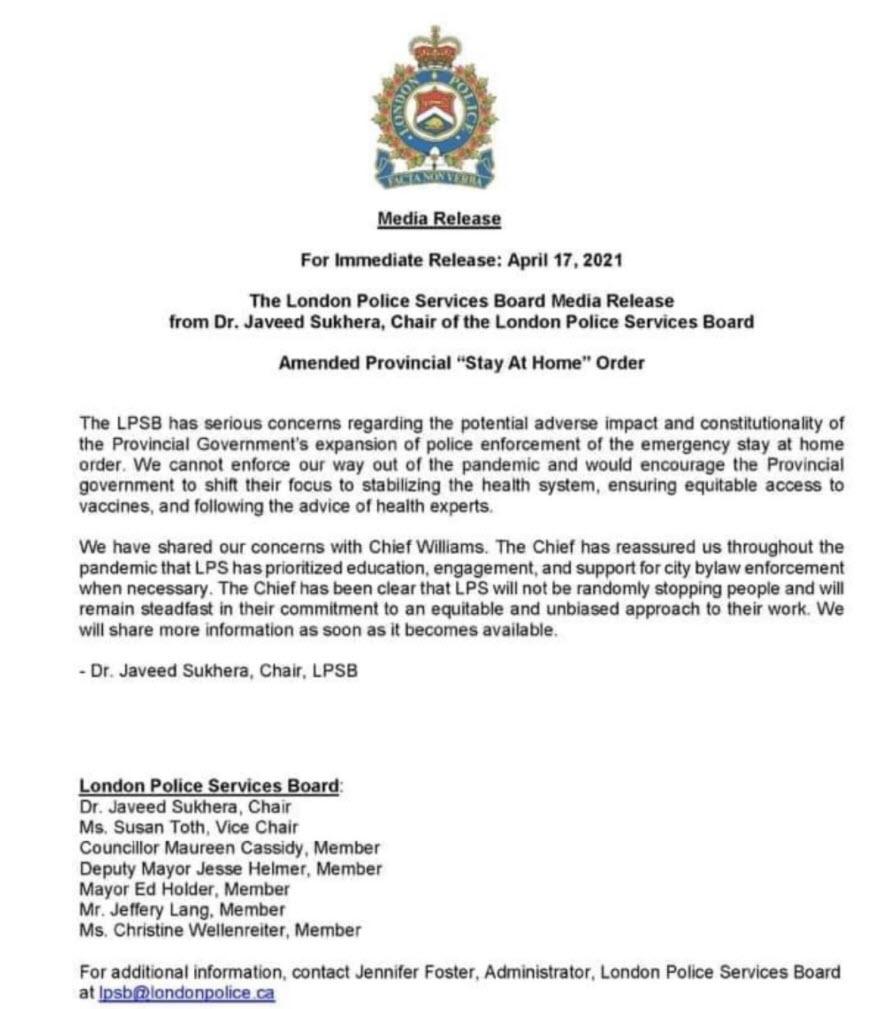
The Ontario government is giving police temporary powers to enforce its stay-at-home order and allowing them to stop individuals and vehicles and ask their reasons for leaving their homes.

Solicitor General Sylvia Jones made the announcement Friday afternoon as part of the new measures introduced by Premier Doug Ford’s government to stop the further spread of COVID-19.

“We have made the deliberate decision to temporarily enhance police officers’ authority for the duration of the stay-at-home order. Moving forward, police will have the authority to require any individual who is not in a place of residence to first provide the purpose for not being at home and provide their home address,” Jones said.

“Police will also have the authority to stop a vehicle to inquire about an individual’s reason for leaving their residence.”

So much for freedom of movement or assembly.  Unless the police deem your presence outside your prison cell home essential, you could be in for trouble.  

Those who will not comply will be issued a ticket, Jones said. The province has not provided further details on possible fines, but she said under the Emergency Management and Civil Protection Act, penalties for non-compliance are set at a minimum of $750.

I find the excerpts from the news conference announcing these changes deeply troubling, just looking at the faces and listening to the tone of these authoritarians as they try to justify their seizure of power over the details of ordinary life.  George Orwell would recognize them:

Ontarian police and local authorities are not necessarily enthusiastic about exercising these new powers to detain citizens and examine their motives for daring to leave home:

A spokesperson for the Toronto Police Service said they are reviewing the new orders.

“Prior to any change in our enforcement strategy, we will notify the public on how we plan to implement the new provincial orders,” spokesperson Allison Sparkes said.

Several police services have said Friday that they will not be randomly stopping people. They include Waterloo Regional PolicePeterborough PoliceGuelph PoliceLondon Police and Ottawa Police.

Toronto Mayor John Tory expressed his concerns over the new police powers, saying in a tweet that he will review the regulations carefully and will discuss them with the medical officer of health and the police chief.

Mississauga Mayor Bonnie Crombie also said stopping people arbitrarily “is not how we get control of the virus.” She added that she will speak to the chief of Peel police and public health to look at how it will be enforced.

It sounds as if the provincial authorities are drawing their inspiration from China’s early response with drastic lockdowns.  At least so far, they are not discussing welding doors shut to trap people inside.  They might also consider the disaster across their own border in Michigan, where Governor Gretchen Whitmer’s drastic lockdown regulations have led to one of if not the worst problems with COVID in the United States, while  free states like Texas and Florida do much better.

I’d be a lot more impressed if, instead of trying tom keep people indoors, where the virus spreads far more readily than outdoors, they focused in early therapeutic intervention in cases of COVID, using ivermectin or hydroxychloroquine, both widely used and relatively benign pharmaceuticals, that inhibit reproduction of the virus and often have been shown to slow and even stop the effects.

Tyler Durden
Sat, 04/17/2021 – 23:00

via ZeroHedge News https://ift.tt/3eduI4O Tyler Durden

“Fentanyl Is Here:” Las Vegas Suffers 200% Surge In Overdose Deaths

“Fentanyl Is Here:” Las Vegas Suffers 200% Surge In Overdose Deaths

America has been engulfed with a drug problem for decades, but the situation is quickly deteriorating as the largest inbound fentanyl traffic into the country was recently reported. Not surprising, but Las Vegas has been the latest metro area to suffer an “alarming” surge in overdose deaths.

According to Las Vegas Sun, fentanyl killed 219 people in the Las Vegas Valley in 2020, a stunning 200% increase from the prior year. 

During the 2015-18 opioid crisis that ravaged many metros across the US, Clark County, Nevada, the area that houses Las Vegas, recorded annual reductions in opioid overdoses and deaths. 

Since then, Mexican fentanyl has flooded the town, and overdoses/deaths have soared. 

We said fentanyl was coming,” Metro Police Capt. John Pelletier told reporters Thursday. “Fentanyl is here.”

Reporters questioned Pelletier about how the drug crisis is going so far (on a year-to-date basis), he answered: “not good.” 

“Clark County fentanyl deaths are on par with the “alarming” 30% increase in total overdose deaths in 2020, when 768 people succumbed to them, compared with 591 in 2019,” Pelletier said, adding that 31 people were killed in the county in August, an average of about one per day. 

Last week, Metro Police announced the creation of the Overdose Response Team, a task force comprised of local police and federal agencies. The task force would pursue murder charges for dealers accused of killing clients with drugs. 

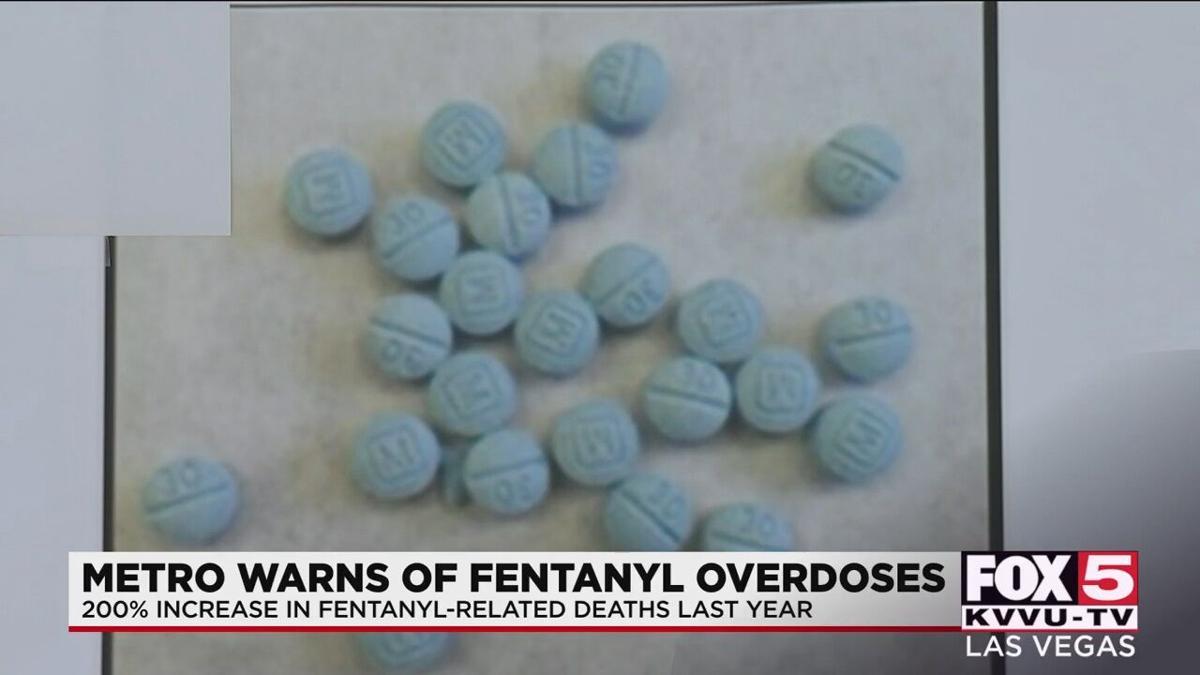
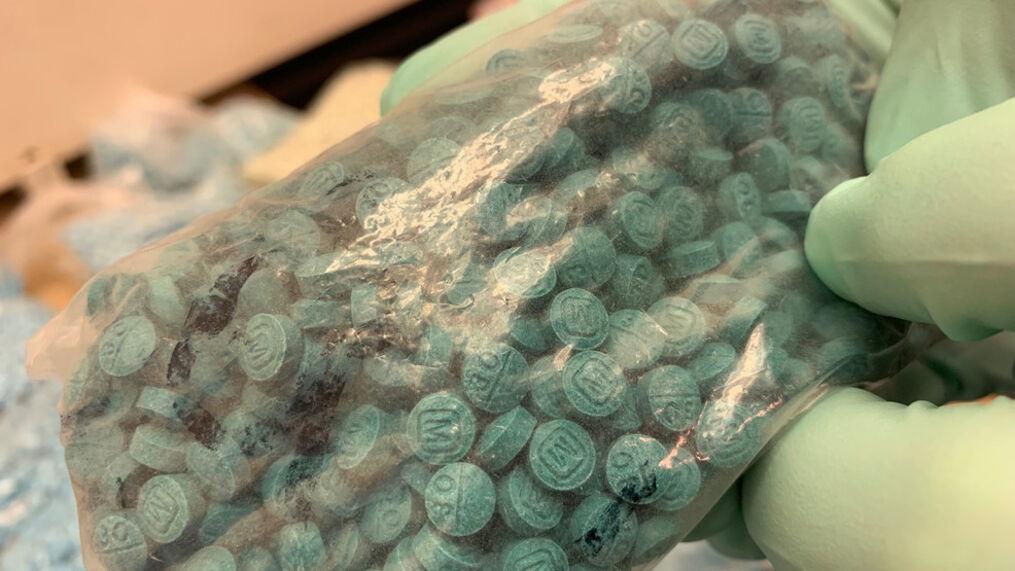
Another issue in Las Vegas and across Clark County is counterfeit pills that look identical to prescription medications are cut with fentanyl and have been responsible for overdoses and deaths. 

The rise in fentanyl use across Clark County coincided with multiple things, such as a socio-economic implosion of Vegas during lockdowns, where tens of thousands of people lost their jobs. At the same time, Mexican drug cartels were pumping record amounts of the drug into the US – some describe this as a ‘perfect storm.’

“This emergency, this situation, does not discriminate,” Pelletier said. “It does not care how old you are; it does not care where you live.”

… and Pelletier is correct. The drug crisis has dramatically worsened since the pandemic began, with many streets in various metro areas have transformed into a “zombie apocalypse.” 

Right now, Mexican drug cartels are pumping US streets with fentanyl, and the Biden administration doesn’t seem too worried about doing anything to stop this from happening with their relaxed border policies. 

Vegas and the surrounding county are the next victims of the fentanyl crisis. Those partying in Vegas, be careful what party drugs you ingest. It could very well be cut with fentanyl. 

Tyler Durden
Sat, 04/17/2021 – 22:30

via ZeroHedge News https://ift.tt/2QBWEah Tyler Durden

The Plutocrats Of Wall Street And Silicon Valley Are Scamming America

The Plutocrats Of Wall Street And Silicon Valley Are Scamming America

Authored by Ryan McMaken via The Mises Institute,

In recent years, it seems that the nation’s CEOs and billionaires are increasingly willing to drop the pretense that they are politically neutral entrepreneurs who simply want to go about their business.

Last week, for example, more than a hundred CEOs met to plot ways to punish the people of Georgia by “stopping investments in states” that pass laws unapproved by the billionaire class.

This comes in the wake of a decision by Major League Baseball—a collection of billionaire-owned sports teams—to punish residents of Georgia for the fact a tiny number of politicians there passed legislation designed to lessen voter fraud. In retaliation, MLB decided to move the league’s all-star game so as to deny the residents of Atlanta the economic benefits of hosting the game.

This comes only a few years after Apple CEO Tim Cook led a corporate campaign to boycott Indiana after Cook and Marc Benioff (the CEO of Salesforce) demanded the people of Indiana be punished. This was because the Indiana legislature passed a law which some billionaires decided was insufficiently pro-LGBT.

These examples, however, constitute only a small and relatively innocuous part of the political scheming and lobbying in which powerful CEOs, billionaires, and investors routinely engage.

Certainly, wealthy CEOs are happy to throw their weight around in pursuit of social policies they like. But while the CEOs’ calls for boycotts and retribution against entire populations of various states makes for good headlines and talk radio, the billionaire class inflicts far more damage on ordinary Americans through other means. 

It is not unusual to find large corporate interests like big banks, Silicon Valley firms, and Wall Street investors calling for a wide variety of policies which transfer wealth from the general public to the well-lined pockets of the monied classes. These can include monetary policies that benefit the wealthiest Americans, as well as tax policies and regulations that favor large well-established firms at the expense of everyone else.

Unfortunately, this is nothing new, and it has always been the case that well-heeled pressure groups attempt to turn their financial resources into political power.

Free Markets vs. the Plutocracy

The potential danger of this situation was not lost on the classical liberals (i.e., the libertarians) of generations past, who opposed “the privileged” among the wealthy who sought to exercise political power.

Specifically, it was the Jeffersonians, the Jacksonians, and other advocates of free markets and laissez-faire who attacked these monied groups under a variety of names. Names like “stock jobbers,” the “new aristocracy,” the “scrip nobility,” and “the plutocracy” have all been employed to draw attention to a wealthy elite which manipulates Congress and the central bank in schemes of economic exploitation.

The Classical Liberals and Economic Exploitation

This language of “exploitation” might strike some readers as odd. Unfortunately, a certain naïve view of social classes has become popular among some conservatives and libertarians who think that that the concept of “class warfare” was invented by the Marxists. Moreover, some even insist that the wealthy classes pose no threat to political or market institutions, and that the wealthy seek only to mind their own business.

But, as historian Ralph Raico has explained, the idea of exploitation of one class by another was, in fact, pioneered by the classical liberals. It was these liberals who well understood that the power of the state could be harnessed by one group for the purposes of extracting resources from another group. Left to itself, of course, the marketplace does not foster exploitation, as market activities are voluntary. Once the state is involved, however, the coercive power of the regime changes the equation. The key to success in exploiting others lays in harnessing the power of the state to carry out the exploiters’ schemes. The wealthy have never been immune to this temptation.

We find these views in an early form in America in the thinking of the Jeffersonian theorist John Taylor of Caroline. Taylor decried the urban investor class that sought to manipulate the new nation’s financial policies to serve this rising plutocracy’s own ends. Taylor, according to Raico,

was outraged by what he saw as the betrayal of the principles of the American Revolution by a new aristocracy based on “separate legal interests,” the bankers privileged to issue paper money as legal tender and the beneficiaries of “public improvements” and protective tariffs. American society has been divided into the privileged and the unprivileged by this “substantial revival of the feudal system.”

The threat of this new “aristocracy” had certainly not lessened by the 1830s, when the Jacksonian William Leggett pointed out that the US had attained its own homegrown exploiter class to rival the haughty ruling classes of the Old World. Referring to the ostentatious palaces erected by the wealthy elites of Genoa, Leggett asked,

Is there no parallel for it in our own [country]? Have we not, in this very city, our “Street of the Palaces,” adorned with structures as superb as those of Genoa in exterior magnificence, and containing within them vaster treasures of wealth? Have we not, too, our privileged orders? Our scrip nobility?1 Aristocrats, clothed with special immunities, who control, indirectly, but certainly, the political power of the state, monopolise the most copious sources of pecuniary profit, and wring the very crust from the hard hand of toil? Have we not, in short, like the wretched serfs of Europe, our lordly masters, “Who make us slaves, and tell us ‘tis their charter?”

For Leggett, the answer to all of this, of course, was yes. To see this new class of plutocrats, Leggett observed, one need only “walk through Wall-street.” Leggett went on to suggests that if anyone “asks concerning the political power” of these Wall Street elites,

he will ascertain that three‐fourths of the legislators of the state are of their own order, and deeply interested in preserving and extending the privileges they enjoy. If he investigates the sources of their prodigious wealth, he will discover that it is extorted, under various delusive names, and by a deceptive process, from the pockets of the unprivileged and unprotected poor. These are the masters in this land of freedom. These are our aristocracy, our scrip nobility, our privileged order of charter‐mongers and money‐changers!

Plutocrats or Private Entrepreneurs?

On the other hand, the great libertarian sociologist William Graham Sumner was careful to note that not all wealthy people are plutocrats. “[W]e must make some important distinctions,” Sumner writes. “Plutocracy ought to be carefully distinguished from ‘the power of capital’…. A great capitalist is no more necessarily a plutocrat than a great general is a tyrant.” In other words, the plutocrats are not simply the factory owners who are on the receiving end of Marxist claims that all capitalists necessarily exploit their workers.

Rather, according to Sumner, the plutocrat is something very specific. Modern plutocrats “buy their way through elections and legislatures, in the confidence of being able to get powers which will recoup them for all the outlay and yield an ample surplus besides.”

That is, plutocrats are political operatives who employ the power of the state to accomplish political and financial ends. Moreover, the plutocrat

is a man who, having the possession of capital, and having the power of it at his disposal, uses it, not industrially, but politically; instead of employing laborers, he enlists lobbyists. Instead of applying capital to land, he operates upon the market by legislation, by artificial monopoly, by legislative privileges; he creates jobs, and erects combinations, which are half political and half industrial … 

Today’s Plutocracy

So, who are the plutocrats of today?

Certainly, this group includes those who seek to blackmail state legislatures with boycotts and pressure tactics. But we find plutocrats using more subtle tactics as well.

For example, Amazon corporation now supports raising the minimum wage. This may seem like some great populist and magnanimous move on Amazon’s part. But it is just what we’ve come to expect from plutocrats. In fact, Amazon’s senior managers know that it can endure paying a higher wage than can Amazon’s smaller and less capitalized competition. Smaller operations have fewer financing options to weather a cash flow crunch and are thus more financially fragile. Basically, Amazon is likely to support a wide variety of government regulations, because government regulations are anticompetitive. Amazon, of course, being the dominant firm, is motivated to crush the competition through state action. This is partly why Jeff Bezos came out in favor of a hike in the corporate tax. He’s just hoping to stay on top, and while a tax hike is unfortunate for him, it’s even worse for the competition that Bezos hopes to destroy through his political lobbying. 

We see similar forces at work when plutocrats like Mark Zuckerberg call for more regulation of social media companies. Zuckerberg is speaking as head of the industry’s largest, most capital rich, and most dominant firm. Now that he’s on top, he’s fine with more regulation, which will hurt small competitors most. (Social media companies, of course, are also happy to buy favors from the regime by deleting user comments and punishing users who annoy regime operatives.)2

But perhaps the most subtle form of exploitation practiced by the plutocrats occurs through the central bank, and this is why the Jeffersonians and Jacksons focused so much on the role of the central bank throughout the nineteenth century. Leggett, after all, is known for calling for “the separation of bank and state.” 

The advantages offered to plutocrats through central banks have been similar for more than two centuries, but in today’s world these advantages can be seen in the fact that central banks are now in the business of pushing up stock prices for the benefit of Wall Street and large public companies. Thanks to the “Greenspan put,” for example, the Federal Reserve has now for three decades been in the business of propping up stock prices. Now, we barely even notice when stock prices soar upward even during periods when millions of workers are laid off and national production collapses. “Stock prices must always go up” is essentially now federal policy. This in itself further helps explain why the plutocrats so often come out in support of higher taxes and a bigger regulatory state. As David Stockman observed, people like Bezos and the Wall Street and Silicon Valley elite: 

have been made so insanely rich by the Fed’s egregious stock market inflation that they no longer care if their businesses are inconvenienced or even deeply harmed by schemes like the Biden [tax hikes]; and, worse still, have no idea about how real, sustainable wealth is generated or that free market prosperity is not at all a sure thing when the state becomes an unhinged wrecker of honest money, fiscal rectitude and financial discipline.

Why worry too much about taxes or regulation when you know you’ll be bailed out by the Fed? Stockman continues:

By and large these new titans are not geniuses. They are bubble riders who were in the right place at the right time. And after years of the Fed’s massive inflation of financial asset prices they have become totally corrupted—politically, intellectually and otherwise.

In all likelihood, they don’t even know how they got rich. But since they are rich, they conclude they must be very smart, and therefore they’re now entitled to run the country; to punish people who live in red states, and run lesser business owners into the ground using the power of the state. 

The nation’s billionaires and megacorps benefit from central banking schemes in other ways as well. Ultralow interest rate policies mean an endless tsunami of cheap debt. Nonetheless, the focus has remained on lending to the lowest-risk firms, which means there’s far less financing available to smaller start-ups and other riskier enterprises. Low rates also mean financially conservative small-time investors can only earn very small returns on their investments. Generally, it’s only the wealthy who can indulge in high-risk yield chasing, which further enriches the wealthy as others stagnate. The end result is more liquidity for the plutocrats while the newcomers fight over scraps.

The Fed now buys corporate debt, and for more than a decade has been buying up assets in order to prop up what would have been the ailing portfolios of the nation’s megabanks and investment firms. The Fed’s monetary inflation leads to immense amounts of asset inflation not only in stocks, but in housing prices as well. This impoverishes first-time home buyers and renters, but benefits those who are already wealthy—and own lots of these assets.

It’s all part of a well-established scam that the laissez-faire liberals identified long ago. The plutocrats hope to keep it going forever. 

Tyler Durden
Sat, 04/17/2021 – 22:00

via ZeroHedge News https://ift.tt/3e93Kvf Tyler Durden

Taco Bell Opens “Digital-Only” Location In Times Square That Serves Alcohol 

Taco Bell Opens “Digital-Only” Location In Times Square That Serves Alcohol 

Restaurants continue to change their processes to improve the customer experience in a virus pandemic. Under the guise of social distancing, Taco Bell has opened a “digital-only” fast-food shop in Times Square that customers can only order food online or through automated kiosks. 

These modern features of digital-only ordering and pick-up will minimize customer to employee interaction. The digital-only front-end of the eatery allows for more convenient pick-up.

“Built with the energy and on-the-go vibrance of the city in mind, the newest restaurant embraces technology in a whole new way to serve the demands of New Yorkers,” Taco Bell said in a press release

The simplified design will keep employees in the backend of the fast-food joint occupied with fulfilling orders. The disbandment of cash registers at the new Taco Bell Cantina in Times Square will require fewer employees to run operations. 

The restaurants have a smaller footprint than a traditional Taco Bell and offer more modern and upscale designs and alcohol. So far, 20 Cantinas across New York’s five boroughs are already open (though the only digital-only one is in Times Square). 

Other restaurant chains, like Chipotle Mexican Grill and Starbucks, have been opening digital-only ordering and pick-up. The focus is not just to minimize human labor but also to increase pick-up orders forced by the virus pandemic. The first digital location Taco Bell opened was in London in 2020. 

The automated concept could be standard at all Taco Bells by the end of this decade as restaurants pivot towards automation and artificial intelligence, which will displace workers, leading to a surge in technological unemployment. 

Yum Brands, which owns KFC, Pizza Hut, Taco Bell, The Habit Burger Grill, and WingStreet worldwide, except in China, will likely expand automation and artificial intelligence in all its stores over this decade. 

What’s frightening is when Yum begins to use robot chefs to automate the backend of the restaurant – essentially eliminating human food preppers. Already, KFC is testing what it calls the “restaurant of the future,” where automation and artificial intelligence dominates the front and back end.

Big corporations are preparing to replace low-skill and low-paid workers with all sorts of new technology through 2030, displacing millions of them. Many of these restaurants will be entirely contactless.

All of this suggests technological unemployment is set to skyrocket in the coming years. So then what to do with all the displaced workers? Nothing like starting a war can help dig the economy out of the rut that it’s currently in and resolve the unemployment situation.

Tyler Durden
Sat, 04/17/2021 – 21:30

via ZeroHedge News https://ift.tt/3n4qUqM Tyler Durden

Black Lives Matter Activist Charged With Anti-Asian Hate Crime

Black Lives Matter Activist Charged With Anti-Asian Hate Crime

Authored by Paul Joseph Watson via Summit News,

A Black Lives Matter activist was arrested in Seattle for allegedly committing two separate hate crimes against Asian people, once again contradicting the media narrative that Donald Trump’s rhetoric on coronavirus was primarily to blame for the hate crime wave.

Pamela Cole, who is Asian, told KIRO 7 News about her experience on March 16 during which she and her young children were subjected to a frightening and abusive attack by a man who later turned out to be 51-year-old BLM protester Christopher Hamner.

Hamner had posted multiple photos of himself attending BLM protests and was also involved in the Seattle CHOP encampment that was populated by Antifa and BLM demonstrators.

“The moment he made eye contact with me he stopped, opens his door and he’s screaming, ‘F— you, you Asian b—-. F— you!’ and I was in complete shock. Are you talking to me?” Cole said.

Cole said she felt like her family were “sitting ducks” as Hamner then proceeded to get out of his vehicle while demanding they get out too.

“I just felt so defenseless and so helpless. And you know as a mom, all we want to do is take care of our kids and protect them,” Cole said.

Cole said that even after the light changed and she was able to drive away, Hamner continued to throw objects at her car and track where she was heading. She was eventually able to pull over and call the police.

“Hamner is accused of committing a similar hate crime two days later, when he cut off two Asian women in a vehicle. The vehicle had a dashboard camera, which enabled authorities to identify Hamner,” reports the Hill, adding that Hamner again charged at the vehicle and threw objects.

After being charged, Hamner pleaded not guilty to hate crimes and his bail has been set at $10,000 dollars.

The two incidents once again expose how the media’s attempt to pin a wave of anti-Asian hate crimes on “white supremacy” by saying they were incited by Donald Trump’s anti-Chinese COVID 19 rhetoric has completely failed.

In virtually every major recent incident where Asians were targeted by violent criminals in hate crime attacks, the perpetrators turn out to be African-American men.

Crime stats also show white people are underrepresented per capita in attacks against Asians.

As the Washington Examiner highlights, citing FBI statistics, whereas whites comprise 62% of the population, they committed 24% of crimes against Asians in 2018.

In comparison, blacks, who comprise 13% of the population, committed 27.5% of all violent crimes against Asian Americans in 2018.

The media’s fake narrative that “white supremacy” is to blame for the hate crime spree in now inciting violent attacks against white people.

37-year-old Michael Sangbong Rhee attacked a woman he believed was white by holding her at gunpoint and trying to rape her.

According to authorities, the attack was “in retaliation for the rise in hate crimes against Asian people.”

*  *  *

Brand new merch now available! Get it at https://www.pjwshop.com/

*  *  *

In the age of mass Silicon Valley censorship It is crucial that we stay in touch. I need you to sign up for my free newsletter here. Support my sponsor – Turbo Force – a supercharged boost of clean energy without the comedown. Also, I urgently need your financial support here.

Tyler Durden
Sat, 04/17/2021 – 21:00

via ZeroHedge News https://ift.tt/3ednzBw Tyler Durden

Trader Fueled Lavish Lifestyle Running Singapore’s “Largest Ever Suspected Investment Fraud”

Trader Fueled Lavish Lifestyle Running Singapore’s “Largest Ever Suspected Investment Fraud”

Stop us if you’ve heard this one before: a young, up and coming “wunderkind” trader was living a lavish lifestyle on the back of a massive fraud.

Can’t be possible, you say? Enter 33 year old Ng Yu Zhi, living in a three-story villa in Singapore, driving a $5 million supercar. The only problem? He had raised at least $740 million from investors for commodity trades that didn’t exist, Bloomberg reported this week. 

He was charged last month with four counts of fraud. It’s being called one of Singapore’s “largest-ever suspected investment frauds”. Court proceedings this week revealed that he was able to raise the money by touting quarterly gains of 15% to investors. It would have made him one of the most successful traders in the world, had it of been true. 

The fraud was centered around his companies Envy Asset Management and Envy Global Trading. Of more than S$1 billion he had invested in his companies, S$300 million had been transferred to his personal account and S$200 million remains “unaccounted for”. Investors had received payments of S$700 million but are still owed S$1 billion, the report says. 

In riding the broader “green” tailwind that has blown tons of hot money into global markets, Ng had purported to invest in nickel, a key ingredient in electric vehicle batteries. Specifically, per Bloomberg:

Ng was involved in deceiving investors into buying supposed forward contracts that were purportedly with French lender BNP Paribas SA, but those contracts didn’t exist, according to the charge sheets. BNP had no account or trading history with Ng, Envy Asset Management or Envy Global Trading, a person familiar with the matter said. A BNP spokesperson declined to comment.

Song Seng Wun, an economist at CIMB Private Banking, thinks more instances of “suspect behavior” will be revealed, thanks to investors feeling like they need to “reach” for returns in an era of low rates. Thanks, Central Banks.

Song said: “This won’t be the last case and that’s the sad reality.”

Shim Wai Han, an investor in Ng with their company Envysion Wealth Management Pte., said: “Our objective now is just one thing. To get back the money for investors and for ourselves.” Shim said she was “working on this together with MAS (The Monetary Authority of Singapore) to help investors.”

Ng has been released on S$1.5 million bail for the time being and is being monitored by an electronic ankle bracelet. He had become “an increasingly visible figure in Singapore’s philanthropic, supercar and corporate communities” over the last couple of years, Bloomberg noted. 

He received an award in August 2020 for his philanthropy and a Pagani Huayra supercar was seized as part of his assets after being charged. The car is valued around $5 million. 

Tyler Durden
Sat, 04/17/2021 – 20:30

via ZeroHedge News https://ift.tt/3suadG2 Tyler Durden