Biden Infrastructure Bill Includes Passive Monitoring Vehicle “Kill Switch” Mandates For Automakers
As if the Biden administration wasn’t doing enough to infringe on your civil liberties with lockdowns and vaccine mandates, media reports over the last several days are suggesting that Biden’s new infrastructure bill will also include a mandate for auto manufacturers to install “kill switches” into vehicles.
Former Rep. Bob Barr, writing for The Daily Caller, calls the measure “disturbingly short on details”, but for the fact that the proposed device must “passively monitor the performance of a driver of a motor vehicle to accurately identify whether that driver may be impaired.”
Which, of course, is code for some kind of device that is constantly on and monitoring your vehicle – and will likely have the power to shut down your vehicle anytime it wants.
“This is a privacy disaster in the making, and the fact that the provision made it through the Congress reveals — yet again — how little its members care about the privacy of their constituents,” The Daily Caller writes.
It appears that in President Biden’s future, not only will you not be in charge of your own personal health decisions, but you also won’t be in charge of whether or not you can fire up your car, which you bought with your hard-earned money, to drive it somewhere, when you deem fit.
That decision will now “rest in the hands of an algorithm”, the report says. Similar monitoring and control devices have faced constitutional opposition, the report notes, “notably with the 5th Amendment’s right to not self-incriminate, and the 6th Amendment’s right to face one’s accuser.”
Barr concludes: “Unless this regulatory mandate is not quickly removed or defanged by way of an appropriations rider preventing its implementation, the freedom of the open road that individual car ownership brought to the American Dream, will be but another vague memory of an era no longer to be enjoyed by future generations.”
Russiagate, that fraudulent fable wherein Russian President Vladimir Putin personally subverted American democracy, Russian intelligence pilfered the Democratic Party’s email, and Donald Trump acted at the Kremlin’s behest, is at last dead.
No, nothing sudden. It has been a slow, painful death of the sort this destructive beast richly deserved. But its demise is now definitive — in the courts and on paper. We await the better historians to see this properly into the record.
Three key operatives in the construction of the Russiagate edifice are indicted for lying to the Federal Bureau of Investigation about aspects of the Russiagate tale. The Steele dossier, the document on which much of the case against former President Trump rested, is now exposed as a Nixonesque “dirty trick” authorized and paid for by Hillary Clinton’s 2016 campaign. Some mainstream newspapers — certainly not all — are busy in their archives, editing out the worst of the falsehoods they reported in 2016 and 2017 as unassailable fact. This is a wholesale collapse now.
There are, as one would expect, those who seem determined to hold out no matter what the factual evidence. These go well beyond MSNBC’s Rachel Maddow, whose record I will let speak for itself.
I am thinking of people such as David Corn, the Mother Jones correspondent in Washington, and David Frum, a staff writer at The Atlantic. Both invested big time into the Russiagate junk, and both published books filled with the ridiculous, evidence-free piffle of which it was made.
Corn, Frum and numerous others like them are now industriously throwing good money after bad to go by recent publications. Here is Corn’s latest, and here Frum’s. One finds the same tired combination of presumption, useless innuendo, and spoon-fed, evidence-deficient falsities derived from the intelligence agencies that were key to fomenting the Russiagate hoax. Yes, Messrs. Corn and Frum, it was a hoax.
To these diehards, people such as your columnist, given to rational, disinterested consideration of what is known and what is conjured from thin air, are “denialists.” Strange it is that those denying established facts and truths call those who accept these facts and truths by this name.
But this is a measure of the extent Russiagate has plunged us into Alice–in–Wonderland depths where what is up is down, what is dark is light, what is true is to be buried, what is false is to be held high — where blindness is preferred to sight.
This leads us to the essential question we now face, or one of them. What are the consequences of the Russiagate scam? If it rested on lies start-to-finish, this is not to say it did not exact its price. It did. The price is high, and we are fated to pay it for some time to come.
The Damage Done
An inquiry of this kind must begin with the damage Russiagate has done to the prevalent American consciousness. The last five years have delivered Americans into a culture of unreason of the kind they have been prone to indulging periodically throughout their history. It is made in equal parts of a native insecurity and anxiety, of paranoia and of irrationality.
This is at once a pitiable and dangerous state. All is reduced to the Manichean distinctions characteristic of the old Westerns (not to mention most of the good guys vs. bad guys Dreck that comes out of Hollywood these days). No subtlety of thought survives in the culture of unreason. Public space is populated with poseurs, cutouts, and imposters. Public discourse, with some exceptions, is much of the time not worth bothering with.
To understand this condition, we must recognize it as the work of a diabolic alliance comprised of the Democratic Party’s corrupt leadership, the FBI and other law-enforcement agencies, the national security apparatus and its many appendages, and the media. It is no longer in the slightest objectionable to speak or write of a Deep State that controls this country.
The elite minority this alliance represents derives its power from its claim to speak for the majority — an absolutely classic case of the “soft despotism” Alexis de Tocqueville warned Americans of 190 years ago. Liberal authoritarianism is another name for what has consolidated itself in the years since Democrats, in mid–2016, first raised the phony specter of Russia “hacking” into its mail systems.
In effect, Russiagate has tipped the American polity upside down. It is the illiberal liberals among us, righteous as the old Puritan ministers of New England, who now prosecute a regime of censorship and suppression of dissent that is at least as severe and anti-democratic as what conservatives had going during the Cold War (and in my view worse).
It is they who seek to cow ordinary Americans into the new, weird idolatry of authority, no matter that those to whom the nation is urged to bow are proven liars, law-breakers and propagandists.
Culture of Unreason
There is, of course, the more dangerous world Russiagate has done so much to create. In the culture of unreason, the Deep State has a discouraging record of success in gaining wide public support for any aggressive campaign against any nation or people it wishes to act against. In this dimension, Russiagate has destroyed the Democrats as a party willing to stand against the imperial project in its late phase.
A war with China over the Taiwan question is now spoken of as a logical possibility. Washington is now raising the temperature on the Ukraine–Russia border, just as it did when it cultivated the 2014 coup in Kiev, and this is put across as a Democratic administration’s sound policy. Rampant Russophobia is a direct consequence of the Russiagate ruse, Sinophobia its uglier sibling — uglier for its racist subtext.
We have active subversion operations in Nicaragua, Venezuela, Cuba and Peru, all progressive states in the true meaning of this term, and Democrats of all stripes — including “progressives” with the necessary quotation marks — cheer on every one of them. We cannot view this as distinct from the elevation of institutions dedicated to campaigns of covert subterfuge — chiefly but not only the CIA. — to wholly inappropriate positions of respect.
The damage Russiagate has done to the press … let me rephrase this. The damage the press has inflicted upon itself in the cause of Russiagate is so extensive it is hard to calculate with any precision. We watch now as their credibility collapses in real time. Those running the mainstream newspapers and networks seem to understand this, as they rush to protect what remains of their reputations with rearguard actions to obscure their grossly irresponsible conduct.
NYT & WashPost showered themselves with Pulitzers for their monomaniacal obsession with Russiagate. Even after Mueller admitted he could find no evidence to establish the conspiracy and indicted *nobody* for it, they persisted. We’ll see what they do now:https://t.co/CLYp0rgZM6
The long list of those who caved to the Russiagate orthodoxy includes some stunning names. Among publications that should have known better we find Mother Jones,The Nation, The Intercept, and Democracy Now! Was it conformity, pressure from donors or Democratic Party ventriloquists, or some combination of ideology, ignorance and inexperience that caused them to flip?
The Atlantic,The New Yorker, the major dailies, the networks — they have all sustained one or another degree of discredit, left either to craven rewrites in their archives, denial in the Corn–Frum mode, or silence. None will do: They will never regain lost ground without first acknowledging what they have done, and this appears out of the question.
Resort of Omission
The feature of the corporate-owned press — and the “progressive,” press, as just suggested — that strikes me most now is its resort of omission. Think about it: Lengthy hearings on Capitol Hill, in which leading Democratic Party Russiagaters admit under oath they never had any of the evidence they long claimed, go unreported. The collapse of the Steele dossier goes unreported in The New York Times and other major dailies.
It is but a short step to all else that is newsworthy but left out — the collapse of the case against Julian Assange (against whom the Russiagate frenzy was wielded), the collapse of the chemical weapons case in Syria, all the above-noted covert subversions. It is wholesale dereliction of duty now, and it was Russiagate that licensed this betrayal.
Mainstream media are now approaching that point when they leave out more of the world we live in than they report. This is a losing proposition in the medium term — a desperate, last-ditch strategy to defend a “narrative” that simply no longer holds. I put the acceleration of this trend down to the poisoned information environment Russiagate did so much to engender.
There is a positive dimension to the media’s fate since Russiagate, and regular readers of this column may already guess where I am headed. The disaster Russiagate has proven for the corporate-owned press, the networks, and the “left” — with-quotation-marks — press has landed independent media such as Consortium News with large, new responsibilities, and they have by-and-large risen to the occasion. Their role in keeping the truth of the Russiagate fraud on the table cannot be overstated.
We witness, in effect, an historically significant transformation in how Americans get their news and analysis. This, a gradual process, is an excellent thing. In time, independent media stand to play as important a role in repairing the across-the-board damage of Russiagate as legacy media played in hatching and deepening it.
‘Never Seen Anything Like It’: Los Angeles Residents Stunned As Violent Crimes Creep Into Wealthier Communities
After two years of rising crime in Los Angeles, residents of upscale neighborhoods are finally starting to freak out after a spate of ‘flash mob‘ lootings at high-end retail stores have been accompanied with a disturbing increase in violent crimes committed in the suburbs, according to the LA Times.
Crews of burglars publicly smashing their way into Los Angeles’ most exclusive stores. Robbers following their victims, including a star of “The Real Housewives of Beverly Hills” and a BET host, to their residences. And this week, the fatal shooting of 81-year-old Jacqueline Avant, an admired philanthropist and wife of music legend Clarence Avant, in her Beverly Hills home.
…these incidents have sparked a national conversation and led to local concern about both the crimes themselves and where the outrage over the violence will lead.
“The fact that this has happened, her being shot and killed in her own home, after giving, sharing, and caring for 81 years has shaken the laws of the Universe,” said Oprah Winfrey, expressing grief over Avant’s killing via Twitter. “The world is upside down.”
The Times notes that while overall crime rates within Los Angeles remain far below the notoriously violent 1990s, much of it has been concentrated in poor communities – so it receives virtually no attention. Now that crime has “crept up in wealthier enclaves and thrust its way to the center of public discourse” across the city.
Turning point?
In 2020, polls showed that California voters largely supported criminal justice reform, as well as rolling back tough sentencing laws to reduce prison populations without nary a thought to how it might affect the crime rate. Now, those concerned about crime and blame liberal policies for its rise are growing more vocal.
For others, it’s been a serious wake-up call.
“I have never seen anything like it,” said Dominick DeLuca, owner of the Brooklyn Projects skateboard shop on Melrose Avenue where burglaries and robberies have seen a sharp enough spike in recent months that he’s now carrying a gun to work. “In the last two years, I have been broken into three times.”
On Thursday, Mayor Eric Garcetti and LAPD Chief Michael Moore advocated for locking offenders up, and questioned several pandemic-related policies that put nonviolent arrestees back on the street without bail.
Moore said arrests had been made in several high-profile “smash-and-grab” burglaries but lamented that the suspects had all been released pending trial. Garcetti said warehousing criminals in jails without rehabilitating them is not a solution, but neither is ceding the streets to repeat offenders.
Los Angeles County Dist. Atty. George Gascón, whose progressive policies around prosecution and sentencing many blame for the uptick in crime, was notably absent at the press conference but said through his office that he is working closely with law enforcement partners to hold perpetrators accountable for such brazen crimes. -LA Times
According to LAPD data through Nov. 27, property crime is up 2.6% YoY, but is down 6t.6% from 2019, while robberies are up 3.9% YoY and down 13.6% from 2019. Burglaries are down 8.4% from last year and 7.7% from 2019. Car thefts, meanwhile, are up nearly 53% vs. 2019.
The difference? Rich people are now getting hit, so officials are officially concerned.
What’s more, violent crime is way up – with homicides jumping 46.7% and shootings up 51.4% vs. 2019. As of the end of last month, there were 359 homicides year-to-date, compared with 355 in all of 2020. That said 2008 was LA’s deadliest year with 384 homicides.
There are many good recommendations promoted by Austrian school economists for improving the economy. Although we enjoy successes periodically, most–such as deregulating trucking and airline pricing–involve eliminating previous government interventions. These successes are to be celebrated, of course. But no one can deny that government intervention into the economy has continued, despite these occasional success stories.
The reason Big Government has continued to grow is that it controls money production. Not only does government grow in terms of spending, regulations, and interventions everywhere (both internally and overseas), but it threatens our very freedoms. In other words, government’s control of money is diametrically opposed to peace, prosperity, and freedom and eventually will destroy our republican democracy. For this reason, returning to sound money–i.e., money that is created by the private market, is part and parcel of the market, and is controlled by no one–should be goal number one for every lover of peace, prosperity, and freedom. Nothing less than the survival of our western-style way of life is at stake.
Here are a few examples of how unsound money progresses and masks its destructive power.
One, unsound money allows government to confiscate resources at will. For example, in 2020 America’s bloated military spent as much as the next eleven nations of the world combined. Of course, military spending went up in 2021 and will continue to increase in 2022. America’s annual budget deficit is projected to be somewhere between $1.84 trillion and $3.4 trillion, depending upon whether you ask the Biden administration or the Congressional Budget Office. All of this money is created out of thin air. Americans’ taxes will not increase enough to cover even a fraction of the Biden estimate, and there is no appetite in the bond market for more American debt. Therefore, the Fed will monetize the new debt onto its balance sheet. The resulting increase in base money will cause the prices of most goods and services to rise. This impoverishment of the American people through the hidden tax of inflation is possible only because money is completely fiat; i.e., produced out of nothing except the government’s printing press and computer terminals.
Two, unsound money masks the destructive power of government market interventions. An example is former President Trump’s tariffs on Chinese goods. According to a friend of mine, the data is irrefutable that the tariffs worked. Well, as Mark Twain said, there’s lies, damned lies, and statistics. What really is irrefutable is the economic law of opportunity cost; i.e., that choosing one thing means the giving up of another. Another is individual preference. The very fact that people must not be allowed to purchase Chinese goods means that they valued those goods to a higher extent than American goods. The reason does not have to be financial. There’s always service, availability, quality, etc. So preventing Americans from buying Chinese goods means less satisfaction for Americans. This is just one example. Another is keeping zombie companies in business through artificially lower interest rates means that capital is misallocated to less productive uses. There’s a whole panoply of labor laws that artificially raises the cost of American labor, reduces American productivity, and lowers business income. Some workers are priced out of the market through minimum wage and mandatory benefit packages. Business has less capital to invest for expansion. New business starts are discouraged. There’s something there for everyone! The destruction is masked by monetarily inflated GDP numbers, artificially suppressed Consumer Price Index (CPI) statistics, increased unemployment payments, and other government programs and manipulated data.
Three, and most importantly, Americans’ freedom is threatened. Government can print enough money to buy unlimited enforcers of its rules. More IRS agents. More agents for enforcing arbitrary rules of the Occupational, Safety, and Health Administration (OSHA). More agents for enforcing new environmental regulations and laws arbitrarily established by the Environmental Protection Agency (EPA). More Drug Enforcement Agency (DEA) agents. Perhaps even agents to confiscate guns.
Conclusion
Returning to limited government, creating a more free market order, having a less intrusive government, etc. requires sound money. Sound money is not a guarantee of a free society, but a free society is impossible without sound money.
I conclude with these quotes from The Quotable Mises. The last quote is especially pertinent to the point of this brief essay. (Emphases are mine.)
The gold standard alone makes the determination of money’s purchasing power independent of the ambitions and machinations of governments, of dictators, of political parties, and of pressure groups. The gold standard alone is what the nineteenth-century freedom-loving leaders (who championed representative government, civil liberties, and prosperity for all) called “sound money.”
All those intent upon sabotaging the evolution toward welfare, peace, freedom, and democracy loathed the gold standard, and not only on account of its economic significance. In their eyes the gold standard was the labarum, the symbol, of all those doctrines and policies they wanted to destroy.
The classical or orthodox gold standard alone is a truly effective check on the power of the government to inflate the currency. Without such a check all other constitutional safeguards can be rendered vain.
I do not want to close on a pessimistic note. Therefore, I offer this final quote from Ludwig von Mises, ever the optimist and ever the gentleman: “Every nation, whether rich or poor, powerful or feeble, can at any hour once again adopt the gold standard.”
Dark Winter Looms For Pennsylvanians As Power Bills Set To Soar
Power prices in some parts of Pennsylvania are set to jump as much as 50% beginning this month, according to the Pennsylvania Public Utility Commission (PUC).
“Most Pennsylvania regulated electric utilities are adjusting the price they charge for the generation portion of customers’ bills on December 1 for non-shopping customers, also known as the ‘Price to Compare’ (PTC). The PTC averages 40% to 60% of the customer’s total utility bill. However, this percent varies by the utility and by the level of individual customer usage,” PUC said in a press release.
PUC lists power increases for residential customers. The most significant increase comes from Pike County Light & Power, which serves nearly 5,000 customers, is expected to raise power prices by 50%. The second highest is PPL Corporation, serving about 1.4 million customers in central and eastern parts of the state, which is expected to raise power prices by 26%.
Citizens’ Electric, up from 6.9777 cents to 7.9476 cents per kWh (13.9%);
Duquesne Light, up from 7.41 cents to 7.98 cents per kWh (7.7%);
Met-Ed, up from 7.114 cents to 7.414 cents per kWh (4.2%);
PECO, up from 6.597 cents to 7.021 cents per kWh (6.4%);
Penelec, down from 6.761 cents to 6.507 cents per kWh (3.8%);
Penn Power, down from 7.657 cents to 7.593 cents per kWh (less than 1%);
PPL, up from 7.544 cents to 9.502 cents per kWh (26%);
Pike County Light & Power, up from 6.5234 cents to 9.796 cents per kWh (50.2%);
Wellsboro Electric, up from 7.2596 cents to 7.5051 cents per kWh (3.4%); and
West Penn Power, up from 5.447 cents to 5.698 cents per kWh (4.6%);
A PUC spokesperson told Fox News that rising energy prices are due to “market forces.”
Many Pennsylvanians will be in for a sticker shock this winter as the Northern Hemisphere winter approaches. Customers are already stretched thin with soaring food, fuel, and shelter inflation. It’s a good thing Fed Chairman Jerome Powell told Congress on Tuesday that he would “retire” the “transitory” narrative to explain the inflationary environment that continues to crush the working poor.
We noted last week that Americans, already preparing for one of the darkest cold seasons in years, have been panic buying cords of firewood and stoves as they seek alternative methods to heat their homes to mitigate soaring power prices.
Persistent inflation this winter will continue to increase discontent for President Biden and could be favorable for Republicans ahead of midterm next year.
As bitcoin gains mainstream acceptance from centralized financial institutions, will Wall Street come to ruin what is most powerful about the asset?
Bitcoin’s potential is immense — an independent global reserve asset, the foundation of a more ethical financial system, uncorrupted by centralized financial overlords.
But what is the risk that bitcoin could become co-opted and corrupted by those centralized financial overlords? What if bitcoin loses its independence? What if bitcoin merely becomes another speculative Wall Street plaything?
TLDR: Wall Street’s growing importance is unavoidable as bitcoin goes mainstream, but correlations will not rise indefinitely and bitcoin’s independence remains in the hands of everyday users like me and you.
HOW BITCOIN’S TECHNICAL SECURITY ADVANCED IN 2021
The great bitcoin mining migration of 2021 further decentralized bitcoin mining, which enhanced its security and reduced the possibility of a technical attack on the network itself. Furthermore, bitcoin showed in 2017 that it is resistant to change. A group of miners and merchants alienated themselves from the community because they ignored the community and pushed for an increase to the blocksize.
So, Bitcoin is technically secure and unlikely to change its underlying principles. The network is decentralized and principles enshrined. Users have vehemently defended those principles. However, technical risks are not the only risks to bitcoin.
WHAT IF BITCOIN BECOMES BITCOINTM, A WALL STREET PLAYTHING?
Ben Hunt outlined some of these softer, more philosophical fears around Bitcoin in his very thought-provoking article “In Praise Of Bitcoin,” in which he wrote about the prospect of BitcoinTM emerging:
“What is Bitcoin!TM in abstracted form? It’s a securitization or representation of Bitcoin ownership that promises the price appreciation of Bitcoin without the hassle of Bitcoin ownership. It’s a casino chip that represents the price of Bitcoin. Michael Saylor, for example, is only too happy to sell you a MicroStrategy casino chip. Or maybe you’d prefer to play on the Canadian crypto ETF felt? Or try your luck at the wheel of a Morgan Stanley private fund?”
This is a much more insidious risk than a technical attack or government regulation, in my opinion, and it warrants reflection.
S&P 500 CORRELATION VS. BITCOIN RISING AGAIN: SHOULD WE BE WORRIED?
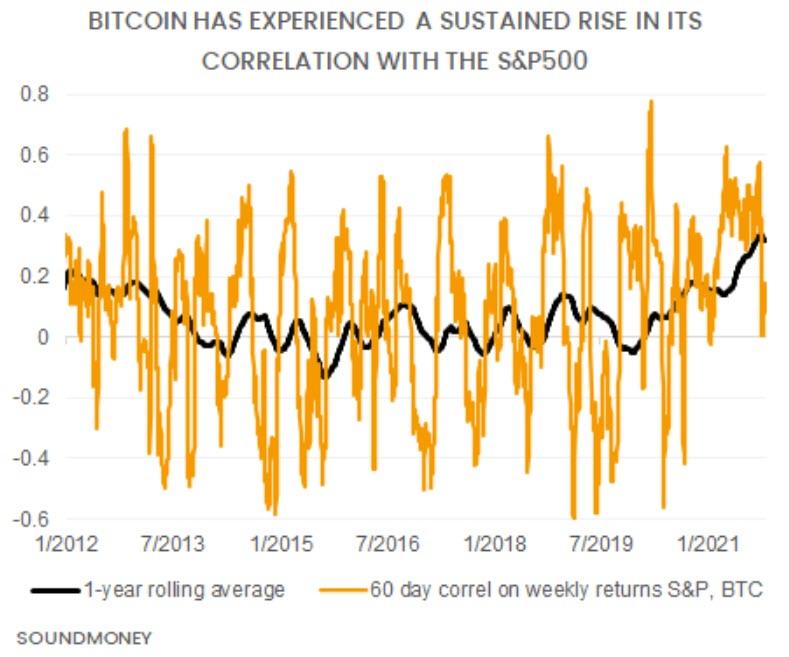
I recently noticed that the one-year rolling correlation between bitcoin and the S&P 500 reached its highest levels on record, according to a chart accessed via Glassnode. This shows that there is a growing relationship between Wall Street and bitcoin, which could be a signal that our worst fears are coming to fruition. Should we be worried?
Source: Glassnode and Sound Money
CENTRAL BANK POLICY DOMINATES ALL ASSET CLASSES
From a technical perspective, different asset classes can be driven by the same factors, even if the assets are fundamentally different in nature. For example, inflation can drive gold and equities higher simultaneously but it can also generate divergent outcomes under different circumstances.
It is no surprise that bitcoin and equity markets are both being driven higher by excessively loose monetary policy, which debases the value of fiat currencies. Many other asset classes are caught in the same theme, including property and bonds.
A rising trend in correlations does not imply that the trend will remain intact indefinitely.
But it could…
WHAT COULD CAUSE A RISING CORRELATION TO BECOME A PERMANENT FEATURE?
If Wall Street creates numerous financial products and trade in these products starts to dominate relative to actual users of the technology, the rising correlation between the S&P 500 and bitcoin could become a permanent feature. What if regulators force users to comply with numerous KYC and AML measures, reducing its censorship-resistant qualities and rendering it less independent?
A couple of responses to each scenario:
1) INSTITUTIONALIZATION IS INEVITABLE BUT THAT DOES NOT IMPLY WALL STREET MUST DOMINATE
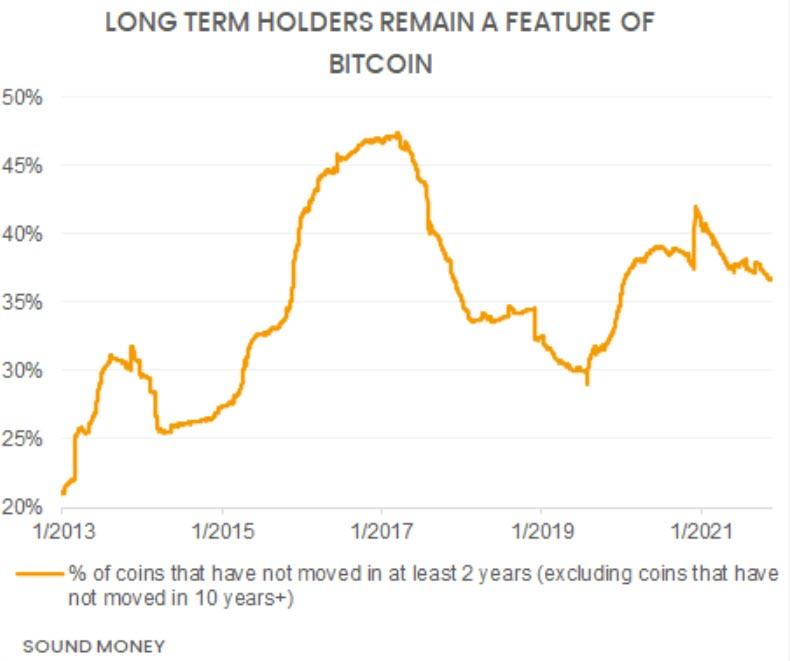
Take a look at the holders of bitcoin today: More than 35% of coins have not moved in at least two years, according to data from Glassnode, which is a strong indication of long-term investment behavior. Some percentage of these holders could be institutional investors. But the fact that they are not trading the asset implies that, for one, they do not view the asset as a speculative plaything and secondly, that they choose to expose themselves to the vagaries and eccentricities of this alternative monetary network for the long haul, i.e., they are investing on bitcoin’s terms, not Wall Street’s.
Source: Glassnode and Sound Money
Bitcoin has no central bank to enter the market during periods of turmoil. The buyers of last resort are everyday bitcoiners who believe in the project and store their long-term wealth in the asset. It’s these bitcoiners who create the price floors during price crashes.
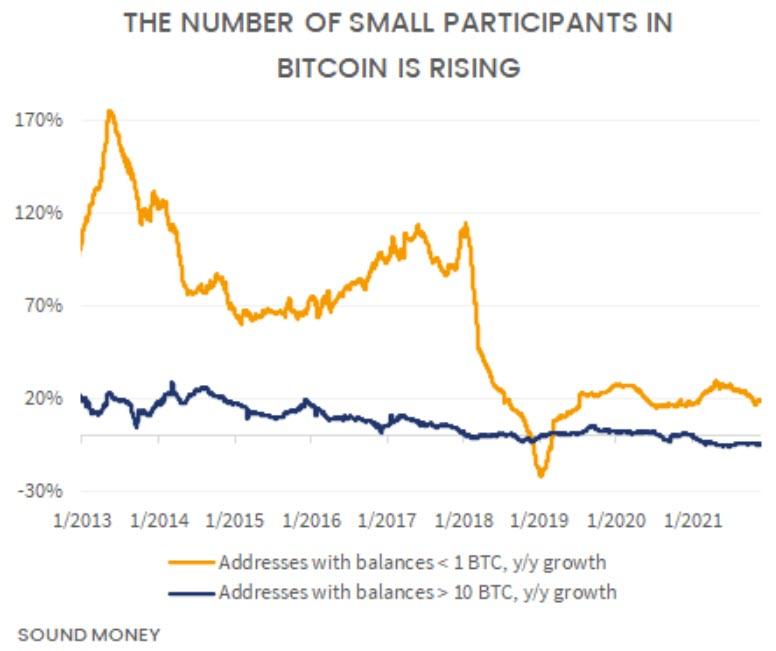
On-chain research via Glassnode shows that the number of addresses with balances less than 1 bitcoin continues to rise in 2021, giving an indication that smaller holders remain a very important dynamic in the market. By contrast, the growth in the number of addresses with balances great than 100 bitcoin has been negative throughout 2021, also per data accessed on Glassnode.
Source: Glassnode and Sound Money
Conclusion: Yes, Wall Street is becoming important for bitcoin, but that does not imply Wall Street dominates bitcoin.
2) PRIVACY IS CRITICAL AND AVAILABLE TO THOSE WHO NEED IT
I would like to remind readers that privacy is a human right and is required by all to live fulfilling human lives. You would not want someone peering into your bedroom every morning! Not only is the right to privacy enshrined in the constitution of numerous countries but also in Article 12 of the UN’s “Declaration Of Human Rights” (UDHR), from 1948.
The desire for privacy does not imply tax evasion or criminal activity. Numerous people require privacy to live due to targeted, government-mandated, financial exclusion. There are more obvious examples in autocratic governments like China, Venezuela and Afghanistan, but there are also more nuanced examples in the countries regarded as the “free world.”
Increasingly stringent financial, travel, property and speech restrictions imposed in 2020 and 2021 implies that the number of people who may be forced into privacy will increase.
Thankfully, numerous users across cryptocurrency markets remain focused on privacy, using techniques to protect their human rights, including privacy-focused altcoins and mixing services to protect fungibility .
Conclusion: While greater government oversight of cryptocurrency is inevitable, greater privacy is also available to those who are willing to put in the effort to get it. Moreover, developers continue to work on technical upgrades which enhance privacy, like Taproot in bitcoin.
CONCLUSIONS
I am worried about bitcoin being co-opted by traditional financial markets and a rising correlation between bitcoin and the S&P 500 accentuates my fear.
Practically speaking, a rising correlation between bitcoin and the S&P500 indicates less diversification potential for traditional investors investing into bitcoin. I do not think it will dramatically alter people’s allocation decisions (0.4 is still a pretty low correlation), but it could because the optimal risk-adjusted portfolio could advocate for a slightly lower allocation based on mean-variance optimizations.
However, a rising correlation should not be extrapolated higher indefinitely into the future. The reasons for the correlation, its persistence and its breakdown should be assessed.
Ultimately, it is unsurprising that extreme central bank policies are driving all financial markets in 2021. If central banks were to remove their stimulus, even if only temporarily, it would have a negative impact on risk assets, including equity, like the S&P 500 and bitcoin.
Investors should never get complacent about this tighter monetary policy risk despite the incredibly low probability that central banks will be able to implement prudent policies with higher real interest rates for any length of time.
Despite all my worries about large players dominating bitcoin and government oversight negating the censorship resistant characteristics of bitcoin, grassroots bitcoiners continue to grow and access to privacy-preserving techniques is increasing.
I continue to encourage all holders of bitcoin to use the technology. You may hold the asset as an investment and may not want to touch it for many years to come — that’s great! But get a little bit of bitcoin in a wallet, send it to your friend and realize the value of decentralized, borderless value transfer and storage so that we continue to advocate for this independent system maintained by individuals, not institutions.
In March, a divided panel of the U.S. Court of Appeals for the Sixth Circuit rejected a Bureau of Alcohol, Tobacco & Firearms declaring that bump stocks constitute illegal “machine guns” under federal law, overturning a district court ruling to the contrary. Among other things, the panel majority concluded that the ATF’s interpretation was not eligible for Chevron deference. In June, the entire court granted a petition for rehearing en banc.
Yet just because there was no opinion for the court does not mean there were no opinions. There were three. Judges White and Gibbons each delivered an opinion in support of affirming the district court. Judge White’s opinion was joined by Judges Moore, Cole, Clay, and Stranch. Judge Gibbons’ opinion was joined by Justice Moore, Cole. White and Stranch. [Judges Griffin and Donald apparently voted to affirm the district court as well, but did not join either opinion.]
Judge Murphy delivered a dissenting opinion, joined by Chief Judge Sutton and Judges Batchelder, Kethledge, Thapar, Bush, Larsen, and Nalbandian. (Senior Judge Batchleder participated because she had been on the original three-judge panel. Judge Readler was recused.)
Although many have interest in this case because it concerns bump stocks, the dueling opinions focused on questions of statutory interpretation and the application of Chevron deference. The judges disagreed over whether a bump stock qualifies as a “machinegun” under 26 U.S.C. § 5845(b) and, insofar as the statutory language is ambiguous, whether the ATF’s interpretation merits Chevron deference given (among other things) that unlawful machinegun possession is a criminal offense.
Here is the relevant statutory text, as summarized in Judge White’s opinion:
Congress defined the term, “machinegun,” to mean “any weapon which shoots, is designed to shoot, or can be readily restored to shoot, automatically more than one shot, without manual reloading, by a single function of the trigger.” 26 U.S.C. § 5845(b). “Machinegun” also includes “the frame or receiver of any such weapon” as well as “any part designed and intended solely and exclusively, or combination of parts designed and intended, for use in converting a weapon into a machinegun, and any combination of parts from which a machinegun can be assembled if such parts are in the possession or under the control of a person.” Id.
In the view of at least six judges, a bump stock constitutes a “machinegun” udner the best interpretation of this language. Five judges further concluded (as articulated in Judge White’s opinion) that the ATF interpretation should be upheld under Chevron deference:
Chevron provides the standard of review, even though the law under consideration has criminal applications. Applying Chevron, Congress has not spoken to the precise question at issue and, after exhausting the traditional tools of statutory construction, § 5845(b) remains ambiguous. Because ATF’s interpretation of § 5845(b) is a permissible construction of the statute and is reasonable, it is entitled to Chevron deference.
Judge White also argued that the rule of lenity was inapplicable and that, even if Chevron deference did not apply, ATF’s interpretation should be accepted under Skidmore.
Judge Gibbons separate opinion agreed that Chevron can apply to statutes with criminal penalties, but that “Chevron application is unnecessary” here because the ATF’s interpretation was “unambiguously the best interpretation” of the statute.
Judge Murphy’s dissent took quite a different view of the statutory language and the applicability of Chevron. Here is how his opinion begins:
Since the early days of our Republic, it has been a bedrock legal principle that our government cannot criminalize conduct and send people to prison except through democratically passed laws that have made it through both Houses of Congress and been signed by the President. See United States v. Hudson, 11 U.S. 32, 34 (1812). Yet the Bureau of Alcohol, Tobacco, Firearms, and Explosives (ATF) has sought to ban “bump stocks” in a far different way: through a regulation adopted by a federal agency alone. BumpStock-Type Devices, 83 Fed. Reg. 66,514 (Dec. 26, 2018) (“Bump-Stock Rule”). By an equally divided vote, our court affirms a decision rejecting a legal challenge to the ATF’s Bump-Stock Rule. I must respectfully dissent from this judgment. Nothing in Congress’s two relevant statutes delegates to the ATF such broad power to expand a crime’s scope through this sort of regulatory lawmaking.
In 1986, Congress amended the Gun Control Act of 1968 to make it a crime to possess a “machinegun,” 18 U.S.C. § 922(o)(1), a term defined in the National Firearms Act of 1934, 26 U.S.C. § 5845(b). Gun Owners of Am., Inc. v. Garland, 992 F.3d 446, 450–51 (6th Cir. 2021). For years, the ATF asserted that private parties could lawfully possess the bump stocks at issue in this case because these devices did not fall within Congress’s “machinegun” definition. Bump-Stock Rule, 83 Fed. Reg. at 66,516. So Americans bought millions of dollars’ worth of bump stocks. Id. at 66,547. Then the ATF changed its position. In the Bump-Stock Rule, the ATF agreed that the possession of bump stocks had been lawful in the past but asserted that the devices would become illegal “machineguns” on the rule’s effective date. Id. at 66,525. There thus can be no doubt that the Bump-Stock Rule creates a new crime.
Judge Batchelder’s panel opinion persuasively explained that neither the Gun Control Act nor the National Firearms Act gives the ATF the power to expand the law banning machine guns through this legislative shortcut. Gun Owners, 992 F.3d at 454–74. I write to add a few more thoughts on why bump stocks are not “machineguns” under these laws and why we cannot fall back on “Chevron deference” to save the ATF’s rule. See Chevron, U.S.A., Inc. v. Nat. Res. Def. Council, Inc., 467 U.S. 837 (1984). Many people, I suspect, would not understand why anyone would want to own a bump stock, a device that helps a person shoot semiautomatic rifles at rapid rates approaching those of automatic weapons. But this case has nothing to do with the policy debate over whether Congress should have banned bump stocks after the tragic Las Vegas
shooting in 2017. Despite the introduction of multiple bills, Congress opted not to pass such legislation. And while the burdensome legislative process may seem “unworkable” in today’s polarized age, it is a core component of our separation of powers designed to protect the liberty of all Americans—not just bump-stock owners. INS v. Chadha, 462 U.S. 919, 959 (1983). Whether one favors or disfavors a policy banning bump stocks, we should all be concerned with the way in which the federal government has enacted that policy into law.
In the course of his dissent, Judge Murphy devotes some time to critiquing the opinions of other federal circuit courts that have upheld the ATF’s bump stock ban.
The circuit courts that have upheld the Bump-Stock Rule have not suggested that the ATF’s contrary view “is the better reading of the statute.” Guedes, 920 F.3d at 30. Indeed, they have not even felt the need to ask which is the better reading. Id. They have instead held that they must review the ATF’s reading under Chevron‘s “two-step” approach. Id. at 17–28; Aposhian v. Barr, 958 F.3d 969, 979–84 (10th Cir. 2020). At step one, these courts find that “automatically” and “single function of the trigger” are sufficiently ambiguous to require courts
to defer to the ATF’s reading. Aposhian, 958 F.3d at 988–89; Guedes, 920 F.3d at 29–31. At step two, they hold that the ATF’s reading is “permissible.” Aposhian, 958 F.3d at 984–88; Guedes, 920 F.3d at 31–32.
I find three problems with this approach. First, the courts justify their use of Chevron with irrelevant cases that interpret statutes expressly delegating power to an agency to enact criminal regulations. Second, the courts wrongly expand Chevron‘s domain by holding that Congress impliedly delegated to the Attorney General the power to interpret a criminal law merely because it gave him a general authority to enact regulations. Third, even under Chevron‘s regime, the courts improperly find ambiguity without attempting to figure out the statute’s meaning.
This portion of Judge Murphy’s opinion highlights that, although all three federal circuit courts to consider the question have upheld the ATF’s bump stock ban, judges have split over the reasons why, and have adopted different approaches to the applicability and application of Chevron.
Judge Murphy’s dissent concludes:
By continuously firing at rapid speeds with one activation of the trigger, machine guns can inflict great harm in short periods. And no doubt many people believe that rifles equipped with bump stocks share the same dangerous traits that led Congress to ban machine guns. Bump-Stock Rule, 83 Fed. Reg. at 66,520. So even though these newer devices might not fall “within the letter” of the statutory “machinegun” ban, courts may be tempted to treat them as covered anyway because they fall within its underlying “spirit.” Holy Trinity Church v. United States, 143 U.S. 457, 459 (1892). In a country with a fluid separation of powers between the branches of government, this judicial approach of enlarging a statute through “equitable” interpretation rather than legislation might not be problematic. See John F. Manning, Textualism and the Equity of the Statute, 101 Colum. L. Rev. 1, 8 (2001). In our country, however, the judiciary has long had a narrower duty: “to apply, not amend, the work of the People’s representatives.” Henson v. Santander Consumer USA Inc., 137 S. Ct. 1718, 1726 (2017). This duty leaves the policy debate over whether to ban bump stocks where it belongs—with the legislative branch accountable to the people. And since that branch has not seen fit to ban bump stocks or give a federal agency the power to do so, I must respectfully dissent from our judgment affirming the district court’s decision in this case.
In March, a divided panel of the U.S. Court of Appeals for the Sixth Circuit rejected a Bureau of Alcohol, Tobacco & Firearms declaring that bump stocks constitute illegal “machine guns” under federal law, overturning a district court ruling to the contrary. Among other things, the panel majority concluded that the ATF’s interpretation was not eligible for Chevron deference. In June, the entire court granted a petition for rehearing en banc.
Yet just because there was no opinion for the court does not mean there were no opinions. There were three. Judges White and Gibbons each delivered an opinion in support of affirming the district court. Judge White’s opinion was joined by Judges Moore, Cole, Clay, and Stranch. Judge Gibbons’ opinion was joined by Justice Moore, Cole. White and Stranch. [Judges Griffin and Donald apparently voted to affirm the district court as well, but did not join either opinion.]
Judge Murphy delivered a dissenting opinion, joined by Chief Judge Sutton and Judges Batchelder, Kethledge, Thapar, Bush, Larsen, and Nalbandian. (Senior Judge Batchleder participated because she had been on the original three-judge panel. Judge Readler was recused.)
Although many have interest in this case because it concerns bump stocks, the dueling opinions focused on questions of statutory interpretation and the application of Chevron deference. The judges disagreed over whether a bump stock qualifies as a “machinegun” under 26 U.S.C. § 5845(b) and, insofar as the statutory language is ambiguous, whether the ATF’s interpretation merits Chevron deference given (among other things) that unlawful machinegun possession is a criminal offense.
Here is the relevant statutory text, as summarized in Judge White’s opinion:
Congress defined the term, “machinegun,” to mean “any weapon which shoots, is designed to shoot, or can be readily restored to shoot, automatically more than one shot, without manual reloading, by a single function of the trigger.” 26 U.S.C. § 5845(b). “Machinegun” also includes “the frame or receiver of any such weapon” as well as “any part designed and intended solely and exclusively, or combination of parts designed and intended, for use in converting a weapon into a machinegun, and any combination of parts from which a machinegun can be assembled if such parts are in the possession or under the control of a person.” Id.
In the view of at least six judges, a bump stock constitutes a “machinegun” udner the best interpretation of this language. Five judges further concluded (as articulated in Judge White’s opinion) that the ATF interpretation should be upheld under Chevron deference:
Chevron provides the standard of review, even though the law under consideration has criminal applications. Applying Chevron, Congress has not spoken to the precise question at issue and, after exhausting the traditional tools of statutory construction, § 5845(b) remains ambiguous. Because ATF’s interpretation of § 5845(b) is a permissible construction of the statute and is reasonable, it is entitled to Chevron deference.
Judge White also argued that the rule of lenity was inapplicable and that, even if Chevron deference did not apply, ATF’s interpretation should be accepted under Skidmore.
Judge Gibbons separate opinion agreed that Chevron can apply to statutes with criminal penalties, but that “Chevron application is unnecessary” here because the ATF’s interpretation was “unambiguously the best interpretation” of the statute.
Judge Murphy’s dissent took quite a different view of the statutory language and the applicability of Chevron. Here is how his opinion begins:
Since the early days of our Republic, it has been a bedrock legal principle that our government cannot criminalize conduct and send people to prison except through democratically passed laws that have made it through both Houses of Congress and been signed by the President. See United States v. Hudson, 11 U.S. 32, 34 (1812). Yet the Bureau of Alcohol, Tobacco, Firearms, and Explosives (ATF) has sought to ban “bump stocks” in a far different way: through a regulation adopted by a federal agency alone. BumpStock-Type Devices, 83 Fed. Reg. 66,514 (Dec. 26, 2018) (“Bump-Stock Rule”). By an equally divided vote, our court affirms a decision rejecting a legal challenge to the ATF’s Bump-Stock Rule. I must respectfully dissent from this judgment. Nothing in Congress’s two relevant statutes delegates to the ATF such broad power to expand a crime’s scope through this sort of regulatory lawmaking.
In 1986, Congress amended the Gun Control Act of 1968 to make it a crime to possess a “machinegun,” 18 U.S.C. § 922(o)(1), a term defined in the National Firearms Act of 1934, 26 U.S.C. § 5845(b). Gun Owners of Am., Inc. v. Garland, 992 F.3d 446, 450–51 (6th Cir. 2021). For years, the ATF asserted that private parties could lawfully possess the bump stocks at issue in this case because these devices did not fall within Congress’s “machinegun” definition. Bump-Stock Rule, 83 Fed. Reg. at 66,516. So Americans bought millions of dollars’ worth of bump stocks. Id. at 66,547. Then the ATF changed its position. In the Bump-Stock Rule, the ATF agreed that the possession of bump stocks had been lawful in the past but asserted that the devices would become illegal “machineguns” on the rule’s effective date. Id. at 66,525. There thus can be no doubt that the Bump-Stock Rule creates a new crime.
Judge Batchelder’s panel opinion persuasively explained that neither the Gun Control Act nor the National Firearms Act gives the ATF the power to expand the law banning machine guns through this legislative shortcut. Gun Owners, 992 F.3d at 454–74. I write to add a few more thoughts on why bump stocks are not “machineguns” under these laws and why we cannot fall back on “Chevron deference” to save the ATF’s rule. See Chevron, U.S.A., Inc. v. Nat. Res. Def. Council, Inc., 467 U.S. 837 (1984). Many people, I suspect, would not understand why anyone would want to own a bump stock, a device that helps a person shoot semiautomatic rifles at rapid rates approaching those of automatic weapons. But this case has nothing to do with the policy debate over whether Congress should have banned bump stocks after the tragic Las Vegas
shooting in 2017. Despite the introduction of multiple bills, Congress opted not to pass such legislation. And while the burdensome legislative process may seem “unworkable” in today’s polarized age, it is a core component of our separation of powers designed to protect the liberty of all Americans—not just bump-stock owners. INS v. Chadha, 462 U.S. 919, 959 (1983). Whether one favors or disfavors a policy banning bump stocks, we should all be concerned with the way in which the federal government has enacted that policy into law.
In the course of his dissent, Judge Murphy devotes some time to critiquing the opinions of other federal circuit courts that have upheld the ATF’s bump stock ban.
The circuit courts that have upheld the Bump-Stock Rule have not suggested that the ATF’s contrary view “is the better reading of the statute.” Guedes, 920 F.3d at 30. Indeed, they have not even felt the need to ask which is the better reading. Id. They have instead held that they must review the ATF’s reading under Chevron‘s “two-step” approach. Id. at 17–28; Aposhian v. Barr, 958 F.3d 969, 979–84 (10th Cir. 2020). At step one, these courts find that “automatically” and “single function of the trigger” are sufficiently ambiguous to require courts
to defer to the ATF’s reading. Aposhian, 958 F.3d at 988–89; Guedes, 920 F.3d at 29–31. At step two, they hold that the ATF’s reading is “permissible.” Aposhian, 958 F.3d at 984–88; Guedes, 920 F.3d at 31–32.
I find three problems with this approach. First, the courts justify their use of Chevron with irrelevant cases that interpret statutes expressly delegating power to an agency to enact criminal regulations. Second, the courts wrongly expand Chevron‘s domain by holding that Congress impliedly delegated to the Attorney General the power to interpret a criminal law merely because it gave him a general authority to enact regulations. Third, even under Chevron‘s regime, the courts improperly find ambiguity without attempting to figure out the statute’s meaning.
This portion of Judge Murphy’s opinion highlights that, although all three federal circuit courts to consider the question have upheld the ATF’s bump stock ban, judges have split over the reasons why, and have adopted different approaches to the applicability and application of Chevron.
Judge Murphy’s dissent concludes:
By continuously firing at rapid speeds with one activation of the trigger, machine guns can inflict great harm in short periods. And no doubt many people believe that rifles equipped with bump stocks share the same dangerous traits that led Congress to ban machine guns. Bump-Stock Rule, 83 Fed. Reg. at 66,520. So even though these newer devices might not fall “within the letter” of the statutory “machinegun” ban, courts may be tempted to treat them as covered anyway because they fall within its underlying “spirit.” Holy Trinity Church v. United States, 143 U.S. 457, 459 (1892). In a country with a fluid separation of powers between the branches of government, this judicial approach of enlarging a statute through “equitable” interpretation rather than legislation might not be problematic. See John F. Manning, Textualism and the Equity of the Statute, 101 Colum. L. Rev. 1, 8 (2001). In our country, however, the judiciary has long had a narrower duty: “to apply, not amend, the work of the People’s representatives.” Henson v. Santander Consumer USA Inc., 137 S. Ct. 1718, 1726 (2017). This duty leaves the policy debate over whether to ban bump stocks where it belongs—with the legislative branch accountable to the people. And since that branch has not seen fit to ban bump stocks or give a federal agency the power to do so, I must respectfully dissent from our judgment affirming the district court’s decision in this case.
Steve Cohen’s Point 72 Venture Fund Is Backing A 24 Hour Equities Exchange
Steven Cohen’s Point72 Ventures is getting behind the idea of 24 hour a day stock trading.
The venture arm of Point72 is leading a $14.25 million funding round for a company called “24 Exchange”, which was founded in 2018 and has already launched FX and crypto trading platforms, according to the WSJ.
It is now seeking approval from the SEC to become an around the clock exchange.
The company believes that traders who are used to trading currencies and Bitcoin, which trades all the time, want the same experience for equity markets.
The obvious downside to such a venture, in addition to needing regulatory approval, would be poor liquidity during off hours. But Point 72 seems to think that “24-hour equities trading has a large potential market, including nonprofessionals trading from home and overseas investors with an appetite for U.S. stocks,” the WSJ reported.
Point72 Ventures partner Pete Casella commented: “When you look at the growth of equities trading over the last couple of years, a lot of that has been the increased role of retail. These are people with day jobs, so they want to trade at night and on weekends.”
The company plans on completing its applications to the SEC by the end of December, Dmitri Galinov, founder and chief executive of 24 Exchange, said.
This means it’ll likely be “well into” 2022 before the SEC renders a decision.
24 Exchange has U.S. offices in Stamford, CT and Miami, and is incorporated in Bermuda.
Point 72 ventures has also invested in fintech startups like Acorns and Say Technologies.
CNN star anchor Chris Cuomo was fired on Saturday, just days after the network suspended him amid an internal investigation into his efforts to help his brother, former Governor Andrew Cuomo, fight a sexual harassment scandal.
“Chris Cuomo was suspended earlier this week pending further evaluation of new information that came to light about his involvement with his brother’s defense,” read a Saturday statement from CNN. “We retained a respected law firm to conduct the review, and have terminated him, effective immediately. While in the process of that review, additional information has come to light. Despite the termination, we will investigate as appropriate.”
As the New York Times reports, the announcement is a ‘stunning downfall’ for the network’s top-rated anchor who had – up until last month – enjoyed the support of CNN president Jeff Zucker. He notably faced no discipline for strategizing with his brother’s political aides – ‘a breach of basic journalistic norms.’
Brian Stelter of CNN‘s “Reliable Sources” predicted Cuomo would be back in January. Whoops.
Brian Stelter, CNN’s chief media correspondent, said he believes it is possible that Chris Cuomo will be back on air in January.https://t.co/NQhLpmz2CP
Chris Cuomo’s undoing came after the NY Attorney General released a batch of testimony and text messages on Nov. 29 which revealed Cuomo had played a far more intimate and direct role in his brother’s damage control.
In May, CNN anchor Jake Tapper spoke out publicly against the Cuomo brothers – saying that his colleague had “put us in a bad spot,” adding “I cannot imagine a world in which anybody in journalism thinks that that was appropriate.”