Report Finds Gruesome Medical Malpractice and Death in Arizona Prisons


elderly-inmate

A paraplegic man was left to physically deteriorate until his penis had to be amputated. A man with undiagnosed, untreated lung cancer lost 90 pounds and died “slowly and agonizingly” without pain medication. A woman’s multiple sclerosis was ignored and misdiagnosed until she was left, at age 36, nearly completely paralyzed.

Arizona’s prison system is on trial once again in a long-running civil lawsuit over claims of medical neglect, including the examples above, and a doctor’s testimony in the case paints a stomach-churning picture of unnecessary suffering, malpractice, and death behind prison walls.

In an expert witness report filed last week in the lawsuit, Tod Wilcox, medical director of the Salt Lake County Jail System, describes several cases of preventable deaths that he says were offensive to him as a medical professional and showed that Arizona prisons put incarcerated people at unacceptable risks of harm.

“A system that allows this level of sustained incompetence and cruelty, and fails to take decisive action to determine the causes of these myriad and horrific breakdowns and to ensure that the people involved in this case are thoroughly retrained and/or separated from service,” Wilcox writes, “is morally bankrupt.”

Wilcox’s report found that the poor quality of nursing inside Arizona prisons continues to put incarcerated people “at an unreasonable and substantial risk of serious harm.”

As Reason has reported, medical neglect is widespread in American prisons and jails, despite the Eighth Amendment’s supposed guarantee of basic medical care, hygiene, and living conditions. 

The American Civil Liberties Union of Arizona and several law firms have been litigating the case since 2012. The federal class-action lawsuit, filed against the Arizona Department of Corrections, Rehabilitation, and Reentry (ADCRR), followed media investigations and persistent allegations of fatally inadequate medical care by the department’s medical provider.

The ADCRR agreed to settle the lawsuit in 2015 by taking steps to improve medical care inside its prisons. But since then, the ACLU and several other law firms have repeatedly accused the ADCRR of failing to abide by the settlement agreement, and federal judges have agreed.

A federal magistrate judge fined the ADCRR $1.4 million in 2018. Judge Roslyn Silver of the U.S. District Court for the District of Arizona held the department in contempt this February and fined it another $1.1 million for failing to meet the benchmarks for proper medical care. Silver also rescinded the settlement agreement, forcing the ADCRR back into court, where a civil trial began last week.

The ACLU argues that the lack of medical and mental health care constitute cruel and unusual punishment under the Eighth Amendment.

“It falls very, very short of the constitutional standard,” says Corene Kendrick, deputy director of the ACLU’s National Prison Project. “The bar is pretty low. It’s not like they’re entitled to a Mayo Clinic level of medical care. We’re just talking about basic, fundamental stuff. Unfortunately our experts are finding that, systematically, they fall short.”

Kendall Johnson, one of several incarcerated witnesses in the trial, testified last week via video conference from the special needs unit where she is now confined due to advanced multiple sclerosis.

According to Wilcox’s report, it took three years after Johnson first reported numbness in her feet and legs before she was correctly diagnosed. In the meantime, she progressively weakened and lost the ability to walk. Johnson testified last week that she wrote letters asking for help until she couldn’t, then had other inmates write on her behalf. She eventually had to resort to paying other inmates to feed her, she said.

After she was diagnosed, it took another year for Johnson to start receiving appropriate medication, but by that time the disease had irreversibly progressed, leaving her “profoundly disabled,” Wilcox writes. The best she can look forward to is maintaining the ability to speak and swallow for some time.

Johnson testified that she spends her days now watching TV and “counting the ceiling tiles,” the Arizona Republic reported.

Wilcox describes another case where an incarcerated man, whose name is redacted from the report, died “horrific and painful death” from lung cancer. Staff overlooked, ignored, and failed to act on obvious signs of cancer, including drastic weight loss.

“A grown man who has lost 90 pounds from his baseline is a medical crisis that demands an explanation,” Wilcox writes. 

Instead, in response to the man’s complaints of severe throat pain and weight loss, a nurse practitioner told him to “eat slow and cut food in small pieces.”

Even the man’s end-of-life care, after he was finally diagnosed with lung cancer, was substandard, Wilcox says. For two months, the man received only Tylenol #3 pills for pain, which in addition to being inadequate for pain management was “malpractice,” Wilcox writes, because the man could barely swallow and had already had life-threatening gastrointestinal bleeding from anti-inflammatory drugs. He eventually received morphine, but only sporadically.

Wilcox says the patient’s “end of life care does not conform to any standard of care for palliative or hospice care. His cachetic body was racked with pain, and he wasted away with no reasonable assistance from medical science in the form of comfort or compassionate pain control.”

In another case, Wilcox describes a paraplegic man who has open sores on his buttocks and scrotum from sliding from his broken wheelchair onto a toilet, as well as having to frequently sit in his own waste. Prison officials allowed his condition to deteriorate until his penis had to be amputated.

According to Wilcox’s report, Centurion, the ADCRR’s contracted medical care provider, won’t even give the man moistened wipes to keep himself clean.

“The amazing thing is that the provider wants to deny him some very inexpensive wipes and Centurion runs the risk of having him develop infections and skin breakdown which would cost phenomenally more money to address through hospital stays and plastic surgery,” Wilcox writes. “The priorities here just make no logical sense.”

Wilcox’s report concluded that the main problem with the ADCRR’s healthcare system is the quality of nursing.

“By design, healthcare decisions in [Arizona prisons] are pushed down to the lowest possible level—nurses who are practicing poorly and far outside the scope of their licenses,” Wilcox writes. “There is a clear pattern of failure by nurses to complete an adequate nursing assessment, take patient reports seriously, recognize dangerous symptoms, and elevate concerns to Providers.”

Even if the ADCRR had complied with the rules of the settlement agreement, Wilcox writes, incarcerated people would still be at serious risk of harm “because when they did see providers and nurses, those clinicians often exercised poor clinical judgment and failed to provide clinical care that meets community standards for such care.”

A spokesperson for the ADCRR declined to comment, citing the pending litigation.

from Latest – Reason.com https://ift.tt/3D2gC1u
via IFTTT

The FDA Warns That Hand Sanitizer ‘Can Cause Serious Injury’ If You Put It in Your Eyes


dreamstime_xxl_178104119

Last week the government issued a press release sure to distress anyone who was about to sanitize their hands: “FDA warns that getting alcohol-based hand sanitizer in the eyes can cause serious injury.”

This is scary stuff. Everyone I know carries hand sanitizer at all times, particularly since the pandemic. Is hand sanitizer blinding an entire generation?

Well, not quite. It seems that, perhaps lacking other public health emergencies to deal with, the government decided to study the issue of eye injuries hand sanitizer might be causing. To do so, it reviewed calls to poison control centers, as well as the academic literature on sanitizer eye injuries, from January 1, 2018 trough April 30, 2021. That is, it studied two and a half years’ worth of ocular incidents, starting a year before COVID-19 right on up through its crest. And in a country of 330,000,000 people over the course of 1,215 days, what horrible truth did the FDA discover?

Precisely “3,642 cases of side effects resulting from eye exposure to these hand sanitizers.” How many of those folks went blind? Zero.

How many of them required eye surgery?

Zero.

So what were the horrific “side effects” discovered by the FDA? Eye irritation and “red eye.”

But that’s not quite the whole story, the agency hastened to add. Among those 3,000+ cases of eye irritation, 58 were categorized as “more serious.” These were treated via a radical intervention known as “rinsing the eye.” Twenty-six of those folks also received antibiotics. In the end, 51 of the 58 were treated and released, but I don’t think you have to worry that the other seven eventually turned up at guide dog orientation. Their particular cases “were either not followed or were minor.”

The FDA adds that when it reviewed two other publications, it encountered 18 cases of “eye exposure” in children that required treatment in a hospital or by a health care professional (which I assume could include a school nurse). Ten had some eye damage, and two required surgery. And another study reported on two children who needed several days of eye-washing and medicine for their problems to resolve.

While that obviously must have been disturbing for those families, why is the government publicly warning us about something that happened to a truly minimal number of people when hundreds of millions of people are using this stuff day in and day out with no eye damage?

“Our policies follow our fears, not the facts,” says David Ropeik, author of How Risky Is It?. We are a culture that distrusts chemicals and fears for our kids on almost every front. “Raising the alarm on behalf of public safety feels like a public service,” Ropeik says. Even when it’s not.

And as chemist Josh Bloom, Director of Chemical and Pharmaceutical Science at the often-skeptical American Council on Science and Health, points out: “There are few chemicals that won’t do damage if you get them in your eye.”

The FDA also warns about the dangers of breathing in hand sanitizer vapors, having discovered 50 adverse incidents over the course of 11 years. That’s almost five a year, or one incident for every 66,000,000 people. For comparison, your odds of dying in a lacrosse incident are 1 in 22,000,000.

“These are the same people who could not approve an at-home COVID-19 test for a year,” says John Tierney, former New York Times science writer and author of The Power of Bad.

Blame it on the Purell fumes.

from Latest – Reason.com https://ift.tt/3D4Fs0w
via IFTTT

“The Most Important Question For The Market Is Identifying The Driver Behind Record Low Negative Real Rates”

“The Most Important Question For The Market Is Identifying The Driver Behind Record Low Negative Real Rates”

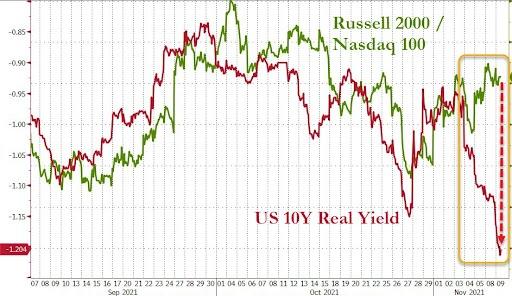
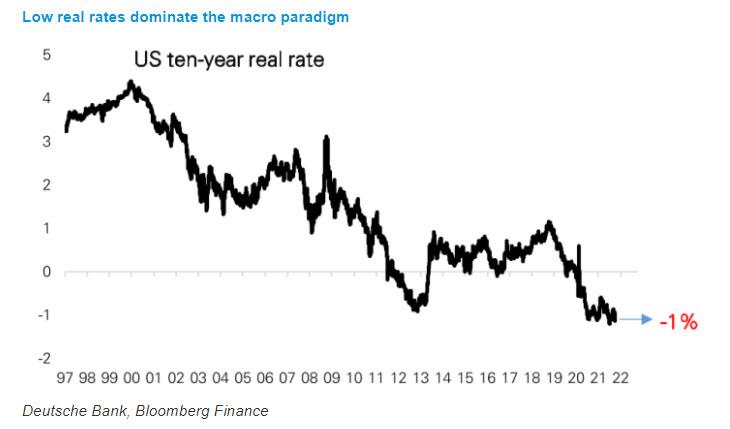
For all the focus on inflation, such as today’s red hot PPI print which saw producer prices soar at a record pace crushing profit margins, DB’s FX strategist George Saravelos writes that “it would be impossible to understand market dynamics this year without highlighting one simple chart: the US ten-year real rate, stuck at record all-time lows.”

Indeed, when looking at real rates – unlike the relentless surge in breakevens – it is as if nothing has happened this year and goes a long way to explain incredibly benign global financial conditions despite multiple macro and market shocks, most recently a massive re-pricing of global front ends.

What is the cause? Here Saravelos doesn’t agree with the argument that it’s central bank dovishness as almost all central banks in EM and DM have surprised hawkishly this year and if the market was so dependent on QE flows, the reaction to faster tapering programs should have been bigger.

It must – the strategist suggests – then follow, that something else is going on.

Here, Saravelos reminds his readers that over the last few months he has emphasized the role of global excess saving and a low terminal rate in driving market dynamics, evidenced in multiple indicators: huge bank buying of treasuries recycling consumer deposits, consumer confidence indicators pointing to high precautionary saving and late-cycle behavior, a smaller than expected widening of the US trade deficit pointing to Ricardian offsets to the fiscal stimulus, curve inversions in EM and the UK, and an evolving supply shock that is negative for growth and pushes down terminal rates.

It follows from the above that last week’s Fed meeting “is unlikely to matter much” and indeed, real 10Y yields have only continued to slide despite the Fed’s formal announcement of a taper.

  • First, because the tapering timeline has been incredibly well flagged so there would need to be a huge change for it to surprise.
  • Second, because the market is already pricing a high chance of Fed hikes before tapering even concludes and financial conditions have proven impervious to front-end repricing anyway.

Rather than the Fed (and indeed the outlook for inflation), the DB strategist argues that the most important question for the market is identifying the driver behind incredibly low negative real rates.

If the answer is “too much” savings and liquidity, it implies front-ends will have to go much more to tighten financial conditions.

On the other hand, if it is a very low terminal rate and r*, it implies the tipping point towards slowing growth is closer than assumed, in other words the Fed is tapering – and tightening – into a recession as we wrote in June.

Over the course of the year, DB has attributed market dynamics to both factors; but as 2022 comes in to view, Saravelos writes that “more precisely assessing the relative importance of the two is going to be critical for the market outlook.”

Tyler Durden
Tue, 11/09/2021 – 14:24

via ZeroHedge News https://ift.tt/3H6s3aP Tyler Durden

Free Markets Are the Best and Fastest Way to Cut Greenhouse Gas Emissions


dpaphotosfive431550(1)

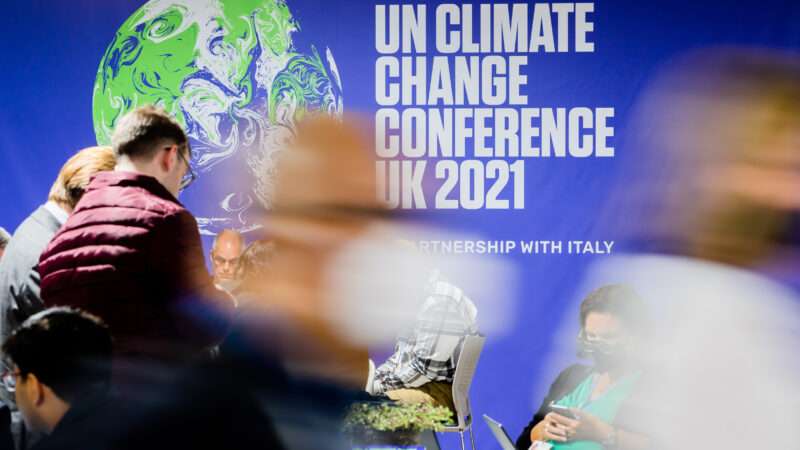
Glasgow—The Freedom and Climate Symposium was convened on November 8 at Strathclyde University by the think tank the Conservative Coalition for Climate Solutions (C3 Solutions) as a concurrent event with the United Nations Framework Convention on Climate Change’s 26th Conference of the Parties (COP26). The symposium brought together energy entrepreneurs, finance experts, free market climate policy wonks, and young conservative climate activists to discuss the role of free markets in addressing the problem of man-made climate change and managing the energy transition from fossil fuels. The solutions discussed at this meeting stood in stark contrast to the government-mandated, top-down policies being promoted by most participants at COP26.

For example, the symposium featured such proposals as the Clean Capitalism Leadership Council’s Rod Richardson’s clean tax cuts as a technology-agnostic way to speed up the financing of technologies that cut emissions of greenhouse gases such as carbon dioxide released by burning fossil fuels. Meanwhile, venture capitalist and insurgent ExxonMobil board member Andy Karsner promoted the Climate Leadership Council’s carbon fee and dividend plan, which would put a price on carbon dioxide emissions and rebate all of the revenues collected as annual dividends amounting to about $2,000 for a family of four.

Richardson argued that his proposal would lift constraints from entrepreneurs and investors whereas the carbon fee would impose burdens on consumers and businesses. Karsner countered that stable price signals were important to encourage investment and uptake of emissions reduction technologies. Some participants wondered if clean tax cuts would really incentivize clean energy investments, since at current interest rates the price of capital is already pretty low. Others worried about public reaction when carbon emissions started to fall and dividend checks began to dwindle.

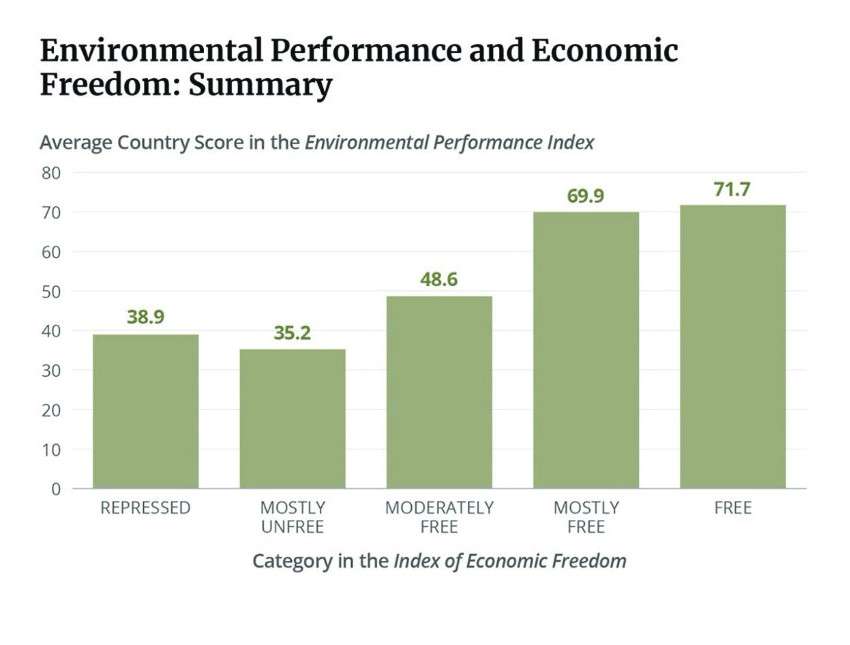
Markets are already playing a clear role in cleaning up the environment. And, generally speaking, the more free market a country is, the cleaner its environment is. A freer market also means that a country’s carbon emissions are already falling. C3 Solutions’ Director of Public Policy Nick Loris made this clear in his report, “Free Economies are Clean Economies.”

Loris used data from the Heritage Foundation’s Index of Economic Freedom that ranks 180 countries on a 100-point scale evaluating measures such as how well they protect property rights, government size, regulatory efficiency, and openness of their markets. Based on these calculations, the Index labels countries as repressed, mostly unfree, moderately free, mostly free, and free. Loris then compared these economic freedom rankings with Yale University’s Environmental Performance Index, which ranks 180 countries on a 100-point scale, judging their performance with respect to air and water pollution, biodiversity, agriculture, and climate change.

Loris found that the correlation between economic freedom and cleaner natural environments is robust.

The U.S. is 20th in the freedom rankings and is ranked 24th on the environmental performance index. China, by contrast, stands at 107th in the freedom index and 120th on the environmental performance scale.

Loris argued that the correlation between freedom and environmental quality confirms the notion of the environmental Kuznets curve (EKC), a concept that says that the natural environment initially deteriorates as industrial development takes off but begins to improve as incomes increase and now wealthier people demand cleaner water, clearer air, and environmental amenities like parks. Although there is still considerable debate over whether an EKC for carbon dioxide emissions exists, Loris cited a recent study by University of Aarhus researcher Christian Bjørnskov analyzing the income and emissions trends in 155 countries since 1975. Bjørnskov found that carbon dioxide emissions begin to decline in a country when average income reaches around $52,000 per person. In addition, he found that emissions of greenhouse gases in general start decreasing from a GDP level of approximately $25,000.

Consequently, Bjørnskov found that rich, economically free democracies such as Australia, Canada, the U.S., and much of Northern Europe have likely already passed the turning point of the carbon dioxide Kuznets curve. It is worth noting that U.S. carbon dioxide emissions peaked in 2007 when per capita income reached about $48,000.

Environmental Kuznets Curves are typically situated to the left in economically free societies, indicating earlier adoption of clean technology and faster transition towards a low-emissions society,” concluded Bjørnskov. “Conversely, although many of them proclaim a better environment as a central political aim, interventionist governments are likely to achieve the opposite.”

from Latest – Reason.com https://ift.tt/3ocJtKn
via IFTTT

Eight Reasons Scarcities Will Increase Rather Than Evaporate

Eight Reasons Scarcities Will Increase Rather Than Evaporate

Authored by Charles Hugh Smith via OfTwoMinds blog,

Who knew it would be so easy? All we have to do is collect urine and we’ll be flying our electric air taxi tomorrow!

While the private-jet crowd is busy selling a future of 1 billion electric vehicles, 1 billion windmills, 1 billion solar arrays, hundreds of thousands of electric aircraft, thousands of new nuclear power plants and trillions more in “wealth” accumulating in their bloated ledgers, reality is intruding on their technocratic fantasies.

The primary assumption of the private-jet crowd is that the developed world will continue to have a free pass to strip developing-world nations of their mineral wealth at the low, low cost of a bribe to the current kleptocrats in power and low, low wages paid to local workers. The profits will naturally flow to the private-jet crowd–it’s the Divine Right of Capital.

Knowledgeable readers assure me that the technologies of extracting resources have reached such heights that resources will continue to be low-cost. I have no doubt that technological advances have lowered the costs of extraction and opened access to deeper deposits, but I also have no doubt that the biosphere, physics, chemistry and geopolitics continue to set limits that no technological advancement can circumvent.

In the technocratic fantasy mindset, all that matters is the electricity that recharges the electric vehicle is “carbon-free.” The sources and quantities of energy required to fabricate the electric vehicle, pave the roads the vehicle travels on, etc. are conveniently ignored because the metals, plastics, glass, semiconductors, batteries, etc. needed to manufacture the vehicle require vast quantities of diesel fuel to power the mining equipment, transport the ore to be processed, then transported to the mills, then on to the factory, etc., vast quantities of coal to fire the smelting, vast quantities of fresh water for all these processes, vast quantities of electricity, very little of which is derived from nuclear or so-called renewable sources (all of which have to be replaced every 15 to 20 years), and so on.

In the technocratic fantasy mindset, any deposit anywhere on the planet is accessible to high tech processes. In the real world, deposits might be far from paved highways, far from major river or bluewater ports, far from processing plants, and far from sources of the millions of liters of diesel fuel that will be needed onsite to extract the ores.

The entire infrastructure to reach the site must be built and maintained, and millions of liters of diesel fuel delivered to power the massive equipment needed to extract the resources. Then the ore must be transported hundreds of kilometers to a port capable of handling this tremendous bulk commodity. There is no way all this will be low-cost and low-risk.

Here’s a list of eight potential sources of scarcities of essential materials. This list not exhaustive, it is merely suggestive of the many real-world limits on the technocratic fantasy.

1. Resources have been depleted globally so there is no longer enough supply to meet rising global demand at affordable prices. Sure, there’s always more somewhere–but at what cost?

2. Exporting nations restrict exports to meet their own rising domestic demand. Yes, it’s irritating that our oil, cobalt, lithium, etc. is under their sand and they decide to use it for their own people.

3. The low-hanging fruit has been consumed and remaining deposits are in difficult-to-access regions of extreme conditions or political disorder. The developed-world exploiters might end up getting an AK-47 round as a dividend.

4. Exporting nations cut off exports to the U.S. as a form of leverage. Nice high-tech economy of gamers and traders you got there; too bad we’re experiencing problems in delivering the cobalt, rare earth minerals, etc. you need to keep your gamers and traders happy. We’re sure you’ll see the wisdom of complying with the new arrangement we propose.

5. Remaining deposits are under the control of geopolitical rivals. See above.

6. There is no longer sufficient diesel fuel to power the global supply chain of mining and transport of essential minerals: the limiting factor is not the availability of deposits but of the fuel needed to extract and transport ores.

7. Supplies are available but at prices that are unaffordable to American households with stagnant purchasing power, i.e., the bottom 90%.

8. Having tired of neocolonial exploitation of their national resources, revolutionary governments expropriate developed-world resource extraction assets and take control of extraction, limiting exports and sharply raising prices.

There’s always more techno-fantastic headlines promising infinite abundance of everything. This is my favorite today: Scientists Perfect Renewable Power from Urine While Cleaning Wastewater in South Korea. Who knew it would be so easy? All we have to do is collect urine and we’ll be flying our electric air taxi tomorrow!

There’s always more until the real world intrudes.

*  *  *

If you found value in this content, please join me in seeking solutions by becoming a $1/month patron of my work via patreon.com.

My recent books:

A Hacker’s Teleology: Sharing the Wealth of Our Shrinking Planet (Kindle $8.95, print $20, audiobook $17.46) Read the first section for free (PDF).

Will You Be Richer or Poorer?: Profit, Power, and AI in a Traumatized World (Kindle $5, print $10, audiobook) Read the first section for free (PDF).

Pathfinding our Destiny: Preventing the Final Fall of Our Democratic Republic ($5 (Kindle), $10 (print), ( audiobook): Read the first section for free (PDF).

The Adventures of the Consulting Philosopher: The Disappearance of Drake $1.29 (Kindle), $8.95 (print); read the first chapters for free (PDF)

Money and Work Unchained $6.95 (Kindle), $15 (print) Read the first section for free (PDF).

Tyler Durden
Tue, 11/09/2021 – 14:07

via ZeroHedge News https://ift.tt/3mZn7fN Tyler Durden

Palestinian Activists Hacked By Israel’s Blacklisted NSO Group Spyware

Palestinian Activists Hacked By Israel’s Blacklisted NSO Group Spyware

At a moment the Israeli government is said to be lobbying the Biden administration to reverse its recent blacklisting of surveillance company NSO Group, which produced the controversial Pegasus spyware that infiltrated the personal phones of world leaders, activists and officials – including French President Emmanuel Macron – a new report has found at least six Palestinian rights activists were also targeted and hacked by the Israeli technology.

“Cellphones belonging to at least six Palestinian rights activists were hacked using the contentious Israeli cyber-surveillance firm NSO Group’s Pegasus software, according to independent investigations published Monday by the University of Toronto and Amnesty International,” writes The Times of Israel.

Image via Politico

The investigation into the six Palestinians’ phones confirmed the infiltration of the phones using Pegasus, however wasn’t able to specify who exactly was behind it – but activists are pointing to the most immediate and obvious culprit of Israel and its military and intelligence services.

NSO Group works with governments around the world, but authorities in Tel Aviv must first approve export license’s for the software. The technology is treated and overseen in the same way defense technology and weaponry is.

Pro-Palestinian activists say the export licensing requirement alone points to the Israeli government being behind the Palestinian leaders’ phones. The Times of Israel details further:

The report did not specify who was behind the alleged hacking, but NSO Group’s export license prohibits the firm from allowing foreign customers to hack Israeli phones — indicating that either NSO Group violated its license or that the hacking was done by Israel, in what would be the first documented case of the technology being used against phones served by Israeli carriers.

Three of targeted individuals in question allegedly belong to outlawed groups that are associated with the Popular Front for the Liberation of Palestine (PFLP), which is considered a terrorist organization by Israel and its Western allies. 

Meanwhile, Israel has argued that it only uses and exports Pegasus for legitimate defense and surveillance purposes, including counterterrorism – and not for suppressing human rights or eavesdropping on world leaders. 

Last week a US Commerce Dept. statement blacklisting both NSO group and another Israeli company called Candiru blasted that the spyware is being given to “foreign governments that used these tools to maliciously target government officials, journalists, businesspeople, activists, academics, and embassy workers.”

Israel is now said to be aggressively behind the scenes seeking a Biden administration reversal of the move, saying the hacking technology remains “of great importance to the national security of both countries,” according to an Israeli report. Washington, meanwhile, is worried the technology will fall into the hands of malign governments only seeking to oppress activists or get a leg up on their rivals.

Tyler Durden
Tue, 11/09/2021 – 13:45

via ZeroHedge News https://ift.tt/3BUisQA Tyler Durden

Build Back Better Legislation Would Hamper Worker-Deprived Sawmill Industry

Build Back Better Legislation Would Hamper Worker-Deprived Sawmill Industry

By Bill Wilson of RT&S

A shrinking workforce and legislation that is being pushed through Washington is weighing heavily on the minds of saw millers.

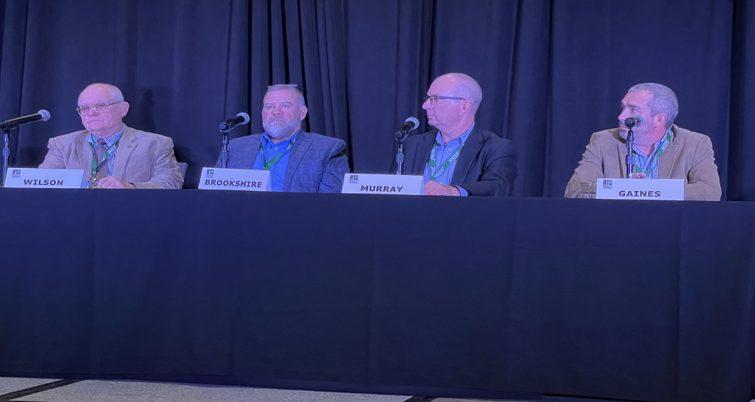
A few in the industry made up the Today’s Sawmill Challenges at the Railway Tie Association’s annual meeting in St. Louis last week.

With the housing market boom and COVID-19 pandemic, railroad wood crossties have taken a back seat to other products in the nation’s sawmills. Supply chain issues are constant, and with the older workers opting out the problem does not seem to have a solution in the near future.

“There are not enough people on the ground in the lumber industry,” Frank Wilson of Wilson Brothers Lumber said.

Paul Gaines from Madison County Wood Products echoed Wilson’s concern, and said wages in the sawmill industry are up 20%.

Production is starting to pick up and it is improving, and what saw millers need to do at the plant is use technology like automation to attract younger workers so the increase in production can be handled.

Perhaps the greatest success (but failure) recruitment story comes from the Missouri Forest Products Association, which attempted to create a school for loggers in Missouri. After being turned down by just about every technical school because enrollment numbers could not be guaranteed, the association created its own education platform. A 10-week program was put together, but after a year and a half it failed.

“We just could not recruit,” said Brian Brookshire. “I think we need to give it another shot where it’s more inclusive and it needs to be set in a technical school for recruitment. The entire industry needs to come together to make this happen.”

President Biden’s Build Back Better economic package also is looming over the sawmill industry. According to Wilson, the legislation could cripple coal-fired plants as the administration tries to encourage the use of more green energy like wind and solar.

“Solar and wind are unreliable and will cause brownouts in the future,” remarked Wilson.

Private industries also are buying up forests and using them to offset carbon footprints, making them off limits to loggers. Build Back Better has money that would assist land owners to participate in more of these programs. Darwin Murray from McClain Forest Products said there is no better way to store carbon than in a railroad tie. Dana Cole, who moderated the session, from the Hardwood Federation, added once a tree is mature it does not store as much carbon.

Congress has been unable to pass Build Back Better, but President Biden said the focus is now on that piece of legislation now that the $1.2 trillion infrastructure bill has been passed.

Tyler Durden
Tue, 11/09/2021 – 13:25

via ZeroHedge News https://ift.tt/3cc15k1 Tyler Durden

10Y Yield Rebounds From Session Low After Ugly, Tailing Treasury Auction

10Y Yield Rebounds From Session Low After Ugly, Tailing Treasury Auction

With 10Y yields sliding all day, and painfully squeezing near-record duration shorts, as the market aggressively prices in the Fed’s upcoming policy error, today’s 10Y auction provided a brief respite for duration bears as the sale of $39BN in ten year paper was plain and simple ugly.

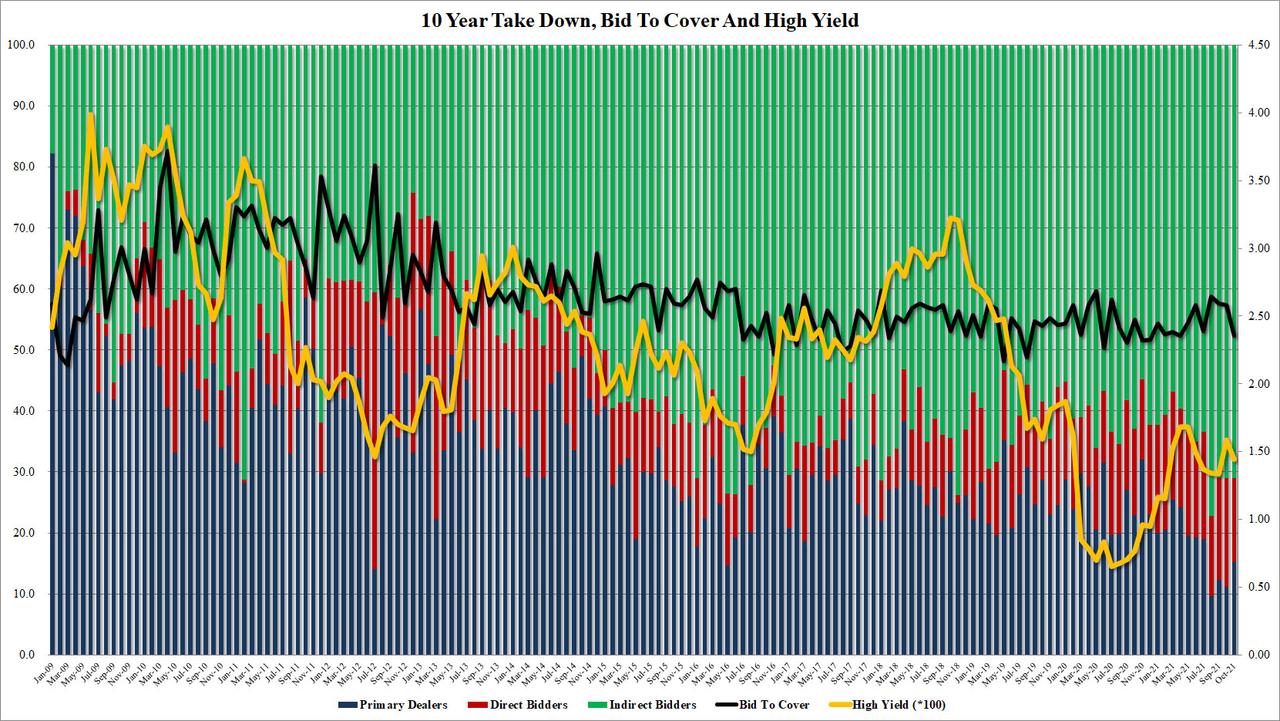
One day after a solid 3Y auction, the high yield on today’s benchmark auction stopped at 1.444%, well below October’s 1.584%, however it also tailed the When Issued by 1.2bps, which was the first tail since April.

The bid to cover was also ugly, dropping from 2.58 in October to 2.35, the worst print of 2021 (the lowest since Dec 2020), and well below th six-auction average of 2.54.

The internals, like yesterday, were a bit better with Indirects taking 71.0%, virtually unchanged from yesterday’s 71.1%, and with Directs taking down 13.8%, the lowest since August, Dealers were left holding 15.2%, or the most since July.

Overall, a mediocre auction, and one which helped yields bounce some 3bps from session lows of 1.41% hit just before the auction.

Tyler Durden
Tue, 11/09/2021 – 13:14

via ZeroHedge News https://ift.tt/3wIZxHH Tyler Durden

Top NIH Scientist Opposes Vaccine Mandate, Will Host Live Ethics Debate Next Month

Top NIH Scientist Opposes Vaccine Mandate, Will Host Live Ethics Debate Next Month

As it turns out, even some of the experts at the NIH oppose Dr. Anthony Fauci’s push for mass forced vaccination that President Biden recently codified by expanding his vaccine mandate to affect some 80MM working Americans –  including health-care workers, who must choose to either accept the jab, or leave their jobs, despite a shortage of medical workers.

WSJ reported Tuesday that vaccine mandates are sparking debates and controversy within the NIH, which has scheduled a Dec. 1 live-streamed roundtable session over “the ethics of mandates”. The seminar is one of four ethics debates to be held this year. These debates will be accessible to all of the NIH’s 20K staff, along with patients and the public.

The Dec. 1 ethics debate was set up after a senior infectious-disease researcher pushed back against the growing drive for mandates. Dr. Matthew Memoli, who runs the clinical studies unit within the Dr. Fauci-controlled NIAID, both opposes vaccine mandates and has declined the vaccine himself, arguing that jabs should be reserved for the vulnerable, the elderly and obese Americans.

Memoli, who has served at the agency for 16 years and recently received an NIH director’s award, even pushed back against the mandates in an email to Dr. Fauci.

“I think the way we are using the vaccines is wrong,” he said to Dr. Fauci in an email on July 30.

Memoli argues that “blanket vaccination of people at low risk of severe illness could hamper the development of more-robust immunity gained across a population from infection,” per the WSJ.

It’s not like he’s just making this stuff up. At least one major study conducted by Israel showed that immunity produced by natural infection is more effective, and longer lasting, than vaccine-induced immunity.

At least one senior bioethicist at the NIH acknowledged that there’s “a lot of debate” about vaccines.

“There’s a lot of debate within the NIH about whether [a vaccine mandate] is appropriate,” said David Wendler, the senior NIH bioethicist who is in charge of planning the Dec. 1 session. “It’s an important, hot topic.”

Current data shows that nearly 90% of the NIH’s federal employees “were fully vaccinated at the end of October.”

Memoli’s detractors assert that pushing natural immunity over vaccination is a “terrible idea.”

“That’s a terrible idea if we have a vaccine that prevents serious disease,” said Timothy Schacker, vice dean for research and an infectious-disease physician at the University of Minnesota Medical School.

The president’s mandate has already faced enough resistance from conservative-leaning states as the US Court of Appeals for the Fifth Circuit Court issued a temporary stay blocking the mandate as it weighs a permanent injunction. The ruling from a three-judge panel on Saturday resulted from a stay sought by the states of Texas, Utah, Mississippi, and South Carolina, along with businesses that oppose the Biden plan. Both the states and businesses filed a petition of review of the agency action, which goes directly to a federal appeals court instead of a one-judge federal district court.

During the December roundtable, Memoli will make his case for a different approach to vaccinations to anybody who wants to listen.

Memoli

NIH bioethics head Christine Grady signed off on the Dec. 1 seminar, which they’re calling “Grand Rounds,” saying via email that she believes there is interest in the topic across the agency.

“Our hope is that the December Grand Rounds will be relevant to the debates that are going on around the country regarding vaccine mandates,” an agency spokeswoman said on her behalf.

It’s just another reminder: when it comes to “the science”, there isn’t a consensus – more like a handful of opposing views, all of which should be carefully considered and discussed.

Tyler Durden
Tue, 11/09/2021 – 13:06

via ZeroHedge News https://ift.tt/3bYkXXs Tyler Durden

Theater Prof Facing Possible Firing for Not Being Sufficiently Outraged

From the Foundation for Individual Rights in Education; I missed it when it was first posted (Oct. 20):

Dr. Steven ​​Earnest [of Coastal Carolina University] … was suspended from teaching after criticizing student protestors who staged a walkout because they saw the names of students of color written on a whiteboard and mistook the list as malicious. In fact, it turned out to have been a list of students who might want to hang out together….

On Sept. 16, a visiting artist was working with two students of color after class, and one student expressed that she felt isolated and would like to get to know other non-white students in the department. The visiting artist asked about whether it might be helpful for non-white students to connect as a group, and she and the students wrote out the names of other non-white students on the classroom whiteboard while brainstorming ideas.

The names were still on the board when the next class arrived, and several of the entering students were offended, believing that whoever had written the list must have been singling out non-white students. They decided to hold a protest in a campus courtyard on Sept. 21 instead of attending class.

After discussion with the students and faculty involved, the Department of Theatre’s Diversity, Equity and Inclusion Committee determined that the names on the board had been presented “as a resource for newer students who are looking to be in community with other BIPOC students.” Nonetheless, the DEI committee apologized to the offended students, writing in an email to the theater department that the “faculty and students involved as well as the Theatre Department as a whole are deeply sorry to anyone who was affected by this incident.” The visiting artist who helped create the list of names also apologized profusely, calling her participation “thoughtless and careless.”

Earnest did not agree. He responded to the email, stating (as written): “Sorry but I dont think its a big deal. Im just sad people get their feelings hurt so easily. And they are going into Theatre?” He received several responses criticizing his remark, and responded again to clarify that he was “just defending our guest artist.”

Students critical of Earnest’s emails accused him of being racially insensitive and dismissive of students of color. Several also called for Earnest to be fired and protested by boycotting theater classes.

“It was upsetting to be accused of racism by students and others with whom I have never interacted,” said Earnest. “But it was even more upsetting to have these false accusations ratified by a university that I have called home for over fifteen years.”

On Sept. 20, Claudia Bornholdt, the dean of Coastal Carolina’s College of Humanities and Fine Arts, told Earnest not to come to his classes and to send her his syllabus, effectively suspending him from his teaching duties.

Earnest contacted FIRE and is now working with the Faculty Legal Defense Fund to defend his rights. FLDF provides free legal assistance to faculty at public universities whose civil liberties are in jeopardy. Launched this year, it has successfully worked (and is still working with) over a dozen faculty members whose rights or livelihoods have been threatened by their public universities….

FIRE wrote to Coastal Carolina on Sept. 29, reminding the university that professors have the right to speak freely on matters of public concern. Additionally, the fact that others found Earnest’s emails offensive does not diminish the emails’ protection under the First Amendment. As a public institution, Coastal Carolina is bound by the First Amendment and required to protect the free speech of its faculty.

FIRE received no response to its letter, but Earnest’s attorney told FIRE that rather than backing down, the university is launching a termination process against Earnest….

from Latest – Reason.com https://ift.tt/30clKle
via IFTTT