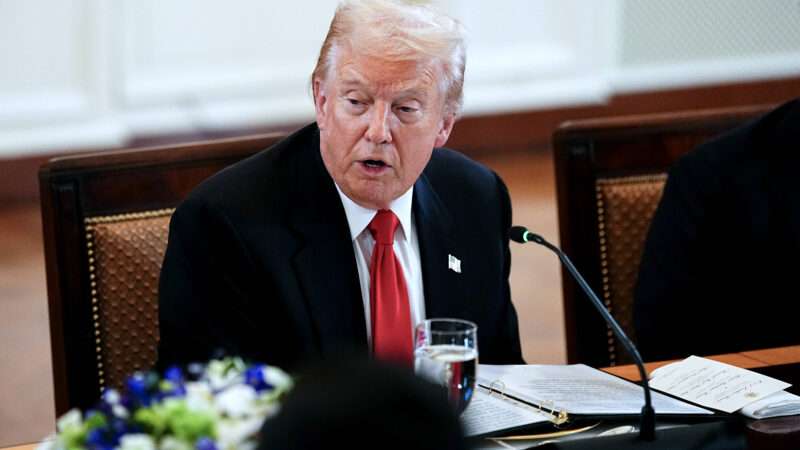
As President Donald Trump rolled out a costly bailout of American farmers this week, his administration has rushed to pin the blame on its predecessor.
China will begin purchasing American soybeans again, press secretary Karoline Leavitt told Newsmax on Tuesday. That’s something, she claimed, that “China wasn’t doing under the last administration because they had no respect for President [Joe] Biden or for the country at the time.”
That echoed what Trump said during Monday’s announcement of the bailout, when he claimed that “we inherited a total mess from the Biden administration,” which “came in and ruined everything.”
Regardless of your views on how the Biden administration handled the economy, inflation, or any number of other issues—or how you feel about Trump continuing to heap blame on Biden more than a year after defeating him in the election—this specific claim stretches credulity. More than that, it reflects a broader problem with Trump’s trade policies, which tie farmers’ fates to the occupant of the White House. Shouldn’t farmers be able to depend on global export markets without waiting for the American president and his Chinese counterpart to strike a deal?
Let’s start with the facts on the soybean trade.
Since 2017, America has exported more than 22 million metric tons of soybeans to China in every year except two. Those years? The first was 2018, when China cut off purchases of American soybeans in response to Trump’s tariffs targeting American imports of Chinese goods. The second was this year, when China did the same thing in response to another set of tariffs imposed by the Trump administration.
In short, it is plainly untrue that China was not buying American soybeans during the Biden administration. During those four years, America consistently exported more than 26 million metric tons of soybeans to China.
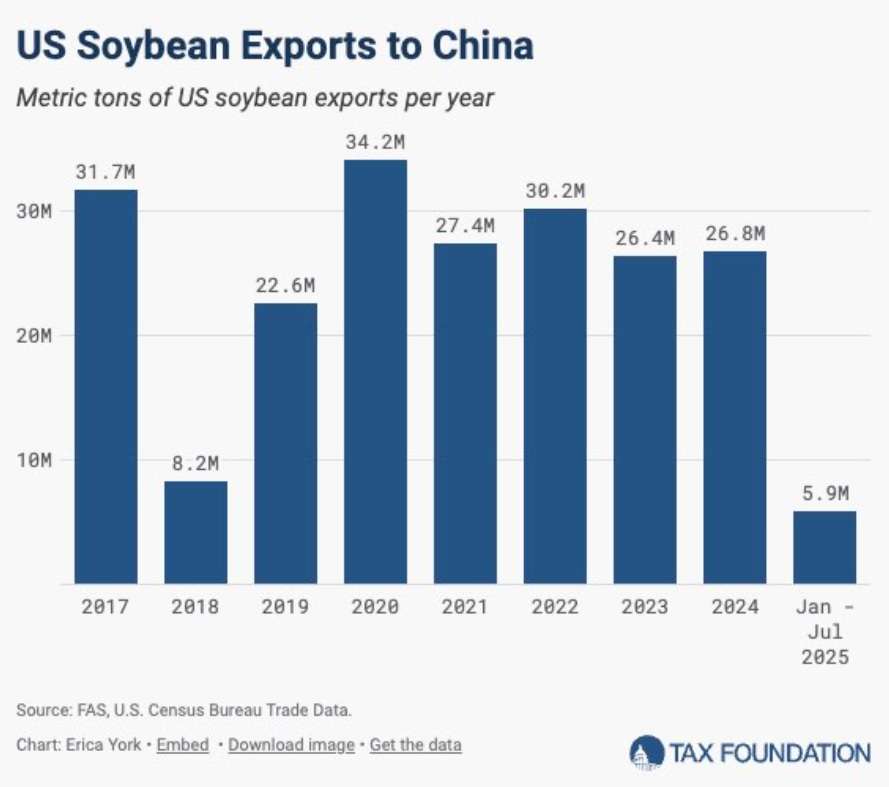
In comparison, the deal that Trump recently struck with Chinese President Xi Jinping calls for China to purchase at least 12 million metric tons of soybeans annually. Yes, that means the deal Trump has hailed as “tremendous” would result in American farmers selling less than half as many soybeans as they did during the Biden years.
And even that total is unlikely to materialize. Both Treasury Secretary Scott Bessent and U.S. Trade Representative Jamieson Greer have recently tempered those expectations, with both saying that the purchases will be completed by the end of February.
Try as they might, there is simply no way for the Trump administration to dodge the unavoidable conclusion here: The president’s trade war has had significant and damaging consequences for American farmers (and manufacturers and consumers), just like it did during his first term. If Trump really wanted to aid farmers, he would ditch the tariffs rather than offering false excuses and a taxpayer-funded bailout.
In a broader way, the soybean situation ought to raise some troubling questions about the White House’s view of the world and the role of free trade. Trump believes that foreign countries, most especially China, are taking advantage of the United States because we buy more stuff from them than they buy from us—that’s the “trade deficit” that the president and his allies talk about so much. The remedy to this perceived problem, Trump believes, is higher tariffs on foreign goods.
As the soybean saga makes clear, tariffs do not exist in a vacuum—and raising barriers to imports can also affect America’s exports in a bunch of ways. One study conducted in the wake of Trump’s 2018 tariff increases found that a quarter of American exporters were subject to retaliatory tariff increases. Bigger exporters were more likely to be harmed—and American agriculture is a huge, export-heavy industry. It makes perfect sense that farmers are hurting again now.
It turns out that trade isn’t really something that happens between countries, but rather between people (who might happen to be in different countries). Trump’s conception of trade requires centralization—deals between leaders who decide how much of which products will flow from one place to another.
But trade works best when it is decentralized. That is, when farmers in America and factories in China can meet demand in the other country without needing political officials to order or condone the transactions. The best thing that political leaders can do is get out of the way. Unfortunately, Trump is doing the exact opposite.
The post Trump Says China Didn't Buy Soybeans While Biden Was President. Here's What the Data Show. appeared first on Reason.com.
from Latest – Reason.com https://ift.tt/AzMLRYy
via IFTTT