De-Dollarization Trend Remains Intact

De-Dollarization Trend Remains Intact

Tyler Durden

Tue, 10/06/2020 – 11:43

Via SchiffGold.com,

Global de-dollarization resumed in the second quarter according to data recently released by the International Monetary Fund (IMF).

While the dollar share of global reserves increased in the first quarter of 2020, it fell sharply in Q2, resuming a more than two-year trend downward.
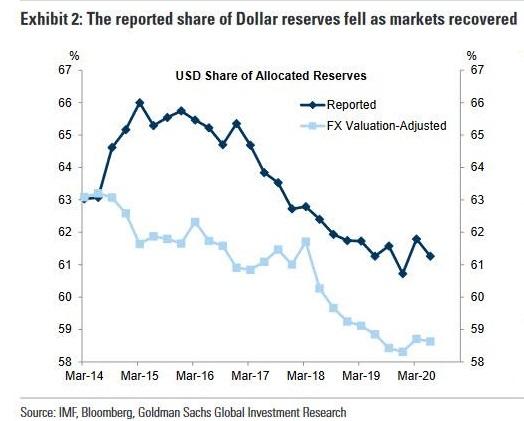
The share of euros making up global reserves rose slightly and the share of yen dropped. The second quarter saw the largest build-up of reserves in Chinese RMB and “other currencies”

The increase in dollar reserves in Q1 was likely an anomaly triggered by increased valuation and safe-haven buying during the early stages of the COVID-19 panic.

A Bank of America report concluded, “the de-dollarization theme appears intact.” According to its data, the share of US holdings has declined to 61.3%, “slightly more than expected based on FX, bond and equity valuation changes.”

Central bank reserves globally rose significantly as they aggressively intervened in foreign exchange (FX) markets. Total FX reserves rose to over $12 trillion. According to analysis by ZeroHedge, most major countries experienced a rise in FX reserves through Q2, with the exception of Turkey. That country continues to bleed reserves in order to stabilize its currency.

There has been a decoupling between the level of dollar reserves and the Trade Weighted USD index – a measure of currency strength weighted by the country’s amount of trade.
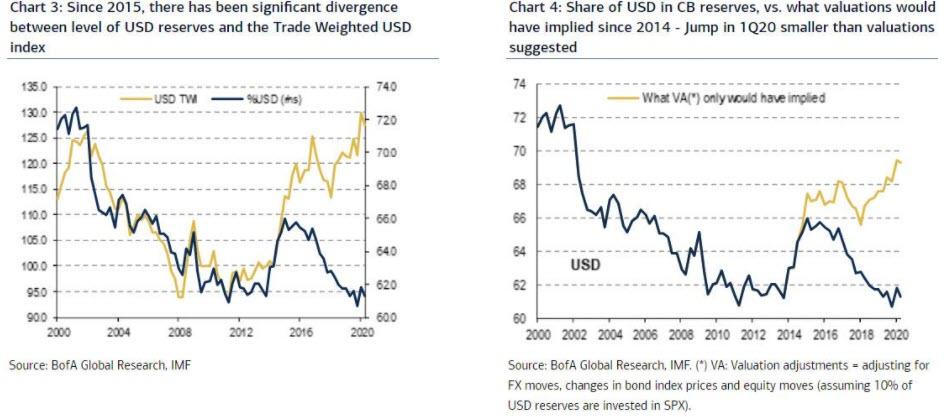
According to ZeroHedge, “This divergence between the level of USD reserves and that of USD TWI is expected to persist, as the world is decoupling from the USD as the notional reference peg.”

According to the BoA report, no single currency stood out as having benefited from the process so far. Instead, many central banks have turned to gold.

Central bank gold purchases have slowed somewhat this year after record buying in 2018 and 2019. But, central bank gold-buying is expected to rebound in 2021, according to analysts for both Citigroup and HSBC Securities.

Central bank demand came in at 650.3 tons last year. That was the second-highest level of annual purchases for 50 years, just slightly below the 2018 net purchases of 656.2 tons. According to the WGC, 2018 marked the highest level of annual net central bank gold purchases since the suspension of dollar convertibility into gold in 1971, and the second-highest annual total on record.

Some analysts believe both China and Russia will resume adding to their gold-holdings next year. Both countries have been aggressive in reducing their exposure to the dollar but recently put gold purchasing on hold.

Earlier this year, Russia announced it would halt gold purchases effective April. Meanwhile, the People’s Bank of China has not reported any gold purchases in 10 months. It’s not uncommon for China to go silent and then suddenly announce a large increase in reserves. The Chinese government has hinted that it might shed more US Treasuries from its reserve holdings. It would come as no shock if the Chinese replaced US debt with gold.

We’ve been watching this de-dollarization trend over the last several years, and have written extensively about a push to minimize dollar exposure by countries like Russia and China and their desire to undermine the ability of the US to weaponize the dollar as a foreign policy tool.

The dollar’s slowly shrinking share of reserves doesn’t yet threaten its status as the world’s reserve currency, but it could be a canary in the coal mine. It’s definitely a trend to keep a close eye on.

via ZeroHedge News https://ift.tt/3njzUbj Tyler Durden
“I Was Aghast” – MSM Attacks Trump For Removing Mask On White House Steps

“I Was Aghast” – MSM Attacks Trump For Removing Mask On White House Steps

Tyler Durden

Tue, 10/06/2020 – 11:14

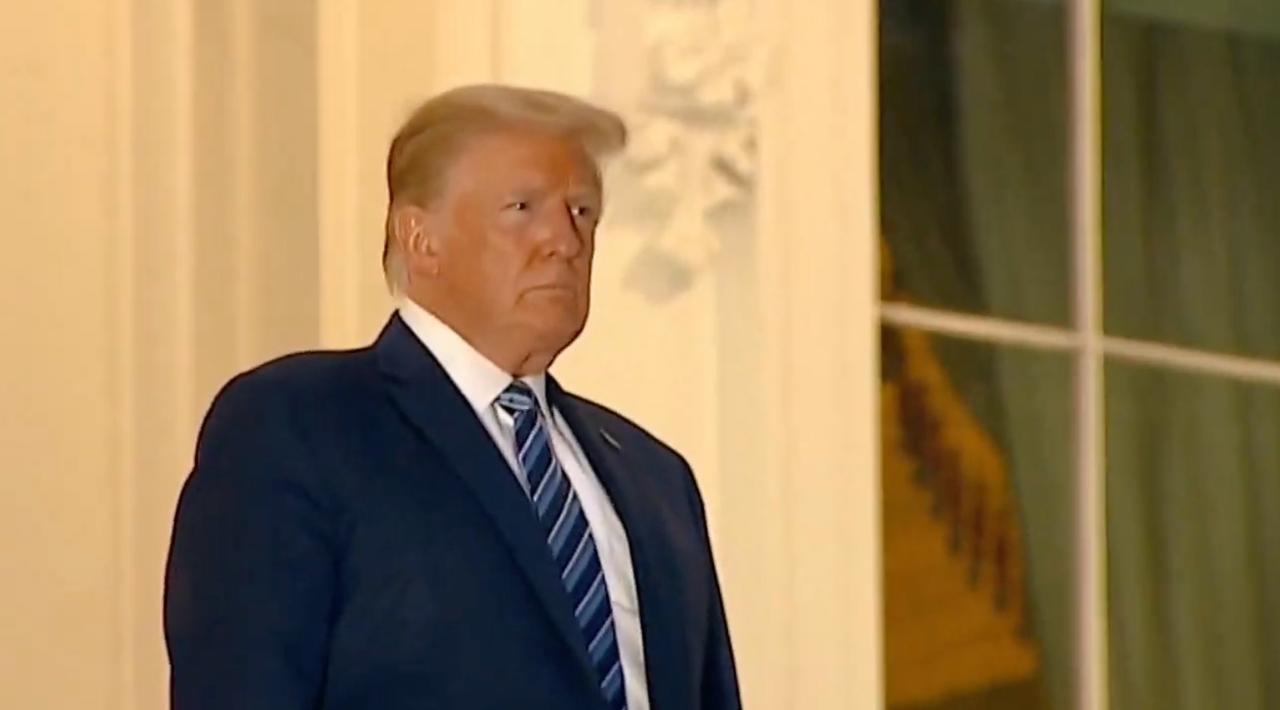
As is often the case with anything and everything involving President Trump, his return to the White House residence last night was either a stirring show of strength or a reckless example of the president’s callous disregard for the safety of others. It all depends on where an individual gets their news.

Reuters reported that Trump’s ‘heavily coordinated’ spectacle – where he encouraged Americans to “get out there” but “be careful” – elicited a backlash mostly because of Trump’s decision to remove his mask while standing – alone – in front of the South Portico.

The newswire service managed to find a couple of partisan doctors to opine on the record that they were ‘horrified’ by Trump’s behavior and words.

Trump has repeatedly flouted social-distancing guidelines meant to curb the virus’ spread and ignored his own medical advisers. He also mocked Biden at last Tuesday’s presidential debate for wearing a mask at events, even when he is far from others.

His decision to remove his mask after climbing the staircase to the White House South Portico – a perch that put him at some distance from others – and his insistence that Americans should not fear the disease horrified some physicians.

“I was aghast when he said COVID should not be feared,” said William Schaffner, a professor of preventive medicine and infectious diseases at Vanderbilt University Medical Center in Nashville.

William Schaffner, Reuters’ main source, was of course widely quoted in press reports criticizing Trump’s approach and second-guessing his treatment.

He has also been one of the leading voices speculating that President Trump might need to be rushed back to Walter Reed in the coming days as the president’s condition worsens.

Of course, these doctors are doing wonders for bolstering the public’s credibility.

But it wasn’t only doctors criticizing Trump: White House reporters, whoa re supposed to impartially cover the president, also criticized him for removing his mask, despite being outdoors and standing alone on the landing.

MSNBC’s Joy Reid “unequivocally condemned” Trump for removing the mask.

Chris Cuomo, who got called out for staging his own dramatic ‘return’ from quarantine after allegedly violating social distancing rules during the early days of the outbreak, also went on a rent on CNN last night.

Democratic politicians like Sen. Chris Coons slammed Trump’s decision as “a failure of leadership”.

The Biden campaign capitalized on the moment with a video showing Trump removing his mask, with Biden, on the other side, putting his on.

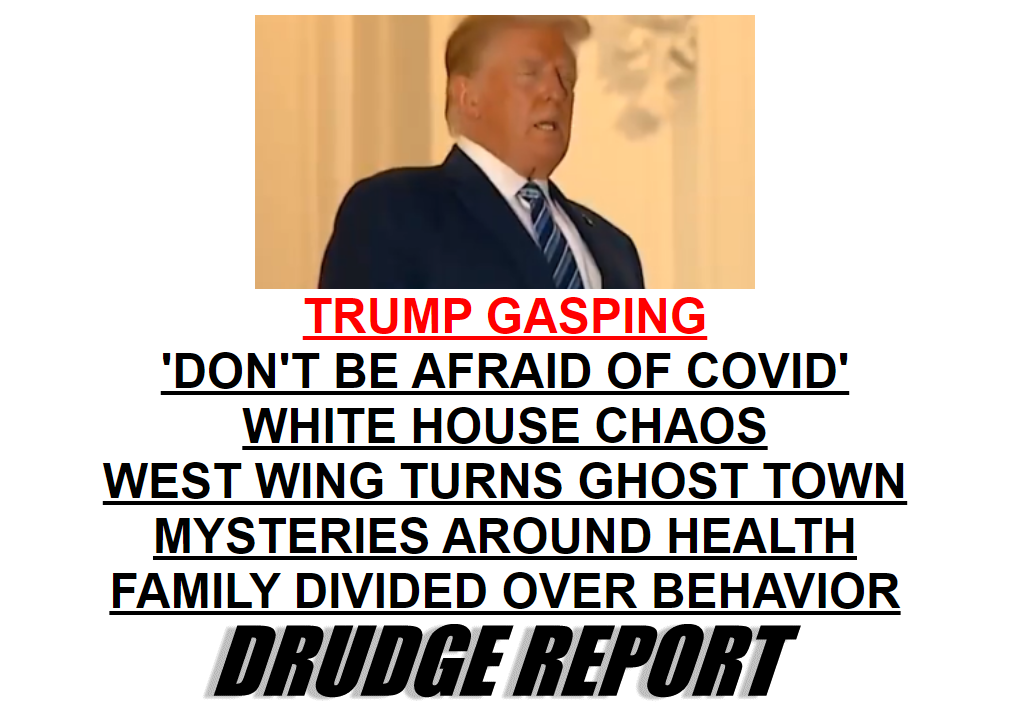
The Drudge Report, which has become increasingly critical of Trump, ran one of its classic all-caps headlines to play up a clip purporting to show Trump gasping for air after his climb up the steps.

The clip dominated the conversation on Twitter overnight, leading the hashtag ‘#GaspingForAir’ to trend.

As members of the White House press corp continued to rant about the White House putting them ‘in harm’s way’ with their lax mask-wearing standards, one CNN reporter angrily commented on Trump’s decision to remove the mask.

Shortly after, a Trump Campaign-affiliated ‘War Room’ account shared footage of Collins in the briefing room taking off her mask when she apparently thought the briefing had ended.

Still, we can’t help but wonder: If the media had their druthers, what would they rather see?

Or perhaps they didn’t think about the notion that Trump was attempting to show the public that he’s doing better to prevent another sharp selloff in financial markets…with the election one month away.

via ZeroHedge News https://ift.tt/3ixGw29 Tyler Durden

FDA Outlines Requirements For “Emergency Use Authorization” Of COVID-19 Vaccine Amid Reports Of WH Interference

FDA Outlines Requirements For “Emergency Use Authorization” Of COVID-19 Vaccine Amid Reports Of WH Interference

Tyler Durden

Tue, 10/06/2020 – 11:01

Last night, both the NYT, Associated Press and Politico published “scoops” detailing an alleged effort from within the West Wing to improperly shape the FDA’s protocols and policies surrounding granting emergency-use authorization (EUA) to COVID-19 vaccines, with the goal of eliminating a provision that would effectively preclude a vaccine before election day.

Politico’s report claimed that the White House was interfering at the behest of the big drug makers hoping for more lax restrictions.

Since they were published during President Trump’s return to the White House, the reports didn’t get much oxygen on cable news. But on Tuesday morning, the FDA surprised observes by releasing the new guidance.

Also, Bloomberg reported last night that the FDA had communicated its new standards directly to the drug makers, eliminating the need to release the new guidance, which was still under White House review.

A spokesman for the FDA told the press that the agency has already reviewed the requirements with individual manufacturers, and any interference with the guidance is really more of a PR issue.

“This does not change how the FDA would evaluate an emergency use authorization request for a Covid-19 vaccine,” said Michael Felberbaum, an agency spokesman. “The FDA has already communicated with individual manufacturers about its expectations, data the agency intends to consider, and what we expect to see in a request for an emergency use authorization to demonstrate safety and efficacy.”

But as the public backlash intensified, the FDA decided to release a document on its website Tuesday morning making clear that the requirement for two months’ of safety data would remain, as would a requirement for an independent panel of experts to weigh in on each candidate before a final decision can be made.

Here’s more from Bloomberg:

The document is the agency’s most detailed public statement yet on what it will take to get a vaccine cleared under a fast-track emergency use authorization, or EUA. The agency has been working on a separate “guidance” document that details the requirements, but it remains under review by the White House and it’s not clear when or if it will be released.

While the exact contents of that guidance document haven’t been released, the FDA has said that it’s already communicated the requirements to drugmakers. Publishing those requirements in the document released Tuesday essentially makes them public, even if the official document is lodged at the White House. It also makes clear that the FDA will add an extra step to the review.

In Tuesday’s document, the FDA said it will require an additional, follow-up meeting of its Vaccine and Related Biological Products Advisory Committee to look at specific applications by drugmakers. “This discussion will be specific to the particular vaccine that is the subject of the EUA request and will be separate from, and in addition to, any general discussion by the VRBPAC regarding the development, authorization and/or licensure of vaccines to prevent Covid-19,” the FDA said in the document.

Then again, whether the agency requires 8 weeks or 6 weeks of safety data may not make much of a difference. Vaccine approval is a tedious process that typically takes years. The speedy approval process virtually guarantees there will be no study of long term ramifications and side effects.

via ZeroHedge News https://ift.tt/2SvskMz Tyler Durden

Watch Fed Chair Powell Ask Congress For More Fiscal Stimulus

Watch Fed Chair Powell Ask Congress For More Fiscal Stimulus

Tyler Durden

Tue, 10/06/2020 – 10:49

Fed chair Powell is holding a virtual conference with National Association for Business Economics. As previewed earlier, there were  no notable surprises in his prepared remarks in which he emphasizes that the outlook remains highly uncertain, the expansion is far from complete, and in keeping with the Fed’s recent appeals to Congress, Powell asks Congress to quickly vote through more fiscal stimulus, assuring lawmakers that providing too much stimulus wouldn’t be a problem.

Powell’s remarks come amid continued gridlock in Congress and Republican opposition to a larger relief package that’s kept talks with Democrats at a stalemate in Congress since aid to jobless Americans and small businesses expired in July and August.

“Too little support would lead to a weak recovery, creating unnecessary hardship for households and businesses,” Powell said in the text of a speech for a virtual conference hosted by the National Association for Business Economics. “By contrast, the risks of overdoing it seem, for now, to be smaller. Even if policy actions ultimately prove to be greater than needed, they will not go to waste.”

While Powell didn’t explicitly reference either party’s position in his prepared remarks, he said that the “recovery will be stronger and move faster if monetary policy and fiscal policy continue to work side by side to provide support to the economy until it is clearly out of the woods.”

Meanwhile, the Fed chair confirmed what we said last week, namely that US consumer are rapidly burning through their savings, something which has so far allowed US consumption to remain stable, however at the current rate of spending, savings would will likely return to pre-covid levels in 2-3 months:

“Consumption held up well through August after the expiration of expanded unemployment insurance benefits, indicating that savings from transfer payments continue to support economic activity,” Powell said. “Still, since it appears that many will undergo extended periods of unemployment, there is likely to be a need for further support.”

Watch him live …

… and red his prepared remarks are here (pdf link)

Powell 20201006 A by Zerohedge

via ZeroHedge News https://ift.tt/3np03Fl Tyler Durden

States Overpaid COVID Claims, Now They Want The Money Back

States Overpaid COVID Claims, Now They Want The Money Back

Tyler Durden

Tue, 10/06/2020 – 10:35

Authored by Mike Shedlock via MishTalk,

A rush to get out checks resulted in claims being paid that shouldn’t have been paid.

Oops Money Already Spent

Please consider States Overpaid Coronavirus Unemployment Claims

Cher Haavind, deputy executive director of the Colorado Department of Labor and Employment, says many overpayments stemmed from workers incorrectly reporting their earnings.

States can waive recovery of overpayments for most unemployment insurance when there is no fraud involved, but the Pandemic Unemployment Assistance program follows a different set of rules. It is administered as a form of disaster relief, and the statute that guides it blocks states from forgiving the debts.

Adding to the complexity, the PUA program gave new categories of workers—including gig workers and the self-employed—access to unemployment checks. But state unemployment systems were designed to calculate benefits based on traditional jobs, employer records, W-2 tax documents and verifying income with pay stubs. Re-engineering the systems to account for far more complicated self-employment income was bound to create problems, experts say.

In Ohio, thousands of workers have been overpaid through the regular unemployment-benefits system and Pandemic Unemployment Assistance, says Michelle Wrona Fox, a staff attorney at Community Legal Aid Services in Youngstown, Ohio. For some of Ms. Fox’s clients, the state is docking their remaining benefits by half to recoup its money.

“I’m seeing complete panic,” she says. Many of Ms. Fox’s clients waited two to three months to get benefits in the first place, she says, and some are facing eviction. “They’re in dire straits,” she adds.

A spokesman for Ohio’s Department of Job and Family Services says about 20% of PUA claimants, or 108,000 people, had been overpaid as of Aug. 31 because of a combination of errors by the agency and claimants, but adds most of the errors arose from individuals failing to claim income they earned in weeks when they also received benefits.

Tip of the Iceberg

The article highlights errors in Pennsylvania, Ohio, and Colorado.

Some received $10,000 or more too much. One person was overpaid  overpaid by $13,969.

Three states is likely the tip of the iceberg.

Fraud?

I suspect so. Individuals failed to claim income they earned in weeks when they also received benefits.

The less money you reported, the higher the benefits you received. 

Some of this was accidental. But how much was purposeful?

Checks Stopped

Meanwhile the checks stopped on September 5. That’s when the PUA benefits expired. 

For discussion, please see Little Progress on Unemployment Claims but Checks Grind to a Halt.

It is not possible to lower payments to make up the difference, yet the money has been spent.

via ZeroHedge News https://ift.tt/2SwEnsS Tyler Durden

US Labor Market Topping: Job Openings Post First Monthly Drop Since Covid Crash

US Labor Market Topping: Job Openings Post First Monthly Drop Since Covid Crash

Tyler Durden

Tue, 10/06/2020 – 10:24

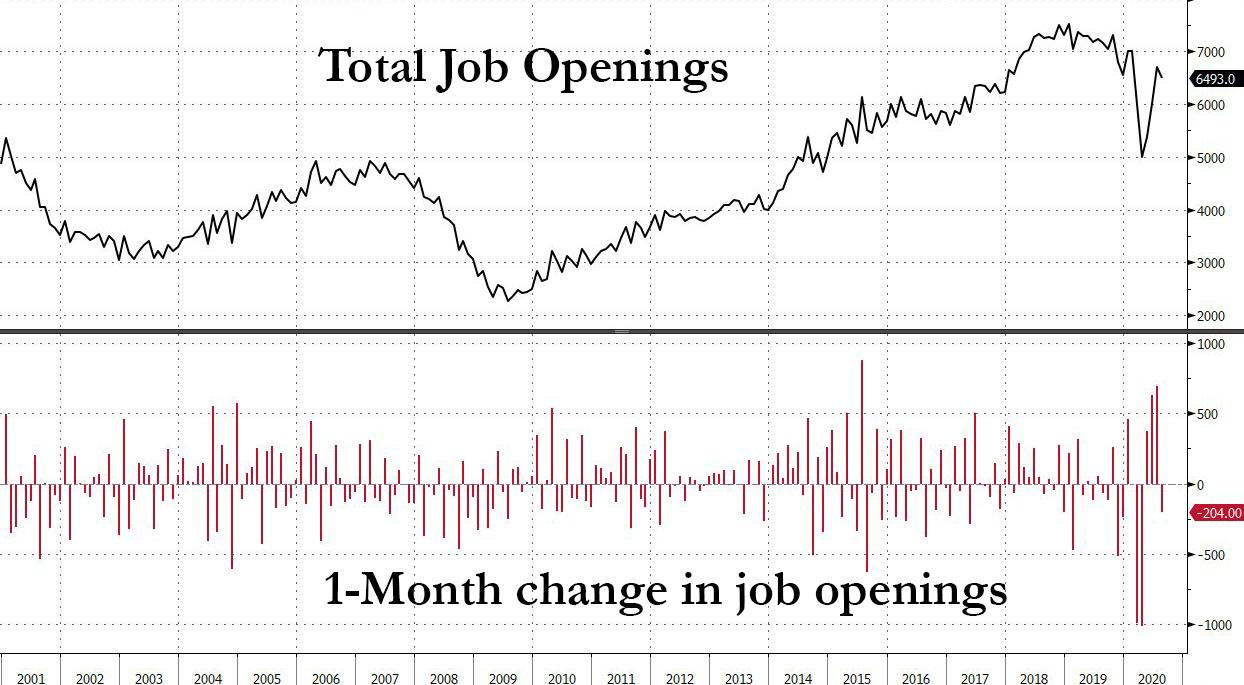
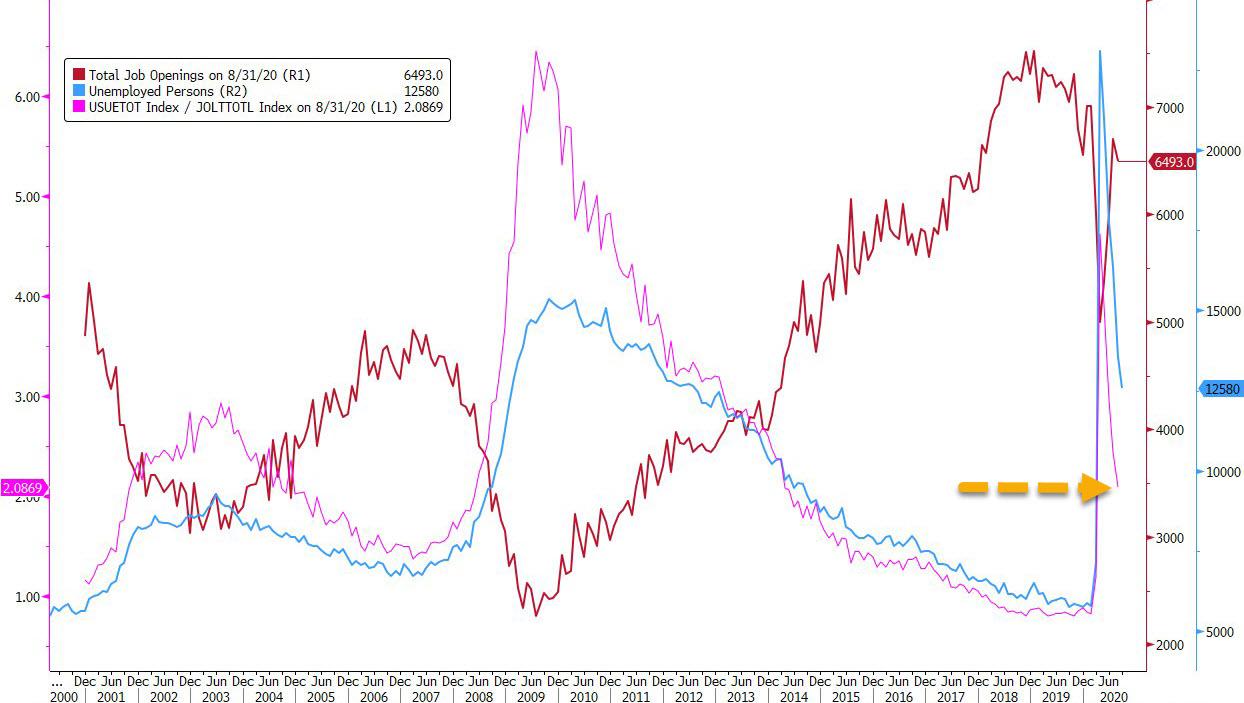
One month after a schizophrenic JOLTs report showed a concurrent surge in job openings accompanied by a record plunge in hirings, things returned somewhat to normal in August (as a reminder, the BLS’s Job Openings and Labor Turnover survey is two months delayed), when the number of job openings dipped dropped by 204K to 6.493 million after posting the biggest two-month increase in the previous two months when US employers announced 1.3 million job openings. This was the first monthly drop in total job-opening since the March/April crash in the labor market, suggesting the recent V-shaped recovery in the labor market may be peaking.

Job openings decreased in construction (-68,000), and information (-25,000). The number of job openings decreased in the Midwest region.

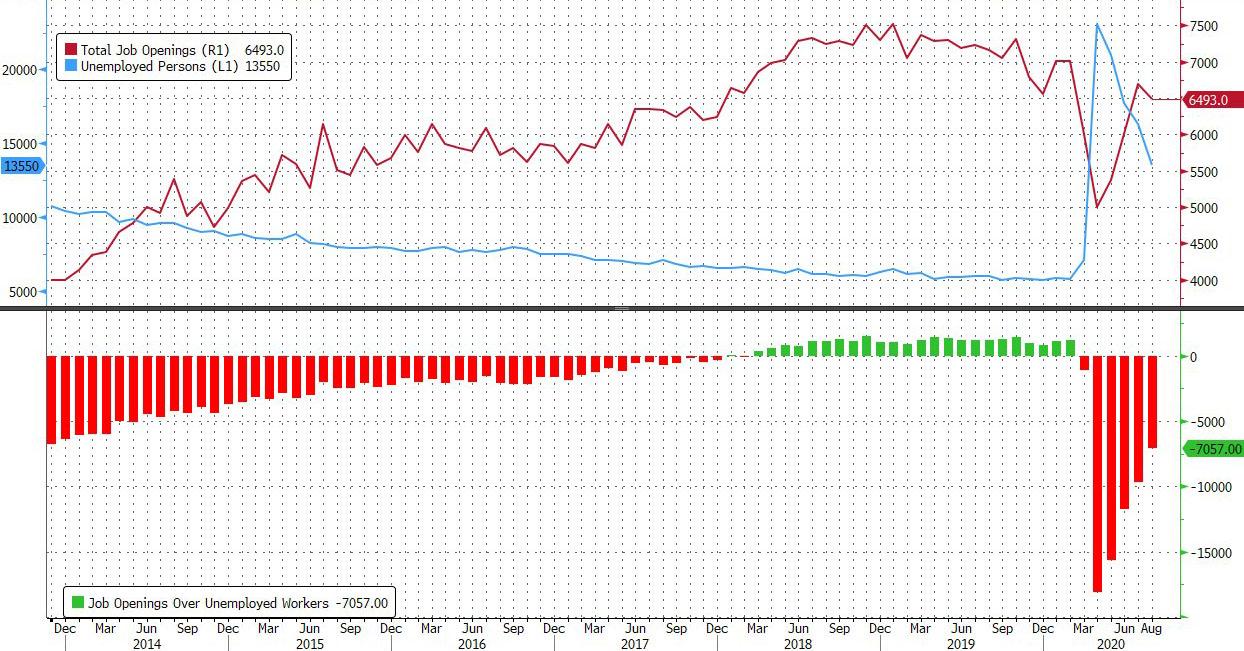
Separately,  we already knew that the series of 24 consecutive months in which there were more job openings than unemployed workers ended with a thud in March, in April it was an absolute doozy with 18 million more unemployed workers than there are job openings, the biggest gap on record. Since then the the gap has closed somewhat, and in July, there were 7.1 million more unemployed than available job openings (after 9.6 million in July).

As a result, there were just over 2 unemployed workers for every job opening, down from 2.4 last month.

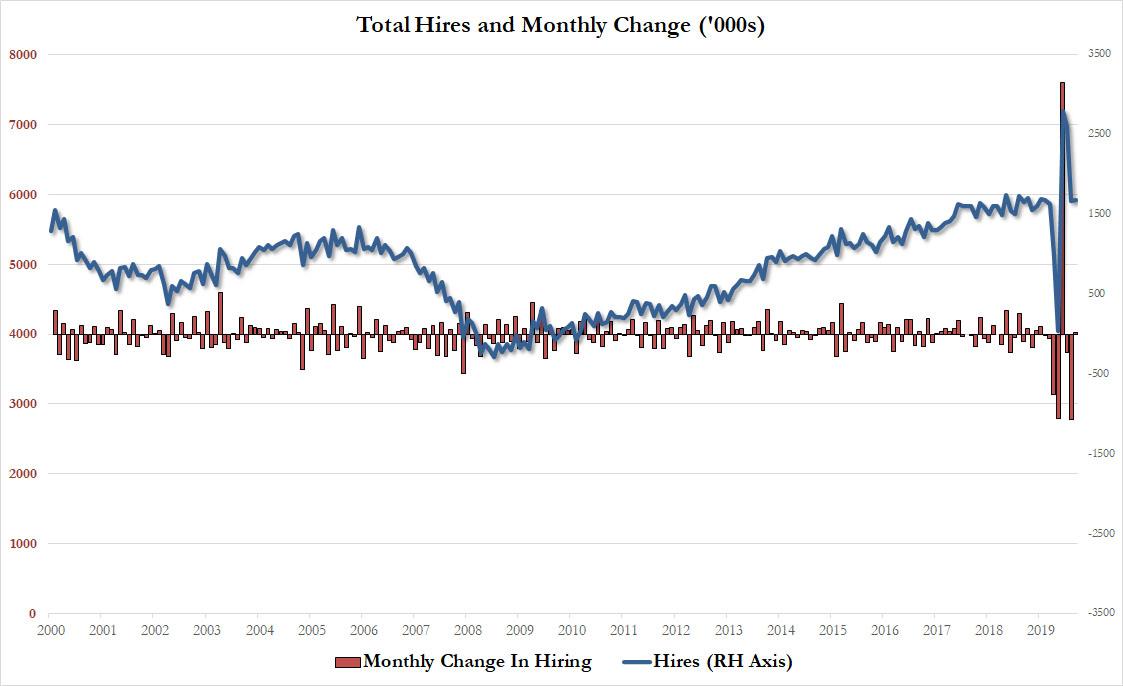
Meanwhile, after a record and unexplained plunge in hiring in July, when the total number of job hires dropped by a 1.2 million to just 5.8 million, in August hiring stabilized modestly, increasing by 16k to 5.919MM from 5.903MM, which still is well below the record hiring pace set in May with 7.2MM.

Hires increased in federal government (+246,000), largely because of temporary 2020 Census hiring. Hires also increased in durable goods manufacturing (+41,000). Hires decreased in accommodation and food services (-177,000), health care and social assistance (-73,000), and real estate and rental and leasing (-28,000).

With hiring relatively flat in August, the number and rate of total separations decreased to 4.6 million (-394,000) and 3.3 percent, respectively. Total separations decreased in other services (-80,000) and in arts, entertainment, and recreation (-56,000). The number of total separations increased in federal government (+13,000). 

Of these, the number and rate of layoffs and discharges decreased to series lows of 1.5 million (-272,000) and 1.0 percent, respectively in August. Layoffs and discharges decreased in a few industries, with the largest decreases in professional and business services (-95,000), accommodation and food services (-62,000), and durable goods manufacturing (-42,000). The number of layoffs and discharges increased in federal government (+12,000).

Finally, after the record surge in the number of American quitting their jobs reported back in June, the number of quits edged down to 2.8 million (-139,000) and the quits rate was 2.0 percent. Quits decreased in a number of industries with the largest decreases in other services (-48,000), construction (-40,000), and arts, entertainment, and recreation (-18,000). The number of quits increased in finance and insurance (+36,000).

via ZeroHedge News https://ift.tt/3llXlP4 Tyler Durden

Trump Mulls Nationwide Address, Insists Americans Must “Learn To Live With COVID”

Trump Mulls Nationwide Address, Insists Americans Must “Learn To Live With COVID”

Tyler Durden

Tue, 10/06/2020 – 10:00

NYT White House reporter Maggie Haberman, who has spent the last 4 days relentlessly chronicling every update in the White House COVID-19 outbreak saga, including Trump’s 72-hour stay at Walter Reed, has just reported that Trump is considering giving a nationwide address on Tuesday.

Haberman, who also reported that Trump still sounds “short of breath”, citing close aides who still speak with him regularly, linked to a report from the NYT which claimed that a “culture of panic” had replaced the “culture of negligence” at the White House. She described the comms shop as “bereft of people”, since the outbreak has taken out both McEnany and some of her top aides.

She added that while Trump stays in the residence, the West Wing has been virtually empty as most White House staffers are working from, either because they have caught the virus, or have been in close contact with somebody who has. She added that the White House “resembled a ghost town” again on Tuesday.

She also confirmed a CNN report claiming another White House aide had tested positive, raising the total infected to an even 30.

Meanwhile, President Trump returned to Twitter Tuesday morning to attack Biden and the Democrats for their support of late-term abortion…

…before reiterating his comments from last night in a tweet where he urged Americans not to be afraid of the virus and insisted “we have learned to live with it”.

According to one source on Twitter, the US hasn’t counted more than 100,000 flu deaths since 1968. Still, Trump’s point that such outbreaks aren’t “unprecedented” stands.


via ZeroHedge News https://ift.tt/36DuK3K Tyler Durden

NYC Schools Close As COVID-19 Makes “Dangerous Comeback” Across US: Live Updates

NYC Schools Close As COVID-19 Makes “Dangerous Comeback” Across US: Live Updates

Tyler Durden

Tue, 10/06/2020 – 09:40

Summary:

  • NYC closes schools in ‘hot spots’

  • Horace Mann school also closes amid outbreak

  • US in the grip of “dangerous” COVID-19 comeback

  • Cases continue to rise across US as Midwest drives new wave

  • GSK + VIR say new antibody treatment enters Phase 3

  • Ireland’s cabinet suggests raising alert level

  • China in talks to have WHO ‘assess’ vaccines

  • India reports fewest new cases since Aug. 25

* * *

Schools in ‘hot spots’ across NYC are closing Tuesday – a day earlier than NYC Mayor Bill de Blasio had hoped – as Gov Cuomo, de Blasio’s political arch-rival, makes changes to the mayor’s proposal, which was subject to state approval. De Blasio had wanted to shutter all “non-essential” business, in the first rollback of the city’s summertime reopening efforts, but Gov. Cuomo wisely staid his hand.

Of course, NY isn’t alone, as outbreaks are worsening across the Midwest and other parts of the country, while states like NY and NJ see incipient new outbreaks of their own.

In addition to the public schools in NYC’s hot spots, Horace Mann, a private school in the Bronx, has suspended in-person classes for its middle and upper grades for two weeks after the school was alerted to a mini outbreak among its teaching staff.

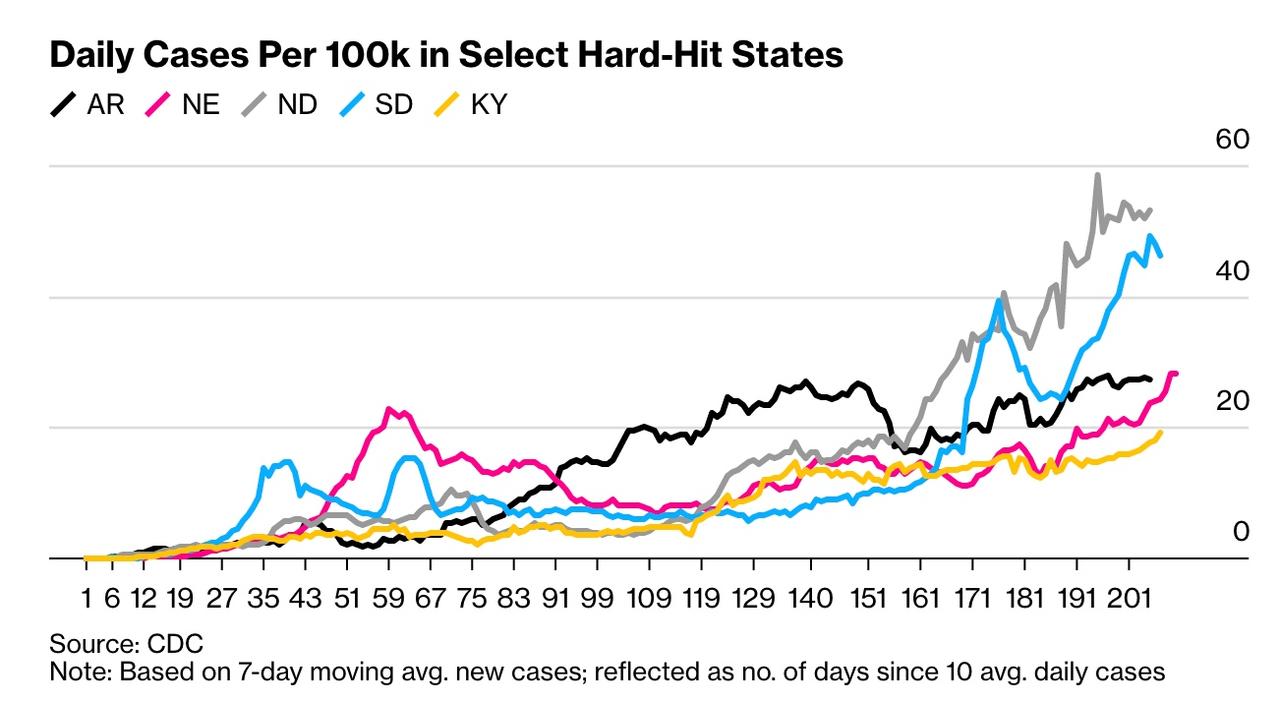
But, as Bloomberg points out, South Dakota and North Dakota are seeing some of the worst outbreaks relative to their populations.

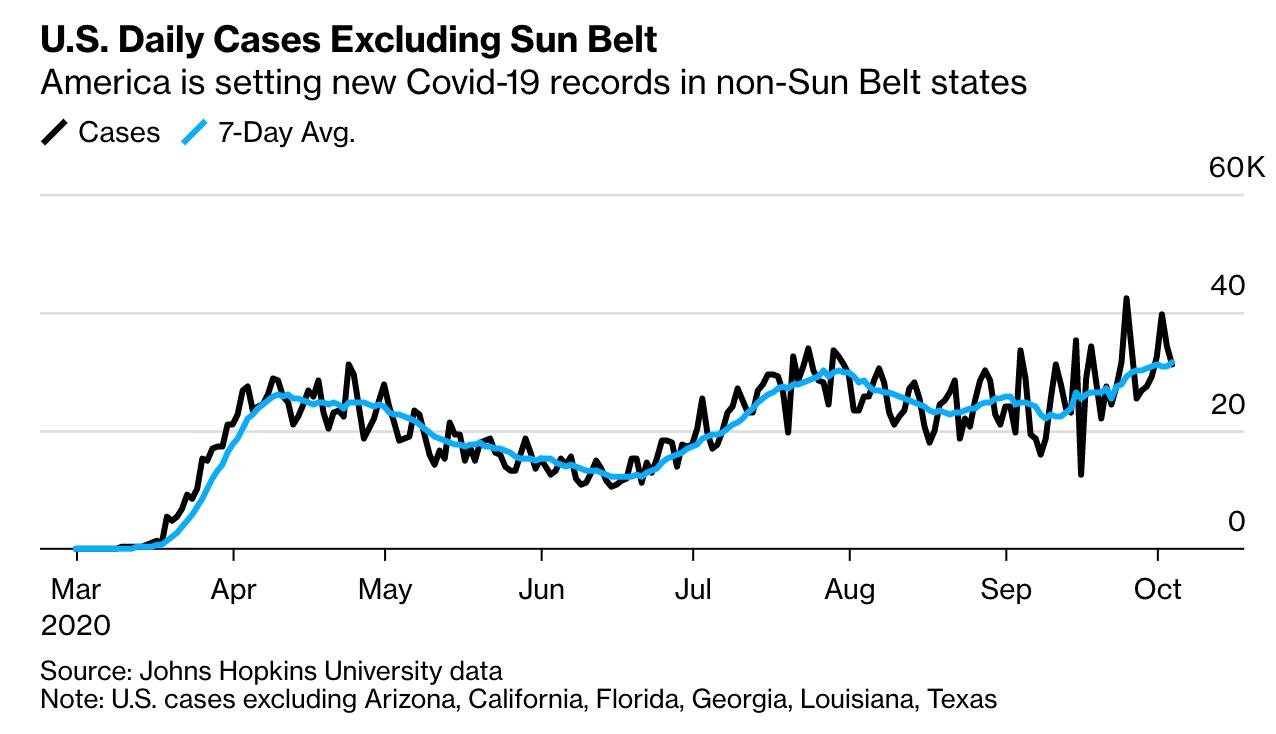
While big states like California, Florida and Texas are seeing cases continue to decline, outside of the Sun Belt, the US outbreak is growing.

Scientists in the US have long warned of a looming “Twindemic” as the coronavirus mixes with the common cold and the seasonal flu. And in the Midwest, where falling temperatures are starting to send people indoors, many states are seeing the virus arrive in towns and small communities where it has been almost totally absent. In Nebraska, the seven-day average of cases hit a record Saturday, joining Midwestern and Western states including Wisconsin, Montana and the Dakotas in confronting a virus that had eluded them until recently.

“We’re in very bad shape, never having achieved any sense of containment, never gotten below 20,000 new confirmed cases per day,” said Eric Topol, director of Scripps Research Translational Institute. “Things can only get worse on this course.”

Meanwhile, as Trump’s return to the White House captivated the country on Monday, the NYT reported – as we mentioned last night – that the administration is once again pressuring the FDA to make changes to its proposed new vaccine guidelines to strip out a section that would essentially rule out the approval of a vaccine before election day.

Despite rising case numbers, Texas Gov Greg Abbott is reportedly preparing to announce another round of rollbacks for the state’s COVID-19-related restrictions.

Finally, on the pharmaceutical side, GlaxoSmithKline and VIR have announced that their antibody therapy, which is similar to convalescent plasma and other techniques seeking a ‘cure’ for COVID-19.

Here’s more COVID-19 news from last night and this morning:

Global cases reach 35,485,738. The worldwide death toll has hit 1,044,085 (Source: JHU)

US COVID cases +39,562 (prev. +35,504) and deaths +460 (prev. +690). New York COVID cases +933 (prev. +1,222) and deaths +8 (prev. +14). (Source: Newswires).

Biontech and Pfizer have initiated a rolling submission to the European Medicines Agency for COVID-19 vaccine candidate as the EU scrambles to approve the leading vaccine projects, which also includes AstraZeneca and Oxford (which has also struck a deal for rolling submission of trial data) (Source: AFP).

France COVID cases +5,084 (prev. +12,565) and deaths +69 (prev. +32). (Source: AFP).

Ireland’s Cabinet recommended to raise the country’s alert level to 3, from, at midnight Tuesday (Source: RTE).

Iranian President Hassan Rouhani reportedly may have contracted COVID-19 (Source: FARS).

China is in talks to have its locally produced COVID-19 vaccines assessed by the World Health Organization, as a step toward making them available for international use, a WHO official says. Hundreds of thousands of essential workers and other groups considered at high risk in China have been given locally developed vaccines even though clinical trials had not been completed, raising safety concerns (Source: Nikkei).

India’s latest daily new case count was just 61,267, fewer than the 74,442 a day earlier and the lowest single-day tally since Aug. 25. India has seen a total of 6.69 million. Deaths rose by 884 to 103,569 (Source: Nikkei).

via ZeroHedge News https://ift.tt/3iAjeZr Tyler Durden

Rabobank: It’s Easy To Call For Continued Lockdowns When One Has A Safe Job Working Comfortably From Home

Rabobank: It’s Easy To Call For Continued Lockdowns When One Has A Safe Job Working Comfortably From Home

Tyler Durden

Tue, 10/06/2020 – 09:20

By Michael Every of Rabobank

Back to the Roach Motel.

President Trump indeed returned to the White House yesterday, where people seem to be going down with Covid like flies. Luckily he is probably already immune, as he noted. Trump arrived by helicopter in a Leni Riefenstahl video clip and urged Americans –for the second time, the first by Tweet– not to be afraid of Covid, and not to let it dominate their lives. He had, he said, fought the virus as a leader. He had to do what he done, knowing the risks, involved.

Critics will point out that the man who just fought the virus is not yet out of the woods medically, and was caught puffing after climbing the stairs: true, but have they ever seen what Trump looks like after climbing any set of stairs at any time? The same critics point out Trump just benefitted from experimental, world class healthcare at public expense even as he has nominated a justice to the Supreme Court who may vote to repeal existing conditions protections offered by Obamacare.

However, one has to also consider that 2020 is likely a base election, and Leni Riefenstahl and Trump know how to fire up a base. It is very easy to call for continued lockdowns when one has a safe job paying full salary to work comfortably from home – which includes most Trump critics (and, full disclosure, this writer too). It’s far less attractive an option for a small business owner facing ruin, or for the self-employed, facing ruin, and even for the ‘always one rule for them and another for us’ blue collar voters who have had to keep working through Covid regardless, for example, delivering food to those working from home. Those are all Trump voters.

In short, objective analysis in partisan times would suggest there is going to be a flood of justified criticism of Trump’s actions (again), but likely also a lot of base support. Unless Trump has a health lapse, as his critics warn – but that is where we have been since Friday anyway.

Stocks certainly perked up on the Trump news, and 10-year Treasury yields rose too in a Lazarus effect….although earlier in the day we were told this was because Biden was far ahead in the polls. Or perhaps this was due to hopes for more US stimulus, which Trump has tweeted he very much wants done, and which appears to be edging closer?

On which, we must enter another Roach Motel. Yesterday, the Financial Times published an article from Stephen Roach –formerly of Morgan Stanley, and now a senior lecturer at Yale– in which he calls for the imminent collapse of the US dollar (which will decline by a third by the end of 2021, apparently) and its loss of global reserve currency status. Such pieces from Roach, always with the same theme, seem to appear once or twice a year now, and always get coverage in the financial press, regardless of the fact that they are nonsense. Two colleagues contacted me last night about the piece, which shows how much consternation it caused: one to double check that Roach’s arguments were indeed as silly as they looked and he wasn’t going mad.

Anyway, Roach is roaching that the USD will collapse because the US is running a vast fiscal deficit, and that will cause a vast current account deficit, and then foreigners won’t want to fund it, and then the USD will plunge, and then something else will emerge to replace it globally. This is what they teach at Yale today, apparently.

Naturally, this overlooks that the vast fiscal deficit –which looming stimulus would indeed make vaster– represents a transfer from the public sector to the private sector, so the huge deficit on one hand is matched by a huge surplus on the other. Think of those cheques for USD1,200 going to households, and all the households who just bank it while working from home. In other words, if the US runs a 20% fiscal deficit, for example, it won’t run a 20% current account deficit too: private savings will spike at the same time, and it will only run perhaps a 4% deficit overall.

So, yes, the USD can go down. But it’s already gone down a long way vs. EUR and JPY of late. Does anyone think the ECB and BOJ —who have the same fiscal deficit problems as the US!!!— are going to sit there and do nothing if EUR should try to go up to 1.40 and JPY to 80, bringing both crushing deflation? Likewise, Roach ignores that the USD is up a lot against many EM FX despite what has happened so far fiscally and politically. Is he really saying everyone will now want to hold EM and not US assets? This is also what they apparently teach at Yale.

That is a parallel to the equally tragicomic ‘But nobody will buy US Treasuries!’ argument, which plays out ad nauseum even as yields trend ever lower: on which, this latest UST yield spike is another false dawn unless Trump or Biden push for serious *structural* change in the economy – and that will take a lot more than a Build Back Better sign falling off of a lectern, Theresa May style, or a Leni Riefenstahl video of a helicopter and a balcony.

Roach also can’t make an argument for how any other currency or asset can realistically replace the USD, which is literally armed to the teeth to stop that happening, and where liabilities in the Eurodollar market exceed available USD by 9 to 1. It will just happen, he says. Such ideas are of course much appreciated in China: here is Roach being praised for his bold commentary in the official China Daily, for example.

Indeed, recall that on 8 October the arms embargo on Iran ends. Russia has suggested it will then sell Tehran its S-400 defence system. The US has said anyone doing so will feel the full effect of the USD ‘weapon’. Likewise, 12 October is the 90-day mark following the passage of the Hong Kong Autonomy Act, by which date China hawk Mike Pompeo must compile a list of each foreign person who is “materially contributing to, has materially contributed to, or attempts to materially contribute to the failure of the Government of China to meet its obligations under the Joint Declaration or the Basic Law”. That then starts a short countdown to financial institutions being listed; which starts the countdown to the imposition of US sanctions. The USD weapon again.

Against this backdrop, people will be avoiding USD and looking at EUR or CNY or others? Only in the way people are always deliberately looking for Roach Motels, rather than ending up in one. For one example, the Aussie trade balance today was just AUD2,643m vs. an expectation of AUD5,050m: exports were down 4% m/m and imports up 2%. The RBA left rates on hold while making clear getting unemployment down is an “important national priority”, and that it is ready to ease again: it is waiting to see the budget, out later today (and a fiscal deficit expected to be around 12% of GDP) before acting, however. Yet expect rates at 0.1% and more QE as soon as November: which according to Mr Roach means AUD is going up to 0.90 by end-2021.

via ZeroHedge News https://ift.tt/3d5zhxd Tyler Durden

3410 Emerges As Key Gamma Level Level For S&P

3410 Emerges As Key Gamma Level Level For S&P

Tyler Durden

Tue, 10/06/2020 – 09:05

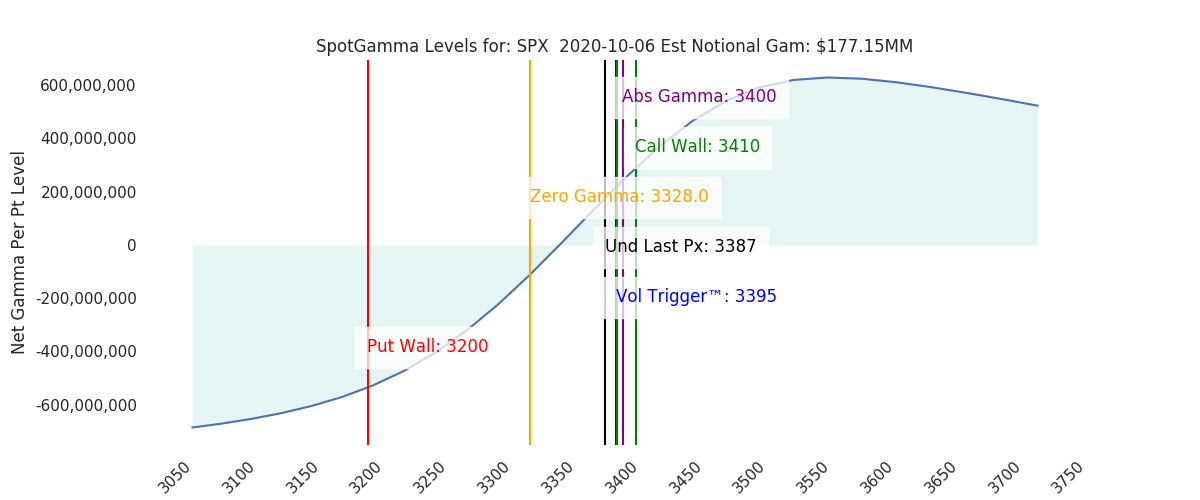
During yesterday’s market ramp, Eminis hit a brick wall at exactly 3,400 which according to SpotGamma yesterday is exactly where the “gamma wall” in the S&P was to be found.

However, now that the trading range has reset higher and the S&P is set to open around 3,400 what are the key “gamma” levels for the market?  For the answer we go to the latest note out of our friends at SpotGamma who note this morning that not surprisingly, the largest interest area shifts from 3350 up to 3400.

As the derivative experts explain, if the market can sustain the rally up into 3500, “gamma notional levels increase which should add some stability to S&P prices” however, the tricky part for bulls here is that the modeled “Call Wall” did not roll up much overnight. That said, they see 3410 as the largest positive gamma strike “which indicates resistance and/or a tendency for markets to mean revert should this level be broken.”

For todays action, they list 3400 as the key pivot and a large price magnet, while 3350 remains support and a break of that area suggests a sharp expansion in volatility. To the upside, the primary resistance is at 3410, but note a large Combo bar at 3428.

Finally, on the single stock side, SG writes that while they have seen a small uptick in call positions they “aren’t detecting anything abnormal” which probably means that SoftBank is taking a break from last week’s gamma squeeze.


via ZeroHedge News https://ift.tt/3jCqmpg Tyler Durden