Biden Drops Details On SPR Release, Then Flees From Media Questions

Biden Drops Details On SPR Release, Then Flees From Media Questions

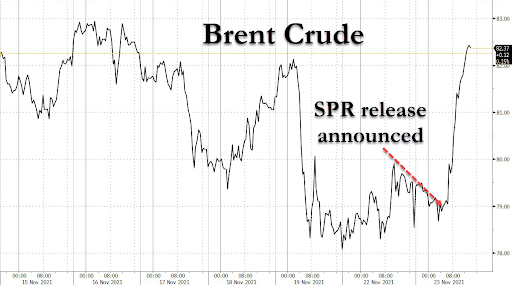
As we noted earlier, Biden’s “exchange-based” release from the global SPR has been a dud, as oil prices surged on Tuesday after the administration confirmed plans for a record-setting 50M barrel release which is contingent on America’s ability to convince Japan, the UK and several other allies to engage in “global” swaps from the strategic reserves.

The decision was aimed at helping alleviate some of the pain Americans have been feeling at the pump this fall.
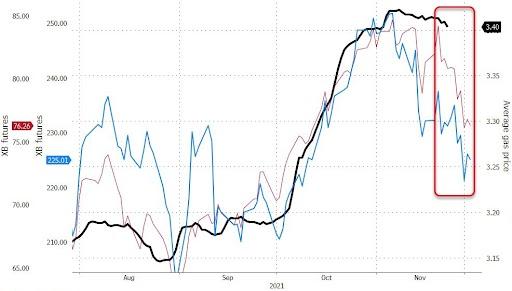
Of course, we don’t have to explain why Biden shouldn’t bother with that SPR release: his administration did that himself last month – insisting that a jolt from the SPR wouldn’t  make a difference in long-term crude prices.

A closer look at the decision might explain the timing; Biden’s SPR announcement comes amid a long-delayed Wednesday sale of oil-exploration leases in the Gulf of Mexico, a decision which has enraged environmentalists, and is ‘unlikely to help tame rising oil and gasoline prices’, according to Bloomberg.
During his Tuesday speech, Biden promised Americans that the drawdown from the reserves would be global in scope, claiming that he had spoken with China about joining it in releasing more from the reserves, while his press secretary importantly said the White House wouldn’t rule out even more cuts.

Biden reassured Americans that they could “rest easy” knowing that stores would be well-stocked this season, something that they probably appreciated after months of near record-setting inflation (and certainly the highest in 30 years) not just in the US, but across the world.
Bloomberg reports that with Biden’s latest economic speech comes amid “policy whiplash” revealing the tension between Biden’s long-term climate goals and short-term political realities. Some promoters of green energy even insisted that Biden can’t really afford higher energy prices rise so high that voters turn against him.

Former Treasury Secretary Larry Summers made the threat to the economy even more explicit last week when he said inflation threatened to usher in a return to power for former President Donald Trump, who called global warming a hoax. Others acknowledged that Biden was already struggling with the decision.

“That’s a challenging tightrope to walk,” said Dan Pickering, founder and chief investment officer at Houston-based Pickering Energy Partners. With no major breakthrough at the United Nations climate conference in Glasgow, and no cohesive strategy for lowering gasoline prices, Pickering added, “you look not great at either, which seems like the worst place in the world for a politician to be.”

The news comes after President Biden made his speech, which he made earlier Tuesday:

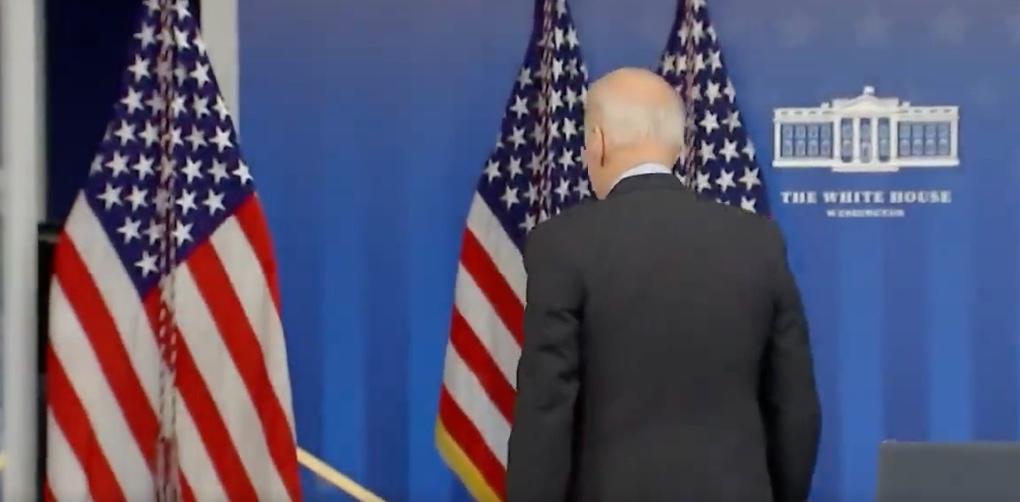
But in one of the most memorable moments from Biden’s administration, the president seemed to almost run away from the press and flee as reporters asked whether the president take questions from reporters.

Tyler Durden
Tue, 11/23/2021 – 16:25

via ZeroHedge News https://ift.tt/3CMXhAz Tyler Durden
Stocks Ramped To A Green Close As Surging Yields Keep Hammering Tech

Stocks Ramped To A Green Close As Surging Yields Keep Hammering Tech

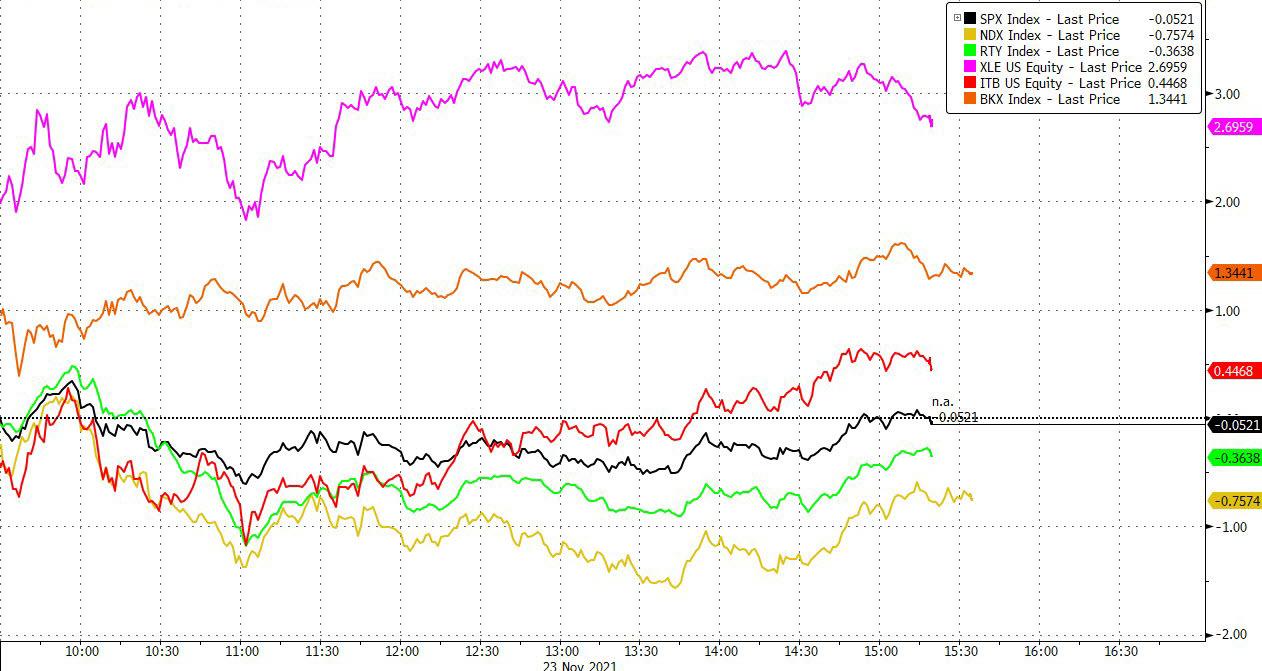
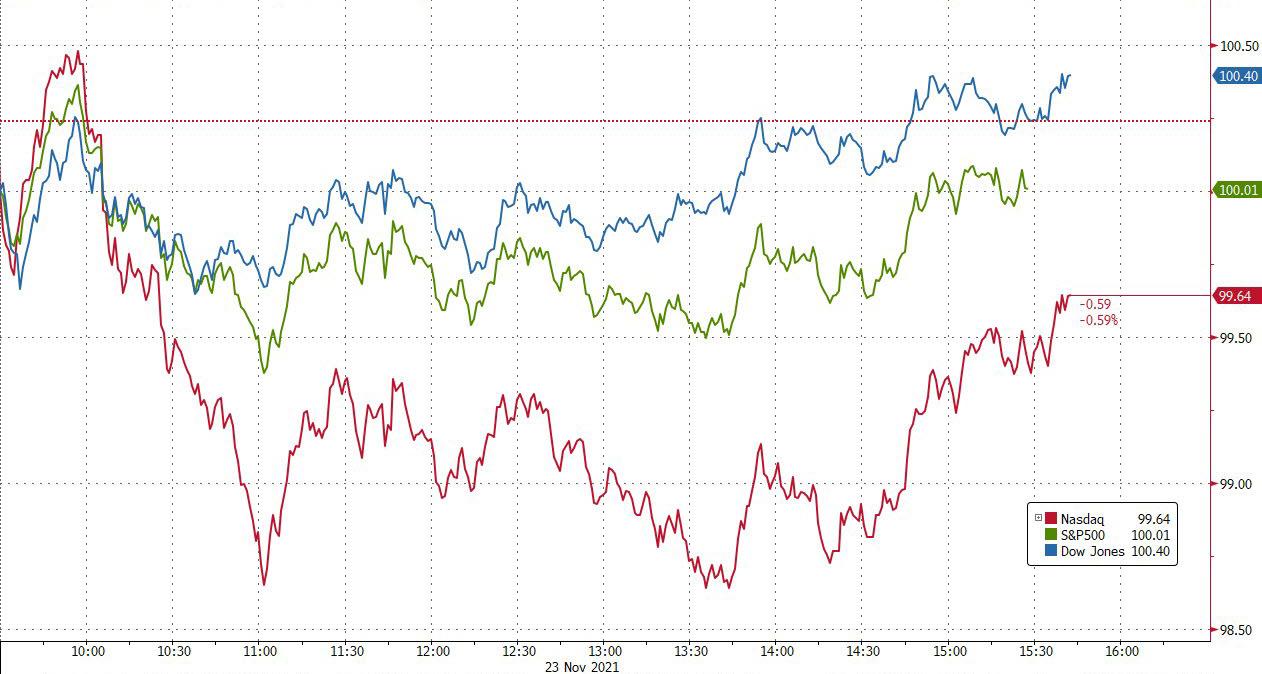
With gamma unclenched after Friday’s major OpEx, as some $2.4 trillion in gamma expired, Tuesday saw more of the same pain for Nasdaq as tech stocks were slammed…

… while the S&P managed to peek into the green thanks to a last 30 minute ramp…

… with the Dow closing near session highs propelled by “old school” stocks such as energy, banks and homebuilders, while tech and small caps got hit for another day.

The opening ramp, momo ignition failed for stonks for the second day in a row…

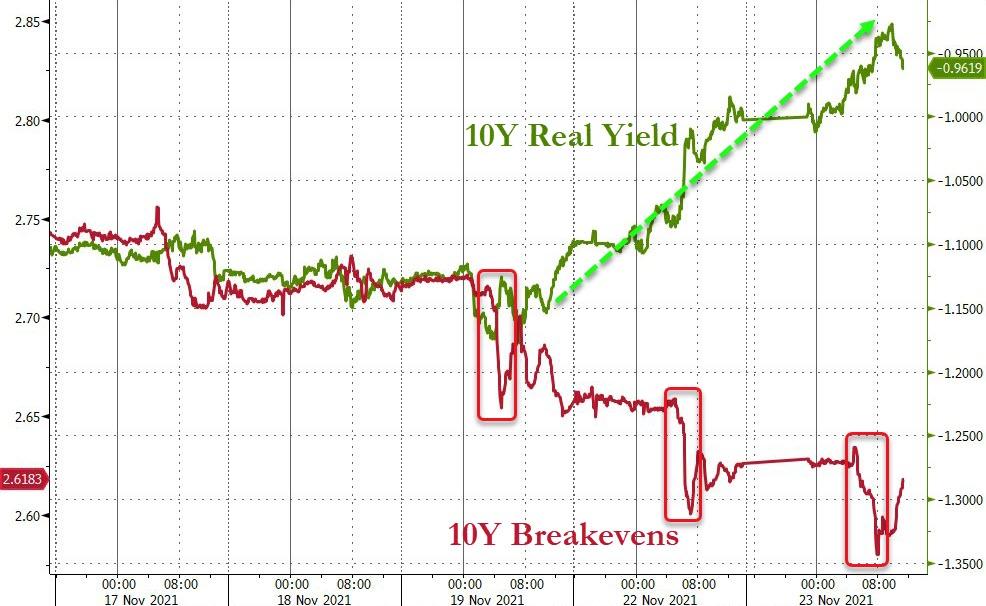
… driven by a continued ramp in real yields, which in turn has hammered high duration-exposed names, while breakevens continue to sink…

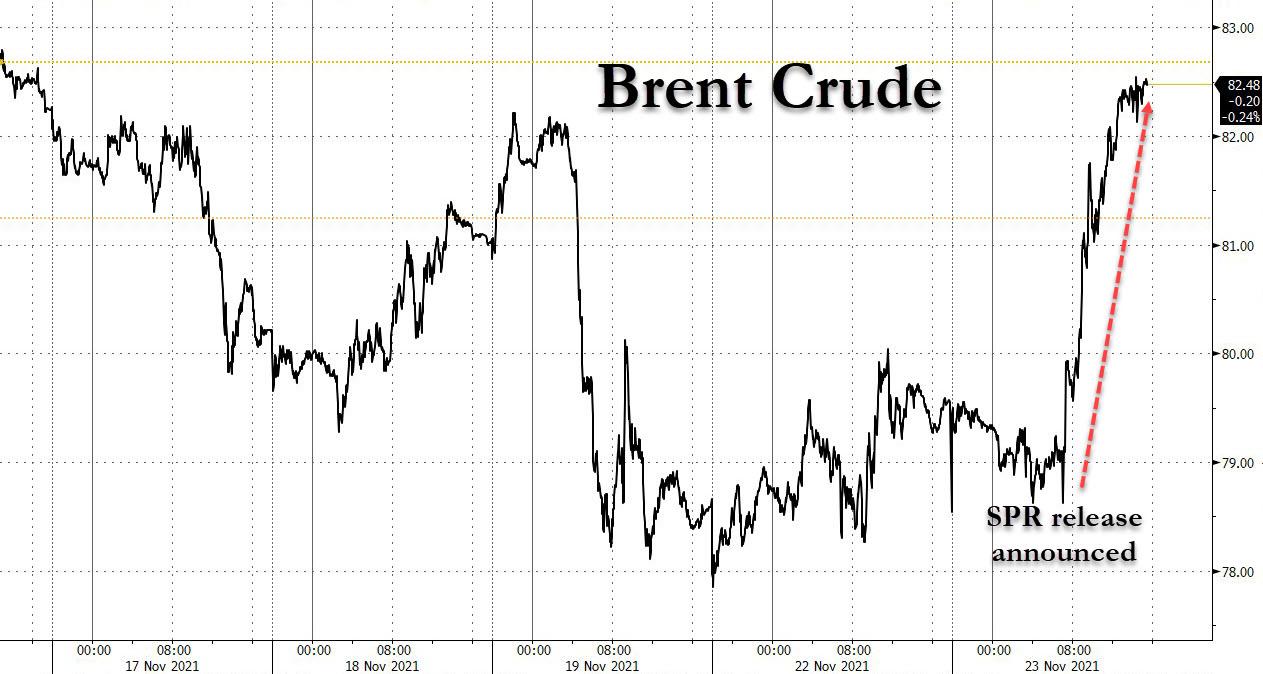
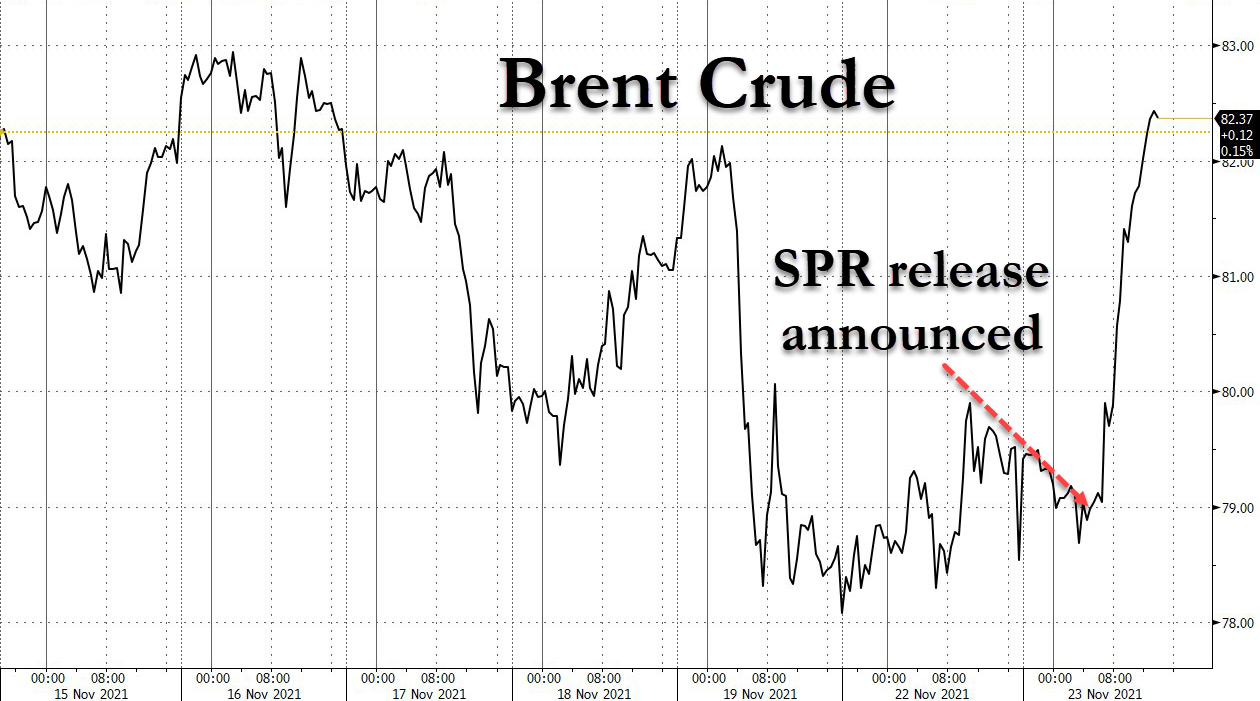
… despite today’s surge in oil which soared as soon as Biden announced a global coordinated SPR which the market has laughed at all day…

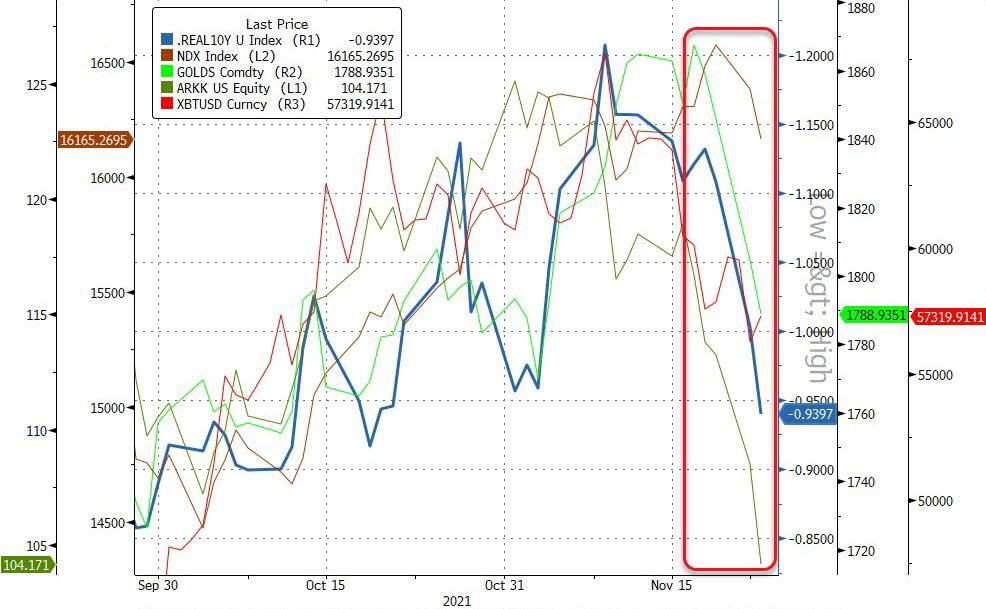
…knocking on to many different asset-classes…

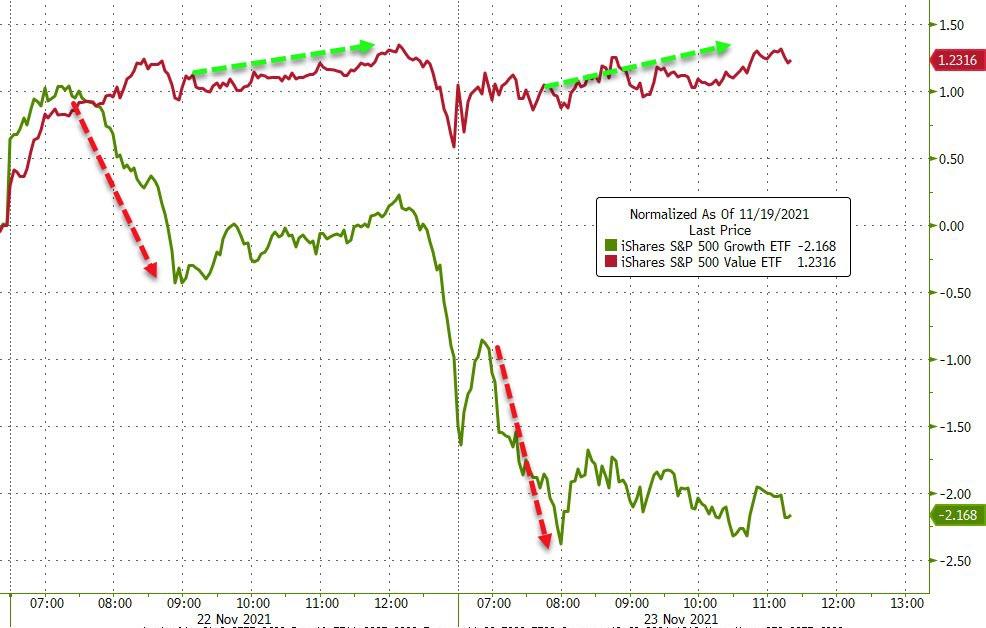
Growth Stocks notably underperformed value once again…

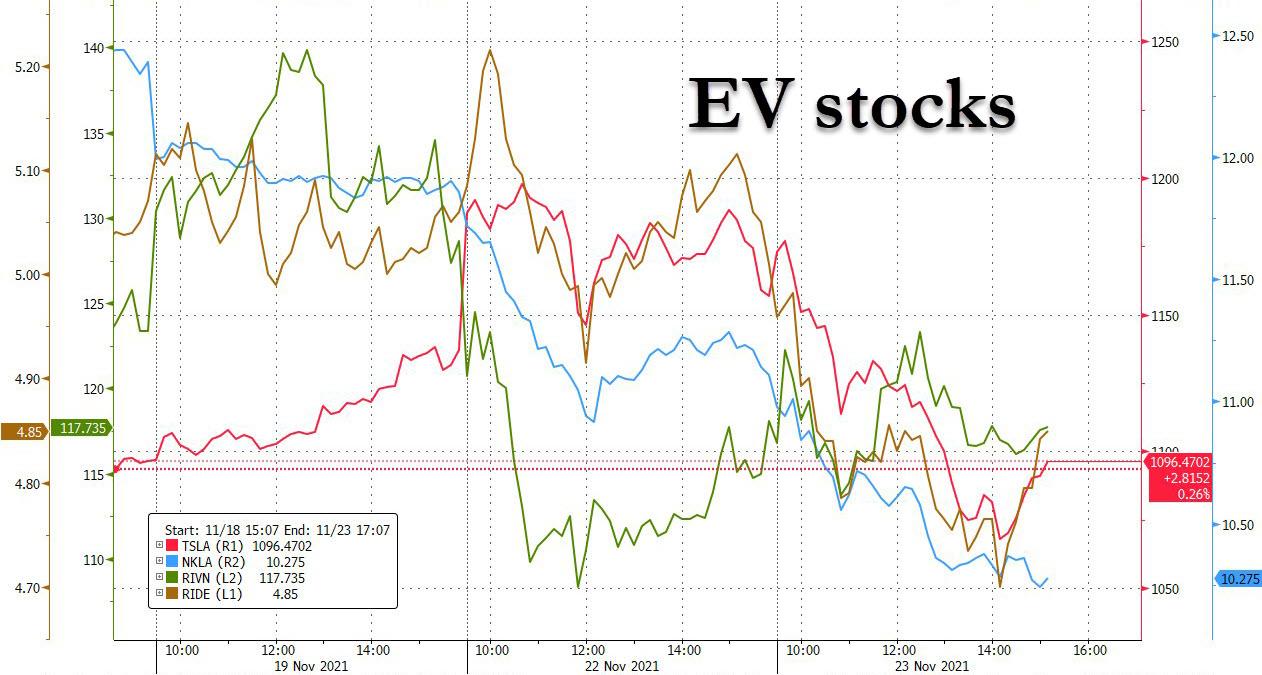
One sector that was hit hard was EV makers: Tesla led electric-vehicle stocks lower, falling as much as 8.1% after climbing for five straight days when it gained 14% in the previous five trading sessions.  Other EV stocks also fell, with Nikola down 6.9%, Lordstown Motors -4.2%, ElectraMeccanica -4.1%, Workhorse Group -2% and Rivian -1.6%.

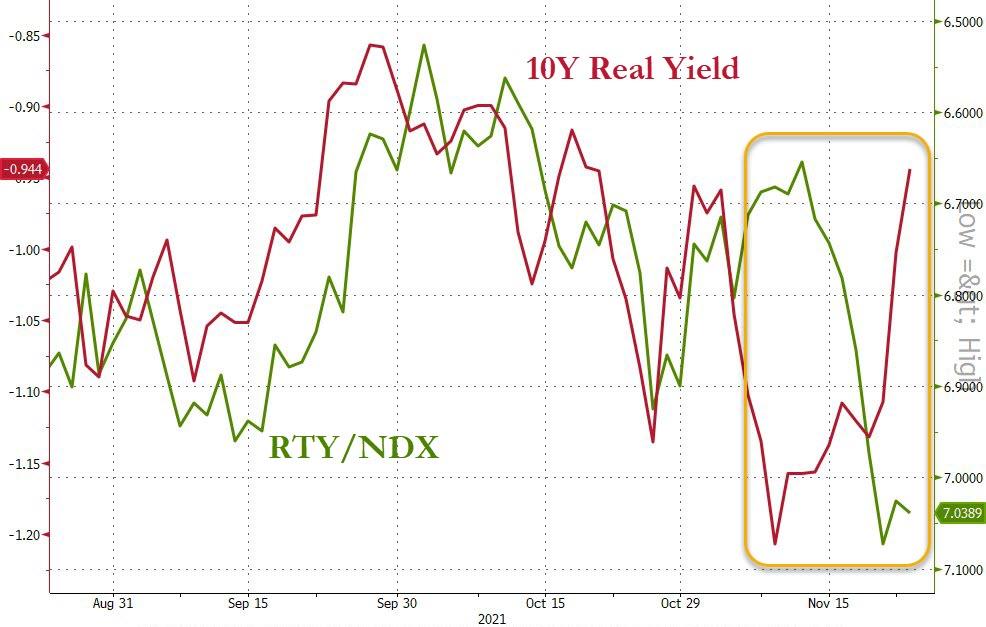
Interestingly, the Nasdaq-Small Caps (Growth/Value) pair has seen a notable regime shift in the last few days relative to real yields…

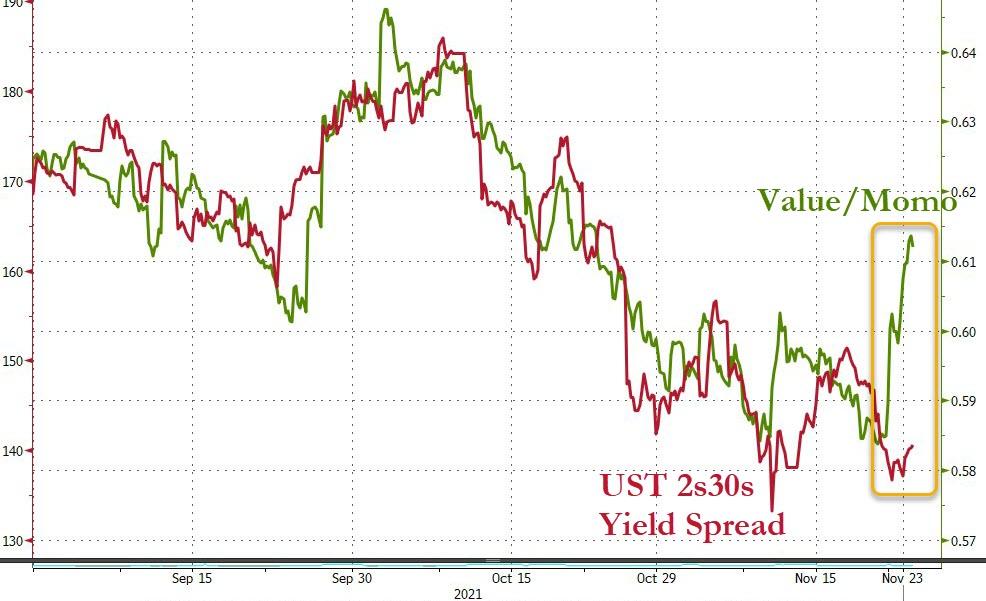
And also Value/Momentum has soared relative to the tight relationship it has had with the TSY yield curve…

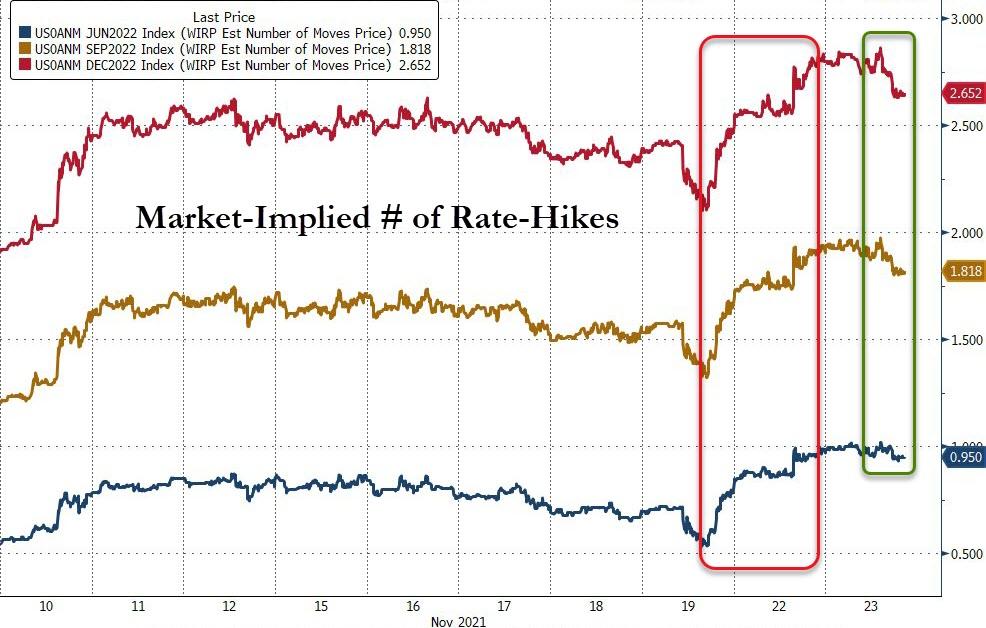
Even though STIRs shifted very modestly dovishly today, the market is still pricing a 55% chance for a May 2022 rate-hike and a 95% chance for a June 2022 rate-hike. As a reminder, the odds of the Fed hiking in a mid-term year – no matter how high inflation is or isn’t – are virtually nil, and Powell will not do anything to jeopardize his MMT JV partner at the Treasury – Janet Yellen – even if it means coming up with new inflation definitions.

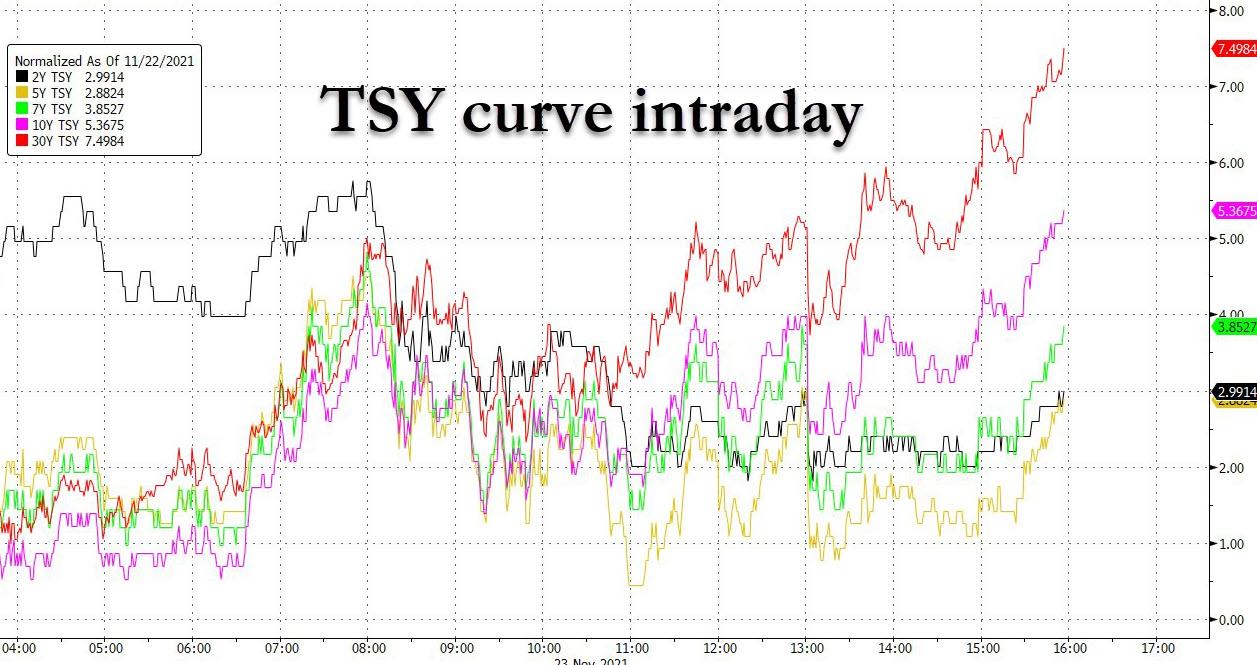
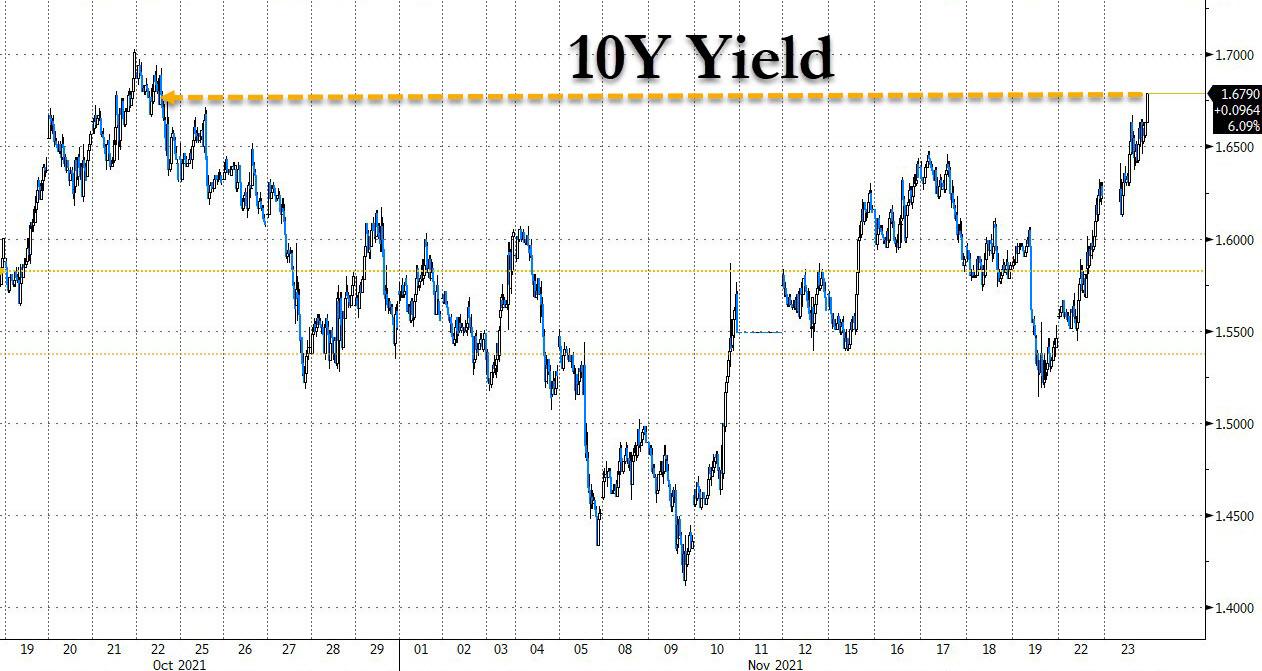
Treasury yields were mixed today with the short-end outperforming (2Y -2.5bps, 30Y +5bps)…

… as 10Y yields

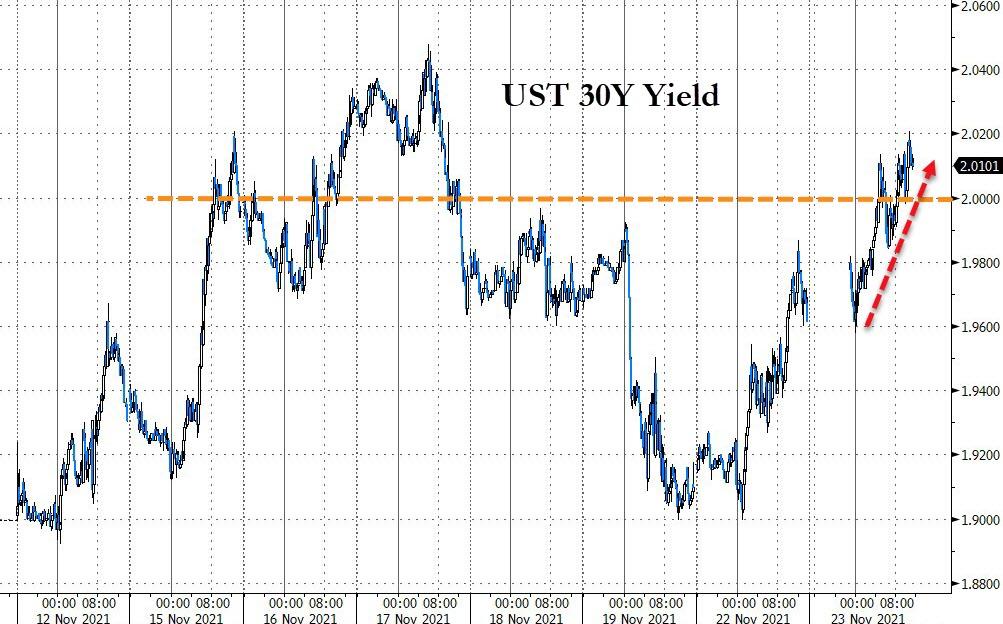
30Y Yields pushed back above 2% today…

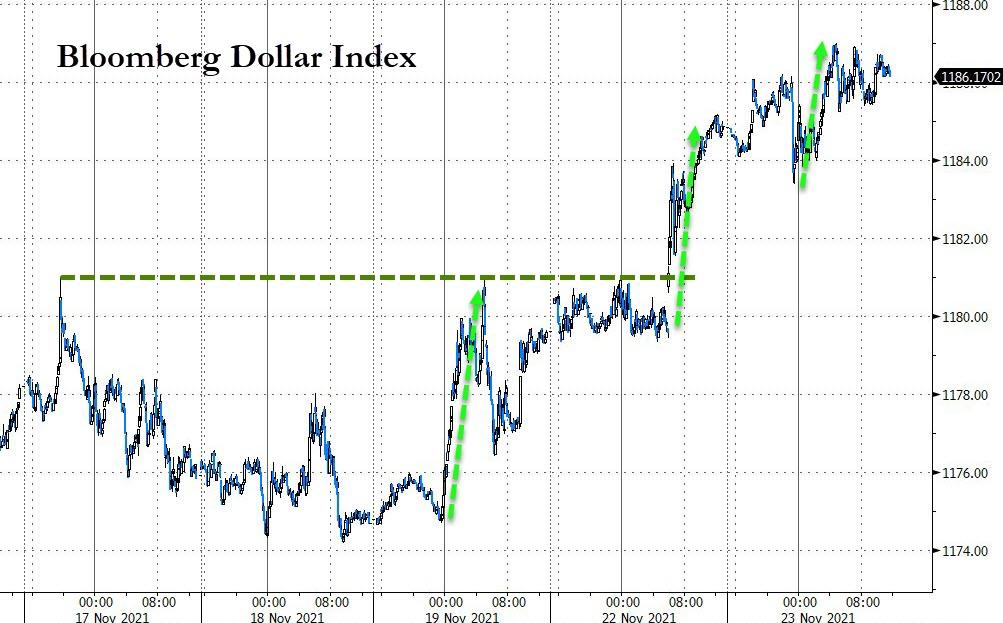
The dollar continued its recent rise, pushing up towards the 9/25/20 recent peak…

Cryptos bounced back from yesterday’s ugliness, pushing bitcoin back above $57k…

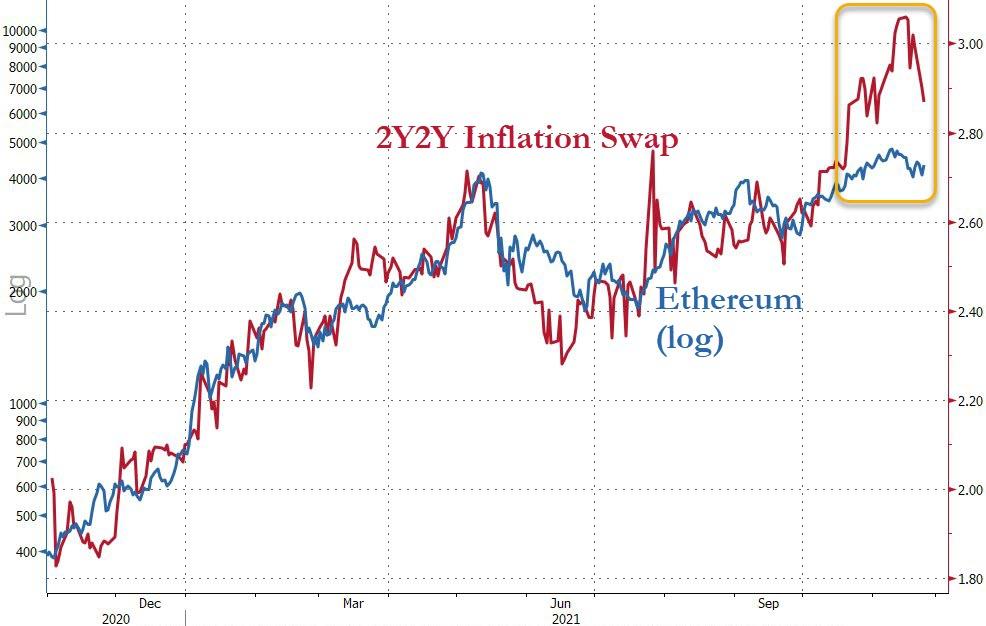
Ethereum rallied back above $4300 today, as the much-watched 2Y2Y inflation swap rate corrected some of its exuberance…

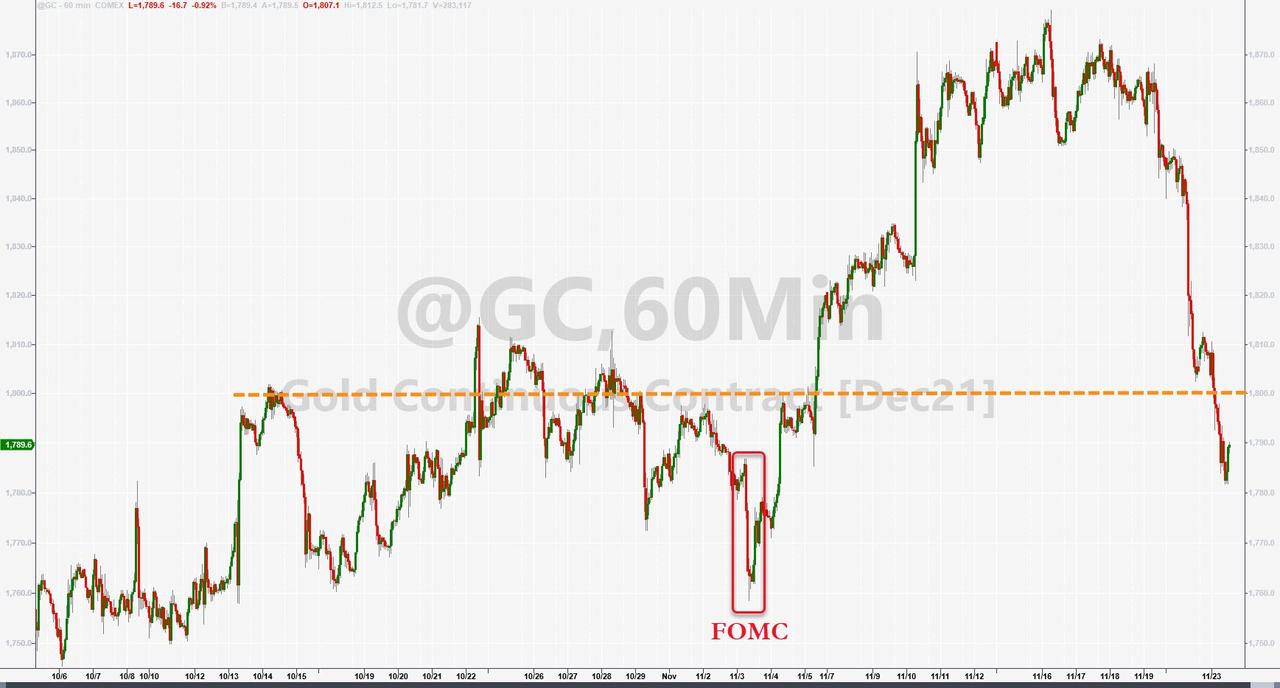
Gold dropped back below $1800 today…

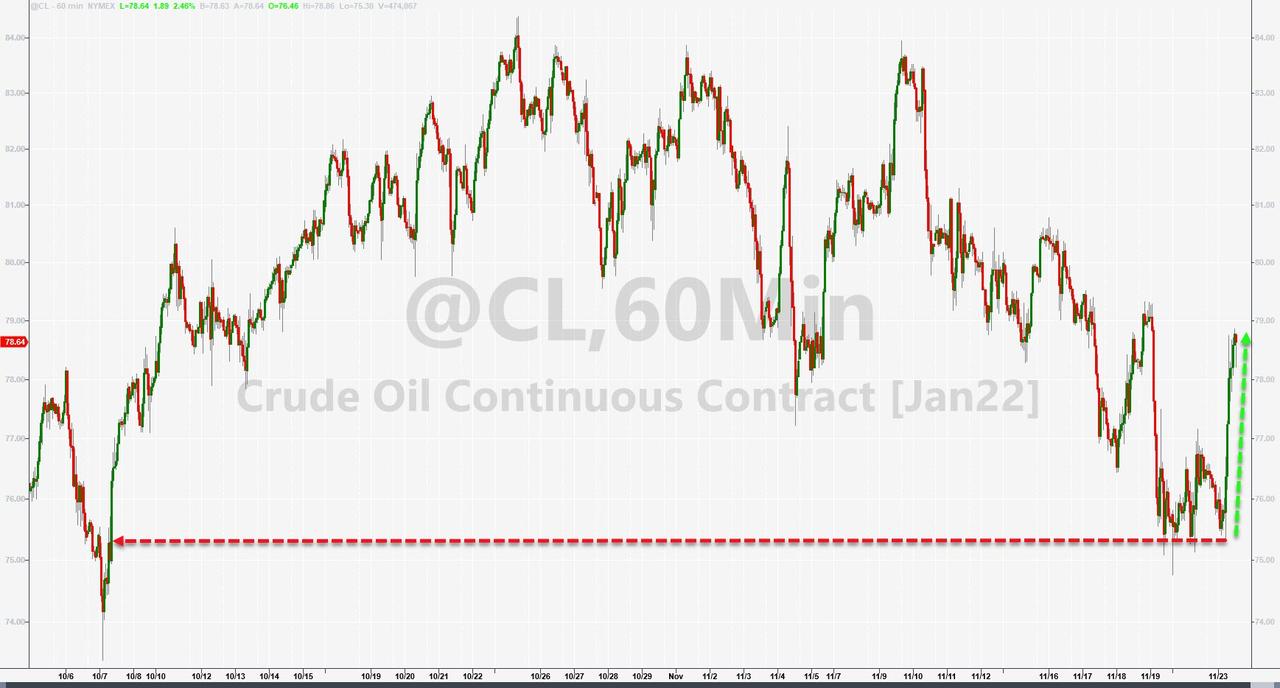
Finally, the Biden administration was thoroughly embarrassed today after crude prices soared following the much-heralded release from the SPR…

Source: Bloomberg

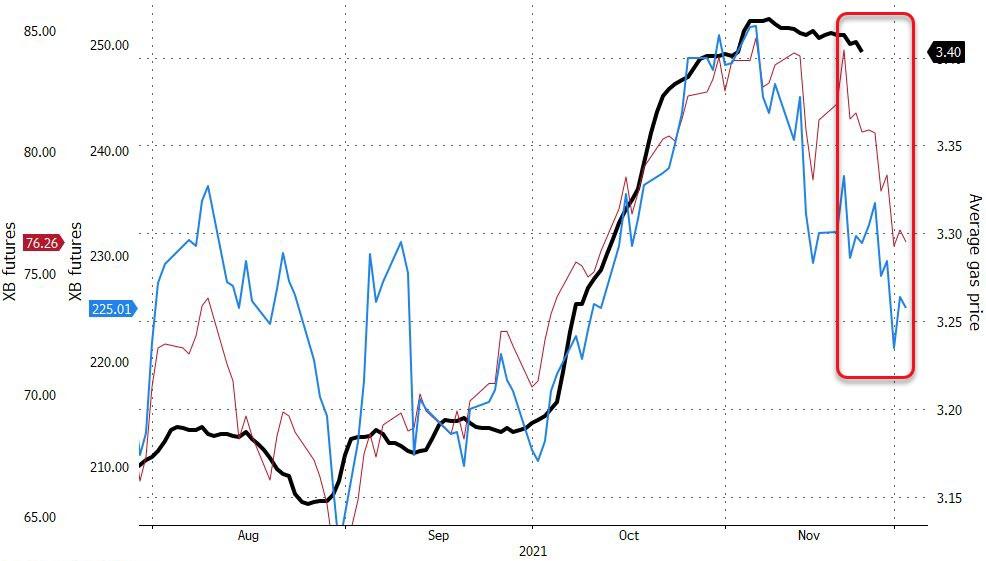
And most notably, his actions today, sending prices for crude higher, will negate the impact of the drop in crude and wholesale gasoline prices that would bring pump prices lower. Simply put, the president is lying when he talks about retailers gouging – and given his lack of actual business experience, seems to have no idea how the supply chain from crude to gasoline works…

Oh, and remember “this is not, I repeat not, due to our environmental policies.”

Tyler Durden
Tue, 11/23/2021 – 16:03

via ZeroHedge News https://ift.tt/3CNPNgm Tyler Durden
Netflix Employee At Center Of Anti-Chapelle Protests Voluntarily Resigns

Netflix Employee At Center Of Anti-Chapelle Protests Voluntarily Resigns

Authored by Katabella Roberts via The Epoch Times,

Netflix employee at the center of worker-led protests over its streaming of comedian Dave Chappelle’s latest comedy special has voluntarily resigned, it was announced Monday.

Chappelle’s special “The Closer”, which debuted on Oct. 5, led to backlash from LGBTQ+ advocates and prompted a walkout among some Netflix employees.

Terra Field, a trans engineer at Netflix, was suspended by the streaming giant after attending a director-level meeting that Field was not invited to before subsequently being reinstated after Netflix found no ill intent in such action.

Prior to the suspension, Field posted a viral tweet thread about the special, alleging that it “attacks the trans community, and the very validity of transness.”

In his special, Chappelle showed support for “Harry Potter” author J.K. Rowling, who has said, “If sex isn’t real, the lived reality of women globally is erased.”

“I agree, man,” Chappelle said.

“Gender is a fact. Every human being in this room, every human being on Earth, had to pass through the legs of a woman to be on Earth. That is a fact.”

Field said in a statement Monday:

“I have resigned from Netflix as of 11/21/2021. This isn’t how I thought things would end, but I am relieved to have closure.”

Field and former colleague, B. Pagels-Minor, are also withdrawing an unfair labor practice charge they filed against the streaming giant in late October that accused the company of retaliating against them for trying to organize a company-wide walkout over Chappelle’s special, Reuters reports.

Pagels-Minor, a game launch operations program manager who also is trans, was fired from Netflix in October for organizing the walkout after the streaming giant also accused Pagels-Minor of leaking confidential information. Pagels-Minor denied leaking such information.

A Netflix spokesperson said in an emailed statement to The Epoch Times on Monday: “We have resolved our differences in a way that acknowledges the erosion of trust on both sides and, we hope, enables everyone to move on.”

The Epoch Times has contacted lawyers for Pagels-Minor and Field for comment.

Tyler Durden

Tue, 11/23/2021 – 15:45

via ZeroHedge News https://ift.tt/3cE5jRD Tyler Durden

JPMorgan Is Once Again The World’s Most Important Bank

JPMorgan Is Once Again The World’s Most Important Bank

After three years on top, JPMorgan – the largest US bank by assets and market cap – was dethroned in November 2020 from its position as the world’s most systematically important bank.

As a reminder, while some might see CEO Jamie Dimon ‘flexing’ over Elon Musk (and others), being the most systemically-important bank is more of a curse, forcing the bank to pay a higher capital burden due to its massive balance sheet (Chinese banks which are generally bigger have explicit state support and as such as broadly viewed as less risky).

And now, JPMorgan is back on top (and paying the price) as the Basel-based Financial Stability Board released its latest annual rankings of systematically important banks, which saw JPMorgan upgraded from Bucket 3 (where it sat with Citigroup and HSBC with a 2.0% capital buffer) to Bucket 4, leaving it the sole bank to face a 2.5% additional buffer.

Goldman Sachs and BNP Paribas also increased one level in this year’s assessment, which lists 30 firms deemed global systemically important banks. The lenders included remain the same as the 2020 list.

For the U.S. firms, the exercise is somewhat symbolic as they already have higher requirements than those recommended by the FSB.

Deutsche Bank, which once headed the list remains in the the 2nd, less risky bucket, which requires a 1.5% capital buffer.

According to Bloomberg, the latest list is based on data from the end of 2020.

Participation in the FSB list is hardly a bragging point: inclusion of a banks means more stringent capital demands and closer scrutiny of their risk management. FSB member authorities apply the following requirements to G-SIBs:

  • Higher capital buffer: Since the November 2012 update, the G-SIBs have been allocated to buckets corresponding to higher capital buffers that they are required to hold by national authorities in accordance with international standards. The capital buffer requirements for the G-SIBs identified in the annual update each November will apply to them as from January fourteen months later. The assignment of G-SIBs to the buckets, in the list published today, therefore determines the higher capital buffer requirements that will apply to each G-SIB from 1 January 2023.
  • Total Loss-Absorbing Capacity (TLAC): G-SIBs are required to meet the TLAC standard, alongside the regulatory capital requirements set out in the Basel III framework. The TLAC standard has begun being phased-in from 1 January 2019 for GSIBs  identified in the 2015 list that continued to be designated as G-SIBs.

  • Resolvability: These include group-wide resolution planning and regular resolvability assessments. The resolvability of each G-SIB is also reviewed in a high-level FSB Resolvability Assessment Process (RAP) by senior regulators within the firms’ Crisis Management Groups.

  • Higher supervisory expectations: These include supervisory expectations for risk management functions, risk data aggregation capabilities, risk governance and internal controls.

The FSB panel, which recommends changes that national supervisors may implement, said shifts in the rankings reflect underlying changes in banks’ activity. The FSB is chaired by The Fed’s Randy Quarles, and includes representatives from authorities including the European Central Bank and Bank of England.

Tyler Durden
Tue, 11/23/2021 – 15:25

via ZeroHedge News https://ift.tt/3xiFfFd Tyler Durden
Kolanovic: Oil Is Actually Very Cheap: Here’s Why

Kolanovic: Oil Is Actually Very Cheap: Here’s Why

Listening to Biden’s press conference this afternoon discussing soaring gas prices and relentless inflation (here Biden pivoted by instead praising the surge in small business creation as if it has anything to do with vibrancy while completely omitting that it was driven by millions hoping to take advantage of the next PPP bailouts when the US enters lockdowns next), which had soundbites such as this:

  • *BIDEN: GOING TO GET THROUGH THIS GASOLINE PRICE SPIKE
  • *BIDEN: CHINA MAY DO MORE ON OIL RESERVE RELEASE AS WELL
  • *BIDEN: UNACCEPTABLE FOR GASOLINE FIRMS TO POCKET GAINS
  • *BIDEN: WILL DO WHAT’S NEEDED TO REDUCE PRICES AT THE PUMP

… one would think that the US is facing nothing short of a 1970s energy crisis (in where communist China is advising the Biden admin on how to best punish evil US energy companies for daring to “pocket gains” — maybe the US should just nationalize them like every other model communist nation) instead of just a collapse in the polls for Democrats ahead of next year’s midterms.

Sarcasm aside, Biden’s comments do bring up a relevant question: just how expensive is oil… or rather how cheap?

Conveniently, overnight JPM’s Marko Kolanovic answered this question writing that “recently there has been a debate on how cheap or expensive recent oil prices are.” The Croat quant continues that “over the last few days, several countries considered releasing strategic reserves in order to lower oil prices, and OPEC+ is considering how to respond.”

But is that actually required? In his analysis, Kolanovic presents one way to assess the cheapness or richness of oil prices, “namely by looking at the historical ratio to other asset classes.” As he explains, “oil prices are driven by demand from reopening and growing economies, supply issues due to underinvestment in energy infrastructure and capital flows (e.g., ESG), increased monetary base and broad inflation, etc. But how do oil prices now compare to other assets that are impacted by similar macro forces?”

Well, as the chart below shows, by comparing oil prices to other major asset classes over the past 20 years (ratio of oil price to other assets), oil appears very cheap.

As it turns out, oil is only in the 12th percentile relative to global stocks (and 7th percentile relative to US stocks), 10th percentile relative to copper, 20th percentile relative to gold, 40th percentile relative to bonds, and 8th percentile relative to central banks’ asset purchases (balance sheet), etc.

So yes, on a relative basis, oil has very rarely been cheaper!

Kolanovic then calculates that when “focusing only on global stocks, bonds and commodities, oil is in the 19th historical percentile; in order to rise to the median (50th percentile) historical relative level, oil would need to be trading at ~$115/bbl (we say this is conservative because we have excluded “expensive assets” such as central bank balance sheets and Nasdaq, which would imply a median oil price in the $300-$500/bbl range).

Translation: a $300-$500 oil price is all to realistic in the coming months as Biden’s catastrophic energy policies crash and burn – pardon the pun – and the world is stuck with the dire consequences.

Going back to Kolanovic’s assessment, he summarizes that “relative to broad levels of various asset prices and the monetary base, oil looks remarkably cheap. One could say that oil producing countries (often developing countries) have been subsidizing oil importing countries (often developed countries), given the broad monetary and asset inflation in the developed world over the past 20 years.”

That said, realizing that oil above $100 would promptly result in a global recession, Kolanovic is quick to add the post script that “that this is only one way to look at asset prices and does not represent our near-term price targets.”

Tyler Durden
Tue, 11/23/2021 – 15:10

via ZeroHedge News https://ift.tt/30PLdB5 Tyler Durden
Uranium “Cornering” Accelerates: Sprott Massively Upsizes Physical Buying Program To $3.5 Billion Amid Relentless Demand

Uranium “Cornering” Accelerates: Sprott Massively Upsizes Physical Buying Program To $3.5 Billion Amid Relentless Demand

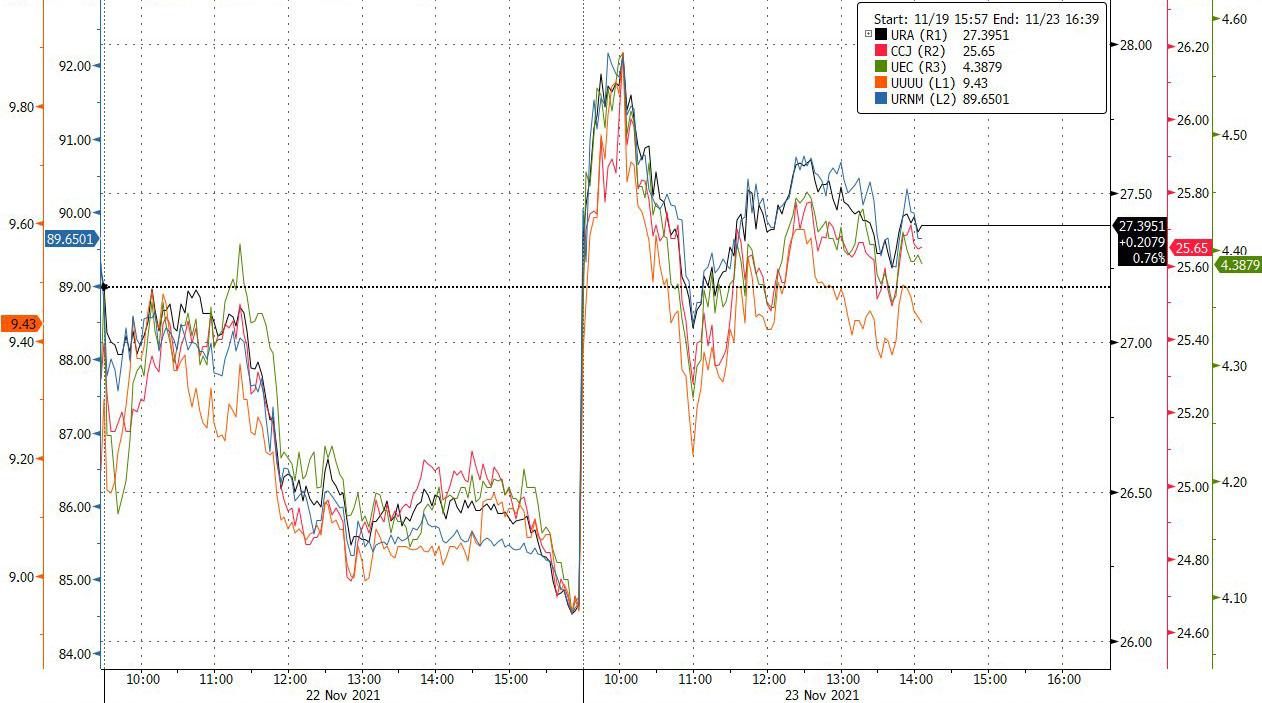
While most markets – and certainly tech stocks – are having another miserable day, the same can not be said for uranium stocks which have rebounded strongly after recent losses.

The driver behind today’s surge is the second consecutive upsizing of the Sprott Physical Uranium Trust, which as discussed here two months ago, had sharply repriced the entire uranium sector, and which after amending its at-the-market program so it can raise up to $1.3 billion (from just $300 million previously), has again upsized it, this time to $3.5 billion in what appears to be ravenous demand for physical uranium – according to the prospectus, SPUT now holds approximately 40 million pounds of physical uranium in a move that increasingly appears like an attempt to corner the market. 

As explained here, the striking recent increase in uranium prices started after the Sprott Physical Uranium Trust began buying uranium in the spot market when it launched its previous at-the-market equity program to raise $300 million on Aug 17.

Barely three weeks later, the Trust had already issued 24.7 million units for gross proceeds of approximately US$244.7 million. With demand rising, and supply about to run out, and also seeing the profound impact this modest ATM buying has had on the sector, Sprott decided to upsize the buying program dramatically and in September upsized the trust so it can issue up to $1.3 billion of units of the Trust in Canada, more than 4x more than the original proposed amount. As we said tat the time, “once there is sufficient investor demand to fill the $1.3 billion offering, we expect another upsizing, and then another.”

That’s exactly what happened, because fast forwarding to today we read that the Trust has “filed and obtained a receipt from securities regulatory authorities” for an amended and restated shelf prospectus allowing the Trust “to issue up to US$3.5 billion of units of the Trust (“Units”) in Canada during the 25-month period that commenced on August 10, 2021.”

The Trust has also updated its at-the-market equity program (the “ATM Program”) to issue up to an additional US$1.20 billion of Units pursuant to a prospectus supplement dated November 22, 2021 (the “Prospectus Supplement”, and together with the Second Amended and Restated Shelf Prospectus, the “Offering Documents”) to the Second Amended and Restated Shelf Prospectus. Copies of the Offering Documents are available at www.sedar.com. Distributions will no longer be made under previous ATM Program prospectus supplements, including the prospectus supplement dated September 13, 2021.

“We continue to experience strong investor demand for units of the Sprott Physical Uranium Trust on growing recognition that nuclear power generates reliable baseload energy while helping to meet de-carbonization goals,” said John Ciampaglia, CEO of Sprott Asset Management.

“Since launching the At-the Market offering, SPUT has issued 87 million Units for gross proceeds of approximately US$987 million, which has resulted in the purchase of 21.5 million pounds of U3O8. SPUT now holds approximately 40 million pounds of physical uranium on behalf of our clients.”

Translation: similar to the Hunts cornering silver in 1980 but only using their own, in-house capital, Sprott is doing the same in uranium right now, only instead of using the firm’s limited funds, Sprott has opened up the cornering attempt to anyone and everyone who wishes to participate in this perfectly legal scheme, thus effectively giving the fund unlimited buying power if enough people decide to participate.

Finally, for those who missed the original uranium thesis, here are the highlights (full discussion here).

Sprott Physical Uranium Trust commonly known as SPUT (SRUUF– Canada), is the entity that has upended the uranium market. Since launching its ATM 13 days ago, it has acquired 2.7 million pounds of uranium. This is an average daily rate in excess of 200,000 pounds or roughly a third of global production on an annual basis. If GBTC is the roadmap to follow, as the price of uranium begins to appreciate, the inflows into the trust should accelerate. Interestingly, there are plenty of other entities also purchasing physical uranium, uranium that utilities were counting on for their future needs. The squeeze is on.

As expected, the utilities are blissfully unaware. Surprised?? I’m not. Utilities are quasi-governmental agencies, managed by the types of fukwits who’d work at your local DMV, except they enjoy stock options. The fact that they’ve ignored the coming squeeze shouldn’t be surprising. Inevitably, they’ll demand rate increases to buy back this uranium–it’s not their money anyway. This is your bid at some point in the future.

Commodities are determined by supply and demand. Uranium is a small market at roughly $6.3 billion in annual consumption (180 million pounds at $35/lb). SPUT has raised approximately $85 million in the 13 days since the ATM went live. It’s hoovering up supply and is already struggling to procure pounds, as shown by their increasing cash balance—cash that they’re legally forced to spend. Something is going to give here, and I suspect it’s the price of uranium.

Since then, the price of uranium has indeed given, and the sector continues to surge higher in what may be one of the best risk-return trades available today.

Tyler Durden
Tue, 11/23/2021 – 14:51

via ZeroHedge News https://ift.tt/30VEg1e Tyler Durden

Prince Andrew And His High-Profile Accuser Absent From Ghislaine Maxwell-Epstein Trial

Prince Andrew And His High-Profile Accuser Absent From Ghislaine Maxwell-Epstein Trial

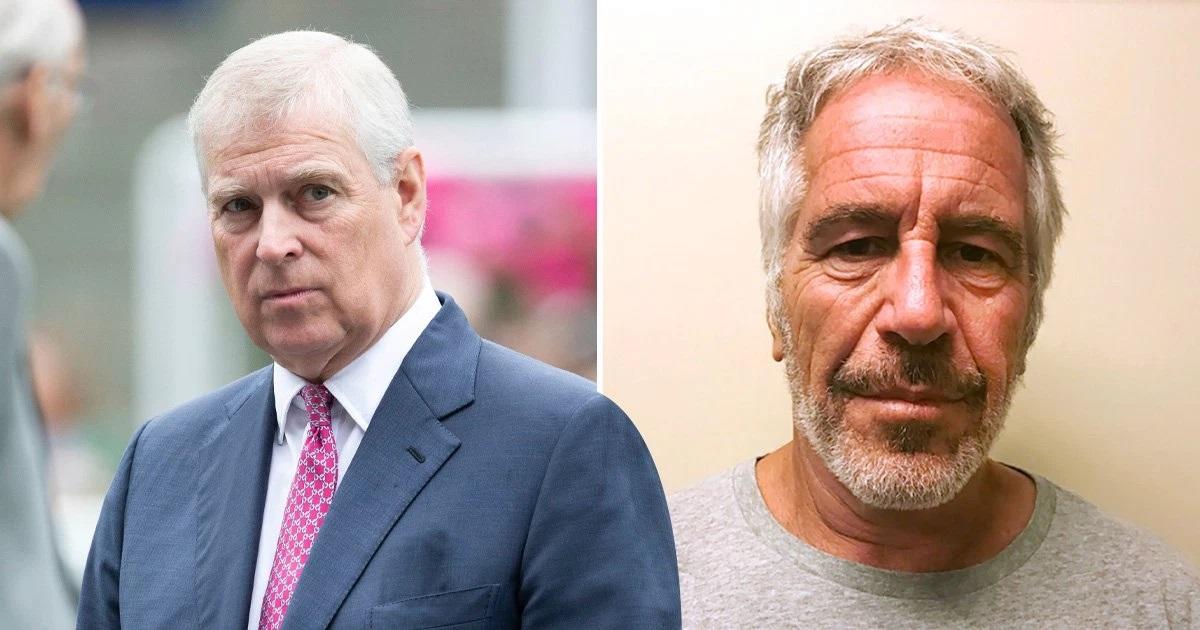
Jeffrey Epstein’s highest-profile accuser, who says the convicted pedophile peddled him to Prince Andrew, will not be included in the trial of longtime Epstein companion and accused accomplice Ghislaine Maxwell, according to AP News.

U.S. prosecutors chose not to bring charges in connection with Virginia Giuffre, who says Epstein and Maxwell flew her around the world when she was 17 and 18 for sexual encounters with billionaires, politicians, royals and heads of state.

She isn’t expected to be called as a witness in Maxwell’s trial, either. -AP

Instead, prosecutors will focus on four other women who say Maxwell recruited them as teenagers for Epstein and his associates to sexually abuse – however none of them have alleged the type of abuse by high-profile international figures that Guiffre has.

In other words, the one witness who can connect the dots between Epstein, the Clintons, Prince Andrew and others won’t be making an appearance. But is there a good reason?

Prince Andrew, Virginia Giuffre

According to the report, prosecutors may have chosen to exclude Giuffre because she has changed her statements multiple times over the years, including falsely stating that she was 15 when Epstein began to abuse her, when she was in fact 17. AP suggests that prosecutors may have wanted to avoid Maxwell calling Giuffre’s alleged abusers to testify, as they have spent years attacking her credibility.

Besides Andrew, Giuffre has said she was sexually trafficked to former New Mexico Gov. Bill Richardson, former U.S. Sen. George Mitchell, the noted lawyer Alan Dershowitz, the French modeling scout Jean Luc Brunel and the billionaire Glenn Dubin, among others.

All have said her accounts are fabricated. -AP

“There is no reason to give the defense anything to work with that can sow the seeds of reasonable doubt,” said former federal prosecutor David Weinstein, who is not involved in the case.

Giuffre has stood by her allegations, and has “repeatedly shown a willingness to go into civil court to prove them, sitting in depositions and assembling a legal team that includes one of America’s most influential lawyers, David Boies,” per AP.

What’s more, Giuffre’s account of spending time with Andrew was corroborated by another Epstein accuser, Johanna Sjoberg, who described an evening socializing with Maxwell, Giuffre, Epstein and Prince Andrew – who allegedly groped her breast while they posed for a photo with a puppet made of him for a television show.

In 2019, she told Dateline NBC that inconsistencies in her recollection were innocent mistakes while trying to remember traumatic events which happened years ago.

“When you are abused, you know your abuser,” she said. “I might not have my dates right. I might not have my times right … but I know their faces and I know what they’ve done to me.”

Epstein’s sexual habits were exposed in 2005 when he was arrested in Florida for paying a 14-year-old girl for sex.

Police identified underage girls who were paid to perform sex acts, but in 2008 the investigation was cut short. Prosecutors allowed Epstein to plead guilty to a charge of procuring a person under 18 for prostitution. He served 13 months in jail.

Dozens of women sued Epstein, but Giuffre’s 2009 lawsuit was different. In it, she said Epstein pressured her into having sex with numerous men “including royalty, politicians, academicians, businessmen and/or professional and personal acquaintances.” -AP

Giuffre also joined a 2014 lawsuit brought by other Epstein accusers – and began identifying alleged abusers who she had previously accused anonymously. It was also the first time she accused Prince Andrew – saying she had sex with him three times, in London during her 2001 trip, at Epstein’s New York mansion when she was 17 and in the Virgin Islands when she was 18.

She accused Maxwell of facilitating the encounters as a “madam.”

Meanwhile, Epstein isn’t the first high-profile pedo associated with the Royal family.

Prince Charles, Jimmy Savile

Tyler Durden
Tue, 11/23/2021 – 14:34

via ZeroHedge News https://ift.tt/3oNTbmE Tyler Durden

Biden Administration Asks US Appeals Court To Reinstate OSHA Vaccine Rule

Biden Administration Asks US Appeals Court To Reinstate OSHA Vaccine Rule

Authored by Jack Phillips via The Epoch Times,

The Biden administration on early Tuesday asked the U.S. Sixth Court of Appeals to reject an order from another federal appeals court and reinstate its Occupational Safety and Health Administration vaccine mandate for private businesses with 100 or more workers.

Several lawsuits that challenge the OSHA rule, known as an emergency temporary standard, were combined into one and sent to the Cincinnati, Ohio-based Sixth Circuit Court, of which 11 of 16 judges are Republican appointees.

Two days after OSHA published the rule, scheduled to go into effect on Jan. 4, the Louisiana-based U.S. Fifth Court of Appeals issued an order blocking the mandate. And last week, in a scathing ruling, the panel of judges on the appeals court reaffirmed their previous injunction and wrote that the mandate will likely be declared unconstitutional.

Overnight on Tuesday, the Biden administration filed court papers (pdf) arguing that the Fifth Circuit panel erroneously interpreted OSHA mandate, saying that “the speculative compliance costs and similar harms asserted by regulated parties cannot overcome the extraordinary harms to the public interest detailed above.”

“Simply put, delaying the standard would likely cost many lives per day, in addition to large numbers of hospitalizations, other serious health effects, and tremendous expenses,” White House lawyers alleged in the new filing.

“That is a confluence of harms of the highest order.”

Further, the administration argued that the Fifth Circuit’s assertion that the mandate would deal significant economic damage to the United States is incorrect. COVID-19-related outbreaks, Biden administration lawyers contend, have forced shutdowns of businesses and various institutions, although numerous studies have shown that fully vaccinated individuals play a relevant role in spreading COVID-19—not simply unvaccinated people.

The OSHA rule mandates businesses with 100 or more workers have to either have their employees receive the COVID-19 vaccine or submit to weekly testing. Unvaccinated workers also have to wear masks inside the workplace, the rule says, which also stipulates that violators can face penalties of thousands or even tens of thousands of dollars per incident.

When it was published earlier in November, it triggered a torrent of lawsuits from Republican-led states, individuals, businesses, and others.

The 5th Circuit ruling this month described the mandate as “fatally flawed” and told OSHA to not enforce the requirement “pending adequate judicial review.”

After the ruling, OSHA last week said it would suspend enforcement of the rule, although the agency said it was confident the Biden administration would prevail in the courts. White House officials, including chief spokeswoman Jen Psaki, also said that businesses should move forward and implement it despite the legal challenges.

“Our message to businesses right now is to move forward with measures that will make their workplaces safer and protect their workforces from COVID-19,” Psaki told reporters at the White House last week.

“That was our message after the first stay issued by the Fifth Circuit. That remains our message and nothing has changed.”

Data provided by the Centers for Disease Control and Prevention (CDC) shows that about 47 million COVID-19 cases have been reported in the United States since the onset of the pandemic earlier last year, while about 770,000 have died.

Meanwhile, Johns Hopkins University’s analysis of the U.S. case-to-fatality ratio suggests that COVID-19 patients have a nearly 99 percent survival rate.

Tyler Durden
Tue, 11/23/2021 – 14:06

via ZeroHedge News https://ift.tt/3xnYFZ9 Tyler Durden

Jury Holds Walmart, CVS, Walgreens Liable In Opioid Distribution

Jury Holds Walmart, CVS, Walgreens Liable In Opioid Distribution

A federal jury on Tuesday concluded that three retail pharmacy chains – Walmart, CVS and Walgreens – recklessly distributed massive amounts of opioids, according to AP, which adds that the verdict could ‘set the tone’ for future lawsuits brought by county governments that want to hold pharmacies accountable for their part in the opioid crisis.

The counties blamed pharmacies operated by CVS, Walgreens and Walmart for not stopping the flood of pills that caused hundreds of overdose deaths and cost each of the two counties about $1 billion, their attorney said.

This was the first time pharmacy companies had completed a trial to defend themselves in a drug crisis that has killed a half-million Americans over the past two decades. -AP

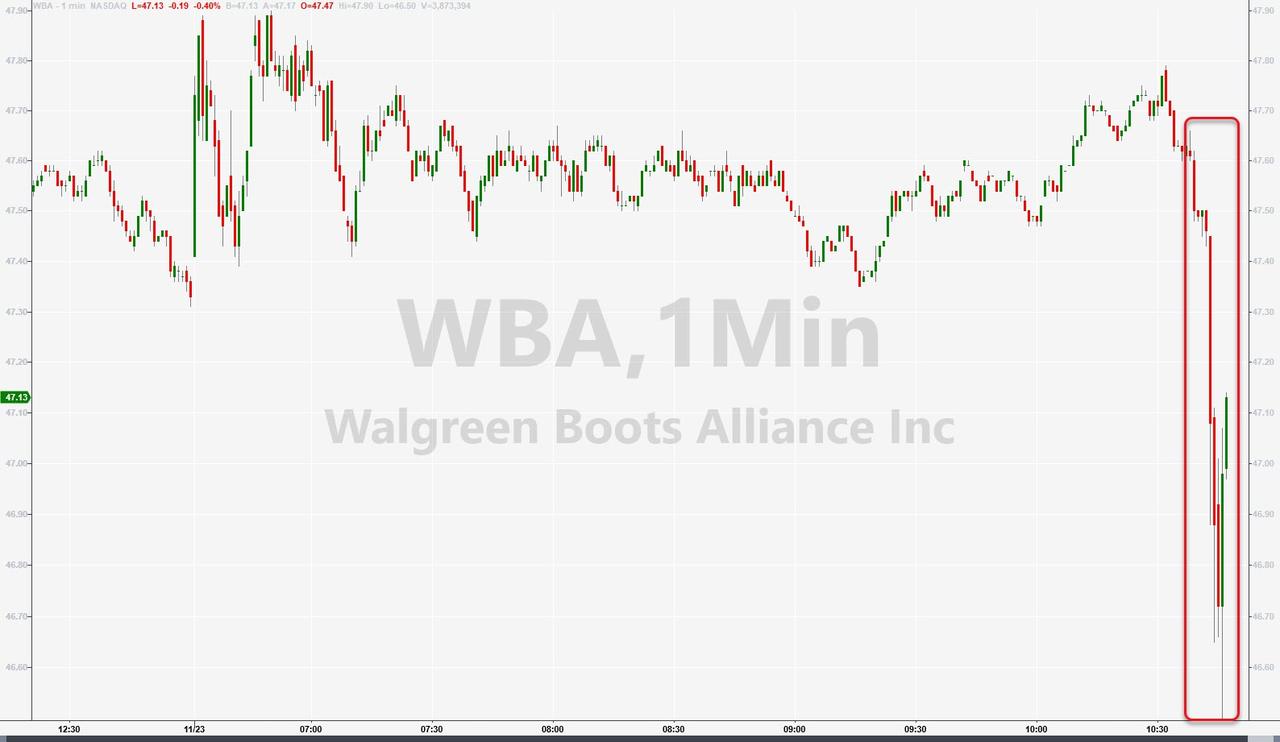
Stocks in Walmart and Walgreens were off sharply on the verdict.

Developing…

Tyler Durden
Tue, 11/23/2021 – 13:52

via ZeroHedge News https://ift.tt/3DMERkC Tyler Durden

Dollar-25-Tree? Discount Retailer Forced To Hike Prices Amid Persistent Inflation

Dollar-25-Tree? Discount Retailer Forced To Hike Prices Amid Persistent Inflation

Dollar Tree Inc. has built an entire brand on every item priced under a buck across 16,000 US retail stores in 48 states and five Canadian provinces. But with logistical costs soaring, persistent labor shortages, and the cost of everything rising, the company announced Tuesday that its new price point would be $1.25. 

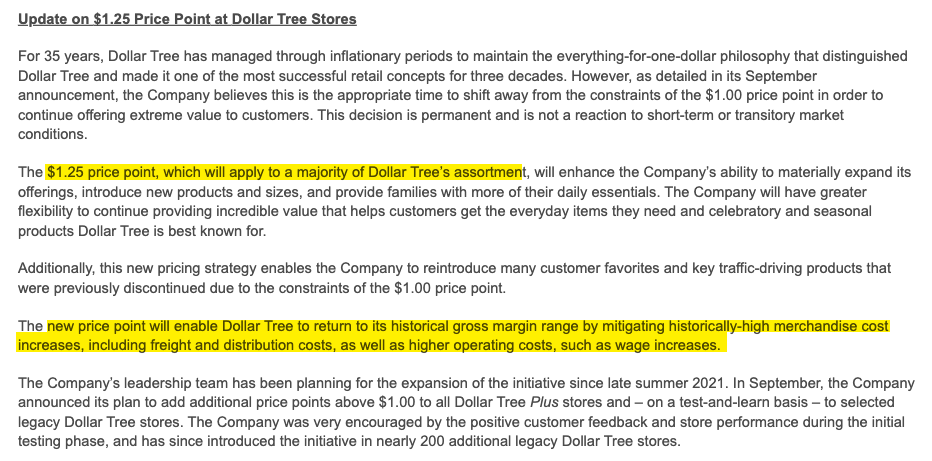
“Our Dollar Tree pricing tests have demonstrated broad consumer acceptance of the new price point and excitement about the additional offerings and extreme value we will be able to provide. Accordingly, we have begun rolling out the $1.25 price point at all Dollar Tree stores nationwide,” Dollar Tree President and CEO Michael Witynski stated in a corporate press release. 

Here’s more on the $1.25 plan:

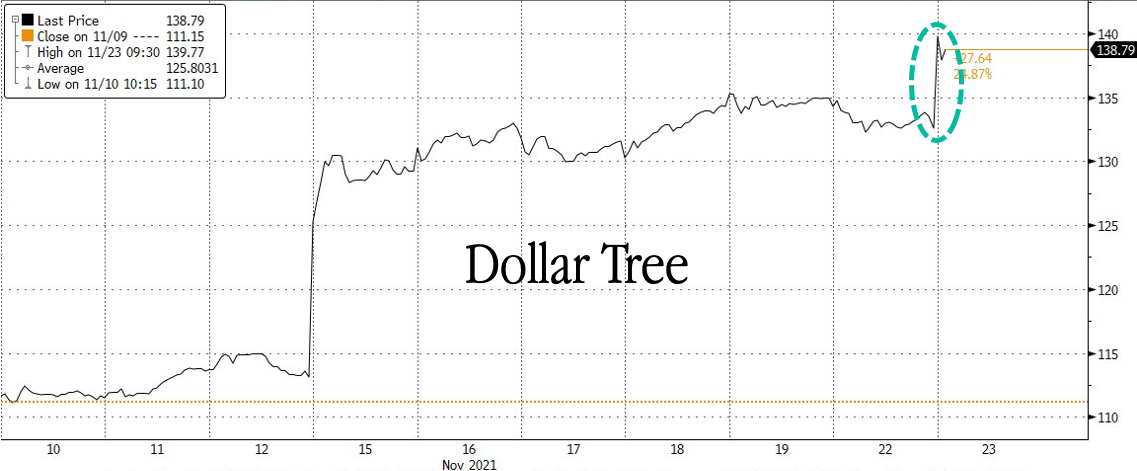
The Virginia-based discount retailer announced earnings Tuesday. It earned 96 cents per share in 3Q on sales of about $6.42 billion, missing the FactSet consensus estimate by 1 cent. Last year, the company earned $1.39 a share on sales of $6.18 billion. In other words, margin compression is crushing the company due to soaring inflation. Third-quarter same-store sales increased 1.6%. Shares are up more than 4% around 1000 ET on the price hike, meaning the company could soon restore its margins in the coming quarters. 

Dollar Tree acknowledged the inflationary environment and said the price hike would help alleviate high freight and distribution costs, as well as wage increases. It said, “freight and supply chain disruptions continue to be the Company’s biggest challenge in the near term.” 

The company recently announced select stores would carry higher price items as a pilot test to observe “consumer acceptance of the new price point,” Witynski said.

Lifting prices over a buck is the clearest signal that purchasing power of consumers is waning amid a persistent inflationary environment. It comes as real wages have turned negative on the year, and there’s growing discontent among consumers

None of this sounds “transitory” to us but permanent. Time for Dollar Tree to change its name to reflect higher prices. What about “Dollar Plus Store”? 

Tyler Durden
Tue, 11/23/2021 – 13:48

via ZeroHedge News https://ift.tt/3FFi76D Tyler Durden