Cannavictory


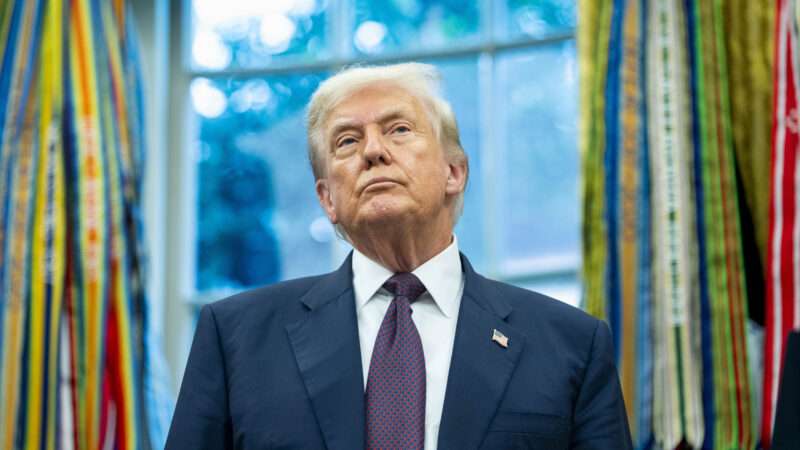
Donald Trump | Bonnie Cash - Pool via CNP/picture alliance / Consolidated News Photos/Newscom

Thank you, President Trump! He’s actually following through on the thing he teased last week: Rescheduling pot from Schedule I—the most restrictive category drugs can fall into, which deems them to have high abuse potential and no accepted medical use—to Schedule III, which includes prescription drugs such as ketamine, certain steroids, and Tylenol with codeine. He signed an executive order yesterday that will downgrade the plant. The change would make it much easier to legally conduct medical research, which is how Trump’s pitching it:

“We have people begging for me to do this, people that are in great pain for decades,” Trump said. “This action has been requested by American patients suffering from extreme pain, incurable diseases, aggressive cancers, seizure disorders, neurological problems and more—including numerous veterans with service-related injuries and older Americans who live with chronic medical problems that severely degrade their quality of life.”

“Trump emphasized that his order ‘doesn’t legalize marijuana in any way, shape or form, and in no way sanctions its use as a recreational drug,'” writes Reason‘s Jacob Sullum. “That is true, since state-licensed marijuana businesses will still be criminal enterprises under federal law. Those businesses nevertheless will benefit from marijuana’s rescheduling because it will allow them to claim standard deductions on their income tax returns. Their inability to do that, the result of a law targeting businesses that illegally supply Schedule I or Schedule II drugs, results in staggeringly high effective tax rates that impose a huge financial burden on the cannabis industry.”

This is a massive, welcome change for the pot industry and a huge victory for libertarians who have been making the case for cannabis freedom for so many decades.

Closure in Brown/MIT case: The man who is believed to have carried out the killings of two Brown University students and one Massachusetts Institute of Technology professor, 48-year-old Portuguese national Claudio Neves Valente, was found dead of a self-inflicted gunshot wound in a storage facility in Salem, New Hampshire. A manhunt had been underway for Valente, who studied physics for a short time as a graduate student at Brown University back in 2000–2001. He doesn’t appear to have known the students that he shot at Brown, but he does appear to have had an unclear relationship of some sort with the MIT professor he killed.

“Authorities said Mr. Valente was believed to have attended Instituto Superior Técnico in Lisbon, the same university where the slain M.I.T. professor, Nuno F.G. Loureiro, studied physics,” reports The New York Times. “Dr. Loureiro, 47, was found shot in his home in Brookline, Mass. on Monday night and was pronounced dead Tuesday morning. Leah Foley, the U.S. attorney for Massachusetts, said she believed Mr. Valente knew Dr. Loureiro but did not elaborate on the nature of their relationship.”

A Reddit tipster who said he’d encountered the suspect helped lead authorities to Valente.

Valente had come to the United States years earlier, becoming a permanent resident through our diversity visa lottery. The Trump administration announced, following this heinous crime, that they’re suspending this visa program, per Homeland Security Secretary Kristi Noem. This crime seems like an issue with the criminal, though, not with the visa program; if there was some sort of red flag that should have been discovered during vetting, then that changes the equation, but so far, nothing like that has emerged.

Also, here’s an insane modern quirk to this story: Betting markets now exist on whether killers will be apprehended.


Scenes from New York: “Within weeks of the Great Phone Lockup, teachers began to notice an incidental (and arguably even more compelling) benefit: The teens were talking to one another as if they were in a Brat Pack movie,” reports Anya Kamenetz for Intelligencer. “At Rosalmi’s school [in Harlem], dominoes rule the cafeteria. ‘Dominoes is really a staple Dominican game. People get passionate. You have to slam that first piece down on the table!’ she says, adding that there’s trash talk ‘but it’s game trash talk. It’s really funny.’ About 11 miles south, at Brooklyn Technical High School, the name of the game is poker, the trash talk is (sometimes) in Russian, and instead of chips or cash, the kids bet with hair ties. Josh (not his real name), a junior there, says about half a dozen games go on during free periods. He tends to play Texas Hold’em with a group of friends he made this year. Their antics draw spectators and even side wagers: ‘We have one player who is probably the least skilled, but a lot of people bet on him because he has absurd luck,’ he says. ‘He pulled our group’s first-of-the-year full house with pocket aces. He’s very entertaining.'”


QUICK HITS

  • The Kennedy Center will be renamed the Trump-Kennedy Center, the White House announced yesterday.
  • A good read from The New York Times on Kristin Cabot, the woman caught on a Jumbotron canoodling with her boss: “The Ritual Shaming of the Woman at the Coldplay Concert.” She claims both parties had been in the middle of separations, so it wasn’t really a situation involving infidelity. My question: Why the hell do the mobs care? Why waste time gawking at these people, regardless of their moral fiber, and trying to exile them from public life?
  • Did private equity eat fly-fishing?
  • “The Trump administration is moving to broadly curtail gender transition care for young people, proposing Thursday to eject medical providers from major federal health insurance programs [Medicare and Medicaid] if they provide services including hormone therapy or procedures such as mastectomies to children and teenagers,” reports The Washington Post. (I reject the use of the term gender transition care, which presupposes a benevolence and medical necessity to these interventions, though your mileage may vary.) The American Civil Liberties Union says they’ll sue. The Food and Drug Administration says it’s going to go after the manufacturers of chest binders, “alleging they are illegally marketing them to children as a treatment for gender dysphoria.” Centers for Medicare and Medicaid Services Administrator Mehmet Oz says that, for too long, health care providers have been treating gender-dysphoric children like “lab mice.”
  • Nice long thread and beautiful sentiment:

The post Cannavictory appeared first on Reason.com.

from Latest – Reason.com https://ift.tt/RqE4Ffw
via IFTTT
Trump’s Somali Insults Are a Disgrace


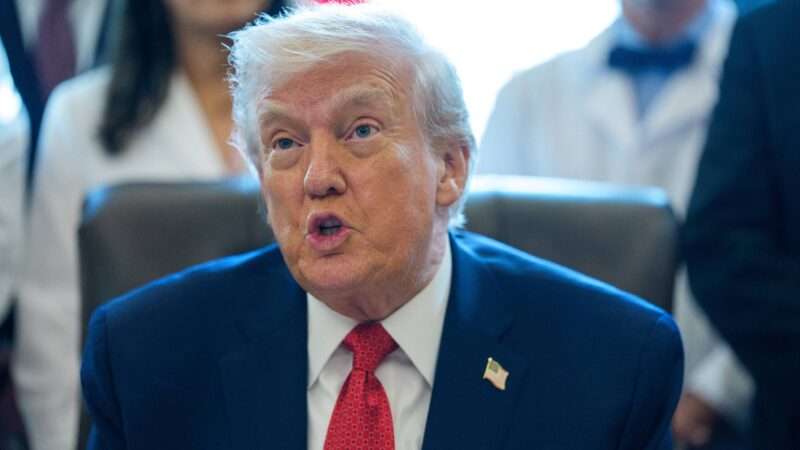
Donald Trump | Aaron Schwartz - Pool via CNP / MEGA / Newscom/RSSIL/Newscom

After Minneapolis Mayor Jacob Frey said he was proud that his city had the largest Somali community in the United States, President Donald Trump unleashed a vicious rant during a press conference ostensibly about the auto industry: “I wouldn’t be proud to have the largest Somalian―look at their nation. Look how bad their nation is. It’s not even a nation. It’s just people walking around killing each other…They have destroyed Minnesota.”

Trump also penned a social-media post claiming Somali gangs have taken over Minnesota and “are roving the streets looking for ‘prey’ as our wonderful people stay locked in their apartments and houses.” The Hennepin County District Attorney’s Office, which is the top law-enforcement agency overseeing the Minneapolis area, released a video debunking those claims. Nearly 90 percent of Somalis there are legal residents, with 58 percent of them having been born in the United States.

“They contribute nothing…I don’t want them in our country,” Trump added, as he has pushed forward a plan to reduce the nation’s refugee-acceptance program by 90 percent. Somalis actually have revived some downtrodden Minneapolis neighborhoods as they mostly pursue the American dream, but why pick nits? The bulk of the new refugees will be white South Africans, but I’m sure race has absolutely nothing to do with his latest immigration-related tirades and decisions.

It’s seems hardly a coincidence that Trump also has directed ire at Haitian immigrants in Ohio whom he falsely accused of eating pets. His decision to eliminate free-entry days at national parks on the Juneteenth holiday commemorating the end of slavery and Martin Luther King Jr. Day also don’t seem like coincidences. In reality, the only roving gangs that Twin-Cities residents need to worry about are the masked ICE patrols Trump has sent to the region, but that’s apparently the point.

Trump is maligning “garbage,” as he referred to a Somali member of Congress and her “friends,” to justify efforts to quash immigration from non-white countries. Can the GOP stop pretending otherwise?

Conservative media are focusing on Minnesota’s social programs, with City Journal‘s Christopher Rufo explaining that “fraud has allegedly been perpetrated by members of Minnesota’s sizeable Somali community” with “millions of dollars in stolen funds have been sent back to Somalia, where they ultimately landed in the hands of the terror group Al-Shabaab.” Minnesota’s Democratic politicians and media have been loath to “connect the dots” because of their “progressive pieties,” Rufo added.

That may be true and any fraud is appalling, but perhaps one reason for the lack of dot-connecting is Minnesota officials’ fear that the administration and its supporters would react as they have, by blaming the entire Somali community for the criminal acts of a few and using the scandal to justify heavy-handed immigration policies.

There are two schools of conservative immigration thought. The first, to which I subscribe, acknowledges immigrants often flee countries ravaged by crime, tyranny and disorder. That’s why many people come to the United States. Our nation’s settlers fled persecution. My father escaped Nazi Germany, which was literally putting people in ovens (although many Republicans lately have struggled with their views on such horrors). Under this long-standing view, Americans should welcome immigrants, but promote E Pluribus Unum.

The other conservative view, which is clearly embraced by national conservatives and populists, is that America is fundamentally a white, Christian nation and that immigration, to whatever limited degree we allow it, should align with those demographics. Some conservatives still tout the, “we’re only against illegal immigration” canard, but that’s not what’s going on here. Trump’s policies—along with much of the anti-immigration rhetoric on the right these days—are about limiting immigration in general. Minnesota’s Somalis and Springfield’s Haitians are, after all, primarily legal.

No one disputes that law-enforcement should clamp down on government fraud. The root problem is the government freebies themselves, which often are overly generous and lacking in oversight. But it’s not like fraud scandals are confined to immigrant and minority communities. One can find similar scandals involving any ethnic group (including native-born Americans).

The president always doubles down. Following the brouhaha over his comments, Trump said to supporters: “Why is it we only take people from sh**hole countries, right, why can’t we have some people from Norway, Sweden, just a few…We always take people from Somalia, places that are a disaster, dirty, filthy, disgusting, ridden with crime.” It’s clear what he’s saying.

By contrast, in his last presidential speech, Ronald Reagan said, “We lead the world because, unique among nations, we draw our people—our strength—from every country and every corner of the world. And by doing so we continuously renew and enrich our nation.” Reagan was right. Trump is wrong. Americans shouldn’t be ashamed that our nation is a beacon to the tired, poor, huddled masses, but we have reason to be ashamed of him.

This column was first published in The Orange County Register.

The post Trump's Somali Insults Are a Disgrace appeared first on Reason.com.

from Latest – Reason.com https://ift.tt/xtecsYX
via IFTTT

Trump Won on Immigration. Now Most Americans Say His Deportations Are Going Too Far.


A photo of Donald Trump alongside photos of immigrants | Illustration: Eddie Marshall | Nano Banana

Donald Trump won the U.S. presidency in no small part thanks to his promise to enforce immigration restrictions that the Biden administration largely ignored. Election year polls found more voters preferred Trump over then-president Joe Biden on the issue and even favored his proposals for mass deportations. But the reality of tough border policies is a harsh reality check; since the current administration took office, Americans have cooled on its policies and warmed to immigration.

That’s not to say the country is embracing Biden’s nudge-and-wink approach to border crossings. Instead, people seem to want a middle ground combining enforcement with a touch of humanity.

Immigration Helped Win the White House for Trump

The former president took office with big plans to roll back Trump’s tough first-term immigration policies. That didn’t go well for him as border crossings skyrocketed, alarming the public. In February 2024, Bloomberg polling found a rising percentage of voters calling immigration the “single most important issue'” contributing to lagging numbers for Biden across the swing states he eventually lost.

By April, Harris polling recorded majority (51 percent) support for mass deportations. Thirty percent of Democrats and 46 percent of Republicans wanted to end constitutionally protected birthright citizenship.

Two weeks ago, in a very belated election post-mortem, The New York Times conceded that “as public concern over border security grew, partly in response to Mr. Biden’s own actions, his administration proved catastrophically slow to change course” and ultimately lost voters to his rival.

But that was then. Public attention is now occupied not by images of crowds surging across the border and crimes committed by undocumented immigrants, but by stories of Immigration and Customs Enforcement (ICE) raids and often rough tactics. While federal officials have arrested some serious criminals—though the vast majority of those taken into custody have no criminal convictions and only about 5 percent have violent convictions—Americans hear far more stories about worksite raids that scoop up peaceful, hard-working laborers.

Rounding up gangbangers is popular. Separating families is not.

This week, The Marshall Project journalism nonprofit reported that “the Trump administration’s revival of family detention has swept thousands of children into ICE custody. At least 3,800 children under age 18, including 20 infants, have been booked since Trump took office.”

But Harsh Enforcement Alienates the Public

The public isn’t seeing what it expected and that’s affecting people’s opinions.

“As the Trump administration escalates its immigration enforcement efforts, 53% of Americans say it is doing ‘too much’ when it comes to deporting immigrants who are living in the United States illegally,” the Pew Research Center revealed this week. “That share is up from 44% in March.”

As you’d expect, there are sizable differences in views between supporters of the two major political parties. Eighty-six percent of Democrats and independents who lean toward that party oppose the Trump administration’s immigration policies, compared to 20 percent of Republicans and Republican leaners. But opposition is rising in both groups.

Importantly, “47% of Hispanic Republicans say the administration is doing too much, up from 28% in March.” That’s a large part of the electorate that drifted in the GOP’s direction in the last election and could just as easily move away.

This isn’t a sudden shift. By July, Gallup found that support for mass deportations had plunged “with 38% now favoring this as the administration is attempting it, down from 47% last year when it was a Trump campaign promise.” The firm also reported that “support for allowing undocumented immigrants to become U.S. citizens has risen to 78%, up from 70% last year.”

In the same survey, “a record-high 79% of U.S. adults say immigration is a good thing for the country.”

That month, 52 percent of respondents called Trump’s approach to immigration policy “too harsh” in The Economist/YouGov polling.

That is, the Trump administration quickly lost the American people with its approach to border enforcement and hasn’t gained them back. Voters didn’t like Biden immigration policies and opted for something different—as a candidate, the current president was very open about what he planned to do—but they don’t like harsh enforcement any better than they cared for near-total lack of enforcement.

So, what do people want when it comes to immigration?

Americans Want a Humane Middle Ground

Obviously, Americans like a welcoming policy towards immigrants—so long as they follow the rules. That can be a problem, given that the legal path to settling in this country is almost impossible to navigate. A 2023 Cato Institute report by David J. Bier noted that “fewer than 1 percent of people who want to move permanently to the United States can do so legally” and that “immigration is now prohibited in a similar way to alcohol during Prohibition.”

Unfortunately, most people don’t realize that only a very fortunate few can find a legal path to entry.

Americans also agree with the president’s occasional promise to deport “the worst of the worst.” In the recent Pew poll, 97 percent of U.S. adults favor deporting those who are in the country illegally and have committed violent crimes. Fifty-two percent of respondents support deporting undocumented immigrants who commit nonviolent crimes.

That’s a policy with a solid base of support. But, as mentioned above, according to the most recent data crunched by Cato’s Bier, only about 5 percent of those detained had a violent criminal conviction. “Nearly three in four (73 percent) had no criminal conviction.”

Americans want border enforcement. But they’re not overall hostile to immigration—they favor increased legal immigration. They want ICE to target human predators who crossed the border illegally, not workers and their families.

So, there is an opening for a middle ground on border enforcement between Biden’s dereliction of duty and Trump’s iron fist. Arresting and deporting dangerous criminals while creating a credible legal path to immigration could win favor with the American people.

The post Trump Won on Immigration. Now Most Americans Say His Deportations Are Going Too Far. appeared first on Reason.com.

from Latest – Reason.com https://ift.tt/QdDjZYH
via IFTTT

Review: Tron: Ares Reminds Us That Artificial Intelligence Is Not the Enemy


Jared Leto in Tron: Ares | <em>Tron: Ares</em>/Disney

Will a hyperadvanced AI be a danger to humanity? That’s nothing compared to the threat posed by military contractors.

That’s the implicit conclusion of Tron: Ares, the third installment in the series that began with 1982’s Tron. This threequel inverts the previous films’ formula: Rather than humans trying to enter a digital world, Ares tells of an AI (Jared Leto) from inside “the Grid” finding its way into meatspace. It’s a sci-fi spin on a fairy tale formula quite familiar to Disney, which made all three of the Tron films. The AI wants to be a real boy.

Standing in Ares’ way is the tech executive (Evan Peters) who built him and intends to sell him to the highest bidder as a supersoldier who could be easily resurrected infinite times. Having achieved self-awareness, Ares decides it would be more meaningful to live just once. The message is as unsubtle as the film’s pulsating Nine Inch Nails soundtrack: It’s the humans who develop and use AI for malicious ends, not the tech itself, who should worry us.

The post Review: <i>Tron: Ares</i> Reminds Us That Artificial Intelligence Is Not the Enemy appeared first on Reason.com.

from Latest – Reason.com https://ift.tt/rMUBS79
via IFTTT

Review: The Sound of Music’s Anti-Authoritarianism


minisSoundsofMusic | <em>The Sound of Music</em>/The Kennedy Center

The Kennedy Center hosted director Jack O’Brien’s production of The Sound of Music from September to October. O’Brien’s rendition left little to criticize: stunning sets, apt casting, and exquisite vocal performances. Cayleigh Capaldi’s high notes could have fractured the glass chandelier. The 65-year-old musical’s depiction of an us-vs.-them mentality emerging around the Anschluss was particularly poignant in the wake of Charlie Kirk’s assassination and the Manichean responses to it. The musical’s anti-authoritarian message was unchanged by President Donald Trump’s recent ascension to chairmanship of the center.

The exclusion of “I Have Confidence” and the deviation from the original lyrics of “Something Good” and “Sixteen Going on Seventeen (Reprise)” are the only areas where this production could be improved. There’s nothing wrong with recognizing our capacity for wickedness or the mutual sense of ownership that characterizes marriage.

The post Review: <i>The Sound of Music</i>'s Anti-Authoritarianism appeared first on Reason.com.

from Latest – Reason.com https://ift.tt/ARP6HkJ
via IFTTT

Brickbat: Merry Christmas


Christmas decorations | ID 128752949 ©  Joanne Eastope | Dreamstime.com

In Portsmouth, England, the local council has ordered residents living in council-owned housing to remove Christmas wreaths and other decorations from outside their front doors. The council’s housing service sent letters warning that placing these items in communal areas violates tenancy agreements, as well as health and safety rules. Officials said hallways, doors, and shared spaces must remain clear to reduce fire risks and other hazards, and suggested residents decorate inside their homes or on private balconies instead. If residents do not take them down, staff will remove them and charge a $33 fee to retrieve them. A council spokesman acknowledged the rule is “frustrating” but said it is “designed to protect everyone.”

The post Brickbat: Merry Christmas appeared first on Reason.com.

from Latest – Reason.com https://ift.tt/E2nBUlr
via IFTTT

Firings, and Tariffs, and Trump, Oh My!

I attended the oral argument in the tariff case. Secretary of the Treasury Scott Bessent sat a few rows behind me, right next to Secretary of the Treasury Howard Lutnick. Every now and then, I turned around to look at Bessent and the other politicos. He was paying very close attention, and didn’t doze off.

Now, Bessent seems to have some information we do not. Bessent told Fox Business that the ruling would likely come in January. If Bessent is right, the opinions in that case must be nearing completion. Yet, based on the oral argument in Slaughter, the tariff case is very much on the Justices’ minds. These two cases may be landmark rulings for the separation of powers. In Slaughter, both Justices Kavanaugh and Barrett brought up the tariff case by name, and Justice Gorsuch called back to his questions from that sitting. Plus Solicitor General Sauer tried as hard as he could to avoid any discussion of the non-delegation doctrine and the major questions doctrine. If Bessent is right, then the Justices are just thinking out loud. But something tells me that the tariff case is not quite settled yet. As I wrote after that argument, counting to five may be tricky.

First, Justice Barrett recalled Justice Gorsuch’s question concerning legislative vetoes:

And, actually, this is a question I truly don’t know the answer to and I just thought of it during the argument as we were talking about bargains.

So both Justice Gorsuch and Justice Kagan were asking you about the bargain that Congress has made in creating these independent agencies. And I was struck by, you know, I remember Justice Gorsuch brought up in the tariffs argument the fact that the tariff statute had a legislative veto originally. I don’t know whether the original 1935 FTC Act from Humphrey’s did or did not.

But I guess the question that I have, is that part of the bargain? Because legislative vetoes were pretty ubiquitous throughout the Twentieth Century. . . . 

But I guess what I’m saying is, having lost that check, maybe these independent agencies have become something that Congress didn’t intend or anticipate even at the point that it set it up, which is the point that Justice Gorsuch made in the tariff argument with respect to IEEPA.

I wrote about the legislative veto issue here. Barrett’s intuition was right. Congress added a legislative veto over FTC rules in 1980, but that “bargain” was upset by Chadha.

Second, Justice Kavanaugh called back to Justice Gorsuch’s questions concerning veto overrides:

Well, once the power is taken away from the President, it’s very hard to get it back in the legislative process. Kind of the flip side of what we were talking about in the tariffs case because the Congress, the real world of this is the independent agencies shift power from the presidency to the Congress. Everyone recognizes that.

I think Congress has more control over the independent agencies than they do over the executive agencies. Congress doesn’t want to give that up. It’s hard for the President to get new legislation passed that would, for example, convert an independent agency to an executive agency.

Do you have an answer to that real -I mean, I think just leave it to Congress ignores the reality of the legislative process and Congress’s desire to keep that power that they have had that most people have recognized over the independent agencies.

That’s a theory out there. I just want to get your response to that.

I wrote about the veto overrides in the tariff case here.

In the tariffs case, Justice Gorsuch described delegation as a one-way ratchet that, as a practical matter, cannot be retrieved.

JUSTICE GORSUCH: Okay. You emphasize that Congress can always take back its powers. You mentioned that a couple of times. But don’t we have a serious retrieval problem here because, once Congress delegates by a bare majority and the President signs it –and, of course, every president will sign a law that gives him more authority –Congress can’t take that back without a super majority. And even –you know, even then, it’s going to be veto-proof. What president’s ever going to give that power back? A pretty rare president. So how –how should that inform our view of delegations and major questions? . . . But what happens when the President simply vetoes legislation to try to take these powers back? . . . Yeah. So Congress, as a practical matter, can’t get this power back once it’s handed it over to the President. It’s a one-way ratchet toward the gradual but continual accretion of power in the executive branch and away from the people’s elected representatives.

Justice Barrett returned to Gorsuch’s question:

JUSTICE BARRETT: Okay. Then a question just to follow up on Justice Gorsuch’s thing about how could Congress ever get this delegation back, you said, well, listen, you point to the –Congress’s ability to terminate emergencies, which it’s done. But, if Congress ever wanted to get the tariffing power back, it would have to have a veto-proof majority because, regardless of the emergency, so if Congress wanted to reject the –let’s say that we adopt your interpretation of the statute. If Congress said, whoa, we don’t like that, that gives a president too much authority under IEEPA, it’s going to have a very hard time pulling the tariff power out of IEEPA, correct? . . .  But –but definitively interpreting a statute that grants presidential power makes it particularly hard to get the President to not want to veto something, which, as Justice was pointing out –Justice Gorsuch was pointing out, has him lose power. All right.

As the argument goes, if the Court upholds the President’s reading of IEEPA, Congress would need a veto-proof majority to claw back that power. But as Kavanaugh suggests, Slaughter presents the “flip side” of the tariff case. Imposing the removal protections on commissioners only took a majority of both houses, and the signature of a President. But if the Court upholds the removal protections on commissioners, it will be virtually impossible for those restrictions to ever be repealed. Why would Congress ever relinquish this power? Moreover, while members of Congress could at least try to pass a bill modifying IEEPA, the President would have no mechanism to force a vote on a bill reforming the FTC. (Under the Recommendation Clause, the President has the power to recommend legislation to Congress, but Congress is under no obligation to act.)

Third, I think Justice Gorsuch sees the tariffs case and Slaughter as inextricably linked–as two sides of the same coin. As Gorsuch sees it, through IEEPA, Congress gave too much legislative power to the executive branch. And, as Gorsuch sees it, through the FTC Act, Congress asserted too much control over the executive branch. Gorsuch’s remedy for this double malady is two-fold: apply the non-delegation doctrine to return all legislative powers to Congress, and apply the unitary executive theory to return all executive powers to the President. Yet, the Court seems poised to only take the latter step in Slaughter, and not the former step in the tariff case.

Let’s walk through the analysis.

Justice Gorsuch asked Solicitor General John Sauer about reinvigorating the non-delegation doctrine.

JUSTICE GORSUCH: General, let me suggest to you that perhaps Congress has delegated some legislative power to these agencies. Let’s just hypothesize that. And let’s hypothesize too that this Court has taken a hands-off approach to that problem through something called the intelligible principle doctrine, which has grown increasingly toothless with time. Is the answer perhaps to reinvigorate the intelligible principle doctrine and recognize that Congress cannot delegate its legislative authority? Is the water warm, General?

Sauer seemed a bit confused by the last part:

GENERAL SAUER: Sorry. What was the last –I couldn’t hear the last bit.

JUSTICE GORSUCH: Is the water warm?

GENERAL SAUER: Is the water warm?

JUSTICE GORSUCH: Warm.

Is the water warm? Huh? Is that an expression. I think Justice Gorsuch was trying to ask subtly whether the climate was right to add some teeth to the non-delegation doctrine. (Gorsuch is not usually known for his subtlety.)

Sauer replied that the “members of this Court have debated the scope of the non-delegation doctrine” but the remedy in Slaughter is simpler:

GENERAL SAUER: Here, though, this wolf comes as a wolf, right? I mean, the restriction on executive power is right there in the statute. It’s easy to remedy by excising the removal restriction in the past group of cases.

But Gorsuch wanted to go further.

JUSTICE GORSUCH: There are a lot of wolves around here, General. The one thing our Framers knew is that every political actor seeks to enhance its own power. We all know that to be true from our own experiences. And this Court, as part of this bargain, has allowed these agencies to exercise both executive and legislative. Justice Sutherland, whose name hasn’t been invoked around here in quite a while, his –his language about quasi-legislative and quasi-judicial and quasi-this powers, and this Court has allowed that for a very long time. But, if we’re not going to allow it any longer, I take the point –I take the point that this has allowed a bargain where a lot of legislative power has moved into these agencies, but, if they’re now going to be controlled by the President, it seems to me all the more imperative to do something about it.

What should be done? Reinvigorate the non-delegation doctrine.

Sauer again tried to stay on task, and told Gorsuch to focus on the removal power issue–the Fenris!

GENERAL SAUER: I agree with that. And we can’t –I can’t address all the wolves in the world, but this wolf, when it comes to constitutional structure, is Fenris, the most dangerous wolf in –in the history of Norse mythology.

Later in the argument, Justice Kavanaugh poured even more cold water on Gorsuch’s dream of reviving the non-delegation doctrine. For Justice Kavanaugh, the major questions doctrine is enough.

JUSTICE KAVANAUGH: I want to return to what Justice Kagan and Justice Gorsuch were talking about with you in terms of the –the bargain, and I think broad delegations to unaccountable independent agencies raise enormous constitutional and real-world problems for individual liberty, as you just mentioned. I’ve obviously said that many times in prior opinions.

I thought one aspect of that that we’ve taken great steps to correct has been the major questions doctrine over the last several years to rein in what Justice Kagan was talking about, these broad delegations, to make sure that we are not just being casual about assuming that Congress has delegated major questions of political or economic significance to independent agencies or to any agencies for that matter. Do you want to speak to the major questions doctrine and how that fits into your answer?

Solicitor General Sauer again tried to re-orient the Court on the removal power issue. Indeed, the federal government is not so keen on the major questions doctrine at the moment, as it could affect the President’s tariff authority.

GENERAL SAUER: Suffice to say that the major questions doctrine is not a substitute for the President’s removal power. It may have done some work in backstopping the fact that we do have these independent agencies without a political discipline. But the President’s removal power is what is dictated by the Constitution, that the President must have the power to control and that these agencies –the one who has the power to remove is the one who –is the person that they have to fear and obey.

The tariff case was looming large in the background of Slaughter.

The post Firings, and Tariffs, and Trump, Oh My! appeared first on Reason.com.

from Latest – Reason.com https://ift.tt/yHjQuwL
via IFTTT

Wisconsin Judge Hannah Dugan Found Guilty of “Obstructing Federal Agents Seeking to Make an Immigration Arrest Outside Her Courtroom”

So reports the Milwaukee Journal Sentinel (John Diedrich, Mary Spicuzza & Hope Karnopp):

On April 18, Dugan was presiding over a misdemeanor court on the sixth floor of the Milwaukee County Courthouse….

Federal agents were there to arrest Eduardo Flores-Ruiz, 31, charged with battery and appearing before Dugan. Flores-Ruiz illegally re-entered the U.S. in 2013.

Dugan learned of the planned arrest from her clerk. She went to the main corridor with another judge, questioned the agents, and directed them to the chief judge’s office, who was working on a plan on how such arrests were to be treated.

Dugan returned to her courtroom, moved Flores-Ruiz’s case up first and then directed Flores-Ruiz and his attorney through a non-public door and into a hallway used by judges and staff, witnesses testified.

Flores-Ruiz and his attorney emerged into the public corridor. Federal agents followed them. He was arrested outside the courthouse after a brief foot chase.

The post Wisconsin Judge Hannah Dugan Found Guilty of "Obstructing Federal Agents Seeking to Make an Immigration Arrest Outside Her Courtroom" appeared first on Reason.com.

from Latest – Reason.com https://ift.tt/f0qQ8wC
via IFTTT