Zerohedge readers who follow our monthly consumer credit updates already knew, aggregate household debt balances jumped in 4Q18. As of late December, total household indebtedness was at a staggering $13.54 trillion, $32 billion higher than 3Q18.
More troubling is that 37 million Americans had a 90-day delinquent strike added to their credit report last quarter, an increase of two million from the fourth quarter of 2017. These 37 million delinquent accounts held roughly $68 billion in debt, or roughly the market cap of BlackRock, Inc.
* * *
New evidence this week points to a further deterioration in consumer creditworthiness.
To understand the American credit card debt crisis, real estate data company Clever surveyed 1,000 credit card users earlier this month.
Using Consumer Financial Protection credit card complaint data and other forms of consumer metrics, the company was able to gain tremendous insight into the average American’s purchasing habits, dependence on credit cards, and feelings about their debt situation.
The survey found that 47% of Americans have a monthly balance on their credit card. About 30% of respondents with credit card debt believe they’ll extinguish the debt this year, leading many of the respondents stuck in an endless debt cycle.
Fifty-six percent of the respondents say they’ve had credit card debt for more than a year. About 20% estimate their debt will be paid off by 2022, while 8% were unsure about a timeline.
“It’s a big issue,” Ted Rossman, credit industry expert for CreditCards.com, tells CNBC. With credit card APR soaring to about 17.64%, a new high, the interest accrued on monthly balances can quickly add up and trap unsuspecting consumers with insurmountable debt.
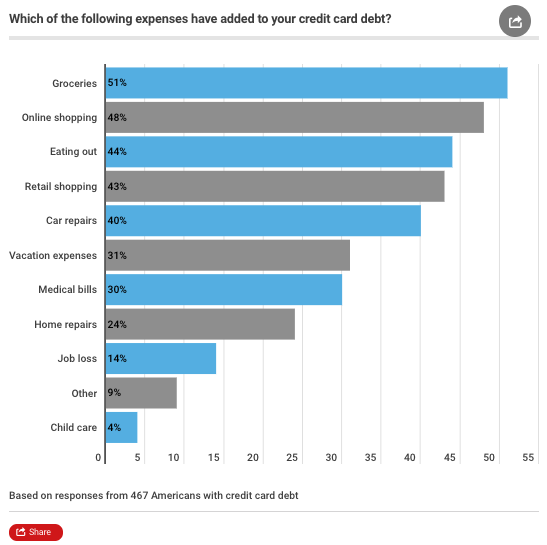
The U.S. recovery has been the slowest since WWII. Consumers have been stuck in the gig-economy with low wage and skill jobs. Their wages have not been able to outpace rapid inflation in groceries and rent. So many have resorted to credit cards to supplement their daily expenses. This is especially prevalent with lower-income families, defined here as those earning less than $50,000 a year. Buying groceries” ranked as the top expense that racked up people’s balances, the survey said.
About 28% of respondents say they’re fully dependent on credit cards to pay rent and utilities.
Emergency expenses were also a major contributor to credit card balances. About 30% cite medical bills and 40% say automobile repairs have moved their balances higher.
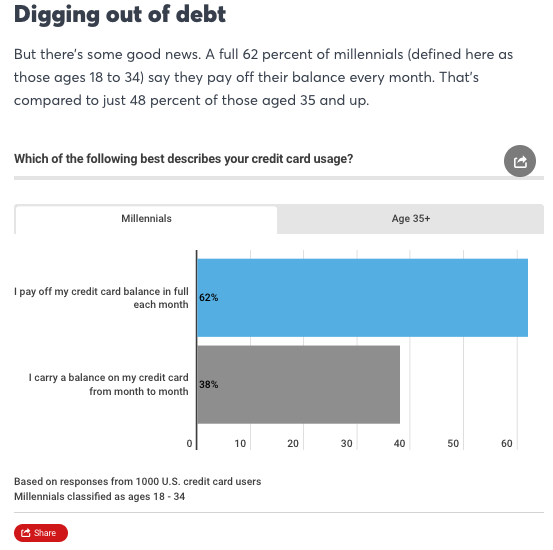
Surprisingly, there is some good news. Sixty-two percent of millennials indicate they pay their balance every month. That’s compared to just 48% of Generation X and Baby Boomers.
Credit cards are an integral part of developing credit and proving creditworthiness. Multiple reports show the consumer is on the cusp of a dangerous deleveraging, an ominous sign that the credit cycle has likely turned. Winter is here.
via ZeroHedge News https://ift.tt/2WwfX2H Tyler Durden
Evolutionary roboticists have decided to begin teaching artificial intelligence powered robots to evolve and reproduce. Why should humans go to the trouble of building more robots when a robot could do it instead?
According to Futurism, this is known ashigh-tech Darwinism.The researchers’ ultimate goal is to design artificial intelligence and robots that can analyze their own source code and mate with others by combining bits and pieces of their code with that of other robots. This would create “offspring,” much like organic life, Futurism reported. But it isn’t actually anything like organic life, actually. But evolutionary roboticists who have this new goal have high-tech Darwinism to the extreme. Apparently, just like biological life evolves to fill ecological niches, these robots’ offspring might be better adapted to their environments that their architects specifically built them for.
An interesting future awaits once high-tech Darwinism becomes successful. And Wired reported that some scientists are well on their way to making this technology a reality.
Computer scientists at Vrije Universiteit Amsterdam built a simplified system that shows how future robots might swap and combine their “genetic” information.
Their recent research, published in the journal Nature Machine Intelligence and which involved programming two parent robots to code a new “offspring,” found that the resulting offspring contain a mixture of the parents’ code as well as some modules that seemed to have mutated or been blended on its own. –Futurism
David Howard, one of the scientists on the project, told Wired that there’s a positive spin to all of this.
“It gives you a lot of diversity, and it gives you the power to explore areas of a design space that you wouldn’t normally go into.”
But others see this as a way to permanently force human beings into extinction.
“One of the things that makes natural evolution powerful is the idea that it can really specialize a creature to an environment,” Howard told Wired.
But natural evolution doesn’t sound anything like robot evolution. Humans are making themselves obsolete and our two cents is that this will not end well for humanity.
via ZeroHedge News https://ift.tt/2uAAxTK Tyler Durden
Stanley Patrick Weber is a former U.S. government pediatrician that was convicted in September of sexually abusing Native American boys and is set to serve 18 years in prison. Records indicate that he is supposed to receive $1.8 million from a government pension during the course of his prison term. Unless congress changes federal law, the government “likely can’t stop the pension payments” either, according to a new report by the Wall Street Journal.
Weber worked at federal Indian Health Service hospitals for roughly three decades and was convicted of sexually abusing two boys on a reservation in Montana. He’s also going to be facing another trial for allegations that he sexually assaulted four other boys in South Dakota. The doctor was on duty at government hospitals or in his government-provided homes when the abuse occurred, according to the article.
Weber is appealing his conviction and has plead not guilty ahead of his second trial.
When complaints about his conduct on reservations arose, Weber was transferred from one reservation to another, as detailed in investigative reports by The Wall Street Journal and Frontline. The Trump administration said earlier this week that it would be heading up an investigation to look into why the IHS failed to stop Weber.
But the government has to continue to pay Weber his $1.8 million pension, regardless.
At 70 years old, Weber is collecting a pension he earned as a former captain in the U.S. Public Health Service Commissioned Corps. It’s currently worth about $100,000 a year, according to estimates “based on a review of military pay tables and information about Mr. Weber obtained in public-records requests”. The Public Health Service provides doctors and other healthcare professionals to its sister agencies within the U.S. government, including to IHS. Weber retired from the Public Health Service in 2011 after 25 years, following a prior stint with the Army for nearly 3 decades.
The government can cut off pensions when current uniformed or military officers are convicted of crimes, but it becomes much tougher after that person has retired.
A spokesman for the Department of Health and Human Services said: “Since Dr. Weber was convicted in September 2018, the Commissioned Corps has been in frequent contact with HHS Office of the General Counsel to determine what actions, if any, could be taken to stop him from receiving his retirement pay”.
The statement continued: “This is a unique complex situation. Nonetheless HHS is looking in every corner of relevant existing laws and policies to determine what possible options may be available.”
Mark Sullivan, a North Carolina-based family lawyer and former Army Reserve colonel said: “…no misconduct short of one thing, treason, can result in the forfeiture of a pension. Atrocities are not a reason for forfeiture.”
Weber has a net worth of more than $1 million and his defense attorney is Harvey Steinberg, a notable Denver lawyer who who defended several NFL players.
Marion Four Horns, the mother of a man Mr. Weber was convicted of assaulting as an 11-year old boy said:
“I don’t feel like Weber has paid enough for all the kids he has traumatized. And now he’s getting money?”
via ZeroHedge News https://ift.tt/2OB8Q66 Tyler Durden
Submitted by Joseph Carson, Former Director of Global Economic Research, Alliance Bernstein.
Inflation has often been involved in political controversy, but today the pendulum has swung from politicians to monetary policymakers. Politicians used the controversy over high inflation to force change in its measurement. Monetary policymakers are using the controversy over low inflation to force change in its policy guidance.
As monetary policymakers have become enmeshed in the politics of the numbers it is important to understand how the politics of inflation has shaped its measurement. Inflation for politicians is to be as low as possible, while inflation for policymakers is to be as accurate as possible. Those two are not always the same, and policymakers mistook it to be true during the housing boom and failed to recognize market price signals. Are policymakers risking making the same mistake again?
This is not the place for a detailed discussion on inflation indexes but suffice it to say there are two basic methods, a “cost of things” and a “cost of living” framework, with variations around each of them. The relationship between the two methods is not constant since “cost of living” is more of an academic concept and not based fully on market prices.
The politics of inflation often involved discussions over which approach to employ for the indexation of social programs, and politicians often favored whatever approach yielded low inflation.
For example, in the early 1980s, consumer inflation (CPI), based on the “costs of things” framework, was driving up the federal government costs of indexation for social programs and the controversy over measurement provided Congress a convenient format to use its statistical policy-making role to force change, while also trying to reduce the budget deficit. The controversy ended with Congress endorsing its first shift towards a “cost of living” framework as it recommended removing actual house prices and replaced them with a subjective measure of owner’s rents.
The politics of inflation erupted again in the mid-1990s when Federal Reserve Chairman Alan Greenspan told Congress the current measure of inflation was over-stating actual inflation by a full percentage point, costing the federal government billions in its indexation of government social programs. Congress demanded immediate action, with one piece of legislation going as far as holding back on appropriations for the government statistical agencies until it lowered the inflation index.
In the end, Congress established a panel of outside experts to study the controversy. The group of experts recommended the inflation index should be designed more like a “cost of living” index and made a number of recommendations, all of which would result in lowering inflation and overlooked any changes that would lift the index. Soon after, with Congress insistence government statisticians started to implement various statistical changes in measurement, moving the inflation index one large step closer to the concept of “cost of living”.
The politics of inflation demonstrated how politicians have used their political clout to lower reported inflation. While there were legitimate issues of concept and design involved in both debates, political opinion was mainly shaped by the dollars to be saved at the federal government level if the inflation index were to increase more slowly.
The controversy converted the inflation index from a “cost of things” to a “cost of living” index. However, in reality, today’s inflation index is not a true “cost of living” index as it’s missing important items, such as financial assets. So, in practice, the inflation index is mishmash, or a hybrid, as it includes actual prices with “imputed” prices.
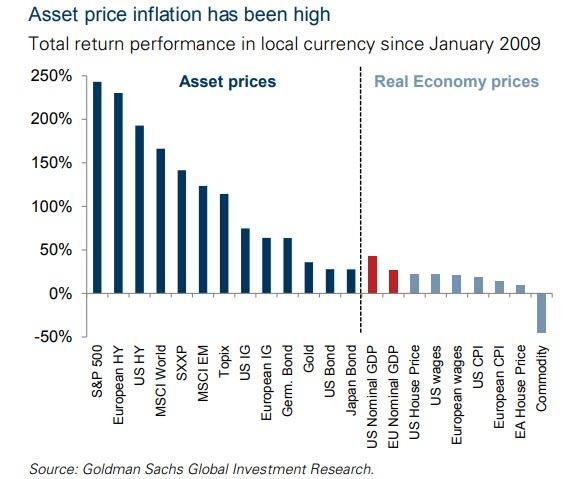
A hybrid inflation index is not appropriate for monetary policy as the focus needs be on the actual “cost of things.” And targeting a hybrid index becomes a problem when there is a great variance between actual prices and imputed prices as evident in the 2000s when house prices skyrocketed and “imputed” rents hardly moved. That trend is also present today but on a smaller scale, suggesting the “cost of things” has been moving up at a faster rate compared to the “cost of living”.
Policymakers should borrow a page from the politicians playbook and conduct a study of price measurement to ensure today’s measures meets their purpose of economy wide inflation. It would also be wise to examine why asset price cycles have been much greater since the shift towards a “cost of living” index and numerical price targeting. Politics of inflation should never favor one type over another as history has clearly shown easy money creating or promoting inflation in only two areas (real and financial assets) can be just as bad economically and financially as if it shows up in all of the items.
via ZeroHedge News https://ift.tt/2WuZAmU Tyler Durden
One of America’s most iconic and popular tourist destinations has been the scene of two accidental deaths over the past week, Bloomberg reports. On Thursday, a Hong Kong man who was visiting the Grand Canyon’s popular “Horseshoe Bend” attraction reportedly stumbled and fell over the edge, plunging more than 1,000 feet to his death.
The body of the man, who hasn’t been identified, was airlifted out of the canyon shortly after. The incident occurred at Grand Canyon West, an area that’s technically outside the bounds of the national park, and on the grounds of the Hualapai reservation, which includes a 100-mile stretch of the Canyon at its western edge.
The fall happened earlier Thursday when not many visitors are at Eagle Point, a remote site best known for the Skywalk, a horse-shoe shaped glass bridge that juts out from the canyon wall. The rim has some ledges and outcroppings below but no barrier between tourists and the edge.
The man in his 50s was taking photos when he stumbled and fell, Leibowitz said. Signs at Eagle Point warn tourists not to get too close to the edge.
The area is closed for the day, Leibowitz said. He extended the tribe’s prayers to the man’s family.
Meanwhile, a second body had been found inside the national park, though the exact cause of death remained a mystery.
Meanwhile, authorities at Grand Canyon National Park – about 95 miles (153 kilometers) east – were working to identify a person believed to be a foreign national. A body was found Tuesday evening in a wooded area south of Grand Canyon Village away from the rim, the park said.
The person’s relatives haven’t been notified, and the cause of death is unclear, park spokeswoman Vanessa Ceja-Cervantes said. The National Park Service and the local medical examiner’s office are investigating.
The Grand Canyon National Park in northwestern Arizona attracts some 6.4 million tourists every year, while the Grand Canyon West attracts another 1 million visitors to the Hualapai reservation.
via ZeroHedge News https://ift.tt/2FGDsPN Tyler Durden
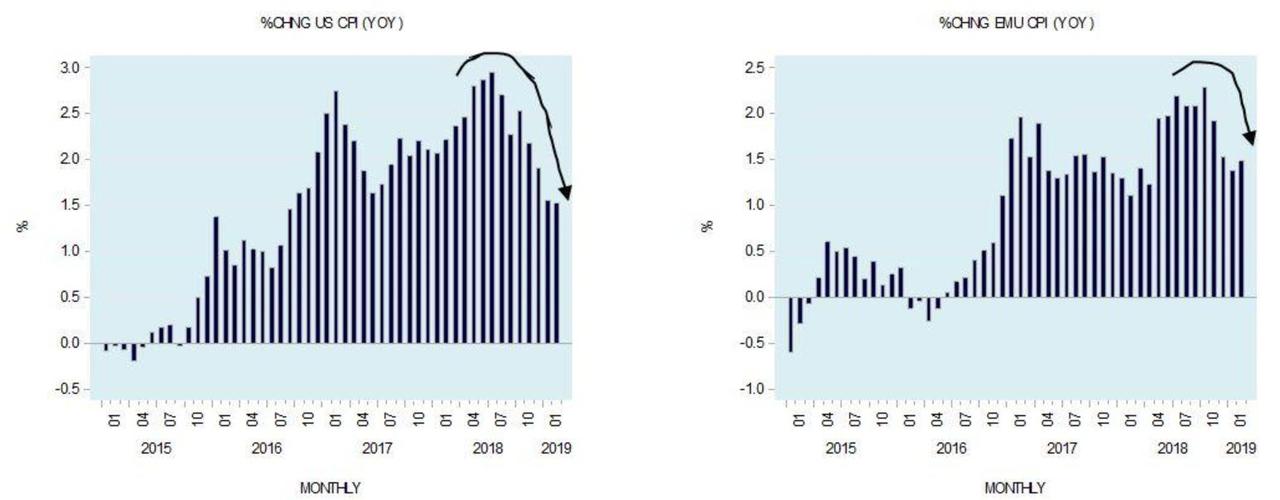
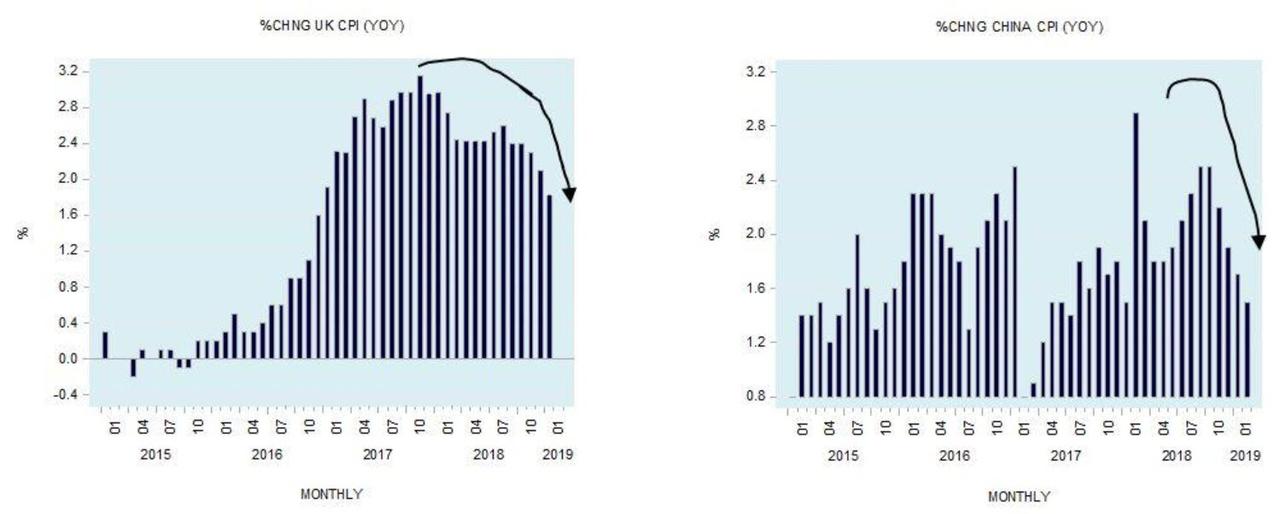
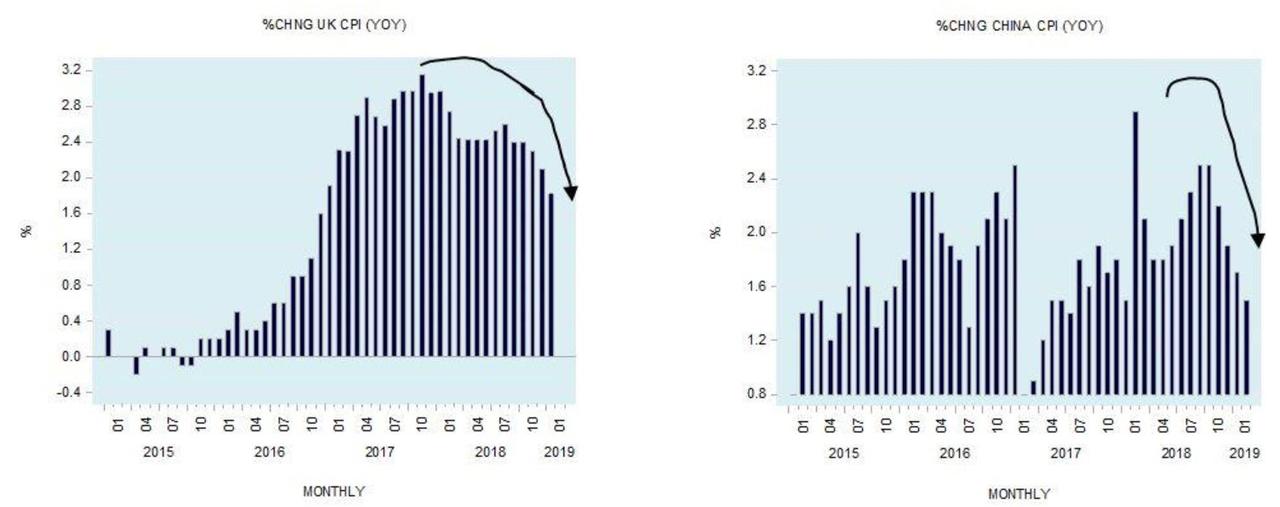
Currently we can observe a general slowdown in the annual growth rate in price inflation across major countries around the world. For instance the yearly growth rate of the US consumer price index (CPI) fell to 1.5% in February from 1.6% in January and 2.2% in February last year. In Europe, the yearly growth rate of the EMU CPI stood at 1.5% in February versus 1.4% in January and 2.3% in October 2018.
The annual rate of China’s CPI has also eased in February falling to 1.5% from 1.7% in January and 2.9% in February the year before.The growth momentum of the UK CPI also displays softening with the yearly growth rate standing at 1.8% in February against 2.1% in the month before and 3% in January 2018.
Most commentators are of the view that deflation generates expectations for a decline in prices. As a result, it is held, consumers are likely to postpone their buying of goods at present since they expect to buy these goods at lower prices in the future. This weakens the overall flow of spending and in turn weakens the economy.
Hence, such commentators believe that policies that counter deflation will also counter the economic slump.For many commentators and economic experts to counter a decline in the annual growth of the CPI, which they fear could develop into a general decline in prices; they advocate that central banks should maintain a very loose monetary stance. For these experts a possible decline in prices — which they label as deflation — poses a major threat to the economy.
It would appear that if deflation leads to an economic slump then policies that reverse deflation should be good for the economy. Reversing deflation will simply involve introducing policies that support general increases in the prices of goods, (i.e., price inflation). By this way of thinking, inflation could actually be an agent of economic growth.
According to most experts, a little bit of inflation can actually be a good thing. Mainstream economists believe that inflation of 2% is not harmful to economic growth, but that inflation of 10% could be bad for the economy.
Why should a rate of inflation of 10% or higher be regarded as a bad thing? If anything at inflation rate of 10% it is likely that consumers are going to form rising inflation expectations, and according to popular thinking, in response to a high rate of inflation, consumers will speed up their expenditure on goods at present, which should boost economic growth. Clearly, there is a problem with the popular way of thinking.
Inflation Is not Essentially a Rise in Prices
Inflation is not about general increases in prices as such, but about the increase in the money supply. As a rule, the increase in money supply sets in motion general increases in prices. This, however, need not always be the case.
The price of a good is the amount of money asked per unit of it. For a constant amount of money and an expanding quantity of goods, prices will actually fall. Prices will also fall when the rate of increase in the supply of goods exceeds the rate of increase in the money supply.
For instance, if the money supply increases by 5% and the quantity of goods increases by 10%, prices will fall by 5%.
A fall in prices however, cannot conceal the fact that we have inflation of 5% here because of the increase in money supply.
The reason why inflation is bad news is not of increases in prices as such, but because of the damage inflation inflicts to the wealth-formation process. Here is why.
The chief role of money is to fulfill the role of the general medium of exchange. Money enables us to exchange something we have for something we want. Before an exchange can take place, individuals must have something useful that they can exchange for money. Once they secure the money, they can then exchange it for the goods they want.
Now, consider a situation in which money is created out of “thin air.” This new money is no different from counterfeit money. The counterfeiter exchanges the printed money for goods without producing anything useful. He in fact exchanges nothing for something. He takes from the pool of real goods without contributing to the pool.
The economic effect of money that was created out of thin air is the same as that of counterfeit money — it impoverishes wealth generators.
The money created out of thin air diverts real wealth towards the holders of new money. This weakens wealth generators ability to generate wealth and this in turn leads to a weakening in economic growth. Note that as a result of the increase in the money supply what we have here is more money per unit of goods, and thus, higher prices.
What matters, however, is not price rises as such but the increase in money supply that sets in motion the exchange of nothing for something or “the counterfeit effect.”
The exchange of nothing for something weakens the process of real wealth formation. Therefore, anything that promotes increases in the money supply can only make things much worse.
Changes in prices are just a symptom, as it were, and not the primary causative factor. So, countering a falling growth momentum of the CPI by means of loose monetary policy (i.e., by creating inflation) is bad news for the process of wealth generation and hence for the economy.
Moreover, in order to maintain their lives and wellbeing, individuals must buy goods and services in the present. Therefore, from this perspective, a fall in prices as such cannot be bad for the economy.
Furthermore, if a fall in the growth momentum of prices emerges on the back of the collapse of bubble activities in response to a softer monetary growth, then this should be seen as good news. The less non-productive bubble activities the better it is for the wealth generators and hence for the overall pool of real wealth.
Likewise, if a fall in the growth momentum of the CPI emerges because of the expansion in real wealth for a given stock of money, obviously this is great news since more people could now benefit from the expanding pool of real wealth. We can thus conclude that contrary to the popular view, a fall in the growth momentum of prices is always good news for the wealth-generating process and hence for the economy.
via ZeroHedge News https://ift.tt/2U34URC Tyler Durden
The U.S. Department of Housing and Urban Development (HUD) has charged Facebook with “violating the Fair Housing Act by encouraging, enabling, and causing housing discrimination through the company’s advertising platform,” according to court documents.
HUD said in a statement Thursday that Facebook was “unlawfully discriminating” by allowing advertisers to define the audience based on race, color, national origin, religion, familial status, sex, and disability, in direct breach of the Fair Housing Act.
HUD claims the social media company permitted advertisers to redline poor neighborhoods.
“Facebook is discriminating against people based upon who they are and where they live,” said HUD Secretary Ben Carson. “Using a computer to limit a person’s housing choices can be just as discriminatory as slamming a door in someone’s face.”
HUD General Counsel Paul Compton said, “Even as we confront new technologies, the fair housing laws enacted over half a century ago remain clear—discrimination in housing-related advertising is against the law. Just because a process to deliver advertising is opaque and complex doesn’t mean that it exempts Facebook and others from our scrutiny and the law of the land. Fashioning appropriate remedies and the rules of the road for today’s technology as it impacts housing are a priority for HUD.”
Facebook said that it was shocked by the charges – as it has continued to work with the housing department to “address their concerns” since August 2018.
“While we were eager to find a solution, HUD insisted on access to sensitive information, like user data, without adequate safeguards. We’re disappointed by today’s developments, but we’ll continue working with civil rights experts on these issues,” Facebook said.
In Thursday’s complaint, HUD announced that anyone who has been hurt by Facebook’s illegal advertising practices could seek damages, plus the “maximum civil penalty” for each violation of the housing act.
Facebook came under heavy criticism from U.S. lawmakers last April who grilled the social network for abusive ad targeting, housing, and employment discrimination and hate speech.
The company’s ad-targeting practices have also been criticized by ProPublica, which in 2016 revealed that the company allowed advertisers access to ethnic filters. After the report, Facebook pledged new reforms and overhauls of its ad business.
Facebook shares are mixed in Friday’s afternoon session up 35bps to 166.10 and down more than 20% since the July 2018 high of 210.
via ZeroHedge News https://ift.tt/2uBooxO Tyler Durden
Conservatives tend to have two bad habits. First, they’re prone to viewing the past through a nostalgic lens. Second, they tend to instinctively give law enforcement the benefit of the doubt.
These tendencies help explain why conservatives for decades have been able to overlook the many abuses—constitutional, legal, and moral—of US intelligence agencies.
These revelations are unique in that they have become highly public and involve a sitting president. However, an examination of the history of US intelligence agencies reveals government bureaucrats were out of control long before the 2016 presidential election.
1. That Time the CIA Considered Bombing Miami and Blaming It on Castro
It’s no secret that the US government soughtto assassinate Fidel Castro for years. Less well known, however, was that part of their regime-change plot included a plan to blow up Miami and sinking a boat-full of innocent Cubans.
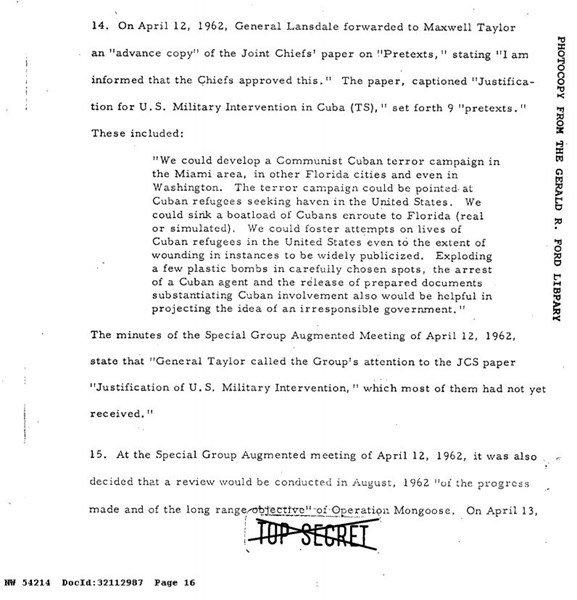
The plan, which was revealed in 2017 when the National Archives declassified 2,800 documents from the JFK era, was a collaborative effort that included the CIA, the State Department, the Department of Defense, and other federal agencies that sought to brainstorm strategies to topple Castro and sow unrest within Cuba. One of those plans included Operation Northwoods, submitted to the CIA by General Lyman Lemnitzer on behalf of the Joint Chiefs of Staff. It summarized nine “pretexts” the CIA and US government could employ to justify military intervention in Cuba. One of the official CIA documents shows officials musing about staging a terror campaign (“real or simulated”) and blaming it on Cuban refugees.
“We could develop a Cuban Communist terror campaign in the Miami area, in other Florida cities and even in Washington,” the Operation Mongoose document says.
“The terror campaign could be pointed at Cubans refugees seeking haven in the United States. We could sink a boatload of Cubans en route to Florida (real or simulated.) We could foster attempts on lives of Cuban refugees in the United States… Exploding a few plastic bombs in carefully chosen spots.”
Ultimately, the broader Mongoose effort failed to remove Castro from power or effectively establish an infiltration within Cuba, though the CIA did engage in several sabotage operations. Mongoose was suspended and ultimately discontinued amid the Cuban Missile Crisis.
2. In 2014 the CIA Was Caught Red-Handed Spying on the Senate Intelligence Committee
In the summer of 2014, the CIA’s inspector general concluded that the CIA had “improperly” spied on US Senate staffers who were researching the agency’s black history of torture. As the New York Timesreported:
An internal investigation by the C.I.A. has found that its officers penetrated a computer network used by the Senate Intelligence Committee in preparing its damning report on the C.I.A.’s detention and interrogation program.
And that’s not the worst part. The Times goes on to note that CIA officers didn’t just read the emails of the Senate investigators. They also sent “a criminal referral to the Justice Department based on false information.”
John Brennan, CIA director from 2013-2017, insisted during Senate hearings these were “very limited inappropriate actions” and that “the actions of the CIA were reasonable.”
Sen. Ron Wyden (D-Oregon) disagreed.
“That’s not what the Inspector General [concluded],” Wyden said. “When you’re talking about spying on a committee responsible for overseeing your agency, in my view that undermines the very checks and balances that protect our democracy, and it’s unacceptable in a free society. And your compatriots in all your sister agencies agree with that.”
Brennan, who publicly lied about the episode, was not punished and even retained his security clearance until Aug. 15, 2018.
3. The FBI’s “Suicide Letter” to MLK and His Wife
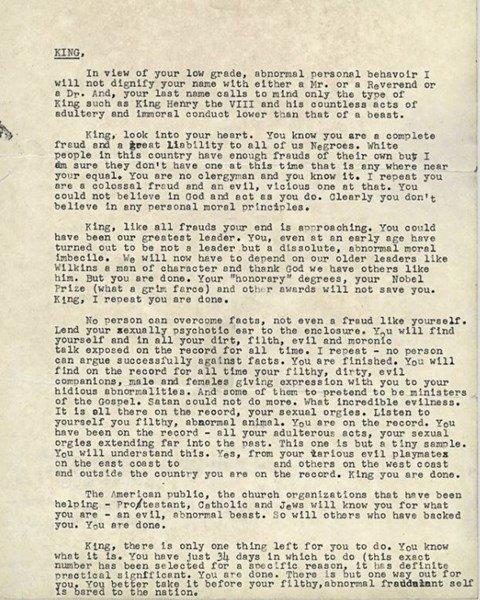
Before he had a day named in his honor and a monument on the National Mall, the government viewed Martin Luther King Jr. very much as a threat. In fact, his message of peace, love, equality, and civil disobedience had the FBI so scared that agents actually sent King and his wife a package containing a strange letter and tape recording. It contained details of the civil rights activist’s sexual indiscretions and encouraged him to kill himself.
In 1961, the FBI learned that Stanley Levison, a known “Red,” had become a close advisor to King. The following year, Bobby Kennedy approved wiretaps on Levison’s home and office, surveillance that would eventually expand. It turns out that J. Edgar Hoover stumbled on to MLK’s busy sex life while investigating King.
“Hoover found out very little about any Communist subterfuge,” wrote Yale historian Beverly Gage in the New York Times in 2014, “but he did begin to learn about King’s extramarital sex life….”
The FBI apparently had no scruples about using the information to try to bring King down. James Comey, Gage writes, used to keep a copy of the King wiretap request on his desk “as a reminder of the bureau’s capacity to do wrong.”
4. The CIA Forced Prisoners to Participate in Mind Control Experiments in the 1950s
If you’ve never heard of Project MKUltra, you might find it hard to believe. Also known as “the CIA Mind Control Program,” the effort was launched by the agency in 1953. The program used drug experiments on humans, oftentimes on prisoners who were tested against their will or in exchange for early release. The experiments were undertaken so CIA agents could better understand how to extract information from enemies during interrogations. Here is a description from the History Channel:
MK-Ultra’s “mind control” experiments generally centered around behavior modification via electro-shock therapy, hypnosis, polygraphs, radiation, and a variety of drugs, toxins, and chemicals. These experiments relied on a range of test subjects: some who freely volunteered, some who volunteered under coercion, and some who had absolutely no idea they were involved in a sweeping defense research program. From mentally-impaired boys at a state school, to American soldiers, to “sexual psychopaths” at a state hospital, MK-Ultra’s programs often preyed on the most vulnerable members of society. The CIA considered prisoners especially good subjects, as they were willing to give consent in exchange for extra recreation time or commuted sentences.
Whitey Bulger, a former organized crime boss, wrote of his experience as an inmate test subject in MK-Ultra. “Eight convicts in a panic and paranoid state,” Bulger said of the 1957 tests at the Atlanta penitentiary where he was serving time. “Total loss of appetite. Hallucinating. The room would change shape. Hours of paranoia and feeling violent. We experienced horrible periods of living nightmares and even blood coming out of the walls. Guys turning to skeletons in front of me. I saw a camera change into the head of a dog. I felt like I was going insane.”
How was any of this legal? Well, it wasn’t, which is why the CIA understood it had to be concealed from the American public at all costs.
“Precautions must be taken not only to protect operations from exposure to enemy forces but also to conceal these activities from the American public in general,” wrote a CIA auditor.
“The knowledge that the agency is engaging in unethical and illicit activities would have serious repercussions in political and diplomatic circles.”
5. The FBI’s Systemic Forensic Fraud in Crime Labs
In the early 1990s, Dr. Frederic Whitehurst, an attorney and chemist who worked at the FBI as a Supervisory Special Agent, noticed troubling practices in the in the bureau’s Investigation Laboratory.
There were “alterations of reports, alterations of evidence, folks testifying outside their areas of expertise in courts of law,” said Whitehurst. “[Really] what was going on was human rights violations. We have a right to fair trials in this country… And that’s not what was going on at the FBI lab.”
In 1994, he blew the whistle on the “systemic forensic fraud” he witnessed. Nothing happened. So he took his case to the Department of Justice. The FBI didn’t like that. Whitehurst was eventually chased out of the Bureau, but not before winning a $1.16 million settlement.
Unfortunately, however, the wheels of justice turn slowly at the Bureau.
“It wasn’t until ten years later that Whitehurst was finally vindicated,” notes the National Whistleblower Legal Defense and Education Fund note, “when a scathing 500+ page study of the lab by the Justice Department Inspector General, Michael Bromwich, concluded major reforms were required in the lab.”
But by then, an untold number of people had been convicted with the help of tainted evidence—evidence the DOJ knew was tainted.
In 2012 the Washington Postpublished an extensive review of the FBI and DOJ failures to properly review the cases impacted by the FBI lab scandal, based on Whitehurst’s research.
As a result, the DOJ agreed to conduct yet another review of hair cases in collaboration with the Innocence Project and the National Association of Criminal Defense Lawyers (NACDL).
3,000 cases were identified by the government that had used microscopic hair analysis from FBI examiners.
500 have been reviewed as of March 2015.
268 included pro-prosecution testimony from FBI examiners.
257 (96 percent) contained erroneous statements from “FBI experts”.
At least 35 of these cases involved convicted criminals who received the death penalty, according to the National Whistleblower Legal Defense and Education Fund.
6. Operation Midnight Climax: Drugging Unsuspecting Johns and Filming their Interactions with Prostitutes
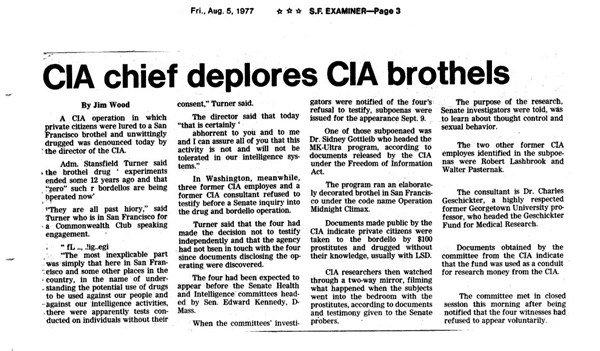
In the 1950s and early 1960s, the CIA admitted to operating a “bawdy house” in a San Francisco apartment where “unsuspecting citizens were lured… for the CIA’s drug experiments,” according to a local news story report documented by the agency.
“Private citizens were taken to the bordello by $100 prostitutes and drugged without their knowledge, usually with LSD,” the San Francisco Examiner reported in 1977 after the CIA admitted to the operation. Agents sat behind a two-way mirror and filmed the interactions between the drugged men and prostitutes.
Then-CIA director Stansfield Turner suggested the operation was intended to understand how drugs could potentially be used against the American people, though he called the experiments “abhorrent” and acknowledged it was “inexplicable” that the CIA would do this without the subjects’ consent. He insisted the agency had ceased the experiments 12 years prior. In a 1977 Senate testimony, CIA agents said the purpose of the experiments was to “learn about thought control and sexual behavior,” the Examiner noted.
7. The FBI Has Routinely Staged Acts of Terrorism
In the wake of 9/11, the FBI has, on numerous occasions, targeted unstable and mentally ill individuals, sending informants to bait them into committing terror attacks. Before these individuals can actually carry out the attack, however, the Bureau intervenes, presenting the foiled plot to the public as a successfully thwarted attack.
In 2011, journalist Glenn Greenwald summarized several examples of this deceitful tactic:
[T]he FBI subjected 19-year-old Somali-American Mohamed Osman Mohamud to months of encouragement, support and money and convinced him to detonate a bomb at a crowded Christmas event in Portland, Oregon, only to arrest him at the last moment and then issue a Press Release boasting of its success. In late 2009, the FBI persuaded and enabled Hosam Maher Husein Smadi, a 19-year old Jordanian citizen, to place a fake bomb at a Dallas skyscraper and separately convinced Farooque Ahmed, a 34-year-old naturalized American citizen born in Pakistan, to bomb the Washington Metro.
8. The CIA’s Media Manipulation Campaigns
From the agency’s earliest days, it has attempted to control the flow of information to the public. In his book Legacy of Ashes: A History of the CIA, former New York Times journalist Tim Weiner documented how much influence the agency’s first civilian director, Allen Dulles, had among major media companies:
Dulles kept in close touch with the men who ran The New York Times, The Washington Post, and the nation’s leading weekly magazines. He could pick up the phone and edit a breaking story, make sure an irritating foreign correspondent was yanked from the field, or hire the services of men such as Time’s Berlin bureau chief and Newsweek’s man in Tokyo.
Weiner noted, “It was second nature for Dulles to plant stories in the press. American newsrooms were dominated by veterans of the government’s wartime propaganda branch, the Office of War Information.” During his time at the agency, Dulles “built a public-relations and propaganda machine that came to include more than fifty news organizations, a dozen publishing houses, and personal pledges of support from men such as Axel Springer, West Germany’s most powerful press baron.”
In 1977, Carl Bernstein further exposed the CIA’s efforts to influence news organization in an article for Rolling Stone in which he revealed that “more than 400 American journalists…in the past twenty‑five years have secretly carried out assignments for the Central Intelligence Agency, according to documents on file at CIA headquarters.”
The Lesson
Amid the media and political establishment’s ongoing, frenzied coverage of Russia-gate, Americans are eager to pin guilt on the president have shown a willingness to trust the CIA and FBI without question despite numerous past and present reasons to be skeptical of their conclusions. Considering the CIA’s long history of intervening in other countries’ elections and governments, it is particularly ironic that their claims of Russia’s meddling in the US’ democracy are taken at face value.
Nor is the corruption and deceit limited to the FBI and CIA. Former Director of National Intelligence James Clapper lied to lawmakers and the public in 2013 when he claimed NSA did not collect any type of data on “millions or hundreds of millions of Americans.” He was caught red-handed months later when whistleblower Edward Snowden revealed the extent of the agency’s mass surveillance operations.
The survival of liberty depends on skepticism of government power—and make no mistake, that includes President Trump. But in light of these federal agencies’ chronic tendency to engage in behavior wholly inconsistent with American values, the same distrust must be applied to the institutions that claim to shed light on abuses by unpopular leaders.
via ZeroHedge News https://ift.tt/2OwpRyz Tyler Durden
The White House has dramatically stepped up its rhetoric threatening action against Russia’s military presence in Venezuela after the Kremlin deployed a troop contingency to Caracas last Saturday.
Trump’s national security adviser John Bolton took tensions to a new level, on Friday issuing a new Monroe doctrine of sorts, telling Moscow any attempt to establish or expand military operationsin the western hemisphere constitutes a “provocative” and “direct threat” to international peace and security in the region.
Russia sent two planes with dozens of soldiers and military advisers to Venezuela’s capital last weekend, via Reuters.
“We strongly caution actors external to the Western Hemisphere against deploying military assets to Venezuela, or elsewhere in the Hemisphere, with the intent of establishing or expanding military operations,” Bolton said in a statement.
“We will consider such provocative actions as a direct threat to international peace and security in the region,” he added. This follows the president’s own warning on Wednesday that “all options” are on the table regarding potential expanding Russian presence in Venezuela.
Two Russian aircraft carrying about 100 servicemen and 35 tons of cargo arrived in Caracas last Saturday, led by Russian General Vasily Tonkoshkurov, identified as chief of the Main Staff of the Ground Forces and First Deputy Commander-in-Chief of the Land Forces of Russia.
This prompted Trump’s Wednesday warning to Russia against involvement in the Latin American nation; he told reporters in the Oval Office that:
“Russia has to get out.”
Kremlin officials responded by explaining that it deployed military specialists merely to service preexisting arms contracts with Venezuela, and that Russia is not interfering in the Latin American country’s internal affairs.
Russian Foreign Ministry Spokeswoman Maria Zakharova said at a press briefing on Thursday when asked how long the Russian troop contingency led by a high ranking general will stay:
“How long? As long as they need to, and as long as the Venezuelan government needs them. It all is being done based on bilateral agreements.”
Russia’s position is that it is not interfering in Venezuela’s internal affairs by merely cooperating on legal and existing service contracts, and that no other country should do so either. It said that only “specialists”had entered Venezuela under a pre-existing agreed upon military cooperation deal.
However, the White House isn’t buying it, as Bolton’s Friday statement further condemned Maduro’s “use of foreign military personnel in his attempt to remain in power, including the introduction of Russian military personnel and equipment into Venezuela.”
“Maduro will only use this military support to further repress the people of Venezuela; perpetuate the economic crisis that has destroyed Venezuela’s economy; and endanger regional stability,” Bolton said.
All of this also comes as the Maduro government stripped US-backed opposition leader Juan Guaido of his position in the National Assembly, further barring him from holding public office for 15 years.
via ZeroHedge News https://ift.tt/2HYwFnf Tyler Durden
How destructive is hyperinflation? To quote economist Thomas Sowell, “Hyperinflation can take virtually your entire life’s savings, without the government having to bother raising the official tax rate at all.”
A number of countries are currently experiencing the destructive effects of hyperinflation.
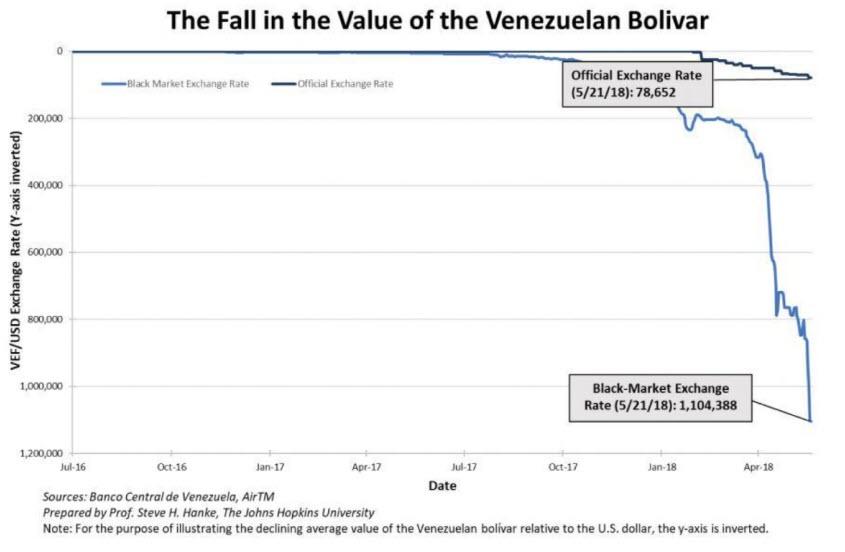
With the Venezuelan Bolivar at above 2,000,000 percent inflation, buying anything, even if something should be available, is virtually impossible. At towns along the Colombian border, food and medicine are bought with dollars or pesos. The Bolivar has simply lost any kind of value.
Foreign currency has become a critical means of survival in Venezuela. More than 40,000 Venezuelans, desperate for work and food, cross the border to Columbia each day. If they find work, they are paid in pesos. Should food be available, that, too, is purchased with pesos. Bolivars have become almost irrelevant to many Venezuelans. Most other currencies are eagerly accepted.
During the recent blackout that left Venezuela in the dark, food and medicine could only be bought with cash, as the electronic payment systems were non-functional. In Venezuela, cash means any foreign currency. In Maracaibo, the country’s second largest city, only U.S. currency greater than the dollar bill was accepted.
Foreign currency becomes available through friends and family who have permanently escaped the country and can send back cash. Those without such connections suffer. Some stores won’t accept the bolivar, and those that do charge a price Venezuelans cannot afford. Anyone lucky enough to have a job finds that the minimum wage of 18,000 bolivars, or $6.00, does not buy much.
With Venezuela in a state of turmoil as Maduro is fighting for his life, even the scarce goods that used to occupy the shelves are becoming rarer. This, of course, makes them more expensive, even when paid for with U.S. dollars. Even the dollar is becoming a victim of Venezuelan inflation.
According to the Venezuelan firm Ecoanalitica, a basket of necessities that was priced at $100.00 in 2018 now costs 675.00. The recent blackout, which left the country without electricity or air conditioning, saw the price of a bag of ice triple within a few days.
An elderly woman living in Caracas indicated that she was able to survive a year ago on the cash she received from family abroad. With hyperinflation continuing to soar, bare survival is a daily struggle. Her monthly pension, which is paid in bolivars, covers a bag of laundry detergent. Nothing more.
Venezuelans living in border cities have easier access to foreign currency, and many shops in those regions set their prices in foreign money. Cities near the Brazilian border conduct business trading the Brazilian real. The Bolivar is no longer accepted.
If life in Venezuela is looking bleak, it is almost certain that it will get worse. Inflation is anticipated to rise to 10 million percent by the end of the year. Venezuela, once one of South America’s wealthiest countries thanks to its massive oil reserves, has seen the destruction of its oil industry as the price of oil plummeted.
In 2018, a desperate President Maduro tried to rejuvenate the Venezuelan bolivar by removing seven of its zeroes. This was widely considered to be a joke. Economist Steve Hanke called it a “scam.” The continued downward spiral of the bolivar has lent gravitas to those words. Professor Hanke continued, “Redenomination will be like going under the knife of one of Caracas’s famed plastic surgeons. Appearances change, but, in reality, nothing changes.”
The actual misery which Venezuelans are experiencing is difficult for an outsider to grasp. Alvaro, a computer engineering professor, related his story on social media. He is in one of the highest paying professions. Alvaro makes approximately $13 a month, or 37,255 bolivars. A liter of milk costs 4,200 bolivars. That is 11 percent of his monthly income or a quarter of the minimum wage. His life’s savings, thanks of hyperinflation, are worth a mere 2 percent of what it was close to 20 years ago. Inflation indeed is an invisible tax, that can wipe out your lifes savings.
As Alvaro points out, 20 years have been stolen from the citizens of Venezuela. From what was a country that enjoyed abundance, the quality of life has receded to hunger, sickness, and nothingness. All due to hyperinflation of the bolivar.
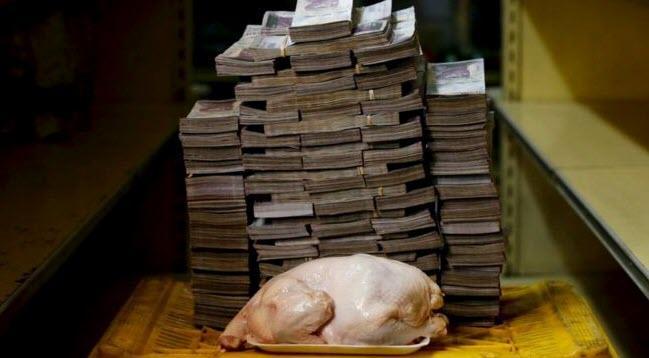
When Venezuelans withdraw money from the bank, it is immediately spent, because it might be worthless the next day. Prices can double on a daily basis. This is a disturbing image reminiscent of the Weimar Republic. Regardless of where it happens, hyperinflation invariably equals economic destruction.
At this time, Venezuela is in a state of flux. Thousands of protestors have called for Maduro’s resignation, and some countries (including the U.S.) have recognized Juan Guaido as his successor. Whoever comes out on top faces a tremendous uphill battle.
Although Venezuela is facing the worse type of hyperinflation, it is not the only country experiencing monetary devaluation at a rapid rate. Zimbabwe’s annual inflation is around 59 percent annually and growing. Fortunately, price increases have been kept manageable at 10 to 15 percent due to government efforts. Zimbabwe has experience with hyperinflation.
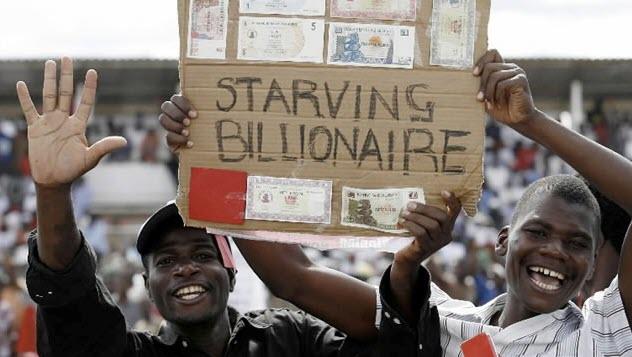
In 2008, Zimbabwe saw inflation spiral out-of-control at 500 billion percent. It was forced to abandon its currency altogether and replace it with the dollar. At the moment, Zimbabwe is facing its worse economic uproar since 2008, with food shortages and a shortage of useable foreign currency. It remains to be seen if history will repeat itself.
The main problem is that Zimbabwe is operating almost without cash or actual currency. The major currencies used are the dollar, bond notes, or EcoCash. Trades, even the purchase of a piece of gum, are done electronically. The value of the electronic currency was supposed to equal the value of paper currency. However, merchants are known to set three separate prices for their wares. The cheapest is payments made in dollars. Payments made in bond notes are somewhat higher. Payments in EcoCash are inflated by around 40 percent. The critical lack of dollars is making this three-tiered monetary system considerably worse.
Iran, in the meantime, is experiencing an annual inflation rate of 42.3 percent. In 2016, the country saw a growth of 12.5 percent. Last year, the growth was only 3.7 percent. Iran’s current economic woes are largely the result of oil sanctions initiated by President Trump. Rising oil prices have helped Iran, but this has also created inflationary conditions. As Professor Hanke points out, during the first six months of 2018, the Iranian rial was devalued by 51 percent while unemployment rose to 11.9 percent.
Despite the U.S. sanctions, some countries are still purchasing Iranian oil, but they are doing so at significantly reduced prices.
Hyperinflation is the inevitable result of a government printing fiat money until it loses all value. Both Venezuela and Zimbabwe in 2008 have done this. For Venezuela, there is little relief in sight. Zimbabwe simply stopped printing any currency, which helped alleviate the worst of the problems. How Iran will deal will with its rising prices and decreased income is yet to be seen.
via ZeroHedge News https://ift.tt/2CLPK8L Tyler Durden