Is The Re-Opening/Value Trade Over?

Is The Re-Opening/Value Trade Over?

Authored by Steven Vannelli via Knowledge Leaders Capital blog,

Interest rates have been falling in recent months leading some to speculate that the “re-opening” trade has run its course. This in turn begs the question as to whether the “value” trade is over. On both accounts, we see signals that still point to an extension of the re-opening/value trade.

Let’s start with the re-opening aspect.

Two easy variables to consider are TSA checkpoint throughput and OpenTable seated diners.

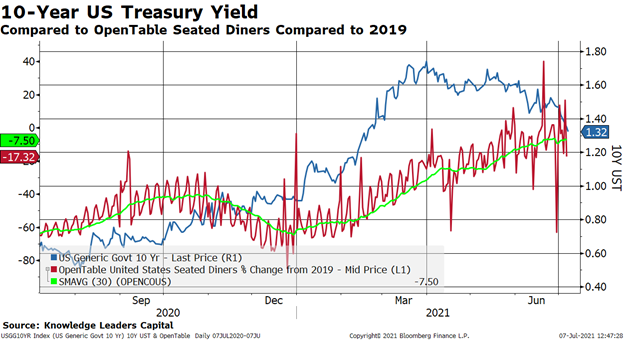
In the first chart, I overlay TSA checkpoint throughput on US 10-Year Treasury yields. Daily throughput is up about 500,000 people/day since yields peaked.

Next, we consider OpenTable seated diners relative to 2019. On a 30-day moving average, seated diners in the US are only off 7.5% from 2019, while they were down 40% when yields peaked. It is hard to see any relationship between the move lower in rates and reduced re-opening related activity. In fact, quite the contrary: re-opening appears to be continuing the strong pace we’ve been seeing all year.

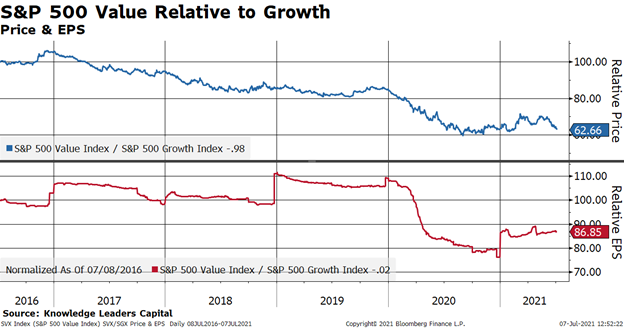
How about earnings estimates for value and growth stocks? In the next chart, I show the ratio of earnings estimates and price of the S&P 500 Value Index relative to the S&P 500 Growth Index.

While value has underperformed growth recently, earnings estimates continue rising at a faster pace for the S&P 500 Value index relative to the S&P 500 Growth index.

In the end, we don’t see the high frequency data that would signal a durable rotation from value to growth.

In our view, this looks more like a buy-the-dip opportunity in value for the next leg of re-opening and earnings momentum.

Tyler Durden
Thu, 07/08/2021 – 13:54

via ZeroHedge News https://ift.tt/3AFsOnX Tyler Durden

Three Tesla Models Tested By Car And Driver Were “Hampered By Quality Problems”

Three Tesla Models Tested By Car And Driver Were “Hampered By Quality Problems”

What we knew heading into today was that Car and Driver had lambasted Tesla yesterday in a glowing review of Ford’s Mustang Mach-E, which it named its 2021 EV of the year.

What we didn’t know was just how bad the publication’s review of a Tesla Model S, Model 3 and Model Y went as part of the selection process. A follow up report now makes it clear that Car and Driver’s reviews of the three Tesla models were “hampered by quality problems”, according to CNN

For example, “the cruise control system on the Tesla Model Y abruptly stopped working with no warning,” Sharon Silke Carty, Car and Driver’s editor-in-chief, told CNN. “All of a sudden I was going 30 in the middle of the highway,” she continued.

The touchscreen in the vehicle she was reviewing also “stopped working not long after the car arrived for testing”. 

Additionally, there were “poor fits between parts” (stop us if you’ve heard this one before) and a “grating squeak” from the Tesla’s rear seat.

The Model 3 arrived with a “large gap around the hood”, the report said, and the Model S, which only had 3,600 miles on it, had its front motor fail upon driving. 

Despite the quality issues, the Teslas did excel in the 1,000 mile trip, thanks to Tesla’s charging network. 

Recall, we wrote yesterday that Ford’s Mustang Mach-E was named 2021 EV of the year by Car and Driver. The review also took shots at Tesla, stating that the Mach-E improved on many features that Tesla first offered.  

“If an automaker wanted to convert people from EV skeptics to EV evangelists, it’s hard to imagine a better vehicle for the job than the Ford Mustang Mach-E,” the review started by saying. 

It continued: “The Mach-E has the range and charging speed to wave off the most common EV criticisms, and thanks to Electrify America’s recent work, there’s a nationwide charging network that makes long interstate trips not just possible but tolerable.”

The review then said that “Best of all, the Mach-E is fun.” Car and Driver gushed: “It moves us past the argument that we should drive EVs because they’re better for the environment and proposes a simpler, more fundamental truth: EVs can be as rewarding to drive as their gas counterparts. The Mach-E strikes a sweet balance between practical and visceral, landing in the space where Mazda often operates. Ford has built an EV that’s suited to kid-hauling duty, Costco runs, and daily commutes but that doesn’t strip the soul out of driving.”

Car and Driver raved about the Mach E’s handling, saying the “family crossover is surprisingly neutral if you push the speed in corners, and quick steering places the Mach-E exactly where you want it”. The review also complimented the space inside the vehicle: “Back-seat space is generous, and the deep cargo hold is roomy despite the fastback roofline.”

And then the review noted that Ford “borrowed” ideas from Tesla and improved on them, noting that Tesla resorted to “gimmicks” and “cost cutting measures”:

Ford clearly borrowed a few ideas from Tesla: panoramic fixed-glass roof, unconventional door handles, vertically oriented center display. While these highlights aren’t particularly original, Ford managed to make the cabin design feel fresh without resorting to gimmicks or trying to pass off cost-cutting meas­ures as innovation the way Tesla does.

The review also lambasted the learning curve necessary to drive a Model Y: “And unlike in, say, a Model Y, there’s no learning curve for driving a Mach-E. The gear selector doesn’t double as the cruise-control switch, like it does in Teslas.”

The review continued:

At long last, an automaker has given us an EV that competes head to head with Tesla on design, performance, price, and range, and it neither looks nor feels like it was built in a tent.

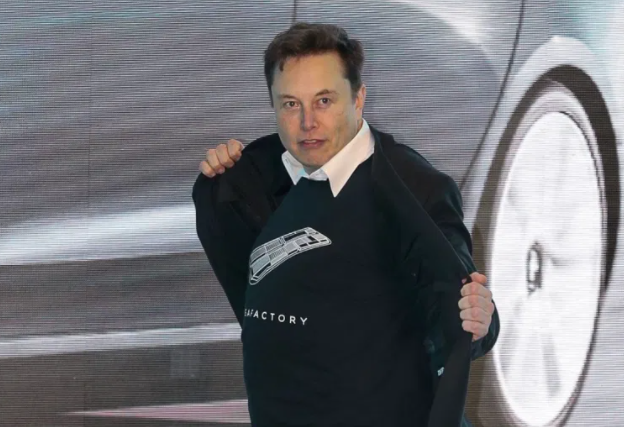
Recall, at around the same time Car and Driver was likely delivering its trophy to Ford, Elon Musk was seen sulking and lamenting about how hard the Full-Self Driving promises he has been making to customers for the last 5 years have been to fulfill. 


Tyler Durden
Thu, 07/08/2021 – 13:35

via ZeroHedge News https://ift.tt/3AFaATD Tyler Durden

The Capitol Police Will Open Offices in the States To ‘Investigate Threats to Members of Congress’


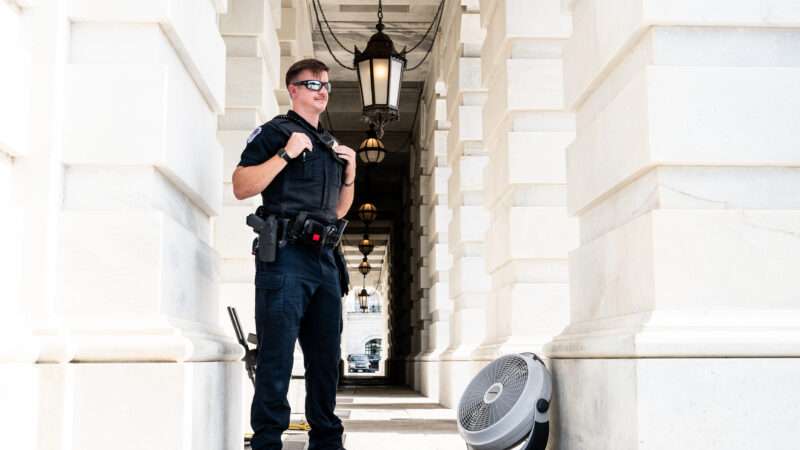
sipaphotoseleven881795

The January 6 riot at the U.S. Capitol thrust its police force into a sympathetic national spotlight; like any other government agency, the U.S. Capitol Police has seized this opportunity to expand its mission and acquire additional funding.

Now the Capitol Police plans to build regional field offices in the states: California and Florida, for starters.

“The Department is also in the process of opening Regional Field Offices in California and Florida with additional regions in the near future to investigate threats to Members of Congress,” notes the department in a press release.

The Capitol Police will also procure more riot gear, invest in use-of-force training camps, and provide “psychological trauma and stress” counseling for its officers. (“New wellness support dogs, Lila and Filip, will spread the message of wellness by helping engage the wellness team with our employees,” notes the press release.)

It is vital to ensure that the actual U.S. Capitol is protected. The events of January 6 must never repeat themselves; fortunately, the proximate cause of the Capitol riot—the sitting president encouraging his followers to delegitimize an election that he lost—seems very unlikely to recur. The Capitol Police require sufficient funding to provide security for the building, and with an annual budget in excess of $600 million, including an $88 million increase over last year, they undoubtedly have what they need.

The department does not need to become yet another unaccountable intelligence agency involved in the dubious and often nakedly political project of conducting widespread surveillance on the American people. Opening field agencies and monitoring “threats to members of Congress” are actions that dilute the Capitol Police’s very clear mandate to guard the Capitol building. The FBI, National Security Agency (NSA), Department of Homeland Security, and CIA are already empowered to investigate threats to political leaders; the federal government does not need to hire additional spymasters for this purpose, especially given that the agencies burdened with doing so have tended to violate the rights of innocent Americans.

But make no mistake: The Capitol Police has every intention of becoming just like the FBI and the NSA. According to the press release, it aspires to move forward “along a new path towards an intelligence based protective agency.”

This development should be vigorously opposed by all civil libertarians. Unfortunately, funding for the Capitol Police is tied into a larger, fraught political narrative about right-wing threats to law and order. For many on the right, Trump and his unhinged supporters are the good guys, which makes the Capitol Police the bad guys. For liberals, it’s the reverse. This has hopelessly scrambled what should have been a clear consensus that the U.S. does not need another domestic spy agency.

Case in point: Contrary to the conservative notion that liberals are trying to defund the police, the Democrats proposed $1.9 billion in additional funding for the Capitol Police and House Republicans voted unanimously against the bill. Several Democratic members of the progressive “squad”—Reps. Cori Bush (D–Mo.), Ilhan Omar (D–Minn.), and Ayanna Pressley (D–Mass.)—stuck to their police-skeptical principles and joined with Republicans to oppose the funding. But Reps. Alexandria Ocasio-Cortez (D–N.Y.), Jamaal Bowman (D–N.Y.), and Rashida Tlaib (D–Mich.) voted “present” rather than “no,” and the bill passed the House by a vote of 213–212.

“As a result of AOC’s craven act in refusing to join with the other three Squad members in uniting with the GOP to stop it, there is now yet another federal law enforcement agency attempting to assert its power outside of Washington: the Capitol Police,” writes Glenn Greenwald. “They intend to open ‘regional offices’ in two of the country’s largest states with plans to grow even further. Perhaps even more significantly, they are turning themselves into a preventative ‘intelligence-based’ private police force for Congress which, by definition, will monitor and spy on Americans beyond what the FBI, NSA and CIA already do.”

One does not need to minimize the horrible spectacle at the Capitol in order to reject the idea that its police force should get millions or billions more dollars and an increased presence outside of Washington, D.C. All Americans should condemn the deranged, lawless mob—and the man who summoned it—while still zealously opposing the relentless expansion of the national security state.

from Latest – Reason.com https://ift.tt/3dWIHwF
via IFTTT

How Long With Soaring Prices Stay High? An Alarming Answer From Goldman

How Long With Soaring Prices Stay High? An Alarming Answer From Goldman

“What goes up must (eventually) come down.”

That, in general terms, is the Fed’s argument why the current inflation surge should be transitory as prices normalize (somehow that logic does not apply to markets, but that’s where the Fed’s balance sheet comes in).

But is that indeed the case? Do higher prices go down on their own?

As we discussed last week in “How Average Inflation Hit A Red Hot 2.4%“, a large portion of the recent rise in inflation is being aided by re-opening dynamics and supply chain bottlenecks — drivers which Goldman expects are likely to be transitory.

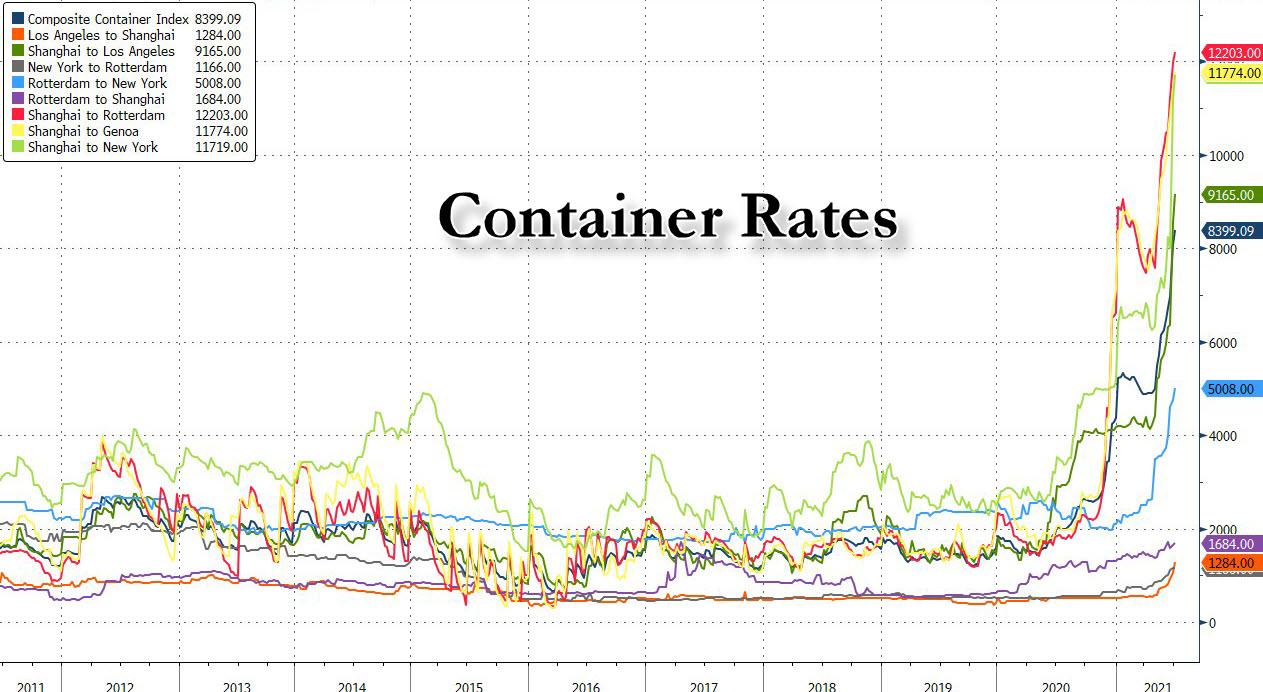
However, in a follow up note published overnight by Goldman, the bank’s economists highlight how the expected normalization of prices later this year and into next is likely to be uneven across categories. The bank clarifies that in its year end-2022 core PCE inflation forecast of 2.0% it assumes that a third of the bottleneck-induced inflection in core goods prices reverses at that horizon. Specifically, the bank expects price reversion to be larger in categories of relatively larger goods like used cars and car rentals, where pandemic and policy effects have driven what Goldman believes is a “temporary” wedge between supply and demand. On the other hand, whereas we have already seen a sharp slowdown in some price categories such as lumber, a quick look at container shipping rates shows that this clearest indicator of broken supply chains has yet to peak, let along normalize and drift lower.

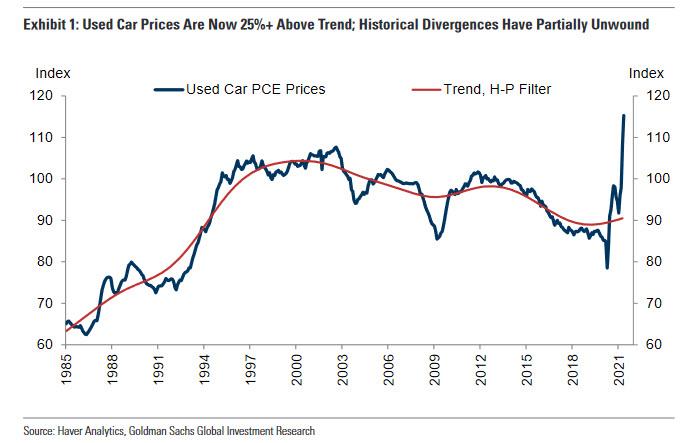
In any case, going back to Goldman’s note, which after doing a deep dig into supply chain disruptions and reopening effects, focuses on  exploring historical divergences in category-level inflation from a statistical perspective. As shown in the chart below, used car prices rose 38% year-on-year in May, and they are now well above statistically derived estimates of the underlying trend.

According to Goldman, full normalization to trend in this category alone would lower year-on-year core PCE inflation by 0.35pp—or even more if recent price outliers have introduced an upward bias to the filter.

To analyze the tendency for category-level prices to converge back to their medium-term trends, Goldman incorporated a “deviation from trend” variable into its bottom-up core PCE models. As shown in the grey bars below, there is evidence of normalization in the majority of categories, including many of today’s inflation outliers (the left 7 categories). However, with the exception of car rentals, and as should be blatantly obvious to anyone, Goldman “finds” that prices on average do not fully converge back to trend.

Even with the benefit of hindsight—and therefore ignoring price inflections that in fact reflected a permanent change in trend— we find that just over half of the price deviations close over the next year (58% on average across all core PCE categories and 55% across the seven currently elevated categories.

The second set of columns reflects the same test using real-time price trends. They show that the predictive power of price deviations is much weaker when they are measured in real time. In other words, while categories prone to temporary supply-demand imbalances such as car rentals and used cars continue to show significant normalization tendencies, the mean-reversion coefficient for the majority of the other categories loses statistical and economic significance.


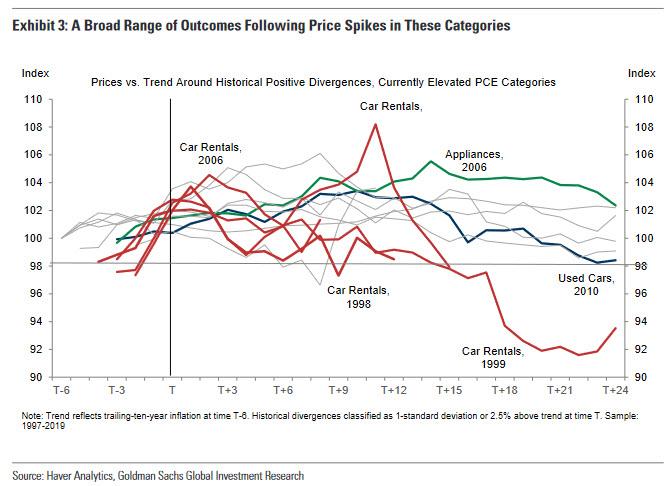
The last chart looks at the divergence episodes since 1997 for the seven categories that are particularly elevated today. Here, a more optimistic Goldman argues that the historic imbalances caused by the 2020 lockdowns and demand swings suggest that today’s divergences could resolve more quickly or fully, and as a result, the bank expects “price reversion to be relatively larger in categories like used cars, where pandemic and policy effects clearly drove a temporary wedge between supply and demand.”

Maybe: it is true that according to the chart, prices in that category fully normalized two years after the Cash for Clunkers program generated a similar price bubble during the financial crisis. But in contrast, the sustained increase in appliance prices during the last housing boom suggests scope for prices in that category to remain elevated long after after the chip shortage ends.

Taken together, Goldman concedes that its results suggest that we should not get carried away with forecasts of rapid or complete price normalization, because it is often difficult to identify bubbles without the benefit of hindsight, and because imbalances often require more than a few quarters to resolve. Which, of course, is precisely why the Fed will continue to argue that soaring prices are “transitory”… while the artificial, Fed-induced all time highs in the stock market will keep rising into perpetuity.


Tyler Durden
Thu, 07/08/2021 – 13:16

via ZeroHedge News https://ift.tt/3dYazjY Tyler Durden

Treat Tucker Carlson’s NSA Snooping Claims Seriously, but Not Literally


Tucker_1161x653

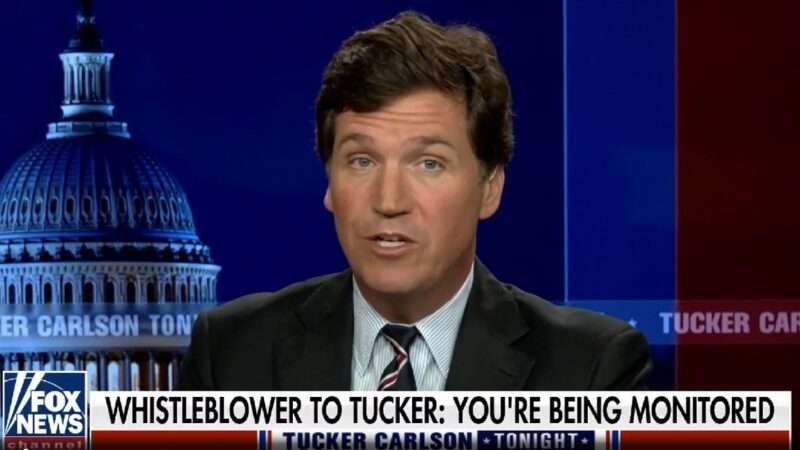
Toward the end of June, Fox News pundit Tucker Carlson made a remarkable on-air claim: He told viewers that the National Security Agency (NSA) had been reading his emails and planned to leak the contents in order to try to get his show off the air. He said a “whistleblower within the U.S. government” told him about the plan.

If the claim were true in the exact way that Carlson said it, this would be an outrageous abuse of the NSA’s power. The job of the NSA is to monitor foreign intelligence to track down spies and terrorists, not snoop on American journalists.

The NSA’s response was pretty lackluster and didn’t exactly close the door on the possibility that there was a kernel of truth in Carlson’s claims. The agency responded (which itself is unusual) that Carlson’s claim that it “was monitoring [his] electronic communications and is planning to leak them in an attempt to take him off the air” was untrue and that Carlson has “never been an intelligence target of the Agency and the NSA has never had any plans to try to take his program off the air.”

I’ve been covering the NSA and surveillance issues for Reason since Edward Snowden’s leaks and through the twists and turns of the investigation surrounding then-President Donald Trump and his associates’ interactions with Russian representatives. I immediately noticed the hole in this denial: Carlson does not actually have to be the “target” of the NSA for the agency to have been able to read his communications. Many of Carlson’s claims could be true even if he were simply communicating with somebody else who was the target of NSA monitoring.

Sure enough, on Wednesday night, Axios reported that Carlson had been communicating with intermediaries to try and arrange for an interview with Russian President Vladimir Putin. It is therefore extremely likely that at least one or more of the people Carlson communicated with (some of whom Axios reports had direct ties to the Kremlin) were legitimate targets of NSA surveillance. And therefore, the NSA did, in fact, probably get access to whatever emails were part of this discussion.

This means that the insistence by the NSA that it didn’t “target” Carlson is accurate, but it also means that Carlson’s claim that the NSA had read his emails may be accurate, at least to the extent that they were emails to the actual surveillance target.

This is colloquially known as a “backdoor search,” which is a way for the NSA or FBI to secretly and warrantlessly access communications by Americans in a way that normally would not be permitted. This was, in part, what happened with former National Security Adviser Michael Flynn when he was part of then-President-elect Donald Trump’s transition team. Flynn wasn’t the target of surveillance at the time—but Sergey Kislyak, the Russian ambassador he was talking to, was. The feds were aware of the nature of the conversations because they were snooping on Kislyak. Flynn got in trouble with the feds not for what he said but for lying about it and covering up the conversations.

It’s not controversial that the NSA could have intercepted Carlson’s emails to Russian intermediaries, especially if they’re connected to the Kremlin. But what is potentially controversial and legitimately bad is what might have happened once somebody at the NSA saw them. Carlson’s identity is supposed to be concealed, and there’s a complex “masking” and “unmasking” process that’s supposed to prevent government officials from knowing who is involved unless there’s a legitimate government interest.

Carlson did absolutely nothing wrong as a journalist by attempting to arrange an interview with Putin. This is all activity protected by the First Amendment. Chris Wallace interviewed Putin for Fox back in 2018. In all likelihood, any email exchanges between Wallace’s camp and Russian officials were intercepted by the NSA on the Russian end, just like Carlson’s might have been. So why has Carlson’s identity been apparently unmasked and this information leaked to Axios?

Let’s be skeptical of Carlson’s claims that this is an attempt to make him look bad. He says now, “The point, of course, was to paint me as a disloyal American. A Russian operative. Been called that before. A stooge of the Kremlin, a traitor doing the bidding of a foreign adversary.” This simply doesn’t seem to track with how the NSA has handled other journalists who have attempted to interview Putin.

We don’t actually know who Axios’ sources are here. And Axios reporter Jonathan Swan notes that the very people Carlson was talking to could have been responsible for distributing the communications to others. Even though Carlson says only his executive producer knew about his outreach to Putin, Carlson has no idea what those Russian intermediaries might have done with the emails. For all we know the NSA might have actually seen the contents of the email via the communications between two Russian surveillance targets.

Nevertheless, this entire affair helps shine a spotlight on the NSA’s backdoor search problem. It remains far too easy for the federal government to skirt the Fourth Amendment and access Americans’ communications without a warrant just because they’re talking with a foreign target. A bipartisan group of privacy-minded lawmakers, including the likes of Sens. Rand Paul (R–Ky.) and Ron Wyden (D–Ore.), have been trying to close these backdoors.

Unfortunately in the past, when given the opportunity, Congress actually expanded the authority of the feds to access this backdoor search information in order to fight domestic crimes, and Trump signed these authorizations into law, even while at the same time complaining about how the NSA did him dirty with the Russian probe.

In response to Carlson’s claims, House Republican Leader Rep. Kevin McCarthy (R–Calif.) announced last week that he has asked Rep. Devin Nunes (R–Calif.) as the ranking member of the House Permanent Select Committee on Intelligence to investigate the extent to which the NSA’s conduct might have been politicized.

Nunes is, unfortunately, emblematic of a lot of the Republican response to the NSA’s excesses since Trump was elected. Nunes has been very emphatic about calling out some bad conduct by the feds and surveillance, particularly the faulty warrants used to justify snooping on former Trump aide Carter Page. And he turned out to be correct. But historically, Nunes has been a massive cheerleader for the power of the surveillance state, voting in favor of the aforementioned expansion of domestic surveillance authorities and attacking former Rep. Justin Amash (L–Mich.), calling him “Al Qaeda’s best friend in the Congress,” for attempting to rein in the NSA and FBI’s domestic surveillance powers.

The best outcome here would be for these former cheerleaders of the surveillance state, having seen its political abuse, to finally support some restraints. What we should all fear, though, is that this is all a populist performance and, as with Trump, they only care when they and their allies are targets, and they aren’t actually interested in the possibility of reform at all.

from Latest – Reason.com https://ift.tt/2UAy0c5
via IFTTT

The Capitol Police Will Open Offices in the States To ‘Investigate Threats to Members of Congress’


sipaphotoseleven881795

The January 6 riot at the U.S. Capitol thrust its police force into a sympathetic national spotlight; like any other government agency, the U.S. Capitol Police has seized this opportunity to expand its mission and acquire additional funding.

Now the Capitol Police plans to build regional field offices in the states: California and Florida, for starters.

“The Department is also in the process of opening Regional Field Offices in California and Florida with additional regions in the near future to investigate threats to Members of Congress,” notes the department in a press release.

The Capitol Police will also procure more riot gear, invest in use-of-force training camps, and provide “psychological trauma and stress” counseling for its officers. (“New wellness support dogs, Lila and Filip, will spread the message of wellness by helping engage the wellness team with our employees,” notes the press release.)

It is vital to ensure that the actual U.S. Capitol is protected. The events of January 6 must never repeat themselves; fortunately, the proximate cause of the Capitol riot—the sitting president encouraging his followers to delegitimize an election that he lost—seems very unlikely to recur. The Capitol Police require sufficient funding to provide security for the building, and with an annual budget in excess of $600 million, including an $88 million increase over last year, they undoubtedly have what they need.

The department does not need to become yet another unaccountable intelligence agency involved in the dubious and often nakedly political project of conducting widespread surveillance on the American people. Opening field agencies and monitoring “threats to members of Congress” are actions that dilute the Capitol Police’s very clear mandate to guard the Capitol building. The FBI, National Security Agency (NSA), Department of Homeland Security, and CIA are already empowered to investigate threats to political leaders; the federal government does not need to hire additional spymasters for this purpose, especially given that the agencies burdened with doing so have tended to violate the rights of innocent Americans.

But make no mistake: The Capitol Police has every intention of becoming just like the FBI and the NSA. According to the press release, it aspires to move forward “along a new path towards an intelligence based protective agency.”

This development should be vigorously opposed by all civil libertarians. Unfortunately, funding for the Capitol Police is tied into a larger, fraught political narrative about right-wing threats to law and order. For many on the right, Trump and his unhinged supporters are the good guys, which makes the Capitol Police the bad guys. For liberals, it’s the reverse. This has hopelessly scrambled what should have been a clear consensus that the U.S. does not need another domestic spy agency.

Case in point: Contrary to the conservative notion that liberals are trying to defund the police, the Democrats proposed $1.9 billion in additional funding for the Capitol Police and House Republicans voted unanimously against the bill. Several Democratic members of the progressive “squad”—Reps. Cori Bush (D–Mo.), Ilhan Omar (D–Minn.), and Ayanna Pressley (D–Mass.)—stuck to their police-skeptical principles and joined with Republicans to oppose the funding. But Reps. Alexandria Ocasio-Cortez (D–N.Y.), Jamaal Bowman (D–N.Y.), and Rashida Tlaib (D–Mich.) voted “present” rather than “no,” and the bill passed the House by a vote of 213–212.

“As a result of AOC’s craven act in refusing to join with the other three Squad members in uniting with the GOP to stop it, there is now yet another federal law enforcement agency attempting to assert its power outside of Washington: the Capitol Police,” writes Glenn Greenwald. “They intend to open ‘regional offices’ in two of the country’s largest states with plans to grow even further. Perhaps even more significantly, they are turning themselves into a preventative ‘intelligence-based’ private police force for Congress which, by definition, will monitor and spy on Americans beyond what the FBI, NSA and CIA already do.”

One does not need to minimize the horrible spectacle at the Capitol in order to reject the idea that its police force should get millions or billions more dollars and an increased presence outside of Washington, D.C. All Americans should condemn the deranged, lawless mob—and the man who summoned it—while still zealously opposing the relentless expansion of the national security state.

from Latest – Reason.com https://ift.tt/3dWIHwF
via IFTTT

11th Circuit Panel Squabbles Over The Word “Alien”

Today the 11th Circuit decided Martinez-Rivera v. Attorney General, an unpublished immigration decision. The majority opinion by Judge Branch used the statutory term “alien” several times. Judge Martin wrote a two paragraph concurring opinion, explaining why she will not use the word “alien.”

I write separately to note why I prefer not to use the term “alien,” which the panel opinion uses ten times. Justice Kavanaugh has equated the term “noncitizen” with the statutory term “alien.” Nasrallah v. Barr, 590 U.S. __, 140 S. Ct. 1683, 1689 n.2 (2020); see also United States v. Estrada, 969 F.3d 1245, 1253 n.3 (11th Cir. 2020). “Alien” is increasingly recognized as an “archaic and dehumanizing” term. Maria Sacchetti, ICE, CBP to Stop Using ‘Illegal Alien’ and ‘Assimilation’ Under New Biden Administration Order, Wash. Post (Apr. 19, 2021).

To the extent the term “noncitizen” does not, in every instance, serve as a perfect replacement for the term “alien,” that concern is not present in this case. I see no need to use a term that “has become pejorative” where a non-pejorative term works perfectly well. Library of Congress, Library of Congress to Cancel the Subject Heading “Illegal Aliens” at 1 (2016), https://ift.tt/3AJ8hif.

Judge Branch wrote a separating concurring opinion in response:

In her separate concurrence, Judge Martin takes issue with the fact that the majority uses the statutory term “alien,” rather than her preferred term “noncitizen,” ten times.1 However, each time the majority uses the term “alien”—in citing the statutory provision at issue, the holding of a court, or a court document, its use of the term is grounded in the text of the Immigration and Nationality Act (“INA”). As it is not our role to “fix” the text of the INA, we should not stray into legislative draftsmanship. . . . Further, if we were to substitute the term “alien” for “noncitizen” in reference to specific statutory provisions, we risk stating the law inaccurately. As Justice Alito cautioned in his dissent in Moncrieffe v. Holder, “‘[a]lien’ is the term used in the relevant provisions of the [INA], and this term does not encompass all noncitizens.” 569 U.S. 184, 210 n.1 (2013) (Alito, J., dissenting). For these reasons, I write separately.

Judge Branch also took a subtle dig at Justice Kavanaugh, noting that Justice Gorsuch still uses the term “alien”

I recognize that, on occasion, the Supreme Court has used the term “noncitizen” rather than “alien” in its general discussion of our country’s immigration laws. For example, in Barton v. Barr, the Court noted that “[t]his opinion uses the term ‘noncitizen’ as equivalent to the statutory term ‘alien.'” 140 S. Ct. 1442, 1446 n.2 (2020). But the Court in that same opinion nonetheless used the correct statutory term “alien” when quoting the INA. Id. at 1446. And subsequent Supreme Court precedent has confirmed that the term “alien” remains appropriate. See Garland v. Dai, 141 S. Ct. 1669, 1680 (2021).

Kavanaugh wrote Barton. But Gorsuch wrote Dai.

from Latest – Reason.com https://ift.tt/3dUxvRi
via IFTTT

Treat Tucker Carlson’s NSA Snooping Claims Seriously, but Not Literally


Tucker_1161x653

Toward the end of June, Fox News pundit Tucker Carlson made a remarkable on-air claim: He told viewers that the National Security Agency (NSA) had been reading his emails and planned to leak the contents in order to try to get his show off the air. He said a “whistleblower within the U.S. government” told him about the plan.

If the claim were true in the exact way that Carlson said it, this would be an outrageous abuse of the NSA’s power. The job of the NSA is to monitor foreign intelligence to track down spies and terrorists, not snoop on American journalists.

The NSA’s response was pretty lackluster and didn’t exactly close the door on the possibility that there was a kernel of truth in Carlson’s claims. The agency responded (which itself is unusual) that Carlson’s claim that it “was monitoring [his] electronic communications and is planning to leak them in an attempt to take him off the air” was untrue and that Carlson has “never been an intelligence target of the Agency and the NSA has never had any plans to try to take his program off the air.”

I’ve been covering the NSA and surveillance issues for Reason since Edward Snowden’s leaks and through the twists and turns of the investigation surrounding then-President Donald Trump and his associates’ interactions with Russian representatives. I immediately noticed the hole in this denial: Carlson does not actually have to be the “target” of the NSA for the agency to have been able to read his communications. Many of Carlson’s claims could be true even if he were simply communicating with somebody else who was the target of NSA monitoring.

Sure enough, on Wednesday night, Axios reported that Carlson had been communicating with intermediaries to try and arrange for an interview with Russian President Vladimir Putin. It is therefore extremely likely that at least one or more of the people Carlson communicated with (some of whom Axios reports had direct ties to the Kremlin) were legitimate targets of NSA surveillance. And therefore, the NSA did, in fact, probably get access to whatever emails were part of this discussion.

This means that the insistence by the NSA that it didn’t “target” Carlson is accurate, but it also means that Carlson’s claim that the NSA had read his emails may be accurate, at least to the extent that they were emails to the actual surveillance target.

This is colloquially known as a “backdoor search,” which is a way for the NSA or FBI to secretly and warrantlessly access communications by Americans in a way that normally would not be permitted. This was, in part, what happened with former National Security Adviser Michael Flynn when he was part of then-President-elect Donald Trump’s transition team. Flynn wasn’t the target of surveillance at the time—but Sergey Kislyak, the Russian ambassador he was talking to, was. The feds were aware of the nature of the conversations because they were snooping on Kislyak. Flynn got in trouble with the feds not for what he said but for lying about it and covering up the conversations.

It’s not controversial that the NSA could have intercepted Carlson’s emails to Russian intermediaries, especially if they’re connected to the Kremlin. But what is potentially controversial and legitimately bad is what might have happened once somebody at the NSA saw them. Carlson’s identity is supposed to be concealed, and there’s a complex “masking” and “unmasking” process that’s supposed to prevent government officials from knowing who is involved unless there’s a legitimate government interest.

Carlson did absolutely nothing wrong as a journalist by attempting to arrange an interview with Putin. This is all activity protected by the First Amendment. Chris Wallace interviewed Putin for Fox back in 2018. In all likelihood, any email exchanges between Wallace’s camp and Russian officials were intercepted by the NSA on the Russian end, just like Carlson’s might have been. So why has Carlson’s identity been apparently unmasked and this information leaked to Axios?

Let’s be skeptical of Carlson’s claims that this is an attempt to make him look bad. He says now, “The point, of course, was to paint me as a disloyal American. A Russian operative. Been called that before. A stooge of the Kremlin, a traitor doing the bidding of a foreign adversary.” This simply doesn’t seem to track with how the NSA has handled other journalists who have attempted to interview Putin.

We don’t actually know who Axios’ sources are here. And Axios reporter Jonathan Swan notes that the very people Carlson was talking to could have been responsible for distributing the communications to others. Even though Carlson says only his executive producer knew about his outreach to Putin, Carlson has no idea what those Russian intermediaries might have done with the emails. For all we know the NSA might have actually seen the contents of the email via the communications between two Russian surveillance targets.

Nevertheless, this entire affair helps shine a spotlight on the NSA’s backdoor search problem. It remains far too easy for the federal government to skirt the Fourth Amendment and access Americans’ communications without a warrant just because they’re talking with a foreign target. A bipartisan group of privacy-minded lawmakers, including the likes of Sens. Rand Paul (R–Ky.) and Ron Wyden (D–Ore.), have been trying to close these backdoors.

Unfortunately in the past, when given the opportunity, Congress actually expanded the authority of the feds to access this backdoor search information in order to fight domestic crimes, and Trump signed these authorizations into law, even while at the same time complaining about how the NSA did him dirty with the Russian probe.

In response to Carlson’s claims, House Republican Leader Rep. Kevin McCarthy (R–Calif.) announced last week that he has asked Rep. Devin Nunes (R–Calif.) as the ranking member of the House Permanent Select Committee on Intelligence to investigate the extent to which the NSA’s conduct might have been politicized.

Nunes is, unfortunately, emblematic of a lot of the Republican response to the NSA’s excesses since Trump was elected. Nunes has been very emphatic about calling out some bad conduct by the feds and surveillance, particularly the faulty warrants used to justify snooping on former Trump aide Carter Page. And he turned out to be correct. But historically, Nunes has been a massive cheerleader for the power of the surveillance state, voting in favor of the aforementioned expansion of domestic surveillance authorities and attacking former Rep. Justin Amash (L–Mich.), calling him “Al Qaeda’s best friend in the Congress,” for attempting to rein in the NSA and FBI’s domestic surveillance powers.

The best outcome here would be for these former cheerleaders of the surveillance state, having seen its political abuse, to finally support some restraints. What we should all fear, though, is that this is all a populist performance and, as with Trump, they only care when they and their allies are targets, and they aren’t actually interested in the possibility of reform at all.

from Latest – Reason.com https://ift.tt/2UAy0c5
via IFTTT
11th Circuit Panel Squabbles Over The Word “Alien”

Today the 11th Circuit decided Martinez-Rivera v. Attorney General, an unpublished immigration decision. The majority opinion by Judge Branch used the statutory term “alien” several times. Judge Martin wrote a two paragraph concurring opinion, explaining why she will not use the word “alien.”

I write separately to note why I prefer not to use the term “alien,” which the panel opinion uses ten times. Justice Kavanaugh has equated the term “noncitizen” with the statutory term “alien.” Nasrallah v. Barr, 590 U.S. __, 140 S. Ct. 1683, 1689 n.2 (2020); see also United States v. Estrada, 969 F.3d 1245, 1253 n.3 (11th Cir. 2020). “Alien” is increasingly recognized as an “archaic and dehumanizing” term. Maria Sacchetti, ICE, CBP to Stop Using ‘Illegal Alien’ and ‘Assimilation’ Under New Biden Administration Order, Wash. Post (Apr. 19, 2021).

To the extent the term “noncitizen” does not, in every instance, serve as a perfect replacement for the term “alien,” that concern is not present in this case. I see no need to use a term that “has become pejorative” where a non-pejorative term works perfectly well. Library of Congress, Library of Congress to Cancel the Subject Heading “Illegal Aliens” at 1 (2016), https://ift.tt/3AJ8hif.

Judge Branch wrote a separating concurring opinion in response:

In her separate concurrence, Judge Martin takes issue with the fact that the majority uses the statutory term “alien,” rather than her preferred term “noncitizen,” ten times.1 However, each time the majority uses the term “alien”—in citing the statutory provision at issue, the holding of a court, or a court document, its use of the term is grounded in the text of the Immigration and Nationality Act (“INA”). As it is not our role to “fix” the text of the INA, we should not stray into legislative draftsmanship. . . . Further, if we were to substitute the term “alien” for “noncitizen” in reference to specific statutory provisions, we risk stating the law inaccurately. As Justice Alito cautioned in his dissent in Moncrieffe v. Holder, “‘[a]lien’ is the term used in the relevant provisions of the [INA], and this term does not encompass all noncitizens.” 569 U.S. 184, 210 n.1 (2013) (Alito, J., dissenting). For these reasons, I write separately.

Judge Branch also took a subtle dig at Justice Kavanaugh, noting that Justice Gorsuch still uses the term “alien”

I recognize that, on occasion, the Supreme Court has used the term “noncitizen” rather than “alien” in its general discussion of our country’s immigration laws. For example, in Barton v. Barr, the Court noted that “[t]his opinion uses the term ‘noncitizen’ as equivalent to the statutory term ‘alien.'” 140 S. Ct. 1442, 1446 n.2 (2020). But the Court in that same opinion nonetheless used the correct statutory term “alien” when quoting the INA. Id. at 1446. And subsequent Supreme Court precedent has confirmed that the term “alien” remains appropriate. See Garland v. Dai, 141 S. Ct. 1669, 1680 (2021).

Kavanaugh wrote Barton. But Gorsuch wrote Dai.

from Latest – Reason.com https://ift.tt/3dUxvRi
via IFTTT

Grocery Stores Are Masking Price Hikes Via “Shrinkflation”

Grocery Stores Are Masking Price Hikes Via “Shrinkflation”

The continued decline in Treasury yields has prompted many short-sighted arm-chair analysts to declare that the Fed was right about inflationary pressures being “transitory”. Of course, as Treasury Secretary Janet Yellen herself admitted, a little inflation is necessary for the economy to function long term – because without “controlled inflation,” how else will policymakers inflate away the enormous debts of the US and other governments.

As policymakers prepare to explain to the investing public why inflation is a “good thing”, a report published this week by left-leaning NPR highlighted a phenomenon that is manifesting in grocery stores and other retailers across the US: economists including Pippa Malmgren call it “shrinkflation”. It happens when companies reduce the size or quantity of their products while charging the same price, or even more money.

As NPR points out, the preponderance of “shrinkflation” creates a problem for academics and purveyors of classical economic theory. “If consumers were the rational creatures depicted in classic economic theory, they would notice shrinkflation. They would keep their eyes on the price per Cocoa Puff and not fall for gimmicks in how companies package those Cocoa Puffs.”

However, research by behavioral economists has found that consumers are “much more gullible than classic theory predicts. They are more sensitive to changes in price than to changes in quantity.” It’s one of many well-documented ways that human reasoning differs from strict rationality (for a more comprehensive review of the limitations of human reasoning in the loosely defined world of behavioral economics, read Daniel Kahneman’s “Thinking Fast and Slow”).

Just a few months ago, we described shrinkflation as “the oldest trick in the retailer’s book” with an explanation of how Costco was masking a 14% price hike by instead reducing the sheet count in its rolls of paper towels and toilet paper.

NPR’s report started with the story of Edgar Dworsky, who monitors grocery store shelves for signs of “shrinkflation”.

A couple of weeks ago, Edgar Dworsky walked into a Stop & Shop grocery store in Somerville, Mass., like a detective entering a murder scene.

He stepped into the cereal aisle, where he hoped to find the smoking gun. He scanned the shelves. Oh no, he thought. He was too late. The store had already replaced old General Mills cereal boxes — such as Cheerios and Cocoa Puffs — with newer ones. It was as though the suspect’s fingerprints had been wiped clean.

Then Dworsky headed toward the back of the store. Sure enough, old boxes of Cocoa Puffs and Apple Cinnamon Cheerios were stacked at the end of one of the aisles. He grabbed an old box of Cocoa Puffs and put it side by side with the new one. Aha! The tip he had received was right on the money. General Mills had downsized the contents of its “family size” boxes from 19.3 ounces to 18.1 ounces.

Dworsky went to the checkout aisle, and both boxes — gasp! — were the same price. It was an open-and-shut case: General Mills is yet another perpetrator of “shrinkflation.”

It’s also being used for paper products, candy bars and other packaged goods.

Back in the day, Dworsky says, he remembers buying bigger candy bars and bigger rolls of toilet paper. The original Charmin roll of toilet paper, he says, had 650 sheets. Now you have to pay extra for “Mega Rolls” and “Super Mega Rolls” — and even those have many fewer sheets than the original. To add insult to injury, Charmin recently shrank the size of their toilet sheets. Talk about a crappy deal.

Shrinkflation, or downsizing, is probably as old as mass consumerism. Over the years, Dworsky has documented the downsizing of everything from Doritos to baby shampoo to ranch dressing. “The downsizing tends to happen when manufacturers face some type of pricing pressure,” he says. For example, if the price of gasoline or grain goes up.

The whole thing brings to mind a scene from the 2000s comedy classic “Zoolander”.

Tyler Durden
Thu, 07/08/2021 – 12:55

via ZeroHedge News https://ift.tt/2VdPj34 Tyler Durden