Michigan Police On High Alert After “Racist” WSJ Op-Ed Piece Calls Dearborn “America’s Jihad Capital”
Dearborn, Michigan, Mayor Abdullah Hammoud took to social media platform X on Saturday afternoon to warn “Effective immediately” that “Dearborn police will ramp up its presence across all places of worship and major infrastructure points.”
Hammoud said the reason behind police officers increasing their presence across places of worship and major infrastructure points followed a Wall Street Journal opinion piece calling Dearborn “America’s Jihad Capital.”
Effective immediately – Dearborn police will ramp up its presence across all places of worship and major infrastructure points.
This is a direct result of the inflammatory @WSJ opinion piece that has led to an alarming increase in bigoted and Islamophobic rhetoric online…
Here’s an excerpt from the op-ed that alleged thousands in the city support the Hamas militant group:
What’s happening in Dearborn isn’t simply a political problem for Democrats. It’s potentially a national-security issue affecting all Americans. Counterterrorism agencies at all levels should pay close attention.
Mayor Hammoud released a statement:
“In response to an Islamaphobic, Anti-Arab, and blatantly racist opinion piece published by the Wall Street Journal today, we have increased the presence of law enforcement throughout Dearborn.
“Dearborn Police continue to monitor social media for threats. This is more than irresponsible journalism. Publishing such inflammatory writing puts our residents at increased risk for harm.”
X user Andy Ngô responded to the mayor’s tweet, pointing out, “You do have an Islamic extremism problem in your city, and that’s part of the reason you were elected. You deny the problem exists so that the Islamists can continue to organize.”
You do have an Islamic extremism problem in your city, and that’s part of the reason you were elected. You deny the problem exists so that the Islamists can continue to organize. https://t.co/pXzOnjjXZD
That persistent cough and wheezing is bad enough without gum disease making it worse. New research reveals why periodontitis, a common gum infection, accelerates the progression of chronic obstructive pulmonary disease (COPD), the irreversible and often deadly lung condition affecting almost 16 million Americans.
Chinese scientists have discovered how bacteria from inflamed gums can travel to the lungs, exacerbating COPD symptoms. The findings from Sichuan University offer hope for new treatment possibilities for managing the breath-stealing disease.
Oral Bacteria Directly Trigger Flare-Ups in COPD Lungs
COPD, encompassing emphysema and chronic bronchitis, is the world’s sixth leading cause of death.
The condition is quietly hurting millions of Americans, as many are unaware they have it. In the United States, cigarette smoking drives most COPD cases, while cooking over open fires drives cases in underdeveloped countries, Dr. Norman Edelman, a pulmonologist at Stony Brook Medicine, professor of internal medicine, and core member of the public health program at Stony Brook University, told The Epoch Times.
COPD impedes airflow and breathing by damaging the airways and lungs. Key symptoms are coughing, excess mucus, and wheezing. Patients also suffer acute exacerbations where symptoms abruptly worsen for days.
While prior research has linked mouth infections to COPD progression, the exact mechanisms were unclear. A 2018 study posited the two were only connected by smoking as a shared risk factor.
The new research from Sichuan University, published in the American Society for Microbiology Journals, finds gum disease pathogens directly associate with COPD flare-ups by activating lung immune cells, which increase lung inflammation-driving bacteria. The researchers demonstrated this in animal models.
“We’ll further carry out additional studies on human subjects to confirm the mechanism,” microbiologist and co-study author Yan Li said in a press statement. “Our findings could lead to a potential new strategy for treating COPD.”
The study shows how poor dental care enables oral bacteria like P. gingivalis to enter the lungs, said Dr. Thomas Kilkenny, director of critical care in pulmonary medicine at Staten Island University Hospital, who was not involved in the research.
“This sets up chronic levels of inflammation beyond that found in COPD,” he told The Epoch Times. Although the various bacteria alone can cause an increased number of respiratory infections, “the heart of the study was the inflammatory cells,” he noted.
Circulating oral bacteria trigger the overproduction of immune signaling chemicals called cytokines. The cytokines spark harmful inflammation and disturb normal lung structures, Dr. Kilkenny said.
70 Percent of COPD Cases Due to Smoking
The root cause behind most preventable COPD cases is cigarette smoking. Smoking activates lung immune cells to release cytokines, fueling inflammation, Dr. Kilkenny added. Smoking accounts for 70 percent of cases.
Nonsmoking risk factors include:
A history of childhood lung infections.
A history of asthma.
Smoke from home cooking and heating fuels.
Secondhand tobacco smoke.
Genetic mutations that can cause the disease.
Vitamin D deficiency may also raise COPD risk. A 2020 meta-analysis of randomized controlled trials found many COPD patients to be vitamin D deficient. Further, vitamin D supplements helped improve lung function for these patients.
Fight Gum Infections to Maintain Overall Health: Expert
While the study could result in future COPD treatments, that lies far in the future, according to Dr. Edelman. He stressed that it would be better for people to take care of their periodontal health.
“To me, the real story, which many people don’t know, is that periodontal disease is a risk factor for systemic disease,” he said. These diseases include diabetes and heart disease.
The prevalence of gum infections in disadvantaged communities constitutes a significant public health issue, he noted.
Specifically, Dr. Edelman said he had observed about one-third of low-income kids on Long Island, where he practices, having tooth decay or gum disease. Getting the word out on the health impacts tied to poor oral health should take priority over any long-term therapeutic implications of this research, he noted.
Senate ‘Deal’ Allows 1.5 Million Illegals Per Year, Slides Up To $2.3B To NGOs Trafficking Them, And Gives $60B To Ukraine
While the House has gone full ‘Israel or Bust’, the Senate has come up with a $118 billion bipartisan agreement which would allow 1.5 million illegals to enter the US every year, allocates $2.3 billion towards NGOs and other organizations which traffic them, gives $14.1 billion in security assistance to Israel, and a whopping $60 billion in support to Ukraine.
The bill also locks in green card giveaways until 2030.
Not only does this bill codify 1.5 million illegal border crossings into law, but the “border emergency” that automatically gets implemented at 5,000 crossings per day in a week can be overturned by Joe Biden.
The agreement was reached by Sens. James Lankford (R-OK), whose own state legislature censured him last week for striking such a crappy border deal, along with Chris Murphy (D-CT) and Kyrsten Sinema (I-AZ).
It’s pretty amazing we’re at a point where allowing 5,000 illegals per day into this country is going to become law
Let’s pause to revisit the fact that President Biden could close the border with the stroke of a pen, right now, but refuses to do so until Ukraine and Israel money materializes. He really likes quid-pro-quo arrangements, you see.
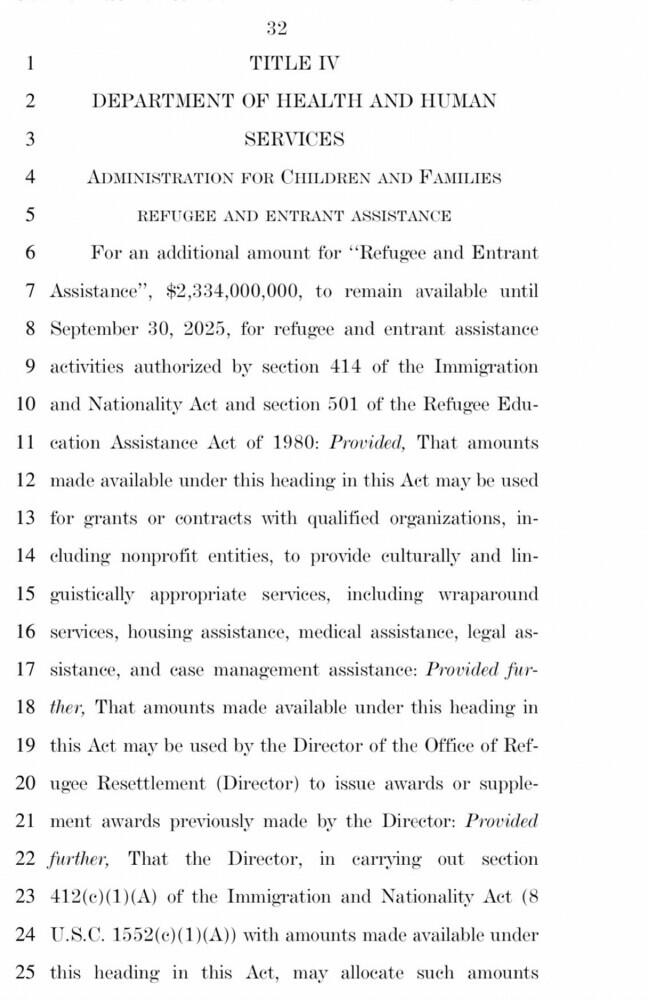
As noted above, the bill also carves out $2.33 billion for “Refugee and Entrant Assistance,” which provides that “Amounts made available under this heading in this Act may be used for grants or contracts with qualified organizations, including nonprofit entities, to provide culturally and linguistically appropriate services.”
Breaking it down further, the $118.28 billion national security supplemental package includes:
$60.06 billion to support Ukraine as it fights back against Putin’s bloody invasion and protects its people and sovereignty.
$14.1 billion in security assistance for Israel.
$2.44 billion to support operations in the U.S. Central Command and address combat expenditures related to conflict in the Red Sea.
$10 billion in humanitarian assistance to provide food, water, shelter, medical care, and other essential services to civilians in Gaza and the West Bank, Ukraine, and other populations caught in conflict zones across the globe.
$4.83 billion to support key regional partners in the Indo-Pacific and deter aggression by the Chinese government.
$2.33 billion to continue support for Ukrainians displaced by Putin’s war of aggression and other refugees fleeing persecution.
The bipartisan border policy changes negotiated by Senators Chris Murphy (D-CT), Kyrsten Sinema (I-AZ), and James Lankford (R-OK).
$20.23 billion to address existing operational needs and expand capabilities at our nation’s borders, resource the new border policies included in the package, and help stop the flow of fentanyl and other narcotics.
The Fentanyl Eradication and Narcotics Deterrence (FEND) Off Fentanyl Act.
$400 million for the Nonprofit Security Grant Program to help nonprofits and places of worship make security enhancements.
“The Senate’s bipartisan agreement is a monumental step towards strengthening America’s national security abroad and along our borders,” said Sen. Majority Leader Chuck Schumer (D-NY) of the deal. “This is one of the most necessary and important pieces of legislation Congress has put forward in years to ensure America’s future prosperity and security.”
Over in the Senate, Rep. Dan Bishop (R-NC) said he’s a “hard NO on any bill legitimizing illegal immigration.“
America Last, Ukraine First from the DC Swamp – literally.
Their priorities are clear, as shown in the first section of the bill summary. pic.twitter.com/kfvHCpT88T
Bill authors say this ends “catch and release” because it requires mandatory supervision of those released and quicker processing time for case. that will depend on funding and staffing…. https://t.co/XVLQ2okr8G
The Senate bill is awful! America, read from pages 212 to 217, and you will see why. There have to be 41 Republican Senators who will say NO to this monstrosity. @SpeakerJohnson, this bill should never get a vote in the House! pic.twitter.com/C92OWB3IKk
Powell Tells 60 Minutes Fed “Not Likely” To Cut In March, Calls Americans Lazy
In his highly anticipated 60-Minutes interview, Jerome Powell did not deliver any new shocks, and unlike the Fed’s dovish December pivot, there were no major surprises: instead, the Fed Chair echoed what he said last week, predicting that the Fed policymakers will likely wait after March to cut interest rates as he sought to explain the central bank’s rationale for eventual reductions to a broad public audience (amid mounting pressure by Democrats to cut aggressively ahead of December even as the Biden Dept of Labor fabricated jobs data to make it seem like the US is enjoying a golden ago for workers).
In an interview conducted on Thursday with CBS’s 60 Minutes and airing Sunday evening, Powell reiterated that Fed officials want to see more economic data to assure that inflation is on a sustainable path to their 2% goal.
“The danger of moving too soon is that the job’s not quite done, and that the really good readings we’ve had for the last six months somehow turn out not to be a true indicator of where inflation’s heading,” Powell said in the interview adding that while “we don’t think that’s the case… the prudent thing to do is to, is to just give it some time and see that the data continue to confirm that inflation is moving down to 2% in a sustainable way.”
Powell then said it isn’t likely that the Fed “will reach that level of confidence” about inflation’s path by its March 19-20 gathering, echoing remarks he made at a press conference Wednesday, and certainly not after the latest laughably ridiculous and political manipulated jobs number. He clarified that while most FOMC members are now dovish and expect rate cuts, that’s certainly not the case for all, to wit: “all but a couple of our participants do believe it will be appropriate to, for us to begin to dial back the restrictive stance by cutting rates this year,” Powell said. “And so, it is certainly the base case that, that we will do that. We’re just trying to pick the right time, given the overall context.” Here is the full exchange:
PELLEY: The next meeting around this table that will decide the direction of interest rates is in this coming March. Knowing what you know now, is a rate cut more likely or less likely at that time?
POWELL: So, the broader situation is that the economy is strong, the labor market is strong, and inflation is coming down. And my colleagues and I are trying to pick the right point at which to begin to dial back our restrictive policy stance. That time is coming. We’ve said that we want to be more confident that inflation is moving down to 2%. And I would say, and I did say yesterday, that I think it’s not likely that this committee will reach that level of confidence in time for the March meeting, which is in seven weeks.
So, I would say that’s not the most likely or base case. However, all but a couple of our participants do believe it will be appropriate to, for us to begin to dial back the restrictive stance by cutting rates this year. And so, it is certainly the base case that, that we will do that. We’re just trying to pick the right time, given the overall context.
While inflation has subsided substantially in recent months, Powell has repeatedly emphasized the central bank’s need to see more data before lowering borrowing costs. He indicated last week a rate cut is unlikely in the first quarter.
The central banker also said he didn’t expect policymakers to “dramatically” change their forecasts for rates next year, which in December showed they expect their benchmark lending rate to reach 4.6% by the end of 2024, suggesting three rate cuts remains the baseline.
PELLEY: This past December in your quarterly report, the Fed predicted rate cuts this year down to about 4.6%. Still likely?
POWELL: Those forecasts were made in December. And those are individual forecasts made by participants. It’s not a committee plan. We don’t update those at every meeting. We’ll update them at the March meeting. I will say, though, nothing has happened in the meantime that would lead me to think that people would dramatically change their forecasts.
PELLEY: So something around a 4.6% interest rate is likely?
POWELL: I would say it this way. It’s really going to depend on the data. The data will drive these decisions. And we can’t do any better than to look at the data and ask ourselves, “How is this affecting the outlook and the balance of risks?” That’s what we’ll be doing. So, what we actually do will depend on how the economy evolves.
Curiously, while there was a Bloomberg headline that…
CBS REPORTER SAYS POWELL SUGGESTED THE FIRST CUT AROUND MIDYEAR
The actual transcript did not show Powell commenting on a midyear cut.
*CBS TRANSCRIPT DOESN’T SHOW POWELL COMMENT ON MIDYEAR CUT
While Powell is unlikely to confirm something he may have said in conversation off camera, the notion of delayed rate cuts certainly affirms the narrative after Friday’s “very strong” (ridiculously so) US jobs report. Still, Powell again underlined the lack of unanimous consensus:
PELLEY: How would you characterize the consensus around this table for rate cuts? Is everyone onboard? Most people?
POWELL: Almost all. Almost all of the 19 participants who sit around this table believe that it will be appropriate in their most likely case for us to cut the federal funds rate this year. So, the consensus, though, the thing that really comes out in people’s thinking as we discuss this around the table, is that what we actually do is really going to depend on the evolution of the economy. So, if the economy were to weaken, then we could reduce rates earlier and perhaps faster. If the economy were to prove — if inflation were to prove more persistent, that could call for us to reduce rates later and perhaps slower. So, it really is going to be dependent on the incoming data as that affects the outlook.
The timing of this year’s policy pivot poses unique challenges for the Fed as rapid price increases have angered Americans, weighed on President Joe Biden’s approval ratings and thrust Powell and the Fed into election-year politics. Cutting rates this year will subject the Fed to Republican accusations that the central bank is trying give Democrats a boost by aiding the economy ahead of the election. And, sure enough, Democrats such as Senators Sherrod Brown and Elizabeth Warrren sent letters last week urging Powell to lower interest rates.
And former President Donald Trump told Fox Business Network on Friday that he wouldn’t reappoint Powell, even though he chose him to lead the central bank in 2017.
PELLEY: Your decisions inevitably are going to have a bearing on this year’s election. And I wonder, to what degree does politics determine your timing?
POWELL: We do not consider politics in our decisions. We never do. And we never will. And I think the record — fortunately, the historical record really backs that up. People have gone back and looked. This is my fourth presidential election in the Fed, and it just doesn’t come into our thinking, and I’ll tell you why.
Two reasons. One, we are a non-political organization that serves all Americans. It would be wrong for us to start taking politics into account. Secondly, though, it’s not easy to get the economics of this right in the first place. These are complicated, you know, risk-balancing decisions. If we tried to incorporate a whole ‘nother set of factors in politics into those decisions, it could only lead to worse economic outcomes. So, we simply don’t do that, and we’re not going to do it. We haven’t done it in the past, and we’re not going to do it now.
And then there was this epic lie:
PELLEY: There are people watching this interview who are skeptical about that.
POWELL: You know, I would just say this. Integrity is priceless. And at the end, that’s all you have. And we in, we plan on keeping ours.
As for the market reaction, while Powell did not say anything he didn’t already bring up in last week’s FOMC meeting, the fact that the Fed chair pushed back on March sent Treasury futures lower as investors interpret the Fed chair’s words as ruling out a Fed interest rate cut before June. And after jumping on Friday after the “blowout” jobs report, the USDJPY – which has been tied to the 10Y yield’s hip – also pushed higher leading a broad dollar bid in early Asian trading Monday.
A tangent here, if you weren’t worried about commercial real estate below, now is a good time to start because, according to Powell, CRE is contained:
PELLEY: The value of commercial office buildings all across the country is dropping as people work from home. Those buildings support the balance sheets of banks all across the country. What is the likelihood of another real estate-led banking crisis?
POWELL: I don’t think that’s likely. So, what’s happening is, as you point out, we have work-from-home, and you have weakness in office real estate, and also retail, downtown retail. You have some of that. And there will be losses in that.
We looked at the larger banks’ balance sheets, and it appears to be a manageable problem. There’s some smaller and regional banks that have concentrated exposures in these areas that are challenged. And, you know, we’re working with them. This is something we’ve been aware of for, you know, a long time, and we’re working with them to make sure that they have the resources and a plan to work their way through the expected losses. There will be expected losses.
It feels like a problem we’ll be working on for years. It’s a sizable problem. I don’t think — it doesn’t appear to have the makings of the kind of crisis things that we’ve seen sometimes in the past, for example, with the global financial crisis.
PELLEY: You believe it’s a manageable problem?
POWELL: I think it appears to be
PELLEY: We’re not gonna see bank failures across the country as we did in 2008?
POWELL: I don’t think there’s much risk of a repeat of 2008. I also think, you know, we need to be careful about making proclamations about the — particularly about the future. Things have surprised us a lot. But no, on this, on this, I do think it’s a manageable problem. I think we’re doing a lot to manage it.
There will be certainly — there will be some banks that have to be closed or merged out of, out of existence because of this. That’ll be smaller banks, I suspect, for the most part. You know, these are losses. It’s a secular change in the use of downtown real estate. And the result will be losses for the owners and for the lenders, but it should be manageable.
Powell may believe it will be a “manageable problem” but when pressed about last year’s bank crisis, the Fed chief admitted the Fed got everything dead wrong (and even, so once again blamed X/twitter):
PELLEY: A follow-up, Mr. Chairman, to our banking line of question. You seem confident in the banks, and yet the Silicon Valley Bank, second largest failure in U.S. history. Did the Fed miss that?
POWELL: So, yes, we did. And I would say it this way. You know, that happened, and we forthrightly saw that we needed to do better. So, we’ve spent a lot of time working on ways to make supervision more effective and also to adapt regulation to a more, to a modern context in which a bank run can happen so much faster than it could have even 20 years ago. So, we have — we accepted that right away. And, yes.
PELLEY: A bank run happening faster than it could have 20 years ago because of the communications that are available today?
POWELL: Yes.
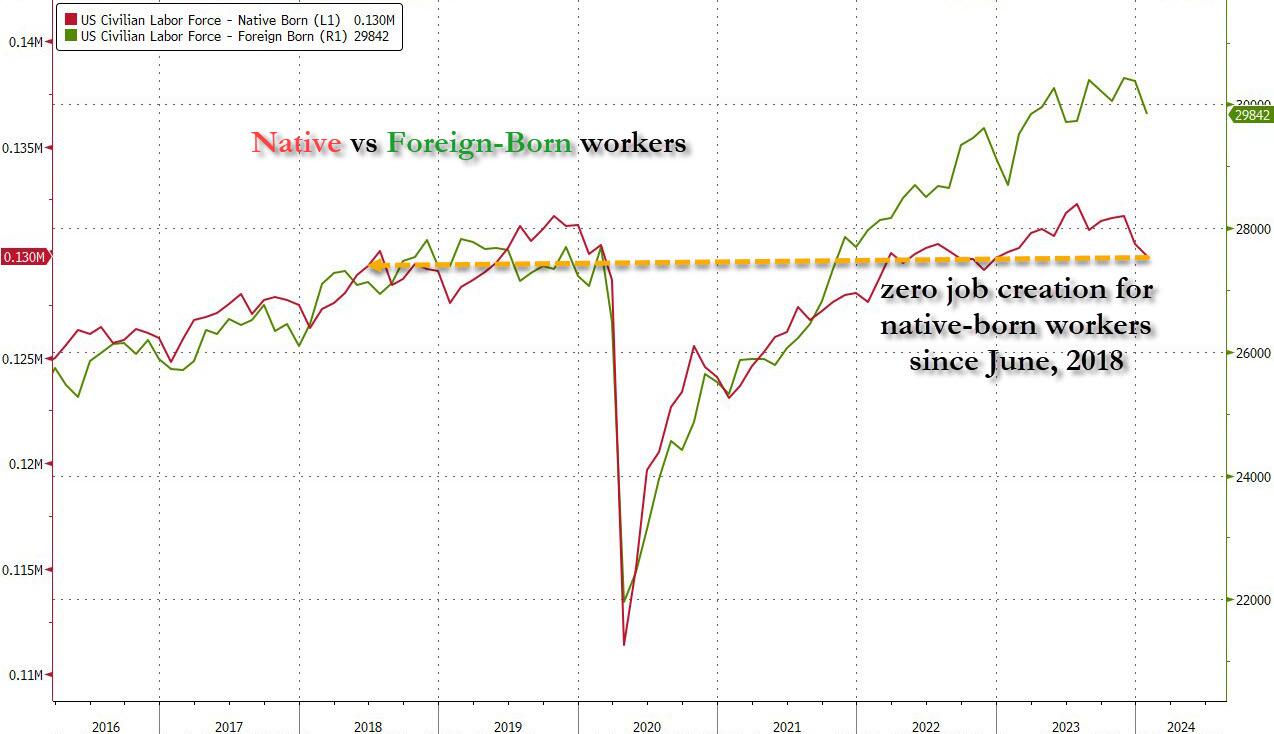
Finally, we pointed out on Friday that all the job gains since 2018 have gone to immigrants (non-native born workers)…
… and here is Powell defending them:
PELLEY: Why was immigration important?
POWELL: Because, you know, immigrants come in, and they tend to work at a rate that is at or above that for non-immigrants. Immigrants who come to the country tend to be in the workforce at a slightly higher level than native Americans do. But that’s largely because of the age difference. They tend to skew younger.
PELLEY: Why is immigration so important to the economy?
POWELL: Well, first of all, immigration policy is not the Fed’s job. The immigration policy of the United States is really important and really much under discussion right now, and that’s none of our business. We don’t set immigration policy. We don’t comment on it.
I will say, over time, though, the U.S. economy has benefited from immigration. And, frankly, just in the last, year a big part of the story of the labor market coming back into better balance is immigration returning to levels that were more typical of the pre-pandemic era.
PELLEY: The country needed the workers.
POWELL: It did. And so, that’s what’s been happening.
Translation: Immigrants (we hope he means legal immigrants here, not the flood of illegal immigrants) work hard, and Americans are lazy.
Here is the full transcript from Powell’s 60 Minutes interview.
Zelensky Visits Front Line Troops Amid Brewing Split With His Top General
President Volodymyr Zelensky visited Ukrainian troops along the frontlines of fighting with Russia on Sunday, on the southeastern front, according to Reuters. “It’s an honor to be here today. To support the warriors and award them. They face a difficult and critical mission to repel the enemy and defend Ukraine,” Zelenskyy said from the Zaporizhzhia region.
The timing of the rare battlefield visit is what is most interesting, given it comes at a moment the Ukrainian president and his commander of the armed forces, Gen. Valerii Zaluzhny, appear to be in an open conflict after Zaluzhny refused to step down.
Zaluzhny is considered to be very popular and commands great loyalty among the troops, so Zelensky could be trying to shore up morale and “test the waters” before continuing to pursue the top general’s ouster.
According to Reuters, “Two sources said on Friday that the Ukrainian government had informed the White House that it plans to fire the country’s top military commander overseeing the war against Russian occupation forces.”
Among other things Zelensky handed out medals to troops on the front lines in Zaporizhzhia. Likely the Zelensky administration fears potential mutiny if he forces Zaluzhny out of the top military post.
According to more from Reuters:
Known as “the Iron General,” Zaluzhnyi is extremely popular. His removal could hurt morale among Ukrainian troops battling to hold positions along more than 620 miles (1,000 kms) of frontlines against a vast Russian force armed with large munitions stockpiles.
Substantial rumors have persisted for days since last week, when The Economist first broke the story of Zelensky’s plans to fire Zaluzhny. Despite the denials of Ukrainian officials, the leaks keep coming, and it appears confirmed that Zaluzhny’s fate is at least up in the air as the government tries to find a path forward without unleashing division and possible rebellion.
Mykola Bielieskov, a military analyst at the National Institute for Strategic Studies, has underscored: “When there are speculations on such a sensitive topic, people want clarity.”
“And if there are major changes in the country’s military command, then they want official confirmation and an explanation of why,” he continued in comments to NBC. “Citizens clearly understand that the survival of the country and themselves depends on the relations between the highest civilian and military officials.”
In a new essay, the head of Ukraine’s armed forces, Valerii Zaluzhnyi, who is reportedly set to be fired by Zelensky, writes:
“We must acknowledge the significant advantage enjoyed by the enemy in mobilizing human resources and how that compares with the inability of state… pic.twitter.com/egHpuOsLmY
Part of the conflict stems from Zaluzhny’s willingness to criticize top decision-making when it comes to the war, whereas Zelensky and his top aides have only consistently sought to portray an optimistic as possible or rosy picture of how things are going. Zelensky has reportedly seen the general’s candid remarks as undermining the war effort and official policies. Zaluzhny also appears more open and realistic about the need for peace negotiations with Moscow.
Starting all the way back in November, Gen. Zaluzhny had been the first first top military official to paint a very negative picture of how Ukraine’s military was fairing on the battlefield. What’s more is the admission quickly caught the eye of other major publications, most notably The New York Times, which underscored at the time, “His comments marked the first time a top Ukrainian commander said the fighting had reached an impasse…”.
These Are The Most Common Types Of Cancer In The US
Cardiovascular disease remains the leading cause of death worldwide among middle-aged adults.
However, deaths from cancer are catching up in some developed countries and even though cancer deaths are declining in the U.S., incidence isn’t.
According to the American Cancer Society, the estimated number of new cases in 2024 will cross the two-million mark for the first time ever. The main types of cancer affecting men and women, however, will remain largely the same as in previous years.
In 2024, almost one third of all new cancer diagnoses in women will be breast cancer.
That number is slightly lower at 29 percent for prostate cancer in men.
Men in the U.S. will be diagnosed with lung cancer – the second most common cancer for both sexes – slightly less than women. But they are diagnosed with colorectal cancers more often, which has become the number one cause of cancer-related deaths for men below 50. While men more commonly suffer from bladder cancer, eight percent of cancer diagnoses in women are for cancer of the uterus.
Overall, the American Cancer Society estimates that more men will be diagnosed with any type of cancer than women.
It isn’t often that one title can encompass geopolitics, the economy, and markets, but “escalation and expansion” covers all three quite well this week.
I went with “Escalation and Expansion” this week, as General (ret.) Marks used the phrase on several of our calls and I thought that it captures the risk better than just “escalation.”
The conflict in the Middle East could escalate, it could expand, or it could do both. As of now, the risk of both occurring is real.
On the flip side, another phrase you are likely seeing (or hearing) more frequently is “escalate to de-escalate.” The theory is that if the U.S. escalates and flexes its military might, then Iran and the “proxies” may back down. In addition, the fear of an ongoing and strong attack phase from the U.S. is enough for the adversaries to back down. That hope could be accompanied by back-channel messaging pointing out that this was retaliation (the proverbial “eye for an eye”) and if no further provocation is given, then the U.S. can step down its efforts.
Without a doubt, the “escalate to de-escalate” strategy would be best for the U.S. and its allies, as well as markets and the global economy.
What remains to be seen, as of the time of publication, is whether that’s how Iran and/or the proxies see it. Maybe they want to challenge the U.S. further? Maybe they doubt our commitment? General (ret.) Ashley often points out a famous quote in our meetings. To paraphrase the quote (which isn’t his; he just references it) – the enemy used to respect us and fear us, but while they still respect us, they no longer fear us. That could be put to the test in the coming days.
If we see de-escalation:
Not much will happen. Shipping won’t return to normal. Maybe if there is some multinational truce reached, we could see that, but I’m not even sure how that could be done logistically with entities like Hamas or the Houthis. De-escalation is better than the alternative, but it is no panacea for global trade or the region. It would just take the region back to where it was a few weeks ago.
If we see escalation and expansion, or “retaliation for the retaliation” by Iran and/or proxies, two things will be crucially important for the impact on the economy and markets:
Does Iran’s production and sale of about 3.5mm barrels of oil a day get put in jeopardy? That number comes from sources in the energy sector who have proven right time and again, which is why I use it as my base case for Iranian production and shipments. Brent crude, the best measurement for current Middle East fears, has backed off in price terms. It is back to $77 a barrel from $83 last Friday. It was at $90 in September (before the conflict) so a price of $90 seems easily reachable if the escalation and expansion of the conflict occurs (dragging the U.S. and Iran into more direct conflict).
What does China do? While the most obvious thing to think about is oil, it makes sense to think about how China might respond.
At Academy Securities, the working assumption (based on an overall assessment from our Geopolitical Intelligence Group) is that China may have had advanced warning of Russia’s invasion of Ukraine and gave Putin “tacit” approval at the very least. Our working assumption is that China, like much of the rest of the world, was surprised by how ineffective the invasion was, and is likely unhappy that the war is ongoing. Nonetheless, they have continued to purchase Russian commodities and have not done anything publicly to demonstrate that they want Putin to end the conflict.
The events in the Middle East are very different. No one in the Geopolitical Intelligence Group thinks that China had any knowledge or forewarning of the attacks in the Middle East. China was as surprised as anyone else. While China is buying Iranian oil, there is no indication of any involvement (tacit or otherwise) in the ongoing conflict. Having said that, if we see much more of a direct U.S./Iran engagement, will it be difficult for China not to “take sides”? Will they come down hard on Iran? Boycott oil? Or will they continue “business as usual” with Iran even as the conflict escalates and expands? The take from the Geopolitical Intelligence Group is that China would come out in a way that supports global trade (i.e. against the proxies), but that is barely consensus and certainly not a universally held opinion. For what it is worth, I lean towards a “business as usual” case, but I am influenced by my own theory that we are in the early stages of a transition from “Made in China” to “Made by China” where they do not need to care as much about trade with the U.S. and even (to a lesser extent) Europe.
Whatever China does (in the event of escalation and expansion) will shape the geopolitical, political, and economic landscape for the foreseeable future!
Hopefully, it doesn’t come to the escalation and expansion case, as cooler (or more cautious) heads prevail, but if it does, China’s reaction could be more important than whatever oil does, though the two will go hand in hand to a large extent.
Escalation and Expansion – Economic
The STUNNING Job Report on Friday could signal a massive shift in how I think about the economy. Even in our instant reaction, we felt obligated to write “if it is true” because the report seemed too strong to be true. It defied some other data like the ADP report, the JOLTs quit/hire rates, etc. January is notoriously difficult to estimate the “seasonal effects” which could come into play. Unable to work due to the weather may have played havoc with the wages. I’m not the only one who seems to question the validity of the report. You can find some interesting take downs, some focus on the ongoing shift from full-time jobs to part-time jobs (published in the Household survey), and the potential over-reliance on the birth/death model.
My view is that the job report was stunning, but I’m skeptical of its veracity. Certainly, if it is an accurate representation of the job market, we may have to skip all the “landing” metaphors and call it a trampoline, or something else that propels us higher as we touch down.
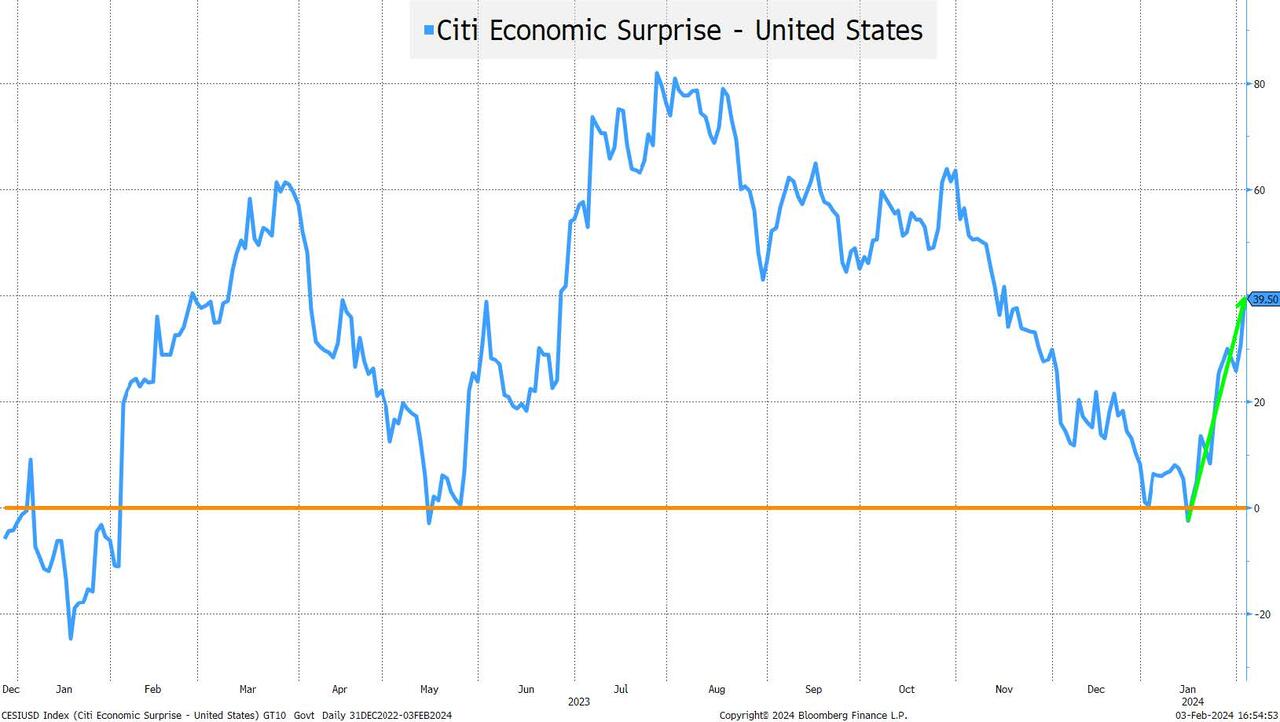
We have had some “surprising” data recently. The Citi Economic Surprise Index touched 0 in the middle of January, but a string of “surprising” data has pushed it higher!
As you will see in the chart below, that was after a steady decline in this index. The index is always fascinating because it reflects the data relative to expectations. As we start seeing a decline in the index, it is usually accompanied by analysts reducing their forecasts. The index rarely bottoms or tops out due to the absolute level of the data, it is because expectations have become too optimistic or pessimistic.
So, a chart like this tells me that we could start seeing economists ratcheting up expectations! If the data keeps outperforming, the natural reaction (certainly from a “consensus” point of view) is to increase your forecasts. That can propel markets higher as that change in sentiment in economic outlook will translate into increased bullish sentiment.
I doubted some of the “surprisingly” good data.
GDP is “old” by the time we get it.
Consumers spent.
But they used credit cards and pushed outstanding consumer credit back above trend lines, dispelling the idea that we are “just getting back to normal” on credit.
Sales seemed to be earlier and more aggressive than usual, so some of the spending may have been demand that was pulled forward, leading to disappointment in the coming weeks and months.
Jobs. If anyone believed in ADP, the Household survey, or even the JOLTs quit and hire rates, then the job market would look as blasé as I think it is.
In any case, I need to revisit all the recent data and decide if I’ve been too negative on the direction of the economy. I haven’t been super bearish on the economy by any stretch of the imagination (mild slowdown, very industry specific, and somewhat rolling/regional rather than all at once/national), but I certainly wasn’t betting on escalation and expansion!
This is the first time in months that I’ve felt the need to step back and see if I’m not giving the economy enough credit! I think that I have it right, but after the streak of surprises and a stunning (if you believe it) job report, it would be malpractice not to rethink my stance. More on that is coming up as we start the week.
Escalation and Expansion – Markets
“Magnificent” is a massive understatement of Meta’s performance on Friday. The stock added just under $200 billion to its market capitalization in a single trading session! If a trillion-dollar company jumping 20% in a day isn’t escalation, then I don’t know what is!
The Nasdaq 100 gained about 3% in 2 days! Again, that seems like “escalation” to me! Having said that, it is only up 0.7% since Thursday January 25th which is a little less eye-popping.
Unfortunately, at least for an overall perspective, we haven’t seen true “expansion.” While the S&P 500 has done a bit better than the Nasdaq 100 for the past week or so, the Russell 2000 continues to underperform and was down on the week.
If economic growth is escalating and expanding, should the stock market be too?
We got the escalation, at least in some stocks, but the expansion to a broad market rally, like we had from mid-November to mid-December last year, hasn’t really returned.
While it is impressive that a mega-cap (I think $1 trillion is mega-cap territory) can jump 20% in a day, it is also somewhat disturbing as it seems frantic (yes there were all sorts of likely reasons, from buybacks, to dividends, to internal growth, to cost cutting, etc.), but I can’t get it out of my thick skull that 20% for a widely followed company (or $200 billion) seems atypical of what you would expect in a “normal” market. Not saying to fight it, just saying it is weird.
I have not been a fan of the so-called “laggards” for some time with the exception of commodities and commodity stocks which are meandering along.
I highly recommended CRE and regional banks for much of last year, starting in April after the mini “banking crisis” created great value. That stopped again, in late December, and I cannot decide if last week’s sell-off is a great buying opportunity or not. KRE, a Regional Bank ETF, dropped over 9% from Monday’s close to Thursday’s close. Part on the Fed and part on renewed fears of the health of smaller banks.
If the recent spate of good data can be trusted, this is a buying opportunity! If problems are only manifesting themselves now as loans mature or need to be rolled over (as we are seeing in some recent announcements), then it is too early to wade back in. I continue to believe that 2024 will be the year of Work from the Office, which will support CRE in many locations. The Fed is done hiking and even if I’m right on rates (10s to 4.3% and then 4.5% with 2s versus 10s going back to positive spreads), CRE can do well. Big banks (and many of what people refer to as “regional” banks, which are also pretty darn big banks) will do well and come out not just unscathed, but also with new opportunities.
Basically, if I believed the economic data, I’d have to be pounding the table for expansion across all equities, but I cannot quite get there. Maybe I should, but I cannot, at least not today.
Bottom Line
I’m not convinced that the economy is about to take off, but I am re-evaluating that – URGENTLY!
Having said that, I still like credit. Yes spreads are tight, but I think that credit (corporate, structured, munis, etc.) should be heavily overweighted in any fixed income portfolio.
Still in the higher yield camp, but that was all over the place this past week.
I hope you enjoy the new delivery/formatting that Academy has instituted for the T-Report! It is a work in progress, but hopefully it allows you to receive and access our content more conveniently!
Denver Starts Booting Migrants From Shelters As City Nears ‘Breaking Point’
Denver, Colorado is reaching a breaking point as migrant arrivals continue to overwhelm the self-proclaimed sanctuary city.
As a result, Mayor Mike Johnston (D) suggested that the city may stop accepting more, while officials begin the process of booting them from overcrowded shelters.
“I think our city is very close to its breaking point now,” he told Fox & Friends last week. And we’ve been talking to leaders in D.C. around the country about why we need them to take action here. I think we have successfully welcomed almost 40,000 migrants in the last year and — and we know what it takes to do this successfully, we just need that help.”
Last year the city helped over 38,000 migrants. As of Friday night, 3,895 were staying in city shelters.
“That’s an incredible number of people to shelter, support, feed, help with transportation, deal with case management,” said Jon Ewing of Denver Human Services.
According to Johnston, more needs to be done to address the influx of migrants at the southern US border.
“And the things we need are — yes, we need federal dollars, but the most important thing is we need, you know, work authorization for folks when they arrive, and we need those resources at the border so you can add more security at the border and so you can help process those asylum claims so the folks that do arrive here can work,” he said.
Perhaps preventing them from entering the country in the first place is the way to go, Mike?
On Friday, Johnson told KOA news that the city is exploring options to pause taking in more people.
“We are considering it. We have to consider all options, particularly if there isn’t any help from the federal government,” he said.
Denver is clearing out migrant shelters
According to Fox31, Denver is clearing out shelters used by the migrants.
Starting on Monday, 150 migrants in city shelters will be discharged. Then that number will fluctuate between 50-100 every day until all 3,800 are out of the 10 shelters currently run by the city.
“The hope and goal is that we are able to connect the vast majority with housing, or at least as many of them as we possibly can,” Ewing said.
The number of migrants arriving in Denver is coming down — 48 arrived on Thursday and 64 on Friday, a significant drop from the beginning of January, when that number was 200-300 daily. –Fox31
“4,000 people when you have limited budget, when you have limited resources … very difficult to find enough housing as is, affordable housing as is, in the city of Denver — that’s going to be difficult,” said Ewing.
Denver is one of several Democratic strongholds across the United States which pledged maximum virtue by signaling themselves as sanctuary cities – only to be completely unprepared for the surge of migrants that followed the Biden administration’s open invitation to them on day one.
New York is facing a similar overload, as Mayor Eric Adams (D) has repeatedly called on the Biden administration to lend a hand in dealing with the migrants. The Big Apple has seen a surge of more than 160,000 asylum seekers since last year.
The continued embrace of diversity, equity and inclusion in STEM combined with a broad decline in academic standards is producing a generation of scientists who are less capable than their predecessors, warned some scientists in recent interviews with The College Fix.
From easier math classes in high school to the elimination of standardized tests to extreme grade-inflation to DEI tropes that elevate lived experiences and ways of knowing over facts and data, the trend represents a pressing problem for science professors working to protect STEM and preserve its standards and meritocracy.
Alex Small, chair of the physics and astronomy department at the California State Polytechnic University, Pomona, said it starts early in a student’s education.
“The K-12 system is walking away from standards at all levels,” he told The College Fix in a recent phone interview.
For example, he said while most of his students took some sort of calculus class their senior year of high school, “at least a third of them test into a class that’s lower than calculus because what happens is the schools will push people through the pipeline.”
“Even if someone hasn’t mastered algebra, they’ll get some sort of generous grade in their prerequisite math classes and then be put into calculus their senior year,” he said.
Similar trends concerning the inability of college students to do high school math have been reported nationally post-COVID, with educators lamenting how incoming freshmen no longer can be expected to know how to add fractions or subtract a positive number from a negative number.
Yi-Zen Chu, an associate professor of physics at the National Central University in Taiwan, who was educated in the U.S. and has been a harsh critic of DEI, stated in a recent email to The Fix that he believes practices such as “grade inflation and lowering the bar” contribute to the lack of preparation exhibited by American college students.
The concern circles back to the “‘everyone gets a prize’ philosophy that has been around for quite a while now,” he said, referring to what’s sometimes called the “Participation Trophy” phenomenon.
Chu suggested one way to combat these practices at the college level “is to staunchly defend the use of standardized tests like the SAT.”
“Students have to compete on the same test to prove their ability relative to others,” he said. “This way, schools know that hyper-grade-inflation will only count against the integrity of the school in the medium/long run.”
Small said what these students need is supplemental instruction, time, extra problem solving sessions, and extra practice.
“There’s no such thing as too much practice, and that’s especially true when you haven’t yet had enough practice,” said Small.
However, although some educators and institutions have embraced remedial summer programs and additional tutoring services, others work toward ideological goals related to DEI that ultimately may prove detrimental to students, as well as the field of physics more broadly.
Lawrence Krauss, one of the world’s leading theoretical physicists, noted in a 2022 interview with The College Fix, “I have written many articles about the absolutely ludicrous ways in which DEI is … enforcing ridiculous notions about both keeping people out of physics who should be in, and trying to interfere with meritocracy and interfere [with] and take over the appointment process so that merit isn’t the crucial factor.”
Small, in a November 2023 article published by Heterodox STEM,discussed the column “Just Physics?” It appears in the physics education journal The Physics Teacher and regularly features discussions from different physics educators exploring alternative pedagogies and the place of DEI in physics education.
Highlighting one recent article, Small wrote in his critique that it “focused on the putative anti-Blackness of the physics community” but offered little in terms of what “changes can or should be implemented” beyond spending “more time in physics class discussing social issues.”
In December, The College Fix reached out to Deepak Iyer, one of the co-editors of “Just Physics?” for comment. Iyer replied he would need to get approval from his editor-in-chief before formally responding. On Jan. 24, Iyer notified The Fix he had still not received a response.
“Some sort of discussion of wider social issues…in moderate doses has its place,” Small told The Fix. “Oppenheimer got a lot of people asking questions again about one of the sort of pivotal moments of the American physics community.”
“If DEI is brought in just as an occasional discussion topic that doesn’t really crowd out the fundamentals, then I don’t have a fundamental objection to it,” he added.
However, Small said, when too much time is spent discussing social issues in physics classes, the fundamentals get crowded out, which, as he pointed out in his Heterodox STEM article, could “hurt students with weak prior preparation, as they need even more focus on fundamentals.”
Peter McCullough of the physics and astronomy department at Johns Hopkins argues there are times when discussions of DEI topics in STEM may be called for or even beneficial.
In the comments section of Small’s article, McCullough highlighted issues with fingertip pulse oximeters, describing the devices as “a technology that works better on lighter skin than darker skin.”
In an email to The College Fix, McCullough also noted claims that some facial recognition programs have difficulty in accurately identifying black faces or recognizing them as faces at all. According to McCullough, such examples might get students thinking about unintended effects of different technologies on society.
Yet, Small noted, a certain number of instructors spending too much time discussing DEI in physics class is not the biggest threat posed by DEI to physics education.
“Where DEI really comes into a lot of discussion among physics educators,” said Small, “is in discussions about standards.”
“It’s not really … so much a discussion of ‘Oh, should we talk about representation during class time’ and more about what can we reasonably expect and if a student can’t meet the standard, is it unfair of us to nonetheless insist on that standard,” he said. “And that’s a much more complicated and dangerous discussion, because … it just perpetuates under preparation.”
Bankruptcy is a developing twenty-first century theme in America. We see bankruptcy in federal government policy and spending, many corporate boardroom decisions, nonprofit and religious groups’ overspending and arrogance, individuals, some United States cities and counties, and the territory of Puerto Rico. The federal bankruptcy law consisting of Chapters 7, 9, 11, and 13 allow bankruptcy filings for local governments, individuals, nonprofit groups, and for-profit businesses, but it does not allow bankruptcy filings for states and the federal government.
A few states are facing the reality of defaulting on their issued bond debt obligation payments and loan payments to lenders. These states are seeing current and future tax revenues decreases, net population losses, fewer private businesses, increased progressive welfare spending, and long-term underfunded public pension systems. US states are not allowed by federal law to print money to finance spending.
States declaring bankruptcy are not without precedent. The Panic of 1837 lead to several states defaulting on canal and railway debt payments in 1841. Passage of the Fourteenth Amendment to the US Constitution under section 4 required some states to declare bankruptcy after the Civil War.
Arkansas defaulted on highway bond payments in 1933 in the fourth year of the Great Depression. Tax revenues plummeted. It ran out of cash and stopped payments on all its highway bonds. The state attempted to invoke its sovereign immunity and impose losses on bondholders against their will. The approach failed. This history, described in an October 2017 Federal Reserve Bank of Cleveland report, may serve as a historical benchmark for future state bankruptcies and bond payment defaults. It appears to be the only state default after Reconstruction ended in 1877.
Standard and Poor’s (S&P) listed its bond ratings of all fifty states from 2004 to 2017. Coronavirus state spending since 2020 has made the bond ratings of some states more tenuous. No state has a junk bond rating, though Illinois is the lowest rated at BBB−, followed by New Jersey at A−. S&P bond ratings go from AAA being the highest to D the lowest. S&P analysts add a plus or minus sign to the bond rating letter grade. A junk bond rating is the low probability of that state reliably meeting future bond payments, and it must sell the bond at a higher interest rate in order to attract an investor.
Illinois and New Jersey are examples of a future state bankruptcy or default on a future bond debt obligation payment. California budget deficits under Governor Gavin Newsom are proliferating as part of the spending trend. Financial press coverage of these states’ financial problems is available. New York, Connecticut, Michigan, and other states are heading to future defaults and possible bankruptcy unless budget and policy reform is enacted.
This article cannot predict how a state’s future bond debt default would play out. Payment default negotiations between that state’s revenue officials and bondholders could take place without federal bureaucrat oversight given bankruptcy silence in federal law. The bondholders and lenders will take a loss and place substantive requirements on that state to cut spending and reform its laws and policies as part of the default settlement.
The undisciplined state spending spree will be addressed through payment default or bankruptcy resulting from inescapable economic realities. This bottoming out could begin the healing process for that state’s citizens through realistic laws, policies, budgets, and tax revenue realities. This is uncharted territory, and we should not be surprised by past poor state political and budgeting choices.
One irony is that twelve US states have bond ratings from three private bond rating agencies higher than the federal government as of August 2023. Many of these states have balanced budget laws that prohibit deficit spending, and some states limit annual spending increases from a set of requirements. Stay tuned for the American twenty-first century bankruptcy shows to continue.