Iran Rocked By Overnight Terror Attacks As Gunmen Leave 11 Dead, Including IRGC Officer

Iran Rocked By Overnight Terror Attacks As Gunmen Leave 11 Dead, Including IRGC Officer

A series of terror attacks rocked Iran overnight involving gunmen in several locations storming military and police stations, which left at least eleven security service members dead. It happened in the country’s restive border province which sits near Afghanistan and Pakistan.

State media detailed on Thursday that at least 16 suspected Sunni militants were killed during the assaults, which took place in the towns of Chabahar and Rask in Sistan-Baluchestan. “The terrorists failed to succeed achieving their goal of seizing the Guards headquarters in Chabahar and Rask,” deputy Interior Minister Majid Mirahmadi announced.

Prior Iranian retaliatory attack aftermath on Baloch separatist locations. Via Business Today

The region also saw ten additional security personnel injured and wounded. The attacks are being widely blamed on Jaish al-Adl (“Army of Justice”), which is a Sunni Baluch separatist organization operating mainly in southeastern Iran.

Among the slain Iranian personnel was an IRGC officer as well as a Basij paramilitary force member, according to Iranian official IRNA news agency.

The attack reportedly went on for many hours, with some reports saying it lasted all night into morning, at well over 12 hours in total before the situation was stabilized. Images of pitched battles in the middle of city streets were posted to social media.

According to a description of the lengthy attack by an Al Jazeera correspondent:

Gunmen stormed various security and military compounds simultaneously… and they also had suicide vests on,” Jabbari said, adding that the fighting continued for several hours.

“The terrorists failed to succeed in achieving their goal of seizing the Guards headquarters in Chabahar and Rask,” Deputy Interior Minister Majid Mirahmadi told state TV.

Jaish al-Adl has conducted dozens of similar such attacks in the last number of years against Iranian military forces, particularly the IRGC. This has even included abductions of border guards and setting off bombs in civilian areas.

Baluch separatists have also been wreaking havoc incise of Pakistan of late, targeting especially Chinese infrastructural projects and investments.

But these latest overnight attacks come at a sensitive moment that all of Iran is already on edge over the ratcheting de facto state of war with Israel, following the Monday Israeli airstrikes on the Iranian embassy complex in Damascus. In the past, Tehran has suspected that destabilizing militant terror attacks inside Iran could have had the hidden hand of Mossad behind it, however in the case of restive Sistan-Baluchestan province, the problems there are historic and long-running.

Tyler Durden
Thu, 04/04/2024 – 10:45

via ZeroHedge News https://ift.tt/Abkgwov Tyler Durden

“Urban Doom Loop” Of Vacant Offices: How Far Will It Go?

“Urban Doom Loop” Of Vacant Offices: How Far Will It Go?

Via SchiffGold.com,

Even the mainstream is starting to acknowledge the massive problem of vacant office buildings littering American cities, slowly turning them into post-Covid wastelands. While a few pundits are claiming (in somewhat Orwellian fashion) that the surge in empty commercial real estate is actually a chance for a utopian turnaround in the ashes of Covid weirdness, the potential for an “Urban Doop Loop” triggered by CRE is now being widely acknowledged as a possible trigger for a broader economic meltdown.

With a pre-existing problem amplified drastically by COVID-19 and then set in stone, the rising office vacancy rate has no real solution. The problem is slowly and steadily getting worse, becoming a “new normal” that simply can’t go on forever without further economic repercussions. And this time is distinct from other major downturns in that during previous shocks, like 9/11 and the 2008 financial crisis, everyone more or less agreed that eventually, things would pick back up again. This time, it’s permanent.

Take just a few examples:

New York — There’s a new record for office vacancies in Manhattan, which have risen above 17%, and show no signs of slowing down. Vacancies have grown 70% in Manhattan since Covid (growing 20% nationally in the same period), with the Financial District hardest hit.

Pittsburgh — Currently sitting above 20% vacant, or 27% if you factor in subleases, it’s estimated that nearly half of the city’s commercial real estate could be empty within four years. If not reversed, a local crisis (at the very least) seems all but assured.

Portland — With the highest office vacancy rate in the nation — a mind-melting 30% or more — Portland officials are offering desperate pleas in the form of tax credits and other incentives to fill its deserted commercial buildings.

Los Angeles — Demand is so low for commercial real estate that, in one case, developers abandoned plans to build a shiny new 61-story office tower in place of an empty commercial building. Instead, they demolished it and installed a handful of EV charging stations.

There’s no great solution. Most cities are floating quixotic proposals to turn empty offices into apartments to “fix” the crisis, but this is often too expensive to be practical and requires navigating lots of bureaucratic red tape, like changes to zoning laws.

Recognizing how dependent their cities are on property taxes harvested from commercial real estate, getting municipal governments to change zoning laws actually might be the easiest part. Vacant office buildings equate to plummeting revenue, forcing cities to make up the loss by increasing taxes elsewhere or reducing spending.

For one, New York City’s commercial real estate accounts for 20% of the property tax and 10% of overall revenue, with the city comptroller projecting a $1.1 billion shortfall from vacant offices in 2024. In Boston, property taxes on office buildings comprise a staggering 22% of total revenue.

Even the most optimistic, desperately trying to see this crisis as an “opportunity” to start fresh, are being forced to acknowledge the challenges. But turning commercial spaces into residential ones and hoping for the best is one of the only few “Hail Mary” options cities have left to avoid a further implosion that bleeds into the banking sector and sets off a chain reaction.

For the hopeful, such as Dana Lind of the Penn Institute for Urban Research, the buyer’s market in big cities provides a golden opportunity that was missed during the 2008 crisis. She hopes local buyers will use these empty buildings to invigorate cities by serving local needs, or that the empty offices will be bought by cities themselves and turned into vibrant community centers:

“Smart investors see what is happening in American downtowns four years out from the onset of the pandemic—the business fundamentals of cities like New York, Boston, or Houston are relatively stable and could even dramatically improve. Why not buy?”

Sure, fundamentals could improve. But will they? She goes on to say:

“As commercial properties fall into foreclosure in 2024, cities could take steps to better shape the city they want in the future by actually investing in those properties themselves.”

It all sounds lovely. Unfortunately, I’m less confident the CRE crisis can be contained this way, and that it won’t contribute to a broader meltdown.

Empty offices mean fewer people visiting the surrounding stores and restaurants. As the economic damage begins to snowball, the domino effect eventually reaches the banking sector, especially smaller and mid-size banks — and thus, the “Doom Loop” takes form. If we are to take the recent failure of regional firms like New York Community Bancorp as evidence, this vicious spiral may already be beginning.

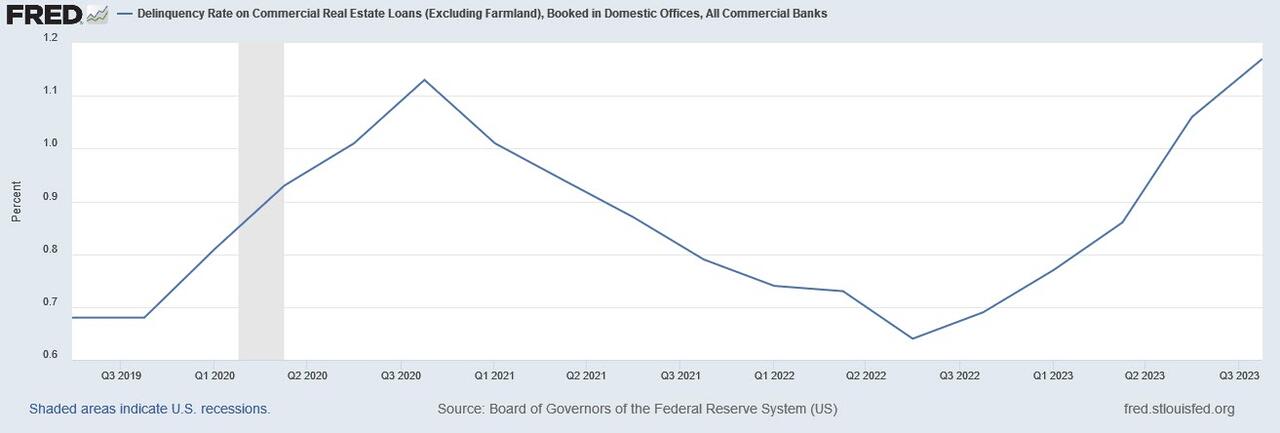
CBS reported in January that office loan delinquencies were up a shocking four times compared to the previous year. In under two years, commercial real estate loans totaling $1.5 trillion are due to expire, portending disaster for the economy when the bill comes due and office owners can’t pay it. According to data from the St. Louis Fed, delinquency rates on commercial real estate loans have already ticked above their Covid peak:

Occupancy Rate on CRE Loans (Excluding Farmland), Booked in Domestic Offices, Q3 2019 to Q3 2023

In an industry that lives and dies by interest rates, the problem provides another powerful source of pressure on the Fed to cut rates this year, boosting the bottom line for commercial landlords and developers who are being squeezed by a high cost of borrowing and already scrambling to change the terms of their debt.

A recent Moody’s podcast offers a glimmer of hope that there are enough factors to offset the challenges of CRE delinquencies. But with the rate cuts that the market hoped for last year now expected to be much less significant, will put further stress on a CRE market that’s addicted to rock-bottom borrowing costs. If the Fed cuts rates too low, inflation will spiral out of control, but keep them too high, and other things (like CRE) will continue to bend and break.

Tyler Durden
Thu, 04/04/2024 – 10:25

via ZeroHedge News https://ift.tt/mnT0Evz Tyler Durden

Bond Market’s Eerie Calm Belies Bigger Move On Way

Bond Market’s Eerie Calm Belies Bigger Move On Way

Authored by Simon White, Bloomberg macro strategist,

Volatility in US interest rate and bond markets is poised to move much higher as it re-attaches to underlying fundamentals. That means higher rates and greater stock volatility, leaving especially high-duration sectors such as tech exposed to underperformance and potential downside.

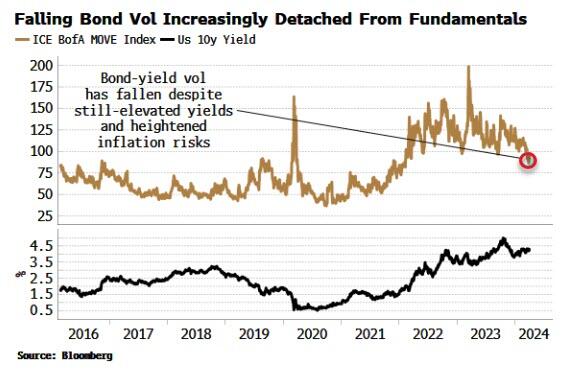
There is something of a preternatural calm to bond markets at the moment. Despite upside growth and inflation risks bubbling up, bond volatility has been in a downward trend for the past six months. It remains much lower than the highs it reached in 2022, and the spasm that was the SVB crisis in 2023.

But there are mounting signs that this won’t last, and we should soon see larger moves in yields again with an upward bias. That also means the currently-depressed VIX is poised to move higher. After a recess, volatility is coming back.

Low or falling volatility often precedes big moves. If you need an example, consider gold and silver. Their volatility fell to multi-year lows in February, ahead of both metals surging higher in recent days.

The MOVE index is the bond equivalent of the VIX. It uses a range of options on interest-rate swaps of different maturities to gauge the average level of rate volatility. As with the VIX, it was very low in the early years of the pandemic as the Federal Reserve pulled out all the stops to avert an economic calamity.

But unlike the VIX, the MOVE rose sharply as the Fed began to raise rates at a faster clip than it had done for decades, before cresting amid the turbulence of SVB’s collapse. Since then it has steadily fallen – yet this is increasingly at odds with the underlying risks.

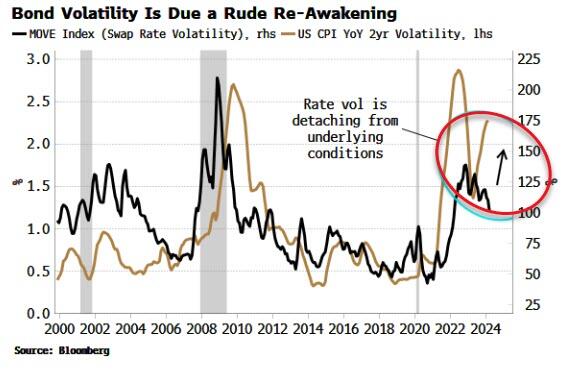
Most focus has been on slowing inflation, but inflation volatility is telling a different story. It’s the variability in inflation as much as its level that’s a problem for bond volatility. Inflation’s volatility, after dipping, is rising strongly again. The MOVE is soon likely to correct higher to reflect rising inflation uncertainty.

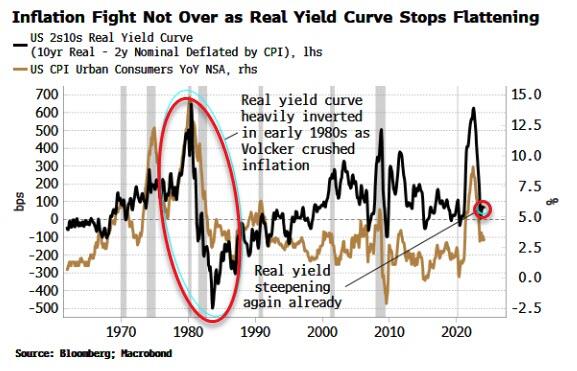
The disconnect is not confined to inflation volatility. The real yield curve, which typically flattens as inflation falls, has stopped flattening, and signally failed to invert as it did in the early 1980s when Volcker unambiguously snuffed out inflation by jacking real rates considerably higher.

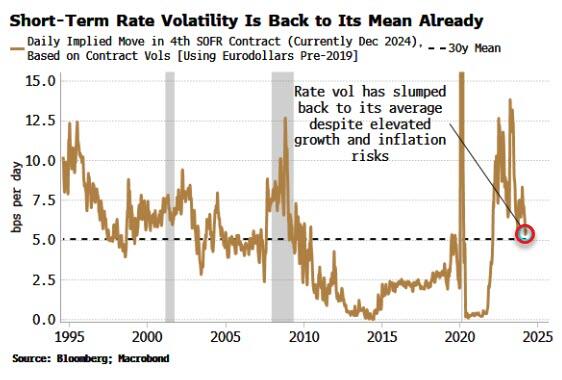
Yet despite today’s latent inflation risks, implied short-term rate volatility has declined rapidly back to its long-term average. The fourth generic SOFR contract (currently December 2024 expiry) is implying a daily move of only 5-6 bps in short-term rates, from more than 12 bps just last year.

That’s still much higher than the post-GFC QE era, but a more fitting comparison is the 1990s and 2000s when five bps a day was the normal daily move. Even so, with higher upside inflation risks today than back then, a five-bps implied move in short-term rates is a floor not a ceiling.

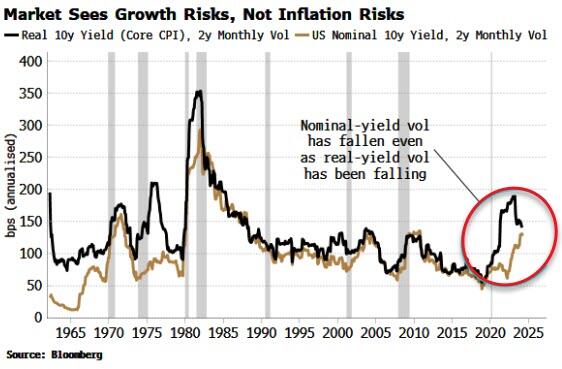
Bonds face inflation as well as upside growth risks, but markets appear to be more worried about the second than the first. Implied bond volatility might be falling, but realized volatility in nominal 10-year yields has been rising. Until early last year, volatility in real yields was also rising, but since then it has been falling.

This suggests a market expectant of upside growth risks (as leading data has been projecting, and the recent better-than-expected manufacturing ISM was a timely reminder of), but exceedingly relaxed about risks from inflation.

Yet with inflation risks rising, not falling, real-yield vol will soon rise, reinforcing nominal-yield volatility (indeed TIPS volatility and skew may be early indicators of impending stress).

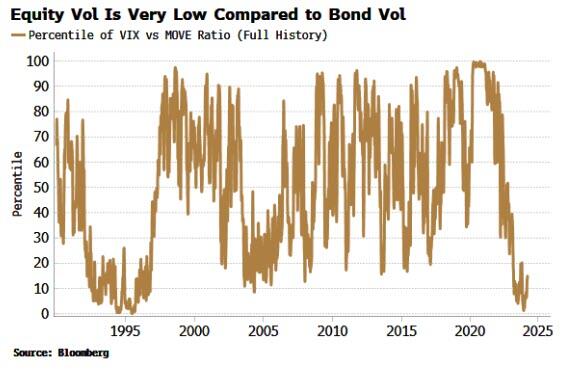
That won’t be the end of it though. While the MOVE has fallen, the VIX is considerably lower on a relative basis. Going back over the last 35 years, the VIX versus MOVE ratio has only been lower 15% of the time. That will change when bond vol rises.

But what is the actual mechanism by which higher rate volatility – not necessarily higher rates – boosts stock-market volatility? In this cycle, certainly, that role is likely to be filled by equity-index correlation.

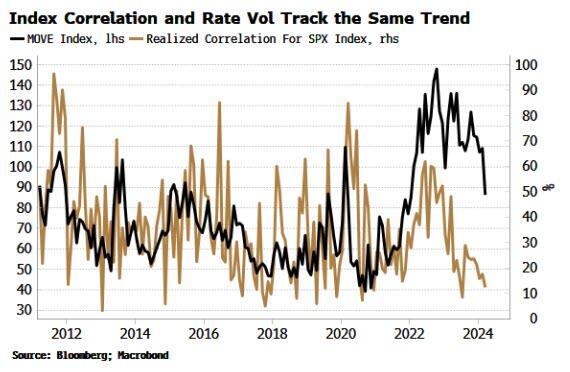
Index correlation has been driven lower by index concentration (the Magnificent Seven effect) and by falling volatility in rates markets. But correlation is now so low it can only really go in one direction, and do so abruptly. It’s the muted correlation between stocks that’s been keeping the VIX low despite the volatility of many single stocks being quite elevated.

Stock-market correlation and bond volatility typically move together, as stocks’ valuations change more as the variance in rates rises. As the chart below shows, the central trends of the MOVE index and index correlation are closely aligned, ex the monthly up-and-down noise in the latter.

Thus a rise in bond volatility would lead to a rising index correlation, which would very quickly translate into a higher VIX.

Higher equity vol would be destabilizing for the stock market. While it may not lead immediately to a broad selloff, in an environment of rising inflation risks high-duration sectors such as tech are prone to underperformance.

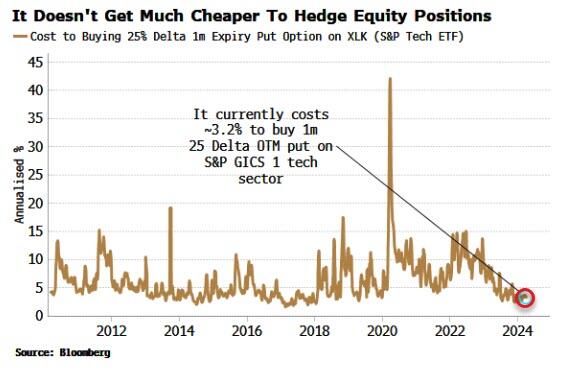
Fortunately, though, stock hedges are still cheap. For example, a 25 delta (~4% out-of-the-money) put option on the XLK tech sector ETF with a one-month expiry costs about 3.2% on an annualized basis. That’s about as cheap as it gets.

“Let no man claim he has got through the perils of winter till at least the 7th of May”, counseled the writer Anthony Trollope. It may be April, but the perils are not over for the bond – or equity – markets, and may in fact just be getting started.

Tyler Durden
Thu, 04/04/2024 – 09:45

via ZeroHedge News https://ift.tt/jWf2RNC Tyler Durden

Supreme Court Considers Hawaiian Climate Change Lawsuit That Could Destroy Energy Industry

Supreme Court Considers Hawaiian Climate Change Lawsuit That Could Destroy Energy Industry

We’re all familiar with progressive gun control groups and their lawsuits against the firearms industry – The basic premise being that gun manufacturers should be held liable when their products are used in the commission of a crime.  Such litigation is designed to destroy entire industries financially rather than politically.  In other words, if Democrats can’t change the law and they can’t change the minds of the public about 2nd Amendment rights, then they will try to force change by crippling the companies that make the guns they don’t like.

The legal argument is absurd because it requires courts to assume business liability based on the misuse of their products.  If someone uses a Toyota truck as a getaway vehicle during a robbery, does Toyota share in the liability of that robbery?  What if the plaintiffs couldn’t even prove they were robbed, or that a Toyota truck was involved?  What if the entire robbery is based on a theory backed by zero concrete evidence?  Should Toyota be made to pay billions or shut down operations to appease victims that cannot show they were victimized? 

The answer is no, of course not, but that’s not how the Supreme Court of Hawaii sees the issue when it comes to climate change.

In 2020, the city of Honolulu sued several major fossil fuel companies, including Exxon and Chevron, claiming the companies’ products cause greenhouse gas emissions and global warming without warning consumers about the risks.  The city employed a series of state laws including public nuisance and trespass measures and said the companies should pay billions to the state to abate the effects of climate change like weather events, sea level rise, heat waves, flooding and global warming. 

The success of the Hawaiian suit would set a precedent for Democrat run states across the nation, allowing them to essentially overwhelm energy companies with lawsuits until they are forced to accept Green New Deal-like parameters and apply them in every state in the US.  Meaning, it won’t matter if conservative states oppose the measures, they would be applied anyway. 

The cost to the American public would be devastating, increasing energy expenses to levels that would make domestic manufacturing impossible and decreasing quality of life for the average citizen for decades to come.

Energy companies appealed to the Hawaii Supreme Court, arguing federal law prevents individual states from effectively shaping energy policies for all states.  But that court disagreed and ruled that the case should advance to trial.  At least 20 conservative states have opposed the furtherance of the Honolulu case and have asked the US Supreme Court to step in.  The court is considering the case now, but if they refuse to intervene the implications for energy policy and inflation across America will be sweeping.  

It should be noted that there is zero substantiated proof of a causational relationship between the oil industry, carbon emissions and global warming.  All scientific evidence is based on correlation and assumption.  There is also no proof whatsoever that “man-made climate change” has any effect on global weather patterns and “bad weather.”  

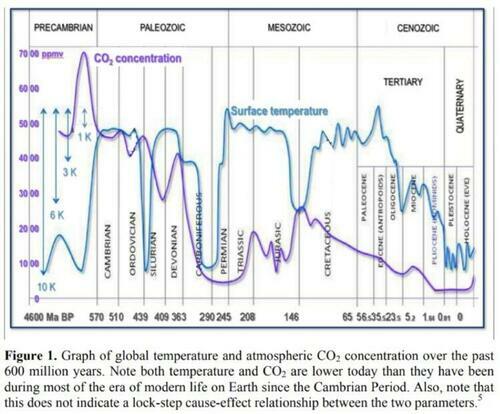
CO2 levels are actually far lower today than they have been for the majority of the Earth’s history.  Temperatures also deviate from CO2 levels constantly.


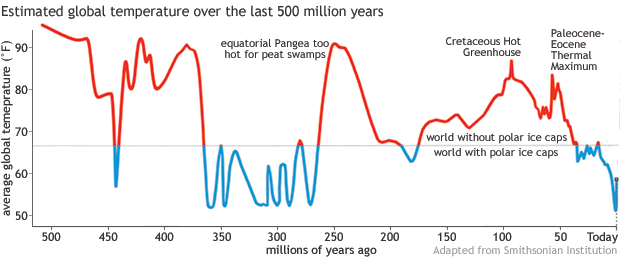
Beyond the lack of relationship between CO2 and temps in the past, global temps for hundreds of millions of years rose and fell without any human influence.  The Earth has been far warmer than today, all without any input from oil based energy and human activity.

The climate change agenda is a farce based on faulty assumptions and faulty science.  How can any serious court hold a company liable for the commission of a crime that doesn’t exist? 

Tyler Durden
Thu, 04/04/2024 – 09:25

via ZeroHedge News https://ift.tt/5bVuRkm Tyler Durden

15 Year Study: Vast Majority Of Children Grow Out Of Gender Confusion

15 Year Study: Vast Majority Of Children Grow Out Of Gender Confusion

Authored by Steve Watson via Modernity.news,

A landmark study conducted over the past 15 years has concluded that most children who experience confusion regarding their gender identity grow out of it and go on to feel content with their lives as men and women.

The study, carried out in the Netherlands by researchers from the University of Groningen, involved more than 2,700 children, tracking them from age 11 to their mid-twenties.

The Daily Mail reports that every three years, the individuals were asked how they felt about their gender.

At the beginning of the study, around 11 percent, or one in ten of the children, expressed ‘gender non-contentedness’.

However, by the age of 25, just 4 percent, or one in 25, said they ‘often’ or ‘sometimes’ felt discontent with their gender.

The study comes as the controversy over allowing children to be given puberty blocking hormones, or even gender reassignment surgery, rages on.

The researchers noted, “The results of the current study might help adolescents to realise that it is normal to have some doubts about one’s identity and one’s gender identity during this age period and that this is also relatively common.”

Published in the journal Archives of Sexual Behavior, the study found that around 19 percent became more content with their gender over 15 years, while just 2 percent became less comfortable. Overall, 78 percent felt the same.

The authors further noted that “Gender non-contentedness, while being relatively common during early adolescence, in general decreases with age and appears to be associated with a poorer self-concept and mental health throughout development.”

Patrick Brown, a fellow at the conservative Ethics and Public Policy Center noted “This study provides even more reason to be skeptical towards aggressive steps to facilitate gender transition in childhood and adolescence.”

Brown added, “The fact that rates of satisfaction are lower even just a few years later suggests that for the vast majority of people, prudence and caution, rather than a rush towards permanent surgeries or hormone therapies, will be the best approach for teenagers struggling to make sense of the world and their place in it.”

A recent report by health data analytics firm Definitive Healthcare revealed that the rate of gender dysphoria increased in every state in America except South Dakota from 2018 to 2022 across all ages. 

In some states it has increased by over 200 percent in just four years.

Since 2014, there has been an explosion in young adults identifying as transgender:

This has gone hand in hand with a massive increase in transgender surgeries and so called ‘gender affirming care’.

*  *  *

Your support is crucial in helping us defeat mass censorship. Please consider donating via Locals or check out our unique merch. Follow us on X @ModernityNews.

Tyler Durden
Thu, 04/04/2024 – 09:05

via ZeroHedge News https://ift.tt/emcgbBo Tyler Durden

Ulta Shares Tumble On Beauty Slowdown As Consumers Pull Back  

Ulta Shares Tumble On Beauty Slowdown As Consumers Pull Back  

Shares of Ulta Beauty plunged 15% on Wednesday, the largest daily decline since March 2020, after the company warned investors at the JPMorgan Chase & Co. conference that first-quarter demand for beauty products cooled. 

“We have seen a slowdown in the total category,” CEO Dave Kimbell told investors. 

Kimbell continued, “We came into the year—and we talked about this on our [earnings] call a few weeks ago—expecting the category to moderate. It has [had] several years of strong growth, as I said. We did not anticipate it would continue at the rate that it’s been growing.”

He predicts first-quarter comparable sales at the lower end of the low-single-digit growth range than previously forecasted for the first half of this fiscal year. He noted the company lost market share in the prestige makeup and hair category.

Kimbell said the slowdown is a ” bit earlier and a bit bigger” than previously anticipated and pointed to high credit card debt and student loan payments as some of the financial pressures on consumers. 

Responding to the CEO’s comments, Oppenheimer analyst Rupesh Parikh wrote in a note to clients that his team is “surprised by the moderation, and, at this point, are unclear whether this represents just a shorter-term blip.” 

Investors dumped Ulta shares in New York on Wednesday, closing the session down 15%, the largest intraday loss since March 2020. 

Ulta’s plunge sent beauty stocks tumbling: Estee Lauder Cos dropped 4%, Coty -6%, and Elf Beauty -12%.

Beauty products have been one of the hottest retail categories over the last several years. But the Federal Reserve’s hiking cycle is squeezing debt-saddled consumers – and now higher for longer has forced low-tier consumers to quit. 

Last month, restaurant group Darden Restaurants warned about a slowdown in sales across its eight brands: Olive Garden, LongHorn Steakhouse, Cheddar’s, Yard House, Ruth’s Chris, The Capital Grille, Seasons 52, Bahama Breeze, and Eddie V’s. It said consumers with incomes under $75k were reducing spending. 

Also, discount retailer Dollar Tree offered a dismal outlook in the first quarter when it said average spending at its stores fell. 

The consumer slowdown is set to broaden with gasoline prices at the pump surging

The continued squeeze on the consumer is bad news for the Biden administration ahead of the presidential elections in November. Furthermore, the failure of Bidenomics is showing up at the polls among Gen Zers who revolt against Democrats because nothing in the economy is affordable. 

Tyler Durden
Thu, 04/04/2024 – 08:45

via ZeroHedge News https://ift.tt/KiR9aoy Tyler Durden

Jobless Claims: Spot The Odd (Government-Supplied) One Out

Jobless Claims: Spot The Odd (Government-Supplied) One Out

In the real world labor market, 2024 has been a shitshow of layoffs…

1. Everybuddy: 100% of workforce
2. Wisense: 100% of workforce
3. CodeSee: 100% of workforce
4. Twig: 100% of workforce
5. Twitch: 35% of workforce
6. Roomba: 31% of workforce
7. Bumble: 30% of workforce
8. Farfetch: 25% of workforce
9. Away: 25% of workforce
10. Hasbro: 20% of workforce
11. LA Times: 20% of workforce
12. Wint Wealth: 20% of workforce
13. Finder: 17% of workforce
14. Spotify: 17% of workforce
15. Buzzfeed: 16% of workforce
16. Levi’s: 15% of workforce
17. Xerox: 15% of workforce
18. Qualtrics: 14% of workforce
19. Wayfair: 13% of workforce
20. Duolingo: 10% of workforce
21. Rivian: 10% of workforce
22. Washington Post: 10% of workforce
23. Snap: 10% of workforce
24. eBay: 9% of workforce
25. Sony Interactive: 8% of workforce
26. Expedia: 8% of workforce
27. Business Insider: 8% of workforce
28. Instacart: 7% of workforce
29. Paypal: 7% of workforce
30. Okta: 7% of workforce
31. Charles Schwab: 6% of workforce
32. Docusign: 6% of workforce
33. Riskified: 6% of workforce
34. EA: 5% of workforce
35. Motional: 5% of workforce
36. Mozilla: 5% of workforce
37. Vacasa: 5% of workforce
38. CISCO: 5% of workforce
39. UPS: 2% of workforce
40. Nike: 2% of workforce
41. Blackrock: 3% of workforce
42. Paramount: 3% of workforce
43. Citigroup: 20,000 employees
44. ThyssenKrupp: 5,000 employees
45. Best Buy: 3,500 employees
46. Barry Callebaut: 2,500 employees
47. Outback Steakhouse: 1,000
48. Northrop Grumman: 1,000 employees
49. Pixar: 1,300 employees
50. Perrigo: 500 employees

But, according to the government-supplied data…

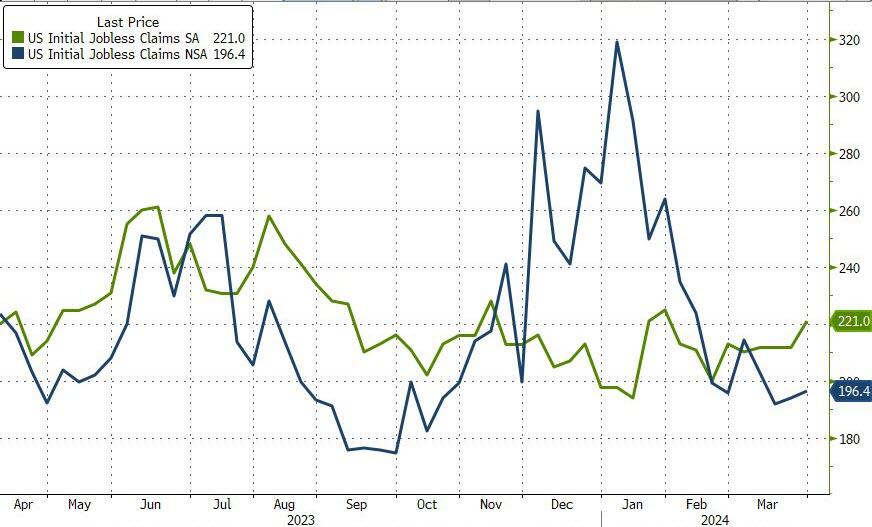
The number of Americans filing for jobless benefits for the first time last week rose from 212k to 221k (SA) to its highest since Jan, and claims ticked modestly higher on an NSA basis

Source: Bloomberg

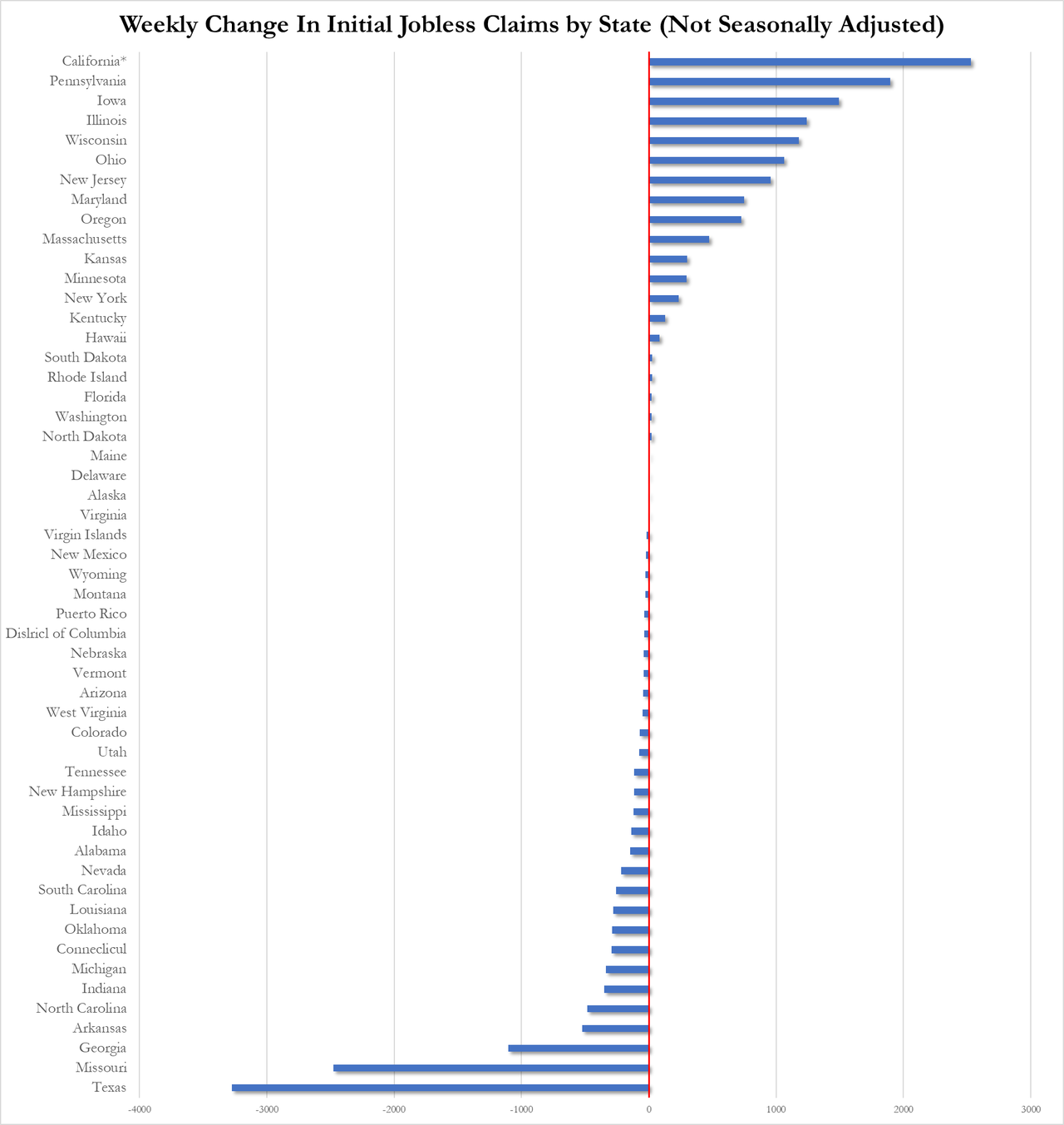
Texas and Missourri saw thelargest declines in claims while California (which was estimated) and Pennsylvania saw the largest rise…

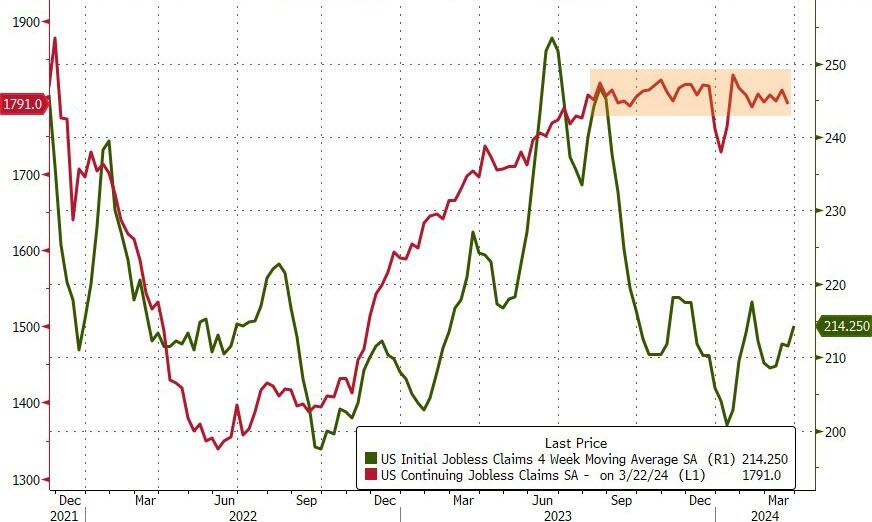
Continuing claims remain glued around 1.8mm Americans – where they have been for nine months…

Source: Bloomberg

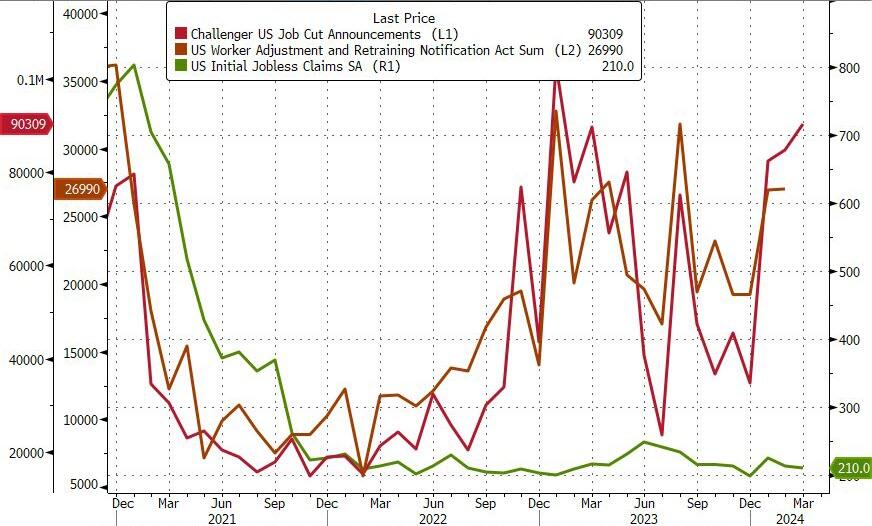
But, here’s the thing… WARNs are soaring… and Challenger-Grey just announced that March saw the most job cuts (90,309) since January 2023…but government-supplied data on initial jobless claims continues to smoothly tick along near record lows…

Source: Bloomberg

Can you spot the odd (government-supplied) one out?

Of course, we know the solution…

Ah, Bidenomics!!

If Trump wins in November, will all this data suddenly be ‘allowed’ to reflect reality?

Tyler Durden
Thu, 04/04/2024 – 08:35

via ZeroHedge News https://ift.tt/fzPCcyv Tyler Durden

Futures Rebound After Powell Reassures On Rate Cuts

Futures Rebound After Powell Reassures On Rate Cuts

US equity futures are higher with both Tech and small-caps outperforming, while the dollar is lower even as yields are higher from Wednesday’s close. As of 7:50am, S&P futures were 0.3% higher and Nasdaq futs rose 0.4%, boosted by Powell’s comments that recent inflation figures did not “materially change” the overall picture while the latest ISM Services print was far less inflationary than the ISM Manufacturing print, in fact bizarrely so. In Europe, major markets are also all higher as part of a global risk-on tone.  Bond yields are +1-2 bps, even as Bloomberg’s dollar index extended its slide for a third day, following its biggest one-day fall in nearly four weeks.  In commodities, energy is a tad lower with Brent trading just below $90, metals are mixed, and Ags are stronger; copper – which as we noted previously could be the first “AI commodity” is the notable outperformer. Today’s macro data focus is on jobless claims but likely will be ignored with the jobs report tomorrow; we also get seven Fed speakers today.
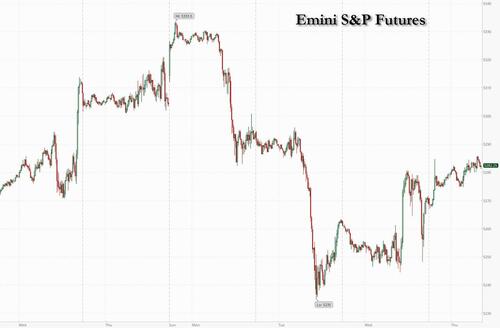
In premarket trading, all Mag 7 names are higher ex-GOOG, which surprised markets with news that it was launching a premium, AI-powered version of search, something which virtually nobody would pay for. Chipmakers such as Micron and AMD advanced, as analysts saw limited impact on the semiconductor market from Taiwan’s recent earthquake. Taiwan Semiconductor, which supplies chips to Apple Inc. and Nvidia Corp., said there was “no damage to critical tools.” Here are some other notable premarket movers:

  • BlackBerry ADRs rise 5% after the software firm reported a surprise 4Q profit.
  • Block falls 3% after Morgan Stanley cut its recommendation to underweight, noting limited additional opportunity for the company’s Cash App to expand banking/credit services.
  • Hertz slips 3% as Goldman Sachs cut its rating to sell, while raising its recommendation on Avis Budget (CAR) to neutral. Avis Budget is up 2%.
  • Levi Strauss jumps 13% after higher-than-expected sales and profit in the first quarter helped fuel a more optimistic full-year outlook.
  • MacroGenics  rises 9% after the drug developer gave interim safety data from a mid-stage trial of its experimental treatment for patients with prostate cancer.
  • Staar Surgical rises 8% after the medical-devices firm reported preliminary net sales for the first quarter that topped the average analyst estimate.
  • Wayfair climbs 4% after Evercore ISI raised its recommendation to outperform, noting improving fundamentals.
  • Zeta Global gains 5% as Morgan Stanley upgrades to overweight, highlighting the software firm’s durable growth and improving profitability.

While stocks reversed from two days of losses on Wednesday, jitters remained as a blowout reading for March private payrolls hinted at the possibility of a similarly strong number for the monthly non-farm payrolls print on Friday. Swap markets still price less than three rate cuts for 2024, and see only a 56% chance of the easing cycle starting in June. Inflation fears are also being fanned by strength in commodity prices, with Brent oil futures approaching five-month highs after OPEC+ confirmed plans to continue tightening crude supply. Copper rose to a 14-month peak and gold is trading near record highs above $2,300 per ounce.

Optimism was also tempered by Atlanta President Raphael Bostic forecasting only one rate cut this year, which would be in the fourth quarter. A raft of other rate-setters, including the Richmond Fed’s Thomas Barkin and Cleveland Fed President Loretta Mester, are due to speak later on Thursday. Euro-area bond yields, meanwhile, slid on expectations the European Central Bank will kick off policy easing on June 6 and cut rates three more times by year-end.

“I think Powell wants to get the process started in terms of the cutting cycle,” said Jamie Niven, senior portfolio manager at Candriam. “We’ve seen some strong data in the last few days, but I don’t think it’s absurd for them to cut from quite restricted territory.”

European stocks also edged up: the Stoxx 600 index rose 0.1%, as mining and auto shares led European equity gains, with copper miners Rio Tinto Plc and Antofagasta Plc rising sharply. Among other movers, Volvo Car AB jumped as much as 6% after reporting a 25% jump in vehicle sales. Regional bond yields are all lower with multiple curves bull flattening. Eurozone PMI-Srvcs and Composite had upside surprises as PPI printed more dovishly, with both MoM and YoY PPI reflecting deflationary levels.

Earlier in the session, Asian stocks rose, rebounding from Wednesday’s selloff, led by rallies in Japan and South Korea with markets shut for holidays in Greater China. The MSCI Asia Pacific Index rose as much as 0.9%, the most in two weeks, with financials and industrials providing the biggest boosts. Markets in China, Hong Kong and Taiwan were closed. Samsung and SK Hynix boosted South Korean benchmarks as halts at DRAM plants in Taiwan due to Wednesday’s earthquake were seeing firming up prices. A Bloomberg gauge of Asian chipmakers climbed, poised to cap a third week of gains.

  • ASX 200 was led by strength in gold miners after the precious metal rose above USD 2,300/oz for the first time.
  • Nikkei 225 outperformed and spent most of the session above the 40,000 level with the help of a predominantly weaker currency.
  • KOSPI was boosted by tech strength with Samsung underpinned ahead of its preliminary earnings results on Friday with its profit seen to rise to the largest in six quarters on higher chip prices, while SK Hynix was lifted amid plans to invest USD 3.9bln to build an Indiana plant.

In FX, the Bloomberg Dollar Spot Index falls 0.1%. The Swiss franc is the weakest of the G-10 currencies, falling 0.4% versus the greenback after CPI unexpectedly slowed in March.

In rates, treasuries are slightly cheaper across the curve, spreads within 1bp of Wednesday’s closing levels. Treasury yields cheaper by up to 1.5bp across intermediates, with 10-year around 4.36%; bunds and gilts outperform by 3bp and 4bp in the sector Regional bond yields are all lower with multiple curves bull flattening: European rates outperform after euro-area PMI and PPI data and long-end supply from Spain and France. US session has several Fed speakers and data including weekly jobless claims, with March jobs report ahead Friday.

In commodities, oil prices are little changed, with WTI trading near $85.40. Spot gold falls 0.3%.

Bitcoin is a touch firmer and at the top-end of the session’s range around USD 66k.

Looking at today’s calendar, the economic data slate includes March Challenger job cuts (the number of job cuts was the highest since January 2023), and the February trade balance and jobless claims (8:30am);  Fed speaker slate includes Harker (10am), Barkin (12:15pm), Goolsbee (12:45pm), Mester and Kashkari (2pm), Musalem (7:20pm) and Kugler (7:30pm)

Market Snapshot

  • S&P 500 futures up 0.3% to 5,283.25
  • STOXX Europe 600 up 0.2% to 511.00
  • MXAP up 0.7% to 176.49
  • MXAPJ up 0.5% to 539.66
  • Nikkei up 0.8% to 39,773.14
  • Topix up 0.9% to 2,732.00
  • Hang Seng Index down 1.2% to 16,725.10
  • Shanghai Composite down 0.2% to 3,069.30
  • Sensex up 0.6% to 74,311.08
  • Australia S&P/ASX 200 up 0.4% to 7,817.34
  • Kospi up 1.3% to 2,742.00
  • German 10Y yield little changed at 2.37%
  • Euro up 0.2% to $1.0860
  • Brent Futures down 0.4% to $89.03/bbl
  • Gold spot down 0.3% to $2,293.50
  • US Dollar Index down 0.15% to 104.10

Top Overnight News

  • Chinese authorities nudged Swiss agrichemicals and seeds group Syngenta to withdraw its application for a long-delayed $9 billion IPO in Shanghai on concerns about the impact a sizeable new offering would have on a volatile market, four people said. RTRS
  • The Bank of Japan cut its economic assessment for most regions on Thursday but signaled its confidence that wage hikes were broadening, leaving scope for another hike in the country’s still-low interest rates. RTRS
  • U.K. businesses expect wages to rise at a slower pace over the coming 12 months, a finding that will help reassure policy makers at the Bank of England that inflation has been tamed. WSJ
  • Swiss inflation cools by more than anticipated, coming in at +1.1% Y/Y in Mar (on an EU harmonized basis) vs. the Street +1.4% and down from +1.2% in Feb. BBG
  • Cease-fire negotiations between Israel and Hamas are stalling again, Israeli officials say, with large gaps between the sides over hostages, prisoners and the future of Gaza. BBG
  • Italian authorities have arrested 23 people and seized more than €600mn as they investigate suspected fraud involving the EU’s €800bn Covid recovery funds. FT
  • US institutional investors are selling more of their private equity holdings at a discount as they cut exposure to the illiquid asset class. Led by pension funds and endowments, big investors sold 99% of their private equity holdings at or below their net asset value on the secondary market last year, the most since the investment bank began tracking the figure in 2017. The figures were 95% in 2022 and 73% in 2021. FT
  • Boeing’s 737 MAX production has plunged in recent weeks in response to FAA scrutiny and steps by the company to improve quality and reliability. RTRS
  • Google could begin charging for a new AI-powered premium search product (AI-powered search eats up much more computing resources than traditional search, which is why Google may look to charge for the experience). FT
  • Quarterly path of S&P 500 EPS year/year growth. Positive EPS surprises averaged 4 pp during the past 4 quarters…

A more detailed look at global markets courtesy of Newsquawk

APAC stocks traded higher as sentiment picked up from the choppy mood and mixed data releases stateside, despite thinned conditions with markets across Greater China shut for the Qingming Festival. ASX 200 was led by strength in gold miners after the precious metal rose above USD 2,300/oz for the first time. Nikkei 225 outperformed and spent most of the session above the 40,000 level with the help of a predominantly weaker currency. KOSPI was boosted by tech strength with Samsung underpinned ahead of its preliminary earnings results on Friday with its profit seen to rise to the largest in six quarters on higher chip prices, while SK Hynix was lifted amid plans to invest USD 3.9bln to build an Indiana plant.

Top Asian News

  • Iron Ore Drops Toward 10-Month Low as Australian Exports Climb
  • Taiwan Begins Recovery From Quake as TSMC Resumes Production
  • Foreign Funds Sold Most Japanese Stocks, Futures in Six Months
  • Goldman Sees Korean Deals Boom on Push for Reform: ECM Watch
  • Egypt Buys LNG in Rare Move to Avoid Summer Gas Crunch
  • Konica Minolta Jumps on Plan to Cut 2,400 Jobs, Boost Profit

European bourses are modestly in the green after a relatively flat/directionless cash open, Euro Stoxx 50 +0.1%; modest post-open upside emerged after revisions to the Final EZ PMIs where Composite returned to expansion. Sectors do not have any overarching theme or bias present; basic resources outperform given base metal prices. Stateside, ES +0.3%, futures are tilting higher in tandem with European futures into another session dominated by Fed appearances alongside weekly IJC data before attention focuses on Friday’s payrolls.

Top European News

  • Riksbank Minutes (Mar): No overt mention of preference between May or June for a rate cut among the members.
  • BoE Monthly Decision Maker Panel – One-year ahead CPI inflation expectations declined further to 3.2% in March, down from 3.3% in February.
  • ECB’s Kazimir says he opposed reviving any “special tools of monetary policy”, according to Bloomberg; declined to comment on current monetary policy due to the ECB’s quiet period ahead of next week’s meeting.

FX

  • USD remains under modest pressure following on from the post-ISM sell off; DXY nearing 104.00 to the downside below which the 50- & 200-DMAs reside at 103.88 and 103.76.
  • EUR continues to inch higher after a softer start to the week, modest support perhaps arising from the PMI revisions while the docket ahead is headlined by ECB Minutes, though these are likely stale; last week’s EUR/USD high next at 1.0864.
  • Sterling steady and unaffected by PMIs or the latest BoE DMP; GBP/USD yet to convincingly surpass the 100- & 50-DMAs at 1.2663 and 1.2667 respectively.
  • JPY steady and unreactive to light jawboning overnight, former top-diplomat Watanabe said intervention is not likely unless USD/JPY sharply eclipses 155.00.
  • CHF the current laggard after another cool Swiss inflation print which has seen market pricing move more convincingly in favour of a second cut in June, though multiple months of data due before then.

Fixed Income

  • EGBs bid despite modest pressure emerging on the morning’s upwardly-revised PMIs. Action which eroded some of the concession into supply from France & Spain, though the auctions were still well received.
  • Bunds firmer by around 30 ticks but within a similar magnitude of the post-PMI 132.30 base; ECB minutes ahead.
  • Gilts followed EGBs into their own data points, with the benchmark unreactive to a modest revision lower (commentary focused on the stickiness of inflation) while the BoE DMP saw inflation expectations edge lower once again. Despite a robust DMO sale, Gilts lost the 99.00 mark but continue to modestly outperform EGBs.
  • US Treasuries are essentially flat, have been directionally moving with the above but yet to differ from the unchanged mark by more than a handful of ticks. Action which comes as a slight breather from recent sessions and after Powell reassured those who were expecting/concerned about a hawkish shift.

Commodities

  • 3M LME Copper tested USD 9.4k/T to the upside and resides at a fresh 52 week high on the morning’s PMIs paint a healthy demand picture; action which comes after an APAC session which saw Chinese markets closed (mainland China returns on Monday).
  • Crude benchmarks near the unchanged mark and at the mid-point of circa. USD 0.80/bbl bounds with specifics light thus far into broader macro events.
  • Spot gold a touch softer irrespective of the modest USD pullback, action which comes as the yellow metal takes a modest breather from recent upside and as US yields inch higher.

Geopolitics: Middle East

  • US official said the Biden administration is calling on the Israeli army to modify its way of transmitting information about the stationing of aid workers and Biden plans to demand these changes. Furthermore, Biden is angry and largely frustrated over the killing of aid workers in Gaza and is ready to clarify his view to Netanyahu during their expected phone call today, while the official added there is no shift in Washington’s policy towards Israel, but there is a shift in President Biden’s frustrations, according to CNN.
  • US Pentagon said Defence Secretary Austin spoke with Israeli Defence Minister Gallant on Wednesday and expressed his outrage at the Israeli strike on a World Central Kitchen humanitarian aid convoy, while Austin stressed the need to immediately take concrete steps to protect aid workers and Palestinian civilians in Gaza after repeated coordination failures with foreign aid groups.

Geopolitics: Other

  • France denied it showed any readiness for Ukraine dialogue in talks with Russia, according to a French government source.
  • Tokyo is in talks with Manila over sending troops to the Philippines in which a possible deployment comes as they boost efforts to deter China in the South China Sea, according to FT.
  • Russia’s Kremlin says relations with NATO have slid to a level of direct confrontation; NATO continues “to move towards our borders”

US Event Calendar

  • 07:30: March Challenger Job Cuts 0.7% YoY, prior 8.8%
  • 08:30: March Continuing Claims, est. 1.81m, prior 1.82m
  • 08:30: March Initial Jobless Claims, est. 214,000, prior 210,000
  • 08:30: Feb. Trade Balance, est. -$67.6b, prior -$67.4b

Central banke speakers

  • 10:00: Fed’s Harker Participates in Fireside Chat
  • 12:15: Fed’s Barkin Speaks on Economic Outlook
  • 12:45: Fed’s Goolsbee Participates in Moderated Q&A
  • 14:00: Fed’s Mester Gives Remarks on Economic Outlook
  • 14:00: Fed’s Kashkari Discusses US Economy
  • 19:20: Fed’s Musalem Gives Introductory Remarks
  • 19:30: Fed’s Kugler Speaks on Enriching Data

DB’s Jim Reid concludes the overnight wrap

Markets recovered their poise over the last 24 hours, as investors were relieved after Fed Chair Powell stuck to his recent views on the economic outlook. In his remarks yesterday, he said that recent data didn’t “materially change the overall picture” and that on inflation “it is too soon to say whether the recent readings represent more than just a bump.” In addition, he reiterated that if “the economy evolves broadly as we expect, most FOMC participants see it as likely to be appropriate to begin lowering the policy rate at some point this year.” So that all helped to validate market pricing, which still expects 71bps of rate cuts from the Fed by the December meeting.

Those comments from Powell supported US Treasuries, and the 2yr yield fell -1.7bps on the day as investors maintained their confidence that rate cuts were still on the agenda this year. The 10yr yield was near flat yesterday (-0.2bps) at 4.35%, but that was actually a sharp decline from earlier in the session, when it hit an intraday peak for 2024 of 4.43%, and overnight there’s only been a modest +1.8bps move back up to 4.37%. That turnaround was partly due to Powell’s remarks, but was also because of the ISM services print for March, which unexpectedly fell to 51.4 (vs. 52.8 expected). And encouragingly on inflation, the prices paid component fell to 53.4 (vs. 58.4 expected), its lowest since March 2020. That contrasted with the upside surprise in the ISM manufacturing on Monday, and combined with Powell’s comments, the release helped to push back against some of the more hawkish narratives over the last couple of sessions.

But even as investors found reassurance from Powell’s speech, it had been a very different story earlier in the day. That was particularly the case after the A DP’s report of private payrolls for March came out, which rose to 184k (vs. 150k expected), and February’s number was revised up by +15k. So that was a fresh sign that the labour market was in good shape ahead of tomorrow’s US jobs report, and it was that release which pushed the 10yr yield up to its intraday peak for 2024 so far. Moreover, it’s worth noting that yesterday saw fresh signs of concern about inflation, as oil prices closed at their highest levels since October. For instance, Brent crude was up +0.48% to $89.35/bbl, whilst WTI was up +0.33% to $85.43/bbl. In fact, Brent crude prices were just shy of $90/bbl at their intraday peak, having briefly traded at $89.99/bbl. That’s also filtering through into consumer prices as well, and the AAA’s daily average of US gasoline prices was up to $3.549/gallon as of Tuesday, which is also its highest since October. Meanwhile, Brent crude prices (+0.30%) continue to move higher overnight, and are currently at $89.62/bbl.

Of course, some of Powell’s comments could be interpreted in a more hawkish light. Among others, he said that “the job of sustainably restoring 2 percent inflation is not yet done”, and that “ We do not expect that it will be appropriate to lower our policy rate until we have greater confidence that inflation is moving sustainably down toward 2 percent.” But for now at least, investors are still pricing in a 64% chance of a rate cut by June, so that’s considered the most likely timing for an initial rate cut. And ultimately, there’s still several important data releases between now and June that will help determine the decision, including tomorrow’s jobs report for March, along with the CPI release next week. Indeed, we’ve seen how expectations for rate cuts have shifted a lot already this year, and up until early February, investors were still pricing in a strong probability of a cut in March.

Over in the Euro Area, the prospect of ECB rate cuts this year got fresh support from developments yesterday. In particular, the flash CPI print for March saw headline CPI fall to +2.4% (vs. +2.5% expected), whilst core CPI fell to +2.9% (vs. +3.0% expected), which is its lowest since February 2022. Alongside that, we also heard from Spanish central bank governor De Cos, who said “I think that today my central scenario is that June could actually be the first reduction in interest rates”. That backdrop saw yields on 10yr bunds (-0.3bps) and OATs (-1.4bps) fall back, and those on 10yr gilts saw a larger -3.0bps decline. In terms of rate cut expectations, overnight index swaps are now pricing in 76bps of ECB cuts by the December meeting, which is more than the 71bps currently priced in by Fed Funds futures.

As investors continued to anticipate rate cuts this year, that helped to stabilise equities after two weak sessions at the start of the week. The S&P 500 (+0.11%) posted a marginal gain, helped by some of the more cyclical sectors as well as tech stocks. Both the NASDAQ (+0.23%) and the Magnificent 7 (+0.49%) outperformed, and there was also a recovery among small-cap stocks, with the Russell 2000 (+0.54%) paring back some of its losses from the start of the week. Amid the underperformers, chipmaker Intel fell -8.22% after announcing a weaker outlook for its factory network. Meanwhile in Europe, the STOXX 600 was up +0.29%, and there were also gains for the DAX (+0.46%) and the CAC 40 (+0.29%). Separately, the prospect of rate cuts meant that gold prices (+0.85%) closed at an all-time high in nominal terms of $2,300/oz.

Overnight in Asia, it’s been a quieter session this morning given markets are on holiday in China. But in general, the more positive tone has continued, with the Nikkei (+1.63%), the KOSPI (+1.06%) and the S&P/ASX 200 (+0.45%) all advancing. That’s evident among US and European equity futures too, with those on the S&P 500 (+0.27%) and the STOXX 50 (+0.12%) both pointing towards further gains. Alongside that, data showed that Australia’s composite PMI for March moved up to 53.3, marking its highest level since April 2022.

To the day ahead now, and data releases from the US include the weekly initial jobless claims and the February trade balance. Meanwhile in Europe, there’s the final services and composite PMIs for March, along with Euro Area PPI for February. Otherwise, central bank speakers include the Fed’s Harker, Barkin, Goolsbee, Mester, Kashkari, Musalem and Kugler. And we’ll get the ECB’s account of their March meeting.


Tyler Durden
Thu, 04/04/2024 – 08:15

via ZeroHedge News https://ift.tt/6VqGeYO Tyler Durden

Statewide Emergency Declared In Indiana Ahead Of Solar Eclipse

Statewide Emergency Declared In Indiana Ahead Of Solar Eclipse

Authored by Jack Phillips via The Epoch Times (emphasis ours),

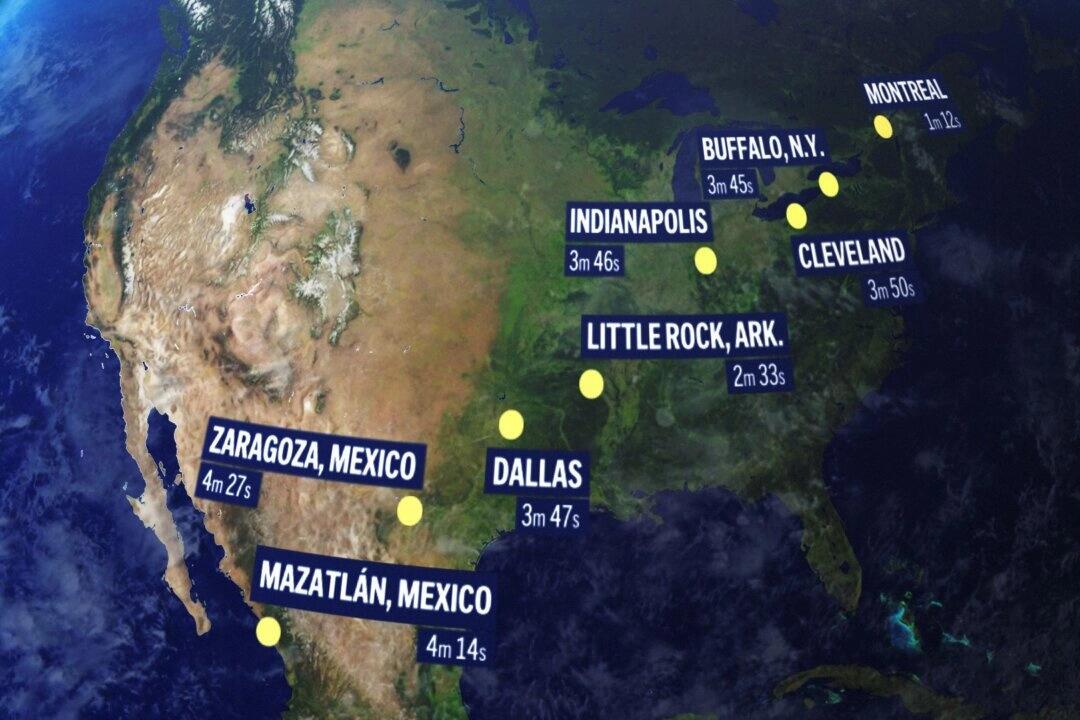
Indiana Gov. Eric Holcomb issued a statewide emergency due to a large influx of visitors to his state to view the total solar eclipse on April 8.

A total solar eclipse on April 8 will begin over Mexico’s Pacific coast, then move through Texas and Oklahoma, crisscross the Midwest, Mid-Atlantic, and New England, before exiting over eastern Canada into the Atlantic. (AP Photo)

The Republican official said that the number of visitors to Indiana may strain the state’s communications, transportation, and emergency response systems, warranting the need for the declaration. Indiana includes some of the best locations in the United States to see the eclipse, according to a map of the path of totality.

“The massive number of people viewing this event in our state may well stress and/or interfere with first responder and public safety communications and emergency response systems such that a technological or other emergency may occur,” Mr. Holcomb said in a statement last week, adding that the declaration was issued as a precaution to bring in emergency resources from other states.

His order noted that the eclipse “will pass directly over the state of Indiana, giving everyone in our state an incredible view of this extremely rare event.” The order stated that the last time a total solar eclipse passed over the state was in 1869. After the event on April 8, the next one is not expected to occur for about another 75 years.

“It is of primary importance to the state of Indiana to be prepared to protect the health, safety and welfare of the public during this event and to be prepared to swiftly and effectively respond to any emergency that may arise,” the order continued.

The state’s capital and largest city, Indianapolis, is located in the eclipse’s path of totality, local media reported.

Officials in other U.S. states have issued advisories or warnings ahead of the astronomical event. Authorities in Ohio’s Summit County, for example, advised residents to “stay home” due to traffic congestion by an expected influx of viewers, while officials from the Illinois Department of Transportation warned that crowd sizes could be massive in some areas.

Crowds of 100,000 to 200,000 are expected to come to the prime viewing area in southern Illinois,” the Illinois agency said. “All roads in and out of the area are expected to have heavy congestion in the couple hours after the eclipse.”

Texas Emergencies

Multiple counties in Texas declared emergencies due to the upcoming April 8 total solar eclipse due to potentially heavy traffic and gridlock.

On Monday, the Bosque County Office of Emergency Management declared a state of emergency due to heavy traffic and will authorize the county to take “any actions necessary to promote life, safety and critical infrastructure protection.”

The population of Bosque County is expected to significantly increase because “tens of thousands of visitors” may travel to the area to view the eclipse, possibly straining local resources and fuel supplies, officials said. Traffic congestion is expected, triggering the emergency declaration because “extraordinary measures must be taken to ensure the protection of public health, safety and welfare of Bosque County residents and visitors.”

Last week, Kaufman County Judge Jakie Allen issued a disaster declaration due to the “projected and expected number of visitors” in the area. County officials have said that some 200,000 people may visit the county to view the eclipse.

“The dramatic increase in population, even for a short time, will greatly impact our public safety agencies, taxing their ability to respond to calls,” county officials said.

Travis County, which includes the capital of Austin, issued a similar declaration last month due to the anticipated crowd sizes, said Judge Andy Brown. He said the population of the county could potentially double in the days surrounding the total eclipse.

“It’s super exciting to see this once-in-a-lifetime event,” the official said. “What makes it different is that it is a natural phenomenon, and we can’t control the weather around it. So there’s a lot of variables that we just can’t control for.”

According to the Dallas Morning News, the Texas Hill Country may be one of the best spots to view the eclipse in the United States.

But a significant influx of tourists may “cause extreme traffic congestion on our roadways, place an enormous strain on our first responders and hospital systems, drain our food and fuel supplies and strain our city and county infrastructure to, quite possibly, overcapacity,” Kerr County Judge Rob Kelly said last month.

Niagara Falls

Meanwhile, last week, a state of emergency was declared in the Canadian Niagara Falls region, adjacent to the city of Niagara Falls in New York state, due to traffic and crowd sizes.

The city is also in the path of totality, which will receive no solar rays for a few minutes on April 8 as the moon blocks the sun. Niagara Falls Mayor Jim Diodati said in March that he expects the most visitors his city has ever seen in a single day.

In New York, Gov. Kathy Hochul warned travelers in the state to expect high amounts of traffic as several eclipse-viewing events will be held. She said that lane closures and construction will be halted ahead of the astronomical event.

Tyler Durden
Thu, 04/04/2024 – 07:45

via ZeroHedge News https://ift.tt/tAra7q1 Tyler Durden

Gold’s Defiance Of Real Yields Can’t Last Unless Trouble Brewing

Gold’s Defiance Of Real Yields Can’t Last Unless Trouble Brewing

By Garfield Reynolds, Bloomberg markets live reporter and strategist

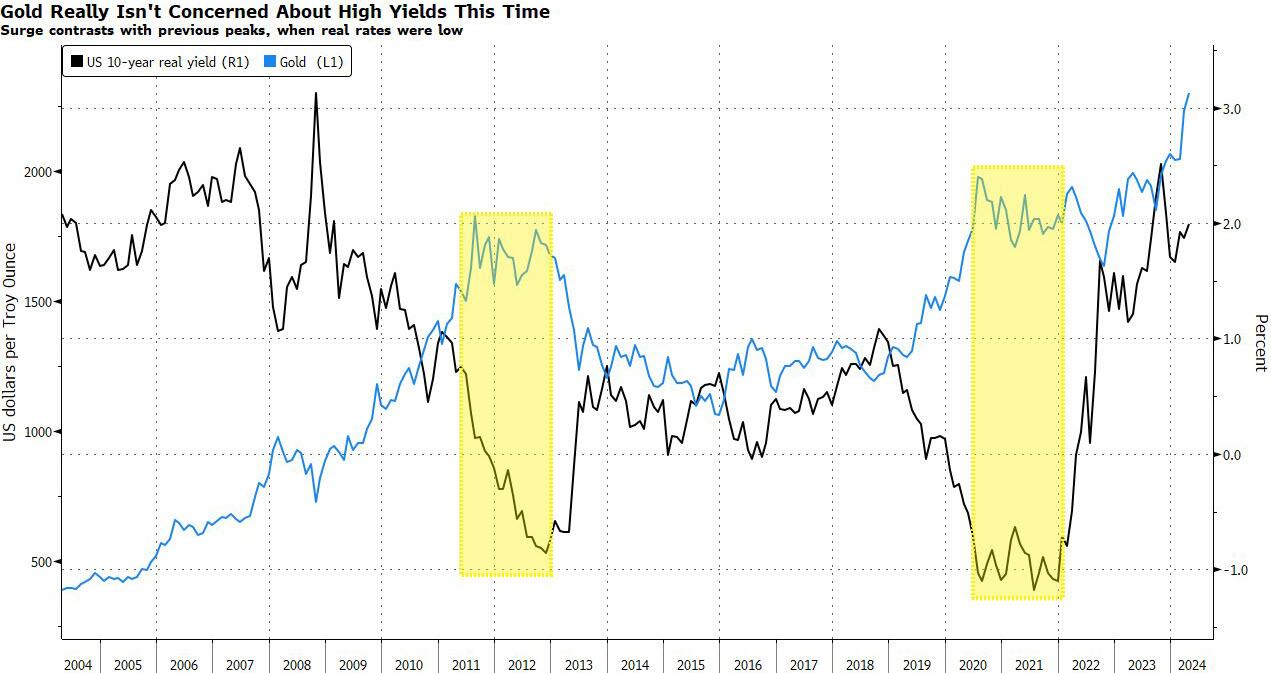
Gold’s surge to record highs is extraordinary — coming as it does in the face of elevated real yields that would normally bring it crashing down. That signals the metal is likely to rapidly reverse this year’s climb, unless risk assets collapse because of an economic or financial crisis.

The 10-year real yield is still around 2%, a level unseen since 2009. That should hurt a non-interest-bearing asset like gold, but it isn’t. The previous two times before the current surge when gold hit record highs were times of negative real yields — during the pandemic and in 2011-12 as Europe’s sovereign debt woes followed on the heels of the global financial crisis.

Back before the introduction of TIPS allowed the ready tracking of market expectations for real rates, the precious metal’s ascent to a record in 1980 came when 10-year nominal yields were well below the inflation rate.

That makes gold’s rally this year vulnerable, though it may also signal investors are becoming worried that major turmoil is coming. The surge that peaked in 2011 blew past gold’s 1980 high at the start of 2008, well before the collapse of Lehman Brothers.

It’s possible the real boon for the yellow metal is negative sentiment, rather than negative real yields.

Tyler Durden
Thu, 04/04/2024 – 07:20

via ZeroHedge News https://ift.tt/5biSnoJ Tyler Durden