“The Yen Collapse Has Become Disorderly”: Look For A Final, Sharp Decline Before It Hits A Floor

“The Yen Collapse Has Become Disorderly”: Look For A Final, Sharp Decline Before It Hits A Floor

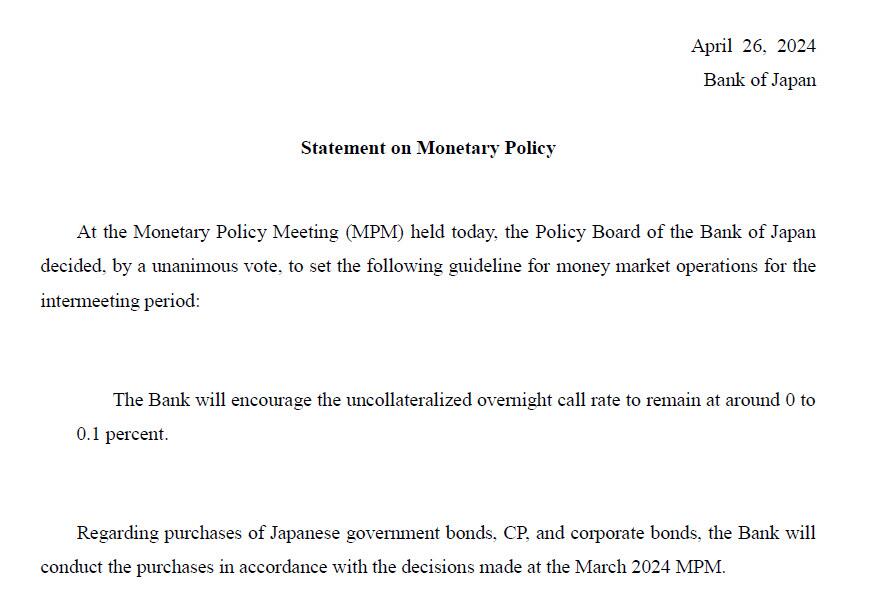
The BOJ came, issued the shortest statement in the history of central banks

… and left, leaving traders stunned and speechless at the sheer idiocy of the world’s most clownish central bank, which has decided to invite currency collapse the same abandon as Zimbabwe, if it means pushing up domestic stonks a little bit more even as hyperinflation is unleashed among Japanese society. And now that the collapse in the yen is making banana republics like Turkey blush, and is making FX managers and traders who are still long the Japanese Dong Lira Yen to the imploding “developed” insolvent, everyone wants to know what happens next?
Below we share to views, one from Deutsche Bank’s Geroge Saravelos, and one from SocGen’s Kit Juckes.

We start with the DB FX strategist who frames the BOJ’s wilful incompetence merely as “benign neglect”, to wit:

On the collapse

The yen has again collapsed today to fresh record lows following the Bank of Japan meeting. We think this is warranted and that this finally marks the day where the market realizes that Japan is following a policy of benign neglect for the yen. We have long argued that FX intervention is not credible and the toning down of verbal jawboning from the finance minister overnight is on balance a positive from a credibility perspective. The possibility of intervention can’t be ruled out if the market turns disorderly, but it is also notable that Governor Ueda played down the importance of the yen in his press conference today as well as signalling no urgency to hike rates. We would frame the ongoing yen collapse around the following points.

  1. Yen weakness is simply not that bad for Japan. The tourism sector is booming, profit margins on the Nikkei are soaring and exporter competitiveness is increasing. True, the cost of imported items is going up. But growth is fine, the government is helping offset some of the cost via subsidies and core inflation is not accelerating. Most importantly, the Japanese are huge foreign asset owners via Japan’s positive net international investment position. Yen weakness therefore leads to huge capital gains on foreign bonds and equities, most easily summarized in the observation that the government pension fund (GPIF) has roughly made more profits over the last two years than the last twenty years combined.
  2. There simply isn’t an inflation problem. Japan’s core CPI is around 2% and has been decelerating in recent months. The Tokyo CPI overnight was 1.7% excluding one-off effects. To be sure, inflation may well accelerate again helped by FX weakness and high wage growth. But the starting point of inflation is entirely different to the post-COVID hiking cycles of the Fed and ECB. By extension, the inflation pain is far less and the urgency to hike far less too. No where is this more obvious than the fact that Japanese consumer confidence are close to their cycle highs.
  3. Negative real rates are great. There is a huge attraction to running negative real rates for the consolidated government  balance sheet. As we demonstrated last year, it creates fiscal space via a $20 trillion carry trade while also generating asset gains for Japan’s wealthy voting base. This encourages the persistent domestic capital outflows we have been highlighting as a key driver of yen weakness over the last year and that have pushed Japan’s broad basic balance to being one of the weakest in the world. It is not speculators that are weakening the yen but the Japanese themselves.

The bottom line is that for the JPY to turn stronger the Japanese need to unwind their carry trade. But for this to make sense the Bank of Japan needs to engineer an expedited hiking cycle similar to the post-COVID experiences of other central banks. Time will tell if the BoJ is moving too slow and generating a policy mistake. A shift in BoJ inflation forecasts to well above 2% over their forecast horizon would be the clearest signal of a shift in reaction function. But this isn’t happening now. The Japanese are enjoying the ride

(More in the full note available to pro subs.)

And next, here is the somewhat more actionable view from SocGen’s FX strategist Kit Juckes:

The yen’s decline is becoming disorderly, which points to a final, potentially sharp, decline before it finds a floor

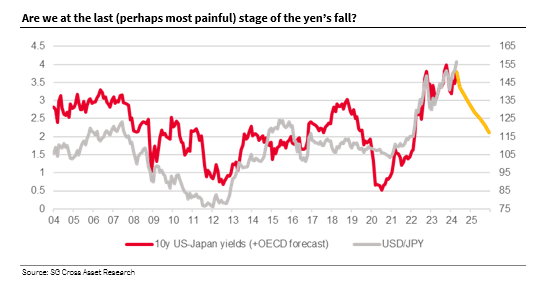
The Bank of Japan, as was universally expected, made no changes to interest rates at today’s policy-setting meeting, though they did edge inflation forecasts higher. Forecasts for the 2025/26 fiscal year look for core inflation (ex-food and energy) at 2.1% and real GDP growth of 1%. In Japan, as in most countries, yields have tended to average more than nominal GDP growth over time, and on that basis the US/Japanese yield differential is set to narrow significantly in the coming quarters. However, for now US yields are rising and Japanese ones are still anchored by very low short-term rates. Those short-term rates give short yen trades their positive carry and have kept the leveraged trading community happy for months.

The chart shows the US-Japanese yield differential and USD/JPY over the last 20 years, with the yield chart extended using the OECD’s forecasts for yields. These are just forecasts but they frame the issue quiet well, particularly bearing in mind how undervalued the yen is now, on any fundamental long-term valuation. If PPP for USD/JPY is now in the mid-90s, fair value adjusted for US exceptionalism and Japanification is still around 110. As long as yield differentials are large and growing, upward pressure on USD/JPY persists and while eventual return to much lower levels is inevitable, the danger here is that unless Japan’s policymakers are much more aggressive (with intervention and monetary policy), this move higher in USD/JPY will end in a final excessive spike higher.  
 

Tyler Durden
Fri, 04/26/2024 – 16:40

via ZeroHedge News https://ift.tt/5BkiNUv Tyler Durden
NYPD Warns Anti-Israel Protesters A ‘Seattle-Style’ Occupation Zone Won’t Be Tolerated

NYPD Warns Anti-Israel Protesters A ‘Seattle-Style’ Occupation Zone Won’t Be Tolerated

Authored by Patricia Tolson via The Epoch Times,

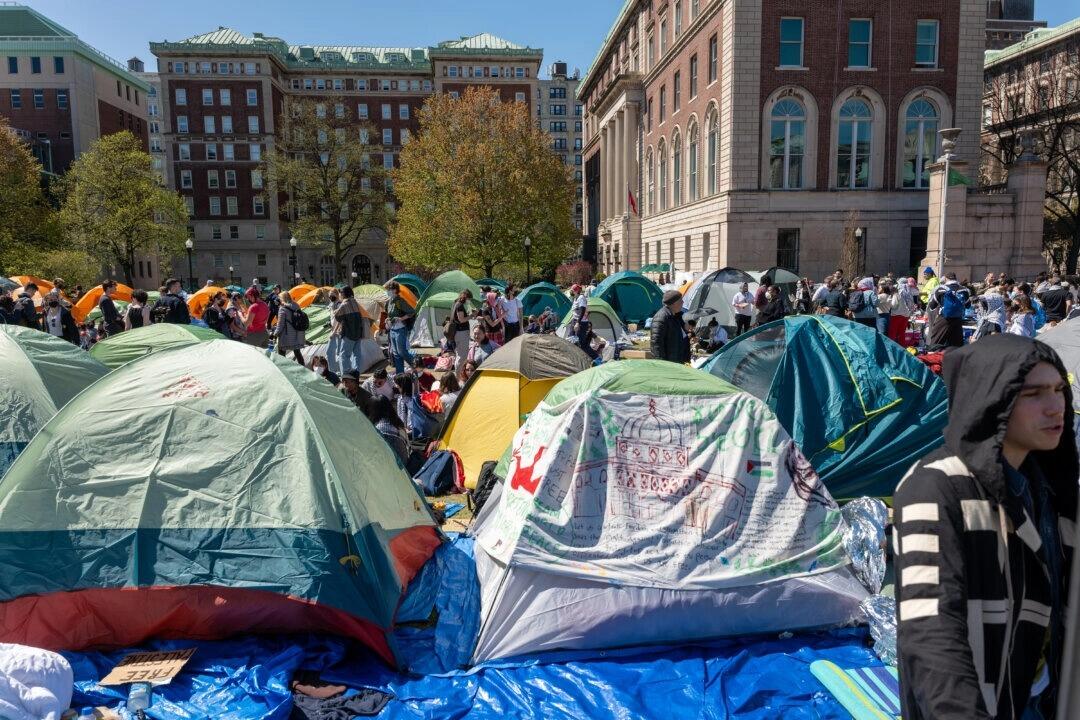
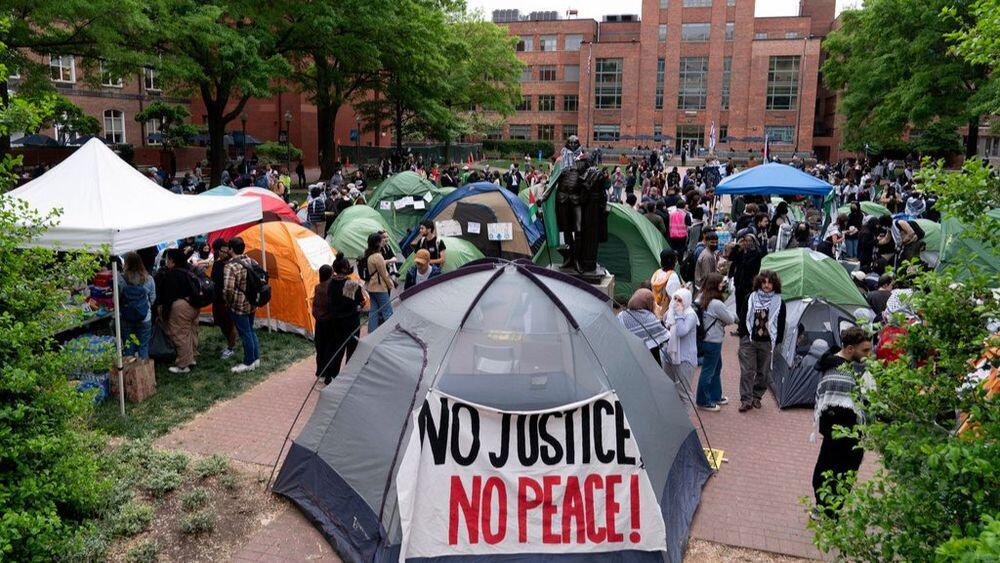
As protests escalate across college and university campuses in the United States, a New York Police Department (NYPD) official vowed that a “Seattle-style” occupation zone will not be tolerated on the streets of New York City.

Two New York Police Department (NYPD) officials spoke with Fox News’ “The Story” anchor Trace Gallagher on April 25. The conversation focused on growing concerns that the anti-Israel protests spreading across America’s college campuses might devolve into further violence.

NYPD Deputy Commissioner of Operations Kaz Daughtry addressed growing speculation that the student anti-Israel encampments could evolve into something similar to the “autonomous zone” established in Seattle, in Washington state, in response to the death of George Floyd in May 2020, suggesting they might “linger and last all summer long and become bigger and more dangerous.”

It was a possibility immediately shut down by Chief of Patrol John Chell.

“We will not have any Seattle-type encampments on the streets of New York City. I can guarantee you that — that would end rather quickly,” he asserted.

The Capitol Hill Autonomous Zone, also known by its acronym CHAZ and later CHOP (Capitol Hill Organized Protest), became a scene of widespread vandalism and violence that spanned more than six blocks in the Capitol Hill neighborhood of Seattle.

A shooting on June 20, 2020, claimed the life of a 19-year-old man and injured a 33-year-old man, as reported by The New York Times on July 1, 2020.  The next day, a 17-year-old man was injured in another shooting. A third shooting took the life of a 16-year-old and left a 14-year-old seriously injured.

“The fine line here is the street, the public property, which we’ll deal with, and the college is the private property,” Mr. Chell explained.

“That’s why we got to strike this balance. Let me repeat, there will never be encampments on the streets of New York City while we’re in power, never going to happen.”

After the NYPD deployed counterterrorism units to the Columbia University campus, Rep. Alexandria Ocasio-Cortez (D-N.Y.) took to social media platform X to condemn the move as a “horrific” decision, adding that NYPD officers had “some of the most violent reputations on the force.”

Mr. Chell responded the next day, defending the “units” and informing her that he was with them when they were deployed to the university.

“These ‘units’ removed students with great care and professionalism, not a single incident was reported,” he said.

“Maybe you should walk around Columbia and NYU and listen to their remarks of pure hatred,” he added. “I will ensure those ‘units’ will protect you as they do for all NYers 24/7/365.”

Mr. Daugherty added his thoughts saying, “There is nothing ‘horrific’ about protecting the safety of Columbia’s young students who are just trying to go to school.”

He also defended NYPD officers, describing them as “the best and most highly trained law enforcement professionals in the world.”

Mr. Daugherty invited Ms. Ocasio-Cortez to “visit Columbia” for a walk-through, promising to protect her and take a report if she feels threatened.

Rep. Ilhan Omar (D-Minn.) speaks to a crowd gathered for a march to defund the Minneapolis Police Department in Minneapolis, Minn., on June 6, 2020. (Stephen Maturen/Getty Images)

Request for Help

The presence of the NYPD at Columbia was by request.

Columbia University’s president, Minouche Shafik, had personally reached out to the NYPD in a letter, requesting their assistance in clearing the encampment set up by more than 100 students on the south lawn of Columbia’s Morningside Heights campus on April 17.

Students had been repeatedly warned, both verbally and in writing, that they were in violation of university rules and policies and would have to disperse. Students staying in the encampment were also informed that they had been suspended.

“I have determined that the encampment and related disruptions pose a clear and present danger to the substantial functioning of the University,” she wrote,“ adding that it was ”With great regret, we request the NYPD’s help to remove these individuals.”

A total of 108 students were arrested for trespassing.

Among them was Isra Hirsi, a student from Barnard, Columbia’s sister college. Ms. Hirsi is the daughter of Rep. Ilhan Omar (D-Minn.), a frequent critic of Israel.

Following her daughter’s arrest, Rep. Omar praised her daughter on social media.

At an April 18 press conference, New York City Mayor Eric Adams explained that the arrests were made because the protesters had been camped out on Columbia’s south lawn for more than 30 hours, in violation of the university’s rules.

He confirmed that the NYPD was dispatched to the campus only after students received “numerous warnings” to disband and after Ms. Shafik reached out to the NYPD “in writing,” requesting support.

He stressed that “no violence or injuries” occurred during the incident.

While acknowledging that Columbia’s students have a right to free speech, he said they “do not have the right to violate university policies and disrupt learning on campus.”

Ms. Shafik issued a statement on April 22, expressing sadness over what is taking place on Columbia’s campus. She said the activities of the protesting students have “severely tested” community bonds and imposed a state of fear among students “across an array of communities.”

On April 21, Columbia’s chief operating officer, Cas Holloway, outlined the enhanced safety measures being imposed on the Morningside Heights campus, where the protesters were “causing considerable disruption and distress.”

The increased security measures include additional security personnel, enhanced security around the perimeter of the Morningside Heights campus, additional security at the Kraft Center, and increased identification checks to make sure that only Columbia University students are on campus.

Republicans Condemn Hatred

Rep. Virginia Foxx (R-NC), chair of the House Education Committee, sent a letter to university leaders on April 21, warning them of consequences if they do not gain control of “the encampment and related activities” which “have created a severe and pervasive hostile environment for Jewish students at Columbia.”

A total of 10 Republican members of Congress sent a letter to Ms. Shafik on April 22, urging her to resign immediately.

House Speaker Mike Johnson held a press conference on the steps of the university’s Low library near the student’s “Liberty Zone” encampment on April 24, and called for her resignation if she could not gain control of her campus.

House Speaker Mike Johnson (R-La.) holds a press conference at the Columbia campus to call for the resignation of university president Minouche Shafik, in New York City, on April 24, 2024. (Alex Kent/Getty Images)

“We just can’t allow this kind of hatred and anti-Semitism to flourish on our campuses, and it must be stopped in its tracks,” he said.

“Those who are perpetuating this violence should be arrested.”

His visit to the campus, which took place shortly after the university extended a deadline by 48 hours (until April 26) to reach an agreement on the removal of the encampment, was to show support for Jewish students, who have been intimidated, threatened, and assaulted by anti-Israeli protesters.

His presence was immediately met by boos and his comments were frequently interrupted with chants of, “We can’t hear you,” and “Free Palestine.”

The University of Southern California was forced to close its campus after campus police were overwhelmed during an effort to shut down an encampment. To clear the area, they had to enlist the help of the Los Angeles Police Department. As students surrendered peacefully, they were arrested.

Student protesters have also set up an encampment at the University of Michigan in Ann Arbor, the Detroit Free Press reported on April  23.

Nine people were reportedly arrested by University of Minnesota police after pro-Palestinian students set up an encampment on the Northrop Mall. Ms. Omar made an appearance, telling the students through a loudspeaker that she was “moved” by their “courage and bravery” in taking a stand “to end the genocide,” Star Tribune reported.

More than 20 tents, festooned with pro-Palestinian signage and flags, have been erected in front of a chapel on the campus of the Massachusetts Institute of Technology in Cambridge, as reported by CNN.

Dozens of student protesters were arrested at the University of Southern California on April 24 and the campus of California State Polytechnic, in Humboldt, was shut down as students barricaded themselves inside a building for a third day, the Associated Press reported on April 25.

At the University of Texas, 57 students were arrested by campus police during a protest organized by the Palestine Solidarity Committee when students tried to “occupy” the South Lawn, Austin television station KXAN reported.

Tyler Durden
Fri, 04/26/2024 – 16:20

via ZeroHedge News https://ift.tt/zZhHNP7 Tyler Durden
Biden Admin Abandons Plan To Ban Menthol Cigarettes To Avoid ‘Angering Black Voters’

Biden Admin Abandons Plan To Ban Menthol Cigarettes To Avoid ‘Angering Black Voters’

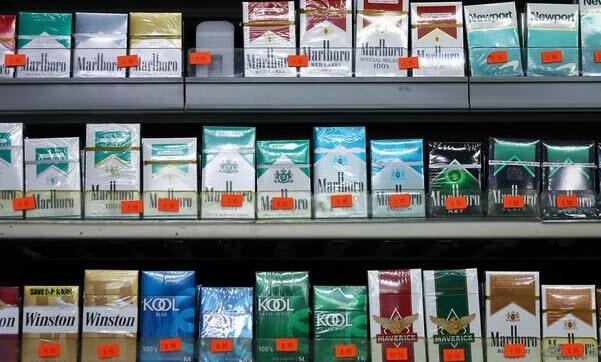
The so-called ‘party of science’ has decided to abandon its plan to save millions of lives (of mostly African American youth) by choosing not to ban Menthol cigarettes after all…

In October 2023, the FDA said it was looking to ban menthol cigarettes and flavored cigars due to concerns these tobacco products are harming American youth.

“The U.S. Food and Drug Administration (FDA) is looking to ban menthol cigarettes and flavored cigars due to concerns these tobacco products are harming American youth.

The agency estimated there were 18.5 million menthol cigarette smokers aged 12 and above in the United States in 2018, with “particularly high rates of use by youth, young adults, and African Americans and other racial and ethnic groups.”

Them in December 2023, after what some called a ‘blacklash’, White House officials were reportedly taking more time to review their sweeping ban plan, despite the science’s awful warnings:

“The federal agency estimates a ban on the flavor additive could prevent 300,000 to 650,000 smoking deaths over several decades.

They claim most of the preventable deaths would be among minority groups and Americans of African descent, who disproportionately smoke menthol cigarettes.”

And now, April 2024 (around six months before the election and with Biden’s poll numbers in the proverbial toilet), The Wall Street Journal reports that the Biden administration is reversing course on its plan to ban menthol cigarettes, after the White House weighed the potential public-health benefits of banning minty smokes against the political risk of angering Black voters in an election year.

Some Black community leaders had fought the measure, saying a ban would expand the illicit market for cigarettes and lead police to racially profile Black smokers.

The American Civil Liberties Union and some members of the Congressional Black Caucus expressed similar concerns.

The administration is expected to announce its decision as soon as Friday afternoon, according to people familiar with the matter.

So, to sum up: The White House is willing to ignore the potential (science-driven data) death of 650,000 mostly African American voters to improve its chances in November?

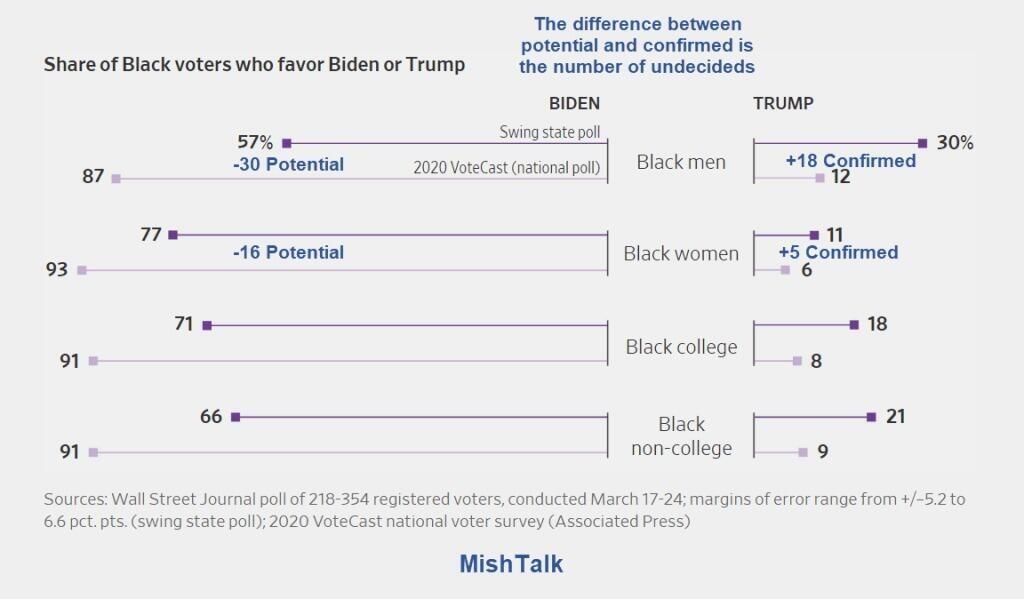
This couldn’t possibly have anything to so with the fact that minorities in America are starting to look for alternatives to the Democrats they have been indoctrinated to vote for all their lives… or the fact that swing-state polls shows black voters abandoning Biden in favor of Trump is huge numbers

Gotcha, “science” indeed!

Tyler Durden
Fri, 04/26/2024 – 14:40

via ZeroHedge News https://ift.tt/jupehPO Tyler Durden

Inspired Idiot of the Week: Lina “Genghis” Khan’s Rampage Continues

The barbarian chief of the Federal Trade Commission (FTC), Lina “Genghis” Khan, has some of the most bewildering priorities I’ve ever seen.

The FTC is the federal government’s most prominent business regulator; yet she doesn’t seem the slightest bit concerned that US economic growth is coming to a screeching halt. Or that stagflation is once lurking. Or that the American manufacturing sector continues to be in a major recession.

She’s not even focused on trying to fix her own agency.

Remember, a recent Congressional investigation found the FTC to be a “toxic work environment” and “beset by dysfunction and chaos stemming from poor leadership and ideological bullying of its Chair [Khan]”. Sounds like a great place to work!

But Genghis Khan isn’t concerned about any of that.

Instead, she has fixed her warmongering gaze on… LUXURY HANDBAGS. And she is prepared to wield all the taxpayer resources at her disposal to ensure that no leather purse is left behind.

Squarely in Genghis Khan’s crosshairs are two American luxury goods producers– Coach and Michael Kors– who are currently attempting to merge; the deal was overwhelmingly approved by shareholders.

And obviously the merger makes sense to investors; giant legacy brands like Coach and Michael Kors suffer from an outdated business model that makes it increasingly difficult to compete with smaller, leaner businesses that sell almost exclusively online.

Coach and Michael Kohrs waste mountains of cash each year on expensive rents at shopping malls that simply no longer attract the foot traffic they once did.

These are massive costs for legacy brands that younger fashion startups don’t incur.

Similarly, because they are enormous companies, Coach and Michael Kors have to waste even more money on corporate administrative costs (like audit fees, company filings, huge bureaucracies, idiotic DEI initiatives) which, again, younger fashion startups don’t have.

At a certain point it makes sense for companies to merge, consolidate their assets, streamline their operations, and boost competitiveness. No wonder shareholders approved the deal.

But Genghis Khan cannot tolerate rational investors in a capitalist society making sensible financial decisions about what to do with their own privately owned shares.

So now she’s trying to block the deal, claiming that the merger will “eliminate fierce head-to-head competition.”

Come again? Has Genghis Khan serious never heard of Louis Vuitton, Gucci, Hermes, Chanel, Prada, Burberry, Valentino, Giorgio Armani, Dolce & Gabbana, Bulgari, Ferragamo, Tom Ford, Tory Burch, Oscar de la Renta, Diesel, etc.

There’s PLENTY of competition in the luxury handbag industry.

But let’s suspend all reality for a moment and pretend that we live in an alternate universe where Genghis Khan is actually correct… and that the Michael Kors / Coach merger would kill competition.

The obvious question, of course, is… who cares?!?! Does Genghis Khan also worry if there will be less competition among private jet manufacturers? Or luxury superyachts?

And that’s the point: this deal shouldn’t even be on the radar of America’s most prominent business regulator.

But wait! There’s more!

In addition to her war on luxury handbag producers, Genghis Khan also unveiled a gargantuan, 570-page regulation last week that, among other things, bans most noncompete agreements.

This is yet another core tenet of capitalism: two willing counterparties voluntarily entering into an agreement with one another.

Noncompete agreements are completely normal in business.

Companies often have to invest a great deal of time and money to train an employee, whether to operate heavy equipment, work on a complicated project, etc.

The company is willing to make the investment in the employee. They just want to ensure they’ll receive a return of that investment, and that the employee can’t just quit and sell those skills somewhere else.

It’s not unreasonable to want to protect your investment.

It’s also a completely voluntary arrangement. If the employee doesn’t want to sign, they don’t have to take the job. And with such a strong labor market, there are plenty of other jobs out there.

But Genghis Khan doesn’t think this voluntary arrangement is OK. Genghis Khan believes that all noncompetes are the result of evil capitalist exploitation.

Just imagine if the US military was subject to this same regulation.

Think about it: when people join the Navy to become a pilot, the military spends a ton of taxpayer money to train them how to land an $80 million fighter jet on a $13 billion aircraft carrier. In exchange, the new recruit agrees to spend the next 8 years flying for the Navy.

This is basically the military equivalent of a noncompete agreement. The taxpayers agree to pay for your training. The pilot agrees to serve for eight years. It’s a great deal for everyone.

But according to Genghis Khan’s logic, Navy pilots should be able to quit as soon as they graduate from flight school and go work for Delta Airlines.

Banning noncompetes is bad for capitalism and bad for the US economy. It means that businesses will be less likely to hire and invest in employee training. It means fewer jobs. It means lower productivity. It means being less competitive in the global economy.

Naturally Genghis Khan understands none of these consequences. And this is one of the key characteristics of Inspired Idiots: they think they’re doing amazing work, and they don’t realize they’re destroying the very economic system which made the United States the most prosperous nation in the history of the world.

They think they know better than everyone… and that they’re more capable of making decisions than you are.

She can’t allow company shareholders to make business decisions. She can’t allow workers to make voluntary employment decisions.

The rest of us are all apparently too stupid and feeble to make our own decisions. She and she alone must decide what’s right for everyone.

And that paternalistic, destructive, nanny state narcissism is perhaps the worst hallmark of Inspired Idiots.

Source

from Schiff Sovereign https://ift.tt/jaIiEVW
via IFTTT

These States Are Making It Illegal For Illegal Immigrants To Enter

These States Are Making It Illegal For Illegal Immigrants To Enter

Authored by Darlene McCormick Sanchez via The Epoch Times (emphasis ours),

Conservative states across the country—Florida, Iowa, Louisiana, Tennessee, Georgia, and Oklahoma—are taking border security matters into their own hands, proposing or passing legislation targeting illegal immigration.

(Illustration by The Epoch Times, Shutterstock, Getty Images)

The Oklahoma legislature just passed a bill designed to prohibit illegal immigrants from entering or living in the state.

HB 4156 states: “A person commits an impermissible occupation if the person is an alien and willfully and without permission enters and remains in the State of Oklahoma without having first obtained legal authorization to enter the United States.”

The bill passed the state House and Senate by wide margins and Gov. Kevin Stitt, a Republican, is expected to sign it into law.

The legislature declared the issue a crisis in the state and stated in the bill: “Throughout the state, law enforcement comes into daily and increasingly frequent contact with foreign nationals who entered the country illegally or who remain here illegally.

Often, these persons are involved with organized crime such as drug cartels, they have no regard for Oklahoma’s laws or public safety, and they produce or are involved with fentanyl distribution, sex trafficking, and labor trafficking.”

Under the new law, a conviction related to “impermissible occupation” would be considered a misdemeanor, punishable by up to one year in a county jail, a fine of up to $500, or both.

Subsequent offenses are felonies, punishable by up to two years in prison, a fine of up to $1,000, or both.

Illegal immigrants who are barred from the country or have been issued a removal order by an immigration judge, and then enter Oklahoma will face a felony charge carrying a possible sentence of up to two years in prison, a fine of up to $1,000, or both.

In all instances, those found guilty must leave Oklahoma within 72 hours of being convicted or released from custody.

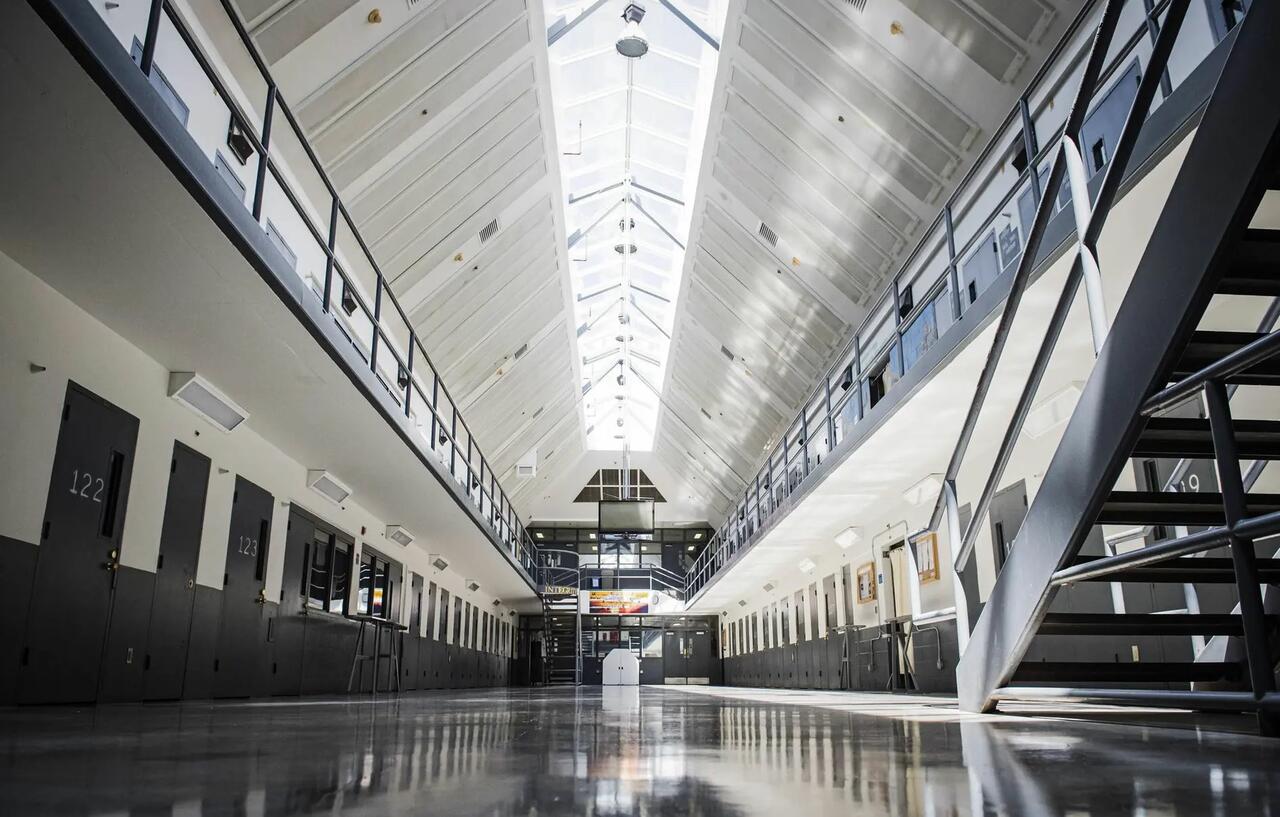
A prison cell block at the El Reno Federal Correctional Institution in El Reno, Okla., on July 16, 2015. (Saul Loeb/AFP via Getty Images)

The law requires police to collect fingerprints, photographs, and biometric data, which will be cross-checked with Oklahoma State Bureau of Investigation databases.

The failure of the federal government to address this issue … has turned every state into a border state,” said bill sponsor state Rep. Charles Mr. McCall said in a statement.

“Those who want to work through the process of coming to our country legally are more than welcome to come to Oklahoma; we would love to have them here. We will not reward [illegal immigration] in Oklahoma, and we will protect our state borders.”

U.S. border authorities have apprehended more than 9 million illegal immigrants nationwide under President Joe Biden, according to Customs and Border Protection (CBP) data.

Under the administration’s catch-and-release policy, many have been released into the United States and have taken up residence all over the country.

Texas’ law, Senate Bill 4, makes it a state crime to enter Texas outside legal ports of entry.

The new law was set to go into effect in March, but has been blocked and is currently tied up in the courts.

New Iowa, Tennessee, and Georgia Laws

Earlier this month, Iowa’s Republican Gov. Kim Reynolds signed Senate File 2340 into law.

The new law, which goes into effect July 1, makes it a misdemeanor to be in the state or attempt to enter the state after being deported, denied admission to the United States, or if an individual has an outstanding deportation order.

Being in the state illegally becomes a felony under certain circumstances such as the accused having two or more misdemeanor convictions involving drugs or crimes against a person.

As with the Texas law, it gives judges the discretion to drop the charges if the illegal immigrant agrees to return to the country from which he or she entered the United States.

Those who come into our country illegally have broken the law, yet Biden refuses to deport them,” Ms. Reynolds stated in a news release.

“This bill gives Iowa law enforcement the power to do what he is unwilling to do: enforce immigration laws already on the books.”

Tennessee Gov. Bill Lee signed a new law this month that requires law enforcement agencies to communicate with federal immigration authorities if they discover people are in the country illegally, requiring in most cases cooperation in the process of identifying, catching, detaining, and deporting them.

Texas Gov. Greg Abbott holds a press conference at Shelby Park in Eagle Pass, Texas, on Feb. 4, 2024. (Sergio Flores/AFP via Getty Images)

The law takes effect July 1.

“When there is an interaction with law enforcement, it’s important that the appropriate authorities are notified of the status of that individual,” Mr. Lee, a Republican, told reporters after signing the bill into law. “I think that makes sense. So, I’m in support of that legislation.”

Members of the Tennessee House blamed President Biden’s lack of border enforcement for the necessity of the law.

President Biden’s administration has delivered this pain to our doorsteps,” Tennessee state Rep. Chris Todd said on the House floor.

In Georgia, lawmakers passed House Bill 1105 that would require jailers to check the immigration status of inmates.

The bill is part of an ongoing political response to the February slaying of nursing student Laken Riley on the University of Georgia campus, allegedly by an illegal immigrant from Venezuela.

The man, Jose Antonio Ibarra, was arrested in February on murder and assault charges in the death of the 22-year-old.

Immigration officials say Mr. Ibarra, 26, crossed into the United States illegally in 2022. The Department of Homeland Security confirmed to Sen. Lindsey Graham(R-S.C.)  that Mr. Ibarra was paroled into the country illegally due to “capacity problems” at border detention facilities

The Georgia bill was sent to Republican Gov. Brian Kemp’s desk on April 3 and awaits his signature, at which time most measures would take effect immediately.

Louisiana, Arizona, New Hampshire

Texas’ neighbor, Louisiana, is considering the passage of SB 388, a GOP-led bill that would allow state police to arrest suspected illegal immigrants within the state.

The law passed the chamber on April 8 along party lines and headed to the House, also controlled by Republicans.

Louisiana is one step closer to securing our border and addressing our illegal immigration crisis,” Republican state Sen. Valarie Hodges, the bill’s sponsor, posted on X.

A National Guard soldier looks across the Rio Grande to Mexico on the border in Eagle Pass, Texas, on May 23, 2022. (Allison Dinner/AFP via Getty Images)

The battleground state of Arizona passed a law similar to Texas’ HB 4, but its Democratic Gov. Katy Hobbs vetoed it.

That inspired the Legislature to draft a ballot measure to be put to voters in November that would require businesses to use E-verify. E-verify is a voluntary federal online service for employers to check an employee’s eligibility to work in the United States against Department of Homeland Security and Social Security records.

New Hampshire, which is Republican-led, passed SB 504 allowing police to bring criminal trespassing charges against people suspected of illegally entering the United States from Canada. The measure must be approved by the House to advance.

Cities and Counties

Cities and counties in red and blue states are also pushing back in creative ways to stop illegal immigrants from coming into their jurisdictions.

They’re basically dumped on their doorstep,” said Jessica Vaughan, director of policy studies at the Center for Immigration Studies, a “pro-immigrant, low-immigration” think tank.

In June 2023, New York City under Democratic Mayor Eric Adams sued more than 30 New York local governments alleging they issued unlawful executive orders prohibiting temporary housing for illegal immigrants in their jurisdictions.

Counties such as Orange and Rockland in upstate New York were successful in using local zoning laws to stop the mayor from busing illegal immigrants to live in their hotels.

The state Supreme Court granted Rockland a temporary restraining order against the mayor’s plan after the county argued that local zoning laws bar hotels from operating as shelters.

Orange County was granted a similar ruling.

Likewise, zoning was used by the city of Taunton, Massachusetts, to stop illegal immigrants from living in hotels, Ms. Vaughan said.

In May 2023, the state was paying millions of dollars to house some 120 homeless and migrant families at a local hotel long-term.

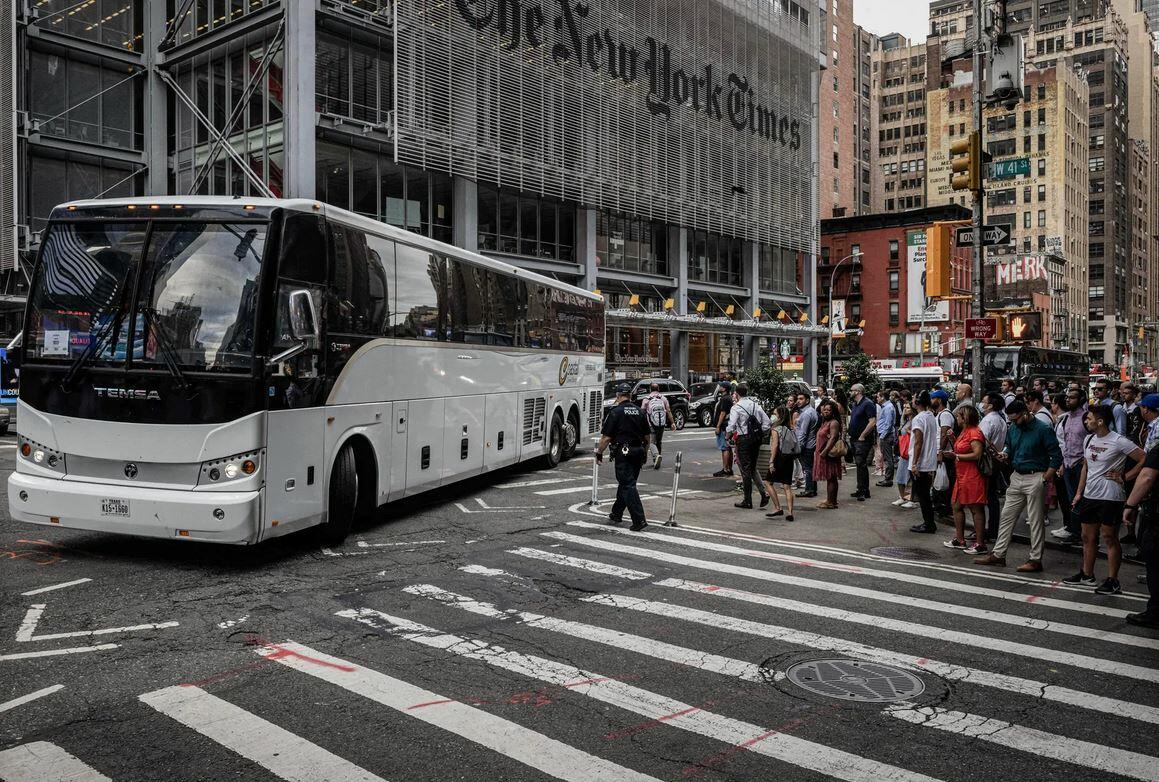
A bus carrying illegal immigrants from Texas arrives at Port Authority Bus Terminal in New York City on Aug. 10, 2022.

Taunton city leaders filed a lawsuit against the hotel, claiming it violated its occupancy limit for nearly four months. The city aims to collect $114,600 in fines.

Residents in these small communities often struggle with housing and obtaining services that illegal immigrants get for free, Ms. Vaughan noted.

Now paying taxes, essentially, to support these illegal migrants in their town. The schools have to accommodate them. And that’s a huge cost on the local taxpayers,” she said.

In Colorado’s Mesa County, commissioners passed a resolution in February declaring the county a “non-sanctuary county,” and denying shelter and services to illegal aliens sent there by the state or federal government, she said.

Commissioners also passed a resolution to send a letter to Denver Mayor Mike Johnston informing him the county doesn’t plan to help the city deal with its illegal immigrant surge.

Ms. Vaughan said that she believes other states are waiting to see what happens with some of Texas’ laws, such as SB 4, which are aimed at deterring illegal immigration.

“I think the feeling among most state and local officials that I’ve talked to about it is that they are watching and waiting and hoping that the court will draw some boundaries for them on what they can and cannot do,” she said.

Florida’s Laws

When it comes to making life more difficult for illegal immigrants through legislation, Florida has proven as aggressive as Texas.

Besides beefing up law enforcement to help the U.S. Coast Guard spot migrants and sending the Florida National Guard to Texas, Florida Gov. Ron DeSantis has approved laws to deter illegal aliens from staying in the Sunshine State.

The Republican governor signed SB 1718 in 2023, which was criticized by the left as one of the most anti-illegal immigrant pieces of legislation in the country.

Read more here…

Tyler Durden
Fri, 04/26/2024 – 12:45

via ZeroHedge News https://ift.tt/uIb4dKG Tyler Durden

20% Of Retail Milk Samples Positive For Bird Flu: FDA

20% Of Retail Milk Samples Positive For Bird Flu: FDA

Authored by Zachary Stieber via The Epoch Times (emphasis ours),

One in five samples of milk from grocery store shelves tested positive for the highly pathogenic avian influenza, the U.S. Food and Drug Administration (FDA) announced late April 25.

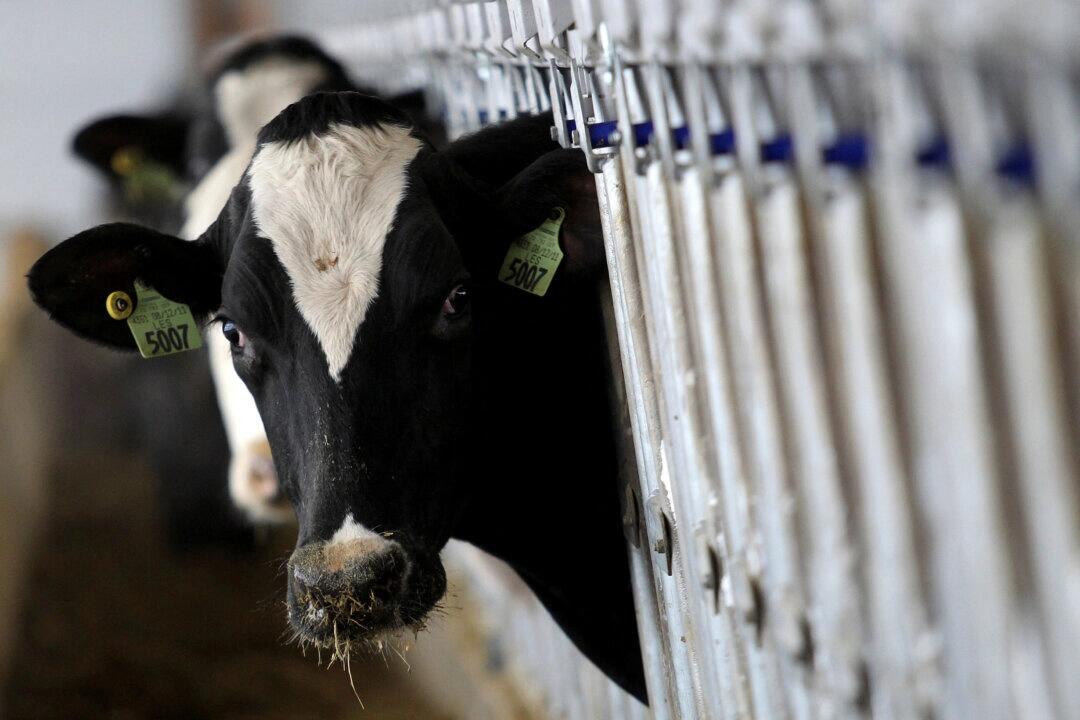
A dairy cow at a dairy farm in Ohio, on December 12, 2014. (Aaron Josefczuk/Reuters)

In a brief 237-word update, the FDA said that initial results from a national commercial milk sampling study “show about 1 in 5 of the retail samples tested are quantitative polymerase chain reaction (qPCR)-positive for HPAI viral fragments, with a greater proportion of positive results coming from milk in areas with infected herds.”

The FDA has refused to disclose how many samples it tested and from which stores the samples came, and a Freedom of Information Act request for the information has not yet yielded results.

Thirty-three cattle herds across eight states—Idaho, Kansas, Michigan, New Mexico, North Carolina, Ohio, South Dakota, and Texas—have tested positive for avian influenza, commonly known as the bird flu, according to the U.S. Department of Agriculture. Poultry in Minnesota and a person in Texas have also become infected with the same genotype of the H5N1 avian influenza strain found in cattle.

Authorities have stressed that positive results from qPCR testing do not mean the pasteurized milk contains intact virus, because the testing can return positive based on fragments of residual virus.

Additional testing is required to determine whether intact pathogen is still present and if it remains infectious, which would help inform a determination of whether there is any risk of illness associated with consuming the product,” the FDA said.

Testing includes injecting eggs with samples that tested positive and seeing whether any active virus replicates.

In another round of testing, conducted by a team from Ohio State University, 58 of 150 milk samples gathered from grocery stores across six states tested positive for bird flu.

“We’ve screened them for the presence of influenza genetic material, so the viral RNA. Those that have tested positive, we have been forwarded to St. Jude Children’s Research Hospital, where they are conducting studies to see if there’s a viable virus in there. To date, none of them have been viable, but certainly they give the indication that there is viral genetic material in the region,” Dr. Andrew Bowman, an associate professor at Ohio State University, told the Bovine Veterinarian magazine.

The fact that you can go into a supermarket and 30 percent to 40 percent of those samples test positive, that suggests there’s more of the virus around than is currently being recognized,” Richard Webby, a virologist at St. Jude’s, told STAT News.

The FDA has said it will release more details about the testing in the future. Raw milk from farms with affected cows has also tested positive for bird flu.

Authorities initially said that pasteurized milk was definitely safe but have since acknowledged that they’re not sure whether milk in grocery stores contains live bird flu virus. The FDA announced Tuesday that some samples tested positive for the influenza.

Officials say it’s still safe to drink milk but some outside experts, including former U.S. government official Rick Bright, have said they’re going to hold off until more information is made public about the outbreak.

The U.S. Department of Agriculture only required testing dairy cows showing symptoms of the flu but, starting Monday will require lactating cows to test negative before being moved across state lines.

The flu originated in birds but has since moved to other animals, including cattle and goats.

The person in Texas, and an individual in Colorado who became sick in 2022, are the only humans with confirmed cases of the H5N1 version in the United States.

Monitoring of people who have come into contact with animals has only covered 44 people so far, Sonja Olsen, an epidemiologist with the U.S. Centers for Disease Control and Prevention, told an Association of State and Territorial Health Officials webinar this week. Twenty-three people who showed symptoms were tested. The person in Texas, a farm worker, has been the only person to test positive so far.

Tyler Durden
Fri, 04/26/2024 – 12:05

via ZeroHedge News https://ift.tt/anM0sci Tyler Durden

Retail Sales Data Suggests A Strong Consumer Or Does It

Retail Sales Data Suggests A Strong Consumer Or Does It

Authored by Lance Roberts via RealInvestmentAdvice.com,

The latest retail sales data suggests a robust consumer, leading economists to become even more optimistic about more robust economic growth this year. To wit:

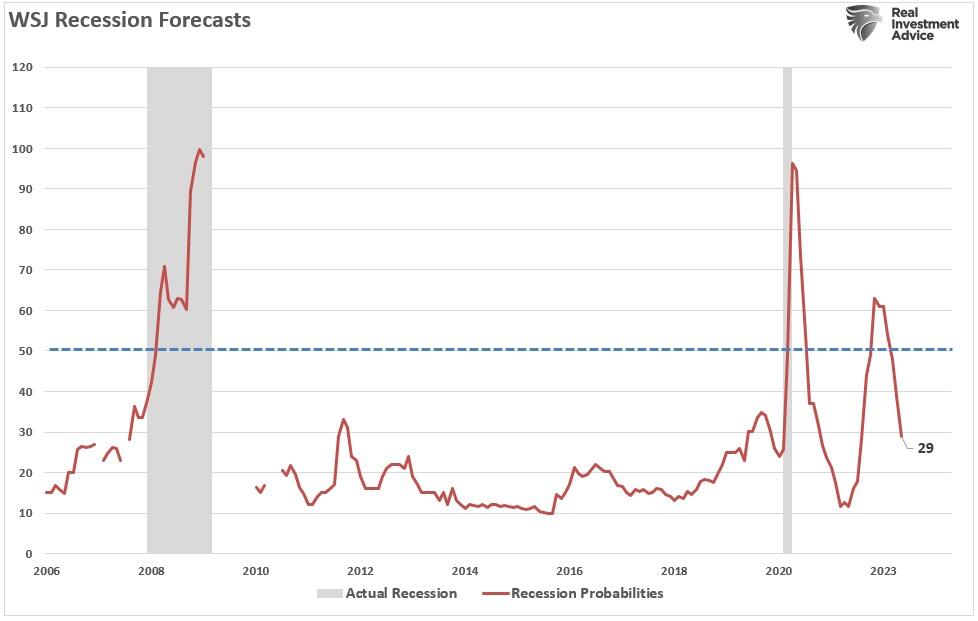
“It has been two years since forecasters felt this good about the economic outlook. In the latest quarterly survey by The Wall Street Journal, business and academic economists lowered the chances of a recession within the next year to 29% from 39% in the January survey. That was the lowest probability since April 2022, when the chances of a recession were set at 28%.

Economists don’t think the economy will get even close to a recession. In January, they, on average, forecast sub-1% growth in each of the first three quarters of this year. Now, they expect growth to bottom out this year at an inflation-adjusted 1.4% in the third quarter.” – WSJ

According to the March retail sales data, consumer spending added “fuel” to economists’ exuberance about this year.

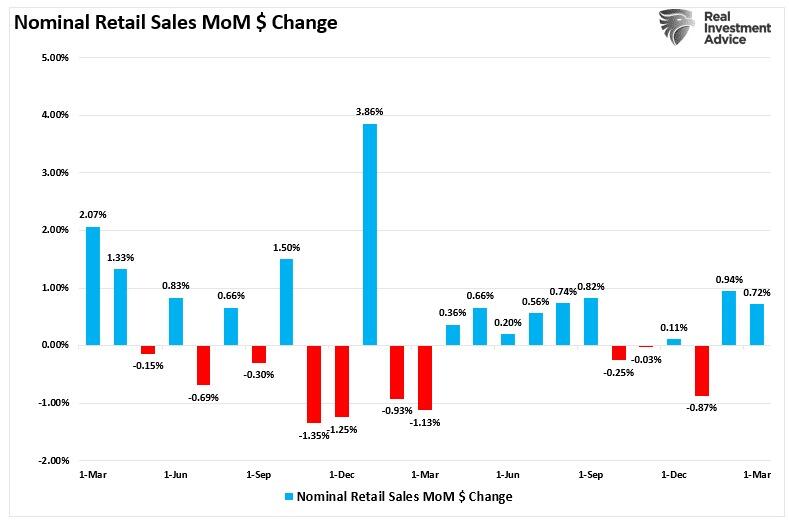
Rising inflation in March didn’t deter consumers, who continued shopping at a more rapid pace than anticipated, the Commerce Department reported Monday. Retail sales increased 0.7% for the month, considerably faster than the Dow Jones consensus forecast for a 0.3% rise though below the upwardly revised 0.9% in February, according to Census Bureau data that is adjusted for seasonality but not for inflation.” – CNBC

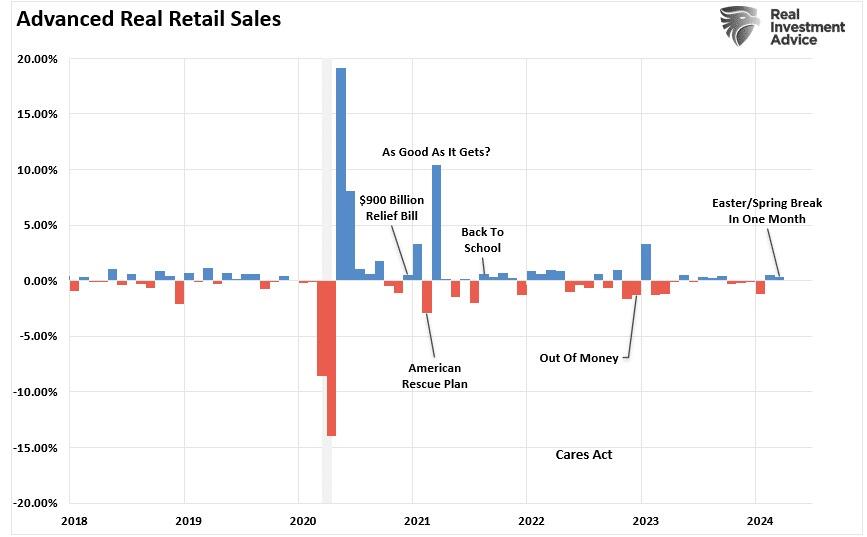
The chart below shows the monthly change in the retail sales data over the last two years.

While mainstream economists trumpeted the strength of the consumer, the March retail sales data had some interesting points worth noting.

First, retail sales data was extraordinarily weak from October to January, the traditionally strongest shopping months of the year. That period included Halloween, Thanksgiving, Christmas, and NYear’sr’s. So, to some degree, the strength of spending over the last two months is unsurprising as, eventually, consumers need to buy goods or services previously postponed.

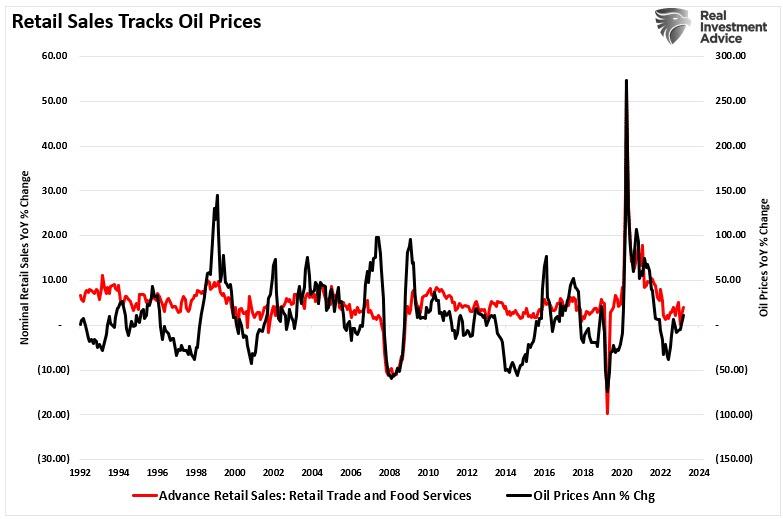
Secondly, while the March retail sales data was strong, it was weaker than February. However, March contained two significant spending periods, Spring Break and Easter, which generally don’t occur. Since Spring Break and Easter are considerable travel and shopping periods, it is unsurprising that the retail sales data increased with oil prices rising. As shown below, there is a very high correlation between nominal retail sales and oil prices.

Paying More For The Same Amount

Economists often overlook another important point about the retail sales data. As noted above, the March retail sales report was NOT adjusted for inflation. Furthermore, the report is in nominal “dollar volume” and not the amount of goods or services sold. Oil and gasoline prices are an excellent example of the issue with the retail sales data.

Let’s assume you own a car with 18-gallon fuel tank. Your daily activities are mostly going to work, going to the grocery store, eating out, having entertainment, etc. As such, you consume one tank of gas each week. Here is the math:

Week 1: 18-gallons of gas @ $3/gallon = $54.

That week, the store adds $54 to the monthly retail sales total for selling 18 gallons of gasoline. However, the price will increase to $4 per gallon next week.

Week 2: 18-gallons of gas @ $4/gallon = $72.

Here is the question.

While the retail sales data increased by $18 in week two, did the consumer purchase more gasoline? In other words, if the economy’s strength is ultimately measured by how much we produce (gross domestic product), then does spending more for the same amount of goods or services equate to a stronger economy?

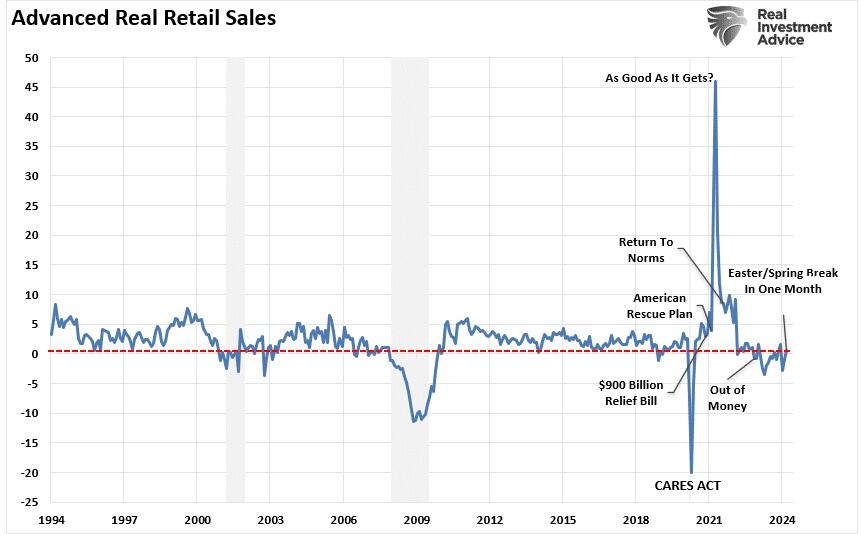
The picture is quite different if we adjust the nominal retail sales data for inflation. Again, it is unsurprising that even on an inflation-adjusted basis, retail sales rose in February after declining for four months previously. However, with March containing Spring Break and Easter, the data suggests a weaker consumer that headlines tout.

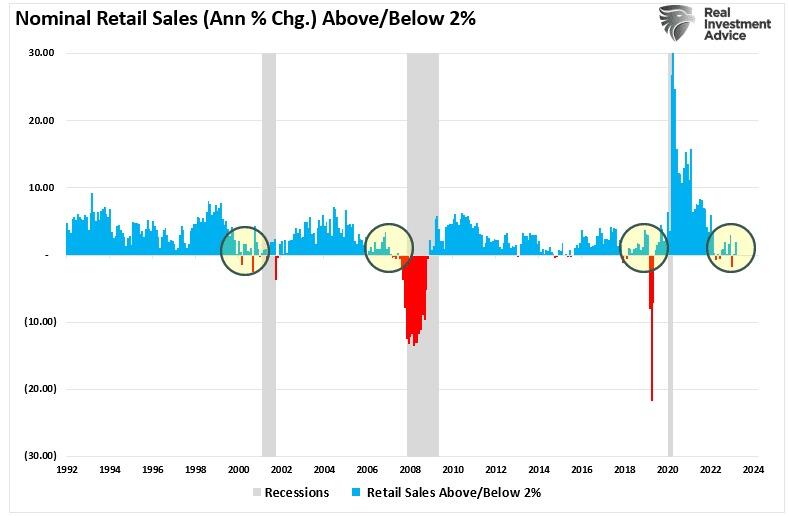
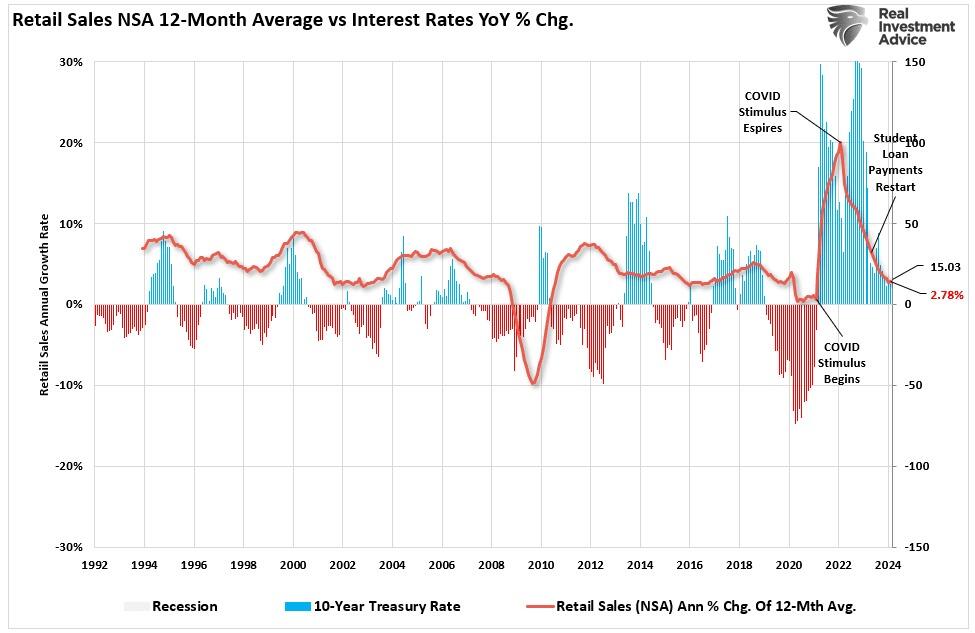
It is worth noting that retail sales data is not very useful in determining whether the economy is nearing a recession. As shown below, an annual growth rate of 2% has been a good marker for economic growth. As such, retail sales should grow at roughly 2% annually as well, given that personal consumption expenditures comprise approximately 70% of the economic equation. However, other than 2007, retail sales did not clarify economic strength.

In other words, spending more for the same amount of goods and services is not a sign of economic strength.

Economic Forecasts Tend To Be Erroneous

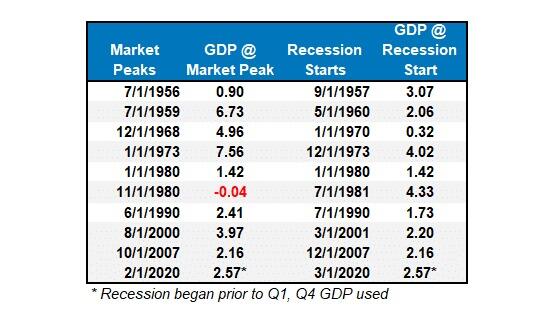
Furthermore, while the recent nominal sales data was robust, it is crucial to remember the economic data has a significant lag. Each of the dates below shows the economy’s growth rate immediately before the onset of a recession. You will note in the table that in 7 of the last 10 recessions, real GDP growth was running at 2% or above. In other words, according to the media, there was NO indication of a recession. But the next month, one began.

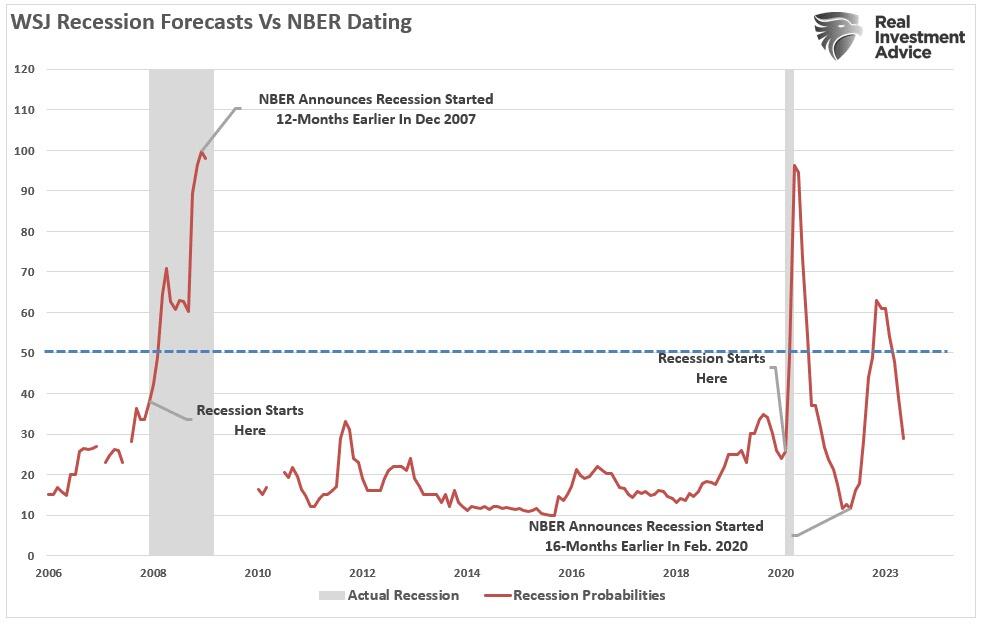
Crucially, I am not saying a recession is starting next month. However, I suggest that relying heavily on one month’s retail sales data to claim the economy avoided a recession is not likely ideal. Let’s revisit that chart of the WSJ economic forecast. I have added two notations: the start and end of recessions and when the NBER officially dated that period. As shown in both previous recessions, WSJ economists had a very low probability of the economy entering a recession just before it occurred.

The reality is that on an inflation-adjusted basis, the retail sales data suggests the consumer remains weak. While spending more to buy the same amount of goods or services may look good on paper, the average household has less money to spend elsewhere. As shown, the annual rate of change in real retail sales is near some of the lowest levels outside of a recession.

Lastly, consumer credit supporting retail sales will become more problematic with rising interest rates. Higher interest rates tend to reduce the average growth rate of retail sales data.

Our advice is to remain cautious about economic exuberance. Those forecasts are often disappointing.

Tyler Durden
Fri, 04/26/2024 – 11:05

via ZeroHedge News https://ift.tt/ue8RjMH Tyler Durden

JPY Plunges To Fresh 34-Year-Lows After BoJ Does Nothing… Again

JPY Plunges To Fresh 34-Year-Lows After BoJ Does Nothing… Again

Having already lost more than 10% of its value versus the US dollar this year, the yen plunged further overnight after Bank of Japan Governor Kazuo Ueda indicated monetary policy will stay easy as he kept rates unchanged and showed little to no support for the embattled currency during the press conference.

While investors had not expected the BoJ to change its policy this week, there was an expectations that Ueda would strike a hawkish tone regarding future rate rises to slow the yen’s decline.

Instead, Ueda said at a news conference on Friday that the central bank’s board members judged there was “no major impact” from the weaker yen on underlying inflation for now.

“Currency rates is not a target of monetary policy to directly control,” he said.

“But currency volatility could be an important factor in impacting the economy and prices. If the impact on underlying inflation becomes too big to ignore, it may be a reason to adjust monetary policy.

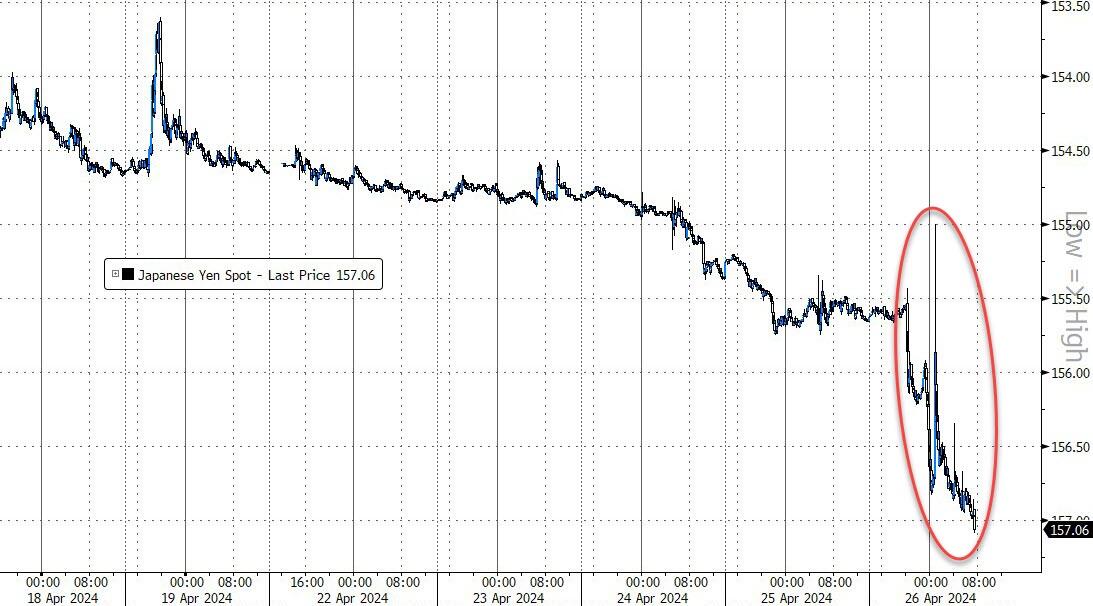
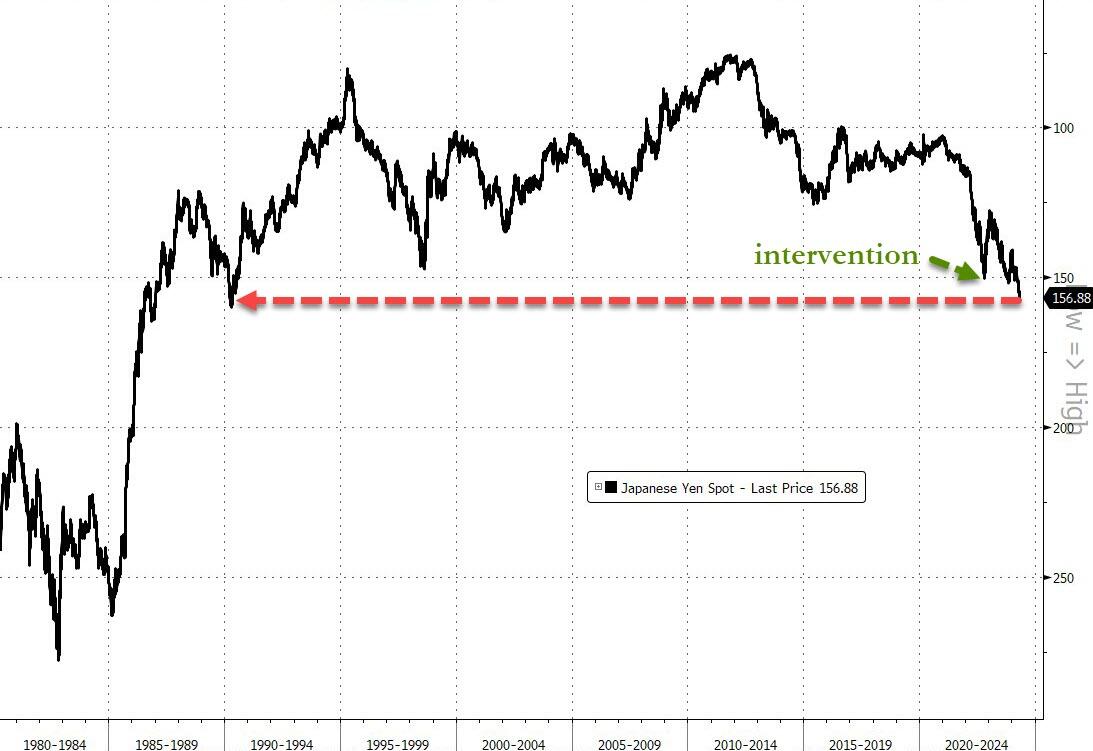
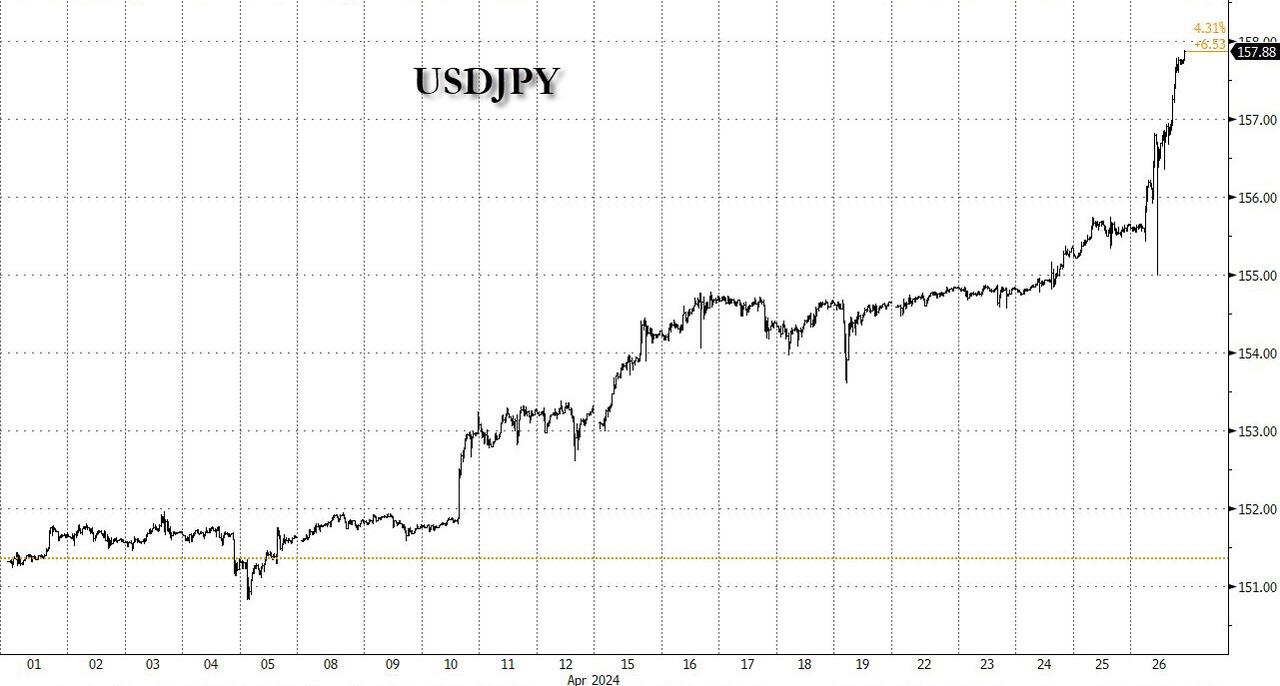
And that sent the currency reeling (amid chaotic swings) back above 157/USD…

Source: Bloomberg

“There is no intention by the BoJ to stop the yen’s decline, at least looking at its statement and its outlook report,” said UBS economist Masamichi Adachi.

“The finance ministry will have to act [to stem the yen weakness]… It would have been more effective if both the government and the BoJ faced the same direction,” he added.

Blowing further below the ‘interventionist’ levels seen previously to a fresh 34-year low…

Source: Bloomberg

“Markets remain on high alert for any indication of whether the yen’s current weakness will be interpreted as a lasting inflationary signal,” said Naomi Fink, global strategist at Nikko Asset Management.

“The BoJ however is likelier to find any knock-on impact from yen weakness upon inflation as more concerning than short-term currency moves.”

Driving the depreciation is the yawning gap between the interest rates in the US – which are at highest in decades after the Fed’s aggressive tightening cycle last year – and those in Japan, where borrowing costs remain stubbornly low near zero.

“Intervention is possible at anytime, but it could have been just someone selling a large lot, which stoked intervention speculation and spurred follow-through moves,” said Koji Fukaya, a fellow at Market Risk Advisory Co. in Tokyo.

“It does not look like intervention, but the only way to confirm is to check data that will be released later by the Ministry of Finance.”

Policymakers have repeatedly warned that depreciation won’t be tolerated if it goes too far too fast.

Finance Minister Shunichi Suzuki reiterated after the BoJ meeting that the government will respond appropriately to foreign exchange moves.

Potential triggers for interventions are public holidays in Japan on Monday and Friday next week, which bring the risk of volatility amid thin trading.

“Should the yen fall further from here, like after the BOJ decision in September 2022, the possibility of intervention will increase,” said Hirofumi Suzuki, chief currency strategist at Sumitomo Mitsui Banking Corp.

“It is not the level but it’s the speed that will trigger the action.”

But so far, nothing! And so the market continues to call Ueda and Suzuki’s bluff, knowing full well that a sudden intervention will perhaps briefly support the currency but will pancake the current gains in Japanese stocks.

However, not everyone is convinced intervention is imminent.

In a note this morning, Deutsche Bank says the currency’s decline is warranted and finally marks the day where the market realizes that Japan is following a policy of benign neglect for the yen.

We have long argued that FX intervention is not credible and the toning down of verbal jawboning from the finance minister overnight is on balance a positive from a credibility perspective. The possibility of intervention can’t be ruled out if the market turns disorderly, but it is also notable that Governor Ueda played down the importance of the yen in his press conference today as well as signalling no urgency to hike rates. We would frame the ongoing yen collapse around the following points.

  1. Yen weakness is simply not that bad for Japan. The tourism sector is booming, profit margins on the Nikkei are soaring and exporter competitiveness is increasing. True, the cost of imported items is going up. But growth is fine, the government is helping offset some of the cost via subsidies and core inflation is not accelerating. Most importantly, the Japanese are huge foreign asset owners via Japan’s positive net international investment position. Yen weakness therefore leads to huge capital gains on foreign bonds and equities, most easily summarized in the observation that the government pension fund (GPIF) has roughly made more profits over the last two years than the last twenty years combined.

  2. There simply isn’t an inflation problem. Japan’s core CPI is around 2% and has been decelerating in recent months. The Tokyo CPI overnight was 1.7% excluding one-off effects. To be sure, inflation may well accelerate again helped by FX weakness and high wage growth. But the starting point of inflation is entirely different to the post-COVID hiking cycles of the Fed and ECB. By extension, the inflation pain is far less and the urgency to hike far less too. No where is this more obvious than the fact that Japanese consumer confidence are close to their cycle highs.

  3. Negative real rates are great. There is a huge attraction to running negative real rates for the consolidated government balance sheet. As we demonstrated last year, it creates fiscal space via a $20 trillion carry trade while also generating asset gains for Japan’s wealthy voting base. This encourages the persistent domestic capital outflows we have been highlighting as a key driver of yen weakness over the last year and that have pushed Japan’s broad basic balance to being one of the weakest in the world. It is not speculators that are weakening the yen but the Japanese themselves.

The bottom line, Deutscxhe concludes, is that for the JPY to turn stronger the Japanese need to unwind their carry trade. But for this to make sense the Bank of Japan needs to engineer an expedited hiking cycle similar to the post-COVID experiences of other central banks. Time will tell if the BoJ is moving too slow and generating a policy mistake. A shift in BoJ inflation forecasts to well above 2% over their forecast horizon would be the clearest signal of a shift in reaction function. But this isn’t happening now.

The Japanese are enjoying the ride.

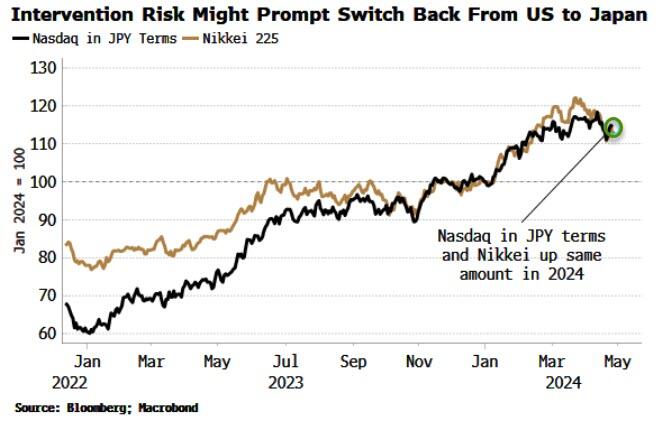
But there is potential for yen upside as Bloomberg’s Simon White notes that profit taking on foreign asset positions might soon prompt some yen repatriation and pressure USD/JPY lower.

If it is perceived that the yen won’t get much cheaper due to intervention risk, domestic investors might choose to start switching some of their US equity positions back to the domestic market, repatriating yen and pressuring USD/JPY lower in the process.

The chart below shows that on the year, the Nasdaq in yen terms and the Nikkei are both up by the same 13%-14% on the year. A stronger yen would present an ongoing headwind to the US position.

Equity positions are typically less FX hedged than bond positions, meaning that the repatriation of the currency is not neutered by the unwind of the hedge.

The dynamics of spot trading, options barriers and potential intervention as well as US PCE data released later today will dominate the currency’s short-term gyrations, but the slightly longer-term considerations of profit taking on foreign positions will start to drive the medium-term outlook.

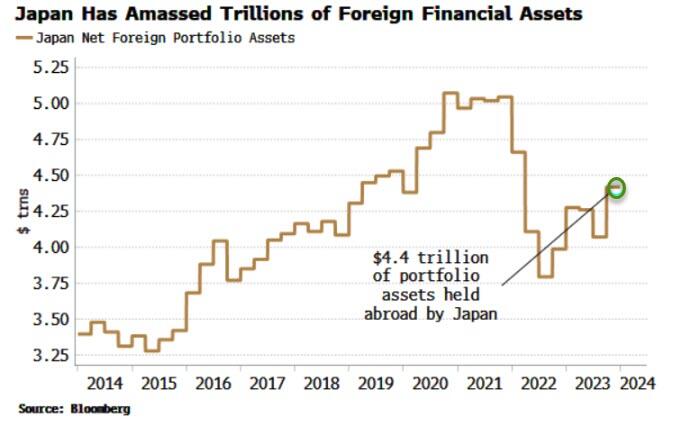
Once that trend establishes itself, longer-term drivers of the yen will come into focus. Japan is the world’s largest net creditor, and there is a significant structural short in the yen.

The country’s net international investment position is $3.3 trillion, but its net position in portfolio assets, i.e. so-called hot flows that could be liquidated quickly, is $4.4 trillion.

Only a fraction of that being repatriated has significant potential to drive the yen considerably higher.

The question is, how much pain is China willing to take from its regional neighbor’s ‘devaluation’?

Tyler Durden
Fri, 04/26/2024 – 10:50

via ZeroHedge News https://ift.tt/4mHNGPV Tyler Durden

Yuan Devaluation Fever Heats Up As China Stockpiles Metals

Yuan Devaluation Fever Heats Up As China Stockpiles Metals

Authored by Simon White, Bloomberg macro strategist,

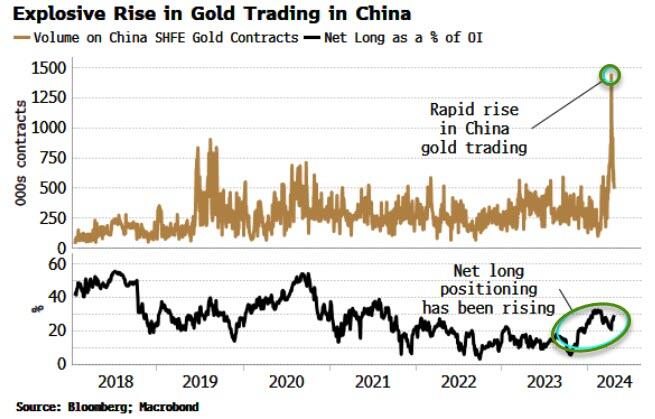
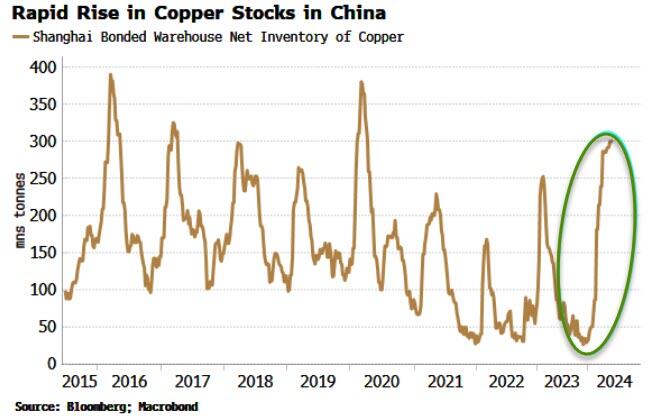
Gold trading in China has exploded and stocks of copper have risen sharply prompting speculation that policymakers are on the brink of a yuan devaluation. Even though it’s still a tail-risk, it’s one requiring greater vigilance as the economy becomes increasingly deflationary, redoubling capital outflow pressures.

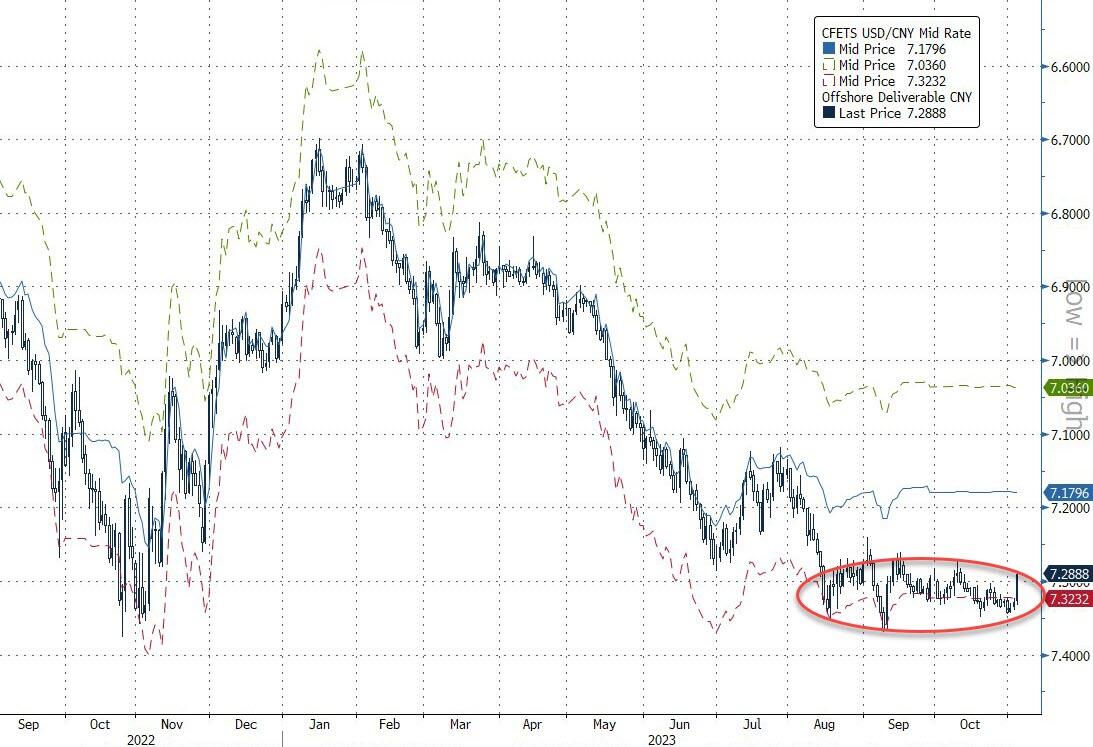
The yuan has been steadily falling versus the dollar this year. So far the decline has been measured, but activity in commodities has prompted conjecture that China is about to orchestrate a significant one-off yuan devaluation. Futures gold trading in China has moved sharply higher, and the net long position has been rising.

Also, there has been a sharp rise in China’s copper stocks. Copper as well as other commodities is used as a source of collateral in China.

USD/CNY has been bumping up against the upper band of the PBOC’s fix for the currency pair.

China has a nominally closed capital account, but it is de facto leaky. Capital outflow is rising, and this puts further pressure on the economy as it has a geared negative effect on domestic liquidity.

Allowing the yuan to depreciate against the dollar (it is appreciating against most other currencies) takes some of the pressure off.

China, though, has been unofficially intervening, via the state banks, to stabilize the yuan’s fall.

Nonetheless, it is still less likely than not they will countenance a significant devaluation of the yuan versus the dollar.

  • First, it would compromise the financial stability that China has sought to obtain.

  • Second, it risks a tariff backlash from the US.

  • Third it may be counter-productive if it looks panicky and prompts even more capital outflow.

The stockpiling could well be for other reasons.

  • Rising global inflation risks (there is more to come, and even China will likely soon face consumer inflation);

  • reserve diversification in a more multi-polar world;

  • and raw materials for solar (AI needs a lot of energy) and EVs, and so on.

  • China planning for an invasion of Taiwan is another tail-risk that can’t be completely discounted.

Falling bond yields, though, show China is nearing a crunch point (read why here) and will need to do something soon to avert a debt deflation.

Even though a full-scale devaluation is less likely, it’s a non-negligible risk that can’t be ignored.

Tyler Durden
Fri, 04/26/2024 – 10:35

via ZeroHedge News https://ift.tt/IQglqtb Tyler Durden

George Soros Paying Student Agitators To Whip Up Anti-Israel Protests

George Soros Paying Student Agitators To Whip Up Anti-Israel Protests

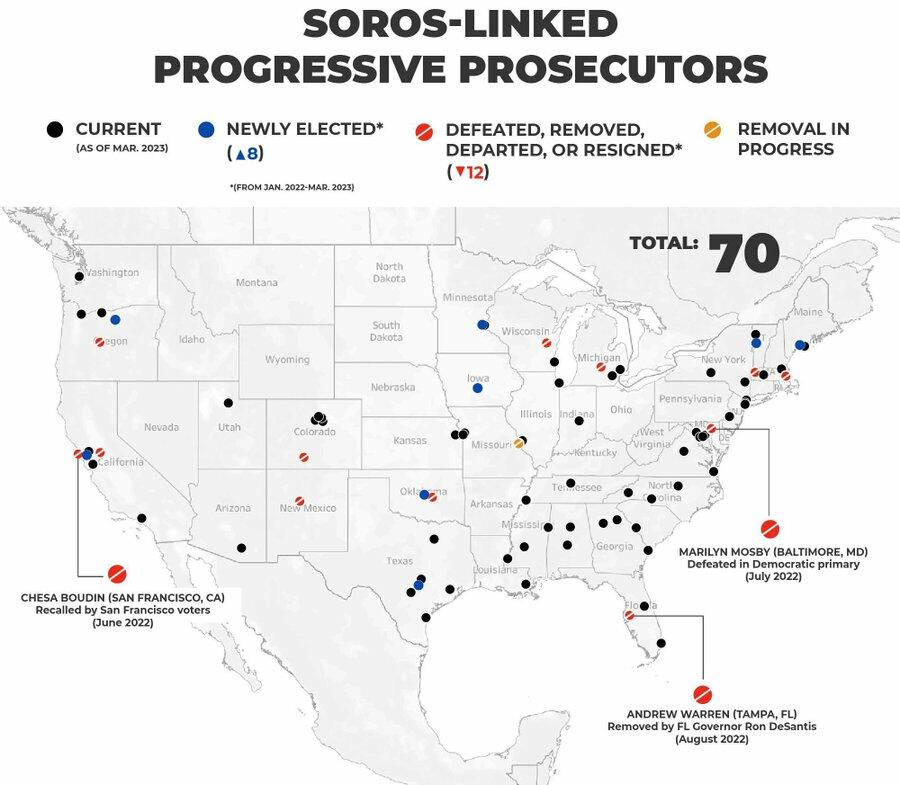
George Soros and his far-left movement is paying student agitators to co-opt and amplify anti-Israel protests at colleges across the country, the NY Post reports.

The protests, which began at Columbia University, have expanded nationwide – with copycat tent cities erected at colleges including Harvard, Yale, Berkeley in California, the Ohio State University and Emory in Georgia, with organized branches of the Soros-funded Students for Justice in Palestine (SJP) having organized them.

Which might explain this:

The parent organization of SJP has been funded by a constellation of nonprofits which all lead to Soros.

At three colleges, the protests are being encouraged by paid radicals who are “fellows” of a Soros-funded group called the US Campaign for Palestinian Rights (USCPR).

USCPR provides up to $7,800 for its community-based fellows and between $2,880 and $3,660 for its campus-based “fellows” in return for spending eight hours a week organizing “campaigns led by Palestinian organizations.”

They are trained to “rise up, to revolution.”

The radical group received at least $300,000 from Soros’ Open Society Foundations since 2017 and also took in $355,000 from the Rockefeller Brothers Fund since 2019. -NY Post

The group has three “fellows” who have helped propel the protests into a nationwide phenomenon, which you can read more about here

We’re sure if the protests get violent, prosecutors will take appropriate action, yes?

And while many of the protesters are just morons…

Some of them are quite spicy, like the leader of Columbia’s encampment…

Tyler Durden
Fri, 04/26/2024 – 10:15

via ZeroHedge News https://ift.tt/L6kURrp Tyler Durden