Luxury DC Apartment Building Replaces Front Desk Staff With Amazon Lockers, Sparking Tenant Protest
Tenants of a luxury apartment building blocks from the White House were furious this week after they discovered the building’s management company fired all front desk workers and replaced them with Amazon delivery lockers.
Journalist Samuel Breslow of the media outlet The Forward wrote on X about tenants of CityCenterDC, a mixed-use development consisting of two condominium buildings, two rental apartment buildings, two office buildings, and a luxury hotel, on 10th St NW, or about a five-minute walk to the White House, “protested the surprise decision to fire front desk staff, replacing them with Amazon delivery lockers.”
Tenants of the @CityCenterDC luxury apartments are protesting a surprise decision to fire front desk staff, replacing them with Amazon/@minnowpod delivery lockers.@Hines management prepared a presentation to try to appease; they didn’t get beyond the first slide.#CityCenterDCpic.twitter.com/Zx4wK0Ov8I
The building described the move to replace human workers with Amazon lockers as a “technology advancement aimed at enriching your stay.”
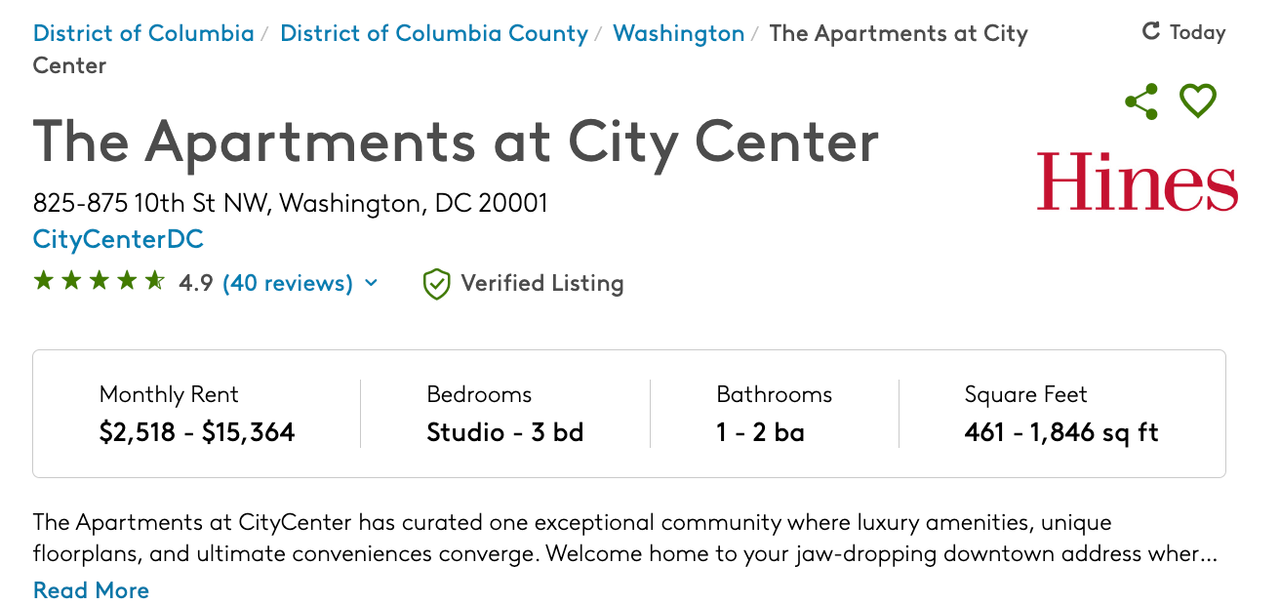
Apartments.com shows that CityCenterDC’s rent ranges from $2,500 a month for a studio to $15,300 for a luxury apartment.
On Instagram, user washingtonianprobspostedBreslow’s story. Folks there weren’t thrilled:
“All the crime and violence goin around the last thing they should do is leave the front desk unattended,” one Instagram user said.
Someone asked: “How did the property management company think that replacing the front desk ppl with lockers is the same?”
“Goes to show how disconnected they are with people outside of their status. They don’t realize that replacing front desk staff with storgage boxes is taking away jobs from people and altering folks livelihood,” another user said.
Launched in 2017, Saudi Arabia’s NEOM, a sprawling high-tech development on the northwestern Red Sea coast, was introduced as the crown jewel of Vision 2030. This futuristic desert megaproject, extending over some Jordanian and Egyptian territory, was cast as a bold leap toward economic diversification under the leadership of Saudi Crown Prince Mohammed bin Salman (MbS). But, recent geopolitical setbacks have raised significant concerns about the viability of some of NEOM’s components.
Initially celebrated for its revolutionary design, The Line, a linear city within NEOM, was to redefine urban living. Yet, recent reports suggest a dramatic scaling back. Earlier this month, Bloomberg revealed a massive reduction in the metropolis’ scope – from 105 to 1.5 miles – and a decrease in likely inhabitants from 1.5 million to fewer than 300,000 by 2030. Furthermore, funding uncertainties and workforce reductions indicate a project in jeopardy.
While this adjustment does not signify a wholesale failure of Vision 2030, it does prompt a re-evaluation of the project’s most ambitious elements.
Experts suggest that The Line’s original scale was overly optimistic, lacking the necessary urban infrastructure for such an innovative endeavor. Financial and geopolitical challenges, including regional instability and insufficient foreign direct investment, further complicate NEOM’s future.
Not so straight-forward
The drastic downsizing of The Line “appears to be a reassessment of timeline feasibility,” Dr Robert Mogielnicki, a senior resident scholar at the Arab Gulf States Institute in Washington, tells The Cradle. “There are many experimental, world-first dimensions within the NEOM gigaproject, and some are eventually going to need rightsizing or rethinking.”
Also speaking to The Cradle, Dr Kristian Coates Ulrichsen, a Baker Institute Fellow at Rice University, believes the project’s contraction to be a good thing:
Reports that The Line may be scaled back significantly is actually a positive move if it injects greater realism into a project whose initial scale appeared fanciful and difficult to translate into reality. Greater pragmatism in designing and delivering the gigaprojects associated with Vision 2030 is a good thing and means there is a greater likelihood of the projects making it off the drawing board.
Given financial and economic factors, The Line was never feasible as initially presented. Ultimately, the amount of wealth the Saudis generate from oil is not enough to finance the most ambitious of MbS’ Vision 2030 projects. And Riyadh has not been able to lure the levels of foreign direct investment needed to make these extremely expensive vanity projects realizable.
“The vast scope of [The Line] always struck me and many other observers as aspirational rather than realistic,” explains Gordon Gray, the former US ambassador to Tunisia.
Some analysts have pushed back against the recent avalanche of negative media coverage…
All the gloating about NEOM getting scaled back misses the point.
NEOM is a “moonshot” that has already succeeded.
It totally shifted the parameters of acceptable ambition in Saudi Arabia and made people see the kingdom within a paradigm of development.https://t.co/UjAX5CSdfM
Speaking to The Cradle, Ryan Bohl, a Middle East and North African analyst at risk intelligence company RANE, says:
I’d argue that the goals for The Line were unrealistic from the start, given that there’s virtually no urban infrastructure in the area, and it’s very difficult for cities to be started from scratch like that, regardless of the amount of investment poured in. Even if Saudi Arabia had, for example, done something extreme like declare NEOM to be their new capital city, it would still probably struggle to attract residents as we’ve seen from other historical examples like Brazil’s shift of its capital to Brasília.
Nonetheless, The Line and other singular projects had a purpose that was not necessarily about actually implementing the projects themselves. “The point of The Line, in particular, was to create a raison de parler – for people to actually talk about Saudi Arabia, to create a massive public debate globally where people are saying there’s something amazing happening in the desert,” Dr Andreas Krieg, an associate professor at King’s College London, tells The Cradle.
It attracts attention. That sort of discourse – positive or negative – creates a buzz. That buzz was supposed to attract investors who wanted to be a part of this, help Saudi Arabia build a city of the future, and try to do something completely outlandish and absolutely unconventional.
Gaza: a wrench in the works
The leadership in Riyadh has understood that the success of Vision 2030 heavily depends on attracting substantial foreign direct investment into the Kingdom. Ultimately, stability in Saudi Arabia and the wider West Asian region is crucial.
Consequently, Riyadh’s recent foreign policy has been less ideological, focusing instead on maintaining amicable terms with all major players in West Asia to advance Saudi business, commercial, and economic interests.
Within this context, Riyadh has worked to reach a peace deal with Yemen’s Ansarallah resistance movement, made an effort to preserve the Beijing-brokered 2023 Saudi–Iranian détente, restored relations with Qatar and Syria, and mended fences with Turkiye.
Therefore, beyond financial and economic constraints that require a reassessment of the most ambitious Vision 2030 projects, such as The Line, Israel’s brutal six-month war on Gaza and the expansion of that conflict into the Red Sea have created headwinds for Saudi Arabia’s geoeconomic plans.
As Arhama Siddiqa, a Research Fellow at the Institute of Strategic Studies Islamabad, explains to The Cradle:
Given the current instability in the Red Sea region, investors may hesitate to support a large-scale project like NEOM due to perceived risks. Even if the direct security threat to NEOM is minimal, the overall instability in the area can deter investors from committing substantial resources to a long-term venture. Additionally, the broader [West Asia] conflict further complicates the situation, adding another layer of uncertainty. Addressing these security concerns could require Saudi Arabia to allocate more resources to regional security measures, potentially diverting funds from the NEOM project.
There is no denying that Saudi Arabia’s economic diversification agenda is vulnerable to naval operations in the Red Sea. NEOM and other Red Sea projects require vessels to be able to freely travel from the Gulf of Aden through the Bab al-Mandab and up to Saudi Arabia’s west coast.
THE LINE, @NEOM ‘s groundbreaking vertical city, reimagines urban living: no roads, cars, or emissions – just 5 minutes to all you need. Powered by the world’s latest tech for sustainability, connectivity, lifestyle. pic.twitter.com/If1mGAM3wV
The Gaza war’s potential spillover into this vital waterway continues to raise concerns for Saudi officials about the impact on the Kingdom’s Vision 2030. These dynamics help explain Riyadh’s frustration with the White House for not leveraging its influence over Israel to negotiate a ceasefire in Gaza. It has led to Saudi Arabia’s decision to abstain from joining any US-led security initiatives and military operations in the Red Sea and Yemen.
The Israel–NEOM connection
Israel’s geographic proximity to northwestern Saudi Arabia, its technological advancement, and its vibrant startup culture position the occupation state as a promising partner for Vision 2030 and the NEOM project, particularly in biotechnology, cybersecurity, and manufacturing.
Writing in March 2021, Dr Ali Dogan, previously a Research Fellow at the Leibniz-Zentrum Moderner Orient, went as far as arguing that “relations with Israel are necessary for Saudi Arabia to complete NEOM.”
Dr Mohammad Yaghi, a research fellow at Germany’s Konrad Adenauer Stiftung, similarly stated that NEOM “requires peace and coordination with Israel, especially if the city is to have a chance of becoming a tourist attraction.” However, Saudi Arabia’s leadership role in the Islamic world, exemplified by the monarch’s title as the “Custodian of the Two Holy Mosques,” makes any formal normalization of relations with Tel Aviv highly sensitive.
Initially, it was thought that while the UAE and Bahrain could establish overt relations with Israel, Saudi Arabia would continue to engage covertly, ensuring essential collaborations like those rumored in the tech sector could progress discreetly.
An example being in June 2020, when controversy arose over Saudi Arabia’s alleged engagement with an Israeli cybersecurity firm, which the Saudi embassy later denied.
Yet, almost seven months into Israel’s campaign to annihilate Gaza, can Saudi Arabia still look to Tel Aviv as a partner in NEOM? It appears that amid ongoing crises in the region, chiefly the Gaza genocide, Riyadh must be careful to avoid being seen as cooperating with the Israelis in covert ways, and full-fledged normalization seems off the table for the foreseeable future.
Nonetheless, after the dust settles in Gaza and the Red Sea security crisis calms down, Saudi Arabia will likely maintain its interest in fostering ties with Israel as part of an “economic normalization” between the two countries. This could be important to Vision 2030’s future, particularly in NEOM. But Israel’s unprecedented military campaign in Gaza will likely alter West Asia in many ways for decades to come. Even after the current war in Gaza is over, anger toward Israel and the US will continue.
Without a doubt, the Israeli–NEOM connection will be increasingly sensitive and controversial, both in the Kingdom and the wider region – a factor that the leadership in Riyadh cannot dismiss.
Secret Service Agent Assigned To Kamala Harris Hospitalized After Fighting Other Agents
A Secret Service agent assigned to protect Vice President Kamala Harris got into a physical altercation with several other agents Monday morning around 9 a.m. near Joint Base Andrews, located near Washington DC.
The agent in question was immediately “removed from their assignment,” the Secret Service told the NY Post.
“A US Secret Service special agent supporting the Vice President’s departure from Joint Base Andrews began displaying behavior their colleagues found distressing,” said Anthony Guglielmi, chief of communications.
According to CBS News, “the agent spouted gibberish, was speaking incoherently and provoked another officer physically,” and “pushed the special agent in charge while they were near the lounge of Joint Base Andrews.”
They were immediately handcuffed and detained by other Secret Service agents who intervened, and ambulances were called to the scene. An initial medical evaluation concluded that there was no indication of substance abuse.
The USSS remains in a temporary holding pattern until further information becomes available, the sources said. After the agent receives additional medical attention and further evaluation, it will be determined if they can return to work. An internal review will be conducted and the USSS will assess if the agent’s top secret security clearance will be removed for medical or disciplinary reasons, sources explained. -NBC News
Harris was at the Naval Observatory at the time according to the USSS, and the incident had “no impact on her departure from Joint Base Andrews” on the day in question.
According to RealClearPolitics journalist Susan Crabtree, “there are DEI concerns among the USSS community about the hiring of this agent,” adding “Other agents and officers within the USSS are asking questions about the agent’s hiring process, whether the USSS did enough to look into the agent’s background and monitor the agent’s mental well-being…”
Other details: Sources say the agent in question was acted erratically upon showing up for a traveling shift at Joint Base Andrews. The agent ended up tackling the Senior Agent in Charge of the VP detail, got on top of him and started punching him. At this point, I’m told, the…
One of them is known as the fallacy of post hoc ergo propter hoc.
It’s Latin for “after this, therefore because of this.”
The classic example concerns the rooster and the sunrise.
Every morning before the sun comes up, the rooster does his crazy crowing routine, waking up everyone around. Shortly after, the light begins to appear on the horizon.
If you knew nothing else, and you watched this happen over and over, you might conclude that the rooster is causing the sun to rise.
Of course, this is testable. You could kill the rooster and see what happens. The sun still comes up. But wait just a moment. Just the fact that this one rooster is dead doesn’t mean that all roosters are gone. Some rooster somewhere is crowing and causing the sun to rise. So your little experiment doesn’t disprove the theory.
What a conundrum, right?
If someone is convinced that a bird is controlling the sun, there is probably no way to convince him otherwise.
We can laugh at this example. How can someone be so dumb? Actually, this basic fallacy affects all science in all times, all places, and all subjects. The presumption that a regular pattern showing something happens and then something else happens with regularity implies causation is baked into human thinking. Now and always.
It’s a fallacy, meaning that it is not necessarily true. It could be true, however, subject to serious investigation. And therein lies the real problem. We need to figure out what causes what. But discerning causal agents from accidental ones is the biggest issue in all thinking.
The need to know is baked into what it means to be a rational creature. We just cannot help ourselves. That’s why this fallacy persists everywhere.
There is also the famous case of malaria. It was once believed that infections were worse at nightfall, so the theory was that it was caused by cold air at night. Not crazy, right? Except that the real reason was that the mosquitoes came out in the evenings. They were the real culprit. But a bad theory based on fallacy prevented many people from seeing it.
My goodness, we were overwhelmed by this during the COVID-19 experience. The fake science was overwhelming.
Day after day, we saw loads of fake science of this sort being dumped on the world.
Look, California’s cases are down and California bans gatherings, therefore coercive measures are controlling virus spread!
Not so fast.
These factors could be completely unrelated. We might not even have good data on infections at all. Those are subject to testing (accurate or not) and might be completely wrong on a population level. Even if the data were correct, the low infections could be caused by weather, prior immunity, or something else that we have not considered.
Early on, I can recall looking at these amazing real-time charts of infections and deaths and believing that I had a window into reality. Several times, I even posted things along the lines of “See, Arizona has achieved herd immunity,” without understanding that the data were wildly inaccurate and subject to testing, reporting, and a host of other factors. Even the data were suspect: Misclassification was rampant.
And here too, the fallacy of post hoc ergo propter hoc bit everyone extremely hard. But most of us went along with it.
So crazy did it all become that people including bureaucrats at the Centers for Disease Control and Prevention started inventing nutty theories such as that masking protects against virus spread, which science had long proven to be untrue. It became even crazier: You can sit without a mask but walking and standing causes viruses to spread, so that’s when you have to wear a mask!
Absolutely nuts!
It was the same after vaccination.
Countless famous people took to social media to announce they had COVID-19 but it was a mild case thanks to the vaccine. There is simply no way they could know that. They knew for sure that they had the vaccine and they knew for sure that their case of COVID-19 was mild. But believing that one caused the other was simply a matter of faith. It might have been mild regardless. It might have been milder. As time went on, we encountered many studies showing that more vaccination was associated with more infection. Did one cause the other? It’s hard to say.
And yet vast numbers of vaccine studies in the past several years have been affected by this problem. Particularly vexing is the problem of the “healthy user bias,” which is that people who were vaccinated tend to be more compliant and conscientious in other ways too, which meant that initially, it seemed like they had better health outcomes from COVID-19 vaccination, but the results were actually attributable to this bias.
This was revealed in later studies. But the problem of discerning cause and effect from random noise still persists.
The field of medicine has long dealt with this problem. We are mortified that the practice of bleeding patients persisted for centuries even up to the 19th century. How could they have been so stupid? Well, they had a theory that disease was caused by bad humors in the blood so it needed to be drained. Then they observed that the patient got better.
Well, the patient might have gotten better anyway and even faster without bleeding. But it took many centuries to finally realize that. Many non-allopathic medicine people had been screaming about this issue for a long time, but they were ignored as cranks. That’s because bleeding was a conventional practice endorsed by the people with the most professional prestige.
Once you see this fallacy at work, you cannot unsee it. It’s everywhere in medicine but also in economics, health, horticulture, law and sociology, and all the physical world sciences. The gun debate is a good example. There is high crime and there are lots of guns, so people conclude that the guns cause the crime, whereas the presence of guns might simply be a response to crime and a means of protection. Without them, the crime would be far worse.
The fallacy in question drives vast amounts of politics today. There is a tendency to blame any existing president for all existing economic conditions, but the real cause might date further back in time. Still, nearly every debate follows the same lines: This happened; therefore, his actions or inactions caused it. It could be true or it might be the same as the rooster and the sunrise.
We flatter ourselves now that we are beyond such fallacies. They belong only to the superstition-ridden ages of the past. That’s complete nonsense. We are probably more inundated by this fallacy now than ever. Whatever it is that people trust and believe in at any particular time is what people identify as the key to curing whatever malady is around.
Today, people believe in pharmaceuticals. Whatever the issue is, it can be solved by a new lab-created potion. As a result, we are soaked as a society in these, even though the evidence for many of them is scant. The more you look at, for example, the effect of psychiatric drugs, the less it becomes clear whether and to what extent these help or actually may worsen the real problem.
It’s even true with antibiotics. All parents use amoxicillin on childhood ear infections today. But my grandmother swore by putting warm mineral oil in the ear and avoiding conventional meds completely. It took me only a few minutes to discover a 2003 study that randomized whether kids got herbal oils with or without antibiotics. Results: no difference.
The implications are profound. We are so attached to pharma and allopathic strategies that we might be overlooking vast naturopathic and homeopathic methods that work better.
Seizing on one solution and sticking with it prevents the human mind from being creative about other possible and better solutions. Generations can go by in which fallacies rule the day. We can laugh about roosters and sun, bleeding and disease, dances and rain, but how many times do we commit these fallacies in our world today but our dogmatic attachments prevent us from seeing them?
Houthis Launch Attack On US Cargo & Navy Ships Following Two Weeks Of Quiet
Yemen’s Iran-linked Houthis have announced new aggressive actions in the Gulf of Aden and Red Sea regions, saying late Wednesday that projectiles were launched against more US and Israeli-owned commercial vessels, and that a US warship was also targeted. This follows a period of relative quiet this month.
Houthi military spokesman Yahya Saree said in a video address that an antiship ballistic missile was launched against the Maersk Yorktown cargo ship in the Gulf of Aden, resulting in a direct hit.
The US military subsequently confirmed the fresh attack on the “US-flagged, owned, and operated vessel with 18 US and four Greek crew members”; however, the statement indicated no casualties or damage. The projectile may have exploded near the ship without hitting it.
“There were no injuries or damage reported by US, coalition, or commercial ships,” US Central Command (CENTCOM) said in the statement, without indicating whether there was any level of an actual direct strike on the ship. Commenting further, Maritime Executive details:
They received a report from a vessel of an explosion in the water approximately 72 nautical miles southeast of the port of Djibouti. The statement only said that there had been an explosion “at a distance,” and that the crew and vessel were reported safe.
CENTCOM further described that within hours of the attack on the Maersk Yorktown, US forces “successfully engaged and destroyed” four drones over Yemen.
The government of Greece this week also said it has been engaged in fresh counter-Houthi actions:
The Greek Ministry of National Defense said on Thursday that one of the country’s military ships serving in the European Union’s naval mission to counter the Houthis in the Red Sea intercepted two drones launched towards a commercial ship from Yemen.
The United Kingdom Maritime Trade Operations (UKMTO) had earlier confirmed an incident some 72 nautical miles (133km) southeast of the port of Djibouti in the Gulf of Aden.
These kind of Houthi attacks in the Red Sea and off Yemen’s coast have somewhat waned of late, compared with the near daily intensity of the prior months, and some analysts have speculated that the Houthis are running low on their missile and drone arsenal.
Prior to Wednesday’s new incidents, the last significant Houthi attacks prior to that came two weeks ago. This could also be due to the prospect of some kind of Red Sea truce negotiations which have been reported of late.
— United Kingdom Maritime Trade Operations (UKMTO) (@UK_MTO) April 25, 2024
A Yemeni official has been cited in regional outlet The National as saying, “In response to the Yemeni group’s attempts to target Israeli ships, the US has not only resorted to military action but also sought to convey proposals that would incentivize the militants to stop their attacks.”
“Messages containing incentives were sent from the Americans to Sanaa in recent weeks. These messages were delivered through envoys and mediators, including western officials, with the Omani capital, Muscat, also playing a significant role,” the source added.
It’s not just record capital gains taxes that Americans have to look forward to if they choose “4 more years, pause” of the senile occupant in the White House: As Epoch Times’ Jeffrey Tucker reports, property taxes are also about to soar.
Below we excerpt from his latest report on where the Biden tax tsunami sill strike next:
There have been very few points of financial solace in the past few years apart from rising financial markets. Part of that has been an incredible increase in home valuations. This comes from inflation, yes, but also from shifts in supply and demand for home purchases. Demand is as it always was but realizing it is another matter.
The problem is on the supply side. In most places around the country, homes are not going on the market at the same and predictable pace they once were. This is for reasons of soaring costs of new mortgages. Many homeowners purchased back when interest rates were absurdly low and negative in real terms, perhaps 2 or 3 percent.
Selling now means paying huge capital gains taxes and then applying for a new mortgage at 7.5 percent. The implications of that seemingly small change are actually gigantic, and making it work without paying drastically more in monthly bills means moving to a cheaper area of the country or downsizing the quality and size of the home.
Rather than make that choice, many homeowners are stuck living right where they are even if they would prefer some other job or home elsewhere. They are frozen in place but, hey, at least these people have homes that they own, right?
Not only that but the valuation that you see on Zillow is going up and up. Yay!
Not so fast. In the United States, you pay property taxes on your home. This reality gives rise to the perennial question: do you really own your home if maintaining that title requires paying huge property taxes on the place annually? If you don’t pay, the house is taken over by the state, period. It feels a bit like renting doesn’t it? Indeed, the difference between renting and owning can get a bit blurry.
Property taxes are the way schools are funded in the United States generally speaking and with some exceptions. Taxes are organized according to school districts, the lines of which are extremely strict. The identical home one street from the next can have a big difference in price based entirely on market perceptions of quality of the schools in the relevant district.
This is a major reason why “school choice,” whereby anyone from any district can attend any other, has never made much progress politically in the United States. It means a tremendous scrambling of ownership valuations. No one wants that.
You pay these taxes whether you use the schools or not and whether or not you even have children at all. That’s what makes them public schools. The public shares in the expense but the reality is that it is not the public but just property owners from one district to another, with subsidies added by state governments and the federal government, plus “booster” organizations formed by parents.
If you are living in a district and stuck in a home because you cannot move due to expense, you are still stuck paying taxes regardless. These are assessed annually based not on the price at which you purchased the home but on the value of the home at present market value. That doesn’t seem fair either. Why should you continue to have to pay more and more in taxes based on valuation that you are not actually seeing in any kind of profit?
You are a sitting duck, forced to cough up whatever the assessors and tax collectors decide you have to pay.
This year alone, we are seeing huge increases in market valuations that are reflected in taxes you have to pay whether you use public schools or not. The taxes on many mid-sized homes in Texas, for example, are going up thousands of dollars right now. The fear in Georgia is so large that some activists have put on the ballot an initiative to cap property taxes to insulate them from market pressures.
Adding to the frustration here is the terrible reality of school closures from 2020–2022. Even if you wanted to use the schools, you could not because the authorities said that there were viruses in the schools that the children would spread and bring home. There was never any evidence at all that schools were uniquely guilty of viral spread but the perception was used as the excuse to force everyone into Zoom school, which taught the kids nothing.
We are now faced with years of learning loss that keeps getting worse, not to mention soaring absenteeism. The routines of an entire generation were disrupted and not returned to normal.
Behind the facade of normalization, even high-income lifestyles have been ghetto-ized.
Consider the defining characteristics of a ghetto:
1. The residents can’t afford to live elsewhere.
2. Everything is a rip-off because options are limited and retailers / service providers know residents have no other choice or must go to extraordinary effort to get better quality or a lower price.
3. Nothing works correctly or efficiently. Things break down and aren’t fixed properly. Maintenance is poor to non-existent. Any service requires standing in line or being on hold.
4. Local governance is corrupt and/or incompetent. Residents are viewed as a reliable “vote farm” for the incumbents, even though whatever little they accomplish for the residents doesn’t reduce the sources of immiseration.
5. The locale is unsafe. Cars are routinely broken into, there are security bars over windows and gates to entrances, everything not chained down is stolen–and even what is chained down is stolen.
6. There are few viable businesses and numerous empty storefronts.
7. The built environment is ugly: strip malls, used car lots, etc. There are few safe public spaces or parks that are well maintained and inviting.
8. Most of the commerce is corporate-owned outlets; the money doesn’t stay in the community.
9. Public transport is minimal and constantly being degraded.
10. They get you coming and going: whatever is available is double in cost, effort and time. Very little is convenient or easy. Services are far away.
11. Residents pay high rates of interest on debt.
12. There are few sources of healthy real food. The residents are unhealthy and self-medicate with a panoply of addictions to alcohol, meds, painkillers, gambling, social media, gaming, celebrity worship, etc.
13. Nobody in authority really cares what the residents experience, as they know the residents are atomized and ground down, incapable of cooperating in an organized fashion, and therefore powerless.
I submit that these defining characteristics of ghettos apply to wide swaths of American life. Ghettos are not limited to urban zones; suburbs and rural locales can qualify as well. The defining zeitgeist of a ghetto is the residents are effectively held hostage by limited options and high costs: public and private-sector monopolies that provide poor quality at high prices.
Daily life is a grind of long waits / commutes, low-quality goods and services, shadow work (work we have to do that we’re not paid for that was once done as part of the service we pay for) and unhealthy addictions to distractions and whatever offers a temporary escape from the grind.
We’ve habituated to being corralled into the immiseration of limited options and high costs; the immiseration and sordid degradation have been normalized into “everyday life.” We’ve lost track of what’s been lost to erosion and decay. We sense what’s been lost but feel powerless to reverse it. This is the essence of the ghetto-ization of daily life.
Behind the facade of normalization, even high-income lifestyles have been ghetto-ized. But saying this is anathema: either be upbeat, optimistic and positive or remain silent.
What’s worse, the ghetto-ization or our inability to recognize it and discuss it openly?
As Tax-Season Ebbs, Money-Market Funds See Return Of Inflows; Fed’s Bank Bailout Fund Remains At $126BN
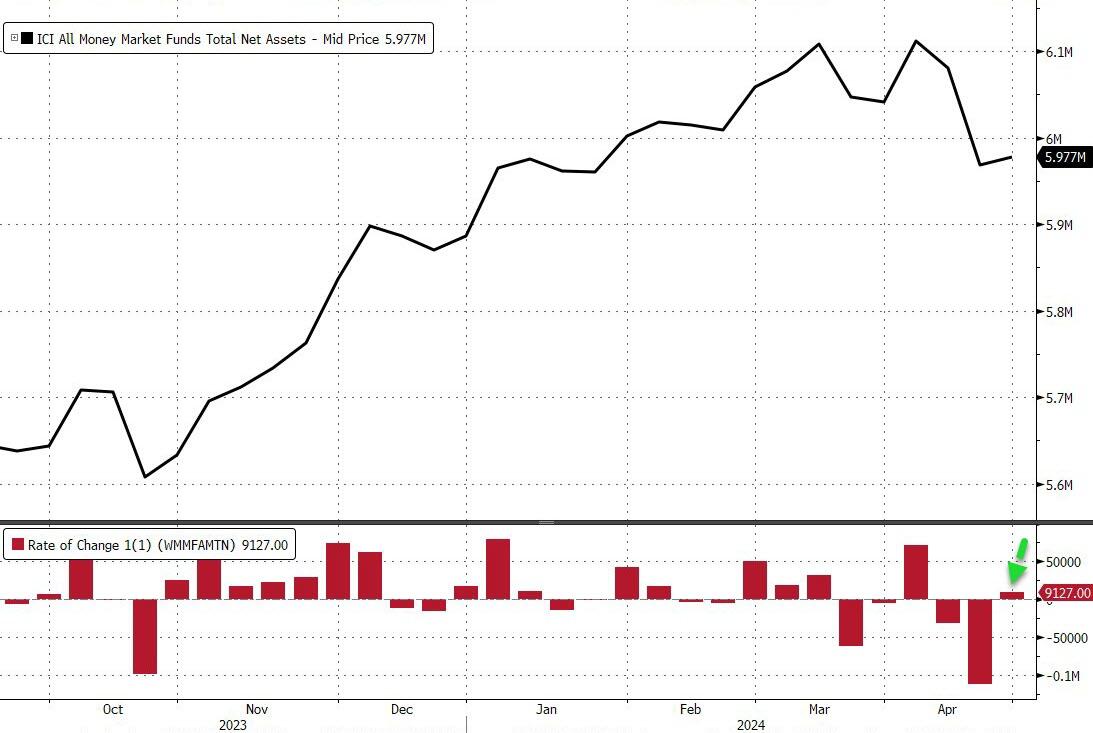
After the prior week’s almost unprecedented outflows, total money market fund assets rose last week (admittedly by a modest $9.1BN), but remain below the $6TN level ($5.97TN) as tax-season draws roll off…
Source: Bloomberg
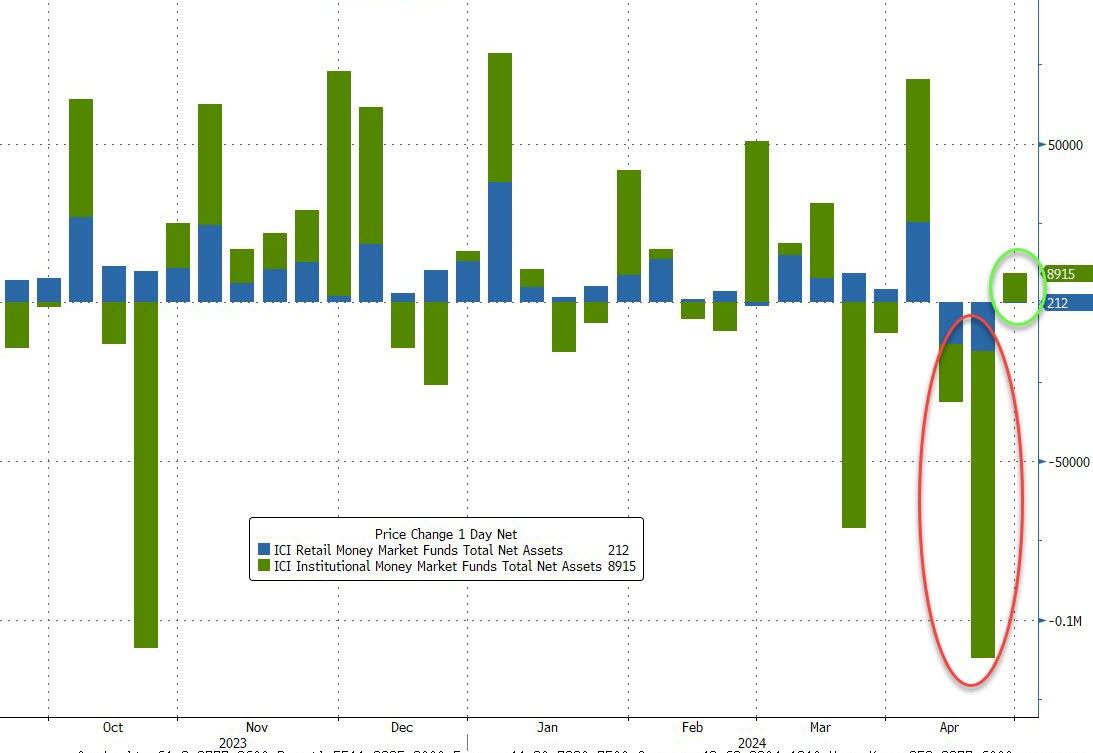
The flows into money-market fund assets through April 24 mainly on the back of inflows by institutional investors, which had led the tax-related decline the prior week. Institutions added $8.9 billion in money-market fund exposure.
Source: Bloomberg
In a breakdown for the week to April 24, government funds – which invest primarily in securities like Treasury bills, repurchase agreements and agency debt – saw assets rise to $4.84 trillion, a $3.97 billion increase.
Prime funds, which tend to invest in higher-risk assets such as commercial paper, meanwhile, saw assets rise to $1.02 trillion, a $3.15 billion increase.
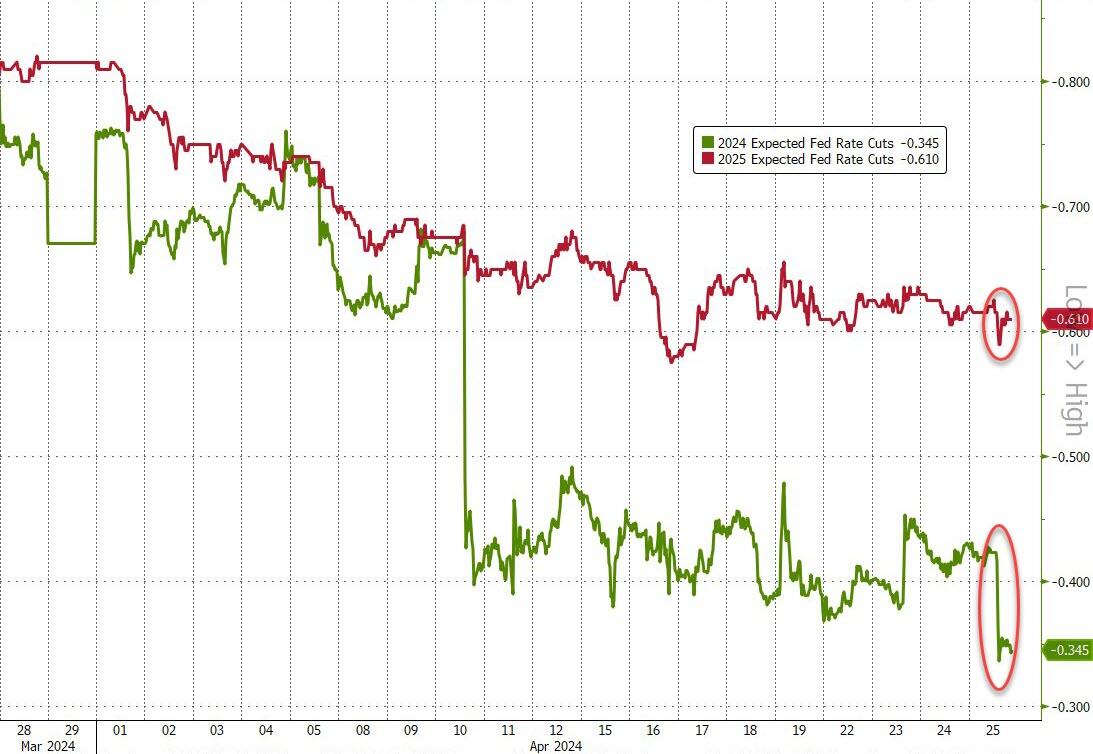
Still, cash is expected to continue piling into money funds as long as the Federal Reserve keeps rates on hold – and this week has seen rate-cut expectations tumble further…
Source: Bloomberg
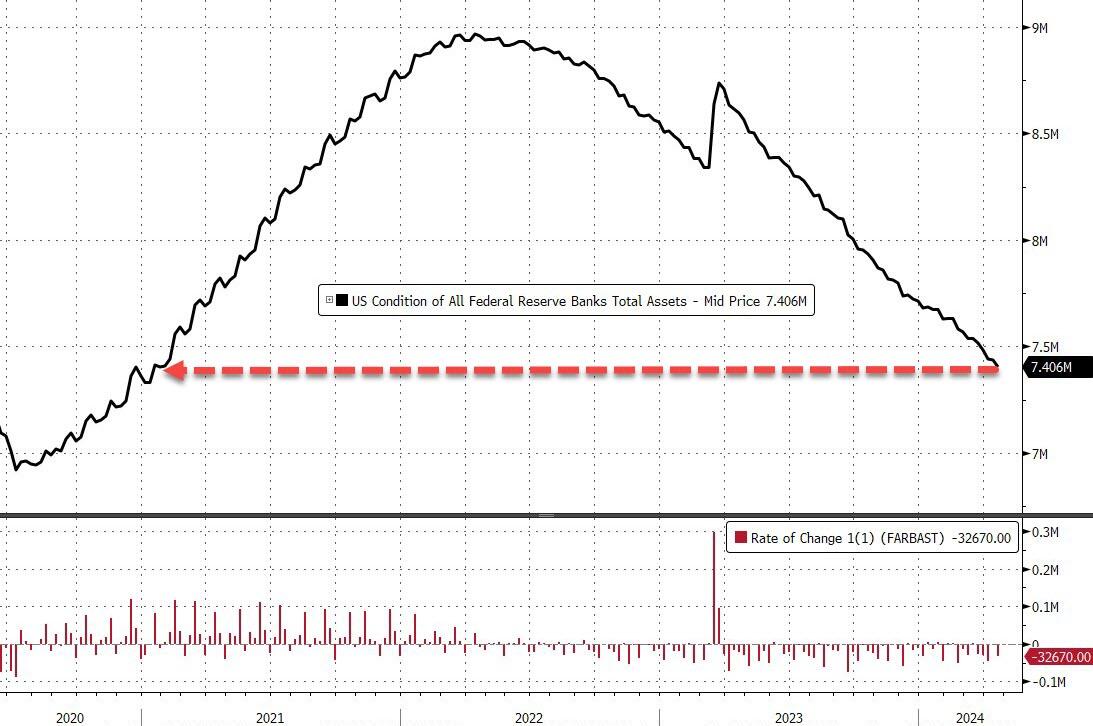
The Fed balance sheet continued to shrink, falling $32.8BN to its lowest since Jan 2021…
Source: Bloomberg
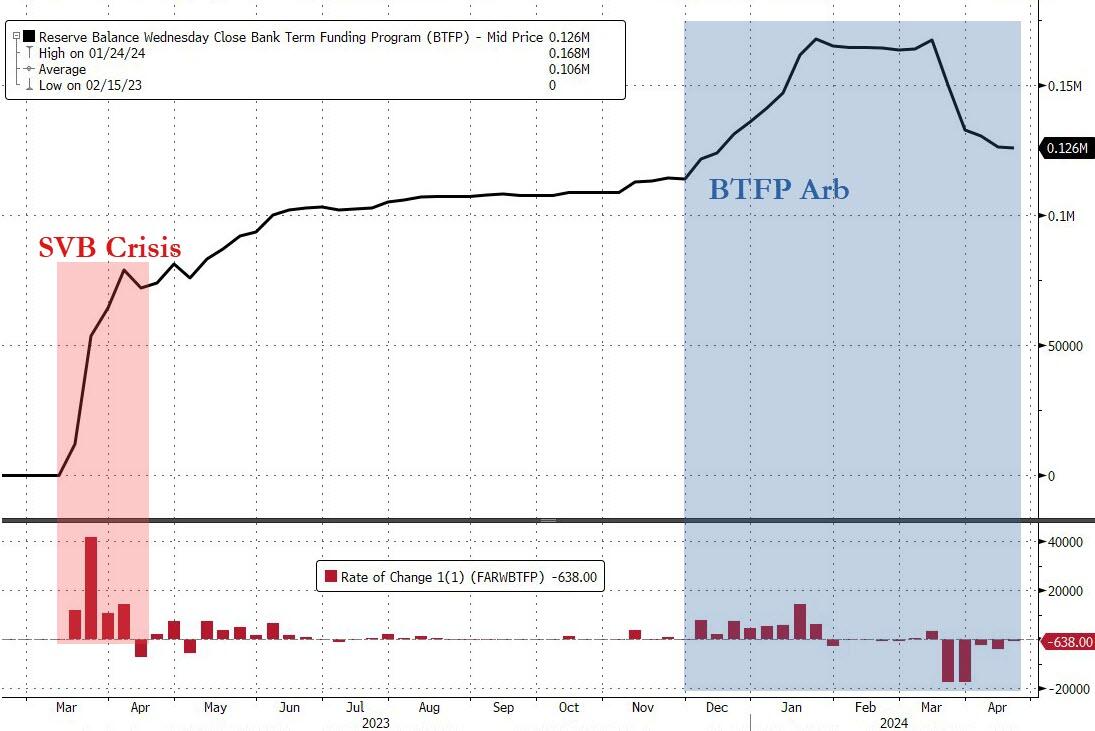
As The Fed starts discussing tapering QT, usage of The Fed’s bank bailout facility (now expired but these are 12 month term loans) continued to decline (though only by a tiny $638MM), basically erasing all the late-period arb-driven inflows, leaving a huge $126BN hole in bank balance sheets still being filled by this…
Source: Bloomberg
This means the ‘real’ crisis money that banks used to save their souls is yet to really unwind from this bailout fund (and rates are considerably higher now than they were a year ago when the balance sheet holes were stuff with fake Fed paper – i.e. the losses are bigger).
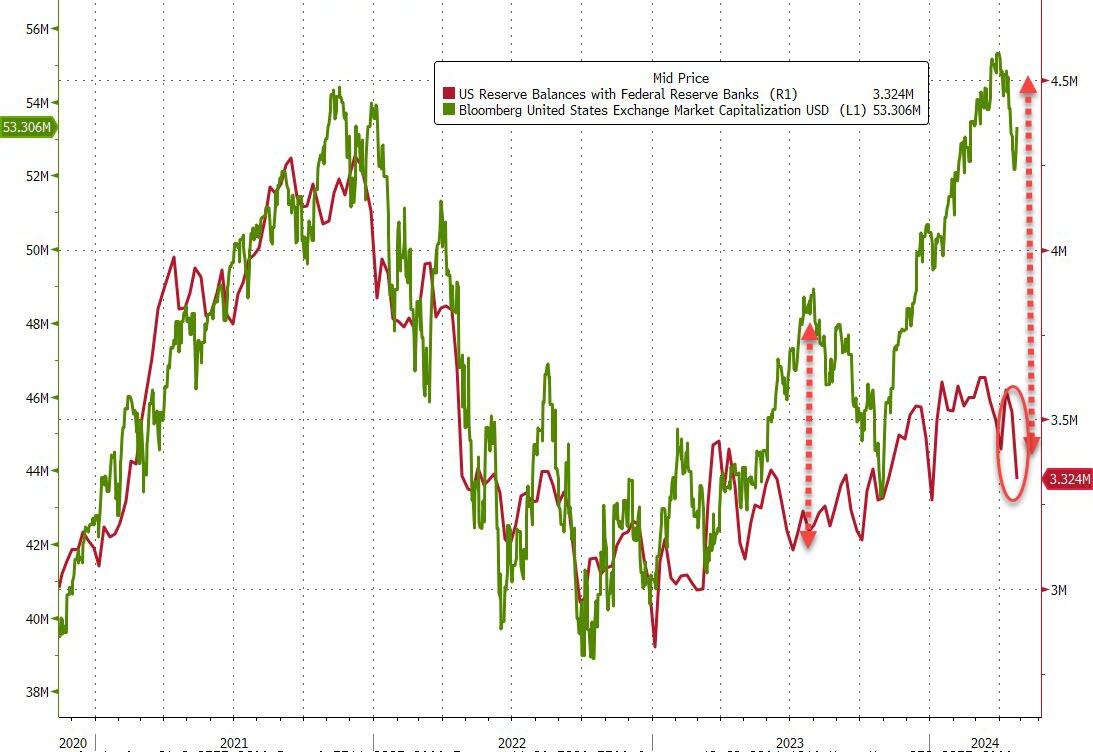
Finally, we note that bank reserves at The Fed plunged last week and while US equity market cap has bounced a little in the last two days, we suspect the trend down (and a painful recoupling) remains a threat…
Source: Bloomberg
While there may be no rate-cuts anytime soon… will The Fed taper QT in a big enough manner to avoid that recoupling?
On Wednesday, lawmakers in the U.S. House of Representatives called for the Internal Revenue Service (IRS) to begin investigating the financial links between China and anti-Israel groups that have been protesting throughout the United States since October 7th.
According to the Washington Free Beacon, the request comes from members of the House Ways and Means Committee, who wrote a letter expressing concerns that “foreign adversaries are taking advantage of loopholes to impact American political activity with little-to-no transparency.”
One such example is The People’s Forum, a group that organized anti-Israel protests such as public school walkouts in New York City.
The group is bankrolled by Neville Roy Singham, a tech mogul with pro-China sympathies, as documented by the New York Times.
The People’s Forum urged students to chant anti-Semitic phrases, including “from the river to the sea, Palestine will be free,” which calls for the extermination of all Israelis.
Another example is The Energy Foundation, a U.S.-based nonprofit group that focuses primarily on global warming, yet operates mostly out of China and has deep ties to the ruling Chinese Communist Party (CCP).
This organization has repeatedly advocated for “green” energy policies that would hurt the United States’ energy production, to the benefit of China.
“Not only do these activities raise serious national security concerns, but they also raise questions about whether organizations like this receive foreign funding from America’s adversaries and whether the Internal Revenue Service (‘IRS’) is conducting oversight of entities like these,” said the letter sent by lawmakers to IRS commissioner Daniel Werfel.
The committee members asked if the IRS has “a definition of antisemitism in place within the agency that it considers when evaluating the claimed exempt purpose of a tax-exempt organization,” for the purposes of cracking down on such radical groups. The letter also asked if the IRS would eventually start an investigation into the various financial links between China and various domestic groups.
Google Soars To Record After Smashing Estimates, Launches $70 Billion Buyback And Starts Paying Dividend
After the first two Mag7 companies were a study in market paradoxes, when TSLA missed across the board and soared (after guiding much better than expected) and META beat across the board but plunged (after guiding weaker than expected while boosting its spending forecast), moments ago two of the Mag7 giants, GOOGL and MSFT, both reported and this time there was far less drama: both beat, and saw their stock soaring after hours.
Focusing on Google parent Alphabet, Goldman said ahead of earnings that positioning here was not as excessive (at 7/10) which may be why the stock is soaring some 13% after the close on what otherwise appears to be a solid beat. Here are the details:
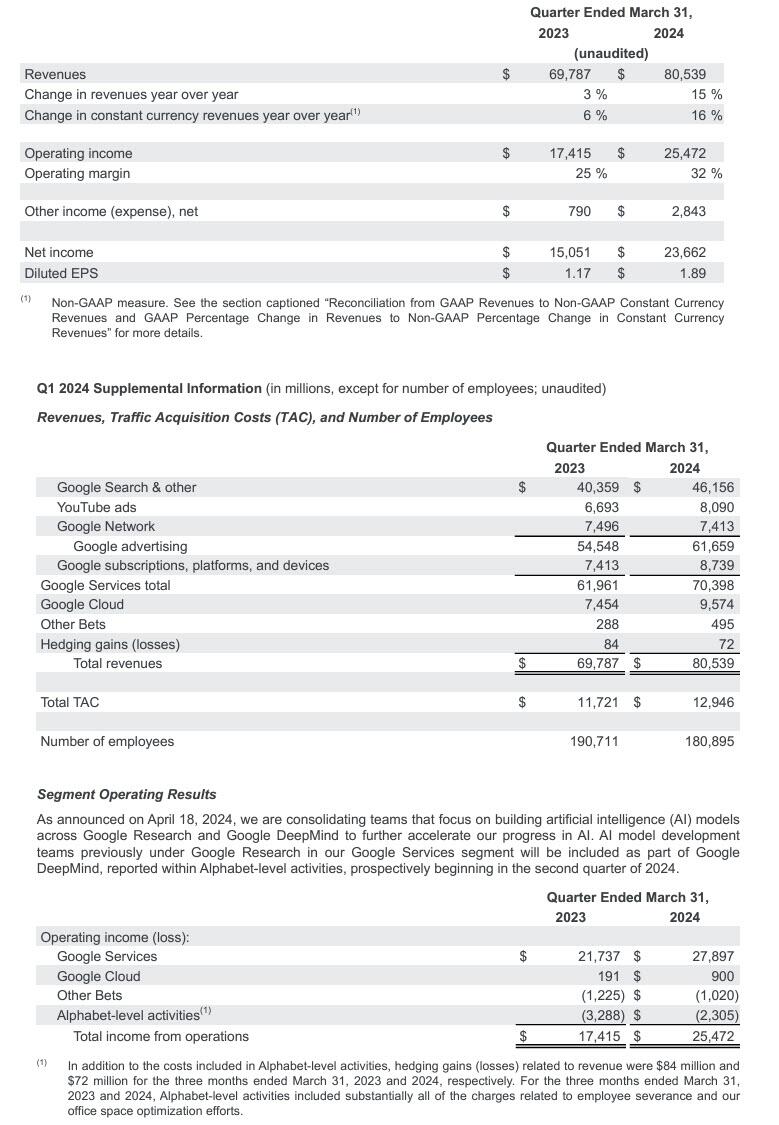
EPS $1.89, beating estimate $1.53, and up more than 50% vs the $1.17 a year ago.
Q1 Revenue $80.54 billion, beating the estimate of $79.04 billion, and up 15% YoY
Google advertising revenue $61.66 billion, beating the estimate $60.18 billion
YouTube ads revenue $8.09 billion, beating the estimate $7.73 billion
Google Services revenue $70.40 billion, beating the estimate $69.06 billion
Google Cloud revenue $9.57 billion, beating the estimate $9.37 billion
Other Bets revenue $495 million, beating estimate $372.4 million
Operating income $25.47 billion, beating estimate $22.4 billion
Google Services operating income $27.90 billion, beating the estimate $24.3 billion
Google Cloud operating income $900 million, beating the estimate $672.4 million
Other Bets operating loss $1.02 billion, beating the estimate loss $1.12 billion
Operating margin 32%, beating the estimate 28.6%
Capital expenditure $12.01 billion, beating the estimate $10.32 billion
Number of employees 180,895, down from 190,711
A quick point on YouTube: it was bought by Google in 2006 for $1.65 billion; YouTube now generates $1.65 billion of revenue every 18 days.
The results visually:
While Google’s cloud numbers were stellar, with revenue rising from $7.5BN to $9.6BN, and beating estimates of $9.4BN, what investors wanted to hear was more about the company’s progress on AI. This is what it had to say:
As announced on April 18, 2024, we are consolidating teams that focus on building artificial intelligence (AI) models across Google Research and Google DeepMind to further accelerate our progress in AI. AI model development teams previously under Google Research in our Google Services segment will be included as part of Google DeepMind, reported within Alphabet-level activities, prospectively beginning in the second quarter of 2024.
Like other Big Tech companies, Alphabet has been plowing money into developing artificial intelligence, a strategy that has helped drive demand for its cloud services, which saw revenue rise 28% in the first quarter. While Google remains a distant third in the cloud computing market, trailing Amazon and Microsoft, the company’s prowess in AI could help it close the gap.
Google has developed much of the underlying technology being used in the AI boom today, and has woven it into products from web search to its suite of enterprise software from Gmail to Google Docs. Yet ever since OpenAI’s ChatGPT was released in late 2022, Google has been battling the perception that it’s lagging behind Microsoft and OpenAI in rolling out new generative AI tools. The arrival of popular chatbots such as ChatGPT — which answers questions in a conversational tone rather than providing lists of links to other websites — has posed a threat to Google’s two-decade stranglehold on search. The company is struggling to compete in generative AI without cannibalizing its core profit machine.
Google has been scrambling to reassert its early lead in AI, after its early efforts were marred by embarrassing blunders, including a scandal over how its AI model Gemini handled race that forced the company to suspend image generation of people.
Commenting on the results, CFO Ruth Porat said: “Our strong financial results for the first quarter reflect revenue strength across the company and ongoing efforts to durably reengineer our cost base. We delivered revenues of $80.5 billion, up 15% year-on-year, and operating margin expansion.”
It certainly delivered, and just to make sure the market rewarded it, the company not only announced the start of new cash dividend at 20 cents…
Alphabet’s Board of Directors today approved the initiation of a cash dividend program, and declared a cash dividend of $0.20 per share that will be paid on June 17, 2024, to stockholders of record as of June 10, 2024, on each of the company’s Class A, Class B, and Class C shares.
… but also announced a new stock buyback program for $70 billion!
Alphabet’s Board of Directors today authorized the company to repurchase up to an additional $70.0 billion of its Class A and Class C shares in a manner deemed in the best interest of the company and its stockholders, taking into account the economic cost and prevailing market conditions, including the relative trading prices and volumes of the Class A and Class C shares.
While investors have shown they are excited about the prospects of AI, they want tech companies to continue to focus on revenue and profit in the meantime. Meta, which competes with Google in AI and also digital advertising, suffered its worst stock decline since October 2022 after reporting that it would spend billions of dollars more this year on AI efforts and projecting weaker revenue for the current quarter. For its part, Google – which does not do forecasts – paid $12BN in capex in the quarter, $1.7 billion more than estimated.
For all the hoopla about AI, search advertising remains the engine of Google’s lucrative business, and the company is facing heightened competition there, too. Meta has been seeding AI tools throughout its advertising business and Snap Inc. has also undergone a total revamp of its ad business to improve ad targeting. The digital ad market is recovering from a post-pandemic slump, buoyed by the Olympics Games this summer, but Google is increasingly vying for those ad dollars with Meta and Snap.
If consumers gravitate from Google search to the new wave of chatbots, that could imperil the company’s search advertising juggernaut, which is expected to generate nearly $200 billion in revenue this year and the bulk of Alphabet’s profit.
Cloud has been a bright spot for Google, after it first became profitable early last year. Many young AI startups are founded by former Google employees, creating a strong pipeline of cloud clients.
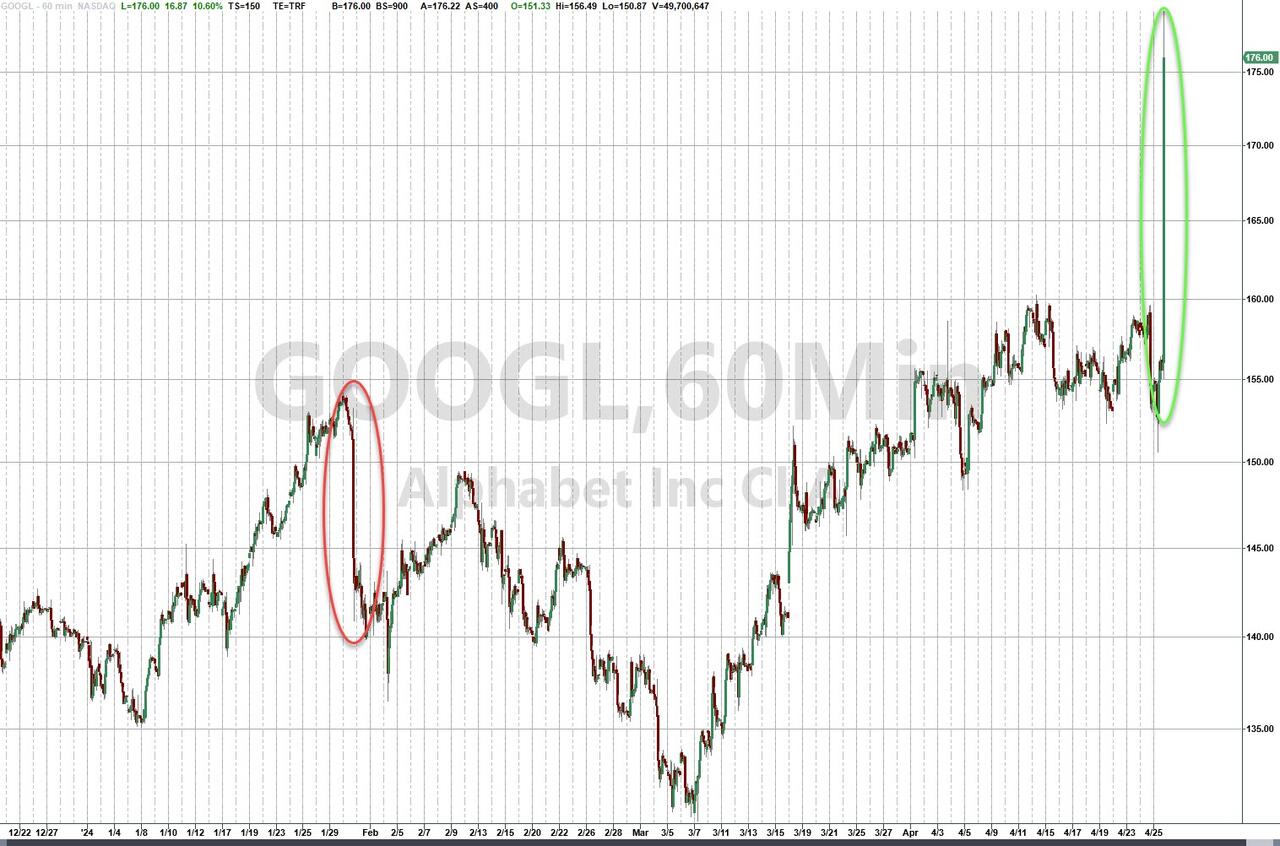
For now, however, these concerns were on the backburner, with GOOGL stock exploding about 12% after hours, and trading at a new all time high.