Why We Need DOGE: 5 Crazy Examples Of How The Government Has Been Wasting Your Tax Dollars

Why We Need DOGE: 5 Crazy Examples Of How The Government Has Been Wasting Your Tax Dollars

Authored by Michael Snyder via TheMostImportantNews.com,

The U.S. government has been wasting money in some of the most bizarre ways imaginable.  Some of the examples that I am about to share with you are likely to make you feel sick.  Wasting colossal piles of our tax dollars would be bad enough if we were running a balanced budget, but that is certainly not the case.  We have been adding trillions of dollars to the national debt each year, and our federal government is now more than 36 trillion dollars in debt.

So the truth is that we have had to borrow the money that we have been recklessly wasting.  

The following are 5 crazy examples of how the government has been wasting your tax dollars…

#1 Joe Biden and his minions spent 15 million dollars to distribute “oral contraceptives and condoms” in Afghanistan…

The Biden administration sent $15 million of taxpayer money in distributing “oral contraceptives and condoms” into Afghanistan, according to a private congressional funding notice reviewed by the Washington Free Beacon.

The award, earmarked by the United States Agency for International Development (USAID) last July, transmitted the funds to Afghanistan.

The money was part of a whopping $100 million package for the Middle Eastern country to support the “basic rights and freedoms” of women and girls who were living under Taliban rule.

#2 Even more money was about to be spent on condoms for the Palestinians.  It is being reported that the Biden administration “almost sent $50 million worth of condoms to Gaza”…

Press Secretary Karoline Leavitt also announced on Tuesday that Biden’s administration almost sent $50 million worth of condoms to Gaza, which she called ‘a preposterous waste of taxpayer money!’

‘There was about to be $50 million taxpayer dollars that went out the door to fund condoms in Gaza!’ Leavitt shockingly claimed.

#3 The Biden administration spent $10,000 for an “ice skating drag show” that was focused on climate change…

The 2024 Festivus Waste Report found that the Biden-Harris administration spent over $1 trillion this year, including giving a $10,000 grant to “Beards on Ice” — an ice skating drag show on climate change put on by the Bearded Ladies Cabaret, a self-described “queer cabaret arts organization.”

#4 20 million of our tax dollars were spent on a Sesame Street spin-off in Iraq that was designed to promote “inclusion”

Additionally, the Agency for International Development (USAID) spent $20 million on a Sesame Street spin-off show in Iraq, titled “Ahlan Simsim,” in an effort to promote “inclusion” and “mutual respect.”

#5 This final example is the most sickening.  1.5 million dollars was spent to study how various species respond to motion sickness.  In one of the experiments, holes were actually drilled into the skulls of young kittens.  This is evil on a level that I don’t even know how to describe…

About $1.5 million was spent experimenting how different species, such as young female kittens, respond to motion sickness.

According to the report, researchers would strap kittens to a table, where they are spun around in several directions and have holes drilled into their skulls to keep them in place — “and it’s all being done with your money,” Paul writes in the report. “More than one and a half million dollars of it.”

Whoever conducted those experiments on young kittens should be immediately arrested and thrown in prison.

Unfortunately, this kind of “science” is happening in secret labs all over the country, and way too often our tax dollars are funding it.

Are you starting to understand why we desperately need DOGE?

I could give you hundreds of more examples of government waste, but I think that I have made my point.

Elon Musk is convinced that it will be possible to cut a trillion dollars out of the federal budget…

“I think we’ll try for $2 trillion. I think that’s like the best-case outcome,” Musk said during tech trade show CES on Wednesday in Las Vegas, the Post reported. “But I do think that you kind of have to have some overage. I think if we try for $2 trillion, we’ve got a good shot at getting $1 [trillion].”

And it looks like they are off to a great start.

The official DOGE account on Twitter has announced that the federal government is already saving approximately a billion dollars a day based on actions that have been implemented so far…

DOGE is saving the Federal Government approx. $1 billion/day, mostly from stopping the hiring of people into unnecessary positions, deletion of DEI and stopping improper payments to foreign organizations, all consistent with the President’s Executive Orders.

A good start, though this number needs to increase to > $3 billion/day.

Of course a billion dollars a day is just a drop in the bucket.

Much deeper cuts are needed, and representatives from DOGE have been interviewing staffers “from more than a dozen federal agencies”

Aides for Tesla and Space X CEO Elon Musk and tech entrepreneur Vivek Ramaswamy are starting to interview staffers with the federal government for the newly created Department of Government Efficiency (DOGE), according to a new report.

Representatives for DOGE have had conversations with staffers from more than a dozen federal agencies — including the Treasury Department and the Internal Revenue Service, as well as the Departments of Veterans Affairs, Homeland Security, and Health and Human Services, The Washington Post reported Friday.

Unused office space is one area where enormous cuts could potentially be made.

It is being estimated that up to two-thirds of the office space that the government owns could potentially be sold

The DOGE people in the Trump administration are considering shedding a big portion of the massive office space that the government owns or leases nationwide, managed by the General Services Administration (GSA), including selling two-thirds of the office space the government owns and terminating three-quarters of the leased office space, according to the WSJ.

Of course selling off so much office space would make our commercial real estate crisis even worse.

But that is a topic for a different article.

For now, we should all be thrilled that a serious effort is finally being made to reduce government waste.

It is inevitable that the left will take legal action against DOGE, but at this moment the Democrats are in a state of shock because the Trump administration is moving so rapidly on so many different fronts

Democrats are hoping that Trump will make mistakes, and hope to capitalize on them when he does. But for now, they are scrambling to find enough lawyers, and lawsuits, to slow down the fastest start in presidential history.

We have never seen anything like this.

Many battles are ahead, and I don’t know how all of those battles will play out.

But at least something is finally being done to crack down on government waste, and that is a reason to smile.

*  *  *

Michael’s new book entitled “Why” is available in paperback and for the Kindle on Amazon.com, and you can subscribe to his Substack newsletter at michaeltsnyder.substack.com.

Tyler Durden
Fri, 01/31/2025 – 06:30

via ZeroHedge News https://ift.tt/ZBldiv2 Tyler Durden

Syrian Leaders Demand Russia ‘Hand Over Assad, Pay Compensation’

Syrian Leaders Demand Russia ‘Hand Over Assad, Pay Compensation’

Syria’s ruling Islamist group, Hayat Tahrir al-Sham (HTS) and the freshly self-appointed “President” of Syria Ahmad al-Sharaa (or Abu Mohammad al-Jolani), have demanded that Russia hand over ousted leader Bashar al-Assad.

Syrian HTS officials are also demanding “compensation” from Moscow after it sent its military forces in support of Assad since 2015. Russia is being asked to help with “reconstruction and recovery” following 13-years of war.

A prior Putin visit to Damascus. Sputnik/AFP via Getty Images

Sharaa’s Islamist government wants Russia to rebuild trust through “concrete measures such as compensation, reconstruction and recovery.”

All of this was conveyed in a meeting which took place this week between HTS and a Russian delegation in Damascus, which was a first since Assad fled on December 8. Russia quickly granted Assad and his family asylum, but he hasn’t been seen or photographed since.

It’s widely been reported that he is in Moscow, and many rumors have persisted – such as that he was supposedly poisoned – but none have proved true.

Of course, Russia is very unlikely to send Assad back to Syria; however, the Kremlin does have a strategic interest in keeping its naval and air bases on Syria’s Mediterranean coast. Military equipment has been largely packed up and moved elsewhere over the past weeks.

The status of the Tartous naval base and Hmeimim airbase remains unresolved:

Satellite imagery recently showed large-scale transportation of Russian equipment and vehicles towards the Tartous naval base. Bogdanov told reporters that “no progress has been made on the issue [of the bases],” and that “more negotiations are needed,” according to Russian news agency TASS. 

The Russian delegation to Damascus was led by Russia’s Deputy Foreign Minister Mikhail Bogdanov. “The meeting was generally good, it lasted three hours and included an official dinner … In general, the meeting was constructive and the atmosphere was positive,” Bogdanov told a press briefing.

The two sides “agreed to continue contacts to strengthen relations and understanding in the field of foreign policy.”

The Kremlin has been asked about the reports of a demand to boot Assad from Russia, but has not confirmed or denied that the request was made.

Meanwhile, Russian forces are still present on Syria’s coast, but likely at diminished capacity, with reports saying much equipment has already been moved to a port in Eastern Libya under Khalifa Haftar.

Tyler Durden
Fri, 01/31/2025 – 05:45

via ZeroHedge News https://ift.tt/ANjho0F Tyler Durden

Tether Disappointed With “Rushed Actions” On MiCA-Driven USDT Delisting In Europe

Tether Disappointed With “Rushed Actions” On MiCA-Driven USDT Delisting In Europe

Authored by Helen Partz via CoinTelegraph.com,

Stablecoin operator Tether addressed European cryptocurrency regulations amid exchanges like Crypto.com preparing to delist its USDt stablecoin in Europe tomorrow.

Tether expressed disappointment over market developments in Europe amid changes triggered by the enforcement of the European Union’s Markets in Crypto-Assets (MiCA) framework.

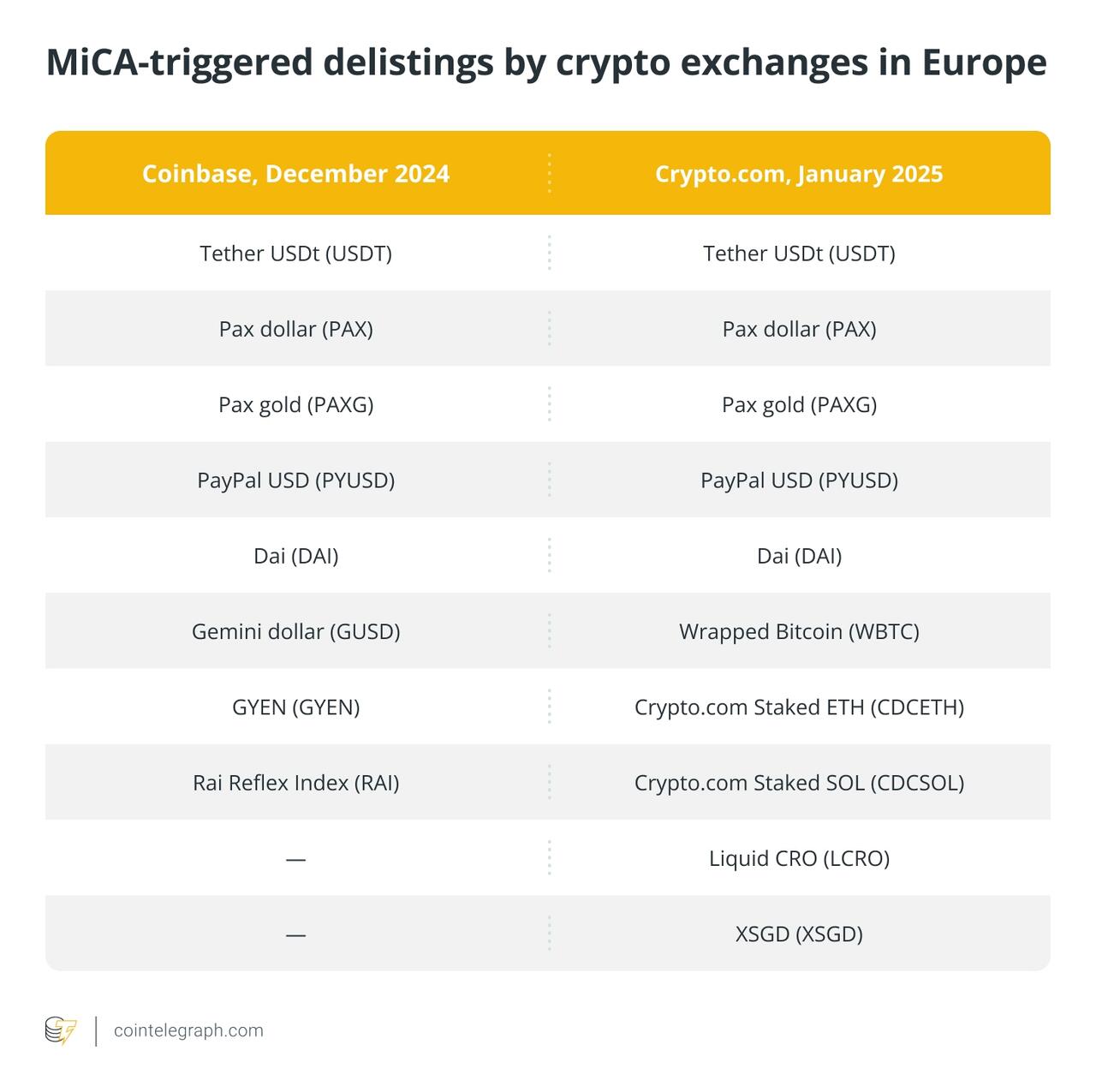
Crypto.com, a global crypto exchange, confirmed on Jan. 29 it will start delisting Tether’s USDt stablecoin and nine other tokens on Jan. 31 to comply with MiCA regulations.

“It is disappointing to see the rushed actions brought on by statements which do little to clarify the basis for such moves,” a spokesperson for Tether told Cointelegraph.

EU consumers under risk of “disorderly” crypto market

MiCA-triggered changes pose significant risks for EU consumers and the local crypto market, with exchanges like Crypto.com preparing to delist multiple tokens, according to Tether.

“These changes affect many tokens in the EU market, not only USDt, and we fear that such actions will lead to further risk being placed on consumers in the EU,” Tether’s representative said.

According to Tether, such regulatory developments in the EU could create a “disorderly” market at a time when MiCA is still in the early stages of implementation.

As previously mentioned, Crypto.com’s MiCA-forced delisting process is set to affect a total of 10 tokens, including Wrapped Bitcoin, Dai stablecoin and more.

Coinbase — an exchange that delisted USDT in December 2024 — said at the time it would delist six tokens to comply with MiCA. The exchange delisted WBTC on the entire Coinbase platform for other reasons on Dec. 19, 2024.

“We regularly review the assets we make available to customers on our platform to ensure we are meeting regulatory requirements, and will assess re-enabling services for stablecoins that achieve MiCA compliance on a later date,” a Coinbase representative told Cointelegraph on Jan. 30.

The spokesperson also mentioned that Coinbase has so far delisted a total of eight tokens to comply with MiCA.

Tether finalizes European strategy for USDt

Apart from broader consumer risks potentially arising from MiCA-triggered ecosystem changes, Tether reiterated that MiCA poses negative implications for stablecoins licensed in the EU.

“As we have consistently expressed, some aspects of MiCA make the operation of EU-licensed stablecoins more complex and potentially introduce new risks,” Tether said.

Tether’s representative also again highlighted differences in stablecoin use cases between Europe and emerging markets, where USDT is extremely popular.

“The USD stablecoin market is almost negligible in Europe,” the spokesperson noted.

At the same time, Tether still commends EU regulators for their efforts in establishing a structured framework, as it plays a key role in fostering growth within the sector, the spokesperson noted, adding:

“As Tether finalizes its European strategy for USDt, it remains committed to ensuring compliance with evolving regulations while introducing groundbreaking technologies such as Hadron and investments in transformative projects such as Quantor, designed to be MiCA compliant.”

Tether’s comments come shortly after the European Securities and Markets Authority pushed European crypto asset service providers (CASP) to start restricting non-MiCA-compliant stablecoins by the end of January.

While still allowing the listing of those tokens in sell mode until March 31, the regulator has asked CASPs to completely restrict non-compliant stablecoins by the end of the first quarter of 2025.

Tyler Durden
Fri, 01/31/2025 – 05:00

via ZeroHedge News https://ift.tt/OSTplfe Tyler Durden

FCC Chair Brendan Carr Launches Investigation Into PBS, NPR As Lawmakers Decide Fate

FCC Chair Brendan Carr Launches Investigation Into PBS, NPR As Lawmakers Decide Fate

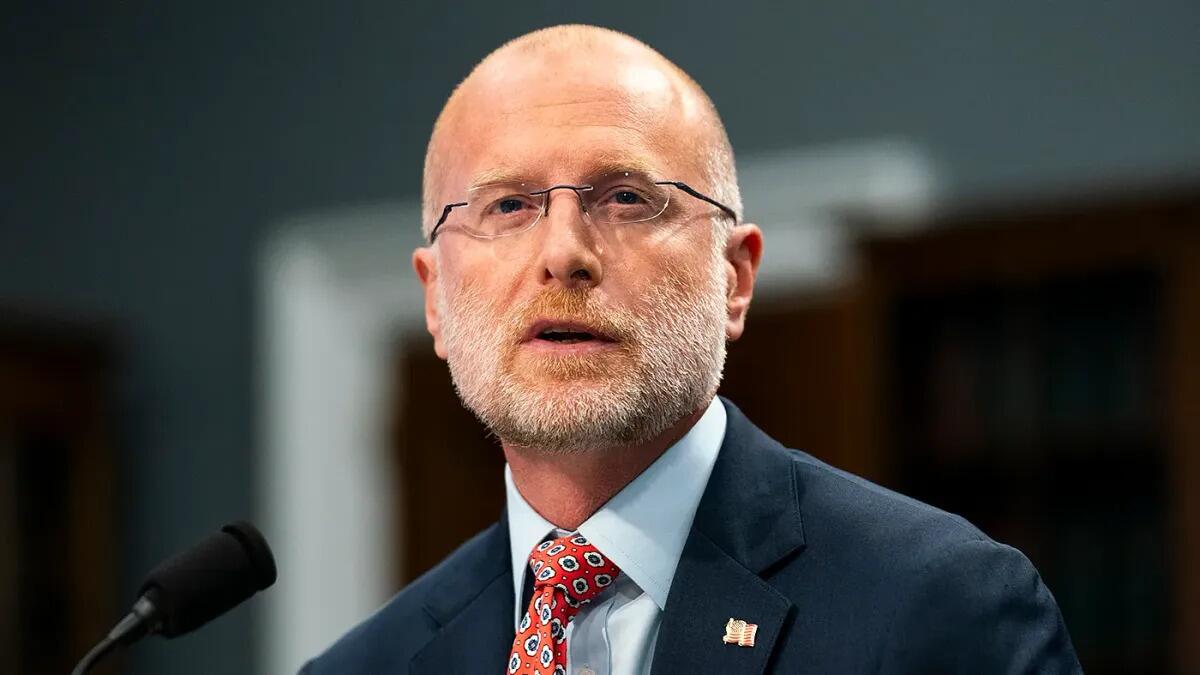
FCC Chairman Brendan Carr is launching an investigation into NPR and PBS he says will help lawmakers decide whether the government will continue funding the public news organizations.

FCC Chairman Brendan Carr

In a Wednesday letter to both outlets, Carr said the inquiry would focus on whether the news organizations’ member stations violated government rules by recognizing financial sponsors on air.

According to Carr, NPR and PBS stations operate as noncommercial broadcast organizations, but that they may be airing announcements that ‘cross the line.”

“I am concerned that NPR and PBS broadcasts could be violating federal law by airing commercials. In particular, it is possible that NPR and PBS member stations are broadcasting underwriting announcements that cross the line into prohibited commercial advertisements,” Carr wrote.

To the extent that these taxpayer dollars are being used to support a for-profit endeavor or an entity that is airing commercial advertisements,” Carr wrote, “then that would further undermine any case for continuing to fund NPR and PBS with taxpayer dollars,” the letter reads.


According to the report, station execs have been bracing for a potential battle with the Trump administration over government funding, and have been gaming out worst-case financial scenarioos.

Carr said he didn’t see a reason for lawmakers to continue funding the organizations, adding that he planned to notify members of Congress of his findings, according to the NY Times.

NPR CEO Katherine Maher said in a statement that the organization’s use of sponsorship – also known as underwriting, “complies with federal regulations.”

“We are confident any review of our programming and underwriting practices will confirm NPR’s adherence to these rules,” she said. “We have worked for decades with the F.C.C. in support of noncommercial educational broadcasters who provide essential information, educational programming, and emergency alerts to local communities across the United States.”

PBS also issued a statement, claiming to be proud of its “noncommercial educational programming,” and that it had worked “diligently to comply with the F.C.C.’s underwriting regulations.”

Two Democrat FCC commissioners released letters in protest of the investigation.

Anna Gomez, a Democrat, said that the investigation appeared to be an attempt to “weaponize the power of the F.C.C.” Geoffrey Starks, also a Democrat, said that Mr. Carr’s statement gave him “serious concern.”

Both stations have aired sponsorships for decades under rules set by the government. That said, public broadcasters are restricted by law from accepting traditional commercials, which the FCC has turned a blind eye to for years. The agency’s softened stance on the issue became a slippery slope – allowing public radio stations to become less dependent on government funding.

Former NPR executive and co-founder of consulting company Magnificent Noise, Eric Nuzum, said that sponsorships and underwriting are distinctly different from traditional advertising on TV and radio.

“The difference is, in a commercial, the sponsor can say anything they want — it’s their time,” said Nuzum. “In an underwriting situation, the station provides an acknowledgment of who’s providing the funding, along with basic information about the underwriter.”

Concurrently, there are multiple bills working their way through congress to defund public media – including the No Propaganda Act introduced by Sen. John Kennedy (R-LA) and Representative Scott Perry (R-PA). Separately, the Defund NPR Act has been introduced by Rep. Jim Banks (R-IA).

Earlier this week, NPR executives informed staff that the Trump administration had sent a memo notifying them that two grant programs for local stations were on the chopping block – however the memo was rescinded after it was blocked by a judge.

Tyler Durden
Fri, 01/31/2025 – 04:15

via ZeroHedge News https://ift.tt/yhIXeDQ Tyler Durden

Poland Won’t Send Troops To Belarus Or Ukraine Without Trump’s Approval

Poland Won’t Send Troops To Belarus Or Ukraine Without Trump’s Approval

Authored by Andrew Korybko via substack,

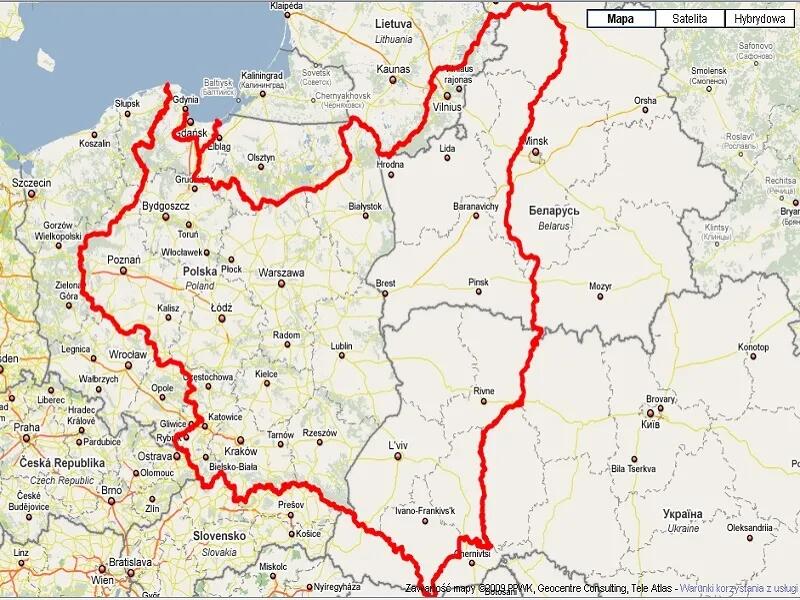
Belarusian President Alexander Lukashenko, who was just re-elected on Sunday for his seventh term, warned about Poland’s alleged territorial plans for his country and Ukraine. 

According to him, “Today you are eyeing western Belarus up to Minsk, you have already started talking about western Ukraine. You understand that you will not get an inch of territory from us. This is our territory.”

While Poland supports Ukraine against Russia and backs regime change in Belarus, it’s unlikely to send troops to either country.

Zelensky himself lamented last week that the Europeans won’t dispatch any peacekeepers to Ukraine like he demanded during his speech at Davos unless the US approves, let alone unilaterally launch a conventional military intervention in his support while the conflict remains ongoing. That’s because Russia earlier threatened to target any unauthorized foreign troops that enter Ukraine, which one of its senior diplomats just reaffirmed over the weekend amidst increased talk of this scenario.

Some Polish nationalists want to restore Warsaw’s Commonwealth-era control over parts of what’s nowadays Belarus, Ukraine, and Lithuania, but they’re a fringe minority, and the state has always sought to establish a sphere of political and economic influence instead of annex their lands. This has been Poland’s policy since 1991 after it accepted its post-World War II eastern borders, which took the form of bilateral cooperation, the Eastern Partnership, the Three Seas Initiative, and the Lublin Triangle.

The reasons were pragmatic since those modern-day countries’ historically indigenous Polish minorities were expelled and coerced to leave en masse after World War II. Additionally, Poland wanted to replicate interwar leader Jozef Pilsudski’s Intermarium policy of creating a buffer zone of subordinated states between it and Russia, which failed at the time due to the territorial compromise that ended the Polish-Bolshevik War (partitioning Belarus and Ukraine) and Lucjan Zeligowski’s (fake) mutiny over Vilnius.

Reviving territorial claims against those three – and especially without any significant Polish minority on the ground to back them up except in Belarus (though many there are considered to be “Sovietized Poles” who want to remain under Minsk’s writ) – would therefore once again ruin these plans. Poland’s hypothetical annexation of Western Ukraine would also radically reshape its demographics, lead to the inclusion of a large hostile minority within its borders, and spike the risk of interwar terrorism returning.

Western Ukraine was one of the cradles of Polish Civilization after many military, political, and artistic leaders came from there since it was incorporated into Poland in the mid-1300s, but Kiev already gave Poles visa-free privileges, so they can visit its historical sites without having to first annex them. The same goes for fellow EU member Lithuania and even Belarus, which also granted Poles visa-free privileges too, albeit for a lesser duration (90 days in a calendar year instead of 180 total days).

The socio-cultural motivation for annexing those countries’ territories where Poles were historically indigenous for centuries prior to the end of World War II is therefore neutralized, which pairs with the aforementioned political-strategic arguments against this for making such a scenario very unlikely. The contemporary military situation also precludes Poland unilaterally launching a conventional military intervention since it would be crushed by Russia unless the US promised to defend it per Article 5.

Therein lies the primary obstacle to the annexation scenarios that Lukashenko warned about since Trump is unlikely to extend such guarantees to allies’ troops in third countries who deploy there without his permission since he doesn’t want the US to get dragged into a war with Russia.

This means that even if Polish-backed militants destabilize Belarus like the latter claimed that it’s plotting to do late last year as explained here, it won’t be able to follow up by sending in what’s now NATO’s third-largest army.

For these reasons, while it’s true that “Poland pursues the most aggressive and bad policy against Belarus” exactly as Lukashenko said on Sunday, it’ll only send troops to there and/or Ukraine with Trump’s approval but he’s unlikely to greenlight this and Poland is even less likely to defy him. With this insight in mind, his remarks serve to raise awareness of the unconventional threat that Poland poses to Belarus and therefore by extension to Russia, but nobody should expect it to take a conventional form.

Tyler Durden
Fri, 01/31/2025 – 03:30

via ZeroHedge News https://ift.tt/co7z2kq Tyler Durden

EU Debates Restarting Russian Gas Purchases As Part Of Ukraine Peace Deal

EU Debates Restarting Russian Gas Purchases As Part Of Ukraine Peace Deal

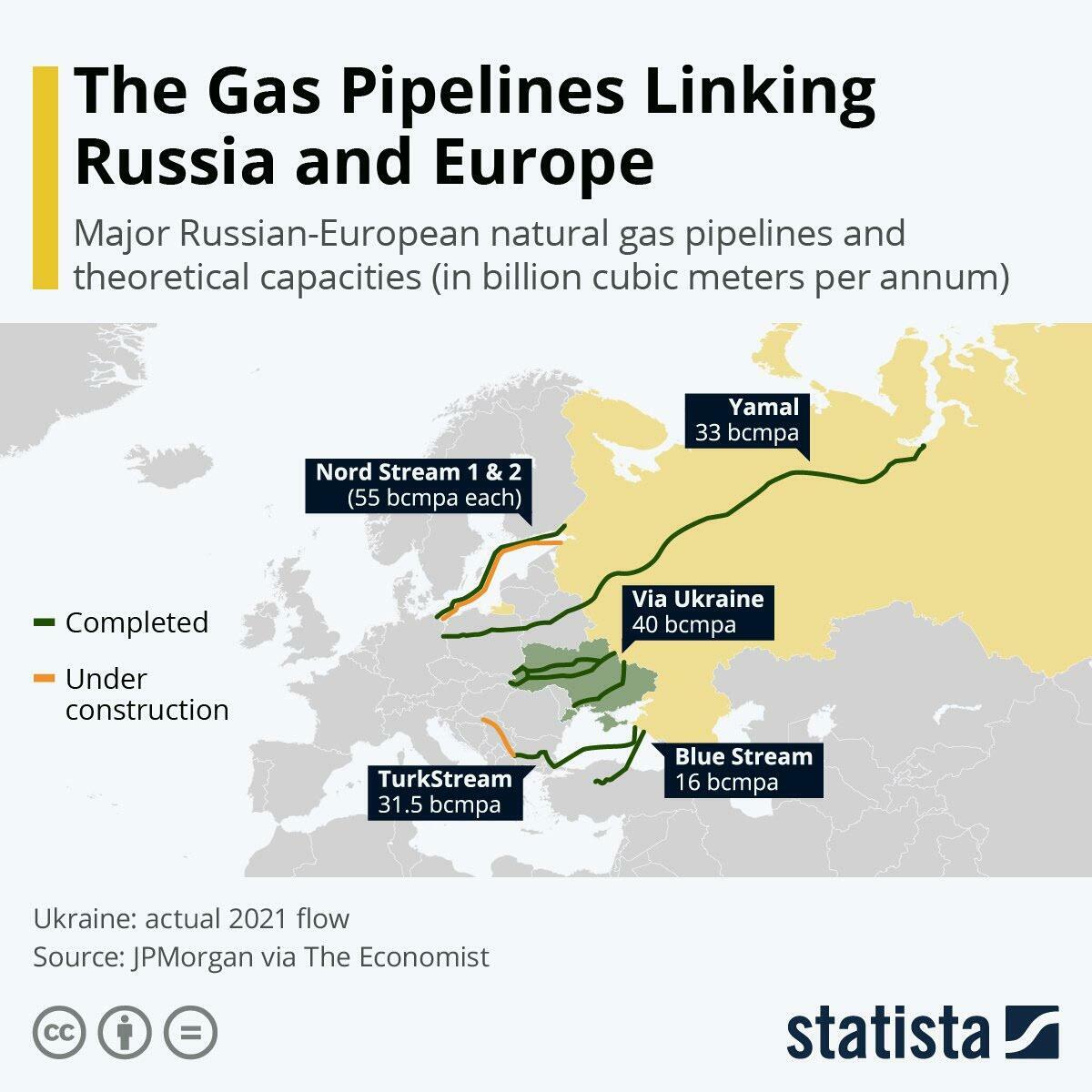
As fully expected, the EU is looking at options to restore Russian natural gas flowing into Europe (and even presumably via Ukraine), discussions which have of late taken on more urgency given Ukraine’s front lines are collapsing and a deal to end the war is looking inevitable, but whether something takes shape sooner or later remains the big question.

EU officials are mulling resumption of purchases of Russian pipeline gas which could be part of any potential settlement to the war, Financial Times has reported, citing unnamed sources. The outlet stated that advocates of such a ‘controversial’ plan, which includes Hungarian and German leaders, state that this could be an underlying incentive to maintain peace the stability of Europe’s energy market.

Anadolu Agency

“There is pressure from some big member states on energy prices and this is one way to bring those down, of course,” one official told the FT. And separately a senior EU official acknowledged that “In the end, everybody wants lower energy costs.”

But the mere suggestion of any such future large-scale return to natural gas in the EU is sure to trigger immense political backlash, which is more convenient for those currently benefiting from the current war time blockage in gas transfers and sanctions.

Pushback on the political front is going to be strong, and the argument will be made of ‘appeasing Russia’ and ‘abandoning Ukraine’ – and of allowing more revenue for Moscow’s war machine. Per the FT:

Floating the resumption of pipeline sales from Russia has infuriated Brussels officials and diplomats from some eastern European countries, many of whom have spent the past three years working to reduce the amount of Russian energy being imported into the bloc. “It’s madness,” said one of the officials. “How stupid could we be to even think about that as an option?”

…Or they could just be looking out for the interests and energy needs of their own respective populations.

As for who is benefitting most from the current state of things as some EU states scramble to make up for depleted supply:

The revival of the debate on gas sales has unsettled some US LNG exporters seeking to sign long-term supply deals with European companies. They fear that any restart of Ukrainian transit could make their products uncompetitive, according to two of the officials.

As we pointed out at the start of this month…

Slovakia and Hungary are among those who continue to rely most heavily on continued Russian gas purchases, and have been resistant to the bloc’s efforts at imposing diversification. To review:

Russia halted pipeline gas deliveries to Europe via Ukraine on Jan. 1 after Kyiv refused to renegotiate a transit agreement in response to Moscow’s full-scale invasion. Prior to the cutoff, the pipeline transported around 50% of Russia’s pipeline gas exports — mainly to Slovakia, Austria, Hungary and non-EU member Moldova.

Despite banning nearly all Russian pipeline gas and oil imports, the EU imported a record 17.8 million tons of liquefied natural gas (LNG) from Russia in 2024. The bloc has committed to phasing out Russian fossil fuel imports entirely by 2027.

While the EU banned Russian crude oil and coal following Moscow’s 2022 invasion of Ukraine, it has not yet imposed restrictions on Russian pipeline gas or LNG.

You will find more infographics at Statista

The biggest beneficiary of non-Russian LNG imports which have for the time being been fulling the supply gap, of course, the US which has seen its LNG exports to Europe soar since the Ukraine war and since either the US or Ukraine (or working in tandem) blew up the Nordstream pipeline, making (expensive) US sourced LNG one of the few realistic alternatives for Europe. In other words, Europe has gone from relying entirely on cheap Russian gas to relying entirely on expensive US LNG.

Tyler Durden
Fri, 01/31/2025 – 02:45

via ZeroHedge News https://ift.tt/a71ZzeE Tyler Durden

Quran-Burning Activist Shot Dead In Sweden

Quran-Burning Activist Shot Dead In Sweden

Via Middle East Eye

Swedish police have confirmed the killing of Iraqi refugee and anti-Islam activist Salwan Momika overnight on Wednesday. Momika, who was in his 40s and became famous for his regular Quran-burning events, was shot dead according to Stockholm police.

“Five people were arrested overnight in connection with the murder incident,” Anna Westberg from Stockholm police’s media center told Middle East Eye.

Salwan Momika, an Iraqi refugee in Sweden, died of multiple gunshot wounds.

“The police received the alarm at 11:11 pm. A prosecutor has been assigned to the case, and the police are cooperating with them in the ongoing investigation,” Westberg added.

Widely circulated videos of his events had caused widespread anger in his native Iraq, leading to a diplomatic spat between Baghdad and Stockholm.

While critics condemned Momika’s Quran-burning events as incitement, the slain activist defended them as acts of free expression.

Momika’s recent posts on social media platform X included anti-Muslim memes, support for Israel’s military campaign in Gaza and calls for donations for his legal defense in an incitement case he faced in Sweden.

“Today the second session of my trial in Stockholm will begin on the charge of incitement brought against me by the public prosecutor because of my criticism of Islam. You can support me and help me save money to pay the lawyer’s fees,” Momika posted on X on 16 January.

A proponent of ending Muslim migration into Europe, Momika was a controversial figure amongst Iraqis in the diaspora.

Najlaa Jassim, a 40-year-old Iraqi woman living in Istanbul, told MEE: “First, I am against killing people, and the Quran is a sacred heavenly book that cannot be touched. I am against attacking religions.”

Police would often have to protect him from angry mobs during his ultra-provocative Quran-burning stunts.

Speaking on Momika’s activism, Hasan Aqeel, a 20-year-old from Basra, said: “What is the point of acting on personal feelings if it harms yourself before anyone else?”

The killing is likely to heighten tensions between European governments and ascendent anti-immigrant movements that also oppose Muslim migration into Europe.

Tyler Durden
Fri, 01/31/2025 – 02:00

via ZeroHedge News https://ift.tt/AnoXxEP Tyler Durden

Ukrainian Media Outlet Leaks Alleged Trump Plan To End The War

Ukrainian Media Outlet Leaks Alleged Trump Plan To End The War

Authored by Dave DeCamp via AntiWar.com,

The Ukrainian news outlet Strana has published leaked details of President Trump’s alleged plan to end the war in Ukraine in 100 days.

According to Newsweek, which said it couldn’t verify if the details were accurate, the plan starts with holding a phone call between Trump and Russian President Vladimir Putin in late January or early February, followed by meetings with both Putin and Ukrainian President Volodymyr Zelensky in February or March.

Getty Images

The leaked plan calls for a ceasefire to be declared by Easter, which falls on April 20. The truce would involve Ukraine withdrawing troops from Russia’s Kursk Oblast.

Once the ceasefire comes into effect, a peace conference will begin hammering out the details of a lasting agreement. The plan calls for a deal to be reached by May 9.

Once the details of the agreement are released, Ukraine will be instructed to end martial law and mobilization. That would mean Zelensky could lose power since his presidential term expired in May 2024, and he used martial law as the justification for not holding new elections. The plan would require allowing parties who oppose continuing the war with Russia to run for office.

Some of the proposed ideas under the plan for a Russia-Ukraine peace deal include barring Ukraine from joining NATO, an agreement for Ukraine to join the EU by 2030, and the EU facilitating Ukraine’s construction. Ukraine would also be able to keep its military and continue receiving military aid from the US, which could be a non-starter for Moscow.

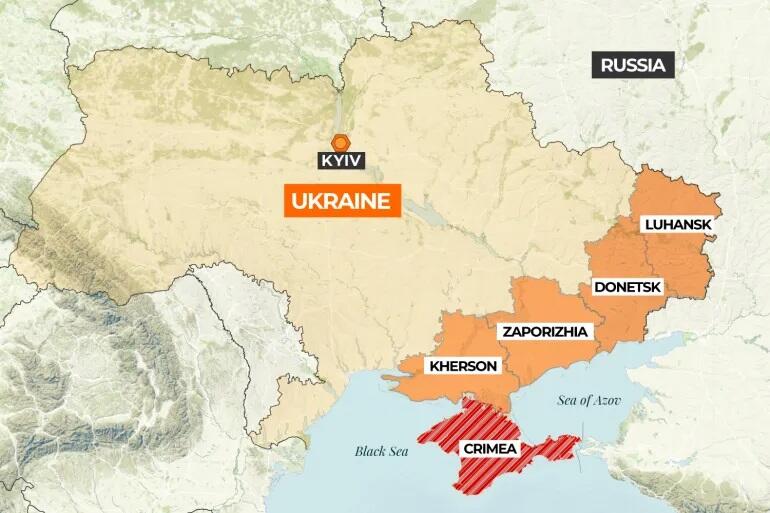
The proposal would also require Ukraine to cede the territory Russia has captured. Ukraine would have to “refuse military and diplomatic attempts to return the occupied territories” and “officially recognize the sovereignty of the Russian Federation over them.”

The four annexed territories, which Russia is unlikely to ever give up. Map via Al Jazeera

Zelensky’s office has denied that the peace plan is authentic, although other media reports have said that Trump tasked his envoy to the conflict, Keith Kellog, with ending the war within the first 100 days of the Trump administration. If the plan is legitimate, leaking it could have been an attempt to sabotage it from moving forward.

Trump has said he wants to speak with Putin, but the Kremlin said on Monday that it hasn’t heard anything from the US about setting up a potential call.

Tyler Durden
Thu, 01/30/2025 – 23:35

via ZeroHedge News https://ift.tt/OblRWrz Tyler Durden

Polarized World: How Other Countries Feel About The Trump Presidency

Polarized World: How Other Countries Feel About The Trump Presidency

As President Trump’s second term begins, it’s clear that voters within the U.S. have a wide spectrum of feelings about how it’s going to go.

On one side of public opinion, it could be a new golden age – on the other, a potential catastrophe. And this same polarization of opinion can also be witnessed around the world.

This shouldn’t be surprising – because of the size of the U.S. economy and its exceptional geopolitical influence, any change in policy in the U.S. can have big ripple effects outside America’s borders for better or worse.

Love and Hate

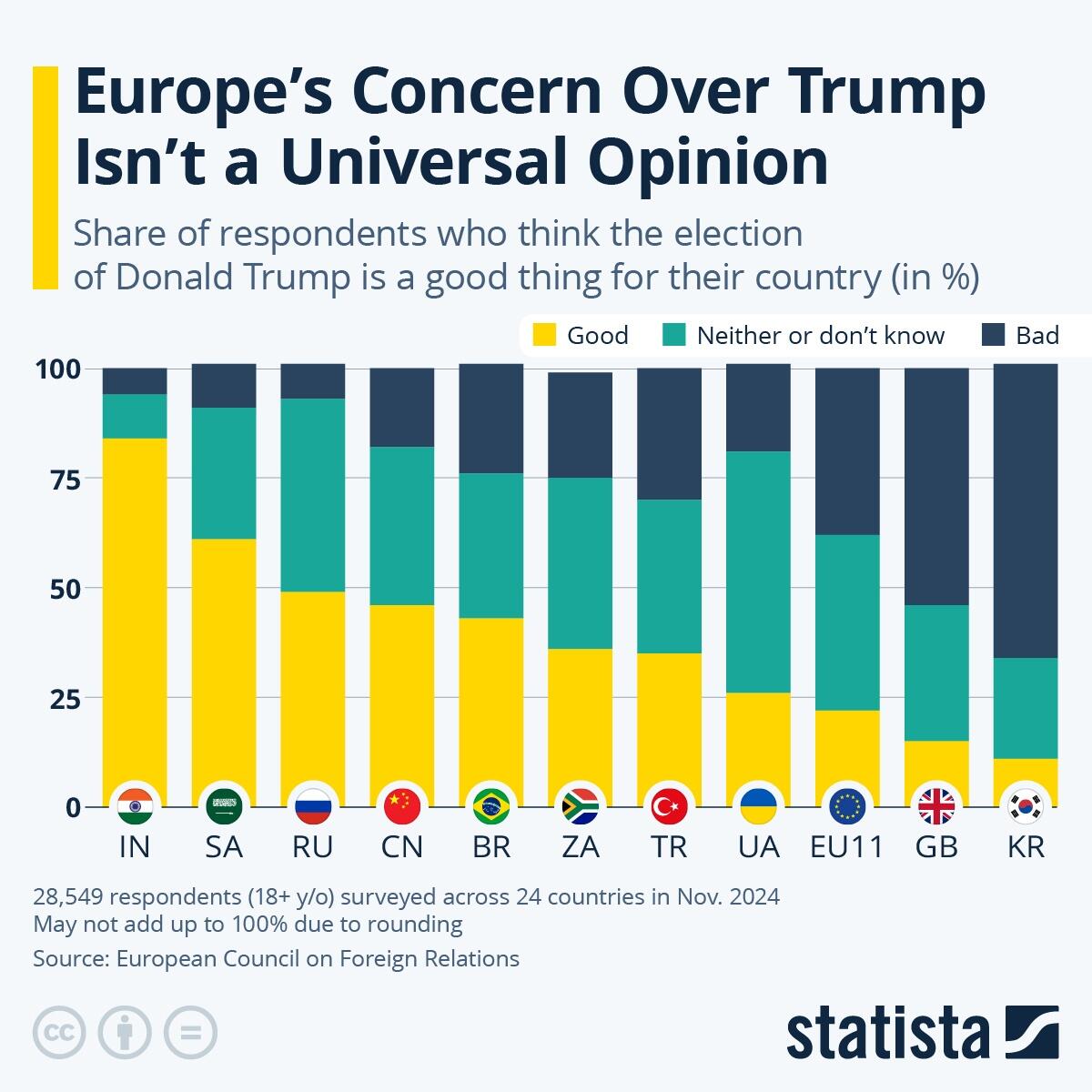
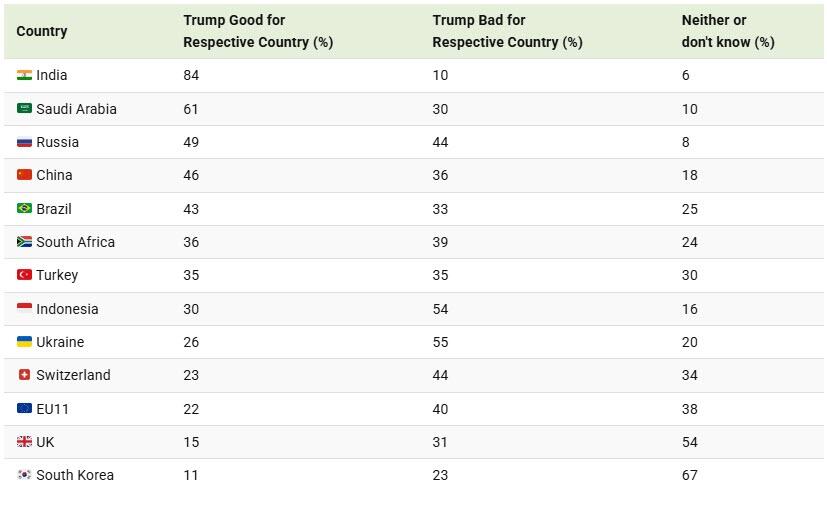
In this chart by Statista, Visual Capitalist’s Jeff Desjardins points out that public opinion on whether Trump’s presidency will have a positive or negative impact on their home country varies greatly…

The Data by Country

The data comes from a survey of 28,549 people by the European Council on Foreign Relations (ECFR). It was conducted across 24 countries in November 2024 after the U.S. presidential election.

In this data set, India is the country that sees Trump’s likely impact on their country as the most positive. A whopping 84% of Indians surveyed saw this to be the case, with only 10% that saw a second term as being bad for India.

On the flipside, South Korea had just 11% of respondents that said Trump would be good for their country. However, a large portion of Koreans (67%) were not sure of the impact that he would have, which is interesting in itself.

As President Trump’s second term progresses, especially given the potential ripple effects abroad through tariffs and other policies, it’s likely that the international community will be watching his administration closely.

Over $1 trillion of billionaire wealth was present at Trump’s inauguration. Who was there and what are they worth? Check out this visualization from Voronoi, the new app from Visual Capitalist to find out.

Tyler Durden
Thu, 01/30/2025 – 23:10

via ZeroHedge News https://ift.tt/kKiZ0Gh Tyler Durden

The Record Shows Tulsi Gabbard Was Not An Apologist For Russia-Backed Syria

The Record Shows Tulsi Gabbard Was Not An Apologist For Russia-Backed Syria

Authored by Aaron Maté via RealClearPolitics,

Tulsi Gabbard’s nomination to serve as President Trump’s director of national intelligence hinges on questions about the judgment and patriotism of the former congresswoman and Army veteran, doubts that are expected to take center stage at her Senate confirmation hearing Thursday.
Echoing a charge first lodged by Hillary Clinton, Sens. Tammy Duckworth and Elizabeth Warren have spread innuendo that Gabbard is a “compromised” “Russian asset” who has been “in Putin’s pocket.” Former CIA Director John Brennan has speculated that Gabbard may deliberately “withhold” or even “skew” vital intelligence in briefing President Trump. Michael McCaul, the Republican chairman of the House Foreign Affairs Committee, has called Trump’s selection of Gabbard to oversee the nation’s 18 spy agencies “a bit baffling” and predicted a defeat of her nomination in the Senate.

While eyebrows have been raised over Gabbard’s support of a pardon for Edward Snowden – the contractor who stole and released classified information revealing that the U.S. government was conducting domestic mass surveillance and who eventually received asylum in Russia – the main criticism involves Gabbard’s views on Syria, whose recently deposed, Russian-backed dictator, Bashar al-Assad, engaged in a long and brutal war against U.S.-backed insurgents. 

In January 2017, just as the U.S. was winding down a covert war to topple the regime, Gabbard met with Assad in Damascus. With designated terror groups occupying swaths of the war-torn country, Gabbard warned that Assad’s removal would create a destabilizing power vacuum filled by Al-Qaeda. And when these same insurgent groups accused Assad’s government of chemical weapons attacks, Gabbard voiced skepticism of the allegations, particularly in two incidents that prompted U.S. military airstrikes.

The charges against Gabbard – which have recently been revived in the Washington Post and other news outlets – are that her dissenting opinions on Syria put her at odds with the consensus views of U.S. intelligence agencies, which therefore calls into question her fitness to oversee them as the nation’s top spy chief.

Yet Gabbard’s record on Syria, and that of the intelligence community she is poised to lead, shows that her views are not the fringe position that her detractors claim. Gabbard has never offered support for Assad or issued a blanket denial of chemical weapons use by his recently ousted government. In a 2020 statement during her run for the Democratic presidential nomination, Gabbard described Assad as a “brutal dictator” and said that “[t]here is evidence” that both his forces and anti-government insurgents “have used chemical weapons.” 

While Gabbard has indeed voiced skepticism about specific chemical weapons allegations lodged against the Assad government, she is far from alone among U.S. officials, including at the top of the intelligence leadership. On this contentious issue, the available evidence shows that Gabbard’s skepticism does not contradict that of the U.S. intelligence community, which has never released formal assessments in the cases where Gabbard has raised doubts. 

‘No Violations’ in Visit to Assad

When Gabbard met Assad in Damascus in January 2017, she characterized the encounter as an effort to end one of the 21st century’s deadliest wars. “In order for any peace agreement … there has to be a conversation with him,” Gabbard said.

To Gabbard’s critics, “particularly … Democrats,” the meeting instead “served to legitimize the dictator,” as the Washington Post put it earlier this month. Although the Post’s article cast Gabbard’s Syria trip as a red flag hanging over her nomination, it only briefly mentioned the Office of Congressional Ethics investigation of her visit in which “no violations were found.” The Post also failed to note that such efforts by members of Congress are not unprecedented: Beginning in 2007, for example, former House Speaker Nancy Pelosi and former Secretary of State/presidential nominee John Kerry met separately with Assad in Damascus, with Kerry doing so multiple times, and despite Bush administration complaints that that such meetings legitimize the dictator

The controversy surrounding Gabbard’s Damascus visit came amid wider unease over her opposition to the U.S. government’s covert support for the insurgency fighting Assad’s government. Shortly after her Syria trip, Gabbard introduced the Stop Arming Terrorists Act, which called for banning any U.S. weaponry or assistance to the Islamic State, Al-Qaeda, and Jabhat Fatah al-Sham (another name for Al-Qaeda’s Syria franchise), all major forces in the armed rebellion.  

A recent Foreign Policy article argued that Gabbard’s bill was unnecessary because these were groups “that were already designated terrorists by the U.S. government and therefore barred from receiving any kind of support.” Yet Gabbard’s bill also singled out assistance to “any individual or group that is affiliated with, associated with, cooperating with, or adherents to such groups.” This reflected what was by then common knowledge at the highest levels of the U.S. government: The U.S.-armed insurgency was dominated by Al-Qaeda, and at times even fighting alongside ISIS.

Jake Sullivan, who would become national security adviser under Joe Biden, acknowledged this in a February 2012 email: “AQ [Al-Qaeda] is on our side in Syria.” Later that year, a Defense Intelligence Agency report noted that “Salafi[s], the Muslim Brotherhood, and AQI [Al Qaeda in Iraq] are the major forces driving the insurgency,” which, it added, has the “support” of the U.S. and its allies.

When President Trump shut down the CIA’s covert Syria program in July 2017, he too echoed Gabbard’s position. “It turns out it’s a lot of al-Qaeda we’re giving these weapons to,” Trump remarked.

Another of Gabbard’s warnings has since proved to be prophetic. “[I]f President Assad is overthrown,” Gabbard warned in 2017, “then Al Qaeda or a group like Al Qaeda … will take charge of all of Syria.” When Assad was finally toppled last month, the head of the new government became Abu Mohammed al-Jolani, the founder of Al-Qaeda’s franchise in Syria and a former deputy leader of ISIS. Jolani’s militia, since renamed Hayat Tahrir al-Sham (HTS), is still a U.S. government-designated terrorist organization, though the Biden administration announced in its last days in office that the U.S. will no longer enforce the $10 million U.S. bounty on his head.

Doubting Press Releases, Not Intel 

While Gabbard’s concerns about the Al-Qaeda-dominated insurgency in Syria are now seldom challenged, her skepticism of chemical weapons allegations against the now former Syrian government have emerged as a major stumbling block to her nomination.

statement released by Foreign Policy for America, a Democratic Party-aligned think tank, recently assailed Gabbard for having “publicly cast doubt on U.S. intelligence reports and overwhelming public reporting that Assad carried out chemical weapons attacks against Syrian civilians.” 

This criticism relies on a widespread misnomer. Gabbard has not “cast doubt on U.S. intelligence reports” about Syrian chemical weapons attacks, because no such reports have ever been released.

In the three major incidents where Gabbard has challenged a U.S. military intervention over alleged Syrian government chemical attacks – in Ghouta (2013), Khan Shaykhoun (2017), and Douma (2018) – the U.S. intelligence community has never published a formal report making the case. In a deviation from established practice where the intelligence community issues declassified summaries of its conclusions, the Obama administration established a precedent in which the White House, not the nation’s spy agencies, have released statements lodging allegations against the Syrian government. 

In Syria’s most notorious chemical weapons incident – the August 2013 sarin attack in Ghouta that crossed President Obama’s self-declared “red line” – the nation’s top intelligence official, then-ODNI director James Clapper, explicitly refused to release an intelligence product accusing Assad’s military of guilt. And on the question of Syrian government culpability, Clapper adopted a position that would later mirror that of Gabbard, his would-be successor.

As Obama and his senior aides mulled bombing Syria after sarin-filled rockets killed scores of civilians in Ghouta, Clapper personally visited the White House to issue an impromptu warning. At the president’s daily briefing, Clapper told Obama that the evidence implicating Assad’s forces in the sarin attack in Ghouta was not a “slam dunk.” This was a deliberate reference to the term used by George W. Bush’s CIA Director, George Tenet, in vouching for the falsified intelligence that Iraq possessed weapons of mass destruction, the pretext for the Bush administration’s decision to invade. 

Clapper went out of his way to repeat that same warning on two other occasions, including at a meeting of White House principals, which nervous aides soon leaked to the media. Obama, The Atlantic’s Jeffrey Goldberg later reported based on an interview with the 44th president, was “unsettled” by Clapper’s visit. He may also have been influenced by intelligence emanating from the Pentagon. According to a leaked assessment prepared for the Defense Intelligence Agency in June 2013, al-Nusra in Syria maintained a sarin production cell that marked the group’s “most advanced sarin plot since al-Qaida’s pre-9/11 effort.”

After invoking the Iraq WMDs debacle, Clapper told his administration colleagues that the intelligence community would not produce an intelligence product for public release. Instead, he handed off the task to Ben Rhodes, Obama’s deputy national security adviser and top speechwriter. “It took me a moment to understand what he was suggesting,” Rhodes later wrote in his memoir. “In all my time at the White House, I had never written that kind of assessment, and never would again. These were usually technical documents produced by teams of people in the intelligence agencies.”

With the job left to him, Rhodes, who had no intelligence experience, was unsettled as well. The former aspiring novelist spent more than two days drafting what he called a “U.S. Government Assessment,” a term that carries no formal significance and that amounts to a White House press release. “I felt waves of anxiety,” Rhodes recalled, “anticipating how I might be hauled before Congress if things went terribly wrong after a military intervention. I was responsible for writing the public document that would justify the United States’ going to war in Syria.”

Gabbard, then serving in Congress, was among the lawmakers to oppose a U.S. military strike on Syria. In criticisms of Gabbard’s position, it is widely overlooked that her skepticism did not entail challenging the formal assessment of the U.S. intelligence community. Instead, she did not accept the argument produced by Rhodes, a creative-writing MFA who felt “waves of anxiety” writing it. 

While Rhodes centered Clapper’s “slam dunk” warning in his memoir, Clapper omitted it from his. Instead, Clapper claimed in his 2018 book that the intelligence community “obtained evidence” of the Assad regime’s guilt in Ghouta. Yet Clapper also hinted that this evidence was far from convincing. The IC’s classified assessment on Ghouta, Clapper recalled, “gave alternate explanations” to an Assad regime chemical attack “and highlighted the things we didn’t know.” The former intelligence chief also disclosed that Obama’s national security adviser, Tom Donilon, was another skeptic. Donilon, Clapper wrote, “seemed to keep raising the evidentiary bar we needed to meet before he believed our reports.”

In a different section of the book, Clapper owned up to participating in the intelligence deception that led to the Iraq war, which undoubtedly informed his “slam dunk” warning over Syria. The U.S. “failure” in Iraq, Clapper wrote, belongs “squarely on the shoulders of the administration members who were pushing a narrative of a rogue WMD program in Iraq and on the intelligence officers, including me, who were so eager to help that we found what wasn’t really there.” 

Clapper was acknowledging that he had failed to stick to the known facts about Iraqi WMDS, and instead help come up with evidence that “wasn’t really there” – in other words, fraudulent. 

Against the wishes of many of his senior aides, Obama ultimately abandoned his “red line” and declined to bomb Syria. In public, the White House claimed that Obama pulled back after Russia offered to facilitate the destruction of Syria’s decades-old chemical weapons stockpile. It was only in his last months of his presidency that Obama acknowledged the “slam dunk” warning from Clapper – and that war skeptics like Gabbard were handed a vindication. 

Challenging a False Flag Coverup

While Clapper’s role in questioning Syrian government culpability in the 2013 Ghouta attack remains widely overlooked, Gabbard has attracted significant controversy for raising questions about two other alleged chemical attacks by Assad’s forces in the period since.

In a 2020 statement, Gabbard said that she was “skeptical” of the Assad regime’s guilt regarding attacks on Khan Shaykhun in 2017 and Douma in 2018 – two towns that were both “under the control of al-Qaeda-linked opposition forces.” In these incidents, she wrote, “there is evidence to suggest that the attacks may have been staged by opposition forces for the purpose of drawing the United States and the West deeper into the war.” 

Here again, Gabbard was not alone. As one former U.S. Ambassador to the Middle East put it, Obama’s “‘red line’ was an open invitation to a false-flag operation.” David McCloskey, a former CIA analyst who spent years covering the Syrian war, is of the view that “most of the chemical weapons attacks that have occurred during the war [were] perpetrated by the regime.” However, he added, “there was obviously a desire on the part of al-Nusra [Al-Qaeda in Syria] and others to gain access to chemical weapons stores—certainly, a desire to frame the regime for attacks, if they could.” 

As with Ghouta, the U.S. intelligence community did not release an assessment in either incident to make the case against Assad. Instead, the White House again issued lengthy press releases written by non-intelligence officials. 

The April 2017 statement on Khan Shaykhun, released by the National Security Council under the direction of then-national security advisor H.R. McMaster, claimed to represent “an unclassified summary of the U.S. Intelligence Community’s analysis.” Given that the summary did not come directly from the intelligence community and did not have its imprint, this claim was impossible to verify. 

In the only nod to U.S. spies’ data on the incident, the document referenced “signals intelligence and geospatial intelligence,” without offering any details on what was obtained. “We cannot publicly release all available intelligence on this attack due to the need to protect sources and methods,” it added. It also pointed to “a significant body of credible open source reporting, that tells a clear and consistent story.” This was a reference to publicly available material not collected by U.S. spy agencies, and therefore not immune to manipulation by biased actors. 

Spies Relying on ‘Public Reporting’

One year later, the U.S. government’s statement on Douma contained only a qualified mention of “[r]eliable intelligence,” without explaining what was acquired or how it was deemed reliable. Instead, the statement again made several references to “open-source information.” Rather than drawing on secret intelligence collected by U.S. agencies, the statement cited “social media users, non-governmental organizations, and other open-source outlets”; “photos and videos”; and “reporting from media, non-governmental organizations (NGOs), and other open sources.” Adopting the same title of Ben Rhodes’ statement on Ghouta five years prior, the White House document was labeled a “United States Government Assessment,” meaning that it did not come from the intelligence community.  

In his memoir, John Bolton – who oversaw the U.S. response to the Douma incident as Trump’s third national security adviser – hinted that that the U.S. government did not collect an overwhelming body of evidence. “We discussed at length what we did and didn’t know regarding Syria’s attack and how to increase our understanding of what had happened,” Bolton recalled. This included, he added, uncertainty over the exact nature of the toxic agent used in Douma, with U.S. officials unsure “whether sarin nerve agent was involved or just chlorine-based agents.” The “[p]roof of the Assad regime’s chemical-weapons usage,” he added “was increasingly clear in public reporting.” Those who claimed that there was no evidence, including voices on Fox News such as Tucker Carlson, “were wrong.”

Yet Bolton’s admitted reliance on “public reporting” suggests that the U.S. government’s case was not supported by concrete intelligence. While “open source” information can sometimes be reliable, it can just as easily be compromised by the biases of the unidentified actors that White House officials extensively cited.

Bolton’s argument undercuts the main argument against Gabbard’s nomination – that she rejected the firm conclusions of intelligence agencies. 

An Aversion to Politicized Intelligence

Questions have also emerged about U.S. claims that Assad was behind the attack.

According to leaked documents, the original investigative team sent to Douma by the Organisation for the Prohibition of Chemical Weapons, the world’s top chemical weapons watchdog, did not find evidence to support allegations of a Syrian government chemical attack, raising the possibility that the incident was staged by insurgents. Two members of the Douma team later accused senior OPCW officials of manipulating the investigation and publishing a final report that baselessly implicated the Syrian government in a chemical attack. 

The OPCW has refused to meet with the veteran inspectors who challenged the cover-up. U.S. officials have dismissed the OPCW’s Douma controversy as “Kremlin disinformation,” yet have never commented on its substantive issues. Establishment U.S. media outlets have also ignored the story, with the exception of the New York Times, which vaguely mentioned it once in passing. To illustrate, a Washington Post article that sought to discredit Gabbard’s skepticism of Syria chemical weapons allegations, published just days before her scheduled confirmation hearing, made no mention of the OPCW whistleblowers and leaked documents.

Amid government and media silence over claims of a cover-up in a Syria chemical weapons probe, Tulsi Gabbard has been a rare exception. In 2021, she signed a letter urging the OPCW to address the cover-up and meet with the dissenting inspectors. “The issue at hand threatens to severely damage the reputation and credibility of the OPCW and undermine its vital role in the pursuit of international peace and security,” the statement said. 

Once again, contrary to her detractors’ claims, Gabbard was not adopting a fringe position. Among the signatories were five former senior OPCW officials, including the organization’s founding director-general Jose Bustani. Others included senior U.S. official Lawrence Wilkerson and Lord Alan West, a former senior U.K. Royal Navy officer and advisor to former U.K. Prime Minister Gordon Brown. 

In Senate meetings ahead of her confirmation hearing, Gabbard has stressed that she is not questioning all Syria chemical weapons allegations, but instead harbors skepticism about the above cases. After speaking with Gabbard, Democratic Sen. Mark Kelly complained that Gabbard was citing “experts that were not credible” – a presumed reference to the OPCW whistleblowers, two highly decorated veteran inspectors with more than 25 years of combined experience. “I have a hard time understanding why you would want to do that, to use your political capital to try to prove something when there are multiple cases,” Kelly added.

Yet throughout her political career, Gabbard has explained her reasoning for questioning allegations that can lead the nation to war. “I served in a war in Iraq, a war that was launched based on lies, and a war that was launched without evidence,” she told a CNN town hall in 2019. “So as a soldier, as an American, as a member of Congress, it is my duty and my responsibility to exercise skepticism any time anyone tries to send our service members into harm’s way or use our military to go in and start a new war.”

Yet again, Gabbard’s outlook does not set her apart from her would-be predecessor, Clapper. In his account of the Ghouta episode, Ben Rhodes stressed that the then-U.S. intelligence chief had a similar motivation. “I understood,” Rhodes wrote, “that Clapper was protecting the intelligence community from a repeat of the role it played before the war in Iraq.” 

With Gabbard now up for the job that Clapper once held, her nomination may come down to whether the Senate sees that same aversion to politicized intelligence as a liability, or a virtue.

Aaron Maté has provided extensive coverage of corruption within federal intelligence agencies as a contributor to RealClearInvestigations. He is also a contributor to The Nation, and his work has appeared in Democracy Now!, Vice, Al Jazeera, Toronto Star, The Intercept, and Le Monde Diplomatique. Maté is the host of the news show Pushback with Aaron Maté.

Tyler Durden
Thu, 01/30/2025 – 22:45

via ZeroHedge News https://ift.tt/DumYsB0 Tyler Durden