Ultra-Processed Foods Linked To Brain Changes That Drive Overeating

Ultra-Processed Foods Linked To Brain Changes That Drive Overeating

Authored by George Citroner via The Epoch Times (emphasis ours),

Ultra-processed foods (UPF) may be literally rewiring your brain to make you overeat, according to research that examined brain scans from nearly 30,000 middle-aged adults and found structural changes in regions that control hunger and food cravings.

beauty-box/Shutterstock

“We present evidence that eating UPFs increases several nutrient and metabolic markers of disease and is associated with structural brain changes in areas that regulate eating behavior,” the study authors wrote.

Key Brain Changes Identified

The research, recently published in Nature, found that people who consumed more UPFs showed measurable differences in brain areas involved in feeding behavior, emotion, and motivation.

Higher UPF intake was linked to increased thickness in the bilateral lateral occipital cortex—a brain region crucial for visual object recognition and processing shapes. This finding suggests changes in how the brain processes visual food cues.

Our findings indicate that a high consumption of ultra-processed foods is associated with structural changes in brain regions regulating eating behaviour, such as the hypothalamus, amygdala and right nucleus accumbens. This may lead to a cycle of overeating,” Arsène Kanyamibwa, the study’s first author and doctoral researcher at the University of Helsinki, said in a press statement.

The study also uncovered a potential biological mechanism behind these brain changes. Researchers found that increased UPF intake was associated with higher levels of systemic inflammation and risky metabolic markers in the blood, including C-reactive protein (CRP), an indicator of inflammation; triglycerides; and glycated hemoglobin (HbA1c). High levels of CRP, triglycerides, and HbA1c are often considered concerning indicators of potential health issues.

Unsurprising Findings, Expert Says

The findings “don’t surprise me one bit,” said Dr. Joseph Mercola, a board-certified family physician and author of “Your Guide to Cellular Health,” who was not involved in the study.

He pointed to previous research showing that just five days of eating ultra-processed foods can “short-circuit” insulin signaling in the brain. This matters because insulin isn’t only a blood sugar hormone, he noted. “It’s literally the delivery service that shuttles glucose, your cells’ preferred fuel, to where it’s needed most—your brain.”

The brain needs insulin for energy—it uses 20 percent of the body’s energy despite making up just 2 percent of its weight—so when insulin can’t do its job, the brain’s appetite control centers run on fumes, Mercola said.

UPFs are designed to be “hyper-palatable“ with combinations of sugar, fat, and salt that rapidly stimulate dopamine-driven reward pathways, encouraging repeated consumption.

Mercola added that this breakdown wrecks our ability to feel full, curb cravings, and make solid dietary decisions. “On top of that, ultra-processed foods light up dopamine pathways much like addictive drugs, creating powerful ‘eat more’ signals.”

Direct Brain Effects

The researchers noted that UPFs, which contain chemically modified ingredients and additives like emulsifiers, might change the brain through pathways independent of obesity. Emulsifiers may affect the brain by disrupting neurotransmitters, causing neuroinflammation, and altering gut microbiota.

The study controlled for factors including nutrient content, socioeconomic status, physical activity, smoking, and alcohol use.

The finding challenges the idea that obesity is just about eating too many calories, Avery Zenker, a registered dietitian at MyHealthTeam and EverFlex Fitness who holds a master’s degree in nutrition and was not involved in the study, told The Epoch Times. The study highlights how additives and food processing affect the brain in a way that promotes overeating.

“A calorie is a calorie, but the type of food it’s sourced from plays a significant role in how we eat and how much we eat,” Zenker said. “I think it’s also validating for people to hear that, if they feel out of control around ultra-processed foods, there’s nothing wrong with them.”

Ultra-processed foods are defined by the NOVA classification system as industrial formulations containing ingredients not typically used in home cooking, such as high-fructose corn syrup, oils, salt, stabilizers, antioxidants, and various chemical additives.

Growing Body of Evidence

The researchers note that their findings, in addition to previous studies, suggest it’s time for regulatory action.

One of these studies, involving more than 114,000 American adults and published last year in The BMJ, found UPF consumption—specifically processed meats, sugary breakfast foods, and sugar or artificially sweetened beverages—was linked to a 4 percent higher risk of all-cause mortality and an 8 percent higher risk of death from neurodegenerative diseases.

Given the growing body of evidence, reducing ultra-processed food intake and strengthening regulatory standards in food manufacturing may be crucial steps toward ensuring better public health outcomes,” Kanyamibwa said.

Zenker said the new study is consistent with much of the existing research on ultra-processed foods.

“While past research has consistently linked UPFs to health conditions like obesity, diabetes, and cardiovascular disease,” she said, “This study goes further by exploring direct structural changes in the brain, particularly in regions related to reward, hunger, and self-regulation.”

Zenker noted that UPFs are often high in sugar, sodium, fat, and carbohydrates, and low in vitamins, minerals, and antioxidants. “We know that this combination tends to be associated with unfavorable health outcomes.”

The researchers acknowledged limitations in their study, noting that while they found associations between UPF consumption and brain changes, they cannot definitively prove causation. The effect sizes were also relatively small.

“Given the observational nature of the study, we cannot exclude the fact that food processing is only part of the equation,” the study authors wrote. Kanyamibwa said that proving causation will require “further longitudinal or experimental evidence.”

Tyler Durden
Mon, 06/30/2025 – 20:55

via ZeroHedge News https://ift.tt/3DfXIPj Tyler Durden

Returning to Virginia

Twenty-four years ago, I left my home in Virginia and moved to Ohio to join the faculty at the Case Western Reserve University School of Law. Several years later, I was tenured, became the inaugural holder of the Johan Verheij Memorial Professorship, and then the founding Director of the Coleman P. Burke Center for Environmental Law.

I have now moved back to Virginia as I am joining the faculty at the William & Mary Law School as the Tazewell Taylor Professor of Law. I am grateful to those who supported and enriched my academic career at CWRU, and to those at W&M who have given me this next opportunity. I am excited to begin this next chapter.

The post Returning to Virginia appeared first on Reason.com.

from Latest – Reason.com https://ift.tt/FlsDbMh
via IFTTT

Federalist Society Webinar on the 20th Anniversary of Kelo v. City of New London

Susette Kelo’s famous “little pink house,” which became a nationally known symbol of the case that bears her name. (Institute for Justice.)


Last week, on June 23, was the 20th anniversary of Kelo v. City of New London, perhaps the most controversial property rights decisions in the history of the Supreme Court. Although the Fifth Amendment only permits the taking of private property for “public use,” the Court ruled that the transfer of condemned land to private parties for “economic development” is permitted by the Constitution.

The Federalist Society organized a webinar on the occasion. The participants were Peter Byrne (Georgetown), Wesley Horton (counsel for New London in the case), Timothy Sandefur (Goldwater Institute), and myself. My George Mason University colleague Prof. Eric Claeys – a leading property law scholar – moderated. Peter Byrne and Wesley Horton are generally sympathetic to the result the Court reached, while Tim Sandefur and I are opposed to it. Below is the video of the event:

Last week, I also an article at the Brennan Center State Court Report website asssessing the massive state response to Kelo, which saw 45 states enact eminent domain reform laws, and several state supreme courts repudiate Kelo as a guide to the interpretation of their state constitutions’ public use clauses.

I also have a new article entitled “Public Use, Exclusionary Zoning, and Democracy,”  available for free download on SSRN. It is part of a forthcoming Yale Journal on Regulation symposium on the 20th anniversary of the case.

The article builds in part on my book about Kelo and its aftermath,  The Grasping Hand, and also on my recent article “The Constitutional Case Against Exclusionary Zoning,” 103 Texas Law Review 1 (2024) (with Joshua Braver). It has already secured a much-coveted “highly recommended” rating on Prof. Larry Solum’s Legal Theory Blog.

The post Federalist Society Webinar on the 20th Anniversary of Kelo v. City of New London appeared first on Reason.com.

from Latest – Reason.com https://ift.tt/5MGy2N4
via IFTTT

Returning to Virginia

Twenty-four years ago, I left my home in Virginia and moved to Ohio to join the faculty at the Case Western Reserve University School of Law. Several years later, I was tenured, became the inaugural holder of the Johan Verheij Memorial Professorship, and then the founding Director of the Coleman P. Burke Center for Environmental Law.

I have now moved back to Virginia as I am joining the faculty at the William & Mary Law School as the Tazewell Taylor Professor of Law. I am grateful to those who supported and enriched my academic career at CWRU, and to those at W&M who have given me this next opportunity. I am excited to begin this next chapter.

The post Returning to Virginia appeared first on Reason.com.

from Latest – Reason.com https://ift.tt/FlsDbMh
via IFTTT

Federalist Society Webinar on the 20th Anniversary of Kelo v. City of New London

Susette Kelo’s famous “little pink house,” which became a nationally known symbol of the case that bears her name. (Institute for Justice.)


Last week, on June 23, was the 20th anniversary of Kelo v. City of New London, perhaps the most controversial property rights decisions in the history of the Supreme Court. Although the Fifth Amendment only permits the taking of private property for “public use,” the Court ruled that the transfer of condemned land to private parties for “economic development” is permitted by the Constitution.

The Federalist Society organized a webinar on the occasion. The participants were Peter Byrne (Georgetown), Wesley Horton (counsel for New London in the case), Timothy Sandefur (Goldwater Institute), and myself. My George Mason University colleague Prof. Eric Claeys – a leading property law scholar – moderated. Peter Byrne and Wesley Horton are generally sympathetic to the result the Court reached, while Tim Sandefur and I are opposed to it. Below is the video of the event:

Last week, I also an article at the Brennan Center State Court Report website asssessing the massive state response to Kelo, which saw 45 states enact eminent domain reform laws, and several state supreme courts repudiate Kelo as a guide to the interpretation of their state constitutions’ public use clauses.

I also have a new article entitled “Public Use, Exclusionary Zoning, and Democracy,”  available for free download on SSRN. It is part of a forthcoming Yale Journal on Regulation symposium on the 20th anniversary of the case.

The article builds in part on my book about Kelo and its aftermath,  The Grasping Hand, and also on my recent article “The Constitutional Case Against Exclusionary Zoning,” 103 Texas Law Review 1 (2024) (with Joshua Braver). It has already secured a much-coveted “highly recommended” rating on Prof. Larry Solum’s Legal Theory Blog.

The post Federalist Society Webinar on the 20th Anniversary of Kelo v. City of New London appeared first on Reason.com.

from Latest – Reason.com https://ift.tt/5MGy2N4
via IFTTT

Quantum Meets AI: Morgan Stanley Maps Out Next Tech Frontier

Quantum Meets AI: Morgan Stanley Maps Out Next Tech Frontier

It’s widely accepted that quantum computing remains a long-term bet, with meaningful commercialization unlikely before the 2030s—if not later.

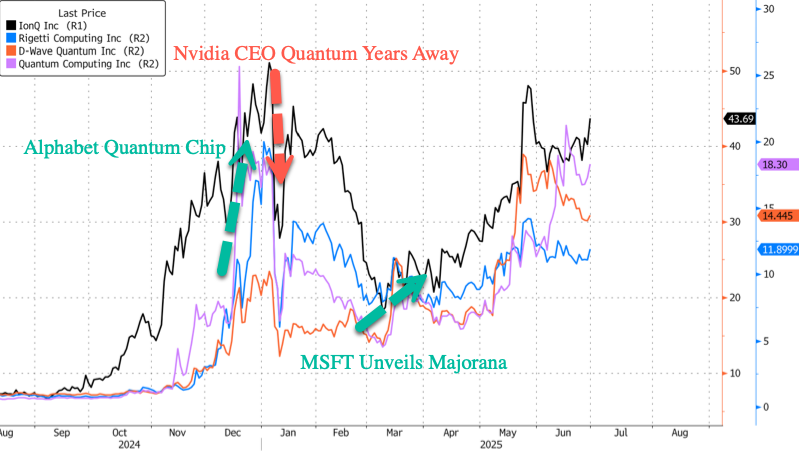
Investor enthusiasm plunged sharply in early January after Nvidia CEO Jensen Huang remarked that “very useful” quantum computers are still years away. Since then, however, quantum computing stocks (IonQ, Rigetti Computing, D-Wave Quantum, and Quantum Computing) have soared, adding billions of dollars in market capitalization. 

Morgan Stanley’s latest report, “Quantum Computing – How Will It Impact AI?”, offers one of the most comprehensive overviews to date, mapping out the evolving quantum landscape and its growing convergence with the artificial intelligence boom.

A team of analysts led by Shawn Kim told clients that quantum computing is entering a new era, marked by breakthroughs such as Microsoft’s ‘Majorana 1’ and Google’s ‘Willow’ chips, which promise to outperform today’s supercomputers.

They noted that these advances could accelerate AI development by enabling solutions to problems currently beyond the reach of classical computing. Rather than replacing classical systems, quantum computing is expected to serve as a powerful accelerator, enhancing AI’s capabilities, particularly in finance, logistics, pharmaceuticals, and energy.

While practical applications remain in the early stages, cloud-based access from big tech is making quantum tools increasingly accessible. Although widespread commercialization is still years away, early investments in the quantum AI ecosystem have already begun, and growing speculation over the industry’s long-term potential has sent related stocks soaring.

Here’s how the analysts frame the broader outlook for the quantum computing industry to clients: 

  • A Quantum leap beyond the Silicon Age. Microsoft’ Majorana 1′ or Google ‘Willow’ quantum chips were launched earlier this year, representing a paradigm shift in the ability to harness the laws of quantum mechanics to perform calculations orders of magnitude faster than today’s supercomputers. This could lead to faster breakthroughs in AI that are currently beyond the reach of classical computing, transforming how we approach complex problems, develop intelligent systems, and make predictions with a level of accuracy and speed that was previously impossible.

  • A powerful synergy – augmenting AI capabilities. We view a merging of the speed of quantum computing with the learning power of AI as a partnership rather than a competition with classical computing. Quantum chips are designed to work as quantum accelerators alongside AI systems to unlock entirely new capabilities that can amplify AI’s potential beyond the reach of classical computing. The two technologies have very different strengths and therefore lend themselves to different use cases with AI excelling at creativity, language and video processing, while quantum computing is more suited for tackling complex problems that are beyond the capabilities of classical algorithms.

  • There will be no shortage of commercial applications. Quantum computing has become more accessible as big tech companies are now offering services via their cloud services, narrowing the gap between theory and practical implementation with the potential to reshape many industries such as finance, pharmaceuticals, logistics and energy by solving complex AI problems much faster than classical computers. Most real-world uses are relatively small today and still in development, but the future looks promising.

  • Preparing for a quantum AI future. The practical applications and integration of quantum computing into AI systems are still in the early stages of development, but much like in the early days of semiconductors, early investments in successful quantum companies and their ecosystems will likely yield substantial returns. An important question remains around the commercial timeline, although many early leaders are computing incumbents and some start-ups.

The analysts outlined the rationale behind publishing this report to clients:

Why we’re writing this report: Following our first deep dive into quantum computing nearly five years ago ( The New Processing Paradigms, 19 July 2020 ), we wanted to take stock of the many moving pieces in the sector after several tech giants released new quantum chips earlier this year. Hyperscalers such as Google (Willow), Microsoft (Majorana1), IBM and Amazon (Ocelot) are all investing in the rapidly evolving quantum race. Some of them are partnering with quantum computer companies and some are doing it in-house. In this report we focus on quantum developments and how they could impact AI in three domains – computing, metrology, and communication – in terms of commercial use cases. As the quantum computing market continues to evolve, staying informed about advances, commercial applications, and regulatory developments will be essential for making sound investment decisions in this emerging sector.

Provided more insight into quantum computing’s impacts on AI:

Quantum computing allows AI to think much faster by introducing non-deterministic and probabilistic elements that allow for more intuitive reasoning vs. current AI that is largely a sophisticated pattern recognition machine. By leveraging quantum superposition, entanglement, and interference, new quantum AI models offer the potential for significant reductions in both computational cost and energy consumption. As quantum computing develops, its integration with AI has the potential to unlock entirely new approaches that are more efficient, enable significantly better accuracy, and hence better performance. AI tools like ChatGPT have already made a profound impact on society, but a critical limitation is the need for computational behemoths using classical large language models (LLMs) that are expensive to train. With fewer parameters required, quantum models could make AI more sustainable, tackling one of the biggest challenges facing the industry today.

Quantum computers have been around for decades, but mostly as experimental models in research institutions and technology companies. Unlike classical computing models, which are binary representations of electrical switches (transistors), quantum computers measure states of subatomic particles using qubits (quantum bits). Quantum computers are still not powerful enough today to do anything commercially viable in AI, due the sensitivity of quantum systems to noise and error. A lot of effort is being made to overcome hurdles, however, industry experts and hyperscale cloud providers predict the timeline for practical commercial applications of quantum computers may only be five years out.

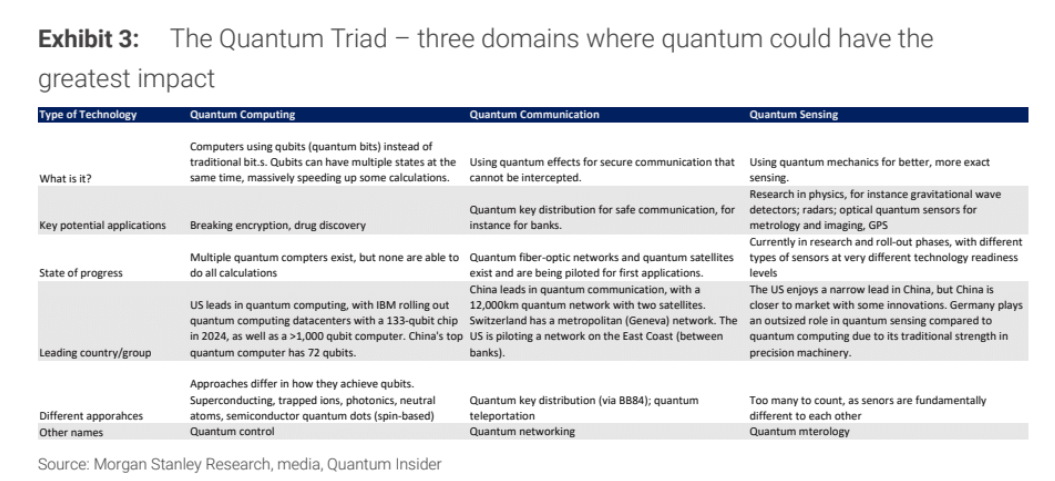
  • Quantum computing. Quantum computers store and process quantum data as opposed to binary data. Unlike current AI systems, which rely on GPU (graphics processing unit) or ASIC (application-specific integrated circuit) chips, quantum computers harness technologies such as superconducting circuits, trapped ions and neutral atoms in highly isolated environments to protect their fragile processing. The main challenge lies in scaling and improving the hardware to fully exploit the potential of quantum computing, which has a number of important uses in computing fields including optimization, power efficiency, and machine learning. Quantum computers are also known for their potential to carry out ‘Shor’s Algorithm’, which can be used to factorize large numbers to decrypt data transmissions.
  • Quantum communication (transfer of quantum ‘signals’). Quantum communication takes advantage of properties unique to the physics of quantum mechanics, opening new paradigms for communication that cannot be realized by classical (non-quantum) communication. Quantum communication could enhance AI’s ability to process and share real-time data across distributed networks, and provide ultra-secure data transmission. Distributed quantum computers and quantum sensors are interconnected with a quantum communication network in the quantum equivalent of the classical internet.
  • Quantum metrology and sensing. This uses the physical properties of quantum systems – photons and atoms – to set standards for units of measurement in science and industry, as well as for engineering other high-precision technologies. Enhanced imaging and sensing technologies from quantum sensors, combined with AI, could achieve breakthroughs in areas such as autonomous systems, medical diagnostics and environmental monitoring. Use cases include quantum imaging or quantum radar that compromise stealth technology. It is also the only known way to detect dark matter and energy.

Before readers get too excited about quantum stocks, the analysts note: “Quantum is still very much in its infancy.” 

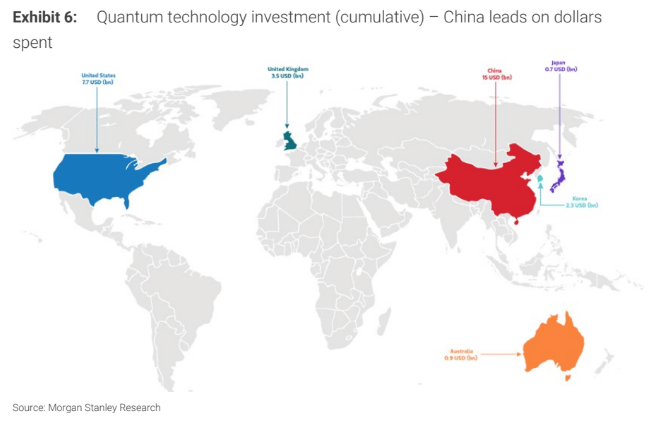
Perhaps most intriguing, the analysts frame the quantum race as a split between the West and the East. 

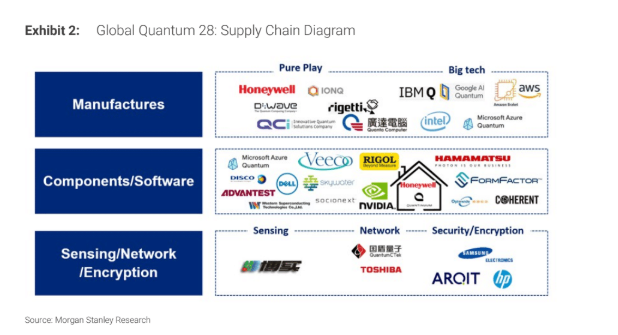
Here are the key players to watch in the space:

  • IBM – Most advanced ecosystem, aiming for 200+ logical qubits and commercialization by 2029.

  • Microsoft – Game-changing topological qubit architecture.

  • Google – “Willow” chip achieved major error-correction milestones.

  • Amazon – “Ocelot” chip; working on bosonic error correction.

  • IonQ, Rigetti, Quantinuum – Specialized quantum startups with wide-ranging partnerships.

Pure Play & Big Tech Stocks 

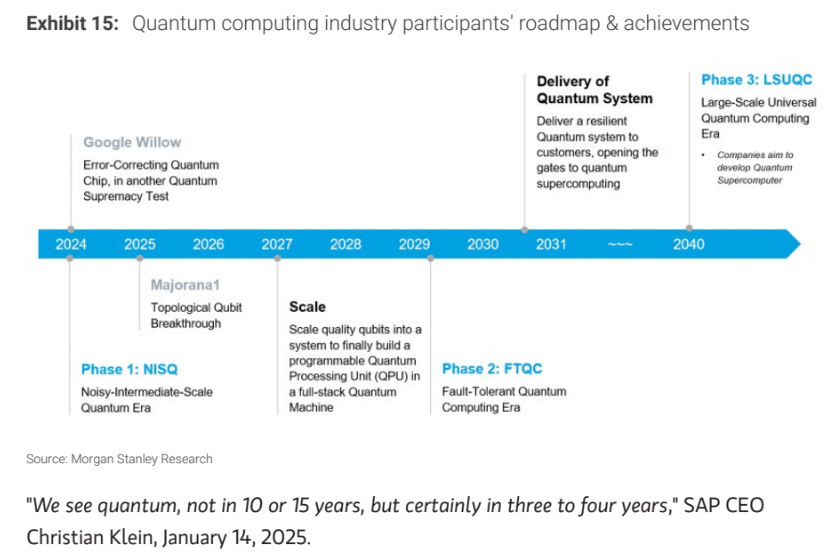
And now to the part that matters most for investors: the timeline for commercialization.

According to the analysts: 

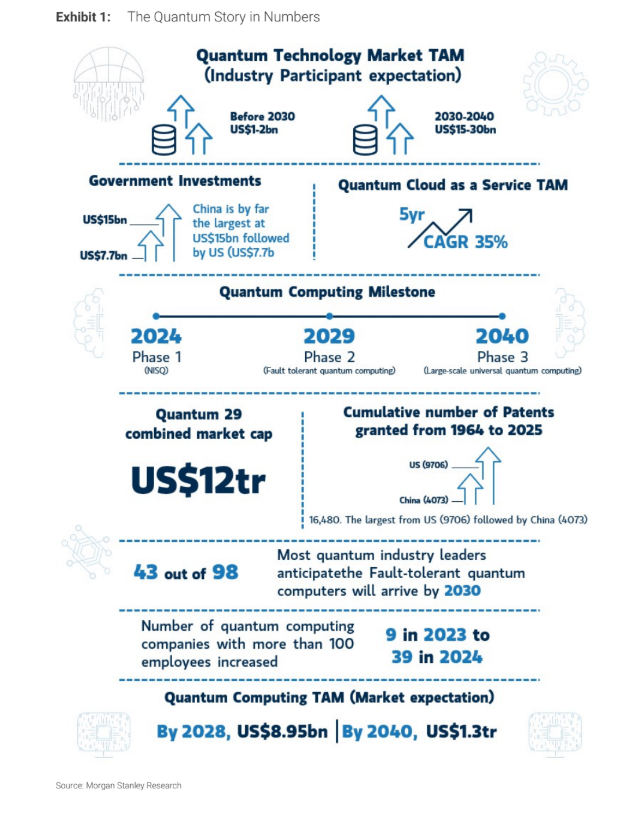
What’s the timing? The consensus quantum computing timeline suggests meaningful commercial applications emerging around 2029-30, with more advanced utility-scale quantum computing expected in the early to mid-2030s. The timing for quantum computing commercialization varies across different milestones, with several key timeframes emerging from industry experts and companies in the field. There are coordinated efforts from companies and governments to make quantum work and still primarily in the research and development phase. Many experts believe the chance of Q- day happening before 2030 is over 50%. Businesses are taking it seriously, pouring billions into preparation and will likely to begin to derive value well before via cloud offerings that are already available today for basic quantum computations.

  • Current state (2025): Quantum computing is still primarily in the research and development phase. Companies like Rigetti are working on scaling their systems, with plans to reach 100+ qubits by the end of 2025 with targeted improvements in error rates.

  • Commercial applications (2029-2030): Multiple sources indicate that meaningful commercial applications of quantum computing are expected in approximately 4-5 years from now:

  • Cryptographic threats (2030): A cryptanalytically relevant quantum computer capable of breaking common public key schemes such as RSA or ECC is expected by 2030. The National Institute of Standards and Technology (NIST) has set 2030 as the timeline for implementing quantum-secure algorithms and deprecating currently used cryptographic methods.

The Roadmap

Read the rest of Morgan Stanley’s deep quantum computing dive—available here for pro subs

Tyler Durden
Mon, 06/30/2025 – 20:30

via ZeroHedge News https://ift.tt/uyUi9cM Tyler Durden

The Future Of Crypto Equity Wrappers

The Future Of Crypto Equity Wrappers

Authored by Omid Malekan,

Co-authored with Frank Cavallo of Motus Capital Management

Crypto treasury companies such as Strategy are all the rage right now. Seemingly not a day goes by without an announcement of yet another public vehicle whose primary purpose is to provide cryptocurrency exposure inside an equity wrapper. While there are benefits to this design, some of these companies lack a unique value proposition and are indistinguishable from each other. Their stocks might not attract a premium during a bear market.

A better approach is to offer a crypto ecosystem company, one that offers comprehensive exposure to the different facets of a specific blockchain by combining operating businesses with targeted and fluid investments. Whereas treasury companies are ultimately little more than crypto market beta, an ecosystem company can provide alpha.

Background

In retrospect, the equity markets and cryptocurrencies were always destined for each other. The stock market is large, liquid, and broadly accessible. Crypto is none of these things, but is an exciting new asset class with greater upside potential. Thus the appeal of putting a long crypto strategy inside a public company wrapper, particularly in markets without cryptocurrency ETFs.

Strategy (formerly MicroStrategy) has executed the plan successfully. It currently holds almost 3 percent of all Bitcoin and trades at over 1.5x times the value of its Bitcoin holdings. As the first — and by far largest — Bitcoin treasury company, it has enjoyed a significant first-mover advantage. Its stock is highly liquid, accessible to institutions and retail investors on countless platforms, and now part of the prestigious NASDAQ 100. That liquidity — along with the premium to its NAV — allows it to keep issuing more shares to buy more Bitcoin. Strategy has also pioneered the use of convertible notes to extend its reach (and exposure to Bitcoin) to the debt market.

Compared to owning Bitcoin outright, the benefits of investing in a Bitcoin treasury company include:

  • Simplification of dealing with crypto custody, tax treatment, and reporting

  • Getting crypto exposure via equity market infrastructure (custodians, prime brokers, etc.)

  • Accessibility by a wide range of accounts and investor types (retirement plans, RIAs, etc.)

  • Better tax treatment of equities over spot crypto in certain countries

  • Access to a more liquid options market than that of spot BTC

  • Investment mandate arbitrage via issuance of convertible senior notes

  • Monetization of flexible capital stacks for leverage

Many of these advantages are also provided by spot Bitcoin ETFs, with the added benefit of lower fees and cleaner pass-through structures. Others will be eliminated by greater maturation of the spot Bitcoin markets or new laws that eliminate regulatory loopholes.

The most likely driver of Strategy’s premium to NAV is the market perception that friendly debt markets will allow it to keep acquiring more Bitcoin without dilution. But there’s no guarantee debt demand will continue, and it can always reverse to due market saturation or a bear market. The inability to refinance could lead to existing debt holders being repaid via newly issued equity, forcing dilution at the worst possible time.

This is not to say NAV discounts are imminent or argue that companies shouldn’t engage in leverage, but rather to point out that treasury operations alone won’t necessarily command NAV premiums, therefore crypto equities should look to additional value propositions.

A More Sustainable Approach

One way to distinguish a crypto treasury company is to focus on alt coins that don’t have ETFs. Such a stock would be particularly appealing if the underlying asset is one that doesn’t yet have a liquid spot market. If it’s a coin that can be staked, the treasury company could do so to earn yield with minimal counterparty risk.

But simply buying and holding such a coin might not be enough to distinguish a treasury company as more ETFs come online — including ones that stake. Access advantages diminish as overall access grows.

A more lasting strategy is to turn the treasury company into an ecosystem play, one that represents an all-inclusive bet on an entire blockchain and whatever yield opportunities it presents, now and in the future.

Ecosystem companies can be deployed for any coin, even Bitcoin. They can offer a more comprehensive and diversified exposure to a platform and handle the operational complexity of deploying capital on a new chain. The larger surface area of activity also allows managers to distinguish themselves from competitors who focus on the same ecosystem.

Other advantages of being an ecosystem company include:

  • Running operating businesses dedicated to a single chain, such as running validators, offering delegated staking, and launching an L2

  • Going beyond simple staking to utilize liquid staking and restaking

  • Participating in DeFi and yield farming opportunities

  • Using leverage to increase returns on DeFi/yield farming

  • Getting preferential treatment from protocol development teams

  • Venture investing in new dApps building in that ecosystem

  • Providing a one-stop shop for access to the totality of opportunities revolving around a native coin.

  • Giving investors the ability to seamlessly move capital from being totally invested in one ecosystem to another, without delay or complexity and at minimum cost.

Ecosystem companies are designed to maximize the benefits of permissionless financial structures where capital can flow seamlessly from one yield-generating opportunity to another. There are countless opportunities on smart contract platforms like Ethereum and Solana, and more will emerge in the years to come.

The equity markets might find this feature of crypto uniquely appealing, given the lack of a TradFi equivalent. But capitalizing on this fluidity — and managing the risks — requires expertise and constant attention, especially for newer chains. Those who execute the strategy effectively can smooth out the inevitable market cycles.

There are diminishing returns to levering up pure treasury companies, and there is no guarantee of being able to raise debt and equity, particularly in difficult markets. Also, tax and access moats are unlikely to persist.

However, ecosystem development companies have features that offer something more valuable (and sustainable) than simple price exposure or leverage. They offer ecosystem convexity. Done right, that is a service the market would be justified to pay a premium for.

Tyler Durden
Mon, 06/30/2025 – 20:05

via ZeroHedge News https://ift.tt/US37gDG Tyler Durden

Protesters Outraged As Trump Expected To Visit ‘Alligator Alcatraz’ in Florida

Protesters Outraged As Trump Expected To Visit ‘Alligator Alcatraz’ in Florida

America has the best alligators in the world, big beautiful alligators, perfect for stopping dangerous illegal immigrants from escaping detention until they can be processed and deported.  At least, Donald Trump and the Department of Homeland Security think so.  Others, however, are not so enamored with the idea of ‘Alligator Alcatraz’ being constructed in the middle of Florida’s swamplands.

A legal and environmental firestorm is growing around Florida’s controversial migrant detention center under construction at the remote Dade‑Collier airstrip deep in the Everglades.  Any illegals trying to escape the facility would have to face hundreds of National Guard soldiers as well as miles upon miles of snake and alligator infested waters before they reached civilization, essentially ensuring they stay in place until they are removed from the US.

Critics call the idea a “cruel spectacle” while proponents are cheering its ingenuity.  A variety of activist groups are already swarming sites near the center in protest, some arguing that the facility threatens the environmental balance of the Everglades and others asserting that it violates Miccosukee and Seminole tribal land.

The conflict over the land goes back to 1968, when authorities in Dade County, now known as Miami-Dade County, began building the Big Cypress Jetport on land the Miccosukees used for ceremonial practices. The Dade County Port Authority referred to the project as the “world’s largest airport,” with six runways designed to handle large jets. 

The airport became a flashpoint, but in 1969, a coalition if tribesmen and conservationists persuaded Florida Gov. Claude R. Kirk Jr. that the airport would damage the Everglades. He ordered construction be stopped. One runway, approximately 10,000 feet in length, was left behind as a training ground for pilots.

The current battle highlights a common tactic used by progressives – The exploitation of environmental sentiments as a tool to undermine unrelated conservative projects and policies.  One lawsuit, filed by Friends of the Everglades and the Center for Biological Diversity, alleges that federal and state agencies have violated laws that, in part, require evaluating potential environmental impacts before such a project can move forward.

Clearly the effort is driven less by environmentalism and more by a desire to thwart deportations of illegals by any means available, but it’s unlikely that the preservation angle will work for activists this time.

Tribal leaders are outraged by the construction of the site, claiming they can trace their rights to the “sacred land” back thousands of years.  Of course, they have no rights to the land today, and this is all that really matters.

President Donald Trump and Secretary of Homeland Security Kristi Noem are expected to visit the site this week and the center it set to go into operations in July.  Florida officials, including Governor Ron DeSantis and AG James Uthmeier, defend the project as an efficient processing center. 

“There will be some very dangerous criminal aliens that get processed through here,” DeSantis told FOX News. “But if, for some reason, someone would be able to get out, where are you gonna go? You gonna dodge alligators for 50 miles to try to get to… no, it’s not gonna happen. So this is basically as secure as it gets.”  The state says the site will cost about $450 million a year to operate. That cost, according to officials, will be reimbursed by FEMA

At bottom, Alligator Alcatraz is going to open and there’s not much that progressives can do to stop it. 

Tyler Durden
Mon, 06/30/2025 – 19:40

via ZeroHedge News https://ift.tt/z520cN6 Tyler Durden