The Vanishing American Dream: Why Young Adults Can’t Afford Homes, Families, Or Stability

The Vanishing American Dream: Why Young Adults Can’t Afford Homes, Families, Or Stability

Authored by Lau Vegys via Doug Casey’s International Man,

The American Dream has become prohibitively expensive, with home affordability at historic lows and the traditional middle-class lifestyle now out of reach for most ordinary people.

But no demographic has taken it more on the chin than young Americans.

You can see it in stark terms in this week’s chart below. Since the postwar era, the share of 30-year-olds in America with both a family and a home has plummeted—from about 52% in 1950 to just 13% in 2025. That’s a staggering 75% decline over 75 years.
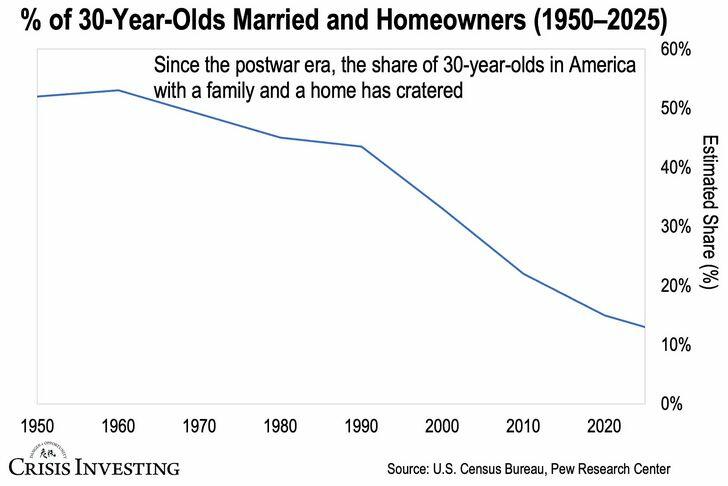
Let that sink in. In 1950, more than half of 30-year-olds had achieved what most would consider the basic markers of adult stability: marriage and homeownership. Today, it’s barely one in eight.

If you look closer, the graph shows two distinct phases of decline. From 1950 to 1990, there was a steady but manageable erosion—the share of 30-year-olds with both a family and a home dropped from 52% to about 43% over those 40 years.

That represented the gradual social changes we’re all familiar with: more women entering the workforce, people marrying later, changing cultural attitudes toward marriage.

Then something dramatic happened around 2000. The decline went into freefall. Between 1990 and 2025, the rate collapsed from 43% to 13%—a 70% drop in just over three decades.

What explains it?

We could, of course, blame this on changing cultural preferences—young people choosing career over family, prioritizing experiences over stability. That’s certainly part of the story. Young people today do have very different priorities than those more than half a century ago.

But there’s another side to this: the economics of young adulthood have become impossible. Keep in mind, today’s families would need the combined income of three households just to match the home affordability levels of a single family in 1959.

The situation gets worse when you factor in the debt burden crushing young adults. The very institution supposedly preparing young people for economic success—college—has become a wealth destroyer. Average student debt more than doubled from $17,297 to $37,850 between 2006 and 2024 alone (with total outstanding student debt exploding from $500 billion to $1.8 trillion).

Think about the brutal math facing today’s 30-year-olds.

They graduate with an average of $38,000 in student debt—though plenty are actually walking away with $60,000, $80,000, or even six-figure debt loads. They need $130,000+ in annual income to afford the average home, and compete in a job market where wages haven’t kept pace with housing costs.

In other words, they’re entering their peak family-formation years already financially crippled.

No wonder marriage and homeownership rates have collapsed.

The cruel irony is that we—scratch that, America’s political class—has created a system where the very credentials supposedly required for middle-class success have priced young people out of middle-class life.

Editor’s Note: If you have young people in your life wondering what the future holds in this broken system, Doug Casey and Matt Smith’s “The Preparation” offers a radical break from the usual path.

Instead of piling on debt for credentials of questionable value, the book lays out a blueprint for building real competence and independence outside traditional institutions. For those willing to think differently about their future, it may be the most valuable roadmap available. Click here to learn more now.

Tyler Durden
Tue, 09/30/2025 – 19:15

via ZeroHedge News https://ift.tt/bDk4lsX Tyler Durden

Israeli Knesset Advances Bill To Execute Palestinian Prisoners Who Killed Jews

Israeli Knesset Advances Bill To Execute Palestinian Prisoners Who Killed Jews

In yet another development which will certainly complicate current Trump administration efforts to find peace in Gaza, the National Security Committee in the Israeli Knesset is advancing a bill to impose the death penalty on Palestinian prisoners detained for killing Israelis.

Killings which are deemed motivated by “racism or hostility to the public” or aimed at harming the “State of Israel” or seeking to thwart the “revival of the Jewish people” would be a capital offensive, according to the legislation. Interestingly, the wording highlights Jewish citizens of Israel are the priority – and not for example Christian, Muslim, or Druze citizens.

It has unleashed immediate controversy both within and outside of Israel. For starters, some Israeli officials as well as families of Oct.7 victims fear that this puts the remaining hostages in Gaza at immediate risk. Notably, the bill does not apply the opposite direction – that is, it would not apply to Israelis who kill Palestinians.

Illustrative image: EuroMedMonitor 

Israeli Prime Minister Benjamin Netanyahu‘s coordinator for negotiations on the captives, Gal Hirsch, has gone on record as vehemently opposing the bill.

“It’s not for nothing that we are asking not to hold this discussion. I completely disagree with your assessment of the situation, Minister [Itamar] Ben Gvir,” he said in a communication protesting the initiative. “Especially when we are engaged in a combined military and diplomatic effort to bring back the hostages, this discussion does not help us.”

An initial Sunday Knesset committee vote was 4-1 in favor, while more of rounds of votes needed for the bill to become law, according to protocol. 

National Security Minister Itamar Ben-Gvir has been leading the charge, resisting calls to postpone the vote due to the precariousness of the hostage situation

One Palestinian rights group had this to say:

The Israeli bill was denounced by the Palestinian Commission for Detainees’ Affairs and the Palestinian Prisoner Society as an “unprecedented savagery,” warning that it would entrench what they described as “systematic crimes” against detainees through legislation.

Increasingly, there have been shootings and terroristic attacks by Palestinians in places like Tel Aviv and Jerusalem, related to ongoing events in Gaza and the West Bank.

Harsh confines at Israeli prison where Palestinians are kept:

At times, Palestinian encounters with Jewish settlers in the West Bank has also resulted in shootings and killings. This legislation would have a further chilling effect on Palestinian villagers and farmers when settlers show up to take their land, given that if they fight back, they could be facing the death penalty. 

Tyler Durden
Tue, 09/30/2025 – 18:50

via ZeroHedge News https://ift.tt/QGNkcL9 Tyler Durden

Obama Library Funds Are Secretly Flowing To Dark Money Networks

Obama Library Funds Are Secretly Flowing To Dark Money Networks

Authored by Matt Margolis via PJ Media,

Barack Obama’s long-promised presidential library is shaping up to be just as corrupt as his administration. You probably haven’t heard much about this in the media, but recent tax filings reveal that money donated to the Obama Foundation—supposedly earmarked for his sprawling “presidential center” in Chicago—is quietly being redirected to one of the left’s most notorious dark money groups: the Tides Foundation.

Obama Foundation via AP

The numbers tell the story. In 2022 and 2023, the Obama Foundation handed over $2 million to Tides, a group best known for serving as a clearinghouse for radical left-wing causes and for shielding donor identities. It should come as no surprise that George Soros heavily backs Tides, and Tides is directly tied to groups organizing anti-Israel protests. That includes demonstrations against the Jewish state in the aftermath of the Oct. 7 Hamas atrocities. In other words, donations made in the name of funding a presidential library are now helping bankroll organizations promoting antisemitic activism under the guise of social justice.

That’s pretty on-brand for Barack Obama.

“The Tides Center played an administrative role in the program by processing grants while Cities United [a nonprofit] managed the application process,” the spokeswoman said in an email. Grants ranged from $15,000 to $30,000 each over the two summers.

Tides has also handled donations for Black Lives Matter Global Network Foundation, which sued the group in California Superior Court last year. It alleged “egregious mismanagement” of more than $33 million in its funds, according to court documents. That lawsuit is ongoing.

In addition to sending donations to Tides, the Obama Foundation has sent more than $3 million in 2022 and 2023 in grants to Gofundme.org for undisclosed “grassroots leaders to empower girls through education,” according to the group’s filings.

Meanwhile, the foundation admitted it has so far spent more than $615 million building the Obama Presidential Center, which is scheduled to open in spring 2026, according to its website.

The group, which received just $129,320 in donations in 2022, spent more than $27 million on salaries.

While community members struggle, insiders at the Obama Foundation are doing just fine. The foundation’s CEO, Emeka Jarrett, earned over $750,000 last year. The executive vice president, Rob Cohen, pocketed nearly $650,000, and also maintains ties to the Pritzker Realty Group. His connection to Penny Pritzker—sister to Governor J.B. Pritzker—only highlights the tangled web of Democratic powerbrokers who are thriving while the project supposedly dedicated to “the people” spirals out of control.

Meanwhile, the presidential center itself—originally sold to the public as a beacon of civic pride for Chicago’s South Side—has turned into a financial pit. Construction on the 20-acre site in Jackson Park began years ago, with a ballooning price tag that has already exceeded $615 million, far above the initial $500 million projection. The opening date has slipped again, now pushed to spring 2026. Local residents aren’t thrilled either. One lawyer described it bluntly as a “monstrosity,” pointing to rising costs, neighborhood headaches, and little actual benefit to the people forced to live around it.

This entire project reeks of the kind of carefully crafted con job only career political operators could pull off. Sell it as a beacon of unity, then funnel millions to radical, antisemitic causes, all while insiders pocket obscene salaries. It’s a true reflection of the same kind of corruption that plagued Obama’s presidency.

The Obama Presidential Center is a $615 million con, funneling money to radical causes and insider salaries. The mainstream media won’t cover this, but we will. Support our work by joining PJ Media VIP. Use promo code FIGHT for 60% off for ad-free access and sharp reporting. Support America First journalism.

Tyler Durden
Tue, 09/30/2025 – 18:25

via ZeroHedge News https://ift.tt/vHAu827 Tyler Durden

Federal Court Rules Speech-Based Deportations of Non-Citizen Students and Academics Violate the First Amendment

Today, in AAUP v. Rubio, federal district Judge William G. Young (appointed by Ronald Reagan) ruled that speech-based deportations of foreign students and academics violate the First Amendment. Here is his summary of his long and detailed ruling (which runs to 161 pages in all):

This case -– perhaps the most important ever to fall within the jurisdiction of this district court –- squarely presents the issue whether non-citizens lawfully present here in United States actually have the same free speech rights as the rest of us. The Court answers this Constitutional question unequivocally “yes, they do.” “No law” means “no law.” The First Amendment does not draw President Trump’s invidious distinction [between citizens and non-citizens] and it is not to be found in our history or jurisprudence… No one’s freedom of speech is unlimited, of course, but these limits are the same for both citizens and non-citizens alike.

With this constitution ruling firmly undergirding its approach, the Court here held a full hearing and a nine-day bench trial on the issue of whether the rights of these
plaintiffs to constitutional freedom of speech have been unconstitutionally chilled by the deliberate conduct of any or all of these Public Official defendants. The Court heard 15 witnesses and admitted 250 exhibits consisting of documents, photographs, and video clips.

Having carefully considered the entirety of the record, this Court finds by clear and convincing evidence that the Secretary of Homeland Security Kristi Noem and the Secretary of State Marco Rubio, together with the subordinate officials and agents of each of them, deliberately and with purposeful aforethought, did so concert their actions and those of their two departments intentionally to chill the rights to freedom of speech and peacefully to assemble of the non-citizen plaintiff members of the plaintiff associations. What remains after issuing this opinion is to consider what, if anything, may be done to remedy these constitutional violations.

Much of the opinion is a long detailed recitation of the extensive evidence showing that the administration does indeed have a policy of targeting non-citizen students and university employees for deportation based on their anti-Israel or pro-Palestinian speech. One can quibble with some of the details here. But the combined weight of evidence is overwhelming, in so far as high officials from the president on down have openly said that is what they are doing. In several cases, such as that of Tufts graduate student Rumeysa Ozturk, they have indeed tried to deport people whose only offense was to engage in speech disapproved of by the administration. Thus, Judge Young is right to conclude there is a basis for a lawsuit by the AAUP and the Middle East Studies Association, both of which have members vulnerable to deportation under the policy.

The latter part of the opinion (beginning at pg. 116) has a solid explanation of why the First Amendment’s protection for freedom of speech applies to non-citizens present in the US, and why Supreme Court precedent supports that position, or at least does not preclude it. Here is one key point:

Lastly,…. this Court observes that, on its face, the First Amendment does not
distinguish between citizens and noncitizens; rather, it states simply, “Congress shall make no law . . . abridging the freedom of speech[.]” U.S. Const. amend. I. As the Supreme Court’s now  frequently cited statement in Bridges v. Wixon confirmed, this text at least arguably implies that “[f]reedom of speech . . . is accorded aliens residing in this country.” 326 U.S. 135, 148 (1945). It also suggests something a little less obvious, but still worth saying, which is that its chief concern is with the character and quality of the “speech” that occurs on American soil, in what Justice Holmes called “free trade in ideas,” which is “the best test of truth,” Abrams v. United States, 250 U.S. 616, 630 (1919), and ensuring that Congress may not twist that speech in the federal government’s preferred direction….

As I have pointed out previously, the First Amendment, like most constitutional rights is phrased as a generalized limitation on government power, not a privilege limited to a specific group, such as citizens. A few rights, are explicitly confined to citizens (such as the Privileges or Immunities Clause of the Fourteenth Amendment) or to “the people” (such as the Second Amendment right to bear arms), which may be a euphemism for citizens. But that makes it all the more clear that rights not explicitly limited to citizens apply to everyone, without exception.

I have defended applying the First Amendment to non-citizens in greater detail elsewhere (e.g. here and here), including responding to the view that speech-based deportations are permissible because non-citizens have no inherent legal right to be in the US:

The text of the First Amendment is worded as a general limitation on government power, not a form of special protection for a particular group of people, such as US citizens or permanent residents. The Supreme Court held as much in a 1945 case, where they ruled that “Freedom of speech and of press is accorded aliens residing in this country.”

A standard response to this view is the idea that, even if non-citizens have a right to free speech, they don’t have a constitutional right to stay in the US. Thus, deporting them for their speech doesn’t violate the Constitution. But, in virtually every other context, it is clear that depriving people of a right as punishment for their speech violates the First Amendment, even if the right they lose does not itself have constitutional status. For example, there is no constitutional right to get Social Security benefits. But a law that barred critics of the President from getting those benefits would obviously violate the First Amendment. The same logic applies in the immigration context.

While Judge Young’s ruling – following Supreme Court precedent – applies a distinction between speech-based initial exclusions and speech-based deportations (allowing greater scope for the former), I would argue both are equally unconstitutional.

As Judge Young notes, today’s ruling follows a number of previous court decisions reaching similar conclusions about  Trump’s speech-based deportations. But his analysis is particularly thorough and compelling.

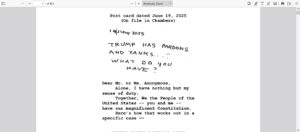
Judge Young’s opinion includes a number of rhetorical flourishes that some might consider inappropriate for a judicial ruling. For example, the beginning and end are framed as a response to an anonymous postcard sent to the court:


If I were in the judge’s place, I probably would not have done this. While I share Judge Young’s dismay at the administration’s illegal actions, these remarks are unlikely to persuade readers who aren’t otherwise inclined to agree with his reasoning. And the predictable controversy they engender could divert attention from the substantive reasoning underlying the court’s ruling. They might also provide critics with an excuse to dismiss that reasoning without seriously engaging with it, by claiming that the judge was acting inappropriately.

That said, the debate over the appropriateness of some of the rhetoric in the opinion should not detract from the substance of Judge Young’s reasoning, which is strong, and a good model for future court decisions on this issue.

In addition to the factual record and the constitutional questions, the ruling also covers claims under the Administrative Procedure Act, and a number of procedural questions (e.g. – associational standing for the plaintiffs), which I will not attempt to assess here.

The legal battle over speech-based deportations will continue. I hope higher courts will follow Judge Young’s and other district courts’ lead, and hold there is no immigration exception to the First Amendment.

The post Federal Court Rules Speech-Based Deportations of Non-Citizen Students and Academics Violate the First Amendment appeared first on Reason.com.

from Latest – Reason.com https://ift.tt/aBemrZ9
via IFTTT

The Curious Tale Of Columbia Professor Daniel Richman

The Curious Tale Of Columbia Professor Daniel Richman

Authored by Jonathan Turley,

Just The News is reporting that “Person 3” in the Comey indictment is not former FBI Deputy Director Andrew McCabe but rather Columbia Professor Daniel Richman. According to the outlet, Richman is the former FBI employee in the indictment who allegedly leaked information about “Person 1,” who is believed to be Hillary Clinton. The report continues the long uncertainty over Richman’s role in these controversies. Richman has described himself as a friend, an FBI special employee, and the lawyer representing Comey at different times. He has also been a columnist and commentator, including for the site Lawfare run by Comey’s friend Ben Wittes. What Richman was doing at any given time remains strikingly uncertain. Professor Richman is not himself charged with any crime.

Richman’s fluid and changing roles are reminiscent of the debate over the role of Hunter Biden’s friend/lawyer/patron Kevin Morris. There was an evolution in the roles that Richman played over the years that left some of us confused as to his specific status at certain times.

At various points in the investigation, Richman alludes to being Comey’s lawyer, as well as a former aide and a friend. Comey used Richman as a conduit to the press and admitted that he was the means by which Comey leaked the contents of a memo that Comey improperly removed from the FBI after being fired.

The respected veteran investigative reporter Catherine Herridge reported on a June 2017 memorandum that documented a phone call with Richman and the so-called “Comey memos,” which detailed his conversations with President Trump.

According to sources, five days earlier, on June 8, 2017, Comey “asked Professor Richman to disclose the content of at least one of those memoranda to the press…”

In interviews,  sources said that Richman was dismissive over the violation of federal rules stating  “something to the effect of, ‘You do things by your rules’ and ‘I do things by my rules.’” Richman seemed to claim that he was serving as counsel and allegedly insisted that “there is a substantial extent to which I would raise attorney-client issues.” The suggestion was that, after leaving his position as a Justice Department adviser to Comey, he may have assumed the role as private counsel to Comey.

Richman admitted to media contacts but reportedly said that he did not think that he confirmed classified material from Comey to New York Times reporter Michael Schmidt.

Comey designated Richman as a Special Government Employee (SGE) at the FBI and subsequently utilized him as a conduit to the media. He gave him access to top-secret information, and Richman seems to have floated between Comey and other offices, such as the FBI’s General Counsel’s office.

The FBI said that “Comey instructed the FBI to hire Richman as a Special Government Employee” in 2015 and “to grant him a Top Secret clearance with access to Sensitive Compartmented Information.” It also said its investigation “revealed Comey also hired Richman, so Comey could discuss sensitive matters, including classified information, with someone outside of the FBI’s regular leadership. Comey also used Richman as a liaison to the media.”

Comey’s use of Richman shows how obsessed he was with his image and framing news stories about his tenure as director. Richman would serve as both an unnamed source and a named source in articles.

Richman admitted to agents that he routinely communicated on behalf of Comey with Times reporter Michael Schmidt, who published some of the non-public information that was the subject of past investigations.

According to FBI memos, Richman explained that his role was “to correct stories critical of Comey, the FBI and to shape future press coverage” outside the bureau’s official press office.

The different roles eventually seemed to cause Richman to resign. He sent an email to FBI officials in early February 2017  saying that “I am resigning my SGE status, and will thus not, as of today, be formally working for the Bureau in the immediate future.” He added that “my SGE status is limiting what I can do in my extracurricular life.”

Richman later joined Wittes, who has described himself as a friend of Comey as well as figures like Peter Strzok, at Lawfare. With Wittes, Richman has written highly critical columns of the Trump Administration.

Comey admitted to being a leaker through Richman. He was accused of being a leaker in other stories through other individuals. Andrew McCabe said that he leaked information on behalf of Comey. Likewise, an FBI memo said that a prior investigation “revealed [FBI General Counsel James] Baker to be one of the two sources” in a leak and “revealed Baker disclosed USG classified information to the NYT under the belief he was ultimately instructed and authorized to do so by then FBI Director James Comey.”

Just in the News reported that a “newly-unredacted portion [of a report] added that ‘Baker indicated FBI chief of staff James Rybicki instructed him (Baker) to disclose the information to the NYT, and Baker understood Rybicki was conveying this instruction and authorization from Comey.’”

The question is what Richman was at any given time in this scandal. Ethics rules tend to reinforce clear lines in the roles played by lawyers. Richman has been described as a “friend” by Comey, but Richman has suggested that he was at times serving as his personal lawyer. During his time as an SGE, Richman also seemed to shift in his focus. Richman’s first term as an SGE ended in 2016 and then Comey brought him back to work as a “consultant” for the FBI’s Office of General Counsel. A good portion of his portfolio at times seemed to be running interference for Comey with the media and protecting his image in the press.

Richman has not been charged with any crime or accused of any ethics violation in any of these dealings or positions. Some of us, however, are concerned by the fluidity of these roles over the years as government employee, private counsel, and friend.

Comey appeared to select Richman in part for his loyalty and Richman has continued to defend Comey. Now, Richman has a new role as the main witness in a criminal prosecution against Comey. It may be the only time in this scandal that his role as been singular and clear.

Tyler Durden
Tue, 09/30/2025 – 17:40

via ZeroHedge News https://ift.tt/u0vRZge Tyler Durden

Jimmy Kimmel’s Audience Numbers Implode After Brief Spike

Jimmy Kimmel’s Audience Numbers Implode After Brief Spike

Progressive late-night television is dying.  The signals could not be more clear with Stephen Colbert’s cancellation due to $40 million losses every year on productions costs.  If Colbert is failing, then nearly all late night shows a failing.  Many analysts have been speculating that Jimmy Kimmel was next on the chopping block.

During the second quarter, Jimmy Kimmel Live! averaged 1.77 million total viewers. That’s down quite a bit from 2015, when Colbert joined the late-night lineup and Nielsen says Kimmel averaged 2.4 million total viewers.  The leftist comedian has become infamous in the past five years for his political hot takes and overt hatred of conservatives, just as the majority of late night hosts have gravitated to propaganda rather than entertainment.  This has not helped their audience ratings.

Then, Kimmel threw himself into the middle of the public turmoil over the Charlie Kirk assassination.  His ABC “cancellation” was short lived and the show was back in a week.  Broadcast affiliates Sinclair and Nexstar decided to bring Kimmel back and his return garnered 6.5 million viewers.  Democrats cheered as if they had just won a political victory, but reality is not kind to the delusional.

In recent broadcasts, “Jimmy Kimmel Live!” averaged 2.3 million total viewers – A staggering 64% drop from the 6.5 million who tuned in for the much-hyped return.  Kimmel shed even more viewers in the advertiser-coveted demographic of adults aged 25-54, with Thursday’s episode hemorrhaging 73% of viewers from the critical category.  

It takes more than political controversy to save a dying show led by an unfunny comedian.  ABC lost a perfect opportunity to get rid of a dud show and they blew it.    

With disinformation talking points from social media in hand Kimmel attempted to spread the false claim that the shooting suspect, Tyler Robinson, was MAGA:

“We hit some new lows over the weekend with the MAGA gang desperately trying to characterize this kid who murdered Charlie Kirk as anything other than one of them and doing everything they can to score political points from it.”  

This was part of a larger spin campaign by democrats and leftist groups to deflect blame (as they always do).  The effort to lie to the public and paint Robinson as “right wing” was desperate and rabid.  To this day, a large percentage of Democrats wrongly assume that Robinson, a gay man with a trans furry boyfriend and an affinity for Antifa slogans, is MAGA.  Their trusted gatekeepers told them he is.

As more and more information was released to the public is became clear that militant woke rhetoric, incessantly repeated by Democrat politicians and late night talk show hosts over the past several years, was to blame for Charlie Kirk’s murder.  The post-shooting celebration by millions of leftists across the country left no doubt who they are as a movement and what they are willing to do to get the power they want.    

Democrats complained that Kimmel’s show being dropped was the same “cancel culture” that conservatives criticized the political left of using.  The difference, though, is that conservatives were being cancelled for telling the truth.  They are being “cancelled” for telling lies celebrating murder.  

Tyler Durden
Tue, 09/30/2025 – 17:20

via ZeroHedge News https://ift.tt/0uSbKj8 Tyler Durden

Federal Court Rules Speech-Based Deportations of Non-Citizen Students and Academics Violate the First Amendment

Today, in AAUP v. Rubio, federal district Judge William G. Young (appointed by Ronald Reagan) ruled that speech-based deportations of foreign students and academics violate the First Amendment. Here is his summary of his long and detailed ruling (which runs to 161 pages in all):

This case -– perhaps the most important ever to fall within the jurisdiction of this district court –- squarely presents the issue whether non-citizens lawfully present here in United States actually have the same free speech rights as the rest of us. The Court answers this Constitutional question unequivocally “yes, they do.” “No law” means “no law.” The First Amendment does not draw President Trump’s invidious distinction [between citizens and non-citizens] and it is not to be found in our history or jurisprudence… No one’s freedom of speech is unlimited, of course, but these limits are the same for both citizens and non-citizens alike.

With this constitution ruling firmly undergirding its approach, the Court here held a full hearing and a nine-day bench trial on the issue of whether the rights of these
plaintiffs to constitutional freedom of speech have been unconstitutionally chilled by the deliberate conduct of any or all of these Public Official defendants. The Court heard 15 witnesses and admitted 250 exhibits consisting of documents, photographs, and video clips.

Having carefully considered the entirety of the record, this Court finds by clear and convincing evidence that the Secretary of Homeland Security Kristi Noem and the Secretary of State Marco Rubio, together with the subordinate officials and agents of each of them, deliberately and with purposeful aforethought, did so concert their actions and those of their two departments intentionally to chill the rights to freedom of speech and peacefully to assemble of the non-citizen plaintiff members of the plaintiff associations. What remains after issuing this opinion is to consider what, if anything, may be done to remedy these constitutional violations.

Much of the opinion is a long detailed recitation of the extensive evidence showing that the administration does indeed have a policy of targeting non-citizen students and university employees for deportation based on their anti-Israel or pro-Palestinian speech. One can quibble with some of the details here. But the combined weight of evidence is overwhelming, in so far as high officials from the president on down have openly said that is what they are doing. In several cases, such as that of Tufts graduate student Rumeysa Ozturk, they have indeed tried to deport people whose only offense was to engage in speech disapproved of by the administration. Thus, Judge Young is right to conclude there is a basis for a lawsuit by the AAUP and the Middle East Studies Association, both of which have members vulnerable to deportation under the policy.

The latter part of the opinion (beginning at pg. 116) has a solid explanation of why the First Amendment’s protection for freedom of speech applies to non-citizens present in the US, and why Supreme Court precedent supports that position, or at least does not preclude it. Here is one key point:

Lastly,…. this Court observes that, on its face, the First Amendment does not
distinguish between citizens and noncitizens; rather, it states simply, “Congress shall make no law . . . abridging the freedom of speech[.]” U.S. Const. amend. I. As the Supreme Court’s now  frequently cited statement in Bridges v. Wixon confirmed, this text at least arguably implies that “[f]reedom of speech . . . is accorded aliens residing in this country.” 326 U.S. 135, 148 (1945). It also suggests something a little less obvious, but still worth saying, which is that its chief concern is with the character and quality of the “speech” that occurs on American soil, in what Justice Holmes called “free trade in ideas,” which is “the best test of truth,” Abrams v. United States, 250 U.S. 616, 630 (1919), and ensuring that Congress may not twist that speech in the federal government’s preferred direction….

As I have pointed out previously, the First Amendment, like most constitutional rights is phrased as a generalized limitation on government power, not a privilege limited to a specific group, such as citizens. A few rights, are explicitly confined to citizens (such as the Privileges or Immunities Clause of the Fourteenth Amendment) or to “the people” (such as the Second Amendment right to bear arms), which may be a euphemism for citizens. But that makes it all the more clear that rights not explicitly limited to citizens apply to everyone, without exception.

I have defended applying the First Amendment to non-citizens in greater detail elsewhere (e.g. here and here), including responding to the view that speech-based deportations are permissible because non-citizens have no inherent legal right to be in the US:

The text of the First Amendment is worded as a general limitation on government power, not a form of special protection for a particular group of people, such as US citizens or permanent residents. The Supreme Court held as much in a 1945 case, where they ruled that “Freedom of speech and of press is accorded aliens residing in this country.”

A standard response to this view is the idea that, even if non-citizens have a right to free speech, they don’t have a constitutional right to stay in the US. Thus, deporting them for their speech doesn’t violate the Constitution. But, in virtually every other context, it is clear that depriving people of a right as punishment for their speech violates the First Amendment, even if the right they lose does not itself have constitutional status. For example, there is no constitutional right to get Social Security benefits. But a law that barred critics of the President from getting those benefits would obviously violate the First Amendment. The same logic applies in the immigration context.

While Judge Young’s ruling – following Supreme Court precedent – applies a distinction between speech-based initial exclusions and speech-based deportations (allowing greater scope for the former), I would argue both are equally unconstitutional.

As Judge Young notes, today’s ruling follows a number of previous court decisions reaching similar conclusions about  Trump’s speech-based deportations. But his analysis is particularly thorough and compelling.

Judge Young’s opinion includes a number of rhetorical flourishes that some might consider inappropriate for a judicial ruling. For example, the beginning and end are framed as a response to an anonymous postcard sent to the court:


If I were in the judge’s place, I probably would not have done this. While I share Judge Young’s dismay at the administration’s illegal actions, these remarks are unlikely to persuade readers who aren’t otherwise inclined to agree with his reasoning. And the predictable controversy they engender could divert attention from the substantive reasoning underlying the court’s ruling. They might also provide critics with an excuse to dismiss that reasoning without seriously engaging with it, by claiming that the judge was acting inappropriately.

That said, the debate over the appropriateness of some of the rhetoric in the opinion should not detract from the substance of Judge Young’s reasoning, which is strong, and a good model for future court decisions on this issue.

In addition to the factual record and the constitutional questions, the ruling also covers claims under the Administrative Procedure Act, and a number of procedural questions (e.g. – associational standing for the plaintiffs), which I will not attempt to assess here.

The legal battle over speech-based deportations will continue. I hope higher courts will follow Judge Young’s and other district courts’ lead, and hold there is no immigration exception to the First Amendment.

The post Federal Court Rules Speech-Based Deportations of Non-Citizen Students and Academics Violate the First Amendment appeared first on Reason.com.

from Latest – Reason.com https://ift.tt/aBemrZ9
via IFTTT

The Government Shutdown Won’t Stop Trump’s Immigration Enforcement Campaign

Pending an unexpected last minute deal, it appears that the federal government will shut down at midnight on Wednesday. Some federal agencies, as a result, are prepared to furlough their workers or scale back operations during an indefinite hiatus. But at least one area will remain largely unaffected: immigration enforcement at the Department of Homeland Security (DHS).

According to the DHS contingency plan released on Saturday, 95 percent of the agency’s employees—nearly 258,000 workers, which is 12,000 more people than the DHS employed in total ahead of the 2018 shutdown—are expected to remain on board in the event of a federal government shutdown. Of this total, 169,887 will be retained for actions “necessary to protect life and property,” including immigration enforcement. More than 93 percent of Customs and Border Protection and Immigration and Customs Enforcement (ICE) employees—over 63,000 and nearly 20,000 personnel, respectively—are expected to remain on the agency’s payroll through the shutdown.

The DHS is also expected to avoid the funding lapses that other agencies dependent on annual discretionary appropriations expect during a shutdown. This is thanks in large part to the One Big Beautiful Bill Act, a reconciliation bill that passed in July and appropriated $165 billion to the DHS—nearly doubling the agency’s budget. 

With an influx of money to the DHS, the Trump administration shows no plans of easing up on its mass deportation goals, even as other agencies temporarily cease operations. Most recently, federal immigration officers have targeted Chicago, netting almost 550 arrests during the first few weeks of September. Some of those arrests, however, have been challenged as unlawful, warrantless arrests.

The DHS crackdown in the Windy City, and elsewhere, has also been met with staunch public opposition. Over the weekend, protests against the increased immigration enforcement by armed, masked federal agents erupted into violence outside of one of the city’s ICE facilities. Meanwhile, Memphis, Tennessee, is expecting both National Guard troops and additional federal agents—including immigration officers—to begin arriving later this week. 

Since President Donald Trump took office, immigration arrests have soared. Between January and June of this year, ICE made roughly 109,000 immigration-related arrests, compared to 49,000 arrests made during that same period in 2024. The Trump administration has maintained an elevated number of immigrant detainees, and is currently detaining nearly 60,000 individuals. Although Trump and his administration officials have repeatedly claimed immigration arrests focus on “the worst of the worst” criminals, the majority of immigrant detainees have no prior criminal record or conviction.

There’s no telling how long a potential government shutdown may last. But with the White House using the funding lapse as an opportunity to cut the size of the government, there is a chance that taxpayers might see a more right-sized federal government once a budget deal is reached. Unfortunately, it’s unlikely that the same kind of cuts will be made in regards to the DHS.

The post The Government Shutdown Won't Stop Trump's Immigration Enforcement Campaign appeared first on Reason.com.

from Latest – Reason.com https://ift.tt/R9fniE0
via IFTTT

Could This Be the Best Government Shutdown Ever?

Here we go again. As I write, politicians are trying to gin up a new panic over a looming “government shutdown.” We’ve seen this before as Democrats and Republicans play chicken over their clashing funding priorities, with a partial suspension of federal activities threatened if they can’t come to a deal.

Unfortunately, the government never really shuts down, and the two parties always work out an agreement that involves spending a lot more money. The worst that happens is that some people are inconvenienced for a few days, as the only things that really cease to function are public-facing operations such as parks and offices—deliberately so, to maintain the illusion that something important is happening. What might be different this time, though, is that there’s a chance to use the impasse to reduce the federal work force.


When Spending Too Much Isn’t Enough

The latest clash over passing a funding bill for the federal government is Democrats’ insistence that the legislation include extensions for Obamacare subsidies to address a problem that, as Paige Winfield Cunningham noted for The Washington Post, “even supporters of the Affordable Care Act fight admit is a flaw in the original law: It wasn’t generous enough to make plans affordable.” Having built much of their eroding reputation on the cobbled-together public-private health care coverage scheme, Democrats need to prop it up with more taxpayer money to keep it functioning.

Republicans aren’t especially interested in keeping the flagship Democratic legislation afloat. That doesn’t mean they’re necessarily thriftier. Having largely abandoned their small-government credentials (with a few notable exceptions), the GOP wants to spend too much money—though less than the Democrats—on its own projects. Those projects place special emphasis on defense and the Department of Homeland Security, with trillions of dollars in projected deficits for the foreseeable future.

Republicans hold a majority, but Democratic votes are needed to move funding bills in the Senate. So far, Democrats have refused to budge in what The Wall Street Journal described as “a stark turnaround for a party that often lambasted Republicans as irresponsible for threatening shutdowns in the past.”


About Those Phony ‘Government Shutdowns’

That means we get a kabuki-theater government shutdown. Museums and national parks will close and federal offices will furlough workers who will be unavailable to give their usual bad tax advice or slowly process forms while most of the non-public-facing work continues behind the scenes.

“The vast majority of the federal government is still in operation, shutdown or no shutdown,” attorney Timothy Snowball commented for the Pacific Legal Foundation in 2019. “Even among the 8% of the federal budget that is not currently funded because of the shutdown, only ‘non-essential’ programs and employees are affected. For ‘essential’ employees it is business as usual.”

Federal employees are, overall, better-compensated than their private sector counterparts. According to a 2024 Congressional Budget Office analysis, “The federal government would have decreased its spending on total compensation by 5 percent if it had adjusted the cost of pay for its employees to match the compensation of their private-sector counterparts.” Even so, federal workers will inevitably cry poverty for interviewers while they’re furloughed and not drawing pay—even though they’ll automatically get all back pay once the shutdown concludes.

At most, a government shutdown is usually just a new excuse for politicians to posture in front of television cameras. This time, though, there’s a chance the federal work force might come out the other end of the shutdown a little smaller.


This Time Could Be Different

“The White House is telling federal agencies to prepare large-scale firings of workers if the government shuts down next week in a partisan fight over spending plans,” The Guardian reported last week. “In a memo released on Wednesday night, the Office of Management and Budget (OMB) said agencies should consider a reduction in force for federal programs whose funding would lapse next week, is not otherwise funded and is ‘not consistent with the president’s priorities.'”

The mentioned OMB memo points out that “with respect to those Federal programs whose funding would lapse and which are otherwise unfunded, such programs are no longer statutorily required to be carried out.” It continues: “Therefore, consistent with applicable law, including the requirements of 5 C.F.R. part 351, agencies are directed to use this opportunity to consider Reduction in Force (RIF) notices for all employees in programs, projects, or activities (PPAs) that satisfy all three of the following conditions: (1) discretionary funding lapses on October 1, 2025; (2) another source of funding, such as H.R. 1 (Public Law 119-21) is not currently available; and (3) the PPA is not consistent with the President’s priorities.”

Importantly, the memo adds: “Once fiscal year 2026 appropriations are enacted, agencies should revise their RIFs as needed to retain the minimal number of employees necessary to carry out statutory functions.”

We could see more than the usual theatrical finger-pointing and interviews of suffering Department of Education employees this time around. The government could reopen its public-facing functions after a few days, or maybe a couple of weeks (the longest shutdown was 35 days from the end of 2018 through the beginning of 2019), with a trimmed payroll.

That would, of course, be the best government shutdown ever.

There’s no guarantee this will happen, of course. Politico‘s Sophia Cai suggests “OMB Director Russ Vought is using the threat of permanent job cuts as leverage” to get Democrats to drop their demands and approve the GOP spending plan. Democrats may blink and end the opportunity for easy work force reductions.

Then again, Our Revolution, a group backed by Sen. Bernie Sanders (I–Vt.), surveyed its members and found “overwhelming support for Democrats holding the line in the shutdown fight.” That’s an important signal for the increasingly left-leaning Democrats, and one that could clear the way for a shutdown and work force reductions.

Following the relative disappointment of the Department of Government Efficiency, we should seize any opportunity to shrink the government that we can. If that opportunity comes in the form of one of the rare government shutdowns that’s actually meaningful, so be it.

The post Could This Be the Best Government Shutdown Ever? appeared first on Reason.com.

from Latest – Reason.com https://ift.tt/C35BuiX
via IFTTT

The Government Shutdown Won’t Stop Trump’s Immigration Enforcement Campaign

Pending an unexpected last minute deal, it appears that the federal government will shut down at midnight on Wednesday. Some federal agencies, as a result, are prepared to furlough their workers or scale back operations during an indefinite hiatus. But at least one area will remain largely unaffected: immigration enforcement at the Department of Homeland Security (DHS).

According to the DHS contingency plan released on Saturday, 95 percent of the agency’s employees—nearly 258,000 workers, which is 12,000 more people than the DHS employed in total ahead of the 2018 shutdown—are expected to remain on board in the event of a federal government shutdown. Of this total, 169,887 will be retained for actions “necessary to protect life and property,” including immigration enforcement. More than 93 percent of Customs and Border Protection and Immigration and Customs Enforcement (ICE) employees—over 63,000 and nearly 20,000 personnel, respectively—are expected to remain on the agency’s payroll through the shutdown.

The DHS is also expected to avoid the funding lapses that other agencies dependent on annual discretionary appropriations expect during a shutdown. This is thanks in large part to the One Big Beautiful Bill Act, a reconciliation bill that passed in July and appropriated $165 billion to the DHS—nearly doubling the agency’s budget. 

With an influx of money to the DHS, the Trump administration shows no plans of easing up on its mass deportation goals, even as other agencies temporarily cease operations. Most recently, federal immigration officers have targeted Chicago, netting almost 550 arrests during the first few weeks of September. Some of those arrests, however, have been challenged as unlawful, warrantless arrests.

The DHS crackdown in the Windy City, and elsewhere, has also been met with staunch public opposition. Over the weekend, protests against the increased immigration enforcement by armed, masked federal agents erupted into violence outside of one of the city’s ICE facilities. Meanwhile, Memphis, Tennessee, is expecting both National Guard troops and additional federal agents—including immigration officers—to begin arriving later this week. 

Since President Donald Trump took office, immigration arrests have soared. Between January and June of this year, ICE made roughly 109,000 immigration-related arrests, compared to 49,000 arrests made during that same period in 2024. The Trump administration has maintained an elevated number of immigrant detainees, and is currently detaining nearly 60,000 individuals. Although Trump and his administration officials have repeatedly claimed immigration arrests focus on “the worst of the worst” criminals, the majority of immigrant detainees have no prior criminal record or conviction.

There’s no telling how long a potential government shutdown may last. But with the White House using the funding lapse as an opportunity to cut the size of the government, there is a chance that taxpayers might see a more right-sized federal government once a budget deal is reached. Unfortunately, it’s unlikely that the same kind of cuts will be made in regards to the DHS.

The post The Government Shutdown Won't Stop Trump's Immigration Enforcement Campaign appeared first on Reason.com.

from Latest – Reason.com https://ift.tt/R9fniE0
via IFTTT