How Governments, Corporations, & Technocratic Systems Are Quietly Redefining Ownership In The 21st Century
Authored by Milan Adams via PreppGroup,
There are periods in history when societies begin to discover that the liberties they believed to be permanent were, in reality, conditional arrangements tolerated only while they remained politically convenient. Across the Western world, governments are quietly expanding the legal and administrative mechanisms through which private land can be reclassified, restricted, absorbed, or transferred in the name of infrastructure, sustainability, industrial security, climate adaptation, and economic modernization. Entire farming regions are now being surveyed for carbon pipelines. Rural communities are facing unprecedented redevelopment pressure linked to energy transitions and semiconductor expansion. Financial institutions are purchasing strategic agricultural land at historic levels while policymakers openly discuss the restructuring of urban life around centralized digital systems. Officially, these transformations are described as progress. Unofficially, an increasing number of citizens have begun to suspect that the modern definition of ownership itself is being rewritten in real time.
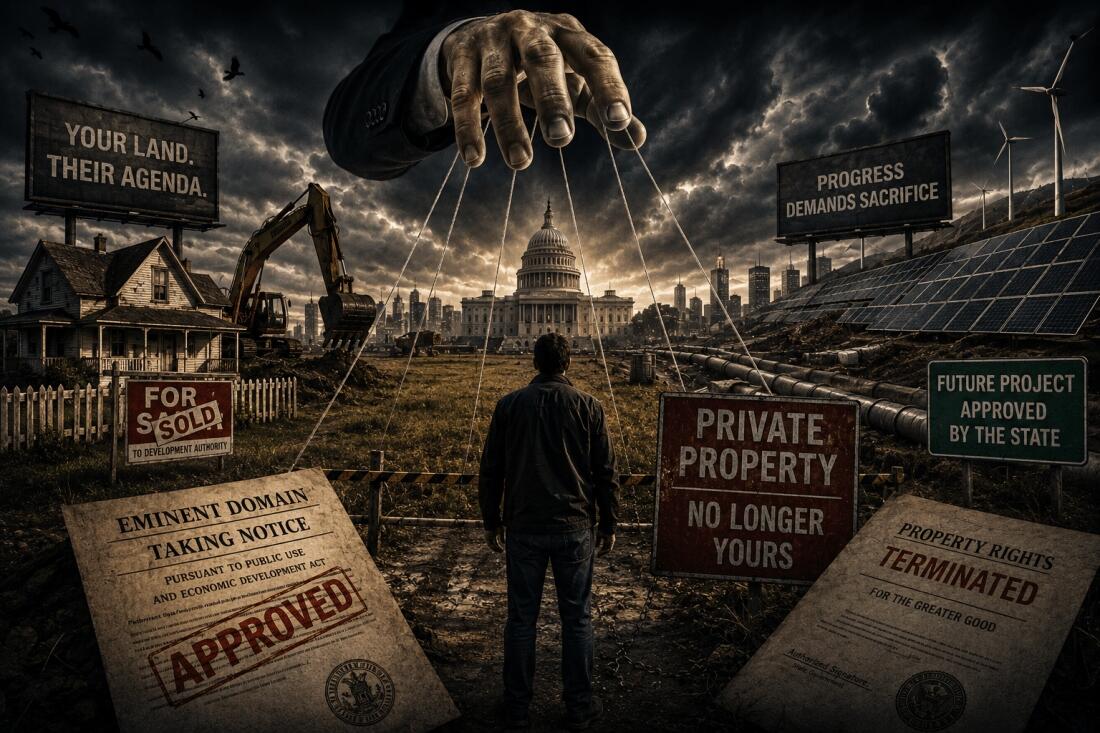
The New Architecture of Property Seizure
The modern citizen has been conditioned to believe that private property represents one of the sacred foundations of liberal democracy. Constitutions defend it, political campaigns celebrate it, and economists routinely describe it as the engine of prosperity and social stability. Yet beneath the ceremonial rhetoric lies a more fragile reality — one in which ownership increasingly resembles a conditional administrative privilege rather than an untouchable natural right. This contradiction becomes impossible to ignore when examining the doctrine of eminent domain, the extraordinary legal authority through which governments may confiscate private property without the owner’s consent.
Supporters of eminent domain insist that such authority is indispensable for the functioning of modern civilization. Roads must be built, railways expanded, energy corridors connected, airports enlarged, water systems modernized, and industrial facilities constructed. In many cases, governments provide financial compensation to displaced owners, presenting the process as a rational exchange carried out for the collective benefit of society. Yet the deeper philosophical problem has never truly revolved around compensation. The more disturbing issue is whether property can genuinely be called “private” if the state ultimately reserves the authority to seize it whenever officials determine that a superior public or economic purpose exists.
Centuries ago, political philosopher John Locke articulated this contradiction with remarkable clarity in his Second Treatise of Civil Government, writing: “For I have truly no Property in that, which another can by right take from me, when he pleases against my Consent.” Locke understood that property rights and liberty are inseparable mechanisms. If ownership exists only so long as political authorities permit it, then freedom itself becomes conditional. A citizen whose property may be overridden by state power is not fully sovereign over the fruits of his labor, his land, or his future.
This philosophical tension has become increasingly visible throughout 2025 and 2026 as eminent domain controversies intensify across the United States and parts of Europe. The issue is no longer confined to highways and traditional public infrastructure. Governments are now invoking compulsory acquisition powers for semiconductor manufacturing facilities, renewable energy grids, carbon capture pipelines, smart-city redevelopment programs, affordable housing mandates, climate resilience projects, and strategic industrial corridors tied to geopolitical competition with China. What once appeared to be an exceptional legal mechanism reserved for rare circumstances is gradually evolving into a normalized instrument of economic planning.
The transformation accelerated dramatically after the controversial Supreme Court decision in Kelo v. City of New London in 2005, which expanded the interpretation of “public use” to include broader economic development objectives. The ruling effectively established that governments could seize private property and transfer it to private developers if officials believed the redevelopment project might generate greater economic productivity or increased tax revenue. Although the decision triggered national outrage, the long-term implications proved even more consequential than many observers initially realized. The ruling fundamentally altered the psychological relationship between citizens and ownership itself. Property was no longer protected solely because it belonged to an individual; it could now be reclassified according to projected economic utility.
Ironically, many of the promises surrounding the original New London redevelopment project collapsed. Large sections of the confiscated land remained undeveloped for years, becoming symbolic monuments to speculative planning failures. Yet rather than causing governments to retreat from expansive eminent domain practices, the ruling instead normalized a new political vocabulary capable of reframing coercive land acquisition in increasingly sophisticated ways. “Urban renewal” evolved into “smart growth.” “Industrial expansion” transformed into “strategic economic resilience.” “Environmental necessity” became “climate adaptation infrastructure.” The language softened while the underlying mechanism remained fundamentally unchanged.
One of the most explosive contemporary examples emerged from the construction of carbon dioxide pipelines across the American Midwest. These projects, promoted as essential components of future climate infrastructure, triggered fierce resistance from farmers and rural landowners who argued that their property rights were being subordinated to corporate and political agendas disguised as environmental policy. Summit Carbon Solutions initiated hundreds of legal actions connected to eminent domain disputes as officials and developers attempted to secure continuous pipeline corridors through privately owned agricultural land. For many rural communities, the issue transcended compensation entirely. Families feared not only environmental consequences involving groundwater and soil stability, but also the broader precedent being established through these forced acquisitions.
The backlash became politically severe enough that South Dakota eventually banned the use of eminent domain for carbon dioxide pipelines in 2025. The significance of this moment extended beyond the pipeline debate itself because it revealed a rapidly expanding distrust toward centralized planning institutions. Citizens increasingly sensed that environmental objectives were being used to justify extraordinary powers capable of overriding local autonomy and long-standing ownership traditions. While governments publicly framed such projects as indispensable for decarbonization and sustainable development, critics argued that the legal infrastructure being constructed around climate policy could eventually extend far beyond pipelines alone.
Many analysts dismiss these fears as exaggerated or conspiratorial. Nevertheless, the broader anxieties persist because governments and international organizations are already openly discussing policies involving managed retreat zones, climate adaptation corridors, AI-assisted urban planning systems, and expanded environmental land-use restrictions. Individually, each proposal appears administratively rational. Collectively, however, they begin to resemble the early architecture of a society in which ownership is increasingly subordinate to centralized optimization models designed around sustainability metrics, industrial planning objectives, and algorithmic governance systems.
The semiconductor industry has provided another revealing example of how geopolitical competition is reshaping the balance between state authority and individual property rights. In New York, a massive semiconductor manufacturing expansion connected to a multibillion-dollar industrial initiative displaced elderly homeowners whose land had been targeted for redevelopment. Officials justified the project as strategically indispensable for national security and technological independence, particularly amid intensifying tensions between the United States and China over advanced chip production. Within such frameworks, resistance from individual landowners becomes politically inconvenient because industrial competitiveness itself is treated as a permanent national emergency requiring extraordinary intervention.
This represents a profound transformation in the logic of democratic governance. Historically, governments expanded coercive authority during visible wars or catastrophic crises. Today, however, economic competition itself increasingly functions as a perpetual justification for exceptional state power. Artificial intelligence infrastructure requires enormous data centers. Data centers require energy corridors and water access. Energy corridors require land consolidation. Strategic manufacturing requires zoning flexibility and rapid acquisition mechanisms. Under these conditions, private property gradually becomes an obstacle to national planning objectives rather than a protected sphere of individual autonomy.
The emotional dimension of this conflict becomes especially visible when examining multigenerational farmland disputes. Across several states, families cultivating the same land for over a century have found themselves confronting eminent domain proceedings connected to rail expansions, renewable energy projects, housing mandates, and transportation corridors. These confrontations reveal a deeper philosophical fracture embedded within modern governance systems. Technocratic institutions increasingly evaluate land through the lens of utility maximization, calculating value according to projected tax revenue, housing density targets, industrial productivity, environmental compliance metrics, or strategic infrastructure potential. Within such frameworks, land ceases to represent permanence, inheritance, or identity and instead becomes a movable economic variable inside a larger administrative equation.
Families, however, tend to perceive property through an entirely different moral architecture. A farm cultivated across generations is not merely acreage measured in market value, just as a family home cannot be reduced to a line inside a municipal redevelopment blueprint. These places often embody continuity, memory, sacrifice, and personal sovereignty in ways financial compensation can never adequately replace. This growing collision between technocratic optimization and emotional permanence is rapidly becoming one of the defining political tensions of the twenty-first century.
What makes the situation particularly volatile is the emergence of a broader economic philosophy that increasingly treats ownership itself as inefficient when compared to centralized management systems. A growing number of political theorists and economic critics have begun describing this transformation as a form of neo-feudalism — not a literal return to medieval structures, but rather the gradual replacement of independent ownership with conditional access controlled by interconnected institutional authorities. Under such systems, citizens may still possess legal titles, mortgages, or deeds, yet ultimate control over property becomes layered beneath zoning commissions, environmental agencies, taxation systems, redevelopment authorities, financial institutions, insurance corporations, and emergency regulatory powers capable of overriding individual autonomy whenever larger policy objectives demand intervention.
The implications of this shift become even more unsettling when viewed alongside the accelerating digitization of governance. Across the Western world, governments and international organizations have proposed integrating land registries with digital identity systems, smart contracts, environmental compliance monitoring, and AI-assisted administrative oversight. Publicly, these innovations are framed as modernization efforts designed to reduce fraud, improve efficiency, and streamline urban planning. Critics, however, fear that such systems could eventually create the infrastructure for unprecedented levels of centralized influence over property rights, particularly if future economic or climate emergencies are used to justify extraordinary intervention measures.
While many of the more apocalyptic theories surrounding these developments remain speculative, the underlying anxieties persist because citizens can already observe partial versions of these dynamics emerging in real time through environmental zoning restrictions, mass institutional acquisition of farmland, algorithmic insurance risk assessments, and increasingly aggressive redevelopment policies carried out under the language of sustainability and economic necessity. Even in the absence of a coordinated conspiracy, the cumulative effect can still produce the same practical outcome: the gradual erosion of truly independent ownership.
Regions Increasingly Targeted by Strategic Redevelopment and Land Acquisition Pressures
-
Midwest agricultural corridors in Iowa, Nebraska, and South Dakota connected to carbon pipeline expansion projects and renewable infrastructure routes.
-
Semiconductor development zones in New York, Arizona, and Texas where strategic manufacturing initiatives are accelerating property acquisition and rezoning procedures.
-
Coastal regions in California, Florida, and parts of the Gulf Coast increasingly affected by climate adaptation planning, insurance withdrawal crises, and managed retreat discussions.
-
Rural farmland sectors across Illinois, Indiana, and Kansas experiencing rapid institutional investment linked to future food security and energy transition strategies.
-
Urban redevelopment districts in cities such as Atlanta, Chicago, and Philadelphia where “blight” designations and smart-city modernization programs have intensified displacement concerns.
-
Transportation and logistics corridors surrounding major inland freight hubs, particularly near Dallas-Fort Worth, Memphis, and Kansas City, where industrial optimization projects continue expanding aggressively.
-
Water-resource regions in the American Southwest where future scarcity projections are beginning to influence zoning policy, agricultural rights, and long-term land valuation models.
As these pressures intensify, the political meaning of ownership itself may continue evolving in ways previous generations would have considered unthinkable. The central issue is no longer limited to whether governments possess the authority to seize property under extraordinary circumstances. The more consequential question involves how frequently those circumstances are now being redefined and expanded to accommodate increasingly ambitious economic, technological, environmental, and geopolitical objectives.
The modern world increasingly celebrates efficiency as the supreme organizing principle of civilization. Governments pursue efficient transportation systems, efficient energy transitions, efficient housing density models, efficient industrial logistics, and efficient urban management structures powered by predictive algorithms and centralized data analysis. Yet liberty has never been efficient. Genuine freedom often depends upon the existence of friction — the ability of individuals to refuse, resist, delay, negotiate, or preserve spaces outside the reach of centralized planning systems.
The farmer who refuses to sell ancestral land, the homeowner resisting redevelopment pressure, the rancher opposing compulsory easements, and the family preserving generational property despite extraordinary financial offers all represent forms of resistance against the growing belief that economic optimization should supersede personal sovereignty. From a purely technocratic perspective, such resistance appears irrational because it slows development and complicates large-scale planning objectives. From a liberty-centered perspective, however, these acts preserve the final boundary separating ownership from conditional occupancy.
In this sense, the debate surrounding eminent domain extends far beyond legal procedure or infrastructure policy. It touches the deeper philosophical foundation of democratic civilization itself. A society in which property exists only until authorities identify a superior administrative use gradually transforms ownership into permission rather than right. Once that transition occurs, liberty itself begins losing the permanence required for true independence. The danger may not emerge suddenly through overt authoritarianism, but incrementally through layers of regulation, emergency policy, technological integration, and economic planning that slowly redefine the relationship between citizens and the spaces they once believed belonged entirely to them.
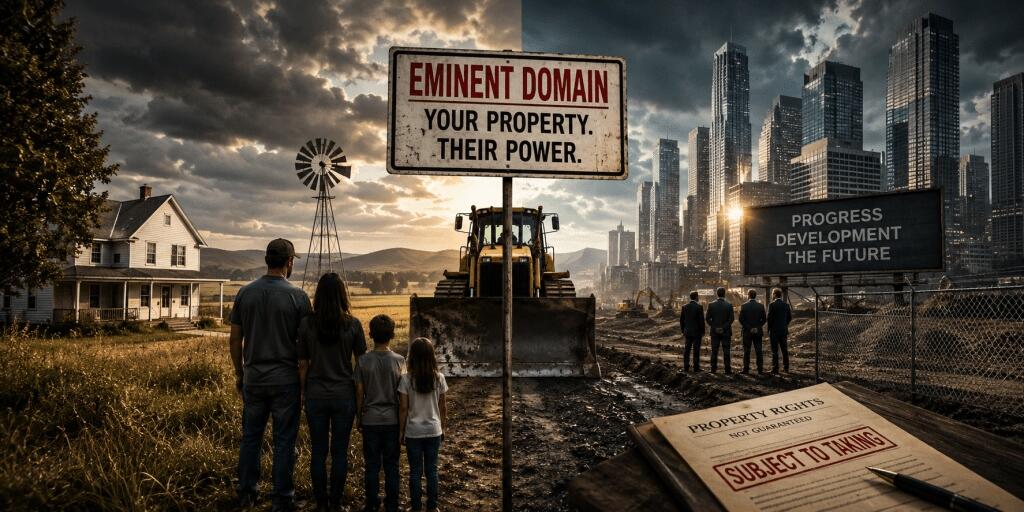
The long-term consequences of this transformation may become even more profound as artificial intelligence, predictive governance systems, and centralized economic planning begin converging into a single administrative framework. During previous centuries, governments lacked the technological capacity to monitor property usage, energy consumption, environmental compliance, financial behavior, demographic movement, and land productivity in real time. That limitation functioned as an invisible restraint on centralized authority. Modern states, however, are rapidly acquiring precisely these capabilities through satellite surveillance, digital registries, biometric identification systems, AI-assisted analytics, and integrated financial technologies capable of processing enormous volumes of behavioral data simultaneously.
This technological convergence has introduced a new political phenomenon that many citizens still underestimate: the replacement of reactive governance with anticipatory governance. Traditional democratic systems generally responded to visible crises after they emerged. Contemporary institutions increasingly attempt to predict and preempt future economic, environmental, or infrastructural disruptions before they fully materialize. In theory, such predictive governance promises efficiency and stability. In practice, it creates conditions under which governments may justify extraordinary interventions based not on present realities, but on statistical projections, algorithmic forecasting, and speculative risk assessments.
This distinction is critical because speculative governance dramatically expands the potential scope of eminent domain and administrative land control. A government no longer needs to demonstrate that land is immediately necessary for an existing public project. It may instead argue that future climate migration patterns, projected energy shortages, demographic shifts, industrial competition, water scarcity, or strategic economic vulnerabilities justify preemptive territorial restructuring decades in advance. Under such conditions, ownership becomes vulnerable not only to current policy objectives but also to predictive models generated by institutions whose assumptions may themselves remain politically contested.
The implications become especially significant when examining the emerging relationship between climate policy and territorial governance. Across North America and Europe, policymakers increasingly discuss the concept of “climate resilience corridors,” managed retreat zones, adaptive infrastructure networks, and carbon-neutral urban restructuring. Publicly, these proposals are presented as rational responses to environmental instability. Yet critics argue that the language surrounding climate adaptation is gradually normalizing the idea that governments may eventually redesign entire regions according to sustainability criteria determined by centralized planning authorities rather than local communities.
Several environmental planning documents have already explored scenarios involving the relocation of populations away from vulnerable coastal areas, the consolidation of agricultural production into designated efficiency zones, and the expansion of urban density models designed to reduce transportation emissions. None of these proposals necessarily constitute authoritarian conspiracies in themselves. Nevertheless, they reveal an ideological trajectory in which land is increasingly treated as a strategic administrative asset subject to optimization rather than as a decentralized foundation of individual autonomy.
This broader transformation also intersects with the accelerating financialization of property markets. Over the past decade, institutional investors, multinational asset management firms, pension funds, and corporate real-estate conglomerates have acquired unprecedented quantities of residential housing, farmland, and strategic infrastructure-linked territory throughout the Western world. In many regions, ordinary citizens now compete against entities possessing virtually unlimited liquidity and long-term strategic acquisition models. Critics increasingly fear that this trend is creating a bifurcated society in which large institutions accumulate permanent ownership while ordinary populations transition toward perpetual rental dependency.
The psychological effects of this shift are already visible among younger generations. Homeownership, once considered a realistic milestone of adulthood, has become unattainable for millions due to escalating property prices, speculative investment patterns, and declining purchasing power. As ownership recedes, dependence on institutional landlords, subscription-based living models, and centralized service ecosystems intensifies. What previous generations viewed as temporary economic hardship may actually represent the early stages of a more permanent structural transition away from widespread independent ownership.
Some economic futurists openly defend this transition, arguing that access-based economies are more flexible, sustainable, and technologically compatible with modern urban life. According to this perspective, citizens no longer require permanent ownership because digital platforms can provide transportation, housing, entertainment, labor, and consumption through integrated subscription ecosystems. Yet critics counter that access and ownership are fundamentally different forms of social power. Ownership creates autonomy, while access remains conditional upon continued institutional approval and financial compliance. A citizen who owns nothing substantial becomes increasingly vulnerable to economic disruption, policy changes, financial censorship, algorithmic exclusion, or shifting regulatory standards.
This concern has intensified dramatically following the expansion of digital financial surveillance systems and programmable payment technologies. Several governments and central banks have explored the future implementation of central bank digital currencies capable of integrating transactions into highly centralized financial architectures. Officially, such systems are promoted as tools for efficiency, anti-fraud enforcement, and economic modernization. However, skeptics fear that combining centralized financial control with digitized property systems could eventually create unprecedented leverage over individual autonomy. If property rights, taxation, energy consumption, environmental compliance, banking access, and digital identity become interconnected within unified administrative systems, then ownership itself may become increasingly conditional upon behavioral conformity.
While some of the more apocalyptic narratives surrounding these developments undoubtedly exaggerate the immediacy of such scenarios, the broader structural trajectory remains difficult to ignore. Governments across the world are steadily increasing their reliance on integrated digital oversight mechanisms. Corporations are accumulating strategic physical assets at extraordinary rates. Artificial intelligence systems are becoming embedded within regulatory decision-making processes. Climate policy is expanding into territorial planning. Economic competition is increasingly framed as a permanent emergency requiring centralized coordination. Each development, considered individually, appears manageable. Collectively, however, they form a landscape in which traditional concepts of private ownership may become progressively diluted over time.
The cultural consequences of this evolution could prove as significant as the legal and economic consequences. Property ownership historically functioned not merely as a financial asset, but as a psychological foundation for citizenship itself. Individuals who possessed land, homes, farms, or independent businesses generally maintained stronger incentives to participate in civic life, resist political overreach, and preserve local community structures. Ownership cultivated permanence, and permanence fostered responsibility toward future generations.
By contrast, highly transient populations dependent upon rental systems and centralized infrastructure often develop weaker attachments to local institutions and reduced capacity for long-term independence. A society dominated by temporary access arrangements rather than enduring ownership may gradually become more politically passive, economically fragile, and administratively manageable. In such environments, governments and corporations acquire increasing influence not necessarily through overt coercion, but through structural dependency.
This dynamic helps explain why eminent domain debates provoke such intense emotional reactions even among citizens who never expect their own property to be seized directly. At an instinctive level, many people recognize that the issue transcends infrastructure policy entirely. The struggle concerns whether there remains any sphere of life genuinely insulated from centralized authority. If property can ultimately be overridden whenever sufficient political, economic, environmental, or technological justification emerges, then ownership itself risks becoming symbolic rather than substantive.
The modern political class frequently frames these tensions as conflicts between progress and obstruction. Citizens resisting redevelopment projects are often portrayed as impediments to modernization, sustainability, affordability, or economic growth. Yet this framing deliberately ignores the philosophical role private property has historically played within free societies. Property rights were never designed solely to maximize economic efficiency. They existed partly to limit concentrations of power by ensuring that individuals retained independent zones of autonomy resistant to political centralization.
The erosion of those protections rarely occurs through sudden authoritarian decrees. More often, it unfolds gradually through administrative normalization. Each new exception appears temporary. Each emergency justification appears rational. Each expansion of authority appears narrowly tailored to a specific crisis. Over time, however, the cumulative effect can fundamentally redefine the relationship between citizens and the state without any single revolutionary moment ever occurring.
History repeatedly demonstrates that societies often fail to recognize transformative shifts while they are happening. Citizens adapt incrementally to changes that previous generations would have considered extraordinary. Policies initially introduced during emergencies become permanent. Temporary surveillance becomes normalized infrastructure. Exceptional powers evolve into ordinary administrative procedures. By the time the broader transformation becomes fully visible, institutional momentum may already be deeply entrenched.
This is precisely why contemporary property-rights debates deserve far greater scrutiny than they currently receive. The issue is not simply whether governments occasionally require land for legitimate public projects. Every complex civilization inevitably faces situations involving infrastructure development and competing territorial interests. The deeper concern involves the accelerating expansion of the philosophical categories capable of justifying compulsory acquisition and centralized territorial management.
Today, governments invoke eminent domain and land restrictions for highways, carbon pipelines, renewable energy corridors, semiconductor facilities, affordable housing mandates, environmental adaptation projects, logistics hubs, and industrial modernization zones. Tomorrow, additional categories may emerge involving AI infrastructure, water rationing systems, food-security corridors, demographic redistribution planning, or automated transportation networks. As technological complexity increases, the temptation for centralized optimization will likely intensify alongside it.
Yet civilizations ultimately face a profound choice between efficiency and autonomy. A perfectly optimized society may achieve extraordinary administrative coordination while simultaneously eroding the independent spaces necessary for genuine liberty. Conversely, a society committed to preserving strong property rights inevitably accepts a degree of inefficiency because decentralized ownership creates friction against centralized planning. That friction is not a flaw within free societies; it is often their primary safeguard against excessive concentration of power.
The future of property rights may therefore determine far more than real-estate law or zoning policy. It may shape the very architecture of citizenship in the twenty-first century. Whether individuals remain sovereign owners with meaningful independence or gradually transition into highly managed participants within centralized administrative ecosystems could become one of the defining political questions of the coming era.
And perhaps that is the most unsettling aspect of the entire debate: the possibility that the transformation is not arriving through dramatic revolution, military force, or visible dictatorship, but through a slow and highly sophisticated convergence of technology, economic planning, environmental policy, financial centralization, and administrative normalization that redefines ownership so gradually that many citizens may not fully recognize the implications until the older understanding of liberty has already faded into history.
Tyler Durden
Sat, 05/09/2026 – 23:20
via ZeroHedge News https://ift.tt/bnQR5wB Tyler Durden