‘I Could’ve Kept It That Way’: Trump Admits The Inflation Is His Choice – For A War That ‘Isn’t A War’
In a wide-ranging interview in which he touted record stock prices and rebranded weapons-grade uranium as “nuclear dust” (and then stormed out), President Donald Trump said the quiet part out loud: the prices Americans are paying at the pump are not an accident. This was all his decision.
“I could’ve kept it that way,” Trump told NBC’s Kristen Welker in an interview taped in a rain-battered Wisconsin barn before he was set to appear at a farming industry roundtable discussion – describing the cheap gasoline everyone enjoyed during his first few months back in office. “But I said, I have to take a little bit of a turn … We’re going to have higher gasoline. We’re going to have a little higher fertilizer, et cetera, et cetera. But I’m going to get rid of a nuclear weapon in the hands of very dangerous people.“
“The farmers love me”
Asked about farmers who can no longer afford fertilizer – seventy percent of them, by Welker’s count – Trump didn’t push back, but instead changed the subject to loyalty.
“I had a choice to make. I could keep it going. The farmers were doing great. Fertilizer was very cheap. Everything was cheap. Gasoline was very low. Everything was very low. I could’ve kept it that way. But I said, I have to take a little bit of a turn. The farmers are going to understand it better than anybody.“
Trump leaned on his heavy support in the heartland. “I love the farmers, and the farmers love me. The farmers trust me,” he said, pointing to the $28 billion in trade-war bailouts he cut growers in his first term. So – the economic cost of the US-Israeli war on Iran is something that Americans should be willing to eat for him.
And again, promises of utopia:
“And when we have a completion, you will see things like you’ve never seen. The oil will go down.“
“It’s all coming down as soon as the war’s over,” he promised of gas and diesel. When Welker pressed for a timeline, he bristled – “No, but you keep talking about speed” – and reached again for Vietnam.
Welker: 70% of farmers say they can’t afford fertilizer.
Trump: The farmers are doing well. All of them support me.pic.twitter.com/ZIRNIE1IPR
— Clash Report (@clashreport) June 7, 2026
The public is less patient: an Economist/YouGov survey this week found sixty-eight percent of adults want a deal to end the war as fast as possible, including fifty-five percent of his own 2024 voters. They are being asked to finance a known cost today against a promised windfall on an unscheduled tomorrow, on the word of a president whose case rests on never having to name the day. That is not an economic argument. It is a leap of faith with a fuel surcharge.
Blame The Fed
And of course, it’s the Fed’s fault for not aligning with Trump’s agenda. Given whispers that the institution is actually considering hiking rates in response to a strong jobs report, Trump preemptively branded the move as a crime against prosperity.
“There’s no reason to raise interest rates … What they do is when they raise interest rates, they try and kill success. I don’t want to kill success. We should actually lower interest rates.”
And then – in what should give any bondholder pause: “Growth is the greatest thing you can have, and growth does not cause inflation.” No, apparently it takes braking a core campaign promise to personally engineer higher prices. Meanwhile, new Fed chair Kevin Warsh gavels his first meeting later this month, and Trump was careful to say he would not “have a big influence on him” – except, he clearly spelled out his expectations.
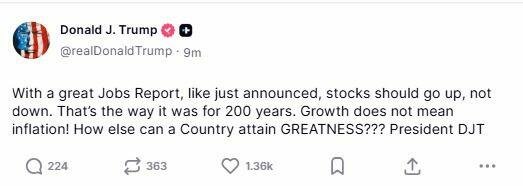
“I would like to see rates get lower,” he said, “because we could build this into the greatest machine that the world has ever seen, but you can’t do that when everybody immediately raises interest rates.”
Meanwhile, Trump insists Iran can be starved into surrender…
“They tried a blockade, and now we blockaded them,” he said of Iran. “And, as you know, they’re losing $400-500 million a day. It’s not sustainable for them. They have an economy that’s shot, in addition to everything else.” The Strait of Hormuz carries roughly a fifth of the world’s seaborne oil; and the valve Trump is twisting shut to strangle Tehran is the same valve lifting fuel costs in Des Moines. The blockade he is celebrating and the inflation he admitted choosing are directly linked.
Asked what happens if the talks fail, Trump did not hedge: “Either way, we win.” Asked about the highly enriched uranium still buried in Iran, he offered a branding note.
“The official name is highly enriched uranium. And I call it nuclear dust because it seemed to be nice, and everyone understands it better, and it’s sort of cute, and people picked it up.”
He assured Welker the sites are under constant watch from orbit: “If anybody walked there, if you walked over there, I would be able to read your first name on your lapel. And these are cameras up in space. It’s pretty amazing technology. Space Force.” He claimed, in passing and without elaboration, that the United States “took over Venezuela in a matter of minutes.” He put Iran’s surviving arsenal at “maybe 21-22% of their missiles … It’s a lot of missiles, but it’s not what it was when we first attacked.”
No New Wars (because this isn’t a war!)
Trump was elected in large part on three words he repeated from 2015 onward: no new wars.
Welker asked the obvious question – had he broken that promise? Trump said ‘no,’ but then insisted that he had never made the promise in the first place.
“First of all, I didn’t guarantee no war,” Trump said. “Why would I have built the strongest military in the world?” When Welker pointed out that he had said it “over and over again,” he did not relent. “So when you say I promised, I didn’t promise anything. I don’t like these endless wars. This is not an endless war.“
WELKER: What changed? You insisted ‘no new wars’
TRUMP: I didn’t guarantee no war. Why would I have built the strongest military in the world? pic.twitter.com/UJacjLWL0p
— Aaron Rupar (@atrupar) June 7, 2026
For the anti-interventionists who treated that pledge as a covenant – the ones who forgave a great deal because at least he would not start the next Iraq – this is the moment the bill came due, narrated by the man who ran it up. He is now prosecuting two wars at once. He will not call either one a war. And his defense, start to finish, is not strategic. It is linguistic.
Not a war, a “military exercise” for “regime change”
Trump then leaned heavily on semantics, insisting this isn’t a war…
“I call it a military exercise because people would rather have it called that,” he said early on. “It’s not a big war for us. It’s not.“
WELKER: Iran just attacked US allies in the region. Is the US at war with Iran?
TRIUMP: I call it a military exercise because people would rather have it called that. It’s not a big war for us. pic.twitter.com/ghOfzVwxsZ
— Aaron Rupar (@atrupar) June 7, 2026
Pressed on the naval blockade of Iran – which is, under international law, itself an act of war – he simply declined to engage the category. “I don’t consider that a war, but if you want to define it as such, I guess you can.” Asked directly how he would define it, he offered the cleanest statement of the whole doctrine: “I don’t define it at all. I don’t think about it. I just do what I have to do.”
Describing the leadership Tehran has installed after the killing of the old Supreme Leader and his lieutenants, Trump volunteered the word the entire post-Iraq right swore off: “And you could say it’s regime change actually because these are very different people. I find them to be more rational, very smart.” – said the guy who built his brand on mocking the people who gave the country Iraq and Libya. And not in one country but two: in the same interview he claimed the United States “took over Venezuela in a matter of minutes.”
Thirteen dead – better than Vietnam!
Trump’s proof that it is all going well is a body count. “We’ve had 13 people killed,” he said, more than once, “and that includes two wars. That’s Venezuela, and that’s Iran.” He means it as triumph: fewer dead than Vietnam, than Iraq, than any war you can name. But for the people who took “no new wars” at face value, the framing collapses on contact. Thirteen Americans are dead in two conflicts the president started and refuses to call wars, sold under the banner he insists makes it acceptable: “You know, it’s America first. I’m doing our country a service.”
Trump: “I’m moving very fast. I’m into three months. You know, Vietnam lasted 19 years.” pic.twitter.com/d4Ol50TIMH
— Aaron Rupar (@atrupar) June 7, 2026
That is the real breach, and it is worse than a broken promise. You can hold a man to a promise. What you cannot do is hold him to a war he will not admit is a war, or a pledge he insists he never made. The Wisconsin barn produced no policy reversal and no apology. It produced something more useful to understand: a president who has discovered that the surest way to keep a promise is to deny, on camera, that you ever gave it.
Doing The World A Service
At the end of the day, Trump had no choice:
“I had to stop a country, very powerful, very dangerous country, from having a nuclear weapon because they’d use it. They’d blow up the world. They’d blow up the Middle East. They’d blow up Israel. They’d come here. They’d blow up Europe. They’re nuts, okay? They’re crazy people. I deal with them. And very high-strung people. Little crazy. And – I get along with them. I like them. But you don’t want to let them have a nuclear weapon. And I’m doing the world a service, but I’m doing our country a service. You know, it’s America first. I’m doing our country a service. Nice rain.”
Indeed…
Trump then called Welker and the MSM ‘crooked’ and stormed out – which, hey, we can’t argue with!
ZeroPointNow
Sun, 06/07/2026 – 12:15
via ZeroHedge News https://ift.tt/oB7plKx ZeroPointNow