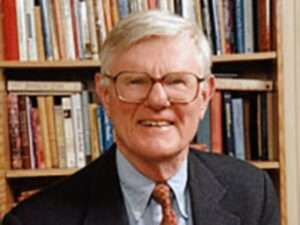
Media reports indicate that Brown University Professor Gordon Wood passed away at the age of 92 yesterday, apparently killed by a passing car while walking. Wood was the greatest historian of the Founding era and the ideology of the American Revolution, author of such seminal works as The Creation of the American Republic and The Radicalism of the American Revolution, among many other important works. He had an enormous influence on generations of historians, legal scholars and many others.
In addition, his work on the universalist Enlightenment liberal political ideals of the Revolution and the Founding is a compelling antidote to both right-wing ethno-nationalists (who envision the US as a nation based on ties of race, ethnicity, and culture), and far-left claims that the Founding was primarily about promoting slavery and white supremacy.
I had a slight acquaintance with Wood, whom I met at a couple of academic conferences. I wish I had known him better. He will be greatly missed.
In Prof. Wood’s honor, I repost an excerpt from one of his last public speeches, a talk he gave at the American Enterprise Institute last fall (I previously wrote about the speech and its significance here). Wood’s message is vitally needed today, as much as ever:
I want to say something about the Declaration of Independence and why it is so important to us Americans.
There has been some talk recently that we are not and should not be a credo nation, that beliefs in a creed are too permissive, too weak a basis for citizenship and that we need to realize that citizens who have ancestors that go back several generations have a stronger stake in the country than more recent immigrants.
This is a position that I reject as passionately as I can. We have had these blood-and soil-efforts before, in the 1890s when we also had a crisis over immigration. Some Americans tried to claim that because they had ancestors who fought in the Revolution or who came here on the Mayflower, they were more American than the recent immigrants….
The United States is not a nation like other nations, and it never has been. There is at present no American ethnicity to back up the state called the United States, and there was no such distinctive ethnicity even in 1776 when the United States was created….
Because of extensive immigration, America already had a diverse society. In addition to seven hundred thousand people of African descent and tens of thousands of native Indians, nearly all the peoples of Western Europe were present in the country. In the census of 1790 only sixty percent of the white population of well over three million remained English in ancestry…
When Lincoln declared in 1858 “all honor to Jefferson,” he paid homage to the Founder who he knew could explain why the United States was one nation, and why it should remain so. Half the American people, said Lincoln, had no direct blood connection to the revolutionaries of 1776. These German, Irish, French, and Scandinavian citizens either had come from Europe themselves or their ancestors had, and they had settled in America, “finding themselves our equals in all things.” Although these immigrants may have had no actual connection in blood with the revolutionary generation that could make them feel part of the rest of the nation, they had, said Lincoln, “that old Declaration of Independence” with its expression of the moral principle of equality to draw upon. This moral principle, which was “applicable to all men and all times,” made all these different peoples one with the Founders, “as though they were blood of the blood and flesh of the flesh of the men who wrote that Declaration….” This emphasis on liberty and equality, Lincoln said, shifting images, was “the electric cord. . . that links the hearts of patriotic and liberty-loving men together, that will link those patriotic hearts as long as the love of freedom exists in the minds of men throughout the world.”
In Jefferson’s Declaration Lincoln found a solution to the great problem of American identity: how the great variety of individuals in America with all their diverse ethnicities, races, and religions could be brought together into a single nation. As Lincoln grasped better than anyone ever has, the Revolution and its Declaration of Independence offered us a set of beliefs that through the generations has supplied a bond that holds together the most diverse nation that history has ever known.
Since now the whole world is in the United States, nothing but the ideals coming out of the Revolution and their subsequent rich and contentious history can turn such an assortment of different individuals into the “one people” that the Declaration says we are. To be an American is not to be someone, but to believe in something. That is why we are at heart a [creedal] nation, and that is why the 250th anniversary of the Declaration next year is so important.
I extend my condolences to such of Professor Wood’s family, friends, and colleagues as may read this post. His passing is a terrible loss.
The post Gordon Wood, RIP appeared first on Reason.com.
from Latest – Reason.com https://ift.tt/Mn6YhHC
via IFTTT