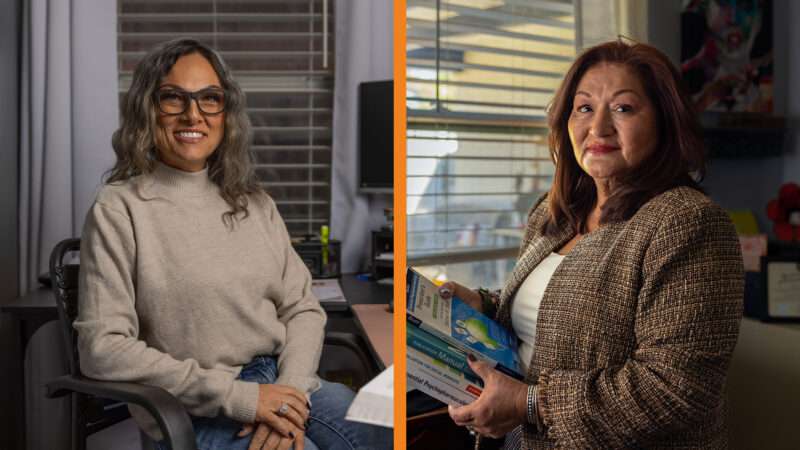
Last week, Texas’ 15th Court of Appeals dismissed a case brought by two women who’ve been denied social workers licenses in the state. Despite their master’s degrees and what the court described as “many strong…letters of recommendation,” the women’s decades-old criminal offenses, committed in the throes of addictions they have since overcome, made them categorically ineligible for licensure under state law.
The plaintiffs, Katherin Youniacutt and Tammy Thompson, plan to appeal the ruling to the Supreme Court of Texas. “We’re confident, under the existing precedent, that we’re entitled to proceed with our case,” Arif Panju, an attorney at the Institute for Justice (I.J.), who is representing the women, tells Reason.
Youniacutt and Thompson, who struggled with substance abuse earlier in their lives, say in their petition before the court that they’ve reformed themselves. Youniacutt, “a victim of clerical abuse” as a child, turned to alcohol to cope, and in 2007, pled guilty to assaulting an off-duty police officer with her car while under the influence.
Thompson began using methamphetamine in the wake of an ugly divorce. When she was threatened in 2006 by a man with a baseball bat, she was protected by friends and onlookers and left the scene before police arrived. Two years later, Thompson learned that the man had accused her of assaulting him with the bat, and “though she does not recall ever picking up the bat or striking him,” she pled guilty to the charges and received two years’ probation, eventually resulting (because of her drug use) in a 4-year prison sentence in 2010.
After earning their master’s degrees in social work, Youniacutt and Thompson, who are both sober, were eager to become “licensed master social workers” and begin treating others who struggle with trauma and substance abuse.
The Texas State Board of Social Worker Examiners even assured both of them in 2019 that although their histories “may present a barrier to licensure,” they would not be disqualified, and the Board would consider extenuating circumstances before making a decision.
However, later that year, Texas passed a law banning from every healthcare profession anyone who was ever “previously convicted of…the commission of a felony offense involving the use or threat of force.” The Board of Examiners did not contact either woman to notify them of the change.
When, after paying hundreds of dollars in exam and application fees, the women finally completed all the licensing requirements—Thompson in 2021 and Younicacutt in 2023—their applications were denied.
Now the two women have challenged the lifetime ban’s legality under the Texas Constitution, arguing that it amounts to an “unreasonable” imposition on their “right to earn an honest living in the occupation of [their] choice.” After a district court allowed the case to proceed—agreeing that the ban was “irrational”—the state district attorney filed an appeal, which proved successful last week.
The Court of Appeals decided that, in fact, “requiring licensed social workers not to have committed violent felonies is still arguably rationally related to the State’s interest.”
Panju tells Reason that the Court of Appeals essentially “deferred blindly to the Legislature.” He says it merely pointed to a legislative study noting that “concerns have been raised regarding the prevalence of licensed healthcare professionals using their privilege and position of authority to commit crimes against vulnerable patients.” And then it concluded that on those grounds alone, the lifetime ban—as applied to two grandmothers who’d utterly turned their lives around—was entirely rational.
“That’s not how economic freedom works in the United States,” says Panju. “And certainly not in Texas.” After the ruling handed down by the Texas Supreme Court in Patel v. Texas Department of Licensing and Regulation (2015), he says a restriction on economic liberty must do a lot more work to justify itself.
“Under the test laid out by the Supreme Court,” he says, the court has to “actually look at the people bringing the challenge—Ms. Thompson and Ms. Youniacutt—and look at the real-world effect of the law on them, as part of the analysis.” The Court of Appeals didn’t do that: “It just…pulled out the ‘Government Always Wins’ rubber stamp,” and dismissed their complaint “at the level of abstraction.”
Asked about their Supreme Court prospects, Panju says he’s “confident, under the existing precedent, that we’re entitled to proceed with our case.”
Once the motion to dismiss is defeated, he says, all the details of “the real-world effects of the law on…Ms. Youniacutt and Ms. Thompson” will be considered, and “we’ll have this declared unconstitutional.”
Until then, these two Texas grandmothers will be banned from guiding others through the same challenges they faced.
The post 2 Texas Grandmothers Who Overcame Addiction Wanted To Become Social Workers. The State Wouldn't Let Them. appeared first on Reason.com.
from Latest – Reason.com https://ift.tt/nQLDvWw
via IFTTT