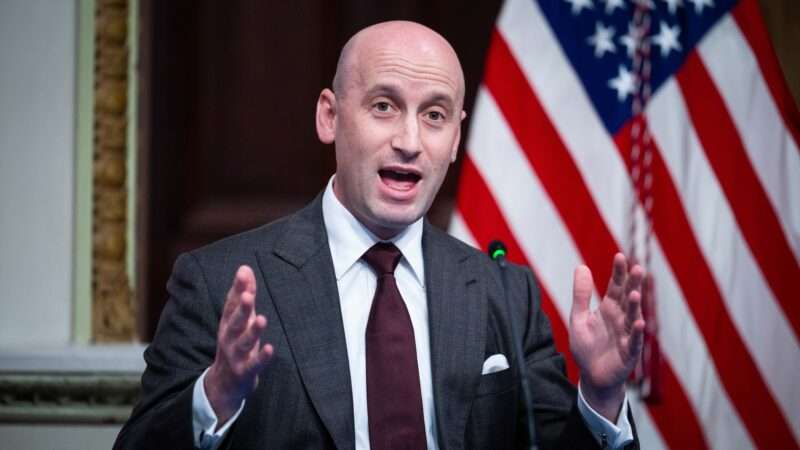
Since illegal immigration is an “invasion,” Deputy White House Chief of Staff Stephen Miller told reporters in May 2025, the Trump administration was “actively looking” at suspending the writ of habeas corpus to facilitate its mass deportation campaign. It turns out that Miller was not just spitballing: According to recent reporting by The New York Times, his comment reflected a serious internal debate about whether to unilaterally override the ancient principle that people nabbed by the government have a right to challenge their detention in court.
That episode is alarming insofar as it illustrates the Trump administration’s disregard for civil liberties. But it is also at least a little reassuring, since Miller’s jaw-dropping proposal was ultimately nixed by objections from White House Staff Secretary Will Scharf, a conservative attorney who explained why it was a legal nonstarter.
Miller was right that letting detainees seek judicial review makes it harder to eject unwanted foreigners from the country. But he was wrong in thinking that President Donald Trump could avoid that requirement by executive fiat.
Just a month before, the Supreme Court had unanimously ruled that alleged Venezuelan gang members detained under the Alien Enemies Act (AEA) had a due process right to file habeas corpus petitions in the district where they were held. Foreign students likewise had used such petitions to challenge the claim that they were “subject to removal” because their political opinions undermined U.S. foreign policy interests.
Miller thought he had a solution to the inconvenience of due process. “The Constitution is clear,” he said. “The privilege of the writ of habeas corpus can be suspended in a time of invasion.”
The Constitution does say “the privilege of the writ of habeas corpus shall not be suspended, unless when in cases of rebellion or invasion the public safety may require it.” But as became clear during litigation over Trump’s invocation of the AEA, unauthorized immigration is not an “invasion” as the Framers defined the term.
Another problem for Miller: The power to suspend habeas corpus has long been understood as belonging to Congress, not the president. “This is clear from the Constitution’s text and structure,” William & Mary law professor Jonathan Adler notes. “The suspension clause is in Article I, section 9,” which includes “several enumerated constraints on legislative power.”
Scharf made that point in an April 2025 memo to White House Chief of Staff Susie Wiles, noting that “the courts have almost uniformly held that suspension of habeas corpus rights requires Congressional action.” He also explained that previous suspensions had all been responses to wars or armed rebellion.
The memo underlined the importance of the principle that Miller claimed could be nullified by a stroke of the president’s pen. “The history of habeas corpus dates back to the very dawn of English common law,” Scharf noted.
“Denial of habeas corpus rights was a key grievance underlying the American Revolution,” Scharf added, “and the right to apply to the federal courts for habeas review dates to the beginning of the Republic. It prevents, in effect, governmental actors from detaining, imprisoning, or executing individuals arbitrarily.”
Scharf also threw cold water on Miller’s suggestion that Trump invoke the antiquated and dangerously vague Insurrection Act in response to protests against his immigration crackdown. In an October 2025 memo to Wiles, Scharf described the Insurrection Act as “a break-the-glass exception to the traditional, general prohibition on the use of the military in the domestic setting.”
Scharf said “most legal analysts agree” that the law gives the president “exceptionally broad” and “essentially unreviewable” powers. But he warned that its invocation probably “would result in vigorous litigation, potentially obviating any advantage to be gained in terms of the flexibility that it would provide to the President.”
As with Miller’s idea of suspending habeas corpus, Scharf’s calmer head prevailed. Luckily for us, it seems the Trump administration is not yet completely devoid of advisers who see a downside to proposals like these.
© Copyright 2026 by Creators Syndicate Inc.
The post The Trump Administration Seriously Considered Unilaterally Suspending the Writ of Habeas Corpus appeared first on Reason.com.
from Latest – Reason.com https://ift.tt/DuBMfoc
via IFTTT