It was my luck that I arrived in Britain to pick up my master’s degree just before a heat wave hit. The temperatures last week were reaching 35 degrees Celsius (95 degrees Fahrenheit) during the day.
That wouldn’t normally be a problem. I was used to even higher temperatures growing up in New Jersey, working in D.C., and studying abroad in Jordan. But now I was without air conditioning. Every night was sweaty and sleepless, and every day was sluggish.
And I wasn’t suffering alone. Around 90 percent of homes in the United Kingdom don’t have AC. Europe’s mainland is not much better: Around 80 percent of homes in the European Union lack air conditioning too. While the heat waves are unpleasant for the young and healthy, they are literally unliveable for the old and sick. Britain recorded 3,000 heat-related deaths during a 2022 heat wave, and the U.N. World Health Organization estimates that 200,000 people have died from heat-related illness across the European Union over the past four years.
The continent was historically a lot colder, which helps explain why air conditioning was not so popular. American summer temperatures used to be a bizarre fluke in Europe; now they’re the new normal. But adapting wouldn’t be that expensive. (After all, air conditioning is more common in places poorer than Europe.) Americans ourselves used to suffer much higher rates of heat death before the 1960s, when air conditioning became widely available. A combination of environmental regulations, NIMBYism, and cultural snobbishness have slowed down Europeans who want to buy an AC unit.
The European Union, which has strict energy consumption rules, encourages citizens to eschew air conditioning in favor of fans. When the Russian invasion of Ukraine caused an energy crisis, Spain and Italy imposed legal limits on how low building owners could put their cooling settings. Some other European countries subject houses with air conditioning to burdensome energy inspection requirements. The Swiss canton of Geneva actually requires homeowners to prove medical need before installing air conditioning.
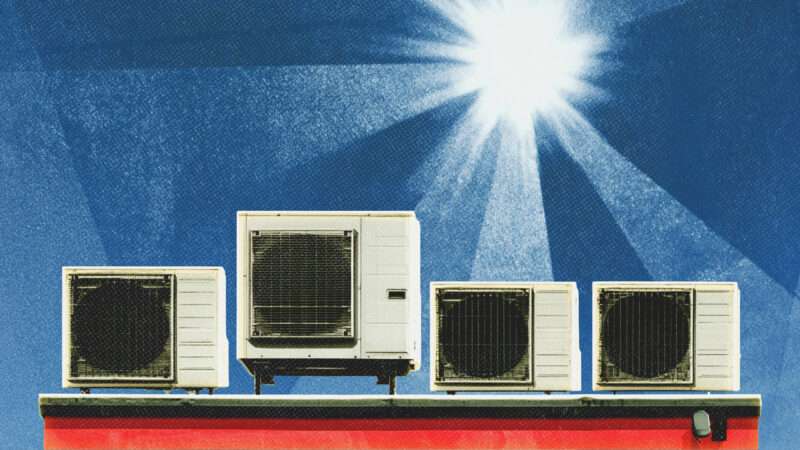
It’s not just tree huggers working to keep houses hot. NIMBY (“not in my back yard”) attitudes have also made it harder for homeowners to install climate-control equipment. The main barriers to air conditioning in many European countries are historical preservation laws, noise regulations, and other aesthetic rules, according to the Consumer Choice Center. Local planning councils in Britain are infamous for rejecting AC installations on these three grounds. Condensers sticking out windows, they argue, could ruin the character of a neighborhood.
Portofino, the richest town in Italy, suffered a police crackdown on illegal air conditioning in 2024, after its mayor caught an AC unit hanging over an alleyway. (“Portofino is located in a regional park and there are rules that need to be respected,” the mayor told The Guardian.) The Italian press described a “vendetta” between Portofino residents, who tried to settle personal scores by reporting each others’ air conditioning to the authorities, even secretly photographing each others’ homes during social gatherings.
That incident points to the final barrier to air conditioning in Europe: sheer snobbishness. “If we jump straight into an air conditioning country, it’s a shame,” the founder of Shade the UK, a nonprofit that helps heatproof buildings, told Bloomberg. The TV show Good Morning Britain ran a debate on whether it is “selfish” to use air conditioning. French media has run downright false stories warning viewers that air conditioning will make them sick. The German magazine WELT has described an “AC-phobia” that comes from a guilt complex around climate change.
Air conditioning is only carbon-intensive if the electricity for it comes from fossil fuels. Ironically, the German environmentalists tut-tutting about air conditioning are the same ones who drove nuclear power out of Germany, ensuring a coal-burning future. In neighboring France, which adopted nuclear power on a large scale, the power grid is much less carbon-intensive. But that country still has a stigma against air conditioning.
Defending French attitudes, Paris resident Thomas Chatterton Williams wrote in The Atlantic that discomfort is all relative, “public beauty” helps keep “the physical sensation of warmth” from becoming painful, and “there is something satisfying, maybe even a little noble, about withstanding the heat without the help of climate control.” He added that Europeans see Americans “as profligate and pampered” for their use of air conditioning.
The most elite Europeans, of course, allow such luxuries for themselves. The German environmental ministry, which was warning against AC use, has a climate-controlled headquarters. On Friday, the European Commission headquarters had an emergency shutdown of its own air conditioning on the lower floors—but somehow managed to keep it running on the upper floors ,where senior officials work. One staffer told Politico that the situation was “feudalism.”
The AC debate sums up a certain sort of European attitude: While believing themselves to be progressive, their self-flagellation ends up keeping the common man down while letting elites get away with murder.
The post I Survived Europe's Heat Wave Without AC—No Thanks to Regulation appeared first on Reason.com.
from Latest – Reason.com https://ift.tt/4k5dgtp
via IFTTT