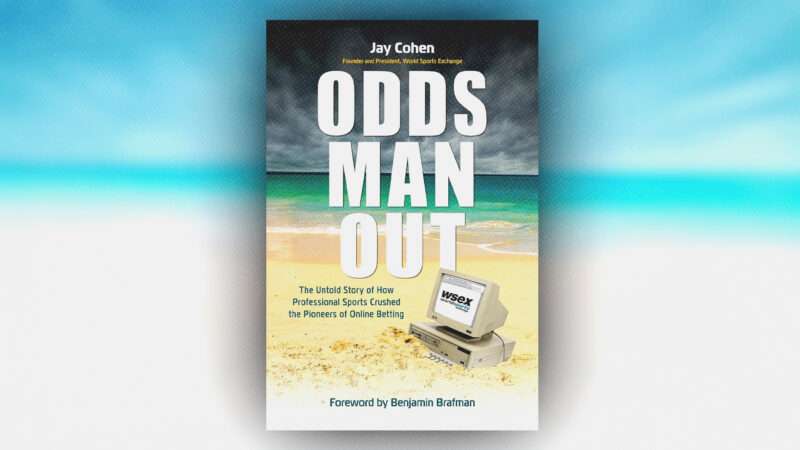
Odds Man Out: The Untold Story of How Professional Sports Crushed the Pioneers of Online Betting, by Jay Cohen, Post Hill Press, 384 pages, $32
In the early 1990s, Jay Cohen was a trader on the Pacific Options Exchange in San Francisco. Traders will bet on anything, and so Cohen and a colleague set up a brisk market for betting on the outcome of the O.J. Simpson trial. But it wasn’t a traditional yes/no betting structure. You could actually buy futures on the outcome of the trial, which would fluctuate in value upon the arrival of news.
It was then that Cohen hatched the idea of opening an online betting exchange for sports. And with that, he started the process that led to the gripping book Odds Man Out, Cohen’s account of being prosecuted and jailed for the crime of starting a successful sports betting website.
Cohen decided to set up the company in Antigua, where sports betting was legal and regulated. He moved there along with two of his partners. They named the firm the World Sports Exchange (WSEX) and set up a primitive website. Its users could make the typical bets you’d get in Vegas—moneylines and spreads—but it also offered futures on the outcome of games that could be traded live, while the game was being played. That was an enormous innovation, and it is identical to the types of contracts that can be traded on prediction markets such as Polymarket and Kalshi today.
The betting volumes were small at first. But after a few mentions in the popular press, WSEX began trading millions of dollars of bets in a year. Meanwhile, back in the United States, legislators—especially Sen. Jon Kyl (R–Ariz.)—were unhappy about the fact that U.S. gamblers could bet offshore on sports.
At the time, the only places Americans could legally bet on sports were Las Vegas and Atlantic City. It wasn’t long before WSEX was doing several times their combined betting volume. WSEX became so large and influential that the traditional sportsbooks in Las Vegas were actually setting their lines around the WSEX lines. Cohen was adamant that WSEX would be a reputable, safe place to gamble, with winnings paid out in full within a matter of hours, operating fully within the rules imposed by the Antiguan government.
Unbeknownst to Cohen, the major sports leagues—the National Football League, the National Basketball Association, the National Hockey League, and Major League Baseball—were applying pressure to a New York law firm that had a revolving-door relationship with prosecutors in the Southern District of New York. Soon charges were filed against Cohen and his partners, alleging wire fraud.
Cohen indignantly insisted that they hadn’t done anything wrong. Bettors from the United States were placing bets on servers located in Antigua, outside U.S. jurisdiction. They were following all local laws, and bets were paid out in full. There were no customer complaints. Cohen was adamant that he was running a legitimate business, and he decided to travel back to the U.S. to face the charges and win in court. His two partners elected to stay in Antigua, run the business, and avoid the American authorities.
Upon arriving in the United States, Cohen was promptly arrested and arraigned, though it would be years before he would actually stand trial. Unfortunately, he drew about the worst possible judge for his case: Thomas Griesa, an elderly man with practically no knowledge of the internet and a strong predisposition against gambling. Griesa ruled against his defense on practically every point, and he ultimately directed the jurors to issue a guilty verdict, which they did. (After the trial, Cohen claims, he was approached by a juror who told him that the jury thought he was innocent but that the judge left them no other option but to convict.) Cohen was sentenced to 21 months in prison. By this point well acquainted with the legal system, he did his best to get the conviction overturned on appeal. He even petitioned the Supreme Court. But his case was declined.
Out of options, Cohen returned to Antigua. WSEX was still doing a booming business, but well-financed competitors had sprung up. In the early 2000s, the site began to lose market share; after a few more years, it failed. Cohen left Antigua for Montenegro to pursue other opportunities. Paranoid that the U.S. government was still going to find a way to go after him, he renounced his citizenship, perhaps unwisely.
Now broke and living in Montenegro, Cohen has made attempts to return to the U.S. to visit his ailing father, but the government prevents him from doing so, contending that wire fraud is a crime of moral turpitude.
One of the most alarming facts of Cohen’s case is that the prosecution asked him at his trial if he was a libertarian, then used that fact against him. Jay Cohen is indeed a libertarian, believing not just that gambling is a victimless crime but that he was preventing the other sort of crime—the sort with victims—by taking the industry out of the hands of neighborhood bookies, who will sometimes use violence to collect on bets.
Sports gambling today is entirely legal—ridiculously legal, in fact, with sportsbooks even located within sports stadiums. Cohen’s innovations, including in-game bets and futures, are now used by FanDuel and DraftKings and the myriad other online sportsbooks. Cohen himself molds away in a tiny apartment in Montenegro, penniless, unable to return home.
Odds Man Out shows how coercive and malignant government can be, how it can target and ruin the life of a man at the behest of powerful corporate interests. And while the proliferation of sports gambling and prediction markets has led to some healthy debates about addiction, financialization, and insider trading, some prediction markets serve an undeniably useful economic purpose, allowing people to hedge against certain outcomes. Before, this was done in smoke-filled rooms, with the threat of muscle to enforce contracts. The prediction markets provide a clean place to mitigate or take risks. And all of that is as a result of Jay Cohen, who served almost two years in prison for making it possible.
The post The Man Who Invented Online Sports Betting—and Went to Prison for It appeared first on Reason.com.
from Latest – Reason.com https://ift.tt/Vec2pb5
via IFTTT