Ericsson Tumbles On Margin Headwinds Sparked By Memory Chip Inflation
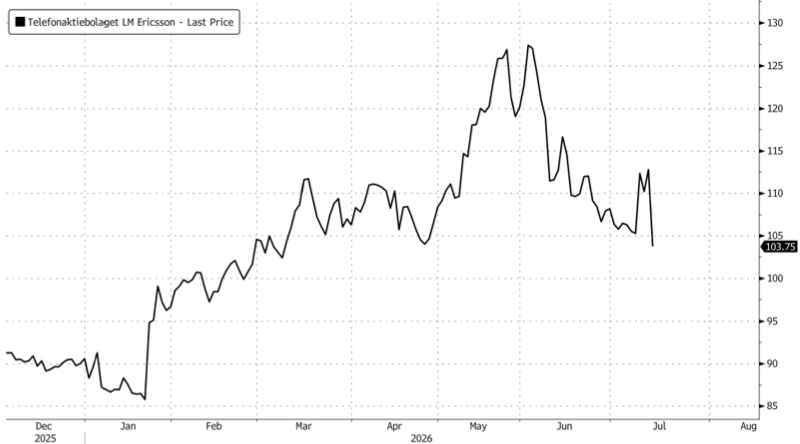
Ericsson shares in Stockholm plunged the most in 18 months after the Swedish telecom equipment giant warned that soaring component costs will pressure margins in its core networks business this quarter.
The stock fell as much as 10% in Stockholm after outgoing CEO Börje Ekholm warned about higher input costs, partly driven by AI-fueled demand for memory chips. Citi analysts said the top concern is the margin impact extending into 2027.
“The big challenge in our view is the building component cost pressure and, not so much the near-term impact, but more the pressure to come in 2027,” Citi analyst Andrew Gardiner wrote.
Second-quarter adjusted earnings before interest, taxes and amortization tumbled 7% to 6.88 billion kronor, slightly above the Bloomberg Consensus estimate of 6.82 billion kronor. Ericsson has been slashing costs as soft carrier spending weighs on the telecom-equipment industry. It eliminated about 5,000 jobs in 2025 and targets similar headcount reductions this year.
BNP Paribas analysts highlighted the “cost pressure building” for Ericsson:
What happened?
The Ericsson call has now finished, and the stock is down c7%. The main focus on the call was on rollout costs, semis cost inflation, and IPR.
BNPP View:
1. Network‑rollout cost drag: Ericsson highlighted that the first few quarters of a network‑rollout cycle are financially the most demanding. The company expects a ramp‑drag in the next few quarters as the mix shifts toward large‑scale rollout projects (we presume India/Japan), which depresses margins before economies of scale and higher volumes kick in. Ericsson said the contracts are accretive over the longer term, even though the short‑term impact on gross margin will be negative. We interpret this that the ~100bp weaker margin in GM in Q3 26 is likely to see continued mix effect drag for a few more qtrs.
2. Memory‑cost inflation and limited pass‑through: Ericsson confirmed that semiconductor price inflation remains an increasing issue. Input‑costs rose in Q2, and the financial impact will increase over the coming quarters, prompting Ericsson to pursue product substitution, targeted cost‑reduction programmes, and longer‑term structural actions such as price adjustments on new tenders and renegotiations with existing customers. Because most contracts are long‑term, they lack automatic price‑pass‑through clauses, i.e. Ericsson company cannot fully offset the higher component costs automatically. Pass‑through will be gradual and is subject to negotiation on a case‑by‑case basis. This is a weaker level of pricing power than we had appreciated and suggests that Ericsson might not be able to fully pass on cost inflation this time.
3. IPR one‑off impact: Ericsson will not have a major one‑off impact from the new IPR settlement. Instead, the agreement is reflected in a higher IPR ARR of SEK13.5bn (was SEK13.0bn). Ericsson said impact of the agreement is marginal in Q3 26 (we presume SEK500m divided by 4).
In a separate note, Barclays analyst Simon Coles told clients that while Ericsson posted “another quarter of resilient margins,” the company is warning that headwinds are mounting in the second half of the year.
Ericsson is guiding down its networks gross margin:
- Sees Networks adj. gross margin 48% to 50%, Bloomberg Consensus estimate 49.5%
Ericsson did not directly blame soaring memory chip prices for margin compression in its earnings release or during the earnings call with analysts.
However, Deutsche Bank analyst Janardan Menon pressed management on an earnings call about rising random-access memory prices and the competitive advantage enjoyed by Chinese telecom giants, which can source these chips at lower prices.
CEO Ekholm responded: “And there may be, as you say, a little bit lower cost inflation in the Chinese ecosystem. And as you know, we cannot rely on that ecosystem to export to a number of countries we’re in. That forces us to look at the product design in a different way.”
Tyler Durden
Tue, 07/14/2026 – 07:20
via ZeroHedge News https://ift.tt/27Ynlh9 Tyler Durden