Disney Caught Indoctrinating Employees With Critical Race Theory, “White Privilege” Checklist

Disney Caught Indoctrinating Employees With Critical Race Theory, “White Privilege” Checklist

According to newly leaked employee training manuals, the Walt Disney Company has been pushing “Critical Race Theory” (CRT) on its employees, including lectures on race and white privilege, and how America was ‘founded on systemic racism.’

According to the trove of documents leaked by a whistleblower, Disney’s “diversity and inclusion” program called “Reimagine Tomorrow” as become “deeply politicized and engulfed parts of the company in racial conflict, according to city-journal.org.

The core of Disney’s racial program is a series of training modules on “antiracism.” In one, called “Allyship for Race Consciousness,” the company tells employees that they must “take ownership of educating [themselves] about structural anti-Black racism” and that they should “not rely on [their] Black colleagues to educate [them],” because it is “emotionally taxing.” The United States, the document claims, has a “long history of systemic racism and transphobia,” and white employees, in particular, must “work through feelings of guilt, shame, and defensiveness to understand what is beneath them and what needs to be healed.” Disney recommends that employees atone by “challeng[ing] colorblind ideologies and rhetoric” such as “All Lives Matter” and “I don’t see color”; they must “listen with empathy [to] Black colleagues” and must “not question or debate Black colleagues’ lived experience.”

In another module, called “What Can I Do About Racism?,” Disney tells employees that they should reject “equality,” with a focus on “equal treatment and access to opportunities,” and instead strive for “equity,” with a focus on “the equality of outcome.” The training also includes a series of lessons on “implicit biases,” “microaggressions,” and “becoming an antiracist.” The company tells employees that they must “reflect” on America’s “racist infrastructure” and “think carefully about whether or not your wealth, income, treatment by the criminal justice system, employment, access to housing, health care, political power, and education might be different if you were of a different race.” city-journal.org

To enact this radical training agenda, Disney sponsored the creation of the “21-Day Racial Equity and Social Justice Challenge” in partnership with the YWCA. It begins with information on “systemic racism” and demands that participants accept that they have “all been raised in a society that elevates white culture over others.”

The lesson then shifts to “white privilege,” in which employees are asked to fill out a white privilege “checklist” with options that include “I am white” , “I am heterosexual” , “I am a man” , “I still identify as the gender I was born in” , “I have never been raped” , “I don’t rely on public transportation,” and “I have never been called a terrorist.”

Participants then learn about “white fragility,” and are made to complete an exercise called “How to Tell If You Have White Fragility.”

In it, white employees are taught to interpret their own beliefs such as “I am a good person, I can’t be racist,” and “I was taught to treat everyone the same” as evidence of one’s own internal racism and white fragility.

At the end of the 21-day challenge, participants are told that they must “pivot” from “white dominant culture” to “something different” – and that “competition” and “power hoarding” come from predominantly white leadership. What’s more, “individualism” , “timeliness,” and “comprehensiveness” are “white dominant” values which “perpetuate white supremacy culture” and should be rejected.

Did you get that? Simply being on time to things is perpetuates ‘white supremacy culture.’

In the same collection of resources, Disney also recommends that employees read a series of how-to guides, including “75 Things White People Can Do for Racial Justice” and “Your Kids Are Not Too Young to Talk About Race.” The first article suggests that white employees should “defund the police,” “participate in reparations,” “decolonize your bookshelf,” “don’t gentrify neighborhoods,” “find and join a local ‘white space,’” and “donate to anti-white supremacy work such as your local Black Lives Matter Chapter.” The second article encourages parents to commit to “raising race-consciousness in children” and argues that “even babies discriminate” against members of other races. A graphic claims that babies show the first signs of racism at three months old, and that white children become “strongly biased in favor whiteness” by age four.

Finally, as part of an initiative labeled “CEO sponsored priorities,” Disney has launched racially segregated “affinity groups” for minority employees, with the goal of achieving “culturally-authentic insights.” In the original launch, the Latino affinity group was called “Hola,” the Asian affinity group was called “Compass,” and the black affinity group was called “Wakanda.” The racial affinity groups, also called Business Employee Resource Groups (BERGs), are technically open to all employees but in practice have become almost entirely segregated by race, with the occasional exception for white “executive champions” who attend on behalf of corporate leadership. “The thing that this company does very well is they know politics, so they leave many things unspoken,” said one employee, a racial minority, who also claimed the affinity groups are intended to be racially segregated spaces. “I don’t think anyone has necessarily even tried to attend something that they would discover that they’re not welcome at.” –city-journal.org

One employee told City Journal‘s Christopher F Rufo that the political environment at the company has intensified in recent months, and that there are “almost daily memos, suggested readings, panels, and seminars that [are] all centered around antiracism.”

The company is “completely ideologically one-sided” and actively discourages Christian and conservative employees from expressing their views.

“I attended several [training sessions] at the beginning just to see what the temperature of the discussion would be and to gauge if I would be able to bring up my own objections in a safe way—safe meaning for my career. And I’ve continually gotten the unspoken answer: ‘no,’” said the employee. “It’s been very stifling to feel like everyone keeps talking about having open dialogue and compassionate conversations, but when it comes down to it, I know if I said one thing that was truthful, based on data, or even just based on my own personal experience, it would actually be rather unwelcomed.

Tyler Durden
Sun, 05/09/2021 – 12:50

via ZeroHedge News https://ift.tt/3f8dYMH Tyler Durden

The Pivot To Gold Has Begun

The Pivot To Gold Has Begun

Authored by Tom Luongo via Gold, Goats, ‘n Guns blog,

For the past few weeks I’ve incurred the wrath of what I’m now calling “Gold-Only” bugs for constantly haranguing them about bitcoin and cryptocurrencies. These are the folks which state only gold can beat the central banks.

I’ve made my position very clear, in a world of digital money and accelerating technology there is room for both assets as stores-of-value for different types of investors and taking a ideological position for either is stupid as well as arrogant.

Like all things, there are reasons why putting all of your eggs in one basket in markets as cocked-up and purposefully manipulated as these is simply bad asset management. Risk is, ultimately, not someone else’s problem no matter how much Wall St. tries to convince of this otherwise.

Risk is your problem.

The gold and crypto communities have been at each other’s throats for months now, as bitcoin continued rallying off the Coronapocalypse low from last March while gold peaked in August and has ground out a truly demoralizing eight-month bear market.

The envy coming from Gold-Only bugs has them missing one of the great opportunities for wealth creation in anyone’s lifetime. You don’t have to love bitcoin to make money from it. Just like you can hate Facebook but own its stock and cash it in when it’s too expensive versus another asset, say… I don’t know? Gold?

But that inverse relationship is finally changing. Bitcoin and gold are getting back into phase. And it’s right on schedule.

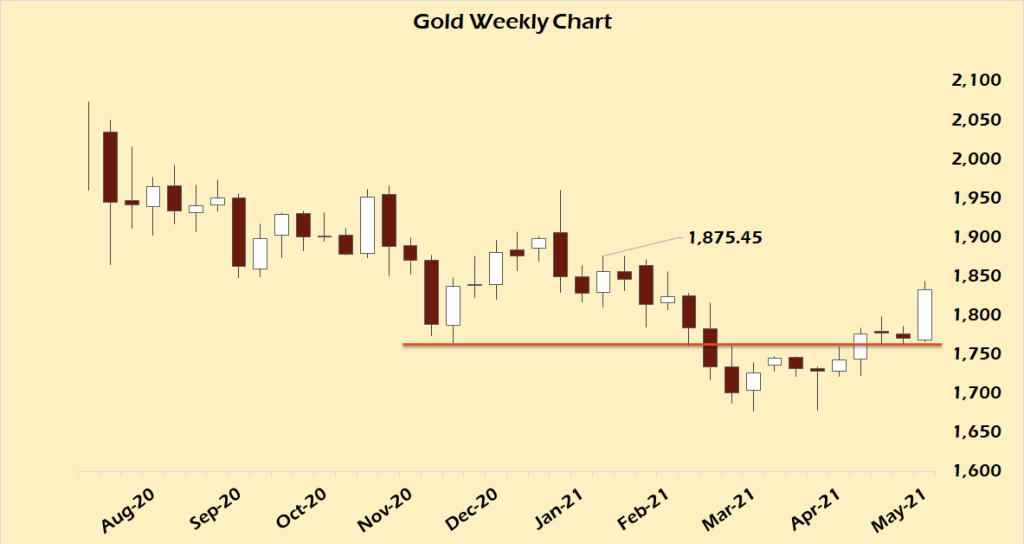
Gold double-bottomed a few weeks ago in the $1670 area and since then a number of small announcements gave it some spine, mostly coming from China — allowing its commercial banks to import up to 150 tonnes of gold. That stabilized the price while at the same time Bitcoin has been building a new base between $48,000 and $64,000.

Consolidation is the word of the day. Both bullish but coming off of different recent trends.

Gold is the standard by which all store-of-value assets is judged. Those that make their living hanging on every word from the Fed are looking at their traditional cross-asset valuation models, seeing U.S. real interest rates rise and had no interest in bidding up gold.

To many of them this bitcoin thing isn’t a real market. Cryptos are a tulip bubble and no one serious takes it seriously. They rightly see the insane situation in Dogecoin and simply have zero frame of reference for what’s going on out there.

Humans are really good at a few things and one of them is rejecting outright something more than one standard deviation away from their previous experience. Dogecoin is something even us veteran crypto advocates look at and shake our heads.

For the past six months however, that perception has slowly changed as one big institution after another bows to bitcoin’s strength and the demand for it. On the best of days those of us in the crypto space have a hard time keeping up with the speed of adoption and the proliferation of new investment products, aspirational projects etc.

So I don’t blame these guys for looking at a sagging gold price and thinking the central banks still have things well in hand. They’ve been telling us inflation is tamed and the recovery is coming as we pull out of the lockdowns. Bitcoin may have been screaming otherwise, but gold wasn’t, so you go with what you know, right?

And then that narrative collapsed.

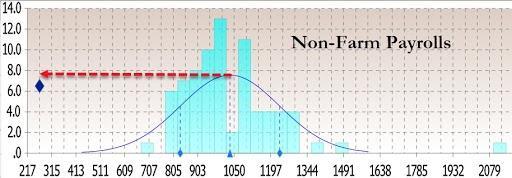
Today’s horrific jobs report finally revealed the reality behind the recovery narrative. 266,000 jobs. Not nearly 1 million. As Zerohedge points out, a 3.7 sigma miss.

To make matters worse, revisions to the February and March’s data nearly wiped out April’s net gains.

Reality slapped everyone in the face. Gold spiked, bonds were bid. The dollar dumped and everyone is looking at the Fed going, WTF Powell?

The reason there is no jobs recovery is because the U.S. government, on the orders of The Davos Crowd are paying people to stay home. Why work when you can live rent-free in someone else’s house protected from eviction?

Why work when the government will pay you nearly as much to stay home?

This jobs report validates everything libertarians and Austrian economists have been saying about minimum wage laws for two generations and turned it into a cartoon. Moreover, this is happening while cost-push inflation for real goods is running far ahead of whatever heuristically-adjusted nonsense they call the CPI says.

The numbers coming out of the equations may be right but the assumptions behind the equations are wrong.

That’s been the “Gold-Only” Bug’s argument and it’s also the Bitcoiners’ argument.

I’ve said this before, it’s a GIGO economy. Garbage in equals garbage out until you finally stop believing the garbage isn’t foie gras. Look up Rene Girard’s Memetic Collapse and you may finally realize who important today’s jobs report was.

And because of that all of a sudden those guys who thought real yields were somehow positive are now radically revising their models based on real world data which says the exact opposite. As such, gold has quickly left $1800 in the rearview mirror and should now be one its way back to the August all-time high.

Today there is now the slowly dawning realization by so many big name money managers that both the Gold Bugs and the Bitcoiners may have been right all along. Gold and bitcoin are the safe havens from central banks and government operatives hell bent on changing the rules of the economy completely.

They are now coming out and complaining about stimulus and support screwing up the labor market. Job openings are at record levels while the Biden administration continues trying to keep everyone at home rather than go back to work.

This is The Davos Crowd’s Great Reset in real terms. This was all part of the plan, folks. Supply chains of basic goods and services are breaking down all over the place and still these people want to keep us locked in our homes until we all get their DNA-altering jabs against COVID-19 which we’re still supposed to be scared of.

That narrative is more unbelievable than the plots of most stuff you find on PornHub for pity’s sake.

That narrative is used to justify, in effect, Universal Basic Income and the destruction of risk capital as an asset class. Let’s just give everyone new digits without backing and send them out to buy another two-liter of Woke-a-Cola Classic, order a cardboard pizza, Netflix and chill.

While denying the reality that in places where there are no mask mandates and no lockdowns the COVID-19 numbers are irrelevant. At this point we are trying to tease signal out of noise. Every day more and more people are tired of it while the corporations who were promised a rose garden by Klaus Schwab continue to try to force everyone to accept masks, social distancing and vaccine passports as the New Normal.

But that New Normal is quickly morphing from The Great Reset to the Great Reject as the revolt against this, frankly, adolescent view of humanity is fought by enough people to ensure its abject failure from here out.

We live in a narrative-driven world created by half-truths and outright lies. The “Gold-Only” Bugs have things mostly right, their desire for the world to get back to things that are ‘real.’ I get it and share it with them. As I said in a recent post, however, reality isn’t only that which was but also incorporates what is and what will be.

In fact, that’s the whole purpose of human endeavor, to turn today’s dreams into tomorrow’s reality. It doesn’t matter which tools we use to get us there, only that we use the right tool for the right task at the right time. Gold’s Achilles’ heel has always been its lack of yield which allowed the central planners to destroy its ability to keep its network of users from collapsing. Once that was achieved divorcing the derivatives, national currencies, from it was child’s play.

Today bitcoin is assisting gold find its place back into the world’s monetary system. It’s helping accelerate the realization by a critical mass of people that those in charge hate us, and only want us around if we kowtow to them as digital serfs in a dying world. They believe they can leave us behind by walling us off the gifts of their world.

But those gifts are shackles, of the mind, body and spirit.

Meanwhile the “Gold Only” Bugs are still hunkered down while the Bitcoiners and those with a foot in both camps are building new alternatives to the digital serfdom of The Davos Crowd.

Returning to a world of real ownership and custody begets a world of responsibility and discipline. Bitcoin and cryptocurrencies have, like all other technologies, the capacity to become corrupted and that’s why gold should always be there to keep us in line.

As The Great Reset unravels and the central banks’ fail to outcompete bitcoin and cryptos, there will come a day where today’s gold reserves, which they control, become the last line of defense for governments intent on maintaining control. And that’s when things really get interesting.

*  *  *

Join my Patreon if you love gold and bitcoin

Donate via

BTC: 3GSkAe8PhENyMWQb7orjtnJK9VX8mMf7Zf
BCH: qq9pvwq26d8fjfk0f6k5mmnn09vzkmeh3sffxd6ryt
DCR: DsV2x4kJ4gWCPSpHmS4czbLz2fJNqms78oE
LTC: MWWdCHbMmn1yuyMSZX55ENJnQo8DXCFg5k
DASH: XjWQKXJuxYzaNV6WMC4zhuQ43uBw8mN4Va
WAVES: 3PF58yzAghxPJad5rM44ZpH5fUZJug4kBSa
ETH: 0x1dd2e6cddb02e3839700b33e9dd45859344c9edc

Tyler Durden
Sun, 05/09/2021 – 12:25

via ZeroHedge News https://ift.tt/3y0GicA Tyler Durden

Another ‘Mystery Explosion’ Has Hit An Oil Tanker Off Syria’s Coast

Another ‘Mystery Explosion’ Has Hit An Oil Tanker Off Syria’s Coast

An oil tanker off Syria’s Mediterranean port of Banias has been hit with an explosion Sunday, resulting in a fire on board which was reportedly extinguished soon after. 

There were reportedly no casualties, but subsequent photographs showed large plumes of black smoke rising above the tanker, which may have been engaged in offloading its cargo. The ‘mystery’ blast comes after a series of alleged Israeli covert attacks against both Iranian and Syrian ships believed engaged in “sanctions-busting” activity related to Washington-led anti-Assad measures.

However, Syrian state media was quick to call it a “technical fault” which “took place in one of the engines of the oil tanker near the coast,” according to the description.

Journalist and Syria analyst Danny Makki quipped in the wake of the incident, “This comes amid a sharp and unexpected rise in engine malfunctions in ships near the Syrian coast” – strongly suggesting that it appears anything but a mere engine accident.

Reuters reviews some of the latest incidents involving oil tankers off Syria’s coast as follows:

Local radio station FM Sham earlier said an explosion had hit a tanker during maintenance works after it had caught fire a few days earlier while offloading its oil cargo.

Last month, Syria’s oil ministry said firefighters put out a fire on an oil tanker off the Banias refinery after a suspected attack by a drone coming from the direction of Lebanese waters.

The oil tanker was widely reported as being empty of its cargo at the time of the blast and fire.

Due the increased frequency of Israeli attacks on Syria as well as Iranian and Syrian vessels, which also in recent months have occurred in the Red Sea, a number of online commentators were quick to speculate this new tanker incident was the result of a drone or other aircraft attack

This comes after a separate mystery incident being simultaneously reported at a distillation unit at Homs Oil Refinery, though there’s little that’s been verified at this point.

Tyler Durden
Sun, 05/09/2021 – 12:00

via ZeroHedge News https://ift.tt/3bweweH Tyler Durden

Bulls Charge Despite Peak Earnings & Poor Payrolls Print

Bulls Charge Despite Peak Earnings & Poor Payrolls Print

Authored by Lance Roberts via RealInvestmentAdevice.,com,

Market Review & Update

Last week, we said:

“While the market remains in a very tight range, the ‘money flow’ sell signal (middle panel) is reversing quickly. Importantly, note that the money flows (histogram) are rapidly declining on rallies which is a concern.”

This past week, market action was sloppy as investors are finding fewer reasons to push stocks higher. Friday’s very disappointing jobs report provided some catalyst as the Fed is assured not to reduce monetary support anytime soon. However, despite the push, the overall conviction was lacking.

Notably, the “money flow buy signal” seemed to cross; however, we need some follow-through action on Monday to confirm. As shown, the uptick in money flows did allow us to add some exposure to portfolios in holdings we had taken profits in with the previous “sell” signal. 

Again, we do want to see confirmation that the breakout above the consolidation range can hold. The last breakout failed, so, again, we do need “follow-through” to confirm buyers are indeed back. Notably, the MACD “sell signal” in the lower panel remains, which suggests upside likely remains limited at this juncture. If the “buy signals” align, we will have a much higher level of conviction about higher prices. 

Overall, the market trend remains bullish, so there is no need to be overly defensive. Just a regular process of tweaking risk and managing exposures is all that portfolios require for now. Such is what we have recommended over the last several weeks, so we are now in a position to take advantage of a short-term bullish move. 

For the rest of this week’s message, we will go into deeper detail on the issues I discussed in the latest “3-Minutes” video:

  1. Peak Earnings,
  2. Inflation, and Margins, and
  3. Hedgefund selling.

Peak Earnings?

Over the last few weeks, we have seen numerous companies report stellar earnings growth. Yet, the market has failed to reward the good news as stocks get sold off. As the chart below shows, it has not been just a few select isolated cases. 

There are a couple of reasons for this. 

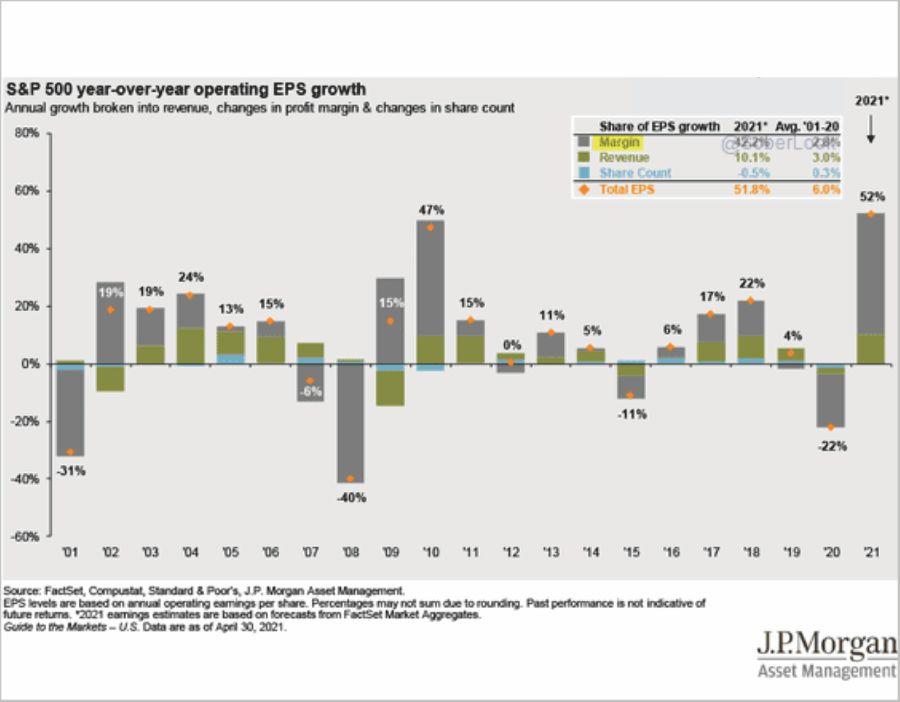
The first is that earnings guidance has not been “exuberant.” Many companies are starting to express concerns over inflationary costs (including labor) and weaker future demand as stimulus fades. Secondly, the problem with earnings in the near term is that most earnings improvement has come from expanding net margins. 

That massive boost to net margins came from the economic shutdown. With reduced workforces, a shift to lower-cost “work-from-home,” and increases in productivity through technology, the surge in margins is not surprising. However, as the economy “reopens,” that tailwind to earnings will fade quickly. The rise of inflationary inputs, increased employment, and potentially higher taxes will shrink net margins dramatically in the quarters to come. 

Such also suggests that analyst’s extremely optimistic earnings revisions will likely need to shift down as well. If the market is indeed sniffing out an “earnings peak” short term, it could be increasingly difficult to justify currently high asset prices and valuations. 

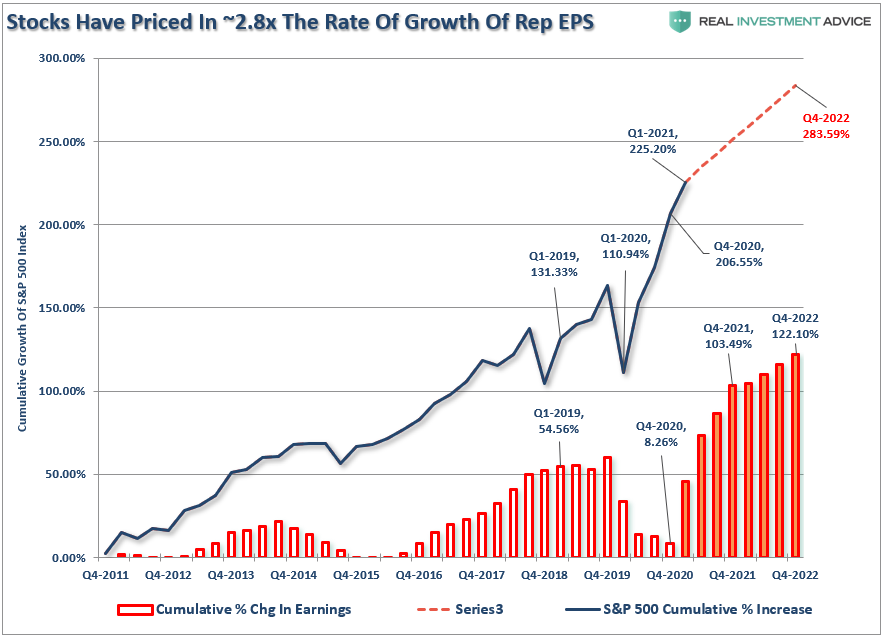
Here is the problem for investors currently. Given analysts’ assumptions are always high, and markets are trading at more extreme valuations, such leaves little room for disappointment. As shown, using analyst’s price target assumptions of 4700 for 2020 and current earnings expectations, the S&P is trading 2.6x earnings growth.

In other words, is the recovery all priced in? The bond market thinks so.

Bonds Aren’t Buying It.

Over the last couple of weeks, we have discussed the correlation between rates and economic growth. To wit:

“As shown, the correlation between rates and the economic composite suggests that current expectations of sustained economic expansion and rising inflation are overly optimistic. At current rates, economic growth will likely very quickly return to sub-2% growth by 2022.”

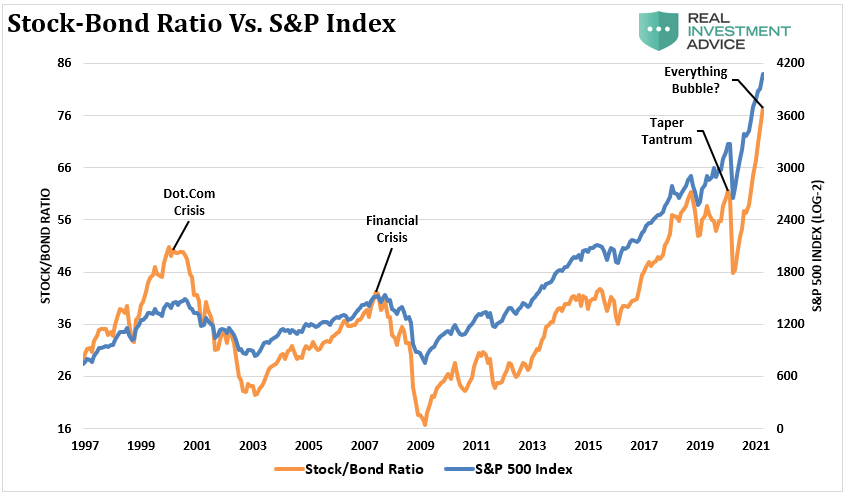
Not surprisingly, given the substantial rise in asset prices, the ratio of stocks to bonds (S&P Index / Bond Total Return) surged to a record high. It is worth noting that previous stock/bond ratio peaks have coincided with corrections and bear markets. 

Given we already know high valuations equate to low long-term returns, the outlook for returns gets confirmed by the extreme stock/bond ratio,

Importantly, as discussed here, indicators like stock/bond ratios, valuations, and fundamentals all suggest low returns over the longer term. However, in the short-term, the next few weeks or months, there is very little correlation. 

It will be the Federal Reserve that controls the near term.

The Fed May Not Like What It Gets

Over the last couple of weeks, both Fed members and Treasury Secretary Janet Yellen floated “trial balloons” that it may be time for the Fed to start lifting rates. The latest comments came from Dallas Fed President Robert Kaplan when he noted the Fed is likely to achieve its “substantial progress” metric as the economy recovered faster than expected.

As I discussed last week: 

“The Fed is again suppressing rates but should be using the massive liquidity injections and economic recovery for hiking rates and taper bond purchases to prepare for the next downturn.” 

Over the next couple of months, there will be an evident surge in inflation, which the Fed wanted. However, that surge in inflation may come in a lot “hotter” than they anticipated. If that occurs, bond yields will jump higher, effectively “tightening” monetary policy very quickly. 

“The Fed has been very articulate in the message they are sending, and as I mentioned the last time, they are placating the equity market. But at the same time, daring the bond market to push rates higher. If the Fed gets its wish of higher inflation, it will push long-term rates significantly higher from here, and there is no way for the equity market to combat that.

The problem is that the market already is trading at its most overvalued levels vs. the 10-year since the mid-2000s when all of this low rate policy began.The higher stocks and yields move, the more overvalued the equity market grows, and the more dangerous it becomes.” – Mott Capital Management

Maybe More Than Just Talk

While the Fed continues to push the narrative, they “aren’t even thinking about thinking about tapering,” the recent “trial balloons” from both the Fed and Treasury may suggest differently. More importantly, as Mott concludes:

“While it sounds all fine and great for the equity market now, it won’t be if rates get just a little bit higher. Powell clearly made the correct call at the March meeting, buying himself another six weeks, but with a slew of economic data coming in the next few days that will show a lot of inflation, he may find the next six weeks harder to endure.”

While the “bullish mantra” has continued to be, correctly, keep buying dips as long as the “Fed Goes BRRRRR,” there is a rising possibility the “printing presses” may need to be turned off. The Fed faces the problem and understands that if inflation runs hot, interest rates will rise. When that happens, it isn’t just the equity market that comes under pressure. Every market built on debt from houses to automobiles, credit markets, mortgage markets, and consumer credit is at risk. 

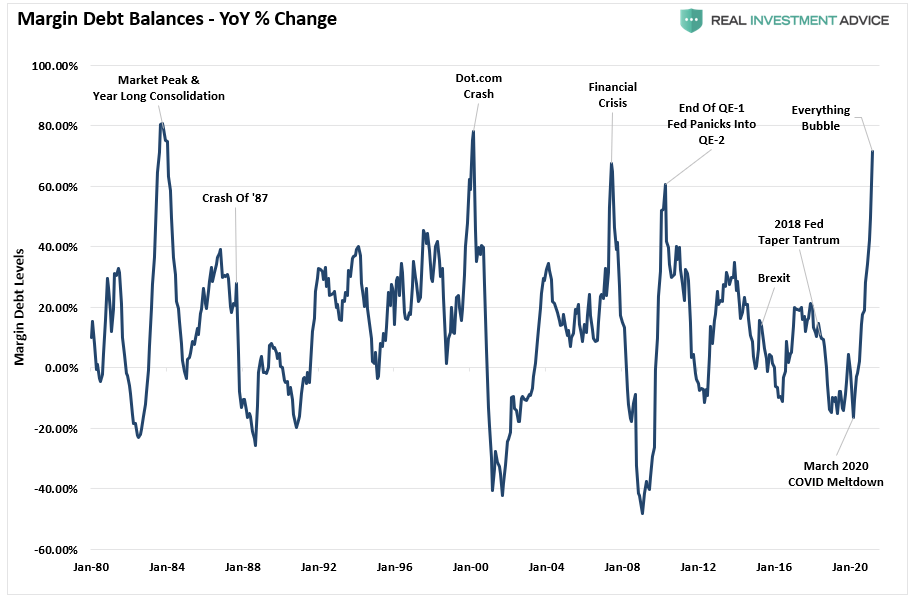
Of course, the biggest issue of all is when the reversal in equities occurs. That reversal will ignite the leverage that now extends into levered ETF’s, cryptocurrencies, options, and a myriad of other speculative investments. 

In other words, the Fed got trapped between continuing to suppress interest rates or deflating the most significant asset bubble in financial history. While the hope is that the Fed can do it in a controlled manner (a soft landing), the Fed’s past attempts have been less than successful.

Portfolio Update

As we noted last week,

“Another reason we don’t expect a lot of upside to markets because the recent “consolidation” failed to work off any of the overbought conditions. Notably, the market remains more than 5% above its 50-dma, which is historically extreme. Such gets corrected, usually through a price decline or a consolidation.” 

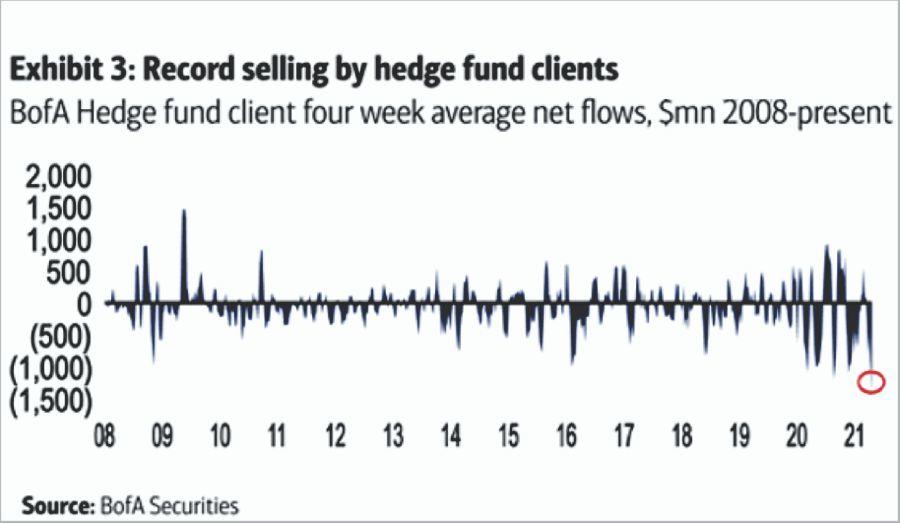
Our “sell signals” have kept us somewhat underexposed to equities and slightly overweight cash. However, the deterioration of “money flows” concerns us and aligns with hedgefund liquidations over the last several weeks. 

Given the more extreme selling pressure and the current short-term oversold condition of the market, we have begun nibbling at exposures that we like. There is also a reasonable expectation we will start to see the major tech companies pick up a bid as managers look for positions with lots of liquidity as we head into the weaker summer months. 

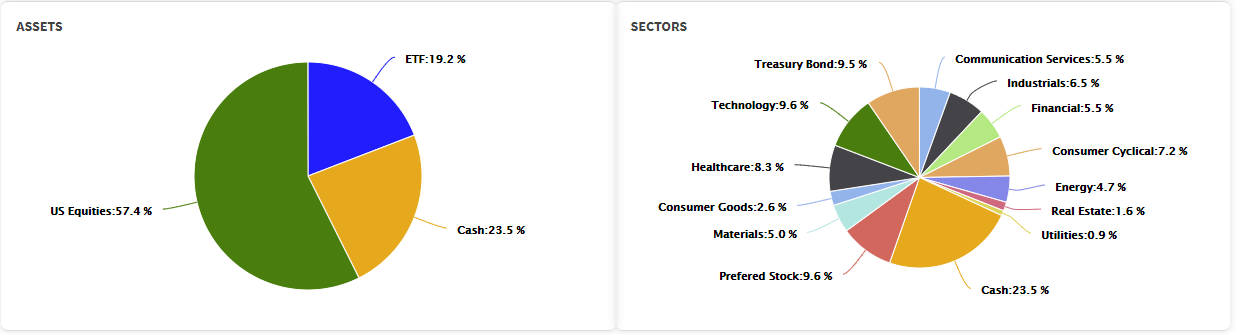
As shown, we are continuing to run a “barbell” approach to portfolios by overweighting our inflation sectors and underweighting our deflation sectors relative to the benchmark. (60/40 index) We have a very short-duration bond portfolio, which is why our “cash” is overweight. (Primarily 1-3 year duration holdings)

Once we get the next “buy” signal, we will adjust our weightings accordingly, but for now, we remain comfortable with our exposures. We continue to “tweak” the allocation as needed to adjust for risk as our intermediate-term concerns remain.

As David Rosenberg recently noted:

“The worst thing anyone can do is to extrapolate to the future. As Bob Farrell once said: ‘When all the experts and forecasts agree, something else is going to happen.’ The consensus has never been more lopsided, and that is reflected in asset allocations that heavily weight stocks relative to bonds.”

We agree.

Tyler Durden
Sun, 05/09/2021 – 11:35

via ZeroHedge News https://ift.tt/3vTRHsQ Tyler Durden

“It’s A Hustle”: Dogecoin Demolished After Musk SNL Snafu

“It’s A Hustle”: Dogecoin Demolished After Musk SNL Snafu

Once upon a time Saturday Night Live was a celebration of acting talent, of impromptu creativity and most importantly, of humor, which is why it launched the careers of too many comedians to count. Alas, over the past few decades, SNL lost its way, and become preachy podium for virtue signaling poseurs, for status quo apologists and for countless people who reveled in the “uniqueness” of their identity politics yet can’t cobble together a simple joke if America’s Universal Basic Income depended on it. It’s also why over the past few decades the viewership of SNL collapsed and countless Americans forgot about the show. Well… many got a stark reminder last night when millions turned on SNL for first time in years (or ever) only to be immediately reminded why they never watched it anymore: yet another catastrophically boring, uninspired and trite attempt by a cast of talentless hacks to be funny yet failing miserably.

And then there was Elon Musk.

The world’s 2nd richest man was the main reason why an entire generation of young Dogecoin “traders” turned on SNL for the first time in their lives…. only to see their favorite joke of a cryptocurrency (which it is by definition) demolished after weeks of breathless buildups for what Elon Musk had in store. Unfortunately, as with most things Musk, the action was all in the fervent anticipation of the main event… which turned out to be a fiasco.

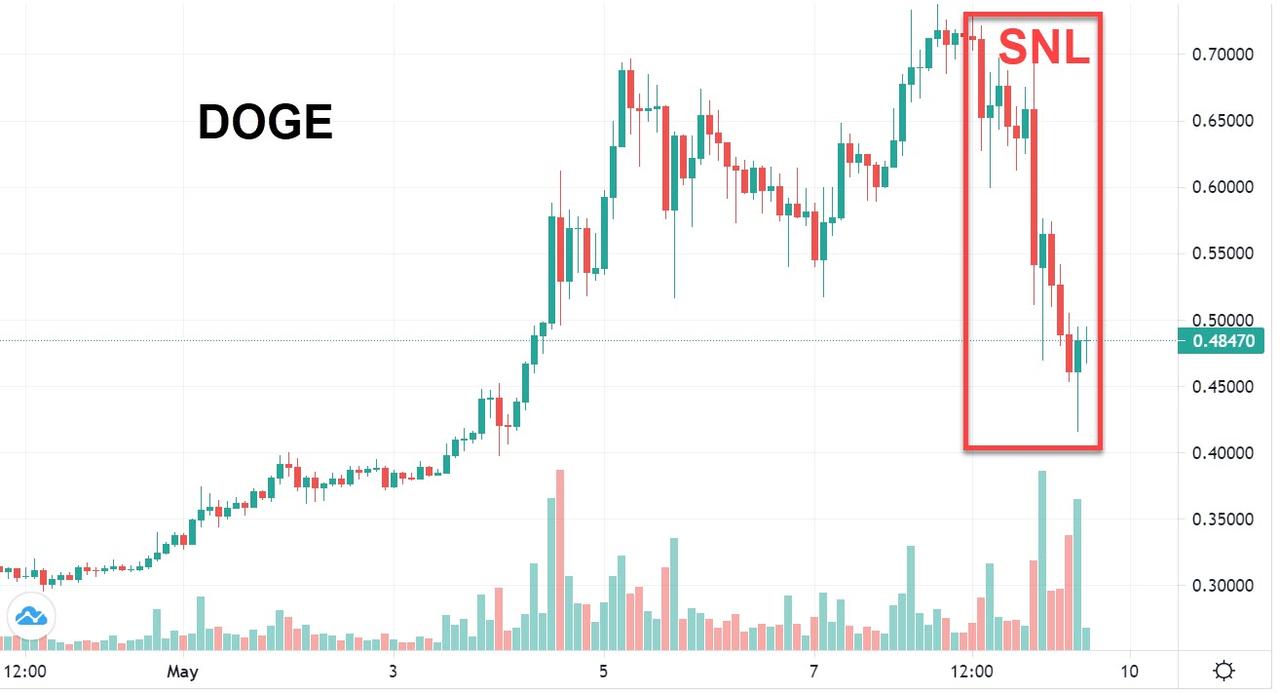
Having surged to a record high of 73 cents (making it the fifth most valuable cryptocurrency) on Saturday ahead of the show, it started to drop as soon as Musk took the microphone….

… then dropped more as Musk’s rambling monologue and boring skits failed to excite…

… or properly promote his favorite joke of a cryptocurrency. It ultimately dumped as low as 42 cents at of 8:05 a.m. ET… 

… a 35% decline in 24 hours and a disappointment for all those who had expected that Musk’s SNL appearance would be the catalyst that pushes the “dog” above parity with the dollar. Or, as Baird’s Michael Antonelli put it, “bad jokes and no funny memes leading to a Doge crash absolutely makes sense to me. It’s like an earnings miss but for a new era.”

The furious selling that emerged after Musk’s appearance also affected Robinhood, which said earlier that it was having some issues with crypto trading, citing high volume and volatility.

So what about the overhyped Musk appearance? It was, in a word, forgettable, his opening monologue flat and boring, which perhaps can be chalked up to Musk’s disclosure that he had Asperger’s, although once again Musk had some trouble with reality – he said he was the first person with Asperger’s to host the show, which is false: Dan Aykroyd was…

… in which Musk incorporated his first Dogecoin reference, a throwaway line from Musk’s mother, who joined him onstage and asked if her Mother’s Day gift would be Dogecoin; Musk replied that it would be. Clearly unhappy with the angle Musk had chosen, just minutes later the doge faithful proceeded to dump the currency, which fell 25% to 50 cents from 66 cents at the start of the show.

Leading into the episode, Alameda Research trader Sam Trabucco (who said in a previous Tweet that he was “studying the typical SNL episode structure to try and understand when a DOGE mention would be the most natural”) speculated that if a joke or mention didn’t come in Musk’s opening monologue, it would be “all over.” And despite getting a very brief mention during the monologue, traders still responded quite negatively.

What he did next did not help: when Musk was asked repeatedly during the “Weekend Update” segment to explain what Dogecoin is. After reciting multiple facts about the cryptocurrency in the character of a “financial expert”, he was asked if Dogecoin was a “hustle.” He responded, “yeah, it’s a hustle” after previously claiming that Dogecoin “the future of currency, it’s an unstoppable financial vehicle that’s going to take over the world.”

Sadly, that skit was also unfunny and fell flat as did most of Musk’s other attempts at humor.

Meanwhile as Musk was sweating before the live audience as well as on YouTube (NBC chose for the first time ever to live-stream the episode on Youtube) Barry Silbert — the founder and CEO of Digital Currency Group, the parent company of crypto investment vehicle company Grayscale — announced a public short on DOGE via the FTX exchange. In a series of follow-up Tweets, he revealed that the position was $1 million in size, and that any proceeds or remaining funds after closing the short would be donated to charity.

As dogecoin was routed, so was the rest of the crypto space, with bitcoin sliding more than 2% to as low as $56,500 while most altcoins were also dragged lower.

Perhaps sensing that his vastly overhyped appearance would lead to turmoil for dogecoin, on Friday Musk tweeted a that cryptocurrencies are “promising, but please invest with caution” linking to a video that showed him talking about the merits of crypto, particularly Dogecoin. That followed months of Twitter posts from Musk about Dogecoin, all of which exuded praise and snared millions of his easily impressionable followers into buying the “joke.”

That said, despite the overnight tumble, Dogecoin is still up more than 16,000% in the past year and while Musk has been among its biggest boosters, fans also include Mark Cuban, Snoop Dogg and Gene Simmons.

Tyler Durden
Sun, 05/09/2021 – 11:09

via ZeroHedge News https://ift.tt/3hehJ6i Tyler Durden

The Fed Embraces Its Inner Zimbabwean

The Fed Embraces Its Inner Zimbabwean

Authored by Doug French via The Mises Institute,

May is on its way, and the old investment saw, “Sell in May and go away,” will be tested once again. Jared Blikre, writing for Yahoo Finance, provides the history behind what may or may not be good advice.

“The full axiom was originally, ‘Sell in May and go away, and come on back on St. Leger’s Day,’” he explains.

“It has its roots in the City of London. Financial professionals would go on holiday in May for approximately four months to escape the summer heat and return for the St. Leger derby in mid-September.” 

While we’re told there’s a pent-up demand for travel, people’s phones and trading apps will still be close by, begging for attention in the summer sun. Robinhood and Coinbase alerts won’t hide from the weary traveler parked under an umbrella, toes in the sand, piña colada in hand. 

Dogecoin will not get the hell out of Dodge this summer. The cryptocoin, created as a joke, is surprisingly not obscure. My newest doctor and I, while he drained the goo from a ganglion cyst on my wrist, discussed the trading action of dogecoin after I mentioned I had done some work on booms and busts. 

As I write, Dogecoin is up after Elon Musk, who will add Saturday Night Live guest host to his resume on May 8, called himself “the dogefather.” Musk’s Tesla shares continue to defy logic and gravity, but could the coming guest-hosting gig signal a market top, at worst, or a reason to sell in May, at least?

DOGE, created by software engineers Billy Markus and Jackson Palmer, was also discussed at dinner the other night, when a couple, who admitted they have no idea what they’re doing, said with a shrug, “Yeah, we’ve each doubled our money in a few months trading stocks.” Nothing as exotic as DOGE, but reopening plays like cruise line and airline shares.

Kevin Duffy, proprietor and author of the Coffee Can Portfolio newsletter, provides thirteen rules for investing, not speculating. Number 12 is, “The retail investor is always late to the party.”

To the sensible and experienced, it seems late indeed.

But is piling into US dollars, made less worthy each day by the Powell Fed, a good idea?

The US central bank now has a climate change mandate, in addition to full employment. Soundness of the currency used to be top of mind for central bankers, but that horse left the Eccles Building long ago.

“Climate change and the transition to a sustainable economy also pose risks to the stability of the broader financial system. So a second core pillar of our framework seeks to address the macrofinancial risks of climate change,” Fed governor Lael Brainard said recently. 

With Brainard, Jerome Powell, and Treasury secretary Janet Yellen focusing on the climate, the M1 money supply has gone parabolic, from just over $4 trillion in February to $18.6 trillion in March.

This is right out of Gideon Gono’s playbook. The once governor of the Reserve Bank of Zimbabwe, said, among many outrageous things, “There is a positive correlation between the drought and inflation.” 

So there you have it. And you thought monetary policy and climate were mutually exclusive. I wrote on mises.org in 2010,

Forget about money printing. Inflation is all about the weather, lack of support from other nations, and political sanctions. In Governor Gono’s mind, he has had nothing to do with the hyperinflation in his country. ‘No other [central-bank] governor has had to deal with the kind of inflation levels that I deal with,’ Gono told Newsweek. ‘[The people at] my bank [are] at the cutting edge of the country.’”

Gono took his job in 2003 with that nation’s inflation rate at 619 percent per year. Five years later, in mid-November 2008 the inflation rate peaked at 79,600,000,000 percent per month.

Maybe we should head toward DOGE this summer, after all.

Tyler Durden
Sun, 05/09/2021 – 10:35

via ZeroHedge News https://ift.tt/33pQZrg Tyler Durden

Two Longtime Enemy Mideast Countries Have Entered Unlikely Peace Talks

Two Longtime Enemy Mideast Countries Have Entered Unlikely Peace Talks

Two longtime bitter enemies who have for much of the past couple decades battled for influence in the Middle East while clashing through proxies have entered unlikely secret talks. On Friday a Saudi foreign ministry official confirmed previously widespread rumors of the past weeks that the kingdom is in communications with Iran in order to reduce regional tensions. Earlier reports suggested the talks secretly took place in Baghdad.

“We hope they prove successful, but it is too early, and premature, to reach any definitive conclusions,” Saudi ministry Ambassador Rayed Krimly told Reuters. He said that Riyadh needs to see “verifiable deeds” before evaluating the talks, with Bloomberg noting that Iraqi officials are mediating, with a focus on de-escalating the situation in Yemen – where Riyadh and Tehran are supporting rival sides of the civil war.

Crown Prince Mohammed bin Salman with Iraq’s Prime Minister Mustafa al-Kadhimi, via Reuters.

Iran’s foreign ministry responded by saying “bilateral co-operation is important in ensuring security and stability in the region.” Late last month the two sides had denied the talks, despite the persistent rumors.

As the Abu Dhabi-based The National recounts, Saudi crown prince MBS for the first time spoke of openness to talks with the Islamic Republic recently:

Last month Saudi Arabia’s Crown Prince Mohammed bin Salman said the kingdom was open to improving relations with Iran.

“Iran is a neighboring state. We are seeking to have good relations with Iran,” Prince Mohammed said.

“We have interests in Iran, we aim to see a prosperous Iran,” he said in a television interview.

“We are working with our partners in the region to overcome our differences with Iran, especially with its support for militias and the development of its nuclear program.”

Syria and Lebanon have also been key battlegrounds for the Shia and Sunni divide, with Shia Iran being Hezbollah’s biggest international backer. The Saudis have long directly armed, trained, and funded Sunni jihadists seeking to topple Assad in Syria while also rolling back Hezbollah’s influence. 

This latest revelation and confirmation of Saudi-Iran talks also comes as the Saudis are reaching out the the Assad government in Damascus. Earlier this week on Tuesday multiple international reports revealed that Saudi Arabia’s powerful intelligence chief traveled to Damascus Monday to meet with his Syrian counterpart in what’s being seen as a major step toward detente. The two broke off relations since near the start of the war in 2011, especially as it became clear the Saudis were a key part of the Western allied push for regime change.

The US and Western alliance has long supported in the Saudi Sunni side of the ‘long war’ for the Middle East. This is particularly after the Shia ascendancy in Baghdad which was the direct result of Bush’s war to topple Saddam Hussein in 2003 (a Sunni secular dictator).

It’s very likely this is directly related to the ongoing Vienna nuclear negotiations involving signatories to the 2015 JCPOA deal, and most notably the ‘indirect’ talks between Tehran and Washington there. A crucial component to any lasting peace in the region would have to involve the Iranians and Saudis agreeing to halt their military support for rival proxies in the region.

However, for Iran its support of groups like Hezbollah, Hamas, and Iraqi Shia militias is mostly geared against Israel as well as US interests. So it’s unlikely Tehran will ever stop such support to any significant degree. At the same time the Saudi Wahhabi interpretation of Islam is deeply embedded within the kingdom’s religious and state establishment, making it a key source of continued ideological support to Sunni jihadism and terrorism globally.

Tyler Durden
Sun, 05/09/2021 – 10:10

via ZeroHedge News https://ift.tt/3xYmCGw Tyler Durden

The Energy Crisis That No One Is Talking About

The Energy Crisis That No One Is Talking About

Authored by Gail Tverberg via Our Finite World blog,

We live in a world where words are very carefully chosen. Companies hire public relations firms to give just the right “spin” to what they are saying. Politicians make statements which suggest that everything is going well. Newspapers would like their advertisers to be happy; they certainly won’t suggest that the automobile you purchase today may be of no use to you in five years.

I believe that what has happened in recent years is that the “truth” has become very dark. We live in a finite world; we are rapidly approaching limits of many kinds. For example, there is not enough fresh water for everyone, including agriculture and businesses. This inadequate water supply is now tipping over into inadequate food supply in quite a few places because irrigation requires fresh water. This problem is, in a sense, an energy problem, because adding more irrigation requires more energy supplies used for digging deeper wells or making desalination plants. We are reaching energy scarcity issues not too different from those of World War I, World War II and the Depression Era between the wars.

We now live in a strange world filled with half-truths, not too different from the world of the 1930s. US newspapers leave out the many stories that could be written about rising food insecurity around the world, and even in the US. We see more reports of conflicts among countries and increasing gaps between the rich and the poor, but no one explains that such changes are to be expected when energy consumption per capita starts falling too low.

The majority of people seem to believe that all of these problems can be fixed simply by increasingly taxing the rich and using the proceeds to help the poor. They also believe that the biggest problem we are facing is climate change. Very few are even aware of the food scarcity problems occurring in many parts of the world already.

Our political leaders started down the wrong path long ago, when they chose to rely on economists rather than physicists. The economists created the fiction that the economy could expand endlessly, even with falling energy supplies. The physicists understood that the economy requires energy for growth, but didn’t really understand the financial system, so they weren’t in a position to explain which parts of economic theory were incorrect. Even as the true story becomes increasingly clear, politicians stick to their belief that our only energy problem is the possibility of using too much fossil fuel, with the result of rising world temperatures and disrupted weather patterns. This can be interpreted as a relatively distant problem that can be corrected over a fairly long future period.

In this post, I will explain why it appears to me that, right now, we are dealing with an energy problem as severe as that which seems to have led to World War I, World War II, and the Great Depression. We really need a solution to our energy problems right now, not in the year 2050 or 2100. Scientists modeled the wrong problem: a fairly distant energy problem which would be associated with high energy prices. The real issue is a very close-at-hand energy shortage problem, associated with relatively low energy prices. It should not be surprising that the solutions scientists have found are mostly absurd, given the true nature of the problem we are facing.

[1] There is a great deal of confusion with respect to which energy problem we are dealing with. Are we dealing with a near-at-hand problem featuring inadequate prices for producers or a more distant problem featuring high prices for consumers? It makes a huge difference in finding a solution, if any.

Business leaders would like us to believe that the problem to be concerned with is a fairly distant one: climate change. In fact, this is the problem most scientists are working on. There is a common misbelief that fossil fuel prices will jump to high levels if they are in short supply. These high prices will allow the extraction of a huge amount of coal, oil and natural gas from the ground. The rising prices will also allow high-priced alternatives to become competitive. Thus, it makes sense to start down the long road of trying to substitute “renewables” for fossil fuels.

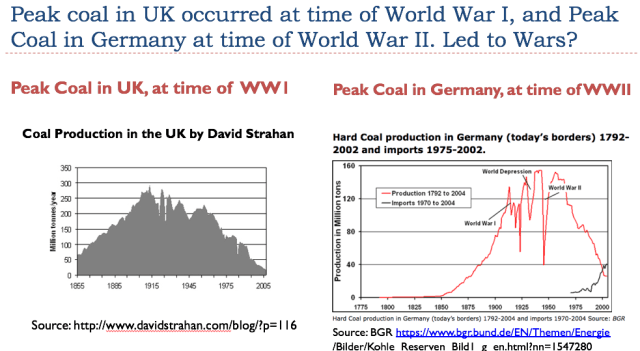
If business leaders had stopped to look at the history of coal depletion, they would have discovered that expecting high prices when energy limits are encountered is incorrect. The issue that really happens is a wage problem: too many workers discover that their wages are too low. Indirectly, these low-wage workers need to cut back on purchases of goods of many types, including coal to heat workers’ homes. This loss of purchasing power tends to hold coal prices down to a level that is too low for producers. We can see this situation if we look at the historical problems with coal depletion in the UK and in Germany.

Coal played an outsized role in the time leading up to, and including, World War II.
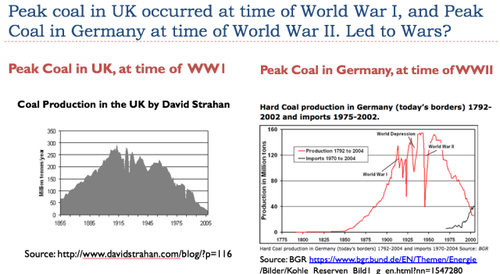
Figure 1. Figure by author describing peak coal timing.

History shows that as early coal mines became depleted, the number of hours of labor required to extract a given amount of coal tended to rise significantly. This happened because deeper mines were needed, or mines were needed in areas where there were only thin coal seams. The problem owners of mines experienced was that coal prices that did not rise enough to cover their higher labor costs, related to depletion. The issue was really that prices fell too low for coal producers.

Owners of mines found that they needed to cut the wages of miners. This led to strikes and lower coal production. Indirectly, other coal-using industries, such as iron production and bread baking, were adversely affected, leading these industries to cut jobs and wages, as well. In a sense, the big issue was growing wage disparity, because many higher-wage workers and property owners were not affected.

Today, the issue we see is very similar, especially when we look at wages worldwide, because markets are now worldwide. Many workers around the world have very low wages, or no wages at all. As a result, the number of workers worldwide who can afford to purchase goods that require large amounts of oil and coal products for their manufacture and operation, such as vehicles, tends to fall. For example, peak sales of private passenger automobile, worldwide, occurred in 2017. With fewer auto sales (as well as fewer sales of other high-priced goods), it is difficult to keep oil and coal prices high enough for producers. This is very similar to the problems of the 1914 to 1945 era.

Everything that I can see indicates that we are now reaching a time that is parallel to the period between 1914 and 1945. Conflict is one of the major things that a person would expect because each country wants to protect its jobs. Each country also wants to add new jobs that pay well.

In a period parallel to the 1914 to 1945 period, we can also expect pandemics. This happens because the many poor people often cannot afford adequate diets, making them more susceptible to diseases that are easily transmitted. In the Spanish Flu epidemic of 1918-1919, more than 50 million people worldwide died. The equivalent number with today’s world population would be about 260 million. This hugely dwarfs the 3.2 million COVID-19 deaths around the world that we have experienced to date.

[2] If we look at growth in energy supply, relative to the growth in population, precisely the same type of “squeeze” is occurring now as was occurring in the 1914 to 1945 period. This squeeze particularly affects coal and oil supplies.
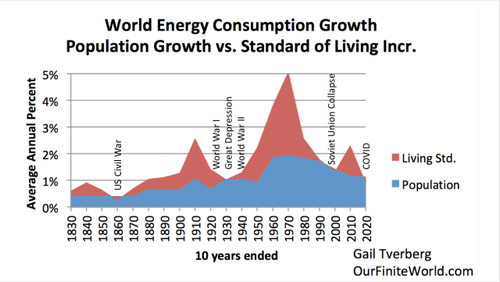
Figure 2. The sum of red and blue areas on the chart represent average annual world energy consumption growth by 10-year periods. Blue areas represent average annual population growth percentages during these 10-year periods. The red area is determined by subtraction. It represents the amount of energy consumption growth that is “left over” for growth in people’s standards of living. Chart by Gail Tverberg using energy data from Vaclav Smil’s estimates shown in Energy Transitions: History, Requirements and Prospects, together with BP Statistical Data for 1965 and subsequent years.

The chart above is somewhat complex. It looks at how quickly energy consumption has been growing historically, over ten-year periods (sum of red and blue areas). This amount is divided into two parts. The blue area shows how much of this growth in energy consumption was required to provide food, housing and transportation to the growing world population, based on the standards at that time. The red area shows how much growth in energy consumption was “left over” for growth in the standard of living, such as better roads, more vehicles, and nicer homes. Note that GDP growth is not shown in the chart. It likely corresponds fairly closely to total energy consumption growth.

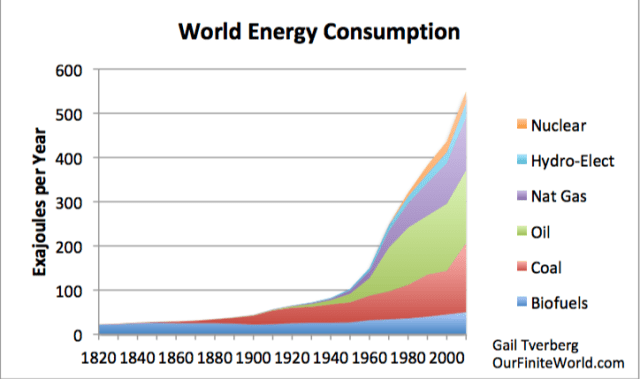
Figure 3, below, shows energy consumption by type of fuel between 1820 and 2010. From this, it is clear that the world’s energy consumption was tiny back in 1820, when most of the world’s energy came from burned biomass. Even at that time, there was a huge problem with deforestation.
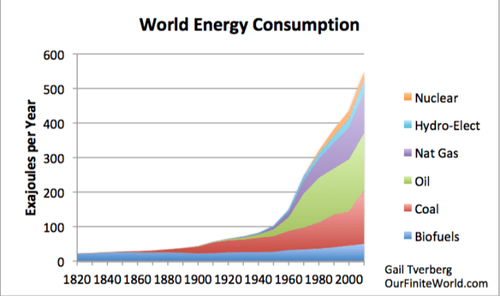
Figure 3. World Energy Consumption by Source, based on Vaclav Smil estimates from Energy Transitions: History, Requirements and Prospects and together with BP’s Statistical Review of World Energy data for 1965 and subsequent years. (Wind and solar are included with biofuels.)

Clearly, the addition of coal, starting shortly after 1820, allowed huge changes in the world economy. But by 1910, this growth in coal consumption was flattening out, leading quite possibly to the problems of the 1914-1945 era. The growth in oil consumption after World War II allowed the world economy to recover. Natural gas, hydroelectric and nuclear have been added in recent years, as well, but the amounts have been less significant than those of coal and oil.

We can see how coal and oil have dominated growth in energy supplies in other ways, as well. This is a chart of energy supplies, with a projection of expected energy supplies through 2021 based on estimates of the IEA’s Global Energy Review 2021.
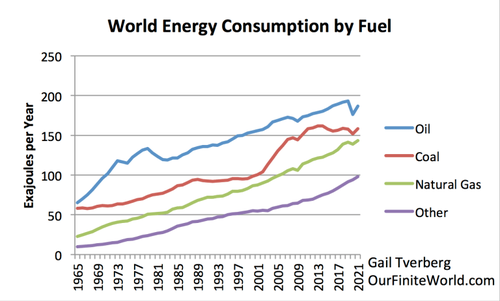
Figure 4. World energy consumption by fuel. Data through 2019 based on information from BP’s Statistical Review of World Energy 2020. Amounts for 2020 and 2021 based on percentage change estimates from IEA’s Global Energy Review 2021.

Oil supplies became a problem in the 1970s. There was briefly a dip in the demand for oil supplies as the world switched from burning oil to the use of other fuels in applications where this could easily be done, such as producing electricity and heating homes. Also, private passenger automobiles became smaller and more fuel efficient. There has been a continued push for fuel efficiency since then. In 2020, oil consumption was greatly affected by the reduction in personal travel associated with the COVID-19 epidemic.

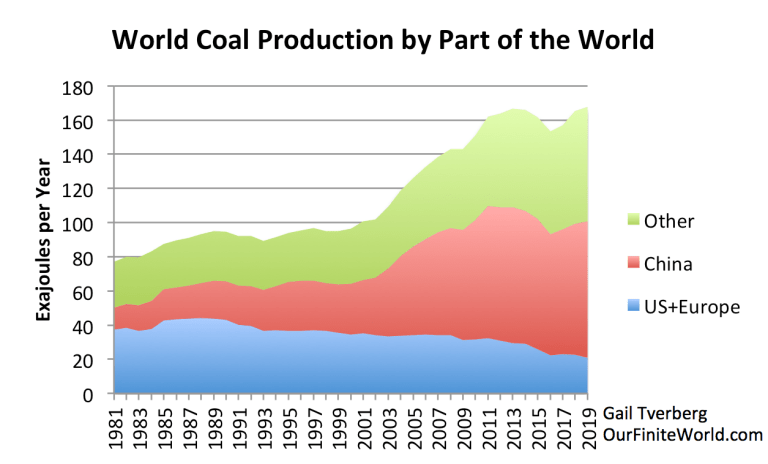
Figure 4, above, shows that world coal consumption has been close to flat since about 2012. This is also evident in Figure 5, below.
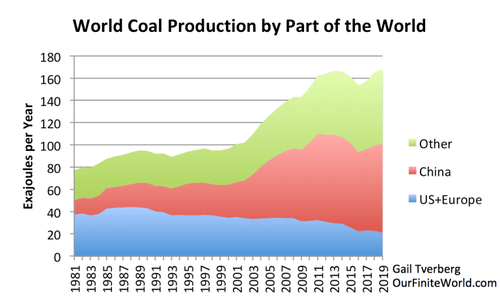
Figure 5. World coal production by part of the world, based on data of BP’s Statistical Review of World Energy, 2020.

Figure 5 shows that coal production for the United States and Europe has been declining for a very long time, since about 1988. Before China joined the World Trade Organization (WTO) in 2001, its coal production grew at a moderate pace. After joining the WTO in 2001, China’s coal production grew very rapidly for about 10 years. In about 2011, China’s coal production leveled off, leading to the leveling of world coal production.

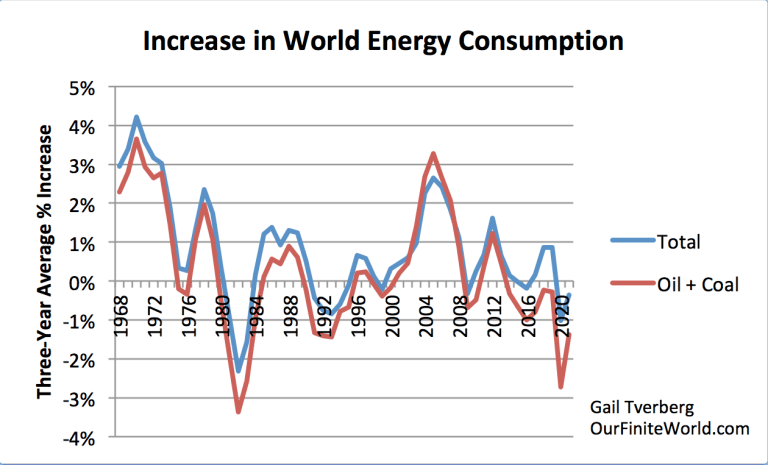
Figure 6 shows that recently, growth in the sum of oil and coal consumption has been lagging total energy consumption.
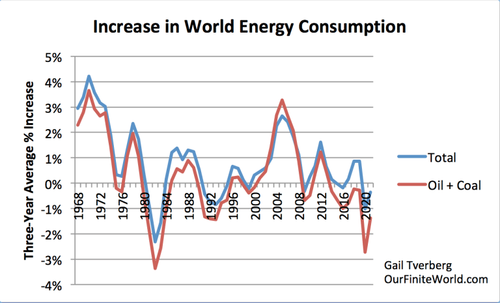
Figure 6. Three-year average annual increase in oil and coal consumption versus three-year average increase in total energy consumption, based on a combination of BP data through 2019 from BP’s Statistical Review of World Energy, 2010 and IEA’s 2020 and 2021 percentage change forecasts, from its Global Energy Review 2021.

We can see from Figure 6 that the only recent time when oil and coal supplies grew faster than energy consumption in total was during a brief period between 2002 and 2007. More recently, oil and coal consumption has been increasingly lagging total energy consumption. For both coal and oil, the problem has been that low prices for producers cause producers to voluntarily drop out of coal or oil production. The reason for this is two-fold: (1) With less oil (or coal) production, perhaps prices might rise, making production more profitable, and (2) Unprofitable oil (or coal) production isn’t really satisfactory for producers.

When determining the required level of profitability for these fuels, there is a need to include the tax revenue that governments require in order to maintain adequate services. This is especially the case with oil exporters, but it is also true in general. Energy products, to be useful, produce an energy surplus that can be used to benefit the rest of the economy. The way that this energy surplus can be transferred to the rest of the economy is by paying relatively high taxes. These taxes allow changes that aid economic growth, such as improvements in roads and schools.

If energy prices are chronically too low (so that an energy product requires a subsidy, rather than paying taxes), this is a sign that the energy product is most likely an energy “sink.” Such a product acts in the direction of pulling the economy down through ever-lower productivity.

[3] Governments have chosen to focus on preventing climate change because, in theory, the changes that are needed to prevent climate change seem to be the same ones needed to cover the contingency of “running out.” The catch is that the indicated changes don’t really work in the scarcity situation we are already facing.

It turns out that the very fuels that we seem to be running out of (coal and oil) are the very ones most associated with high carbon dioxide emissions. Thus, focusing on climate change seems to please everyone. Those who were concerned that we could keep extracting fossil fuels for hundreds of years and, because of this, completely ruin the climate, would be happy. Those who were concerned about running out of fossil fuels would be happy, as well. This is precisely the kind of solution that politicians prefer.

The catch is that we used coal and oil first because, in a very real sense, they are the “best” fuels for our needs. All of the other fuels, even natural gas, are in many senses inferior. Natural gas has the problem that it is very expensive to transport and store. Also, methane, which makes up the majority of natural gas, is itself a gas that contributes to global warming. It tends to leak from pipelines and from ships attempting to transport it. Thus, it is doubtful that it is much better from a global warming perspective than coal or oil.

So-called renewable fuels tend to be very damaging to the environment in ways other than CO2 emissions. This point is made very well in the new book Bright Green Lies by Derrick Jensen, Lierre Keith and Max Wilbert. It makes the point that renewable fuels are not an attempt to save the environment. Instead, they are trying to save our current industrial civilization using approaches that tend to destroy the environment. Cutting down forests, even if new trees are planted in their place, is especially detrimental. Alice Friedemann, in her new book, Life after Fossil Fuels: A Reality Check on Alternative Fuels, points out the high cost of these alternatives and their dependence on fossil fuel energy.

We are right now in a huge scarcity situation which is starting to cause conflicts of many kinds. Even if there were a way of producing these types of alternative energy cheaply enough, they are coming far too late and in far too small quantities to make a difference. They also don’t match up with our current coal and oil uses, adding a layer of time and expense for conversion that needs to be included in any model.

[4] What we really have is a huge conflict problem due to inadequate energy supplies for today’s world population. The powers that be are trying to hide this problem by publishing only their preferred version of the truth.

The situation that we are really facing is one that often goes under the name of “collapse.” It is a problem that many civilizations have faced in the past when a given population has outgrown its resource base.

Needless to say, the issue of collapse is not a story any politician wants to tell its citizens. Instead, we are told over and over, “Everything is fine. Any energy problem will be handled by the solutions scientists are finding.” The catch is that scientists were not told the correct problem to solve. They were told about a distant problem. To make the problem easier to solve, high prices and subsidies seemed to be acceptable. The problem they were asked to solve is very different from our real energy problem today.

Many people think that taxing the rich and giving the proceeds to the poor can solve our problem, but this doesn’t really solve the problem for a couple of reasons. One of the issues is that our scarcity issue is really a worldwide problem. Higher taxation of the rich in a few rich countries does nothing for the many problems of poor people in countries such as Lebanon, Yemen, Venezuela and India. Furthermore, taking money from the rich doesn’t really fix scarcity problems. Rich people don’t really eat a vastly disproportionate amount of food or drink more water, for example.

A detail that most of us don’t think about is that the military of many different countries has been very much aware of the potential conflict situation that is now occurring. They are aware that a “hot war” would require huge use of fossil fuel energy, so they have been trying to find alternative approaches. One approach military groups have been working on is the use of bioweapons of various kinds. In fact, some groups might even contemplate starting a pandemic. Another approach that might be used is computer viruses to disrupt the systems of other countries.

Needless to say, the powers that be do not want the general population to hear about issues of these kinds. We find ourselves with narrower and narrower news reports that provide only the version of the truth that politicians and news media want us to read. Citizens who have developed the view, “All I need to do to find out the truth is read my home town newspaper,” are likely to encounter more and more surprises, as conflict situations escalate.
Tyler Durden
Sun, 05/09/2021 – 09:45

via ZeroHedge News https://ift.tt/3hciAUQ Tyler Durden

Egypt Prepares To Unveil New ‘Octagon’ Defense Headquarters

Egypt Prepares To Unveil New ‘Octagon’ Defense Headquarters

Via AlMasdarNews.com,

Egyptian military sources reportedly told RT Arabic this week that Egypt is preparing to open the new headquarters of its armed forces

The headquarters of the new Egyptian army, dubbed “the Octagon”, was designed to resemble the ancient temples of Thebes, with their huge columns and towering walls, but was also clearly inspired by the US Pentagon.

The sources said that Egyptian Prime Minister Mostafa Madbouly went to the building on Wednesday, on the orders of Egyptian President Abdel Fattah El-Sisi, to find out the developments in the opening of the new defense capital and put the final touches.

During his stay there, the Egyptian Prime Minister said that President Abdel Fattah El-Sisi was assigned to start preparing for the celebration of the inauguration of the new “administrative capital”.

Madbouly indicated that the ceremony will be at the highest level, through which it will express a clear message about the “new republic”, which the Egyptian President announced.

The new Egyptian army headquarters, consisting of eight-faceted buildings in the Pharaonic style, appeared compact in the form of a circle that includes administrative buildings.

The Octagon building includes all the headquarters of the Egyptian Armed Forces, and its construction is scheduled to be completed soon.

The project is located on a total area of ​​189,000 square meters, while the actual area of ​​the building is estimated at 45,000 square meters.

There are two ministerial buildings located in the center of the circle, and they are connected to each other and the rest of the eight external buildings (the number of the Egyptian army departments) by longitudinal corridors.

Tyler Durden
Sun, 05/09/2021 – 09:00

via ZeroHedge News https://ift.tt/3xZyw2z Tyler Durden

Don’t Fight The Fed’s Commodity “Put”

Don’t Fight The Fed’s Commodity “Put”

By Ryan Fitzmaurice of Rabobank

Don’t fight the Fed

  • Inflation remains a key concern for investors as was clear from Warren Buffett’s comments at the Berkshire Hathaway annual event this past weekend
  • Commodity index inflows picked up substantially this week as institutional investors return to the alternative asset class in a big way
  • Strong investor interest is providing steady and reliable demand for oil futures

The Fed commodity “put”

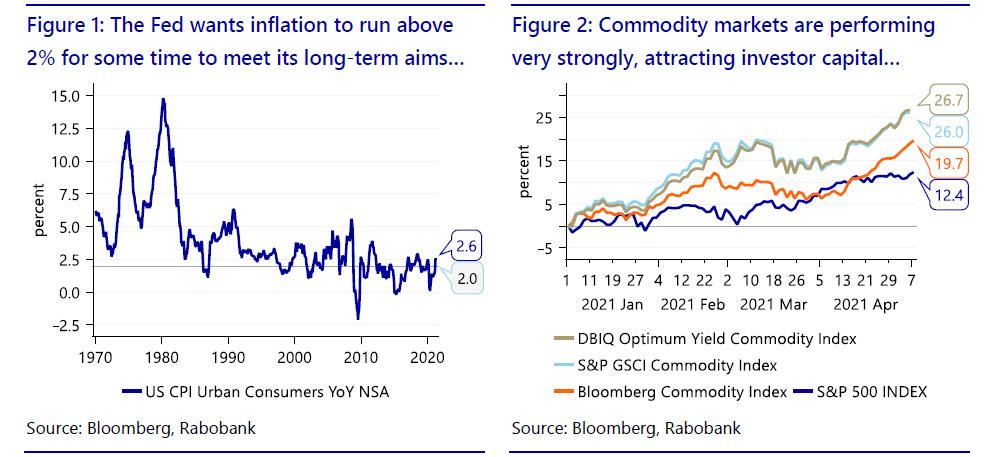
Inflation concerns are top of mind for many investors these days, as is clear from the never-ending financial news media coverage of the topic lately. In fact, just last weekend Warren Buffett’s Berkshire Hathaway held its annual shareholder meeting and commodities and inflation were hot topics, unsurprisingly. At the televised event, Buffett talked up mounting inflationary pressures indicating that Berkshire is already seeing substantial inflation in many of its own businesses. Buffett explained, “We are raising prices. People are raising prices to us, and it’s being accepted.” He went on to describe that the spike in input costs and raw materials is being passed on to consumers without much push back given the loose monetary and fiscal policies at play, saying that “people have money in their pocket, and they are paying higher prices”. As is clear from these well-supported comments, there are good reasons to be concerned about inflation given everything that has transpired with the pandemic this past year and now as we look towards the inevitable recovery with financial markets well lubricated from historic stimulus and central bank easing. In fact, the Fed has stated quite clearly that it wants inflation to run hot above 2% for some time to achieve its “longer-term” average of 2% and it appears to be getting what it wants. This is not surprising given what a powerful market force the Fed can be and, as such, investors are generally wise not to stand in its way. To that end, the Fed is telling the market it wants higher oil and commodity prices to achieve this “longer-term” average of 2% inflation. As a result, commodities markets continue to benefit from this widely perceived Fed commodity “put”, with year-to-date gains anywhere from 19% to 27%, depending on which index you look at.

Strategic rotation

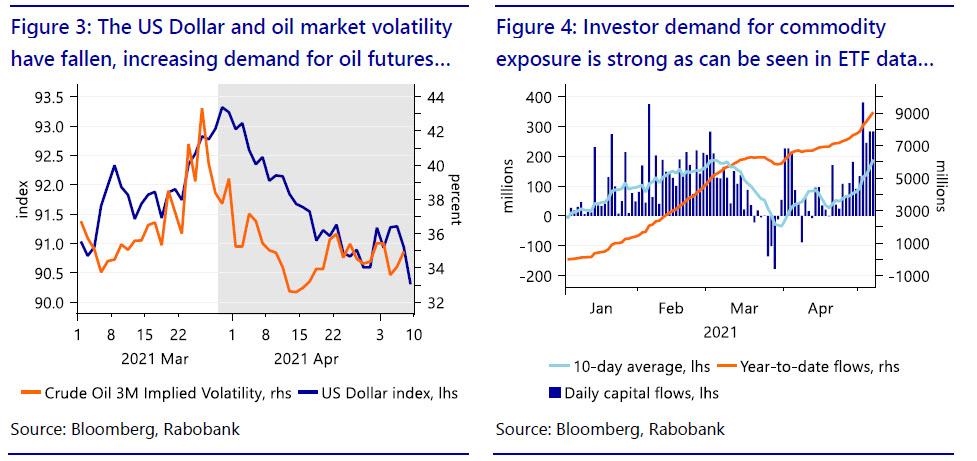
Commodity index inflows picked up substantially this week as institutional investors return to the alternative asset class in a big way. In fact, roughly +1bn USD of inflows were reported in just the last five trading sessions bringing the year-to-date total firmly above the 8bn mark. The 10-day average inflow is now firmly above the +100mm USD per day mark, a level not seen since early March. As is clear from Figure 4, this trend of “new” money into commodity index funds has been in place all year as institutional investors rush to add inflation hedges to their portfolios. Increasing commodity prices are often key drivers of inflation themselves, so naturally commodity-related investments are widely perceived to act as an inflation hedge and the asset class has indeed performed well in high inflationary periods throughout history.

These large inflows suggest that a strategic rotation is taking place across asset classes with investors seeking out higher commodity exposures while likely reducing other holdings on the margin. The increase in investor commodity exposure is clear though when looking at the most actively traded commodity index ETFs which have seen money pour into them this year with the exception of a brief period in late March and early April when the US Dollar rallied sharply, temporarily alleviating inflation fears. Since then, the US Dollar has resumed its downtrend and with that inflows have increased steadily. In our view, we are likely still in the early to mid-stages of this strategic rotation back into commodity markets, given how much money left the space over the past five to seven years coupled with the loose financial conditions currently at play. As we have explained in the past, these funds generally have high oil market weightings, so these inflows have provided steady and meaningful demand for oil futures all year and we fully expect that trend to continue. In addition, CTA funds are heavily “long” oil futures as well on bullish trend, momentum, and “carry” signals. As a result, we expect the speculative interest to remain overwhelming on the “bid” side of oil for the foreseeable future, barring any spikes in volatility or the dollar that could trigger a liquidation event. So in short, we see a strong case to be “long” oil futures, especially in the deferred months, given the Fed’s willingness to let inflation run “hot” in the near-term coupled with the likelihood of continued strong investor appetite for oil futures.

Looking Forward

Looking forward, we see upside risks developing for oil prices as we approach the high demand summer months in conjunction with the re-opening of key cities and regions. We expect this year’s strong investor interest in commodities to be more persistent in nature and related to an ongoing strategic rotation across asset classes. As a result of these strong inflows, OPEC+ appears to be in a position of strength assuming they are restrained in returning supply to the market. That’s not to say there are not downside risk lurking, such as the big job data miss in the US or the still worrisome virus data out of India, but we still see no reason to fight the Fed/trend.

Tyler Durden
Sun, 05/09/2021 – 08:15

via ZeroHedge News https://ift.tt/3vQDk8K Tyler Durden