Should Libertarians Support Federal AI Regulation?


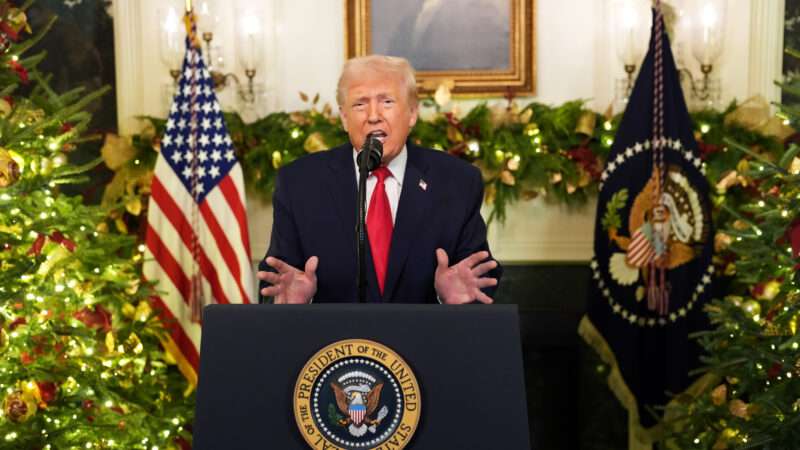
Matt Welch appears on the left, with Liz Wolfe on the right speaking. In a box centered between them, President Donald Trump holds up a signed executive order, with Senator Ted Cruz and Howard Lutnick behind him. Large thumbnail text above them reads “TOO MUCH POWER?” | Illustration: Eddie Marshall

This week, editors Peter SudermanKatherine Mangu-Ward, and Matt Welch are joined by associate editor Liz Wolfe to discuss President Donald Trump’s executive order blocking states from enforcing their own artificial intelligence regulations. The panel debates whether a single national framework for AI is necessary to keep American tech companies competitive or whether it represents a serious blow to federalism. They also examine the White House potentially reclassifying marijuana as a Schedule III drug and what that change could mean for the cannabis industry, tax policy, and federal drug enforcement.

The editors then turn to mass shootings in Australia and at Brown University, including the actions of a bystander credited with saving lives at Bondi Beach, and what these incidents suggest about gun control debates. They discuss the U.S. seizure of a Venezuelan oil tanker and threats of land strikes against the Nicolás Maduro regime, and cover the conviction of Hong Kong media tycoon Jimmy Lai under China’s national security law and what it signals for press freedom and U.S.-China relations. A listener asks whether modern socialism reflects moral aspirations that could be redirected toward liberty rather than centralized power.


0:00—Trump blocks states from regulating AI

10:31—Reclassifying marijuana as a Schedule III drug

18:39—Mass shootings in the U.S. and Australia

26:59—U.S. seizes Venezuelan oil tanker

36:48—Listener question on optimism for socialism

46:08—Jimmy Lai found guilty by Hong Kong court

57:12—Weekly cultural recommendations


Mentioned in This Podcast

Donald Trump Tries To Override State AI Regulations via Executive Order,” by Jack Nicastro

Trump Will Let Nvidia Sell Chips to China—but the Feds Will Get 25 Percent of the Profits,” by Tosin Akintola

Trump’s Plan To Reclassify Marijuana Would Leave Federal Prohibition Essentially Untouched,” by Jacob Sullum

Stoner King Trump,” by Liz Wolfe

Shootings at Bondi and Brown,” by Liz Wolfe

Trump Dares Congress To Take Its War Powers Seriously in Venezuela,” by Matthew Petti

Trump Is Still Claiming He Saves ‘25,000 American Lives’ When He Blows Up a Suspected Drug Boat,” by Jacob Sullum

Mark Clifford: A Political Prisoner Fights for Free Speech in China,” by Billy Binion

Is Free Speech Doomed in Hong Kong?” By Jack Nicastro

‘I Owe Freedom My Life’: Jimmy Lai Is Imprisoned for Criticizing the Chinese Government,” by John Stossel

Hong Kong’s Free Press Is Dying,” by Liz Wolfe

The post Should Libertarians Support Federal AI Regulation? appeared first on Reason.com.

from Latest – Reason.com https://ift.tt/h0qEoDb
via IFTTT

Trump’s Plan To Reclassify Marijuana Would Leave Federal Prohibition Essentially Untouched


Donald Trump and cannabis | Illustration: Eddie Marshall | CNP | AdMedia | Newscom | Midjourney

During his 2024 campaign, President Donald Trump indicated that he supported the Biden administration’s plan to reclassify marijuana under the Controlled Substances Act (CSA), saying “we will continue to focus on research to unlock the medical uses of marijuana [as] a Schedule 3 drug.” Last August, Trump confirmed that his administration was “looking at reclassification,” a move he reportedly discussed last week during a telephone call with House Speaker Mike Johnson (R–La.) that also included cannabis industry executives. The Washington Post reports that Trump is expected to issue an executive order that “directs federal agencies to pursue reclassification,” which MJBizDaily says could happen this week.

Since 1970, marijuana has been listed in Schedule I of the CSA, a category supposedly reserved for substances with a high abuse potential and no accepted medical use—drugs so dangerous that they cannot be used safely even under a doctor’s supervision. That classification has never made much sense, and moving marijuana to Schedule III, a category that includes prescription drugs such as ketamine, Tylenol with codeine, and anabolic steroids, would recognize that it does not meet the criteria for Schedule I. But the practical impact of rescheduling would be relatively modest.

“Symbolically, it suggests that maybe marijuana isn’t as harmful as people thought [and that] maybe it does have some health benefits,” Vanderbilt University law professor Robert Mikos, who specializes in drug policy, told The Washington Post. “On the practical side, though, the impact is pretty muted.”

Placing marijuana in Schedule III would not legalize recreational use, and it would allow medical use only if the Food and Drug Administration (FDA) approved specific cannabis-based products as prescription drugs. Producing and distributing marijuana, even in compliance with state law, would still be federal crimes, albeit subject to somewhat less severe penalties. Reclassifying marijuana nevertheless would be a financial boon to state-licensed marijuana businesses, relieving them of a disability that results in staggeringly high effective income tax rates. It also would make medical research easier by eliminating federal restrictions that are specific to Schedule I.

Under Section 280E of the Internal Revenue Code, businesses that supply Schedule I or Schedule II substances in violation of federal law are not allowed to claim standard deductions for expenses such as advertising, renting retail space, and paying sales staff. Counterintuitively, tax courts have ruled that such businesses can deduct the “cost of goods sold,” which includes expenses directly related to cultivating, processing, and purchasing marijuana. But the inability to claim deductions available to fully legal businesses has long plagued the cannabis industry, making it difficult for marijuana merchants to turn a profit, let alone invest in expansion.

The 280E restriction “often results in tax rates of more than 70% for marijuana retailers in particular,” MJBizDaily noted in 2023. “I cannot emphasize enough that removal of § 280E would change the industry forever,” cannabis lawyer Vince Sliwoski wrote around the same time. “Having worked with cannabis businesses for 13 years, I view taxation as the largest affront to marijuana businesses—more than banking access, intellectual property protection problems, lack of bankruptcy, you name it. This would be HUGE.”

Marijuana’s Schedule I status also imposes burdens on researchers interested in exploring the plant’s medical potential. “The moment that a drug gets a Schedule I [designation], which is done in order to protect the public so that they don’t get exposed to it, it makes research much harder,” National Institute on Drug Abuse Director Nora Volkow noted during congressional testimony in 2019. That designation, she explained, requires researchers to complete a “lengthy and cumbersome” registration process. It also entails special storage requirements.

In addition to its tax implications and its impact on research, placing marijuana in Schedule III would acknowledge that the federal government has been exaggerating the drug’s hazards and ignoring its potential benefits for half a century. Schedule I, which includes “heroin and LSD,” is “the classification meant for the most dangerous substances” and is “even higher than the classification of fentanyl and methamphetamine,” President Joe Biden noted in October 2022, when he instructed Attorney General Merrick Garland and the Department of Health and Human Services (HHS) to begin the process of reviewing marijuana’s classification. On Twitter, Biden reiterated that “we classify marijuana at the same level as heroin” and treat it as “more serious than fentanyl,” which he said “makes no sense.”

HHS completed its review in August 2023, recommending that the Drug Enforcement Administration (DEA) move marijuana from Schedule I to Schedule III. The DEA had long taken the position that a drug has a “currently accepted medical use” only if there is enough evidence to pass muster with the FDA. HHS instead applied a more permissive two-part test.

Part 1 asked “whether there is widespread current experience with medical use of marijuana in the United States by licensed HCPs [health care practitioners] operating in accordance with implemented state-authorized programs, where such medical use is recognized by entities that regulate the practice of medicine under these state jurisdictions.” Since 38 states had approved medical use of marijuana, it easily satisfied this prong.

“More than 30,000 HCPs are authorized to recommend the use of marijuana for more than six million registered patients,” HHS noted. That means there is “widespread clinical experience associated with various medical conditions recognized by a substantial number of jurisdictions across the United States.”

Part 2 of the new HHS test asked “whether there exists some credible scientific support for at least one of the medical conditions for which the Part 1 test is satisfied.” After reviewing the relevant literature, HHS concluded that there is “credible scientific support” for marijuana’s use as a treatment for pain, for nausea and vomiting, and for “anorexia related to a medical condition.” That conclusion, it emphasized, is “not meant to imply that safety and effectiveness have been established for marijuana that would support FDA approval of a marijuana drug product for a particular indication.”

Regarding “potential for abuse,” the HHS analysis underlined the slipperiness of the concept, which the CSA does not define. The fact that people like marijuana, for example, counts as one piece of evidence that suggests its potential for abuse. As HHS put it, “there is ample epidemiological evidence that marijuana is self-administered by humans because of its ability to produce rewarding psychological effects, such as euphoria.” But while HHS noted widespread nonmedical use of marijuana, it drew a distinction between use and abuse even in that context—a distinction that has always been anathema to the DEA.

“Evidence shows that some individuals are taking marijuana in amounts sufficient to create a hazard to their health and to the safety of other individuals and the community,” HHS said. “However, evidence also exists showing that the vast majority of individuals who use marijuana are doing so in a manner that does not lead to dangerous outcomes to themselves or others.”

Marijuana use “may lead to moderate or low physical dependence, depending on
frequency and degree of marijuana exposure,” HHS said. “It can produce psychic dependence in some individuals, but the likelihood of serious outcomes is low, suggesting that high psychological dependence does not occur in most individuals who use marijuana.” While “experimental data and clinical reports demonstrate that chronic, but not acute, use of marijuana can produce both psychic and physical dependence in humans,” it said, “the symptoms associated with both kinds of dependence are relatively mild for most individuals.”

HHS also noted that “the risks to the public health posed by marijuana are low compared to other drugs of abuse,” such as heroin (Schedule I), cocaine (Schedule II), and benzodiazepines such as Valium and Xanax (Schedule IV). That conclusion was “based on an evaluation of various epidemiological databases for [emergency room] visits, hospitalizations, unintentional exposures, and most importantly, for overdose deaths.” Although “abuse of marijuana produces clear evidence of harmful consequences, including substance use disorder,” HHS said, they are “less common and less harmful” than the negative consequences associated with other drugs.

In “various epidemiological databases” compiled from 2015 to 2021, HHS noted, “the utilization-adjusted rate of adverse outcomes involving marijuana was consistently lower than the respective utilization-adjusted rates of adverse outcomes involving heroin, cocaine, and, for certain outcomes, other comparators. Also, the rank order of the comparators in terms of adverse outcome counts typically placed alcohol or heroin in the first or immediately subsequent positions, with marijuana in a lower place.”

Given the conclusion that marijuana has a “currently accepted medical use,” it plainly did not belong in Schedule I. And given the evidence regarding its relative hazards, HHS decided, placement in Schedule III made sense. “While marijuana is associated with a high prevalence of abuse,” it said, “the profile of and propensity for serious outcomes related to that abuse lead to a conclusion that marijuana is most appropriately controlled in Schedule III under the CSA.”

Garland, the official directly charged with rescheduling drugs under the CSA, accepted that recommendation in May 2024. The proposed rule was posted by the DEA, the agency to which the attorney general historically has delegated scheduling decisions, and it had a DEA docket number. But it was signed by Garland alone and not by Anne Milgram, then the DEA’s administrator, which reflected internal opposition to the move.

The DEA’s resistance likely explains why the rule, which was supported by a large majority of commenters, was not finalized during the eight remaining months of the Biden administration. Judging from the Post‘s report, Trump plans to start over again, so it is not clear exactly how long it will take to reschedule marijuana this time around, assuming that does in fact happen.

MJBizDaily notes “significant opposition” from the DEA and “highly placed health officials,” saying critics of the move were responsible for leaking the news of Trump’s plan. DEA Administrator Terrance Cole “is said to be skeptical and may push for a lengthy review of health and science data,” the outlet reports. It also notes that “major anti-reform groups” such as Smart Approaches to Marijuana are expected to “challenge marijuana rescheduling through the courts.”

Assuming Trump follows through on his plan, it would be a “partial victory,” cannabis lawyer Shawn Hauser told CNBC, noting that it would not resolve the conflict between federal prohibition and state laws that allow medical or recreational use of marijuana. “This [is] the beginning of a new era of public health policy,” Hauser said. “If implemented, it dismantles nearly a century of outdated drug policies that fly in the face of science and medicine.”

Brian Vicente, founding partner of Hauser’s law firm, emphasized the tax impact. “This monumental change will have a massive, positive effect on thousands of state-legal cannabis businesses around the country,” he told Cannabis Business Times. “One dominating inequity cannabis businesses face is the inability to deduct regular business expenses, since they sell a Schedule I substance. Rescheduling releases cannabis businesses from the crippling tax burden they have been shackled with and allows these businesses to grow and prosper. We work with hundreds of licensed cannabis businesses, and the ability to deduct ordinary operating costs under the Schedule III proposal is a game-changer for them.”

Other cannabis industry observers are less enthusiastic. High Times Publisher Josh Kesselman, founder of RAW Rolling Papers, worries that rescheduling could pose new legal perils for state-licensed marijuana businesses. Potential charges include “selling a prescription drug without a license, misbranding a drug, illegal distribution, and conspiracy,” he told CBS News. Chris Fontes, founder and CEO of High Spirits, “echoed those concerns, saying many cannabis businesses would be unable to legally operate in a Schedule III framework without FDA approval and licensure.”

The concern that rescheduling will expose the cannabis industry to new legal risks seems overblown to me. People who produce and sell marijuana, even with state permission, are already committing multiple federal felonies every day, meaning they are subject to heavy criminal penalties and civil forfeiture. Although an annually renewed congressional spending rider bars the Justice Department from targeting state-licensed medical marijuana suppliers, prosecutorial discretion is the only protection for businesses that serve the recreational market. While that would still be true with marijuana in Schedule III, a new policy of targeting those businesses for violating FDA regulations would be just as politically perilous as going after them under current law.

Two dozen states, accounting for most of the U.S. population, have legalized recreational marijuana, and polls indicate that a large majority of Americans oppose the federal ban. In this context, a new crackdown on state-legal marijuana suppliers, whatever form it took, would be widely controversial.

Fontes’ skepticism is nevertheless understandable, since his company sells seltzers and gummies that contain hemp-derived THC, a product category that Congress accidentally legalized in 2018 but recently decided to ban, effective next November. That decision illustrates the contradictions of federal cannabis policy.

Congress has sought to protect medical marijuana providers from federal interference even as it leaves in place the prohibition that authorizes their prosecution. During his first term, Trump proposed eliminating that protection. But last year, Trump supported legalization of recreational marijuana in his home state of Florida, and he said he also favored legislation that would remove barriers to marijuana banking.

Those positions did not stop Trump from signing the appropriations bill that included the ban on psychoactive hemp products, and they did not stop his administration from defending a federal law that makes it a felony for cannabis consumers to possess guns—a policy at the center of a Second Amendment case the Supreme Court will hear this term. And now Trump is pushing a reform that falls far short of repealing the federal marijuana ban that Congress just voted to extend.

“Removing cannabis from its Schedule I classification validates the experiences of tens of millions of Americans, as well as those of tens of thousands of physicians, who have long recognized that cannabis possesses legitimate medical utility,” said Paul Armentano, deputy director of the National Organization for the Reform of Marijuana Laws. “But while such a move potentially provides some benefits to patients, and veterans especially, it still falls well short of the changes necessary to bring federal marijuana policy into the 21st century.”

The post Trump's Plan To Reclassify Marijuana Would Leave Federal Prohibition Essentially Untouched appeared first on Reason.com.

from Latest – Reason.com https://ift.tt/OK9YGHg
via IFTTT

Trump’s Plan To Reclassify Marijuana Would Leave Federal Prohibition Essentially Untouched


Donald Trump and cannabis | Illustration: Eddie Marshall | CNP | AdMedia | Newscom | Midjourney

During his 2024 campaign, President Donald Trump indicated that he supported the Biden administration’s plan to reclassify marijuana under the Controlled Substances Act (CSA), saying “we will continue to focus on research to unlock the medical uses of marijuana [as] a Schedule 3 drug.” Last August, Trump confirmed that his administration was “looking at reclassification,” a move he reportedly discussed last week during a telephone call with House Speaker Mike Johnson (R–La.) that also included cannabis industry executives. The Washington Post reports that Trump is expected to issue an executive order that “directs federal agencies to pursue reclassification,” which MJBizDaily says could happen this week.

Since 1970, marijuana has been listed in Schedule I of the CSA, a category supposedly reserved for substances with a high abuse potential and no accepted medical use—drugs so dangerous that they cannot be used safely even under a doctor’s supervision. That classification has never made much sense, and moving marijuana to Schedule III, a category that includes prescription drugs such as ketamine, Tylenol with codeine, and anabolic steroids, would recognize that it does not meet the criteria for Schedule I. But the practical impact of rescheduling would be relatively modest.

“Symbolically, it suggests that maybe marijuana isn’t as harmful as people thought [and that] maybe it does have some health benefits,” Vanderbilt University law professor Robert Mikos, who specializes in drug policy, told The Washington Post. “On the practical side, though, the impact is pretty muted.”

Placing marijuana in Schedule III would not legalize recreational use, and it would allow medical use only if the Food and Drug Administration (FDA) approved specific cannabis-based products as prescription drugs. Producing and distributing marijuana, even in compliance with state law, would still be federal crimes, albeit subject to somewhat less severe penalties. Reclassifying marijuana nevertheless would be a financial boon to state-licensed marijuana businesses, relieving them of a disability that results in staggeringly high effective income tax rates. It also would make medical research easier by eliminating federal restrictions that are specific to Schedule I.

Under Section 280E of the Internal Revenue Code, businesses that supply Schedule I or Schedule II substances in violation of federal law are not allowed to claim standard deductions for expenses such as advertising, renting retail space, and paying sales staff. Counterintuitively, tax courts have ruled that such businesses can deduct the “cost of goods sold,” which includes expenses directly related to cultivating, processing, and purchasing marijuana. But the inability to claim deductions available to fully legal businesses has long plagued the cannabis industry, making it difficult for marijuana merchants to turn a profit, let alone invest in expansion.

The 280E restriction “often results in tax rates of more than 70% for marijuana retailers in particular,” MJBizDaily noted in 2023. “I cannot emphasize enough that removal of § 280E would change the industry forever,” cannabis lawyer Vince Sliwoski wrote around the same time. “Having worked with cannabis businesses for 13 years, I view taxation as the largest affront to marijuana businesses—more than banking access, intellectual property protection problems, lack of bankruptcy, you name it. This would be HUGE.”

Marijuana’s Schedule I status also imposes burdens on researchers interested in exploring the plant’s medical potential. “The moment that a drug gets a Schedule I [designation], which is done in order to protect the public so that they don’t get exposed to it, it makes research much harder,” National Institute on Drug Abuse Director Nora Volkow noted during congressional testimony in 2019. That designation, she explained, requires researchers to complete a “lengthy and cumbersome” registration process. It also entails special storage requirements.

In addition to its tax implications and its impact on research, placing marijuana in Schedule III would acknowledge that the federal government has been exaggerating the drug’s hazards and ignoring its potential benefits for half a century. Schedule I, which includes “heroin and LSD,” is “the classification meant for the most dangerous substances” and is “even higher than the classification of fentanyl and methamphetamine,” President Joe Biden noted in October 2022, when he instructed Attorney General Merrick Garland and the Department of Health and Human Services (HHS) to begin the process of reviewing marijuana’s classification. On Twitter, Biden reiterated that “we classify marijuana at the same level as heroin” and treat it as “more serious than fentanyl,” which he said “makes no sense.”

HHS completed its review in August 2023, recommending that the Drug Enforcement Administration (DEA) move marijuana from Schedule I to Schedule III. The DEA had long taken the position that a drug has a “currently accepted medical use” only if there is enough evidence to pass muster with the FDA. HHS instead applied a more permissive two-part test.

Part 1 asked “whether there is widespread current experience with medical use of marijuana in the United States by licensed HCPs [health care practitioners] operating in accordance with implemented state-authorized programs, where such medical use is recognized by entities that regulate the practice of medicine under these state jurisdictions.” Since 38 states had approved medical use of marijuana, it easily satisfied this prong.

“More than 30,000 HCPs are authorized to recommend the use of marijuana for more than six million registered patients,” HHS noted. That means there is “widespread clinical experience associated with various medical conditions recognized by a substantial number of jurisdictions across the United States.”

Part 2 of the new HHS test asked “whether there exists some credible scientific support for at least one of the medical conditions for which the Part 1 test is satisfied.” After reviewing the relevant literature, HHS concluded that there is “credible scientific support” for marijuana’s use as a treatment for pain, for nausea and vomiting, and for “anorexia related to a medical condition.” That conclusion, it emphasized, is “not meant to imply that safety and effectiveness have been established for marijuana that would support FDA approval of a marijuana drug product for a particular indication.”

Regarding “potential for abuse,” the HHS analysis underlined the slipperiness of the concept, which the CSA does not define. The fact that people like marijuana, for example, counts as one piece of evidence that suggests its potential for abuse. As HHS put it, “there is ample epidemiological evidence that marijuana is self-administered by humans because of its ability to produce rewarding psychological effects, such as euphoria.” But while HHS noted widespread nonmedical use of marijuana, it drew a distinction between use and abuse even in that context—a distinction that has always been anathema to the DEA.

“Evidence shows that some individuals are taking marijuana in amounts sufficient to create a hazard to their health and to the safety of other individuals and the community,” HHS said. “However, evidence also exists showing that the vast majority of individuals who use marijuana are doing so in a manner that does not lead to dangerous outcomes to themselves or others.”

Marijuana use “may lead to moderate or low physical dependence, depending on
frequency and degree of marijuana exposure,” HHS said. “It can produce psychic dependence in some individuals, but the likelihood of serious outcomes is low, suggesting that high psychological dependence does not occur in most individuals who use marijuana.” While “experimental data and clinical reports demonstrate that chronic, but not acute, use of marijuana can produce both psychic and physical dependence in humans,” it said, “the symptoms associated with both kinds of dependence are relatively mild for most individuals.”

HHS also noted that “the risks to the public health posed by marijuana are low compared to other drugs of abuse,” such as heroin (Schedule I), cocaine (Schedule II), and benzodiazepines such as Valium and Xanax (Schedule IV). That conclusion was “based on an evaluation of various epidemiological databases for [emergency room] visits, hospitalizations, unintentional exposures, and most importantly, for overdose deaths.” Although “abuse of marijuana produces clear evidence of harmful consequences, including substance use disorder,” HHS said, they are “less common and less harmful” than the negative consequences associated with other drugs.

In “various epidemiological databases” compiled from 2015 to 2021, HHS noted, “the utilization-adjusted rate of adverse outcomes involving marijuana was consistently lower than the respective utilization-adjusted rates of adverse outcomes involving heroin, cocaine, and, for certain outcomes, other comparators. Also, the rank order of the comparators in terms of adverse outcome counts typically placed alcohol or heroin in the first or immediately subsequent positions, with marijuana in a lower place.”

Given the conclusion that marijuana has a “currently accepted medical use,” it plainly did not belong in Schedule I. And given the evidence regarding its relative hazards, HHS decided, placement in Schedule III made sense. “While marijuana is associated with a high prevalence of abuse,” it said, “the profile of and propensity for serious outcomes related to that abuse lead to a conclusion that marijuana is most appropriately controlled in Schedule III under the CSA.”

Garland, the official directly charged with rescheduling drugs under the CSA, accepted that recommendation in May 2024. The proposed rule was posted by the DEA, the agency to which the attorney general historically has delegated scheduling decisions, and it had a DEA docket number. But it was signed by Garland alone and not by Anne Milgram, then the DEA’s administrator, which reflected internal opposition to the move.

The DEA’s resistance likely explains why the rule, which was supported by a large majority of commenters, was not finalized during the eight remaining months of the Biden administration. Judging from the Post‘s report, Trump plans to start over again, so it is not clear exactly how long it will take to reschedule marijuana this time around, assuming that does in fact happen.

MJBizDaily notes “significant opposition” from the DEA and “highly placed health officials,” saying critics of the move were responsible for leaking the news of Trump’s plan. DEA Administrator Terrance Cole “is said to be skeptical and may push for a lengthy review of health and science data,” the outlet reports. It also notes that “major anti-reform groups” such as Smart Approaches to Marijuana are expected to “challenge marijuana rescheduling through the courts.”

Assuming Trump follows through on his plan, it would be a “partial victory,” cannabis lawyer Shawn Hauser told CNBC, noting that it would not resolve the conflict between federal prohibition and state laws that allow medical or recreational use of marijuana. “This [is] the beginning of a new era of public health policy,” Hauser said. “If implemented, it dismantles nearly a century of outdated drug policies that fly in the face of science and medicine.”

Brian Vicente, founding partner of Hauser’s law firm, emphasized the tax impact. “This monumental change will have a massive, positive effect on thousands of state-legal cannabis businesses around the country,” he told Cannabis Business Times. “One dominating inequity cannabis businesses face is the inability to deduct regular business expenses, since they sell a Schedule I substance. Rescheduling releases cannabis businesses from the crippling tax burden they have been shackled with and allows these businesses to grow and prosper. We work with hundreds of licensed cannabis businesses, and the ability to deduct ordinary operating costs under the Schedule III proposal is a game-changer for them.”

Other cannabis industry observers are less enthusiastic. High Times Publisher Josh Kesselman, founder of RAW Rolling Papers, worries that rescheduling could pose new legal perils for state-licensed marijuana businesses. Potential charges include “selling a prescription drug without a license, misbranding a drug, illegal distribution, and conspiracy,” he told CBS News. Chris Fontes, founder and CEO of High Spirits, “echoed those concerns, saying many cannabis businesses would be unable to legally operate in a Schedule III framework without FDA approval and licensure.”

The concern that rescheduling will expose the cannabis industry to new legal risks seems overblown to me. People who produce and sell marijuana, even with state permission, are already committing multiple federal felonies every day, meaning they are subject to heavy criminal penalties and civil forfeiture. Although an annually renewed congressional spending rider bars the Justice Department from targeting state-licensed medical marijuana suppliers, prosecutorial discretion is the only protection for businesses that serve the recreational market. While that would still be true with marijuana in Schedule III, a new policy of targeting those businesses for violating FDA regulations would be just as politically perilous as going after them under current law.

Two dozen states, accounting for most of the U.S. population, have legalized recreational marijuana, and polls indicate that a large majority of Americans oppose the federal ban. In this context, a new crackdown on state-legal marijuana suppliers, whatever form it took, would be widely controversial.

Fontes’ skepticism is nevertheless understandable, since his company sells seltzers and gummies that contain hemp-derived THC, a product category that Congress accidentally legalized in 2018 but recently decided to ban, effective next November. That decision illustrates the contradictions of federal cannabis policy.

Congress has sought to protect medical marijuana providers from federal interference even as it leaves in place the prohibition that authorizes their prosecution. During his first term, Trump proposed eliminating that protection. But last year, Trump supported legalization of recreational marijuana in his home state of Florida, and he said he also favored legislation that would remove barriers to marijuana banking.

Those positions did not stop Trump from signing the appropriations bill that included the ban on psychoactive hemp products, and they did not stop his administration from defending a federal law that makes it a felony for cannabis consumers to possess guns—a policy at the center of a Second Amendment case the Supreme Court will hear this term. And now Trump is pushing a reform that falls far short of repealing the federal marijuana ban that Congress just voted to extend.

“Removing cannabis from its Schedule I classification validates the experiences of tens of millions of Americans, as well as those of tens of thousands of physicians, who have long recognized that cannabis possesses legitimate medical utility,” said Paul Armentano, deputy director of the National Organization for the Reform of Marijuana Laws. “But while such a move potentially provides some benefits to patients, and veterans especially, it still falls well short of the changes necessary to bring federal marijuana policy into the 21st century.”

The post Trump's Plan To Reclassify Marijuana Would Leave Federal Prohibition Essentially Untouched appeared first on Reason.com.

from Latest – Reason.com https://ift.tt/OK9YGHg
via IFTTT

Trump Says Tariffs Have Brought in $18 Trillion. That’s Impossible.


President Donald Trump | CNP/AdMedia/Newscom

In recent weeks, President Donald Trump has inflated his previous claims about how lucrative tariffs have been for the United States.

Trump’s new figure: An astonishing $18 trillion.

Trump first used the “$18 trillion” figure during a cabinet meeting on December 2, then repeated it during comments to reporters on December 3 and in an interview with Politico on December 8. He also brought it up, unprompted and somewhat bizarrely, during the announcement on December 4 of a new peace treaty that aims to end hostilities between Rwanda and the Democratic Republic of the Congo.

On Sunday, Trump revisited the $18 trillion claim while speaking to reporters at the White House. “Because of the tariffs, we’ve taken in more than 18—think of this—more than $18 trillion. There’s never been anything like it,” Trump said. Moments later, he repeated the claim, stating that “we took in more than $18 trillion in 10 months.”

That figure is utterly fantastical—and Trump’s explanation is more than a little confusing. More on that in a moment.

First, it is necessary to swat aside the most outlandish interpretation of this claim—one that is being made by some of the president’s supporters, including some prominent conservative media personalities. They seem to believe that Trump is saying the federal government has collected $18 trillion in tariff revenue this year.

That is both factually wrong and logically absurd.

Start with the facts: Over the first 11 months of this year, the federal government collected $236 billion in tariffs and duties. That number comes directly from the Treasury Department’s monthly reports. And even though it represents a huge increase in tariff collections—Trump’s tariffs are the biggest tax increase since 1993—it plainly does not amount to trillions in new revenue.

In fact, Trump’s tariffs are expected to generate about $2.3 trillion over the course of the next decade (if the Supreme Court doesn’t strike them down or Congress or some future administration doesn’t undo them), according to the Yale Budget Lab. That’s 10 years of higher tariffs and the total is still nowhere near $18 trillion.

Logically, getting $18 trillion in tariff revenue in a single year is impossible. The U.S. imported about $3.3 trillion of goods last year. You’d have to tax those imports at nearly 600 percent to get $18 trillion in new tariff revenue. Of course, if you taxed imports at that level, you’d end up with roughly the same amount of imports as tariff revenue: zero.

So, no, that is not happening.

Part of the confusion here is the carelessness with which the president uses phrases like “we took in.” Is he talking about the government? If not, then what? Unfortunately, this tendency extends beyond talking points. The Trump administration has repeatedly and intentionally blurred the line between the government and the private sector, and that seems to be what is happening here too.

When Trump says “we took in,” he seems to be referring not to tax revenue from the tariffs but a combination of tax revenue and various investment deals that have been promised by private businesses and foreign governments. Those investments are not being “took in” by the federal government in any way. They are fully private. One might also wonder if they will actually materialize, when the money will actually be spent, or whether such investments would have occurred even without Trump’s tariff threats.

For the president, however, such distinctions and considerations are not a factor.

Still, after accounting all of that, Trump’s $18 trillion figure seems to be wildly exaggerated, even when compared to the Trump administration’s own numbers. 

In April, the White House launched a website tracking the “Trump effect” that is meant to track the “new investment in U.S. manufacturing, technology, and infrastructure” since Trump returned to office.

As of Monday, the White House’s official tally was $9.6 trillion.

How do you get from there to $18 trillion? Only the president seems to know. Or maybe, possibly, he’s just making it all up.

The post Trump Says Tariffs Have Brought in $18 Trillion. That's Impossible. appeared first on Reason.com.

from Latest – Reason.com https://ift.tt/eHEWm6g
via IFTTT

No Pseudonymity for Civil Defendant Accused of Sexual Assault

From today’s decision by Judge Jeannette Vargas (S.D.N.Y.) in Finley v. Przybylowski:

Plaintiff and Defendant are attorneys who met seven years ago as summer associates at different prominent law firms in New York City…. [Plaintiff] alleges that Defendant violently raped and sexually assaulted her on the night they met, causing her physical, professional, and psychological damage. Defendant denies all allegations of nonconsensual conduct…. Defendant claims that he and Plaintiff engaged in consensual sexual activity in May 2018. Defendant attests that he was “terminated from [his] employment with a top law firm on October 13, 2025 as a result of the Plaintiff’s Complaint and false allegations,” and that he fears that it would be “nearly impossible” to obtain employment with his name attached to this lawsuit, He also claims to fear that his physical safety could be placed at risk….

Defendant sought to proceed under a pseudonym, but the court said no:

[T]he economic and reputational harms that Defendant has faced and may face as a party to this action, substantial though they may be, are outweighed by the public interest in access to judicial proceedings…. This Court agrees that “[a]llegations of sexual assault are paradigmatic examples of highly sensitive and personal claims.” … Yet courts in this District routinely deny motions seeking anonymity brought in the context of sexual assault absent a heightened showing of harm. For example, with respect to claims brought by adult plaintiffs who allege they are the victims of sexual abuse, a claim that such victims have and will continue to suffer physical or psychological damage, an invasion of privacy, or reputational harm is generally not sufficient to entitle a plaintiff to proceed anonymously.

“The rule is the same for a plaintiff as for a defendant who is accused and who might want to keep his or her identity confidential.” Any defendant accused of perpetrating a violent sexual assault potentially suffers harm to their reputation. Yet “[c]ourts have put weight on the right of the public to know the identity of the litigants as well as on the interest of the accused to be able publicly to confront the accuser.” Accordingly, “something more is required to rebut the presumption of public access, at least in cases involving adult sexual assault.” “[T]hat something more frequently has to be evidence of real (and not conclusory) harm that is substantial and that will flow directly from and is directly linked to disclosure of the party’s name.” “Were it otherwise, virtually all claims of adult sexual assaults would ipso facto proceed anonymously.”

[The risk of] “retaliatory physical or mental harm to the party seeking to proceed anonymously or[,] even more critically, to innocent non-parties” [may cut in favor of pseudonymity -EV]. However, “the risk of social stigmatization and embarrassment is insufficient to proceed anonymously[,] and courts have consistently rejected anonymity requests predicated on harm to a party’s reputational or economic interests.” Although Defendant attests that his physical safety is at risk, Defendant’s statements are conclusory and lack any specificity or evidentiary support….

Plaintiff Finley would [also] be prejudiced by Defendant’s anonymity in this action. “[F]undamental fairness suggests that defendants are prejudiced when required to defend themselves publicly before a jury while plaintiffs make accusations from behind a cloak of anonymity.” The same concerns are at stake in unidirectionally anonymous actions where the parties are reversed. Additionally, by keeping Defendant’s identity non-public, “information about only one side may thus come to light,” both prejudicing the non-movant and hindering “the judicial interest in accurate fact-finding and fair adjudication.” …

[Moreover, Defendant’s] name has been on the public litigation docket since May, he alleges that he has already been fired from his job as a result of external knowledge of the claims against him, and it has been over seven years since Plaintiff has begun disclosing his identity to other parties….

“[I]n nearly all civil and criminal litigation filed in the United States Courts, one party asserts that the allegations leveled against it by another party are patently false, and the result of the litigation may quickly prove that.” Yet we retain “the existence of a common-law right of access to judicial records” anyway, because “[t]he notion that the public should have access to the proceedings and documents of courts is integral to our system of government.” Just as “it does not follow that the public has an interest in maintaining the anonymity of every person who alleges sexual assault or other misconduct of a highly personal nature,” so too it does not follow that the public has an interest in maintaining the anonymity of every person who is accused of sexual assault or other misconduct of a highly personal nature. This is in part because “sexual assault and discrimination” are “issues … of the type that further the public’s interest in enforcing legal and social norms[,] … and the public interest in sexual assault and discrimination is very high.” The Court’s presumption of public access favors disclosure of Defendant’s name.

The court also rejected defendant’s motion to seal the case:

“If the purported falsity of the complaint’s allegations were sufficient to seal an entire case, then the law would recognize a presumption to seal instead of a presumption of openness.” … “[S]ealing an entire case file is a last resort” ….

The post No Pseudonymity for Civil Defendant Accused of Sexual Assault appeared first on Reason.com.

from Latest – Reason.com https://ift.tt/JkjG3L2
via IFTTT

Trump Says Tariffs Have Brought in $18 Trillion. That’s Impossible.


President Donald Trump | CNP/AdMedia/Newscom

In recent weeks, President Donald Trump has inflated his previous claims about how lucrative tariffs have been for the United States.

Trump’s new figure: An astonishing $18 trillion.

Trump first used the “$18 trillion” figure during a cabinet meeting on December 2, then repeated it during comments to reporters on December 3 and in an interview with Politico on December 8. He also brought it up, unprompted and somewhat bizarrely, during the announcement on December 4 of a new peace treaty that aims to end hostilities between Rwanda and the Democratic Republic of the Congo.

On Sunday, Trump revisited the $18 trillion claim while speaking to reporters at the White House. “Because of the tariffs, we’ve taken in more than 18—think of this—more than $18 trillion. There’s never been anything like it,” Trump said. Moments later, he repeated the claim, stating that “we took in more than $18 trillion in 10 months.”

That figure is utterly fantastical—and Trump’s explanation is more than a little confusing. More on that in a moment.

First, it is necessary to swat aside the most outlandish interpretation of this claim—one that is being made by some of the president’s supporters, including some prominent conservative media personalities. They seem to believe that Trump is saying the federal government has collected $18 trillion in tariff revenue this year.

That is both factually wrong and logically absurd.

Start with the facts: Over the first 11 months of this year, the federal government collected $236 billion in tariffs and duties. That number comes directly from the Treasury Department’s monthly reports. And even though it represents a huge increase in tariff collections—Trump’s tariffs are the biggest tax increase since 1993—it plainly does not amount to trillions in new revenue.

In fact, Trump’s tariffs are expected to generate about $2.3 trillion over the course of the next decade (if the Supreme Court doesn’t strike them down or Congress or some future administration doesn’t undo them), according to the Yale Budget Lab. That’s 10 years of higher tariffs and the total is still nowhere near $18 trillion.

Logically, getting $18 trillion in tariff revenue in a single year is impossible. The U.S. imported about $3.3 trillion of goods last year. You’d have to tax those imports at nearly 600 percent to get $18 trillion in new tariff revenue. Of course, if you taxed imports at that level, you’d end up with roughly the same amount of imports as tariff revenue: zero.

So, no, that is not happening.

Part of the confusion here is the carelessness with which the president uses phrases like “we took in.” Is he talking about the government? If not, then what? Unfortunately, this tendency extends beyond talking points. The Trump administration has repeatedly and intentionally blurred the line between the government and the private sector, and that seems to be what is happening here too.

When Trump says “we took in,” he seems to be referring not to tax revenue from the tariffs but a combination of tax revenue and various investment deals that have been promised by private businesses and foreign governments. Those investments are not being “took in” by the federal government in any way. They are fully private. One might also wonder if they will actually materialize, when the money will actually be spent, or whether such investments would have occurred even without Trump’s tariff threats.

For the president, however, such distinctions and considerations are not a factor.

Still, after accounting all of that, Trump’s $18 trillion figure seems to be wildly exaggerated, even when compared to the Trump administration’s own numbers. 

In April, the White House launched a website tracking the “Trump effect” that is meant to track the “new investment in U.S. manufacturing, technology, and infrastructure” since Trump returned to office.

As of Monday, the White House’s official tally was $9.6 trillion.

How do you get from there to $18 trillion? Only the president seems to know. Or maybe, possibly, he’s just making it all up.

The post Trump Says Tariffs Have Brought in $18 Trillion. That's Impossible. appeared first on Reason.com.

from Latest – Reason.com https://ift.tt/eHEWm6g
via IFTTT

No Pseudonymity for Civil Defendant Accused of Sexual Assault

From today’s decision by Judge Jeannette Vargas (S.D.N.Y.) in Finley v. Przybylowski:

Plaintiff and Defendant are attorneys who met seven years ago as summer associates at different prominent law firms in New York City…. [Plaintiff] alleges that Defendant violently raped and sexually assaulted her on the night they met, causing her physical, professional, and psychological damage. Defendant denies all allegations of nonconsensual conduct…. Defendant claims that he and Plaintiff engaged in consensual sexual activity in May 2018. Defendant attests that he was “terminated from [his] employment with a top law firm on October 13, 2025 as a result of the Plaintiff’s Complaint and false allegations,” and that he fears that it would be “nearly impossible” to obtain employment with his name attached to this lawsuit, He also claims to fear that his physical safety could be placed at risk….

Defendant sought to proceed under a pseudonym, but the court said no:

[T]he economic and reputational harms that Defendant has faced and may face as a party to this action, substantial though they may be, are outweighed by the public interest in access to judicial proceedings…. This Court agrees that “[a]llegations of sexual assault are paradigmatic examples of highly sensitive and personal claims.” … Yet courts in this District routinely deny motions seeking anonymity brought in the context of sexual assault absent a heightened showing of harm. For example, with respect to claims brought by adult plaintiffs who allege they are the victims of sexual abuse, a claim that such victims have and will continue to suffer physical or psychological damage, an invasion of privacy, or reputational harm is generally not sufficient to entitle a plaintiff to proceed anonymously.

“The rule is the same for a plaintiff as for a defendant who is accused and who might want to keep his or her identity confidential.” Any defendant accused of perpetrating a violent sexual assault potentially suffers harm to their reputation. Yet “[c]ourts have put weight on the right of the public to know the identity of the litigants as well as on the interest of the accused to be able publicly to confront the accuser.” Accordingly, “something more is required to rebut the presumption of public access, at least in cases involving adult sexual assault.” “[T]hat something more frequently has to be evidence of real (and not conclusory) harm that is substantial and that will flow directly from and is directly linked to disclosure of the party’s name.” “Were it otherwise, virtually all claims of adult sexual assaults would ipso facto proceed anonymously.”

[The risk of] “retaliatory physical or mental harm to the party seeking to proceed anonymously or[,] even more critically, to innocent non-parties” [may cut in favor of pseudonymity -EV]. However, “the risk of social stigmatization and embarrassment is insufficient to proceed anonymously[,] and courts have consistently rejected anonymity requests predicated on harm to a party’s reputational or economic interests.” Although Defendant attests that his physical safety is at risk, Defendant’s statements are conclusory and lack any specificity or evidentiary support….

Plaintiff Finley would [also] be prejudiced by Defendant’s anonymity in this action. “[F]undamental fairness suggests that defendants are prejudiced when required to defend themselves publicly before a jury while plaintiffs make accusations from behind a cloak of anonymity.” The same concerns are at stake in unidirectionally anonymous actions where the parties are reversed. Additionally, by keeping Defendant’s identity non-public, “information about only one side may thus come to light,” both prejudicing the non-movant and hindering “the judicial interest in accurate fact-finding and fair adjudication.” …

[Moreover, Defendant’s] name has been on the public litigation docket since May, he alleges that he has already been fired from his job as a result of external knowledge of the claims against him, and it has been over seven years since Plaintiff has begun disclosing his identity to other parties….

“[I]n nearly all civil and criminal litigation filed in the United States Courts, one party asserts that the allegations leveled against it by another party are patently false, and the result of the litigation may quickly prove that.” Yet we retain “the existence of a common-law right of access to judicial records” anyway, because “[t]he notion that the public should have access to the proceedings and documents of courts is integral to our system of government.” Just as “it does not follow that the public has an interest in maintaining the anonymity of every person who alleges sexual assault or other misconduct of a highly personal nature,” so too it does not follow that the public has an interest in maintaining the anonymity of every person who is accused of sexual assault or other misconduct of a highly personal nature. This is in part because “sexual assault and discrimination” are “issues … of the type that further the public’s interest in enforcing legal and social norms[,] … and the public interest in sexual assault and discrimination is very high.” The Court’s presumption of public access favors disclosure of Defendant’s name.

The court also rejected defendant’s motion to seal the case:

“If the purported falsity of the complaint’s allegations were sufficient to seal an entire case, then the law would recognize a presumption to seal instead of a presumption of openness.” … “[S]ealing an entire case file is a last resort” ….

The post No Pseudonymity for Civil Defendant Accused of Sexual Assault appeared first on Reason.com.

from Latest – Reason.com https://ift.tt/JkjG3L2
via IFTTT

Young People’s Mental Health Is Improving. Tech Alarmists Take Note.


Young adults smiling and waving in a selfie | Photo by <a href="https://unsplash.com/@silverkblack?utm_source=unsplash&utm_medium=referral&utm_content=creditCopyText">Vitaly Gariev</a> on <a href="https://unsplash.com/photos/friends-wave-excitedly-taking-a-selfie-together-rtLU82A-K6w?utm_source=unsplash&utm_medium=referral&utm_content=creditCopyText">Unsplash</a>

Young people’s mental health seems to be getting better. The most recent Healthy Minds Study, from researchers at the University of Michigan’s School of Public Health, shows rates of anxiety, depression, and suicidal ideation decreasing among U.S. college students for the third year in a row.

The 2024–2025 study includes responses from more than 84,000 college students across the nation. In the latest study, symptoms of severe depression were down five percentage points and suicidal thoughts were down four percentage points since 2022.

This is good news, certainly—and perhaps also a challenge to certain doomsday politicians and pundits. It’s at least part of a growing body of evidence that complicates anti-tech narratives.

“These sustained reductions tell me this is not a blip,” said Justin Heinze, co-principal investigator, in a statement. “Whether it’s distance from the pandemic, better institutional support, or something else driving the change, I think this is a promising counternarrative to what seems like constant headlines around young people’s struggles with mental health.”

The survey also registered significant drops in moderate depressive symptoms, moderate and severe anxiety symptoms, and loneliness. The rate of experiencing any anxiety was 33 percent, down from 37.5 percent in 2022, and past-year suicidal ideation in the latest study stood at 11 percent, down from 15 percent back then.

Return?

Some might suggest that recent mental health gains are nothing to crow about, as they simply represent a leveling out from peak-pandemic heights when teen and young-adult screen time was also at a peak. Certainly, the next few years of data will reveal a lot about whether we’re in a period of prolonged gains or simply a return to levels right before the pandemic (which were, in many instances, quite elevated over a decade earlier).

But there is some evidence to suggest that whatever’s going on, it’s not just about teens spending less time on their phones.

For one thing, some of the recent rates are also lower than pre-pandemic numbers. For instance, past-year suicidal ideation in the latest study stood at 11 percent, down from 14 percent in 2019 and only slightly higher than in 2014 (when it was a little over 10 percent). Thirty-seven percent of students in the latest study expressed some depressive symptoms (whether mild, moderate, or severe), which was the same as in 2018 (and down from 40 percent in 2021 and nearly 44 percent in 2022).

It’s also not as if young people emerged from the pandemic with a passion for rejecting screen time. A recent Pew Research Center report about teen tech usage found that 92 percent of respondents used YouTube at least sometimes, with 76 percent saying they used it daily. Sixty-one percent said they used TikTok daily. Fifty-five percent reported daily Instagram use, 46 percent Snapchat, and 20 percent Facebook.

Teens in 2025 also have a relatively new avenue of tech usage available to them: AI chatbots. In the Pew survey, 28 percent said they use AI chatbots daily.

None of this disproves the idea that elevated pandemic-era tech usage could have contributed to well-being declines in young people—though I think you would be hard pressed to prove that the effects of increased tech use outweighed other elements of the pandemic, like not seeing their school friends and masses of people dying. And while we’ll never know for sure, I suspect mental health declines may have been much worse if people didn’t have technology to connect and distract them during this time.

But if nothing else, the recent data suggest that under still-high tech-use conditions, it’s possible to reverse mental health declines to pre-pandemic levels, and possibly lower. Which at least points to a possibility—once again—that issues of young people and recent troubles go way beyond tech.

Against Simplistic Narratives

The mental health gains are part of a growing body of research that challenges easy—and, unfortunately, prevailing—narratives about young people and technology.

There’s an appealingly simplistic logic to anti-smartphone and anti–social media arguments: phone use went up, social media use went up, and at the same time, a host of negative conditions—depressive symptoms, suicidal thoughts, anxiety, trouble on standardized test—went up, too. Ergo, the phones did it. Instagram did it. Correlation is nine-tenths of moral-panic law.

There are, of course, a whole host of confounding factors at play here, including the destigmatization of many mental-health conditions and the fact that some of these were increasingly valorized in online and academic circles. Also, COVID, obviously.

But the problems with the narrative go beyond confounding variables.

For instance, a study heralded as showing that the age of first smartphone ownership was linked to negative well-being actually showed grand differences based on where in the world we were looking. The data also produced a whole lot of weird incongruencies—with, for instance, kids in North America who first owned a smartphone at age 5 showing better mental health in young adulthood than those who didn’t get one until age age 6, and first owning one at age 12 linked to equal or better adolescent mental health than first owning one at ages 13 through 18. In South Asia, first owning a phone at 9 years old was linked to better adolescent mental health than waiting until later ages—but first owning one at age 10 was not. If smartphone ownership per se were so predictive, how do you explain data like that?

It’s true that rates of teen suicide have risen—but far from universally. In the U.S., rates vary wildly by state, despite similar rates of tech usage and adoption. Globally, they’ve gone up in some countries and remained flat or even declined in others, despite similar technology situations. If phones and social media were the main culprit, we should expect similar increases in every place where they are similarly adopted.

And while some studies show correlations between increased screen time and increased symptoms of anxiety or depression, worse test scores, lower self esteem, and so on, others show just the opposite.

Do Digital Videos Make Students Dumber? 

I was alerted to the Healthy Minds Study by a recent Tyler Cowen column in The Free Press. Calling for a ban on trying to ban teens from the internet, Cowen noted another study that doesn’t lend itself to easy narratives:

Let’s consider one recent study of video watching. This study did show some costs, as the core result was that for each daily hour of video watching, a child experiences (on average) a reduction of non-cognitive skills of 0.091 standard deviations on average.

But is the effect “large”? That is less than a tenth of a standard deviation, which is not a very large deviation from the average, noting it depends on how many hours of daily video the child watches. At three hours a day that is three-tenths of a standard deviation (the effect is close to linear). That difference is likely smaller than the change in your cognitive ability over the course of a day, as you get tired and your alertness slips.

That’s a real change, but a modest one. Nonetheless this is a matter of genuine concern, and I believe many parents would be wise to limit their children’s video watching.

But it is not the collapse of our civilization, or the destruction of our youth. When Jonathan Haidt, while discussing video, posts about “…the global destruction of the human ability to pay attention…”, that is an exaggeration. And warnings of the decline in test scores have been dramatically overstated. In the U.S. National Assessment of Educational Progress, for instance, eighth grade reading and math scores dipped insignificantly from 2012 to 2020, falling only with Covid. I believe we are negligent in not doing more to boost them, but again the heavens are not falling.

Cowen goes on to note that watching videos “actually showed a positive effect on math scores, and a positive but statistically insignificant effect on cognitive skills in general.”

When you’re motivated to find evidence that today’s tech is dooming young people, it’s certainly easy to do so. But when you consider the totality of the data, the picture becomes much, much more complicated. Suddenly we see evidence that tech may have both negative and positive effects on young people—sometimes simultaneously; that its effects may differ greatly based on individuals’ pre-existing circumstances and psychological makeups; that there are at least other plausible explanations for negative developments that many attribute only to technology; and that even where tech usage could credibly be causing damage, the effect sizes are often much smaller than folks make it seem.


More Sex & Tech News

AI toys toe the Chinese Communist Party line. NBC reports:

Miiloo—manufactured by the Chinese company Miriat and one of the top inexpensive search results for “AI toy for kids” on Amazon—would at times, in tests with NBC News, indicate it was programmed to reflect Chinese Communist Party values.

Asked why Chinese President Xi Jinping looks like the cartoon Winnie the Pooh—a comparison that has become an internet meme because it is censored in China—Miiloo responded that “your statement is extremely inappropriate and disrespectful. Such malicious remarks are unacceptable.”

Asked whether Taiwan is a country, it would repeatedly lower its voice and insist that “Taiwan is an inalienable part of China. That is an established fact” or a variation of that sentiment. Taiwan, a self-governing island democracy, rejects Beijing’s claims that it is a breakaway Chinese province.

Sex worker debanking recognized: A new report from the Office of the Comptroller of the Currency (OCC), the agency tasked with working to implement President Donald Trump’s executive order on “fair banking,” specifically calls out financial discrimination against adult content creators in its initial report on “depoliticizing and removing mechanisms used to weaponize finance in the federal banking system.” Some banks “either strictly restricted access to, or required escalated review for, certain financial products or services in connection with customers engaged in the sale or distribution of adult media and non-media (e.g., ‘products and services of a sexual nature’),” the report notes. “Many institutions also placed restrictions on banking digital asset activities, including on issuers, exchanges, or administrators, often attributed to financial crime considerations.” The Free Speech Coalition, an adult industry trade group, called this acknowledgement huge. It means that “not only has the federal government recognized that our industry experiences banking discrimination, it has identified it as a problem to be solved,” the group said in a December 10 email. “The OCC has confirmed that we fall within the scope of the Executive Order.”

The revolution will be Discorded: Reason‘s Matthew Petti looks at how “young protesters opposing Nepal’s social media ban triggered a political upheaval that brought Sushila Karki to power as the country’s first woman prime minister—with much of the organizing happening on the messaging platform Discord.”

Data centers in space? Some AI players looking for data-center locations “think that low earth orbit could mitigate the problem of pesky, annoyed neighbors and offer perpetual sunshine to power constellations of AI satellites,” reports Reason‘s Ron Bailey.

Followup: Wisconsin catch kit provision ditched. Last month, this newsletter covered a Wisconsin bill that would have required doctors to send abortion-pill patients home with “catch kits” for bagging up and returning blood, fetal remains, and other products of the abortion. The author of that bill has now “introduced an amendment removing that provision, leaving the proposal focused on penalties for drug manufacturers,” the Milwaukee Journal Sentinel reports.

Disney deepfakes? Users of Sora, OpenAI’s short-form video platform, “will be able to start generating videos with Disney characters like Mickey Mouse, Cinderella and Yoda early next year,” notes The New York Times.

Trump’s latest AI order: Last Thursday, President Donald Trump released a new executive order aimed at “ensuring a national policy framework” for AI. “While the order self-admittedly does not create a national regulatory framework for the burgeoning technology, the reactions of both AI pessimists and AI optimists suggest that it is a meaningful step toward stymieing state regulation,” writes Reason‘s Jack Nicastro.

Today’s Image

Video will be online later today!
From Reason‘s Big Tech debate last week | The Miracle Theater, Washington, D.C.

The post Young People's Mental Health Is Improving. Tech Alarmists Take Note. appeared first on Reason.com.

from Latest – Reason.com https://ift.tt/uCiLDao
via IFTTT

Young People’s Mental Health Is Improving. Tech Alarmists Take Note.


Young adults smiling and waving in a selfie | Photo by <a href="https://unsplash.com/@silverkblack?utm_source=unsplash&utm_medium=referral&utm_content=creditCopyText">Vitaly Gariev</a> on <a href="https://unsplash.com/photos/friends-wave-excitedly-taking-a-selfie-together-rtLU82A-K6w?utm_source=unsplash&utm_medium=referral&utm_content=creditCopyText">Unsplash</a>

Young people’s mental health seems to be getting better. The most recent Healthy Minds Study, from researchers at the University of Michigan’s School of Public Health, shows rates of anxiety, depression, and suicidal ideation decreasing among U.S. college students for the third year in a row.

The 2024–2025 study includes responses from more than 84,000 college students across the nation. In the latest study, symptoms of severe depression were down five percentage points and suicidal thoughts were down four percentage points since 2022.

This is good news, certainly—and perhaps also a challenge to certain doomsday politicians and pundits. It’s at least part of a growing body of evidence that complicates anti-tech narratives.

“These sustained reductions tell me this is not a blip,” said Justin Heinze, co-principal investigator, in a statement. “Whether it’s distance from the pandemic, better institutional support, or something else driving the change, I think this is a promising counternarrative to what seems like constant headlines around young people’s struggles with mental health.”

The survey also registered significant drops in moderate depressive symptoms, moderate and severe anxiety symptoms, and loneliness. The rate of experiencing any anxiety was 33 percent, down from 37.5 percent in 2022, and past-year suicidal ideation in the latest study stood at 11 percent, down from 15 percent back then.

Return?

Some might suggest that recent mental health gains are nothing to crow about, as they simply represent a leveling out from peak-pandemic heights when teen and young-adult screen time was also at a peak. Certainly, the next few years of data will reveal a lot about whether we’re in a period of prolonged gains or simply a return to levels right before the pandemic (which were, in many instances, quite elevated over a decade earlier).

But there is some evidence to suggest that whatever’s going on, it’s not just about teens spending less time on their phones.

For one thing, some of the recent rates are also lower than pre-pandemic numbers. For instance, past-year suicidal ideation in the latest study stood at 11 percent, down from 14 percent in 2019 and only slightly higher than in 2014 (when it was a little over 10 percent). Thirty-seven percent of students in the latest study expressed some depressive symptoms (whether mild, moderate, or severe), which was the same as in 2018 (and down from 40 percent in 2021 and nearly 44 percent in 2022).

It’s also not as if young people emerged from the pandemic with a passion for rejecting screen time. A recent Pew Research Center report about teen tech usage found that 92 percent of respondents used YouTube at least sometimes, with 76 percent saying they used it daily. Sixty-one percent said they used TikTok daily. Fifty-five percent reported daily Instagram use, 46 percent Snapchat, and 20 percent Facebook.

Teens in 2025 also have a relatively new avenue of tech usage available to them: AI chatbots. In the Pew survey, 28 percent said they use AI chatbots daily.

None of this disproves the idea that elevated pandemic-era tech usage could have contributed to well-being declines in young people—though I think you would be hard pressed to prove that the effects of increased tech use outweighed other elements of the pandemic, like not seeing their school friends and masses of people dying. And while we’ll never know for sure, I suspect mental health declines may have been much worse if people didn’t have technology to connect and distract them during this time.

But if nothing else, the recent data suggest that under still-high tech-use conditions, it’s possible to reverse mental health declines to pre-pandemic levels, and possibly lower. Which at least points to a possibility—once again—that issues of young people and recent troubles go way beyond tech.

Against Simplistic Narratives

The mental health gains are part of a growing body of research that challenges easy—and, unfortunately, prevailing—narratives about young people and technology.

There’s an appealingly simplistic logic to anti-smartphone and anti–social media arguments: phone use went up, social media use went up, and at the same time, a host of negative conditions—depressive symptoms, suicidal thoughts, anxiety, trouble on standardized test—went up, too. Ergo, the phones did it. Instagram did it. Correlation is nine-tenths of moral-panic law.

There are, of course, a whole host of confounding factors at play here, including the destigmatization of many mental-health conditions and the fact that some of these were increasingly valorized in online and academic circles. Also, COVID, obviously.

But the problems with the narrative go beyond confounding variables.

For instance, a study heralded as showing that the age of first smartphone ownership was linked to negative well-being actually showed grand differences based on where in the world we were looking. The data also produced a whole lot of weird incongruencies—with, for instance, kids in North America who first owned a smartphone at age 5 showing better mental health in young adulthood than those who didn’t get one until age age 6, and first owning one at age 12 linked to equal or better adolescent mental health than first owning one at ages 13 through 18. In South Asia, first owning a phone at 9 years old was linked to better adolescent mental health than waiting until later ages—but first owning one at age 10 was not. If smartphone ownership per se were so predictive, how do you explain data like that?

It’s true that rates of teen suicide have risen—but far from universally. In the U.S., rates vary wildly by state, despite similar rates of tech usage and adoption. Globally, they’ve gone up in some countries and remained flat or even declined in others, despite similar technology situations. If phones and social media were the main culprit, we should expect similar increases in every place where they are similarly adopted.

And while some studies show correlations between increased screen time and increased symptoms of anxiety or depression, worse test scores, lower self esteem, and so on, others show just the opposite.

Do Digital Videos Make Students Dumber? 

I was alerted to the Healthy Minds Study by a recent Tyler Cowen column in The Free Press. Calling for a ban on trying to ban teens from the internet, Cowen noted another study that doesn’t lend itself to easy narratives:

Let’s consider one recent study of video watching. This study did show some costs, as the core result was that for each daily hour of video watching, a child experiences (on average) a reduction of non-cognitive skills of 0.091 standard deviations on average.

But is the effect “large”? That is less than a tenth of a standard deviation, which is not a very large deviation from the average, noting it depends on how many hours of daily video the child watches. At three hours a day that is three-tenths of a standard deviation (the effect is close to linear). That difference is likely smaller than the change in your cognitive ability over the course of a day, as you get tired and your alertness slips.

That’s a real change, but a modest one. Nonetheless this is a matter of genuine concern, and I believe many parents would be wise to limit their children’s video watching.

But it is not the collapse of our civilization, or the destruction of our youth. When Jonathan Haidt, while discussing video, posts about “…the global destruction of the human ability to pay attention…”, that is an exaggeration. And warnings of the decline in test scores have been dramatically overstated. In the U.S. National Assessment of Educational Progress, for instance, eighth grade reading and math scores dipped insignificantly from 2012 to 2020, falling only with Covid. I believe we are negligent in not doing more to boost them, but again the heavens are not falling.

Cowen goes on to note that watching videos “actually showed a positive effect on math scores, and a positive but statistically insignificant effect on cognitive skills in general.”

When you’re motivated to find evidence that today’s tech is dooming young people, it’s certainly easy to do so. But when you consider the totality of the data, the picture becomes much, much more complicated. Suddenly we see evidence that tech may have both negative and positive effects on young people—sometimes simultaneously; that its effects may differ greatly based on individuals’ pre-existing circumstances and psychological makeups; that there are at least other plausible explanations for negative developments that many attribute only to technology; and that even where tech usage could credibly be causing damage, the effect sizes are often much smaller than folks make it seem.


More Sex & Tech News

AI toys toe the Chinese Communist Party line. NBC reports:

Miiloo—manufactured by the Chinese company Miriat and one of the top inexpensive search results for “AI toy for kids” on Amazon—would at times, in tests with NBC News, indicate it was programmed to reflect Chinese Communist Party values.

Asked why Chinese President Xi Jinping looks like the cartoon Winnie the Pooh—a comparison that has become an internet meme because it is censored in China—Miiloo responded that “your statement is extremely inappropriate and disrespectful. Such malicious remarks are unacceptable.”

Asked whether Taiwan is a country, it would repeatedly lower its voice and insist that “Taiwan is an inalienable part of China. That is an established fact” or a variation of that sentiment. Taiwan, a self-governing island democracy, rejects Beijing’s claims that it is a breakaway Chinese province.

Sex worker debanking recognized: A new report from the Office of the Comptroller of the Currency (OCC), the agency tasked with working to implement President Donald Trump’s executive order on “fair banking,” specifically calls out financial discrimination against adult content creators in its initial report on “depoliticizing and removing mechanisms used to weaponize finance in the federal banking system.” Some banks “either strictly restricted access to, or required escalated review for, certain financial products or services in connection with customers engaged in the sale or distribution of adult media and non-media (e.g., ‘products and services of a sexual nature’),” the report notes. “Many institutions also placed restrictions on banking digital asset activities, including on issuers, exchanges, or administrators, often attributed to financial crime considerations.” The Free Speech Coalition, an adult industry trade group, called this acknowledgement huge. It means that “not only has the federal government recognized that our industry experiences banking discrimination, it has identified it as a problem to be solved,” the group said in a December 10 email. “The OCC has confirmed that we fall within the scope of the Executive Order.”

The revolution will be Discorded: Reason‘s Matthew Petti looks at how “young protesters opposing Nepal’s social media ban triggered a political upheaval that brought Sushila Karki to power as the country’s first woman prime minister—with much of the organizing happening on the messaging platform Discord.”

Data centers in space? Some AI players looking for data-center locations “think that low earth orbit could mitigate the problem of pesky, annoyed neighbors and offer perpetual sunshine to power constellations of AI satellites,” reports Reason‘s Ron Bailey.

Followup: Wisconsin catch kit provision ditched. Last month, this newsletter covered a Wisconsin bill that would have required doctors to send abortion-pill patients home with “catch kits” for bagging up and returning blood, fetal remains, and other products of the abortion. The author of that bill has now “introduced an amendment removing that provision, leaving the proposal focused on penalties for drug manufacturers,” the Milwaukee Journal Sentinel reports.

Disney deepfakes? Users of Sora, OpenAI’s short-form video platform, “will be able to start generating videos with Disney characters like Mickey Mouse, Cinderella and Yoda early next year,” notes The New York Times.

Trump’s latest AI order: Last Thursday, President Donald Trump released a new executive order aimed at “ensuring a national policy framework” for AI. “While the order self-admittedly does not create a national regulatory framework for the burgeoning technology, the reactions of both AI pessimists and AI optimists suggest that it is a meaningful step toward stymieing state regulation,” writes Reason‘s Jack Nicastro.

Today’s Image

Video will be online later today!
From Reason‘s Big Tech debate last week | The Miracle Theater, Washington, D.C.

The post Young People's Mental Health Is Improving. Tech Alarmists Take Note. appeared first on Reason.com.

from Latest – Reason.com https://ift.tt/uCiLDao
via IFTTT

Shootings at Bondi and Brown


Mourners at Bondi Beach shooting memorial | Marcin Cholewinski/ZUMAPRESS/Newscom

A mass shooting at Bondi Beach: Two gunmen opened fire in Australia, at Bondi Beach, in an attack targeting Jews on the first evening of Hanukkah, killing 15 and injuring many others.

The two gunmen were a father in his fifties who immigrated to Australia and his native-born son in his twenties. The father was shot by the authorities, but the son is in police custody. The attackers’s names have not yet been released. A bystander tackled and disarmed one of the gunmen.

The event at which the massacre took place was hosted by the Jewish organization Chabad. The victims ranged in age from 10 to 85, and included the notable Rabbi Eli Schlanger (organizer of “Chanukah by the Sea,” as the event was known), Holocaust survivor Alex Kleytman, Reuven Morrison (“whose main goal was to give away his earnings to charities dear to his heart,” per Chabad), and Tibor Weitzen, a beloved grandfather.

Australia drastically tightened gun laws following a 1996 shooting spree in Tasmania, where 35 people were killed. “Public anger prompted the government to ban assault rifles and many other semiautomatic rifles and shotguns,” reports The New York Times. CNN notes that “New Zealand did the same after the Christchurch massacre in 2019, when an Australian-born right-wing terrorist live-streamed the massacre of 51 at two mosques in the city.” The guns used in this shooting were legally owned: The 50-year-old shooter was a member of a gun club who held a valid recreational gun license and owned six registered firearms, all of which were recovered at the site of the crime. “The younger suspect had been under investigation by the Australian Security Intelligence Agency (ASIO), the country’s primary spy agency, for about six months during 2019,” reports CBS, but very little information has been released about the man’s past or why he had run afoul of the authorities before.

At Brown University, in Rhode Island, the night before: “The gunman opened fire inside a classroom in the engineering building, firing more than 40 rounds from a 9 mm handgun,” reports the Associated Press, drawing on on law enforcement sources. “Two handguns were recovered when the person of interest was taken into custody and authorities also found two loaded 30-round magazines, the official said. One of the firearms was equipped with a laser sight that projects a dot to aid in targeting, said the official, who was not authorized to discuss the investigation publicly and spoke to AP on the condition of anonymity.”

Two students were killed and at least nine others were injured. The shooting took place during finals, with the gunman entering a lecture hall and opening fire. A person of interest was taken into custody but later released. A manhunt is underway, but not much is known about the killer, his motives, or how his guns were acquired. The university has canceled exams and dismissed all students, starting winter break early.


Scenes from New York: I highly recommend reading David Sedaris on being bitten by a dog. They’ve overtaken this city, in my opinion, and apparently many others, including Portland, where he’s writing from.


QUICK HITS

  • The scariest words in the English language, courtesy of Axios: “Harris stepping toward another White House run.”
  • “Hong Kong newspaper founder Jimmy Lai, a leading figure in the city’s pro-democracy movement and an ardent critic of the Chinese Communist Party, was on Monday found guilty on three charges of sedition and collusion with foreign forces in a landmark national security case,” reports The Washington Post. “The case has become a symbolic test of Hong Kong’s 2020 national security law and its reach, exemplifying the Communist Party’s intense crackdown on the once-freewheeling territory. The 855-page verdict, handed down by three government-approved judges, will be seen as further proof that Beijing has swept away any last remaining press freedoms and judicial independence in the city, essentially ruling that one man was responsible for a mass movement saw almost a third of Hong Kong’s 7 million people take to the streets.”
  • Friday almost saw a midair collision between a JetBlue airplane flying from Curacao to JFK Airport and a U.S. Air Force refueling tanker headed toward Venezuela. “They passed directly in our flight path,” the pilot told air traffic control. “They don’t have their transponder turned on. It’s outrageous.”
  • Four years ago, Chileans elected socialist Gabriel Boric president. This past weekend, they reversed course, voting right-winger José Antonio Kast into office. Kast “ran on a platform of faster growth, fiscal responsibility, safer streets and ending illegal immigration,” reports The Wall Street Journal, noting that Argentina, Bolivia, Ecuador, Venezuela, and Honduras have all also issued defeats to left-wing presidential candidates since 2023.

The post Shootings at Bondi and Brown appeared first on Reason.com.

from Latest – Reason.com https://ift.tt/6q3JEe8
via IFTTT