‘Dilbert’ Creator Asks “What Exactly Is The Risk Of A Trump Presidency?”

As posted by Scott Adams via Dilbert's blog,

What exactly is the risk of a Trump presidency? Beats me. But let’s talk about it anyway.

Your Abysmal Track Record

For starters, ask yourself how well you predicted the performance of past presidents. Have your psychic powers been accurate?

I’m not good at predicting the performance of presidents. I thought Reagan would be dangerous, but he presided over the end of the Cold War. And I thought George W. Bush would be unlikely to start a war, much less two of them.

But it gets better. Even AFTER the presidency, can you tell who did the best job? I can’t. You think you can, but you can’t. And the simple reason for that is because there is no base case with which to compare a president. All we know is what did happen, not what might have happened if we took another path. You can’t compare a situation in the real world to your imaginary world in which something better happened. That is nonsense. And yet we do it. Watch me prove it right now.

So, how did President Obama do on the job? Was he a good president?

If you have an answer in your head – either yes or no – it proves you don’t know how to make decisions. No judgement can be made about Obama’s performance because there is nothing to which it can be compared. No one else in a parallel universe was president at the same time, doing different things and getting different results. 

I’m not a fan of everything our president has done, but I feel as if historians will rank him as one of our best presidents. Definitely in the top 20%.

Wait, what? Am I crazy?

Many of you think Obama nearly destroyed civilization. You and I can’t both be right. But both of us can be irrational in trusting our opinions. We are literally comparing Obama’s actual performance to imagined alternatives that exist only in our minds. Maybe you think the imaginary president in your mind is way better than the real one, whereas I think the real one did well compared to my imaginary alternative. 

That isn’t thinking. Science is pretty clear on that.

And how about your ability to predict the future of your own relationships? Most relationships end badly, so we know that the majority of Americans are not good at predicting the future. Have all of your relationships worked out the way you expected? Mine haven’t. 

I think you’ll agree that humans are terrible at predicting the future. But that’s not the problem. The problem is that we think we are not terrible at predicting the future. Our certainty in the face of overwhelming uncertainty is irrational.

Do you think President Trump would be extra-dangerous to the world? If you have an opinion on that – either yes or no – you’re being irrational. 

The FBI Profiler Approach

When FBI profilers are trying to figure out who perpetrated a specific type of crime, they can often narrow it down to people who have done the same sort of thing in the past. Arsonists have played with matches in their youth. Serial killers have probably been cruel to animals. Abusers have probably abused people before. Pedophiles have often been victims themselves. Patterns of this sort can be predictive, at least when viewed by experts.

Donald Trump has about five decades of track record in business that includes no violent acts whatsoever. Nor have we heard stories of any Trump temper tantrums in the business world that go beyond the scope of what any CEO does on a bad day. Somehow Trump built hundreds of business entities, amassed great wealth, and raised a great set of kids. And nowhere in the story is the part where he did something scary or dangerous. That sort of behavior doesn’t pop up suddenly when you’re a grandfather.

The Scary Talk

Trump does talk tough. He talks of expelling illegals from the country. He talks of waterboarding. He talks of bombing the shit out of ISIS. He talks about going after the families of terrorists.

But Trump also openly talks about the value of hyperbole (also known as bullshit). He wrote about it in The Art of the Deal. Trump tells us – in the clearest possible language – that he always sets the table for negotiating by making a big opening offer. If Trump is consistent with decades of history – and with what he says about his approach to negotiating – then his more extreme statements are just psychology. That’s what an FBI profiler would tell you. People don’t suddenly change their basic mode of operation at age 69, especially when it is working.

Chemical Cyborgs

In my view, we are already in the Age of Cyborgs. You probably have a friend who has one kind of personality without drugs (legal or illegal) and a completely different personality when using drugs, including alcohol. Maybe the drugs are curing depression, or anxiety, or loneliness, or something. But people are different when they are on them. That’s the point of taking drugs.

Trump doesn’t drink. He never has. He doesn’t take illegal drugs either. He’s the same guy at night that he is in the morning. He’s not a chemical cyborg with a personality that is driven by big pharma.

Clinton, on the other hand, is part human, part pharmacological grab-bag. Her personality is at least partly determined by whatever cocktail of meds and wine are in her system at any given moment. In  other words, she is just like most adults. Our personalities are the product of the drugs in our system, for better or for worse.

Do you make the same decisions when you are tired? Do you make the same decisions when you’re angry, depressed, or in pain? Probably not. So if meds are fixing those conditions, those meds are also controlling your decisions. And that introduces risk.

Trump brings with him all the risks of being Trump, but he does seem to be the same person every day. Clinton brings with her all the risks of being Clinton, plus any extra risks from a glass of wine or doctor-prescribed meds. That risk could be nearly nothing. Or not. We have no way to know.

Scaring Foreign Leaders

I hear voters say they worry about Trump offending world leaders and triggering wars. But keep in mind that world leaders have been putting up with dangerous and shitty U.S. presidents for hundreds of years. It hasn’t been a problem yet.

One of the things Trump has going for him is that he’s a well-known entity. People hate surprises. Any foreign leader would know exactly what they are getting with Trump. Like Reagan, a President Trump would talk tough – for effect – but he is likable in person, and he has a strong bias to avoid any problems that are bad for business. China would have no problem with any of that. Putin would have no problem with Trump either. They know what negotiating looks like.

Do foreign leaders WANT a President Trump? Hell, no. Trump says he plans to negotiate better deals for America, which means worse deals for everyone else. Of course foreign leaders are going to tell us Trump is risky, scary, and anything else bad, just to stop him.

I doubt any foreign leader is literally afraid of Trump. But they might want you to think they are afraid of him, so you won’t elect him. Foreign leaders are not idiots. To some extent, they are playing us.

Racism

What about all of Trump’s racism? An FBI profiler would assume a person’s pattern of racism would continue, maybe worsen.

But Trump’s racism exists solely in the minds of his opponents. He has proposed no racist policies and he has no racist acts in his past.

Trump opposes illegal immigration. But he loves legal Americans of every color and flavor. He says so often. That’s not racism. That’s more like the opposite.

Trump did say Mexicans are rapists. But you’d have to be dumb to think he meant every single Mexican coming into the country is a rapist. Literally no one – ever – has believed all Mexicans are rapists. If you think Trump believes it – or wants us to believe it – you have abandoned any hold on reason. 

But we agree that Trump says outrageous things, because doing so gets him elected, apparently.

Religious Discrimination

What about Trump’s idea to temporarily ban Muslim immigration until we figure out what the problem is? Isn’t that religious discrimination?

Yes, it is. But it is the legal kind because it would only apply to non-citizens trying to enter the country. And keep in mind that Islam – as commonly practiced in Muslim countries around the world – is not compatible with the Constitution of the United States. That’s different from the situation with Presbyterian immigrants, for example, whose beliefs fold neatly into the current system.

I don’t have an opinion on the best way to handle Muslim immigration because I don’t know how effectively we can screen people. But common sense says we should treat different risk classes in different ways. That’s the way we price car insurance, and it is the way we make all data-driven decisions. Ignoring risk is noble, but it isn’t always smart.

Trump also suggested creating a government list of which residents of the country are Muslim. That’s some scary shit. Until…you realize the government already has that list. You know they do, right?

And if they don’t, they can pull it together from existing Big Data any time they want. That risk is already baked into our current situation. The government knows what you are up to as well. They know your religion (with high probability), your spending habits, your porn preferences, and your health. Or at least they can know those things any time they want.

The privacy ship already sailed.

War Crimes

Trump famously suggested we use torture to fight terrorism. Torture is not legal. And he suggested going after the families of terrorists. That’s a war crime too.

Did he mean any of that?

Trump is always operating on the dimension of emotion and persuasion. He wants you – and the terrorists – to know he’s the most bad-ass player running for president. That gives him an edge in getting elected and it gives him a psychological advantage against ISIS. If you’re a potential suicide bomber, you don’t worry about President Obama killing your family. But President Trump? You’d better think this through.

Personally, I think it would be a terrible idea to torture terrorists (unless it works), and always a bad idea to target families. But saying you might do those things is effective both for winning a Republican primary and for keeping the enemy off balance.

I think I’ve mentioned that Trump says things for effect. 

Risk of Business as Usual

Have you wondered why Republican Bill Kristol and others are looking for a third-party candidate who will guarantee a Clinton win over Trump? That’s probably because they know Clinton is in the pockets of the defense industry, and perhaps so are they.

The defense industry needs America to fight wars. History suggests Clinton will be a normal president who starts wars when the defense industry tells her to do so. Trump is less likely to play that game because he doesn’t need their money. That makes Trump the lower risk of starting a war. He has no profit motive.

When to Increase Risk

As a general rule, you want to keep risks low when things are going well and nothing is broken. But when things are heading in the wrong direction, sometimes the only way to fix the situation is to introduce a reasonable, entrepreneurial risk.

So, if you think the country is heading in the right direction, you probably don’t want someone like Trump as president. Trump is more likely to introduce change than Clinton. But if you think the government is broken, you might want some Trump-like entrepreneurial risk in your future.

via http://ift.tt/211zXGg Tyler Durden
Cable Plunges After “Leave” Voters Overtake “Remain” In Latest Brexit Poll

The volatility continues with GBPUSD trading in gappy 100 pip spikes on each and every new poll. Tonight’s plunge in cable to a 1.43 handle is driven by an ITV poll showing 45% for “Leave” and 41% for “Remain.” We are sure the establishment will come up with an equally pro-remain poll by the morning…

  • *‘LEAVE’ VOTERS OVERTAKE ‘REMAIN’ CAMP IN EU BREXIT POLL: ITV
  • *ITV POLL SHOWS 45% FOR `LEAVE,’ 41% FOR `REMAIN’

and one more:

  • *U.K. POLL ON EU SHOWS 43% LEAVE, 41% REMAIN: TNS POLL

Send cable tumbling…

Erasing all the payrolls-driven weak-USD spike from Friday.

With the vote now 3 weeks away, the 1-month-1-week vol premium has exploded as everyone buys protection ahead of the chaos…

via http://ift.tt/211z9kQ Tyler Durden

5 Reasons This Country Is In For Big Trouble

By Chris at http://ift.tt/12YmHT5

My little girl came into my office the other day and was looking over my shoulder. Suddenly she ran out of the room calling to her brother. “I know Dad’s password! I know Dad’s password!”, she yelled. “What is it?”, my son asked? “It’s 8 stars.”

Sometimes we look at things believing with sincerity we know and understand what we’re seeing. But we’re really as dumb as a box of rocks.

This brings me to our “trusted” friends at the rating agencies.

In March of this year Fitch took out their big rating agency stamp and hammered a AAA rating on Australia:

“Australia’s ‘AAA’ rating is underpinned by the economy’s high income, strong institutions and effective governance. The free-floating exchange rate, credible monetary policy framework, low public debt and growing recognition of the Australian dollar as a reserve currency allow the economy to adjust to changing economic conditions.”

Say What

Reading rating agency reports is like being immersed in a warm bath, with a glass of hot milk, while being read Winnie The Pooh and Peter Rabbit. You feel all warm and fuzzy inside but it’s one big fairy tale.

Let me take a necessary sledgehammer to the above statement.

“The economy is underpinned by high income, strong institutions and effective governance.”

Actually there are 4 pillars underpinning Aussie economic growth:

  1. The investment bubble in mining. Many of the high incomes have been tied to the mining boom. This is now over.
  2. Sales of exports to China which, while still there, have been falling steadily thanks to a hollowing out of the manufacturing sector.
  3. Government spending, which they keep promising to cut back on. Ha!
  4. Rising mortgage debt.

Of the 4 pillars above the only one still rising is mortgage debt. Pillars should be built of concrete. This one is built from polystyrene and it’s holding up the economy.

I’m struggling to understand how an economy increasingly running on the over consumption of real estate financed by mortgage debt is anything but insane?

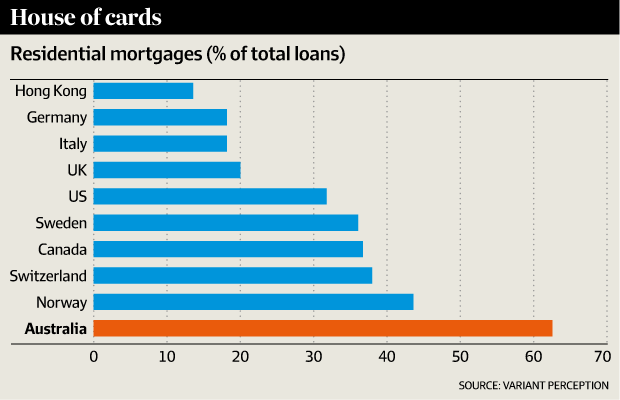
For those of you who think in pictures, Jonathan Tepper of Variant Perception did his own analysis of Australian real estate and provides some excellent graphical representations of the problem:

Residential Mortgages

Move on, nothing to see here. Remember, Australia is different. It’s the lucky country.

Or is it?

High prices in themselves are not a problem so long as they are relative to high incomes. An executive living in NY, earning $500,000 a year, and living in a $1m house is the same as an executive in Kansas, earning $100,000, and living in a $200,000 house.

But over in the “lucky country” incomes bear no sustainable relationship with asset prices:

Household Debt

For context. Back in the 80’s private sector debt to GDP was 20%. Today it’s a whopping 95% while total household debt (mortgages, credit card debt, consumer loans) clocks in at 123% of GDP – the highest in the world.

Debt to GDP

Mortgage debt is now 3.8 times GDP. This is only a problem if you think history repeats. If, on the other hand, you subscribe to the “we’re different because the weather is better here”theory then stop reading now because the rest will just have you hurling insults at me.

Let me remind you that Ireland and Japan had ratios of 3.5 times GDP at the very peak of their respective booms. Right before epic busts that “nobody” saw coming.

So how is this mother load of debt financed?

Interest Only Residential Loans

Nearly half of all mortgages in Australia are now interest only mortgages. Oy vey!

The only reason you’d pay interest only on a mortgage is if you were letting the property and receiving a positive yield or if you simply couldn’t afford to make principal payments. Since yields are strongly negative, we know borrowers can’t actually make principal payments.

The banks tell us they’re just fine but their loan books are so heavily biased towards residential real estate at a time when the manufacturing sector is being completely hollowed out. The way it’s supposed to work is that incomes drive asset values (not the other way around). None of this will end well.

Sustainable?

According to Fitch (and Winnie the Pooh), it’s perfectly fine. The next point made by Fitch…

“A free floating exchange rate, credible monetary policy, and low public debt.”

Let me tackle monetary policy first. Everywhere in the developed world it’s incredible.

incredible

?n?kr?d?b(?)l

adjective

1. impossible to believe.

As for a floating exchange rate: when I grew up there was a regulation that all kitchens by law had to have two exits. Most household fires begin in the kitchen and nobody wants to be trapped. You need an exit. And a free floating exchange rate is like the kitchen back door. It is the proverbial exit valve.

When investors see fire, they bolt out the “kitchen door” and the exchange rate is repriced.

It is true that public debt is relatively low, however private debt, as I’ve shown earlier, is outrageously high. The US mortgage crisis had little to do with public debt and it still rocked the world.

And then there’s this…

…growing recognition of the Australian dollar as a reserve currency allow the economy to adjust to changing economic conditions.

Where to start?

Adjusting to economic conditions?

Do they mean China, commodity prices, the emerging market slowdown, relative outperformance of the US economy, US interest rates tightening cycle, and the pending Aussie housing crash?

If so, they certainly have some adjustments to contend with.

And so despite what Fitch may have to say I’m short the Australian dollar and here are 5 reasons why:

  1. The USD bull market (as discussed here, here, and when explaining how the carry trade works), is not over yet. This is de facto negative for the Australian dollar.
  2. When the rest of the world is loosening monetary policy and the Fed are either not hiking or hiking the synthetic yield difference becomes self reinforcing.
  3. With $2 trillion in household debt, on the back of a $1.6 trillion GDP, the RBA will continue to slash rates. In so doing, the yield differential that the Australian dollar has been enjoying evaporates. Traders who have gotten used to playing the AUD/USD carry trade will have no incentive to do so, thus reversing capital flows.
  4. Everything that Australia makes, sans housing stock, is under pressure as China grapples with a domestic credit bubble and excess capacity.
  5. As I tweeted back in February, Australian banks are beginning to see an increase in loan impairment.

Commonwealth Bank

Banks are going to find that hiding the real story is going to become increasingly difficult. Maybe Fitch should take notice.

Westpac

I’ve seen Australian houses and believe me, they’re just as boring as houses elsewhere in the world. And despite what the fine folks at Fitch have to say on the matter, Australia is not A-OK.

While Australia has certainly been the lucky country: sporting good weather, littered with commodities, an educated workforce, and even Kylie Minogue, there are some major imbalances which need to be worked out. With an open capital market and floating exchange rate, a housing bust will only add extra juice to a currency which I believe will weaken regardless.

– Chris

“Think it over, think it under.” – A.A. Milne, Winnie-the-Pooh

============

Liked this article? Don’t miss our future articles and podcasts, and

get access to free subscriber-only content here.

============

via http://ift.tt/1UrULC2 Capitalist Exploits

Bank Of Japan Board Member Warns Of “2003 Shock” Historic Bond Market Collapse

In a somewhat shocking break from the age-old tradition of lying and obfuscation, Bank of Japan policy board member Takehiro Sato raised significant concerns about global financial stability in a speech last week. In addition to raising concerns about Japanese economic fragility, Sato warned that due to the impact of negative interest rates, he “detected a vulnerability similar to that seen before the so-called VaR (Value at Risk) shock in 2003.”

Financial institutions are facing the risk of a negative spread for marginal assets due to the extreme flattening of the yield curve and the drop in the yield on government bonds in short- to long-term zones into negative territory. When there is a negative spread, shrinking the balance sheet, rather than expanding it, would be a reasonable business decision. In the future, this may prompt an increasing number of financial institutions to take such actions as restraining loans to borrowers with potentially high credit costs and raising interest rates on loans to firms with poor access to finance.


…a weakening of the financial intermediary functioning could affect the financial system’s resilience against shocks in times of stress. In addition, an excessive drop in bond yields in the super-long-term zone could also make the financial system vulnerable by increasing the risk of a buildup of financial imbalances in the system.


There is also the risk that financial institutions that have problems in terms of profitability or fiscal soundness will make loans and investment without adequate risk  valuation. From financial institutions’ recent move to purchase super-long-term bonds in pursuit of tiny positive yield, I detect a vulnerability similar to that seen before the so-called VaR (Value at Risk) shock in 2003.

Simply put, as Bloomberg notes, Sato is concerned the government bond market is heading for an historic collapse after 10-year yields plunged below zero, forcing banks to pile into super-long-term bonds in pursuit of tiny positive yields. This is creating huge concentrated positions with increasing duration risk (as we detailed previously), causing a vulnerability “similar to that seen before the so-called VaR (Value at Risk) shock in 2003,” when an initial jump in yields triggered a spectacular sell-off by breaching banks’ models for estimating potential losses.


The ripples from such a move – as we saw in Germany last year – would be unstoppable given the size, concentration, and leverage of the JGB market.

Chart: Bloomberg

via http://ift.tt/24rOHPz Tyler Durden

Husbands Can “Lightly Beat” Their Wives If They Refuse Sex According To Islamic Council

Submitted by Mac Slavo via SHTFPlan.com,

Since millions of women in the United States support the unrestricted immigration of middle eastern “refugees” we thought it appropriate to give them a warning about the kind of mentality they can expect, because apparently the sexual assaults and rapes in Europe aren’t enough.

According to an Islamic Council made up of clerics and scholars, Pakistani husbands can now beat their wives if they refuse certain requests.

The head of a powerful Islamic council is refusing to back down from a proposal that make it legal for husbands to “lightly beat” their wives in Pakistan, despite ridicule and revulsion including calls that maybe the  clerics should stand for their own gentle smack down.


Speaking to reporters, the chairman of the Council of Islamic Ideology, Muhammad Kahn Sherani, said a “light beating” should be a last resort.


If you want her to mend her ways, you should first advise her. … If she refuses, stop talking to her … stop sharing a bed with her, and if things do not change, get a bit strict,” Sherani said, according to Pakistan’s Express-Tribune newspaper.


If all else fails, he added, “hit her with light things like handkerchief, a hat or a turban, but do not hit her on the face or private parts.”


Source: Washington Post

According to the report, there are a number of reasons for why a light beating might be in order:

A husband should be allowed to lightly beat his wife if she defies his commands and refuses to dress up as per his desires; turns down demand of intercourse without any religious excuse or does not take bath after intercourse or menstrual periods.

How can such an ideology ever assimilate to Western laws that protect everyone, including women, equally under the law?

via http://ift.tt/1Py0t9x Tyler Durden

Hillary Campaign Rocked By Shocking Secret Service Book Exposing Clintons’ Dirty Laundry

"Hillary Clinton is now poised to become the Democratic nominee for president of the United States, but she simply lacks the integrity and temperament to serve in the office. From the bottom of my soul I know this to be true. So I must speak out.


I had no animosity toward the Clintons. Out of a sense of loyalty to our First Family I even secretly disposed of sordid physical evidence that might later have been used to convict the president. The blue dress wasn't the only evidence of his misdeeds. But I could not keep from asking myself how our nation's leaders could be so reckless, so volatile, and so dangerous to themselves and to our nation. And yes, to me and my family.


I want you to hear my story. It's about the men and women risking their lives to protect this nation. And more important, it's about how the Clintons must never again be allowed to put them or you and your children—at risk."

     –  Gary Byrne, former secret service agent.


Hillary Clinton's campaign is scrambling as details emerge of a shocking "tell-all" book written by an ex-Secret Service agent, Gary Byrne, who protected the Clintons during the 1990s.

Gary Byrne says he was posted outside Bill Clinton's Oval Office in the 1990s and as Drudge Report reports, the secret project is causing deep concern inside of Clinton's campaign. Specific details of the agent's confessional are being held under tight embargo.

"What I saw in the 1990s sickend me," Byrne explains. "I want you to hear my story."

As The Daily Mail notes, his expose is causing deep concern in the White House, according to Drudge Report, and its release comes as Hillary comes within touching distance of securing the Democratic nomination.

Because I was there – in the spotlight, in the crosshairs — I realize better than most Americans that we have pretty much forgotten what an amateur-night, three-ring circus the Clinton White House was.

In the book, Byrne provides a firsthand account of the scandals – known and unknown – and daily trials ranging from the minor to national in scale.

"Having witnessed the personal and political dysfunction of the Clinton White House – so consumed by scandal and destroying their enemies, real and imagined – Byrne came to understand that, to the Clintons, governing was an afterthought.


He now tells this story – before voters go to the polls – in the hopes that Clinton supporters will understand the real Hillary Clinton.

The book titled Crisis of Character: A White House Secret Service Officer Discloses His Firsthand Experience with Hillary, Bill, and How They Operate is set to hit shelves on June 28. The Democratic convention, where Hillary could be confirmed as the nominee, will take place a month later.

"I have not written a word of this book with a political agenda.


Whether the Clintons were Democrats or Republicans, I saw what I saw; I heard what I heard.


Politics do not change unpleasant truths.


Politicians only think they do."

Many of the most shocking revelations are being withheld but below are some of the key exceprts released so far…

I witnessed firsthand the Clintons' personal and professional dysfunction: So consumed were they by scandal, so intent on destroying their real or imagined enemies, that governing became an afterthought. The First Couple wasted days obsessing over how to "kill" a forthcoming book (one alleging that Bill Clinton's mother ran a brothel) or in squashing yet another tabloid revelation. Their machinations and their constant damage control diverted them from the nation's real business. Good people like Leon Panetta, Betty Currie, and Evelyn Lieberman had to pick up the slack and bear it for as long as they could.


I saw how the Clinton Machine's appalling leadership style endangered law enforcement officers, the military, and the American people in general. And with Hillary Clinton's latest rise, I realize that her own leadership style—volcanic, impulsive, enabled by sycophants, and disdainful of the rules set for everyone else hasn't changed a bit.


Though portrayed as the long-suffering spouse of an unfaithful husband, whose infidelities I personally observed or knew to be true, the Hillary Clinton I saw was anything but a sympathetic victim. Those loyal to her kept coming back for her volcanic eruptions.


I had no animosity toward the Clintons. Out of a sense of loyalty to our First Family I even secretly disposed of sordid physical evidence that might later have been used to convict the president. The blue dress wasn't the only evidence of his misdeeds. But I could not keep from asking myself how our nation's leaders could be so reckless, so volatile, and so dangerous to themselves and to our nation.


And yes, to me and my family.


Only under federal subpoena—and later a ruling by U.S. Supreme Court Chief Justice William Rehnquist—did I reveal to Ken Starr's prosecutors the true story of President Bill Clinton's false testimony and misstatements.

And when Hillary gave Bill a black-eye…

One morning in late summer 1995, I entered the White House to assume my post just outside the Oval Office officially Secret Service Post E-6.


Things were stirring, and I wanted to know why.


Everyone on post that night, Secret Service agents (SAs), Secret Service Uniformed Division (UD) officers like myself, the houseman, and the ushers couldn't help but hear the First Couple arguing as sounds from their fracases traveled through the old building. Mrs. Clinton had a booming voice, and their yelling matches easily traversed the living quarters' private elevator, vents, and staircase. Many housemen eased away, but the SAs and UD couldn't leave their posts. This was especially a big argument that ended with a crash. SAs were obligated to respond and found its cause, a vase on the other side of the room. A houseman picked up the damage. The First Couple couldn't just sweep up and toss out the remains because everything in the White House is logged and recorded, befitting its role as a national landmark and a veritable museum.


I peeked into the curator's small, windowless ground-floor office across from the China Room and the Diplomatic Reception Room. It was cluttered with blueprints and history books on the every detail of the White House: fabrics, furniture, artifacts. Sure enough, there was a box containing a light blue vase smashed to bits. The rumors were true!


"Can I help you?"


The White House's official curator looked up from what she was reading, clearly annoyed and already tired of people checking out the box. "Can I help you, Officer?" she said again.


"No thanks," I said.


The president entered around nine. His arrival times fluctuated. I couldn't believe my eyes: a black eye! I was well accustomed to his allergy-prone, puffy eyes. But this was a shiner, a real, live, put-a-steak-on-it black eye. I was shocked. Minutes later, I popped into the office of Betty Currie, the president's personal secretary. Nancy Hernreich, his personal scheduler, was already there.


"What's the black mark on the president's face?" I asked.


I felt real tension.


"Oh, uh, he's allergic to coffee," said Nancy, turning toward her office.


"An allergy to coffee shows in just one eye?"


Betty smiled. She burrowed down into her work, chuckling, but looking busy. As I departed, I added, "I'm also allergic to the back of someone's hand."


I wanted to send a message. We knew what the mark was from, and it wasn't right. Surely the Clintons must realize how close we are to them, I thought, how deeply we feel about our responsibilities for their safety. Didn't they feel the same? It wasn't just that we protected them 24/7, but we were extremely loyal. We didn't do our job for the paychecks. Each man and woman protecting them had their reasons, but the Clintons were the focal point of every reason.


What might happen if she had sucker-punched him? Or if that vase had hit its target? If his head hit a countertop corner, my entire life's work would have been for nothing.


Sure, seeing a president's black eye is strange but standing at my post I couldn't escape the sinking feeling that this didn't make sense.


This wasn't how it was supposed to be. I loved my job and I believed in it, but I couldn't make sense of any of it.


It was a circus. Yet I never lost a sense of wonder and excite- ment. Even when the First Lady hollered and cursed and demanded firing thousands of people who protected her—and we spent more hours ensuring the Clintons' protection than we spent with our own families—I loved every minute of most every day. Law enforcement — protecting others — is my passion. Protecting a president is an incredible honor. I low, I kept asking myself, did a kid from Ridley, Pennsylvania, ever get to the White House? I wanted to stay for the rest of my life.


Reality destroyed my dream—in ways I never imagined.

Finally in a crushing afterword, Byrne exclaims…

Over a twenty-nine-year career serving my country in the military and in federal law enforcement, I've encountered both heroes and villains.


I've observed human character at its greatest heights and lowest depths. In any organization, character is defined at the top; it percolates down to the top executives of an organization, to the middle managers, and to the grunts at the front lines.


Hillary Clinton is now poised to become the Democratic nominee for president of the United States, but she simply lacks the integrity and temperament to serve in the office. From the bottom of my soul I know this to be true. So I must speak out.

Perhaps this sums up best what America would have to look forward to… "The Clintons treat running the free world like a damn part-time job."

via http://ift.tt/1Pdu4j9 Tyler Durden

When All Else Fails, Build A ‘Crowd-Funded’ Beer Pipeline

In a more lighthearted story for the weekend, De Halve Maan Brewery in Bruges, Belgium was faced with a problem: How to get beer from its brewery to a bottling plant 2 miles away without forcing large trucks to navigate the narrow and cobbled streets.

So the brewery did what any sensible operation would do when facing logistical issues – it crowdfunded money to help build a beer pipeline. Approximately €300,000 was raised in the effort (to be put toward the $4.5 million project), which broke out contribution into three tiers, all with their own reward for pitching in.

Gold Membership


Costs € 7,500, for which you get one 33cl bottle of Brugse Zot Blond every day for the rest of your life, as well as 18 personalized glasses. You’ll be invited as a VIP to the ground-breaking of the works, and the ceremony to inaugurate the pipeline.


Silver Membership


Costs € 800, and gets you one case of 24 bottles of Brugse Zot Blond a year for life, six glasses and an invitation to the inauguration.


Bronze Membership


Costs € 220 for one presentation bottle of 75cl of Brugse Zot Blond a year for life, one personalized glass and an invitation to the inauguration.

One of the 21 people who signed up for the Gold membership was Philippe Le Loup, who runs a restaurant on the Simon Stevin square, a few hundred yards from the pipeline. Loup's restaurant serves about 1,850 gallons of the brewery's Brugse Zot a year, would have also preferred a direct tap into the pipeline "it would have saved me a lot of keg-dragging" he said. Loup also bought a bronze membership for each of his 12 employees – "I calculated that if I pick up my free beers for 15 years, my investment will be paid back. When I'm 50, I will make a profit."

CEO Xavier Vanneste said "it all started as a joke, nobody believed it was going to work. This beer pipeline means that we'll be able to remain in the city." The pipeline is a now a reality and it will pump more than 1,500 gallons of beer an hour through pipe that runs about 6 feet underground, and even 100 feet under in some spots.

* * *

While it is not a project that will enable people to mine asteroids, it's certainly just as, if not more important – cheers!

via http://ift.tt/1Pduiqh Tyler Durden

“Rising” Rates Hit New Lows

Via Dana Lyon's Tumblr,

Despite ubiquitous calls and expectations for rising interest rates, yields on the long bond closed the week at a 52-week low.

It was probably over 10 years years ago when we first started getting calls from mutual fund wholesalers pushing their inverse bond funds. Their spiel was that, with interest rates at 40-year lows following a multi-decade rally in the bond market, rates had nowhere to go but up. To be honest, as contrarian as we like to think we are programmed to be, it didn’t seem like a reach to expect rates to soon begin to move higher. If forced to make a 10-year bet on the direction of interest rates at the time, you can be sure that bet would have been for higher rates. And it would have been a comfortable bet. The yield on the 30-year treasury bond back then was around 5%. Today, it is half that.

It is the comfort level that probably should have tipped us off that rates didn’t “have to” rise. That and the fact that it was the consensus thinking. Now, we might be slow, but we’re not the slowest. Thus, in recent years we’ve gone against the grain, remaining consistently in the “lower for longer” camp regarding interest rates, both short and long-term. Apparently, that is still “non-consensus”. That’s because, in light of one of the biggest Non-Farm Payroll misses in recent memory, the 30-year yield dropped Friday to 2.517%, a new weekly 52-week closing low. In the process, it also broke down below the Up trendline stemming from the January 2015 all-time lows.

image


The fresh break of that 16-month trendline (the lower bound of a 2-year symmetric triangle) suggests even lower yields to come as well. Although, zooming out a tad, we see that the close in the 2.50% vicinity may not necessarily clinch an easy immediate path for bond bulls. As this next chart shows, the 2.50% area served as major support for 30-year yields over the last 7-8 years. Rates bottomed in that vicinity during the 2008 financial crisis and the 2012 Eurozone crisis as well as in early 2015 and early 2016.

image


Now, we have often said that the more times a level is probed, the weaker it becomes as support or resistance. It is especially true when the length of time between touches gets shorter. Thus, we would not be surprised to see A) yields attempt to stabilize at the 2.50% level, but B) eventually break lower.

Now there are some ancillary factors that have recently begun to lessen our conviction of indefinitely lower rates and we hope to touch on those in the near future. Specifically, we are referring to long-term rates which are set by the marketplace, not Fed Funds which are established by the Federal Reserve. There is no telling what a limited collection of central bankers may decide to do – although, based on the chart of bank stocks (which were bludgeoned today), we recently cautioned against the growing consensus expectation for a June rate hike.

However, for now, as was the case 10 years ago – and 20 years ago – the trend in interest rates continues to be lower…”rising rates” crowd be damned.

*  *  *

More from Dana Lyons, JLFMI and My401kPro.

via http://ift.tt/1UrJsd2 Tyler Durden

Scotland Bans Fracking… Forever

Submitted by Zainab Calcuttawala via OilPrice.com,

The Scottish Parliament voted to ban fracking countrywide on Wednesday, making a moratorium on the controversial technique a permanent affair.

The narrow vote can after the legislative body temporary outlawed fracking in January 2015 while it conducted a public health impact assessment and consulted environmental experts.

The Scottish Greens, the Liberal Democrats, and the Labour Party joined together to hand a 32-29 defeat to the Conservatives, who vehemently opposed the permanent measure, The Guardian reported.

Legislators affiliated with the Scottish National Party chose to abstain from the vote, which prompted its fellow liberal parties to call on the group's leaders to clarify its position on fracking and its energy platform.

The Scottish National Party’s energy minister, Paul Wheelhouse, said he and his government remained “deeply skeptical” on the merits of fracking and confirmed that the practice would not be allowed in Scotland until there is clear evidence that it does not cause health-related or environmental harm.

Maurice Golden, a newly elected member of parliament for the Conservative party, argued in favor of fracking, and said the “leftwing cabal” of the three united liberal parties had been “ignoring” scientific evidence regarding the practice, which, if allowed, would add jobs and boost the economy.

The Scottish vote comes right after local leaders in the North Yorkshire region of the United Kingdom approved industrial tests that would allow fracking in the country for the first time in more than five years.

The Guardian reported that the go-ahead “swept aside” vocal protests from residents and environmentalists who feared “catastrophic seismic activity, health problems, and pollution” if hydraulic fracturing was introduced.

Two other high-profile applications to frack in the Lancashire area have been rejected by councilors since late-2011, but the companies have lodged appeals to reverse the decisions.

The UK remains one of the few European countries that has not banned fracking on a national level. Hydraulic fracturing has been seen by many as a means of decreasing the dependence on Russian natural gas deliveries. The contrary seemed to have taken place however as Gazprom’s CEO Alexei Miller said on June 1 that natural gas exports to the U.K. have increased by 91,5 percent to 3.85 billion cubic meters in the first five months of the year.

via http://ift.tt/1XuUMfs Tyler Durden

Dramatic Drone Footage Shows Syrian Army Advancing Toward Islamic State Capital

Starting about two weeks ago, a new campaign was launched to put the substantially weakened Islamic State on the defensive: in the south, Iraqi Security Forces (ISF), Popular Mobilization, and Sunni tribal fighters have closed in on a multiple-axis assault to encircle the city of Fallujah. As we reported previously, Iraqi forces, together with Kurdish Peshmerga forces, Shi’ite Muslim militias, and Sunni tribal fighters, backed by U.S.-led coalition forces, have pushed on toward Fallujah after recapturing several key cities in the past year, including Ramadi, Tikrit, and Baiji. Here, the advance has been problematic however as Aljazeera reported earlier today, fighters battling to retake Fallujah say they have secured its southern edge and have almost completely encircled the whole Iraqi city.

A leader of the Iran-backed Shia coalition taking part in the offensive said on Sunday the only side of Fallujah that remained to be secured by pro-Baghdad forces was part of the western bank of the Euphrates. “We are now at the gates of Fallujah,” Abu Mahdi al-Muhandis, deputy leader of the Popular Mobilisation Forces, told a news conference broadcast on state TV.  As reported previously, in a curious twist, it was in the Fallujah offensive that a familiar to Zero Hedge readers face has re-emerged, that of Iran’s notorious Qassem Soleimani, the head of the Iranian Revolutionary Guards Corps-Qods Force, the external operations wing of the Revolutionary Guards.

Indeed, as the ISW reports, Iranian-backed Iraqi Shi’a militias maintain a steady presence in northern Fallujah, where reports have surfaced of abuses against Sunni populations. Several local sources claim that Popular Mobilization fighters destroyed the Great Mosque in Garma while chanting sectarian slogans and vowing to kill residents. Sources claimed that militias prevented the Sunni Waqf head from entering Garma to organize Friday prayers, have looted homes and factories around Garma, and arrested civilians. A notable tribal sheikh in Garma claimed that Popular Mobilization militants kidnapped 73 men from Garma District and executed 17 of them on charges of belonging to ISIS. Prime Minister Haidar al-Abadi, however, criticized media outlets for distorting the truth and inciting sectarianism through false reporting on events in Fallujah.

Fallujah control map animated: May 23-31, 2016

And while the battle for Fallujah continues, a far more important battle is taking place in the northeast, where TV channel al-Mayadin reports that Syrian troops have crossed into Raqqa province for the first time in nearly two years and are nearing the ISIS capital of Raqqa, a city seized by the Islamic State in 2013 from rebels opposed to al-Assad.

According to BBC, heavy Russian air strikes have helped the offensive which was started by an alliance of Syrian Kurdish and Arab fighters in May. As Sputnik adds, the troops crossed the administrative border of the province, capturing the strategic town of Zakia, which is an important transportation hub in the region. Some units of the Syrian army moved by approximately 10 kilometers and are now advancing towards the city of Tabqa, which has a vital military airfield.

Earlier, it was reported that the Syrian Army launched a large-scale offensive on June 3 to liberate the city of Raqqa, the de-facto capital of the Daesh caliphate.
According to retired Syrian Major General Sabet Muhammad, the operation started in the town of Isriya, in Hama province, nearly 140 km to the west of Raqqa. “Preparations for the operation lasted many days. Several thousand troops were deployed to Isriya. The forces have several interim objectives, including the town of al-Thawrah, a military airfield as well as the town of Resafa. These positions will be used for an assault on Raqqa,” he said.

In February and March, the Syrian Army made an attempt to carry out an attack on Raqqa. After a series of clashes with militants the attack was suspended and the Syrian Army began their offensive on Palmyra.

Upon its liberation, a representative of the Syrian Kurdish Democratic Union Party (PYD) in Iraqi Kurdistan, Gharib Hassou, told RIA that Raqqa will become a part of the Federal Democratic System of Rojava and Northern Syria.

As we await the biggest battle of the ISIS war yet, that for the capital of the Islamic State, RT has unveiled recently released aerial footage showing the Syrian Army making gains into the Raqqa province as forces loyal to the President Bashar Assad continue their assault. The drone footage, released on Saturday, demonstrates the swift advance of Syrian government troops into Raqqa province.

The video shows army vehicles, including tanks and missile launchers, taking positions on Thursday after claiming victory over IS militants at the Zakiyah Crossroad, a strategic area at the border between Hama and Raqqa provinces. Syrian forces reportedly advanced over 35 kilometers (21.7 miles) towards Raqqa within two days, while driving the rebels before them, in an offensive backed by Russian air strikes.

Another video shows the Syrian army launching missiles at militant positions, as Syrian troops prepare to press their offensive forward.

Despite the rapid initial advance, strategists say that as the Syrian army approaches the ISIS capital, the battle for Raqqa will be fierce and protracted. And, courtesy of modern technology, we expect most of it to be televised in real time courtesy of drone footage such as that shown above, a feat that has now made CNN’s trademark war coverage obsolete.

via http://ift.tt/22HlEIz Tyler Durden