Chicago Officials Trying To Block $1 Million Tax Refund On Trump Building

Chicago Officials Trying To Block $1 Million Tax Refund On Trump Building

Authored by Isabel van Brugen via The Epoch Times,

Chicago officials are trying to block former President Donald Trump from receiving a $1 million tax refund that the Illinois Property Tax Appeal Board ruled is owed on his Chicago skyscraper’s 2011 tax bill.

The office of Cook County State’s Attorney Kimberly Foxx filed a lawsuit with the Illinois Appellate Court on July 9 disputing the refund, noting that the money would come out of the property taxes due to the city of Chicago, the Chicago Public Schools and several other government agencies.

The lawsuit comes after the board ruled in a 5-0 vote in June that the former president is owed a total tax refund of $1.03 million as the value of the Trump International Hotel & Tower had been overassessed.

The tax agency ruled that the “Cook County Board of Review overestimated the value of the building’s hotel rooms and retail space,” the Chicago Sun-Times reported.

The Epoch Times has reached out to the Trump Organization for comment.

The dispute over the tax bills on the high-rise building is the latest chapter in a long-running legal battle over Trump’s tax bills that started more than 12 years ago and has led to more than $14 million in tax breaks for the former president.

Originally, the state agency rejected Trump’s argument that the vacant stores had no value because he could not find any tenants to lease them. A hearing officer for the state agency rejected Trump’s argument that the vacant stores at the building had no value because he couldn’t lease them. But a staff member later wrote a report that Trump was entitled to the refund.

The agency delayed acting on the case until Trump was out of office and in June voted to reduce the assessment on the building’s commercial property.

This comes as the Department of Justice said that tax officials must hand over Trump’s tax returns to a congressional panel, after a lawyer in the department’s Office of Legal Counsel on July 31 reversed a 2019 decision that said they didn’t have to be given to Rep. Richard Neal (D-Mass.), chairman of the House Ways and Means Committee, because Neal was “disingenuous” about the true purpose of seeking the returns.

After Trump was elected in 2016, a number of Democrats have attempted to obtain his tax returns. The former president has refused to release them to the public.

Tyler Durden
Mon, 08/02/2021 – 18:20

via ZeroHedge News https://ift.tt/3fnSb4T Tyler Durden

Delta Wave Has Likely Peaked In UK, Europe, Goldman Analysts Say

Delta Wave Has Likely Peaked In UK, Europe, Goldman Analysts Say

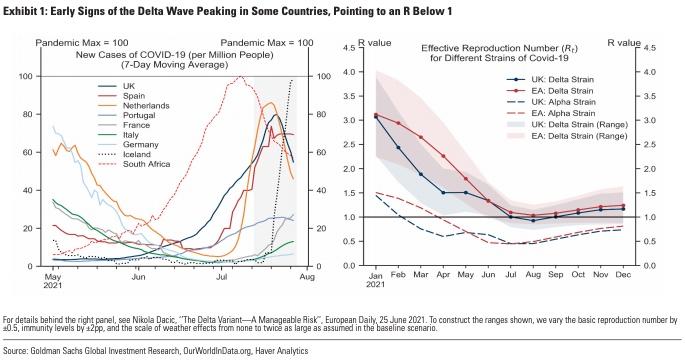
As we have reported, a team of Goldman analysts has been closely monitoring the most recent delta-variant-driven surge in COVID cases in Europe (the trajectory of the outbreak will have an important impact on bank’s economic projections, particularly for the eurozone). In working out its projections, the team was among the first on Wall Street to adopt the view that delta would have a minimal impact on the growth outlook for developed nations with high vaccination rates (though Goldman of course is not alone).
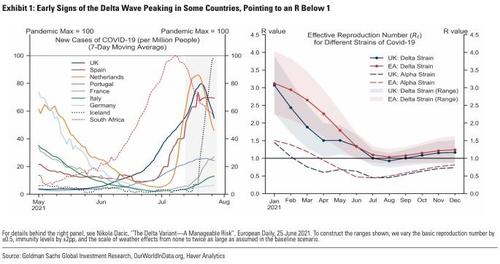
In its latest note, the Goldman team “stress-tested” its projections for the European economy (and by extension, the waning delta-driven wane) in Q&A format via a note to clients. The first example is also the most relevant: the team evaluates the evidence suggesting delta has “peaked” in Europe and the UK. The biggest risk factor according to the Goldman team is that the UK and Europe likely won’t reach the higher herd immunity threshold (between 80% and 85% vs. 70% in pre-delta times) needed to protect against delta. That could allow the virus’s reproduction rate to climb back above “1” later in the year (the demarcation point between spreading and slowing).

However “continued testing, some limits on mass events, and behavioural factors (e.g., voluntary mask wearing) could still lower R and help to contain rapid outbreaks,” the team wrote.
Here’s the rest of the Q&A courtesy of Goldman:

Q2. Has mass vaccination been a key factor in keeping hospitalisations relatively low in Europe?

A: Yes.

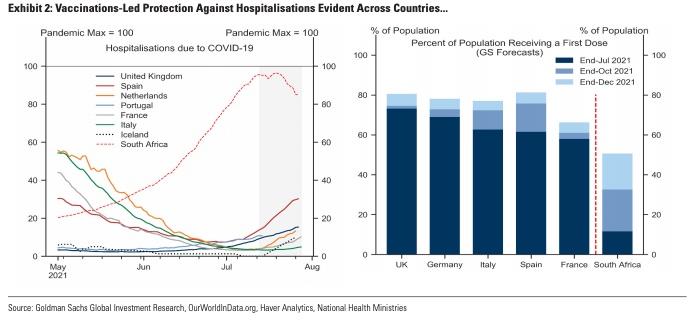
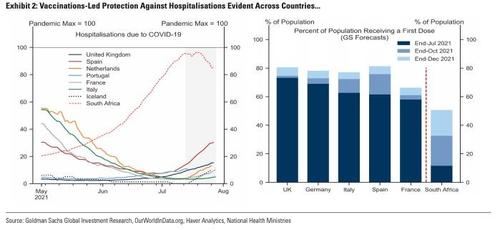
One of the most striking and consistent patterns in Europe over recent weeks has been the disproportionately low level of hospital admissions relative to new cases (Exhibit 2, left). Although hospitalisations have risen somewhat over recent weeks, the ratio of hospitalisations-to-infections has remained stable at record low levels. The available evidence overwhelmingly suggests a key role for vaccinations in explaining these dynamics. Across countries, this divergence is most pronounced across developed and emerging economies, with hospitalisations rising sharply in a number of low-vaccination emerging economies (including South Africa), as our Global Team has shown. By contrast, the relatively similar experience across European countries is consistent with comparably high levels of population that have been vaccinated (Exhibit 2, right).
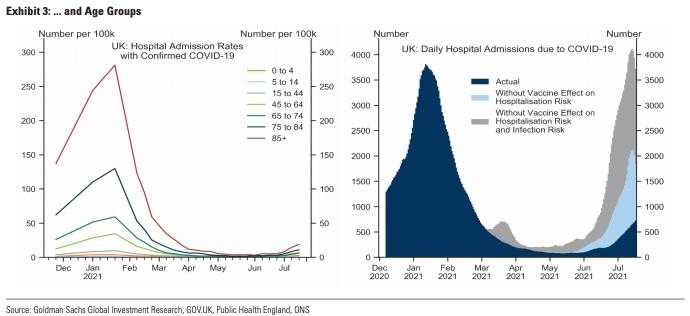
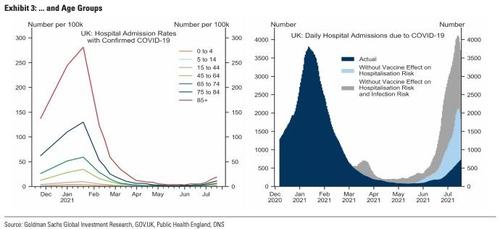
Within Europe, there is clear evidence of an effect of vaccinations on hospitalisation risk. For example, UK data shows a sharp reduction in rates of hospitalisations across age groups, with particularly large and frontloaded reductions for older age groups consistent with (i) higher pre-vaccine hospitalisation rates for these groups, and (ii) the prioritisation of older groups in the initial distribution of vaccines (Exhibit 3, left). Importantly, vaccines have had a twofold effect on observed hospitalisations: first, by lowering infection risk, and second, by lowering hospitalisation risk conditional on an infection (especially for the elderly). We can parse out the relative importance of these two effects by (i) taking as given the observed new infections across age groups, but assuming pre-vaccine hospitalisation probabilities across age groups, and (ii) allowing cases to evolve without the dampening effect of vaccines on infection risk. We implement (i) by using hospitalisation probabilities from late November last year, and (ii) by assuming the ratio of new cases for all age groups other than 0-14 years of age evolves in constant pre-vaccine proportions to new cases among the youngest (which have had the lowest vaccination rate). Our results suggest that overall hospitalisations would have already exceeded the January peak—when nearly 90% hospital beds in England were reportedly full—without the benefit from vaccinations in terms of lower infection and hospitalisation risks (Exhibit 3, right).
In Iceland, where over 85% of the 16+ population have received full doses—one of the highest shares globally—hospitalisations have only risen to around 10% of the historical peak, even though new cases have already reached an all-time peak after all restrictions on social contact were lifted at end-June. This pattern is also consistent with higher protection against hospitalisation than symptomatic infection, especially for non-mRNA vaccines (which have an overall share of around 43% in Iceland)—see ‘Efficacy of Vaccines Against Variants’ in our Tracker

Q3. Has there been a behavioural response from consumers to rising delta-variant cases?

A: Possibly some, but it appears modest so far.

Although hospitalisations have remained disproportionately low relative to cases, it appears likely that the renewed outbreaks may have prompted consumers to voluntarily adjust their behaviour to reduce exposure to a potential infection. Such adjustments could come with economic costs, for instance if consumers reduce their spending on consumer-facing service activities (such as retail or hospitality). To analyse the potential magnitude of these effects, we consider two approaches and focus on the UK where the ongoing delta wave has been most advanced in Europe.

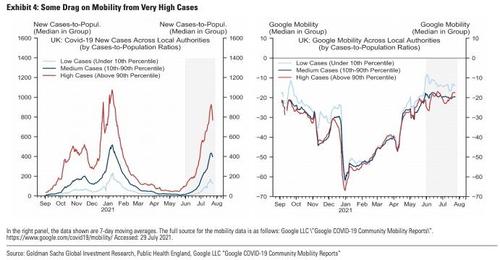
First, we make use of regional data on new infections and Google retail, transit, and workplace mobility for 152 local/regional authorities in the UK. We classify authorities on each date into three categories—’low’, ‘medium’, and ‘high’—based on new infections relative to local population size. Exhibit 4 (left) shows the median cases-to-population ratio for each category. We find that regions with lower case growth have typically seen higher mobility, although these differences were negligible during the spring nationwide lockdown (Exhibit 4, right).3 Over recent weeks, mobility has remained at higher levels in areas with lower cases, although the recent plateauing appears broad-based across all regions.
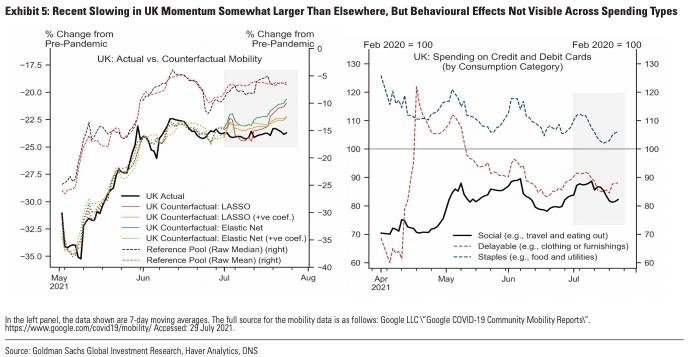
Second, to uncover whether the recent stagnation in some high-frequency UK metrics (including mobility) is UK-specific, we consider a set of 18 European countries which have not seen a significant increase in new cases since May—at least not large enough to potentially trigger a behavioural response—as a ‘counterfactual reference pool’ for the UK.4 We then use statistical methods to match UK’s actual mobility data using that from these countries between 1 May and 1 July (at which point the UK’s outbreak became more severe).5 Using the estimated coefficients, we then construct a counterfactual path for UK mobility after 1 July based on the mobility dynamics in the ‘low-delta’ reference pool, where the pace of mobility increases has also slowed in recent weeks. Our results nonetheless point to a moderate degree of UK underperformance relative to the counterfactual, suggesting scope for some behavioural effects (Exhibit 5, left).6 This appears consistent with the material downside surprise in the UK flash composite PMI for July.
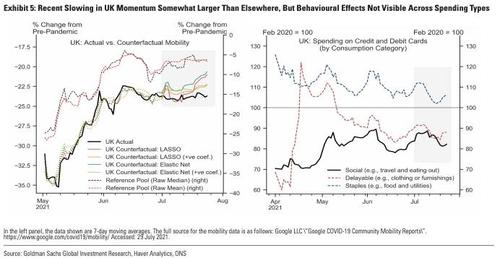
We also look at high-frequency data on credit and debit card spending in the UK, which does not seem to indicate significant behavioural effects due to rising cases, as the recovery in household spending on ‘low-risk’ categories (such as staples) and ‘high-risk’ social categories (such as restaurants) has stagnated in tandem over recent weeks, albeit at different levels (Exhibit 5, right).

Overall, while we do find evidence of some UK underperformance relative to ‘low-infections’ countries since early July, the recent flattening of mobility data even in areas of the UK with low cases and for ‘low-contact’ types of spending suggests other possible reasons—such as a moderation in sentiment following an initial overshoot— may also be contributing to the recent slowing in UK high-frequency data. We expect this slowing to reverse given the further easing of restrictions since 19 July and now-moderating case growth.

Q4. Has the spread of the delta variant contributed to labour shortages?

A: Not in the Euro area (yet), and yes in the UK according to anecdotal evidence, but macroeconomic effects likely small and largely transient so far

A large number of anecdotal reports from the UK over recent weeks have suggested significant labour shortages as a result of those infected or their close contacts being asked to self-isolate. Recent reports showed that around 520k people were ‘pinged’ by the NHS Test and Trace App in the week ending 18 July.7 Relatedly, the British Retail Consortium has reportedly warned that around 20% of shop workers have had to isolate. This was echoed in the weaker-than-expected flash PMIs for July, where ‘’shortages of labour availability were made worse as many staff self-isolated’

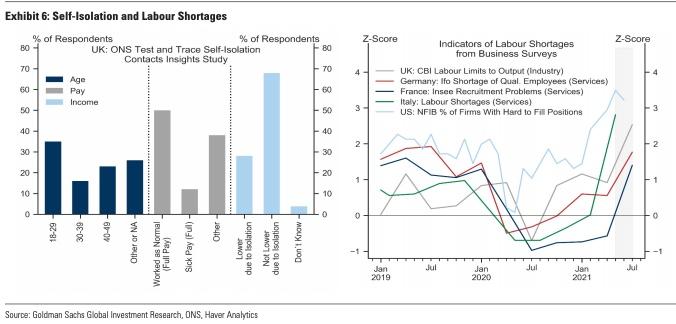
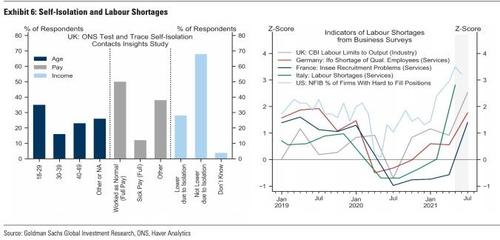
How significant are these effects for the macroeconomy? First, data from the UK suggests that the majority of those in self-isolation were under the age of 40 (with 35% aged 18-29), consistent with the skew in infections towards younger age groups (Exhibit 6, left). ONS survey data suggests less than 30% of those asked to self-isolate have reported some loss of income, and 50% of those employed pre-isolation still continued to work as normal. On one hand, the combination of (i) infections and self-isolations skewed toward younger age groups which have lower employment rates, (ii) continued fiscal support (e.g., via furlough/short-time work schemes), (iii) higher teleworkability than pre-pandemic, and (iv) plans to end self-isolation for double-vaccinated workers from mid-August, suggests the impact of widespread new infections and the ensuing rise in absenteeism from work may be smaller than headline figures could suggest (e.g., 520k people in self-isolation vs. 1.5m on furlough). On the other hand, the planned phase-out of fiscal support (e.g., furlough in the UK) and scope for continued upward pressure on cases could continue to disrupt labour supply and hamper the normalisation of activity.

The latest data from business surveys does suggest an increasing degree of labour shortages from previous quarters, but the cross-country data does not point to a clear difference between countries with higher cases (e.g., the UK and France) and those with lower cases (e.g., Germany and Italy) (Exhibit 6, right). With activity levels well-below normal (especially in services) and a large number of workers still under furlough/short-time work schemes, rising labour shortages could be a concern.8 While we do expect some upward pressure on unemployment rates in the UK and Euro area over coming quarters, we think the labour market consequences of the delta variant are likely to be largely transient, although some sectors (e.g., hospitality) could still be somewhat more affected temporarily.
Q5. Has the delta variant increased the risk of renewed restrictions over coming months?

A: Not significantly, and we think it poses a manageable risk overall.

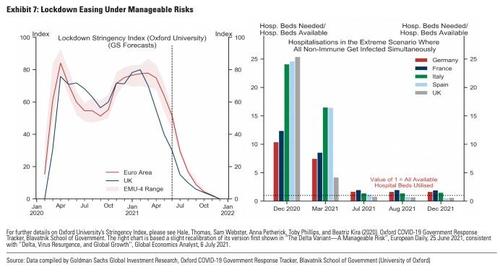
We continue to expect a gradual relaxation of the remaining containment measures by year-end, with Euro area governments in aggregate proceeding with some delay relative to the UK (Exhibit 7, left). We think the risk of renewed restrictions will ultimately depend on:

1. Cases: As we had argued above, we do see a risk of infections rising again in coming months, both in the UK and Euro area. That said, our analysis above points to limited evidence of significant persistent effects on consumer behaviour or labour availability from infections reaching levels we have seen in Europe over recent weeks. These effects could become larger if infections were to rise to much higher levels, in which case we would see scope for some targeted measures to be reimposed (e.g., limits on public gatherings or mass events, mask-wearing, or international travel), likely entailing only a modest economic cost.

2. Hospitalisations and/or fatalities: Our analysis suggests that even in a very severe and very unlikely scenario where each non-immune person was to become simultaneously infected, the pressure on hospitals would only modestly exceed available capacity.9 Modelled scenarios by the UK’s SAGE Institute also project hospitalisation outcomes that are well below (or no worse) than those from the winter wave, including in severe downside scenarios. We therefore think the risk of hospital overflow or elevated fatalities from here on is vastly lower than at any point since February 2020.

3. New variants: The potential emergence of new variants could take two forms. First, if a new highly-transmissive variant against which existing vaccines are nonetheless highly effective was to appear, its spread across Europe could cause some further delay to the recovery (depending on overall immunity levels at the point of its arrival). Second, if a new sufficiently-transmissive variant that is vaccine-resistant was to emerge, that could derail the recovery and remains the most severe downside risk in our view.
Ultimately, on our baseline, we think neither the potential upward pressure on cases nor a much more moderate increase in hospitalisations by year-end are likely to trigger economically meaningful renewed restrictions while more targeted, less economically-costly measures (such as those in the Netherlands or Iceland recently) are possible. Continued vaccine efficacy against all strains is a crucial element of our assessment.

Tyler Durden
Mon, 08/02/2021 – 18:00

via ZeroHedge News https://ift.tt/37mTNXT Tyler Durden

Olympic Committee Looking Into Gesture American Made On Podium

Olympic Committee Looking Into Gesture American Made On Podium

Authored by Zachary Stieber via The Epoch Times,

The International Olympic Committee is reviewing a gesture a Team USA silver medalist made on the podium, which could violate rules the panel announced in April.

Raven Saunders made an “x” above her head on Sunday in Tokyo while on the podium after winning the silver medal in shot put.

Saunders told The Associated Press that she made the symbol because “it’s the intersection of where all people who are oppressed meet.”

“I really think my generation really don’t care,” Saunders added.

“Shout out to all my black people, shout out to all my LBGTQ community, shout out to everybody dealing with mental health. Because at the end of the day, we understand that it’s bigger than us, and it’s bigger than the powers that be.”

The International Olympic Committee said before the Olympics that athletes who protested by making gestures on the podium would face punitive measures.

Violations would be examined on a case-by-case basis, officials said at the time.

Mark Adams, a spokesperson for the committee, told a press conference on Monday that “we are looking into the matter and will now consider our next steps.”

Athletes are free to express themselves during press conferences, on social media, and in other venues. But Adams noted that most athletes, in a survey of thousands of them, said they did not want protests during competitions or on podiums.

The U.S. Olympic and Paralympic Committee told news outlets that Saunders’s gesture “was respectful of her competitors and did not violate our rules related to demonstration.”

Saunders took to Twitter to write, “Let them try and take this medal,” adding, “I’m running across the border even though I can’t swim.”

She added a laughing emoji.

Saunders, 25, of South Carolina, lost to China’s Lijiao Gong. New Zealand’s Valerie Adams took bronze.

“I’m really proud to win this competition for my country and not only for myself but also for all the people in China who supported me,” Gong told reporters.

Tyler Durden
Mon, 08/02/2021 – 17:40

via ZeroHedge News https://ift.tt/3lq2x82 Tyler Durden

Drought, Frost Plunge Brazil’s Second Corn Yields To Decade Low

Drought, Frost Plunge Brazil’s Second Corn Yields To Decade Low

An agriculture nightmare plays out in Brazil as drought and frost cause second corn yields in the country’s center-south to hit their lowest level in 10 years. Crop losses due to unfavorable weather may result in shortages and persistent food inflation due to Brazil is a top player in global corn production. 

Reuters, citing a new report via agribusiness consultancy AgRural, said drought then frosts destroyed much of the crop this year. Brazilian farmers expect to harvest around 51.6 million tons of corn, down 19 million from last season’s 70.5 million. 

Brazil’s heavily exported second corn crop, planted after soybeans are harvested, is the country’s top corn crop and accounts for about three-fourths of production in a given year. Brazil, the number three producer in the world, competes with the US in Asian markets. 

“Failure of the 2021 corn crop, planted with much delay due to the later soybean harvest, was the result of the lack of rain in most of the producing areas in April and May,” AgRural said. “The frost starting at the end of June and lasting until now reduced yields and also caused quality problems.”

Corn prices may remain elevated due to the prospects of a dismal second corn yield in Brazil, along with drought concerns in the US corn belt

Besides corn – citrus trees, coffee, and sugar cane in Brazil have also been heavily impacted by adverse weather conditions. 

Due to unfavorable weather conditions worldwide, wreaking havoc on farmlands, the likelihood of food inflation abating anytime soon is unlikely. 

Tyler Durden
Mon, 08/02/2021 – 17:20

via ZeroHedge News https://ift.tt/2VtabDO Tyler Durden

Turley: The Biden Administration Goes To War With The “Non-Vacs”

Turley: The Biden Administration Goes To War With The “Non-Vacs”

Authored by Jonathan Turley via jonathanturley.org (emphasis ours),

Below is my column in the Hill on the shift from reasoned consent to coerced consent in the campaign for vaccinations. The push by the Biden Administration for private companies to enforce mandates and restrictions has increased in the last week. There is a high likelihood of a new round of litigation as pressure builds for new mandates and even lockdowns.

Just before this column ran, CDC Director Rochelle Walensky was asked by Fox host Bret Baier “Are you for mandating a vaccine on a federal level?” She responded “That’s something that I think the administration is looking into.” Later she reversed herself by saying “I was referring to mandates by private institutions and portions of the federal government. There will be no federal mandate.” It was a telling response because she was asked about a federal mandate directly. She now says she meant to say a privately enforced mandates is what they are thinking about. The reversal may be a problematic as the original. It would confirm that the Biden Administration is using private companies as a type of direct surrogate for a public mandate.
Here is the column:

They didn’t get vaccinated.” Those words from President Biden summed up why his administration made a critical shift in its COVID policies, from mask recommendations to mandatory shots for federal workers. And that represents a third stage of government policy, toward a more confrontational approach to “them” — the increasingly demonized unvaccinated class that is roughly half of America.

But this stage could face legal challenges in coming weeks, as citizens and some states push back on mandates.

This month was a clear break from persuasion and a step toward coercion in dealing with those who refuse to be vaccinated. Even the normally staid Centers for Disease Control and Prevention (CDC) is ramping up its rhetoric, declaring that the “war has changed” due to the Delta variant. For some, however, there is concern that Biden’s “they” is a declaration of war on them.

Clearly, there is a rapidly diminishing level of communication between the “vacs” and “non-vacs.”

Stage One: Reasoned consent

Until recently, the Biden administration relied largely on what could be called the “reasoned consent” model. Not unreasonably, it assumed that Americans would want the vaccine, given the dire consequences of being unvaccinated. For many of us, it took little persuasion. My family and I took the earliest possible date for vaccinations. But this first stage was in some regards a failure: While more than 85 percent of the high-risk population of older Americans have been vaccinated, roughly half of the wider population has not been fully vaccinated.

A myriad of reasons exist: distrust of government programs among some minorities and conservatives; people who previously had COVID-19 considering themselves immune; those concerned with religious or medical issues. Billions spent on state and federal outreach programs failed to penetrate that wall of resistance.

Stage Two: Induced consent

As long lines disappeared at vaccine centers, it became clear that many citizens have come to distrust the media and the government on this, as on so many issues. Anyone raising questions about the virus — even its origins — was censored by Big Tech, and politicians weaponized the wedge issue for their own purposes. Such censorship continued this week even for those merely suggesting a “pause” to examine the data. For people already distrustful of the government, the censorship and overheated rhetoric only confirm their suspicions.

Government officials then shifted from reasoned to induced or compensated consent. In Ohio, $1 million lottery prizes were offered to those willing to take the shots; other states offered free metro or free museum passes. It didn’t work — but that didn’t stop President Biden this week from telling states to use federal funds to offer $100 for every person who consents to take a shot. It is the monetization of vaccination under the logic that those not motivated by self-preservation will be persuaded by a C-note.
The government and the media, however, remain unwilling to engage vaccine resisters beyond stereotyping them as “Trumpers” or pandemic-spreading morons. That includes censoring questions and opposing discussion of whether the level of statistical risk should leave this to be a matter of individual choice, as with other viruses and illnesses.

Stage Three: Coerced consent

We are now entering the “coerced consent” stage. Unable to persuade or purchase consent, many are arguing to make it difficult to be gainfully employed or functionally active without proof of vaccination. It is a type of de facto pandemic passport. After indicating the administration was considering a federal vaccine mandate, CDC Director Dr. Rochelle Walensky said this week, “I was referring to mandates by private institutions and portions of the federal government. There will be no federal mandate.”
Unwilling to face the legal or political challenges of mandating a vaccination program, the Biden administration has actively encouraged companies to bar unvaccinated people from planes, restaurants and other venues. The danger is that using companies to censor opposing views and restrict people can amount to a type of government-by-surrogate, a shadow state.

There clearly are good reasons why many companies and schools demand vaccinations to rejoin workplaces or classrooms. As expected, those rules have been upheld, including a recent favorable ruling for Indiana University.

More concerning are those calls to use mandates to make life miserable for anyone who still has doubts. German Chancellor Angela Merkel told her citizens that they will have fewer “freedoms” until they consent. Some in the media have echoed these calls, and some private organizations are following the same strategy. The NFL, for example, has been openly making life “a living hell” for NFL players who prefer to be tested but not vaccinated.
For the most part, the motivation behind government and private mandates are hard to litigate. Courts tend to defer to measures ostensibly protecting others from risk of illness; even in criminal cases, the government has been allowed to conduct “pretextual traffic stops” if it can cite an objective basis.

There may be new legal challenges ahead, however. First, those with religious or medical concerns can challenge mandated vaccination programs. CNN’s Don Lemon this week called for barring unvaccinated people from offices and businesses, insisting “It has nothing to do with liberty. You don’t have the freedom and the liberty to put other people in jeopardy.” In truth, there are constitutional questions when you force people to take medications or vaccinations that violate their religious beliefs or that fail to satisfy a rational basis.

States also are moving to counter private mandates or to bar mandatory masking rules; Florida Gov. Ron DeSantis (R) just signed an executive order allowing parents to ignore masking orders for their children in the state’s public schools. That could force the hand of the Biden administration on implementing federal mandates or executive orders — a conflict that would raise core federalism issues.

The federal government is on shaky ground in mandating hood behavior or inactivity. In 2012 in NFIB v. Sebelius, Chief Justice John Roberts declared that “Construing the Commerce Clause to permit Congress to regulate individuals precisely because they are doing nothing would open a new and potentially vast domain to congressional authority.”

The greatest danger with the coercion model is that it will further deepen our divisions and turn vaccine resistance into a type of patriotic resistance for some people. Recently, a shocking poll found that almost 50 percent of Republicans believe “patriotic Americans [might] have to take the law into their own hands.” The poll shows how many Americans are increasingly alienated from the government, the media and the established order. Conversely, some commentators on the left have declared that the unvaccinated are terrorists using “biological warfare” against the nation.

Threatening to make the lives of the unvaccinated a “living hell,” or isolating them from society, likely will do little to increase the level of vaccination — but it will do much to increase the level of alienation in our society.

Jonathan Turley is the Shapiro Professor of Public Interest Law at George Washington University. You can find his updates on Twitter @JonathanTurley.

Tyler Durden
Mon, 08/02/2021 – 17:00

via ZeroHedge News https://ift.tt/3ykCClD Tyler Durden

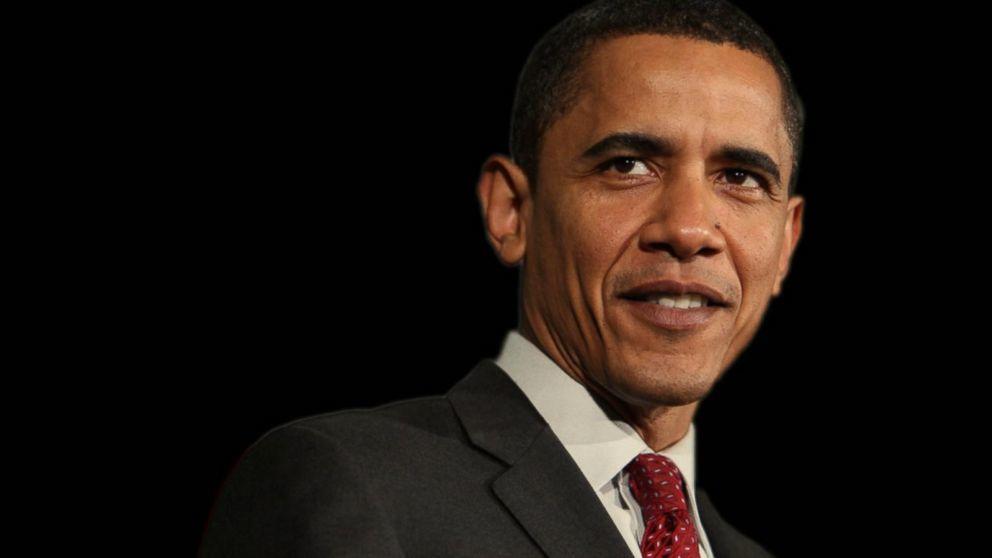
Obama Risks Superspreader Event As 700 Expected To Attend 60th Birthday Party At Martha’s Vineyard Mansion

Obama Risks Superspreader Event As 700 Expected To Attend 60th Birthday Party At Martha’s Vineyard Mansion

Less than two weeks go, the Daily Mail reported on Australian socialite Anthony Hess, who ‘unknowingly spread the Delta strain of coronavirus to at least 60 people in a single weekend’ despite being fully vaccinated.

And days ago, the Washington Post cited a CDC report which found that 75% of people infected during a Massachusetts COVID-19 outbreak associated with summer events and large public gatherings were fully vaccinated.

Now – as Democrat-run cities and states go back into quasi-lockdowns – former President Barack Obama has come under fire for forging ahead with his celeb-packed 60th birthday bash in Martha’s Vineyard despite official warnings against large gatherings during the pandemic.

The party will be held outside the Obamas’ 7,000-square-foot home in Edgarton he and former first lady Michelle bought in 2019 for nearly $12 million (pictured)

“If you’re talking about a small party like I might have at my house for six or eight people who are all fully vaccinated, I do not believe, at this point, we need to put masks on to be next to each other” said NIH Director Francis Collins on Sunday, adding “But if there were 100 people, and, of course, how are you really going to be sure about people’s vaccination status?”

The CDC, meanwhile, advises people who want to have large gatherings to instead do so virtually.

The event is expected to include 475 invited guests, served by at least 200 staff at his 30-acre, $12 million waterfront property he and wife Michelle bought in 2019, according to Axios, which adds that guests will need to be tested and vaccinated, and that the party will be held outdoors.

There will also be a “COVID coordinator’ employed by the Obamas to ensure that proper protocols are being followed, however it’s unclear how they will verify proof of a negative COVID test or a vaccine, or whether guests will be required to wear masks.

The New York Times reports that the community, at the tip of Cape Cod, was crowded with over 60,000 people, many of whom were maskless, during the holiday.

Officials did not worry about it, however, as the community had one of the highest vaccination rates in the state.

But since then, scientists have traced 965 cases to the gatherings, 238 of them involving Provincetown residents. -Daily Mail

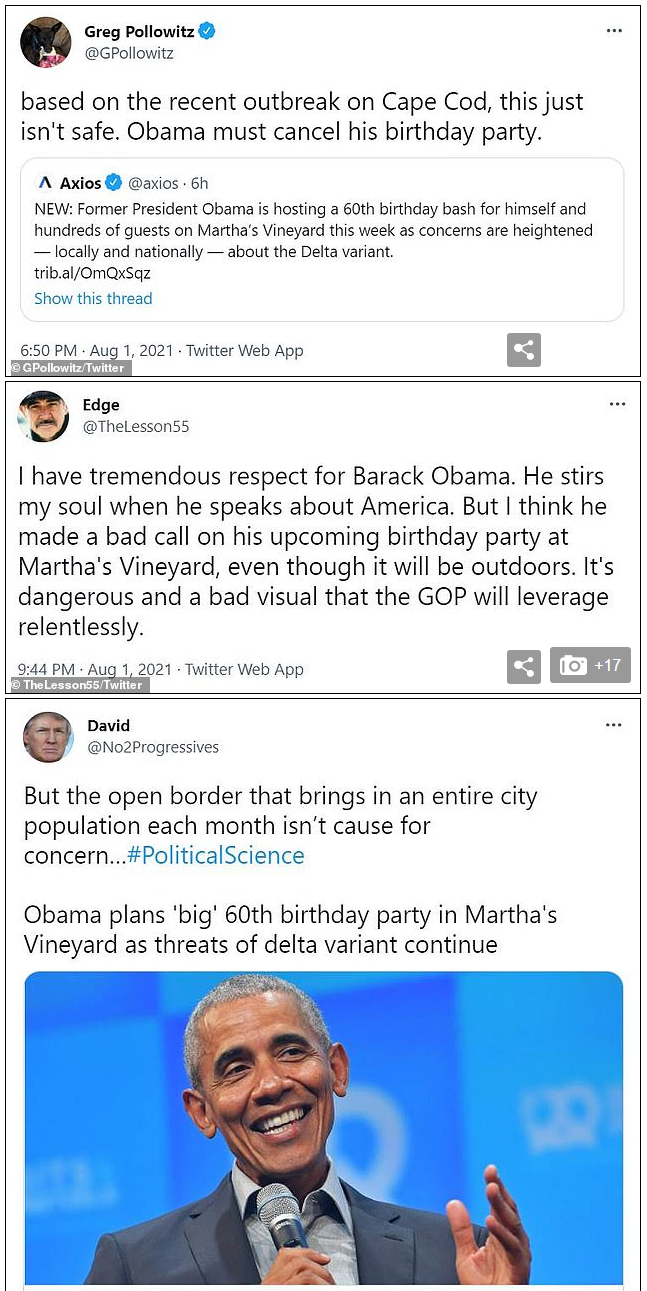
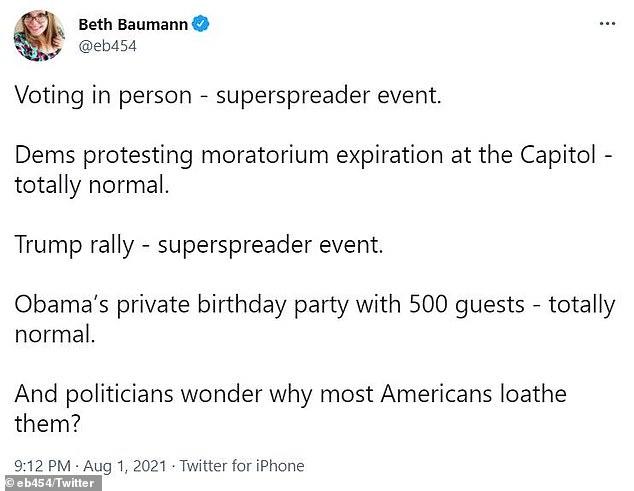
As the Mail notes, twitter users immediately picked up on Obama’s ‘bad example.’

Pearl Jam will perform at the event, while a family spokesperson told The Sun that the guest list “includes a number of family members and friends to mark the occasion,” while The Hill reports that Oprah Winfrey, George Clooney and Stephen Spielberg are slated to attend.

President Joe Biden, meanwhile, will not be in attendance.

Tyler Durden
Mon, 08/02/2021 – 16:40

via ZeroHedge News https://ift.tt/3CaMalR Tyler Durden

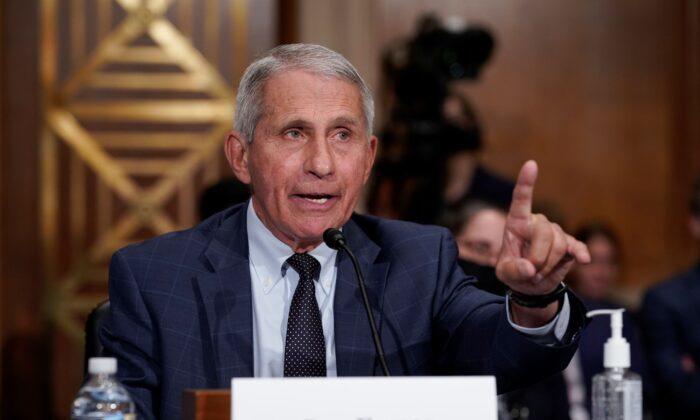
Fauci, HHS “Hiding Something” With Redacted Emails: Sen. Johnson

Fauci, HHS “Hiding Something” With Redacted Emails: Sen. Johnson

Authored by Isabel Van Brugen via The Epoch Times,

Sen. Ron Johnson (R-Wis.) on Sunday suggested that the Department of Health and Human Services (HHS) and infectious disease expert Dr. Anthony Fauci are “hiding something” from Americans by redacting key information in correspondence that the public “deserves to have.”

“The redactions in Dr. Fauci’s emails are hiding something. They need to be transparent. This is information the American public deserves to have,” Johnson said in a statement on Twitter.

Johnson is one of five Republican senators demanding answers from the HHS after it redacted parts of an email between National Institute of Allergy and Infectious Diseases (NIAID) chief Fauci and U.S. researcher Peter Daszak, president of the nonprofit EcoHealth Alliance.

EcoHealth Alliance has worked directly with China’s Wuhan laboratories to research coronaviruses. The group has sent federal funds to support gain-of-function research at China’s Wuhan Institute of Virology (WIV) where there have since been reports of potentially the first COVID-19 cases detected in late 2019.

Daszak’s organization in the past had received $3.7 million in funding from NIAID, at least $600,000 of which was sent to the WIV.

Troves of internal emails detailing the findings were obtained by nonprofits and news organizations through Freedom of Information Act (FOIA) requests. A portion of an email was redacted using an exemption reserved for information related to “pending law enforcement proceedings.”

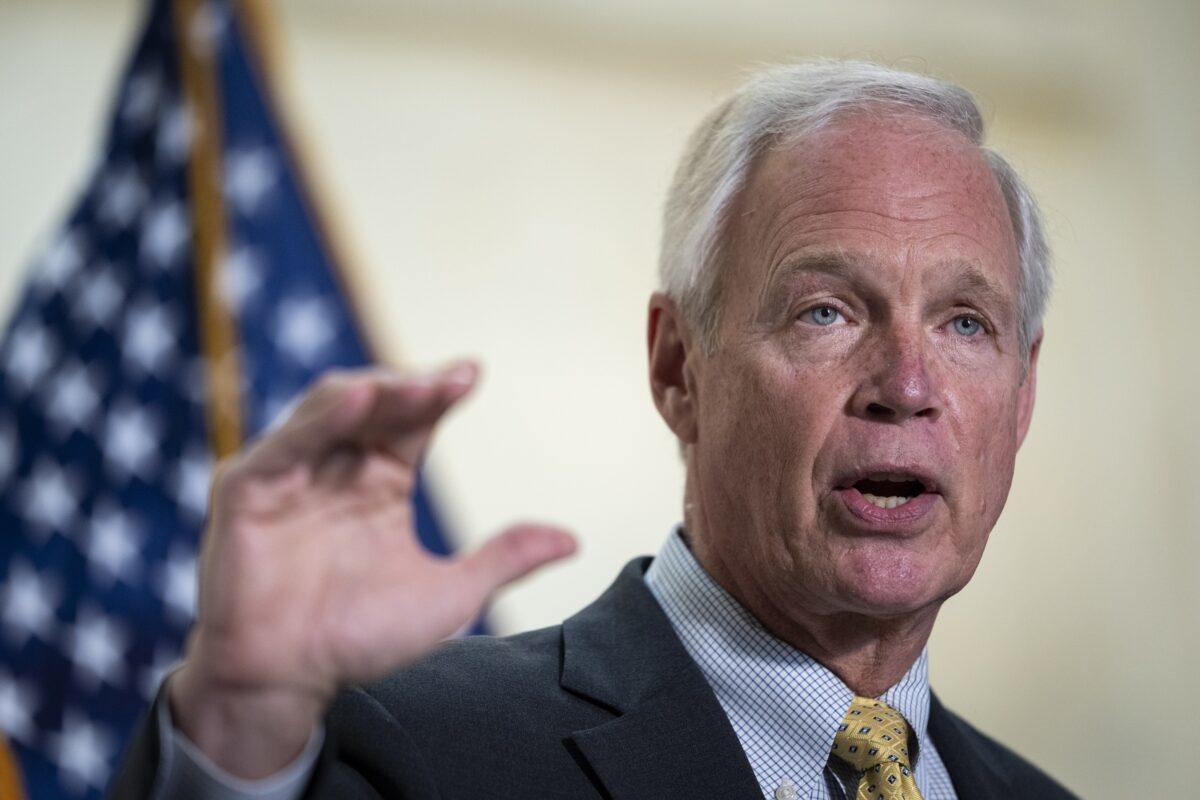
Sen. Ron Johnson (R-Wis.) speaks on Capitol Hill in Washington on May 26, 2021. (Drew Angerer/Getty Images)

“I really want the emails of Dr. Fauci,” Johnson said during an appearance on Fox News’ “The Ingraham Angle,” noting that the emails were “heavily redacted.”

“So we sent a letter with five members of my committee, that if five members do request this, the agency shall turn them over to us. We got the exact same FOIA requests, except for one paragraph was not redacted, and when it was redacted, it was for apparently being related to an open law enforcement investigation,” he explained.

“But we saw the paragraph,” Johnson continued.

“It has nothing to do with the law enforcement investigation. So that brings into question all the redactions, and by the way, Congress is not subject to those same four redactions, so they are hiding something. Again, that just reduces my trust and faith in these agencies.”

The senator added:

“They need to come clean. They need to be transparent. This is information the American public deserves to have.”

The group of lawmakers, including Sens. Rand Paul (R-Ky.), James Lankford (R-Okla.), Rick Scott (R-Fla.), and Josh Hawley (R-Mo.), in a letter last week to Sen. Gary Peters (D-Mich.), chairman of the Senate Homeland Security Committee, also questioned why that portion had been redacted, the Washington Examiner reported.

“The paragraph above does not appear to contain any information that ‘could reasonably be expected to interfere with [law] enforcement proceedings,” they wrote in their letter.

“This example calls into question HHS’s redaction process, not only for FOIA requests from the public but also for documents produced to Congress.”

Fauci and the HHS didn’t immediately respond to requests for comment by The Epoch Times.

It comes as calls for a probe into the origins of the CCP (Chinese Communist Party) virus have intensified in recent months as the hypothesis that the virus could have been the product of experiments at the WIV receives wider recognition.

President Joe Biden on May 26 ordered the U.S. intelligence community to conduct an assessment with a 90-day deadline.

Tyler Durden
Mon, 08/02/2021 – 16:20

via ZeroHedge News https://ift.tt/2VsWwwx Tyler Durden

Stocks, Bond Yields, & Crude Tumble As ISM Peaks & Fed Speaks

Stocks, Bond Yields, & Crude Tumble As ISM Peaks & Fed Speaks

The all-important (when it’s rising) Manufacturing ISM survey (green line) fell to its lowest of 2021, with the ‘soft’ survey data starting to catch down to ‘hard’ data’s reality (red line)…

Source: Bloomberg

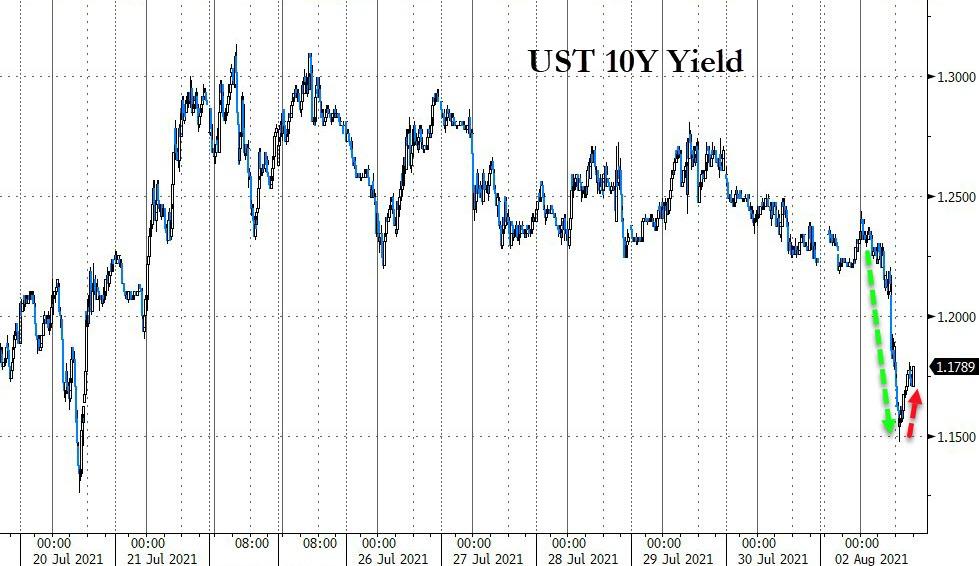
This prompted a plunge in Treasury yields…

Source: Bloomberg

This sparked a plunge in the 10Y to a 1.14% handle, before the European close, which sparked some bond selling…

Source: Bloomberg

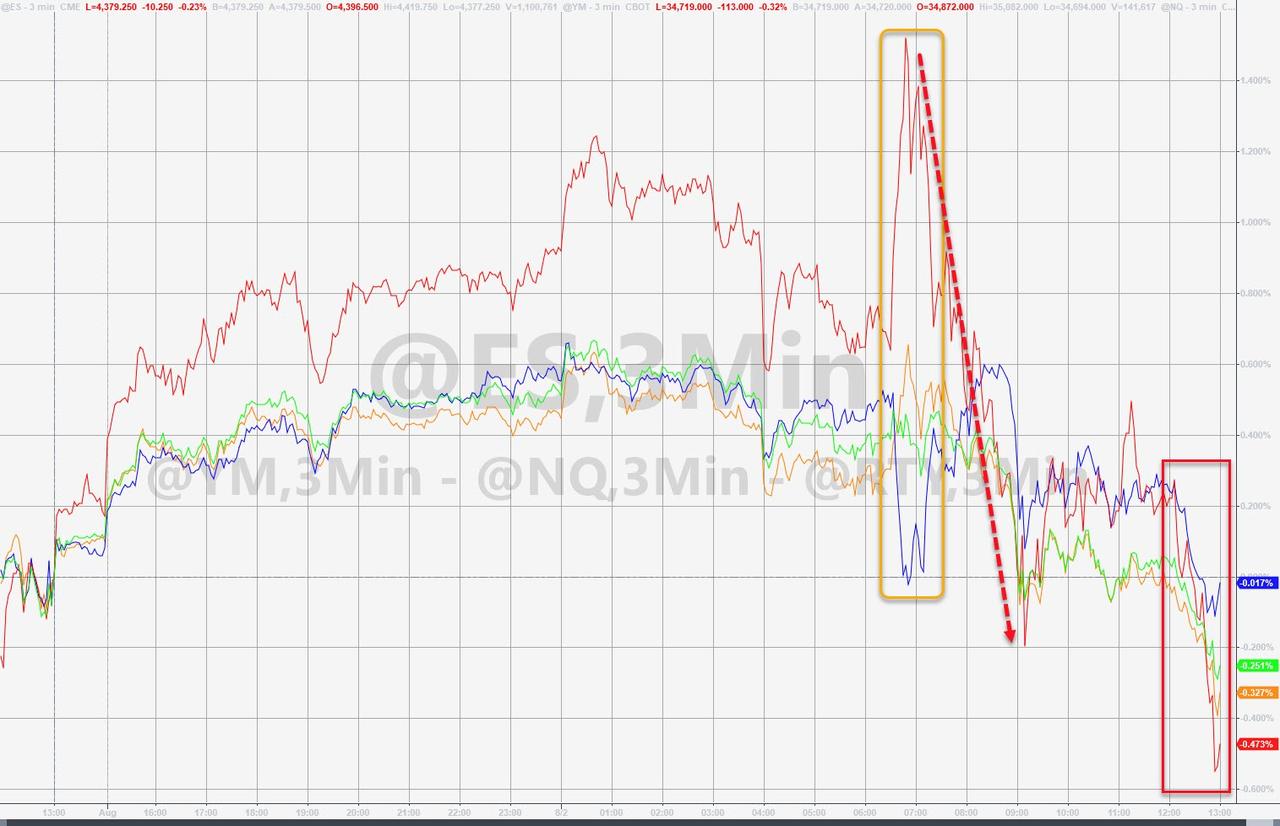
Stocks were all lower on the first day of the month (after futures front-ran the inflows before the bell). Fed’s Waller warned in the last hour that if we get good jobs data in the next two months then The Fed will “taper early and fast” and would “taper MBS faster” which spooked stocks a little…

“I think you could be ready to do an announcement by September,” Waller said Monday in an interview on CNBC.

“That depends on what the next two jobs reports do. If they come in as strong as the last one, then I think you have made the progress you need. If they don’t, then I think you are probably going to have to push things back a couple of months.”

“If the jobs reports come in as I think they’re going to in the next two reports, then in my view with tapering we should go early and go fast, in order to make sure we’re in position to raise rates in 2022 if we have to. I’m not saying we would.”

Stonks did not like that…Nasdaq outperformed on the day as Small Caps lagged…

You have been warned…

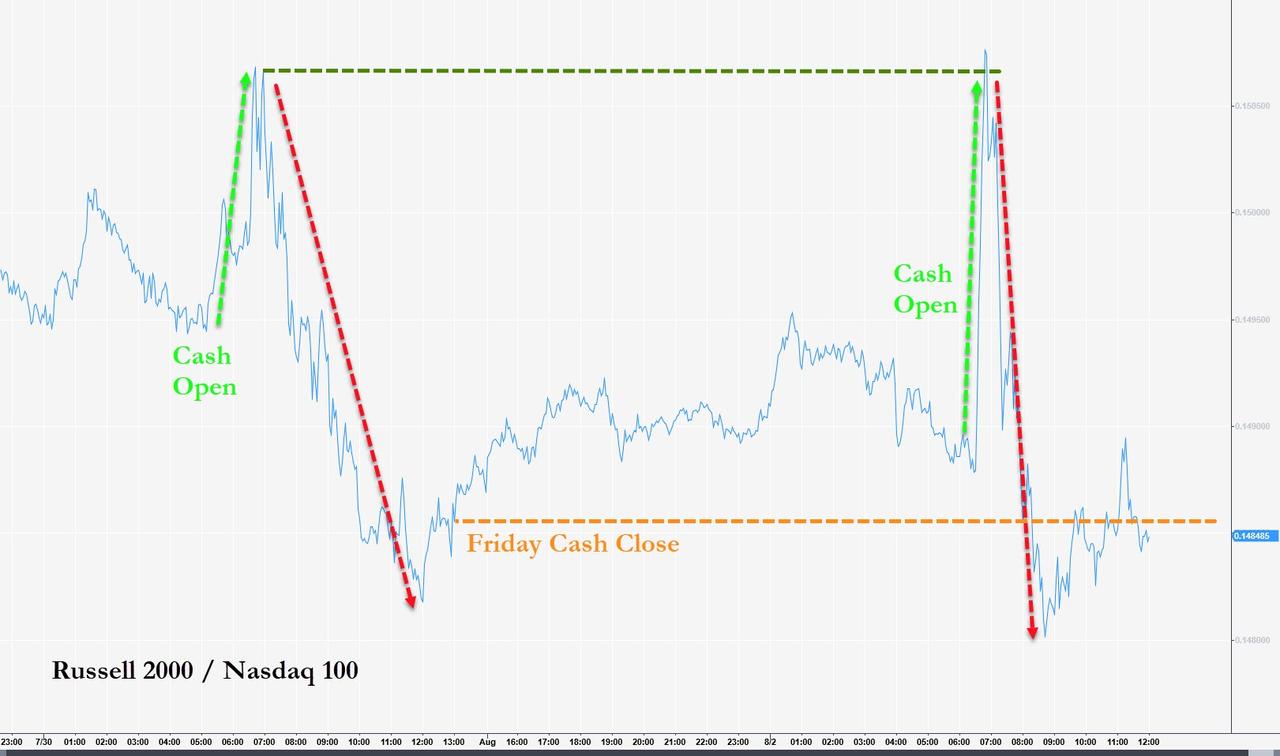
There were chaotic swings in Nasdaq vs Small Caps at the open as the algos ran the stops once again…

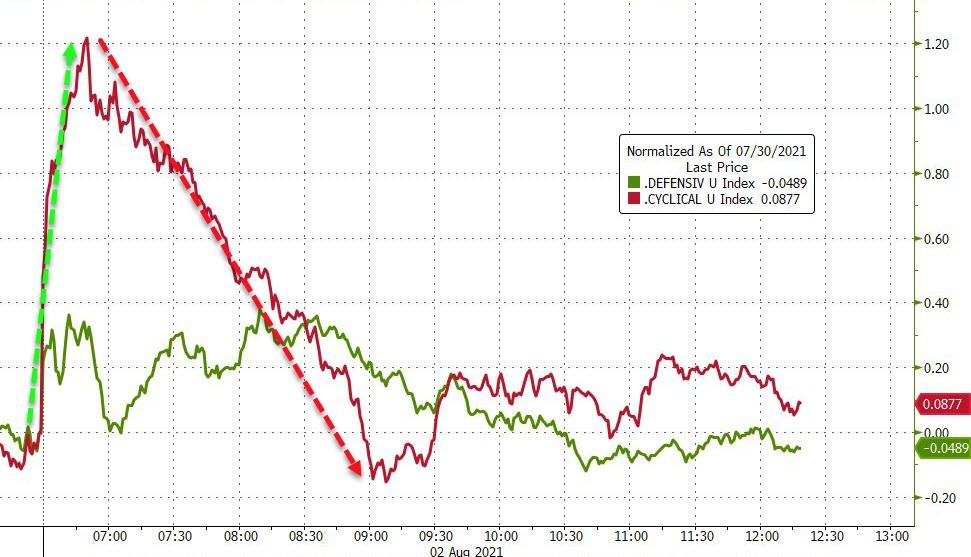
Cyclicals were well bid the open but gave it all up by the close…

Source: Bloomberg

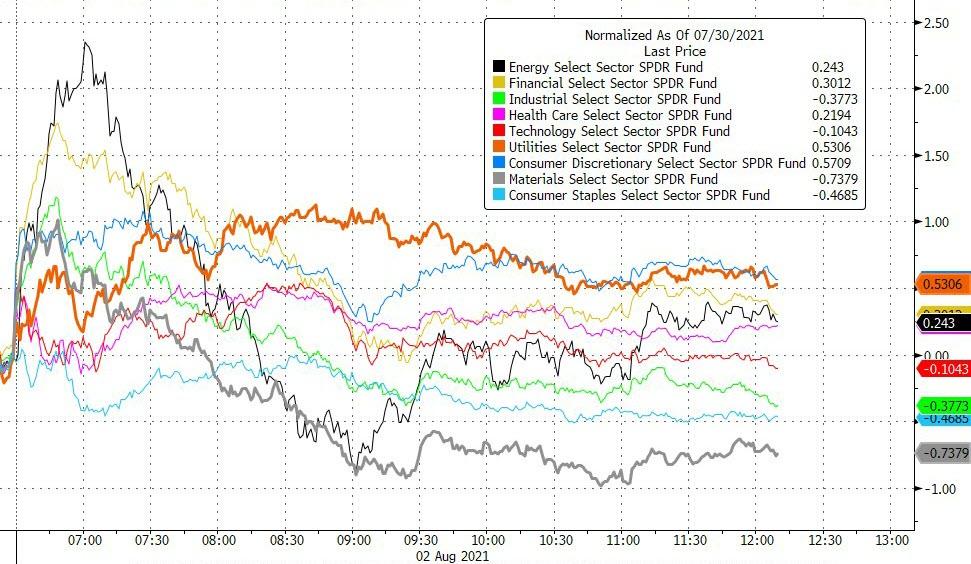
Materials stocks underperformed as Utes rallied (energy stocks spiked at the open, then dumped as the short squeeze failed)…

Source: Bloomberg

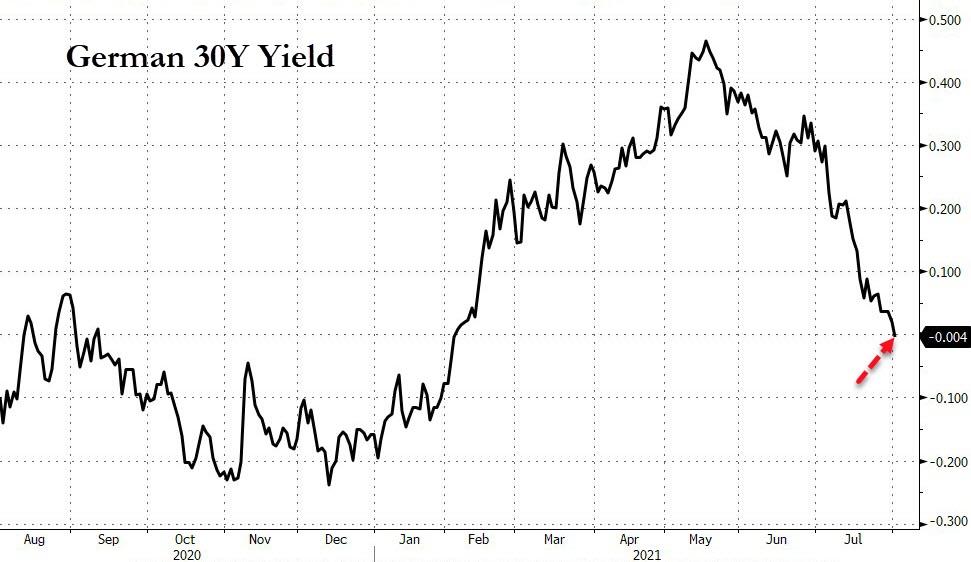
German 30 yields tumbled back below 0 for the first time since Feb 5th…

Source: Bloomberg

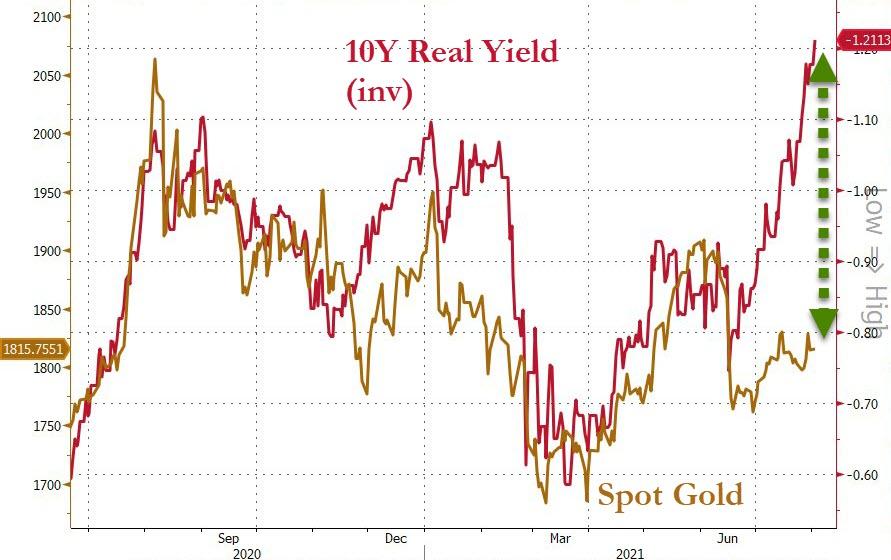
Which is sending global negative-yielding debt soaring once again (back above $16 trillion, and signaling higher gold prices to come)…

Source: Bloomberg

US Real yields hit a new record (negative) low…

Source: Bloomberg

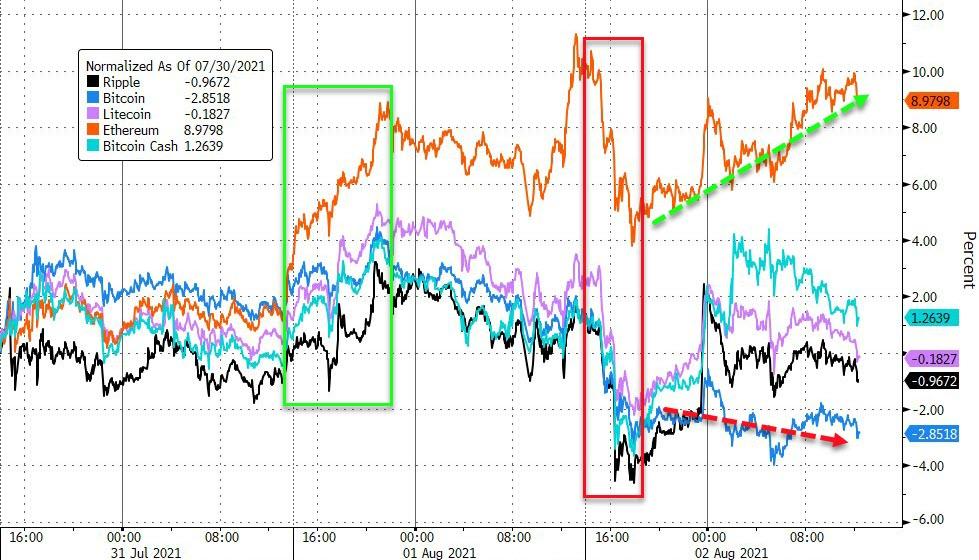
Cryptos were mixed with Ethereum up strongly since Friday and Bitcoin down modestly (chatter on the new infrastructure bill’s crypto taxation plan spooked some)…

Source: Bloomberg

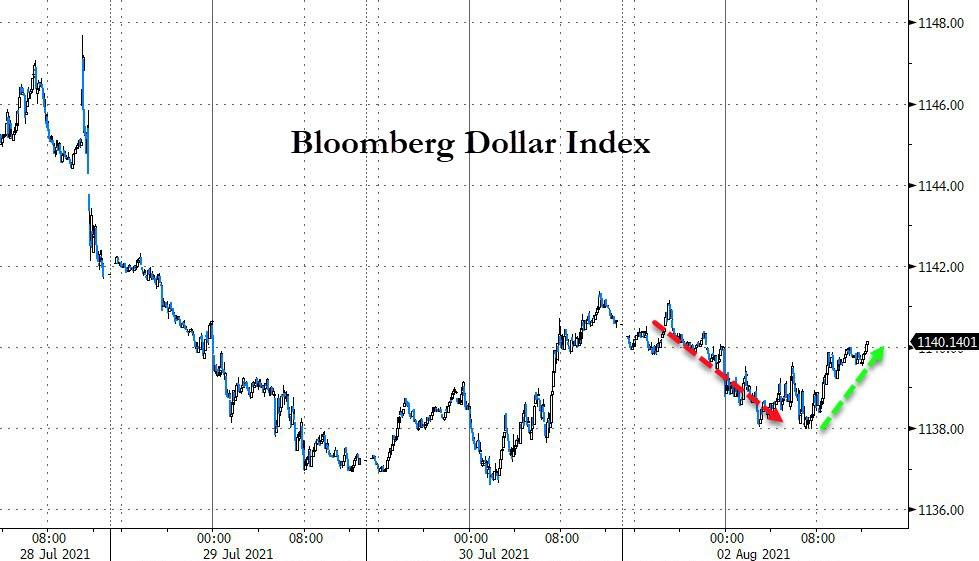
The dollar went nowhere fast today, drifting lower into the US open and rallying after…

Source: Bloomberg

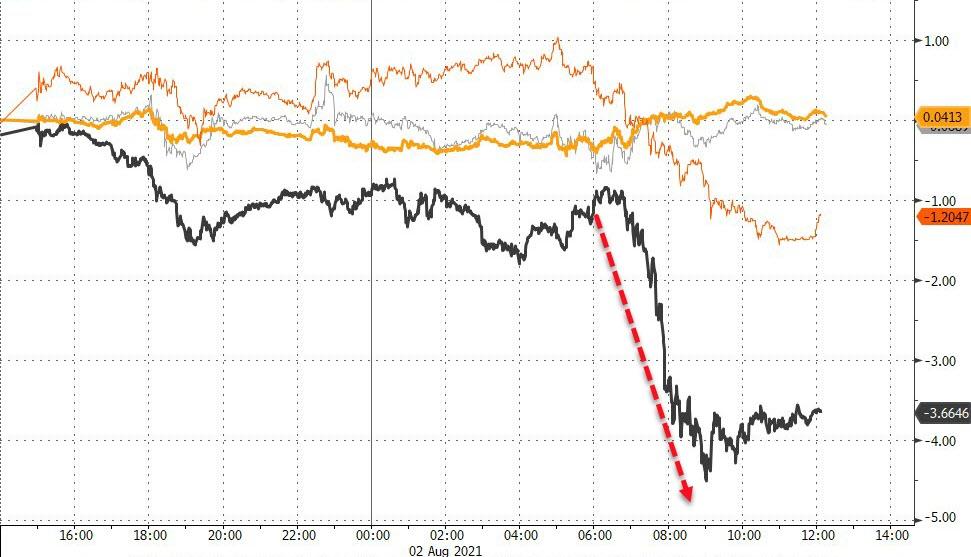
Commodities were mixed with crude the big laggard along with copper. PMs were flat…

Source: Bloomberg

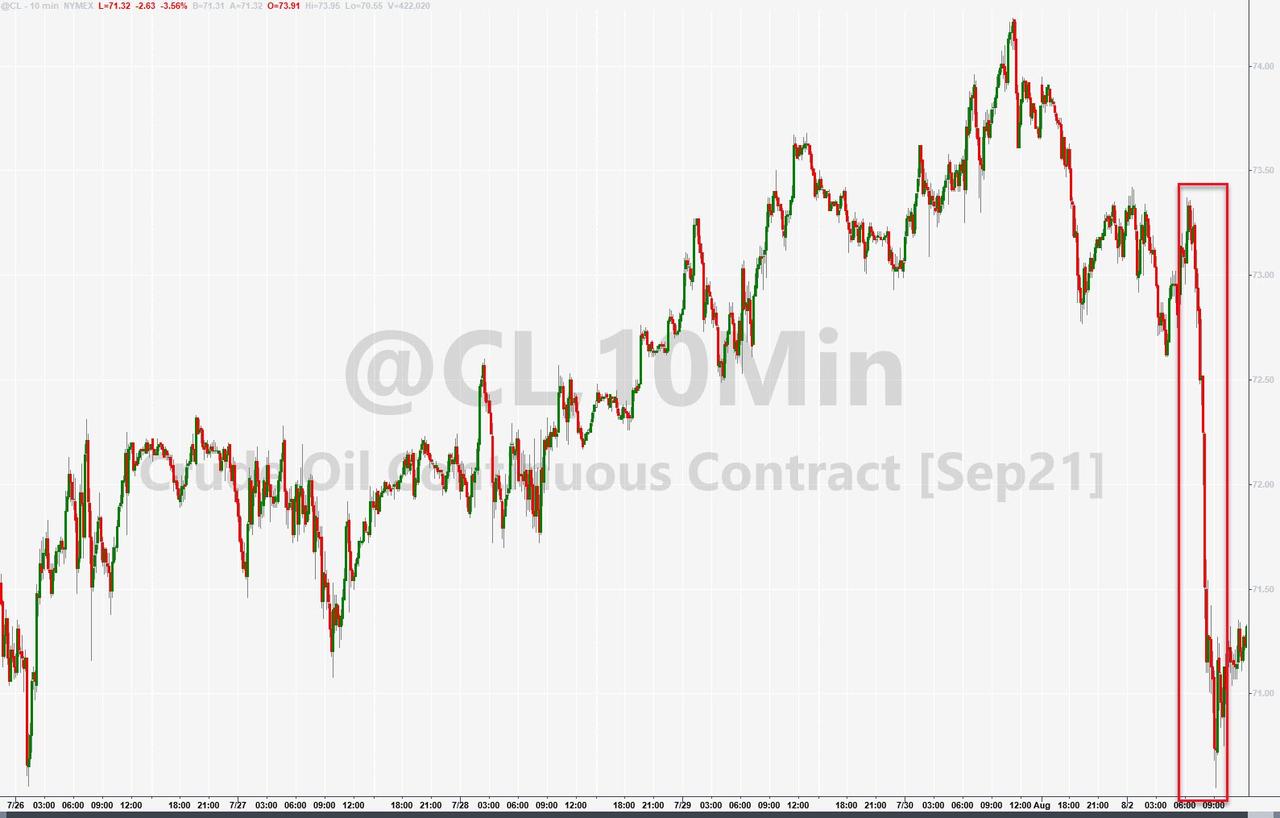
WTI tumbled to a $70 handle after the weak ISM data…

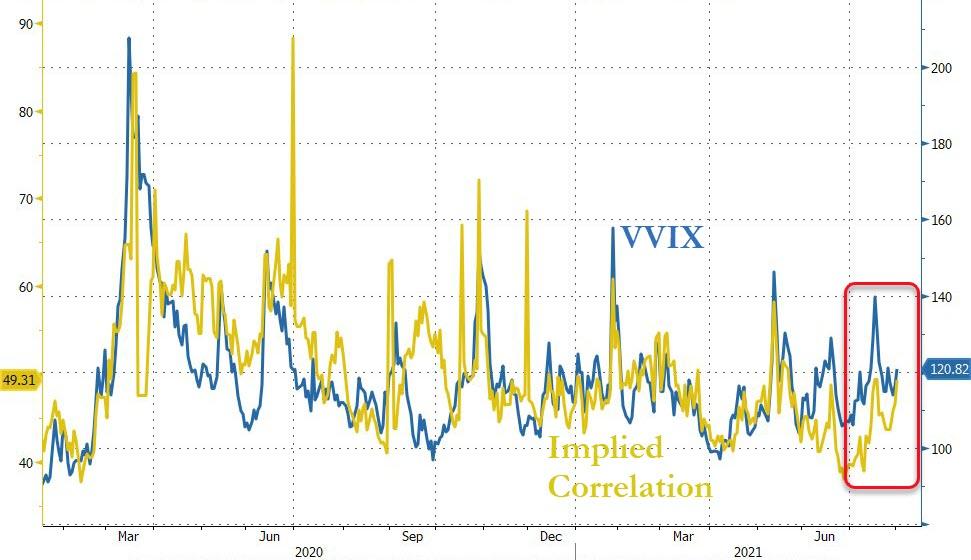
Finally, for all the chatter about how near record highs we are and how great earnings are etc, under the surface looks anything but stable…

Source: Bloomberg

Tyler Durden
Mon, 08/02/2021 – 16:00

via ZeroHedge News https://ift.tt/3ltUG9H Tyler Durden

Shrinking Rolls Of Toilet Paper? Blame The Fed!

Shrinking Rolls Of Toilet Paper? Blame The Fed!

Via SchiffGold.com,

We’ve been talking a lot about rising prices. The CPI has come in hotter than expected every month this year. We’re paying more to buy less.

We see the impacts of inflation on price tags, but sometimes it squeezes us more subtlety. It’s known as “shrinkflation.”

Rising prices don’t just hit consumers. In fact, they impact producers first. As the cost of materials, labor and equipment goes up, companies feel the pinch. Eventually, they pass those costs on to their customers. A lot of companies have been doing this of late. Chipotle is just one example.

But raising prices is bad for business, so sometimes, companies find other ways to cut costs. They shrink packages, or simply put less stuff in the same size box. Consumers rail against this practice, but economist Doug French suggests their anger may be directed in the wrong place. Perhaps they should blame the Fed.

The following article by Doug French was originally published at the Mises Wire. The opinions expressed are those of the author and don’t necessarily reflect those of Peter Schiff or SchiffGold.

A term has been coined for product sellers who shrink their packages, and thus, the amount of product in those packages, keeping the package price the same: shrinkflation. Anyone with a bit of good sense or economics training knows this is another form of price inflation, caused by what used to be the dictionary meaning of inflation; an increase in the supply of money.

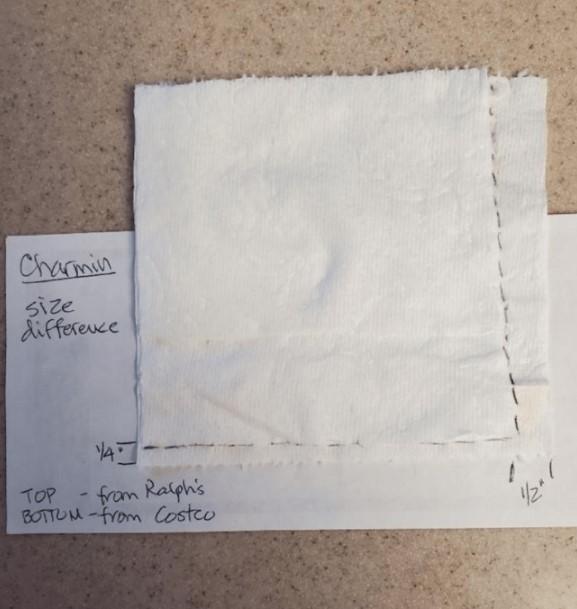
For example, while the average American behind continues to widen, toilet paper has narrowed. A friend’s mother busted out a ruler to confirm her theory. Last year John Hebbe of Fairfax, Virginia, provided photographic proof to the Washington Post: an old roll was 4.5 inches wide, a new roll, 3.75 inches. Of course, the new rolls are fatter, for now, causing annoyance with homeowners with toilet paper dispensers with the roller too close to the wall to accommodate the fatter rolls.

Greg Rosalsky wrote for NPR.org, “The original Charmin roll of toilet paper, [Edgar Dworsky, former Massachusetts assistant attorney general,] says, had 650 sheets. Now you have to pay extra for “Mega Rolls” and “Super Mega Rolls”—and even those have many fewer sheets than the original. To add insult to injury, Charmin recently shrank the size of their toilet sheets. Talk about a crappy deal.

Source: WBUR.

“Downsizing is really a sneaky price increase,” Dworsky told NPR. “Consumers tend to be price-conscious. But they’re not net-weight conscious. They can tell instantly if they’re used to paying $2.99 for a carton of orange juice and that goes up to $3.19. But if the orange juice container goes from 64 ounces to 59 ounces, they’re probably not going to notice.”

Homo economicus is assumed to notice this trickery pokery in neoclassical economics theory. Oliver Kim wrote in The Crimson, “But here’s a confession: Homo economicus is at most a useful fiction—in economic jargon, a model. Human beings do not actually think like Scrooge McDuck, but, in approximation and in aggregate, we often behave like we do.”

“Over the years, Edgar Dworsky has documented the downsizing of everything from Doritos to baby shampoo to ranch dressing. ‘The downsizing tends to happen when manufacturers face some type of pricing pressure,’ he says. For example, if the price of gasoline or grain goes up,” Rosalsky explained.

What the NPR scribe misses is inflation’s breakdown of the division of labor. Average folk, not savvy Homo economicus types, have to pump their own gas, scan their own groceries, and, probably worst of all, manage their own retirement funds.

Since the government has deemed its paper tickets and computer digits to be money, Murray Rothbard wrote, “then the government, as dominant money-supplier, becomes free to create money costlessly and at will. As a result, this ‘inflation’ of the money supply destroys the value of the dollar or pound, drives up prices, cripples economic calculation, and hobbles and seriously damages the workings of the market economy.” That would include the division of labor.

“As we’re seeing inflation picking up now, that’s why I think you’re going to see more items being downsized,” Dworksy told Rosalsky. “And maybe it’s going to be a double-whammy: We’re going to see some products going up in price at the same time that you’re actually getting less in the package.”

A Charmin spokeswoman, when confronted by reporters at WBUR about shrinking the size of their toilet sheet squares, pulled an explanation out of her you-know-what, suggesting it was the result of “innovations” allowing “consumers to, basically, wipe their butts more efficiently.”

Rosalsky, writing from NPR La La Land believes, “consumers will start to notice and voice concern and the power of consumer demand will force companies to listen and right-size their products.” Right-size? What’s the right size?

Don’t blame Charmin, as Ludwig von Mises explained. “[I]f the ruling party does not want to imperil its popularity by heavy taxation, it takes recourse to inflation.”

Consumers should complain to those working at the Eccles Building producing money, not to those in the private market producing toilet paper.

Tyler Durden
Mon, 08/02/2021 – 15:50

via ZeroHedge News https://ift.tt/3rN1mkl Tyler Durden

Stealth QE Is Over: Treasury Projects Adding $300BN In Cash By Dec 31, Reversing The “Liquidity Tsunami”

Stealth QE Is Over: Treasury Projects Adding $300BN In Cash By Dec 31, Reversing The “Liquidity Tsunami”

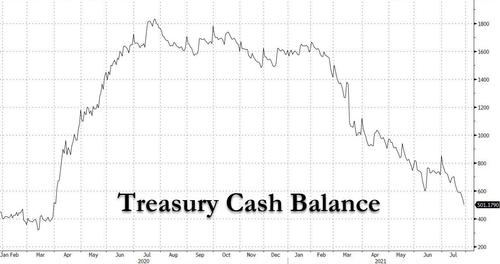
Three months ago, at the start of May when the Treasury was busy spending hundreds of billions of cash parked in the Fed’s Treasury General Account in a form of stealth QE, the US government surprised markets when it announced that it expected to release just $100BN in cash in May and June, from the $903BN currently to $800BN at the end of June, and then just another $50BN lower three months later, or $750BN at the end of Sept. Additionally, the Treasury assumed a cash balance of approximately $450 billion at the expiration of the debt limit suspension on July 31 based on expected outflows under its cash management policies. And while the Treasury caveat that “the actual cash balance on July 31 may vary from this assumption based on changes to expected outflows in that period” its estimate was surprisingly spot on, with the latest Daily Treasury Statement showing roughly $500 billion as of the end of July, not too far from its forecast.

And as a reminder, on Sunday the debt ceiling was reinstated after a two-year break, and lawmakers have not yet formulated a concrete plan to avert default, which the Congressional Budget Office warned could come in October or November once Treasury exhausts special measures and its cash pile. It will now be up to Congress to extend this token limit in the next few months. We don’t expect it to be an issue especially in the aftermath of the August 2011 debt ceiling debacle.

So fast forward to today when the Treasury released its latest Treasury Announces Marketable Borrowing Estimates which showed that the Treasury plans on borrowing almost $1.4 trillion in the second half of calendar 2021, it hopes to end the year with $800 billion in cash – well below the $1.7 trillion in cash it held at the end of 2020 – and last but not least, assumes that a debt limit suspension or increase will be enacted.

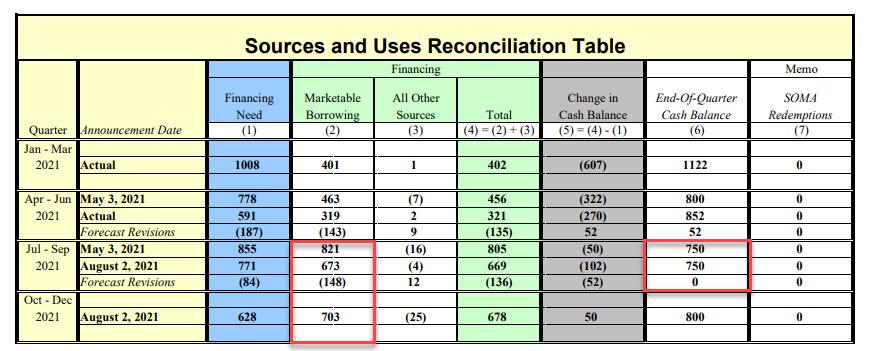
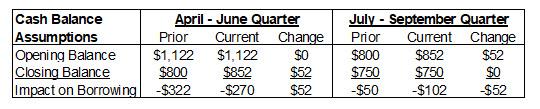
First, looking at the just completed quarter, the Treasury reminds us that it previously estimated privately-held net marketable borrowing of $463 billion and assumed an end-of-June cash balance of $800 billion. The actual numbers were $319 billion in debt issuance, a $143 billion decrease in borrowing from the previous estimate primarily from an increase in receipts and a decrease in expenditures, offset by the increase in the end-of-June cash balance, which were $852BN vs the Treasury estimate of $800 billion. The slower pace of debt issuance may go a long way to explaining why yields plunged as much as they did in a quarter that saw far less supply than many had expected.

What about the current and future quarters? Here are the details:

  • During the July – September 2021 quarter, Treasury now expects to borrow $673 billion in marketable debt, assuming an end-of-September cash balance of $750 billion. This borrowing estimate is $148 billion lower than announced in May 2021, primarily due to the higher beginning of quarter balance and lower outlays.
  • During the October – December 2021 quarter, Treasury expects to borrow $703 billion in privately-held net marketable debt, assuming an end-of-December cash balance of $800 billion.
  • The end-of-September and December cash balances assume enactment of a debt limit suspension or increase.
  • These borrowing estimates are based upon current law and do not include any assumptions for the impact of additional legislation that may be passed.

The Treasury’s Sources and Uses table is below:

Source: Treasury Sources and Uses table

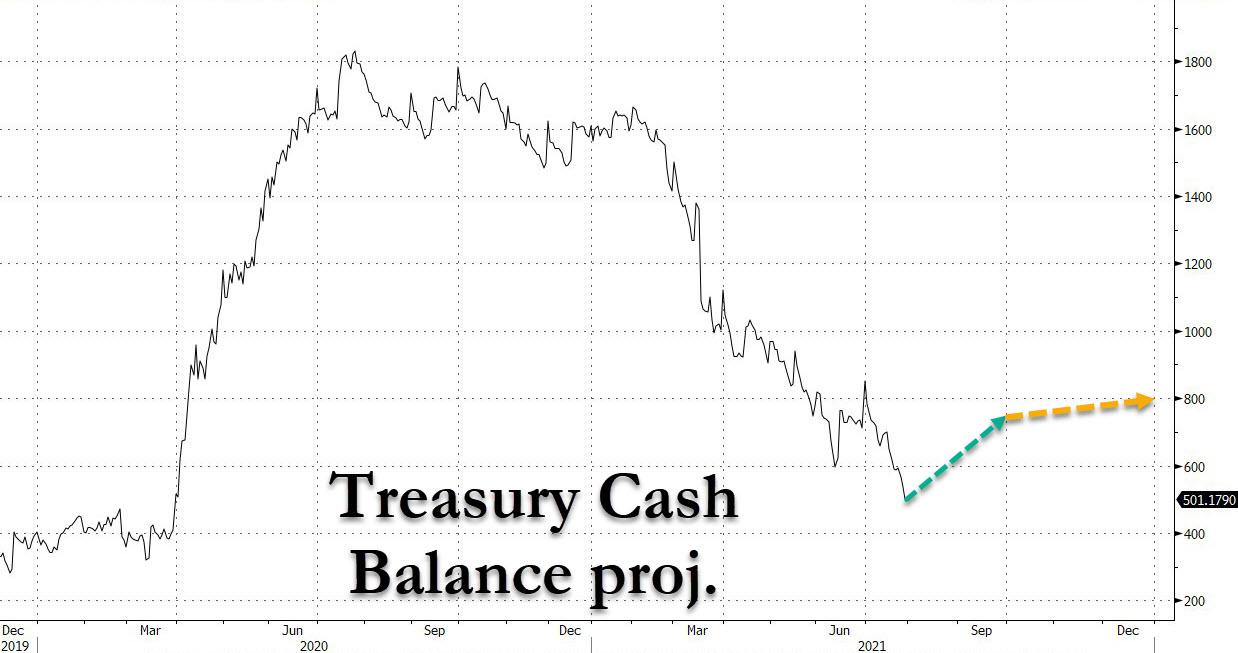
In other words, the government expects to borrow almost $1.4 trillion in the second half assuming lawmakers raise or suspend the newly reinstated debt limit, as money continues to support coronavirus relief even before the impact of additional economic programs being considered by Congress. As for the cash, what for the past six months had been one huge “stealth QE”, as the Treasury injected $1.1 trillion in cash into the economy – and the Fed’s reverse repo facility – it’s about to go in reverse with the Treasury now expecting cash balances to rise by $250 billion to $750 billion through the end of Q3 from today’s $501 billion, and another $50BN by the end of the year, pushing the net cash balance to $800 billion by year end.

Visually, this is how Stealth QE is expected to end and go into reverse, assuming of course that the US will find a way to extend (and pretend) the debt ceiling limitation, which after much theatrical posturing, it will.

Today’s data merely underscores what we said three months ago when we said that “the liquidity tsunami is over” and since the Treasury will now be actively rebuilding its cash balance over the next 5 months, not only is the stealth QE over but it is about to go into reverse.

A much more detailed picture of the Treasury’s funding needs will be unveiled on Wednesday when the Treasury releases additional details about its borrowing plans. As Bloomberg notes, for the first time in more than five years, the Treasury in coming months will be scaling back its mammoth quarterly sales of notes and bonds according to  Wall Street dealers – a shift so large it’s likely to more than counter the Federal Reserve’s potential pullback in purchases. While most dealers expect no change in the $126 billion size of recent refundings, many see officials setting the stage for a reduction in November. It is this surprising decline in net issuance that many speculate could be behind the striking drop in yields in recent months as there is not nearly enough supply to meet demand. That too will change, however, once the Fed begins tapering and certainly once QE is over…. although we aren’t holding our breath.

Tyler Durden
Mon, 08/02/2021 – 15:37

via ZeroHedge News https://ift.tt/3loUecs Tyler Durden