“The Alternative Sucks” – Matthew McConaughey Explains Why America Is Awesome

“The Alternative Sucks” – Matthew McConaughey Explains Why America Is Awesome

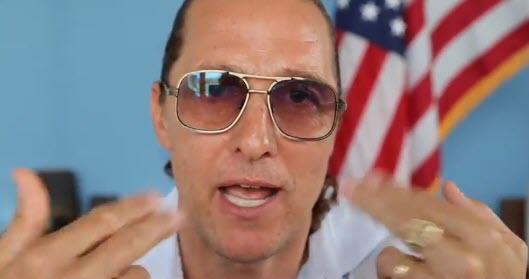
Superstar actor and recent additional to the plethora of podcasters, Matthew McConaughey released his “Happy Birthday America” and they are anything but the usual virtue-signaling Kow-towing we have come to expect from the celebrati.

His thoughts were summarized will in the following sentence…

“We’re all in this together… as the UNITED states of America… If you don’t purchase that, move on, go somewhere else!”

Watch the full clip below:

Tyler Durden
Mon, 07/05/2021 – 17:25

via ZeroHedge News https://ift.tt/3xjSvIT Tyler Durden

Morgan Stanley: Here’s Why The Market Rally Is About To Take A Break

Morgan Stanley: Here’s Why The Market Rally Is About To Take A Break

By Michael Wilson of Morgan Stanley

It’s Getting Hot

When the COVID lockdowns first hit, the primary risk facing companies centered on how to survive the sharpest economic downturn in 90 years. On reflection, what companies were able to accomplish over the past year with most of the labor force working from home is an economic miracle. In aggregate, the US economy surpassed its pre-COVID peak last quarter, just nine months after the trough of the recession. Profits returned to peak levels even faster, with many companies feeling no effects of the recession at all. In fact, essential businesses and technology enablers achieved an acceleration in pre-COVID sales trends, accompanied by record profitability as labor and other costs fell precipitously.

Now, with the economic recovery from COVID in full bloom, companies and investors are facing different questions:

  1. First, how will consumers spend their money? Will their purchases of the items they bought last year remain elevated or will we see a wallet share shift toward the experiences they were unable to enjoy? Perhaps there’s enough pent-up savings to support both? In our view, as the stimulus checks and supplemental unemployment benefits run out later this summer, consumers will be forced to make choices. That likely means a rotation toward services and away from goods, which have been over-consumed.
  2. Second, higher costs are returning as businesses deal with supply chain shortages. Most investors are aware of the spike in certain materials like lumber, copper and semiconductors. However, they also view such increases as temporary, or transitory, as the Fed calls them. They believe materials prices will eventually simmer down as supply adjusts, the normal pattern for commodity markets historically.

We’re not quite as confident in that view, but we do believe some commodity prices will subside where supply can adjust in a timely fashion.

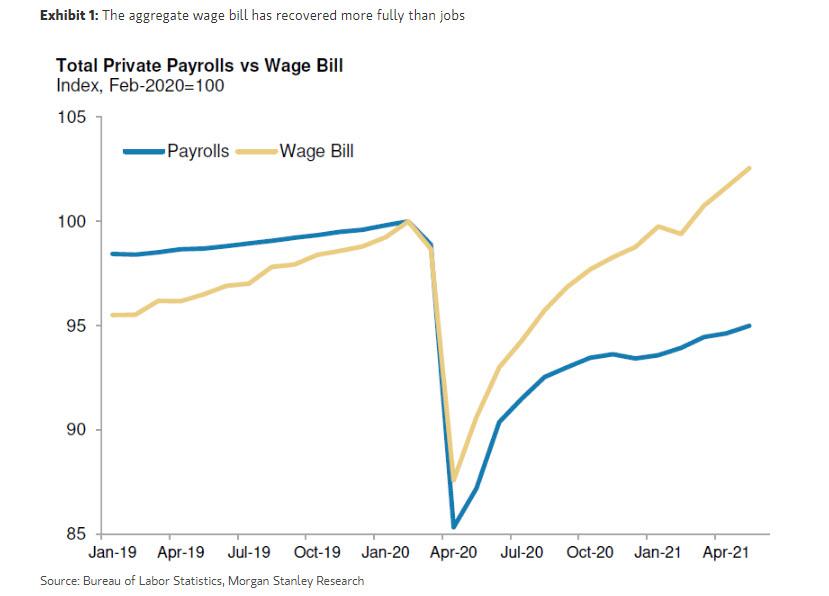
On the other hand, we think the risk is growing that rising labor costs are more structural. First, the pandemic lockdown has curtailed the labor supply in ways that may not be easily fixed. Many workers have moved on to new occupations, which means that labor shortages may be more persistent than normal. This is especially true of the hospitality, travel and leisure industries, where demand is now surging the most. Second, generous supplemental unemployment benefits and stimulus checks have given many the means to delay their return to the labor force or enroll in higher education or training to pursue a more attractive career. Third, thanks to the extraordinary rise in asset prices, including homes, some older workers are choosing to retire earlier than planned. All these factors suggest that there is less slack in the labor force than usual at this stage of the recovery. In fact, aggregate payrolls are already well above pre-COVID levels even though total payrolls are still well below (Exhibit 1). That suggests higher labor costs for businesses as we fully reopen and lower profitability.

A powerful political shift toward fostering social equality is also under way, increasing pressure on companies to pay higher wages. This trend began in 2015 with the push for an increase in the minimum wage. Since then, minimum wages in many states are up as much as 50% or more. At the federal level, ever greater increases have been proposed. Nevertheless, when adjusted for inflation, real minimum wages are still down almost 40% from their highs in the late 1960s. This suggests there’s a long way to go before policy-makers are satisfied.

Finally, globalization and the outsourcing of manufacturing and labor costs have been on a one-way track for the past 25 years. In addition to increasing political pressure to reverse course, the pandemic has exposed the outsourcing model as vulnerable when supply is less than fluid, leading many companies to rethink and reshore, which could mean higher costs.

The bottom line is that the US economy is booming, but this is now a known known and asset markets reflect it. What isn’t so clear anymore is at what price this growth will accrue. Higher costs mean lower profits, another reason why the overall equity market has been narrowing. It also supports our view that equity markets are likely to take a break this summer as things heat up.

Tyler Durden
Mon, 07/05/2021 – 16:47

via ZeroHedge News https://ift.tt/3ytFRqz Tyler Durden

Black Dems & NPR Trashed The Declaration Of Independence Yesterday

Black Dems & NPR Trashed The Declaration Of Independence Yesterday

Authored by Thomas Lifson via AmericanThinker.com,

Our founding document, The Declaration of Independence, changed the world by establishing that human rights come from God, not courtesy of a ruler, and that justice requires governments operate with the consent of the governed. That the nation built upon the principles flourished and became the leader of the free world changed the rest of the world. Without the Declaration, there would be no such thing as the United Nations’ Universal Declaration of Human Rights and no social democracies in former kingdoms of Europe, much less the expectation even in dictatorships that sham elections must take place.

But because some of the states that declared their independence permitted slavery, and because eighteenth century society had different customs and linguistic conventions than now, a growing chorus of progressives condemns the document on its anniversary day.

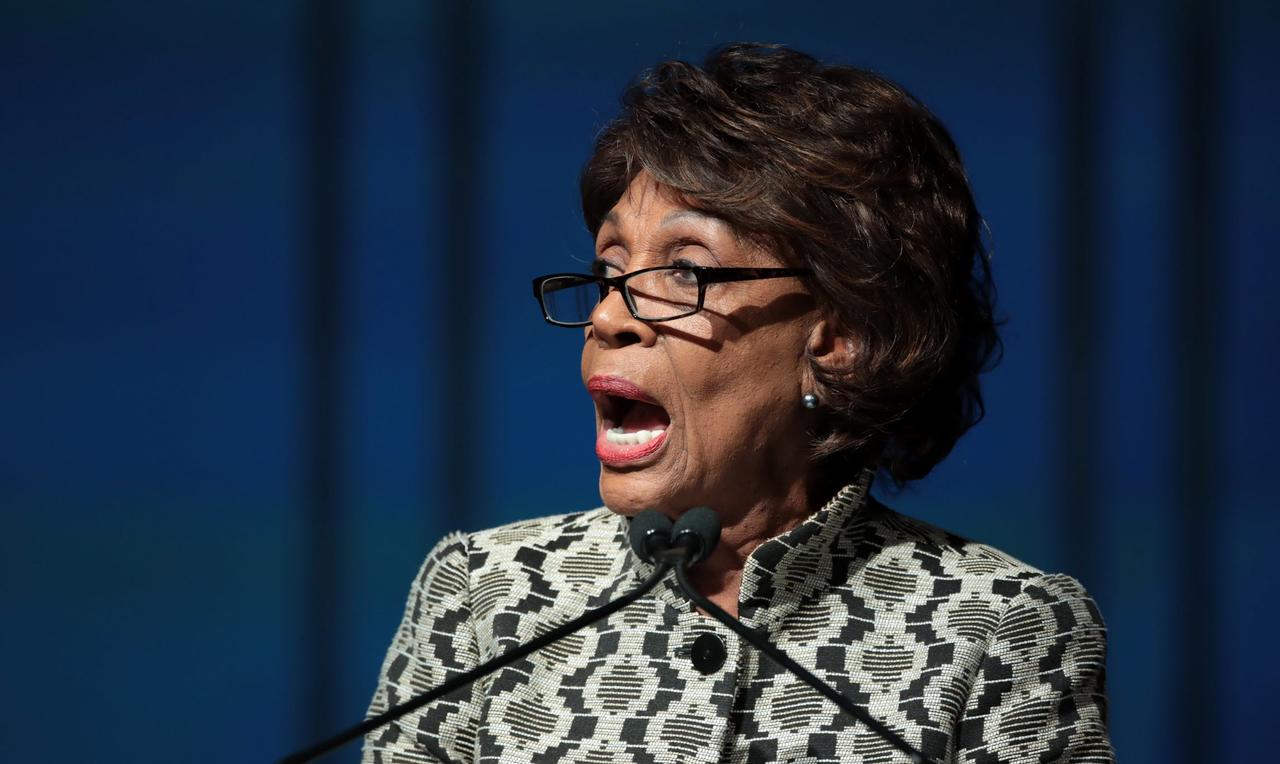
Three Black Democrats serving in the House of Representatives ignored the free Blacks in the North when they spoke out against the Declaration yesterday:

They also ignore the fact that the language of the Declaration served as justification for the abolitionist movement that ended up electing a Republican president and Congress that ended slavery during a bloody civil war fought to end slavery, that was defended by Democrats.

Even worse than these radical politicians whose political careers are founded on hatred and resentment is National Public Radio, the taxpayer-funded entity that has become a propaganda organ of the left.  Penny Starr reports for Breitbart:

Taxpayer-funded National Public Radio (NPR) reluctantly repeated its tradition of staff reading the Declaration of Independence, this year framing its report to point out the “flaws” and racist elements of one of the most cherished U.S. documents. (snip)

NPR included remarks from author David Treuer, who is Ojibwe from Leech Lake Reservation.

“But a deeper look at history also shows that one of the reasons why the colonists wanted to rise up against the British — and wage the Revolutionary War — was over the question of who would try to colonize Native lands west of the colonies,” Treuer told Morning Edition.

It boiled down to power and money, Treuer argued. 

“The crown wanted that money for themselves,” he said. “The colonists, understandably, would have preferred to have it for themselves. So the whole revolution was in large part fought over who got to take our stuff.”

“One of the reasons”? Maybe a few people thought about control of the rest of North America, but the Declaration makes no such mention, nor was the question of colonizing other lands much of an issue in the discontent leading up to the American Revolution. Besides, Spain and France controlled a lot of the land that eventually became the United States. The most charitable description I can make of Treuer’s argument is to describe it as thinly-justified.

Then there is the question of the “stolen” land, a continuing libel of the United States. The universal condition of the globe is that land is ruled by sovereigns that gained control of it by conquest. That is as true of the native tribes that controlled land in North America in 1776 as it is of Alsace-Lorraine, whose sovereign authority has changed and then changed back, in the last couple of centuries.

The Ojibwe Tribe from which Mr. Treuer alleges land was “stolen”:

…migrated from the east along the Great Lakes, pushed by newly arrived Europeans and other tribes.

With the help of guns acquired in the fur trade, they pushed the Dakota south and west in the 18th century and replaced them in the north woods.

Mr. Treuer’s tribe owns the Leech Lake Reservation because they “stole” the land from the Dakotas.  Using guns!

Had American settlers not “stolen” the land from Native Americans, they would be living in the Neolithic conditions that predated the arrival of the Americans, complete with life spans of roughly four decades, partly fueled by starvation, curable diseases, and of course, strife with other tribes not constrained by notions of just war or human rights that also arrived with settlers that followed the Declaration as their founding document.

Tyler Durden
Mon, 07/05/2021 – 15:40

via ZeroHedge News https://ift.tt/3xjJfo7 Tyler Durden

Multiple Rockets Hit Iraq’s Largest US Base In Apparent Revenge Attack

Multiple Rockets Hit Iraq’s Largest US Base In Apparent Revenge Attack

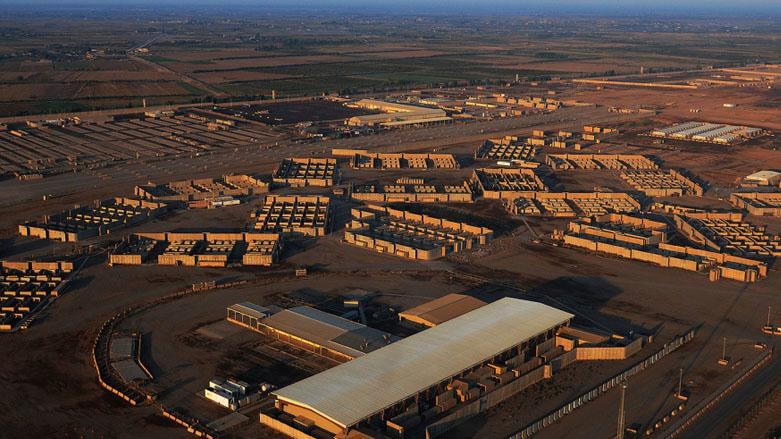
A fresh rocket attack was unleased Monday on the largest military base where US troops are hosted in Iraq. Ain Al Assad airbase in western Iraq’s Anbar province was hit by at least three rockets, the American coalition has confirmed.

An official US coalition statement said that “At approx. 2:45 PM local time, Ain Al-Assad Air Base was attacked by three rockets. The rockets landed on the base perimeter.” It indicated no injuries and that damage is being assessed.

Though the perpetrators of this new attack are as yet unknown, it will likely be seen as part of broader revenge attacks for the June 27 series of US airstrikes on Iran-backed militia groups along the Iraq-Syria border, which killed and wounded multiple fighters as well as reports of civilians. 

Immediately after the US military action, which was the second of Biden’s presidency, a coalition of pro-Iranian Iraqi militias vowed revenge in a statement issued immediately afterward, which saidWe will avenge the blood of our righteous martyrs against the perpetrators of this heinous crime and with God’s help we will make the enemy taste the bitterness of revenge,” they said.

The Iraqi Army issued a blistering statement condemning the “blatant and unacceptable violation of Iraqi sovereignty and national security.”

Such airstrikes began growing commonplace during the last year of the Trump administration amid growing tit-for-tat attacks between Iranian-backed Iraqi militias.

Now it looks to continue under Biden, creating greater pressure in terms of the growing Iraqi demands for foreign troops to finally exit the country.

During 2020 the series of attacks nearly sucked Iran and the US into direct war, especially following the January assassination of Gen. Qassem Soleimani. 

Tyler Durden
Mon, 07/05/2021 – 15:05

via ZeroHedge News https://ift.tt/2SOBaIR Tyler Durden

Leftists Blame Capitalism, Global Warming For Mexican State-Owned Oil Company’s Gulf Fire

Leftists Blame Capitalism, Global Warming For Mexican State-Owned Oil Company’s Gulf Fire

Authored by Monica Showalter via AmericanThinker.com,

To get a whiff of just how unserious the left is, take a look at the leftist knee-jerk reaction to a recent oil fire in the Gulf of Mexico:

These tweets are stupidities because while the boiling gas fire at the bottom of the Gulf of Mexico is spectacular, it hasn’t a single thing to do with either capitalism or global warming. 

It’s the result of an accident from a poorly maintained pipeline owned by Pemex, the state oil company of Mexico.

That’s a 100% government-owned entity that was created in 1938 based on uncompensated expropriation from private-sector energy companies.

State energy enterprises are never capitalist, they are socialist state entities.

Mexico’s is worse than most of them – even Venezuela’s state oil company has some private ownership. Mexico’s, though is a full socialist state creature with zero accountability to shareholders.

It calls to mind that it’s not capitalism, nor global warming that’s causing these accidents, but the hard fact that socialist state energy enterprises have an amazing environmental record.

In Venezuela, we see state oil company pollution on an untold scale, with this sort of thing going on:

While the collapse of Venezuela’s oil industry and what was once the richest economy in South America are well documented, there is little coverage of the immense environmental damage being caused by the decay of its energy infrastructure.

The autocratic Maduro regime is determined to squeeze whatever oil and gasoline production it can generate from Venezuela’s crumbling oilfields, corroded refineries and rusting pipelines. The situation is so dire that oil spills are a regular event in the near-failed state, especially since Washington ratcheted up sanctions, preventing Caracas from obtaining the capital required to conduct critical maintenance and overhauls. Under Maduro’s leadership Venezuela’s government, including national oil company PDVSA, has ceased collecting and releasing data, making it near-impossible for international observers to ascertain what is occurring in the country. PDVSA data (Spanish) from 2016, before the national oil company stopped releasing operational information, showed that oil spills had multiplied fourfold since 1999. This was a worrying portent of what was to come because the worst of the decline for Venezuela’s oil industry did not start until 2018 as progressively stricter U.S. sanctions were imposed.

Aside from PDVSA ceasing to publicly report operational data, Caracas regularly attempts to ignore or even cover up oil spills. That makes it extremely difficult for neighboring countries and the international community to discern just how much environmental damage is occurring.

Notice the cover-ups, easy to do in a socialist state when the state controls the press.

In Ecuador, we’ve got another state oil company situation that’s just about as bad:

Chevron has never conducted oil production operations in Ecuador. Its subsidiary Texaco Petroleum Co. (TexPet) did operate in Ecuador, mostly in minority partnership with Ecuador’s state oil company, Petroecuador, which owned 62.5 percent. TexPet left Ecuador in 1992, and at that time it fully remediated its share of environmental impacts arising from oil production. The $40 million remediation operation was certified by all agencies of the Ecuadorian government responsible for oversight, and TexPet received a complete release from Ecuador’s national, provincial and municipal governments. Chevron acquired TexPet in 2001.

For more than two decades, Petroecuador has been the sole owner of the operations TexPet left behind, and the state oil company has greatly expanded them. Petroecuador has been slow to remediate its majority share of pre-1992 impacts and has amassed a poor environmental record since that time. All remaining environmental conditions in the region are the sole legal responsibility of Petroecuador, and in December 2011, Petroecuador announced a $70 million remediation program that would address the balance of the necessary clean-up.

A phony lawsuit pinning Chevron for blame for the Ecuadorean state oil company’s oil pollution in the Amazon fell apart after Chevron spent hundreds of millions to get the truth out. That has not just left Ecuador with state environmental pollution, it’s poisoned the environment for future foreign investment. Lucky Ecuador, and since that happened, the ChiComs have rolled in. In December 2018, I wrote:

If there was ever an example for nations worldwide of What Not To Do, take a look at what socialist Ecuador has done to itself in dumping the U.S. and turning to align its interests to China. The New York Times has a superb (albeit stomach-churning) report about how Ecuador sold itself out as a vassal of China, getting for itself a junk dam that is already collapsing, and turning over 80% of its oil production to the communist behemoth in order to pay its massive, massive debts from it. That, in exchange for scrapping its military ties to the U.S. and skipping out on its tab with western banks.

All that state capitalism, and pollution, too, yet somehow the West with its capitalism and rule of law, plus existing environmental standards that don’t exist in the socialist state-owned third world, is now to blame.

Similar cases of socialist state oil company mismanagement and the horrible consequences of it abound in Russia, China, Nigeria, Iran, the list is pretty amazing.

Now we have this Mexican case, and Mexico’s state oil company, Pemex, to its credit, has said it has since got the fire out.  

If anything, this fire amounts to an argument against state oil companies and the inevitable results of their activity, where profit is not the foremost concern, profit is not a thing, and making shareholders happy is not an issue. These state enterprises just serve as a cash cow for socialist governments that have so impoverished their people they’ve lost their tax base.

Now, if there’s any argument at all about global warming in this, it’s that countries like Mexico and China need to be held to the same standards as every other nation signed on to the Paris accord. That of course, is not happening, so this garbage goes on, useful to the left for pointing fingers at capitalism and global warming and, in reality, the West

That brings us back to these leftists with their dishonest narratives about capitalism and global warming.

Two of the idiots who posted those statements are leftist politicians who have a big thirst for attaining more power, for the state, and for themselves.

And now before any facts are in, they’re assuming the voters are idiots, too, and will buy hook, line, and sinker the notion that capitalism and global warming are to blame for the Gulf fire.

According to these tweets, it doesn’t seem to be working. Voters seem to be onto them and their ignorant, cynical game. Twitchy has curated some choice tweets educating these charlatans about the nature of the beast, too.

It just goes to show that they’ll use a condemnation of capitalism, or a claim to global warming, to blame anything, no matter what disaster went down, on the West. It’s like a knee reflex.

Tyler Durden
Mon, 07/05/2021 – 14:30

via ZeroHedge News https://ift.tt/2SU79HO Tyler Durden

Evacuations Ordered After Thai Plastic Factory Explodes

Evacuations Ordered After Thai Plastic Factory Explodes

A massive explosion has rocked a chemical plant in the suburbs of Bangkok early Monday. Authorities have evacuated the surrounding area for fear the thick column of black smoke is highly toxic and secondary explosions may occur. 

In the early hours of Monday, an unexplained explosion occurred at the Ming Dih Chemical factory located on the capital’s outskirts. The factory produces expanded polystyrene plastic material consisting of small hollow spherical balls that are expanded when molded. The lightweight cellular plastic material is then molded into packaging and storage products to ship goods worldwide. 

According to the company’s website, its products are mainly used to safely pack televisions, computers, electric tools, household and kitchen appliances, automobile accessories, among other things, in boxes for transport overseas. 

AP News reports the fire broke out around 0300 local time, with an explosion so large that it blew out windows of surrounding homes and sent debris flying across the area. The blast was reportedly heard miles away. The fire was brought under control by mid-morning, but it ravaged the factory in a stunning inferno for hours. 

The explosion was captured on a nearby security camera. 

Here’s another view of the initial blast. 

A better view of the blast via CCTV camera. 

The inferno from a firefighter’s perspective. 

Thick black plumes of smoke were seen from miles away. 

Helicopters were called in to dump fire retardant onto the blaze as the fire was too hot for firefighters on the ground to fight. 

There are still isolated fires and plumes of black smoke visible from the factory. Another concern is that three large chemical tanks may explode. 

The blast injured 62 people, including 12 firefighters, and at least one person has been confirmed dead. 

Compound the loss of this factory in the already stretched global supply chains as exporters in the country who use this company to export their products overseas may have to source styrofoam packing material elsewhere.  

In the last few days, we should remind readers that an oil refinery in Romania caught fire, a Mexican state-owned PEMEX offshore rig experienced a massive underwater pipeline fire, and a powerful explosion was observed in the Azerbaijani region of the Caspian Sea, known for offshore gas production. 

Tyler Durden
Mon, 07/05/2021 – 14:00

via ZeroHedge News https://ift.tt/2Ujt4s9 Tyler Durden

Justice Or Just Desserts? Trump, Cosby, & Georgia Cases Show Rising Cost Of Political Litigation

Justice Or Just Desserts? Trump, Cosby, & Georgia Cases Show Rising Cost Of Political Litigation

Authored by Jonathan Turley,

Below is my column in the Hill on a series of cases that appear propelled by political rather than legal considerations. 

The costs to the legal system, the public, or victims in such cases are often overlooked but they are considerable.

Here is the column:

“It’s not about politics.” New York prosecutor Carey Dunne’s words were repeated like a mantra after this week’s indictment of the Trump Organization and its financial chief, Allen Weisselberg. The problem is that it is manifestly untrue.

In fairness to Dunne, he is prosecuting a case given to him by his superiors. Nor is he alone in pursuing a case driven more by political than legal considerations. From the prosecution of Bill Cosby to a federal lawsuit against Georgia, courts are dealing with cases where government lawyers repeat the same implausible claims with the same unconvincing results. The political gains from these cases ignore the real costs borne by others.

The Weisselberg indictment

Dunne’s statement was made after Manhattan District Attorney Cyrus Vance Jr. and New York Attorney General Letitia James paraded triumphantly in front of hundreds of cameras with a handcuffed Weisselberg in their wake. The excitement — if not euphoria — expressed by many in the media was barely containable.

Weisselberg is charged with failing to pay taxes on executive perks, including cars, apartments and holiday gift accounts; prosecutors added up every possible perk and came up with roughly $1.7 million in taxable benefits. There is no question that such tax violations can be charged criminally; however, if they prosecuted all untaxed executive perks, half of Manhattan would be frog-marched to the hoosegow. That does not make Weisselberg a Mother Teresa figure, but neither does it make him John Gotti.

More importantly, it does not make him Donald Trump.

The piling-on of charges clearly is intended to coerce Weisselberg to flip on Trump. However, prosecutors are not investigating anything involving Trump’s election or presidency. Instead, they are investigating another common practice in business — whether Trump undervalued assets for taxes while overvaluing assets for securing loans.

It simply does not matter what the eventual charges are, however. James pledged to get Trump or his associates on any charge, and she found someone to charge. It is the name on the caption — not the name of the crime — that matters in a prosecutorial trophy kill. (James previously targeted the National Rifle Association.) Politicians like James who run for office by promising to bag political opponents, or their associates, do so at great cost to our legal system and to the concept of blind justice.

The Cosby ruling

In Pennsylvania, another prosecutor insisted that politics had nothing to do with a case. Kevin Steele, the Montgomery County district attorney who convicted comedian Bill Cosby in 2018, remained defiant after the Pennsylvania Supreme Court overturned Cosby’s sexual assault conviction on Wednesday.

In Cosby v. Commonwealth of Pennsylvania, the court found that Cosby was trapped by a “bait-and-switch” after a prior prosecutor assured that he would not be prosecuted if he testified in four civil depositions. Cosby proceeded to incriminate himself and admitted giving drugs to women who alleged sexual assaults. Steele later dismissed that agreement, introduced the incriminating statements, and then called five women to testify about their own uncharged alleged rapes. Those gross errors were allowed by Judge Steven T. O’Neill (who the defense sought to force off the case for bias). O’Neill refused to accept the prior agreement and mocked the notion that “The rabbit is in the hat and you want me at this point to assume: ‘Hey, the promise was made, judge. Accept that.’”

The state’s justices had no problem “seeing the rabbit in the hat,” nor did many of us who criticized the trial. However, it was hugely popular to disregard Cosby’s legal rights in the first major trial of the #MeToo period, given the magnitude of the accusations against him.

DA Steele is unapologetic and insists he was trying to show that “no one is above the law — including those who are rich, famous and powerful.” What he missed is that the rule of law should particularly apply to prosecutors who enforce it — and the costs of violating it are borne not just by Cosby but by his alleged victims, who lost any chance for a fair trial and a formal adjudication. The public will pay, too, not just the millions spent on the case but possible damages if Cosby sues for malicious prosecution based on the prosecutor’s public aggrandizing.

The Georgia lawsuit

Last week, the Biden administration surprised many observers by filing a civil rights action against the state of Georgia over its recent election reforms. The lawsuit was less surprising than its timing: It was filed just days before the release of Brnovich v. Democratic National Committee, an Arizona case in which the U.S. Supreme Court interpreted the very statutory provision (Section 2 of the Voting Rights Act) being used as the basis in the Georgia challenge.

The Biden administration has made opposition to Georgia’s law into a rallying cry for its stalled legislative efforts to federalize state election laws. The problem is that President Biden has been long on rhetoric and short on facts in denouncing the law as “Jim Crow on steroids.” The Washington Post awarded him four “Pinocchios” for his characterization of the law, including the false claim that it reduces the hours for voting; the law actually does the opposite. Likewise, Biden falsely claimed Georgia’s law prevents voters in line at polling places from getting water. Georgia was responding to complaints that campaigns circumvent rules barring politicking around polling places by giving food and drinks to voters in line; the law allows “self-service water from an unattended receptacle.” On these and other provisions, Georgia’s law has considerable overlap with provisions in other states.

In its 6-3 decision upholding Arizona’s election rules, including a bar on vote “harvesting,” the Supreme Court rejected presumptions of racial discrimination due to partisan objectives. Justice Samuel Alito declared “partisan motives are not the same as racial motives.” The ruling builds on earlier cases limiting the reach and meaning of the Voting Rights Act. The new Georgia challenge takes a considerable risk of magnifying these losses in court.

The legal cost of this ill-considered move could be immense. Important questions are being raised about the impact of some laws on minority votes. Yet the attack on Georgia’s law is a poor choice, despite Biden going “all in” on the narrative, because it locks the administration into proving a weak case. While the court declined to issue a sweeping new standard for all Section 2 voting rights cases, this case could open the door for precisely that type of ruling. The Biden administration — which has lost a remarkably high number of legal cases in its first year — is likely to lose this one, too, before the next presidential election.

Politically motivated cases like these impose costs that are rarely paid by those who bring them. The more a prosecutor feels it necessary to repeat that “It’s not about politics,” the more likely a case is entirely political.

Tyler Durden
Mon, 07/05/2021 – 13:30

via ZeroHedge News https://ift.tt/3dMfggz Tyler Durden

Fauci-Funded EcoHealth Refuses To Give Wuhan Documents To Congress

Fauci-Funded EcoHealth Refuses To Give Wuhan Documents To Congress

Four months before the Obama administration suspended federal funding for gain-of-function research on US soil, the process by which virologists manipulate viruses to be more transmissible to humans, a subagency of the National Institutes of Health (NIH) – headed by Dr. Anthony Fauci – effectively shifted this research to the Wuhan Institute of Virology (WIV) via a grant to nonprofit group EcoHealth Alliance, headed by Peter Daszak.

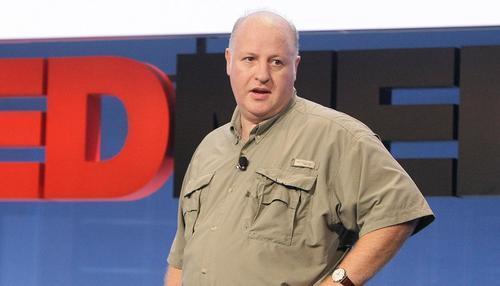
Peter Daszak, president of EcoHealth Alliance

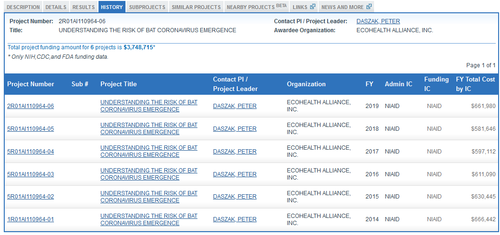
The first $666,442 installment of EcoHealth’s $3.7 million NIH grant was paid in June 2014, with similar annual payments through May 2019 under the “Understanding The Risk Of Bat Coronavirus Emergence” project, as we noted in April.

As we noted in April, the WIV “had openly participated in gain-of-function research in partnership with U.S. universities and institutions” for years under the leadership of Dr. Shi ‘Batwoman’ Zhengli, according to the Washington Post‘s Josh Rogin.

Now, Daszak is refusing to comply with a months-old document request from House Republicans related to his work at the Wuhan lab, according to Just The News.

As government investigators and journalists dig to uncover the full scope of Daszak’s links to the WIV, Daszak is continuing to spurn a congressional request for that information

In April, Republicans on the House Committee on Energy and Commerce sent Daszak a letter directing him to submit, among many other documents, “all letters, emails, and other communications between [EcoHealth] and [the WIV] related to terms of agreements, bat coronaviruses, genome or genetic sequencing, SARS-CoV-2, and/or laboratory safety practices” pursuant to key NIH research funding through EcoHealth to the Wuhan lab as a grant sub-recipient.

Yet Daszak himself has not cooperated with the request. An aide with the Energy and Commerce Committee confirmed to Just the News this week that the committee has “received no response still from EcoHealth Alliance and Peter Daszak to the April 16th letter from Leaders Rodgers, Guthrie, and Griffith.” -JTN

“We have asked Daszak to provide information we know he has that sheds light on the origins of this pandemic,” said GOP Rep. Cathy McMorris Rodgers, who has also publicly noted Daszak’s refusal to play ball.

“Dr. Daszak, you received American funds you used to conduct research on bat coronaviruses at the Wuhan Institute of Virology,” Rodgers continued during a House subcommittee meeting last week. “You owe it to the American people to be transparent.”

Meanwhile, Congressional Democrats aren’t actually interested in getting to the bottom of things – as they themselves hold subpoena power in both chambers. The ultimate authority, as JTN notes, rests with that party – specifically Energy and Commerce Committee Chairman Frank Pallone – who notably boosted funding to Fauci’s NIH in 2015 to the tune of $2 billion per year through 2020. 

Rep. Frank Pallone (D-NJ)

Why a subpoena hasn’t been issued in more than two months is unclear, but we could venture a guess…

Tyler Durden
Mon, 07/05/2021 – 13:00

via ZeroHedge News https://ift.tt/3xisM3u Tyler Durden

In Space No One Can Hear You Scream At Billionaires

In Space No One Can Hear You Scream At Billionaires

By Michael Every of Rabobank

Will markets xenomorph?

Payrolls on Friday almost achieved escape velocity at 850K vs. 720K expected. However, with unemployment up to 5.9% not down to 5.6%, and average weekly hours down to 34.7, while stocks went into a higher orbit, bond yields actually came down, closing at 1.42%. What would it take to give the reflation trade a booster rocket? Presumably at least a million headline, a plunge in unemployment, and a surge in both the work week and earnings. When does that happen?

Today’s follow-up will be muted because it is a US market holiday given yesterday Americans either did or didn’t celebrate Independence Day. We saw the usual hoopla in many places; and tweets from sitting politicians questioning the validity of July 4th and the Declaration of Independence; The New York Times noting it is becoming political to display the US flag; and a recent poll showing only a minority of Generation Z prefer capitalism to socialism, including only 66% of young Republicans. Of course the grass is always redder, and in the 1960s and 70s, a swathe of suburban America turned hippy before quickly becoming yuppie a decade later. Nonetheless, this is potentially a huge socio-economic change if sustained into a cohort effect rather than being an age or Covid effect: markets will move on it if policy ever does.

Perhaps there is also good reason then -beyond ego, mid-life crisis, and more money than sense- for billionaire Richard Branson to be trying to beat billionaire Jeff Bezos into space: “In space no one can hear you scream at billionaires”? It’s also the only vantage spot from which they can check all of their vast global property portfolios efficiently – so think of it as a landlord inspection. They will probably be joined in time by Elon Musk, who loves anything with the word ‘rocket’ in the name. And perhaps the billionaire(?) CEO of China’s ride-sharing app Didi might want to join given just two days after a $4.4bn US IPO, Beijing regulators started an investigation into data-security issues and have now told Chinese web-stores to delete the app immediately (The Global Times noting this was about “national security”). That will play well with any of US Generation Z who put their sparse savings into the IPO – and with anyone thinking we aren’t heading for a global splinternet.

Yet perhaps even space isn’t safe for billionaires. As Amazon presses ahead with the purchase of MGM studios, Disney, which owns the Alien franchise via 21st Century Fox, is to make an Alien TV series which, as Variety puts it “Will Be Class Warfare With Xenomorphs”. As the showrunner says: “it’s about time for the facehuggers and xenomorphs to sink their claws into the white-collar executives who have been responsible for sending so many employees to their doom.”

After all, the first Alien film featured pre-Reagan blue-collar “truckers in space” getting killed by a giant corporation for profit; the second saw a group of Reaganite space marines getting killed by the same firm for the same goal; the third saw prisoners die the same way; the fourth, a group of mercenaries; then Prometheus saw an Erich Von Daniken trillionaire get a group of scientists killed for profit; and Alien: Covenant had a group of idiots getting killed by the aliens created by the robot created by the trillionaire to try to find the real aliens for profit. After four decades of this, we will apparently now get to see the C-Suite of Weyland-Yutani Corporation getting eaten one by one – and viewers will (presumably) cheer at this great Robespierre levelling exercise/gorefest.

Which is ironically aimed to make vast amounts of profit for a giant corporation.

Notably, the horror genre is often an allegory to the social zeitgeist – and excess inequality is genuinely as terrifying as it gets. It enters like a facehugger, usually via a period of one-off reforms; but then these drop away and the host seems to recover and is still fine on the face of it. The damage inequality will eventually do is hidden as it gestates unseen, like an Alien embryo in the stomach. Yet it will eventually burst out into the world, killing the host, to great shock and surprise. Even then, it still seems small and not too much of a threat to the rest of the social group. Yet if it continues to grow, it can demonstrably rip societies into bloody pieces. There is no guarantee of a happy ending, where inequality is simply blasted out of an airlock.

We enjoy watching horror films because the monsters are projected elements of the dangers of the real world and the darker parts of our own psyche. In short, we watch because we know what they show us will always be with us. I doubt many viewers watching space CEOs getting eaten by aliens will be thinking that this is going to somehow boost their own meagre pay, or reduce the generous package of the CEO of Disney. The bond and stock markets both seem to agree.

That doesn’t mean there is no lesson in watching horror films – that too is part of the reason to do so. And indeed, we already see policies being floated to try to deal with inequality in various places “Leveling Up”; “Build Back Better World”; “Dual Circulation”, etc. – albeit all of them so far tentative and aiming not to offend the Weyland-Yutanis of this, or other, worlds.

But perhaps we will end up with a horror show for asset markets that sends our billionaires off into space to avoid paying tax. The latest policy idea to fight inequality from the UK Labour Party, which only narrowly held a safe seat in last week’s by-election, is to go further than the governing Conservative Party’s post-Brexit “Level Up” with a pledge to “Buy British”; to “make, sell and buy more in Britain”; and to build a “strongly patriotic policy platform” where “far more public contracts [are] awarded to British businesses….This would be tied in with an emphasis on securing more high-skilled UK jobs for the future in the green, financial technology, digital media and film sectors, and other industries in this country.” Perhaps that involves making movies about aliens eating CEOs in space, which Brits are rather good at. However, it is also potentially a step back to an inflationary world where the Brits made cars nobody wanted to drive – and there is a lot of that about.

Meanwhile, as the market continues to trade as if there aren’t any monsters, really, life shows us:

  • President Biden has said the US will respond if Russia is behind the series of cyberattacks that hit the country on Friday, which follow on from him telling President Putin at their recent summit that these were a red line;

  • Forbes reports Japan is reportedly closer to shifting towards a policy where it would fight alongside the US should the latter do so over Taiwan, which marks a huge structural change in its defense policy, and which will either increase tensions in the region, or ease them, depending on whom one listens to;

  • French President Macron and German Chancellor Merkel, who just had their request for an EU-Russian summit shot down by their European partners, are now shifting the focus of their negotiations to China, and will reportedly hold another video conference with Xi Jinping this week – presumably talking up the CAI deal frozen by the EU parliament, which would again underline how the EU cannot find one voice to speak with except on Northern Irish sausages; and

  • Fed-maven Zoltan Pozsar is warning about the mix of excess cash, QE, the debt ceiling, and reverse repos, suggesting a potentially explosive mix if money market funds rotate out of T-bills into the new reverse-repo program, which could drain excess reserves from the banking system.

Tell me – are we making our horror movies about the right things?

Tyler Durden
Mon, 07/05/2021 – 12:30

via ZeroHedge News https://ift.tt/3hDJh3f Tyler Durden

Oil Jumps After OPEC+ Abandons Meeting With No Deal

Oil Jumps After OPEC+ Abandons Meeting With No Deal

We asked yesterday, Is the world about to go through another 2014 Thanksgiving massacre when OPEC collapsed sending the price of oil crashing and unleashing a brief if catastrophic wave of destruction across the US shale sector?
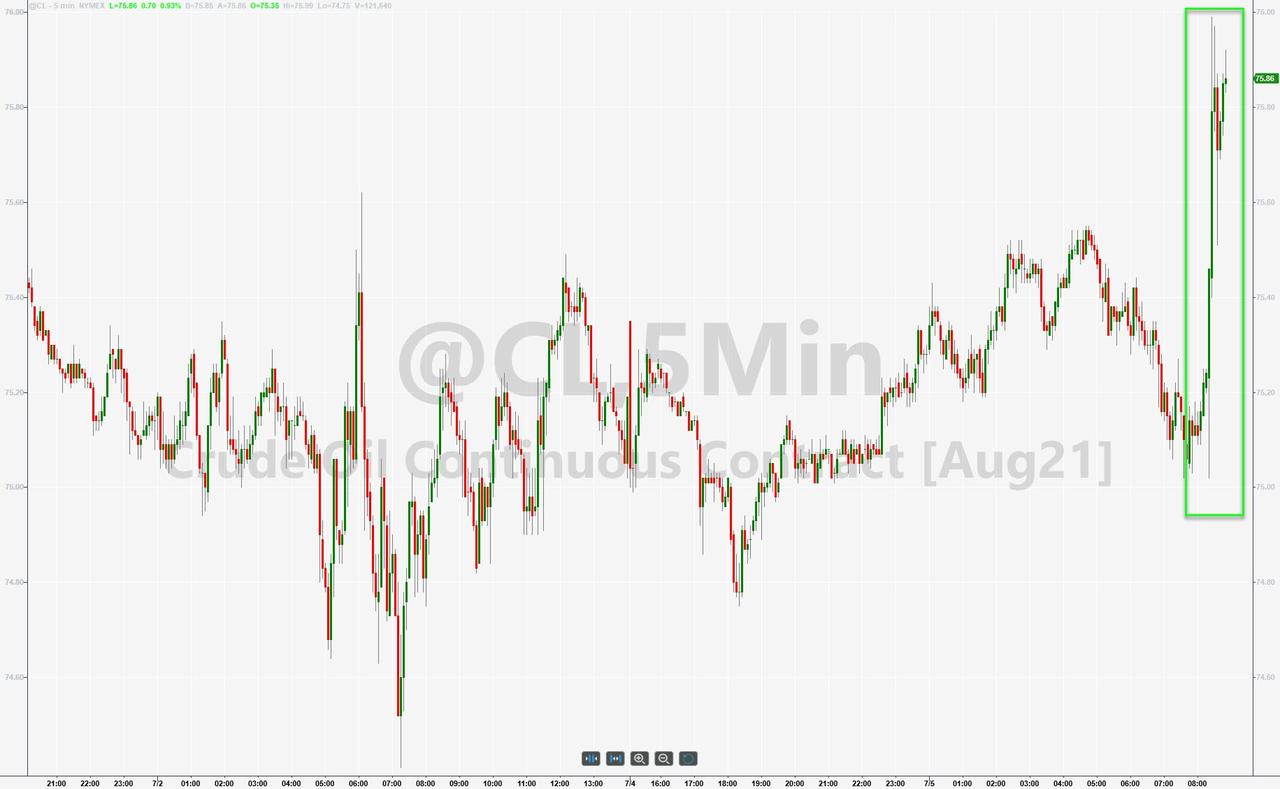
It would appear we have an answer – at least in the short-term – as Bloomberg reports that OPEC+ failed to reach a deal and called off a meeting planned for today, leaving the oil market to contend with much tighter supplies than had been expected.

The UAE’s position hasn’t changed, according to a person with knowledge of the country’s thinking. The joint monitoring committee, the JMMC, needed more time to consider the UAE’s position, and the country remains committed to an increase in OPEC production, they said.

Of course, that leaves the UAE still opposing an extension of the deal.

Stalemate stands, it seems.

This decision is implicitly bullish as there is no explicit increase in production across the cartel:
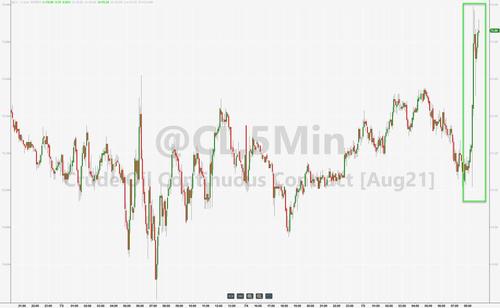
But, as Bloomberg’s Javier Blas notes, while the outcome today is the most bullish, I can’t but think that for 2022 it’s still the most bearish. It’s simply a matter of when and how, rather than if, the UAE puts more barrels into the market. It may happen next month, next year, or after April 2022, but I don’t see how Abu Dhabi walks away from this crisis pumping at a limit of 3.168 million barrels a day. The risk that the whole OPEC+ alliance unravels has also increased significantly. It may be a short-term bullish, medium-term bearish, scenario.

Here’s the background for today’s decision:

Commodity traders are wondering what happens next as just two days after the UAE refused to fall inline with the rest of OPEC+, late on Sunday, in a Bloomberg TV interview, Saudi Prince Abdulaziz said that “we have to extend,” referring to the deal agreed upon by all but the UAE on Friday, according to which oil production would be increased by 400kbd over the next few months, while also extending the broader production quota agreement until the end of 2022 for the sake of stability: “the extension puts lots people in their comfort zone” said the Saudi, adding that Abu Dhabi was isolated within the OPEC+ alliance.

“It’s the whole group versus one country, which is sad to me but this is the reality”, the Saudi summarized the potentially explosive situation, which has seen Saudi Arabia and the United Arab Emirates crank up the tension in their OPEC standoff which as Bloomberg summarizes, has left the global economy guessing how much oil it will get next month.

The bitter clash between the Saudis and UAE has forced OPEC+ to halt talks twice already, with the next meeting scheduled for Monday, putting markets in limbo as oil continues its inflationary surge above $75 a barrel. With the cartel discussing its production policy not only for the rest of the year, but also into 2022, the solution to the standoff will shape the market and industry into next year.

While traditionally the oil cartel has been shy of publicity, keeping its spats behind close doors, on Sunday the fight between the two key producers broke into public view with both countries, which typically keep their grievances within the walls of the royal palaces, airing their differences on television, with Riyadh insisting on its plan, backed by other OPEC+ members including Russia, that the group should both increase production over the next few months, while also extending the broader agreement reached in the aftermath of the oil price collapse of 2020 until the end of 2022 to avoid a production glut.

Just hours earlier, the Emirati energy minister, Suhail al-Mazrouei, again rejected the Saudi-proposed deal extension, supporting only a short-term increase and demanding better terms for itself for 2022.

“The UAE is for an unconditional increase of production, which the market requires,” Al-Mazrouei told Bloomberg Television earlier on Sunday. Yet the decision to extend the deal until the end of 2022 is “unnecessary to take now.”

What happens next is binary: while on one hand, Abu Dhabi is forcing OPEC into a difficult position: accept its requests, or risk unraveling the cartel without an output agreement in place, which would squeeze an already tight market, sending crude prices sharply higher. But only briefly because as Bloomberg notes, a more dramatic scenario is also in play – a repeat of Thanksgiving 2014 – when OPEC risks breaking down entirely, risking a free-for-all that would crash prices in a repeat of the crisis last year. Back then, it was a disagreement between Saudi Arabia and Russia that triggered a punishing price war, which according to some sparked the March 2020 liquidation panic, not the covid shutdown panic.

Speaking to Bloomberg, Prince Abdulaziz said that without the extension of the agreement there’s a fallback deal in place  under which oil output doesn’t increase in August and the rest of the year, potentially risking an inflationary oil price spike. Asked if they could hike production without the UAE on board, Prince Abdulaziz said:

“We cannot.” Which, of course, is false: should OPEC collapse it will be every oil exporter for themselves, and after a brief price spike oil will crater once again.

According to Bloomberg, OPEC+ nations, oil traders and consultants have been stunned by the severity and duration of the fight, and the apparent lack of communication between the two. Prince Abdulaziz said he had not spoken to his counterpart in Abu Dhabi since Friday — even as he insisted he remained his friend. “I haven’t heard from my friend Suhail,” he said, adding he was ready to talk. “If he calls me, why not?” Asked if more senior officials had been in touch, he declined to comment.

At the center of the dispute is a word key to OPEC+ output agreements: baselines. Each country measures its production cuts or increases against a baseline. The higher that number, the more a country will be allowed to pump. The UAE – a relatively minor oil producer – says its current level, set at about 3.2 million barrels a day in April 2020, is too low, and says it should be 3.8 million when the deal is extended into 2022.

That, however, is a non-starter to Saudi Arabia and Russia, which have rejected re-calculating the output target for the UAE, fearing that conceding to one member would prompt everyone else in OPEC+ to ask for the same treatment, unraveling the deal that took several weeks of negotiations, and the the help of U.S. President Donald Trump as broker, with the ultimate outcome being another glut of supply.

Prince Abdulaziz suggested that Abu Dhabi was cherry picking its new output target, and it would set a bad precedent. “What kind of compromise you can get if you say my production is 3.8 and this is going to be my base,” he said.

For its part, Abu Dhabi – which in April 2020 accepted its current baseline – said it doesn’t want the straitjacket to stay on for even longer, arguing that it has spent heavily to expand production capacity, attracting foreign companies too.

Meanwhile, as OPEC+ bickers, a potential wildcard is the flood of even more oil supply: Iran is expecting to return to the oil market as soon as it reaches a nuclear deal with Biden, boosting global supply by several millions barrels of oil.

And so, markets remain on edge ahead of the next OPEC+ virtual meeting scheduled for Monday at 3 p.m. Vienna time, although Prince Abdulaziz suggested it wasn’t set in stone. He wouldn’t comment on the chances of finding a consensus, saying he would work hard to seek one. “Tomorrow is another day.”

*  *  *

And circling back, we now know “tomorrow’s” decision – no deal!
Tyler Durden
Mon, 07/05/2021 – 11:59

via ZeroHedge News https://ift.tt/3hAzzP9 Tyler Durden