Will Your FBI Entrap You?

Will Your FBI Entrap You?

Tyler Durden

Mon, 10/19/2020 – 22:20

Authored by Angelo Codevilla via AmGreatness.com,

The FBI-generated indictment of six men on charges of terrorism for planning to kidnap Michigan Governor Gretchen Whitmer has all the earmarks of what has become that corrupt agency’s standard operating procedure.

Their lawyers are sure to claim they were victims of entrapment. If the case comes to trial, I doubt a jury will convict them.

During the eight years I spent supervising the intelligence agencies for the Senate Intelligence Committee, I watched as what had been a clerisy of strait-laced guardians of truth and justice was becoming a bunch of lazy bureaucrats eager to serve the ruling class’ prejudices. 

No longer doing the hard and dangerous work of investigating deeply connected criminals and subversives such as the Mafia and well-financed, politically supported subversives, the FBI limited its vision to politically correct “profiles,” and started chasing small fry. Easy targets, defended by no one. What’s not to like?

After 9/11, the FBI spent few years going after very petty Islamists while covering its collective eyes to the work of major sources of trouble, such as the Muslim Brotherhood, the Palestinian Authority, and Saudi Arabia—each beloved by parts of the ruling class. But before and after this period, these profiles more often than not pointed to the ruling class’ favorite enemy: fellow Americans “excessively concerned with their liberties.” 

The FBI’s method? Place agents among the target group, stoke their sentiments, and lead them to say or do something that could be characterized as a crime, then arrest them and claim credit for foiling a plot. In intelligence lingo, that is provocation. In legal terms, it’s entrapment. By whatever name, this is the work of cheap, dirty cops.

In the 1950s, the joke was that any meeting of a Communist Party cell in the New York area was likely to consist of two-thirds infiltrators, half from the FBI and the other half from the New York Police Department. But these FBI infiltrators, like those of the Vietnam era in the 1960s and early ’70s, and like those who penetrated organized crime were merely watching. Doing an honest job. They were not provoking or entrapping, not creating something that would never have been there except for their presence.

Fast forward to our time. The contrast between how the FBI behaves with regard to persons connected to the ruling class and those who are not speaks for itself. The 918 Americans who died in mass suicide in Jonestown Guyana in November 1978 were victims of a cult that had been closely associated with the California Democratic Party. Relatives of the people who were being drawn in had complained to the FBI. But the FBI had refused to keep an eye on the movement, and later officially argued that doing so would have infringed on its political and religious liberties. 

And yet when the Tea Party movement arose to protest collusion between the Republican and Democratic parties against popular sentiment on a host of political issues, the FBI rushed to infiltrate it.

Having addressed countless meetings of Tea Parties in Northern California from 2010 to 2012, I experienced this infiltration directly. The audiences were respectful, and asked informative questions. When, occasionally, I got a question that seemed to push me to say something inflammatory, I made it a point to find and speak to the individual who had asked it. Invariably, the person fit a profile with which I had become familiar from my years overseeing the FBI: a man in his late 30s, who had recently moved into the community and worked for a big company, often remotely, and whose echoing of the sentiments surrounding him sounded studied. I would then advise him on how to write his report to headquarters. Generally, the man would walk away.

In the Michigan case, it seems the FBI had started by monitoring the men’s social media traffic and, on the basis of “excess concern for liberty” (prithee, what is that?) had obtained warrants for wiretaps and had inserted one or more infiltrators. But up to this time, no crime could be alleged—only what the FBI and its local affiliate considered a bad attitude. 

What exactly was the infiltrator’s role in moving the men from mere talk to incipient, allegedly criminal action? That is going to be the essence of the trial. The FBI will produce recordings made by the infiltrator. When was the device turned on, and when off? To what extent do those intermissions and/or additions made to the recording contribute to the impression that this was a real plot hatched autonomously? 

The accused will have the government’s and media’s full weights used against them, as would you or I.

The jury will have to decide whether the FBI was protecting society from sociopaths or whether it is itself sociopathic.

via ZeroHedge News https://ift.tt/3kgKopL Tyler Durden

DC Lobbyists See Dollar Signs Under Potential Biden Win

DC Lobbyists See Dollar Signs Under Potential Biden Win

Tyler Durden

Mon, 10/19/2020 – 22:00

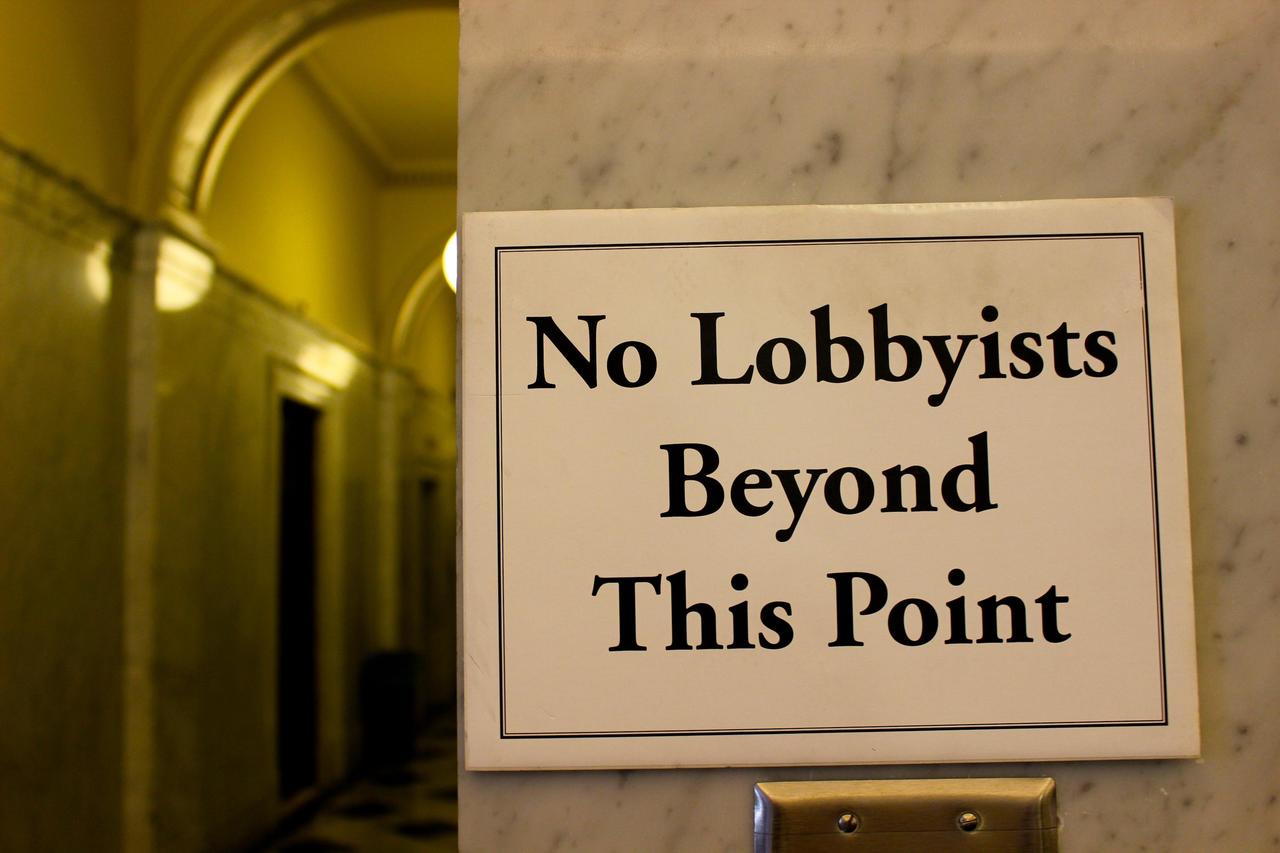
DC lobbyists are licking their chops at the prospect of a Biden win in November, as a flood of new regulations means they’ll have their work cut out for them.

“There is a huge amount of planning going on in our client base for what this could look like,” according to Holland & Knight LLP lobbyist, Rich Gold. “It’s highly likely the first six months of 2021 are some of the biggest legislative months I will have in my career in terms of things moving.

Gold represents the American Chemistry Council, education technology provider Zovio, Inc., agriculture giant Corteva and several local governments.

According to Bloomberg, K Street lobbyists began planning for major changes when polling began to show former Vice President Biden leading President Trump, as well as the possibility that Democrats would regain control of the Senate.

“Not since 2008, when President George W. Bush was leaving the White House, have lobbyists planned for the possibility of so sweeping a change in Washington’s corridors of power,” writes Bloomberg‘s Jennifer Dlouhy and Ben Brody.

The presidential race remains tight in key states and the firms remain vigilant for another Trump victory like the one that caught many by surprise in 2016. But they are hedging their bets and increasingly planning around Biden’s polling lead.

One firm is developing dossiers on potential appointees, selling them to clients under the maxim “people are policy.” Another has created flow charts outlining possible committee leadership changes on Capitol Hill. And at least one group has established a war room to brainstorm strategies for countering policy proposals. –Bloomberg

One oil lobbyist told Bloomberg on condition of anonymity that the election would be a “rack-and-stack” exercise when it comes to the multitude of actions the Biden administration could undertake, while a Democratic sweep of the Senate has caused many lobbyists to begin cultivating relationships with moderate Democrats, including Jon Tester of Montana, Kyrsten Sinema of Zrizona, and Joe Machin of West Virginia.

According to lobbyists interviewed by Bloomberg News, a Biden administration would likely take immediate action on a new COVID-19 relief bill to help stimulate the US economy, along with their healthcare agenda and an increase in the corporate tax rate.

The stimulus bill alone would generate a whirlwind of activity for corporate interests – such as drugmakers who want to fend off the Trump administration’s efforts to limit drug prices, while the renewable energy industry will be looking for ways to get in on the COVID-19 package to foster clean energy programs.

“It’s so difficult to play out some of these scenarios here, and as a committed Democrat, I think we’re all still suffering from a little post-traumatic stress from 2016,” said former Al Gore aide and current partner at Mehlman Castagnetti Rosen & Thomas, David Thomas. “Everything comes with qualifiers.”

The energy industry, meanwhile, will be girding their loins in anticipation that a Biden administration would undo much of the deregulation enacted by the Trump administration.

Companies are trying to figure out “what do Biden’s first 100 days look like,” and “how do they impact us and how do we begin planning for that, according to longtime energy consultant, Stephen Brown.

“You can’t just be against everything; it’s what you can be for and how can you be for it,” he added. “That creates a huge internal discussion, not just by company by company but also trade association by trade association.”

Tony Podesta’s ex-wife, Heather Podesta – a Democratic lobbyist and CEO of lobbying firm Invariant – says that “Sophisticated corporations are in a constant state of re-evaluating their consulting teams, understanding that they’ve got to be nimble and have the best possible folks advising them and representing them in Washington.” Podesta represents Apple, Yelp, PelsiCo and the Business Roundtable.

“Right now, everybody is in a state of speed dating,” she added.

Heather and Tony Podesta

via ZeroHedge News https://ift.tt/2Tg03JX Tyler Durden

Escobar: There Won’t Be An Iranian ‘October Surprise’

Escobar: There Won’t Be An Iranian ‘October Surprise’

Tyler Durden

Mon, 10/19/2020 – 21:40

Authored by Pepe Escobar via The Saker blog, originally posted at The Asia Times,

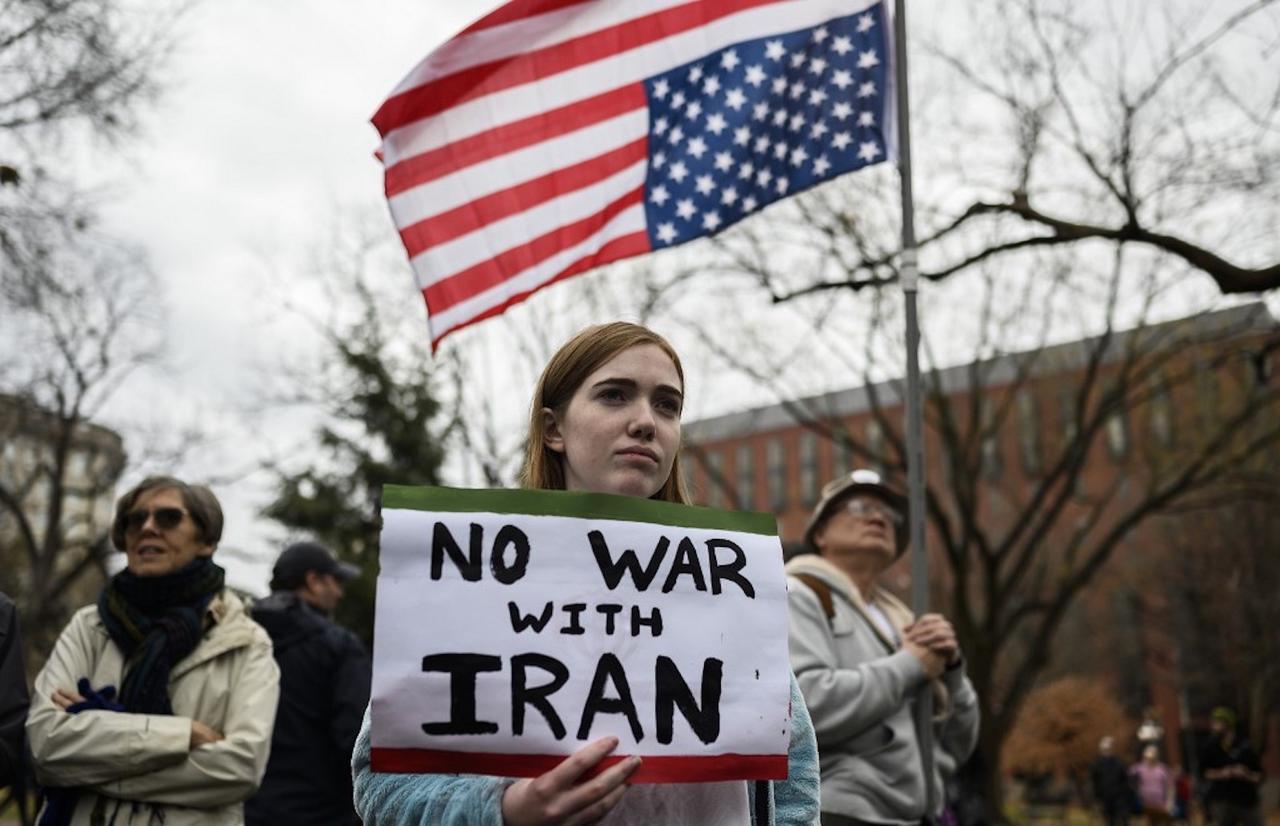
No Washington-designed “maximum pressure” has been able to derail a crucial milestone this Sunday: the end of the UN arms embargo on Iran, in accordance with UN Security Council 2231, which has endorsed the 2015 JCPOA deal.

The JCPOA – or Iran nuclear deal – was unilaterally ditched by the Trump administration. But that, notoriously, did not prevent it from engaging in a massive campaign since April to convince the proverbial “allies” to extend the arms embargo and simultaneously trigger a snapback mechanism, thus re-imposing all UN sanctions on Tehran.

Foad Izadi, professor of International Studies at Tehran University, summed it all up:

“The US wanted to overthrow the government in Iran but failed obviously, they wanted to get more concessions out of Iran, but they have not been successful and they actually lost concessions. So the policy of maximum pressure campaign has failed.”

Under the current US electoral shadow play, no one can tell what happens next. Trump 2 most certainly would turbo-charge “maximum pressure”, while Biden-Harris would go for re-incorporating Washington to the JCPOA. In both options, Persian Gulf oil monarchies are bound to increase the proverbial hysteria about “Iranian aggression”.

The end of the arms embargo does not imply a renewed arms race in Southwest Asia. The real story is how the Russia-China strategic partnership will be collaborating with their key geostrategic ally. It’s never enough to remember that this Eurasian integration trio is regarded as the top “existential threat” to Washington.

Tehran patiently waited for October 18. Now it’s free to import a full range of advanced weaponry, especially from Moscow and Beijing.

Moscow has hinted that as long as Tehran keeps buying Su-30s, Russia is ready to build a production line of these fighter jets for Iran. Tehran is very much interested in producing its own advanced fighters.

Iran’s own weapons industry is relatively advanced. According to Brigadier General Amir Hatami, Iran is among a select group of nations able to manufacture over 90% of its military equipment – including tanks, armored personnel carriers, radars, boats, submarines, drones, fighter jets and, crucially, land and seaborne cruise missiles with a respective range of 1000 km and 1400 km.

Professor Mohammad Marandi from the Faculty of Policy Studies at the University of Tehran confirms, “Iran’s military industry is the most advanced in the region and most of its needs are provided by the Ministry of Defense.”

So yes, Tehran will certainly buy military jets, “but Iranian made drones are the best in the region and they’re improving”, Marandi adds. “There is no urgency, and we don’t know what Iran has up its sleeves. What we see in public is not everything.”

A classic case of the public face of something that can’t be seen was just offered by the meeting last Sunday in Yunnan province in China, between excellent pals Mohammad Javad Zarif, Iran’s Foreign Minister, and his Chinese counterpart Wang Yi.

That’s of course part of their own strategic partnership – to be sealed by the now notorious $400 billion, 25-year, trade, investment and energy deal.

Both China and Iran happen to be encircled by rings of the US Empire of Bases and have been targets of varying, relentless brands of Hybrid War. Needless to add, Zarif and Wang Yi reaffirmed the partnership evolves in direct contrast with US unilateralism. And they must have discussed weapons trade, but there were no leaks.

Crucially, Wang Yi wants to set up a new dialogue forum “with equal participation of all stakeholders” to deal with important security issues in West Asia. The top precondition for joining the forum is to support the JCPOA, which was always staunchly defended by the Russia-China strategic partnership.

There won’t be an October Surprise targeting Iran. But then there’s the crucial interregnum between the US presidential election and the inauguration. All bets remain off.

via ZeroHedge News https://ift.tt/2T7p5uL Tyler Durden

Greenwich Home Sales Have Best Quarter “In A Decade” As New York City Exodus Continues

Greenwich Home Sales Have Best Quarter “In A Decade” As New York City Exodus Continues

Tyler Durden

Mon, 10/19/2020 – 21:20

It looks like the exodus out of the city, first catalyzed by the pandemic and then helped along by Bill De Blasio’s commitment to allow criminals to overtake the city, is continuing at a blistering pace. 

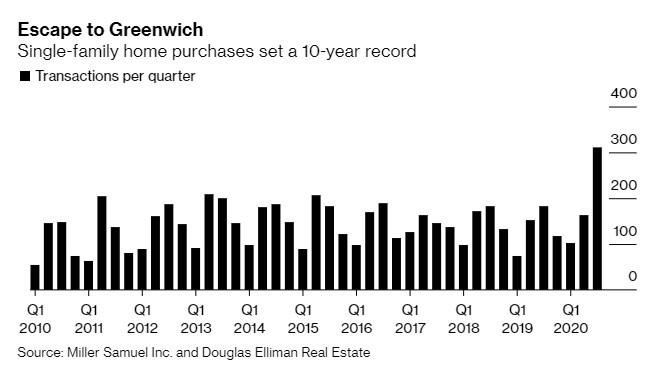
Home sales in Greenwich had their strongest quarter in “more than a decade” as people looked to escape the city. Single family home purchases were up 70% in Q3 to 311 sales, the most in a 3 month period in records that date back to 2010, per Bloomberg

According to appraiser Miller Samuel Inc. and brokerage Douglas Elliman Real Estate, the median price of the sales was up 18% to $2.13 million. 

Discounts in Greenwich have averaged just 4.4%, the smallest in a decade – and properties are staying on the market for 25% less time than they were a year ago. 

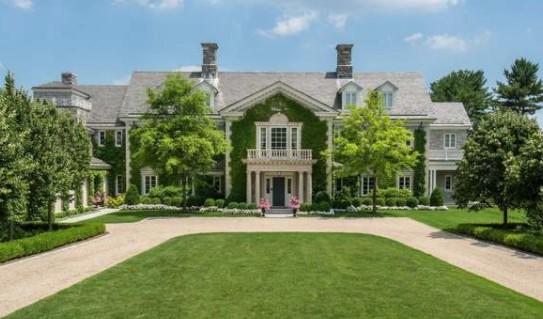
The suburb had been coming off of a long stretch where home prices were faltering and sales were slowing. But the large estates that had fallen out of favor are now once again in demand. Buyers are once again placing premiums on luxuries like swimming pools and “enough land for socially distant gatherings”, Bloomberg notes.

Brokerage manager David Haffenreffer said: “With bigger homes, you’ve got the opportunity to have extended family with you, but also more amenities on-site. You can spread out and live that quarantine life in a more-liberated way.”

The section of town called “Back Country”, which features large properties on large lots, saw the biggest leap in prices. 

Scott Durkin, president of Douglas Elliman said: “We couldn’t give Back Country away, it was too far away from downtown.” Now, he says the area has become the “most requested”. 

And the trend shows no sign of slowing. As of September, there were 172 homes under contract, an almost 100% increase from the year prior. Haffenreffer concluded: “This could last a while. I don’t see what it is that could turn this on its head.”

    via ZeroHedge News https://ift.tt/34eug2u Tyler Durden

    White House Chief Of Staff Warns Of Potential Lawsuit Against Tech Giants

    White House Chief Of Staff Warns Of Potential Lawsuit Against Tech Giants

    Tyler Durden

    Mon, 10/19/2020 – 21:00

    Authored by Masooma Haq via The Epoch Times,

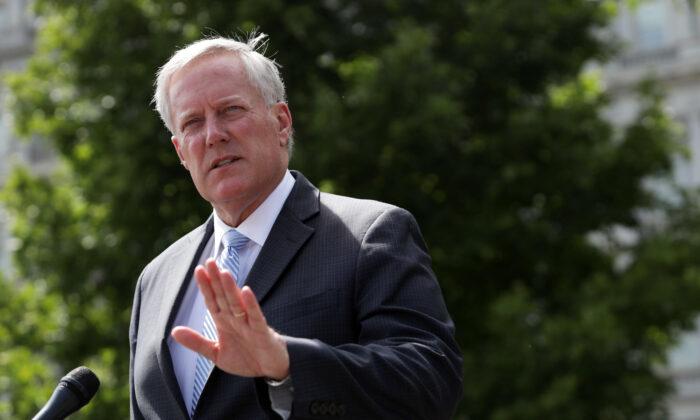
    White House chief of staff Mark Meadows on Monday suggested that the Trump administration would bring a lawsuit against the social media companies that have recently restricted and blocked news reports about Democratic presidential nominee Joe Biden and his son Hunter.

    In an interview on “Fox & Friends,” Meadows said that the online platforms try to censor conservatives and suggested that if the story about Joe and Hunter Biden was about President Donald Trump and his family, tech companies would have not blocked the story.

    They have two standards: one for one campaign, one for the other. But I do believe that additional lawsuits will be filed perhaps as early as today to go after that,” Meadows said.

    “Listen, it’s not just the campaigns,” he added. “They’re now starting to censor, actually, reporters. That’s a dangerous place for them to go when they’re the arbiter of what they deem to be the truth.”

    The Chief of Staff’s comments come in the wake of a report by the New York Post alleging to have obtained emails from a laptop belonging to Hunter Biden. Many Democrats have claimed the story is an effort to discredit Joe Biden and an attempt by Russia to help elect Trump. So far, neither of the Bidens have denied the authenticity of the emails.

    The threat of a lawsuit was also prompted by the actions Twitter took to lock Trump’s reelection campaign account last Thursday for trying to share the New York Post story.

    Meadows said he has not received any intelligence suggesting that the Russians were involved in the emails being extracted from Hunter Biden’s laptop as Rep. Adam Schiff (D-Calif.) has alleged.

    “All of this narrative that is out there that would suggest that it’s not real, that’s the disinformation. You know, Adam Schiff came on and said, ‘Oh, this is Russia, Russia, Russia,’ and again, I can tell you this is Adam Schiff once again trying to spin a story that’s not accurate.” Meadows said,

    “I talked to director Ratcliffe over the weekend and I said, ‘Listen, if this is a Russian disinformation campaign, we need to make sure the American people know that.’ His response to me is that he had no knowledge of that.”

    Schiff, who is the chairman of the House intelligence committee, has repeatedly asserted, without evidence, that the Trump 2016 campaign colluded with Russia and now is claiming that Trump is working with Russia to hurt Biden’s campaign.

    “We know that this whole smear on Joe Biden comes from the Kremlin,” the California Democrat said on CNN last week, claiming that “the Kremlin has an obvious interest in denigrating Joe Biden,” and that “they want Donald Trump to win.”

    When Schiff was asked about specific intelligence about the Kremlin’s involvement with disinformation about Biden, the Representative was unable to provide any evidence, saying that the Director of National Intelligence, John Ratcliffe was not “forthcoming” with intelligence.

    “And frankly, we haven’t got much from the intelligence community very recently, which concerns me,” added Schiff.

    Meanwhile, Ratcliffe told Fox News on Monday that there is no intelligence to suggest the Hunter Biden email scandal is led by Russia.

    “It’s funny that some of the people who complain the most about intelligence being politicized are the ones politicizing the intelligence,” Ratcliffe said. “Unfortunately, in this case it is Adam Schiff, who said the intelligence community believes the Hunter Biden laptop and emails on it are part of a Russian disinformation campaign.”

    He continued, Let me be clear: the intelligence community doesn’t believe that, because there is no intelligence that supports that. And we have shared no [such] intelligence with Chairman Schiff or any other member of Congress.”

    via ZeroHedge News https://ift.tt/34anF9l Tyler Durden

    “Nasdaq Whale” Doubles Down: SoftBank Ups Tech Stock Holdings To $20 Billion

    “Nasdaq Whale” Doubles Down: SoftBank Ups Tech Stock Holdings To $20 Billion

    Tyler Durden

    Mon, 10/19/2020 – 20:49

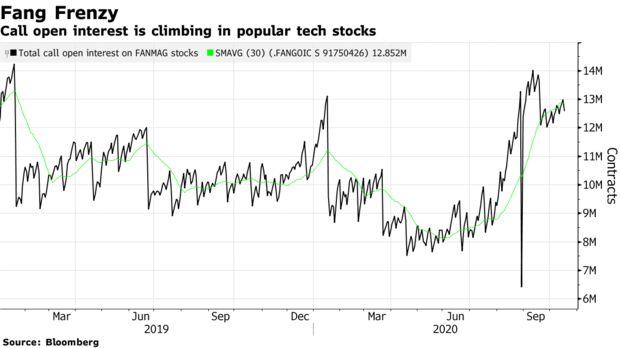
    One month ago, when we first reported that SoftBank was the “Nasdaq Whale” responsible for the gamma meltup across some of the largest tech names which quickly led to marketwide levitation across the entire stock market – as the Japanese conglomerate was furiously buying call spreads in a generally illiquid market and forcing dealers who were short gamma to delta hedge at ever higher prices creating a upward price feedback loop – we observed that according to Bloomberg’s previous reporting, SoftBank had been targeting investments of approximately $10 billion in public stocks as part of a new asset management arm, far exceeding the initial holdings that founder Masayoshi Son outlined to shareholders in the company’s latest earnings call, and a break from the company’s strategy of investing in private names.

    Then, two weeks ago, the Nasdaq Whale made a repeat appearance, when we reported that SoftBank was back for round two: as SpotGamma wrote, highlighting the strong rally in many tech names “there are notes out detailing large options positions building in tech. Looking at FB as an example you can see how call activity has picked up over the last two weeks” and “this chasm between call & put gamma is starting to look similar to that of early August.”

    This was confirmed that same day by CNBC’s David Faber who said that on Oct 1, SoftBank had bought $200M worth of calls in NFLX, AMZN, FB and GOOGL.

    But if SoftBank had built up a $10 billion stake in public tech stocks by mid-August, how big was its position now that it appeared to be doubling down? Well, there’s your hint right there: according to a new Bloomberg report, SoftBank has doubled its equity positions to more than $20 billion despite what was initially a skeptical response from shareholders, one which prompted the bank to announce it would not act as a Robinhood-esque hedge fund chasing momentum stocks, and would consider tempering its trading plans in early September after reports that SoftBank’s spending spree was stirring froth in tech stocks.

    Yet despite the news costing SoftBank about $9 billion in market value at the time, with the stock rebounding Masa Son has re-reconsidered and is now literally doubling down.

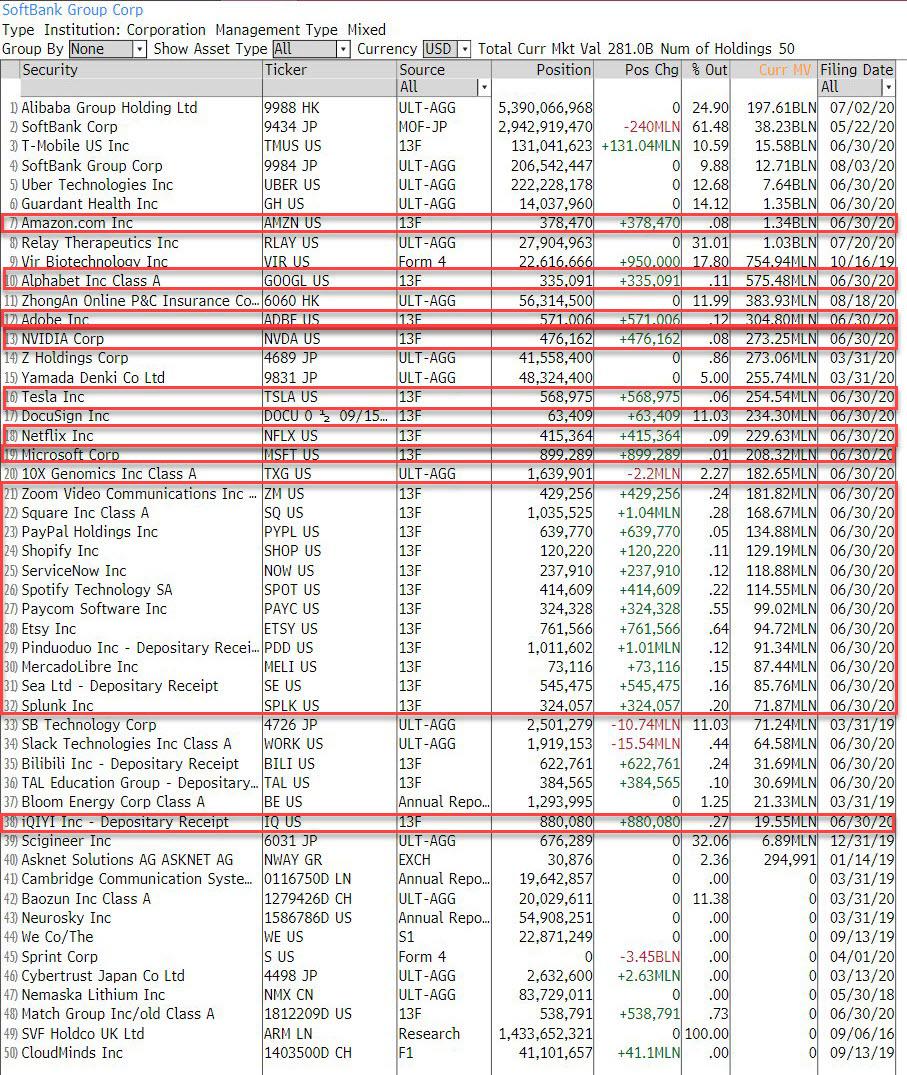
    In its public filings, SoftBank disclosed holdings of “only” $3.9 billion in stocks such high beta tech names as Amazon, Alphabet NVidia and Netflix…

    … however, it has since bought a lot more stocks. Curiously, according to Bloomberg, while focusing on major tech stocks, SoftBank has also been expanding to smaller companies. Last week, it invested $215 million in Norway-based Kahoot, which makes education software.

    So what is SoftBank’s thinking this time behind its “renewed commitment” to the public equities trading arm? According to Bloomberg sources, the strategy – which consists of buying out-of-the-money call options funded by selling calls at even higher prices – is “built around expectations of a volatile third-quarter earnings season.” That, however, makes no sense because SoftBank’s strategy is fundamentally a bullish bet, and anything but a vol hedge. In fact, as August demonstrated, if done in size and if it triggers another gamma melt-up, such call spread buying itself can become the catalyst the pushes stocks higher. And that’s precisely the strategy adopted by Masa Son and implemented by former Deutsche Bank trader Akshay Naheta, first identified here and whom we called the “gamma whale.

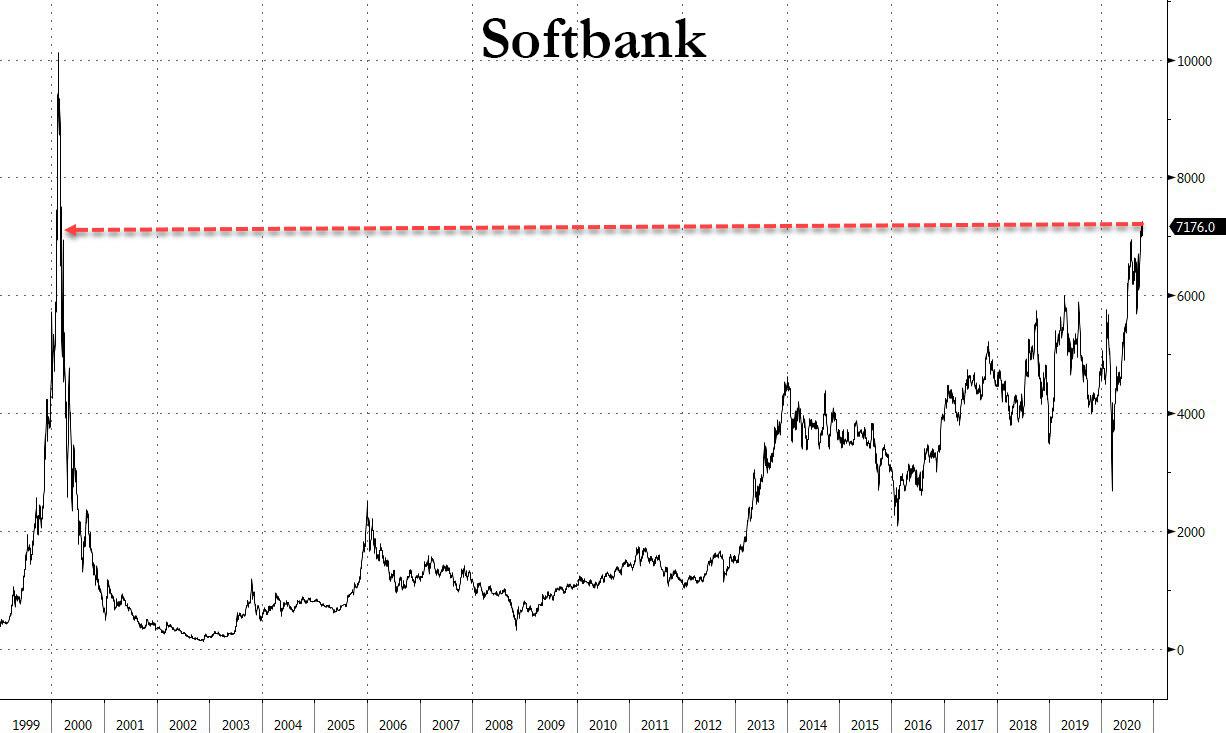
    And now that this information is public amid renewed chatter of yet another gamma squeeze, will SoftBank fade away as it did in early September when it was first identified? Hardly: if anything Masa Son will triple down. After all, for the Japanese billionaire, the only thing that matters is SoftBank’s stock price, and that just happened to hit a 20 year high on monday, the highest since the March 2000 dot com boom.

    In fact, looking at the chart above, it is very likely that Masa Son will aggressively continue to expand this strategy until softbank’s stock price regains it all time bubble highs.

    via ZeroHedge News https://ift.tt/3jf7M5Q Tyler Durden

    “Nasdaq Whale” Doubles Down: SoftBank Ups Tech Stock Holdings To $20 Billion

    “Nasdaq Whale” Doubles Down: SoftBank Ups Tech Stock Holdings To $20 Billion

    Tyler Durden

    Mon, 10/19/2020 – 20:49

    One month ago, when we first reported that SoftBank was the “Nasdaq Whale” responsible for the gamma meltup across some of the largest tech names which quickly led to marketwide levitation across the entire stock market – as the Japanese conglomerate was furiously buying call spreads in a generally illiquid market and forcing dealers who were short gamma to delta hedge at ever higher prices creating a upward price feedback loop – we observed that according to Bloomberg’s previous reporting, SoftBank had been targeting investments of approximately $10 billion in public stocks as part of a new asset management arm, far exceeding the initial holdings that founder Masayoshi Son outlined to shareholders in the company’s latest earnings call, and a break from the company’s strategy of investing in private names.

    Then, two weeks ago, the Nasdaq Whale made a repeat appearance, when we reported that SoftBank was back for round two: as SpotGamma wrote, highlighting the strong rally in many tech names “there are notes out detailing large options positions building in tech. Looking at FB as an example you can see how call activity has picked up over the last two weeks” and “this chasm between call & put gamma is starting to look similar to that of early August.”

    This was confirmed that same day by CNBC’s David Faber who said that on Oct 1, SoftBank had bought $200M worth of calls in NFLX, AMZN, FB and GOOGL.

    But if SoftBank had built up a $10 billion stake in public tech stocks by mid-August, how big was its position now that it appeared to be doubling down? Well, there’s your hint right there: according to a new Bloomberg report, SoftBank has doubled its equity positions to more than $20 billion despite what was initially a skeptical response from shareholders, one which prompted the bank to announce it would not act as a Robinhood-esque hedge fund chasing momentum stocks, and would consider tempering its trading plans in early September after reports that SoftBank’s spending spree was stirring froth in tech stocks.

    Yet despite the news costing SoftBank about $9 billion in market value at the time, with the stock rebounding Masa Son has re-reconsidered and is now literally doubling down.

    In its public filings, SoftBank disclosed holdings of “only” $3.9 billion in stocks such high beta tech names as Amazon, Alphabet NVidia and Netflix…

    … however, it has since bought a lot more stocks. Curiously, according to Bloomberg, while focusing on major tech stocks, SoftBank has also been expanding to smaller companies. Last week, it invested $215 million in Norway-based Kahoot, which makes education software.

    So what is SoftBank’s thinking this time behind its “renewed commitment” to the public equities trading arm? According to Bloomberg sources, the strategy – which consists of buying out-of-the-money call options funded by selling calls at even higher prices – is “built around expectations of a volatile third-quarter earnings season.” That, however, makes no sense because SoftBank’s strategy is fundamentally a bullish bet, and anything but a vol hedge. In fact, as August demonstrated, if done in size and if it triggers another gamma melt-up, such call spread buying itself can become the catalyst the pushes stocks higher. And that’s precisely the strategy adopted by Masa Son and implemented by former Deutsche Bank trader Akshay Naheta, first identified here and whom we called the “gamma whale.

    And now that this information is public amid renewed chatter of yet another gamma squeeze, will SoftBank fade away as it did in early September when it was first identified? Hardly: if anything Masa Son will triple down. After all, for the Japanese billionaire, the only thing that matters is SoftBank’s stock price, and that just happened to hit a 20 year high on monday, the highest since the March 2000 dot com boom.

    In fact, looking at the chart above, it is very likely that Masa Son will aggressively continue to expand this strategy until softbank’s stock price regains it all time bubble highs.

    via ZeroHedge News https://ift.tt/3jf7M5Q Tyler Durden

    Indian Police Catch Smuggler With 2 Pounds Of Gold Stuffed In His Rectum

    Indian Police Catch Smuggler With 2 Pounds Of Gold Stuffed In His Rectum

    Tyler Durden

    Mon, 10/19/2020 – 20:40

    A man flying in from Dubai was caught trying to enter the Indian city of Kerala with nearly 1 kilogram (roughly 2.2 pounds) in gold bullion hidden inside his rectum. The man arrived at Kerala’s Kannur airport on a GoAir flight from Dubai.

    According to the National Journal, airport intelligence officers spotted the man waddling through the airport and decided he looked suspicious. After executing a search, they soon found 972 grams of flattened gold coins inside the man’s rectum.

    Another passenger on the same flight in from Dubai was caught trying to smuggle roughly 1.5 kilos, though the report didn’t provide any details on his situation.

    The following day, the customs office seized 386g of gold from a passenger who landed in the coastal city of Kozhikode on an Air Arabia flight from Sharjah, another city in the UAE.

    Local officials said the gold was hidden in the traveler’s underwear in an attempt to avoid declaring it.

    Indian police have reported a surge in criminal gangs trying to smuggle gold into the country in recent months, presumably as India’s punishing COVID-19 lockdown ravaged the country’s economy. Customs officials said smugglers returning to India typically mask the gold in chocolate boxes, purses, umbrellas or even in pens in attempts to try and evade taxes.

    UAE and Indian officials said they were working to trace the crime syndicate.

    Gold prices have surged in 2020 as central banks unleashed a flood of liquidity to try and help mitigate the economic fallout of the lockdowns that rattled the global economy earlier this year.

    Of course, gold smuggling isn’t only a problem in India, where the precious metal has important cultural significance and a major role in weddings.

    via ZeroHedge News https://ift.tt/3ofoBRZ Tyler Durden

    Democrat-Run Chicago Broke As Mayor Mulls Tax Hikes & Layoffs To Plug $1.2BN Budget Gap

    Democrat-Run Chicago Broke As Mayor Mulls Tax Hikes & Layoffs To Plug $1.2BN Budget Gap

    Tyler Durden

    Mon, 10/19/2020 – 20:20

    In a sign of where the entire country could soon find itself, the Democrat-run city of Chicago isn’t just facing soaring violent crime, but is staring down a whopping $1.2 billion budget deficit, the Chicago Tribune reports.

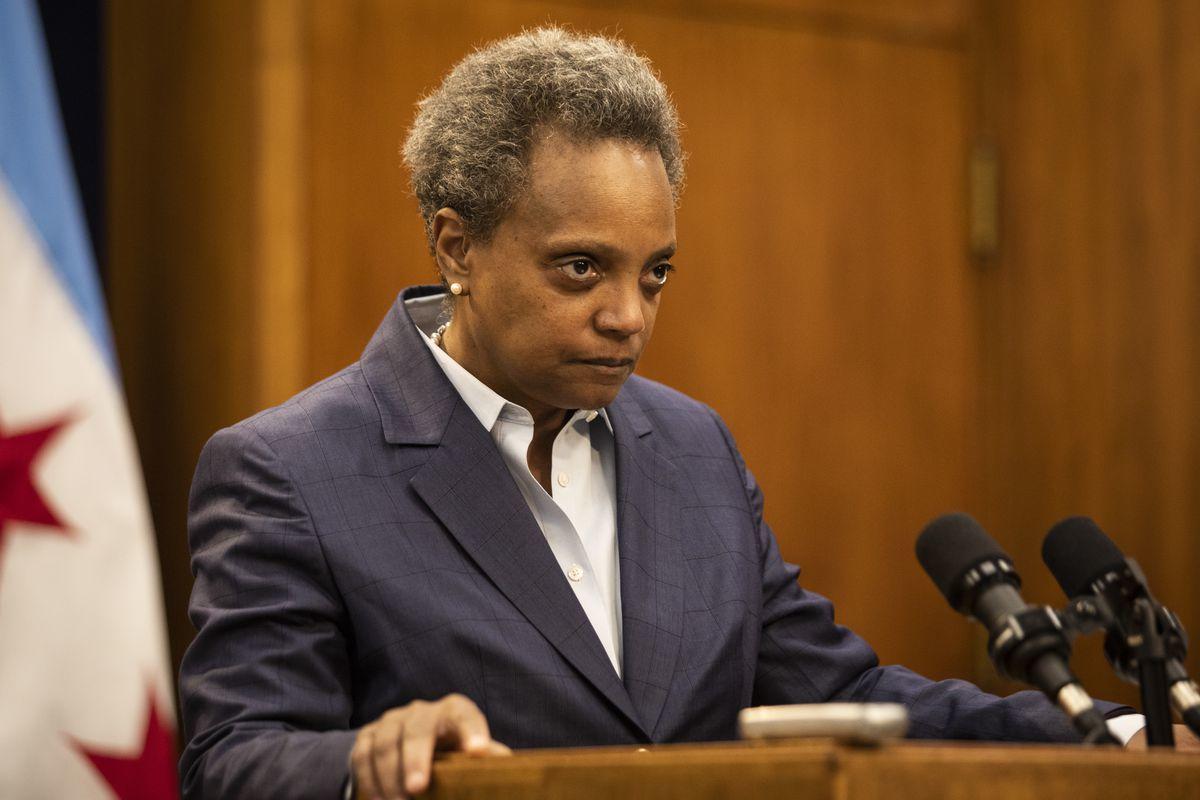
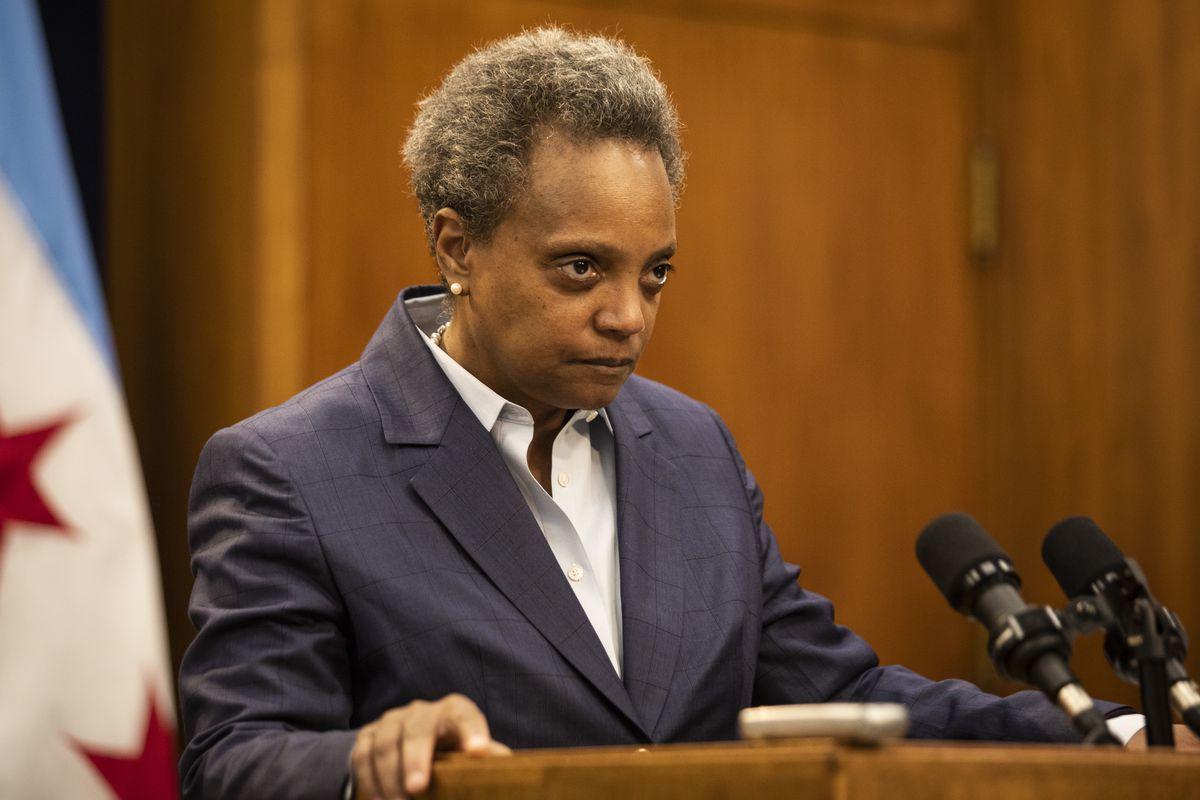
    Naturally the response to what some are already excusing as the city’s “coronavirus-fueled budget deficit” is for Mayor Lori Lightfoot to immediately talk massive tax hikes to plug the hole.

    Mayor of Chicago Lori Lightfoot, via Chicago Sun-Times

    “Chicago Mayor Lori Lightfoot is considering a $94 million property tax increase, layoffs for more than 300 city workers and a gas tax hike as part of her plan to close a $1.2 billion budget deficit, sources told the Tribune,” the report says.

    She’s expected to present her plan on Wednesday, which is according to a summary in Fox and Chicago Tribune to additionally include:

    • a five-day furlough for all nonunion city employees 
    • shifting some costs onto the books of the Chicago Public Schools  
    • …including asking Chicago Public Schools to reimburse city for $40 million more in school pension contributions
    • raising the cloud-computing tax
    • up to 350 layoffs of civic employees
    • possible $77 million in cuts to unfilled positions, or more than 1,000 vacancies

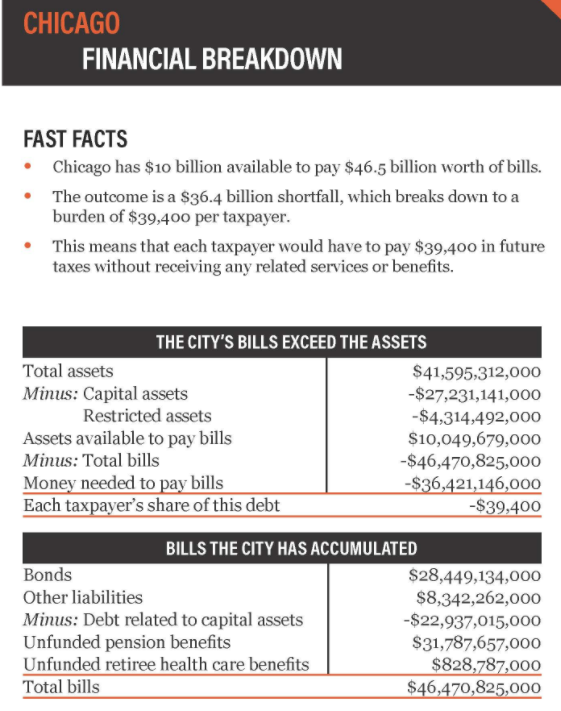
    The problems have been building for years, given already the city was strapped with $46.5 billion in unpaid bills and only a reported $10 billion cash on hand, based on a damning review of the city’s finances released this summer by Truth in Accounting.

    Figures as of July 2020:

    Trump and other Republican leaders have lately seized on rampant mismanagement on display in Democrat-run cities, in some instances with the president personally calling out “wacky” mayors, such as recently with Portland.

    Let’s hope the proposed layoffs and furloughs of city employees don’t cut into the already understaffed police force, given that as things currently stand law enforcement clearly can’t get the soaring violent crime and murder rate under control, also at a moment far-Left activists have demanded the disbanding of the police.

    Progressive activists have claimed the problem is the opposite – that Chicago PD currently takes too big a cut of the city’s budget and resources. 

    via ZeroHedge News https://ift.tt/3dEVVwC Tyler Durden

    Trump Announces Sudan’s Removal From Terror List, Paving Way For Israel Peace Deal

    Trump Announces Sudan’s Removal From Terror List, Paving Way For Israel Peace Deal

    Tyler Durden

    Mon, 10/19/2020 – 20:00

    President Trump indicated via a Tweet Monday afternoon that he is removing Sudan from the official terror blacklist as the Arab League nation is inching closer toward normalizing ties with Israel.

    The president indicated that Sudan, which has long been on the list based on allegations of providing covert support to Islamic militants that have carried out attacks on Americans, has agreed to set aside $335 million for payments for American victims of terrorism in the region.

    For example, Washington would later blame Sudan in part for funding operations related to the deadly al-Qaeda twin bombings of the US embassies in Kenya and Tanzania in 1998, which had killed 224 people, including 12 Americans. Another 5,000 people were injured in the major attacks. Sudan was known have given safe-haven to Osama bin Laden at one point.

    This means Sudan is likely to become the third Arab League member state to normalize ties with Israel, after the UAE and Bahrain inked historic, unprecedented agreements to establish peaceful diplomatic relations and economic cooperation. 

    The timing is also crucial, given that just weeks before the Nov.3 election, the White House could tout this as a major foreign policy win.

    US Secretary of State Mike Pompeo on an official visit to Khartoum, Sudan in August. AFP via Getty Images

    Talks between Sudan and Israel have been underway for some time, but full diplomatic recognition has recently been stalled after Sudan officials accused the US of threatening the country with remaining on the terrorism list if it didn’t accept the normalization deal with Israel. 

    Sudan has been on the State Department’s list going all the way back to 1993, amid the lengthy rule of strongman Omar al-Bashir, who was toppled by Sudanese Army coup d’état in 2019.

    During the post-9/11 ‘war on terror’ Sudan became under even more scrutiny.

    Israeli Prime Minister Benjamin Netanyahu and Sudanese Governing Council Chairman Abdel Fattah Al-Burhan will are expected to meet in Uganda.

    Concerning the 1998 embassy bombings, Voice of America has recently detailed that “Leading up to the attacks, the Sudanese government harbored the al-Qaeda militants, providing them with Sudanese passports and allowed them to transport weapons and money across the border into Kenya.”

    “Sudan had also given safe haven to Osama Bin Laden leading the U.S. State Department to place the country on a list of state sponsors of terrorism in 1993,” the report underscored.  

    via ZeroHedge News https://ift.tt/34ff857 Tyler Durden