Americans Can No Longer Afford The Luxury Of Caring If Trump Did This Or That

Americans Can No Longer Afford The Luxury Of Caring If Trump Did This Or That

Tyler Durden

Wed, 10/07/2020 – 13:00

Authored by Bruce Wilds via Advancing Time blog,

Many Americans no longer care what Trump has done or not done. When it comes to choosing between him and Joe Biden as our President, far greater issues loom before us than Trump’s past. As for the thought of Russia’s meddling in the 2016 election or whether Trump colluded with the Russians, by now most people seem to have made up their mind. People are either outraged, simply concerned, or taken the attitude this is all a big nothing burger and lies promoted by is enemies.
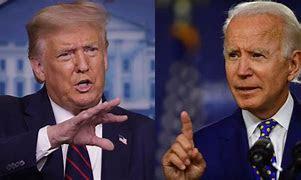
We Have Two Starkly Different Paths Forward

Today few Americans are concerned as to whether President Trump had a closer relationship with Russia at any point before his election than he leads on. This runs directly up against the question of how much it matters, does it impact national security, as the deep state claims, and does the average American even care? Things are much different than in mid-December of 2018 when there was a huge dust-up as new statements and “allegations” surfaced having to do with Trump’s sexual adventures. These “misdoings of a personal nature” took front and center. Of course, at the time those attempting to impeach and ouster the Donald latched on to these claims thinking they would be the final nail in his coffin.

Back then the story surrounded Trump’s former attorney Michael Cohen and the parent company of the National Enquirer, American Media Inc. (AMI), admitting responsibility for its role in a $150,000 “catch-and-kill” hush money payment to a former Playboy Playmate. The Playmate, Karen McDougal, alleged that she had an affair with Donald Trump in 2006. Under a non-prosecution agreement, AMI admitted that it refused to publish Karen McDougal’s claim to prevent it from influencing the election by damaging Trump.
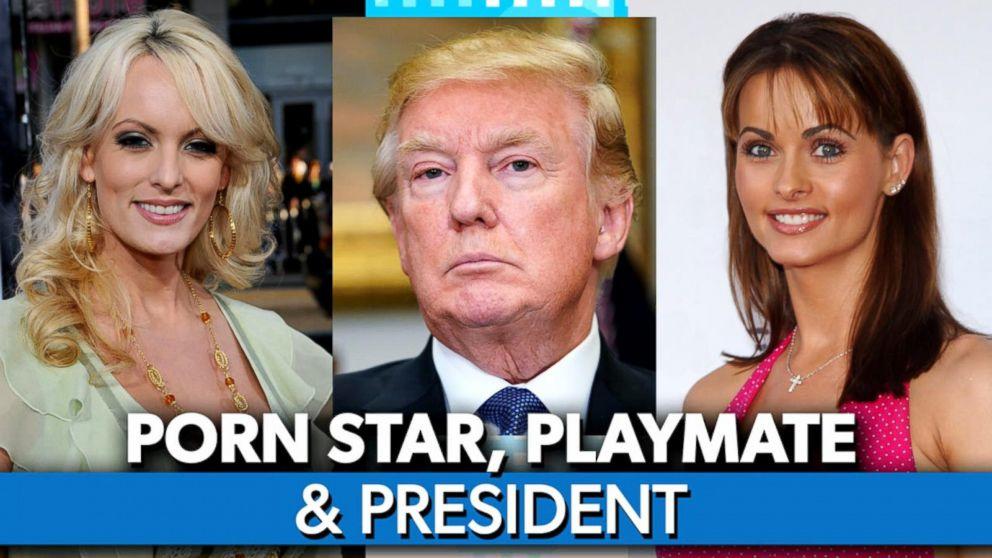
Do Voters Care If Trump Was A Womanizer?

The “womanizer” episode of the “dump Trump” saga lasted a short time with the never-ending Washington sideshow ramping up as the mainstream media kept us a “breast” of every salacious detail. They even provided us with eye-candy suggestive photos of all lewd, crude, and improper conduct our current Pervert and Chief may have touched on. With everyone all a tither with speculation, this gave lobbyists even more time to go about their task of writing legislation giving those they represent an edge. For taxpayers who send representatives to Washington at great expense, this only added to America’s dysfunctional political culture.

When Trump’s past sexual exploits failed to gain traction we saw those pushing for impeachment shift to a strategy centering around a whistle-blower complaint. It claimed President Donald Trump broke the law during a phone call with the Ukrainian president when he threatened to withhold military aid in exchange for a political favor. That complaint was riddled with repeated references to what anonymous officials allegedly told the complainant. These include things such as: “I have received information from multiple U.S. Government officials,” “officials have informed me,” “officials with direct knowledge of the call informed me,” “I was told by White House officials,” “the officials I spoke with,” “I was told that a State Department official,” and more.

These did not prove to be crimes significant enough to merit Trump’s ouster unless expanded into the world of technicalities and lies. This is a place where speculation, who knew what, when, or who said what often rule the day. Again, this brings us back to the question of whether Trump is guilty and does America really care? We can only pray this game of, “if his enemies can’t get Trump on this, they will go after him on that” may have finally run its course.  Unfortunately, this has also raised substantial questions about the intelligence community’s behavior and its growing role in politics.

Is This About His Policies Or Trump As A Man?

Politics should not be the driver as to what is “impeachable behavior.” The standard for removal from office on impeachment should remain the conviction of, treason, bribery, or other high crimes and misdemeanors. Circling back around as to how we got here, A big part of the problem is that Hilary Clinton the Democratic presidential candidate that ran against Trump in 2016 was such a tarnished figure many Americans were left feeling they were forced to chose between the least of two evils.

When it comes to lies, and lying to the people, both political parties should hang their heads in shame. America is not alone when it comes to the rich history of politicians bending the truth, breaking pledges, or committing outright deceit. It is almost as if honesty is in the eye of the beholder and this is where terms like alternative facts come to mind. This is evident when we view the nightly news presented by the main-stream media or look into how big tech companies are manipulation information. Currently, a full-scale propaganda war rages with many Americans hellbent on convincing the rest of us what is really going on. 

Adding to the confusion is that respect for the media, politicians, institutions like the FBI and CIA has fallen to where we are left wondering who to trust. Many Americans are oblivious to the fact the militarization of police forces and government surveillance grew in leaps and bounds during the Obama years. Many of the issues stemming from these trends were not created by Trump but problems he inherited when he took office. The same could be said about trade and China, for decades the trade deficit has increased and many people have been warning of the consequences if it was not addressed.

More overshadowing than any other factor affecting this election is that we are seeing two starkly different paths forward. If Trump is re-elected, the focus will continue to lean toward job creation, increasing our wealth, and letting the private sector, the supply side of the economy, expand as rapidly as possible. Biden’s agenda, in contrast, is more centered on addressing America’s problems with growing economic inequality. This is likely to be accomplished by redistributing more economic opportunities, including some wealth, to the lower and middle classes via government programs.

Joe Biden as a Presidential candidate is not formidable and his past dealings as a politician do not leave him squeaky clean. Looking back at the early primaries leaves many voters wondering what twist of fate reversed the waning fortunes of a campaign that had been considered dead. Another factor we must consider is that both Trump and Biden are not spring chickens and getting a bit long in the tooth. Whether you like him or not, it is difficult to deny that Vice President Pence is far more experienced than first-term Senator Kamala Harris if called upon to step into the role of President.

Whether it was the deep South or the deep State that brought Joe back from the brink we may never know. What we do know is that the economic path Biden wants to take us down will have huge negative social and cultural ramifications. Once America starts down this path the majority of people that always want more will have their way and the checks and balances that have served this country will slip away. That is why in my opinion many American’s will feel they can no longer afford the luxury of caring if Trump did this or that.

via ZeroHedge News https://ift.tt/2GAj8nt Tyler Durden
Disney Jumps After Dan Loeb Urges Dividend Halt, Expansion Of Streaming Services

Disney Jumps After Dan Loeb Urges Dividend Halt, Expansion Of Streaming Services

Tyler Durden

Wed, 10/07/2020 – 12:48

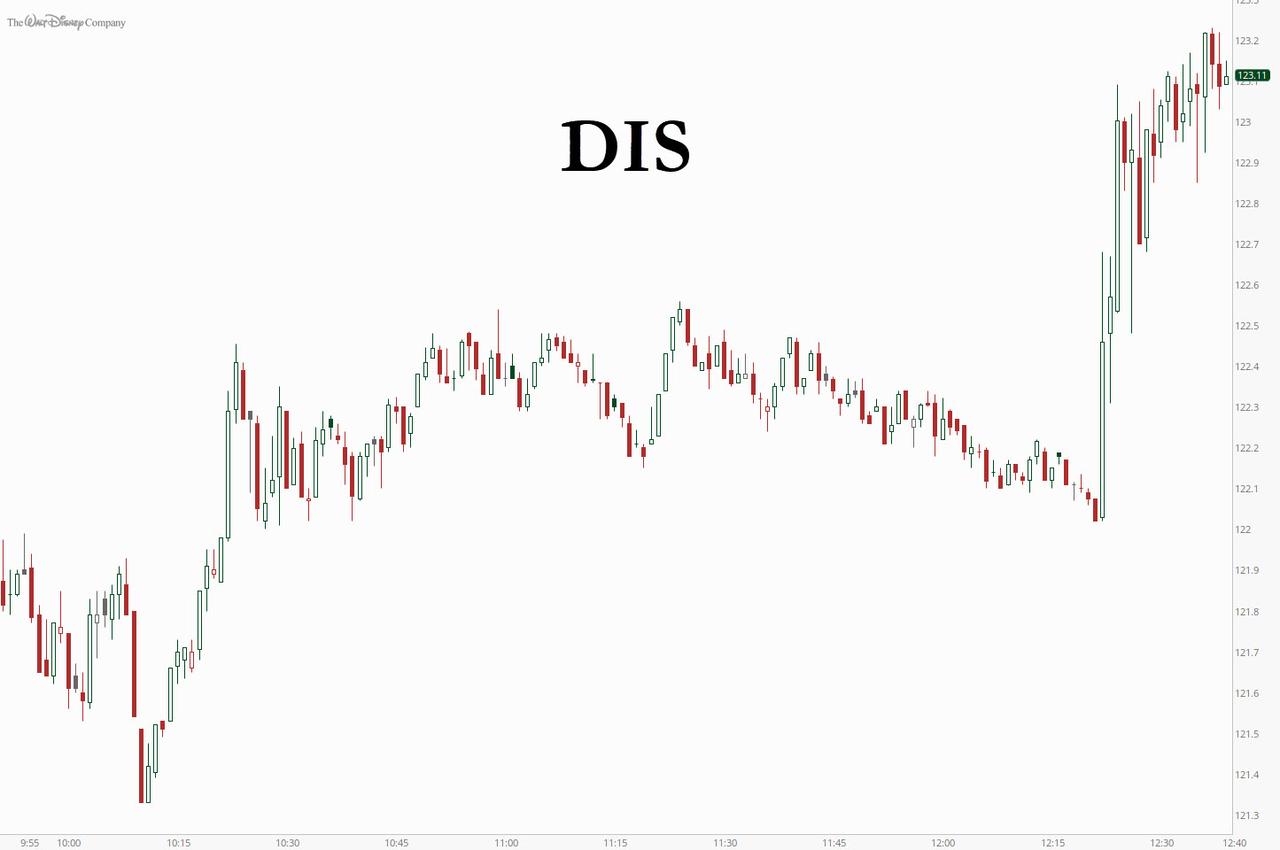
Disney stock jumped just before 1230pm when billionaire and activist scourge of lazy corporate management teams and boards everywhere, Dan Loeb, lobbed a (polite) letter at the Mickey Mouse company, urging it to “permanently suspend” its $3 billion annual dividend and instead redirect those funds to acquiring and producing content for its streaming service, Disney+.

Loeb – who owns less than 1% of DIS – claims that the billions in annual shareholder dividends would be better spent on its direct-to-consumer streaming service, noting that doing so could more than double Disney+’s budget for original content.

“Beyond bringing additional subscribers onto the platform, increased velocity of dedicated content production will deliver several knock-on benefits spread across your existing base including elevated engagement, lower churn, and increased pricing power,” Loeb wrote in the letter, a copy of which was viewed by Bloomberg.

In August, Loeb told investors in his Third Point hedge fund that he opened a new position in the Walt Disney Company during the second quarter based in part on the media giant’s decision to enter the streaming market. Loeb had initiated the long position when Disney shares sank on fears that theme park and movie theater closures would cripple the company. But those concerns, he said, masked a far more compelling opportunity, saying that “streaming is Disney’s biggest market opportunity ever with potentially $500 billion of revenue.” Surely Amazon, Netflix, HBO, NBC and all other companies who are scrambling for market share would beg to differ.

Unlike some of Loeb’s previous, and far more aggressive activist campaigns, this time the 58-year-old billionaire was far more contained, and concluded by saying he wants to maintain cordial relations with the company.

The stock rose less than 1% on the news, as investors were hopeful that Loeb’s involvement could transform the dividend paying media giant into more of a growth company.


via ZeroHedge News https://ift.tt/34BQ0nM Tyler Durden

FOMC Minutes Preview

FOMC Minutes Preview

Tyler Durden

Wed, 10/07/2020 – 12:45

While the release of Minutes for the September FOMC meeting at 2pm today will likely reinforce the recent run of Fed commentary (more fiscal stimulus needed, uncertainties ahead, rates not going anywhere any time soon, etc) the market will be paying particular attention to any remarks on the Fed’s QE purchases, with some expecting the Fed will eventually extend the maturity profile according to NewsSquawk. Furthermore, the minutes are not likely to capture the themes seen in the last week or so (on elections, curve steepening, etc), although any commentary on controlling yields will be taken in the context of the recent yield backup.

Courtesy of NewsSquawk, here is a summary of what to look forward to in today’s Minutes:

  • Average Inflation Targeting: The September FOMC saw the official adoption of the new flexible Average Inflation Target, where  the Fed affirmed that it was willing to let inflation overshoot its 2% target to reach its full employment mandate; there were no

  • changes to its asset purchase remit of USD 120bln across Treasuries, TIPS and MBS, balanced across the term structure.

  • Projections: The economic projections showed that policymakers, in general, do not see PCE inflation reaching 2% until 2023, indicative of a Fed on hold at the lower bound (FFR at 0.00-0.25%) well past the forecast horizon. The minutes could give further insight on the manner in which policy makers are comfortable to let inflation overshoot, i.e. the velocity in which it moves above the 2% target and the ceiling at which it starts becoming a concern if above.

  • Recent Commentary: Fed commentary in recent weeks has been mixed in regard of clarity around what it considers the upper-limit for inflation, where analysts/participants are generally honing in on between 2.25-2.5%. Evans and Barkin said they would be in favor of up to 2.5%; however, Evans said he was in a “distinct minority” in that view. It is most likely that the minutes will showcase the flexibility of the new inflation-targeting framework, looking to avoid asserting steadfast inflation ceilings and instead showing a preference to view the framework as a dynamic process in which the velocity of inflation pressures are also taken into account.

  • QE Maturities: Meanwhile, prior to the meeting, there had been some expectations for either the announcement of a more long-end-focused/formal QE transition, from the current “smooth market functioning” form, or some indication that this was being considered. This did not come to fruition, with Powell not indicating any such consideration in the presser/Q&A either. Therefore, it will be interesting to see if there was any focus on such a transition, and if so, what is keeping the Fed from taking such measures. This week, Fed’s Mester has suggested that the Fed should have the scope to lengthen QE maturities, while other analysts have previously argued that this may help the Fed to achieve more ‘bang for its buck’ with regards to purchases.

Before expectations of another round of fiscal stimulus were reduced, analysts had been highlighting the imbalance of an increasing Treasury supply slate, in addition to more stimulus-induced bill issuance, potentially causing a supply glut in the Treasury market, to which it was considered the Fed would have to step-up further to provide support, particularly at the long-end in wake of record coupon auction sizes. However, with chances of new stimulus before the election now all but gone, and with it the respective ramp-up in Treasury debt issuance, this has reduced/delayed those supply pressures, hence giving the Fed some time to hold off on more asset purchases.

With that said, markets have been pricing an increased probability of a Biden Presidency and Democrat ‘clean sweep’ of Congress; many analysts expect the Treasury will need to boost issuance even further, given Biden’s spending pledges, and that issuance will likely then need to be mopped up by the Fed.

via ZeroHedge News https://ift.tt/36BUA8q Tyler Durden

White House Targets Ant Group, Tencent Payment Systems As Economic Assault On China Continues

White House Targets Ant Group, Tencent Payment Systems As Economic Assault On China Continues

Tyler Durden

Wed, 10/07/2020 – 12:34

As Beijing complains that the WTO that the Trump Administration’s attempt to ban TikTok violates international trade rules, the Trump Administration isn’t slowing down in its economic assault on the Chinese technology industry.

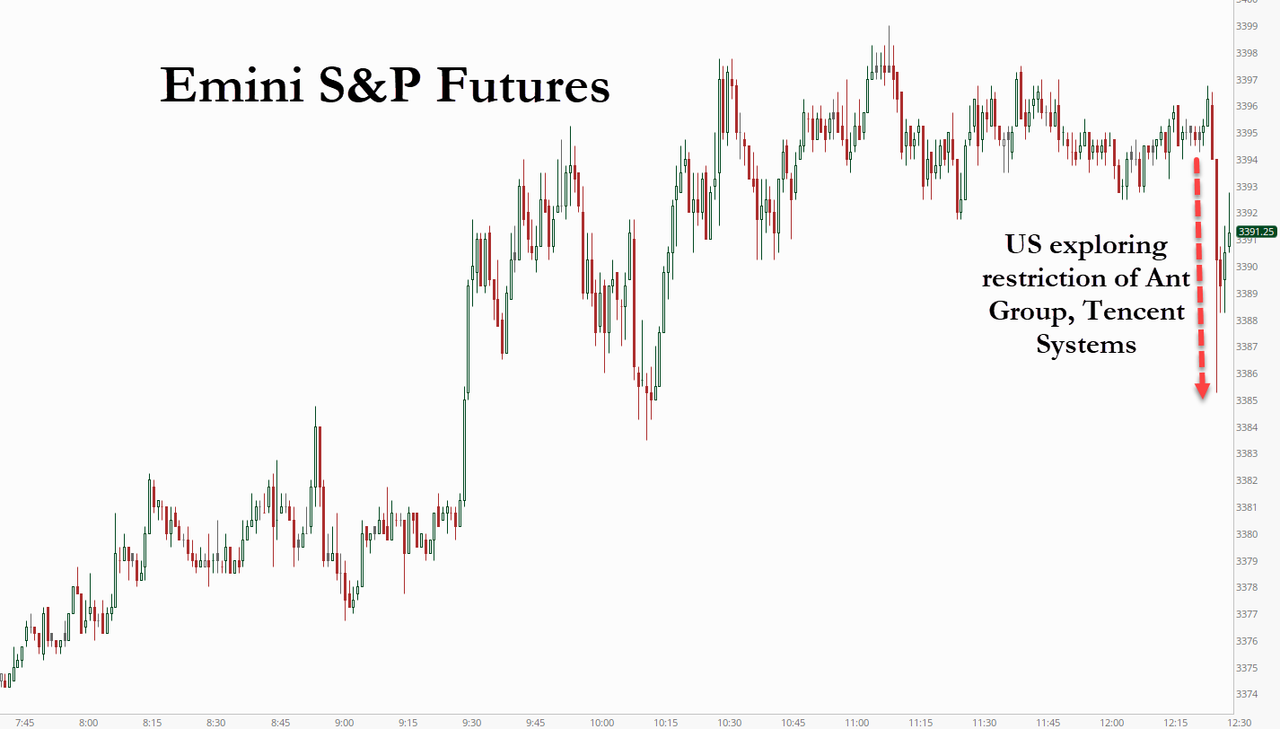
According to media reports, the administration is considering new restrictions on Ant Group and Tencent’s payment systems.

Stocks dumped on the headline, but the gap has filled fast.

By specifically going after the payment systems, the Trump Administration is taking a different approach on trying to curtail Chinese tech firms’ access to American markets and consumers.

via ZeroHedge News https://ift.tt/3iAcivb Tyler Durden

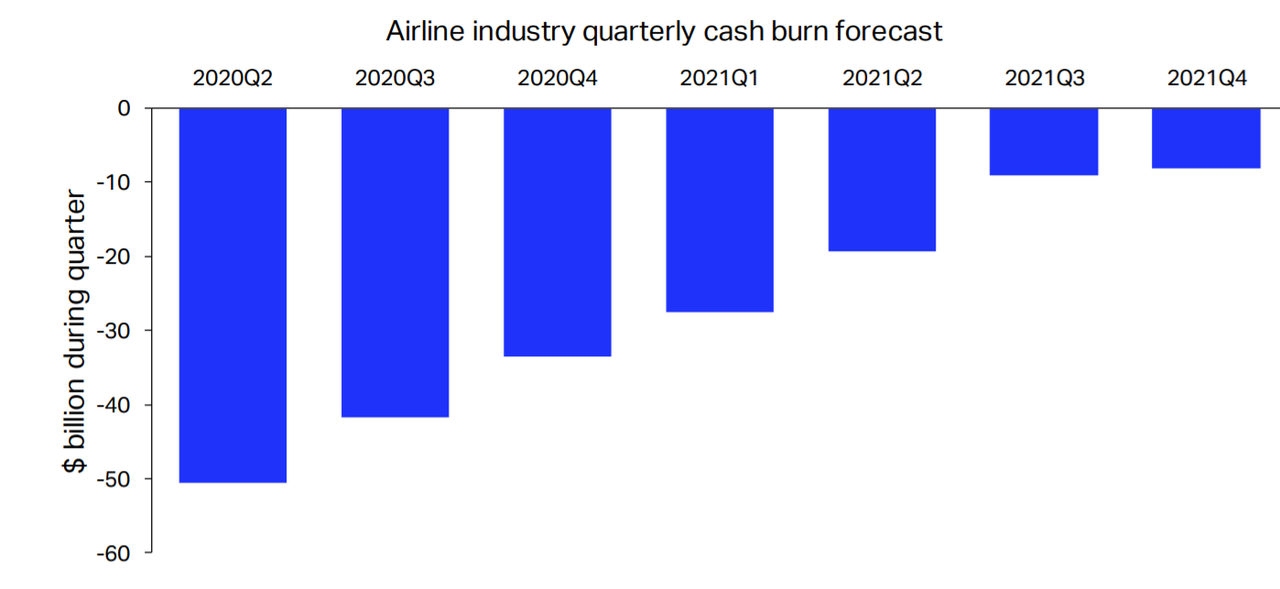
Airlines To Burn Through $128 Billion In Cash By 2022

Airlines To Burn Through $128 Billion In Cash By 2022

Tyler Durden

Wed, 10/07/2020 – 12:25

By Eric Kulish of FreightWaves,

The International Air Transport Association on Tuesday warned that airlines are on track to lose nearly $130 billion this year – significantly more than the group’s June estimate of $84 billion – because of the coronavirus crisis, and that the aviation and travel sectors will be crippled for a long time unless governments increase financial aid.

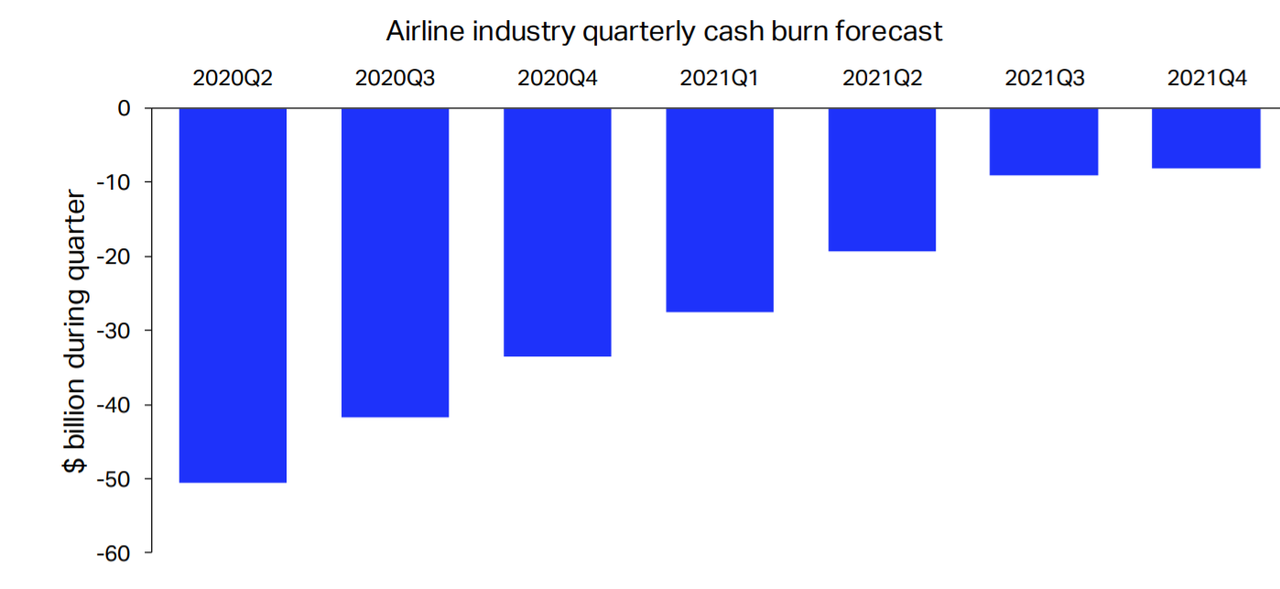
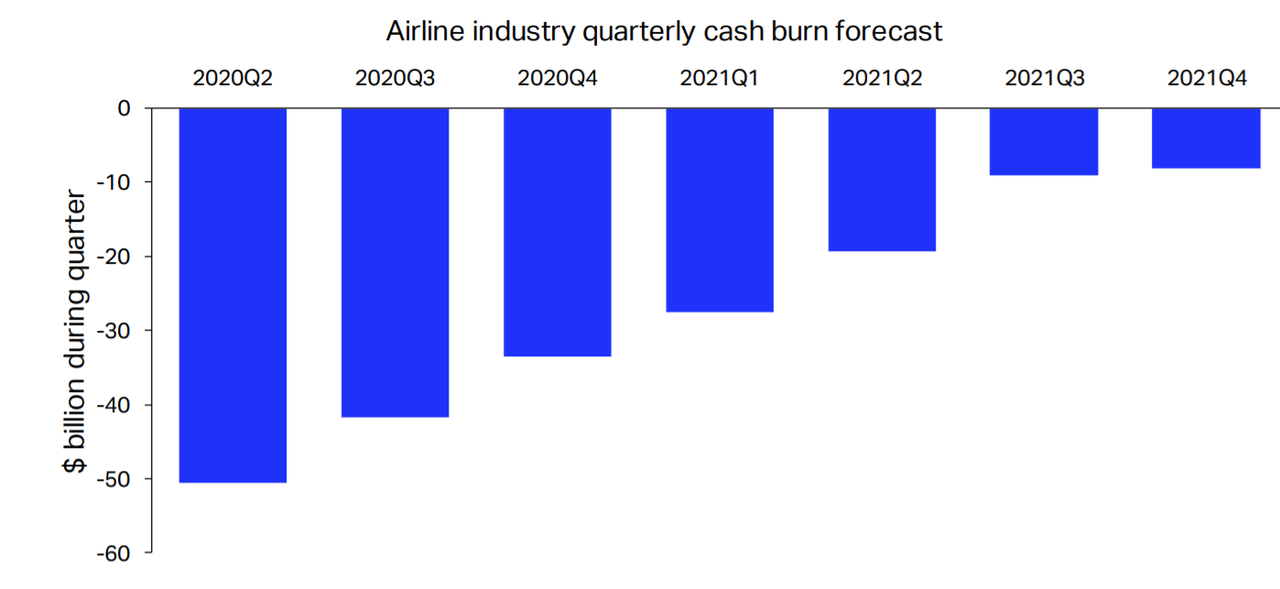
The trade association said member carriers will burn through $77 billion in cash during the second half of 2020, almost $13 billion per month, despite the phased restart of many flight schedules. The slow recovery in air travel means the airline industry will continue to burn cash at an average rate of $5 billion to $6 billion per month in 2021, or $60 billion to $70 billion for the full year.

Already 30 or 40 airlines have failed or gone into bankruptcy restructuring.

The median airline has 8.5 months of cash on hand at the current burn rate, according to IATA.

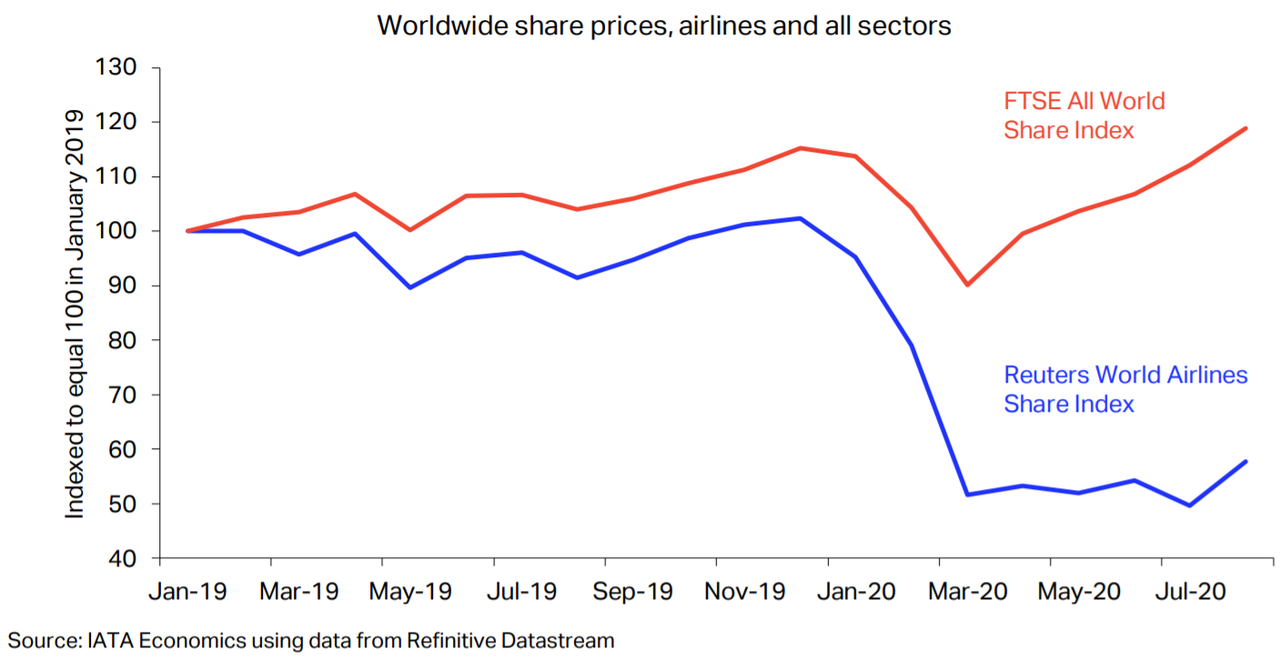
The sector’s uphill climb is illustrated by the fact that airline share prices are 40% below where they were at the start of the pandemic, while investor expectations for the broader market are higher than before.

Director General Alexandre de Juniac repeated pleas for governments to provide a financial bridge for airlines during the winter season that lasts until March, a period when passenger traffic typically subsides and airlines make less money even under good economic conditions. 

Governments so far have provided $162 billion in support through direct grants, loans, wage subsidies, corporate tax relief, fuel tax abatements and other temporary tax holidays. Suppliers have also contributed $20 billion to airlines through givebacks, such as postponing aircraft lease payments and regulatory fees. IATA said government loans are not desirable because airlines are already fully leveraged and would lose years of growth potential if they had to repay the money.

“We are grateful for this support, which is aimed at ensuring that the air transport industry remains viable and ready to reconnect the economies and support millions of jobs in travel and tourism. But the crisis is deeper and longer than any of us could have imagined. And the initial support programs are running out,” de Juniac said in prepared remarks to the media. “Today we must ring the alarm bell again. If these support programs are not replaced or extended, the consequences for an already hobbled industry will be dire.”

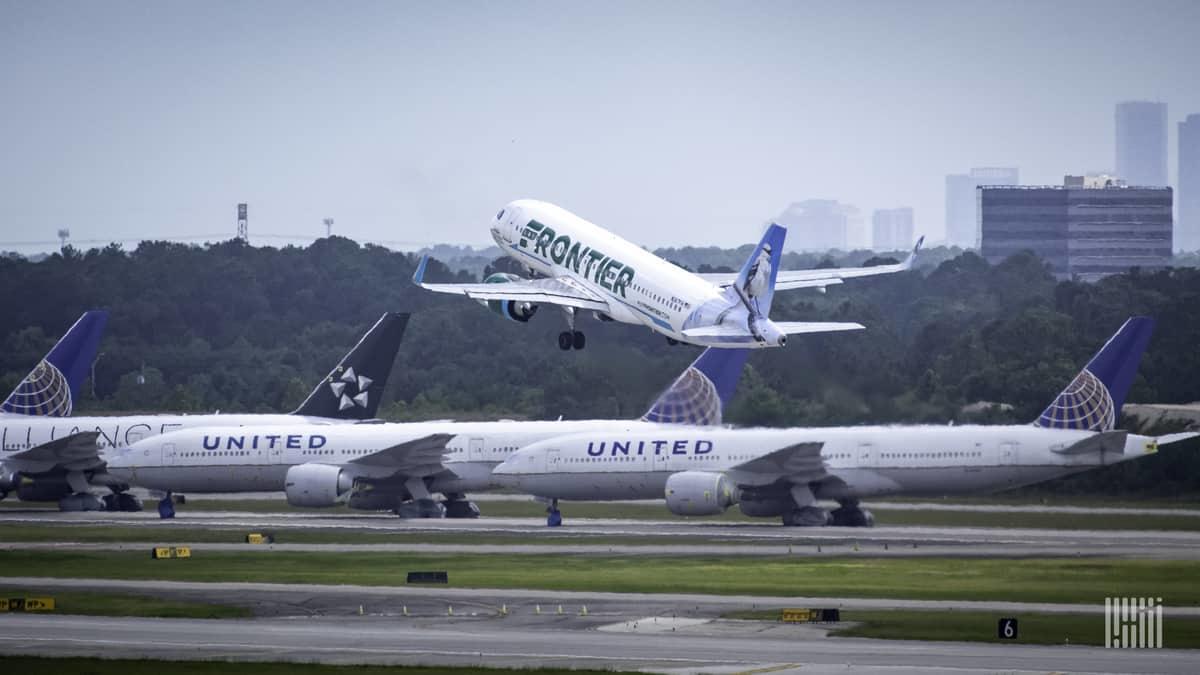
The SOS call came after a six-month U.S. government lifeline expired at the end of September, leading United Airlines (NYSE: UAL) and American Airlines (NASDAQ: AAL) to immediately begin furloughing 32,000 employees. Domestic airlines received $25 billion in direct payroll assistance on the condition that workers would remain on the job and maintain minimum pay and benefits. Airlines had to grant the government warrants for a portion of the money and also had access to another $25 billion in federal loans. But Congress has been unable to agree on a follow-up emergency package despite bipartisan support because any legislation is being considered in the context of a broader, national economic stimulus plan stymied by political divisions.

“Historically, cash generated during the peak summer season helps to support airlines through the leaner winter months. Unfortunately, this year’s disastrous spring and summer provided no cushion. In fact, airlines burned cash throughout the period. And with no timetable for governments to reopen borders without travel-killing quarantines, we cannot rely on a year-end holiday season bounce to provide a bit of extra cash to tide us over until the spring,” said de Juniac.

Governments such as Canada, Singapore, Germany and the U.K. are extending wage subsidy support, but about 30 other programs have expired, or soon will.

Rate hikes no solution

Despite cutting costs by more than 50% during the second quarter, the airline industry blew through $51 billion in cash and liquid assets, or $17 billion per month, as revenues fell almost 80% compared to the same period last year. The industry is projected to lose up to $70 billion in 2021 and not turn cash positive until 2022, according to IATA.

Airlines are already downgrading fourth-quarter traffic forecasts, with expectations that passenger volumes will be 68% below last year’s level in December compared to June’s estimate of -55% growth. That’s only a slight improvement from the 75% year-over-year demand reduction in August. Meanwhile, fares and yields are performing even worse. The plunge in overall revenues comes despite strong increases in cargo revenues as business interest in goods transport grows.

(Source: IATA economic analysis)

Survival tactics included parking thousands of aircraft, cutting routes, eliminating discretionary spending, encouraging hundreds of thousands of workers to take voluntary leaves of absence, and raising billions of dollars in capital.

A big challenge for cost containment is that airlines are unable to cut fleet costs in proportion to the level of travel demand and the fall in revenue, IATA Chief Economist Brian Pearce said. The in-service fleet is only 23% below pre-COVID levels despite demand falling by three-quarters because most travel taking place now is of the short-haul variety, which requires more aircraft to meet service commitments.

Passenger airlines are suffering across the board, but financial health differs based on the ability of a few carriers to raise money in capital markets through stock offerings or mortgaging assets, and which ones receive government aid. Latin American governments, in particular, have not extended much assistance to the industry.

Airlines that depend on corporate travel or connecting flights have found the restart more difficult, Pearce said, putting low-cost airlines with point-to-point service in a somewhat better position to deal with the current environment.

Airlines are expecting a reasonable recovery in traffic and revenues in the second half of next year once a vaccine is available, with the assumption it won’t be available in all markets by then. The extra revenues and reduced costs associated with restructuring should help reduce cash burn, Pearce said.

IATA chief de Juniac said government aid is also necessary for airports and air traffic control organizations. He dismissed suggestions that the aviation sector fund itself by raising rates and fees, saying that would kill demand and precipitate a race to the bottom that many companies would not survive.

“Government support for the entire sector is needed. The impact has spread across the entire travel value chain including our airport and air navigation infrastructure partners who are dependent on pre-crisis levels of traffic to sustain their operations. Rate hikes on system users to make up the gap would be the start of a vicious and unforgiving cycle of further cost pressures and downsizings. That will prolong the crisis for the 10% of global economic activity that is linked to travel and tourism,” said de Juniac.

IATA said consumers are not willing, or able, to pay more for air travel. In a recent IATA survey, about two-thirds of travelers indicated that they will postpone travel until the overall economy or their personal financial situation stabilizes. “Increasing the cost of travel at this sensitive time will delay a return to travel and keep jobs at risk,” said de Juniac.

According to the latest figures from the Air Transport Action Group, a coalition of organizations and companies, the severe downturn this year, combined with a slow recovery, threatens 4.8 million jobs across the entire aviation sector by early next year — a 43% reduction from pre-COVID levels. Up to 46 million jobs are at risk when indirect employment in tourism, construction, catering and professional services is counted, putting $1.8 trillion of economic activity at risk.

In addition to financial rescue efforts, airports and airlines are insisting that governments loosen what they claim are haphazard and counterproductive border restrictions, quarantine declarations and travel embargoes that are hindering growth in travel. Instead, they are pushing for pre-departure testing to guide case-by-case decisions on who should travel. 

The airline industry has previously asked governments to relax slot rules at busy airports that require carriers to use 80% of their allocated takeoff and landing windows or lose them to competitors. Otherwise, many airlines will be forced to defend all-important airport access by operating money-losing flights at a time when they can least afford to do so, IATA says. 

On Monday, the U.S. Department of Transportation extended until March 27 a waiver of minimum slot rules at five major international gateways, as long as foreign countries offer reciprocal treatment for U.S. carriers, in order to give airlines maximum operational flexibility. It also waived rules at New York LaGuardia and Ronald Reagan Washington National Airport, both slot-controlled airports that primarily serve domestic destinations.

via ZeroHedge News https://ift.tt/3deibx9 Tyler Durden

Wells Fargo Cuts 700 Jobs As COVID-19-Inspired Bloodletting Begins

Wells Fargo Cuts 700 Jobs As COVID-19-Inspired Bloodletting Begins

Tyler Durden

Wed, 10/07/2020 – 12:10

Roughly one week after Wells Fargo and a handful of other Wall Street banks announced plans to re-start layoffs now that their coronavirus-inspired (and, in some cases, PPP-inspired) moratoriums had come to an end, the San Francisco-based bank best known in recent years for scamming retail customers and botching small business refi loans has announced the first 700 layoffs in a scheme that will eventually cull tens of thousands of jobs.

According to Bloomberg, Wells is cutting 700 positions from its commercial-banking unit. The bank said the cuts will impact business lines across the division. The commercial banking division typically services businesses with at least $5 million in annual sales, according to a company spokeswoman.

That would suggest that Wells Fargo is cutting back more on the commercial banking side as it re-focuses on its consumer-banking strengths, like mortgages, amid a booming housing market and rock-bottom interest rates. 

Wells Fargo has long been the US banking industry’s largest employer, given its domestic, retail-oriented focus, and traditional dominance west of the Mississippi.

That Wells was the first US megabank to announce plans to re-start layoffs is hardly surprising: As Bloomberg notes, the bank is under enormous pressure to spend less after slashing its dividend by 80% after Q2 earnings sank deep into the red.

As if the coronavirus-sickened economy and low interest rates weren’t enough, Wells is still operating with the albatross of a Federal Reserve cap on balance sheet growth (which had to be eased earlier this year so the bank could participate in the ‘Paycheck Protection Program’).

To be sure, not all of CEO Charlie Scharf’s projected cost-savings will come from layoffs: the bank expects “to reduce the size of our workforce through a combination of attrition, the elimination of open roles and job displacements,” one Wells spokeswoman told Bloomberg.

“We are at the beginning of a multiyear effort to build a stronger, more efficient company for our customers, employees, communities and shareholders,” Ellis said in a statement. “As part of this work, we will have impacts, including job reductions, in nearly all of our functions and business lines, including commercial banking, where we have started displacements.”

While Wells’ layoffs probably look huge compared to its American peers, two European banking giants – Deutsche Bank and HSBC – currently have it beat, with both banks planning massive head count reductions that amount to the biggest financial services bloodletting since Lehman.

via ZeroHedge News https://ift.tt/3lrlgg3 Tyler Durden

Pelosi Open To Standalone Airline Relief; Direct Payments To Americans Left Hanging

Pelosi Open To Standalone Airline Relief; Direct Payments To Americans Left Hanging

Tyler Durden

Wed, 10/07/2020 – 11:55

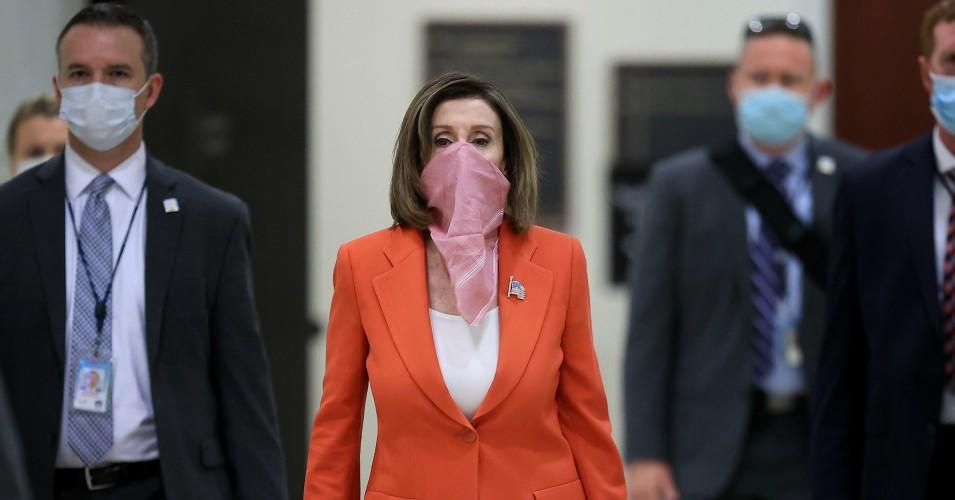
House Speaker Nancy Pelosi (D-CA) has signaled a willingness to consider a standalone airline relief bill during a Wednesday morning telephone conversation with Treasury Secretary Steven Mnuchin, after President Trump pulled the plug on broader stimulus negotiations until after the election.

The secretary inquired about a standalone airlines bill. The speaker reminded him that Republicans blocked that bill on Friday & asked him to review the DeFazio bill so that they could have an informed conversation,” tweeted Pelosi spokesman, Drew Hammill.

And while President Trump mentioned an airline standalone bill following a barrage of Tuesday tweets, Hammill made no mention of the $1,200 direct stimulus payments Trump said he would sign off on “IMMEDIATELY.”

According to Bloomberg, “Mnuchin’s call underscores the Trump administration’s concern about the state of the airline industry, which has been walloped by the Covid-19 crisis and seen tens of thousands of job cuts. Help for the carriers had been part of a broader coronavirus relief package negotiation, which Trump abruptly ended Tuesday.”

As Goldman Sachs notes, “Since the White House and Democratic leaders appear to support standalone airline relief legislation, enactment of another $25bn in airline aid looks increasingly likely.”

And if airline aid isn’t passed, soon, Q4 cash burn will accelerate an already-catastrophic backdrop for the industry thanks to the pandemic.

U.S. carriers have furloughed about 38,000 people since Oct. 1, including major layoffs at American Airlines Group Inc. and United Airlines Holdings Inc. Those cuts followed the departure of 150,000 who left airlines voluntarily or accepted leave. Pelosi last week urged the airlines to postpone layoffs, promising that relief was imminent. –Bloomberg

Last Friday, House Transportation Committee Chairman Peter DeFazio attempted to pass an extension for airline aid by unanimous consent, but GOP lawmakers objected – saying they hadn’t been briefed on it.

And on Wednesay, Pelosi appeared on “The View,” where she said Trump made a “terrible mistake” by walking away from negotiations until after the election, because he “saw the political downside of his statement of walking away.”

via ZeroHedge News https://ift.tt/3jEAL47 Tyler Durden

Get Ready For Chaos

Get Ready For Chaos

Tyler Durden

Wed, 10/07/2020 – 11:40

Authored by James Rickards via The Daily Reckoning,

There’s less than a month until Election Day. Once the votes are in, the die will be cast for the next four years, perhaps longer. Trump or Biden? The difference could not be more clear, and the stakes could not be higher for you and your investments.

Again, this is the most consequential election of our lifetime.

If that sounds like an overstatement, it’s not.

If Trump wins, he may actually be able to finish his task of cleaning out Deep State actors, reducing regulation and taxes, securing U.S. energy independence, facilitating peace in the Middle East and finally bringing U.S. troops home from multi-decade wars in Iraq and Afghanistan.

If Biden wins, brace yourself for higher taxes, the end of fracking, the Green New Deal, free tuition, free healthcare and free child care (of course, none of this is truly “free,” it’s just paid for with more debt financed by higher taxes or more money printing).

In a Trump administration, the decoupling from China will continue, and China’s ability to spy on the U.S. and steal our best ideas will be curtailed.

If Biden wins, it will be back to business as usual with China stealing U.S. jobs, stealing U.S. intellectual property and cheating on their obligations to the World Trade Organization and the IMF.

This list of policy differences goes on, but those differences are not even the most important distinction between Trump or Biden in the White House. The main difference is that the country will set out on two entirely different paths depending on the outcome.

In that sense, this will be the most consequential election since 1860, when a vote for Lincoln pointed toward a possible Civil War because the South had already made its intentions clear if Lincoln won.

Today, the Rebels are not Southern secessionists. They are home-grown neo-Marxists, anarchists, thugs and goon squads who are rioting and looting daily in scores of U.S. cities.

If Trump wins, you can expect to find U.S. cities in flames within 24 hours of the election results. If Biden wins, the neo-Marxists will have a seat at the table in the form of Bernie Sanders and Alexandria Ocasio-Cortez as they insist on full implementation of their agenda.

This includes higher taxes, higher spending, more regulation and permanent changes to U.S. governance in the form of an end to the Electoral College, a packed Supreme Court (by expanding the number of justices), single-party rule in the Senate (by ending the filibuster) and more.

Think that’s bad? It gets worse. The two paths involving riots or left-wing governance depend on someone winning. What if there is no winner?

Millions of votes are being cast in the form of mail-in ballots. State counting systems have broken down lately when they had to count a few hundred thousand ballots in close races. What happens when the ballots are in the tens of millions?

Secretaries of State in swing states such as Michigan, Wisconsin and Pennsylvania will be ordered by Democratic governors not to certify the results. Armies of lawyers will descend on courthouses demanding extending voting hours, impoundment of mail-in ballots and counting of all ballots regardless of postmarks, timely mailing, timely receipt and other formalities. Other lawyers will push back.

Neither side will concede. The outcome could be uncertain for weeks. The riots will continue in the meantime.

And if Biden does win, it’s entirely possible he won’t be president for more than a few months. His cognitive decline, probably the result of Alzheimer’s Disease or some other form of dementia, is already apparent to observers. I realize he performed well during his debate with Trump, but Alzheimer’s does not progress in a straight line.

The type of cognitive decline Biden is suffering is not a continuous downhill slide. It’s what’s called a “step function.” That means the mental ability drops suddenly, then stabilizes or plateaus for a while, then drops again. It never improves, but it can appear stable for a time until the next sudden drop comes.

It will be relatively simple to remove Biden from office under the 25th Amendment and install Kamala Harris as Acting President. This could be followed by a formal resignation by Biden, at which point Harris would become President.

This was hinted at on September 12 when Kamala Harris made reference to a coming “Harris Administration,” and again on September 15 when Joe Biden referred to the “Harris-Biden administration” at a campaign event.

These are not mere slips of the tongue, but rather a preview of the fact that a vote for Biden is really a vote for President Harris. Kamala Harris does not have the cognitive challenges of Joe Biden, but she is a malleable blank slate who will be easily handled by the radicals whom she supports.

Compared to disputed election results and the removal of Joe Biden (if he wins) coming so soon after the removal of Donald Trump (through mail-in ballot fraud), maybe a 39.6% capital gains tax doesn’t seem so bad. Actually, it should. It will tank the stock market as savvy investors get out ahead of the 2021 tax law change by selling stocks in late 2020.

All of these issues – taxes, regulation, foreign affairs, social unrest – are now playing out against the backdrop of the process to replace Ruth Bader Ginsburg on the Supreme Court. That vacancy emerged when Justice Ginsburg passed away on the evening of September 18.

Trump has nominated Amy Coney Barrett, a judicial conservative who once clerked for Antonin Scalia. Those who oppose her fear she’s a threat to abortion rights and other causes supported by progressives.

A Supreme Court Justice confirmation fight is an intense political battle at the best of times. This has been true since the Robert Bork nomination to the Supreme Court by Ronald Reagan in 1987. The Senate rejected the Bork nomination, but that confirmation process set the standard for personal attacks and the extreme political invective that has been with us ever since.

This personal attack process was on full display in the confirmation hearing for Justice Brett Kavanaugh in the summer and fall of 2018. Many members of the Senate Judiciary Committee who engaged in the Kavanaugh attacks, including Democratic Vice Presidential nominee Kamala Harris and presidential candidates Cory Booker and Amy Klobuchar, are still on that committee.

There is every reason to expect that this new confirmation process will be just as bitter and divisive as those for Bork and Kavanaugh. In the broader context, this is just another wild card in what has already been an unpredictable and contentious electoral year.

Uncertainty will reign until Election Day. Investors understand this. What is not as well understood is that uncertainty will continue to reign after Election Day.

  • If Trump wins, the Resistance will not take it well. They will challenge the outcome in court, deny the legitimacy of a Trump victory, and extreme elements in the Resistance will burn American cities.

  • If Biden wins, his behind-the-scenes handlers will come to the fore with demands for high taxes, more regulation, the Green New Deal and other elements of the Socialist and globalist agendas.

Markets are not fully priced for any of this. They’re not priced for anti-Trump chaos, and they’re not priced for the Bernie Bros’ hidden agenda that will be foisted on Biden.

Although markets may not be prepared, you should be. A reduced exposure to equities, an increased allocation to Treasury notes and cash, and a 10% portfolio allocation to gold will offer true diversification, high returns and be robust to the turmoil that is in store.

via ZeroHedge News https://ift.tt/3jHZTqv Tyler Durden

“This Is A Large Concern” – 3370 Is S&P’s Line In The Sand

“This Is A Large Concern” – 3370 Is S&P’s Line In The Sand

Tyler Durden

Wed, 10/07/2020 – 11:19

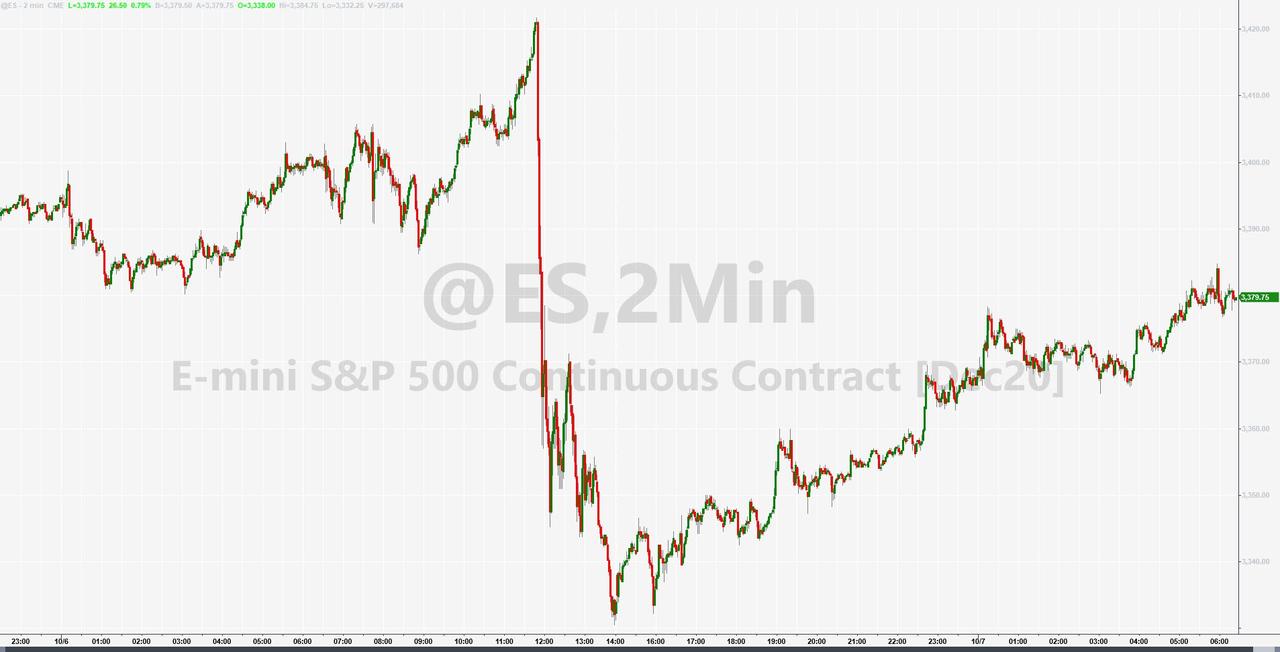
Futures initially pushed lower to 3330 overnight before recovering to 3375, squarely between the large 3350/3400 interest areas.

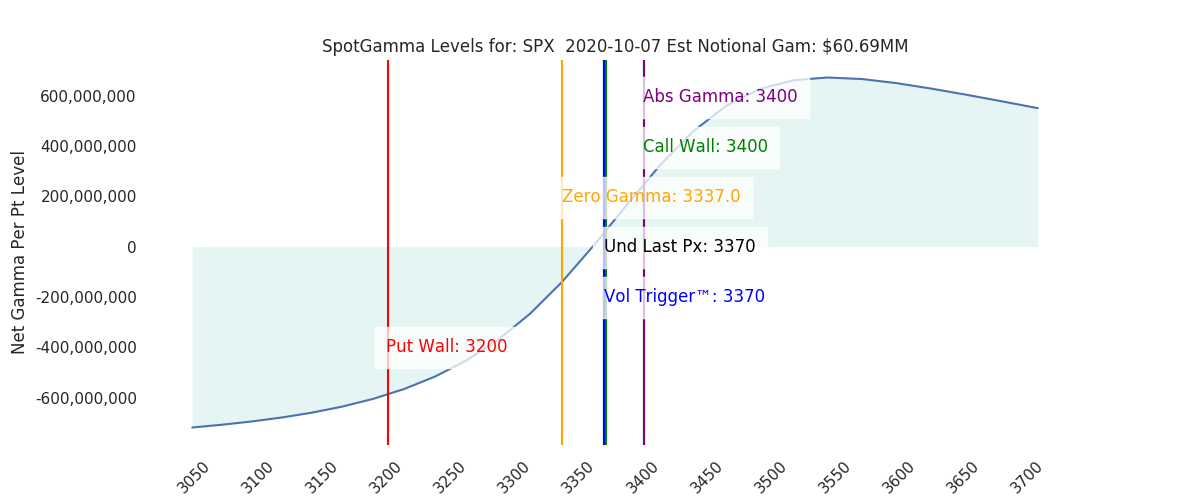
The overnight update to SpotGamma’s Gamma Index shows both SPX & NQ are sitting with very flat gamma positions. It appears Trump took to Twitter offering various “light stimulus” proposals which has helped stabilize things.

There was some interesting SPX volume yesterday with ~30k each (puts/calls) at 3400 and a decent uptick in 3350 put positions (~10k). You can see here how put OI increases as the market slides lower.

While we do not mean to sound like a broken record here, this is a large concern.

If the market does shift lower and “picks up” these larger put positions we could get a fairly substantial drawdown. The issue is of course a trigger – but that is always just “one tweet away”.

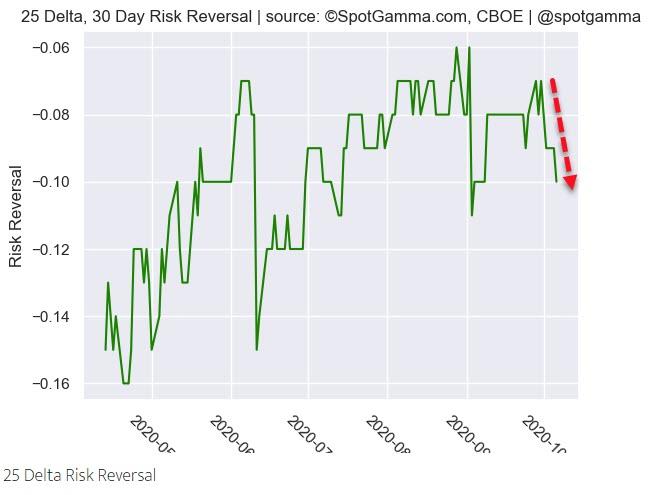
The other chart of note today is the Risk Reversal which is now starting to pick up the election. You can see that metric shows prices shifting in favor of puts, and it will be interesting to watch this over the next several days.

For today 3400 still markets the top of our range. We look at the cluster of levels around 3340 as support. Its important to note that 3350 is now more “put heavy” and we are therefore less enthusiastic about mean reversions off of this level.

via ZeroHedge News https://ift.tt/3iA0au9 Tyler Durden

UK Threatens To “Walk Away” From Brexit Talks If No Deal By End Of Next Week

UK Threatens To “Walk Away” From Brexit Talks If No Deal By End Of Next Week

Tyler Durden

Wed, 10/07/2020 – 11:07

Prime Minister Boris Johnson has pressed ahead with his Intermarket Bill, calling Brussels’ bluff about its threats to sue London over what many have described as a unilateral violation of an international treaty.

As Brussels  presses ahead with a drawn-out and tedious legal action – which will ultimately come to nothing since a decision might not arrive until after the transition period ends Dec. 31 – allowed per the resolution mechanisms hashed out in the withdrawal agreement, Johnon is once again drawing a line in the sand, upping the pressure by declaring Oct. 15 – ie a week from Thursday – as the UK’s deadline for a deal. Otherwise, it will walk away.

“We do need to be in a position where we’re able to provide certainty to businesses as to what the terms of our future trading relationship with EU are going to be, and we do believe that we need to be able to give clarity on whether or not there’s going to be a deal by the 15th of October,” the spokesman said.

The EU insists that it won’t be pressured into concessions, and that they’re also preparing for ‘no deal’ and are prepared to call BoJo’s bluff. Bloomberg reported, citing an anonymous official from No. 10, that BoJo was “serious” about walking away…but anonymous comments like this should probably be taken with a grain of salt.

Meanwhile, Michael Gove, a top official in Johnson’s government, told Parliament that HMG is stepping up preparations for a no-deal scenario when its transition deal with the European Union expires. While the government would prefer a deal with Brussels, it refuses to be “held hostage”.

“No one would be happier than me if we could conclude an agreement, but we have an absolute obligation to ensure that the country is ready in the event that we don’t,” Gove told a parliamentary committee.

Gove added that no-deal planning was being undertaken to ensure “that this country is not held hostage in a negotiation process.”

Meanwhile, In the Republic of Ireland, the only EU member to share a land border with part of the UK, Foreign Minister Simon Coveney warned on Wednesday that it would be difficult to envision a compromise that would satisfy both Ireland and the EU’s other Atlantic member states, along with Britain.

“This is a big obstacle and I don’t think the British government should underestimate the strength of feeling on fishing of many of the Atlantic member states,” he said.

Though as we’ve learned in the past, the mood of Brexit talks can change on a time. Boris Johnson said last week that he was “pretty optimistic” that deal would be struck. However, the last round of formal talks ended without a deal last week. And while both sides insist that they’re committed to finding common grand, many fraught areas of disagreement remain, including the fisheries issue mentioned above. Aside from fisheries, the other main issue for the UK is rules on state subsidies. For more on this, Politico has published a comprehensive guide to what might happen if ‘no deal’ becomes a reality.

British trade minister Liz Truss offered an apt summary of the UK’s negotiating position during an interview Wednesday on BBC radio, where Tess insisted that a deal with the European Union is “do-able”, so long as the bloc remembers where the UK is coming from. “A deal is absolutely do-able. We know the type of deal we want, it’s the deal that Canada has with the EU,” Truss said.

The pound weakened against the dollar Wednesday suggesting that markets are taking Johnson’s threat seriously. To be sure, if we’ve learned anything from the last three years, it’s that both sides need to run out the clock, since both the EU27 and BoJo have a political interest in convincing their electorates that they managed to win hard-fought concessions from the other.


via ZeroHedge News https://ift.tt/3d5iF8V Tyler Durden