Ahead of what looks to be a busy day for President Trump – in addition to his social media summit, Mnuchin has a meeting scheduled with Nancy Pelosi and the White House has just called a press conference about the latest court decisions on the citizenship question – the president indulged in a scattered twitter rant about the fake news media, some of his would-be Democratic challengers, and his amazing economy.
After the mainstream press criticized Trump’s social media summit for purportedly bringing ‘fringe’ voices to the White House for another grievance session, Trump apparently felt compelled to hit back. He warned that the subject of the summit will be the “tremendously dishonest, biased” mainstream press.
He also insisted that the “Fake News” is “not as important, or as powerful, as Social Media” (though he insisted he would still be president if Twitter never existed).
And when Trump leaves office in six years, taking the Trump traffic bump with him, many media companies will go bankrupt – a claim that Trump has made before (he even included a very timely Mad Magazine reference just days after Mad ended its longrunning print mag).
The White House will be hosting a very big and very important Social Media Summit today. Would I have become President without Social Media? Yes (probably)! At its conclusion, we will all go to the beautiful Rose Garden for a News Conference on the Census and Citizenship.
A big subject today at the White House Social Media Summit will be the tremendous dishonesty, bias, discrimination and suppression practiced by certain companies. We will not let them get away with it much longer. The Fake News Media will also be there, but for a limited period..
….The Fake News is not as important, or as powerful, as Social Media. They have lost tremendous credibility since that day in November, 2016, that I came down the escalator with the person who was to become your future First Lady. When I ultimately leave office in six……
….years, or maybe 10 or 14 (just kidding), they will quickly go out of business for lack of credibility, or approval, from the public. That’s why they will all be Endorsing me at some point, one way or the other. Could you imagine having Sleepy Joe Biden, or @AlfredENeuman99,..
Trump notoriously didn’t invite Facebook, Twitter or Alphabet to the summit, meaning social media companies won’t be well represented. Instead, he invited a group of Internet personalities. After the media rant, Trump quickly pivoted to attacking some of his rivals, joking that he couldn’t imagine ‘Sleepy Joe’ or ‘Pocahontas’ as president, while offering a little trolling by referring to himself as “so great looking and smart, a true Stable Genius!”
…or a very nervous and skinny version of Pocahontas (1000/24th), as your President, rather than what you have now, so great looking and smart, a true Stable Genius! Sorry to say that even Social Media would be driven out of business along with, and finally, the Fake News Media!
Trump then pivoted to a tweet about the pledge of allegiance being under siege.
The Pledge of Allegiance to our great Country, in St. Louis Park, Minnesota, is under siege. That is why I am going to win the Great State of Minnesota in the 2020 Election. People are sick and tired of this stupidity and disloyalty to our wonderful USA!
Then moved on to last week’s jobs number and the economy more broadly.
“Nearly one million more blacks and two million more Hispanics are employed than when Barrack Obama left office, and minorities account for more than half of all new jobs created during the Trump Presidency. Unemployment among black women has hovered near 5% for the last six…..
Robert Johnson, B.E.T. “I give the President a lot of credit for moving the Economy in a positive direction that’s benefiting a large number of Americans. I think the Tax Cuts clearly helped stimulate the Economy. Overall, if you look at the U.S. Economy, and you look at…..
….the number of people who are no longer looking for jobs but who are now seeing the opportunity for job growth, you’ve got to give the President an A Plus for that.” Thank you Robert, one of our great business leaders!
The Fake News Media loves the narrative that I didn’t use many banks because the banks didn’t like me. No, I didn’t use many banks because I didn’t (don’t) need their money (old fashioned, isn’t it?). If I did, it would have been very easy for me to get.
….And remember, a bank that I did use years ago, the now badly written about and maligned Deutsche Bank, was then one of the largest and most prestigious banks in the world! They wanted my business, and so did many others!
There is a Bloomberg headline this morning which best summarizes the market mood on the day after Powell’s 1st day of Congressional testimony: “Traders Take Fed Message as License to Buy Everything“, and it’s pretty much spot on, with S&P futures storming back over 3,000, following Asian stock higher amid certainty that the Fed will cut rates at least by 25-50bps in the immediate future, even as an early European rally fizzled as investors didn’t get the memo, and grew skeptical by the relentless dovish flood. Meanwhile, Treasuries dropped and the dollar edged lower.
The S&P was set to open back over 3,000 as it briefly topped the key psychological level for the first time Wednesday after the Fed Chair made it abundantly clear he is willing to lower rates, citing a slowing global economy and trade issues. In his first day of testimony before Congress on Wednesday, Powell confirmed the U.S. economy was still under threat from disappointing factory activity, tame inflation and a simmering trade war, and said the Fed stood ready to “act as appropriate”.
A strong June U.S. jobs report last Friday heightened expectations the Fed was more likely to cut by 25 basis points than by 50. But Powell’s cautious stance helped fuel bets of two rate cuts at its next policy meeting on July 30-31, and the odds of a 50 bps cut rose to 27.6% from 3.3% on Tuesday, after minutes from the Fed’s last meeting showed many policymakers felt there was not yet a strong case for easing.
“Powell’s statement confirmed we are going in the direction of a cutting cycle,” said Charles Zerah, a fund manager at Carmignac. “The main question now is, are investors pricing too much in terms of rate cuts by year end? The way you see equity markets behaving, risk is that what markets are pricing could lead to disappointment.”
The European Stoxx 600 Index was headed for the first advance in five days, spurred by energy companies, though it came off its highs for the session, climbing 0.1% after losing 1.4% over the past four sessions; carmakers were the worst performers on broader benchmark, falling for a fifth day while energy shares and utilities lead gains, tempering losses from cyclical sectors. Germany’s DAX dipped after opening higher, while Britain’s FTSE 100 erased a gain of as much as 0.4% as Bank of England Governor Mark Carney spoke at a press conference in London, noting that risks of a no-deal Brexit have increased and such an outcome could hurt the pound, government bonds and house prices.
Earlier in the session, shares rose across most of Asia as MSCI’s index of Asia-Pacific shares ex-Japan rose 1% with the South Korean and Hong Kong markets outperforming and stocks in China edging higher. Asian stocks climbed for a second day, led by energy and technology firms. Japan’s Nikkei and Topix both closed 0.5% higher, snapping a three-day losing streak, even as Japan’s worst dispute in decades with South Korea dragged on. Nintendo helped bolster the gauge after introducing a cheaper version of its Switch gaming machine. The Shanghai Composite Index added 0.1%, supported by large banks and insurers. China’s Finance Minister Liu Kun expressed confidence that the country’s economic growth will remain in a range of 6% to 6.5%. The S&P BSE Sensex Index advanced 0.8%, with Housing Development Finance, HDFC Bank and IndusInd Bank among the biggest boosts.
As usual, some questioned how much momentum there was behind the latest rally.
“We are in the camp and have been all year, and arguably wrongly, that the Fed becoming more dovish and cutting rates is not good for risk assets,” said Neil Dwane, global strategist and portfolio manager at Allianz Global Investors. Nine of 12 Fed rate cutting cycles had not stopped a recession, he noted. “Given we are in the longest expansion and have only had rates lifted to 2.5%, for me it begs the question, is a soft landing possible?”
The rate cut prospects also weighed on the dollar. The dollar index against a basket of six major currencies slipped 0.2% to 96.929, extending losses for a second straight session after reaching a three-week peak on Tuesday. The dollar was down 0.4% at 108.03 yen, forced off a six-week high of 108.990 the previous day. It was still some distance from a six-month trough of 106.780 set on June 25. The euro nudged up 0.23% to $1.1275, as German core inflation for June was revised higher.
In fixed-income markets, the 10-year U.S. Treasury yield fell to 2.037% after dropping on Wednesday from a three-week high of 2.113%. In Europe, Italian bonds pared earlier gains after a debt sale, while bunds decline as gilts underperform. BTPs trimmed gains and curve flattens after sale of EU5.5b 3- and 7-year bonds, while Bunds fell as core debt underperforms semi-core and curves steepen. Germany’s 10-year government bond yield dropped to minus 0.32% on expectations that monetary easing in the euro zone will not be far behind the Fed.
In commodities, U.S. crude oil futures climbed to a six-week high as oil rigs in the Gulf of Mexico were evacuated before a storm, while an incident with a British tanker in the Middle East highlighted ongoing tensions in the region. WTI futures gained 42 cents to trade at $60.84 per barrel, while Brent rose 47 cents to $67.48. Spot gold gained to $1,426 an ounce, its highest since July 3, on the reinforced expectations for a Fed rate cut, while cryptocurrencies slumped after Powell voiced substantial skepticism that Facebook’s Libra fiat-backed stablecoin will be greenlighted.
Looking ahead, highlights include US CPI, weekly jobs, OPEC monthly report, Fed Chair Powell’s testimony to the Senate, ECB’s Coeure, supply from the US.
Market Snapshot
S&P 500 futures up 0.2% to 3,002.75
STOXX Europe 600 up 0.2% to 388.01
MXAP up 0.8% to 160.48
MXAPJ up 0.7% to 526.05
Nikkei up 0.5% to 21,643.53
Topix up 0.5% to 1,578.63
Hang Seng Index up 0.8% to 28,431.80
Shanghai Composite up 0.08% to 2,917.76
Sensex up 0.6% to 38,770.18
Australia S&P/ASX 200 up 0.4% to 6,716.14
Kospi up 1.1% to 2,080.58
German 10Y yield rose 3.5 bps to -0.272%
Euro up 0.2% to $1.1273
Brent Futures up 0.7% to $67.47/bbl
Italian 10Y yield rose 0.3 bps to 1.381%
Spanish 10Y yield fell 3.2 bps to 0.406%
Brent Futures up 0.7% to $67.47/bbl
Gold spot up 0.3% to $1,422.57
U.S. Dollar Index down 0.2% to 96.89
Top Overnight News
The British navy intervened to stop Iran from blocking a commercial oil tanker leaving the Persian Gulf, heightening friction just as European nations scramble to salvage a landmark nuclear accord with the Islamic Republic
The U.S. Department of Justice is investigating Deutsche Bank AG as part of a broadened probe of Malaysia’s scandal-plagued 1MDB investment fund, according to a person with knowledge of the matter
Federal Reserve Chairman Jerome Powell says uncertainties around trade tensions and global growth have continued to weigh on the U.S. economic outlook since policy makers met in June. Fed minutes show many saw stronger rate-cut case as risks grew
Bank of England policy maker Silvana Tenreyro says she’s unlikely to support raising interest rates in the next few months as slower growth keeps inflation in check.
European leaders have made clear they’ll give Britain’s new prime minister a hearing over Brexit, and may be prepared to make concessions, according to David Lidington, Prime Minister Theresa May’s de-facto deputy. They would first want to know a revised deal could pass the House of Commons, he said
The U.S. will investigate a French plan to impose taxes on technology companies, a move that has been a prelude to new U.S. tariffs under the Trump administration
The Bank of Japan needs to extend its pledge to keep extremely low rates and there’s a good chance it will tweak the time frame as soon as the July meeting, ahead of an expected Federal Reserve rate cut, according to Kazuo Momma, a former executive director at the BOJ
Oil extended gains after closing at a seven-week high as around a third of the Gulf of Mexico’s crude output was cut before a potential hurricane and U.S. crude inventories shrunk more than expected.
Australia’s prudential regulator has ordered three of the nation’s largest banks to increase their capital holdings after finding weaknesses in risk management akin to those at Commonwealth Bank of Australia
Trump administration officials signaled support for pro-democracy protesters in Hong Kong — and defiance toward the Chinese government — by granting a series of high-level meetings this week to a Hong Kong bookseller who has drawn Beijing’s ire
In the crowded 2020 Democratic presidential field, campaign bank accounts are beginning to separate the contenders from the also-rans. candidates report their second-quarter fundraising totals to the Federal Election Commission on Monday
A surprise win for underdog Jeremy Hunt in the contest to become U.K. prime minister would cause the pound to rally — but not for long. While he is seen averting a no-deal Brexit, he would still have to face the same problems the previous PM did — negotiating a deal
The U.K. is stepping up its review of open-ended funds to prevent the growing industry becoming a threat to financial stability and the economy
Asian equity markets traded positively as the region took advantage of the tailwind from the US where a dovish testimony by Fed Chair Powell kept the door open for a July rate cut, which lifted all major US indices to all-time highs and the S&P 500 to briefly above the monumental 3000 level for the first time ever. ASX 200 (+0.4%) was led higher by commodity-related sectors after gold surged back above the USD 1400/oz level and oil prices rallied around 4% on bullish inventory data, but with the gains limited by initial weakness in financials after APRA advised an increase in minimum capital requirements of AUD 500mln each for 3 of the Big 4 banks and as Westpac faces legal proceedings in New Zealand for allegedly breaching the Credit Contracts Act. Nikkei 225 (+0.5%) were marginal as the upbeat momentum was partially offset by a firmer currency, while Hang Seng (+0.8%) and Shanghai Comp. (U/C) advanced with energy names frontrunning the outperformance in Hong Kong and as sentiment was also underpinned after China announced to take measures to stabilize trade as well as lower import tariff levels. Finally, 10yr JGBs were higher as they tracked the moves in T-notes in the aftermath of Powell’s dovish testimony, but with upside limited amid gains in stocks and weaker demand at the enhanced liquidity auction for longer-dated JGBs.
Top Asian News
No Easy Exit in Sight From Worst Japan-South Korea Spat in Years
Reliance Infra Lenders Sign Debt Resolution Pact; Shares Rise
How Malaysia’s 1MDB Scandal Shook the Financial World: QuickTake
China Hopes U.S. Removes Huawei Restrictions ASAP, Gao Says
China’s Movie Business Takes a Hit — From Its Own Government
Major European indices opened in positive territory though have drifted into negative territory recently [Euro Stoxx 50 U/C]. Sectors are somewhat mixed and unsurprisingly Energy names outperform as the broader complex gains support from the ongoing weather situation in the Gulf of Mexico, which has led to multiple platform shutdowns. Other notable movers include, Indivior (+26.0%) who are topping the Stoxx 600 after raising their FY19 guidance after experiencing a stronger than expected H1. Separately, Deutsche Banks (-0.7%) woes are continuing as reports indicate that the US Justice Department is investigating the Co. in relation to the 1MDB funds. Elsewhere, sources indicate that Ab InBev (-0.8%) are to guide pricing for their Hong Kong Budweiser unit towards the bottom end of its indicative range; which implies a price of USD 8.3bln vs. the USD 9.8bln at the top of the scale. Finally, off of the back of a broker downgrade at UBS, Sika (-4.0%) are lagging the SMI; for reference, the Co. was downgraded to sell from neutral.
Top European News
Woodford Loses Second Long-Time Ally as Fund Freeze Bites
Norwegian Air Chief Steps Down as Turnaround Plan Takes Form
U.K. Labour Figures ‘Interfered’ on Antisemitism Cases
Outperformance of Growth Stocks Is a Structural Trend: Goldman
In FX, dovish FOMC minutes have prompted another recalibration of market pricing for the July meeting and a further resurgence in expectations for a 50 bp rate cut to over 25% from as little as 2.5% at one stage post-NFP. Hence, the Greenback has pulled back further ahead of US CPI data that has assumed even more importance given Fed chair Powell’s growing concern about persistently weak inflation, in contrast to transitory factors that were deemed to be depressing prices not that long ago. Amidst widespread declines, the DXY has retreated below 97.000 towards 96.800 and not far from the 200 DMA (96.767) that was reclaimed on the back of last Friday’s stellar 200k+ payrolls count.
JPY/NZD/CHF/GBP – The major beneficiaries of the Buck’s demise as the Yen rebounds through 108.00 and gets close to decent option expiry interest layered from 107.80 (1.2 bn) to 107.70-65 (1 bn) before losing some momentum, while the Kiwi is consolidating strong recovery gains above 0.6650 after yesterday’s overnight stop or error trade induced spill and now eyeing NZ manufacturing PMI for independent inspiration. Elsewhere, the Franc is not far from 0.9850 and the Pound has reclaimed 1.2500+ status with more conviction, though could be hampered by 500 mn expiries at the strike.
AUD/CAD/EUR – The Aussie has also bounced firmly from lows and a probe under key Fib support with the aid of diverging RBA/Fed policy outlooks, as the former shifts to neutral or wait-and-see mode following back-to-back 25 bp eases. Aud/Usd is hovering around 0.6975 and seeking further guidance/direction from RBA’s Debelle later today. Similar story for the Loonie following Wednesday’s BoC meeting that revealed more caution and downside risks to base-line assessments and forecasts, but ultimately maintained an on hold stance, with Usd/Cad settling lower after knee-jerk moves and currently pivoting 1.3050. Continuing the Central Bank theme, ECB minutes could undermine the single currency if dovish enough, as Eur/Usd stalls ahead of 1.1300 having breached 1.1250 and the 200 DMA (1.1255), while decent option expiries lying between 1.1290-1.1300 (1.3 bn) may also prove tough to overcome.
In commodities, WTI and Brent have remained modestly firmer in what has been a quiet session thus far. The complex continues to derive support from the weather situation in the Gulf of Mexico where most recently the NHC are expecting the disturbance to become a tropical depression today; in terms of the impact, yesterday it was reported that 32% of the Gulf’s production has been halted, with the Gulf representing around 15% of the US’ total production. Additionally, the OPEC monthly report is scheduled for release today (12:10 BST) and for reference on Tuesday the EIA cut 2019 oil demand growth view to 1.07mln BPD, -150k BPD. NHC say the distrubance is expected to become a tropical depression later on today; storm surge, heavy rains and hurricane conditions are possible across the North/Central Gulf Coast in a few days Gold (+0.3%) is continuing to benefit from the softer post-Powell dollar, with the yellow metal now firmly above the USD 1400/oz level having printed a session high of USD 1427/oz. This mornings dollar drive strength from gold is likely being derived from market pricing now indicating around a 25% chance of a 50bp cut at July’s FOMC meeting, as such today’s inflation metrics and the second set of comments from Chair Powell may well prove pertinent for the yellow metal. Elsewhere, copper prices are little changed after yesterdays dollar driven rally.
US Event Calendar
8:30am: US CPI MoM, est. 0.0%, prior 0.1%; YoY, est. 1.6%, prior 1.8%
8:30am: US CPI Ex Food and Energy MoM, est. 0.2%, prior 0.1%; YoY, est. 2.0%, prior 2.0%
8:30am: Initial Jobless Claims, est. 221,000, prior 221,000; Continuing Claims, est. 1.68m, prior 1.69m
8:30am: Real Avg Hourly Earning YoY, prior 1.3%; Real Avg Weekly Earnings YoY, prior 1.0%
9:45am: Bloomberg Consumer Comfort, prior 62.6
2pm: Monthly Budget Statement, est. $7.85b deficit, prior $207.8b deficit
DB’s Jim Reid concludes the overnight wrap
Just to make sure everyone is up to speed we’ll continue this message about DB Research at the top for today and tomorrow. After some difficult decisions were announced over the weekend about the firm’s direction, we want to reiterate that DB Research will remain at the forefront of the firm with strong backing from senior management. As well as FIC, Macro, QIS, Data Science, and Thematic research, DB is still committed to providing extensive and top-quality Company Research coverage in Europe and the US. DB will combine Equity Research and Research Sales into a newly formed Company Research and Advisory Group to strengthen ongoing connectivity with institutional clients. So if you are a consumer of any of our research and have any questions, please let me know and we can try to answer them.
One publication we will continue to publish is our flagship Thematic magazine “Konzept” where we take a big picture theme and use our expertise across research to delve deeper into the relevant issue. The latest edition was out yesterday and was entitled “How 5G will change your life” ( link ). In this we look behind the hype of the 5G roll-out and examine the unexpected impact on everything from smartphones to factories to politics and Smart Cities. But a deluge of data can have a real economic cost. In one piece we note that too much information and interruption could cost the US economy $1tn each year. In fact, when employees work without email they collaborate more and feel more productive. But before you strive to be more productive please don’t stop reading this email… just ignore all the others instead!
From 5G to 3K as the S&P 500 briefly crossed that landmark for the first time intra-day yesterday, on a dovish interpretation of Mr. Powell’s testimony, before closing a bit below that landmark. A week before the 50th anniversary of the first man on the moon (my Dad to his final breath was totally convinced it was a Hollywood creation), I wonder whether people will equally remember where they were the moment the S&P went through 3000. Probably not, but for me it was Starbucks. Lunar forces seemed to be in operation in bond markets yesterday as they waxed and waned sharply after an initial Europe-led selloff was quickly reversed by the text release of Powell’s testimony. The Q&A with Powell more or less affirmed the rally is back for rates while the FOMC minutes in the evening did nothing to change the narrative.
As discussed, the biggest market moves came with the pre-release of Powell’s statement in early afternoon London time. The key snippet from the statement concerned the dovish reference to “in our June meeting statement, we indicated that, in light of increased uncertainties about the economic outlook and muted inflation pressures, we would closely monitor the implications of incoming information for the economic outlook and would act as appropriate to sustain the expansion. Many FOMC participants saw that the case for a somewhat more accommodative monetary policy had strengthened. Since then, based on incoming data and other developments, it appears that uncertainties around trade tensions and concerns about the strength of the global economy continue to weigh on the U.S. economic outlook. Inflation pressures remain muted.”
The questioning at the hearing itself wasn’t hugely eventful, with Powell sending a strong but not completely explicit signal in favour of a rate cut this month. He cited trade uncertainty, global growth, and low inflation as the major issues facing the Fed, saying “crosscurrents have reemerged,” while simultaneously downplaying the recent bits of news that could have sparked a hawkish shift. Powell didn’t mention the positive outcome of the G20 in his remarks and downplayed the robust June jobs report, saying that while it was “positive,” it “did not shift our policy outlook.” He did say that incoming labour market, retail sales, and GDP data will be important for deciding about future policy, but it feels like the outlooks for global growth and US inflation will in fact be the key variables to watch. Our US econ team has a full write-up on their takeaways and their Fed forecasts available here .
As for markets, 10y Treasuries were trading as high as 2.112% before the Powell text was released (+4.7bps on the day at that point) only to then rally to 2.037% in a matter of minutes. They traded in a couple of basis points’ range thereafter as Powell answered questions and the Fed released the June meeting minutes, before ending the session a touch higher at 2.062% (-0.4bps on the day) however they have dropped another -2.1bps to 2.041% this morning. Two-year yields rallied more steeply, with yields dropping -8.0bps (and a further -1.6bps this morning). That encouragingly helped the 2y10y yield curve to steepen to 22.7bps at the time of writing, bringing it back more in the May-June c.20-30bp range.
Powell’s message was supported by the subsequent release of the June FOMC minutes, which admittedly were already a bit stale. While the baseline forecast remains solid, “many participants noted that the economy appeared to have lost some momentum,” and accordingly “many participants indicated that the case for somewhat more accommodative policy had strengthened.” “Many” is the FOMC’s strongest language before “most” or “a majority,” so it seems highly likely that a few members shift over to the dovish side to deliver a rate cut this month, as we expect.
One other interesting aspect with regards to inflation from the minutes was the assertion that “a number of participants anticipated that the return to 2 percent would take longer than previously projected,” which would be consistent with a more prolonged easing cycle rather than a one-and-done. However, before we get to that, we’ll have to see if the Fed delivers 25bps or 50bps of cuts this month. On that, we’re back to now pricing in 32bps of cuts for the meeting this month after starting the day at 27bps. So we’ve actually swung back to a more aggressive pricing of around a ~25% chance of a 50bps cut. This came despite further comments from St. Louis Fed President Bullard, who reiterated his recent comments that, while he supports an “insurance” rate cut, he doesn’t think the situation calls for a 50bps cut. It is pretty surprising to see the market getting so far ahead of the FOMC’s most dovish member.
Over in equities it had looked like normal service might have resumed as the S&P 500 broke 3000 for the first time ever, however markets did pare back slightly from their opening highs. The S&P 500 eventually closed below that key level albeit still up +0.45% on the day and just 0.10% away from its all-time peak. The NASDAQ closed up +0.75% at a fresh all-time high, while the DOW gained +0.29% to within 0.39% of its highest-ever level. Meanwhile, HY credit spreads were flat and the USD weakened -0.39%. Oil advanced +4.50%, boosted by strong inventory data that showed a 9.5mn reduction in US crude stockpiles, plus further confrontational rhetoric from President Trump directed at Iran. Storms in the Gulf of Mexico also reportedly derailed some drilling operations.
Looking ahead the next test for the market and perhaps the last possible hurdle for a rate cut this month is likely to be the June CPI report this afternoon in the US. The consensus expects a +0.2% mom core reading which should be enough to keep the annual rate at +2.0% yoy. Our economists forecast an unrounded +0.19% mom reading and note that this would help shorter-term inflation trends to firm with their forecast for the three-month annualized rate being a 17bp increase to +1.78%. That data is due out at 1.30pm BST and our team’s full forecast is available here .
This morning in Asia markets are following Wall Street’s lead with the Nikkei (+0.40%), Hang Seng (+1.19%), Shanghai Comp (+0.33%) and Kospi (+1.21%) all posting healthy gains while futures on the S&P 500 are also up +0.28% and trading back above the 3000 mark. There hasn’t been much fresh news however Bloomberg did report that President Trump has asked aides to find a way to weaken the US dollar in an effort to boost the economy ahead of the 2020 presidential election while adding that Trump’s chief economic advisor, Larry Kudlow, and Treasury Secretary Steven Mnuchin disapprove of the idea of government tampering to weaken the dollar.
Back to yesterday where there were also big moves for European bonds. The moves were initially driven by a combination of better-than-expected industrial production data in France and Italy – more on that below – and what was perceived to be a bit of a disappointing Bund auction given the drop in oversubscription. That said, the bund auction did result in a new record low yield for fresh issuance and was the first time that German issued a bond with a zero coupon since 2016. Thereafter, European yields eased off their highs as the Treasury rally carried over to Europe. In the end, 10y Bund yields rose +4.7bps to -0.309% which was the biggest one-day climb since April. Similar maturity yields in France, Netherlands, Spain and Portugal were also +3.3bps, +4.5bps, +1.9bps and +2.9bps higher respectively while Greece rose +7.4bps and which therefore puts the two-day move at +19.7bps after yields had edged to within a whisker of similar maturity Treasuries. Italian BTPs outperformed, with yields rising only +0.2bps, with most of the gains coinciding with Powell’s remarks, as Italy stands to be one of the top beneficiaries of easier monetary policy.
Equity markets in Europe finished a touch weaker, despite a pop alongside US equities when Powell’s testimony hit the wires, with the STOXX 600 ending -0.20%. The only bright spots were in the energy and materials sectors, which were helped by the global rally in oil prices mentioned above. Just on the data, May industrial production in France rose +2.1% mom and far exceeded expectations for +0.3% while Italy printed at +0.9% mom (vs. +0.2% expected).
Here in the UK industrial production was reported as rising +1.4% mom which was a little a bit less than the +1.5% expected while manufacturing production was much weaker than expected (+1.4% mom vs. +2.2% expected) however the focus was instead on the May GDP print which was in line with expectations at +0.3% mom. The 3M/3M reading also rose +0.3% which was a little ahead of expectations. Finally in the US the only noteworthy data were the final May wholesale inventories numbers which were confirmed at 0.4% mom as expected.
Looking at the day ahead, the big focus will be the June CPI report in the US. Prior to that we are also due to get final June CPI revisions out of Germany and France. Other US data include jobless claims and the June monthly budget statement. Away from the data we’re due to get the BoE’s financial stability report while the ECB minutes are also out around lunchtime. It’s also a packed day for Fedspeak with Powell again testifying before the Senate – which is unlikely to be a lot different to yesterday’s comments – while Williams, Bostic, Barkin, Quarles, Williams and Kashkari are also due to speak. The ECB’s Coeure is also due to speak this morning.
via ZeroHedge News https://ift.tt/2LiCz4X Tyler Durden
The gradual liberalization of Saudi Arabia’s repressive laws and social mores continued on Thursday with WSJ reporting that Crown Prince MBS plans to drop restrictions barring women from traveling out of the country without a male guardian’s permission. Though we suspect that this time, there will be no glowing NYT op-ed praising the young crown prince – the kingdom’s de facto ruler – for his reformist tendencies and his respect for human rights.
It won’t happen right away: WSJ says the kingdom plans to end the ban some time this year. The plan would end guardianship laws relating to travel for men and women over 18 years old. As it stands, women of any age, and men under 21, must have a guardian’s permission to travel internationally. Soon, that won’t be the case.
But even more notably is the timing: It has been just over eight months since the murder of Jamal Khashoggi, the Saudi insider-turned-critic who lived in Virginia and wrote for the Washington Post. US intelligence suspects that MBS personally ordered that an execution squad lure Khashoggi to the Saudi consulate in Istanbul. Once inside, the journalist was ambushed, killed, dismembered and his remains were never recovered.
The Saudi government’s presumed involvement (after all, the killing happened in an official diplomatic setting) set off an international wave of condemnation that prompted companies to cut ties with the kingdom, spoiling MbS’s “Davos in the Desert”.
But the killing marked a turning point in MBS’s reputation. The myth that he was a reformer because he lifted bans on women driving and theaters and music was shattered – a myth that had been propagated by the New York Times and other establishment American media organizations.
Now, it appears MBS feels enough time has passed to once again burnish his reputation as a reformer. Though guardianship laws relating to travel will be lifted, restrictions related to marriage and a woman’s living situation remain in place. Human Rights groups have blasted these rules for impinging on womens’ fundamental human rights.
While some other Muslim countries have guardianship systems, Saudi Arabia’s goes the furthest to enshrine it in law. One Saudi woman who barricaded herself in her hotel room in Thailand was recently granted asylum in Canada after she claimed she’d be killed if she went back to the kingdom.
Saudi authorities this year created a government committee to revamp guardianship laws. The committee’s work helped led to the lifting of the ban. Notably, at around the time MBS lifted the ban on female driving last year, the government arrested a group of female activists calling for lifting of the driving ban and the scrapping of the guardianship law system.
The timing couldn’t be better. Pretty much everybody in the West has forgotten about the Khashoggi murder and the brutal proxy war in Yemen, which people briefly cared about last year. This latest reform will give western companies and governments cover to reengage with the kingdom publicly.
via ZeroHedge News https://ift.tt/2LfZb6q Tyler Durden
These days, leaks about ‘progress’ in the US-China trade talks have been almost hilariously dull. For example, American and Chinese negotiators spoke on the phone Tuesday and agreed to meet in person again at some point in the not-too-distant future. But with no deadline set, it’s looking likely that these talks could progress extremely slowly, and many analysts now believe a resolution might not come before voters head to the polls in November of next year.
But as President Trump and his team see it, that’s not necessarily a bad thing, at least not in terms of Trump’s reelection prospects.
Reuters reports that Trump’s advisers “are confident he can portray his stance against Beijing as a strength in the 2020 election, despite making concessions and having no deal in sight.”
This isn’t all that surprising. Trump’s aggressive rhetoric about taking on China – labeling it a currency manipulator and a bad actor when it comes to bilateral trade with the US – helped set him apart from the rest of the Republican field as early as 2015. And since he slapped the first trade-war tariffs on foreign aluminum and steel last year, Trump’s position on China has garnered bipartisan support. Even Beijing-friendly Joe Biden was forced to concede recently that China is a threat and that Trump is doing the right thing.
Steve Bannon told Reuters that he thinks Trump’s decision to ease up on Huawei and suspend new tariffs will help him politically.
“I think you’re into 2020 before there’s any resolution to this,” said Steve Bannon, Trump’s former chief White House strategist, who has advocated for a tough stance against Beijing.
He applauded Trump’s decision to take new tariffs off the table and be flexible on Huawei because it got the talks between the two countries going again.
“I think it will help him politically because it’s the reality of the world that we live in,” Bannon said.
If there’s any area of vulnerability that Dems will try to exploit, its the impact on farmers. China’s retaliatory tariffs have mostly focused on agricultural goods. Trump has come to their aid with two farmer bailouts, but still, the financial situation for a group that represents a core constituency in Trump’s heartland base remains dire.
Without a deal, farmer-heavy swing states such as Iowa and Pennsylvania, which supported Trump in 2016, could swing to the Dems.
“From farmers in Iowa to an array of manufacturing jobs across the Midwest, swing state after swing state supported him based on the promise that he would win the trade war with China and bring their jobs back. So far he’s done neither,” said Scott Mulhauser, a China expert and former aide to Vice President Joe Biden, the current front-runner for the 2020 Democratic presidential nomination.
As Stephen Moore said, truces can’t last forever, and Trump could offer more concessions to the Chinese to secure a deal, then take a harder line after he’s reelected.
Stephen Moore, an outside economic adviser to the president, said a quick deal would be helpful. The de-escalation agreed to in Japan was positive, he said, but truces do not last forever.
“Perhaps this could get us through the election,” said Moore, who withdrew from consideration for a seat on the Federal Reserve earlier this year after criticism of his sexist comments on women and shifts on interest rate policy.
“My personal advice to Trump…when he’s asked me about it, is get a deal that you’ve got now and pick up a much harder line with China after you get re-elected,” he said.
To secure the truce when he met with President Xi in Osaka, Trump promised to ease pressure on Huawei, something that had become a serious point of contention in the bilateral relationship, and he also promised to hold off on more tariffs. On Thursday, Ministry of Commerce spokesman Gao Feng said China hopes Washington will follow through with its promises to back off from Huawei.
And even if Trump has at times proven overly eager to compromise, and although he hasn’t secured a deal yet, the fact remains: He’s doing more than any president who came before him.
“President Trump is the first U.S. president to stand up to China for their bad actions on trade over many decades, a position of strength that will resonate with voters concerned about American jobs,” said Trump campaign spokeswoman Erin Perrine.
So long as he retains the ‘tough on China’ label going into the election, his decision to press ahead with his trade war plans to the consternation of the business community and many other constituencies should earn respect from the voters.
via ZeroHedge News https://ift.tt/2JCHSsY Tyler Durden
In October 2011, the bank’s Chairman bristled at the characterization. His was not going to be a “bad bank” as many in the financial media had been saying. Pierre Mariani, chief executive of Belgium’s Dexia, preferred instead to call it the “residual bank.”
No matter the label, the firm was being bailed out for the second time by the Belgian government in combination with French authorities. Any assets which could be sold at a reasonable (meaning not terrible) price would be. There were already investors lined up for the pieces of Dexia’s balance sheet unencumbered by stupidity.
It’s always a complex story with these things; in this case a little less so at least from an overview. What someone might call “reach for yield” in later years, banks across Europe not just Dexia came out of 2008 seeking to grow their way back to glory. The combination of a zero-risk weight on sovereign debt, applied at that time also to bonds issued by Greece, Portugal or Italy, plus higher returns drew these already-troubled firms like moths to flames.
Desk managers in them knew these exposures were risky, and therefore had to be hedged. That wasn’t the stupid part. No, the really mind-boggling part of the story was how: Dexia, in particular, used longer-dated derivatives. Called total return swaps, the bank sought, essentially, to short German bunds (as the swap benchmark) as protection against a rise in interest rates.
A lot of times these are marked and priced against the US dollar exchange value – which is always expected to fall in most baseline recovery models.
The bank’s strategists (read: econometric models) never conceived or at least downplayed the scenario where Greek bonds would fall in price, the scenario requiring the hedges, but that German bunds would go in the other direction. Surely the near-omniscient and all-powerful ECB would never “allow” that to happen (again, actually).
The primary risks, as almost everyone saw them, were how if interest rates rose (and bond prices fell) it would be because of economic recovery, in combination with higher inflation and eventually short-term rates as the world would surely normalize following the Global Financial Crisis.
In that case, the swap hedging would’ve worked flawlessly.
But that’s not what happened, obviously. Therefore, what were cash-flow positive long-dated derivatives marked in-the-money suddenly became money pits. Once the bank was downgraded in March 2011, because of its PIIGS holdings, funding problems were greatly amplified by these “hedges” turning dead set against the bank at the worst possible time.
It is never losses which kill you. It is liquidity or the lack of it. Once the collateral calls pile in, that’s it. Unless your buffer or margin is enormous, there’s no stopping the downward spiral. At the start of 2011, Dexia held only €21.8 billion in PIIGS bonds, mostly Italian. Didn’t matter.
Despite cutting its balance sheet following 2008, despite reducing its reliance on short-term wholesale funding (a lot of it in dollars, of course) after its first bailout, it was forced to post an additional €15 billion in margin and collateral up to October 2011 on its total return swaps. The more German yields plummeted, the more the collateral calls, the closer to the end.
Mr. Mariani’s “residual bank” would consist largely of those obligations. It’s not that the investments proved to be bad ones, necessarily; in rough terms because of the way they were structured they cost more to fund than they yielded in returns. That’s what volatility and/or modeled uncertainty will do to pricing
It should be pointed out the role of gain-on-sale-accounting here; the profits of these trades are booked at inception, leaving the bank to write down, if necessary, any other-than-temporary charges if either the market prices or the modeledassumptions change substantially. That’s one reason why volatility is such a killer in terms of funding; a profitable trade booked years before suddenly requires billions in collateral and an increasingly unknown probability of write-downs.
That’s also why the “bad bank.” Move that uncertainty, funding and pricing, over to a relatively healthy balance sheet which can withstand those huge negative pressures. In Dexia’s case, the bad bank balance sheet came too late and consisted of whatever was left of Dexia after everything else had been sold off – this residual bank supported by its existing shareholders, by that time mostly governments in Belgium and France.
The situation with Deutsche Bank in 2019 is a bit different, maybe even totally different. We don’t know because nobody is going to say much. What we can speculate about, though, is a situation with similar outlines maybe proportions.
To be perfectly clear, I’m not using Dexia as a template nor am I saying that DB will follow in its dubious footsteps. What’s similar is mostly the predicament; what we know so far about how this later “bad bank” is shaping up.
More importantly, why now?
What DB’s management has said to this point is that the assets marked for the “bad bank” are longer-dated derivatives which are (currently) cash-flow positive and whose profits were likewise booked up front (gain-on-sale). Red flags already.
To begin with, the revised estimate of €74 billion intended for the bad bank is only the level of risk-weighted assets. This raises the question of just how much notional there is involved here; if all the assets are 100% RWA, then the bank would just refer to the gross amount of assets rather than their combined risk weighted calculations. In other words, the bank is intentionally downplaying the scale of its problem (which started out at €50 billion RWA just a few weeks ago).
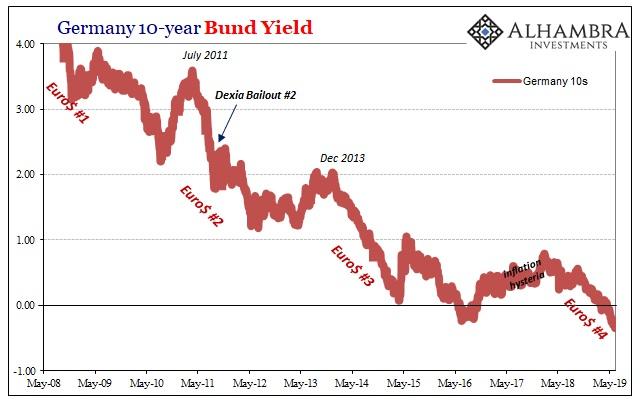
Two other things we know: first, DB starting in 2013 but really in 2014 (at the worst possible time) began investing purposefully in a recovery scenario. This wasn’t a secret, the bank’s very own investment presentation from May 2014 spelled out just that intended course. Like Dexia, DB intended to grow its way back to behemoth status by betting on money dealing capacities and investments in EM markets, US$ leveraged loans or junk, and the like. Risky stuff that would pay off (handsomely) should the global economy normalize in 2015 and beyond like everyone (Janet Yellen and Mario Draghi) said it would.
It never did; and despite 2017’s inflation hysteria, as 2019 wears on it doesn’t look like it ever will.
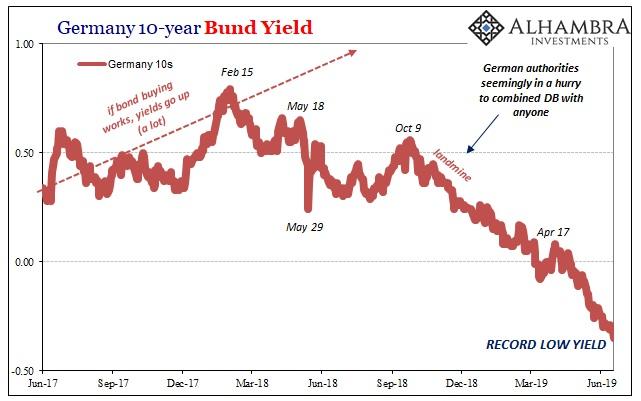
Which brings us to the second fact: bond yields, especially those of German bunds, have been dropping precipitously since last October. In other words, we don’t know how DB has hedged (or how it might have increased its hedges following 2015) its 2013-14 Reflation #2 exposures – but we can sure guess by the timing of all this.
Thus, risky assets which pay off in a recovery scenario likely hedged by instruments which follow that expected(read: modeled) course only to confront instead another liquidity driven event erasing the profit window and leaving the bank exposed as especially safety yields tumble yet again.
The German bank believes it can divest the assets without taking large hits to its profit or capital because the long-dated interest rate derivatives are not toxic and have a predefined run-off plan, one of the people said.
It’s that last part which should grab your attention. As of right now, the bank is saying that its “bad bank” stuff almost certainly wildly in excess of the claimed €74 billion RWA is cash positive but capital intensive following a predefined run-off plan; that’s the key word here.
Except, worldwide financial conditions and probabilities are all moving very hard against that predefined run-off plan. Not only might that endanger the funding situation for the specific assets, and therefore increase the strain on the bank, it also induces credit problems and risk as (modeled) valuations must change to incorporate actual conditions – desirable or not.
To oversimplify, the more safety yields fall the greater the likelihood these longer-dated derivatives detour from their predefined run-off plan and then become “toxic” in a manner similar to what we’d observed within that troubled bank in Belgium.
What I believe is behind everything is how DB’s managers, and government authorities, may be concerned about probabilities changing so unfavorably. That what are capital-intensive but stable hedges start becoming something more nefarious as things continue to go the wrong way. Not toxicity but toxicity potential. The more bond yields fall, the more toxicity potential rises (defined also in liquidity terms in the form of collateral calls and the like).
This might explain why German authorities were in such a rush (and whenthey became in such a rush) to combine DB with any other balance sheet they could find. And it would simultaneously explain why there were no takers.
Without some other balance sheet to absorb these risks through combination, DB is left only to isolate the problem assets via a “bad bank” hoping that whomever ultimately absorbs them (with assistance?) can be able to dispose of them in a way Deutsche cannot, not on its own.
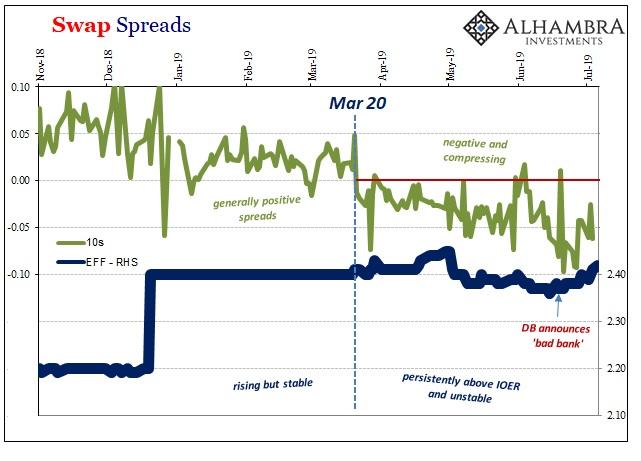
In a way DB cannot. I think that’s one piece of what is spooking funding markets right now. Not only does it mean systemic risks are perceived to be greater, therefore increasing liquidity pressures that much more in a feedback loop, how many more lesser problems with similar (and similarly rising) “toxicity” potential are out there? The “bad bank” makes these things real, a confirmation of what might merely be suspected.
Deutsche Bank will not have been the only one especially in 2017 loading up and hedging only for globally synchronized growth – to find instead Euro$ #4 waiting for the backwards hedged into globally synchronized downturn.
Dexia’s final demise wasn’t its own stupidity. This is a common one, unfortunately. While most had come to terms with the lesson of Bear Stearns, some bankers hadn’t completely given up on the good ‘ol days (taking big risks and believing they can be comprehensively and effectively managed especially via derivatives), very much willing (as we’ve all been taught) to give central bankers and their monetary policies the benefit of the doubt.
In this fragile monetary system, there’s not much room for margin – even though the bank today claims otherwise:
Now that the bank is sitting on €260bn of cash and similarly liquid securities, it no longer relies on these assets for cashflow and can attempt to run them down or sell them to other banks with lower funding costs and capital pressures, or to private equity investors eager to scoop them up at a discount, one of the people said.
DB has tons of liquidity margin and doesn’t need these assets. OK, then why the haphazard plan thrown together at the last minute in lieu of DB being sold altogether? Are we really going to believe private equity investors are salivating over these assets?
They might be, if the discount is big enough. That, in a nutshell, is what has likely changed and it would be directly related to the same shifting probabilities that Dexia once faced. The key difference between them can still be: move them off DB’s balance sheet before the required discount becomes too big.
What maybe unites Dexia and DB isn’t potential failure, it is this lesson: don’t bet on Economists and central bankers. They really have no idea what they are doing. It doesn’t lead anywhere good.
via ZeroHedge News https://ift.tt/2YWKlog Tyler Durden
As the UAE announced this week it would withdraw its forces from Yemen as a longtime lead country in the Saudi coalition which has fought Houthi rebels since 2015, the United Nations issued a damning report on what it previously dubbed the “world’s worst humanitarian crisis” and what many analysts have described as the “forgotten war,” due to the little coverage it receives in the mainstream media.
War-ravaged Yemen has seen more than than 460,000 suspected cholera cases so far this year, which is significantly higher that the total number for all of 2018, at 380,000— the UN stated early this week.
This as the over four-year long war is has reached casualty numbers on par with the opening half of the Syrian war, expected to reach an estimated 233,000 deaths by the end of 2019, according to a previous UN report issued in May.
Image via Anadolu Agency
In addition to famine, malnutrition, cholera, and other diseases, the new UN statements noted lack of access to clean drinking water for vast segments of the population, which has facilitated the rapid spread of diseases uncommon in much of the rest of the world, specifically cholera.
The AP cited UN deputy spokesman Farhan Haq as noting that the “increased number of cases has led to 705 apparent cholera deaths since January, dramatically higher than the 75 deaths in the same period last year.”
The UN also estimated that some 10 million Yemenis currently rely on food aid to survive – a figure that’s 50% higher compared to pre-war assessments. The UN also confirmed “pockets of famine-like conditions in dozens of places across Yemen.”
Despite the UAE pulling out, the situation is expected to deteriorate further, given the Saudi coalition – which has long included key US military support – sees itself in a zero-sum proxy war against Iran inside Yemen.
The US House and Senate have of late been attempting to stymie a White House initiative to sell $8.1 billion worth of precision-guided munitions and other weapons to Saudi Arabia on the basis of executive order, something thus far proving unsuccessful.
In a tragically ironic bit of logic, the White House and Pentagon position on weapons sales to the Saudis as they continually bomb civilian areas of Yemen has been to say more advanced and precision weapons in Riyadh’s arsenal will actually help reduce civilian casualties.
via ZeroHedge News https://ift.tt/2LgnUax Tyler Durden
Rory Stewart, the surprise star of the Tory leadership election, has said he would help organise an “alternative parliament” in order to stop a no-deal Brexit if the new prime minister tried to prorogue parliament in order to bypass MPs’ wishes.
Stewart said a former Speaker, such as Betty Boothroyd, could be enlisted to oversee a parliament continuing to sit in defiance of Boris Johnson if he presses ahead with a no-deal Brexit by seeking to prorogue the Commons, or to use some other “constitutional manoeuvre which means whatever legislation parliament tries to pass does not bind his hands”. He said any plan to prorogue parliament, an option still entertained by Johnson, would be a constitutional outrage.
Constitutional Outrage
What a hoot.
Setting up an alternate Parliament with no legal authority to do so would be the “constitutional outrage”.
In other laughable maneuvers, Stewart says he will restart his “Rory walks” tours around the country. He admits, with his trademark candour: “I am still thinking this through.”
Eurointelligence Comments
Rory Stewart, the much-hyped Tory leadership contender, plans to counter a hypothetical prorogation of parliament by setting up an alternative parliament – essentially in a pub down the street. We don’t think that prorogation is likely in any case, and so we don’t feel we need to think this through to the end. But we are wondering whether Stewart and other Remainers in the Tory party are well-advised to indulge schoolboy fantasies of staging a rebellion, instead of focusing on the options that are available to them under EU law. The treaties allow for ratification of the withdrawal agreement or unilateral revocation as the only tools to stop a no-deal Brexit. They need to choose. The Remainers’ leap into the procedural fog benefits the Brexiters.
The problem is that the Remainers disagree both on what they want – some want revocation, other don’t – and on how to achieve it. The 30 or so Tory rebels are not all going to support a no-confidence vote brought by Jeremy Corbyn. So it is not clear to us how they can proceed. If the government were to lose its majority, then surely there will be elections at some point in the autumn.
From a strategic point of view, we much prefer the approach suggested by Will Hutton in his Observer column. He is calling on Labour not only to endorse a second referendum but to seek an electoral alliance with the LibDems so that voters have a single pro-Remain candidate on the ticket. We don’t support a second referendum ourselves, and believe the EU has no interest in another year of uncertainty that such a process would produce.
Strategic Point of View
From a strategic pint of view, it might equally be wise for the Tories to form an alliance with the Brexit Parrt.
Johnson ruled it out, but he could easily rule it back in.
UK Election Polls
Remainer Coalition
Even if one believe the jump in the most recent poll for Labour, it was at the expense of the Liberal Democrats.
In terms of a coalition, the last three polls put a coalition at 40%, 38%, and 39% respectively. And there is a huge block of Labour voters in favor of Brexit. Put another referendum on the ballot and the coalition would likely get crushed.
Leave Coalition
A leave coalition would get 45%, 47%, and 44% of the vote respectively.
All those in the Brexit Party would certainly vote against another referendum. Nearly all the Tories would as well.
Some Tories might shift, but Labour would lose more.
Brexit is a Done Deal
Brexit is a done deal.
Eurointelligence commented:
“We would not rule out that Boris Johnson returns with an amended deal. If he does, Remainers should vote in favour of it. We have argued before that they should accept the withdrawal treaty and then begin a long campaign for re-entry.”
Eurointelligence needs to look at polling math to see how ridiculous their idea of starting another campaign to get back in really is.
A coalition to do so right away would get crucified. If they wait, the UK will have made other treaties, and the chance long gone.
Either way, Brexit is a done deal.
Binary Choice
The binary choice is not to leave or remain, but to leave with No Deal or leave with a deal.
The UK parliament has little say in the outcome.
The EU will offer a deal or it won’t. And if it won’t, the EU may still agree on a long interim trade deal coupled with a temporary arrangement on the backstop. The latter is what I expect.
via ZeroHedge News https://ift.tt/2LfwUwC Tyler Durden
German researchers at Technische Universität München (TUM), located in Munich, Germany, have designed and tested an autonomous system that can land a small civilian plane without relying on ground systems. This technology could open up a new era of autonomous flight — and take the human error out of landings, reported TechCrunch
Commercial passenger planes heavily rely on ground-based systems that aid pilots in locating the runway on the final approach. This system is called the Instrument Landing System (ILS), guides a commercial aircraft to the runway. Pilots use ILS to verify their alignment and glide slope with the runway but rarely use it for an automated landing.
The new automated landing system is called C2Land, uses a set of cameras and sensors mounted in the nose of the plane to guide the airplane for final approach. The plane’s computers take over and land the aircraft on the centerline of the runway, without human reaction nor any help from ground systems. The automated system was installed on a Diamond DA42 Twin Star, a twin-engine plane that seats four, for experimental testing.
The first test flight was conducted in May as the Diamond DA42 made a successful automatic landing at the Diamond Aircraft airfield.
Test pilot Thomas Wimmer was amazed by the new landing system:
“The cameras already recognize the runway at a great distance from the airport. The system then guides the aircraft through the landing approach on a completely automatic basis and lands it precisely on the runway’s centerline.”
Automated landings without ground-based systems is a significant milestone for the proliferation of automated flight, expected to revolutionize the transportation industry in the 2020s and beyond. This means computerized landings that aren’t possible at smaller airports because ILS isn’t installed could soon have the ability to see automated landings in the coming years.
Vision-assisted navigation systems like C2Land will likely become standard on all aircraft in the future; the technology is still its infancy.
via ZeroHedge News https://ift.tt/2LO8Ss2 Tyler Durden
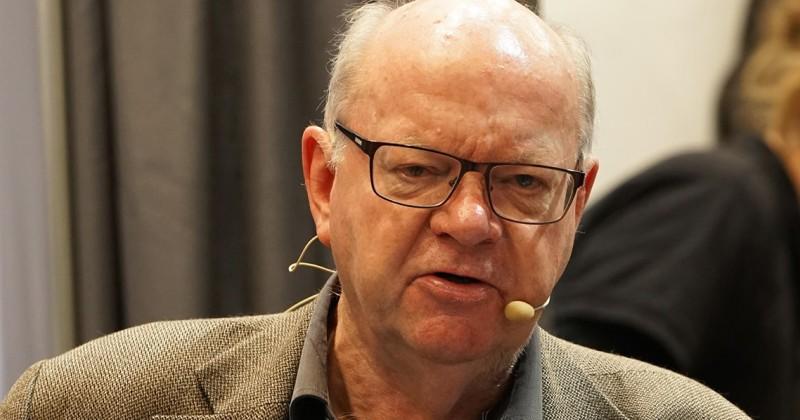
Danish history professor Uffe Østergaard says it’s time to build a wall around Europe because integration of migrants has failed and, “Protecting borders is necessary, otherwise the population will rebel against the government”.
Østergaard is a Jean Monnet professor of European civilisation and integration at Aarhus University and professor of European and Danish history at Copenhagen Business School. He specializes in European identity history and has studied multicultural and multiethnic states such as Austria-Hungary and the Ottoman Empire and their successor states.
Writing in an opinion piece for the Politiken newspaper, Østergaard admits that he used to be heavily in favor of multiculturalism but has since reversed his position.
“The time has come to build walls with wire fences in four lanes, floodlights and guard posts,” states the headline of his piece, which argues that if this doesn’t take place there will be a split between western and eastern Europe based on adversarial ideas on the management of immigration.
“Protecting borders is necessary, otherwise the population will rebel against the government,” writes Østergaard, asserting that the rise of no-go ghettos across Europe is a clear sign that integration has failed.
“Ghettos are a good example of parallel societies that arise. The integration has not failed for everyone, but for relatively many people,” writes the professor, demanding that “assimilation” and not “integration” should be the goal.
It is simply not possible to absorb such large numbers of people into welfare states, according to Østergaard.
The professor’s tone is somewhat similar to comments made by Russian President Vladimir Putin last month.
“The ruling elites have broken away from the people,” Putin told the Financial Times, adding that the “so-called liberal idea has outlived its purpose” and some western leaders had acknowledged that “multiculturalism” is “no longer tenable”.
* * *
There is a war on free speech. Without your support, my voice will be silenced. Please sign up for the free newsletter here. Donate to me on SubscribeStar here. Support my sponsor – Turbo Force – a supercharged boost of clean energy without the comedown.
via ZeroHedge News https://ift.tt/2JHHx8u Tyler Durden
“As political and economic freedom diminishes, sexual freedom tends, compensating, to increase. And the dictator (unless he needs cannon fodder and families with which to colonize empty or conquered territories) will do well to encourage that freedom.”
– Aldous Huxley, Brave New World
Power corrupts.
Anyone who believes differently hasn’t been paying attention.
Politics, religion, sports, government, entertainment, business, armed forces: it doesn’t matter what arena you’re talking about, they are all riddled with the kind of seedy, sleazy, decadent, dodgy, depraved, immoral, corrupt behavior that somehow gets a free pass when it involves the wealthy and powerful elite in America.
In this age of partisan politics and a deeply polarized populace, corruption – especially when it involves sexual debauchery, depravity and predatory behavior – has become the great equalizer.
But then there are the extra-ordinary men, such as Jeffrey Epstein, who belong to a powerful, wealthy, elite segment of society that operates according to their own rules or, rather, who are allowed to sidestep the rules that are used like a bludgeon on the rest of us.
As the Associated Press points out, “The arrest of the billionaire financier on child sex trafficking charges is raising questions about how much his high-powered associates knew about the hedge fund manager’s interactions with underage girls, and whether they turned a blind eye to potentially illegal conduct.”
It doesn’t matter whether you’re talking about a politician, an entertainment mogul, a corporate CEO or a police officer: give any one person (or government agency) too much power and allow him or her or it to believe that they are entitled, untouchable and will not be held accountable for their actions, and those powers will eventually be abused.
We’re seeing this dynamic play out every day in communities across America.
A cop shoots an unarmed citizen for no credible reason and gets away with it. A president employs executive orders to sidestep the Constitution and gets away with it. A government agency spies on its citizens’ communications and gets away with it. An entertainment mogul sexually harasses aspiring actresses and gets away with it. The U.S. military bombs a civilian hospital and gets away with it.
Abuse of power—and the ambition-fueled hypocrisy and deliberate disregard for misconduct that make those abuses possible—works the same whether you’re talking about sex crimes, government corruption, or the rule of law.
It’s the same old story all over again: man rises to power, man abuses power abominably, man intimidates and threatens anyone who challenges him with retaliation or worse, and man gets away with it because of a culture of compliance in which no one speaks up because they don’t want to lose their job or their money or their place among the elite.
It’s not just sexual predators that we have to worry about.
For every Jeffrey Epstein (or Bill Clinton or Harvey Weinstein or Roger Ailes or Bill Cosby or Donald Trump) who eventually gets called out for his sexual misbehavior, there are hundreds—thousands—of others in the American police state who are getting away with murder—in many cases, literally—simply because they can.
The cop who shoots the unarmed citizen first and asks questions later might get put on paid leave for a while or take a job with another police department, but that’s just a slap on the wrist. The shootings and SWAT team raids and excessive use of force will continue, because the police unions and the politicians and the courts won’t do a thing to stop it.
The war hawks who are making a profit by waging endless wars abroad, killing innocent civilians in hospitals and schools, and turning the American homeland into a domestic battlefield will continue to do so because neither the president nor the politicians will dare to challenge the military industrial complex.
The National Security Agency that carries out warrantless surveillance on Americans’ internet and phone communications will continue to do so, because the government doesn’t want to relinquish any of its ill-gotten powers and its total control of the populace.
Unless something changes in the way we deal with these ongoing, egregious abuses of power, the predators of the police state will continue to wreak havoc on our freedoms, our communities, and our lives.
Police officers will continue to shoot and kill unarmed citizens. Government agents—including local police—will continue to dress and act like soldiers on a battlefield. Bloated government agencies will continue to fleece taxpayers while eroding our liberties. Government technicians will continue to spy on our emails and phone calls. Government contractors will continue to make a killing by waging endless wars abroad.
And powerful men (and women) will continue to abuse the powers of their office by treating those around them as underlings and second-class citizens who are unworthy of dignity and respect and undeserving of the legal rights and protections that should be afforded to all Americans.
As Dacher Keltner, professor of psychology at the at the University of California, Berkeley, observed in the Harvard Business Review, “While people usually gain power through traits and actions that advance the interests of others, such as empathy, collaboration, openness, fairness, and sharing; when they start to feel powerful or enjoy a position of privilege, those qualities begin to fade. The powerful are more likely than other people to engage in rude, selfish, and unethical behavior.”
After conducting a series of experiments into the phenomenon of how power corrupts, Keltner concluded: “Just the random assignment of power, and all kinds of mischief ensues, and people will become impulsive. They eat more resources than is their fair share. They take more money. People become more unethical.They think unethical behavior is okay if they engage in it. People are more likely to stereotype. They’re more likely to stop attending to other people carefully.”
Power corrupts.
And absolute power corrupts absolutely.
However, it takes a culture of entitlement and a nation of compliant, willfully ignorant, politically divided citizens to provide the foundations of tyranny.
As researchers Joris Lammers and Adam Galinsky found, those in power not only tend to abuse that power but they also feel entitled to abuse it: “People with power that they think is justified break rules not only because they can get away with it, but also because they feel at some intuitive level that they are entitled to take what they want.”
We need to restore the rule of law for all people, no exceptions.
Here’s what the rule of law means in a nutshell: it means that everyone is treated the same under the law, everyone is held equally accountable to abiding by the law, and no one is given a free pass based on their politics, their connections, their wealth, their status or any other bright line test used to confer special treatment on the elite.
This culture of compliance must stop.
The empowerment of petty tyrants and political gods must end.
The state of denial must cease.
Let’s not allow this Epstein sex scandal to become just another blip in the news cycle that goes away all too soon, only to be forgotten when another titillating news headline takes its place.
Sex trafficking, like so many of the evils in our midst, is a cultural disease that is rooted in the American police state’s heart of darkness. It speaks to a far-reaching corruption that stretches from the highest seats of power down to the most hidden corners and relies on our silence and our complicity to turn a blind eye to wrongdoing.
If we want to put an end to these wrongs, we must keep our eyes wide open.
via ZeroHedge News https://ift.tt/2GaMHJ8 Tyler Durden