DOJ Grand Jury Probes Neville Roy Singham’s Marxist NGO Empire: Report

DOJ Grand Jury Probes Neville Roy Singham’s Marxist NGO Empire: Report

Perhaps we are finally learning why President Trump has taken to Truth Social in recent days to blast the socialists and Marxists who are transforming the Democratic Party into an anti-American movement that seeks to end capitalism and the Western world.

The party’s leftward drift became so glaring last week that even top Democrats were forced onto mainstream media to address the party’s dangerous shift toward the far-left.

The timing of Trump’s Truth Social posts suggests the president may have been briefed on a federal grand jury probe in Manhattan examining alleged financial crimes tied to far-left, China-based tech financier Neville Roy Singham, who has reportedly funneled hundreds of millions of dollars into left-wing nonprofits, media operations, and activist networks that seek to sow chaos and spread communism inside the US.

Fox News’ Asra Nomani reports that on Monday, U.S. Attorney Jay Clayton for the Southern District of New York, authorized by Acting Attorney General Todd Blanche, is examining whether Singham, NGOs he funded, or their leaders committed wire fraud, bank fraud, money laundering, or other financial crimes.

Prosecutors have issued subpoenas seeking bank records and other financial documents, according to Nomani’s sources.

Nomani’s team recently reported that Singham pumped $285 million through a Goldman Sachs donor-advised philanthropy fund and shell entities before it flowed into US nonprofits, while a broader review showed that $591 million flowed across five continents from 2017 through 2025.

More color from the report:

Of that money, Fox News Digital established a documented $278 million flowed directly from Singham into organizations that “sow discord” in the U.S., as House Ways and Means Chair Jason Smith put it earlier this year at a hearing a dynamics called “foreign malign influence.”

Singham, who resides in China, has a long track record of assisting far-left entities, such as Code Pink and the Party for Socialism and other socialist NGOs, that oppose U.S. interests and support U.S. adversaries.

According to investigative reports (e.g., New York Times, 2023), Singham has worked closely with pro-CCP propaganda networks targeting the US.

From NYT:

What is less known, and is hidden amid a tangle of nonprofit groups and shell companies, is that Mr. Singham works closely with the Chinese government media machine and is financing its propaganda worldwide.

From a think tank in Massachusetts to an event space in Manhattan, from a political party in South Africa to news organizations in India and Brazil, The Times tracked hundreds of millions of dollars to groups linked to Mr. Singham that mix progressive advocacy with Chinese government talking points.

Nomani’s report also stated that Treasury Secretary Scott Bessent recently met with Goldman CEO David Solomon to discuss the bank’s philanthropic arm and its role in facilitating some of the transactions.

Nomani detailed Singham’s transactions:

Step 1: Alleged Placement

Singham allegedly funneled $278 million from Shanghai into the United States through three key channels — the philanthropic arm of Goldman Sachs and two shell corporations that have since gone defunct.

  1. $164,040,000 to Mutod LLC, a now-defunct shell corporation established in 2017, based in Chicago.
  2. $110,376,701 to GS Donor Advised Philanthropy Fund For Wealth Management Inc., a philanthropy arm of Goldman Sachs, based in New York City.
  3. $3,500,000 to Likewise Conceptions LLC, a now-defunct shell corporation established in 2017, based in Crystal Lake, Ill.

Step. 2: Alleged Layering

The three entities then pumped the $278 million into six nonprofits:

  1. $167,540,000 to People’s Support Foundation Ltd., a 501(c)(3) nonprofit established with a hotel address in 2017 in Chicago and Singham’s wife, Evans, on the board.
  2. $68,748,701 to Justice and Education Fund Inc., a 501(c)(3) established with a UPS Store address in 2018 in New York City with self-avowed communists, including Manola De Los Santos, on the board.
  3. $22,440,000 to People’s Forum Inc., a 501(c)(3) established in 2017 on W. 37th Street in New York City with Evans and De Los Santos on the board.
  4. $16,760,000 to Tricontinental Ltd., a 501(c)(3) established in North Hampton, Mass., in 2017 by Singham friend and fellow Marxist ideologue Vijay Prashad.
  5. $1,330,000 to CodePink Women For Peace, a 501(c)(3) established in 2009 in Marina Del Ray, Calif., by Singham’s wife, Evans, and her friend, Susan Medea Benjamin.
  6. $1,098,000 to Breakthrough BT Media Inc., a 501(c)(3) established in New York City in 2020 at the People’s Forum headquarters with longtime American communist leader Brian Becker’s son, Ben Becker, as editor-in-chief of its pro-communist propaganda outlet, Breakthrough News.

Step 3: Alleged Integration

The six nonprofits then funneled at least $223 million and other forms of support into a global network of organizations including:

  1. People’s Welfare Association, a 501(c)(4) established in 2019 with the address of a UPS store in Madison, Wisc., today reporting about $12 million in revenues transformed into grants to undisclosed groups around the world.
  2. Countless unidentified organizations in six regions around the world, including Subsaharan Africa, Central America and even North America, receiving tens of millions of dollars.
  3. The ANSWER Coalition, a communist organization whose Chicago address has been listed as the location of the Green Mill Restaurant, a regular haunt for 20th century gangster Al Capone, whom federal prosecutor Elliott Ness prosecuted and convicted for tax evasion.
  4. The Party for Socialism and Liberation, a loosely-structured organization with shared leadership from the House of Singham, like the Becker father-son duo.

Related:

1. Is There A “Cuba Connection” Behind The Radicalization Of America’s Nonprofit Left

2. Troubling Pattern Of Left-Wing Revolutionaries Targeting “Capitalists” Raises Alarm Over Youth Radicalization

3. “Wants To Be More Political Than His Daddy”: Alex Soros Plows $103 Million Into Unhinged Democrats Ahead Of Midterms

4. Trump Jokes “I’d Be The Greatest Communist In History” As Democratic Elites Panic Over Socialist Hijack

For the first time, the American people may soon learn why parts of the Democratic Party’s left-wing NGO ecosystem have been pushing a socialist revolution and the end of capitalism. These ideas do not appear to have emerged organically. Instead, the grand jury probe into Singham’s funding network could expose what appears to be a broader foreign-influence network, with possible financial links potentially stretching through China, Cuba, Europe, and other anti-Western networks.

Tyler Durden
Mon, 06/29/2026 – 13:00

via ZeroHedge News https://ift.tt/Zfc5xk6 Tyler Durden

Tether’s USDT Jumps To 8.5% Premium In India After Crypto Payment Crackdown

Tether’s USDT Jumps To 8.5% Premium In India After Crypto Payment Crackdown

Authored by Shaurya Malwa via CoinDesk.com,

Raids on crypto payment firms in Bengaluru disrupted the pipeline that feeds dollar-pegged USDT to Indian platforms, pushing its local price more than 8.5% above the dollar, roughly double the usual gap.

The price of Tether’s USDT, the largest dollar-pegged stablecoin, has climbed to more than 8.5% above its dollar value on Indian platforms after a government crackdown on crypto payment firms choked off the token’s supply into the country.

USDT traded around 102.88 rupees over the weekend against an official dollar-rupee rate of about 94.65, a gap that normally sits between 3% and 4%.

That spread, known as the USDT premium, is the extra amount buyers in India pay for the stablecoin above what a dollar costs through banks, and it widens when local demand outstrips the supply of tokens.

Local publication ET said the squeeze followed action by the Enforcement Directorate (ED), India’s financial-crime agency, which searched six premises in Bengaluru on June 17 under the Foreign Exchange Management Act, the law governing cross-border money flows.

The agency is targeting five crypto payment firms it alleges moved more than $265 million in unauthorized cross-border transfers using digital assets.

The ED alleges the firms ran what amounted to an informal remittance channel, with non-resident Indians using USDT in place of bank wires.

Rupees were deposited into company accounts, converted into stablecoins, sent across borders and sold on Indian exchanges, the agency said, sidestepping the paperwork and approvals that formal remittance routes require under FEMA and India’s anti-money-laundering law.

The model had operated for about two years, drawing users because stablecoin transfers were faster and cheaper than bank routes and, thanks to the standing premium, converted into more rupees on the way in.

The premium spiked because the crackdown hit supply directly.

After the ED announced its action, market makers and liquidity providers, the firms that source tokens from abroad to sell on local platforms, pulled back on buying USDT overseas, tightening the domestic pool just as the off-ramps feeding it came under pressure. An off-ramp is the route for turning crypto back into local cash.

As such, prominent exchange Coinbase launched direct rupee rails in India last month, easing some reliance on peer-to-peer trades, though the ED’s action targets the off-ramp infrastructure that drives the premium.

[ZH: These actions by Indian officials come as their currency collapses and various capital controls – on bullion most recently – are enacted… see here, here, and here.]

Tyler Durden
Mon, 06/29/2026 – 12:40

via ZeroHedge News https://ift.tt/A2hUTGz Tyler Durden

NANO Nuclear Rises On Potential Power Plant, Dual-Listing In Abu Dhabi

NANO Nuclear Rises On Potential Power Plant, Dual-Listing In Abu Dhabi

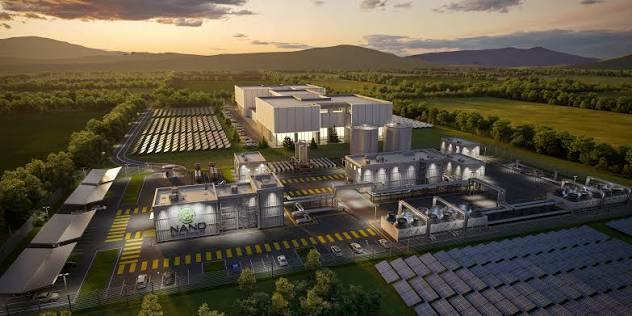
Over the past year, we’ve tracked NANO Nuclear’s reactor, fuel, and supply chain programs closely through nearly every milestone. After branching into the Asian market and then making the formal transition to a revenue generating company, the company is now working on their next frontier in the UAE.

According to Semafor, the company is actively working to restart its UAE partnership after delays caused by the Iran war. The update builds on NANO Nuclear’s February announcement of a Memorandum of Understanding with EHC Investment LLC, the Abu Dhabi-based firm tied to International Holding Company. 

Company leadership is looking to explore joint deployment of the KRONOS MMR Energy System and supporting supply chains in the UAE and select Gulf markets. 

The MOU followed the company’s earlier signals of interest in regional opportunities, including senior executives’ participation at ADIPEC 2025 in Abu Dhabi where leaders highlighted advanced nuclear’s role in the global energy mix.

The original agreement, signed just days before the Iran conflict started, targeted power for data centers and remote oil and gas facilities. CEO James Walker told Semafor “Demand from the Gulf market could become very large, very quickly.”

However, as a result of the war, NANO has held off though on sending teams for site selection and feasibility studies until tensions ease. Deployment of personnel is now planned for later this year. 

Early-stage talks are also underway for potential investment from a Sheikh Tahnoon Bin Zayed-linked entity. Such capital could fund expansion, support a possible UAE power plant order, and open the door to dual listing in Abu Dhabi. 

Reactor designs like those used in the current American commercial fleet are poorly designed for water-restricted environments like the Middle East. 

Advanced designs, like the gas-cooled KRONOS reactor from NANO, are uniquely capable of operating in environments that lack easy access to water-based cooling systems.

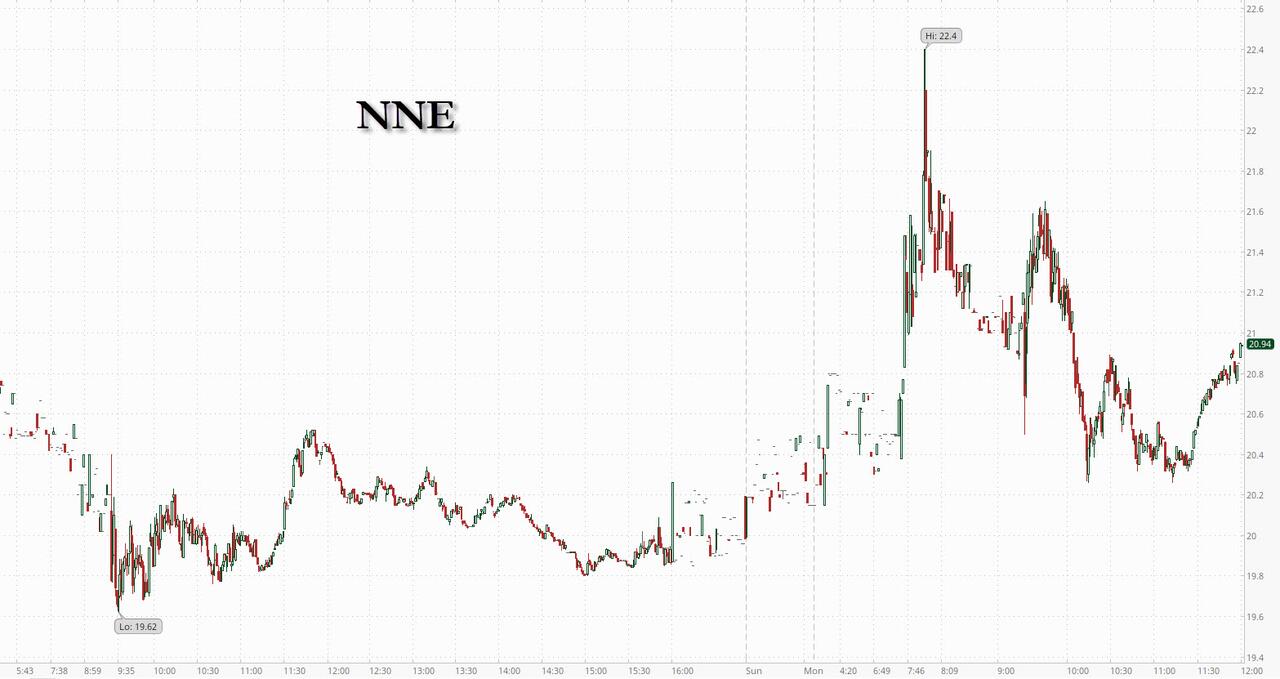
NNE stock rose on the news, and was last trading up over 5%.

Tyler Durden
Mon, 06/29/2026 – 12:20

via ZeroHedge News https://ift.tt/MYgFx7S Tyler Durden

‘Problematic But Not Critical’: Putin Concedes Fuel Shortages After Ukraine Strikes, Plays It Cool

‘Problematic But Not Critical’: Putin Concedes Fuel Shortages After Ukraine Strikes, Plays It Cool

President Vladimir Putin made a rare admission over this past weekend, belatedly acknowledged Sunday that Russia is facing a “certain shortage” of fuel following weeks of ramped-up drone warfare coming out of Ukraine, which has chiefly targeted oil refineries and domestic supply facilities, including in the Moscow region.

“As for strikes against critical infrastructure in general, and energy infrastructure in particular, of course, these attacks on our infrastructure facilities create problems,” Putin said in the new interview published by the Kremlin. “That’s obvious.

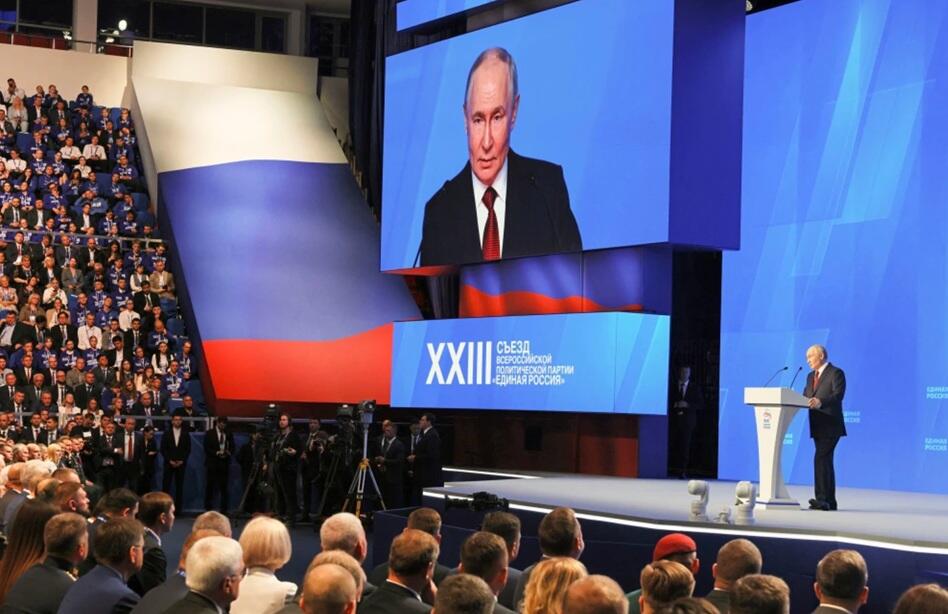
“Right now we’re observing a certain shortage, but it’s not critical,” he added. He also made wide-ranging public remarks at a major summit of the ruling ‘United Russia’ party.

AFP via Getty Images

Ukraine’s Zelensky has made no secret of his plans to make life inside Russia as painful as possible, in order to put pressure on the Kremlin to end the war. By close of last week, the rare national fuel crisis inside Russia was outlined as follows:

A fast-growing number of regional officials and gas station chains across Russia are restricting gasoline and diesel sales as Ukrainian drone attacks on oil refineries and supply networks take a mounting toll on supplies. 

Fuel rationing measures were in place in at least 56 Russian regions as of Thursday, according to open-source data analyzed by The Moscow Times. In dozens more regions, residents are complaining about fast-rising gasoline prices, closed filling stations and miles-long lines, while some local authorities and major retailers remain hesitant to enact rationing. 

“In some districts of our republic, there is no fuel at gas stations right now, so people go to [the capital] Kyzyl to refuel,” said a resident of Tyva, a southern Siberian republic roughly the size of Tunisia. 

Further, a state of emergency for all citizens was also declared in Crimea last week – with fuel only being provided to military and state entities at this point.

Putin further acknowledged in his comments that small, slow-moving drones have proven a problem for Russia’s anti-air defense systems, which were conventionally designed to intercept large fast projectiles like missiles or warplanes.

This has been big on Russians’ minds, as this month they beheld unprecedented scenes of massive smoke plumes overtaking Moscow’s skyline, as a key refinery there burned. Still , the Russian leader sought to project strength, stating:

Our retaliatory strikes deep inside Ukraine are far more powerful, more painful, and, frankly, more destructive, causing serious consequences for the “Kyiv regime.”

“Yes, we see the problems, we are aware of them and are responding to them, but we will certainly ensure the security of both the country and our citizens, as well as the inviolability of Russia’s borders,” Putin said at an earlier speech at the congress of the ruling United Russia party

“We will undoubtedly overcome all the challenges facing us today, including terrorist attacks on our territory and infrastructure facilities,” he added.

In the context of the separate Kremlin interview, Putin continued to express hope of positive talks with the US, amid efforts to both improve bilateral relations and negotiate a final political solution to end the Ukraine conflict.

Addresses Ukraine’s ‘information campaign’…

“We are ready to continue negotiations and discuss all the details,” Putin said, saying that he expects White House special envoy Steve Witkoff and Trump’s son-in-law Jared Kushner to visit Moscow after the “active phase” of the war in the Middle East passes.

Russian officials have repeatedly commented on Washington being busy and absorbed with the Iran conflict and Strait of Hormuz crisis.

That Putin is somewhat downplaying the fuel crisis, emphasizing that it’s “not critical” – signals that Russia is not yet feeling enough pressure to compromise or capitulate on anything, as Zelensky is hoping.

Tyler Durden
Mon, 06/29/2026 – 11:40

via ZeroHedge News https://ift.tt/LlGyPiz Tyler Durden

Lawsuit Filed For Records On Jan. 6 Provocateur Ray Epps

Lawsuit Filed For Records On Jan. 6 Provocateur Ray Epps

Authored by Ken Silva via Headline USA,

During the Biden years, Kash Patel accused Jan. 6 provocateur Ray Epps of being a federal asset.

Referring to the fact that Epps was taken off the FBI’s Most Wanted list in early 2021, Patel said there was only two ways someone could get off that list—either they died or they’re working for the government.

Now that he’s FBI director, Patel has gone silent on Epps. But a New Jersey investigative journalist is trying to force disclosure with a Freedom of Information Act lawsuit filed Friday in federal court.

In his lawsuit, the journalist, Yehuda Miller, said he filed a request in April 2025 for all communications and directivesrelating to the removal of Epps from the FBI’s wanted list, as well as all communications between the FBI and Epps from Jan. 1, 2020, through Jan. 1, 2025.

Miller filed his lawsuit after the FBI denied him those records on privacy grounds. Miller urged a judge to force the FBI to produce the documents on Epps.

“The public interest in understanding whether the FBI maintained a confidential informant or undercover relationship with Ray Epps, the circumstances of his disparate treatment relative to other January 6 participants, and the FBI’s internal communications and directives relating to his removal from the wanted list substantially outweighs any privacy interest Ray Epps may assert,” his lawsuit says.

“The current FBI Director’s own public statements confirm the significance of this public interest.”

According to FBI records, agents had “photographic/and or video evidence that James Ray Epps conspired to and/or recruited others to storm the United States Capitol Building.”

However, a July 29, 2021, FBI report said that its “investigation did not reveal sufficient evidence that Epps … engaged in acts of violence or committed any other criminal violations.” That’s despite the fact that video had already surfaced showing him pushing a sign into a group of police officers, and that Epps had admitted to trespassing on Capitol grounds.

The Justice Department apparently reopened the Epps case after Rep. Thomas Massie, Revolver News and other conservatives began to question whether he was being protected by government. The DOJ eventually slapped him with a lone misdemeanor count of disorderly conduct, and he received one year of probation in January 2024.

Last October, Massie wrote to the DOJ, also seeking records on Epps. Massie sought all internal communications between FBI Headquarters and its Phoenix field office, which initially investigated Epps. He also sought all communications between the FBI and DOJ about him.

Additionally, Massie wanted to know whether the DOJ or any of its components, including the FBI, had any communication with Epps prior to the Jan. 6, 2021, Capitol Hill protest. Such communications might indicate whether Epps was working for the government at the time.

However, there’s no public indication that the DOJ ever responded to Massie’s letter.

Tyler Durden
Mon, 06/29/2026 – 11:20

via ZeroHedge News https://ift.tt/8H1G40p Tyler Durden

Supreme Court Allows Late Receipt Of Ballots During Elections

Supreme Court Allows Late Receipt Of Ballots During Elections

The Supreme Court on Monday ruled 5–4 to uphold a Mississippi law providing that absentee ballots do not have to be received by Election Day – and that states may count ballots postmarked by Election Day but received afterward.

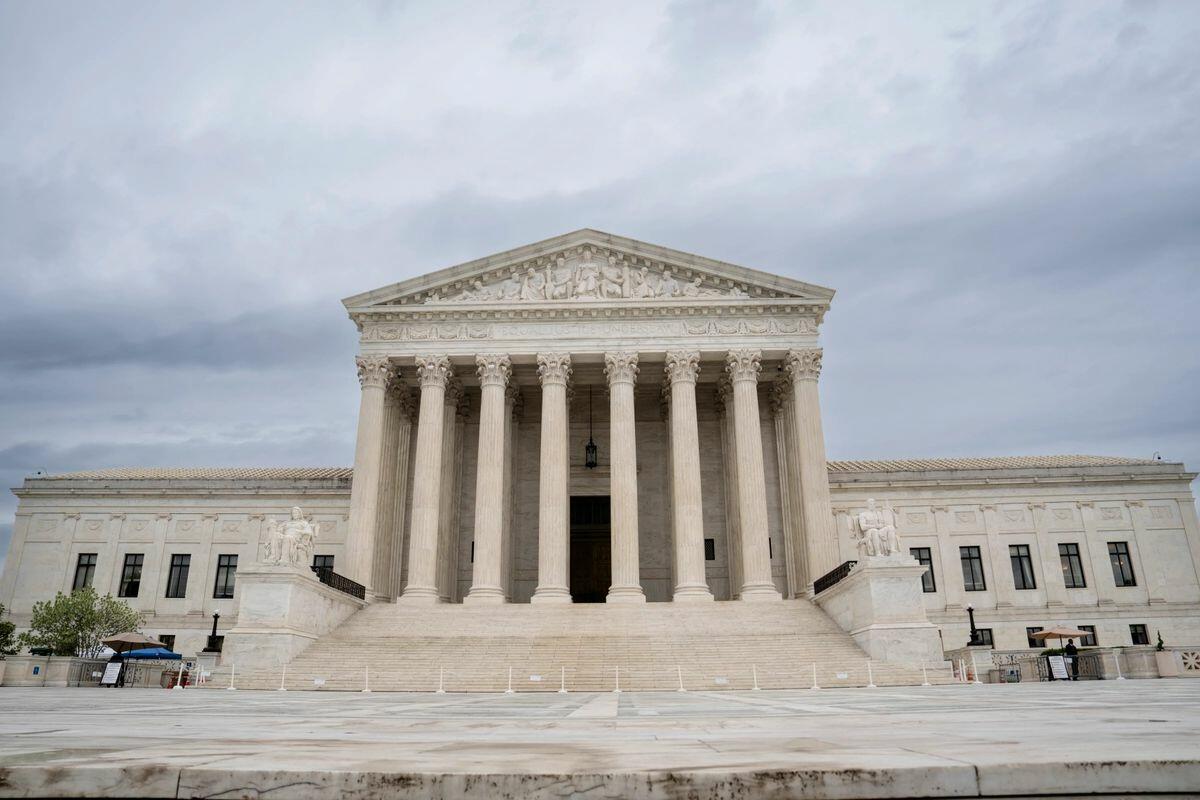
The Supreme Court in Washington on April 28, 2026. Madalina Kilroy/The Epoch Times

The ruling in Watson v. Republican National Committee reverses the Fifth Circuit, which had sided with the Republican National Committee and the Mississippi Republican Party. It leaves in place the ballot receipt practices of roughly 30 states and puts Congress, not the Court, on the hook if anyone wants a nationally uniform receipt deadline.

The Case

Mississippi lets certain residents – including college students away from home, senior citizens, and others – vote by absentee ballot. They can mail their ballots or send them by common carrier. The deadline: ballots must be postmarked on or before Election Day and received by the registrar no more than five business days afterward.

The RNC argued that the three federal Election Day statutes – governing presidential electors, House members, and senators – use the word “election” to mean two things at once: ballot casting and ballot receipt. So when Congress set a day for the “election,” the RNC argued, it also set a receipt deadline. The Fifth Circuit agreed. The district court had not.

Writing for the majority, Justice Amy Coney Barrett framed the question at the outset: does counting ballots postmarked by Election Day but received up to five days later violate the federal statutes?

Justice Amy Coney Barrett

Barrett’s argument runs on three tracks: text, statutory context, and constitutional structure.

On text, “election” has always meant the act of choosing. Webster’s 1869 dictionary defines it as “[t]he act of choosing a person to fill an office.” The Court’s own precedent in United States v. Classic (1941) called an election “no more and no less than the expression by qualified electors of their choice of candidates.” That choice, Barrett writes, is made when voting is complete – not when ballots land on a registrar’s desk. The statutes set when the people vote, and says nothing about when the mail arrives.

The 2022 amendment to the presidential Election Day statute reinforces this point. When Congress inserted the phrase “election day” and defined it, it tied the definition to “the period of voting” – not the period of receipt. That is the act Congress was governing.

The Electoral College has always separated the act of voting from the act of transmission. Electors “give their Votes” on a uniform day and then “transmit” those votes to the seat of government. The Constitution mandates that the voting day be uniform; it says nothing about the day of receipt. The federal Election Day statutes follow the same architecture. As Barrett closes the majority opinion: “The election-day statutes say nothing about ballot receipt, and we cannot add to the words Congress chose.”

The Dissent Comes Out Swinging

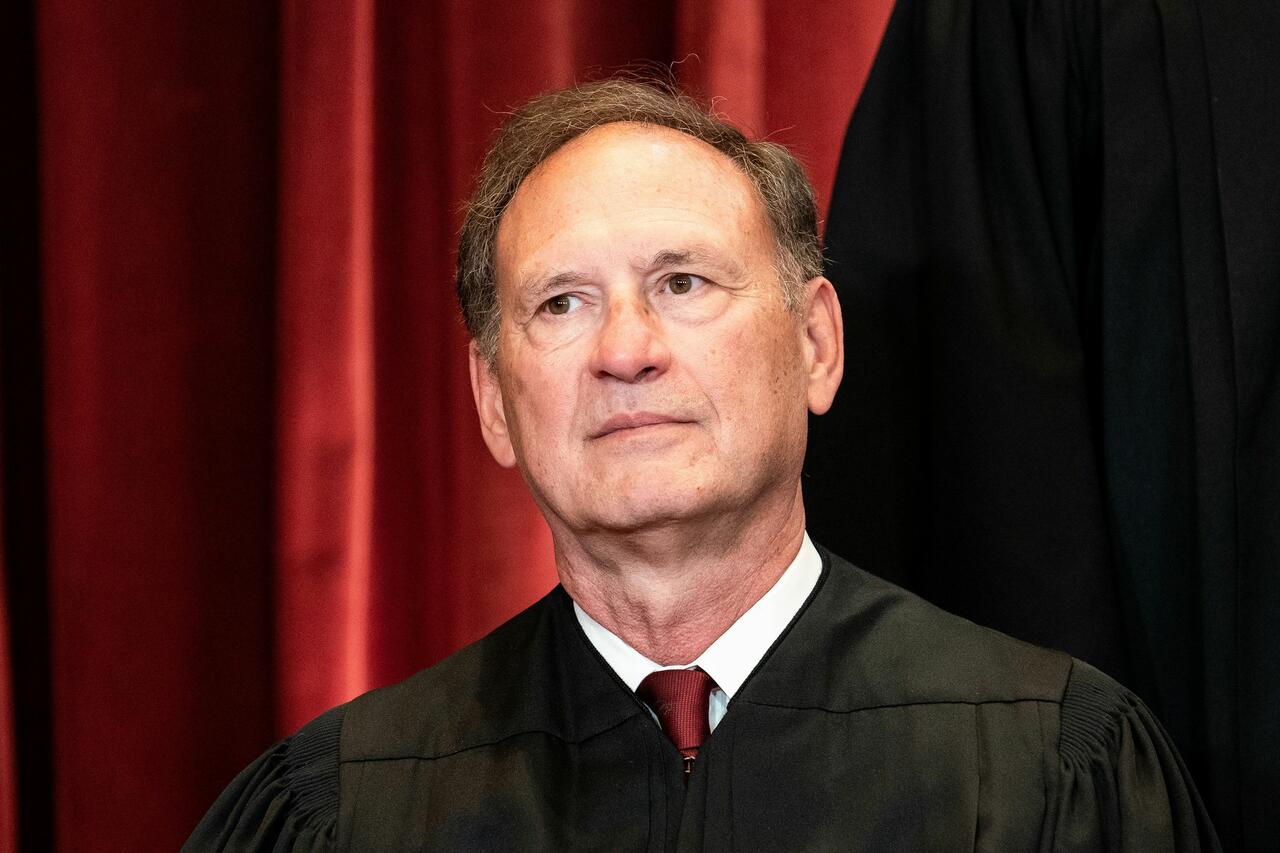
In a scathing dissent, Justice Samuel Alito argued that an “election” is a collective act, not an individual one. The electorate does not express its choice until the full collection of ballots is in official custody. Until that moment, the choice is not made – it is still in transit, still subject to recall, and still incomplete. Receipt is therefore part of the election, not merely an administrative matter.

Justice Samuel Alito

He cited two centuries of practice to support that view: from the founding through most of the 20th century, Election Day was the day ballots were collected. Even during the Civil War, when states had every logistical incentive to extend receipt deadlines for soldiers at the front, none did. Alito finds it implausible – a “delicately put understatement,” he says, borrowing the majority’s own phrase – that extending receipt deadlines simply never occurred to Civil War-era legislatures as an option. In short, he argues, they understood federal law to require receipt by Election Day.

Alito also cites Foster v. Love (1997) – the Court’s only prior interpretation of the Election Day statutes – which defined “election” as the “combined actions of voters and officials meant to make a final selection of an officeholder.” If officials receiving ballots is part of that “combined action,” then officials receiving ballots must occur on Election Day. The majority, Alito argues, quietly reads the “officials” half of that formula out of the statute.

And he raises a practical alarm: what is the outer limit of today’s holding? Mississippi uses a five-day window. Washington state allows receipt up to 21 days after Election Day. The majority’s reasoning sets no federal floor. Could states eliminate receipt deadlines entirely? Could a voter hand a ballot to an Uber driver on Election Day for delivery weeks later?

What Happens Next

The immediate effect: Mississippi’s five-day post–Election Day receipt window survives. The Fifth Circuit’s ruling is reversed and remanded.

The broader effect: the roughly 30 states that already count ballots postmarked by Election Day and received afterward are now on solid federal legal footing. No federal preemption argument runs against them under today’s ruling.

Tyler Durden
Mon, 06/29/2026 – 11:00

via ZeroHedge News https://ift.tt/0gcumbF Tyler Durden

Supreme Court Blocks Trump Firing Of Fed Governor Lisa Cook – For Now

Supreme Court Blocks Trump Firing Of Fed Governor Lisa Cook – For Now

The Supreme Court on Monday handed President Trump a significant defeat – ruling 5-4 that his attempt to fire Federal Reserve Governor Lisa Cook was procedurally invalid and that the Fed’s century-old independence from presidential removal-at-will remains constitutionally intact. That said, it isn’t over for Cook – as the Court said she can stay in her job for now – while she fights in lower courts against Trump’s bid to oust her over allegations of mortgage fraud. 

In a majority opinion authored by Chief Justice Roberts and joined by an unlikely coalition spanning Sotomayor, Kagan, Kavanaugh, and Jackson, the Court denied the administration’s application for a stay, leaving in place a lower court injunction that keeps Cook on the Board of Governors pending full litigation.

Concurring
Roberts
Kavanaugh
Jackson
Sotomyaor
Kagan

Dissenting
Alito
Gorsuch
Barrett
Thomas

The Court’s decision rests on procedure; Trump didn’t give Cook notice or a deadline to respond – as it was done via tweet. That, the majority held, is insufficient to terminate a presidential appointee serving a 14-year term on the body that controls the cost of money in the United States. The ruling leaves open whether the mortgage fraud allegations – two simultaneous primary-residence mortgage commitments signed just 14 days apart – would constitute adequate cause for removal once proper process is followed.

“At minimum, Cook was entitled to some explanation of the evidence at issue, some avenue for a response, and a deadline by which a response would be due,” the decision reads. 

So, it’s not quite over – she just gets to keep her job, for now. 

Cook, the first Black woman to serve on the Federal Reserve Board of Governors, has remained in her position despite Trump’s attempt to remove her in August 2025 – citing allegations of mortgage fraud that Cook has strongly denied. No president had previously fired a sitting Fed governor in the central bank’s 112-year history.

She was initially nominated by President Joe Biden and confirmed by the Senate in 2022. Biden renominated her in 2023 for a full 14-year term expiring in 2038. Under the Federal Reserve Act, members of the Board of Governors can be removed by the president only “for cause,” a protection intended to safeguard the central bank’s independence from political pressure.

The Dispute

In a letter posted to Truth Social, Trump accused Cook of making false statements on mortgage applications prior to her Fed service, describing the actions as “deceitful and potentially criminal.” Cook and her legal team have rejected the claims, provided rebuttal evidence, and argued that she was never given an opportunity to contest the allegations or receive due process. She has never been charged with any crime related to the matter.

In September 2025, the Department of Justice opened a criminal investigation into the mortgage allegations, issuing grand jury subpoenas related to properties in Ann Arbor, Michigan, and Atlanta, Georgia. The probe remains active as of May 2026 with no charges filed against Cook.

Cook filed suit in federal court in Washington, D.C., challenging the removal as unlawful. On September 9, 2025, U.S. District Judge Jia Cobb issued a preliminary injunction blocking the firing, finding that Cook made a strong showing that the removal violated the Federal Reserve Act’s for-cause provision. The D.C. Circuit Court of Appeals upheld the injunction on an emergency basis, allowing Cook to participate in Federal Open Market Committee meetings.

The Trump administration appealed to the Supreme Court, which on October 1, 2025, declined an emergency request to immediately remove Cook but scheduled full oral arguments for January 21, 2026. Cook has continued serving on the Board throughout the litigation.

Meanwhile, last September the DOJ opened a Grand Jury criminal investigation into Cook over the allegations. 

Key Legal Issues

Trump v. Cook, centers on two core questions:

  • Whether the president has broad authority to interpret and apply the “for cause” standard unilaterally, or whether courts can review such removals.
  • The broader implications for the independence of the Federal Reserve and other independent agencies with similar statutory protections.

During oral arguments on January 21, 2026, justices across the ideological spectrum expressed skepticism about the administration’s position, questioning the lack of due process for Cook and the potential risks to central bank independence. Observers noted the Court appeared likely to side with Cook, at least on keeping her in place pending full resolution.

New Leadership at the Fed

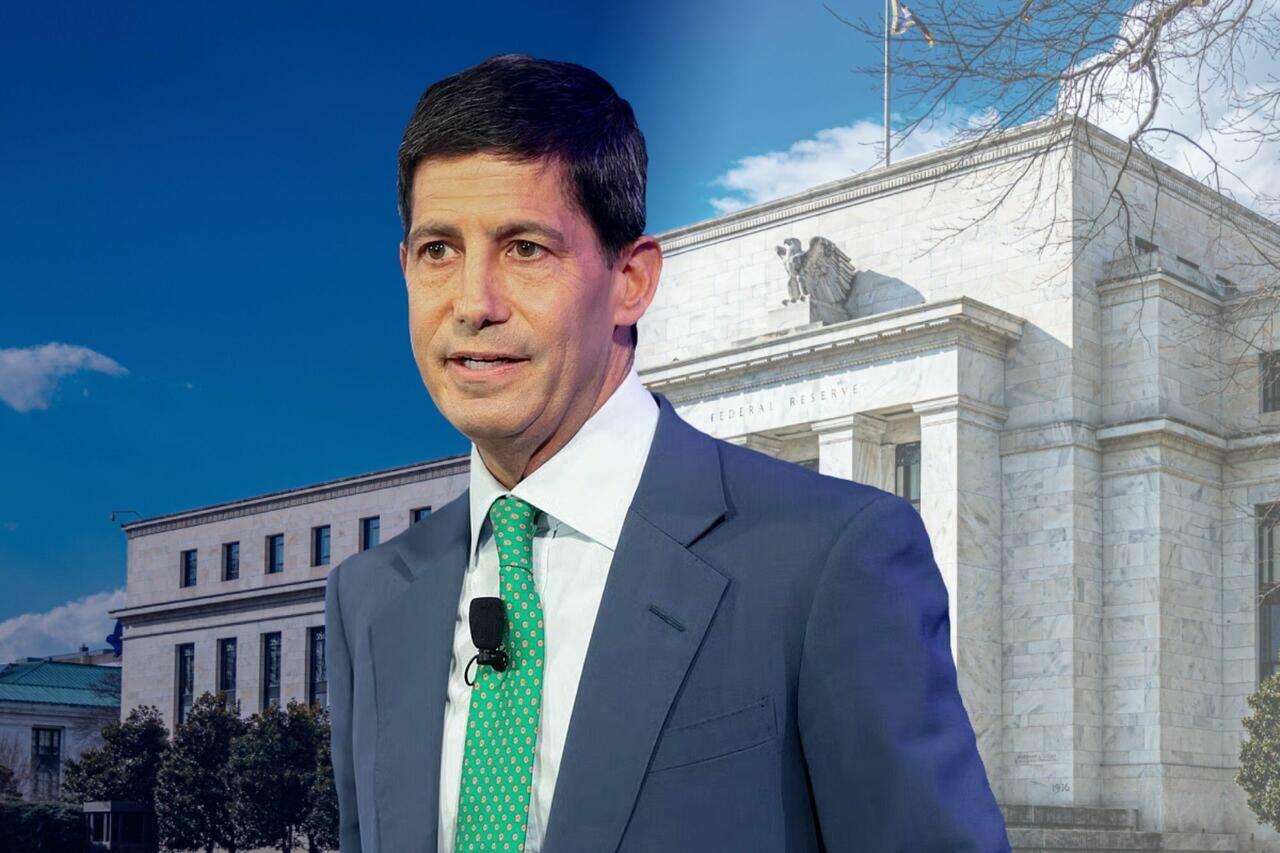
The case unfolds against a major leadership transition at the Federal Reserve. Last month, the Senate confirmed Kevin Warsh as the new Chair of the Federal Reserve, succeeding Jerome Powell. Warsh, a former Fed governor and Trump nominee, has advocated for a “regime change” at the central bank, signaling a potential shift toward policies more aligned with administration priorities, including greater focus on lowering interest rates where appropriate while maintaining independence in decision-making.

Warsh has largely stayed out of the Cook litigation during his confirmation process, declining to comment directly on the removal effort or pledge to defend her position. His ascension marks a new direction for the Fed amid ongoing debates over monetary policy, inflation pressures, and institutional independence.

According to Cook supporters, allowing at-will removals by the president could politicize monetary policy, undermining market confidence and economic stability. The administration has contended that the president retains ultimate executive authority under Article II of the Constitution. Cook, meanwhile, has described the case as determining whether the Fed will continue to set policy based on evidence and independent judgment or face political pressure.

Tyler Durden
Mon, 06/29/2026 – 10:20

via ZeroHedge News https://ift.tt/U89Rqnj Tyler Durden

Key Events This Holiday-Shortened Week: Jobs, Warsh In Sintra, ISM, ADP

Key Events This Holiday-Shortened Week: Jobs, Warsh In Sintra, ISM, ADP

Global attention this holiday-shortened week,will center on the US labor market, with the June employment report due on Thursday ahead of the Independence Day holiday. A reminder that the US will be 250 years old this week. Alongside that, central bank communication will be in focus at the ECB’s Sintra forum (today through Wednesday), while inflation data across Europe and activity indicators in Asia—notably China’s PMIs and Japan’s monthly data—round out a busy global calendar.

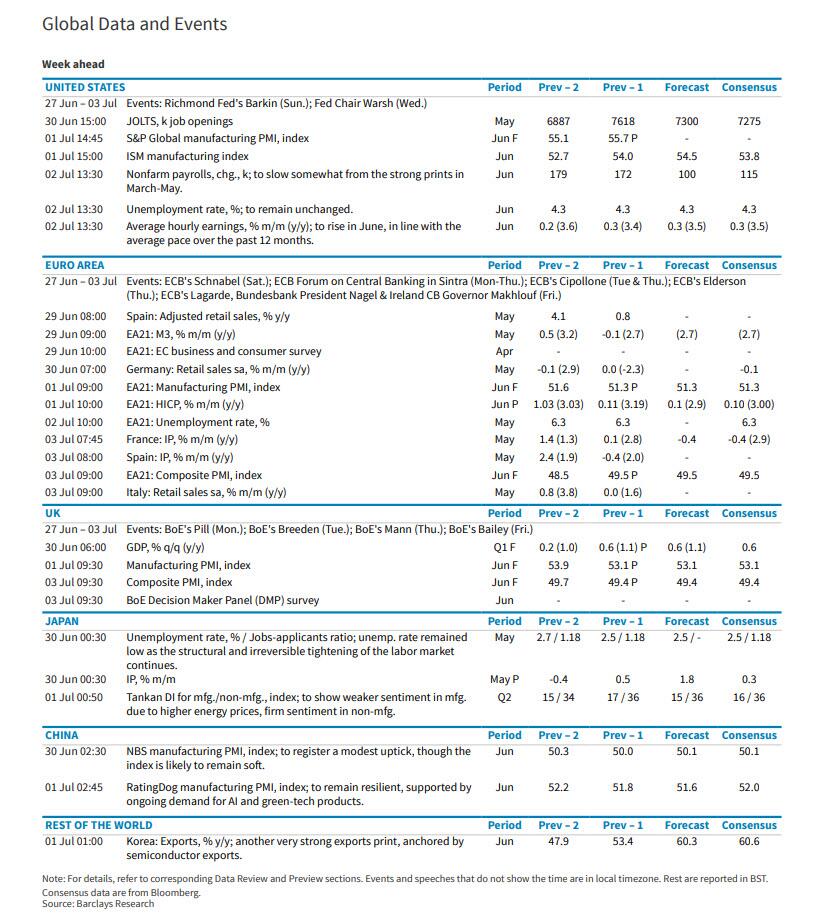
In the US, DB economists expect payroll growth on Thursday to slow to +75k (from +172k previously), with private payrolls rising by around +90k. There is some risk of seasonals pulling down the numbers as they have in recent years around this time. The unemployment rate is expected to hold at 4.3%, while average hourly earnings are seen unchanged at +0.3% month-on-month. Hours worked are also expected to remain steady at 34.3, leaving nominal income growth broadly stable.

Ahead of that, today brings the Dallas Fed manufacturing survey, while tomorrow sees the May JOLTS report, where markets will watch for any shifts in hiring, quits and layoffs amid a still subdued hiring environment. Wednesday then features the ADP employment report alongside the ISM manufacturing index (forecast 53.9 vs 54.0 previously). These releases should help set expectations going into Thursday’s payrolls. Beyond the labor market, tomorrow also sees the Conference Board’s consumer confidence index (economists expect 94.4 vs 93.1 previously).

On policy, attention will turn to Wednesday, when Fed Chair Warsh speaks at the ECB’s Sintra forum. DB economists continue to expect a relatively hawkish policy path, with two rate hikes pencilled in later this year. However, near-term guidance is likely to remain limited, leaving markets to take their cues primarily from incoming data.

Looking beyond the US, Europe’s main event is the aforementioned ECB’s annual Sintra conference, which begins today and runs through Wednesday, featuring remarks from major central bank leaders. In parallel, inflation data will be a key focus, with Spain and Belgium reporting today, followed by Germany, France and Italy tomorrow, and the Eurozone aggregate on Wednesday. DB economists expect inflation of 2.46% YoY in Germany, 2.30% in France, 3.23% in Italy, and 2.95% for the Eurozone. Switzerland will also release CPI on Thursday. In the UK, the BoE publishes its credit conditions surveys on Thursday and the DMP survey on Friday.

In Asia, China releases various PMIs in the first half of the week. In Japan, today’s retail sales (out earlier) is followed by industrial production tomorrow, where economists expect a +1.4% month-on-month increase. The highlight, however, will be the Bank of Japan’s Tankan survey on Wednesday, which is expected to show broadly steady sentiment and may reinforce the case for further gradual policy tightening.

Courtesy of DB, here is a day by day calendar of events

Monday June 29

  • Data: US June Dallas Fed manufacturing activity, UK May net consumer credit, M4, Japan May retail sales, Eurozone May M3, June economic confidence
  • Central banks: ECB forum on central banking in Sintra (through July 1), ECB’s Lagarde speaks, BoE’s Pill speaks
  • Earnings: Prosus, AeroVironment

Tuesday June 30

  • Data: US June Conference Board consumer confidence index, MNI Chicago PMI, Dallas Fed services activity, May JOLTS report, April FHFA house price index, China June official PMIs, UK June Lloyds Business Barometer, Q1 current account balance, Japan May jobless rate, job-to-applicant ratio, industrial production, housing starts, Germany June CPI, unemployment claims rate, May retail sales, import price index, France June CPI, May PPI, consumer spending, Italy June CPI, May PPI, Canada April GDP
  • Central banks: ECB’s Vujcic, Elderson, Schnabel, Cipollone and Lane speak, BoE’s Breeden speaks
  • Earnings: Nike

Wednesday July 1

  • Data: US June ISM index, ADP report, May construction spending, China June RatingDog manufacturing PMI, Japan Q2 BoJ’s quarterly Tankan survey, June consumer confidence index, Italy June new car registrations, budget balance, Q1 deficit to GDP, Eurozone June CPI
  • Central banks: Fed’s Warsh speaks, ECB’s Lagarde, Vujcic, Cipollone and Lane speak, BoE’s Bailey speaks, BoC’s Macklem speaks
  • Earnings: General Mills
  • Other: Ireland takes on the rotating presidency of the Council of the EU

Thursday July 2

  • Data: US June jobs report, May factory orders, initial jobless claims, Japan June monetary base, France May budget balance, Italy May unemployment rate, Eurozone May unemployment rate, Canada June manufacturing PMI, Switzerland June CPI
  • Central banks: ECB’s Cipollone speaks, BoE’s Mann speaks, BoE’s Q2 bank liabilities, credit conditions surveys
  • Other: US bond markets close early

Friday July 3

  • Data: China June RatingDog services PMI, UK June official reserves changes, France May industrial production, Italy May retail sales
  • Central banks: ECB’s Lagarde, Nagel and Makhlouf speak, BoE’s Bailey speaks, BoE’s June DMP survey
  • Other: US Independence Day holiday (all markets closed)

Finally, looking at just the US, Goldman writes that the key economic data release this week is the employment report on Thursday. Fed Chairman Kevin Warsh is expected to speak at the ECB Forum in Sintra, Portugal on Wednesday. 

Monday, June 29 

  • There are no major economic data releases scheduled. 

Tuesday, June 30 

  • 09:00 AM FHFA house price index, April (consensus +0.2%, last +0.1%)
  • 09:00 AM Case-Shiller home price index, April (GS -0.1%, consensus -0.1%, last -0.2%)
  • 10:00 AM Conference Board consumer confidence, June (GS 95.5, consensus 94.6, last 93.1)
  • 10:00 AM JOLTS job openings, May (GS 7,100k, consensus 7,288k, last 7,618k): We estimate that JOLTS job openings declined to 7.1mn in May based on the signal from online measures of job postings from Indeed and LinkUp.

Wednesday, July 1 

  • 08:15 AM ADP employment change, June (GS +120k, consensus +119k, last +122k)
  • 09:00 AM Fed Chairman Warsh speaks: Fed Chairman Kevin Warsh will participate in a panel discussion with the President of European Central Bank Christine Lagarde, Bank of England Governor Andrew Bailey, and Bank of Canada Governor Tiff Macklem at the ECB Forum on Central Banking in Sintra, Portugal. A moderated Q&A is expected. The event will be livestreamed. In his press conference following the June FOMC meeting, Chairman Warsh said, “The Committee thought that the labor markets were stable. There were some people around the Committee who thought that it was trending better than that, [and] trends matter more than data points.” He also reiterated language from the post-meeting statement, saying, “Inflation remains elevated relative to the Committee’s 2 percent goal, in part reflecting supply shocks that have driven price increases in certain sectors, including energy… but to be clear, the Fed will deliver price stability.”
  • 09:45 AM S&P Global US manufacturing PMI, June final (consensus 55.7, last 55.7)
  • 10:00 AM ISM manufacturing index, June (GS 54.0, consensus 53.9, last 54.0): We estimate that the ISM manufacturing index was unchanged at 54.0 in June, reflecting a slight decline in regional manufacturing surveys—our manufacturing survey tracker declined by 0.6pt to 54.4 in June—that is offset by a tailwind from residual seasonality.
  • 10:00 AM Construction spending, May (GS +0.2%, consensus +0.2%, last +0.4%)
  • 05:00 PM Lightweight motor vehicle sales, June (GS 16.1mn, consensus 16.1mn, last 16.1mn)

Thursday, July 2 

  • 08:30 AM Nonfarm payroll employment, June (GS +130k, consensus +115k, last +172k); Private payroll employment, June (GS +95k, consensus +118k, last +120k); Average hourly earnings (MoM), June (GS +0.2%, consensus +0.3%, last +0.3%); Unemployment rate, June (GS 4.3%, consensus 4.3%, last 4.3%): We estimate nonfarm payrolls increased 130k in June. On the positive side, we estimate that the World Cup could boost payroll growth by 40k in June. Additionally, June payrolls have exhibited a consistent positive bias in initial prints over the last decade. The bias has become particularly pronounced in state and local government educational services payrolls: over the last three years, the category has been revised down by an average of 45k between the first and third releases. On the negative side, we expect a 10k decline in government payrolls outside of state and local government educational  services. We estimate average hourly earnings rose 0.2% month-over-month in June, reflecting negative calendar effects. We estimate that the unemployment rate was unchanged on a rounded basis at 4.3% in June, reflecting the stabilization in continuing claims.
  • 08:30 AM Initial jobless claims, week ended June 27 (GS 215k, consensus 220k, last 215k): Continuing jobless claims, week ended June 20 (consensus 1,813k, last 1,821k)
  • 10:00 AM Factory orders, May (GS -1.7%, consensus -2.0%, last +4.8%)

Friday, July 3 

  • US Independence Day holiday observed. There are no major economic data releases scheduled. NYSE will be closed, SIFMA recommends bond markets remain closed.

Source: DB, Goldman

Tyler Durden
Mon, 06/29/2026 – 10:20

via ZeroHedge News https://ift.tt/3s51LVg Tyler Durden

Str-Eye-ke For A Str-Eye-ke

Str-Eye-ke For A Str-Eye-ke

By Bas van Geffen, senior macro strategist at Rabobank

This weekend’s events cast fresh doubts over the value of the US-Iran memorandum of understanding.

On Friday, President Trump condemned the drone attack on a container ship that was transiting the Strait of Hormuz. Trump posted on Truth Social that the US had shot down three other drones, adding that “obviously, this is a foolish violation of our Ceasefire Agreement.”

What followed was a series of eye-for-an-eye strikes. The US targeted Iranian military sites in retaliation for the attack on the container ship. And on Saturday, the US hit Iran again after the country attacked a tanker transporting Qatari oil.

Both sides have since agreed to halt their attacks and have said that further peace talks in Doha must go on. Or, that is what US officials believe, at least: “Our understanding is that both sides will stand down for now and vessels can move freely.”

That news seems to be sufficient to reassure financial markets today, with US equity futures indicating a moderately positive opening of the week. But will this new pinky swear to cease all aggression be enough to convince shipping companies, insurers, and ships that passage through the strait is once again safe?

Firstly, we would ask whether the US’ understanding is the same as Iran’s? Recall that both sides were already at odds over what “safe passage” meant in the first place, after Iran warned that only ships following the routes sanctioned by the IRGC are guaranteed safe transit. And “for now” does a lot of heavy lifting in that US statement too. Is that for the duration of the memorandum of understanding? Is it until the talks in Doha this week have concluded? Or just until either side decides otherwise?

Israel’s war against Hezbollah remains another potential trigger for renewed escalation in the strait. Hezbollah has rejected the framework agreement signed by Israel and Lebanon as a “surrender of sovereignty.”

Even if a number of ships is willing to sail through the Strait of Hormuz, the likely presence of sea mines limits the capacity of the strait. The CEO of NYK Lines told the FT that “the routes available for navigation are extremely limited,” adding that traffic will not return to normal “for months.”

The war between Russia and Ukraine may exacerbate global fuel shortages. Putin admitted that Ukrainian attacks on energy infrastructure are having effect. The Russian president acknowledged that businesses and motorists are facing fuel shortages, and he indicated that problems are likely to persist due to refinery outages: “the right type of gasoline isn’t always available right now.” The government is discussing measures, including a possible ban on diesel exports.

So, uncertainty about fuel supply remains high. Together with concerns about new US import tariffs, that’s driving shipping costs to new highs.

Last month, the US administration unveiled plans for new tariffs on a range of trading partners, after the Supreme Court annulled part of Trump’s original tariff scheme. So, US companies are trying to build inventory ahead of these tariffs. Just like the frontloading seen ahead of the “Liberation Day” tariffs, this stockpiling is putting pressure on shipping costs. According to data from Drewry, the freight rate for a 40-foot container has surged to the highest in about two years.

And so, new import tariffs –or the anticipation thereof– will probably continue to put upside pressure on US inflation, thereby delaying Fed Chair Warsh’ rate cutting campaign. In fact, some policymakers are considering a rate hike as their next move. Kashkari indicated which dot in the Fed’s dot plot is his: he said that he has pencilled in one rate hike in for this year, and that he expects rates to stay on hold in 2027. The central banker then added “we’re going to have to see how no forward guidance works.” Well, not like this?

Tyler Durden
Mon, 06/29/2026 – 10:00

via ZeroHedge News https://ift.tt/ZzxsL64 Tyler Durden

Futures Rise As Dip-Buyers Lift Tech Stocks

Futures Rise As Dip-Buyers Lift Tech Stocks

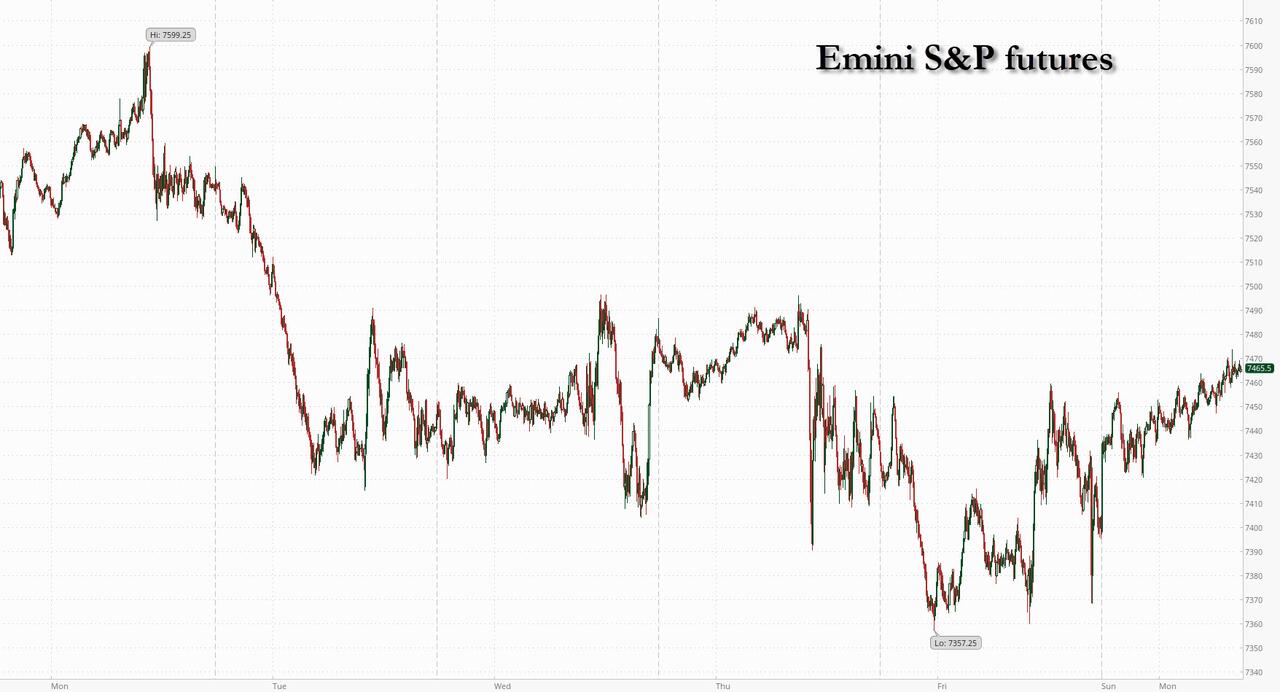
US equity futures are higher led by Tech as Mag7 leads the group higher and points to a reversal of last week’s profit-taking, as traders position for the end of the first half. A shortened week will likely focus on a speech from the Fed’s Warsh on Wednesday and payrolls on Thursday.  As of 8:30am, S&P futures are 0.9% higher as traders bought the dip after a rotation out of this year’s top-performing stocks sent the US benchmark to its second-worst week of the quarter; Nasdaq futures gain 1.2%, with both Software and Semis higher, which may be more driven by period-end reshuffling than a shift in sentiment. A mix of space, software and artificial-intelligence infrastructure names led premarket gains. Comcast Corp. jumped 23% on a plan to split its business. Cyclicals ex-Materials are leading Defensives ex-HC with the AI theme bid up across sectors. Bond yields are +1-2bp higher with the Dollar down a touch. Commodities are lower but the Energy complex is bid following another series of attacks between US / Iran; WTI back above $70/bbl, and Brent climbed 0.8% to $72.59 a barrel following weekend flare-ups between the US and Iran. While the two sides have since agreed to halt the attacks, the pace of shipments through the chokepoint has slowed, with shipowners likely to remain wary of crossing the strait. Gold / silver are down 1-2%, base metals with a slight bid, and Ags mostly lowers. Today’s macro data focus is on the June Dallas Fed activity with the balance of the holiday-shortened US week including June jobs report Thursday and ISM-Mfg, JOLTS and ADP.
In premarket trading, Magnificent Seven stocks are all higher (Alphabet +1%, Amazon +1%, Apple +0.1%, Meta +1.5%, Microsoft +1.7%, Nvidia +1%, Tesla +0.8%)

  • Chip stocks are rebounding following a 5.3% decline in the Philadelphia Semiconductor Index on Friday, with equipment stocks leading gains after South Korea’s Samsung and SK Hynix set out plans to build two chipmaking plants.
  • Comcast (CMCSA) is up 22% after the company said it plans to separate its media businesses from its cable-TV and internet operations, spinning off NBCUniversal and Sky into a new publicly traded company in a bid to increase value.
  • Doximity (DOCS) falls 4% after BofA double downgraded the healthcare software company to underperform from buy, citing limited clarity on the near-term trajectory of margins as well as execution risks related to the pivot to AI.
  • Iridium (IRDM) climbs 20% after Rocket Lab agreed to buy the company for $54 a share in a cash-and-stock transaction that puts the satellite communications company at about $8 billion in enterprise value.
  • Martin Marietta Materials (MLM) slips 3% after agreeing to combine with building materials supplier Lhoist North America in a transaction valued at $13.5 billion, including debt.
  • Viridian Therapeutics (VRDN) jumps 14% after the biotech said the FDA had approved its drug for treating an inflammatory disorder that affects the tissues around eyes.

In other corporate newsoOnline spending across all retailers in the US hit $26.4 billion during Amazon’s annual Prime Day sale, according to Adobe, narrowly beating the firm’s earlier estimate of $26.3 billion. The FDA approved AbbVie’s Skyrizi as the first IL-23 inhibitor approved in the US for pediatric patients six years of age and older weighing less than 40 kilograms.

In AI news, Anthropic won US approval to restore some access to its Mythos 5 model after resolving Trump administration concerns about the technology’s potential threats to national security. Google has placed limits on Meta’s use of its Gemini AI models because it could not provide as much computing capacity as the social media company wanted, according to the Financial Times. China is said to have matched Anthropic in cybersecurity, resetting the AI race, according to the WSJ. 

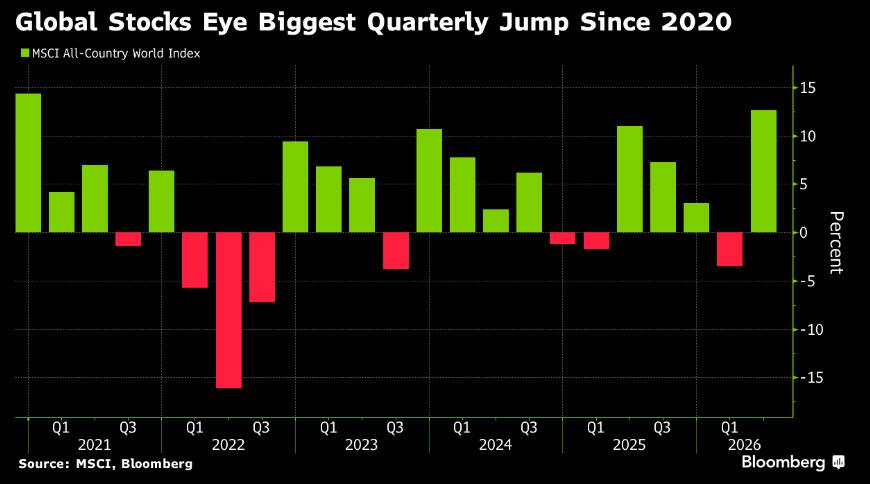
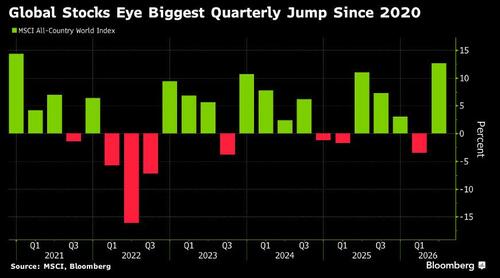
As the S&P 500 heads for its best quarter since 2020, one of the biggest debates is how much further high-flying chipmakers can push markets higher after an almost one-way rally turned more volatile in recent weeks. US equities are likely to enjoy another robust earnings season on the back of a “solid macro backdrop” and the AI investment boom, according to Goldman strategists. RBC Capital Markets strategists raised their 12-month target for the S&P 500 index to 8,150 points.
“It wasn’t a full-blown selloff, but more a rotation of the kind that we saw many times in the last 12 months,” said Guy Miller at Zurich Insurance. “There are strong fundamentals in terms of super-normal profits. In semiconductors in particular, there’s still clearly a supply-demand imbalance.”

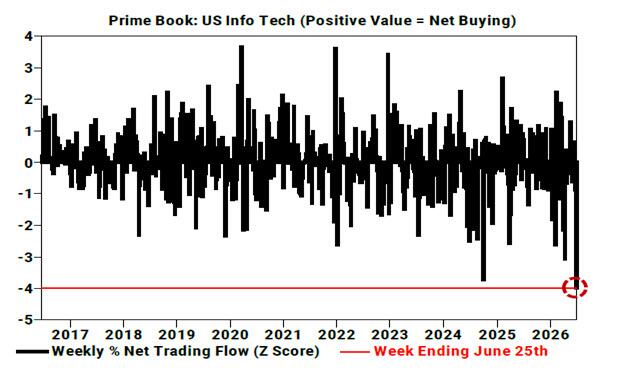
As we reported over the weekend, hedge funds dumped global TMT stocks last week, with the combined total reaching its highest level in over 10 years, according to Goldman Sachs’ Prime desk. 
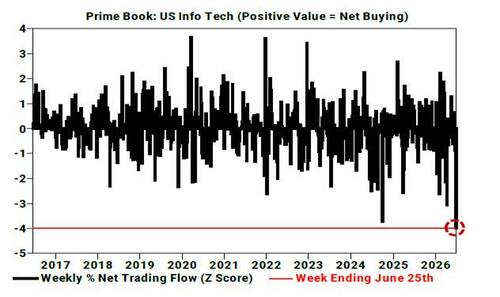
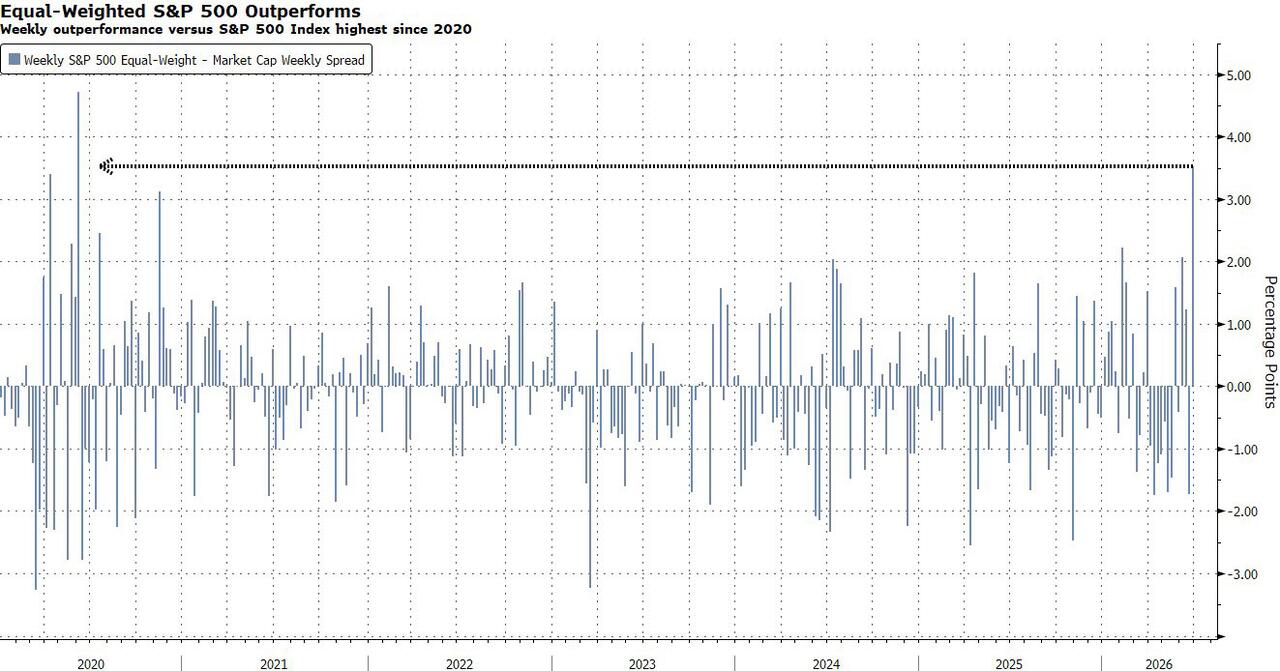
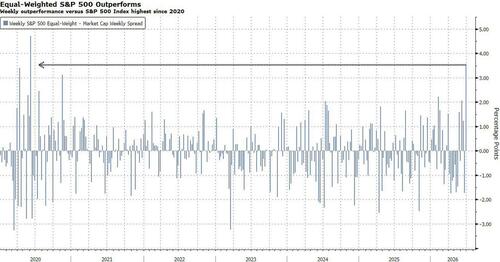
Deutsche Bank strategists confirmed that tech funds saw record outflows, as investors trimmed their aggregate equity positioning last week with overall equity positioning now slightly below neutral. Morgan Stanley’s Mike Wilson notes market breadth is improving as earnings recover beyond megacap tech, crude prices fall and crowded AI momentum trades in hyperscalers and semiconductors come under pressure. 

Still, US equities are likely to enjoy another robust earnings season on the back of a “solid macro backdrop” and the AI investment boom, according to Goldman Sachs strategists. And RBC strategists raised their 12-month target for the S&P 500 index.
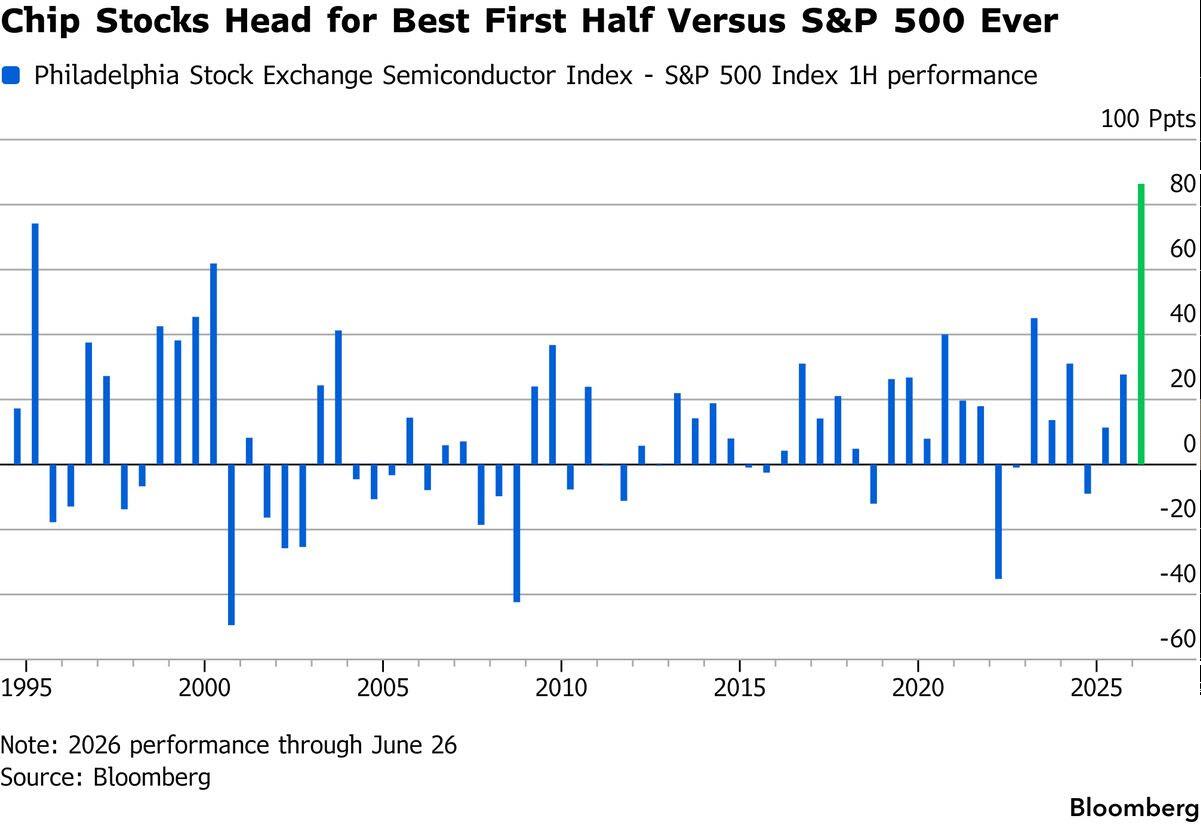
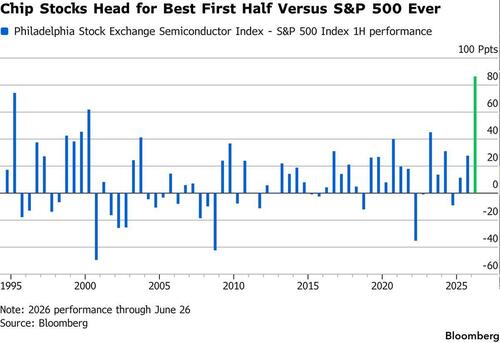
A strong first half for stocks has historically been a good sign for the rest of the year in the market. Whether that holds again is the question in light of all the wild cards on the horizon. Despite the “chip wreck” last week, the sector is on track to post the best first half performance versus the S&P 500 ever.
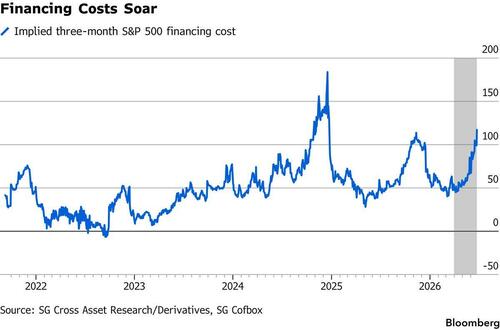
The surge in market leverage, stemming in part from the massive growth of levered ETF products, retail margin accounts and hedge fund deposits at prime brokers, is stoking worries that it may exacerbate the next crisis. And an AI bust, inflation and fiscal stress are among the most alarming threats to global prosperity at present, the BIS warned in its annual report published on Sunday.
Traders will shift their focus this week to the annual gathering of central bankers in Portugal, where Federal Reserve Chair Kevin Warsh will make his public debut outside the US. Aside from hints on interest rates, questions over financial stability, including those linked to the artificial-intelligence boom, will be among the themes under discussion. Another prominent event will be the monthly US jobs report on Thursday, the culmination of the usual flurry of labor data that opens each month.

“After the hawkish pause of the Fed earlier in the month, one would have expected market exuberance to stall, but that doesn’t seem to be the case,” said Andrea Gabellone, head of global equities at KBC Securities. “That means the market believes that US exceptionalism is there to stay. It also means that the rally will likely broaden toward other corners of the market.”

Fed’s Barkin warned that inflation is too high, though he sees tentative signs that price pressures may moderate soon. The calendar for this week includes the annual central bankers’ gathering in Portugal, with an appearance by new Fed Chair Warsh, and US June jobs report on Thursday — likely to be a third straight extremely strong print, according to Bloomberg Economics.

“Our economists continue to expect a relatively hawkish policy path, with two rate hikes penciled in later this year,” noted Jim Reid at Deutsche Bank AG. “However, near-term guidance is likely to remain limited, leaving markets to take their cues primarily from incoming data.”

Europe’s Stoxx 600 is edging lower, with tech outperforming in Europe too but being offset by declines for health care and consumer stocks. Tech and media stocks rise most, while construction shares lag. Here are the biggest movers Monday:

  • Bridgepoint gains as much as 12%, the most since April, after the UK private equity firm announced it has agreed to buy Florida-based Kayne Anderson Real Estate in the group’s first push into the US property market
  • Nagarro shares rise as much as 92% to €77.50 after Galaxy Germany, a holding company for Persistent Systems, said it plans to offer €81 per share to buy the IT services firm
  • Prosus shares rise as much as 4% after the company reported strong results for fiscal year 2026 that were in line with expectations. Analysts welcome a 40% increase in the dividend
  • Elmera rises as much as 3.2% after the Norwegian electricity provider agreed to sell itself to Finnish rival Fortum, which beat an earlier bid from Spain’s Audax. Fortum shares gain as much as 1.1%
  • Ipsen shares climb as much as 1.9%, making them among the biggest gainers in the Stoxx 600 Health Care Index on Monday. The French company’s deal to buy Kartos Therapeutics is “strategically sensible,” according to Barclays
  • Gerresheimer shares fall as much as 5.8% after the German firm lowered its guidance for the 2026 financial year, citing a challenging economic environment, some project delays on the part of customers and operational challenges
  • Novo Nordisk shares drop as much as 2%, underperforming the Stoxx 600 Health Care Index on Monday morning, with JPMorgan noting an expected guidance raise is already reflected in current consensus figures

Asian markets traded higher on Monday after South Korean stocks recouped most of their losses following massive investment plans by heavyweight chipmakers. The MSCI Asia Pacific Index rose 0.2% after falling as much as 1% earlier in the session. Samsung Electronics and SK Hynix slumped more than 6% before erasing the bulk of their declines, leading to a similar move in the Kospi. In an ambitious plan aimed at cementing South Korea’s status as a technological powerhouse, the nation is planning investments of at least 1,350 trillion won ($880 billion) from companies including Samsung Electronics and SK Hynix into chips and data centers. Elsewhere, Japan’s Nikkei 225 closed 0.2% higher while benchmarks in Hong Kong, Taiwan and Thailand climbed. In geopolitics, the US and Iran agreed to stop attacking each other before peace talks resume this week over the Strait of Hormuz and other issues. 

“At this point, the market appears to be driven much more by sentiment than fundamentals,” said Kim Dojoon, chief investment officer at Zian Investment Management. “Price action has been concentrated in the large electronics names,” with developments in semiconductor pricing dynamics weighing on the outlook over time.

In FX, the Bloomberg Dollar Spot Index is little changed, with the euro holding around $1.14 and sterling hovering just above $1.32.

In rates, bond yields in the US, Europe and the UK are higher, with gilts slightly underperforming and yields up by two or three basis points across the curve ahead of a speech by would-be prime minister Andy Burnham. Treasuries are mixed, keeping yields within a basis point of Friday’s closing levels, as oil futures stabilize near four-month low with US and Iran halting attacks, while dip buyers emerge in US stocks, following a rotation out of this year’s top performers. Front-end and belly yields are slightly higher on the day, long-end tenors slightly richer, flattening 5s30s spread by around 1bp; 10-year near 4.37% is little changed, similar to bunds and gilts in the sector. IG dollar issuance slate includes five names so far; supply this week is expected to slow, with dealers forecasting $10 billion to $15 billion of sales. Treasury coupon issuance resumes next week with 3-, 10- and 30-year tenors

In commodities, WTI crude oil futures, off session highs, remain more than 1% higher; Brent climbed 0.8% to $72.59 a barrel following weekend flare-ups between the US and Iran. While the two sides have since agreed to halt the attacks, the pace of shipments through the chokepoint has slowed, with shipowners likely to remain wary of crossing the strait. Gold is down by about $40/oz to around $4,050/oz.

US economic data calendar includes only Dallas Fed manufacturing activity at 10:30am; ahead this week before Thursday are June consumer confidence, May JOLTS job openings, June ADP employment change and June ISM manufacturing. Fed speaker slate empty for the session. Chairman Warsh participates in an ECB panel event on Wednesday in Sintra

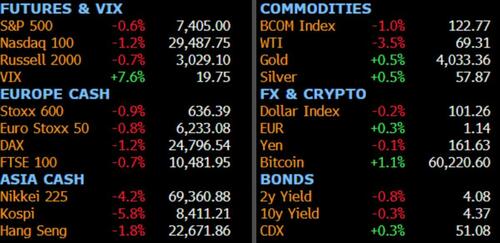
Market Snapshot
Top Overnight News

  • The U.S. and Iran have agreed to end days of back-and-forth fighting around the Strait of Hormuz and resume peace talks, said officials from the U.S. and other countries involved in the negotiations.
  • Commercial shipping continued to move through the Strait of Hormuz at a reduced level after recent attacks on two vessels. A handful of vessels made open transits over the weekend, according to tracking data. BBG
  • China’s central bank set the interest rate on its new overnight liquidity tool at a level that was below expectations, according to people familiar with the matter, in what some economists see as a de facto rate cut that could push down market borrowing costs. The PBOC said it conducted 300 billion yuan ($44 billion) of overnight reverse repurchase agreements in open market operations on Monday. BBG
  • China has expanded the list of Japanese companies and organizations on its export control list in Beijing’s latest move to curb what it describes as a “new type of militarism” from the government of Prime Minister Sanae Takaichi. FT
  • Vladimir Putin expects US negotiators to visit Russia for Ukraine talks once Washington shifts focus from Iran, but rejected a proposal to halt long-range strikes. He acknowledged fuel supply problems and said he’s considering a full ban on diesel exports. BBG
  • Investors have never been more eager to ratchet up their stock returns through margin loans and funds that amplify gains and losses. U.S. margin debt, or what investors borrow from their brokerages to buy securities, rose 54% to a record $1.4 trillion in May from a year earlier, according to Finra data. Meanwhile, high-risk leveraged exchange-traded funds that produce double or triple the daily move of underlying stocks are growing rapidly, as is trading in options tied to them. WSJ
  • Comcast shares jumped premarket (CMCSA +24%) after it announced plans to separate into two companies with a tax-free spinoff of NBCUniversal and Sky. BBG
  • The Supreme Court is set to rule on two of Trump’s most audacious gambits: his bids to oust Fed governor Lisa Cook and to roll back automatic birthright citizenship. The judges will release the final seven rulings of their term this week, starting today. BBG
  • Private credit’s latest bet is Buy Now, Pay Later loans. Supporters say the consumer assets offer attractive returns, but critics worry about parallels to the subprime mortgage crisis. BBG
  • Financials will kick off the Q2 2026 earnings season the week of July 13th. By the first week of August, roughly 75% of S&P 500 market cap will have reported results. Nvidia (NVDA), the largest stock in the market, will report on August 26th. GIR
  • US House Speaker Johnson said he will send the Housing Bill over to President Trump on Monday: Fox News.
  • S&P affirmed the US at AA+; Outlook Stable.

Iran Conflict

  • US CENTCOM announced that it conducted strikes against multiple Iranian targets on Saturday, on the orders of US President Trump, “in direct response to continued Iranian aggression against commercial shipping.” In retaliation, Iran’s IRGC responded by hitting 8 US military installations at the Ali Al Salem air base in Kuwait and the US Navy’s Fifth Fleet in Bahrain, according to IRNA. However, in the early hours of Monday, a US official said technical talks with Iran are slated to continue on all areas of the MoU, while the official added that both sides will stand down for now and that vessels can move freely.
  • US official said Iranian drone and missile attacks on Kuwait and Bahrain failed and that all Iranian projectiles were intercepted or missed, according to ABC News.
  • Iran cancelled technical talks with the US scheduled on Sunday and cited recent attacks on the country and a failure to meet conditions outlined in the MoU with the US. However, it was separately reported that the US and Iran agreed to halt strikes and meet this week, according to Axios citing a senior US official. Furthermore, US and Iran technical talks that were scheduled to be held on Tuesday in Switzerland, which would focus on nuclear and other issues, have reportedly been changed and will now be held in Doha on Tuesday and will focus on the Strait of Hormuz and recent escalation.
  • Iran’s Foreign Minister Araghchi said the US and Israel have violated the MoU, particularly the first clause, which hinders the restoration of regional security, while he also stated that Iran seeks to implement the MoU in good faith in accordance with the principle of commitment for commitment and that they will act decisively against contract breaches.
  • Mediators have reportedly set up communication channels to de-escalate any incidents with technical talks set to continue, according to reports.
  • Iran’s President said they will get USD 6bln from Qatar of the USD 12bln of Iranian funds that were frozen due to US restrictions within Qatar, journalist Mallick reported.
  • Israeli army said it attacked 3 Hezbollah headquarters in southern Lebanon last night.
  • Israeli military has received no orders to withdraw from Lebanon, according to Al-Jadeed and Haaretz, citing an Israeli military source.
  • Instructions have been given to the Israeli army to reduce the destruction of homes and infrastructure in areas of southern Lebanon it controls, Al Hadath reported citing Israeli media.
  • Israel destroyed a Hezbollah underground tunnel in southern Lebanon, while Israeli forces reportedly shelled a Syrian village near the Golan Heights.
  • Israeli PM Netanyahu and Defence Minister Katz said the IDF will remain in the southern Lebanon “security zone” after destroying a Hezbollah underground facility.
  • Iran and Oman held the first meeting on the Strait of Hormuz, within the framework of Article 5 of the MoU, Mehr reported.

A more detailed look at global markets courtesy of Newsquawk

APAC stocks began the week mixed, heading closer to month- and quarter-end, while participants reflected on the geopolitical developments over the weekend, in which the US and Iran conducted tit-for-tat strikes. Although, the sides have since agreed to halt attacks and will meet for talks this week. ASX 200 traded rangebound with the index kept afloat by strength in tech, telecoms, healthcare and the consumer sectors, while utilities, industrials and real estate lagged. Furthermore, price action was contained in the absence of any pertinent data and with the ACCC announcing that the excise tax cut on fuel is to be lowered from July 1st to August 2nd. Nikkei 225 continued its pullback from recent record highs and slipped beneath the 69,000 level amid tech-related weakness, although the index is off today’s worst levels as participants also digested strong Retail Sales data. Moreover, reports that the government is to call for “appropriate” monetary policy in its basic policy guidelines, in an apparent effort to dissuade the BoJ from further hiking rates, also boosted sentiment. Hang Seng and Shanghai Comp are positive, albeit to varying degrees, with outperformance in Hong Kong amid strength in biotech and a rebound in hyperscalers. Baidu was boosted as its AI chip unit Kunlunxin targets a USD 50bln Hong Kong listing. However, the mainland was contained after somewhat mixed industrial profits data, and despite the PBoC conducting overnight reverse repo operations as flagged.

Top Asian News

  • South Korea announced a new AI and chip spending package, which includes huge investment from the likes of Samsung Electronics (005930 KS) and SK Hynix (000660 KS). 
  • PBoC injected CNY 157.5bln via 7-day reverse repos with the rate maintained at 1.40%, while it announced CNY 300bln in overnight reverse repos with the overnight reverse repo rate said to be 1.25% vs exp. 1.35%, according to Bloomberg.
  • Japan’s government is expected to call for “appropriate” monetary policy in its basic policy guidelines, in an apparent effort to dissuade the BoJ from further hiking rates, according to Bloomberg citing a document.

European bourses (STOXX 600 -0.1%) started the day tentatively, but have gradually edged off best levels. The latest US-Iran flare up has had little impact on trade this morning, with traders ultimately focusing more on any potential disruptions to the Strait rather than fresh strikes. Focus in the APAC session was on South Korea, where it announced a new KRW 1,350tln AI and chip spending package. The total plan includes promoting a semiconductor fab worth KRW 800tln, 81tln in a packaging hub and 550tln to build AI data centres. Samsung Electronics and SK Hynix are to be heavily involved, with the two Cos planning to build two chipmaking plants each for KRW 800tln. Even though the announcement helped reverse the earlier losses (Samsung Electronics -4.8%, SK Hynix -1.7%), analysts at Morningstar think that, if the new commitments are standalone investments, they could imply material oversupply risk over the next decade.

Top European News

  • Spanish Economy Ministry said the Government expects the economy to grow by 2.6% in 2026 (prev. 2.2%).

FX

  • Snapshot: G10s are mixed against the USD and to varying degrees. The Kiwi slightly outperforms vs peers, whilst the GBP and EUR follow closely behind. The JPY resides at the bottom of the list. Outside of the G10 space, the KRW is weaker this morning after South Korea unveiled a USD 1tln chip/AI investment plan. Potentially on fears surrounding a) how Korea aims to finance the government’s portion of the investment, b) pressure in SK Hynix/Samsung shares, which leads to outflows in domestic markets, c) heightened geopolitical risk, and the associated inflationary impacts on the region.
  • DXY is incrementally weaker against the USD, and currently holds within a 101.15 to 101.39 range. Focus for the index over the weekend was on the increased geopolitical risk, which ultimately highlighted the uncertain nature of the current US-Iran MoU. As a reminder, the US and Iran conducted tit-for-tat strikes; thereafter, the pair agreed to halt strikes and resume meetings this week. It seems to be the case that markets are happy to ignore the short-term flare-ups, and broadly focus on whether there are any material disruptions to the Strait of Hormuz.
  • GBP is slightly firmer, holding within a narrow 1.3191 to 1.32282 range. Really not much driving the action this morning for the GBP, but focus ahead will be on commentary from likely PM Burnham. He is expected to announce plans to devolve powers and money from the central government to England’s regions. This would mark his first major policy speech since announcing his intention to stand for leadership of the ruling Labour Party.
  • That aside, speculation around the next UK Chancellor continues. The Sun reports that current Work and Pension Secretary McFadden is a contender, under the belief he would steady the market. However, Miliband remains a contender, with a source to the Sun remarking that it is now between McFadden and Miliband. The latter remains the worst option for markets.
  • JPY remains the slight underperformer this morning. USD/JPY currently holds towards near-term highs at 161.95, and within a 161.72-161.88 range. Speculation surrounding intervention remains heightened, particularly heading into US Independence Day. Japan favours intervention during periods of low volume, given the improved effectiveness when attempting to strengthen the JPY.

Fixed Income

  • Fixed income benchmarks initially started the week on the backfoot as energy prices opened higher on renewed US-Iran strikes over the weekend, but have since come off lows as crude benchmarks fall from highs. This came after the US and Iran agreed to halt strikes, and meet on Tuesday.
  • Gilts (-23 ticks) are slightly softer, ahead of MP Burnham’s speech at 11:30BST/06:30EDT. It is to last around 20 minutes, focusing on his economic plans. We do not anticipate a Q&A. He is also expected to focus on expanding the devolution of control away from London, and could also touch on nuances around tax levels, housing stock, defence spending and within that, possibly war bonds. Welfare reform will also feature as part of the move to give local authorities more control. The UK benchmark currently trades in the lower part of a 89.24-89.58 range.
  • Bunds (-8 ticks), likewise, are rangebound (127.35-127.51), despite a hotter-than-expected inflation print from Spain. HICP Y/Y printed at 3.6% vs exp. 3.4%, well above the ECB’s 2% target, while the core figure ticked lower to 2.9% from 3.0%. If the trend of lower core figures follows through to other EZ economies, with France, Italy and Germany set to release their inflation figures later this week, this could signal that the ECB would be willing to look through higher headline figures. The lower core figures would also support the view put forward by ECB President Lagarde, in which she said, “We see no evidence yet of de-anchoring of inflation expectations or second-round effects that would warrant a more forceful policy response at this stage.”
  • USTs (-2+ ticks) follow their European counterparts, lacking any clear direction, with an appearance by Fed Chair Warsh at Sintra on Wednesday and the US jobs report on Thursday going to be the key driver for Treasuries. Warsh is likely to maintain a slightly hawkish tone and give little in terms of guidance. Ahead of the jobs report, economists at Capital Economics said further downside in yields could lose momentum, with the June report due to be strong again. The economist states that the increasingly strong labour market is not a reason to delay tightening, which could be the biggest near-term risk to USTs.

Commodities

  • A choppy morning for crude as we digest the initial escalation and then the easing of tensions between the US and Iran over the weekend, with the near-term focus now on Tuesday’s technical talks in Doha.
  • Just after the open, WTI and Brent hit highs of USD 70.97/bbl and USD 73.39/bbl respectively. While firmer by over USD 1.50/bbl on the day at the peak, the move failed to test Friday’s respective USD 71.86/bbl and USD 75.13/bbl tops, and by extension numerous levels thereafter.
  • Benchmarks pulled back in acknowledgement of the initial Axios scoop that the side would be meeting this week, and, ahead of that, have agreed to stop strikes. Nonetheless, there still appears to be conflict occurring in Gaza and Lebanon. As the European morning proceeded, WTI and Brent have clambered off lows and trades firmer by USD 0.92/bbl and USD 0.66/bbl respectively.
  • Spot gold picked up at the end of last week, reacting to the initial US strikes in the Hormuz area. The yellow metal ended the week at USD 4091, just off Friday’s USD 4096/oz best, though markedly shy of that week’s USD 4198/oz peak. For today, as above, geopolitical tensions have moderated somewhat and as such, XAU has lost some of its haven allure, slipping into the red by around USD 30/oz, with the US equity tone also bid and tech-led after the huge Korean AI and Chip spending plan, alongside confirmation that SPCX is to join the Nasdaq.
  • Base metals are mixed, despite the firmer US tone. Instead, reflecting the mixed APAC handover and acknowledging the marginal deterioration in the European tone across the morning. 3M LME Copper is just about in the green, but in a thin and familiar range, shy of the mid-May peak.
  • TotalEnergies (TTE FP) said operations at its oil refinery and petrochemical plant in northwest France were impacted by a power outage on Friday.
  • Spain’s Bilbao Port Executive President urged the EU to delay the 2027 ban on Russian LNG or risk becoming overdependent on the US, according to FT.
  • Oman LNG’s first LNG carrier has reportedly departed the nation, Oman News Agency reported.
  • US Agriculture Secretary Rollins said the US and Mexico opened a sterile fly production facility in Metapa, Mexico, which is expected to produce up to 100mln sterile flies a week.

Trade/Tariffs

  • China’s MOFCOM said 20 Japanese firms were added to the export control list for links to Japan’s military. MOFCOM stated that measures only target some Japanese entities and apply only to dual-use items, while they do not affect normal economic and trade exchanges between China and Japan.

Central Banks

  • Fed Chair Warsh is reportedly set to announce task force details in the coming few weeks, NYT reported citing sources,
  • Fed’s Barkin (2027 voter) said inflation is too high, but he sees some signs that price pressures could moderate soon, according to Bloomberg.
  • ECB’s Kazaks said there is currently no need for multiple ECB hikes in a rushed way, according to Econostream. Probabilities of the negative scenarios have fallen massively, with the shock and persistence being smaller while a smaller shock reduces the risk of non-linearities and second-round effects.
  • BoE’s chief economist Pill said the BoE is still experimenting with scenarios and external presentations.

Geopolitics

  • Ukrainian President Zelensky said Ukraine targeted the Slavyansk-na-Kubani oil refinery in the Krasnodar region and a refinery in the Yaroslavl region of Russia, as part of Kyiv’s “long-range sanctions” campaign against Russia.
  • Ukraine’s air force said a UAV was detected in the Dnipropetrovsk region, while explosions were reported in the suburbs of Kharkiv.
  • Russian President Putin said Russia has proposed that both sides stop striking each other’s deep targets and warned that if such strikes continue, Russian strikes on Ukraine will become more powerful with more severe consequences.
  • Russian President Putin said Russia is expecting US negotiators once the US is less busy with Iran, while he also stated that Russia is ready for talks with the US, according to AFP.

US Event Calendar

  • 10:30 am: June Dallas Fed Manf. Activity, est. 1, prior 0.4

DB’s Jim Reid concludes the overnight wrap

We have published our quarterly global markets survey, which includes a range of fascinating insights—from expectations around events in Iran and where bubbles may be forming in financial markets, to how AI is being used at work and views on its potential to replace jobs. It also covers our regular questions and, perhaps most importantly, predictions for the World Cup. You 

Tensions in the Iran conflict have continued to escalate since Friday, with a series of tit-for-tat strikes around the Strait of Hormuz despite a fragile ceasefire framework. The latest flare-up began with attacks on commercial shipping, prompting successive US strikes on Iranian-linked targets, while Iran responded with missile and drone attacks on US-linked sites in the Gulf, including bases in Bahrain and Kuwait. Over the weekend, the conflict intensified further with additional strikes on vessels and military targets, leading to heightened maritime security risks and the Joint Maritime Information Center raising the threat level in the Strait to “substantial.” However, overnight developments suggest a tentative de-escalation, with the US and Iran reportedly agreeing to halt further attacks ahead of renewed technical talks in Doha this week. Both sides are said to be standing down for now, allowing shipping flows to continue, although disputes over key provisions of the memorandum of understanding—particularly around control and potential costs for transit through Hormuz—mean the situation remains fragile and risks to regional stability persist. Brent is up +0.71% this morning.

Asian equity markets are mixed this morning. Easing geopolitical tensions in the Middle East are providing some support, though fresh regional trade frictions are weighing on sentiment after China imposed tighter export controls on 20 Japanese entities, requiring government approval for shipments. Beijing said the move reflects concerns over Japan’s military posture. The KOSPI (-2.24%) is the weakest performer, with technology stocks still under pressure following last week’s semiconductor volatility, while the Nikkei (-0.88%) is also lower. In contrast, the Hang Seng (+2.12%) is outperforming, with the CSI (+0.08%) and Shanghai Composite (+0.15%) posting modest gains, and the S&P/ASX 200 (+0.35%) edging higher. US equity futures are firmer, with both S&P 500 and Nasdaq futures up +0.57%, while 10yr UST yields are +1.2bps at 4.38%.

On the policy front, the PBOC has introduced an overnight reverse repo facility, setting the rate at 1.25%. This marks another step in modernising its monetary policy framework and improving short-term liquidity management. The new rate sits 15bps below the existing seven-day reverse repo rate of 1.40%, which remains the main policy benchmark.

In Japan, early data showed retail sales rose 5.3% YoY in May, well above expectations of 3.0% and up from April’s downwardly revised 2.8%.

Global attention this week will centre on the US labour market, with the June employment report due on Thursday ahead of the Independence Day holiday. A reminder that the US will be 250 years old this week and Peter and Henry have written a piece explaining how it’s continually prospered over the period and the likelihood of it doing so going forward. 

Alongside that, central bank communication will be in focus at the ECB’s Sintra forum (today through Wednesday), while inflation data across Europe and activity indicators in Asia—notably China’s PMIs and Japan’s monthly data—round out a busy global calendar.

In the US, our economists expect payroll growth on Thursday to slow to +75k (from +172k previously), with private payrolls rising by around +90k. There is some risk of seasonals pulling down the numbers as they have in recent years around this time. The unemployment rate is expected to hold at 4.3%, while average hourly earnings are seen unchanged at +0.3% month-on-month. Hours worked are also expected to remain steady at 34.3, leaving nominal income growth broadly stable.

Ahead of that, today brings the Dallas Fed manufacturing survey, while tomorrow sees the May JOLTS report, where markets will watch for any shifts in hiring, quits and layoffs amid a still subdued hiring environment. Wednesday then features the ADP employment report (our economists expect +110k) alongside the ISM manufacturing index (forecast 53.8 vs 54.0 previously). These releases should help set expectations going into Thursday’s payrolls. Beyond the labour market, tomorrow also sees the Conference Board’s consumer confidence index (our economists expect 94.1 vs 93.1 previously).

On policy, attention will turn to Wednesday, when Fed Chair Warsh speaks at the ECB’s Sintra forum. Our economists continue to expect a relatively hawkish policy path, with two rate hikes pencilled in later this year. However, near-term guidance is likely to remain limited, leaving markets to take their cues primarily from incoming data.

Looking beyond the US, Europe’s main event is the aforementioned ECB’s annual Sintra conference, which begins today and runs through Wednesday, featuring remarks from major central bank leaders. In parallel, inflation data will be a key focus, with Spain and Belgium reporting today, followed by Germany, France and Italy tomorrow, and the Eurozone aggregate on Wednesday. Our economists expect inflation of 2.46% YoY in Germany, 2.30% in France, 3.23% in Italy, and 2.95% for the Eurozone. Switzerland will also release CPI on Thursday. In the UK, the BoE publishes its credit conditions surveys on Thursday and the DMP survey on Friday.

In Asia, China releases various PMIs in the first half of the week. In Japan, today’s retail sales (out earlier) is followed by industrial production tomorrow, where our economists expect a +1.4% month-on-month increase. The highlight, however, will be the Bank of Japan’s Tankan survey on Wednesday, which is expected to show broadly steady sentiment and may reinforce the case for further gradual policy tightening.
Recapping last week now, and markets were rocked by a global tech sell-off, even as oil prices declined amid increasing traffic through the Strait of Hormuz. So both the S&P 500 (-1.95%, -0.05% on Friday) and the Nasdaq (-4.60%, -0.24% Friday) declined, whilst the Magnificent 7 (-5.46%, +1.47%) entered correction territory, down -12.6% from its May 28 peak. A large part of the tech weakness was driven by chipmakers, as the Philly Semiconductor Index dropped by -7.94% (-5.29% Friday), despite a brief reprieve midweek after Micron beat revenue estimates for Q4. In Asia, the Kospi (-5.81%, -7.08% on Friday) and Nikkei (-2.65%, -4.15%) also slumped.

The equity sell-off came despite Brent crude prices (-10.65%, -4.34% on Friday) falling back to below their pre-war levels at $71.99/bbl, as flows through the Strait of Hormuz continued to ramp up. The oil price decline has eased fears about an inflation shock and aggressive rate hikes. That was also helped by some positive US data last week, including Thursday’s PCE inflation which showed headline PCE up only +0.4% on the month (vs. +0.5% expected).

So investors dialled back expectations of Fed rate hikes, with the amount of hikes priced by December down -7.3bps to 32bps over the week. In turn, that led the 2yr Treasury yield -8.7bps lower over the week (-3.1bps on Friday), whilst the 10yr yield (-8.4bps, -2.3bps on Friday) fell to 4.37%. Pricing of ECB rate hikes by December also fell -12.8bps over the week to 24bps. Germany’s 2yr (-12.9bps, -1.1bps on Friday) and 10yr (-13.4bps, -0.6bps on Friday) declined in response.

Finally, in Europe UK assets outperformed as Prime Minister Starmer’s resignation announcement on Monday helped ease political uncertainty with Andy Burnham so far unchallenged as Starmer’s successor. Yields on 10yr gilts (-11.1bps, +3.2bps Friday) fell, while the FTSE 100 rose +1.40% (-0.21% on Friday). That helped keep the STOXX 600 stable over the week (+0.04%, -0.68% Friday), even as the DAX (-1.26%, -1.29% Friday) and CAC 40 (-0.55%, -0.43% Friday) fell after Friday’s slump.

Tyler Durden
Mon, 06/29/2026 – 08:48

via ZeroHedge News https://ift.tt/DVhawrT Tyler Durden