Trucking Boom U-Turns

Authored by Wolf Richter via WolfStreet.com,

Another Gauge of the Goods-Based Economy Heads South.

Orders for Class-8 trucks – made by Daimler (Freightliner, Western Star), Paccar (Peterbuilt, Kenworth), Navistar International, and Volvo Group (Mack Trucks, Volvo Trucks) – plunged 58% in February compared to February last year, to 16,700 orders, according to FTR Transportation Intelligence after they’d already plunged 58% year-over-year in January and 43% in December.

The orders in January and February were back in the range of the “transportation recession” that had hit the industry in 2015 and 2016. At the time, truck and engine manufacturers reacted with layoffs. But for now, they’re sitting on a massive backlog from the boom in orders last year (data via FTR):
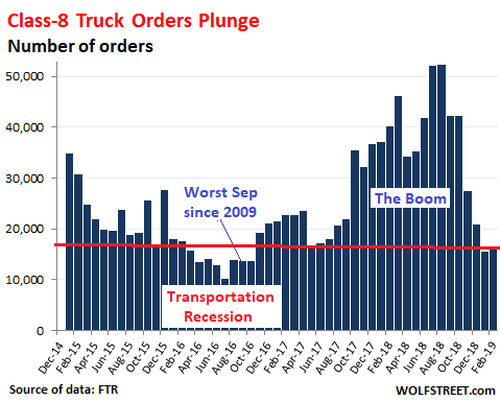
The business is infamously cyclical, with regular booms that lead to over-ordering and then overcapacity, followed by busts that then sort it all out again. The industry is also seasonal, so we can use year-over-year comparisons to eliminate most of the effects of seasonality.

The chart below shows the percent change of Class-8 truck orders for each month compared to the same month a year earlier. The year-over-year plunges over the past three months are of the same magnitude as the plunges during the last transportation recession (data via FTR):
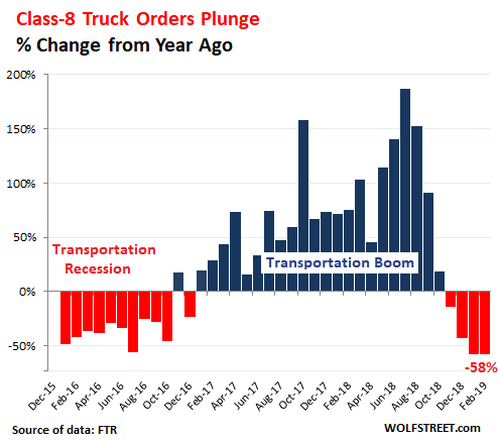
“The weaker orders mean that backlogs will tumble for the second straight month, but they remain at historically high levels,” FTR says. These backlogs will keep plants running at capacity until mid-2019, and some truck makers “are booked solid for 2019 with limited sales slots open for the remainder of the year,” according to FTR.

So truck makers are going to stay busy for a while, and fleets are getting their trucks, and trucking capacity is expanding and will continue to expand, even as orders get slashed.

This rising capacity finally provides some relief to shippers, such as retailers or industrial companies that need to ship their products to their customers. The transportation recession – as tough as it was on truckers, railroads, and truck and component makers – was nirvana for shippers: lower freight rates and no bottlenecks. But in 2018, they’d been complaining about soaring freight rates and shipping delays, and any loosening of those shipping conditions is a godsend to them.

Now, shippers are getting a break as the trucking sector is cooling off, according to FTR’s Shippers Conditions Index. The index, which gauges the temperature of the freight market — including trucking, rail, and intermodal — from the shippers’ point of view, combines freight demand, freight rates, fleet capacity, and fuel price into an index value.

A positive index value signals “good, optimistic conditions” for shippers – not truckers. A value around zero represents a neutral operating environment. A negative value signals “bad, pessimistic conditions” for shippers, according to FTR. “Double digit readings (both up or down) are warning signs for significant operating changes.”

Index values had been deeply negative, with several months in the double digits, until late last year, then the pressure came off. The index for November, released a month ago, turned positive for the first time since August 2016, and index for December, released at the end of February, rose further into positive territory (data via FTR):
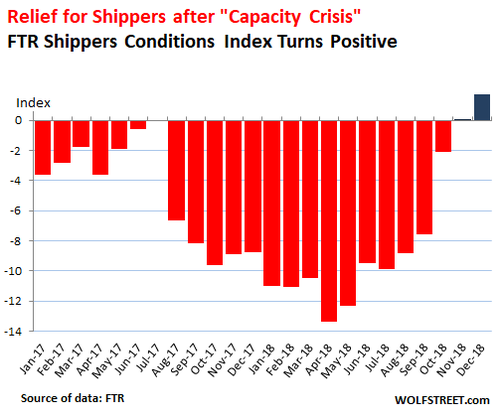
“Stable fuel prices, a turn in rail service levels, and loosening truck capacity have combined to create a favorable environment for shippers seeking to move freight,” said FTR’s VIP of rail and intermodal, Todd Tranausky.

Now there’s the same problem on the horizon that contributed to the transportation recession of 2015 and 2016: Inventories have been piling up. In December, latest data available, wholesale inventories rose 7.3% from December 2017, to a record $662 billion, even as sales have begun to stall. As companies react by whittling down their orders, shipments decline.

This is already happening, according to the Cass Freight Index – and it’s causing a peculiar situation. “In 30 years, I’ve never seen anything like this,” fretted the CEO of warehouse operator Pacific Mountain Logistics. Read… Inventory Pileup Sounds Alarm for Goods-Based Economy

via ZeroHedge News https://ift.tt/2UpcXo6 Tyler Durden
“Ghastly” Vancouver Home Sales Crash By 33%, Lowest Since 1985

Grant’s “Almost Daily”, submitted by Grant’s Interest Rate Observer

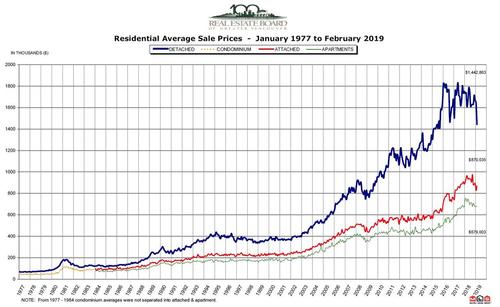
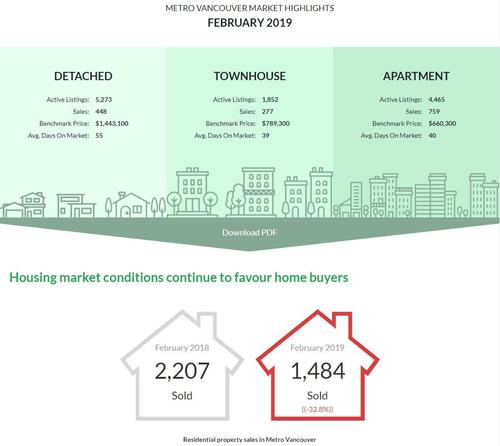
On Monday, the Real Estate Board of Greater Vancouver reported February results that could be classified as ghastly, with residential home sales plummeting 32.8% year-over-year to 1,484 units. That’s the lowest February sales total since 1985 and 42.5% below the 10-year average.

Prices have also broken lower, with the composite index sinking by 6.1% year-over-year.  In addition, inventories have jumped, with total listings in metro Vancouver up to 11,590 homes at month end. That’s up 48.2% from February 2018.

Toronto, Canada’s largest city, has held up better, with February prices rising 1.6% year-over-year, while new listings dropped 6.2% to outpace the 2.4% decline in sales. Nevertheless, TREB president Gurcharan Bhaura asked for regulatory relief from the mortgage stress test mandated by the Office of the Superintendent of Financial Institutions. These subject borrowers to the greater of the five-year benchmark rate or the contracted mortgage rate plus 200 basis points (Almost Daily Grant’s, May 31):

The OSFI mandated mortgage stress test has left some buyers on the sidelines who have struggled to qualify for the type of home they want to buy. The stress test should be reviewed and consideration should be given to bringing back 30 year amortizations for federally insured mortgages. There is a federal budget and election on the horizon. It will be interesting to see what policy measures are announced to help with home ownership affordability.

On the score of home affordability, there is certainly room for improvement. According to Demographia’s International Affordability Survey for 2019, Toronto ranked 294th out of 309 metropolitan housing markets, with a median house price of 8.3 times median annual gross pre-tax household income, up from 7.9 times year-over-year.  For context, the United States national median multiple registers at 3.5 times, while the organization designates anything beyond 5.1 times to be “severely unaffordable.” Vancouver puts Toronto in the shade, ranked second to last by Demographia (only Hong Kong is more expensive) with a median multiple of 12.6 times.

As Canada’s long-running housing bull market teeters, economic data continue to disappoint.  Friday’s release of fourth quarter GDP showed annualized growth of just 0.4%, well below the 2% third quarter reading and the 1% consensus expectation, while December retail sales fell by 0.5% ex-automobiles, also worse than the expected 0.3% decline. M2 money supply growth registered 4.99% in December, down from 5.83% year-over-year and 8.65% in the final month of 2016.

Perhaps most importantly, total residential mortgage growth fell to just 3.1% year-over-year in December, the worst monthly reading since May 2001. That last data point may be especially concerning for Canada’s banks: Craig Fehr, investment strategist at Edward Jones & Co., told Bloomberg that the mortgages are, “in many cases, the largest and most profitable and steady of the businesses that these banks operate.” Fehr concludes: “The bread and butter of profitability for Canadian banks – is going to have a little less butter on the bread.”

Early indications bear that out, as a trio (the Bank of Nova Scotia, Toronto-Dominion Bank and Canadian Imperial Bank of Commerce, or CIBC) of Canada’s five largest banks reported earnings shortfalls in the quarter ended Jan. 31. Increased credit losses figured in two of those reports, with Toronto-Dominion raising its loan loss provision to C$850 million ($645 million), up 23% year-over-year.  CIBC’s provision for credit losses jumped to C$338 million, more than double last year’s C$153 million and well above the expected C$258.5 million.

CIBC CFO Kevin Glass told Bloomberg that “three big” non-performing loans across different sectors hurt the bank’s credit portfolio, while asserting that the jump “is certainly not representative of any sign of underlying problem.”

Glass may not be worried, but an extended housing downturn may cause CIBC particular discomfort.  For more, see the Feb. 9, 2018 edition of Grant’s.

In other news from formerly-booming housing markets, yesterday The Australian reported that Queensland-based bank Suncorp Group Ltd. warned that some investors in an A$120 million ($85 million) residential mortgage bond may not be repaid. The problem: An increase in borrowers at least 60 days past due on their mortgages to above 3% of the loan pool has triggered a clause prioritizing senior claims holders, potentially diverting principal repayment from those farther down the creditor food chain.  

Meanwhile, Australian new auto sales fell by 9.3% year-over-year in February, the eleventh straight decline. On Feb. 21, Fitch Ratings reported that Australian prime auto loan asset-backed securities in arrears rose to a record high in the fourth quarter, with loans past due more than 30 and 60 days rising to 2.05% and 1.03%, respectively.  That compares to a five year net loss rate of 0.51%.

via ZeroHedge News https://ift.tt/2UkJmMl Tyler Durden

David Stockman: The Undrainable Swamp & The Inevitable Recession

Authored by Adam Taggart via PeakProsperity.com,

What the future of the post “Peak Trump” era holds…

Love it or hate it, the potency of the Trump Administration is on the wane, soon to be stuck in the mire of the Swamp it has deepened instead of drained, while the economy falls into one hell of a recession — so claims former Regan-era Cabinet member and Congressman David Stockman.

In his new book Peak Trump, Stockman notes how the wide divergence between Trump the campaigner and Trump the president appears to be proving to be his undoing.

Rather than fight to dismantle the institutions he railed against as a candidate — most notably the Deep State and the Federal Reserve — Trump has embraced them.

Now, when this latest asset bubble bursts (and Stockman believes the markets saw their peak back in Fall 2018), Trump will ‘own’ that. Having chosen to tie his administration’s success to the rising price of the S&P 500 since taking office, he won’t be able to foist the blame of a market crash on his predecessors.

Similarly, the Deep State — especially the military industrial complex — is experiencing a bonanza under the Trump administration. As a result, the Swamp is deeper than it has ever been:

I learned a long time ago as Budget Director and even before that as a member of Congress that the real deep end of the Washington swamp is on the Pentagon side of the Potomac. What Trump has done is basically taking a defense budget at $600 billion that was already swollen with waste and extending it far beyond anything you need for a homeland defense.

I have a whole section in the book about how a homeland of defense wouldn’t cost $600 billion that he inherited or now the $700 billion that we have. $720 billion actually, that after two huge Trump increases. But you can do an honest, effective, and safe homeland defense for $250 billion. By putting all of these funds into the DOD and into an even larger intelligence budget which is already $75 billion and triggered in the entire Russian military budget for everything… He has actually fed the monster.

Remember, the walking around dollars that create the prosperity in Washington and all of the lobbies, NGOs, think tanks, and all the rest of it comes out of the DOD, National Security, State Department, Intelligence Community budget. It becomes a self-perpetuating lobby for its own, ultimately if you add everything up, $800 billion per year fleecing of the tax papers. Domestically, yeah. We have this huge amount of waste and the domestic budget as well. But most of it’s entitlements and so, it’s cash flowing out of all the places across America. Those entitlements need to be reformed.

But the impact on governance and what he rightly called the swamp, comes from the National Security side. The warfare state, not the welfare state. He’s obviously… It was a nice phrase but unfortunately he has embraced policies that go into the opposite direction and made the swamp even far deeper than it already was on the warfare state side of the equation.

Click the play button below to listen to Chris’ interview with David Stockman (55m:51s).

via ZeroHedge News https://ift.tt/2NTusKZ Tyler Durden

An American Citizen Is Trapped In Saudi Arabia Due To Male Guardianship Laws

Last summer, months prior to the Jamal Khashoggi killing which would soon change everything, Saudi crown prince Mohammad bin Salman was widely hailed as a “reformer” for the kingdom’s “entering the 21st century” through legal reversals which would allow women to drive and the opening of co-ed move theaters, among other things. But after the journalist’s gruesome murder at the Saudi consulate in Istanbul on Oct. 2nd, western media perhaps regained its skepticism once again. 

And now one of the more notoriously backwards and oppressive Saudi policies has taken center stage after an American woman and her 4-year daughter old have become trapped inside the country, thanks to restrictive laws which give her ex-husband total power over her ability to travel. The nightmare scenario has prevented US citizen Bethany Vierra from leaving the country due to the kingdom’s so-called guardianship laws, which allow male guardians — especially husbands — power to dictate travel, bank account usage, or even access to legal counsel for women

Bethany Vierra’s child is now four years old – both are stuck inside Saudi Arabia, prevented from leaving by her ex-husband. Left is an unknown man believed to be a friend of the family, not her husband, according to reports. Image source: Daily Mail via Facebook

Vierra, originally from Washington state, married a Saudi man in 2013 while teaching at a women’s university in the kingdom, but after he became abusive and violent-tempered to her and their child, she sought divorce. Even after her husband agreed to the divorce last year, however, he’s still been granted the power to maintain parent-like control over her, leaving her trapped in a country and society she wanted to flee. 

Her cousin told The New York Times this week “she is completely stuck, she is out of options,” and said the family wanted to go public with Vierra’s plight after they had no recourse but to appeal to international media.

This after last month a Saudi teenager fled to Thailand, later barricading herself in an airport hotel room in order to evade Saudi demands that she be apprehended and extradited. The 18-year old girl, Rahaf al-Qunun, was later granted asylum by Canada for fear that her family would harm or even kill her upon return. 

In Vierra’s case her ex-husband was able to legally forbid her from traveling last Christmas when she sought return to her family’s home in Washington state. Worse, he let her residency expire, which gave her illegal alien status in the Saudi government’s eyes. This further means, as her cousin explained to the Times, she has no bank account access or other financial or legal recourse. 

Bethany Vierra with her 4-year old daughter Zaina. Image source: The New York Times.

The Times explained the further difficulty concerning the legal status of the daughter as well, who possesses dual Saudi and American citizenship

While there is a new Saudi law that would allow her to get residency as the parent of a Saudi citizen, only her husband has the power to get the documents needed to apply for that status, and Carroll [Vierra’s cousin] told The Times he has refused to do so.

There’s also the issue of her daughter Zaina’s dual Saudi Arabian-American citizenship. Because Saudi Arabia only recognizes her as Saudi, she would need to get her father’s permission to leave the country. That means that even if her mother finds a way to leave, Zaina will likely have to stay behind, Carroll said.

It was recently revealed that a Saudi government app called Absher is able to give male guardians complete surveillance power over a female’s whereabouts, most especially permission-granting status to male family members over legal matters such as obtaining a passport.

The Absher system gives men access to a massive database of Saudi women and means to bar them from traveling, including text alerts should they try to use any travel documents without permission at an airport or border crossing.

In Vierra’s case, the situation looks incredibly bleak and dire considering she no longer even has legal status in the country, and is now likely under some form of house arrest imposed by her ex-husband and his family.

Indeed, her family requested that the New York Times refrain from publishing the ex-husband’s identity for fear they would lash out at her while she remains stuck in the country, making her plight worse. 

via ZeroHedge News https://ift.tt/2NJTHz0 Tyler Durden

The Long History Of US-Russian “Meddling”

Authored by Stephen Cohen via The Nation,

The two governments have repeatedly interfered in each other’s domestic politics during the past 100 years – and it’s not all bad.

Even though the bipartisan Senate Intelligence Committee found “no direct evidence of a conspiracy between the Trump campaign and Russia,” Russiagate allegations of “collusion” between candidate and then–President Donald Trump and the Kremlin have poisoned American politics for nearly three years. They are likely to continue to do so for the foreseeable future, and due not only to the current subpoena-happy Democratic chairs of House “investigative” committees. 

At the core of the Russiagate narrative is the allegation that the Kremlin “meddled” in the 2016 US presidential election. The word “meddle” is nebulous and could mean most anything, but Russiagate zealots deploy it in the most ominous ways, as a war-like “attack on America,” a kind of “Pearl Harbor.” They also imply that such meddling is unprecedented when in fact both the United States and Russia have interfered repeatedly in the other’s internal politics, in one way or another, certainly since the 1917 Russian Revolution.

For context, recall that such meddling is an integral part of Cold War and that there have been three Cold Wars between America and Russia during the past one hundred years. The first was from 1917 to 1933, when Washington did not even formally recognize the new Soviet government in Moscow. The second is, of course, the best known, the forty-year Cold War from about 1948 to 1988, when the US and Soviet leaders, Ronald Reagan and Mikhail Gorbachev, declared it over. And then, by my reckoning, the new, ongoing Cold War began in the late 1990s, when the Clinton administration initiated the expansion of NATO toward Russia’s borders and bombed Moscow’s longtime Slav and political ally Serbia.

That’s approximately eighty-five years of US-Russian Cold War in a hundred years of relations and, not surprisingly, a lot of meddling on both sides, even leaving aside espionage and spies. The meddling has taken various forms.

In the period from 1917 to 1933, such interference was extreme on both sides. In 1918, President Woodrow Wilson sent approximately 8,000 US troops to Siberia to fight against the “Reds” in the Russian Civil War. For its part, Moscow founded the Communist International (Comintern) in 1919 and urged the American Communist Party to pursue revolutionary regime change in the United States, an historical analogue of the “democracy promotion” later pursued by Washington. During these years, both sides eagerly generated, and amply funded, “disinformation” and “propaganda” directed at and inside the other country.

During the second Cold War, from 1948 to 1988, the “meddling” was expanded and institutionalized. At least until the McCarthyite attempted purge of such activities, the American Communist Party, now largely under the control of Moscow, was an active force in US politics, with some appeal to intellectuals and others, as well as bookstores and “schools”—all amply supplied with English-language Soviet “propaganda” and “disinformation”—in many major cities.

US meddling during those years took various forms, but the most relevant in terms of the role of social media in Russiagate were nearly around-the-clock Russian-language short-wave radio broadcasts. When I lived in Moscow off and on from 1976 to 1982, every Russian I knew had a short-wave radio and as well as a nearby place where reception was good. Many were enticed by the then-semi-forbidden rock music—Elton John was the rage, having surpassed The Beatles—but stayed tuned for the editorial content, which was, Soviet authorities complained, “disinformation.”

Suspect “contacts” with the other side was another Cold War precursor of Russiagate. Here too I can provide first-hand testimony. By 1980, my companion Katrina vanden Heuvel—now my wife and publisher and editor of The Nation—joined me on regular stays in Moscow. Most of our social life was among Moscow’s community of survivors of Stalin’s Gulag and the even larger community of active dissidents. In mid-1982, both of us were denied Soviet visas. I appealed to two sympathetic high-level Soviet officials. After a few weeks, both reported back, “I can do nothing. You have too many undesirable contacts.” (Our visas were reissued shortly after Mikhail Gorbachev came to power in March 1985.)

In the post-Soviet era since 1992, at least until Russiagate allegations began in mid-2016, almost all of the “meddling” has been committed by the United States. During the 1990s, under the banner of “democracy promotion,” there was a virtual American political invasion of Russia. Washington openly supported, politically and financially, the pro-American faction in Russian politics, as did American mainstream media coverage. US government and foundation funding went to desirable Russian NGOs. And the Clinton administration lent ample support, again political and financial, to President Boris Yeltsin’s desperate and ultimately successful reelection campaign in 1996. (For more on the 1990s, see my Failed Crusade: America and the Tragedy of Post-Communist Russia.) Conversely, there was almost no Russian meddling in American politics in the 1990s, apart from the pro-Yeltsin lobby, largely made up of Americans, in Washington.

As for Russia under Vladimir Putin, since 2000, again there was virtually no notable Russian “meddling” in American politics until the Russiagate allegations began. (Not surprisingly, in light of the history of mutual “meddling,” Russian social media was active during the 2016 US election, but with no discernible impact on the outcome, as Aaron Maté has shown and as Nate Silver has confirmed.) American meddling in Russia, on the other hand, continued apace, or tried to do so. Until more restrictive Russian laws were passed, US funding continued to go to Russian media and NGOs perceived to be in US interests. Hillary Clinton felt free in 2011 to publicly criticize Russian elections, and, the same year, then–Vice President Joseph Biden, while visiting Moscow, advised Putin not to return to the presidency. (Imagine Putin today advising Biden as to whether or not to seek the US presidency.)

Indeed, the Kremlin may be more tolerant of American “meddling” today than Washington is of Russian “interference.” Maria Butina, a young Russian woman living in the US, has been in prison for months, much of the time in solitary confinement, charged with “networking” on behalf of her government without having registered as a foreign agent. Hundreds of Americans have “networked” similarly in Russia since the 1990s, myself among them, to the indifference of the Kremlin, though this may now be changing, largely in reaction to US policies.

How should we feel about US-Russian “meddling” of the kind that involves dissemination of their respective information and points of view? We should encourage it on both sides. Attempts to suppress it is leading to censorship in both countries, while the more conflicting information and dialogue we have the better—better understanding and better policymaking and more and better democracy on both sides. (Disclosure: All of my own books and many of my articles have been published in Moscow in Russian-language translations. The reactions of Russian readers are exceptionally valuable to me, as they should be to any American author.)

via ZeroHedge News https://ift.tt/2TnWHY6 Tyler Durden

Enbridge’s Line 3 Pipeline Expansion Delayed In Latest “Major Blow” To Canadian Energy Industry

Enbridge Inc. is delaying the date when it expects its replacement Line 3 crude oil pipeline to be in expanded service, in what is being called a “major blow” to the oil industry in Canada. According to Bloomberg, the project had previously been set to begin shipping crude in Q4 2019. But now the company is pushing back construction due to slow permitting in Minnesota.

Enbridge expects the pipeline to begin service in the second half of 2020 now, as its Minnesota permits won’t be complete until November of this year. Federal permits won’t be received until as long as 60 days after that. 

This pipeline was of importance because the government of Alberta was planning on using it to end mandated production cuts that were implemented to deal with a supply glut of crude oil. The glut has been a result of a lack of pipeline space, making it difficult to ship supply to refineries. 

The Line 3 expansion is set to cost $6.8 billion and help add 370,000 barrels of daily shipping capacity. Its delay is the latest of several blows for the Canadian energy industry, including the stalled Keystone XL pipeline and the stalled Trans Mountain expansion. In addition, the industry has suffered from the cancellation of TransCanada’s Energy East pipeline and the Canadian government’s rejection of the Northern Gateway conduit, which was also proposed by Enbridge.

This delay flies in the face of the company’s expectation of having the Line 3 expansion finished this year, a timeline that Enbridge reiterated as recently as February 15. The expansion would help ship crude along a 1031 mile route from Alberta’s oil hub to Superior, Wisconsin, where construction is already completed. 

Back in January, we reported  as to why we thought Canada’s crude oil production cuts were “unsustainable”. We concluded:

Even if the Albertan government re-evaluates the present mid-2019 expiration date for the current stricter production cuts, extending the production caps could have enduring negative consequences in the region’s oil industry. Keeping a long-term cap on production in Alberta would potentially discourage investment in future production as well as in the infrastructure the local industry so sorely needs. According to some reporting, the cuts will not be able to control the gap between Canadian and U.S. oil for much longer anyway, just another downside to drawing out what should be a short-term solution. The government will need to weigh the possible outcomes very carefully as the expiration date approaches, when the and the pipeline shortage is still a long way from being solved and the price of oil remains dangerously variable.

via ZeroHedge News https://ift.tt/2VG2OU8 Tyler Durden

House Democrats Erupt In Closed-Door Chaos As Party Fractures Over Anti-Semitism Rebuke

House Democrats erupted in protest over plans to vote this week on a resolution condemning anti-Semitism – an indirect sanction on freshman Rep. Ilhan Omar (D-MN) in response to the suggestion that supporters of Israel have “allegiance to a foreign country.” 

House Majority Leader Steny Hoyer (D-MD) said on Wednesday that there may not be a vote this week on the measure, saying “We’re discussing what is the best way to address it,” according to the Washington Post

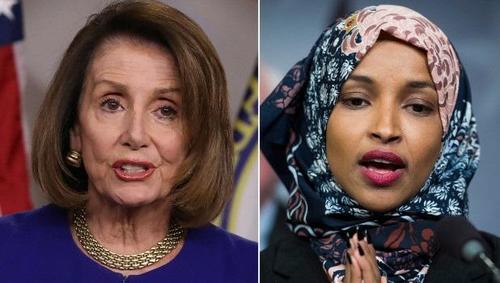
Walking into them meeting, a confident Pelosi told the media that the Omar situation “would be resolved,” adding “I think you make more of it than there is . . . to be very honest with you — the press loves to foment unease in the Democratic Party but we are very united” regarding the Democratic House agenda.

Moments later, all hell broke loose: 

Inside the meeting, according to multiple people present, House Speaker Nancy Pelosi (D-Calif.) tried to keep her caucus focused on a planned Friday vote on a sweeping campaign and elections reform bill. She acknowledged “internal issues,” according to notes taken by a Democratic aide present, and urged members not to “question the motivations of our colleagues.”

But moments later, multiple House members stood up to challenge the decision — endorsed by Pelosi and the rest of the House Democratic leadership — to move forward with a resolution condemning religious hatred. Initially the measure targeted only anti-Semitism, with some Democrats pushing for a direct rebuke of Omar, but by Tuesday night — facing backlash from members not on board with the plan — leaders decided to expand it to include anti-Muslim bias. –Washington Post

Several Democrats those who took issue with the measure were members of the Congressional Black Caucus, who opposed even an indirect rebuke of Rep. Omar when they should be focusing on how to attack President Trump. 

“I think there’s a big rise in anti-Semitism and racism, and that’s a bigger conversation we need to be having.” said Rep. Cedric L. Richmond (D-LA). “But it starts at 1600 Pennsylvania. It doesn’t start with one member out of 435 members of Congress.

Why are we doing this?” asked Rep. Bonnie Watson Coleman (D-NJ), who said that a resolution would be “redundant and unnecessary,” likely referring to the January 11 rebuke of Omar after she accused the American Israel Public Affairs Committee (AIPAC) of contributing to pro-Israel politicians.

“We’ve individually and collectively already responded to the fact that we oppose all ‘-isms’ that do not treat people in this country fairly and justly,” said Coleman. “To continue to engage in this discussion is simply an opportunity to give both the media and Republicans distractions from our agenda. We’ve got important work to do.”

Other members, including Richmond, said it was unfair that the caucus would take action against one of its own members while other GOP lawmakers have uttered offensive remarks with no retribution. This week, House Judiciary Committee Chairman Jerrold Nadler (D-N.Y.) accused Rep. Jim Jordan (R-Ohio) of anti-Semitism for a tweet referring to Tom Steyer, a Democratic donor of Jewish descent as “Tom $teyer,” and Richmond and several other members mentioned Trump. –Washington Post

“We need to have equity in our outrage,” said Rep. Ayanna Pressley (D-MA) who said after the meeting that she was focused on “the occupant of this White House who is seeding every form of hate, emboldening it with racist rhetoric and policies. That is who we all need to be focused on, and this is a distraction.”

According to those present, Omar attended the meeting but did not speak. 

Jewish lawmakers, meanwhile, insist that the House needs to pass the resolution condemning anti-Semitism in response to Omar’s remarks. 

Rep. Ted Deutch (D-Fla.), who is among the Jewish members involved in crafting the initial resolution, rose to defend the resolution and, according to one member present, grew emotional. He said his colleagues needed to understand that these sort of words were hurtful to people like himself who had dealt with them all their lives. –Washington Post

President Trump, meanwhile, capitalized on the splinter among House Democrats, tweeting Wednesday afternoon: “It is shameful that House Democrats won’t take a stronger stand against Anti-Semitism in their conference. Anti-Semitism has fueled atrocities throughout history and it’s inconceivable they will not act to condemn it!” 

Other GOP leaders piled on as well – accusing Democrats on Wednesday of tolerating anti-Semitism by refusing to remove Omar from the House Foreign Affairs Committee – which as the Post notes, has jurisdiction of the relationship between the United States and Israel.  

“They should stop empowering her disgusting hatred before it turns into horror,” said Rep. Liz Cheney (R-WY) – House Republican Conference chairwoman. 

“It should not be tough to stand up against this type of talk,” said House Minority Leader Kevin McCarthy (R-CA), who compared the Democrats’ decision to that faced by Republicans in the case of Rep. Steve King (R-IA) after he publicly questioned why the phrase “white supremacy” is offensive. King was immediately stripped of his committee assignments – something the Democrats refuse to do with Omar. 

“I’m just wondering, within their conference, if they’re willing to lead,” added McCarthy. 

For Democrats, the internal divide over how to handle Omar’s statements has been exacerbated by members targeting each other on Twitter, where much of the public debate has played out — both among Democrats and between members of the two parties.

At one point during the meeting, Rep. Jan Schakowsky (D-Ill.), a close Pelosi ally, pleaded with Democrats: “Everyone stop tweeting!” –Washington Post

Congressional Progressive Caucus co-chair Pramila Jayapal (D-Wash.) said afterward that by fighting publicly, Democrats were playing into GOP hands.

“We are now in the majority, and Republicans have an intent to divide us whenever they can,” said Rep. Jayapal, adding that her colleagues should find “a process where these things can play out in private and not in front of everybody.”

On Tuesday, Rep. Juan Vargas (D-CA) was publicly targeted by Democratic Socialist Rep. Alexandria Ocasio-Cortez, who knocked him for saying that questioning the US-Israel relationship should be out of bounds.

Vargas shot back on Wednesday, saying “She could have come down the hall and asked me what my opinion is. That would have been fine,” adding “We have a very different opinion here, I believe. To question someone’s loyalty because they’re Jewish, I think, is terrible. It’s something that we shouldn’t question at all.”

via ZeroHedge News https://ift.tt/2EQMCtB Tyler Durden

Alan Howard Hedge Fund Tumbles 8.5% YTD After Blistering Returns In 2018

The torrid outperformance of macro funds appears to be ending with a whimper.

After a blistering 30% return in 2018, largely thanks to an outsized gain in May when bets against Italian bonds repaid in spades, hedge-fund manager Alan Howard has had a painful start to 2019 with his Brevan Howard AH Master Fund – which was launched two years ago – sinking 8.5% in first two months of 2019 according to Bloomberg.

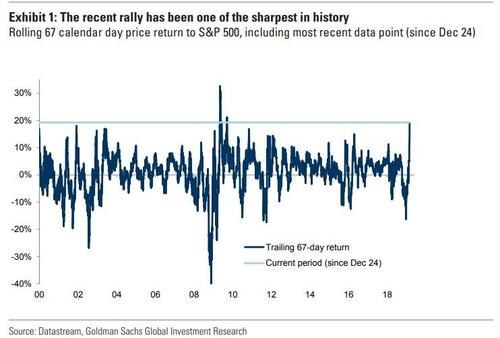
Macro funds bucked the dismal underperformance by the broader hedge fund community in 2018, when their bets on higher interest rates and volatility caused by geopolitical tensions, together with generally bearish disposition led to outsized returns. However, following the sharpest rally since the financial crisis, much of their gains have evaporated.

The loss did not affect all funds run by the billionaire: the flagship, Brevan Howard Master Fund, lost just 0.2% in the first two months of this year, according to an investor letter seen by Bloomberg. It also posted a more muted 12.3% return in 2018, which was its best year since the end of the global financial crisis, Bloomberg reported in January.

Meanwhile, Bloomberg also notes that many of the other Brevan funds that were launched to reduce the firm’s reliance on the main Master Fund started the year in the black, so the underperformance may have been stratregy specific. For example. the Brevan Howard MB Macro fund led by trader Minal Bathwal gained 4.7% in January, while the firm’s Alpha Strategies pool returned 2%.

Even so, as a result of the chronic underperformance by the macro hedge fund, Brevan’s assets had fallen to $6.4 billion from more than $40 billion in 2013.

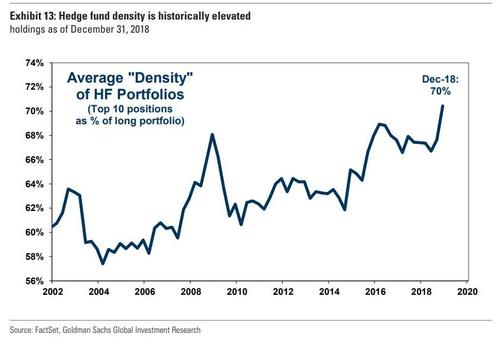
Taking a step back, after a dismal Q4, and a devastating December, the hedge-fund industry as a whole rebounded strongly in 2019, gaining about 3% in January and February, according to Eurekahedge, when a handful of mostly tech stocks posted significant gains, the same handful of stocks that most “diversified” hedge funds appears to all be invested in now that the concentration of holdings by the 2 and 20 crowd is the highest on record.

via ZeroHedge News https://ift.tt/2UmTX9D Tyler Durden

Trade Isn’t China’s Only Worry

Authored by Charles Hugh Smith via OfTwoMinds blog,

Trade is only one manifestation of much deeper economic insecurities and imbalances.

China’s enormous successes–raising hundreds of millions out of poverty, landing a rover on the dark side of the moon, etc.–are well known. Less appreciated is China’s increasing vulnerability to financial instability arising from asymmetries that cannot be resolved by tweaking trade policies.

As this article explains, The China Story That Is Far Bigger Than Apple, China’s trade balance–trade surpluses for decades– is close to slipping into trade deficits.

At the same time, China’s once-mighty pool of savings has diminished as consumption has risen. As a result, China now needs foreign investment more than it did in the previous era.

Chinese businesses have borrowed around $2 trillion in US dollar-denominated debt in the past few years, requiring the acquisition of dollars to service the debt.

So far this sounds like a typical case of a fast-growth economy maturing into a trade-deficit, debt-dependent consumption economy.

What the article misses the staggering rise in the cost of living in China over the past two decades. Some services are still dirt-cheap–subway fares are extremely cheap–and private healthcare is a mere fraction of healthcare costs in the U.S.

But other costs–housing, food, clothing, etc.–have shot up to the point that our on-the-ground correspondents report that living expenses aren’t much different than in the U.S.

Officially, inflation is low in China, but the reality is not so cheery: “Domestic sentiment is definitely very bad, perhaps even worse than during the 2008 global financial crisis,” said Fred Hu.

Recall that wages for college graduates are around $1,100 per month (7600 RMB), with $1,500 per month (10,000 RMB) being an above-average salary.

While white-collar wages are $13,000 annually, apartments in first and even second tier cities are similar in cost to desirable U.S. cities. Rent for a small flat is $800 USD in Shanghai, more than half the average salary, and typically cost hundreds of thousands of dollars to buy.

As I’ve noted before, roughly 3/4 of all household wealth in China is tied up in real estate, where it is effectively dead-money, earning no yield and largely illiquid outside of Beijing and Shanghai.

Reflecting a broad malaise, China’s stock market has dropped by 25% in 2018 while its currency weakened against the USD (by official design, of course).

One question no one is asking seems glaringly obvious: if everything is going great in China’s economy, why did President Xi feel compelled to declare himself president for life? Why is China rushing to install an Orwellian system of monitoring of behavior, online activity, etc., with heavy penalties for those who violate official norms?

Here’s another obvious question: what is it saying about China’s future prospects that those who know China best (i.e. insiders) are fleeing the yuan and moving their capital overseas?

We might also ask why critics of official policy are censored or even swept out of view. Are these the actions of a secure, confident ruling elite? The short answer is no, and some of that insecurity is undoubtedly the result of the increasingly fragile nature of China’s growth story.

Simply put, trade is only one manifestation of much deeper economic insecurities and imbalances.

*  *  *

Pathfinding our Destiny: Preventing the Final Fall of Our Democratic Republic ($6.95 ebook, $12 print, $13.08 audiobook): Read the first section for free in PDF format. My new mystery The Adventures of the Consulting Philosopher: The Disappearance of Drake is a ridiculously affordable $1.29 (Kindle) or $8.95 (print); read the first chapters for free (PDF). My book Money and Work Unchained is now $6.95 for the Kindle ebook and $15 for the print edition. Read the first section for free in PDF format. If you found value in this content, please join me in seeking solutions by becoming a $1/month patron of my work via patreon.com.

via ZeroHedge News https://ift.tt/2C6H6S4 Tyler Durden

Trump Gives Carmakers An Ultimatum: It’s My Way Or The I-5 Freeway

The White House has sent a message to automakers on emissions: side with us, or face Donald Trump’s wrath by siding with California, i.e. “it’s my way or Interstate 5″. That was the message delivered during a “tense” conference call between the Trump administration and executives in the auto industry, according to Bloomberg, which also included senior officials from the EPA and the NHTSA. 

The call, which took place in late February, came after Trump’s administration had repeatedly terminated talks between federal regulators and California officials in an attempt to maintain a common emission standard across the industry. Executives in the industry have been urging the two sides to reach an agreement to avoid a legal battle with California, which is in the unique position of being able to establish its own standards. 

The call to automakers came after the White House admitted that months of talks with the California Air Resources Board had failed. The White House said in late February: “Despite the administration’s best efforts to reach a common-sense solution, it is time to acknowledge that CARB has failed to put forward a productive alternative.”

CARB spokesman Stanley Young disputed this, saying the administration had broken off talks “and never responded to our suggested areas of compromise – or offered any compromise proposal at all.”

In August, the Trump administration had recommended capping tailpipe carbon emissions standards and fuel economy requirements at 37 mpg after 2020, instead of the 47 mpg mandated under rules put in place by the Obama administration. The proposal also called for revoking California’s authority to set its own greenhouse standards for vehicles.

Meanwhile US automakers, caught in the middle, have been urging compromise, and a solution that will avoid a messy legal battle and negative effects on operations across the industry. 

Industry officials on the call were told that automakers should publicly state their support for the Trump administration’s direction or back California’s tougher standards. This has put automakers in a worrisome position of getting caught between the wrath of the President and the nation’s largest auto market. 

“A coordinated program with every stakeholder is in the best interest of Ford’s customers, and is the best path forward to achieve reductions in carbon dioxide emissions and support critical investments in new technologies,” Ford spokeswoman Rachel McCleery said. 

    Additionally, the President was said to be reviewing the findings of a Commerce Department report on whether imported cars posed a national security risk. Automakers worry that these findings could result in further tariffs – and a further decline in demand – for the industry.  

    via ZeroHedge News https://ift.tt/2EDOwN8 Tyler Durden