The Kobayashi Maru And The Dentist

The Kobayashi Maru And The Dentist

By Michael Every of Rabobank

As William Shatner finally goes into space at the age of 90 –to give us his renditions of Space Oddity, Lucy in the Sky with Diamonds, or Rocket Man?– Earth faces a mountain of problems; and markets, once again seizing on only ‘good news’, face the Kobayashi Maru scenario from ‘The Wrath of Khan’: a no-win scenario.

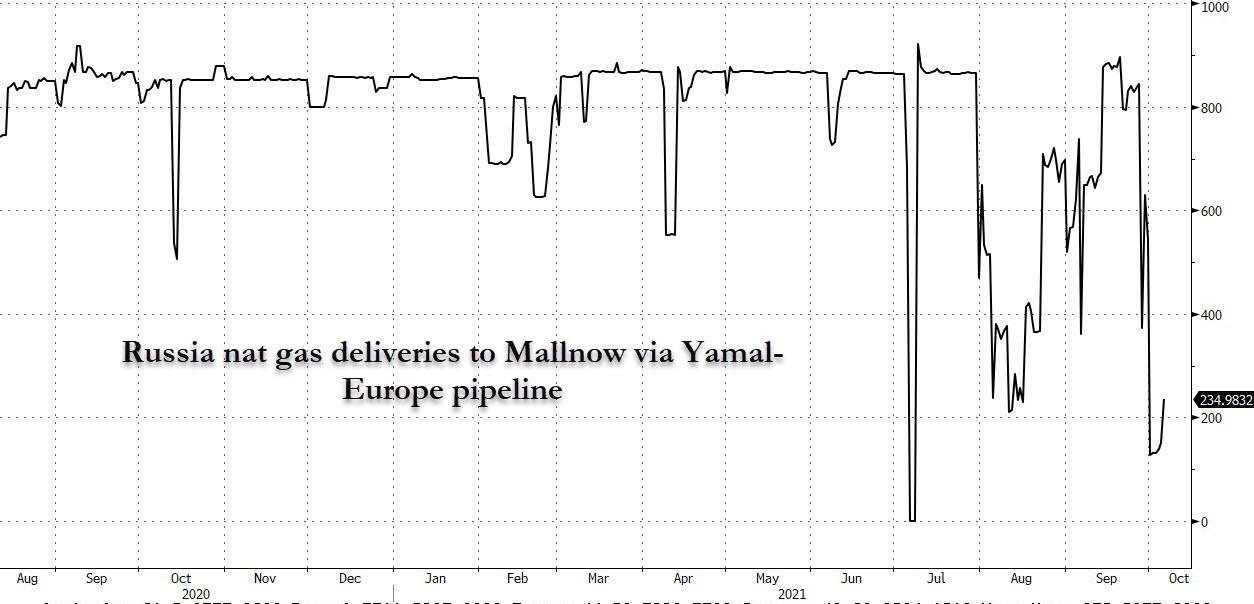
At one point Wednesday, natural gas prices in the UK and EU were up 40% on the day. That is not a supply shock: it’s a photon torpedo. Then Russia’s President Putin suggested he might have some spare gas lying around, and prices retreated to levels still as painful as William Shatner’s singing. Crisis over? Not until gas goes all the way back down again: and even if Russia magically fills the gas gap, it would still underline what an enormous geostrategic error the EU made in thinking energy supplies are not a pressure point on it – just as critics said would be the case when Angela Merkel opted for NordStream 2. When she goes to the dentist, does she opt for the cheapest one possible, or the one she trusts who costs more? As the old joke goes, realpolitik is getting your teeth done but, from the dentist’s chair, grabbing them somewhere important, and saying: “Do we have an understanding?” What else is there to understand?

In Congress, which knows from both pulling teeth and such grabbing, Mitch McConnell ”has blinked” by offering the Democrats a path to a short-term, small-cap debt-ceiling increase out to the end of the year. Except the Republicans are reportedly still going to insist on linking a proper end-year debt-ceiling hike –which would be more embarrassing for the Democrats to have to vote on again— to reconciliation, which again uses up that bullet there rather than on the desired elements of Progressive spending bills. In short, this crisis isn’t over yet either.

In Zurich, the US and China agreed to set up a virtual meeting between President Biden and Xi Jinping by year end – just as he will be tied up with the debt ceiling again. As the wags ask, is it better held on China’s Zoom or China’s TikTok for maximum security? It’s good for the US and China to be talking; and for the US to repeat it doesn’t want a Cold War, even as it pushes military alliances, tech controls, and threatens tariffs and new trade tools; and for China to say the same as it de facto decouples parts of its economy too. Yet Minxin Pei opines: “as security competition overshadows US-China relations, it will be nearly impossible for them to cooperate even on issues of mutual interest, such as climate change and future pandemics. All bilateral issues will be viewed only through the lens of national security and evaluated in terms of whether modest cooperation might strengthen the other’s security.” He adds the historical analogy that the pre-WW1 UK and Germany were tied together by trade –and royal blood– more than the US and China are today. Meanwhile, as Taiwan claims China will be capable of an invasion by 2025, the Global Times editor tweets: “PLA already has the ability NOW to liberate Taiwan at one stroke, why has to wait until 2025? That the mainland hasn’t taken the action is a goodwill of Beijing to treasure cross-Straits peace. I worry that the goodwill could be abused by Taiwan and the war is triggered suddenly.”

US Secretary of State Blinken, who wasn’t in Zurich, argues the energy crisis underlines the need for a push for green energy, which it does – while overlooking the fact that the green push also precipitated the crisis. Blinken is also asking China to “act responsibly and to deal effectively with any challenges” over Evergrande. On that note, the Financial Times repeats research showing in 2008, 75% of Chinese houses were bought by first-time buyers, but in 2018 this had fallen to 15%, with the rest snapped up by investors – as enough homes to house 90m people sit empty. Is this “responsible”, or Marxist ‘productive capital’? Can markets reasonably expect things to look the same when the dust settles? If so, it says a lot about markets and not a lot about Marxists. But what lies on the other side if not more bubbles? We simply don’t know. Higher growth is not likely to be a key part of it, however.

But of course, the deepest Kobayashi Maru challenge sits with central banks. With inflation raging, what are they to do? Tighten policy? Like that will help on top of tax hikes and higher prices! (**RED ANECDOTE ALERT** My favourite supermarket sushi just hiked prices on my favourite set by 40%. Set phasers to ‘less sushi’, sadly.) How about easing policy? Like that will help either!

We have already seen the RBNZ opt for the former path. In Australia, the rates market is certain hikes are coming. Poland just hiked. The chatter is the BOE will follow: or at least this is reportedly the UK Treasury’s expectation, and more so given the government openly flags it wants a high wage, high productivity economy when the former is the infinitely easier of the two to achieve, historically. And Fed tapering apparently looms. One wonders at how this will play out, and not even in the long term.  

Trying the other path, the ECB “will discuss boosting its regular asset purchases once the pandemic-era emergency stimulus comes to an end, but any such increase is by no means guaranteed,” says Governing Council member Muller. In short, while the Eurozone “recovery” –the recessionary energy crisis aside– will allow the ECB to end its EUR1.85trn pandemic bond-buying program in March 2022, the idea is already being floated of then compensating by increasing QE by another EUR20bn a month! And, of course, the EU is now all for subsidizing energy prices, which will only see those prices increase further, and likewise increase the whip-hand that President Putin now holds.

I repeat, neither monetary nor fiscal policy will be of much help unless they address the supply side of things, which right now they don’t. On which note, our recent ‘In Deep Ship’ report argued that smaller economies would logically start looking at diversifying trade to smaller vessels and/or consider launching national carriers as a response to current shipping snarls. As Splash247.com reports, US carrier Matson has now started a direct Shanghai-Auckland service using 707TEU and 516TEU vessels, on top of a Taiwanese carrier launching a 1,700 and 2,700TEU service between Qingdao, Shanghai, Ningbo, Nansha, Shekou and Tauranga. Moreover, “An extreme shortage of liner calls to New Zealand in recent months has prompted talk among exporters of the need to create a national shipping line.”

Such structural re-workings of the Kobayashi Maru scenario —which themselves open up very worrying geopolitical scenarios!— are arguably the only way one can defeat it, as Captain Kirk infamously did. Yet for most central banks, and governments, the greater likelihood is that they will boldly go into the mission to ‘Build Back Better’….and then end up like Lieutenant Saavik in her attempt:

“Activate escape pods. Send out the Log Buoy. …All hands abandon ship. Repeat, …all hands abandon ship.”

Tyler Durden
Thu, 10/07/2021 – 08:21

via ZeroHedge News https://ift.tt/306IlPZ Tyler Durden

Futures Surge On Debt Ceiling Reprieve, Slide In Energy Prices

Futures Surge On Debt Ceiling Reprieve, Slide In Energy Prices

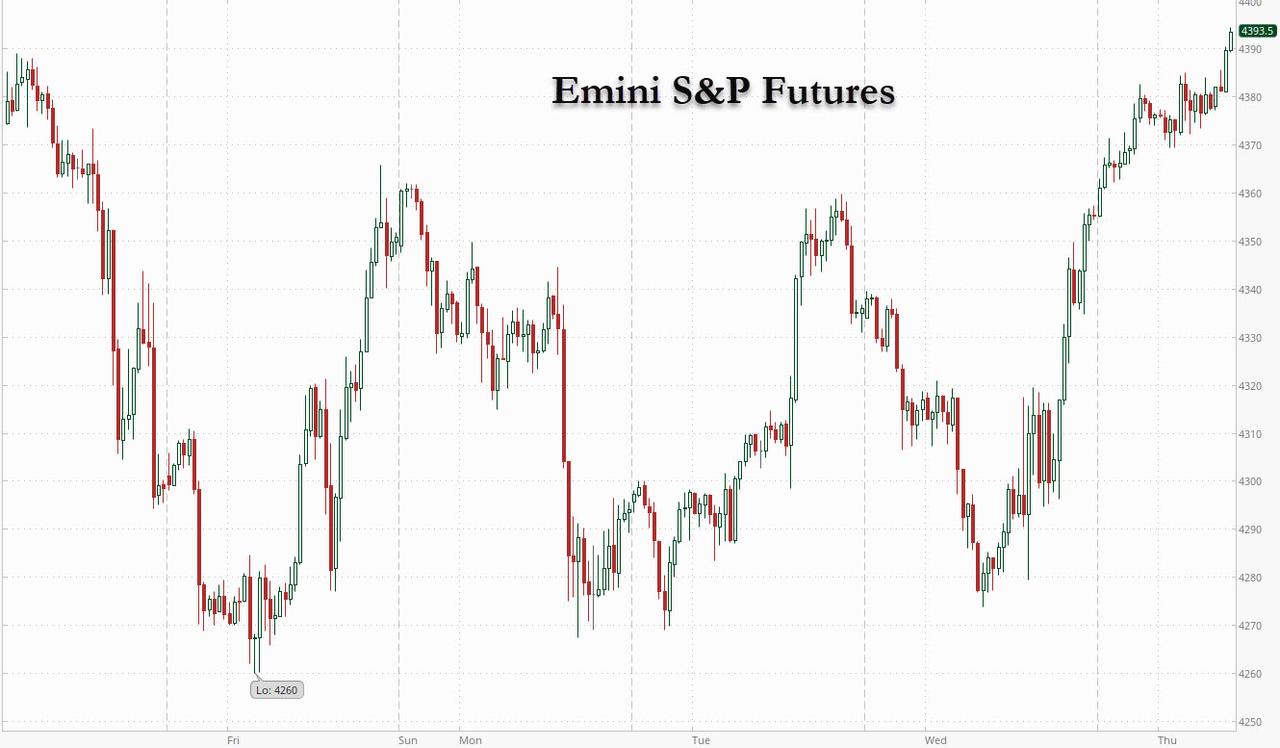
The nausea-inducing rollercoaster in the stock market continued on Thursday, when US index futures continued their violent Wednesday reversal – the biggest since March – and surged with Nasdaq futures up more than 1%, hitting a session high, as Chinese technology stocks rebounded from a record low, investors embraced progress on the debt-ceiling impasse in Washington, a dip in oil prices eased worries of higher inflation and concerns eased about the European energy crisis fueled a risk-on mood. At 7:30am ET, S&P futures were up 44 points or 1.00% and Dow futures were up 267 points or 0.78%. Oil tumbled as much as $2, dragging breakevens and nominal yields lower, while the dollar dipped and bitcoin traded around $54,000.
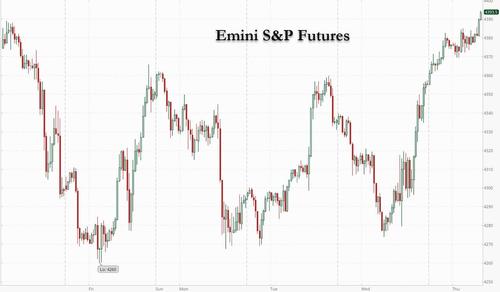
Wednesday’s reversal started after Mitch McConnell on Wednesday floated a plan to support an extension of the federal debt ceiling into December, potentially heading off a historic default, a proposal which Democrats have reportedly agreed to after Senate Majority Leader Chuck Schumer suggested an agreement would be in place by this morning. While the deal is good news for markets worried about an imminent default, it only kicks the can to December when the drama and brinksmanship may run again.

Markets have been rocked in the past month by worries about the global energy crisis, elevated inflation, reduced stimulus and slower growth. Meanwhile, the prospect of a deal to boost the U.S. debt limit into December is easing concern over political bickering, while Friday’s payrolls report may shed light on the the Federal Reserve’s timeline to cut bond purchases.

“We have several things that we are watching right now — certainly the debt ceiling is one of them and that’s been contributing to the recent volatility,” Tracie McMillion, head of global asset allocation strategy at Wells Fargo Investment Institute, said on Bloomberg Television. “But we look for these 5% corrections to add money to the equity markets.”

Tech and FAAMG stocks including Apple (AAPL US +1%), Nvidia (NVDA +2%), Microsoft (MSFT US +0.9%), Tesla (TSLA US 0.8%) led the charge in premarket trading amid a dip in 10-year Treasury yields on Thursday, helped by a slide in energy prices on the back of Putin’s Wednesday announcement that Russia could ramp up nat gas deliveries to Europe, something it still has clearly not done.

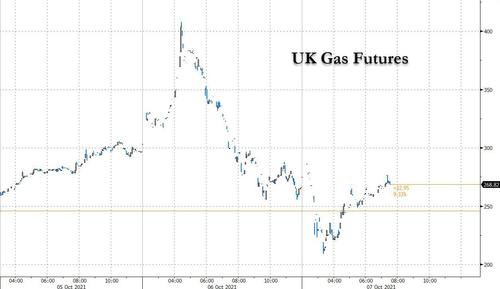
Perhaps sensing that not all is at Putin said, after plunging on Wednesday UK nat gas futures (NBP) from 407p/therm to a low of 209, prices have ominously started to rise again.
As oil fell, energy stocks including Chevron, Exxon Mobil and APA led declines with falls between 0.6% and 2.1%. Here are some of the other big movers today:

  • Twitter (TWTR US) shares rise 2% in U.S. premarket trading after it agreed to sell MoPub to AppLovin for $1.05 billion in cash
  • Levi Strauss (LEVI US) rises 4% in U.S. premarket trading after it boosted its adjusted earnings per share forecast for the full year; the guidance beat the average analyst estimate
  • NRX Pharmaceuticals (NRXP US) drops in U.S. premarket trading after Relief Therapeutics sued the company, alleging breach of a collaboration pact
  • Osmotica Pharmaceuticals (OSMT US) declined 28% in premarket trading after launching an offering of shares
  • Rocket Lab USA (RKLB US) shares rose in Wednesday postmarket trading after the company announced it has been selected to launch NASA’s Advanced Composite Solar Sail System, or ACS3, on the Electron launch vehicle
  • U.S. Silica Holdings (SLCA US) rose 7% Wednesday postmarket after it started a review of strategic alternatives for its Industrial & Specialty Products segment, including a potential sale or separation
  • Global Blood Therapeutics (GBT US) climbed 2.6% in Wednesday after hours trading while Sage Therapeutics (SAGE US) dropped 3.9% after Jefferies analyst Akash Tewari kicked off his biotech sector coverage

On the geopolitical front, a senior U.S. official said President Joe Biden’s plans to meet virtually with his Chinese counterpart before the end of the year. Tensions are escalating between the two countries, with U.S. Secretary of State Antony Blinken criticizing China’s recent military maneuvers around Taiwan.

European equities rebounded, with the Stoxx 600 index surging as much as 1.3% boosted by news that the European Central Bank was said to be studying a new bond-buying program as emergency programs are phased out. Also boosting sentiment on Thursday, ECB Governing Council member Yannis Stournaras said that investors shouldn’t expect premature interest-rate increases from the central bank. Here are some of the biggest European movers today:

  • Iberdrola shares rise as much as 6.8% after an upgrade at BofA, and as Spanish utilities climbed following a report that the Ministry for Ecological Transition may suspend or modify the mechanism that reduces the income received by hydroelectric, nuclear and some renewables in relation to gas prices.
  • Hermes shares climb as much as 3.8%, the most since February, after HSBC says “there isn’t much to worry about” from a possible slowdown in mainland China or questions over trend sustainability in the U.S.
  • Edenred shares gain as much as 5.2%, their best day since Nov. 9, after HSBC upgrades the voucher company to buy from hold, saying that Edenred, along with Experian, offers faster recurring revenue growth than the rest of the business services sector.
  • Valeo shares gain as much as 4.9% and is Thursday’s best performer in the Stoxx 600 Automobiles & Parts index; Citi raised to neutral from sell as broker updated its model ahead of 3Q results.
  • Sika shares rise as much as 4.2% after company confirms 2021 guidance, which Baader said was helpful amid market concerns of sequentially declining margins due to rising raw material prices.
  • Centrica shares rise as much as 3.6% as Morgan Stanley upgrades Centrica to overweight from equalweight, saying the utility provider will add market share as smaller U.K. companies fail due to the spike in wholesale energy prices.

Earlier in the session, Asian stocks rallied, boosted by a rebound in Hong Kong-listed technology shares and optimism over the progress made toward a U.S. debt-ceiling accord. The MSCI Asia Pacific Index climbed as much as 1.3%, on track for its biggest jump since Aug. 24. Alibaba, Tencent and Meituan were among the biggest contributors to the benchmark’s advance. Equity gauges in Hong Kong and Taiwan led a broad regional gain, while Japan’s Nikkei 225 also rebounded from its longest losing run since 2009. Thursday’s rally in Asia came after U.S. stocks closed higher overnight on a possible deal to boost the debt ceiling into December. Focus now shifts to the reopening of mainland China markets on Friday following the Golden Week holiday, and also the U.S. nonfarm payrolls report due that day. READ: China Tech Gauge Posts Best Day Since August After Touching Lows “Risk off sentiment has persisted due to a number of negative factors, but worry over some of these issues has been alleviated for the near term,” said Shogo Maekawa, a strategist at JPMorgan Asset Management in Tokyo. “One is that concern over stagflation has abated, with oil prices pulling back.” Sentiment toward risks assets was also supported as a senior U.S. official said President Joe Biden plans to meet virtually with Chinese President Xi Jinping before the end of the year.

Of note, holders of Evergrande-guaranteed Jumbo Fortune bonds have yet to receive payment; the holders next step would be to request payment from Evergrande. The maturity of the bond in question was Sunday October 3rd, with a Monday October 4th effective due data, though the bond does have a five-day grace period only in the event that payment failure is due to an administrative/technical error.

Australia’s S&P/ASX 200 index rose 0.7% to close at 7,256.70. All subgauges finished the day higher, with the exception of energy stocks as Asian peers tumbled with a retreat in crude oil prices.  Collins Foods was among the top performers after the company signed an agreement to become KFC’s corporate franchisee in the Netherlands. Whitehaven tumbled, dropping the most for a session since June 17.  In New Zealand, the S&P/NZX 50 index fell 0.5% to 13,104.61.

Oil extended its decline from a seven-year high as U.S. stockpiles grew more than expected, and European natural gas prices tumbled on signals from Russia it may increase supplies to the continent.
The yield on the U.S. 10-year Treasury was 1.526%, little changed on the day after erasing a 2.4bp increase; bunds outperformed by ~1.5bp, gilts by less than 1bp; long-end outperformance flattened 2s10s, 5s30s by ~0.5bp each. Treasuries pared losses during European morning as fuel prices ebbed and stocks gained. Bunds and gilts outperform while Treasuries curve flattens with long-end yields slightly richer on the day. WTI oil futures are lower after Russia’s offer to ease Europe’s energy crunch. Negotiations on a short-term increase to U.S. debt-ceiling continue.   

In FX, the Bloomberg Dollar Spot Index was little changed and the greenback was weaker against most Group-of-10 peers, though moves were confined to relatively tight ranges. The U.S. jobs report Friday is the key risk for markets this week as a strong print could boost the dollar. Options traders see a strong chance that the euro manages to stay above a key technical support, at least on a closing basis. Risk sensitive currencies such as the Australian and New Zealand dollars as well as Sweden’s krona led G-10 gains, while Norway’s currency was the worst performer as European natural gas and power prices tumbled early Thursday after signals from Russia it may increase supplies to the continent. The pound gained against a broadly weaker dollar as concerns over the U.K. petrol crisis eased and focus turned to Bank of England policy. A warning shot buried deep in the BoE’s policy documents two weeks ago indicating that interest rates could rise as early as this year suddenly is becoming a more distinct possibility. Australia’s 10-year bonds rose for the first time in two weeks as sentiment was bolstered by a short-term deal involving the U.S. debt ceiling. The yen steadied amid a recovery in risk sentiment as stocks edged higher. Bond futures rose as a debt auction encouraged players to cautiously buy the dip.

Looking ahead, investors will be looked forward to the release of weekly jobless claims data, likely showing 348,000 Americans filed claims for state unemployment benefits last week compared with 362,000 in the prior week. The ADP National Employment Report on Wednesday showed private payrolls increased by 568,000 jobs last month. Economists polled by Reuters had forecast a rise of 428,000 jobs. This comes ahead of the more comprehensive non-farm payrolls data due on Friday. It is expected to cement the case for the Fed’s slowing of asset purchases. We’ll also get the latest August consumer credit print. From central banks, we’ll be getting the minutes from the ECB’s September meeting, and also hear from a range of speakers including the ECB’s President Lagarde, Lane, Elderson, Holzmann, Schnabel, Knot and Villeroy, along with the Fed’s Mester, BoC Governor Macklem and PBoC Governor Yi Gang.
Market Snapshot

  • S&P 500 futures up 1% to 4,395.5
  • STOXX Europe 600 up 1.03% to 455.96
  • MXAP up 1.2% to 193.71
  • MXAPJ up 1.8% to 633.78
  • Nikkei up 0.5% to 27,678.21
  • Topix down 0.1% to 1,939.62
  • Hang Seng Index up 3.1% to 24,701.73
  • Shanghai Composite up 0.9% to 3,568.17
  • Sensex up 1.2% to 59,872.01
  • Australia S&P/ASX 200 up 0.7% to 7,256.66
  • Kospi up 1.8% to 2,959.46
  • Brent Futures down 1.8% to $79.64/bbl
  • Gold spot up 0.0% to $1,762.96
  • U.S. Dollar Index little changed at 94.19
  • German 10Y yield fell 0.6 bps to -0.188%
  • Euro little changed at $1.1563

Top Overnight News from Bloomberg

  • Democrats signaled they would take up Senate Republican leader Mitch McConnell’s offer to raise the U.S. debt ceiling into December, alleviating the immediate risk of a default but raising the prospect of another bruising political fight near the end of the year
  • The European Central Bank is studying a new bond-buying program to prevent any market turmoil when emergency purchases get phased out next year, according to officials familiar with the matter
  • Market expectations for interest-rate hikes “are not in accordance with our new forward guidance,” ECB Governing Council member Yannis Stournaras said in an interview with Bloomberg Television
  • Creditors have yet to receive repayment of a dollar bond they say is guaranteed by China Evergrande Group and one of its units, in what could be the firm’s first major miss on maturing notes since regulators urged the developer to avoid a near-term default
  • Boris Johnson’s plan to overhaul the U.K. economy is a 10-year project he wants to see out as prime minister, according to a senior official. The time frame, which has not been disclosed publicly, illustrates the scale of Johnson’s gamble that British voters will accept a long period of what he regards as shock therapy to redefine Britain
  • The U.K.’s surge in inflation has boosted the cost of investment-grade borrowing in sterling to the most since June 2020. The average yield on the corporate notes climbed just past 2%, according to a Bloomberg index

A more detailed look at global markets courtesy of Newsquawk

Asia-Pac stocks traded positively as the region took impetus from the mostly positive close in the US where the major indices spent the prior session clawing back opening losses, with sentiment supported amid a potential Biden-Xi virtual meeting this year, and hopes of a compromise on the debt ceiling after Senate Republican Leader McConnell offered a short-term debt limit extension to December. The ASX 200 (+0.7%) was led higher by strength in the tech sector and with risk appetite also helped by the announcement to begin easing restrictions in New South Wales from next Monday. The Nikkei 225 (+0.5%) attempted to reclaim the 28k level with advances spearheaded by tech and amid reports Tokyo is to lower its virus warning from the current top level. The Hang Seng (+3.1%) was the biggest gainer owing to strength in tech and property stocks, with Evergrande shareholder Chinese Estates surging in Hong Kong after a proposal from Solar Bright to take it private. Reports also noted that the US and China reportedly reached an agreement in principle for a Biden-Xi virtual meeting before year-end and with yesterday’s talks in Zurich between senior officials said to be more meaningful and constructive than other recent exchanges. Finally, 10yr JGBs retraced some of the prior day’s after-hours rebound with haven demand hampered by the upside in stocks and after the recent choppy mood in T-notes, while the latest enhanced liquidity auction for longer-dated JGBs resulted in a weaker bid-to-cover.

Top Asian News

  • Vietnam Faces Worker Exodus From Factory Hub for Gap, Nike, Puma
  • Japan’s New Finance Minister Stresses FX Stability Is Vital
  • Korea Lures Haven Seekers With Bonds Sold at Lowest Spread
  • Africa’s Free-Trade Area to Get $7 Billion in Support From AfDB

Bourses in Europe hold onto the gains seen at the cash open (Euro Stoxx 50 +1.5%; Stoxx 600 +1.1%) following on from an upbeat APAC handover, albeit the upside momentum took a pause shortly after the cash open. US equity futures are also firmer across the board but to a slightly lesser extent, with the tech-laden NQ (+1.0%) getting a boost from a pullback in yields and outperforming its ES (+0.7%), RTY (+0.6%) and YM (+0.6%). The constructive tone comes amid some positive vibes out of the States, and on a geopolitical note, with US Senate Minority Leader McConnell offered a short-term debt ceiling extension to December whilst US and China reached an agreement in principle for a Biden-Xi virtual meeting before the end of the year. Euro-bourses portray broad-based gains whilst the UK’s FTSE 100 (+1.0%) narrowly lags the Euro Stoxx benchmarks, weighed on by its heavyweight energy and healthcare sectors, which currently reside at the foot of the bunch. Further, BoE’s Chief Economist Pill also hit the wires today and suggested that the balance of risks is currently shifting towards great concerns about the inflation outlook, as the current strength of inflation looks set to prove more long-lasting than originally anticipated. Broader sectors initially opened with an anti-defensive bias (ex-energy), although the configuration since then has turned into more of a mixed picture, although Basic Resource and Autos still reside towards the top. Individual movers are somewhat scarce in what is seemingly a macro-driven day thus far. Miners top the charts on the last day of the Chinese Golden Week Holiday, with base metal prices also on the front foot in anticipation of demand from the nation – with Antofagasta (+5.1%), Anglo American (+4.2%) among the top gainers, whist Teamviewer (-8.2%) is again at the foot of the Stoxx 600 in a continuation of the losses seen after its guidance cut yesterday. Ubisoft (-5.1%) are also softer, potentially on a bad reception for its latest Ghost Recon game announcement.

Top European News

  • ECB’s Stournaras Reckons Investor Rate-Hike Bets Are Unwarranted
  • Shell Flags Financial Impact of Gas Market Swings, Hurricane
  • Johnson’s Plans for Economy Signal Ambitions for Decade in Power
  • U.K. Grid Bids to Calm Market Saying Winter Gas Supply Is Enough

In FX, the latest upturn in broad risk sentiment as the pendulum continues to swing one way then the other on alternate days, has given the Aussie a fillip along with news that COVID-19 restrictions in NSW remain on track for being eased by October 11, according to the state’s new Premier. Aud/Usd is eyeing 0.7300 in response to the above and a softer Greenback, while the Aud/Nzd cross is securing a firmer footing above 1.0500 in wake of a slender rise in AIG’s services index and ahead of the latest RBA FSR. Conversely, the Pound is relatively contained vs the Buck having probed 1.3600 when the DXY backed off further from Wednesday’s w-t-d peak to a 94.102 low and has retreated through 0.8500 against the Euro amidst unsubstantiated reports about less hawkish leaning remarks from a member of the BoE’s MPC. In short, the word is that Broadbent has downplayed the prospects of any fireworks in November via a rate hike, but on the flip-side new chief economist Pill delivered a hawkish assessment of the inflation situation in the UK when responding to a TSC questionnaire (see 10.18BST post on the Headline Feed for bullets and a link to his answers in full). Back to the Dollar index, challenger lay-offs are due and will provide another NFP guide before claims and commentary from Fed’s Mester, while from a technical perspective there is near term support just below 94.000 and resistance a fraction shy of 94.500, at 93.983 (yesterday’s low) and the aforementioned midweek session best (94.448 vs the 94.283 intraday high, so far).

  • NZD – Notwithstanding the negative cross flows noted above, the Kiwi is also taking advantage of more constructive external and general factors to secure a firmer grip of the 0.6900 handle vs its US counterpart, but remains rather deflated post-RBNZ on cautious guidance in terms of further tightening.
  • EUR/CHF/CAD/JPY – All narrowly mixed against their US peer and mostly well within recent ranges as the Euro reclaims 1.1500+ status in the run up to ECB minutes, the Franc consolidates off sub-0.9300 lows following dips in Swiss jobless rates, the Loonie weighs up WTI crude’s further loss of momentum against the Greenback’s retreat between 1.2600-1.2563 parameters awaiting Canada’s Ivey PMIs and a speech from BoC Governor Macklem, and the Yen retains an underlying recovery bid within 111.53-23 confines before a raft of Japanese data. Note, little reaction to comments from Japanese Finance Minister, when asked about recent Jpy weakening, as he simply said that currency stability is important, so is closely watching FX developments, but did not comment on current levels.

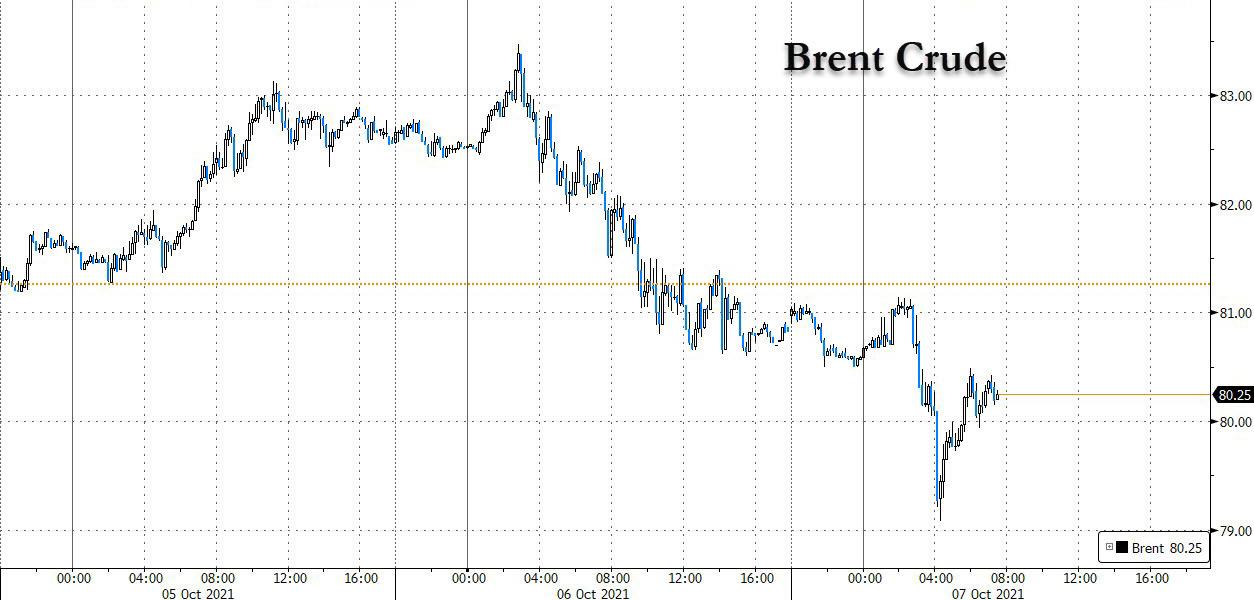
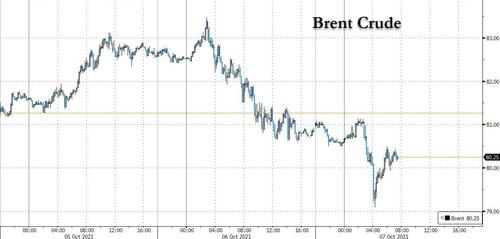
In commodities, WTI and Brent front month futures are on the backfoot, in part amid the post-Putin losses across the Nat Gas space, with the UK ICE future dropping some 20% in early trade. This has also provided further headwinds to the crude complex, which itself tackles its own bearish omens. WTI underperforms Brent amid reports that the US was mulling a Strategic Petroleum Reserve (SPR) release and did not rule out an export ban. Desks have offered their thoughts on the development. Goldman Sachs says a US SPR release would likely be of up to 60mln barrels, only representing a USD 3/bbl downside to the year-end USD 90/bbl Brent forecast and stated that relief would only be transitory given structural deficits the market will face from 2023 onwards. GS notes that any larger price impact that further hampers US shale activity would lead to elevated US nat gas prices in 2022, and an export ban would lead to significant disruption within the US oil market, likely bullish retail fuel price impact. RBC, meanwhile, believes that these comments were to incentivise OPEC+ to further open the taps after the producers opted to maintain a plan to hike output 400k BPD/m. On that note, sources noted that the OPEC+ decision against a larger supply hike at Monday’s meeting was partly driven by concern that demand and prices could weaken – this would be in-fitting with sources back in July, which suggested that demand could weaken early 2022. The downside for crude prices was exacerbated as Brent Dec fell under USD 80/bbl to a low of near 79.00/bbl (vs 81.14/bbl), whilst WTI Nov briefly lost USD 75/bbl (vs high 77.23/bbl). Prices have trimmed some losses since. Metals in comparison have been less interesting; spot gold is flat and only modestly widened its overnight range to the current 1,756-66 range, whilst spot silver remains north of USD 22.50/bbl. Elsewhere, the risk tone has aided copper prices, with LME copper still north of USD 9,000/t, whilst some also cite supply concerns as a key mining road in Peru (second-largest copper producer) was blocked, with the indigenous community planning to continue the blockade indefinitely, according to a local leader. It is also worth noting that Chinese markets will return tomorrow from their Golden Week holiday.

US Event Calendar

  • 7:30am: Sept. Challenger Job Cuts YoY, prior -86.4%
  • 8:30am: Oct. Initial Jobless Claims, est. 348,000, prior 362,000; Continuing Claims, est. 2.76m, prior 2.8m
  • 9:45am: Oct. Langer Consumer Comfort, prior 54.7
  • 11:45am: Fed’s Mester Takes Part in Panel on Inflation Dynamics
  • 3pm: Aug. Consumer Credit, est. $17.5b, prior $17b

DB’s Jim Reid concludes the overnight wrap

On the survey, given how fascinating markets are at the moment I think the results of this month’s edition will be especially interesting. However the irony is that when things are busy less people tend to fill it in as they are more pressed for time. So if you can try to spare 3-4 minutes your help would be much appreciated. Many thanks.

It was a wild session for markets yesterday, with multiple asset classes swinging between gains and losses as investors sought to grapple with the extent of inflationary pressures and potential shock to growth. However US equities closed out in positive territory and at the highs as the news on the debt ceiling became more positive after Europe went home.

Before this equities had lost ground throughout the London afternoon, with the S&P 500 down nearly -1.3% at one point with Europe’s STOXX 600 closing -1.03% lower. Cyclical sectors led the European underperformance, although it was a fairly broad-based decline. However after Europe went home – or closed their laptops in many cases – the positive debt ceiling developments saw risk sentiment improve throughout the rest of New York session. The S&P rallied to finish +0.41% and is now slightly up on the week, as defensive sectors such as utilities (+1.53%) and consumer staples (+1.00%) led the index while US cyclicals fell back like their European counterparts. Small cap stocks didn’t enjoy as much of a boost as the Russell 2000 ended the day -0.60% lower, while the megacap tech NYFANG+ index gained +0.82%.

Risk sentiment improved following reports that Senate Minority Leader Mitch McConnell was willing to negotiate with Democrats to resolve the debt ceiling impasse and allow Democrats to raise the ceiling until December. This means President Biden and Congressional Democrats would be able to finish their fiscal spending package – now estimated at around $1.9-2.2 trillion – and include a further debt ceiling raise into one large reconciliation package near year-end. Senate Majority Leader Schumer has not publicly addressed the deal yet, but Democrats have signaled that they’ll accept the deal, although they’ve also indicated they’d still like to pass the longer-term debt ceiling bill under regular order in a bipartisan manner when the time came near year-end. Interestingly, if we did see the ceiling extended until December, this would put another deadline that month, since the government funding extension only went through to December 3, so we could have yet another round of multiple congressional negotiations in just a few weeks’ time.

The news of a Republican offer coincided with President Biden’s virtual meeting with industry leaders, where the President implored them to join him in pressuring legislators to raise the debt limit. Treasury Secretary Yellen also attended the meeting, and re-emphasised her estimate for the so-called “drop dead date” to be October 18. Potentially at risk Treasury bills maturing shortly thereafter rallied a few basis points, signaling investors took yesterday afternoon’s debt ceiling developments as positive and credible.

This was a far cry from where markets opened the London session as turmoil again gripped the gas market. UK and European natural gas futures both surged around +40% to reach an intraday high shortly after the open. However, energy markets went into reverse following comments from Russian President Putin that the country was set to supply more gas to Europe and help stabilise energy markets, with European futures erasing those earlier gains to actually end the day down -6.75%, with their UK counterpart similarly reversing course to close -6.96% too. The U.K. future traded in a stunning 255 to 408 price range on the day.

We shouldn’t get ahead of ourselves here though, since even with the latest reversal, prices are still up by more than five-fold since the start of the year, and this astonishing increase over recent weeks has attracted attention from policymakers across the world as governments look to step in and protect consumers and industry. In the EU, the Energy Commissioner, Kadri Simson, said that the price shock was “hurting our citizens, in particular the most vulnerable households, weakening competitiveness and adding to inflationary pressure. … There is no question that we need to take policy measures”. However, the potential response appeared to differ across the continent. French President Macron said that more energy capacity was required, of which renewables and nuclear would be key elements, while Italian PM Draghi said that joint EU gas purchases had wide support. However, Hungarian PM Orban took the opportunity to blame the European Commission, saying that the Green Deal’s regulations were “indirect taxation”, which shows how these price spikes could create greater resistance to green measures moving forward. Elsewhere, blame was also cast on carbon speculators, with Spanish environment minister Rodriguez saying that “We don’t want to be hostages of external financial investors”, and outside the EU, Serbian President Vucic said that his country could ban power exports if there were further issues, which just shows how energy has the potential to become a big geopolitical issue this winter.

Those declines in natural gas prices were echoed across the energy complex, with both Brent Crude (-1.79%) and WTI (-1.90%) oil prices subsiding from their multi-year highs the previous day, just as coal also fell -10.20%. In turn, that served to alleviate some of the concerns about building price pressures and helped measures of longer-term inflation expectations decline across the board. Indeed by the close, the 10yr breakeven in the US had come down -1.4bps, and the equivalent measures in Germany (-4.6bps), Italy (-6.1bps) and the UK (-4.2bps) had likewise seen declines of their own.

In spite of those moves for inflation expectations, this proved little consolation for European sovereign bonds as higher real rates put them under continued pressure, even if yields had pared back some of their gains from the morning. Yields on 10yr bunds (+0.6bps), OATs (+0.9bps) and BTPs (+3.2bps) were all at their highest levels in 3 months, whilst those on Polish 10yr debt were up +13.7bps after the central bank there unexpectedly became the latest to raise rates, with the 40bps hike to 0.5% marking the first increase since 2012. However, for the US it was a different story, with yields on 10yr Treasuries down -0.5bps to 1.521%, having peaked at 1.57% earlier in the London morning.

There was a late story in Europe that could bear watching in the coming weeks as Bloomberg reported that the ECB is studying a new bond-buying tool that could help ease market volatility if a “taper tantrum”-esque move were to happen when the PEPP purchases end in March. The plan would reportedly target purchases selectively if there were to be a larger selloff in more heavily indebted economies, which differs from the existing programs that buys debt in relation to the size of each member’s economy.

Asian stocks overnight have performed strongly, with the Hang Seng (+2.28%), Nikkei (+1.68%) and KOSPI (+1.61%) all advancing after the positive news on the debt-ceiling, as well on news that US President Biden was set to meeting with Chinese President Xi by the end of the year. All the indices were lifted by the IT and consumer discretionary sectors, and the Hang Seng Tech index has rebounded by +3.29% this morning. Separately, Evergrande-related news has been subsiding in recent days, but China Estates, a company controlled by a backer of Evergrande, rose 30% after the company disclosed an offer to take it private for $245mn. Otherwise, US futures are pointing to a positive start later, with those on the S&P 500 (+0.50%) and DAX (+1.19%) both advancing.

Turning to Germany, exploratory talks will be commencing today between the centre-left SPD, the Greens and the Liberal FDP, who together would make up a so-called “traffic-light” coalition. That marks a boost for the SPD, who beat the CDU/CSU bloc into first place in the September 26 election, although CDU leader Armin Laschet said that his party were “still ready to hold talks”. However, the CDU/CSU have faced internal tensions after they slumped to their worst-ever election result, whilst a Forsa poll out on Tuesday said that 53% of voters wanted a traffic-light coalition, versus just 22% who favoured the Jamaica option led by the CDU/CSU. So momentum seems clearly behind the traffic light option for now.

Looking at yesterday’s data, in the US the ADP’s report at private payrolls came in at an unexpectedly strong +568k (vs. +430k expected), which is the highest in their series for 3 months and comes ahead of tomorrow’s US jobs report. However in Germany, factory orders in August fell by -7.7% (vs. -2.2% expected) amidst various supply issues.

To the day ahead now, and data releases include German industrial production and Italian retail sales for August, whilst in the US we’ve got the weekly initial jobless claims and August’s consumer credit.From central banks, we’ll be getting the minutes from the ECB’s September meeting, and also hear from a range of speakers including the ECB’s President Lagarde, Lane, Elderson, Holzmann, Schnabel, Knot and Villeroy, along with the Fed’s Mester, BoC Governor Macklem and PBoC Governor Yi Gang.

Tyler Durden
Thu, 10/07/2021 – 07:57

via ZeroHedge News https://ift.tt/3adQHqD Tyler Durden

Default Averted For Now After Senate Reportedly Reaches Debt-Ceiling Deal

Default Averted For Now After Senate Reportedly Reaches Debt-Ceiling Deal

Following negotiations that stretched late into Wednesday evening, Democrats and Republicans have reportedly forged a compromise deal on a short-term increase in the the debt ceiling which will avoid default, but as Bloomberg notes, “threatens to exacerbate year-end clashes over trillions in government spending.”

In moving forward, Democrats appear to be on the verge of accepting a proposal from GOP leader Sen. Mitch McConnell (R-KY) which would raise the debt limit by a specific amount – enough to move things into December, when Congress will have to vote again to avoid a default.

While the details aren’t totally clear, McConnell’s offer was to allow a vote on extending the debt limit at a fixed collar amount – which Goldman’s Alec Phillips expects a number on over the next day or so.

We’re making good progress,” Senate Majority Leader Chuck Schumer said in early Thursday morning comments from the Senate floor, adding “we hope to have agreement tomorrow morning,” adding that the Senate would come back into session at 10 a.m. Thursday.

That said, this is classic can-kicking which will have consequences down the road, as Democrats will likely attempt to move forward with their massive tax and spending package and separate infrastructure bill while at the same time funding the government to avoid yet another potential shutdown after December 3.

News of a possible debt-ceiling accord stoked the biggest positive turnaround in the equity market in more than seven months, as the S&P 500 Index closed up 0.4% after tumbling earlier. In the bond market, traders bid back up the prices of Treasuries set to mature in the window around a potential default. Investors then moved on to gauge which securities may now be most at risk of a missed or delayed payment under the new congressional timeframe. -Bloomberg

Treasury Secretary Janet Yellen has warned that the US would likely default after October 18 without congressional action. At present, the current debt limit is $28.4 trillion, while the Treasury reported that it had $343 billion in combined extraordinary measures and cash on hand.

As an approximation, during the period from Sep. 29 to Dec. 3, 2019, debt subject to limit (this includes marketable and non-marketable debt) increased by $356bn and the cash balance declined by $50bn, suggesting that the Treasury would use around $400bn in borrowing capacity by early December if cash flows are similar this year. Since the Treasury still had more than $300bn in room under the debt limit at the end of September, a debt limit increase to only $28.5-$28.6 trillion might be sufficient to accomplish the intent of the agreement, but the Treasury will be the final word on this and the amount will depend on expected cash flows this year. -Goldman Sachs

And while a fixed dollar amount (vs. a calendar-based solution) injects a bit of uncertainty as to when exactly the next deadline will hit, the debt deal alleviates concerns which were beginning to reverberate throughout the investment community. Earlier this week, McConnell sidestepped a question over whether any major banks or wall street titans had contacted him over the debt ceiling fight.

It was thought that the investment community would hammer Washington if lawmakers bumbled into a debt ceiling crisis. 

Worry started to permeate Washington that rating agencies could downgrade the creditworthiness of the U.S. before Oct. 18 – the deadline when Treasury says the U.S. will run out of cash. –Fox News

Senate Democrats have considered the debt deal a victory –  with Sen. Elizabeth Warren (D-MA) exclaiming on Wednesday that “McConnell caved,” adding “And now we’re going to spend our time doing child care, health care, and fighting climate change.”

From here, the focus will undoubtedly return to negotiations over Biden’s fiscal agenda – and in particular, the stalemate within the Democratic party between Senate moderates Joe Manchin (WV) and Kyrsten Sinema (AZ), who have vowed to sink any reconciliation plan that exceeds $1.5 trillion, and House progressives, who will likewise tank the $1.2 trillion bipartisan infrastructure deal unless Manchin and Sinema bend the knee.

Assuming that drags into December, expect fireworks into the end of the year.

Tyler Durden
Thu, 10/07/2021 – 07:35

via ZeroHedge News https://ift.tt/3iHwaQ9 Tyler Durden

Finland Joins Sweden & Denmark By Limiting Use Of Moderna’s Jab In Young Men

Finland Joins Sweden & Denmark By Limiting Use Of Moderna’s Jab In Young Men

Finland became the latest Scandinavian country to impose new restrictions on the use of Moderna’s COVID jab, announcing Thursday that it would halt use of the jab for younger males due to the risk of rare but harmful side effects, including heart inflammation.

Following in the footsteps of Sweden and Denmark, the director of Finland’s health institute said the country would instead give the Pfizer jab to men born in 1991 or later. Presently, patients age 12 and older can be vaccinated in Finland.

Mika Salminen, the director of Finland’s health institute, blamed the new restrictions on data collected in a Nordic study.

“A Nordic study involving Finland, Sweden, Norway and Denmark found that men under the age of 30 who received Moderna Spikevax had a slightly higher risk than others of developing myocarditis,” he said.

Yesterday, Swedish and Danish health officials announced they would pause the use of the Moderna vaccine for all young adults and children, citing the same as-yet-unpublished unpublished study.

The Finns said the Nordic study would be published within a couple of weeks. Preliminary data has already been sent to the EMA for further assessment. The EMA, which is the pan-EU medicines regulator, determined back in July that rare cases of heart inflammation had been detected in some younger male patients.

Regulators in the US, as well as the WHO, have repeatedly insisted that the risks of the mRNA jabs are far outweighed by their benefits. Moderna executives have stepped up to defend their jab, while Italy’s Health Minister Roberto Speranza told reporters on Thursday that Italy wasn’t planning to suspend or limit use of the Moderna jab and said European countries should work together more closely to coordinate better.

Tyler Durden
Thu, 10/07/2021 – 07:02

via ZeroHedge News https://ift.tt/3BowVVE Tyler Durden

Why Shortages Are Permanent: Global Supply Shortages Make Fantastic Financial Sense

Why Shortages Are Permanent: Global Supply Shortages Make Fantastic Financial Sense

Authored by Charles Hugh Smith via OfTwoMinds blog,

The era of abundance was only a short-lived artifact of the initial boost phase of globalization and financialization.

Global corporations didn’t go to all the effort to establish quasi-monopolies and cartels for our convenience–they did it to ensure reliably large profits from control and scarcity. Not all scarcities are artificial, i.e. the result of cartels limiting supply to keep prices high; many scarcities are real, and many of these scarcities can be traced back to the stripping out of redundancy / multiple suppliers of industrial essentials to streamline efficiency and eliminate competition.

Recall that competition and abundance are anathema to profits. Wide open competition and structural abundance are the least conducive setting for generating reliably ample profits, while quasi-monopolies and cartels that control scarce supplies are the ideal profit-generating machines.

The incentives to expand the number of suppliers, i.e. increase competition, are effectively zero. America’s corporations spent $11 trillion buying back their own stocks over the past decade; that’s equal to the combined GDP of Japan, Germany and Italy. If adding new suppliers to the global supply chain were profitable, some of that $11 trillion would have exploited those vast profits.

The financial reality is attempting to compete with an established cartel that has captured regulatory and political mechanisms is a foolhardy waste of capital. If firing up a new supplier of essential solvents, etc. was so captivatingly profitable, the why wouldn’t Google and Apple take a slice of their billions in cash and go make some easy money?

The barriers to entry are high and the markets are limited. A great many specialty lubricants, solvents, alloys, wires, etc. are essential to the manufacture of all the consumer and industrial products that are sourced globally, but the markets are narrow: manufacturers need X amount of a specialty solvent, not 10X.

Back in the good old days before globalization and financialization conquered the world, corporations lined up three reliable suppliers for every critical component, as this redundancy alleviated supply chain chokeholds. But to keep those three suppliers in business, you need to spread the order book among all three. Nobody will keep a facility open if it’s only used occasionally when the primary supplier runs into a spot of bother.

And so now we’re all seated at the banquet of consequences flowing from stripping out redundancy and competition, and ceding control of supply chains to quasi-monopolies and cartels. Scarcities are their source of profits, and since it makes zero financial sense to spend a fortune building a plant to make solvents, lubricants, alloys, etc. in limited quantities in markets dominated by quasi-monopolies and cartels, shortages are a permanent feature of the 21st century global economy.

The era of abundance was only a short-lived artifact of the initial boost phase of globalization and financialization; now that the consolidation is complete, shortages make fantastic financial sense.

By all means thank Corporate America for squandering $11 trillion to further enrich the top 0.1% and insiders. Alas, there was no better use for all those trillions than further enriching the already-super-rich.

*  *  *

If you found value in this content, please join me in seeking solutions by becoming a $1/month patron of my work via patreon.com.

My recent books:

A Hacker’s Teleology: Sharing the Wealth of Our Shrinking Planet (Kindle $8.95, print $20, audiobook $17.46) Read the first section for free (PDF).

Will You Be Richer or Poorer?: Profit, Power, and AI in a Traumatized World (Kindle $5, print $10, audiobook) Read the first section for free (PDF).

Pathfinding our Destiny: Preventing the Final Fall of Our Democratic Republic ($5 (Kindle), $10 (print), ( audiobook): Read the first section for free (PDF).

The Adventures of the Consulting Philosopher: The Disappearance of Drake $1.29 (Kindle), $8.95 (print); read the first chapters for free (PDF)

Money and Work Unchained $6.95 (Kindle), $15 (print) Read the first section for free (PDF).

Tyler Durden
Thu, 10/07/2021 – 06:30

via ZeroHedge News https://ift.tt/3iI5Bdt Tyler Durden

US Desperate For Coal Miners To Meet Soaring Global Demand

US Desperate For Coal Miners To Meet Soaring Global Demand

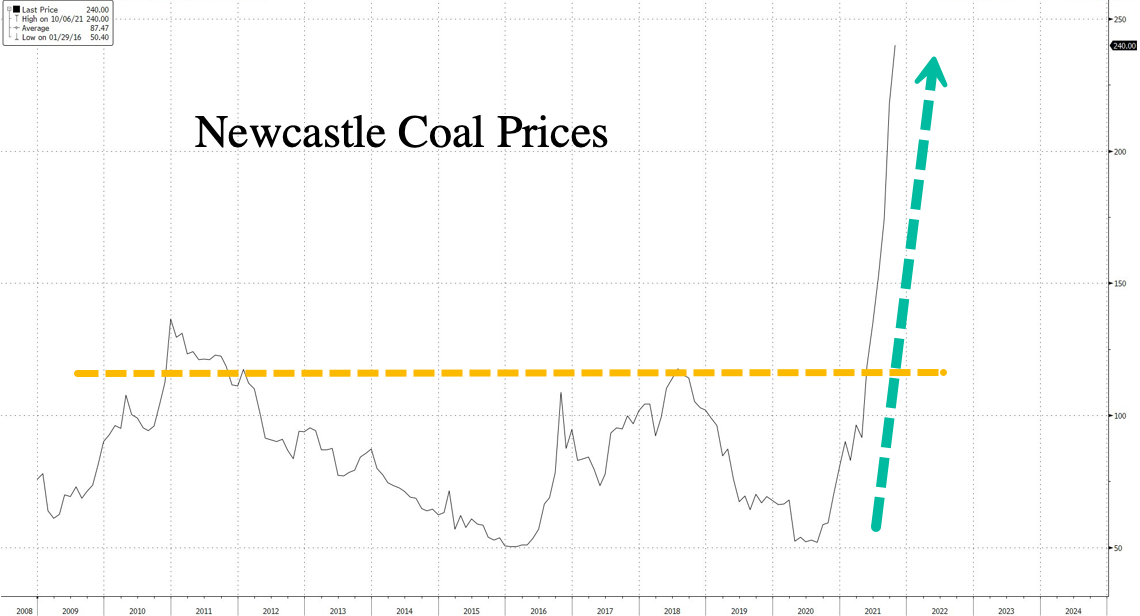
Coal supply shortages in Asia and Europe are pushing prices for the dirtiest fossil fuel to record highs and have become a challenge for US suppliers due to a shortage of miners, according to Bloomberg

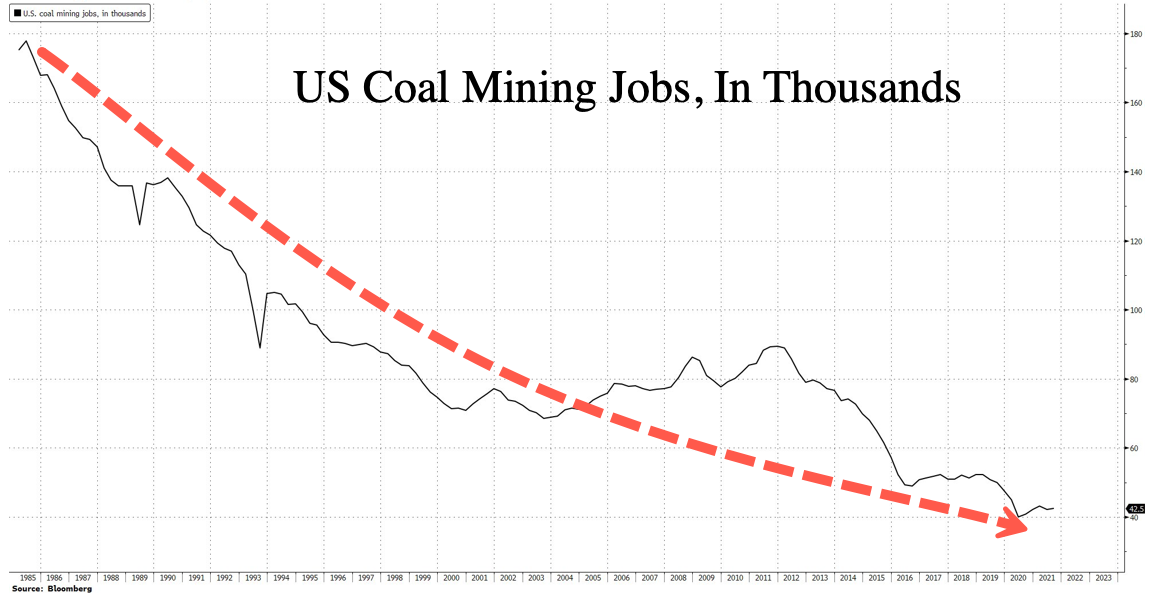
For the last three and a half decades, the number of coal mining jobs in the US has collapsed from 180,000 to 42,500 in August. The industry remains 9,500 miners short from pre-COVID times. 

With coal prices worldwide screaming to all-time highs ahead of winter as China and Europe scramble for supplies, the US coal industry is failing to find new miners willing to do the dirty work as demand soars. 

“That’s making it difficult for mining companies to boost production at a time when the global energy crisis is making utilities desperate for every lump of coal they can dig up. Even with coal prices surging around the world, the labor shortages are another sign that it’s going to be tough to shore up energy stockpiles,” Bloomberg said. 

Erin Higginson of Custom Staffing Services, which recruits miners in the Illinois Basin, said miners used to walk into their office for jobs, but now they have to “hold job fairs all over just to find a few miners.” 

Attracting new miners in the US has been a difficult sell to prime working-age men and women convinced by mainstream media that the green energy transition is imminent. However, with surging natural gas, coal, and oil prices heading into winter, it appears the transition will take decades, not years, because renewable energy is not reliable, as the UK found out the hard way late in the summer when its wind turbine generation plunged forcing it to power up natgas generators to protect the grid from collapse

What this suggests is there are many jobs available in the fossil fuel space. 

“There’s a perception that the coal industry, if not dead, is dying,” Ernie Thrasher, chief executive officer of Xcoal Energy & Resources LLC, a Pennsylvania coal trader that works with several suppliers. said. “Young people just have many more choices.”

Mining companies are getting creative in hiring, said Rich Nolan, CEO of the National Mining Association trade group.

Along with higher pay, some firms offer benefits like daycare. “Everyone is scraping for employees,” Nolan said. “They’re using every trick in the book to attract qualified workers.”

Some mining firms are desperate enough that they are offering $100k per year for new talent. 

Miners might not meet the surge in demand due to years of decommissioning mines to reduce carbon emissions and transition the economy from fossil fuels to green energy. A sustainable energy transition will likely take decades, not years: 

“There is an energy transition taking place,” said Xcoal’s Thrasher. “But it’s going to take longer than people think.”

To sum up, Asia and Europe need fossil fuels as the green energy transition is unreliable, triggering one of the great power crunches the world has ever seen. But the US might come up empty handed as labor shortages plague the industry. 

Tyler Durden
Thu, 10/07/2021 – 05:45

via ZeroHedge News https://ift.tt/3BlSlTg Tyler Durden

Europe’s Gas Prices Surge To Avert Risk Of Winter Shortage

Europe’s Gas Prices Surge To Avert Risk Of Winter Shortage

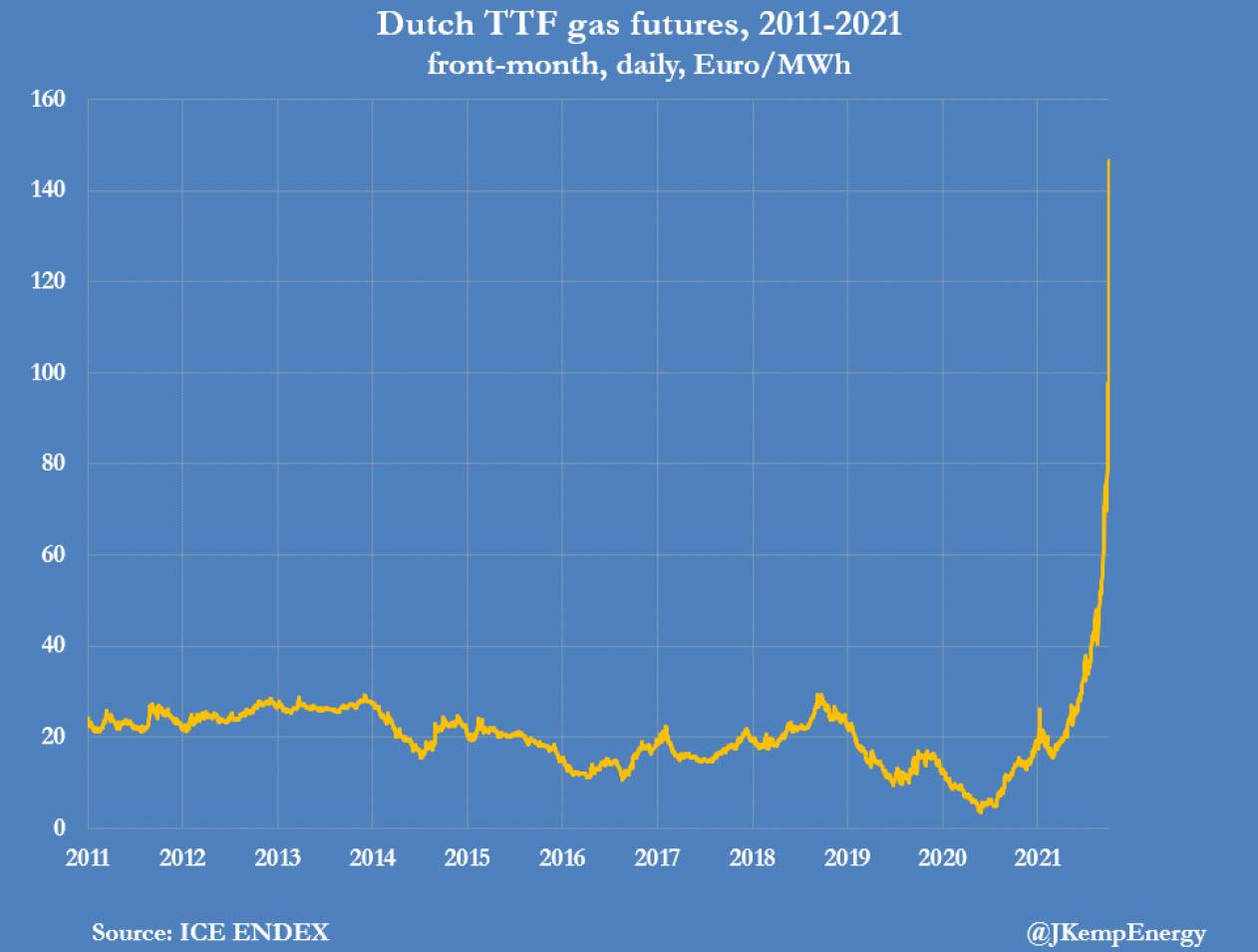
By John Kemp, Reuters energy analyst and reporter

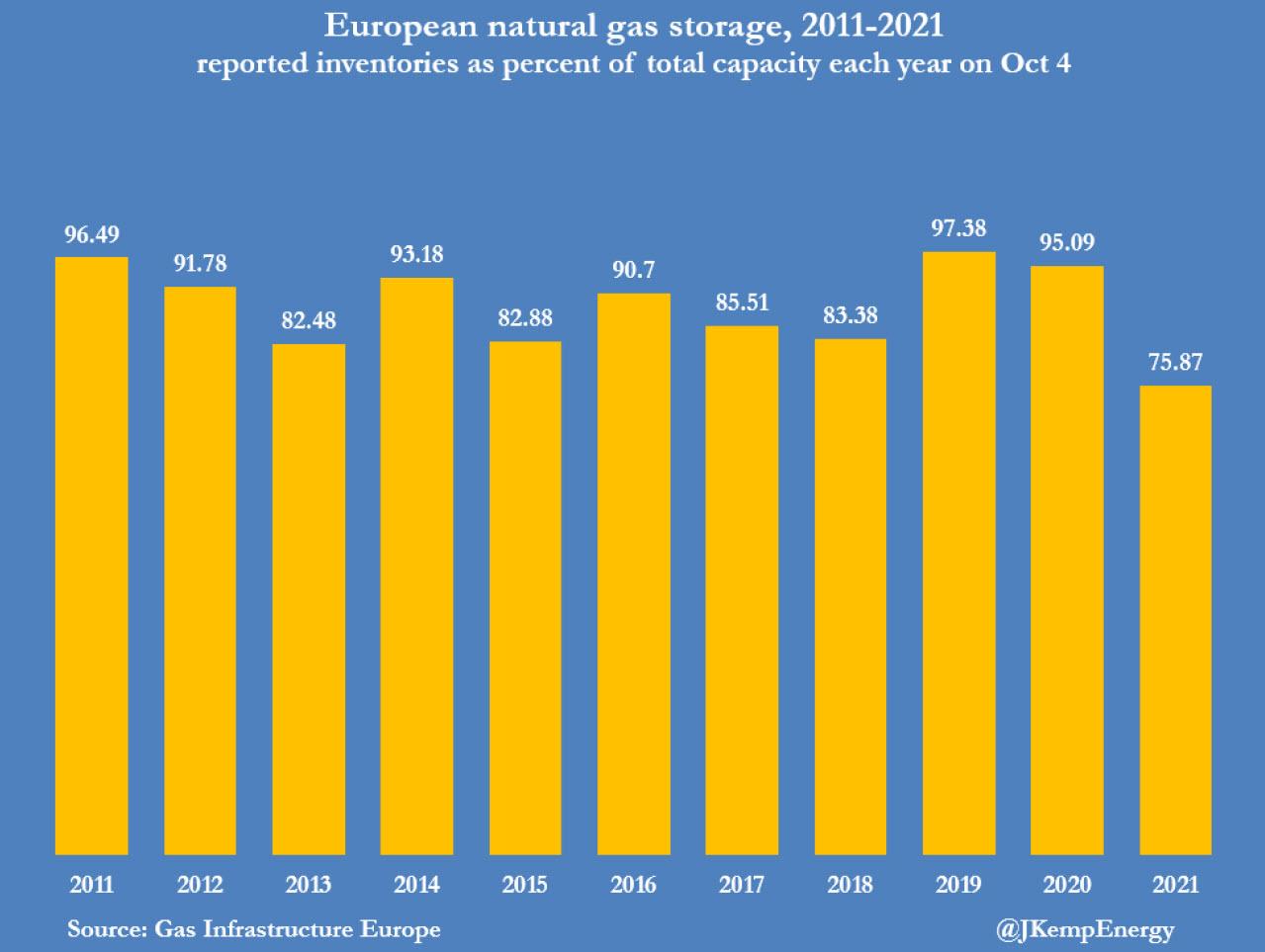
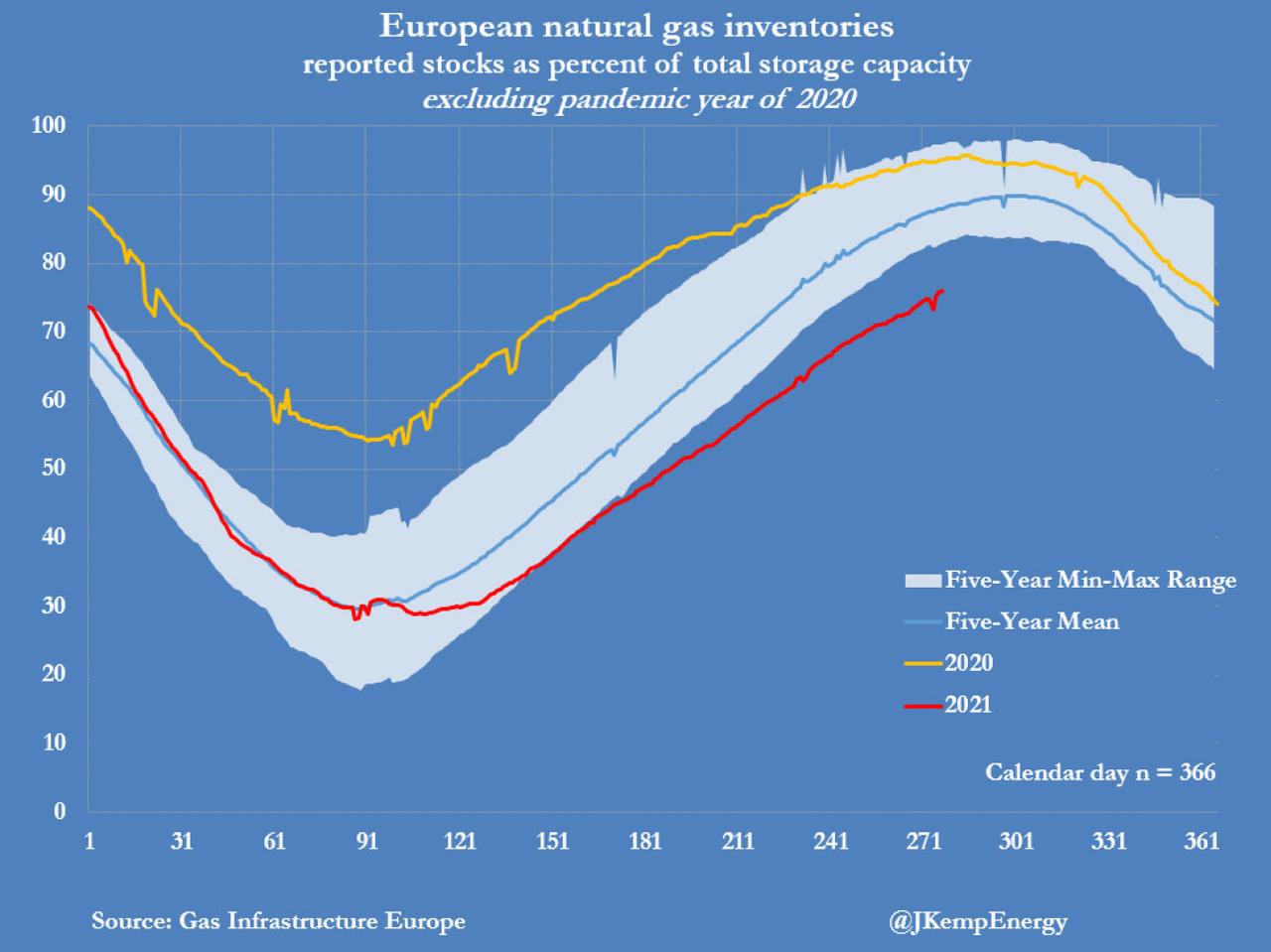
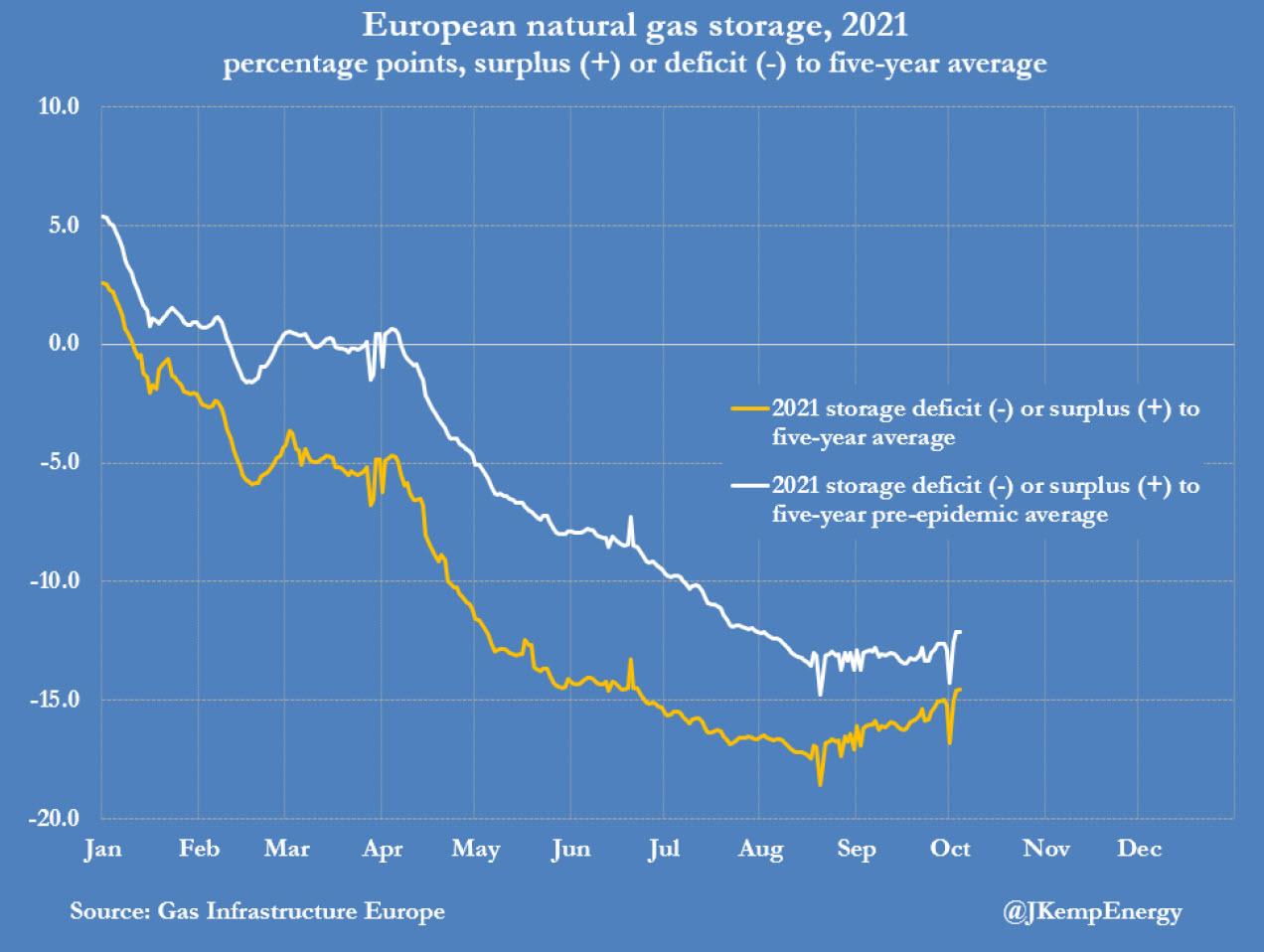
Europe’s gas and electricity prices are setting record highs on a daily basis and rising at an accelerating rate as the market tries to destroy enough demand to protect depleted inventories ahead of the winter.  Gas storage sites in the European Union and United Kingdom are currently just under 76% full, compared with a ten-year seasonal average of almost 90%, according to data compiled by Gas Infrastructure Europe.

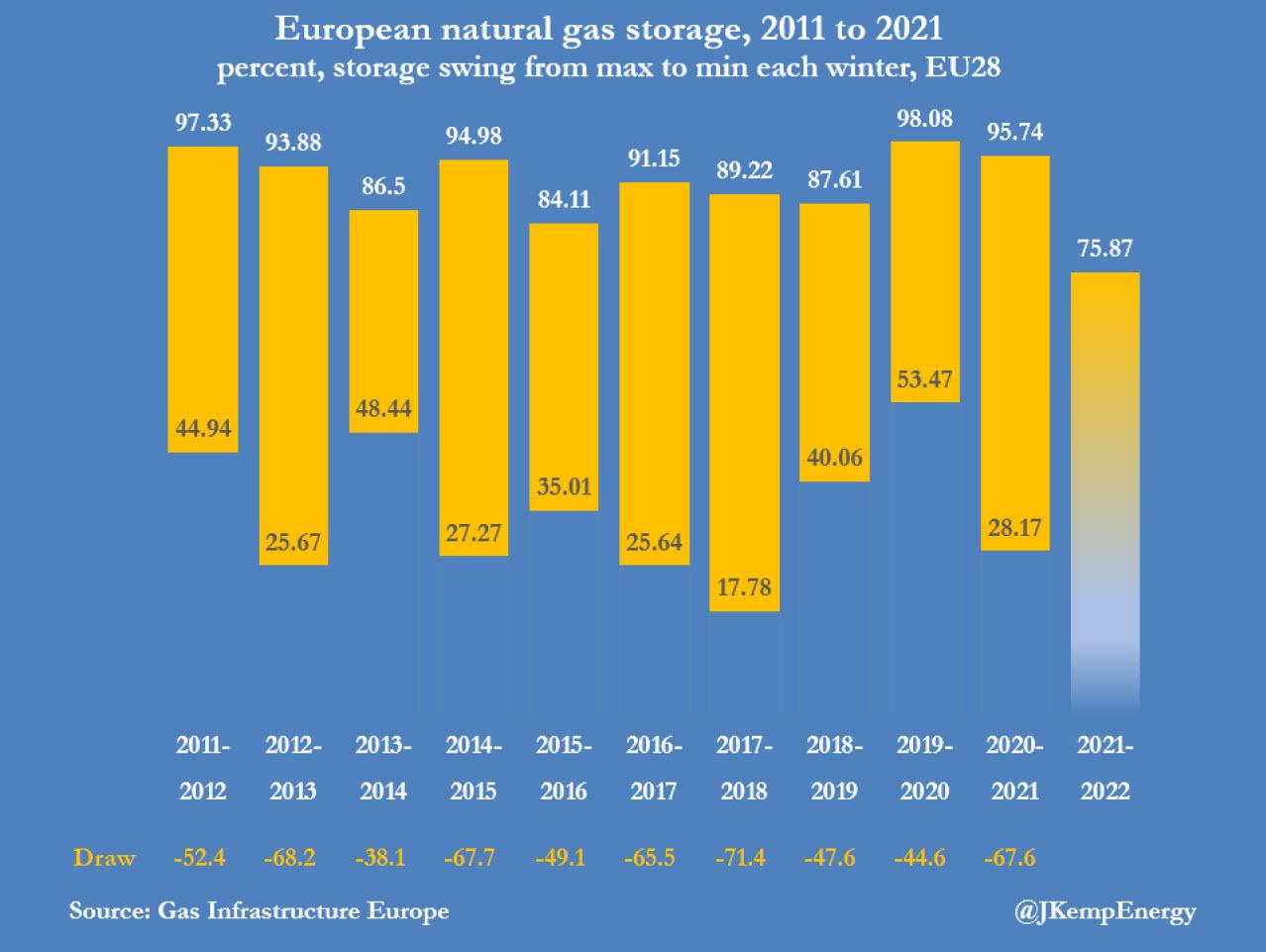
In the last decade, storage has emptied by an average of 57 percentage points over winter, but depletion is highly variable, ranging from a minimum of 38 points in 2013/14 to a maximum of 71 points in 2017/18.

If this winter sees an average drawdown, storage sites would be reduced to just 19% full by next spring, the second lowest for a decade, leaving the region with a persistent gas shortage next year.

If the winter sees a moderately strong draw, in the 75th percentile, storage would be reduced by 68 percentage points to a record low of just 8% next spring, increasing the probability supply will actually run out in some areas. 

If the winter sees a maximum draw, similar to 2017/18, storage would be almost exhausted by next spring, making local shortages almost inevitable.

Futures prices are rising to avert this threat by rationing demand now to conserve inventories and reduce the risk of running out later in the winter.

Sharply rising prices are the reason wholesale markets (such as European gas) rarely run into physical shortages, unlike retail markets (U.K. gasoline and diesel) where price rises are typically more limited for commercial and political reasons.

Europe’s gas and electricity prices are likely to remain elevated until there is clear evidence that they have begun to reduce demand and conserve inventories.

There are tentative signs the inventory situation has already improved slightly since late August in response to much higher prices, but the market may need a much stronger signal of conservation before prices fall.

The most likely early signs of conservation are temporary factory closures (especially energy-intensive users); reductions in central and local government energy consumption (street lighting and building temperatures); and reductions in commercial and residential consumption (building temperatures).

Until there is a clear signal consumers have begun to respond by reducing gas use, prices are likely to remain exceptionally high to avert a much worse situation early next year.

Tyler Durden
Thu, 10/07/2021 – 05:00

via ZeroHedge News https://ift.tt/3oDVgTA Tyler Durden

UK Inflation To Hit 7% By… April?

UK Inflation To Hit 7% By… April?

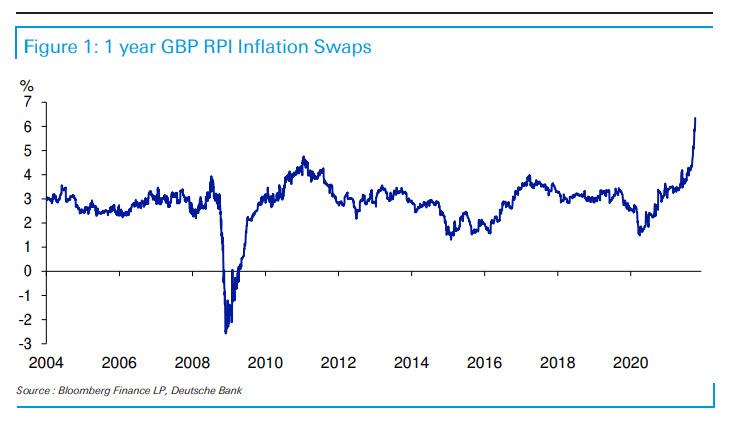
This morning’s most remarkable market observation comes from DB’s chief credit strategist Jim Ried, whose chart of the day shows that the UK may be starting at galloping, runaway inflation of up to 7% as soon as April, the direct result of the insanity taking place in Europe’s energy markets.

Picking up on our obsession with soaring breakevens, this morning Reid points out that the extraordinary moves in natural gas prices have continued to drive global inflation breakevens to multi-year highs, with the stand out feature of the last 24 hours being that index-linked bonds are now implying UK Retail Price Index (RPI) inflation will be 7% in April 2022.

As Reid explains, this is the month the energy regulator Ofgem updates its price cap for utility bills. Typically, the RPI/CPI gap is around 1% but this widens when energy spikes: “Regardless of which inflation gauge is used (and RPI is a flawed measure), it’s fair to say that the cost of living is going up fast. In any case, RPI is used by the UK government to set things like train prices and student loan rates. Some students could in theory be facing 10% interest on their student loans if this continues, 100 times the BoE base rate.”

However, as the Deutsche Banker also notes, “it is likely that the UK government will mitigate a lot of these impacts as many governments around the world are doing for the lower paid in order to offset the rise in energy costs. Expect this to be a recurring theme.”

So going back to Reid’s “Chart of the Day”, it shows the impact that all this has had on 1 year UK RPI swaps. They moved above 6.3% earlier this morning. The 5y, 10y and 5y5y RPI swaps were around c.4.6%, c.4.3% and c.3.95% earlier this morning, which indicates that UK RPI inflation is not necessarily seen as transitory on those metrics.

From a trade perspective, anyone who disagrees with these market forecasts can receive some “pretty big fixed coupons” as long as you’re prepared to pay the eventual realized inflation rate. That said, UK 10 year Gilts at c.1.1% look very unappealing though.

FWIW, DB’s rates strategists recently commented on the apparent inconsistency between nominal and inflation rates: as a reminder since 1971, UK inflation has averaged 5.3%, and only 45 out of 152 countries have averaged less than 5%. So although the last couple of decades have seen much lower inflation than that average, Reid concludes that “it would take a brave person to receive a low fixed income (e.g. government bonds) for any length of time with all the transitory, cyclical and structural inflation in the pipeline.”

Tyler Durden
Thu, 10/07/2021 – 04:15

via ZeroHedge News https://ift.tt/3DnLsl1 Tyler Durden

The Electricity Crisis Was Not Caused By A “Perfect Storm”

The Electricity Crisis Was Not Caused By A “Perfect Storm”

By Leonard Hyman and William Tilles of OilPrice.com

  • From hydropower failures in South America to natural gas shortages in Europe, and coal prices soaring in Asia, the global electricity crisis has clearly gone global

  • While plenty of observers are willing to blame this on a ‘perfect storm’ of events, the truth is electricity providers were simply not prepared when they should have been

  • As a result of this crisis, consumers are likely to disassociate themselves from unreliable and profit-chasing producers as they search for resilience 

Recent news from the global electricity sector looks grim. South Americans, heavily dependent on hydroelectricity,  face drought-induced scarcity. Hard to believe in a continent laced by three enormous river systems. The alternatives for South American electricity users are an increased reliance on fossil fuels or turning off the lights (conservation). And unlike relatively inexpensive hydroelectricity, generating electricity with fossil fuels (apart from the ecological consequences) incurs fuel expense, which raises prices.

The news emphasizes growing inflationary pressures. And this certainly feeds into that narrative. But there is a more worrisome problem for energy planners here. More droughts mean that hydro can no longer be considered a “firm” long-term resource for the electrical grid. Subtracting a major low-cost resource like hydro from a region’s energy mix and replacing it in any other fashion is an enormous financial undertaking. Just as countries are moving to reduce reliance on fossil fuels, one of the cleanest energy sources becomes scarcer.

But there is a distinctly global flavor now to stories of electric utility infrastructure under duress not simply due to extreme weather. Failure of human ingenuity plays a part here. In Puerto Rico, the reorganized and semi-privatized electricity system, PREPA, experiences frequent blackouts. Yet customers seeking to install their own generation (and potentially resell power to the utility at critical times) can’t get the power company to hook them up. India faces an electricity shortage because power companies failed to restock coal inventories. Their executives expected a meaningful decline in coal prices which never materialized so they’re stuck. In the UK the windpower yield was below expectations and that dramatically pushed up power prices.

But winter is coming—when the existing natural gas shortage pushes prices even higher. And then there is China. Electricity demand rose, coal usage increased, and coal prices went way up. But the government puts a ceiling on the price of electricity which causes generators to lose money on power sales in periods of rapidly escalating fuel prices like the present. So who wants to lose money on every KWH sold in the hope of making it up in volume? After experiencing blackouts and other usage reduction measures, the electric companies went to purchase more coal. However, world coal markets are now tight. One obvious short-term solution is a rapprochement with regional neighbor Australia despite a recent chilling in relations between the two governments. 

In many places, the price of natural gas determines the price of electricity. If global warming were not a pressing concern, natural gas would be the boiler fuel of choice. In its absence, they would burn coal or oil. Natural gas prices have more than doubled this year in the US and quadrupled in European markets. No doubt a combination of higher demand and more cautious development by petroleum companies has tightened the market. But Europe depends to a great extent on Russian supplied gas and there are indications that the Russians did not fill European storage facilities in order to manipulate scarcity to their advantage. The Europeans do have alternatives to Russian gas, such as pipelines from Algeria (which is not the most stable supplier). Morocco wants to sign a deal but it has a problem caused by the sometimes rebellious Polisario Front which claims to represent the western Sahara region. European countries could sign big gas deals with Israel and Cyprus but would face Turkish objections. As they say, it’s complicated. 

These and similar problems are not accidents and do not result from one-off difficulties or calamities. Forget about the perfect storm excuse. The problems arose because electric companies chose to defer capital and maintenance expenses, skimped on adequate fuel reserves, and focused on cost efficiencies. Customers would have been better served had they focused on hardening grid infrastructure and preserving continuous service against an increasingly hostile climate. Excessive focus on creating shareholder value can mean cutting corners to achieve savings. But the implied hope (and whether hope is an adequate basis for corporate strategy is another question) is that nothing untoward happens as a result. It’s like building a house of cards outside assuming the wind will never blow. It was in this vein that electric utilities adopted what amounts to a just-in-time supply system mentality with respect to electricity. 

And there is another point to be emphasized. A well-functioning just-in-time inventory management system is a thing of beauty, efficiency, and cost minimization. But because of the extreme interdependency, one factory relies on the output of another, often thousands of miles away, any break in this carefully choreographed manufacturing process results in chaos and dysfunction. This corporate mentality has resulted in electricity systems that are now relatively low-cost but increasingly fragile.

Puerto Rico, for example, is a simple case of underinvestment. The electric company, PREPA,  would have had to raise prices substantially to improve the network. If the UK had sufficient gas reserves in storage low wind conditions would not have been a big problem for power generation. But new construction and adequate gas reserves cost money. And UK regulators have worked heroically to keep down capital spending.

The Europeans signed up voluntarily for Russian gas and nixed other projects. More pipelines serving their market meant paying the overhead on several competing gas transport lines which were not deemed economically efficient. As for Chinese and Indian utilities, having at least a 90-120 day coal inventory may become part of normal operations if one burns coal. But again all that adds substantially to costs.  

Roughly four decades ago, neo-liberal economic principles were introduced to the electricity sector. The industry gradually changed from one dedicated to serving the public and encouraging economic development to one focusing instead on maximizing profits. Along the way, the political and regulatory systems seem to have become unusually obliging with respect to corporate interests as big money in US politics exerts its corrupting influence. Where will this lead? Well, sadly we don’t think it will lead to any serious evaluation of the structure of the electricity markets, or natural gas networks, or government policies that control them. Introspection or reflection about better utility arrangements takes time possibly even for trial and error. But our present system lurches from crisis to crisis.

So where does that leave us, the electricity consumers? First, power users will try to disassociate themselves from increasingly expensive and unreliable networks. There are two reasons for this, reliability and price. As we wrote recently in reference to Entergy’s four- to six-week power outages following hurricane Ida, repeated outages of this duration are unacceptable in that it makes those regions both commercially disabled or even uninhabitable for protracted periods. We believe for this reason alone those who have the means will increasingly look for alternatives to the local power company.

In addition, we’re also now witnessing rapid fuel price increases which are driving escalating electricity prices. Installing individual, non-fuel power generation and storage systems provide the energy user with long-term price stability. Once installed, a solar and battery storage system provides long-term price stability for the life of the system, possibly 20 or 30 years! This is a gigantic inflation hedge— although not looked at that way at present. In inflationary times self-generation permits power users to cap their (self-generated) rates for an extended period—a considerable benefit against a backdrop of volatile energy prices. 

Lastly, we should mention the resurrection of nuclear power generation technologies both small-modular and gigawatt-scale. New and existing nuclear is heralded as the perfect low emissions, base load complement to intermittent wind or solar. It is relatively unaffected by the variabilities of nature and does not rely on fossil fuels with volatile prices. Nor need its fuel be imported from unfriendly nations which may suddenly turn off the “spigot” so to speak. As the notion of energy independence once again gains currency, widespread nuclear new-build may actually resume. But there is always something. The resumption of interest in new nukes is occurring against a backdrop of rampant price inflation. We will conclude by saying that the last time those two teamed up in the 1980s it wasn’t pretty. 

Tyler Durden
Thu, 10/07/2021 – 03:30

via ZeroHedge News https://ift.tt/2WMOXl8 Tyler Durden

German Parking Garage Unveils Dedicated Spaces For LGBTQ And Migrant Drivers

German Parking Garage Unveils Dedicated Spaces For LGBTQ And Migrant Drivers

Today in “our obsession with inclusiveness is once again leading us back to segregating people” news, a car park in Germany is unveiling dedicated parking spaces for LGBTQ and migrant drivers.

The three “diversity” parking spaces were put up in an underground car park in Hanau city centre, according to the Daily Mail.

Hanau is considered a city of diversity already, the report noted. Hanau’s population was “already ethnically diverse” before the 2015 migrant crisis. 

The aim of the spots was to “help people who feel a special need for protection,” according to Thomas Morlock, Chairman of the Supervisory Board of the lot.

Morlock told the Daily Mail the spaces were built to set a “conspicuously colourful symbol for diversity and tolerance”.

He said they “are not necessarily meant” to be used by a “seperate group of people”.

And of course, as the Daily Mail puts it, the kicker:

“It is not immediately clear how the authorities intend to monitor whether people who park in the spaces are in fact part of the LGBTQ community or migrants…”

Keep up the great work, Herr Morlock. 

Tyler Durden
Thu, 10/07/2021 – 02:45

via ZeroHedge News https://ift.tt/3uMnRr3 Tyler Durden