Google Banning Ads With “Inaccurate” Content On Climate Change

Google Banning Ads With “Inaccurate” Content On Climate Change

Authored by Katabella Roberts via RealInvestmentAdvice.com,

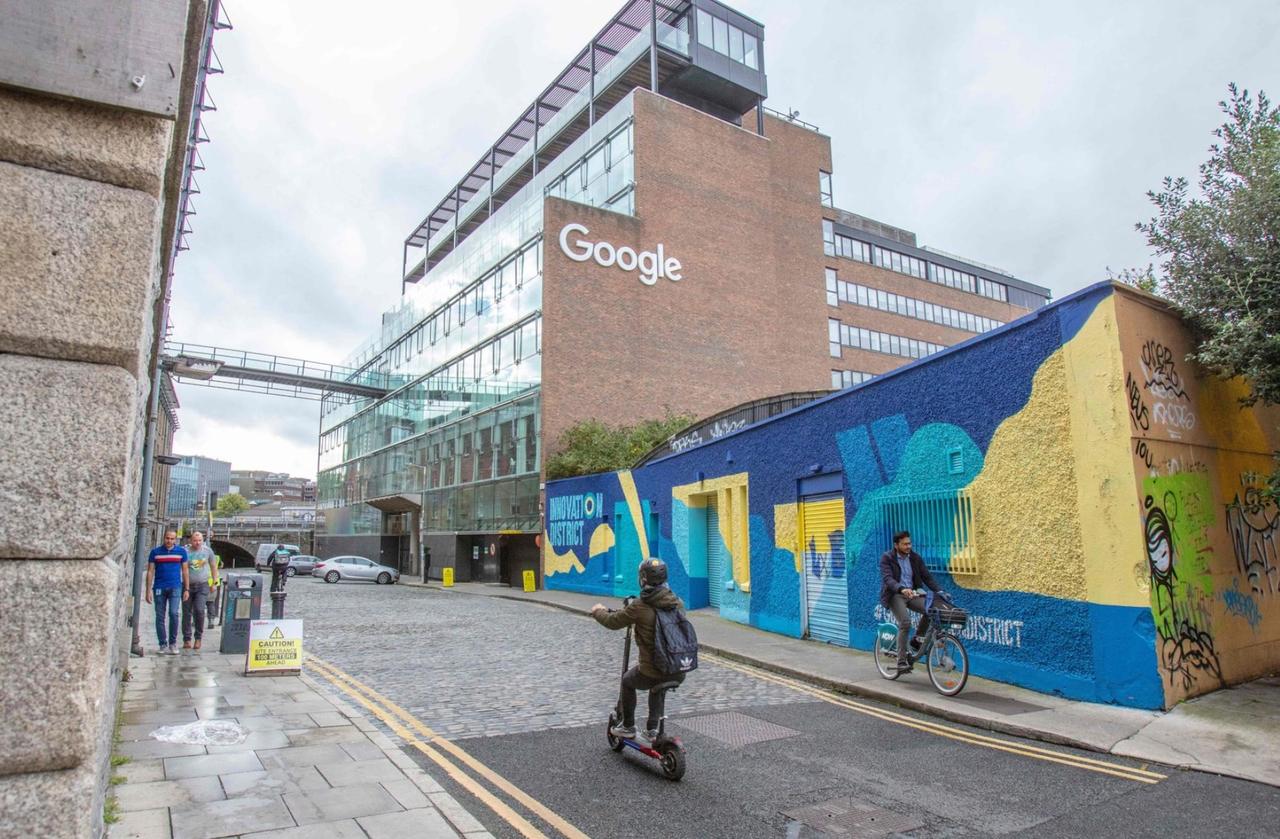
Google is banning advertisements featuring content that contradict what it called “inaccurate” content on climate change, and will no longer allow ad revenue to be made from them, the company announced in a blog post on Oct. 7.

The tech giant said the new policy will go into effect in November and will help “strengthen the integrity” of Google’s advertising ecosystem, and also align with their past work to promote sustainability and “confront climate change.”

“In recent years, we’ve heard directly from a growing number of our advertising and publisher partners who have expressed concerns about ads that run alongside or promote inaccurate claims about climate change,” the company said in Thursday’s blog post announcing the updates.

“Advertisers simply don’t want their ads to appear next to this content. And publishers and creators don’t want ads promoting these claims to appear on their pages or videos.”

Google said that those concerns are what led them to create the new monetization policy, which applies to commercials Google places online, as well as the websites and YouTube videos that run Google ads.

The updated policy prohibits advertising for and monetization of content that contradicts what Google calls the “well-established scientific consensus” on the existence and causes of climate change.

It includes any content that denies human contributions to global warming or treats “climate change as a hoax or a scam,” such as “denying that long-term trends show the global climate is warming, and claims denying that greenhouse gas emissions or human activity contribute to climate change,” Google said.

Going forward, Google will be analyzing content and considering whether it presents accurate or false claims about climate change, or whether it is simply discussing or reporting such a claim.

“We will also continue to allow ads and monetization on other climate-related topics, including public debates on climate policy, the varying impacts of climate change, new research and more,” the company said.

Google added that it consulted with “authoritative sources” on climate science—including those who have contributed to the United Nations Intergovernmental Panel on Climate Change (IPCC) Assessment Reports—when creating the new policy.

The new policy will be enforced through employees reading or watching the content as well as through “automated tools,” although the company did not state specifically what these are.

Google’s new policy comes as President Joe Biden’s administration aims to achieve net-zero greenhouse gas emissions by 2050.

Google had previously in late 2019 announced its support for the Paris Agreement and touted multiple ways it was taking to support renewable energy markets and ensuring sustainability in its products.

This week, the big tech giant rolled out several products aimed at increasing climate awareness, including a routing model in Google Maps that shows users the most eco-friendly route to their destination.

Last month, Facebook announced several new measures to expand community engagement with “climate topics” and said it was seeking to make sure people “have access to reliable information while reducing misinformation.” It added that it was going to invest $1 million in a new climate grant program to fact check any climate content it deems “misinformation.”

Tyler Durden
Fri, 10/08/2021 – 14:43

via ZeroHedge News https://ift.tt/2Yy7mCF Tyler Durden

Taiwan Will Do “Whatever It Takes” To Defend Freedom, But Isn’t Seeking War With Beijing, President Says

Taiwan Will Do “Whatever It Takes” To Defend Freedom, But Isn’t Seeking War With Beijing, President Says

After Taiwan’s defense ministry inspired a wave of alarming headlines in the global press with his warning that Beijing would be capable and ready for a military invasion of Taiwan by 2025, Taiwanese President Tsai Ing-wen sought to de-escalate the situation – which was initially provoked by Beijing’s latest streak of military muscle-flexing by repeatedly violating Taiwan’s air defense zone – by proclaiming that Taiwan doesn’t seek military confrontation, but will do whatever it takes to defend its freedom.

Tsai’s statement also follows revelations in the American media that, for at least a year now, US Marine special forces have been quietly stationed in Taiwan, and have been training small contingents of Taiwanese ground forces, while also working with maritime forces on small-boats training.

President Tsai Ing-wen

Whether or not Beijing knew about this deployment previously, the official response was menacing, with one popular media mouthpiece for the CCP suggesting that China should have blasted the foreign “invaders” since the US refused to be transparent and honest.

In her comments, Tsai criticized Beijing’s provocations, while reaffirming that Taipei’s top priority is peace.

Taiwan has complained for more than a year of such activities, which it views as “grey zone warfare”, designed to wear out Taiwan’s armed forces and test their ability to respond.

“Taiwan does not seek military confrontation,” Tsai told a security forum in Taipei.

“It hopes for a peaceful, stable, predictable and mutually-beneficial coexistence with its neighbours. But Taiwan will also do whatever it takes to defend its freedom and democratic way of life.”

As Reuters reminds us, Beijing has repeatedly blamed the US for stoking tensions with Taiwan by inking arms deals and taking steps toward strengthening diplomatic ties with Taipei, infuriating Beijing, which insists that this violates the spirit of America’s commitments to the “One China” policy. And it’s not just the US: other western allies have joined in. Just this week, Taiwan welcomed lawmakers from France and former Aussie PM Tony Abbott (who said he was visiting in a personal capacity).

While Beijing has threatened to retaliate against any foreign power that would dare interfere in China’s domestic affairs (which it considers the Taiwan situation to be), Taiwan insists that it is doing whatever it can to work with other powers in the region to “ensure stability.”

The Indo-Pacific must remain peaceful, stable and transparent, Tsai said. But the many “opportunities” in the region “also brings new tensions and systemic contradictions that could have a devastating effect on international security and the global economy if they are not handled carefully.”

Taiwan will work with other nations to accomplish this and “is fully committed to collaborating with regional players to prevent armed conflict in the East China, South China Seas and in the Taiwan Strait.”

While the US still officially recognizes the “One China” policy, it’s also obligated to help arm and defend Taiwan should China ever try to seize the territory by force. But even the US military is well aware that, almost no matter how much help and aid and arms it gives (or sells) to Taiwan, should Beijing choose to pursue it, it could paralyze Taiwan’s defenses and seize control of the island without very much effort at all.

Imagine what that would do the semiconductor supply chain…

Tyler Durden
Fri, 10/08/2021 – 14:20

via ZeroHedge News https://ift.tt/3Br6zCm Tyler Durden

SEC Investigating Archegos For Market Manipulation: Report

SEC Investigating Archegos For Market Manipulation: Report

More than a year after we wrote “All You Ever Wanted To Know About Gamma, Op-Ex, And Option-Driven Equity Flows” in which we said that “Gamma has the potential to be one of the most important non-fundamental flows in equity markets” the SEC appears to have finally caught up and is targeting the one fund that masterfully used a gamma squeeze to ramp a handful of stocks before suffering a spectacular blow up.

According to Bloomberg, an SEC investigation into the collapse of Bill Hwang’s Archegos Capital Management is examining whether the firm engaged in market manipulation. Specifically, the agency best known for Sucking Elon’s C***, is “scrutinizing the firm’s trading activity, including whether it concealed the size of its bets on public companies.” Authorities are also reviewing whether Archegos bought multiple stakes in the same companies across several banks in an effort to avoid triggering public disclosure rules. He, of course, he did, much to the chagrin of short sellers who were forced to cover and suffer tremendous losses.

As a customary disclaimer, Bloomberg notes that the opening of an SEC probe is typically a preliminary step and doesn’t mean Hwang, who hasn’t been accused of wrongdoing, will face an enforcement action, but it is hardly good news for other funds (or CEOs) who have used and abused gamma squeezes – whether using options, or levered instruments like Total Return Swaps –  to force a melt up in underlying stocks.

As a reminder, Archegos amassed a concentrated portfolio of stocks well in excess of $100 billion by using borrowed money in the form of TRS, which kept the exposure on the books of the various prime brokers working with Archegos, thus allowing Hwang to hide his full exposure. His funded imploded in March as some of the stocks tumbled, triggering margin calls from banks, which then dumped Hwang’s holdings.

The pain was especially acute for the fund’s prime brokers such as Credit Suisse, Nomura and Morgan Stanley, who collectively lost more than $10 billion, prompting internal investigations and the forced departures of senior executives. Regulators, meanwhile, are discussing whether to revise rules exempting family offices like Hwang’s from tougher oversight.

The probe takes place after SEC head Gary Gensler said that “more stringent disclosure laws may be warranted for investment firms after the Archegos debacle, and he later signaled plans to make more industry data publicly available.” So far the SEC has not released any guidance or regulations on the matter.

Amusingly, this will be the second time the SEC has probed Hwang: the first time was in 2012, when after years of investigations by authorities in the U.S. and Hong Kong, the SEC accused his former firm, Tiger Asia, of insider trading and manipulation of Chinese bank stocks. Hwang settled that case without admitting or denying wrongdoing, and Tiger Asia pleaded guilty in the U.S. to wire fraud. At that point, Hwang closed his firm and opened Archegos.

Tyler Durden
Fri, 10/08/2021 – 14:02

via ZeroHedge News https://ift.tt/3uSiiYa Tyler Durden

Albert Edwards: “It’s Starting To Feel A Bit Like July 2008”

Albert Edwards: “It’s Starting To Feel A Bit Like July 2008”

One of the theories seeking to explain the Lehman collapse and the ensuing financial crisis points to the record surge in oil prices which rose as high as $150 in the summer of 2008, and which combined with tight monetary conditions, precipitated a giant dollar margin call which in turn pricked the housing bubble with catastrophic consequences. In his latest note, SocGen’s resident permabear draws on that analogy and writes that “as energy prices surge with a backdrop of central bank tightening it’s starting to feel a bit like July 2008″ referring to that moment of “unparalleled central bank madness as the ECB raised rates just as oil prices hit $150 and the recession arrived.”

Is today any different?

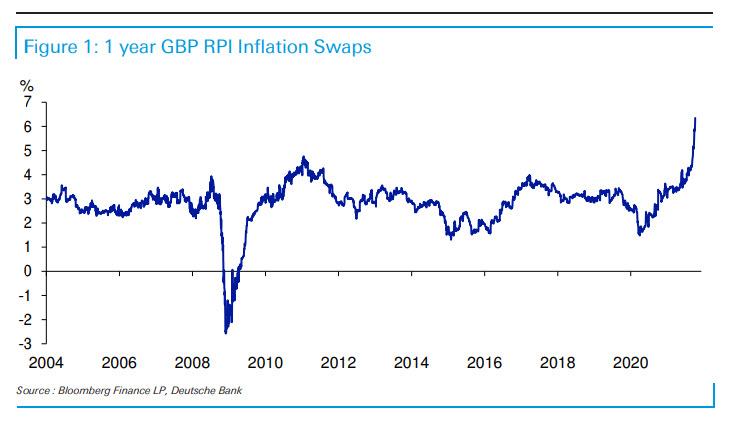
Pointing to the recent surge in global energy prices (described in detail in Gasflation), Edwards writes that “the current high energy prices will hugely impact the debate about whether the post-pandemic surge in inflation is transitory or permanent.” And while we wait for the Fed (and to a much lesser extent the ECB) to commence tapering as neither will be willing to admit they were wrong about “transitory” being permanent, financial conditions are already sharply tighter with breakeven inflation rates (a proxy for market inflation expectations) surging, especially in Europe, and especially in the UK where the Retail Price Index points to 7% inflation as soon as April.

While market are perhaps hoping that central banks will reverse their path similar to what, the Fed did in Dec 2018, a toxic price/wage spiral has already taken hold as “ultra-tight labor markets conspire with households being bludgeoned by higher energy prices and the cost of living generally.”

Meanwhile, even though central bankers repeat like a broken record that they view inflation as transitory, Edwards notes that “the increasing threat of transitory inflation becoming more permanent is prompting central banks around the world to begin their tightening cycles, either with actual hikes in rates (Norway and New Zealand) or threats of hikes next year (UK), or tapering QE (US and eurozone).”

So a double whammy of soaring prices and tighter financial conditions? July 2008 indeed.

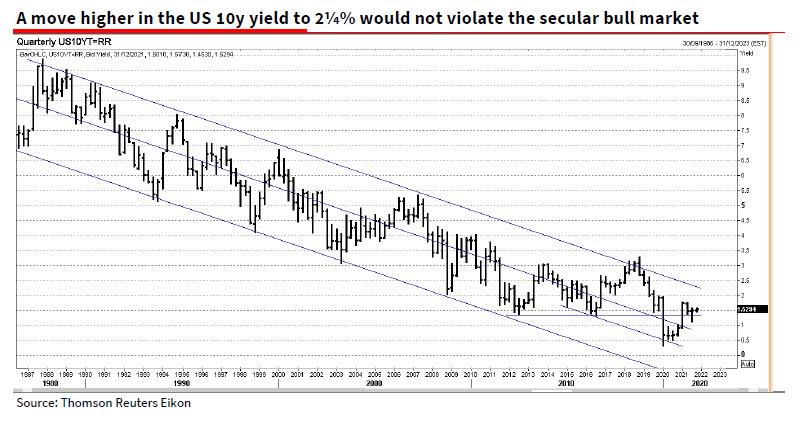
Looking ahead, Edwards sees even tighter financial conditions as bond yields continue to drift higher due to the more inflationary backdrop together with the threat of Fed tightening (like Morgan Stanley’s Michael Wilson, Edwards notes that “I do think that tapering is tightening”). As the evidence shifts, Edwards expects 10y yields to attempt to reach 2-2¼% – the upper bound of the long-term secular Ice Age downtrend.

And while this move would not violate the bond bull market, “it would certainly feel like a violation to equity investors” especially if it is rapid, and nobody would be hit harder than tech investors who have built nose-bleed valuations on ultra-low bond yields (Edwards discusses this in depth below). So while it is possible that we could yet see a Dec-2018-like Powell Pivot just weeks into a Fed Taper – as a reminder in late 2018 the “Ghost of 1937” emerged, forcing the Fed to ease long before it reached its target rate, Edwards asks “what about the R-word?”

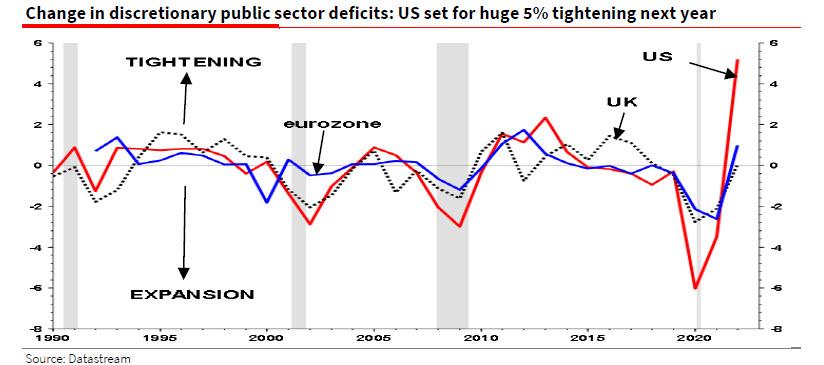
He is, of course, referring to a coming recession (borne out the current global economic stagflation), yet which virtually nobody anticipates. One reason why he sees the US as especially vulnerable to a recession is because the OECD is estimating a huge 5% fiscal tightening next year, the result of trillions in fiscal stimuli fading and turning into outright headwinds.

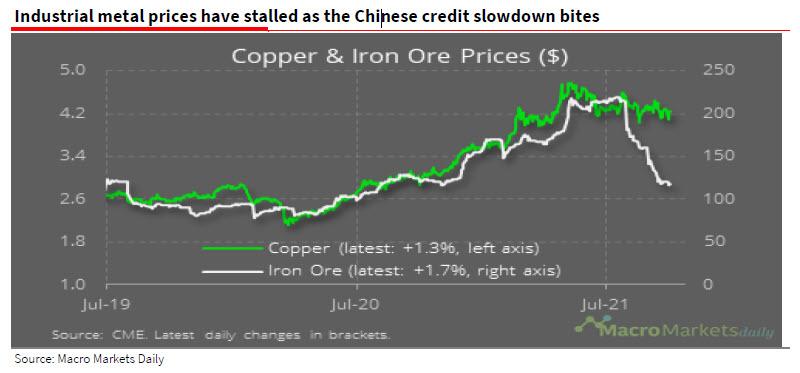
Real-time economic indicators already suggest that the slowdown has arrived: Edwards points to the latest Atlanta Fed GDPNow forecast which has fallen to just 1.3% for Q3, while Goldman recently forecast zero sequential growth in China this quarter. While this can be dismissed as all Covid (Delta) related, it could be something more, especially as the ongoing tightening Chinese credit impulse discussed here and elsewhere continues to punish the economy.

But while the economy is set to suffer from rising inflation and a concurrent increase in rates, it is markets that are even more exposed.

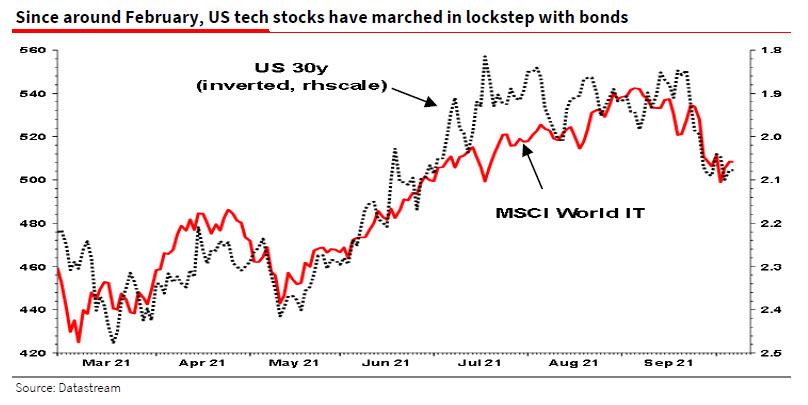
To demonstrate just how much, Albert pulls a chart from BCA Research which showed how conjoined global tech stocks have been with the US 30y bond yield since the start of this year. The SocGen strategist then notes that “if the US 30y yield rises to 2.4% from the current 2.1%, it would knock some 15% off tech stock prices. Imagine if the US 10y rose from 1.5% currently to 2¼%! We could see quite a bear market in tech!

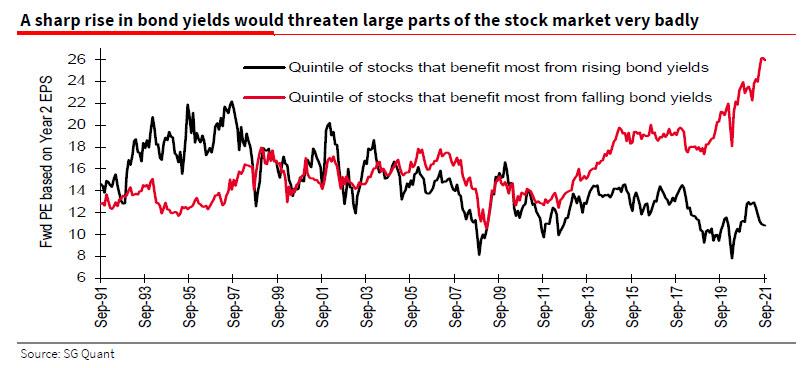
It’s not just tech stocks that are jeopardy should rates rise: defensives – which are mostly a proxy for long-term yields – are too. Edwards’s SocGen colleague, Andrew Lapthorne, shows that the bond sensitivity valuation gap among stocks has never been wider!

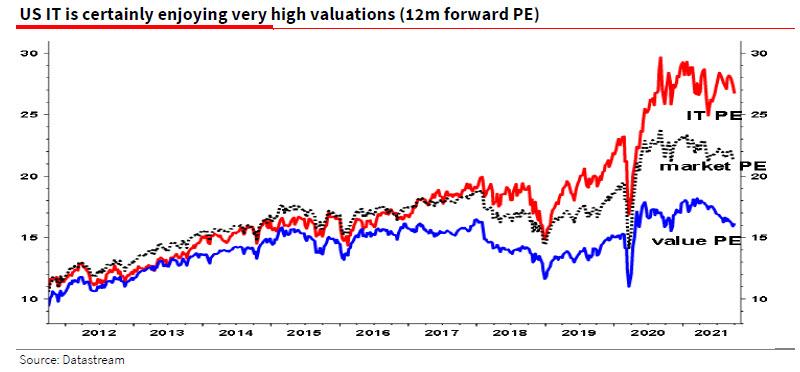
Incidentally one can blame the Fed for this staggering move: as the next chart shows, the polarization in forward PE valuations for the US tech sector against both ‘Value’ and the market kicked off after Powell’s infamous Dec-2018 pivot.

Putting it all together, Edwards is concerned that a bigger risk to Nasdaq than higher bond yields would be a follow-on recession (like 1982). Noting that the US tech sector continues to enjoy extraordinarily robust profits growth, particularly during the 2020 Covid recession, it is this earnings growth “that allowed the tech cyclicals to continue in the pretense that they were also ‘Growth’ stocks by turning in a robust profit performance.” The problem is that even a garden variety recession “would put these ‘growth’ imposters to the sword, just as they were in 2001.”

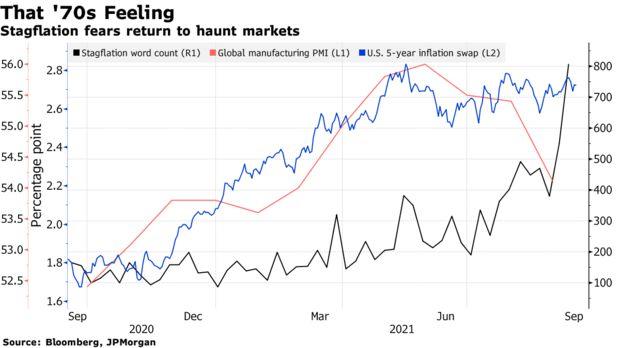
That’s why, in a world where the dreaded “stagflation” word – which few dared to breathe in “polite society” – has seen a record surge in recent article usage

… Edward’s advice to equity investors is to “think hard about the likelihood that higher energy prices and bond yields will trigger a ‘wholly unexpected’ recession. For that is where the biggest risk might lie for investors.”

Incidentally, Edwards isn’t exactly correct: in a study published overnight by former BOE central banker David Blanchflower (who set interest rates at the BOE during the 2008 financial crisis) and Alex Bryson of University College London, the two say that consumer expectations indexes from the Conference Board and University of Michigan tend to predict American downturns 18 months in advance. Their conclusion: the U.S. economy is already in recession even though employment and wage growth indicate otherwise, to wit: “downward movements in consumer expectations in the last six months suggest the economy in the United States is entering recession now.”

Tyler Durden
Fri, 10/08/2021 – 13:45

via ZeroHedge News https://ift.tt/3AnlgF5 Tyler Durden

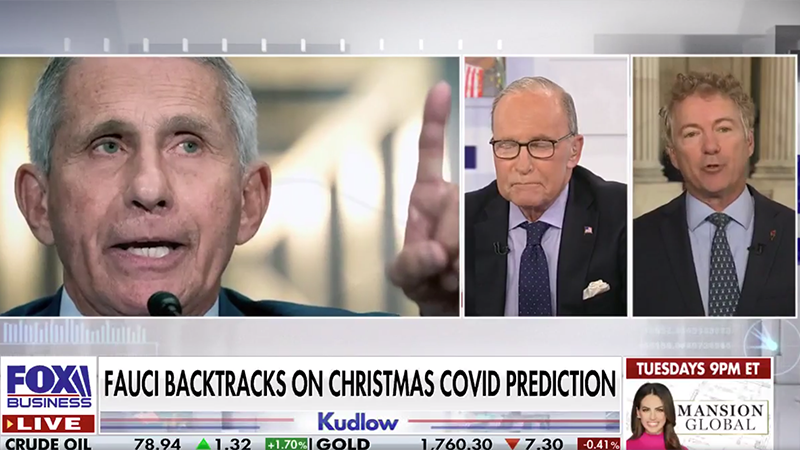
Watch: Rand Paul Blasts “Lying” Fauci; “He Ignores Natural Immunity Because It Foils His Mass Vaccination Plan”

Watch: Rand Paul Blasts “Lying” Fauci; “He Ignores Natural Immunity Because It Foils His Mass Vaccination Plan”

Authored by Steve Watson via Summit News,

Senator Rand Paul charged that NIAID director Anthony Fauci is purposefully acting ignorant on the benefits of natural immunity to COVID because it would ‘foil his mass vaccination plan,’ further describing the notion that everyone needs to be vaccinated as “nonsense.”

“Hey, this guy has an opinion on baseball, hockey, Tinder, and Christmas, but he was asked the other day about natural immunity that you acquire after the disease, he is like, ‘Oh, that is really interesting thought, I never thought about that. I don’t have an opinion because I haven’t thought about naturally acquired immunity,’” Paul said during a Fox Business News interview, adding, “He has and he is lying to you.”

Paul continued, “The reason he won’t bring up natural immunity is because it foils his plans to get everybody possible vaccinated.”

“He thinks it might slow down vaccination. And I’m for people getting vaccinated particularly people at risk, but the thing is, if you ignore naturally acquired immunity then you’re saying we don’t have enough people, you have to force it on younger people,” the Senator further urged.

“There was a statistic that came out that somebody put together today. If you’re 85, your chances of dying are 10,000 times greater than if you’re 10. Should we treat a 10-year-old the same we treat an 85-year-old? It is nonsense,” Paul reasoned.

Watch:

Last week Paul told Biden health secretary Xavier Becerra to his face that he is a ‘arrogant, authoritarian, and un-American’ for ridiculing people who choose natural immunity over vaccinations.

Paul further warned that health officials are acting ‘hysterical’ when it comes to unvaccinated people, and that what they are claiming is “actually the opposite of the truth.”

*  *  *

Brand new merch now available! Get it at https://www.pjwshop.com/

In the age of mass Silicon Valley censorship It is crucial that we stay in touch. We need you to sign up for our free newsletter here. Support our sponsor – Turbo Force – a supercharged boost of clean energy without the comedown. Also, we urgently need your financial support here.

Tyler Durden
Fri, 10/08/2021 – 13:25

via ZeroHedge News https://ift.tt/3aiei9O Tyler Durden

OECD Secures Deal On Sweeping Global Corporate Tax Reform As Last Holdouts Cave

OECD Secures Deal On Sweeping Global Corporate Tax Reform As Last Holdouts Cave

Much to President Biden’s relief, the US-led effort to reform the international corporate tax code appears to be moving along even more quickly than some critics had anticipated, although there’s still room for the deal to fail.

After Ireland told the FT yesterday that it had signed on to the OECD tax plan by agreeing to raise its headline minimum corporate tax rate to 15% from  12.5% (on the condition that smaller, domestic companies are allowed to keep the lower rates), Hungary and Estonia, the two remaining EU holdouts apparently also decided to join the deal.

With the EU united, the OECD decided to announced Friday that 136 of its 140 members had agreed to the new tax deal.

Still, 4 OECD member states – Kenya, Nigeria, Pakistan and Sri Lanka – haven’t yet signed on to the program. But 136 members out of 140 still gives the OECD an overwhelming majority, making the new tax framework a slam dunk. Though, keep in mind, for these changes to take effect, many legislatures, including the US Congress, will need to agree on it.

The so-called “two pillar” solution relies on the US allowing foreign governments to take a bigger piece of the multinational tax pie generated by America’s largest tech companies, opening American tech giants to pay taxes in jurisdictions “where they operate but aren’t necessarily based.”

Here’s more on Phase 1 and Phase 2 from the OECD’s press release:

Under Pillar One, taxing rights on more than USD 125 billion of profit are expected to be reallocated to market jurisdictions each year. Developing country revenue gains are expected to be greater than those in more advanced economies, as a proportion of existing revenues.

Pillar Two introduces a global minimum corporate tax rate set at 15%. The new minimum tax rate will apply to companies with revenue above EUR 750 million and is estimated to generate around USD 150 billion in additional global tax revenues annually. Further benefits will also arise from the stabilisation of the international tax system and the increased tax certainty for taxpayers and tax administrations.

“Today’s agreement will make our international tax arrangements fairer and work better,” said OECD Secretary-General Mathias Cormann.

“This is a major victory for effective and balanced multilateralism. It is a far-reaching agreement which ensures our international tax system is fit for purpose in a digitalized and globalised world economy. We must now work swiftly and diligently to ensure the effective implementation of this major reform,” Secretary-General Cormann said.

Here’s how things will work going forward: the 136 members who agreed to the deal plan to make it official in 2022, and expect the implementation date won’t be until 2023. The convention is already under development and will be the vehicle for implementation of the newly agreed taxing right under Pillar One, as well as for the standstill and removal provisions in relation to all existing Digital Service Taxes and other similar relevant unilateral measures. At least one key member has voiced a concern about the timing, with Switerzland saying it simply won’t be able to implement the new rules by 2023.

Per the OECD, the second pillar of the deal includes many provisions that enticed dozens of emerging economies to sign on to the deal (payments will take the form of taxes on big tech).

Assuming it’s implemented, the deal will divide existing tax revenues in a way that favors countries where users and customers are based, not where the company operates.

The measure was first proposed by the Biden Administration, where Treasury Sec. Janet Yellen was charged with sheparding the deal through the OECD. Ultimately, the deal hopes to dissuade companies from relocating to “cheaper” jurisdictions by creating a uniform system of taxes that would disincentivize manufacturers to constantly in search of cheaper labor.

The final deal is expected to be approved by G-20 leaders during an upcoming meeting Rome at the end of this month. After this agreement, all the signatories will need to change their national laws and amend international treaties to incorporate the changes to the international tax code into their own laws.

Higher taxes are expected to earn European countries more than  $150 billion a year in revenues for the 136 member states who have agreed to the framework.

Tyler Durden
Fri, 10/08/2021 – 13:05

via ZeroHedge News https://ift.tt/3FtveZl Tyler Durden

Nuclear Energy Could Bridge The Energy Transition Gap

Nuclear Energy Could Bridge The Energy Transition Gap

By Felicity Bradstock of OilPrice.com

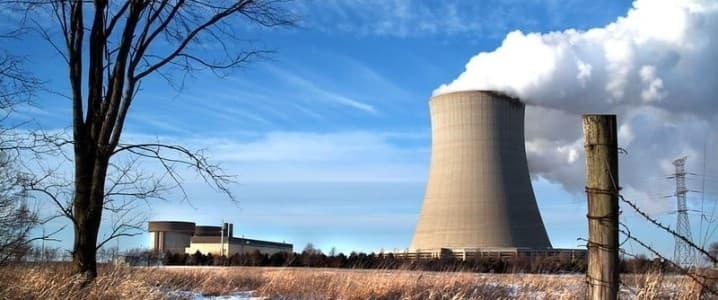
Small scale nuclear companies are picking up pace, following the example of bigger nuclear firms looking for their place in future of renewables, as nuclear power finally makes a comeback following years of criticism and fear of power stations.

Two companies in Poland, KGHM and Synthos, are looking to get small-scale modular SMR nuclear reactors up and running in a bid to stake their claim to the future of Europe’s nuclear power. To date, over 70 companies around the world are involved in SMR nuclear reactor projects, with the popularity of small-scale nuclear business quickly expanding. 

Both KGHM and Synthos are planning to work with American companies familiar with the SMR technology to advance their independent projects in Poland, in line with European Union expectations for net-zero carbon emissions within the next few decades. 

Critics of the small-scale projects suggest that opponents of nuclear energy will use the same arguments as those of larger nuclear projects, that because of the cost and safety concerns around nuclear power, alternatives such as wind and solar energy projects are far more useful to invest in and will be more technologically advanced in a shorter timeframe. In addition, much of the small-scale technology still requires extensive testing to ensure its safety. However, small nuclear plants may be able to bridge the gap in energy output that wind and solar energy production faces. When there is a lull in renewable energy production, small-scale nuclear power could plug the gap in a way that is not possible for larger nuclear projects to do due to their high cost to energy value. 

The next step is for countries developing the technology, such as the U.S., the U.K., and Canada, to work alongside the International Atomic Energy Agency (IAEA) and national regulators to continue testing the safety of SMR reactors and agree upon international protocols and safety procedures. 

But companies like KGHM and Synthos are simply following the examples of countries like the U.K., the U.S. and France, which have been proponents of nuclear power for years and continue to back nuclear energy despite criticism over safety and potentially life-threatening failures.                                               

Many countries are highlighting nuclear power as a necesity in a zero-carbon future, with the U.K. announcing this week that it is planning for a fossil fuel-free power grid by 2035 through the use of nuclear energy. Nuclear energy will be used by the U.K. as a back-up for renewable energy production during the energy transition period. To drive this transition, Prime Minister Boris Johnson has promised the construction of at least one large-scale nuclear project by 2025.

As some of the world’s energy leaders are showing their support for large-scale nuclear projects, some popular names are also backing the new small-scale technology. Bill Gates’ Terrapower, for example, is planning for a nuclear plant in Wyoming to be made up of small reactors that are better suited for a smaller grid system. 

A major appeal of SMR reactors is that they can be factory-built and then shipped, adding more as energy demand rises. These reactors have an output of anything between 50 and 300 megawatts but can be combined to form a powerplant of up to 1,000 megawatts. Furthermore, if one of the modules breaks, it can be repaired without completely stopping operations. This reduces the environmental risk as well as the cost of the project – which is often criticized by energy companies and opponents of nuclear power. 

The backing of nuclear energy by several governments, companies, and leading energy names around the world is largely due to the desire to move away from fossil fuels towards renewable alternatives and the lack of scope currently available for renewable energy production. While wind, solar, hydro, and other renewable energies have come a long way, there is still a significant road to track before the scale of these projects can meet the energy demand of 7.9 billion people worldwide. 

But it’s important to remember that nuclear energy still has a bad rep. After the monumental failures of Fukushima and Chernobyl, several countries swore off nuclear power completely. Many people around the world oppose nuclear power for fear of safety issues, fighting governments who want to build new nuclear plants. But many now question if the safety concerns, for both people and the environment, are any worse than those we face because of continued oil and gas use. As the energy transition becomes unavoidable, proponents of nuclear power are likely to remind us of this comparison and the need for something beyond renewable energy projects to bridge the gap. 

Yet, while some small companies and major governments are welcoming nuclear power once again, others continue to reject it. Nuclear power, it seems, is not for everyone – even in regions that are in dire need of sustainable electricity sources such as California. The Diablo Canyon nuclear powerplant, based in San Luis Obispo County, California, is currently in the middle of a ten-year decommissioning project, which will entirely strip the state of nuclear power. This is a questionable decision for a state that has experienced severe electricity cuts in the face of annual heatwaves.

Some of the arguments against nuclear power in California include the risk of earthquakes potentially leading to failures in the plants, utility companies in the region that are not willing to buy nuclear power, and the cost involved in the development of nuclear power plants compared to other energy options such as wind and solar power. So, while nuclear power could provide the low-carbon energy production so direly needed in California, the risks are deemed too costly. 

There seem to be mixed messages when it comes to nuclear power. Advocates believe that nuclear energy is necessary if we hope to meet the world’s energy demand as we transition away from fossil fuels, as well as being more environmentally friendly – providing rigorous international safety guidelines are met. However, not everyone agrees. Whether for the cost or for fear of failure, some governments may never get on board. What we may start to see, however, is the development of small-scale nuclear projects that support renewable energy advances over the next decade, providing competition to larger energy companies that do not want to get involved. 

Tyler Durden
Fri, 10/08/2021 – 12:50

via ZeroHedge News https://ift.tt/2Yt6Nu0 Tyler Durden

PA State Rep. Introduces ‘Parody’ Bill To Limit Men To Having 3 Children Before Mandating Vasectomies

PA State Rep. Introduces ‘Parody’ Bill To Limit Men To Having 3 Children Before Mandating Vasectomies

Legislation is being introduced in Pennsylvania that would limit the number of children men could father to three. The bill, being called “parody legislation”, would mandate vasectomies for men at age 40 or following their third child, whichever comes first, according to Patch.

State Rep. Chris Rabb (D-Philadelphia) has acknowledged the legislation is supposed to be satirical and poke fun at recent restrictive anti-abortion legislation that was passed in Texas. 

Despite Rabb using his taxpayer funded salary to spend time thinking of new and interesting ways to make political points via bad jokes, we don’t really understand the point of wasting resources to try and advance the bill forward. Maybe we’re just not woke enough…

Rabb

Rabb says the bill would “place more of the burden of conception’s responsibility on men” and highlight double standards for reproductive rights.

He commented: “To each person who views this bill I’ve introduced as absurd, I’d urge you to apply equal scrutiny to laws in places like Texas and right here in Pennsylvania, which enact paternalistic restrictions on the personal liberty of cis women, trans men and nonbinary individuals who have an unwanted pregnancy.”

He continued, writing on Twitter: “As long as legislators continue to restrict the #ReproductiveRights of cis women, trans men & non-binary folx, there should be laws to address the responsibility of men who impregnate them!”

The legislation includes a $10,000 reward for reporting “violators who refuse to get vasectomies”.

Rabb’s proposal has faced “enormous backlash,” the report says. Rabb said that within hours of relasing the memo on the bill, he faced “the most hateful and threatening emails and voicemails” of his career.

And while Rabb refers to it as “parody” legislation now, we’ll see just how long that label lasts…

State Rep. David Rowe (R) concluded: “This bill will never see the light of day as long as Republicans control the House. But I wanted you all to be aware how quickly policies that belong in Communist China would become the norm here if Democrats seized total control of state government.”

Tyler Durden
Fri, 10/08/2021 – 12:30

via ZeroHedge News https://ift.tt/2YDOgvx Tyler Durden

Why We Aren’t Repeating The Roaring ’20s Analog

Why We Aren’t Repeating The Roaring ’20s Analog

Authored by Lance Roberts via RealInvestmentAdvice.com,

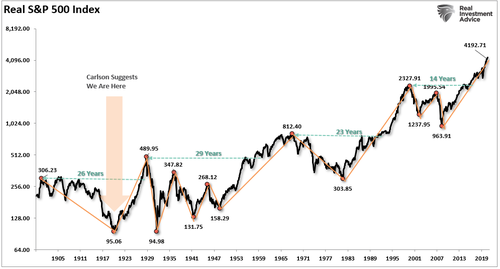
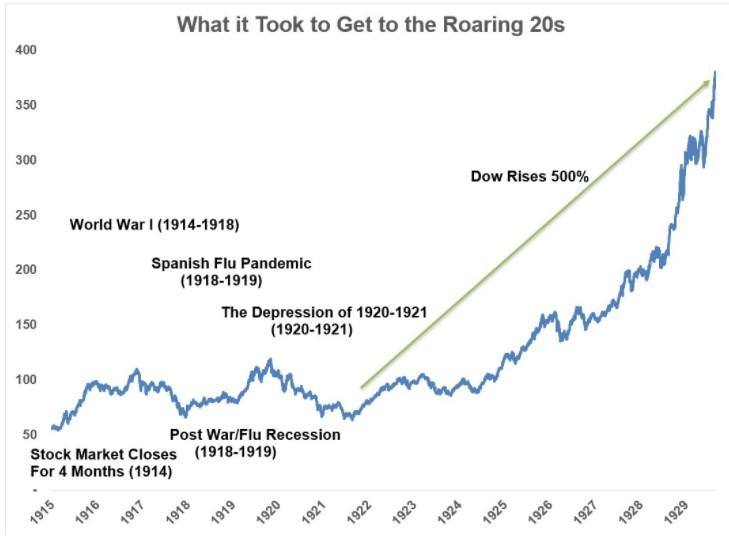
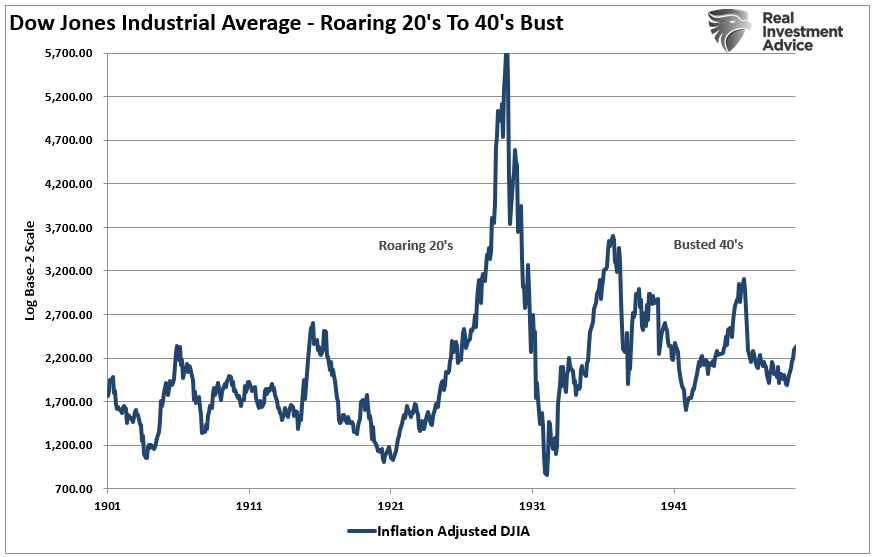
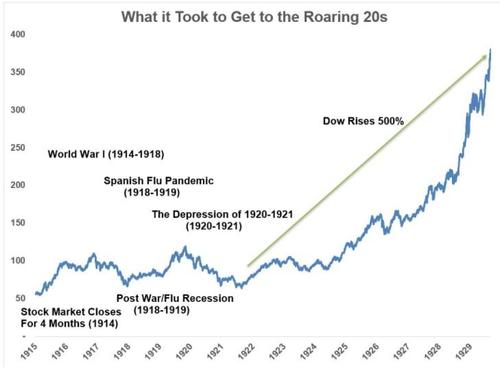
No. We are not repeating the “Roaring 20’s” analog. Ben Carlson had a recent post asking if the “Roaring 20’s” are already here? As his chart shows below, there are certainly some similarities between 1920 and 2020 given the recent “pandemic shutdown” driven recession.
However, what Ben missed were the differences both economically and fundamentally between the two periods. 

Let me preface this article by stating that I don’t like market analogies, particularly when they are with early market eras like the ’20s. The population of the country was vastly smaller, the financial markets were rudimentary at best, there were few big players in the markets, and the flow of information was slow.

1920 Was The Bottom

Ben makes an important observation to start his post.

“Yet coming out of that awful period, America experienced an unprecedented boom time the likes of which this country had never seen before.  

The 1920s ushered in the automobile, the airplane, the radio, the assembly line, the refrigerator, electric razor, washing machine, jukebox, television and more. There was a massive stock market boom and explosion of spending by consumers the likes of which were unrivaled at the time. After the immense pressure of the Great War, many people simply wanted to have fun and spend money.”

Ben is correct, the ’20s marked the start of a period of marvel and rapid change. However, his chart above misses some important events starting in 1900 leading to 20-years of negative returns.

  • Panic of 1907

  • Recession in 1910-1911

  • Recession in 1913-1914

  • Bank Crash of 1914

  • World War I ran from 1914-1918

  • Spanish Flu Pandemic 1918-1919

  • Economic Depression in 1920-1921

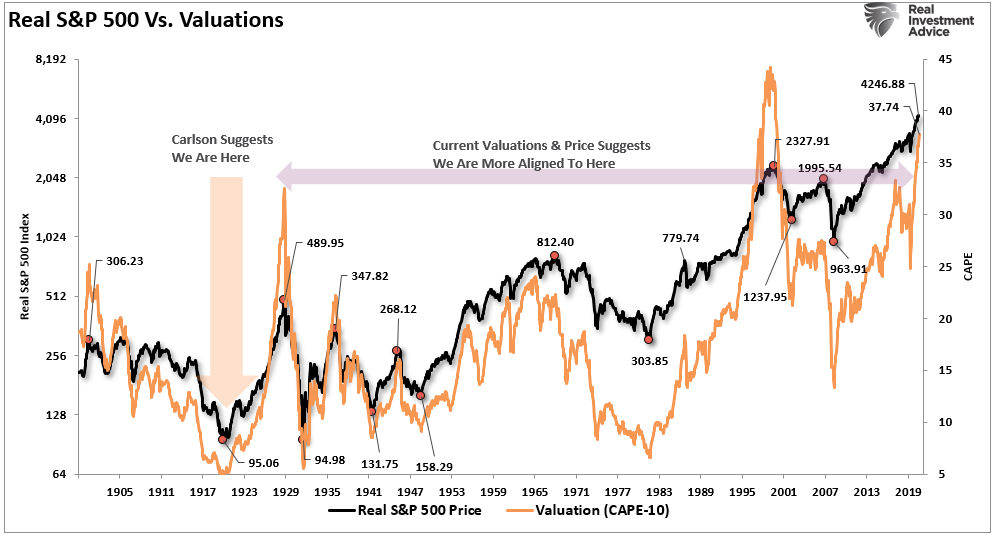
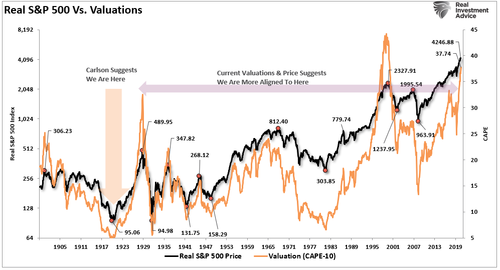
The market “melt-up” was undoubtedly driven by an economic recovery, a surge in innovation, etc. but was supported by historically low valuations. (Current valuations align with 1929 more than 1920.)
The innovations in the early 1900s put increasing numbers of people to work. The increases in jobs led to higher wages and more robust economic growth. Today, companies are spending money on innovation and technology to increase productivity, reduce employment, and suppress wage pressures.

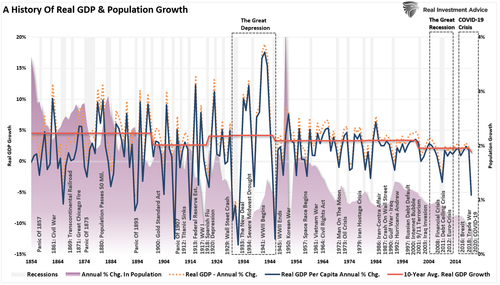
The history of the economy and related events shows the difference between then and now.
As Ben notes:

“But that’s why people in the 1920s were so joyous — they went to hell and back before the boom times.”

Yes, the U.S. certainly went through a tough year in 2020. But such is far different than what was experienced in the early 1900s. There are also fundamental challenges that exist today.

Valuations Do Matter

“Frederick Lewis Allen once wrote, ‘Prosperity is more than an economic condition: it is a state of mind.’ Yet the current boom isn’t just a happiness survey. The numbers back me up here.

The S&P 500 has now hit 58 new all-times since the pandemic bear market ended in March 2020. Housing prices are at all-time highs. People have more equity in their homes than ever before. Wages are rising at the fastest pace in years. Economic growth is going to be at the highest level in decades in 2021.

Add it all up and the net worth of all American households is at all-time highs. But this time it’s not just the top 1% who is benefitting.” – Ben Carlson

Again, Ben is correct, however comparing the recent liquidity-driven stock market mania to that of the 1920s is not exactly apples to apples. 

In the short term, a period of one year or less, political, fundamental, and economic data has very little influence over the market.

In other words, in the very short term, “price is the only thing that matters.” 

Price measures the current “psychology” of the “herd” and is the clearest representation of the behavioral dynamics of the living organism we call “the market.”

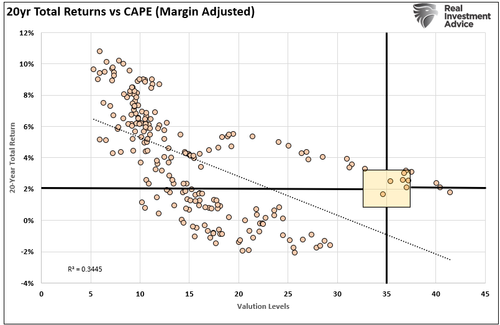
But in the long-term, fundamentals are the only thing that matters. Both charts below compare 10- and 20-year forward total real returns to the margin-adjusted CAPE ratio.
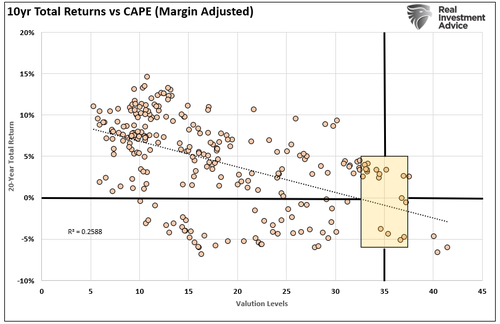
Both charts suggest that forward returns over the next one to two decades will be somewhere between 0-3%.

There are two crucial things you should take away from the chart above with respect to the 1920’s analogy:

  1. Market returns are best when coming from periods of low valuations; and,

  2. Markets have a strong tendency to revert to their average performance over time.

Wash, Rinse, & Repeat

As noted, the flood of liquidity, and accommodative actions, from global Central Banks, has lulled investors into a state of complacency rarely seen historically. However, while market analysts continue to come up with a variety of rationalizations to justify high valuations, none of them hold up under real scrutiny. The problem is the Central Bank interventions boost asset prices in the short-term; in the long-term, there is aninherently negative impact on economic growth. As such, it leads to the repetitive cycle of monetary policy.

  1. Using monetary policy to drag forward future consumption leaves a larger void in the future that must be continuously refilled.

  2. Monetary policy does not create self-sustaining economic growth and therefore requires ever-larger amounts of monetary policy to maintain the same level of activity.

  3. The filling of the “gap” between fundamentals and reality leads to consumer contraction and, ultimately, a recession as economic activity recedes.

  4. Job losses rise, wealth effect diminishes, and real wealth is destroyed. 

  5. The middle class shrinks further.

  6. Central banks act to provide more liquidity to offset recessionary drag and restart economic growth by dragging forward future consumption. 

  7. Wash, Rinse, Repeat.

If you don’t believe me, here is the evidence.

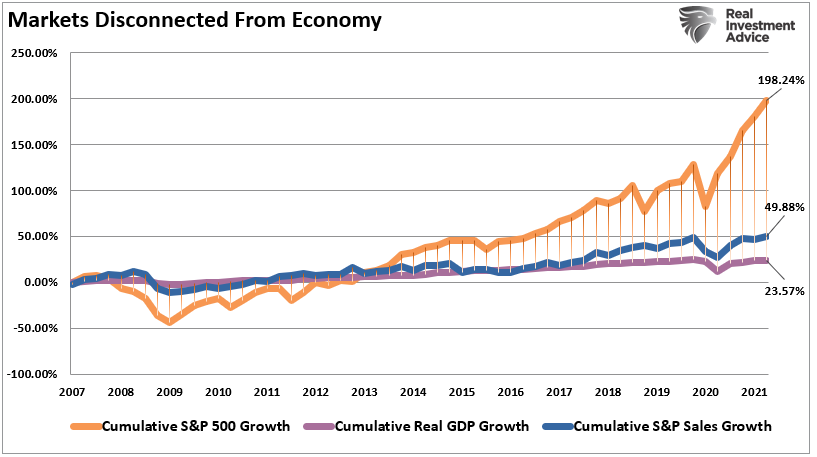
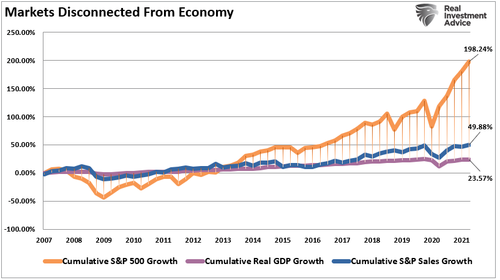
The stock market has returned more than 198% since the 2007 peak, which is more than 3.9x the growth in corporate sales and 8x more than GDP.
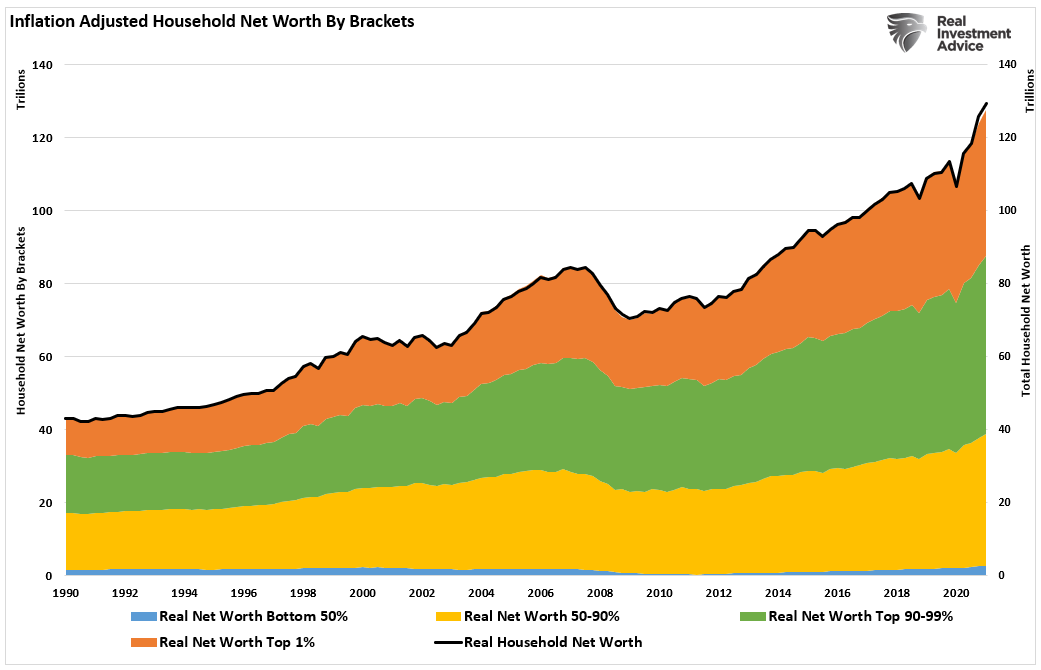
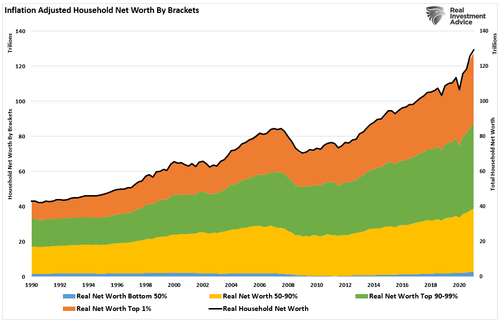
Unfortunately, the “wealth effect” impact has only benefited a relatively small percentage of the overall economy. While Ben notes that even the bottom 50% have benefitted, such is a bit of an exaggerated claim. The bottom 50% of the population has the same net worth as prior to the “Financial Crisis.” Such hardly suggests an economy benefitting all. 
A Quick Note On Technology

Ben is correct when he discusses the advances in technology in the ’20s.

However, there is a fundamental difference between the impacts of technology in the 1920s and today.

The rise of automation and the automobile’s development had vast implications for an economy shifting from agriculture to manufacturing. Henry Ford’s innovations changed the economy’s landscape, allowing people to produce more, expand their markets, and increase access to customers.

In the ’20s, technological advances led to increased demand, creating more jobs needed to produce goods and services to reach those consumers.

Today, technology reduces the demand for physical labor by increasing workers’ efficiencies. Since the turn of the century, technology has continued to suppress productivity, wages, and, subsequently, the rate of economic growth. Such was a point we made in “The Rescues Are Ruining Capitalism.”

“However, these policies have all but failed to this point. From ‘cash for clunkers’  to  ‘Quantitative Easing,’ economic prosperity worsened. Pulling forward future consumption, or inflating asset markets, exacerbated an artificial wealth effect. Such led to decreased savings rather than productive investments.”
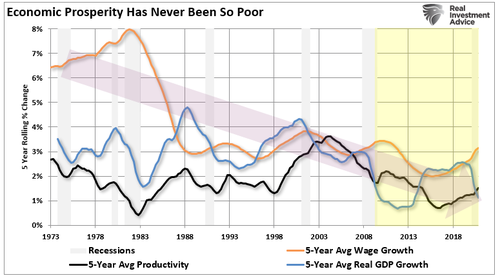
The critical distinction between the technology of the ’20s and today is stark.

When technology increases productivity and output while simultaneously increasing demand by increasing “reach,” it is beneficial.

However, when technology improves efficiencies to offset weaker demand and reduce labor and costs, it is not.

Given the maturity of the U.S. economy and the ongoing drive for profitability by corporations, technology will continue to provide a headwind to economic prosperity.

Conclusion

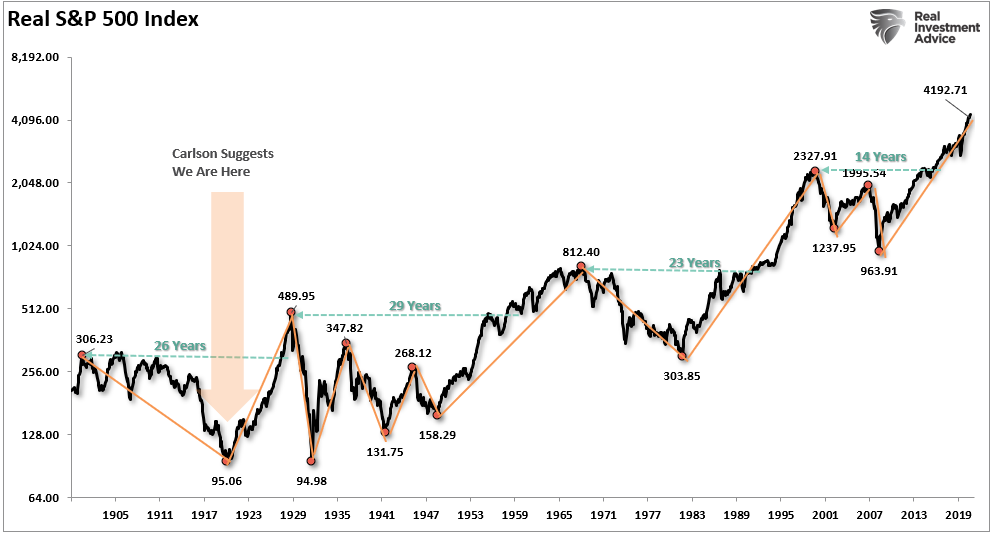
Ben and I do agree that this is very much like the 20s. However, where we differ is that while he believes we may starting that period, we suggest we are likely closer to the end.

In 1920, banks were lending money to individuals to invest in the securities they were bringing to market (IPO’s). Interest rates were falling, economic growth was rising, and valuations grew faster than underlying earnings and profits.

There was no perceived danger in the markets and little concern of financial risk as “stocks had reached a permanently high plateau.” 

It all ended rather abruptly.
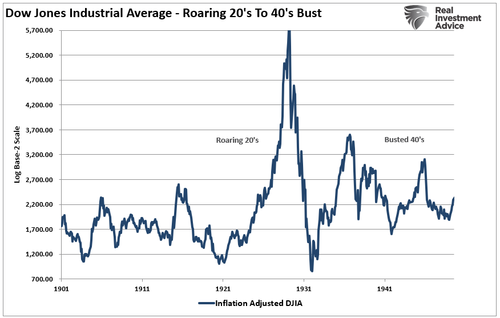
Today, while stock prices can be lofted higher by further monetary tinkering, the underlying fundamentals are inverted. The larger problem remains the economic variables’ inability to “replay the tape” of the ’20s, the ’50s, or the ’80s. At some point, the markets and the economy will have to process a “reset” to rebalance the financial equation.

In all likelihood, it is precisely that reversion that will create the “set up” necessary to begin the “next great secular bull market.” Unfortunately, as was seen at the bottom of the market in 1974, there will be few individual investors left to enjoy the beginning of that ride.

Tyler Durden
Fri, 10/08/2021 – 12:10

via ZeroHedge News https://ift.tt/3AtIDg5 Tyler Durden

Gazprom Plant Connected To Russia-China Gas Pipeline Shuttered Due To Fire

Gazprom Plant Connected To Russia-China Gas Pipeline Shuttered Due To Fire

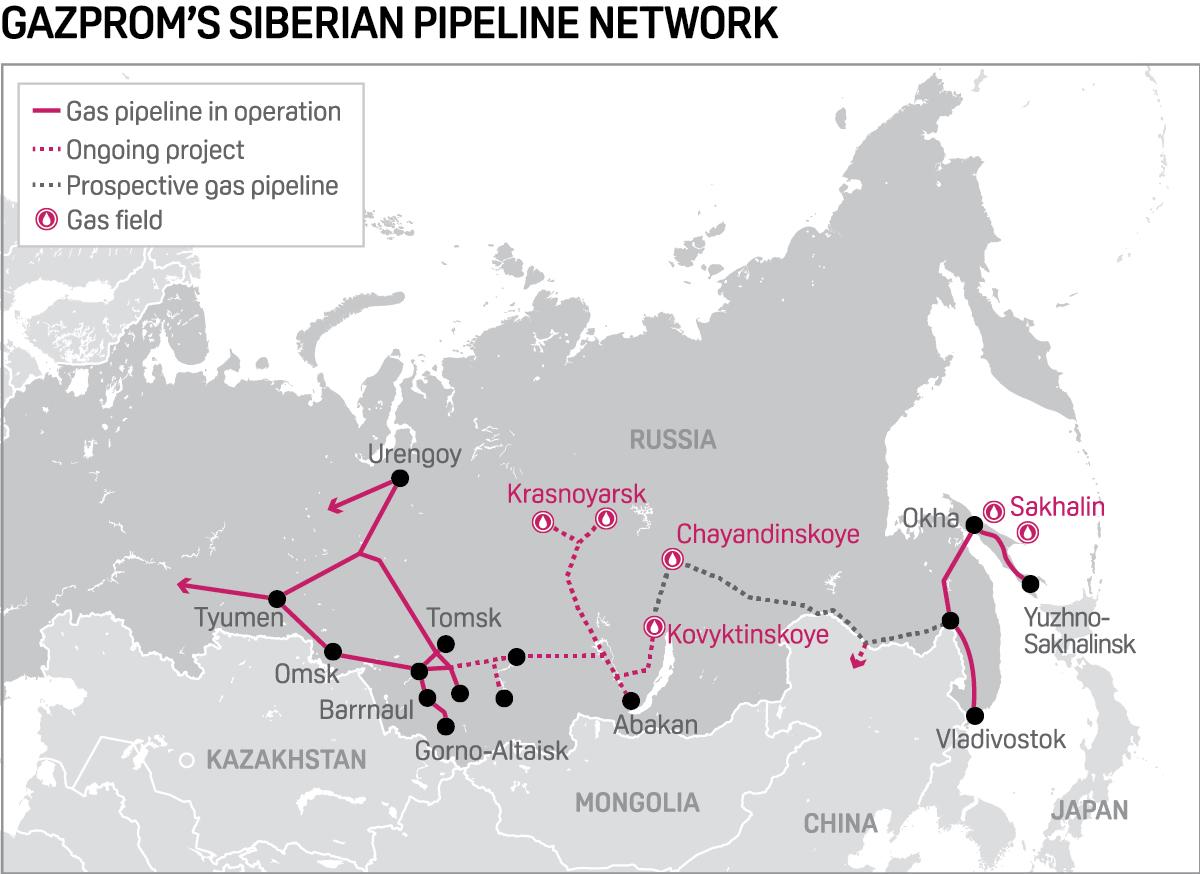
China’s energy crunch has resulted in power rationing in more than half of the provinces and affected the world’s biggest production base for electronic gadgets to semiconductors to appliances, among other things. Beijing has ordered energy firms to “secure supplies at all costs” as winter fast approaches to avoid shortages. But as we learn this morning, a Gazprom gas processing plant, connected to Russia’s sole gas pipeline to China, shuttered operations following a fire at the facility, according to Bloomberg

Irina Dmitruk, the spokeswoman for the Gazprom unit, said the blaze at the Amur processing facility in eastern Siberia was extinguished around 0500 London time. 

Bloomberg’s top energy analyst Javier Blas tweeted what appears to be a video of the fire at the processing plant. He said, “still unclear what’s the damage.” 

However, Blas tweeted: “Gazprom is saying that the main equipment at the plant was not damage, and that gas exports toward China continue in line with requests.” Still, a full damage assessment report has not been released. 

The Power of Siberia began operations in late 2019, before the Amur plant was launched. The facility processes natural gas from Gazprom’s Chayanda field and is used as feedstock for petrochemical production. 

Instances like these outline the fragility of the fossil fuel industry. If processing or pipelines are shut down amid energy crunches in Europe and Asia, it would be absolutely devastating, considering both continents have very low stockpiles of fossil fuels ahead of the winter season. 

Tyler Durden
Fri, 10/08/2021 – 11:50

via ZeroHedge News https://ift.tt/3DtyWk1 Tyler Durden