Tencent Shares Tumble As WeChat Removed From Chinese App Stores

Tencent Shares Tumble As WeChat Removed From Chinese App Stores

Beijing’s crackdown on its education and tutoring industry continued Tuesday, further rattling Chinese stocks traded in Hong Kong and the US.

Hang Seng tech shares added to their weekly loss following reports that regulators had ordered the suspension of new users for WeChat, one of the most popular apps in China. According to Bloomberg, WeChat, which already has more than 1 billion users, won’t be allowed to register new users while it undergoes a “security technical upgrade” in accordance with relevant laws and regulations according to a statement released by Tencent.

Before yesterday, most Americans probably didn’t grasp the significance of China’s burgeoning techedu sector. More than $1 trillion has been wiped off Chinese education stocks since February.

But Tuesday’s news is only the latest in a seemingly unceasing series of setbacks for Tencent: in a punishment that has also befallen Didi and other popular Chinese apps, Tencent’s “WeChat” app has been removed by Tencent from Chinese app stores on orders from Beijing, Bloomberg reports.

This isn’t even the first China crackdown news this week. Yesterday, one of Beijing’s tech regulators (seems like there are so many) the Ministry of Industry and Information Technology, announced that Chinese companies would soon be forced to end what Beijing described as “the malicious blocking o website links”. Analysts warned afterwards that “everyone is in the crosshairs”.

Over the last nine months, President Xi Jinping has presided over a crackdown of China’s tech industry that started when Beijing scrapped the Ant Group IPO – what would have been the biggest IPO ever – after Alibaba founder (and Ant Group chief) Jack Ma angered the Politburo with complaints about China’s regulatory framework, which Ma said stifled innovation.

Since then, Alibaba has hit with a massive $2.8 billion fine, while Ant Group and other companies with fintech operations have been forced to apply for a banking license, subjecting them to cumbersome regulations that will likely limit their growth, and their ability to compete.

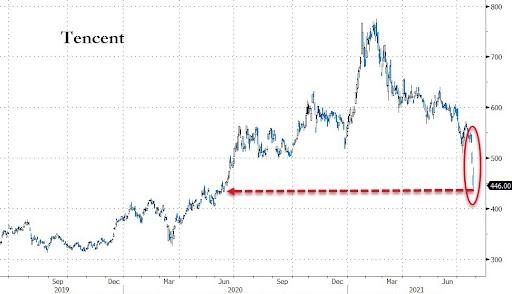
Tencent sank 9% on Tuesday, its biggest drop since October 2011, and the latest example of panic selling that has afflicted many Chinese stocks.

While new downloads will be halted while the “security upgrade” continues, billions of people – and more than 1 billion of China’s 1.4+ billion citizens – have already downloaded the app. For investors who are trying to remain exposed to China while avoiding this type of blowback, Jian Shi Cortesi, a portfolio manager at GAM Investment Management in Zurich, told Bloomberg that the key is to avoid companies that the government might determine are benefiting a “small group at the expense of broader prosperity.” Those businesses are likely to face tighter regulation, Cortesi said, pointing to live streaming as one area that may be vulnerable. At the same time, she’s looking for chances to buy shares that have been unduly punished in the selloff.

Tyler Durden
Tue, 07/27/2021 – 09:50

via ZeroHedge News https://ift.tt/3i6aAEY Tyler Durden

IMF Upgrades 2022 Global GDP Projection Just As Economic Growth Peaks

IMF Upgrades 2022 Global GDP Projection Just As Economic Growth Peaks

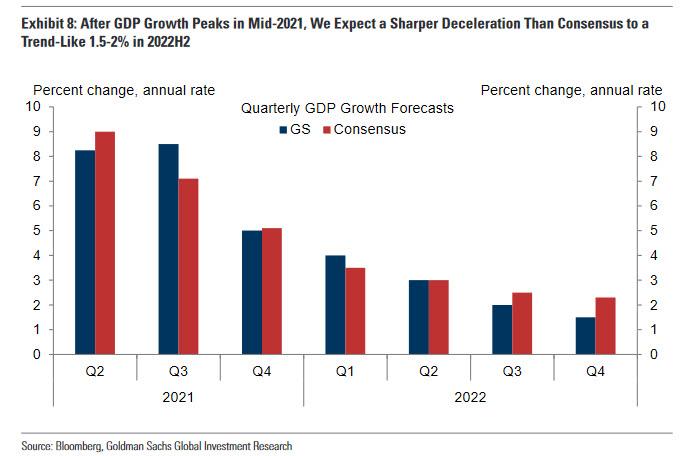
There is no more sure way to guarantee that global economic growth has peaked than for the IMF to release an economic upgrade in its latest World Economic Outlook. And one day after Goldman slashed its 2022 US growth forecast and now expects GDP growth to shrink to just 1.5% – 2% by the second half of 2022 (from 8.5% in Q3 2021 and 5% in Q4), a far “sharper deceleration than consensus expects”…

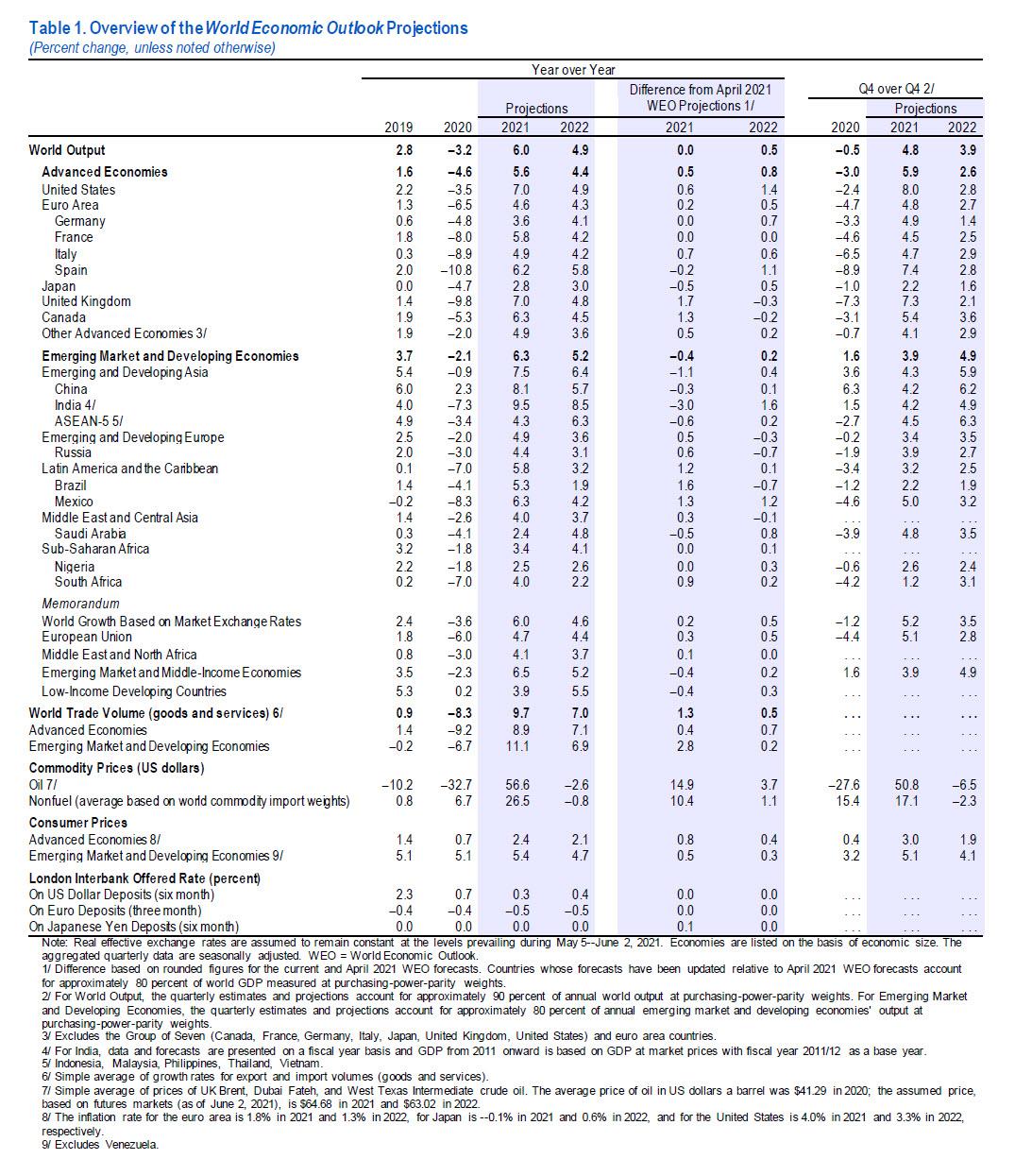
… the echo chamber career economists at the IMF have done just that, predicting a 0.5% increase in Advanced economic growth in 2022 to 4.9% (while keeping its 2021 projection unchanged), while hiking its EM forecast more modestly by 0.2% to 5.2%.

Some more details from the latest just released World Economic Outlook:

  • US 2021 and 2022 GDP forecasts rasied by 0.6% and 1.4%, respectively, just as the US economy has peaked.
  • Euro Area forecasts raised by 0.2% and 0.5%;
  • China 2021 forecast cut by 0.3%, while hiking the 2022 forecast by 0.1%
  • Global 2021 GDP forecast unchanged, raised 2022 by 0.5%

In summary, the IMF said world output is still expected to grow 6% in 2021 following last year’s 3.2% drop, and shrink to 4.9% in 2022. It reduced the forecast for emerging-market expansion to 6.3% compared with the 6.7% increase projected in April, and raised the estimate for advanced economies by 0.5 percentage point to 5.6%. The U.K. got the biggest bump among major economies, with the IMF now forecasting a growth rate of 7% in 2021, just below the BOE’s own estimates.

Some comments from the latest forecast:

“Recent price pressures for the most part reflect unusual pandemic-related developments and transitory supply-demand mismatches. Inflation is expected to return to its pre-pandemic ranges in most countries in 2022 once these disturbances work their way through prices, though uncertainty remains high. Elevated inflation is also expected in some emerging market and developing economies, related in part to high food prices. Central banks should generally look through transitory inflation pressures and avoid tightening until there is more clarity on underlying price dynamics. Clear communication from central banks on the outlook for monetary policy will be key to shaping inflation expectations and safeguarding against premature tightening of financial conditions. There is, however, a risk that transitory pressures could become more persistent and central banks may need to take preemptive action.”

Alas, with China growth stumbling and US growth now clearly ebbing, all the IMF has done is confirm that its optimism will be wrong. Again.

At least the fund admitted it will likely be wrong noting that risks tilt to the downside, with uncertainty surrounding the global baseline remaining high. Delays in administering vaccines would allow new variants to spread, “with possibly higher risks of breakthrough infections among vaccinated populations.”

Addressing the growing divergence between advanced economies and emerging markets, the IMF said that “vaccine access has emerged as the principal fault line along which the global recovery splits into two blocs: those that can look forward to further normalization of activity later this year — almost all advanced economies — and those that will still face resurgent infections and rising Covid death tolls… The recovery, however, is not assured even in countries where infections are currently very low so long as the virus circulates elsewhere.”

To address the widening gap, the taxpayer funded organization urged advanced economies to share their vaccine surplus with poorer nations.

“Multilateral action is needed to ensure rapid, worldwide access to vaccines, diagnostics, and therapeutics,” IMF Chief Economist Gita Gopinath said in a related blog. “This would save countless lives, prevent new variants from emerging and add trillions of dollars to global economic growth.”

Among the other IMF findings (courtesy of Bloomberg):

  • Emerging Asia saw the biggest downgrade among regions, with the IMF trimming the growth projection for this year by 1.1 percentage points to 7.5%.
  • A 3 percentage-point cut in the annual growth rate for India — hurt by a severe second Covid-19 wave from March to May — led the drop. Despite this, gross domestic product there is set to expand 9.5% in 2021.
  • The forecast for sub-Saharan Africa is unchanged relative to April, with worsening pandemic developments expected to weigh on the region’s recovery. A 0.9 percentage-point increase in South Africa’s forecast offset downward revisions in other countries.
  • The fund raised its GDP expansion outlooks for the U.S., the euro area, Latin America and the Middle East and Central Asia.
  • Inflation is expected to return to its pre-pandemic ranges in most countries in 2022 once these disturbances work their way through prices, the fund said. Elevated inflation is also expected in some emerging-market and developing economies, related in part to high food prices.

Tyler Durden
Tue, 07/27/2021 – 09:34

via ZeroHedge News https://ift.tt/2Wq0nuK Tyler Durden

Federal Decision On Mask Mandate Imminent: Report

Federal Decision On Mask Mandate Imminent: Report

Despite Dr. Anthony Fauci’s claim that the federal government wouldn’t adopt any new confusing and unscientific mask or vaccine guidance, CNN reports that federal officials are preparing to announce new nation-wide masking guidance after NYC and California ordered public workers to either provide proof of their vaccination status or mask up, while LA has ordered people to wear masks in public once again. According to CNN, the decision is “imminent”, and could arrive as soon as Tuesday.

What’s more, as the delta variant continues to spread, a drop in new cases seen in the UK and Europe may be signaling a coming “inflection point” in the US.

Alex Berenson pointed to the trend on Twitter on Tuesday.

Yet, despite this, CNN says top US health officials gathered Sunday night to review the new data and evidence on delta’s transmissibility. An announcement could land as soon as Tuesday, while others told CNN that it likely won’t arrive until later in the week.

This isn’t the first hint we have received about a possible revision: Dr. Fauci clarified on Sunday that updating mask guidance is under “active consideration.” Dr. Fauci also warned that the US government is going in “the wrong direction” as the number of new COVID cases remains stubbornly high.

Last time the CDC updated its mask guidance was two months ago when they first said people could go without masks outdoors and inside if they have been fully vaccinated. Since then, people have been working out at gyms without masks in most of the US. A reversal of these types of privilege would almost certainly outrage all those adults who got the vaccine solely so they could avoid the restrictions.

As more super-liberal cities and states adopt what he described as “unscientific” regulations, Fox News’ Sean Hannity slammed Dems for breaking their promise that the vaccine would mean individuals no longer need to wear masks in public or take other precautions

“The mask-obsessed ‘Left’ isn’t following the science…and they’re trying to blame conservatives for it,” Hannity said. Berenson has also ridiculed certain local officials for their almost mystical justifications of the mask guidance.

Meanwhile, the White House told CNN that it would be “up to the CDC” to change regulations and guidance surrounding mask use.

Earlier this month, LA County adopted new mandatory masking requirements calling for masks to be worn when in public (despite President Biden’s claim that “you can’t get COVID” if you’ve been vaccinated).

That is, unless you’re in Israel.

Tyler Durden
Tue, 07/27/2021 – 09:10

via ZeroHedge News https://ift.tt/2VeEy0u Tyler Durden

US Home Prices Have Never Risen This Fast

US Home Prices Have Never Risen This Fast

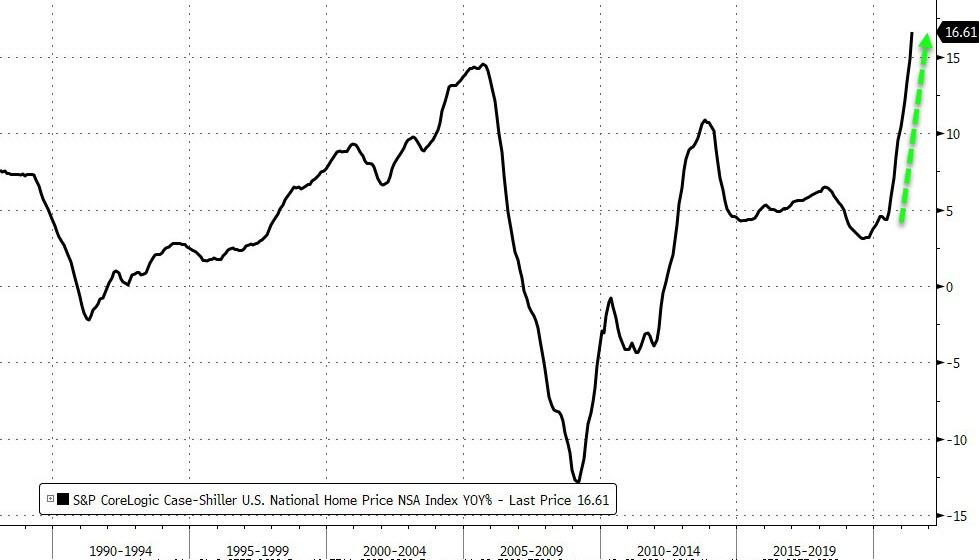
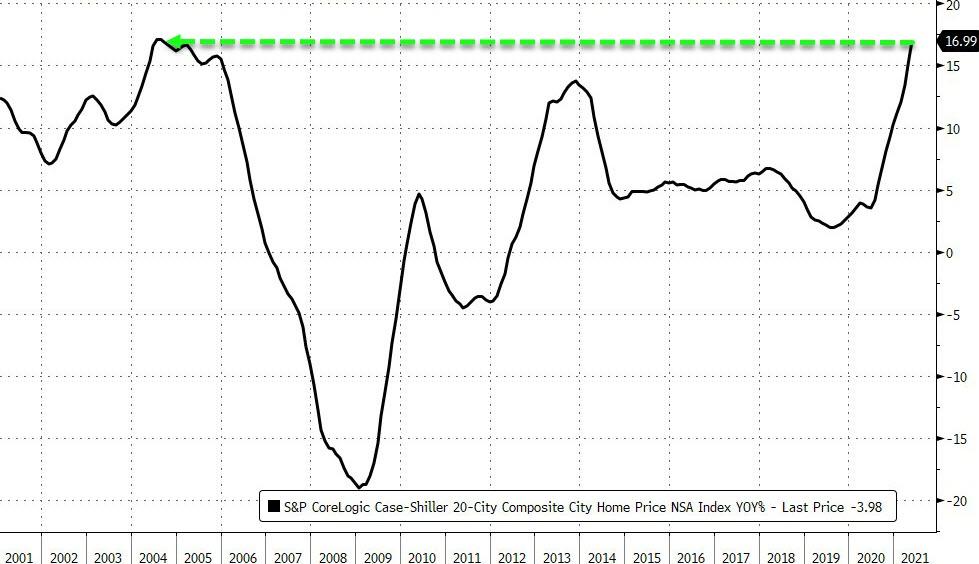
US home prices rose an astonishing 16.61% YoY in May (the latest available data from Case-Shiller). That is the great YoY surge in prices in the 33 year history of the index…

Source: Bloomberg

In the 20 largest US cities, home prices rose at 16.99% YoY (topping expectations), just shy of the record pace of 17.09% in July 2004…

Source: Bloomberg

Phoenix, San Diego, Seattle reported highest year-over-year gains among 20 cities surveyed.

“As was the case last month, five cities — Charlotte, Cleveland, Dallas, Denver, and Seattle — joined the National Composite in recording their all-time highest 12-month gains,” Craig J. Lazzara, global head of index investment strategy at S&P Dow Jones Indices, said in statement.

“Price gains in all 20 cities were in the top quartile of historical performance; in 17 cities, price gains were in top decile.”

But it’s not a bubble right, Jay? The Fed is cornered – just keep buying those MBS now or face the collapse of ‘conditioned-buying’ that will make 2008 look like child’s play.

Finally, we do note that this data is from May, before the recent slowdown in sales.

Tyler Durden
Tue, 07/27/2021 – 09:04

via ZeroHedge News https://ift.tt/2US3uet Tyler Durden

Chinese Massacre Spreads To Bonds, FX Amid Rumors Of Foreign Liquidations

Chinese Massacre Spreads To Bonds, FX Amid Rumors Of Foreign Liquidations

The rout in Chinese shares, which has demolished the country’s tech giants following Beijing’s regulatory crackdown on various sectors, extended into the bond and currency markets Tuesday amid unverified rumors swirled that U.S. funds are offloading China and Hong Kong assets.

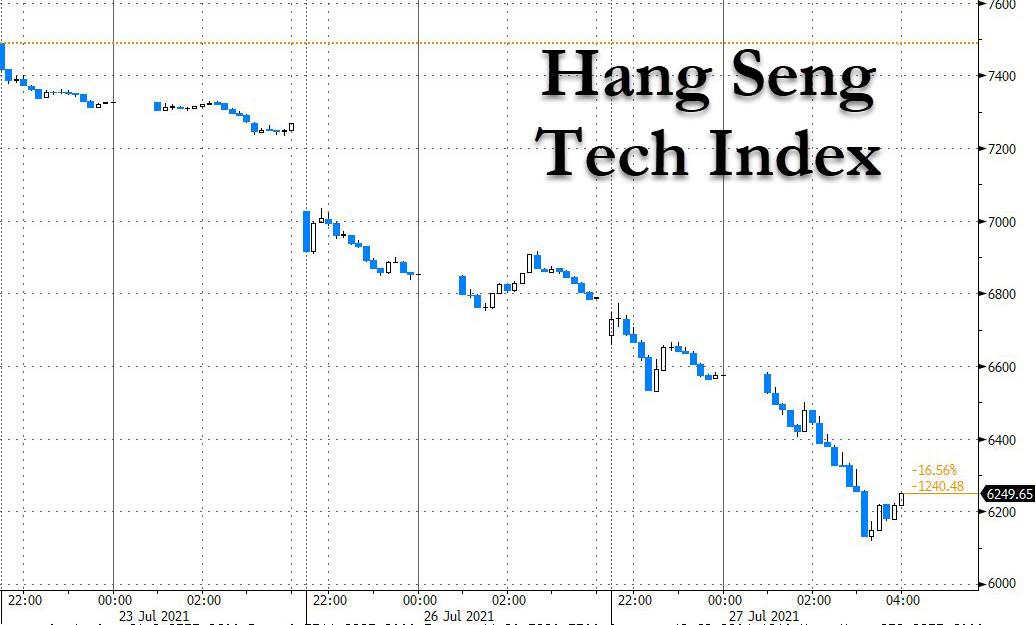
The speculation, first reported by Bloomberg, included talk that the U.S. may restrict investments in China and Hong Kong, circulated among traders in late afternoon in Asia, spurring a renewed bout of selling which sent Hong Kong’s Hang Seng Tech Index, a gauge of many Hong Kong-listed Chinese stocks, crashing as much as 10% to its lowest level since inception…

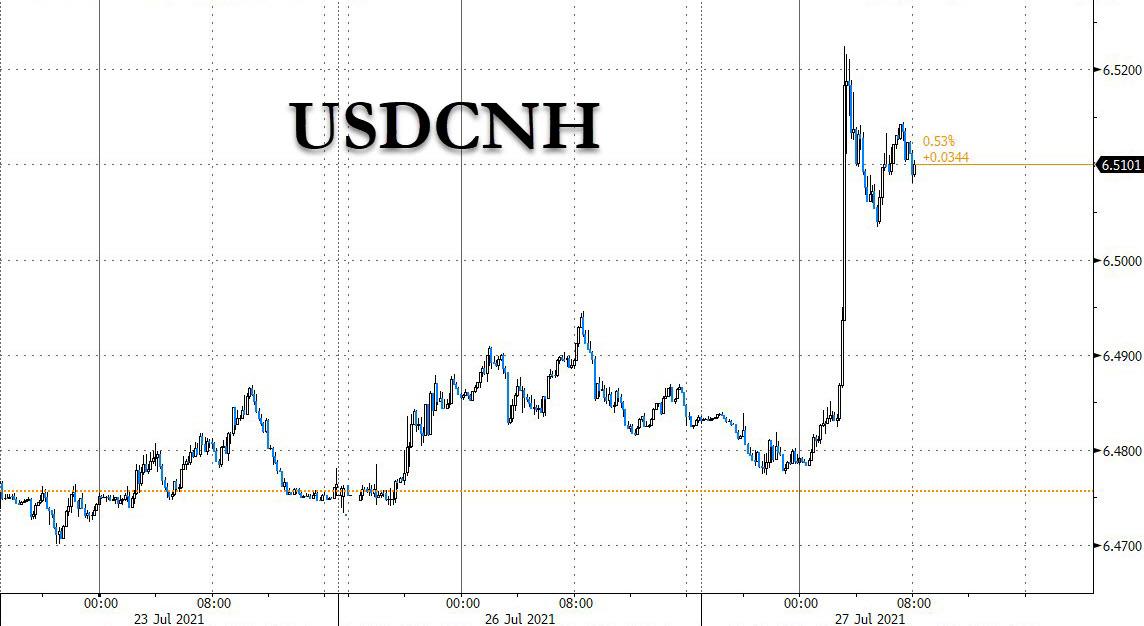
… while the offshore yuan slid to its weakest since April against the dollar, dropping as much as 0.6% to 6.52 per dollar and one-month volatility in the currency pair posted the biggest jump since May…

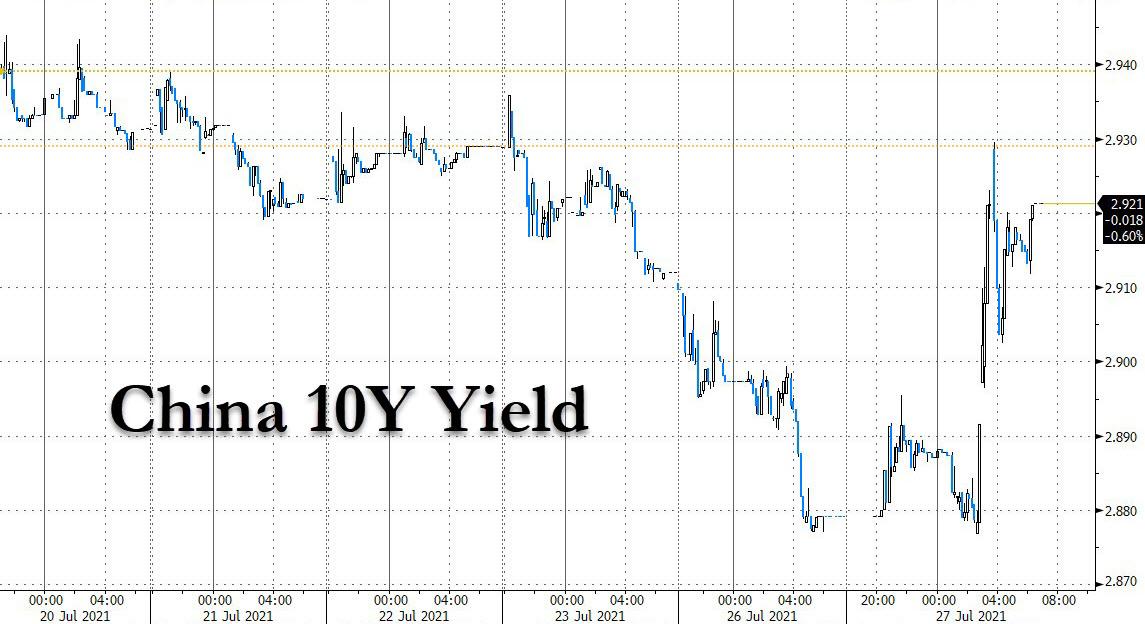
… and even Chinese bonds were dumped, with the yield on China’s most actively traded 10-year government notes rising seven basis points to 2.94%, the most in a year.

The liquidation spree spread into the offshore Chinese credit market as well, with high-yield notes down as much as 5 cents on the dollar, while investment-grade bond spreads widened by another 10 to 15 basis points, following the latest plunge in China’s Evergrande which overnight announced it would be scrapping its special dividend which artificially propped up its battered stock.

As Bloomberg notes, the drastic moves underscore how fragile investor confidence has become after a monthslong regulatory onslaught by Beijing that appears to be getting worse by day. Traders fear the latest crackdown on the nation’s education, food delivery and property sectors could expand to other industries such as health care, as China looks to tighten its grip on Big Tech and reduce the wealth gap.

“The spread of declines from the Chinese equities space into the yuan signals that the concerns over regulatory risk in China might have taken a turn for the worst,” said Terence Wu, foreign-exchange strategist at Oversea-Chinese Banking Corp. in Singapore.

As investors liquidated Chinese assets with the bathwater, treasuries rose with the traditional safehavens such as the dollar and the yen.

The liquidation firestorm, sparked by a rumor, was of the kind where traders sell first and ask questions later: “Although we can’t verify if it’s true or not, the market fears that foreign capital will flow out from the Chinese stock market and bond market on a large scale, so sentiment is badly hurt,” Li Kunkun, a trader from Guoyuan Securities Co. said of the speculation.

“The key concern now is whether regulators will do more and expand the crackdown to other sectors,” said Daniel So, strategist at CMB International Securities Ltd. “The regulatory concerns will be the key overhang to the market for the second half.” He added that it was too soon in his opinion for investors to “bottom fish.”

Amid the rout, technology and education shares were hammered hardest, while property stocks also fell on Tuesday. Tencent Holdings Ltd. slumped 9%, most in about a decade, after the company’s music arm gave up exclusive streaming rights and was hit with fines.

Its WeChat social media platform has stopped taking new users as it undergoes “security technical upgrade” in accordance with relevant laws and regulations. Meituan fell as much as 18%, its biggest decline ever, as investors digested new rules on online food platforms.

Tuesday’s rout followed the “panic selling” on Monday which followed the shocking news from Chinese regulators on Saturday revealing that will fundamentally alter the business model of private firms teaching the school curriculum. Hong Kong’s major retail brokers lowered margin financing for battered Chinese education stocks as investors suffered steep losses.

“There is no anchor for us to justify the stock valuations now given the regulation uncertainties,” said Dai Ming, a Shanghai-based fund manager at Huichen Asset Management. “In the past, the market was expecting normal regulations on certain sectors, but now it looks like the government can even tolerate killing a whole industry or some leading companies when it’s needed.”

Tyler Durden
Tue, 07/27/2021 – 08:44

via ZeroHedge News https://ift.tt/3zKKttl Tyler Durden

US Durable Goods Orders Unexpectedly Slow In June

US Durable Goods Orders Unexpectedly Slow In June

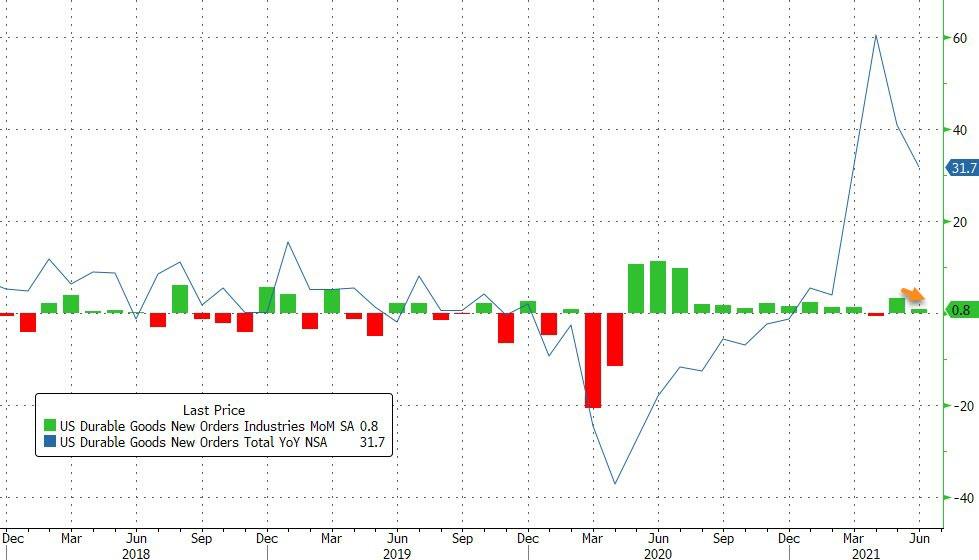
After a surprisingly large jump higher in May, analysts expected today’s preliminary June Durable Goods Orders to continue to improve (despite PMIs signaling the opposite), but they were wrong as Orders rose just 0.8% MoM (well below the 2.2% MoM rise expected).

Source: Bloomberg

The May print was revised significantly higher to +3.2% MoM from +2.3% thanks to a sizable jump in commercial aircraft bookings.

Underneath the headline figure, core capital goods orders, a barometer of business investment that excludes aircraft and military hardware, increased 0.5% for a second month, but missed expectations.

This is much more in line with the slowdown in the Manufacturing surveys (ISM and PMI) as it appears Q2 was the peak of the recovery.

Tyler Durden
Tue, 07/27/2021 – 08:36

via ZeroHedge News https://ift.tt/3x2dmiV Tyler Durden

The Market’s Next “Minsky Moment”

The Market’s Next “Minsky Moment”

Authored by Lance Roberts via RealInvestmentAdvice.com,

In this past weekend’s newsletter, I discussed the issue of the markets next “Minsky Moment.” Today, I want to expand on that analysis to discuss how the Fed’s drive to create “stability” eventually creates “instability.”

In 2007, I was at a conference where Paul McCulley, who was with PIMCO at the time, discussed the idea of a “Minsky Moment.”  At that time, this idea fell on “deaf ears” as markets were surging higher amidst a real estate boom. However, it wasn’t too long before the 2008 “Financial Crisis” brought the “Minsky Moment” thesis to the forefront.

So, what exactly is a “Minskey Moment?”

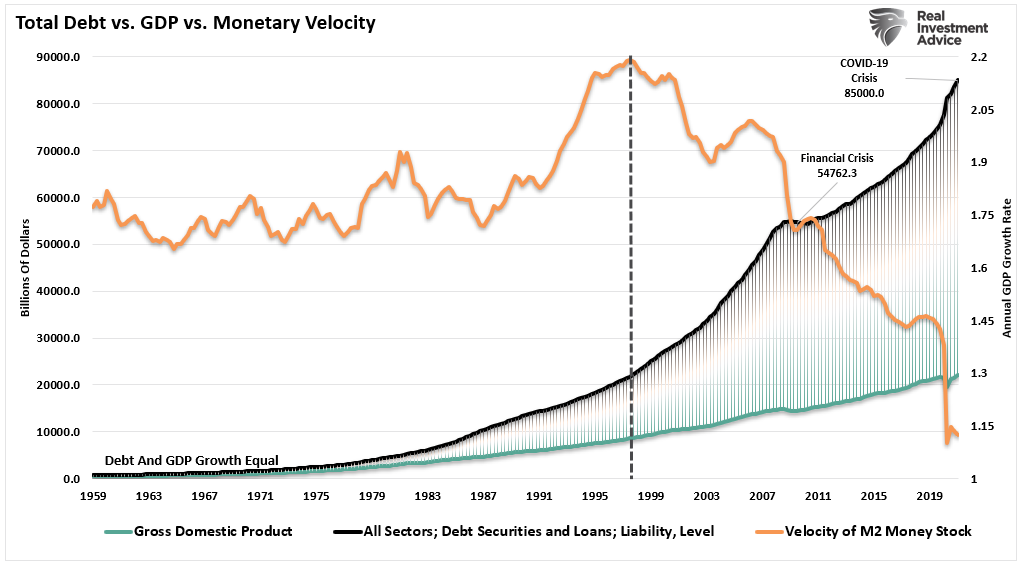
Economist Hyman Minsky argued that the economic cycle is driven more by surges in the banking system and credit supply. Such is different from the traditionally more critical relationship between companies and workers in the labor market. Since the Financial Crisis, the surge in debt across all sectors of the economy is unprecedented.

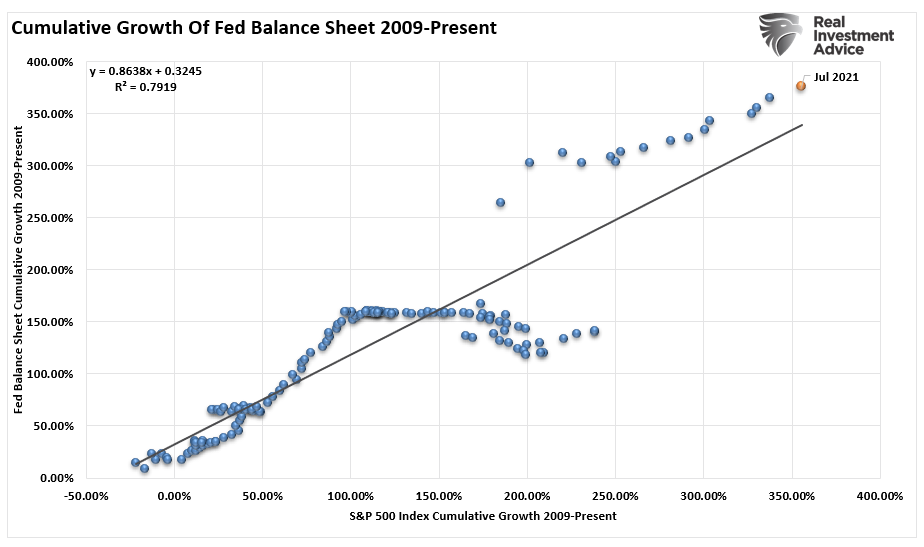
Importantly, much of the Treasury debt is being monetized, and leveraged, by the Fed to, in theory, create “economic stability.” Given the high correlation between the financial markets and the Federal Reserve interventions, there is credence to Minsky’s theory. With an R-Square of nearly 80%, the Fed is clearly impacting financial markets.

Those interventions, either direct or psychologicalsupport the speculative excesses in the markets currently.

Bullish Speculation Is Evident

Minsky’s specifically noted that during periods of bullish speculation, if they last long enough, the excesses generated by reckless, speculative activity will eventually lead to a crisis. Of course, the longer the speculation occurs, the more severe the problem will be.

Currently, we see clear evidence of “bullish speculation” from:

  • Due to commission-free trading and mobile apps, retail trading has exploded.

  • A surge in IPO’s

  • A record increase in SPAC’s

  • Investors paying record multiples and prices for money-losing companies

  • Option contract speculation has seen record increases

  • Margin debt at new highs and near-record annual increases.

  • A widely accepted belief “this time is different,” due to the “Fed Put.”

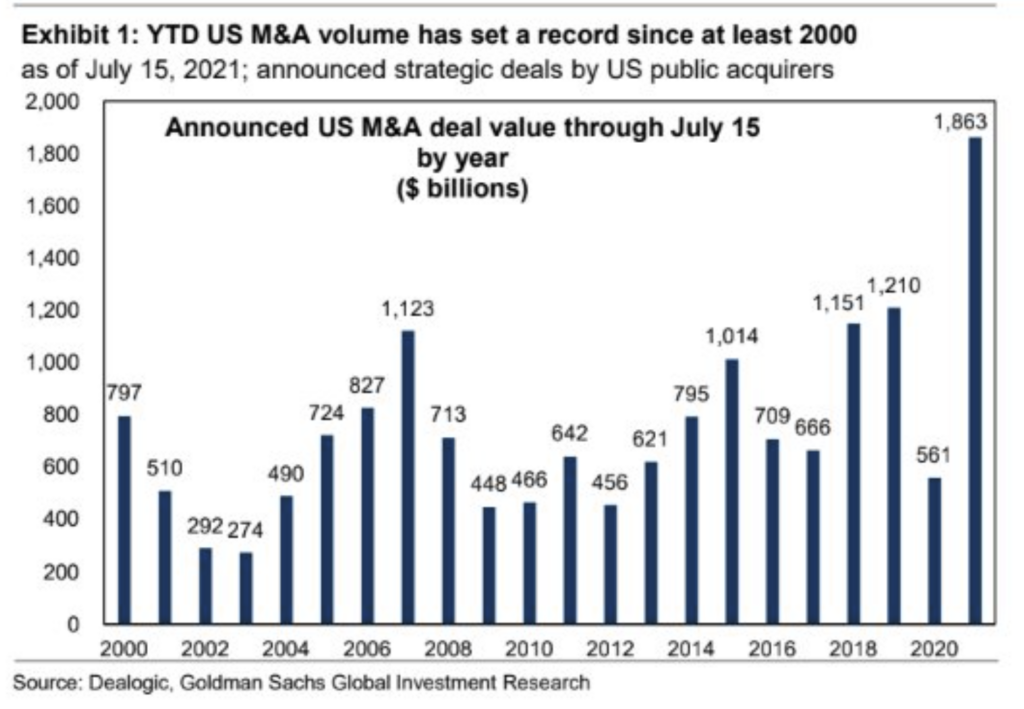
  • Record M&A activity

But, again, these issues are not new. In one form or another, they have all been present at every prominent market peak in history.

Notably, what fosters these periods of exuberance in markets is “stability.” In other words, there are periods of exceptionally low volatility in markets, which breed overconfidence and speculative appetites.

However, these periods of exceptionally low volatility are also a problem.

The Instability Of Stability

Hyman Minsky argued there is an inherent instability in financial markets. As noted, an abnormally long bullish cycle spurs an asymmetric rise in market speculation. That speculation eventually results in market instability and collapse. 

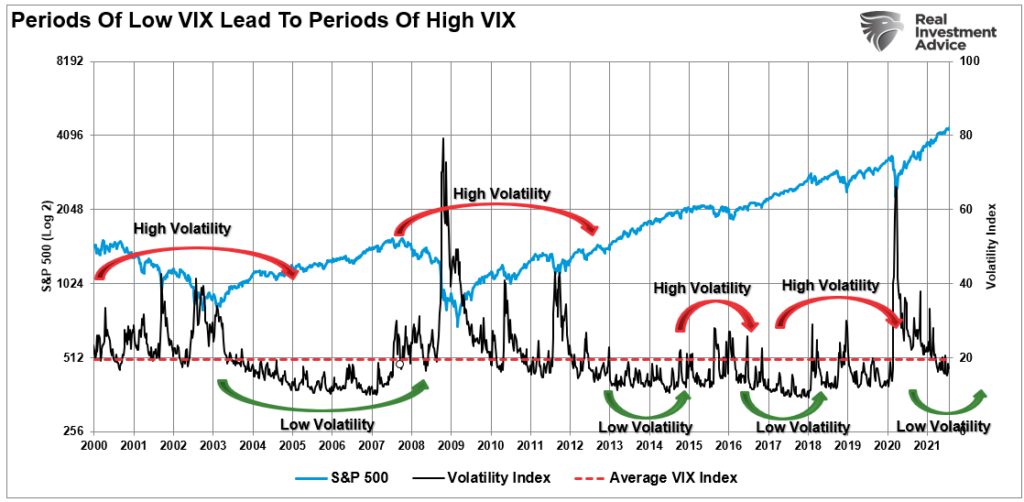
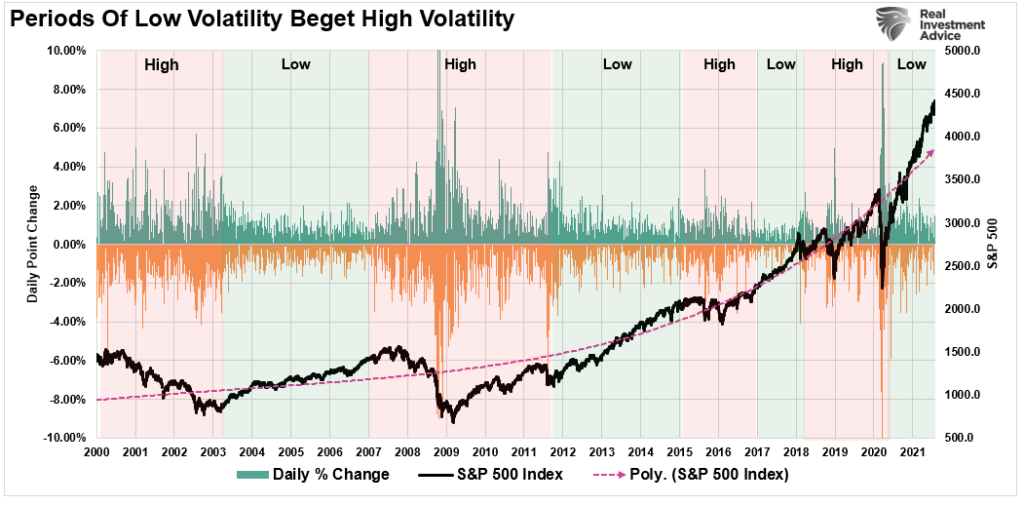
We can visualize these periods of “instability” by examining the Volatility Index versus the S&P 500 index. Note that long periods of “stability” with regularity lead to periods of “instability.”

Given the volatility index is a function of the options market, we can also view these alternating periods of “stability/instability” by looking at the daily price changes of the index itself.

“Minsky Moment” is the reversal of leverage following prolonged bullish speculation. The build-up of leverage is the direct result of the complacency occurring from low-volatility market regimes.

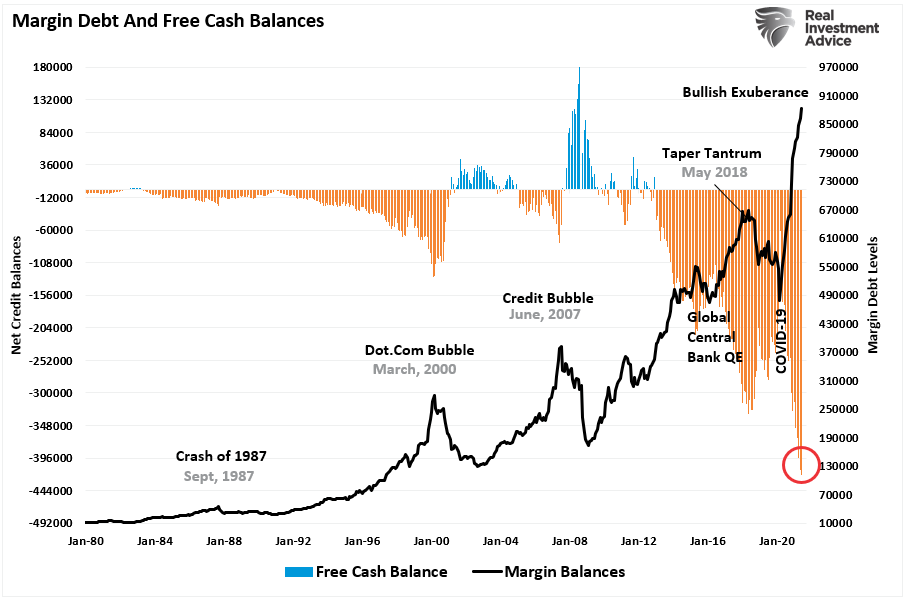
One way to look at “leverage,” as it relates to the financial markets, is through “margin debt,” and in particular, the level of “free cash” investors have to deploy. So, for example, in periods of “high speculation,” investors are likely to be levered (borrow money) to invest, which leaves them with “negative” cash balances.

Critically, while “margin debt” provides the fuel to support the bullish speculation, it is also the accelerant for “crisis” when it occurs. 

The Dependency Of The Fed

The dependency on maintaining “stability” is the most significant problem facing the Fed.

Currently, the Fed has created a “moral hazard” in the markets by inducing investors to believe they have an “insurance policy” against loss. Therefore, investors are willing to take on increasing levels of financial risk. This level of speculative risk-taking gets shown in the current yields of CCC-rated bonds. These are corporate bonds just one notch above “default” and should carry very high yields to compensate for that default risk.

As noted, with the entirety of the financial ecosystem more heavily levered than ever, the “instability of stability” is now the most significant risk.

The Paradox

The “stability/instability paradox” assumes that all players are rational. Therefore, such rationality implies avoidance of destruction. In other words, all players will act rationally, and no one will push “the big red button.”

The Fed is highly dependent on this assumption as it provides the “room” needed, after more than 12-years of the most unprecedented monetary policy program in U.S. history, to try and navigate the risks that have built up in the system.

The Fed is dependent on “everyone acting rationally.”

Unfortunately, that has never been the case.

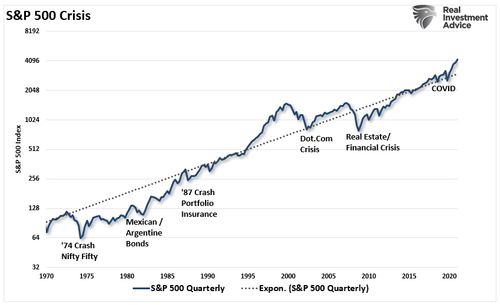
Throughout history, as noted above, the Fed’s actions have repeatedly led to adverse outcomes despite the best of intentions.

  • In the early 70’s it was the “Nifty Fifty” stocks,

  • Then Mexican and Argentine bonds a few years after that

  • “Portfolio Insurance” was the “thing” in the mid -80’s

  • Dot.com anything was a great investment in 1999

  • Real estate has been a boom/bust cycle roughly every other decade, but 2006 was a doozy

  • Today, it’s ETF’s and “Passive Investing,” and levered credit.

Another measure of “exuberance” is the deviation from the long-term moving averages. As shown, the market pushing an extreme deviation from the 4-year moving average, with the 12-month relative strength index (RSI) in very overbought territory.

The problem with “monthly charts” is they are slow to mature. The current period of exuberance could last another 12-18 months, potentially even longer. The extended period of “stability” will lead investors to “dismiss” the warning as “wrong” given it did not immediately result in a correction.

As Howard Marks once quipped:

“Being early is the same as being wrong.”

Therefore, while investors must manage portfolios in the near term to generate returns, it is undoubtedly a warning you should not dismiss entirely.

Rates Are Also Sending A Warning

The risk to this entire market remains a credit-related event.

Risk concentration always seems rational at the beginning, and the initial successes of the trends it creates can be self-reinforcing. That is, until suddenly, and often without warning, it all goes “pear-shaped.”

We wrote in early 2020, just before the Covid crisis, that yields would approach zero.

“While yields going to zero certainly sounds implausible at the moment, just remember that all yields globally are relative. If global sovereign rates are zero or less, it is only a function of time until the U.S. follows suit. This is particularly the case if there is a liquidity crisis at some point.

It is worth noting that whenever Eurodollar positioning has become this extended previously, the equity markets have declined along with yields. Given the exceedingly rapid rise in the Eurodollar positioning, it certainly suggests that ‘something has broken in the system.’” 

It wasn’t long after that yields approached zero in the depth of the economic shutdown.

With risk elevated, the Fed continues to supply liquidity at the rate of $120 billion a month. The sole goal, of course, is to maintain “stability.” Importantly, with inflation pushing 5%, and economic growth expected to surpass 4%, interest rates should be at a corresponding level.

However, interest rates are warning that “something is not quite right” in the financial system. Previously, when rates have risen from lows and peaked, such has preceded periods of “market instability.”

Will this time be different.

Maybe.

But history suggests it won’t be.

Conclusion

Only those that risk going too far can possibly find out how far one can go.” – T.S. Eliot

All of this underscores the single most significant risk to your investment portfolio.

In extremely long bull market cycles, investors become “willfully blind” to the underlying inherent risks. Or rather, it is the “hubris” of investors that they are now “smarter than the market.”

Yet, the list of concerns remains despite being completely ignored by investors and the mainstream media.

  • Growing economic ambiguities in the U.S. and abroad: peak autos, peak housing, peak GDP.

  • Excessive valuations that exceed earnings growth expectations.

  • The failure of fiscal policy to ‘trickle down.’

  • Geopolitical risks

  • Flattening of yield curves amid surging economic growth.

  • Record levels of private and public debt.

  • Exceptionally low junk bond yields

For now, none of that matters as the Fed seems to have everything under control.

The more the market rises, the more reinforced the belief “this time is different” becomes.

Yes, our investment portfolios remain invested on the long side for now. (Although we continue to carry slightly higher levels of cash and hedges.)

However, that will change, and rapidly so, at the first sign of the “instability of stability.” 

When will the next “Minsky Moment” arrive? We don’t know.

What we do know is that by the time the Fed realizes what they have done, as always, it will be too late.

Tyler Durden
Tue, 07/27/2021 – 08:20

via ZeroHedge News https://ift.tt/2TH5ohw Tyler Durden

Tesla Q2 Call Wrap Up: Musk Jabs At Apple, Questions Full Self Driving, Says He Won’t Be On Future Calls

Tesla Q2 Call Wrap Up: Musk Jabs At Apple, Questions Full Self Driving, Says He Won’t Be On Future Calls

As we reported yesterday after hours, Tesla released Q2 results that largely beat analyst estimates. 

  • Revenue $11.96B, beating the est $11.36B

  • Adjusted EPS $1.45, beating the est 97c

  • Free Cash Flow $619M, beating the estimate of a Negative $319.1M

  • Automotive gross margin 28.4%, beating the estimate of 25.0%

  • Cash and cash equivalents of $16.229BN, missing the estimate $16.55 billion

With the financials out, all eyes were on the ensuing conference call, which – despite not being quite as absolutely insane as some past conference calls – still offered up some commentary and information that wasn’t included in the the company’s Q2 report. 

First, the lede: Elon Musk admitted on the conference call that he may not be attending future calls. By our estimation, the lack of mumbling through incoherent jargon could and half-truths could shave dozens of minutes off of future calls, keep them far more coherent and make them far less of a legal liability. 

“I will no longer default to doing earnings call. Obviously I’ll do the annual shareholder meeting, but I think that going forward I will most likely not be on earnings calls…” Musk said. He continued, stating he wouldn’t reappear on calls “unless there’s something really important that I need to say” to which a MarketWatch opinion piece hilariously responded:

Earlier, “important” things Musk had to say in earnings calls included describing public-health restrictions during the COVID-19 pandemic as “fascist,” calling a Wall Street analyst “boneheaded” in a rant, and saying he wasn’t looking for his highly valued company to be too profitable. Those are the kinds of performances no investor should miss.

“Elon Musk says he is done with regular appearances on earnings calls. Tesla Inc. and its investors should be thankful,” MarketWatch wrote

Could this be a sign that adults – or maybe even regulators – are finally starting to get the ear of Elon Musk?

Also of note on the call was Elon Musk taking jabs at Apple not once, but twice. Recall, Apple’s Titan vehicle project is being head up by Doug Field, who spent five years with Tesla. 

First, Musk took exception with Apple’s use of cobalt mining: “Apple uses I think almost 100% cobalt in their batteries and cell phones and laptops, but Tesla uses no cobalt in the iron-phosphate packs, and almost none in the nickel-based chemistries. On on a weighted-average basis we might use 2% cobalt compared to say, Apple’s 100% cobalt. Anyway, so it’s just really not a factor.”

Musk then took a shot at Apple’s “Walled Garden”, which is a term used to describe how strict the company is with what software can be installed on its iPhones. 

“I think we do want to emphasize that our goal is to support the advent of sustainable energy. It is not to create a walled garden and use that to bludgeon our competitors which is used by some companies.” According to CNBC, for those who didn’t get his reference, Musk then faked a cough and said, “Apple.”

Speaking of Musk creating liabilities for the company with what he says on conference calls, toward the end of the call Musk addressed Full Self Driving in a manner that made it sound like the non-existent product that he has been charging customers for over the last half decade still doesn’t work.

“Yeah. I mean, any given price is going to be wrong, so we’ll just adjust it over time as we see the value proposition makes sense to people. So we’re just really — I’m not thinking about this a lot right now. We need to make Full Self-Driving work in order for it to be a compelling value proposition. Otherwise, people are betting on the future,” Musk said.

It’s a stark tacit admission that Full Self Driving doesn’t work and that Musk may be coming around to the idea that “betting on the future” may be Musk-code misinterpreted by pesky regulators to mean “I’ve been selling people a product for a half decade that doesn’t exist”.

Musk ended the call by continuing to question the value proposition of his own software: “Like right now, does it makes sense for somebody to do FSD subscription? I think it’s debatable,” Musk said.

Tyler Durden
Tue, 07/27/2021 – 08:02

via ZeroHedge News https://ift.tt/3BLAJRj Tyler Durden

Futures Slide As Asian Stocks Plunge To 2021 Lows

Futures Slide As Asian Stocks Plunge To 2021 Lows

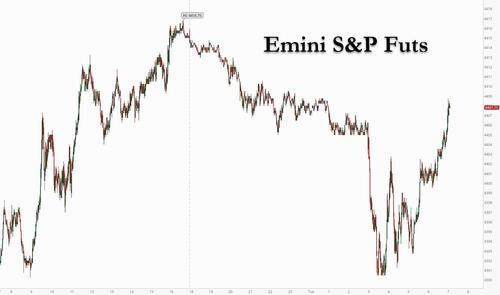
Futures swung from all time highs to losses during the European session and then rebounded again as Asian stocks hit their lowest this year on a third straight session of selling in Chinese internet giants, while real bond yields hit another record low ahead of earnings from the most valuable companies on Wall Street and in the run-up to the two-day Federal Reserve meeting. S&P 500 E-minis were down 5 points, or 0.11%, at 07:15 am ET. Dow E-minis were down 77 points, or 0.22%, while Nasdaq 100 E-minis were up 3 points, or 0.02%.
More than one third of the S&P 500 is set to report quarterly results this week, led by Apple, Microsoft, Amazon and Alphabet, the four largest U.S. companies by market value. Apple, Alphabet and Microsoft, which were largely flat in premarket trade, are set to report earnings after the market closes, while Amazon will report results on Thursday. U.S.-listed Chinese stocks extended their declines as fears over more regulations in the mainland persisted. Alibaba and Baidu lost about 3.6% and 4.9%, respectively (more below).  Here are some of the biggest U.S. movers today:

  • Chinese large cap stocks listed in the U.S. fall in premarket trading amid a deepening rout trigged by Beijing’s regulatory crackdown. Didi Global (DIDI) drops 4.4% and JD.com (JD) falls 6.4%, while Baidu (BIDU) declines 4.9%.
  • Cryptocurrency-exposed stocks slumped in premarket trading after Bitcoin gave up some of the gains seen on Monday. Bit Digital (BTBT) sinks 18% and Riot Blockchain (RIOT) drops 5%, while Marathon Digital (MARA) falls 6.2%.
  • ObsEva (OBSV) soars 34% after entering a pact for Organon to exclusively develop and commercialize ebopiprant, a treatment for preterm labor.
  • Tesla’s (TSLA) second-quarter earnings beat and increased delivery outlook was well received by analysts, with the stock gaining 2.5% in premarket trading.

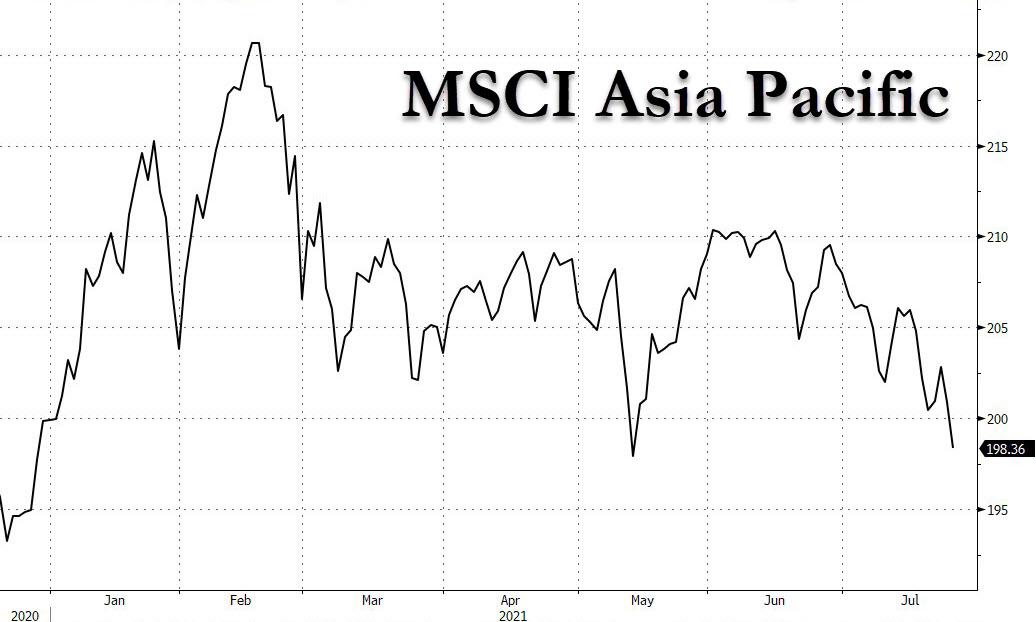
All eyes were on Asia, however, where equities dropped for a third day sliding to 2021 lows, as a selloff in Chinese tech shares deepened amid continued worries over Beijing’s regulatory crackdown. The MSCI Asia-Pacific index outside Japan fell 2.2% to its lowest level since end-December, having slid 2.45% the previous day.
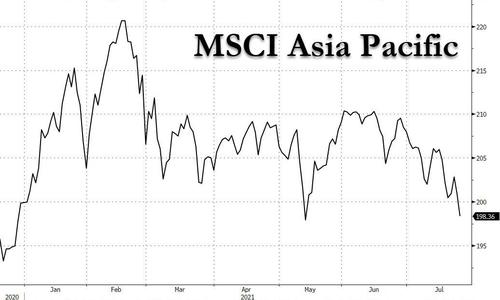
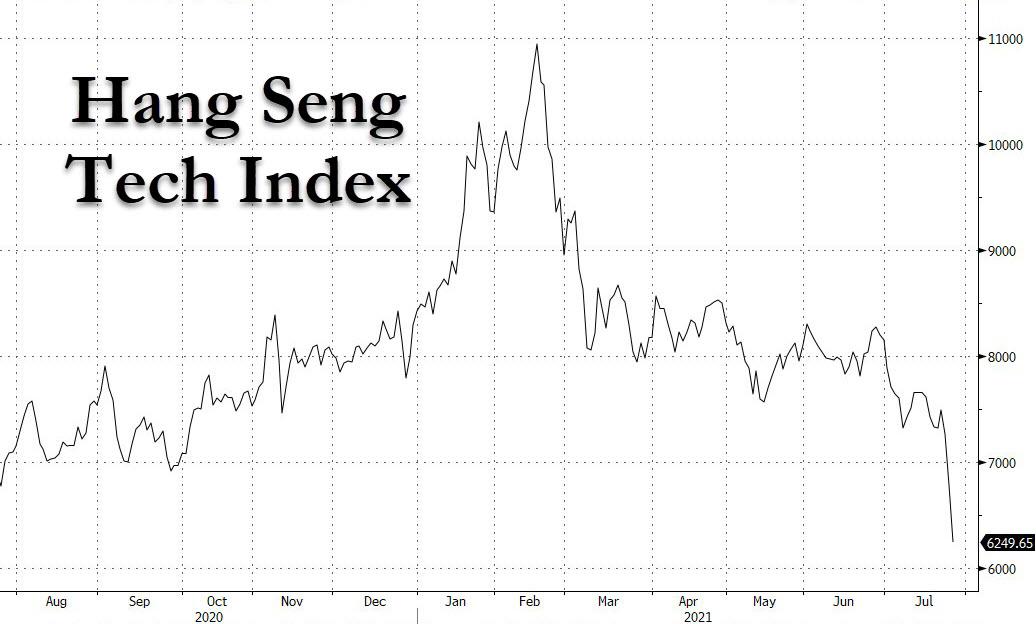
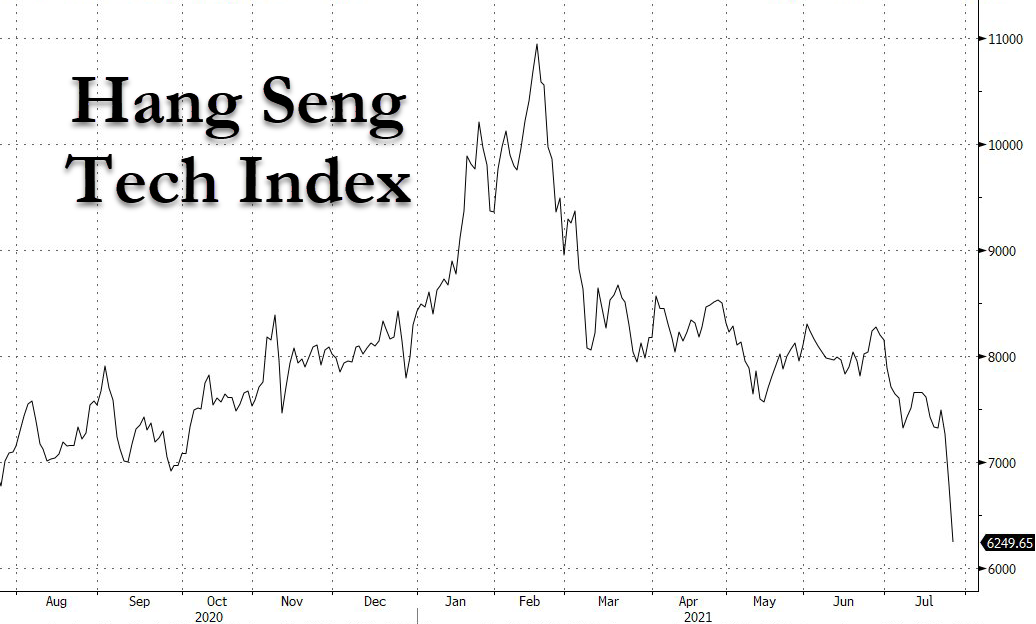
The broader MSCI Asia Pacific Index fell as much as 1.4% after sliding 1.3% on Monday. The Hong Kong Hang Seng Index slid 4.2%, its third day of declines, as speculation swirled that U.S. funds are offloading China and Hong Kong assets. The Hang Seng Tech index slumped as much as 9.6% to its lowest since its inception in July 2020. It has fallen around 17% in three days and has lost 44% from a February peak.
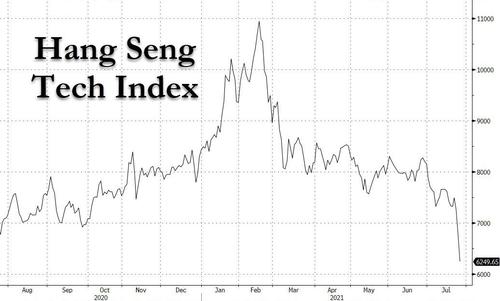
Delivery giant Meituan plunged the most on record, while Tencent, Alibaba and JD.com also plunging. Fears over the government’s intensifying crackdown has shaken sentiment toward Chinese stocks, forcing investors like Cathie Wood of Ark Investment Management to dump shares of companies like Tencent Holdings and KE Holdings. Chinese bluechips dropped 3.53%, also hitting 2021 lows, thanks to regulatory crackdowns in the education and property sectors.

“The market seems to be uncertain whether there will be more policy changes for fintech, social media platforms, delivery platforms and ride hailing platforms,” said Iris Pang, chief economist for Greater China at ING. “Each has their own issue and faces different regulatory actions, so the market is looking for ‘which technology subsector will be next?’”

While it isn’t completely clear if the current selloff has follow-through, there are some indications it might, said Ilya Spivak, head of greater Asia at DailyFX. “Establishing a foothold below the 4,800 figure on the benchmark CSI 300 index would suggest that recent weakness is more than just a corrective pullback and speak to scope for downward follow-through.”

Not all was doom and gloom: Japanese equities climbed for a third day as investors looked for catalysts in earnings reports at home and abroad. Electronics makers and banks were the biggest boosts to the Topix, which rose 0.6%. Advantest and Recruit were the largest contributors to a 0.5% advance in the Nikkei 225. The market was also looking toward this week’s Federal Reserve meeting and reports from major Japanese companies including Fanuc and Canon. “As investors anticipate a recovery in the economic cycle and corporate earnings, stocks sensitive to business cycles such as autos are likely to be bought up,” said Ryuta Otsuka, a strategist at Toyo Securities Co. South Korean stocks also gained, along with equities in the Philippines and Vietnam.

Asian weakness weighed on European stocks, which fell 0.92%, moving further away from recent record highs. Britain’s FTSE 100 was down 1.23%. Here are some of the biggest European movers today:

  • LVMH shares gain as much as 1.8% after the company’s 1H results beat analyst expectations, with luxury valuations hovering at near-record levels. The sector remains in focus with peers Kering and Moncler due to report later on Tuesday.
  • Dassault Systemes shares rise as much as 4.8% to a record high after results, with Citi saying the software firm saw another “solid” execution performance against high expectations.
  • Croda shares rise as much as 6.1%; Berenberg says results are “excellent,” analyst Sebastian Bray (buy) remains positive on shares.
  • MorphoSys shares fall as much as 11.6% after Commerzbank downgrades to hold from buy and slashes PT to EU59 from EU105, with the broker saying it is losing confidence in the investment case turning positive.
  • Reckitt shares sink as much as 10%, the most since the global financial crisis, after the U.K. consumer- goods company’s results disappointed analysts. Reckitt is the biggest decliner in the FTSE 100 Index and the second-worst performer in the Stoxx 600 Index on Tuesday.
  • Randstad falls as much as 8.1%, the most since April 2020, after the temporary- employment services firm reported results. Jefferies (underperform) notes U.S. weakness and suspects operational gearing has peaked.

Looking ahead, 3 of the 5 FAAMGs, Alphabet, Apple and Microsoft, are set to publish quarterly results late on Tuesday, with Amazon.com Inc’s due later in the week. In addition, the Fed will begins its two-day meeting on Tuesday, with investors set to scrutinise a statement and press conference from Chair Jerome Powell due late Wednesday. They will be looking to see how the central bank will balance fast-rising prices with the complication of increased coronavirus infections.

“While we expect the Federal Reserve to prove more hawkish than expected…the negative impact on the equity market should be quite subdued as easy monetary policy is still there for quite a while,” said Sebastien Galy, senior macro strategist at Nordea Asset Management.

In rates, real bond yields in the United States and Europe have fallen to record lows and on Tuesday, the yield on 10-year Treasury inflation-protected securities (TIPS) hit -1.147%, down 4 basis points on the day. German inflation-linked bond yields also extended their recent falls, hitting a new low at around -1.747%. ING Bank strategist Antoine Bouvet said the fall in real yields could be explained by thin market liquidity and hefty central bank bond buying. “Of course there are macro worries, and the phase of growth acceleration of this cycle looks to be over, but this does not justify rates where they are,” he said.

In nominals, the yield on benchmark 10-year U.S. Treasury notes slipped three basis points to 1.26%, outperforming bunds and gilts by 2bp each as flight-to-quality favors Treasuries vs core Europe; 10-year German Bund yields dropped 2.6 basis points, close to a 5-1/2 month low set on Monday. Gains during Asia session were on light futures volumes, however. U.S. session highlights include 5-year note auction and, on the economic data slate, durable goods orders and consumer confidence.

In fx, the Japanese yen and U.S. dollar rose amid a broad risk-off tone as concerns about a crackdown in China rippled through global markets The dollar rose 0.18% against a basket of currencies and the euro slipped 0.2% versus the dollar. The dollar also fell 0.2% against the yen. The yen rose against all its Group-of-10 peers as a rout in Chinese shares fueled by Beijing’s regulatory crackdown extended into global bond and currency markets. Ned Rumpeltin, head of foreign-exchange strategy at Toronto-Dominion Bank, said the dollar may have further to rise. “We’ve seen a general pattern of risk reduction over the last several weeks, with USD shorts dialed back,” he said. “The optics of that would suggest that broader trends favor some further near-term USD strength”.

In commodities, crude oil dropped 0.45% to $71.60 a barrel amid concern surging COVID-19 cases worldwide could impact demand. Gold was steady at $1,798.86 per ounce. Bitcoin was trading around $37,100 from a Monday peak of $40,581 after Amazon.com offered a qualified denial of a weekend news report that said it was preparing to accept cryptocurrencies.

Looking at the day ahead, there’ll be a number of earnings reports of interest, including Apple, Microsoft, Alphabet, Visa, UPS, Starbucks and General Electric. Otherwise, data releases from the US include the Conference Board’s consumer confidence indicator for July, preliminary durable goods orders for June, the FHFA’s house price index for May, and the Richmond Fed’s manufacturing index for June. In Europe, there’s also the Euro Area M3 money supply for June. Finally, the ECB’s Hernandez de Cos will be speaking, and the IMF will be releasing their World Economic Outlook Update.

Market Snapshot

  • S&P 500 futures down 0.4% to 4,395.75
  • STOXX Europe 600 down 0.6% to 458.20
  • MXAP down 1.1% to 196.16
  • MXAPJ down 2.0% to 642.46
  • Nikkei up 0.5% to 27,970.22
  • Topix up 0.6% to 1,938.04
  • Hang Seng Index down 4.2% to 25,086.43
  • Shanghai Composite down 2.5% to 3,381.18
  • Sensex down 0.6% to 52,552.29
  • Australia S&P/ASX 200 up 0.5% to 7,431.36
  • Kospi up 0.2% to 3,232.53
  • German 10Y yield fell 1.8 bps to -0.436%
  • Euro down 0.2% to $1.1775
  • Brent Futures up 0.4% to $74.77/bbl
  • Gold spot down 0.1% to $1,795.97
  • U.S. Dollar Index up 0.16% to 92.80

Top Overnight News

  • Unverified rumors swirled that U.S. funds are offloading China and Hong Kong assets. The speculation, which included talk that the U.S. may restrict investments in China and Hong Kong, circulated among traders late afternoon in Asia, spurring a renewed bout of selling
  • Around the globe, people and governments are finding out that Covid won’t be thrashed into extinction, but is more likely to enter a long, endemic tail
  • European Central Bank policy makers have acknowledged that their new push to boost inflation expectations could take quite a while to kick in, according to officials familiar with the discussions

A more detailed look of global markets courtesy of newsquawk

Asian equity markets traded mostly positive as the region found inspiration from Wall St. where all major indices extended on record highs, led by outperformance in cyclicals and with earnings in focus including the looming results from the mega cap tech giants Apple, Alphabet and Microsoft that are due to report after-market on Tuesday. ASX 200 (+0.5%) was underpinned by strength in the commodity-related sectors following further production updates and with BHP lifted after it reached a deal related to port infrastructure for handling of potash which spurred hopes the Co. may proceed with the multi-billion-dollar Jansen mining project. There was also some encouragement from reports that South Australia and Victoria states will exit their lockdowns, although the most-populous state of New South Wales continued to suffer from increasing infections. Nikkei 225 (+0.5%) remained positive and re-tested the 28k level to the upside as earnings results began to trickle in but with gains limited amid concerns of PM Suga’s approval rating which slipped to a nine-year low beneath the 35% level that is seen as a “point of no return” and which has historically resulted in most LDP PMs stepping down within a year. KOSPI (+0.3%) was buoyed by the latest GDP data which despite missing expectations at 5.9% vs exp. 6.0%, it was still the fastest pace of growth in a decade and above the 4.2% government projection for this year, while it was also reported that South Korea and North Korea reopened their hotline and that their leaders exchanged several letters since April. Hang Seng (-4.2%) and Shanghai Comp. (-2.4%) were varied with the mainland temperamental following the prior day’s regulatory-triggered sell-off and with the continued downturn in Hong Kong led by underperformance in healthcare and heavy losses in tech, while Evergrande shares saw double-digit declines after it scrapped its special dividend proposal – pressure for the indexes became more pronounced going into the European session. Finally, 10yr JGBs were marginally lower after the recent pullback in T-notes and amid mild gains in Japanese stocks, while softer demand at the 40yr JGB auction later also added to the headwinds for prices.

Top Asian News

  • Hong Kong Court Issues Guilty Verdicts in First Security Trial
  • Two Koreas Agree to Rebuild Ties in Possible Opening for Biden
  • Yuan May Fall Further Amid Concerns of Regulatory Risk: OCBC
  • Virus Cases in Tokyo Leap to New Record of 2,848 Amid Olympics

Stocks in Europe trade lower across the board (Stoxx 600 -0.4%) as early losses in futures markets were exacerbated ahead of the cash open amid another decline in Chinese stocks. The downside in China was partly a continuation of the moves seen yesterday which, were triggered by the ongoing regulatory crackdown by the government. News flow overnight was also downbeat for the region after a US SEC official stated that US-listed Chinese companies must disclose risks of interference by the Chinese government as part of their regular reporting responsibilities. Furthermore, Evergrande shares saw double-digit declines after it scrapped its special dividend proposal. In terms of the damage, the Shanghai Composite closed lower by 2.5%, the Hang Seng was softer by 4.2% (lowest since 4th November 2020) with its Tech Index declining nearly 8% to a record low close. This added to the selling pressure at the open in Europe with US futures also succumbing to the deterioration in sentiment. As a reminder, US indices were able to close at record highs yesterday with some desks suggesting the China-inspired declines were overblow with focus switching to a slew of large-cap earnings reports. Tesla (+2.2%) are higher in the pre-market post-results with attention now turning to earnings from GE, UPS, 3M and Raytheon ahead of the Wall St open, whilst Alphabet, Apple, Microsoft, AMD, Visa and Starbucks report after-hours. Back to Europe, sectors are all softer with defensive names fairing marginally better than peers whilst Autos, Basic Resources and Retail names lag. Earnings in Europe have continued to pick up pace with French luxury heavyweight LVMH (+0.5%) bucking the downbeat trend amid strong sales metrics for Q2. Elsewhere, Reckitt (-8.9%) sit the near the foot of the Stoxx 600 as sales numbers and margins disappointed investors at its Q2 results release. Finally, Just Eat Takeaway.com (+2.3%) sit near the top of the Stoxx 600 with Cat Rock Capital (4.2% stake) calling on the Co. to take urgent action to increases its share price in order to avoid a possible hostile takeover.

Top European News

  • ECB Is Said to Have Discussed Fed’s Inflation Policy Shift
  • Nordic Capital Is Said In Talks to Buy Health Tech Firm Inovalon
  • Falling Covid Cases Are Welcome Surprise for U.K. Scientists
  • City of London Staff Return in Highest Numbers for 16 Months

In FX, the Dollar Index and Japanese Yen have been firming throughout the European morning as the deterioration in sentiment prompt flows into the traditional safe-havens. However, the DXY remains somewhat contained within a relatively tight range sub-93.000 with a plethora of risk events ahead, including the FOMC, US GDP, PCE alongside a slew of large-cap earnings. From a fiscal standpoint, US Senate Democratic Leader Schumer said he is committed to passing the bipartisan infrastructure bill and the Senate may stay in session through the weekend to finish the bill. Despite the positive noises out of The Hill, participants remain sceptical regarding a swift and seamless passage as some Dems are adamant that a reconciliation bill should also be at hand. From a technical perspective, DXY’s 50 DMA (91.435) and 200 DMA (91.352) diverge further after forming a “golden cross”, and near-term resistance levels include yesterday’s 92.959 high ahead of the round figure. USD/JPY meanwhile probes 110.00 having had waned from its 110.39 overnight peak, with the 21st July trough at 109.85 and 100 DMA seen around 109.54. Japan’s COVID situation remains in focus as the Tokyo Olympics are underway, with positive cases more than doubling D/D to 3,000. Japanese ministers are meeting at the PM’s official residence to discuss the COVID situation.

  • CNH – The Yuan has been the marked EM laggard, with investors skittish over China’s crackdown on onshore and offshore domestic firms (with speculation that the US may restrict investments in China and Hong Kong), whilst three districts in north-eastern Beijing issued red alerts for a rainstorm on Tuesday – following the fatal flooding in the Henan province last week. The Yuan saw sideways trade overnight following a steady PBoC fix and shrugged off a slower-paced rise in Industrial profits, but the Chinese currency yielded as losses across Chinese assets accelerated heading into the European open – with the Hang Seng posting intraday losses in excess of 5% at one point. USD/CNH popped higher to a three-month high of 6.5224 (vs low 6.4772), with gains exacerbated by an upside breach of the 200 DMA (6.4988) and the psychological 6.5000.
  • CAD, AUD, NZD, SEK, NOK – The non-US Dollars underperform and the Scandis are pressured amid the soured risk mood and losses across commodities. The petro-G10s CAD and NOK are pressured by the losses across the crude complex, albeit off worst levels as oil prices stage a mild rebound at the time of writing. USD/CAD stopped short of the 1.2600 handle before pulling back – with similar action seen across NOK pairs after EUR/NOK tested 10.4900 to the upside. The SEK sees losses to a lesser magnitude, whilst a rise in Sweden’s June trade balance surplus provided no reprieve. Turning to the antipodeans AUD and NZD lag with the latter the G10 underperformer as AUD/NZD climbs back above 1.0550 (vs 1.0538 low), whilst the former seems less pronounced losses as Australia’s Victoria state Premier announced the decision to ease lockdown restrictions in the state from midnight tonight and reports noted that South Australia will also exit lockdown. AUD/USD declined from a 0.7389 overnight peak to a 0.7340 base. NZD/USD has dipped under 0.6950 from a 0.7006 peak.

In commodities, WTI and Brent front month futures have experienced choppy trade within a tight range, with losses seen heading into the European open as stocks in China continue to bleed, keeping upside capped for the oil contracts via broader sentiment. That being said, the overarching force remains the supply/demand balance – with the supply side unlikely to see many updates until at least early-to-mid August, whilst demand tracks COVID and vaccine developments. Of course, the FOMC and tier-1 US data later in the week will likely sway prices at that point. On the travel front, the UK is reportedly to consider easing travel restrictions from the EU and the US, which would provide a rosier outlook for fuel demand. WTI prints on either side of USD 72/bbl whilst its Brent counterpart forfeited the USD 75/bbl handle and resides around mid-74/bbl. Elsewhere, spot gold and silver are relatively flat but see a mild divergence, with the yellow metal just south of USD 1,800/oz having had printed a current high a Dollar above the psychological mark awaiting this week’s upcoming risk events. LME copper is softer on the day amid general risk aversion, but prices came to under USD 100/t away from the USD 10k/t level. The sentiment is also dented by overnight reports that China is reportedly mulling steel export levies to curb domestic prices. Finally, reports suggested that BHP reached a deal related to port infrastructure for the handling of potash which spurred hopes the Co. may proceed with the multi-billion-dollar Jansen mining project.

US Event Calendar

  • 8:30am: June Durable Goods Orders, est. 2.1%, prior 2.3%; -Less Transportation, est. 0.8%, prior 0.3%
    • June Cap Goods Orders Nondef Ex Air, est. 0.8%, prior 0.1%;
    • June Cap Goods Ship Nondef Ex Air, est. 0.8%, prior 1.1%
  • 9am: May S&P/Case-Shiller US HPI YoY, prior 14.59%
    • S&P CS Composite-20 YoY, est. 16.30%, prior 14.88%
  • 10am: July Conf. Board Consumer Confidence, est. 123.8, prior 127.3; Expectations, prior 107.0; Present Situation, prior 157.7
  • 10am: July Richmond Fed Index, est. 20, prior 22

DB’s Jim Reid concludes the overnight wrap

Markets were in something of a holding pattern much of yesterday as they awaited tomorrow’s Federal Reserve decision and a raft of corporate earnings releases this week. By the end of the session though the S&P 500 and the Dow Jones had both managed to grind out a +0.24% gain to reach new all-time highs. We earlier had a risk off start to the week with the highlight being real yields on 10yr US Treasuries hitting an intraday all-time low (since TIPS used from 1997) of -1.131%. We still closed -3.4bps at -1.106% which demonstrates how well bid Treasuries are irrespective of the inflation story. It’s likely a combination of extraordinary treasury technicals and concerns over global growth.

However, overall US Treasury yields reversed course as the session developed and rose marginally on the day to be up +1.3bps to 1.290% (1.2196% at the early London lows), as the decline in the real yields (-3.5bps) was overridden by rising inflation breakevens (+4.9bps), which finished at their highest level in just over 7 weeks. So higher inflation expectations are back in vogue just as real yields are collapsing.

That decline in real yields came amidst a number of underwhelming data prints in yesterday’s session that led to further angst about the strength of the economy’s growth momentum into the second half. To start with, the Ifo’s business climate indicator from Germany unexpectedly fell in July, seeing a decline to 100.8 (vs. 102.5 expected), with the expectations measure falling to 101.2 (vs. 103.6 expected). Separately in the US, we then found out that new home sales in June had also fallen unexpectedly, coming in at an annualised rate of 676k (vs. 796k expected), which is the lowest number since April 2020, whilst the previous month’s number was also revised down -45k. On top of that, the Dallas Fed’s manufacturing index also unexpectedly fell for a 3rd consecutive month to 27.3 (vs. 31.6 expected).

On the flipside of the Delta worries, the UK reported further good news yesterday with the number of new cases at 24,950. This means that the total number of cases over the last 7 days is now down -21.5% relative to the week before, and marks the fastest weekly reduction since April 12. If the UK can make it through the summer with barely any legal restrictions on daily life, then it will start showing a path towards living with covid without crippling the domestic health system. Hence we think it’s a great case study. Only 9 days ago many experts were expecting a pattern that would see new cases hit 100,000 per day fairly soon. That they’ve suddenly fallen is remarkable even if there is some element of voluntary mobility restrictions and a heatwave to counterbalance the good news. As a minimum cases can now go up from a much lower base and perhaps a weaker trajectory than looked possible little more than a week ago.

Back to markets and US equities managed to hit new highs as mentioned, with the S&P 500 (+0.24%) advancing in anticipation of various earnings releases. After the close last night, Tesla reported earnings well above consensus (2Q EPS of $1.45 vs $0.75 expected) causing the stock to gain nearly 1% in post-market trading after already rising +2.2% during the day. The company cited robust demand both domestically and abroad, but also added to the drumbeat of supply chain issues. The automaker cited “port congestion” and the “global semiconductor shortage” as key risks that they expect to continue. Tesla also indicated they plan to keep production “running as close to full capacity as possible” for the immediate future. The earnings focus will continue today with Apple, Microsoft, Alphabet, Visa, UPS, Starbucks and General Electric all reporting. So a big day.

In terms of sectors, Energy companies (+2.50%) led the way yesterday as the reopening trade did fairly well even in light of cratering real rates. Airlines (+3.17%), materials (+0.88%), and banks (+0.91%) were among the best performing industries, while biotech (-0.52%) and health care equipment (-0.73%) lagged.

Asian markets are trading mostly up this morning with the Nikkei (+0.51%), Shanghai Comp (+0.14%) and Kospi (+0.67%) all higher while the Hang Seng (-1.03%) is down. Futures on the S&P are marginally weaker at -0.13% while those on the Stoxx 50 (+0.04%) are broadly unchanged. Yields on 10y USTs are slightly lower.

The bipartisan infrastructure talks took one step back yesterday, as CNN’s chief congressional correspondent, Manu Raju, tweeted that the Republicans had rejected the Democrats “global offer” on the infrastructure deal, and that talks were in a “precarious state”. Late Sunday night Democrats sent their Republican colleagues an offer to bridge the remaining divide in the bill. They sought to resolve some funding provisions for “physical” infrastructure, the creation of an infrastructure bank, and how much unspent Covid money can be re-appropriated to infrastructure. However Republican lawmakers felt the offer was reopening closed issues between the two sides. While the vote didn’t happen yesterday, some lawmakers still expect it will get a vote this week. Senators are set to begin a 5-week recess on August 9, but Majority Leader Schumer has already said he would keep members of his chamber past that date in order to pass this legislation.

Here in Europe, markets had a relatively weaker performance, with the STOXX 600 (-0.08%) posting a small loss in spite of a strong performance from energy (+2.10%) and banks (+1.72%). Sovereign bonds also underperformed their US counterparts, with yields on 10yr bunds (+0.2bps), OATs (+1.1bps) and BTPs (+1.1bps) all moving higher in yield. However gilts (-1.3bps) had a relatively better performance thanks to dovish remarks from the BoE’s Vlieghe. In a speech, he said that he hadn’t changed his view that the current bout of inflation would prove temporary, and pointed out that the economy “remains an average recession away from full employment” and also faced the end of various government support schemes soon. As a result, he said he thought it would “remain appropriate to keep the current monetary stimulus in place for several quarters at least, and probably longer.”

Another outperformer yesterday was Bitcoin (+9.48%) which traded above $40,000 for the first time since back in mid-June. The move followed a job advert from Amazon, which said that they were looking for an executive to develop their “digital currency and blockchain strategy”, raising hopes among investors that cryptocurrencies could be accepted as a means of payment more widely. Crypto-assets in general had a strong performance on the back of the news, with Ethereum (+4.97%), XRP (+5.19%) and Litecoin (+6.59%) all posting solid advances by the close. Bitcoin is down -2.47% this morning as Amazon have said that this move does not indicate that they are close to accepting Bitcoin as a means of payment.

Elsewhere, coffee prices (+9.95%) followed up their advances over the last two weeks as further frost was headed for Brazil, which is something that has the potential to affect production for many years into the future as trees need to be replaced. Commodities more broadly saw further gains yesterday, with the Bloomberg Commodity Spot index seeing a further +1.00% gain to close in on its highest level in the last decade. Oil was little changed – WTI down -0.22% and Brent crude up +0.54% – after a volatile day of trading as delta variant concerns weighed on the growth outlook of emerging markets in particular, where vaccinations rates lag. We’ve broadly reversed these losses in the Asian session.

Debate about vaccination passports and requirements are becoming an increasing live debate across countries. In the US, California yesterday announced that all state employees would have to prove they are vaccinated or wear a mask in offices and be subjected to weekly testing. In addition, all health care facility workers, public or private, will have to provide proof of vaccinations or wear masks and be subjected a test twice a week. New York City extended its vaccine mandate to all city government employee, which follows a mandate last week that sought to get all health care workers in public hospitals and clinics vaccinated. Furthermore, yesterday the US Justice Department said that the vaccine’s emergency status does not disqualify state and local mandates.

To the day ahead now, and there’ll be a number of earnings reports of interest, including Apple, Microsoft, Alphabet, Visa, UPS, Starbucks and General Electric. Otherwise, data releases from the US include the Conference Board’s consumer confidence indicator for July, preliminary durable goods orders for June, the FHFA’s house price index for May, and the Richmond Fed’s manufacturing index for June. In Europe, there’s also the Euro Area M3 money supply for June. Finally, the ECB’s Hernandez de Cos will be speaking, and the IMF will be releasing their World Economic Outlook Update.
Tyler Durden
Tue, 07/27/2021 – 07:44

via ZeroHedge News https://ift.tt/3zEpYOF Tyler Durden

Massive Explosion Rocks German Chemical Complex, Residents Urged To Shelter Inside

Massive Explosion Rocks German Chemical Complex, Residents Urged To Shelter Inside

A massive explosion rocked an industrial yard for chemical companies in the western German city of Leverkusen on Tuesday, sending a column of black smoke into the air. Several people were injured, and five remain missing as local authorities urge residents to shelter indoors.

According to Reuters, the explosion occurred around 0940 local time, causing a massive fire at a fuel depot at Chempark. The industrial park for chemicals is home to companies such as Bayer and Lanxess. 

Currenta, the company operating Chempark, said that several employees were injured, at least two of them severely, and that five people remain missing.

Chempark tweeted, “for a previously unknown cause, there was an explosion in the Chempark Leverkusen. Plant fire brigade and air test vehicle in action. Residents, please go to closed rooms and keep doors and windows closed.” 

Residents felt the blast, with some saying the explosion rattled their homes. Some uploaded dramatic footage of the incident:

There’s still no official word on what disruptions this incident may have caused for the companies operating in Chempark.

Tyler Durden
Tue, 07/27/2021 – 07:18

via ZeroHedge News https://ift.tt/3iNd7mC Tyler Durden