Silicon Valley Algorithm Manipulation Is The Only Thing Keeping Mainstream Media Alive

Silicon Valley Algorithm Manipulation Is The Only Thing Keeping Mainstream Media Alive

Authored by Caitlin Johnstone via Medium.com,

The emergence of the internet was met with hope and enthusiasm by people who understood that the plutocrat-controlled mainstream media were manipulating public opinion to manufacture consent for the status quo. The democratization of information-sharing was going to give rise to a public consciousness that is emancipated from the domination of plutocratic narrative control, thereby opening up the possibility of revolutionary change to our society’s corrupt systems.
But it never happened. Internet use has become commonplace around the world and humanity is able to network and share information like never before, yet we remain firmly under the thumb of the same power structures we’ve been ruled by for generations, both politically and psychologically. Even the dominant media institutions are somehow still the same.

So what went wrong? Nobody’s buying newspapers anymore, and the audiences for television and radio are dwindling. How is it possible that those same imperialist oligarchic institutions are still controlling the way most people think about their world?

The answer is algorithm manipulation.

Last month a very informative interview saw the CEO of YouTube, which is owned by Google, candidly discussing the way the platform uses algorithms to elevate mainstream news outlets and suppress independent content.

At the World Economic Forum’s 2021 Global Technology Governance Summit, YouTube CEO Susan Wojcicki told Atlantic CEO Nicholas Thompson that while the platform still allows arts and entertainment videos an equal shot at going viral and getting lots of views and subscribers, on important areas like news media it artificially elevates “authoritative sources”.

“What we’ve done is really fine-tune our algorithms to be able to make sure that we are still giving the new creators the ability to be found when it comes to music or humor or something funny,” Wojcicki said.

“But when we’re dealing with sensitive areas, we really need to take a different approach.”

Wojcicki said in addition to banning content deemed harmful, YouTube has also created a category labeled “borderline content” which it algorithmically de-boosts so that it won’t show up as a recommended video to viewers who are interested in that topic:

“When we deal with information, we want to make sure that the sources that we’re recommending are authoritative news, medical science, et cetera. And we also have created a category of more borderline content where sometimes we’ll see people looking at content that’s lower quality and borderline. And so we want to be careful about not over-recommending that. So that’s a content that stays on the platform but is not something that we’re going to recommend. And so our algorithms have definitely evolved in terms of handling all these different content types.”

Progressive commentator Kyle Kulinski has a good video out reacting to Wojcicki’s comments, saying he believes his (entirely harmless) channel has been grouped in the “borderline” category because his views and new subscribers suddenly took a dramatic and inexplicable plunge. Kulinski reports that overnight he went from getting tens of thousands of new subscriptions per month to maybe a thousand.

“People went to YouTube to escape the mainstream nonsense that they see on cable news and on TV, and now YouTube just wants to become cable news and TV,” Kulinski says.

“People are coming here to escape that and you’re gonna force-feed them the stuff they’re escaping like CNN and MSNBC and Fox News.”

It is not terribly surprising to hear Susan Wojcicki admit to elevating the media of the oligarchic empire to the CEO of a neoconservative publication at the World Economic Forum. She comes from the same elite empire management background as all the empire managers who’ve been placed in charge of mainstream media outlets by their plutocratic owners, having gone to Harvard after being literally raised on the campus of Stanford University as a child. Her sister Anne is the founder of the genetic-testing company 23andMe and was married to Google co-founder Sergey Brin.

Google itself also uses algorithms to artificially boost empire media in its searches. In 2017 World Socialist Website (WSWS) began documenting the fact that it, along with other leftist and antiwar outlets, had suddenly experienced a dramatic drop in traffic from Google searches. In 2019 the Wall Street Journal confirmed WSWS claims, reporting that “Despite publicly denying doing so, Google keeps blacklists to remove certain sites or prevent others from surfacing in certain types of results.” In 2020 the CEO of Google’s parent company Alphabet admitted to censoring WSWS at a Senate hearing in response to one senator’s suggestion that Google only censors right wing content.

Google, for the record, has been financially intertwined with US intelligence agencies since its very inception when it received research grants from the CIA and NSA. It pours massive amounts of money into federal lobbying and DC think tanks, has a cozy relationship with the NSA, and has been a military-intelligence contractor from the beginning.

Then you’ve got Facebook, where a third of Americans regularly get their news. Facebook is a bit less evasive about its status quo-enforcing censorship practices, openly enlisting the government-and-plutocrat-funded imperialist narrative management firm The Atlantic Council to help it determine what content to censor and what to boost. Facebook has stated that if its “fact checkers” like The Atlantic Council deem a page or domain guilty of spreading false information, it will “dramatically reduce the distribution of all of their Page-level or domain-level content on Facebook.”

All the algorithm stacking by the dominant news distribution giants Google and Facebook also ensures that mainstream platforms and reporters will have far more followers than indie media on platforms like Twitter, since an article that has been artificially amplified will receive far more views and therefore far more clicks on their social media information. Mass media employees tend to clique up and amplify each other on Twitter, further exacerbating the divide. Meanwhile left and antiwar voices, including myself, have been complaining for years that Twitter artificially throttles their follower count.

If not for these deliberate acts of sabotage and manipulation by Silicon Valley megacorporations, the mainstream media which have deceived us into war after war and which manufacture consent for an oppressive status quo would have been replaced by independent media years ago. These tech giants are the life support system of corporate media propaganda.

*  *  *

My work is entirely reader-supported, so if you enjoyed this piece please consider sharing it around, liking me on Facebook, following my antics on Twitter, or throwing some money into my tip jar on Ko-fiPatreon or Paypal. If you want to read more you can buy my books. Everyone, racist platforms excluded, has my permission to republish, use or translate any part of this work (or anything else I’ve written) in any way they like free of charge. The best way to get around the internet censors and make sure you see the stuff I publish is to subscribe to the mailing list for at my website or on Substack, which will get you an email notification for everything I publish. For more info on who I am, where I stand, and what I’m trying to do with this platform, click here.

Bitcoin donations:1Ac7PCQXoQoLA9Sh8fhAgiU3PHA2EX5Zm2

Tyler Durden
Tue, 05/04/2021 – 17:25

via ZeroHedge News https://ift.tt/2SqZErb Tyler Durden
Transitory? Here Are The Companies Hiking Prices In Response To Soaring Costs

Transitory? Here Are The Companies Hiking Prices In Response To Soaring Costs

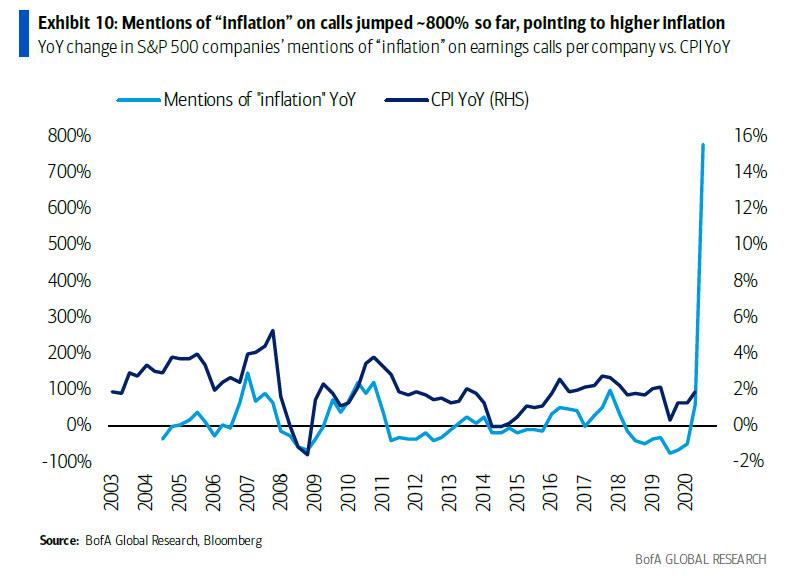
Earlier today we noted that the one thing every company was obsessing during their Q1 earnings call: inflation. As BofA equity strategist Savita Subramanian calculated, mentions of “inflation” quadrupled YoY, and after last week, mentions have exploded nearly 800% YoY. More striking was her observation that as “mentions skyrocket to near record highs from 2011” these point to at the very least, “transitory hyper-inflation ahead.” This is an official statement from a Big-4 bank, not some tinfoil conspiracy blog.

What is more concerning is that not only are companies talking about inflation, they are also responding to soaring input costs by hiking prices either in absolute terms or by stealth shrinkflation.

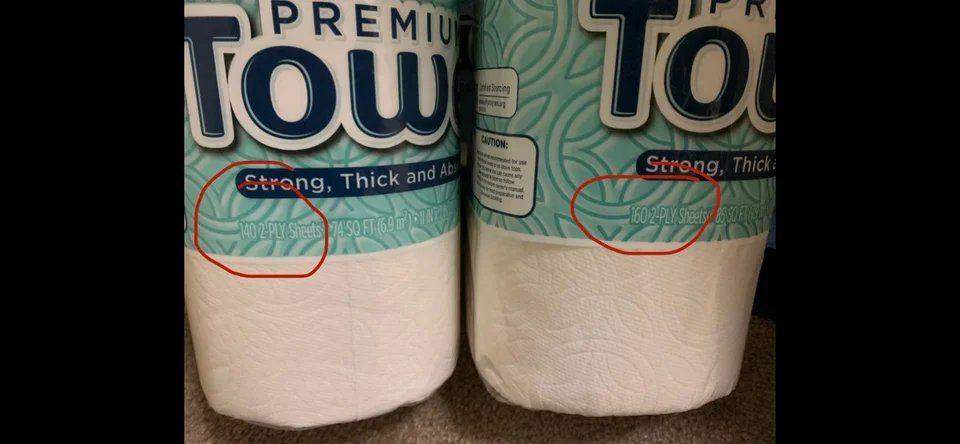
We presented an example of the latter over the weekend when we showed how Costco was masking nearly 15% inflation by selling a paper roll with 140 sheets for the same price it used to sell 160 sheets.

Of course, once companies realize they can get away with such shrinkflation – and they will because as a member of the Red Flag Deals message board pointed out…

I tried telling the clerk at Costco about this, and they said “who cares, it’s just 20 sheets.”

Will be the typical response.

… the obvious next step will be to no longer bother with such attempts at masking double digit inflation, and to hike prices outright until there is an actual decline in supply, or as TBT predicts, “this is the precursor to real inflation next.” And sure enough, names from consumer giants from Kimberly-Clark to Clorox, Procter & Gamble, as well as food makers such as Hormel, JM Smucker, General Mills, Skippy and Hershey are already doing just that.

But don’t worry, according to the Chairman, “it’s transitory.” Or maybe it won’t be, as increasingly more banks are starting to speculate.

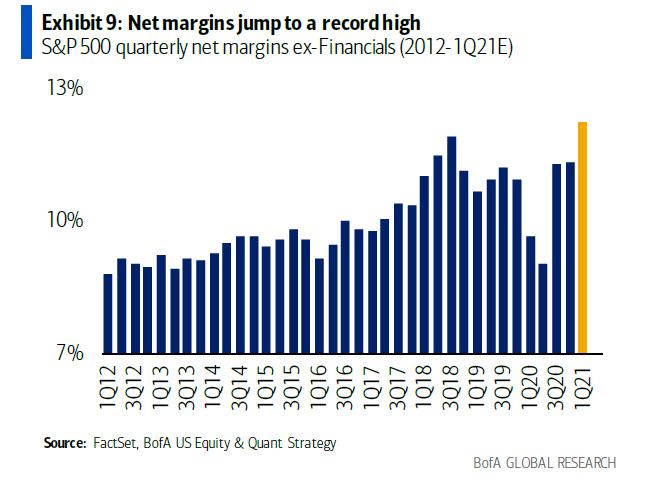
One thing we do know: once companies hike prices, they almost never cut them again. In fact, most companies would rather file for bankruptcy rather than reverse their pricing strategy, especially since among the most striking outcomes of Q1 earnings season are record high profit margins. Well, guess what happens to those margins as input costs continue to soar – either they collapse (and turn negative), or companies hike prices. Guess which choice they will pick.

Finally, courtesy of BofA, here is a list of the companies that have complained in recent weeks about soaring prices most if not all of which have proceeded to pass on price increases to consumers… that would be you dear readers:

  • FAST (Industrials): “we are experiencing significant material cost inflation, particularly for steel, fuel and transportation costs.”

  • GIS (Staples): “Looking ahead, as we experienced higher inflationary environment, our first line of defense will continue to be our strong holistic margin management cost savings program. In addition, we are taking actions now and in the coming months […] to drive net price realization that will benefit our FY2022. “

  • CAG (Staples): “we’re seeing input cost inflation accelerate in many of our categories and across the industry.”

  • LW (Staples): “while the pandemic-related effects on our supply chain were the primary drivers of our cost increases, we also realized higher costs due to input cost inflation in the low single-digits. We expect that rate will begin to tick up in the coming quarters as edible oil and transportation costs continue to increase.”

  • PPG (Materials): “we experienced a significant acceleration of raw material and logistics cost inflation during the quarter. Coming into the year, we were expecting an inflationary environment and had prioritized selling price increases across all of our businesses. This has helped us achieve solid price increases year-to-date. With a higher inflation backdrop, we have already secured further selling price increases and are in the process of executing additional ones during the second quarter. “

  • DOV (Industrials): “What we are going to fight against between now and the end of the year […] is inflationary input costs between raw materials, labor, and price/cost […] the way it’s looking we may have to intervene on price again in certain of the businesses over the balance of the year.”

  • TEL (Tech): “I would expect our margins to modestly improve as we work our way forward here into the third and fourth quarter based on some of the actions that are underway and our ability to combat some of the inflationary pressures out there. […] Certainly, we’re feeling the biggest inflation right now is on the freight side. The freight inflation has been significant. And as we battled through there and there’s a variety of reasons for that including higher air freight and so forth in terms of that. And that’s not unique to TE. Certainly, I think that’s been as well publicized across the overall supply chain. […] labor cost is not a major issue on the inflation side, but labor  availability in certain places that are still being more impacted by COVID continues to drive some inefficiencies.”

  • CMG (Consumer Discretionary): “So, all of that is very, very manageable and we feel like if there is going to be significant increased inflation because of market-driven or because of federal minimum wage, we think everybody in the restaurant industry is going to have to pass those costs along to the customer.”

  • ALLE (Industrials): “This guide incorporates pricing actions to offset direct material inflation, as well as reflecting our supply chain capability to mitigate industry challenges on supply and electronic component shortages. We anticipate that these challenges will persist for the balance of the year, and we will continue to monitor and adapt to changing market conditions.”

  • WHR (Consumer Discretionary): “The global material cost inflation in particular in steel and resins will negatively impact our business by about $1 billion. We expect cost increases to peak in the third quarter.”

  • PNR (Industrials): “All inflation remains high. We have instituted a number of selling price increases across the portfolio that we expect to help mitigate inflation in the second half of the year.”

  • TSCO (Consumer Discretionary): “Compared to our initial outlook for the year, our forecast does reflect higher transportation costs and product inflation. We experienced increasing pressures from these factors during the first quarter and expect them to continue to be a headwind throughout 2021.”

  • POOL (Consumer Discretionary): “We previously said that inflation would be in the 2% to 3% range but now believe it will be in the 4% to 5% with some products into double-digits. We don’t anticipate any of this getting hung up in the channel so that will provide a tailwind for the year. Considering that most of our – most of the cost of constructing a new pool or remodeling an existing pool is tied up in labor we don’t anticipate this inflation having a meaningful effect on demand as it relates to nondiscretionary products such as chemicals, inflation has simply passed through again with no real effects on demand.”

  • LUV (Industrials): “Outside of salary, wages and benefits, the largest drivers of our sequential cost pressure are flight driven cost increases and landing fees, employee, customer and revenue related cost, and maintenance expense…”

  • HON (Industrials): “Yeah, that’s definitely a watch out item for the year. And for us, inflation is taking hold. There’s no doubt about it. We knew it. We see it. It’s real. And if you don’t stay on top of it, the two areas where – and this is not a surprise – steel, semiconductors, copper, ethylene, those are the four elements that we saw substantial inflation in Q1. [..] I can tell you that we stood up a pricing team, which has been in place since the beginning of the year. We’re quickly taking actions and we are staying ahead of it. And we’re going to continue to monitor what happens and stay ahead of it. But it’s a watchout item. I don’t think things are going to abate. The short cycle is definitely hot. We all read the same articles around semiconductors and what’s going on there, and I think we’re going to have to just stay ahead of it. But we do expect an inflationary environment this year. And we’re going to stay ahead of it. That’s our commitment.”

  • CE (Materials): “We’re certainly feeling the inflationary factor. I think, the good news is we anticipated this coming back in the fourth quarter of last year already and started moving prices […] So, although it is an inflationary pressure, we’ve been able to push that through in our pricing and basically maintain the same level of variable margin.”

  • KMB (Staples): “The biggest reason being that our pricing actions and the benefits of that will be coming through the P&L in the second half. In terms of input cost inflation, that is ramping in the first quarter, and the second quarter. We expect that, it will peak and then moderate and, in some cases, come down a bit in the second half.”

  • MDLZ (Staples): “In terms of inflation, there is more inflation coming. And so, profitability is great in Q1. We believe we are going to hit the numbers as we had originally in mind. But the higher inflation will require some additional pricing and some additional productivities to offset the impact, which I believe at this point is absolutely manageable given that all these positions are pretty much hedged for 2021.”

  • SHW (Materials): “On the cost side of the equation we now expect raw material inflation for the year to be in the high-single-digit to low-double-digit range, a significant increase from the low- to mid-single-digit range we communicated in January. And let me just begin by reiterating a little bit what John and Al have been saying. This whole area of raw material inflation is a transitory issue for us. It’s not new for us. We’ve demonstrated an ability to manage through this many times in the past, and we’ll get through this as well.”

  • WM (Industrials): “We do expect that inflation will kick up a little bit, and so we’ll get some help. And we’re typically a beneficiary of higher inflation.”

  • PKG (Materials): “We also anticipate continued inflation with freight and logistics expenses as well as most of our operating and conversion costs. However, energy costs should improve as we move into seasonally milder weather.”

  • MMM (Industrials): “We are also raising prices, but it’s going to take a little bit of time. The inflation has come in faster. So you’re going to see 75 to 125 basis points of headwind which is the net of price versus inflation and logistics.” “On supply chain disruption, there are two pieces. One is of course the inflation that we’ve told you about which will cost 75 to 125 basis points of headwind between price and inflation and the raw material and logistics costs as well as making sure that we have all the product availability that we have. So that’s the other, I would say, headwind to 1Q.”

  • PHM (Consumer Discretionary): “We have updated our guide in terms of what the inflationary aspect of the sticks and bricks is. We have been at or near 5%, 6%. We’re now 6% to 8%. And depending what lumber does, that could move a little bit even higher than that.”

  • F (Consumer Discretionary): “We’re definitely feeling the commodity headwind, as John said. And inflation, it feels like we’re seeing inflation in variety parts of our industry kind of in ways we haven’t seen for many years. On the other hand, it feels like it’s all due to a lot of one-timers as the economy comes out of lockdown. So I think it’s a bit too early to declare the run rate or where it’s going to be. It’s just too hard to tell from my standpoint.”

  • AVY (Materials): “supply chains have remained tight and input costs have been increasing. As a result, raw material and freight inflation were above our initial expectations. And we have continued to see costs rise as we entered the second quarter We now expect mid to high single digit inflation for the year with variations by region and product category.”

  • IDX (Health Care): “I would say on the inflationary front, it’s kind of spotty for us. I mean remember we’re a little further down the food chain. We don’t buy a lot of giant quantities of base material. We buy things that have been converted, so it does have a little bit of a lag for us. And so we see the same things others are seeing where we buy lots of metals. There’s some inflationary pressure; electronics, a few other places but we’re navigating around those on the freight side. That’s certainly a challenge both on the price, frankly more on the availability side. […] We’re no different than anybody else trying to find sea containers, trucking, trains, port facilities that have to unclog all of those things. Our model helps us. Our folks help us. I think as we go further out, the inflationary pressure, I actually think that’s going to ramp up a bit for everybody.”

  • SWK (Industrials): “As many of you follow, steel and resin represent the two largest commodity exposures and they have been impacted by rapid spot market increases as the global supply chain response to the surge of demand and temporary supply gaps. This dynamic has occurred across many of our key commodities, components, finished goods that we purchase. We now expect inflation headwinds to approximate $235 million, which is up $160 million versus our previous outlook of $75 million.”

  • MAS (Industrials): “We have seen significant inflation in raw materials, namely copper, zinc, and resin, used in both our paint and plumbing businesses as well as increases in freight costs. All in, we expect our raw material and freight costs to be up in the  mid single-digit range for the full year for both our Plumbing and Decorative segments, with inflation likely reaching high single-digit levels in both segments in the third and fourth quarters.”

We can’t wait for all the above companies to cut prices as soon as the “transitory” period is over.

Tyler Durden
Tue, 05/04/2021 – 17:05

via ZeroHedge News https://ift.tt/2Rr3ekE Tyler Durden

Texas “Critical Race Theory” Opponents Fight Back, Win School Board Election

Texas “Critical Race Theory” Opponents Fight Back, Win School Board Election

Authored by Isabel van Brugen via The Epoch Times,

Two candidates opposed to teaching critical race theory (CRT) in public school classes have been elected to a Texas school board.

Nine months after Hannah Smith and Cameron “Cam” Bryan introduced a proposal to prevent teaching CRT in the Dallas-area Carroll Independent School District, the pair received nearly 70 percent of the vote in their respective races, winning two seats on the board.

The election came after a 2018 video surfaced showing two students shouting the N-word. The district in response proposed a “Cultural Competency Action Plan,” drawing backlash from parents and the two candidates, who vocally criticized CRT.

Some parents argued during school board meetings that the district’s proposal, which would require diversity and inclusion training, would create “diversity police” and discriminate against white children.

Smith and Bryan won Saturday’s election in landslide, taking two open school board spots.

“The voters have come together in record-breaking numbers to restore unity,” said Smith, a Southlake attorney and former clerk for Supreme Court Justice Samuel Alito.

“By a landslide vote, they don’t want racially divisive critical race theory taught to their children or forced on their teachers. Voters agreed with my positive vision of our community and its future.”

Smith’s opponent, Erik Hernandez, said after the vote that he was worried about how the result would impact students in the affluent school district.

“I don’t want to think about all these kids that shared their stories, their testimonies,” Hernandez said.

“I don’t want to think about that right now because it’s really, really hard for me. I feel really bad for all those kids, every single one of them that shared a story. I don’t have any words for them.”

The news comes as a growing number of Republican leaders nationwide have said they aim to ban the teaching of CRT in schools, workplaces, and government agencies.

President Joe Biden, in one of his first executive actions in the White House, rescinded his predecessor’s ban of CRT in federal workplaces. Former President Donald Trump’s September 2020 executive order declared that diversity and inclusion training for federal employees should not promote “un-American” and “divisive concepts.”

Biden instead issued an executive order stating that the federal government must pursue “a comprehensive approach to advancing equity for all.”

CRT has gradually proliferated in recent decades through academia, government structures, school systems, and the corporate world. It redefines human history as a struggle between the “oppressors” (white people) and the “oppressed” (everybody else), similarly to Marxism’s reduction of history to a struggle between the “bourgeois” and the “proletariat.” It labels institutions that emerged in majority-white societies as racist and “white supremacist.”

Like Marxism, it advocates for the destruction of institutions, such as the Western justice system, free-market economy, and orthodox religions, while demanding that they be replaced with institutions compliant with the CRT ideology.

In February, the Chinese American Citizens Alliance of Greater New York condemned CRT, describing it as an outgrowth of the European Marxist school of critical theory that interprets American social and political life through the lens of a power struggle between the race of the oppressor and that of the oppressed.

Proponents of CRT have argued that the theory is merely “demonstrating how pervasive systemic racism truly is.”

On Thursday, the Oklahoma House voted to ban public schools and universities from teaching CRT. The bill, HB1775, now heads to Gov. Kevin Stitt’s desk to be signed into law. He has received requests to veto the bill.

Days earlier, Idado Gov. Brad Little signed into law a bill, H 377 (pdf), that would prevent the teaching of CRT in the Gem State’s public schools and universities.

And last month, Florida Gov. Ron DeSantis denounced CRT as hateful.

“There’s no room in our classrooms for things like critical race theory,” he said, announcing that the state’s new civic curriculum will explicitly exclude critical race theory.

“Teaching kids to hate their country and to hate each other is not worth one red cent of taxpayer money.”

Tyler Durden
Tue, 05/04/2021 – 16:45

via ZeroHedge News https://ift.tt/3nYvnvH Tyler Durden
WTI Extends Gains After Biggest Crude Draw Since January

WTI Extends Gains After Biggest Crude Draw Since January

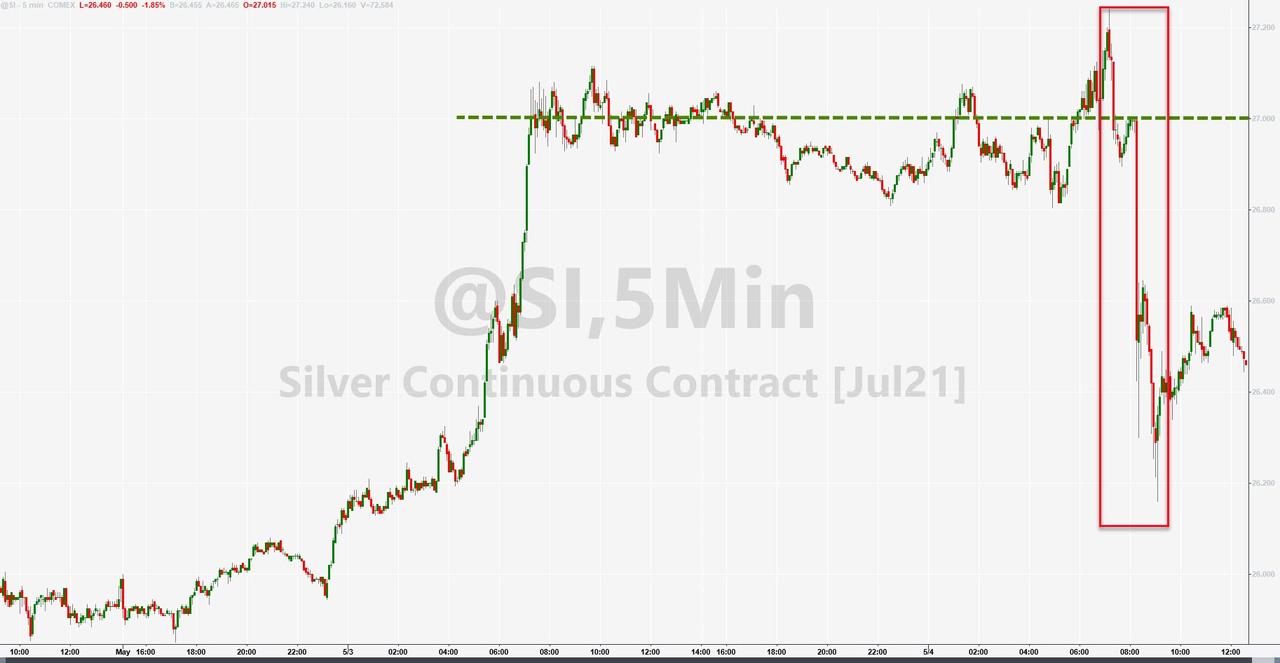
A stronger dollar and a hawkish Yellen were not enough to slow oil’s rebound as more US states eased lockdowns and the European Union sought to attract more travellers, which would help offset weakened fuel demand in India as COVID-19 cases soar.

“Gasoline inventories in the U.S. are well below where they were a year ago and we’ve taken out refinery capacity,” said Peter McNally, global head for industrials, materials and energy at Third Bridge.

“We’ve seen the impact on demand as more people get vaccinated, so we’re going to get that tailwind plus seasonality coming later this month.”

While OPEC kept its crude production steady in April, ahead of a planned output hike this month, all eyes will be on signs of demand picking up in US crude stocks.

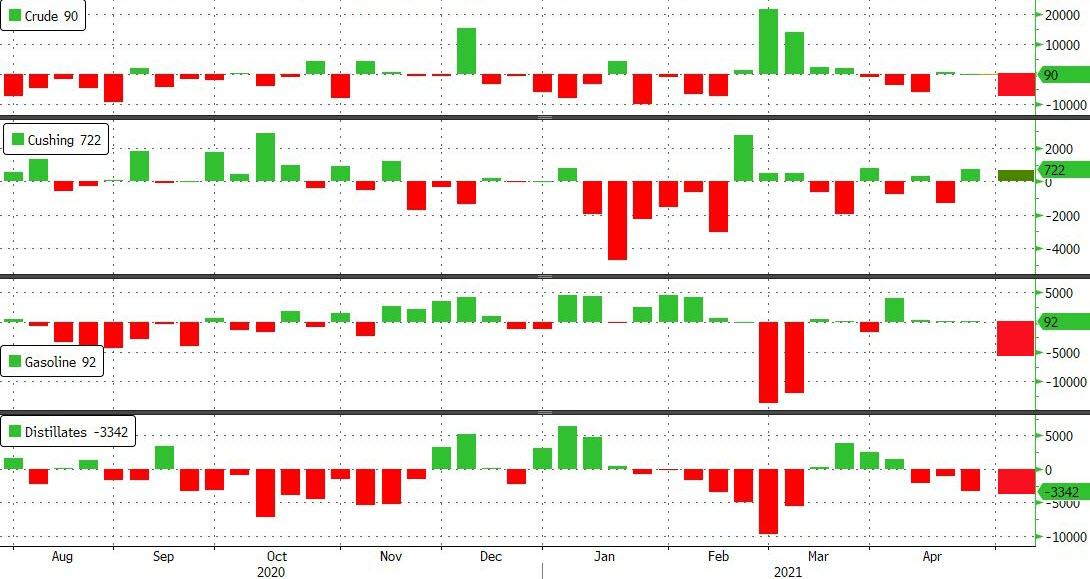
API

  • Crude -7.688mm

  • Cushing +548k

  • Gasoline -5.308mm

  • Distillates -3.453mm

The last few weeks have seen very modest changes in crude stocks and analysts expected inventories to have fallen last week, and it did in a big way. Crude stocks fell 7.688mm barrels – the biggest weekly draw since January

Source: Bloomberg

Solid gains for WTI today left it hovering at the highs of the day around $65.75 ahead of the API print – its highest since mid-March – and extended gains above $66 after the data.

“The news from Europe on the outlook toward reopening is providing a good sense of optimism for global demand continuing to rise,” said Gary Cunningham, director at Stamford, Connecticut-based Tradition Energy.

Tyler Durden
Tue, 05/04/2021 – 16:35

via ZeroHedge News https://ift.tt/2POT4d7 Tyler Durden

Lyft Soars After Beating Estimates; On Verge Of Cashflow Breakeven

Lyft Soars After Beating Estimates; On Verge Of Cashflow Breakeven

With the world slowly emerging from the covid pandemic, ridesharing services are seeing an impressive return to normalcy as the just released results from Lyft showed.

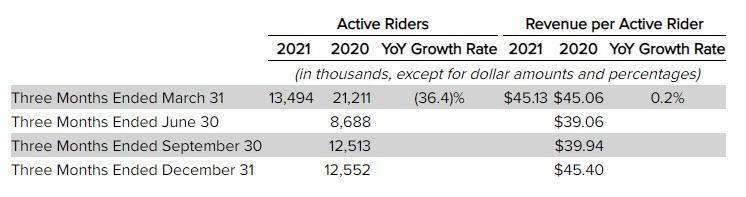
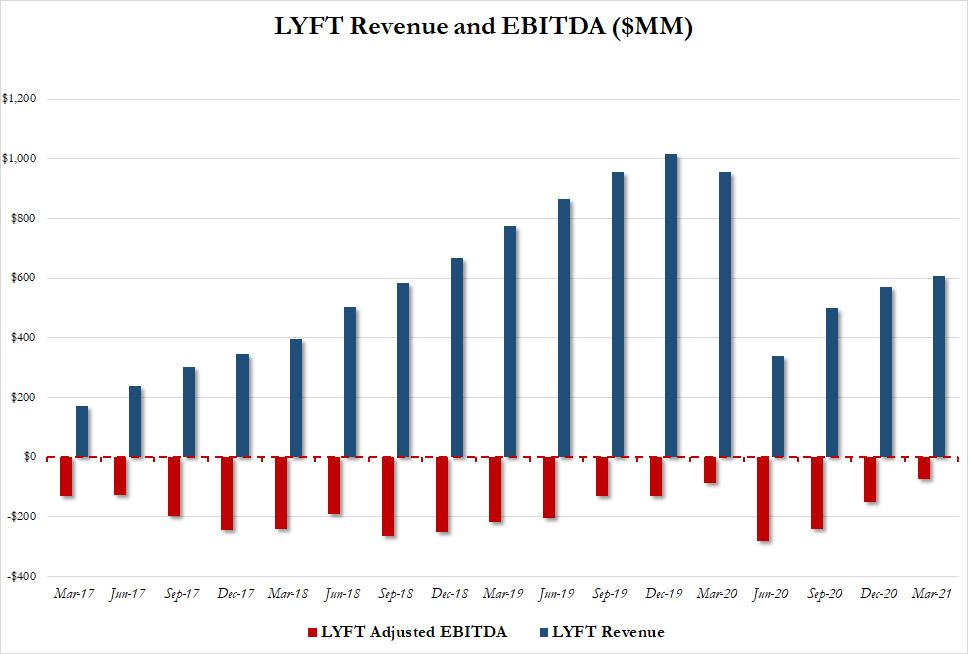
After seeing its revenue crash as much as 61% in the first full post-covid quarter, moments ago Lyft reported that in Q1 2021, earnings were down 36% from a year ago (and up 7% from Q4), the smallest decline in a year, even if total revenues of $609MM (which beat exp of $557.3MM) were still some $350MM shy of the $955MM it made a year ago, thanks to 13.5 million active riders, above the estimated 12.7 million.

Some more Q1 earnings details:

  • Adjusted net loss for Q1 2021 was $114.1 million versus an adjusted net loss of $97.4 million in the first quarter of 2020.
  • Lyft reported Contribution for Q1 2021 of $337.3 million versus $547.4 million in the first quarter of 2020, down 38 percent year-over-year but up 7 percent from $316.0 million in Q4 2020. Contribution Margin for Q1 2021 was 55.4 percent, which was down by 1.9 percentage points year-over-year but down by just 10 basis points quarter-over-quarter. Contribution Margin for Q1 2021 exceeded the Company’s outlook of 51 to 51.5 percent1.
  • Lyft reported $2.2 billion of unrestricted cash, cash equivalents and short-term investments at the end of the first quarter of 2021, roughly unchanged on the quarter.

But what was most impressive, was the remarkable improvement in EBITDA, which shrank to just a loss of $73MM, nearly half the expected loss of $143.5MM, and on pace to turn cash flow positive despite still generating well below pre-covid revenues.

The company’s revenue and EBITDA over time:

“The improvements we’ve made over the last year are paying off – we’ve built a much stronger business. As the recovery continues, we are confident that we will be able to deliver strong financial results” said Logan Green, co-founder and chief executive officer of Lyft.

“We had an exceptionally strong Q1 as more people started moving again. Our results meaningfully exceeded our outlook driven by elevated demand across our network,” said Brian Roberts, chief financial officer of Lyft.

“With the pending sale of our Level 5 self-driving division, Lyft is set up to win the transition to autonomous through our hybrid network of human drivers and AVs, advanced marketplace tech, and leading fleet management capabilities,” said John Zimmer, co-founder and president of Lyft.

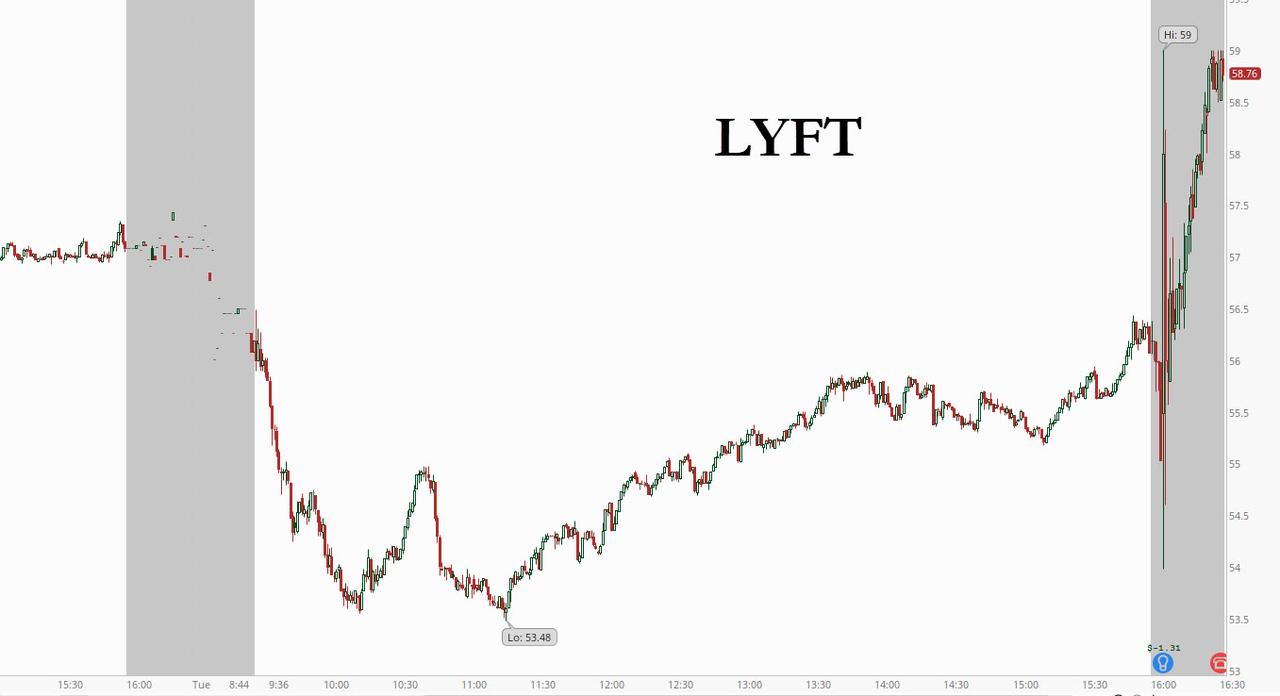
Remarkably, unlike most of its covid vaccine beneficiary peers who have seen their stock tumble despite beating, LYFT shares jumped after hours, rising as high as $59 after closing at $56 in the regular session…

… although the company’s announcement that it plans to increase driver incentives in the coming months – i.e., hike net pay, could end up hitting the stock once the news is digested.

Tyler Durden
Tue, 05/04/2021 – 16:34

via ZeroHedge News https://ift.tt/3eiwxi2 Tyler Durden
May The Fourth Be Not With The Doves

May The Fourth Be Not With The Doves

As many celebrate Star Wars Day, Janet Yellen stepped up to the plate to deliver, warning that “interest rates will have to rise to ensure the economy does not overheat.”

“I felt a great disturbance in the farce, as if millions of dovish voices suddenly cried out in terror and were suddenly silenced.”

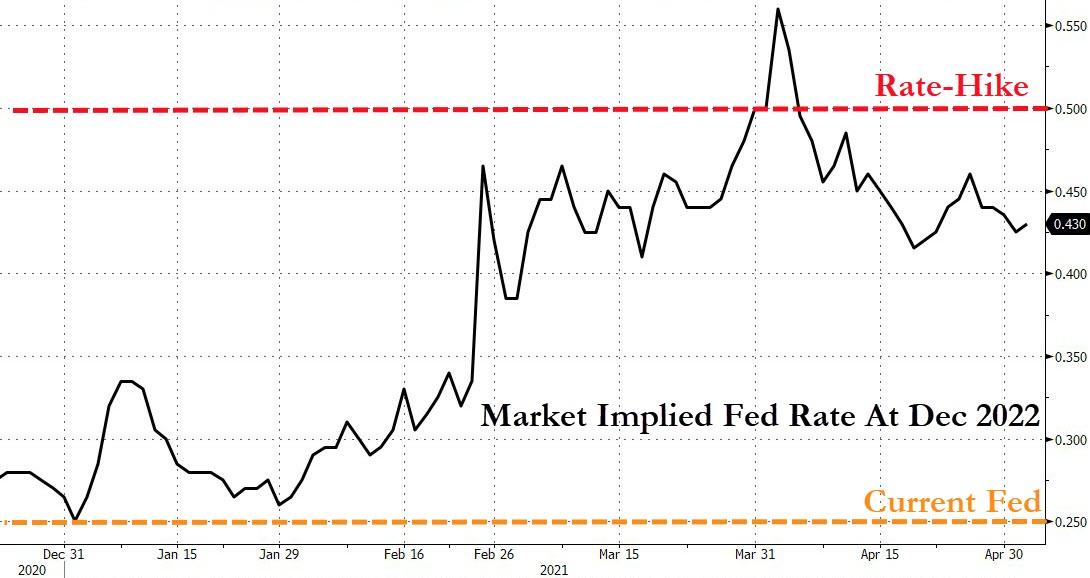
Bear in mind that money-markets have been discounting a rate-hike far sooner than The Fed’s dot-plot forecast would suggest for months…

Source: Bloomberg

“Every client call I’m on including the one I just finished … is talking about overheating,” CNBC cited BackRock’s CIO Rick Rieder as saying.

So this move today is more of a wake-up call for stocks than anything else. The Dow scrambled back to unchanged (King Kong Yellen ain’t got shit on me…). Nasdaq suffered its worst day since mid-March and is down 5 of the last 6 days…

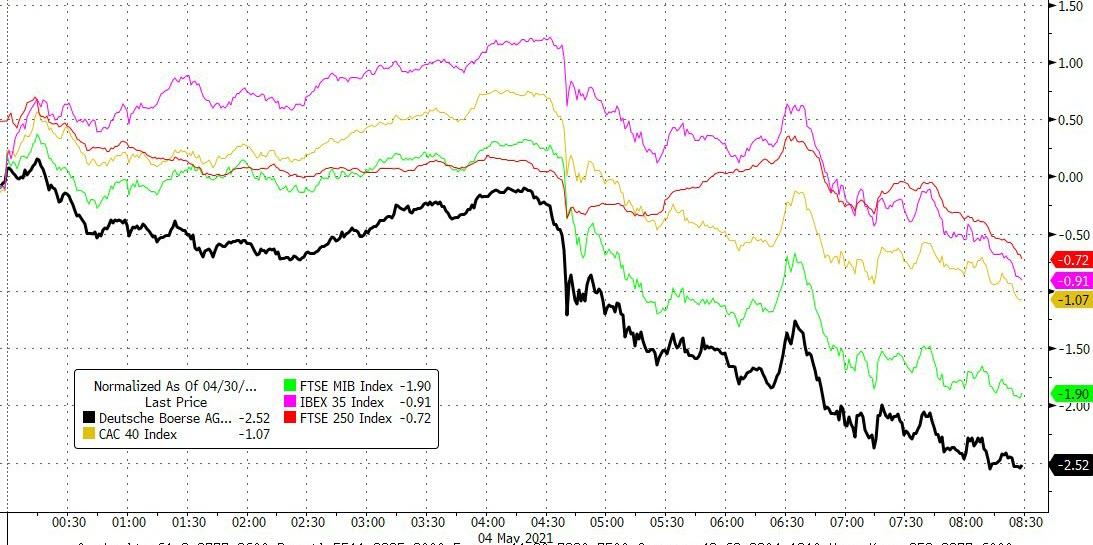
European stocks also puked…

Source: Bloomberg

“Dammit, Janet!”

We do note that we suspect a “just kidding” clarification is coming as The White House confirmed that Yellen will join the press briefing on Friday. Press Secretary Psaki says the Biden administration takes “inflationary risk incredibly seriously.”

Fed’s Kaplan continued his ‘cover your ass’ warnings:

  • *KAPLAN: SHOULD BE AWARE OF IMPACT OF LOW RATES ON ASSET PRICES

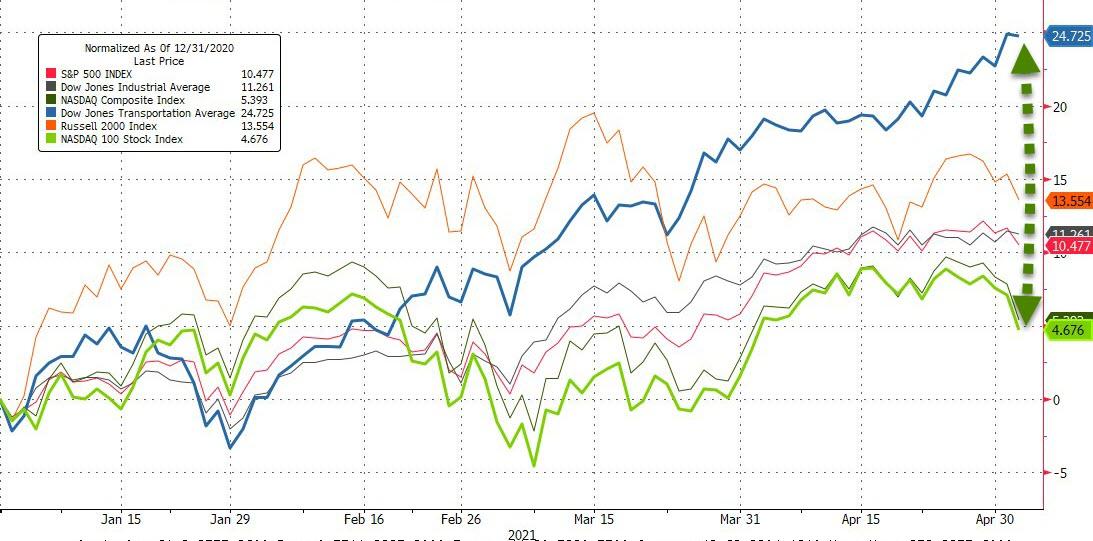
Year-to-date, Nasdaq 100 is the laggard now, up 4.7%… while Dow Transports are up a stunning 24.7%…

Source: Bloomberg

Seems like Biden’s Tax malarkey took the shine off the Growth trade…

Source: Bloomberg

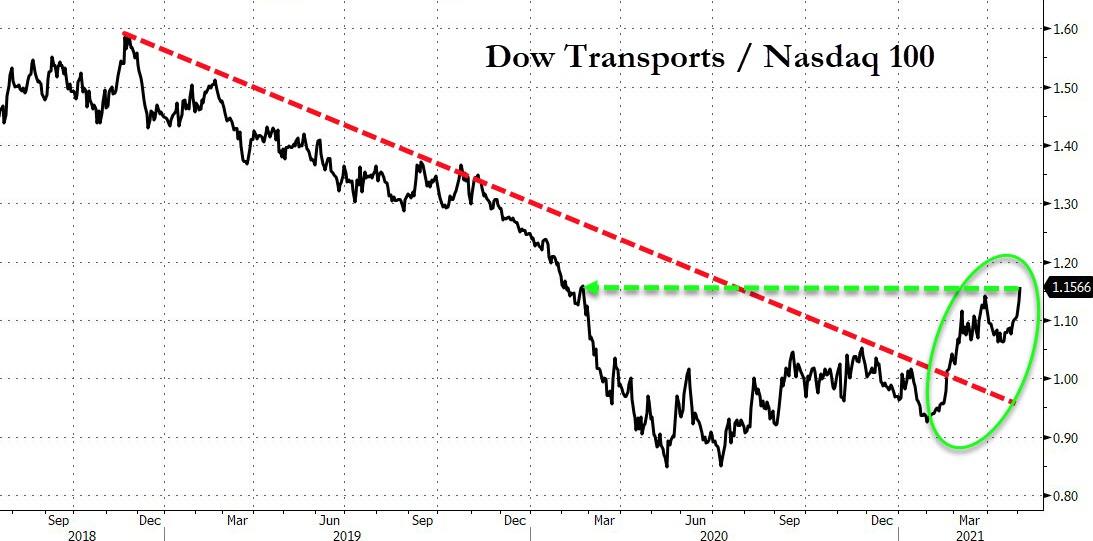
Trannies have regained all their relative underperformance versus Nasdaq 100 since March 2020…

Source: Bloomberg

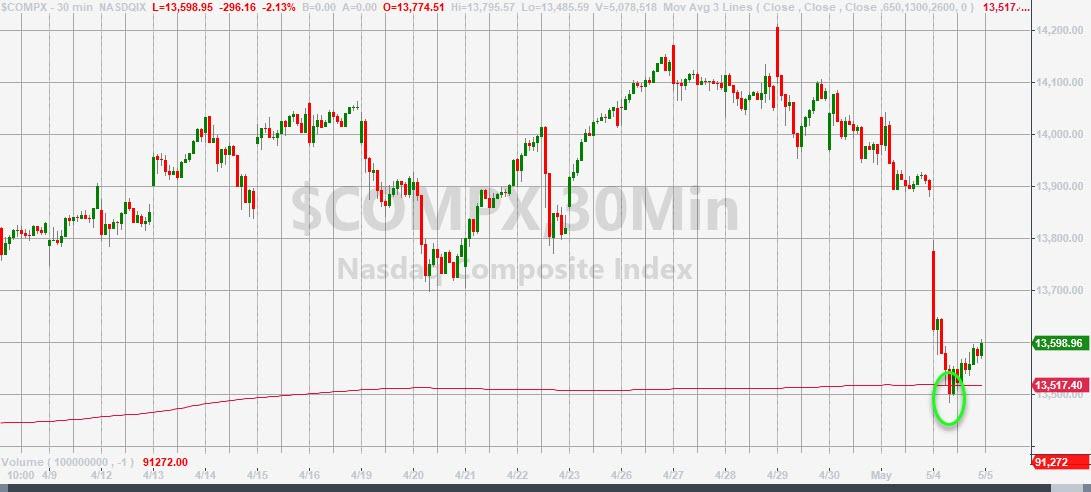
The Nasdaq found support at its 50DMA…

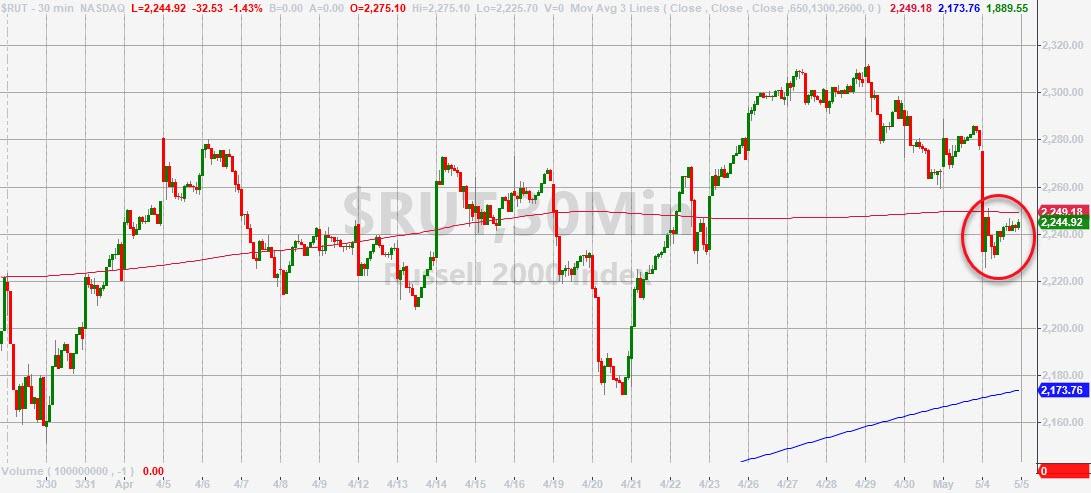
Russell 2000 broke below its 50DMA (and didn’t recover)…

“Most Shorted” stocks are down 6 straight days and today was the biggest drop since March…

Source: Bloomberg

FAAMG stocks were hammered…

Source: Bloomberg

Semis are down 5 of the last 6 days and broke below key technical levels today…

Source: Bloomberg

Ether continued its recent rampage to new record highs (above $3500) before falling after Yellen’s comments…

Source: Bloomberg

Bitcoin was clubbed like a baby seal…

Source: Bloomberg

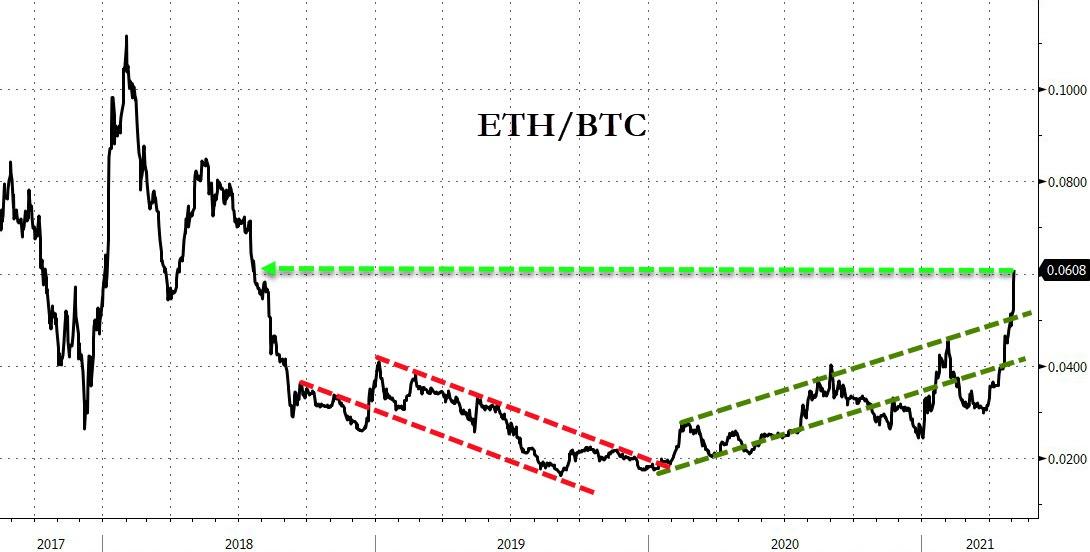
BTC’s weakness relative to ETH sent the ratio soaring once again…

Source: Bloomberg

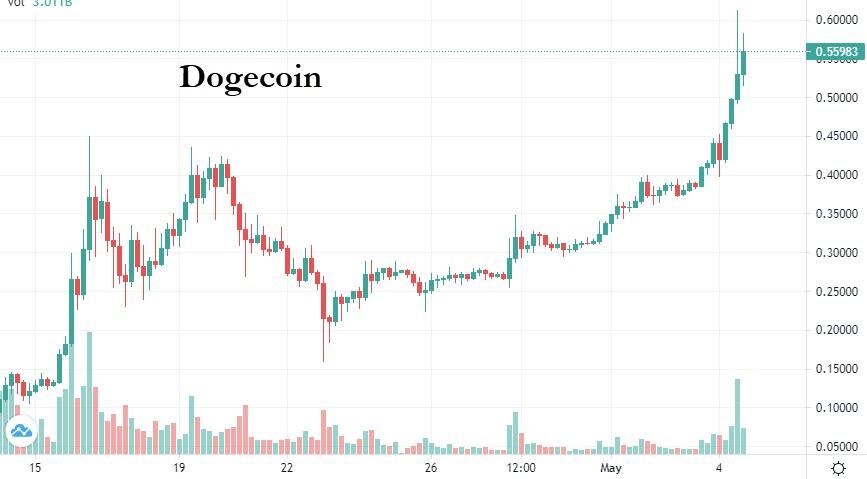
Meanwhile, Dogecoin ripped to become the 4th largest cryptocurrency…

Source: Bloomberg

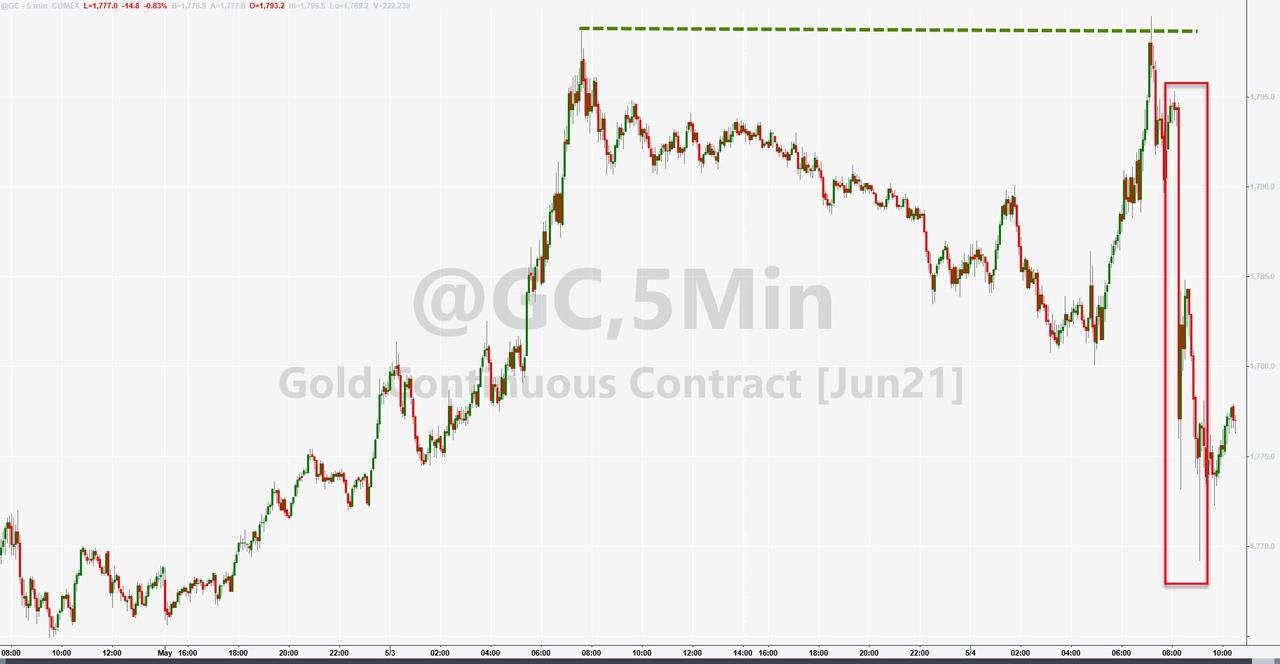
And bullion was battered on Janet’s jawboning…

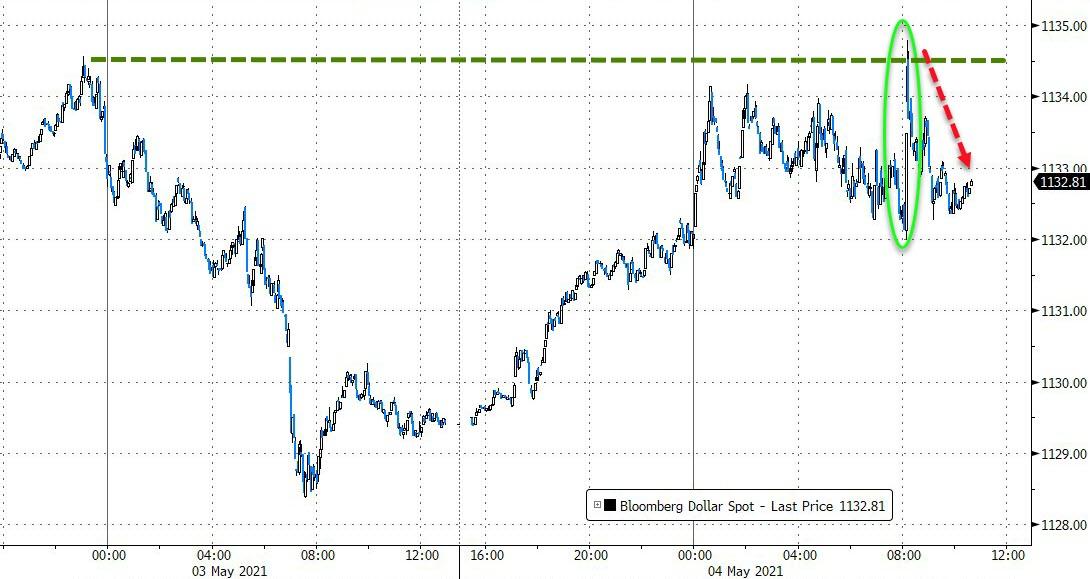
The dollar spiked on Yellen’s comments but gave it all back after running stops from yesterday’s highs…

Source: Bloomberg

Treasury yields were all lower today, led by the long-end (30Y -3bps). NOTE, very similar pattern to yesterday in terms of buying and selling..

Source: Bloomberg

10Y Yield dropped back below 1.60%(though chopped around a little on Yellen’s comments)…

Source: Bloomberg


Source: Bloomberg

WTI managed gains today, unfazed by Yellen, holding above $65 ahead of tonight’s API inventory data…

Silver lost $27 today…

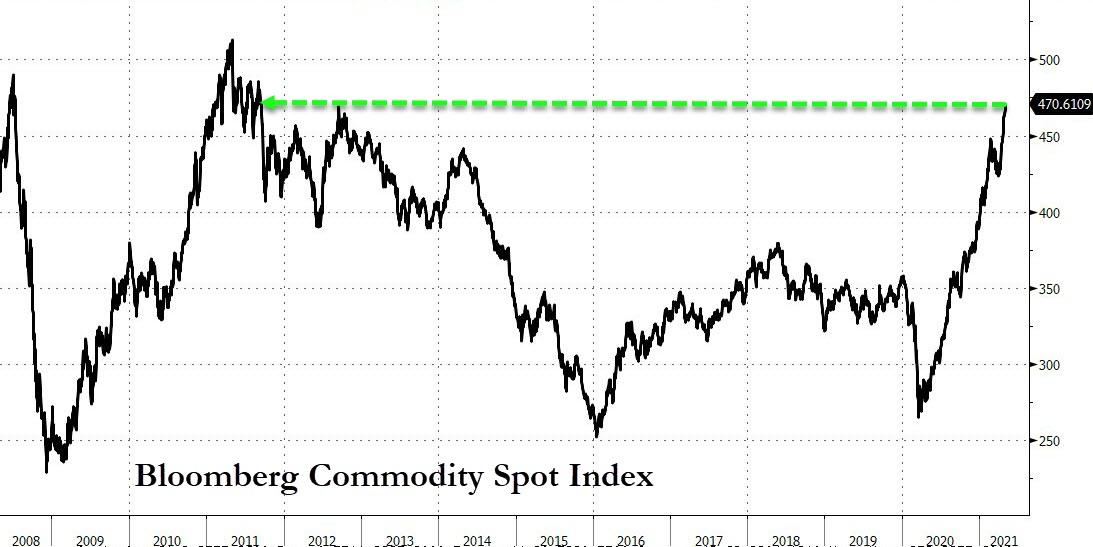
Bloomberg’s Commodity Spot Index continued its surge to the highest since 2011…

Source: Bloomberg

Finally, we wonder how investors would cope if the S&P 500 were to fall back to its global liquidity support level (only around 3900)?

Source: Bloomberg

Tyler Durden
Tue, 05/04/2021 – 16:00

via ZeroHedge News https://ift.tt/3h2WhB4 Tyler Durden
“You’ll Never Be White” – Black Teacher’s Racist Rant Highlights Need To Equip All Officers With Body Cameras

“You’ll Never Be White” – Black Teacher’s Racist Rant Highlights Need To Equip All Officers With Body Cameras

Authored by Jonathan Turley,

For years, I and others have argued for body camera (and police interrogation cameras) to be used in every jurisdiction. Despite the obvious value of such cameras, jurisdictions like Los Angeles County have resisted and still do not have this basic protection for both officers and citizens alike. Likewise, prosecutors in cities like Chicago long opposed the filming of officers by citizens.

The recent controversy over a traffic stop in L.A. shows the importance of such body cameras. In the video, an officer pulls over a self-described teacher for using her cellphone while driving and is met with a barrage of racist slurs. The officer was only able to show his side in the encounter because he paid for his own camera. It is absurd that Los Angeles County forces officers to pay for their own cameras to guarantee a record of such encounters.  In LA County, it is bring your own camera (BYOC) or engage in policing at your own risk.

The African-American teacher is shown in the video immediately attacking the hispanic officer with a litany of racist slurs and insults from repeatedly calling him a “murderer”…

“Yes, I started to record because you’re a murderer,” she says.

“You’re threatening to kill me and my son,” she says at one point in the encounter.

…and then it escalated as the woman is heard telling the deputy,

“You’re always going to be a Mexican. You’ll never be white, you know that, right?”

“You’ll never be white, which is what you really want to be,” she says after signing a citation. “You want to be white.”

Police say the woman is well known for bringing baseless charges against officers.

Here is the body cam video of the April 23 incident in San Dimas:

The officer remains calm despite the litany of insults.

My anger at the video was not just over the racist slurs but the fact that this officer had to equip himself in Los Angeles.

As many of us have argued for 20 years, these cameras protect officers and the public alike. If this officer did not have this videotape, this could have been an incident where there are two wildly different accounts between the driver and the officer. If a harassment claim is filed, the matter would likely be treated as unproven rather than untrue. It would remain on the officer’s record that he was accused for racism and harassment.

Yet, there is no anger at the political leaders in Los Angeles County for the failure to supply this basic piece of equipment. Last year was the first deployment of body cameras in the city for LA sheriffs. Los Angeles police officers began using body cameras in 2015.

While many politicians are now calling for body cams, it was not long ago that they remained silent on the issue or failed to object (or joined) as police departments demanded delays in the release of such records.  In April 2018, the LAPD began releasing body cam footage to the public from officer-involved shootings.

One of the issues delaying such deployment has been the insistence of officers to have greater control in turning on and off cameras. There should be no such debate in terms of the cameras operating as all times in public movements and encounters.

Tyler Durden
Tue, 05/04/2021 – 15:45

via ZeroHedge News https://ift.tt/3tpnS1W Tyler Durden

Service Corp Soars To Record As Funeral Company Sees Spike In “Deathcare”

Service Corp Soars To Record As Funeral Company Sees Spike In “Deathcare”

While most Americans have suffered amid the dreadful misery of COVID’s impact (and the policymakers’ responses), there is one group that is benefiting… albeit somewhat morosely.

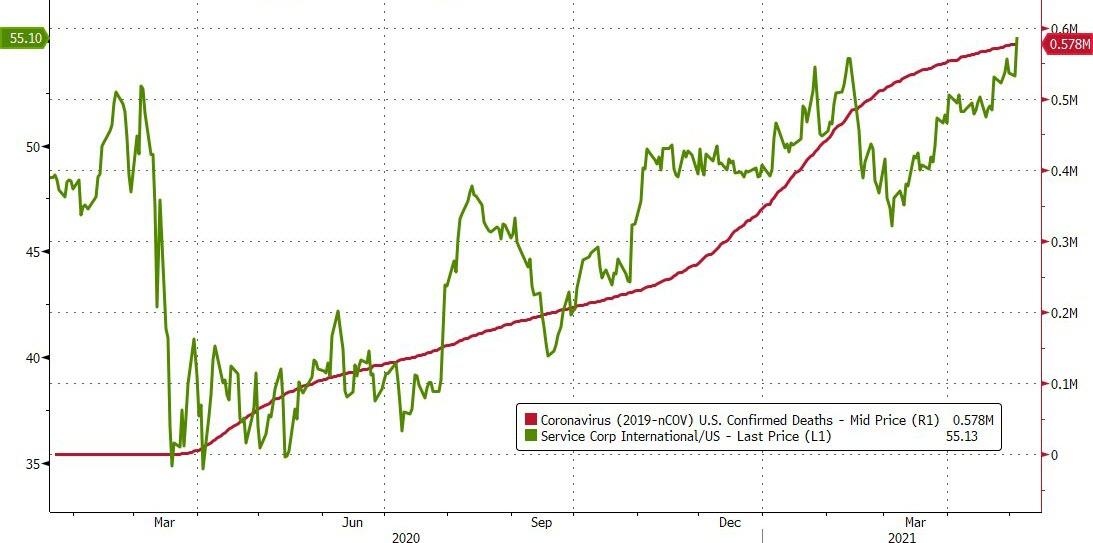
Service Corp. International surged almost 5% to a new record high this morning after the funeral and cemetery services company announced a big beat on earnings and raised its 2021 outlook.

Both funeral and cemetery segments saw better-than-expected revenue growth on strong pre-need sales, while gross margins also beat expectations on strong cost management and higher volumes, according to Raymond James analyst John W. Ransom.

Source: Bloomberg

Service Corp’s Statement:

Today we are reporting earnings per share of $1.33 and net cash provided by operating activities of $298 million for the quarter. The $0.88 growth in earnings per share in the quarter was primarily driven by increased comparable pre-need cemetery sales production and continued elevated COVID-19 mortality, which resulted in an increase in both funeral services performed and burials in our cemeteries.

Comparable pre-need cemetery sales production grew $130 million, or 67%, during the quarter driven by an increase in sales velocity, sales averages, and large sales activity. Net cash provided by operating activities grew approximately $118 million over the prior year quarter, primarily due to increased operating profit.

Based on our first quarter results, we are raising the midpoint of our full year adjusted earnings per share guidance fifteen cents to $2.85 and the midpoint of our adjusted operating cash flow guidance to $687.5 million.

Finally, we wonder, given the success of the vaccination program – and the concomitant collapse in cases, hospitalizations, and deaths…

Source: Bloomberg

…what exactly is Service Corp betting on for the rest of 2021 that prompted them to raise the full-year earnings expectations?

Tyler Durden
Tue, 05/04/2021 – 15:30

via ZeroHedge News https://ift.tt/3eiJ99a Tyler Durden

“Use It Or Lose It” – New White House Policy Pressures States To Ensure Vaccine Adoption

“Use It Or Lose It” – New White House Policy Pressures States To Ensure Vaccine Adoption

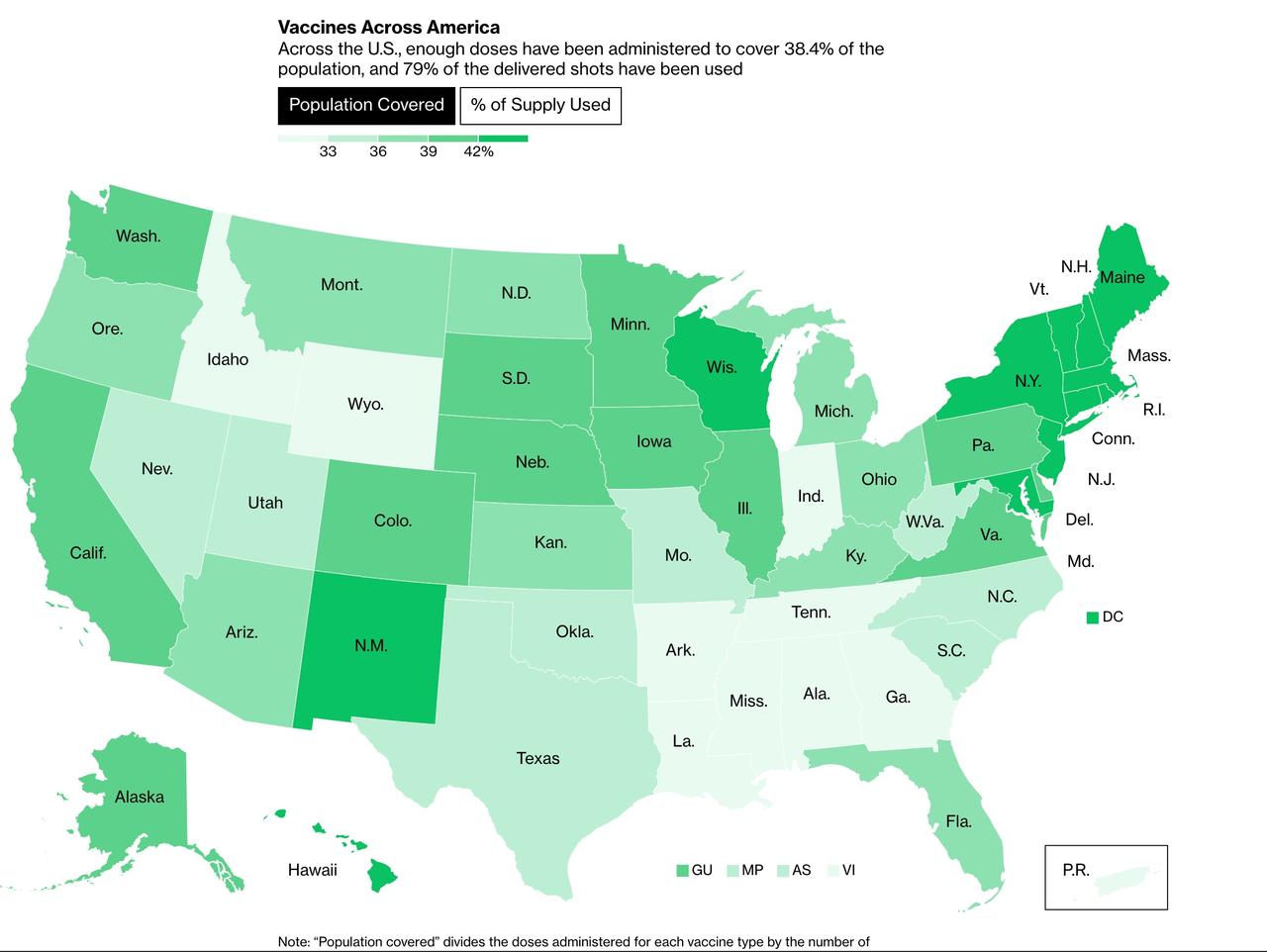
As states resort to cash rewards and other tactics to try and encourage reluctant (or just plain lazy) adults to get their COVID-19 jabs, the White House on Tuesday just upped the pressure, warning the (mostly red) states that have lagged in the vaccine rollout in recent weeks that the federal government will start allocating unordered vaccines to other states.

The Washington Post described the change in policy as “the most significant shift in domestic vaccine distribution” since Biden took office, and “part of an effort to account” for flagging demand in parts of the country.

According to the new plan, each state’s share of the total US adult population will still determine weekly allocations.

But instead of allowing unordered doses to carry over week-to-week, the White House will instead steer untapped vaccines into a federal bank available to states where demand continues to outstrip supply. Those states will be able to order up to 50% above their weekly allocation.

The “use it or lose it” strategy could put more pressure on states to make sure their citizens accept the vaccines, even prompting them to try different strategies, like abandoning mass vaccination sites in favor of sending jabs to small private practices where patients can receive the vaccine from their regular doctor. Doctors have been mulling these alternative distribution strategies, warning that it could increase the costs associated with mass vaccination. However, in order to reach the 70% threshold for artificial herd immunity, there might not be another option.

Last week, Arkansas declined its entire allotment of COVID-19 jabs as demand ebbed. States in the deep south have reported the fewest vaccinations per capita in recent weeks, leading the national pull back as the US reports roughly 2MM vaccinations per day, roughly half of the 4MM at the peak.

Just before leaving office, President Trump and his administration had settled on an incentive plan that would have rewarded states that used up their vaccine allotments with more jabs. However, President Biden scrapped that plan because his team worried about the political optics.

Source: Bloomberg

As part of the new policy, pharmacies will have more control over the redistribution of doses, which in theory should help states redistribute supply to areas where demand is greatest.

Guidelines for the federal program had made 80% of the supply going to pharmacies tethered to a state’s population and the other 20% available for pharmacies to reallocate. Moving forward, only a majority of the supply will be based on a state’s population, and pharmacies will have discretion over as much as 49%.

Tyler Durden
Tue, 05/04/2021 – 15:15

via ZeroHedge News https://ift.tt/33smt01 Tyler Durden

“Use It Or Lose It” – New White House Policy Pressures States To Ensure Vaccine Adoption

“Use It Or Lose It” – New White House Policy Pressures States To Ensure Vaccine Adoption

As states resort to cash rewards and other tactics to try and encourage reluctant (or just plain lazy) adults to get their COVID-19 jabs, the White House on Tuesday just upped the pressure, warning the (mostly red) states that have lagged in the vaccine rollout in recent weeks that the federal government will start allocating unordered vaccines to other states.

The Washington Post described the change in policy as “the most significant shift in domestic vaccine distribution” since Biden took office, and “part of an effort to account” for flagging demand in parts of the country.

According to the new plan, each state’s share of the total US adult population will still determine weekly allocations.

But instead of allowing unordered doses to carry over week-to-week, the White House will instead steer untapped vaccines into a federal bank available to states where demand continues to outstrip supply. Those states will be able to order up to 50% above their weekly allocation.

The “use it or lose it” strategy could put more pressure on states to make sure their citizens accept the vaccines, even prompting them to try different strategies, like abandoning mass vaccination sites in favor of sending jabs to small private practices where patients can receive the vaccine from their regular doctor. Doctors have been mulling these alternative distribution strategies, warning that it could increase the costs associated with mass vaccination. However, in order to reach the 70% threshold for artificial herd immunity, there might not be another option.

Last week, Arkansas declined its entire allotment of COVID-19 jabs as demand ebbed. States in the deep south have reported the fewest vaccinations per capita in recent weeks, leading the national pull back as the US reports roughly 2MM vaccinations per day, roughly half of the 4MM at the peak.

Just before leaving office, President Trump and his administration had settled on an incentive plan that would have rewarded states that used up their vaccine allotments with more jabs. However, President Biden scrapped that plan because his team worried about the political optics.

Source: Bloomberg

As part of the new policy, pharmacies will have more control over the redistribution of doses, which in theory should help states redistribute supply to areas where demand is greatest.

Guidelines for the federal program had made 80% of the supply going to pharmacies tethered to a state’s population and the other 20% available for pharmacies to reallocate. Moving forward, only a majority of the supply will be based on a state’s population, and pharmacies will have discretion over as much as 49%.

Tyler Durden
Tue, 05/04/2021 – 15:15

via ZeroHedge News https://ift.tt/33smt01 Tyler Durden