Ex-NFL Player Behind Horrific Mass Murder-Suicide In South Carolina Home

Ex-NFL Player Behind Horrific Mass Murder-Suicide In South Carolina Home

There were shocking headlines of another mass shooting Thursday morning – this time at a home in a suburb of Charlotte, N.C. – but it was only later in the afternoon that police identified that a longtime professional football player was behind the murder rampage and suicide

Ex-NFL player Phillip Adams killed five people and wounded a sixth victim on Wednesday before turning the .45-caliber handgun on himself. He shot a prominent doctor that was reported to have been treating Adams as well as his wife and their two grandchildren, before later killing himself after he sough refuge in his parents’ house with police outside. Another man who had been working at the house was also shot and pronounced dead at the scene. 

Phillip Adams in 2010 when he played for the San Francisco 49ers, via AP

York County Sheriff Kevin Tolson during an initial news conference said “there’s nothing right now that makes sense to any of us,” and indicated police have yet to identify a motive

However, Adams’ distraught father told a local television station that injuries sustained during his football career are to blame

“I can say he’s a good kid — he was a good kid, and I think the football messed him up,” Alonzo Adams told WCNC-TV. “He didn’t talk much and he didn’t bother nobody.”

A brief review of the NFL player’s career for multiple teams is as follows: 

Adams, a cornerback, played in college for South Carolina State. The San Francisco 49ers picked him in the seventh round of the 2010 draft, and he played there until he was released before the 2011 season. He went on to play for five more teams: the New England Patriots, Seattle Seahawks, Oakland Raiders, New York Jets and Atlanta Falcons. His final year in the NFL was 2015.

Tragically the 33-year old Adams even took the lives of children during the rampage

Prominent York County doctor Robert Lesslie, 70, his wife Barbara Lesslie, 69, and their grandchildren, 9-year-old Adah Lesslie and 5-year-old Noah Lesslie, were all pronounced dead at the scene. James Lewis, 38, who was working at the house at the time, was found shot to death outside. A sixth victim sustained “serious gunshot wounds” and was hospitalized, York County Sheriff’s Office’s spokesperson Trent Faris said.

The tragic killings have sparked widespread speculation that Adams could have been suffering from Traumatic Brain Injury (TBI) which has been subject of immense controversy in the league over the past multiple years.

ESPN among others is highlighting the possibility – but again it remains pure speculation…

As a rookie late in the 2010 season, Adams suffered a severe ankle injury that required surgery that included several screws being inserted into the leg. He never played for the 49ers again, getting released just before the 2011 season began. Later, with the Raiders, he had 2 concussions over 3 games in 2012.

Whether he suffered long-lasting concussion-related injuries wasn’t immediately clear. Adams would not have been eligible for testing as part of a broad settlement between the league and its former players over such injuries, because he hadn’t retired by 2014.

The major settlement referenced by ESPN and spotlighting of potential long term brain damage being found in professional football players was focus on the 2015 Hollywood movie Concussion which brought huge public attention to the issue. 

The movie presented fictional accounts of NFL players committing suicide and threatening loved ones – which were based on true accounts of murder-suicides involving NFL players over prior years. 

Tyler Durden
Thu, 04/08/2021 – 17:40

via ZeroHedge News https://ift.tt/3d1AdUP Tyler Durden

Credit Suisse Tightens Hedge Fund Lending As Senator Demands “Answers” From Banks On Archegos Blowup

Credit Suisse Tightens Hedge Fund Lending As Senator Demands “Answers” From Banks On Archegos Blowup

Reports about regulators (including the SEC in the US and the FCA in the UK) grilling the banks involved in the Archegos Capital Management blow up emerged just days after the $20 billion “family office” suffered an epic margin call that sapped all of its capital as brokers dumped blocks of shares as fast as they could, even as Morgan Stanley and Goldman Sachs beat them to the punch.

As academics and former regulators chirped in the press about the need for more stringent reporting requirements for family offices (essentially private hedge funds comprising the wealth of a single individual or family), and more regulation of OTC derivatives trading, some joked that the main players would inevitably be dragged in front of the Senate Banking Committee for a hearing, as if they were the founders of Citadel, Robinhood or Facebook.

The world came one step closer to that reality Thursday when the FT reported that Sherrod Brown, a progressive Democrat from Ohio and chairman of the Senate Banking Committee had written to four major banks, including Goldman, Morgan Stanley, Credit Suisse and Nomura (based in Switzerland and Japan, respectively), seeking “answers” about how Archegos Capital managed to amass so much leverage without any of its prime brokers realizing the firm was repeatedly borrowing against the same collateral (for more on that, click here).

Brown is seeking information about Archegos, and family offices more broadly. So far, banks who lent to Archegos have reported $7.5 billion in losses and analysts at JPM fear those losses could climb to $10 billion.

“I am troubled, but not surprised, by the news reports that Archegos entered into risky derivatives transactions facilitated by major investment banks, resulting in panicked selling of stocks worth tens of billions of dollars and those banks collectively losing nearly $10 billion,” Brown said in his letter to Crystal Lalime, general counsel at Credit Suisse.

“The details and ultimate consequence of Archegos’s failure remain to be seen, but the massive transactions, and losses, raise several questions regarding Credit Suisse’s relationship with Archegos and the treatment of so-called family offices, Hwang’s history, and the transactions that have been mentioned in news reports,” Brown added.

The letter follows Credit Suisse’s announcement on Tuesday that it would slash its dividend to help offset the impact of the $4.7 billion loss it booked from its Archegos trades (here’s how CS managed to lose that much).

Just as we anticipated, Bloomberg reported Thursday that Credit Suisse is tightening lending terms for hedge funds and family offices, in a potential harbinger of a new industry-wide practice, and a major U-turn from the steady loosening in lending standards as yield-starved banks grasped for profits in recent years. As we expected, CS is reportedly switching from “static margining” to “dynamic margining”, which could force clients to post more collateral and reduce the profitability of some trades.

Typically, clients lock in margin terms on swap agreements for a fixed period, say 60 or 180 days. But the Zurich-based bank – Switzerland’s second-largest bank after crosstown rival UBS – is asking some clients to move to the new terms immediately, according to Bloomberg’s sources.

News of CS’s move to “de-risk” brings to mind a warning from Guggenheim’s Scott Minerd, who said he fears another Archegos-style blowup is “highly likely,” Well, by upping margin requirements, CS will effectively force firms to deleverage by unwinding their gross and net exposure substantially. This likely means lots of ‘smart money’ selling is ahead. 

And the next blowup might be closer at hand than we expect, as JPM dumps a block of $ASO shares after hours on Thursday, prompting Bear Traps report author Larry McDonald to muse:

Every hedge fund compliance officer across the Street is now in search of the next Archegos, and they have as much trust in their prime broker as the lovely Marylin Monroe had in the playboy that was JFK. There are times to take on more risk and other inflection points which whisper into the wise man’s ear, “reach across the velvet and pull some chips off the table.” This is one of them, let the mad mob chase.

For much of the last six months we have been in the growth to value camp, pounding the table on the migration of capital running out of Big Tech over to equities in the commodity sector. As most of our long term clients know, we have never been more bullish. Our focus has been on rotation – NOT a drawdown leaking across asset classes. Today, we must make a stand. It’s time to take down risk positions across the board and let the fools chase.

For now, we will be waiting for the next shoe to drop on $ASO.

Circling back to Brown, let’s remember that he isn’t the only Senate Democrat sniffing around. Elizabeth Warren, who, like Brown, sits on the influential Senate Banking Committee, has raised concerns about the situation during an interview with CNBC, where she said the blowup had “all the makings of a dangerous situation – largely unregulated hedge fund, opaque derivatives, trading in private dark pools, high leverage, and a trader who wriggled out of the SEC’s enforcement.”

“Regulators need to rely on more than luck to fend off risks to the financial system: we need transparency and strong oversight to ensure that the next hedge fund blow-up doesn’t take the economy down with it,” she added.

Earlier this week, former FDIC chief Sheila Bair told CNBC that Archegos is a symptom of banks’ shoddy risk management, particularly in the competitive prime brokerage business. “There’s going to be a lot more questions about how they handled this situation,” Bair said. CS fired its chief risk office earlier this week, along with nearly half a dozen others.

These questions should chagrin senior Fed officials, especially Chairman Powell, who has repeatedly insisted that banks are much better capitalized now than they were in the run-up to the financial crisis, making a systemic blowup where over-leveraged hedge funds collapse like dominoes unlikely.

And Brown, for what it’s worth, will have an opportunity to interrogate Powell again in the not-too-distant future.

Tyler Durden
Thu, 04/08/2021 – 17:20

via ZeroHedge News https://ift.tt/3s3EGL9 Tyler Durden

Financial Tyranny: Footing The Tax Bill For The Government’s Fiscal Insanity

Financial Tyranny: Footing The Tax Bill For The Government’s Fiscal Insanity

Authored by John W. Whitehead & Nisha Whitehead via The Rutherford Institute,

“We are now speeding down the road of wasteful spending and debt, and unless we can escape we will be smashed in inflation.”

– Herbert Hoover

We’re not living the American dream. We’re living a financial nightmare.

The U.S. government—and that includes the current administration—is spending money it doesn’t have on programs it can’t afford, and “we the taxpayers” are the ones who will be forced to foot the bill for the government’s fiscal insanity.

We’ve been sold a bill of goods by politicians promising to pay down the national debt, jumpstart the economy, rebuild our infrastructure, secure our borders, ensure our security, and make us all healthy, wealthy and happy.

None of that has come to pass, and yet we’ve still been loaded down with debt not of our own making.

This financial tyranny works the same whether it’s a Democrat or Republican at the helm.
Let’s talk numbers, shall we?

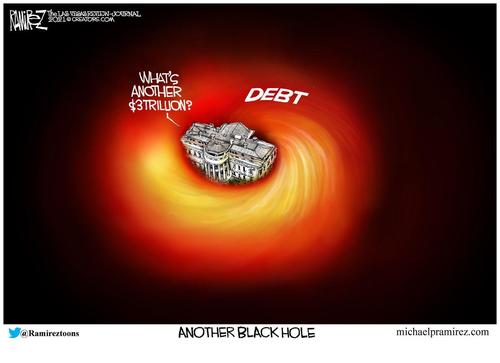
The national debt (the amount the federal government has borrowed over the years and must pay back) is $28 trillion and growing. That translates to roughly $224,000 per taxpayer.

The government’s answer to the COVID-19 pandemic has been to throw more money at the problem in the form of stimulus checks, small business loans, unemployment benefits, vaccine funding, and financial bailouts for corporations. All told, the federal government’s COVID-19 spending has exceeded $4 trillion.

The Biden administration is proposing another $2 trillion in infrastructure spending.

The amount this country owes is now greater than its gross domestic product (all the products and services produced in one year by labor and property supplied by the citizens). And the top two foreign countries who “own” about a third of our debt are China and Japan.

That debt is also growing exponentially: it is expected to be twice the size of the U.S. economy by 2051.

Essentially, the U.S. government is funding its very existence with a credit card.

We’re paying more than $300 billion in interest every year on that public debt, not including what COVID-19 just added to the bill. That breaks down to more than $2400 per household.

According to the Committee for a Reasonable Federal Budget, the interest we’re paying on this borrowed money is “nearly twice what the federal government will spend on transportation infrastructure, over four times as much as it will spend on K-12 education, almost four times what it will spend on housing, and over eight times what it will spend on science, space, and technology.”

Clearly, the national debt isn’t going away anytime soon, especially not with government spending on the rise and interest payments making up such a large chunk of the budget.

Still, the government remains unrepentant, unfazed and undeterred in its wanton spending.

Indeed, the national deficit (the difference between what the government spends and the revenue it takes in) is expected to be $2.3 trillion for fiscal 2021.

If Americans managed their personal finances the way the government mismanages the nation’s finances, we’d all be in debtors’ prison by now.

Despite the government propaganda being peddled by the politicians and news media, however, the government isn’t spending our tax dollars to make our lives better.

We’re being robbed blind so the governmental elite can get richer.

This is nothing less than financial tyranny.

“We the people” have become the new, permanent underclass in America.

In the eyes of the government, “we the people, the voters, the consumers, and the taxpayers” are little more than pocketbooks waiting to be picked.

Consider: The government can seize your home and your car (which you’ve bought and paid for) over nonpayment of taxes. Government agents can freeze and seize your bank accounts and other valuables if they merely “suspect” wrongdoing. And the IRS insists on getting the first cut of your salary to pay for government programs over which you have no say.

We have no real say in how the government runs, or how our taxpayer funds are used, but we’re being forced to pay through the nose, anyhow.

We have no real say, but that doesn’t prevent the government from fleecing us at every turn and forcing us to pay for endless wars that do more to fund the military industrial complex than protect us, pork barrel projects that produce little to nothing, and a police state that serves only to imprison us within its walls.

If you have no choice, no voice, and no real options when it comes to the government’s claims on your property and your money, you’re not free.

It wasn’t always this way, of course.

Early Americans went to war over the inalienable rights described by philosopher John Locke as the natural rights of life, liberty and property.

It didn’t take long, however—a hundred years, in fact—before the American government was laying claim to the citizenry’s property by levying taxes to pay for the Civil War. As the New York Times reports, “Widespread resistance led to its repeal in 1872.”

Determined to claim some of the citizenry’s wealth for its own uses, the government reinstituted the income tax in 1894. Charles Pollock challenged the tax as unconstitutional, and the U.S. Supreme Court ruled in his favor. Pollock’s victory was relatively short-lived. Members of Congress—united in their determination to tax the American people’s income—worked together to adopt a constitutional amendment to overrule the Pollock decision.

On the eve of World War I, in 1913, Congress instituted a permanent income tax by way of the 16th Amendment to the Constitution and the Revenue Act of 1913. Under the Revenue Act, individuals with income exceeding $3,000 could be taxed starting at 1% up to 7% for incomes exceeding $500,000.

It’s all gone downhill from there.

Unsurprisingly, the government has used its tax powers to advance its own imperialistic agendas and the courts have repeatedly upheld the government’s power to penalize or jail those who refused to pay their taxes.

While we’re struggling to get by, and making tough decisions about how to spend what little money actually makes it into our pockets after the federal, state and local governments take their share (this doesn’t include the stealth taxes imposed through tolls, fines and other fiscal penalties), the government continues to do whatever it likes—levy taxes, rack up debt, spend outrageously and irresponsibly—with little thought for the plight of its citizens.

To top it all off, all of those wars the U.S. is so eager to fight abroad are being waged with borrowed funds. As The Atlantic reports, “U.S. leaders are essentially bankrolling the wars with debt, in the form of purchases of U.S. Treasury bonds by U.S.-based entities like pension funds and state and local governments, and by countries like China and Japan.”

Of course, we’re the ones who will have to repay that borrowed debt.

For instance, American taxpayers have been forced to shell out more than $5.6 trillion since 9/11 for the military industrial complex’s costly, endless so-called “war on terrorism.” That translates to roughly $23,000 per taxpayer to wage wars abroad, occupy foreign countries, provide financial aid to foreign allies, and fill the pockets of defense contractors and grease the hands of corrupt foreign dignitaries.

Mind you, that staggering $6 trillion is only a portion of what the Pentagon spends on America’s military empire.

The United States also spends more on foreign aid than any other nation ($50 billion in 2017 alone). More than 150 countries around the world receive U.S. taxpayer-funded assistance, with most of the funds going to the Middle East, Africa and Asia. That price tag keeps growing, too.

As Dwight D. Eisenhower warned in a 1953 speech, this is how the military industrial complex will continue to get richer, while the American taxpayer will be forced to pay for programs that do little to enhance our lives, ensure our happiness and well-being, or secure our freedoms.

This is no way of life.

Yet it’s not just the government’s endless wars that are bleeding us dry.

We’re also being forced to shell out money for surveillance systems to track our movements, money to further militarize our already militarized police, money to allow the government to raid our homes and bank accounts, money to fund schools where our kids learn nothing about freedom and everything about how to comply, and on and on.

It’s tempting to say that there’s little we can do about it, except that’s not quite accurate.

There are a few things we can do (demand transparency, reject cronyism and graft, insist on fair pricing and honest accounting methods, call a halt to incentive-driven government programs that prioritize profits over people), but it will require that “we the people” stop playing politics and stand united against the politicians and corporate interests who have turned our government and economy into a pay-to-play exercise in fascism.

Unfortunately, we’ve become so invested in identity politics that pit us against one another and keep us powerless and divided that we’ve lost sight of the one label that unites us: we’re all Americans.

Trust me, we’re all in the same boat, folks, and there’s only one real life preserver: that’s the Constitution and the Bill of Rights.

The Constitution starts with those three powerful words: “We the people.”

As I make clear in my book Battlefield America: The War on the American People, there is power in our numbers. That remains our greatest strength in the face of a governmental elite that continues to ride roughshod over the populace. It remains our greatest defense against a government that has claimed for itself unlimited power over the purse (taxpayer funds) and the sword (military might).

Where we lose out is when we fall for the big-talking politicians who spend big at our expense.

Tyler Durden
Thu, 04/08/2021 – 17:00

via ZeroHedge News https://ift.tt/3t6LBVg Tyler Durden

US Mulls Sending Warships Into Black Sea To Be “Ready To Respond” To Ukraine Crisis

US Mulls Sending Warships Into Black Sea To Be “Ready To Respond” To Ukraine Crisis

A US defense official has told CNN on Thursday that the Biden administration is seriously considering sending warships into the Black Sea amid reports that Russia is mustering forces near the border with Ukraine in response to a renewed uptick in fighting in nearby Donbas. 

The warships could be deployed “in the next few weeks in a show of support for Ukraine,” the unnamed defense official described. And further, “The US Navy routinely operates in the Black Sea, but a deployment of warships now would send a specific message to Moscow that the US is closely watching, the official said,” according to the CNN report

Via AFP

Typically the US gives 14-days notice prior to sending warships into the Black Sea, according to a long established treaty with Turkey regarding use of the Bosporus to enter the waters.

Importantly, the new CNN reporting comes two days after Ukraine’s president Volodymyr Zelensky personally urged NATO to immediately expand its Black Sea presence.

He had said in a phone call with NATO Secretary-General Jens Stoltenberg, “Such a permanent presence should be a powerful deterrent to Russia, which continues the large-scale militarization of the region and hinders merchant shipping,” the president’s press service indicated in a readout.

Despite a slew of international reports this week hyping threat of a Russian “offensive” in eastern Ukraine – based largely on Kiev officials loudly claiming as much – the Pentagon’s official assessment still appears to be that the Kremlin is not preparing for some kind of offensive move on Ukraine. 

Surprisingly even CNN is bluntly stating that the US doesn’t see this as imminent, despite all the breathless reports over extra Russian troops in Crimea and near the border

Although the US does not see the amassing of Russian forces as posturing for an offensive action, the official told CNN that “if something changes we will be ready to respond.”

Their current assessment is that the Russians are conducting training and exercises and intelligence has not indicated military orders for further action, the official said, but noted that they are well-aware that could change at any time.

But should US battleships indeed enter the Black Sea (though they semi-regularly conduct drills there) during this particular period of heightened tensions, we can expect Russia will “answer” with a greater naval build-up in its own backyard – something which appears to have already begun in a preemptive fashion.

Tyler Durden
Thu, 04/08/2021 – 16:40

via ZeroHedge News https://ift.tt/39W8piH Tyler Durden

NY Rewards Illegal Aliens With COVID Relief Checks 10 Times Amount Given To American Citizens

NY Rewards Illegal Aliens With COVID Relief Checks 10 Times Amount Given To American Citizens

By Kyle Becker of BeckerNews,

The State of New York has passed a new budget with major tax increases that will only drive more business from the declining state. It is also carving out billions to cut one-time checks for illegal immigrants who lost work due to the state’s lockdowns. The size of the checks? Over ten times that given to Americans in the last round of stimulus sent out by the Biden administration.

The bill includes $2.1 billion fund to provide “one-time payments for undocumented workers who did not qualify for federal stimulus checks or unemployment benefits,” the New York Times reported, “according to budget highlights released by the governor’s office.”

“New York will now offer one-time payments of up to $15,600 to undocumented immigrants who lost work during the pandemic,” the report continued.

“The effort – a $2.1 billion fund in the state budget – is by far the biggest of its kind in the country and a sign of the state’s shift toward policies championed by progressive Democrats.”

The last round of “stimulus” payments sent to under the Biden administration’s plan began to be issued on Friday.

“That brings the total disbursed payments from the latest stimulus package to more than 156 million payments, worth about $372 billion,” reported USA Today.

The payments, which total up to $1,400 each per individual, were distributed mostly by direct deposits and paper checks.”

New York rewarding illegal immigrants with massive one-time payments comes amidst a surge in illegal migrants that has the Biden administration taking flak from all sides. While Biden now tries to deflect from his record by telling prospective illegal migrants such things as “don’t come” to America, his lip service only serves to underscore that the president knows his administration’s policies are harmful to America.

“The president campaigned on easing immigration controls, including a moratorium on deportations, an end to former President Donald Trump’s ‘wait in Mexico’ policy for asylum-seekers and halting construction of the border wall,” an NBC opinion piece noted in March.

“That platform gave migrants good reason to believe it would be easier to get into the United States if he were elected.”

Biden has also begun building parts of the southern border wall begun under President Trump, drawing fire from radical critics. Meanwhile, New York state is handing out $15,600 checks to anyone from around the world who can make it into the state illegally — but not to American citizens whose livelihoods were decimated or destroyed by the governor’s reckless and unlawful lockdown policies.

The $15,600 checks being cut for illegal aliens while millions of Americans are struggling is the latest sign that the Democratic Party’s policies are a recipe for social discord and budgetary disaster.

The Big Apple is collapsing and surreal policies like the ones just passed in Albany is a primary reason why. The state is run by a governor whose corrupt administration hid thousands of nursing home deaths from the public and who has been credibly accused of sexual harassment by multiple aides. Meanwhile, the state’s draconian and arbitrary lockdowns have crippled small businesses, shuttering hundreds of them permanently. It has gotten so bad that many New Yorkers are throwing in the towel on the disastrously managed state.

Last year, tens of thousands of the richest New Yorkers fled the state – as many as 70,000, according to a Unacast report cited by Reuters. The spendthrift measures passed by Albany have set the state on a course for budgetary implosion and another round of blue state “bailouts” from the Biden administration.

Tyler Durden
Thu, 04/08/2021 – 16:20

via ZeroHedge News https://ift.tt/320pOlX Tyler Durden

Dollar Dump Sparks Bid For Bonds, Bullion, Bitcoin, & Big-Tech

Dollar Dump Sparks Bid For Bonds, Bullion, Bitcoin, & Big-Tech

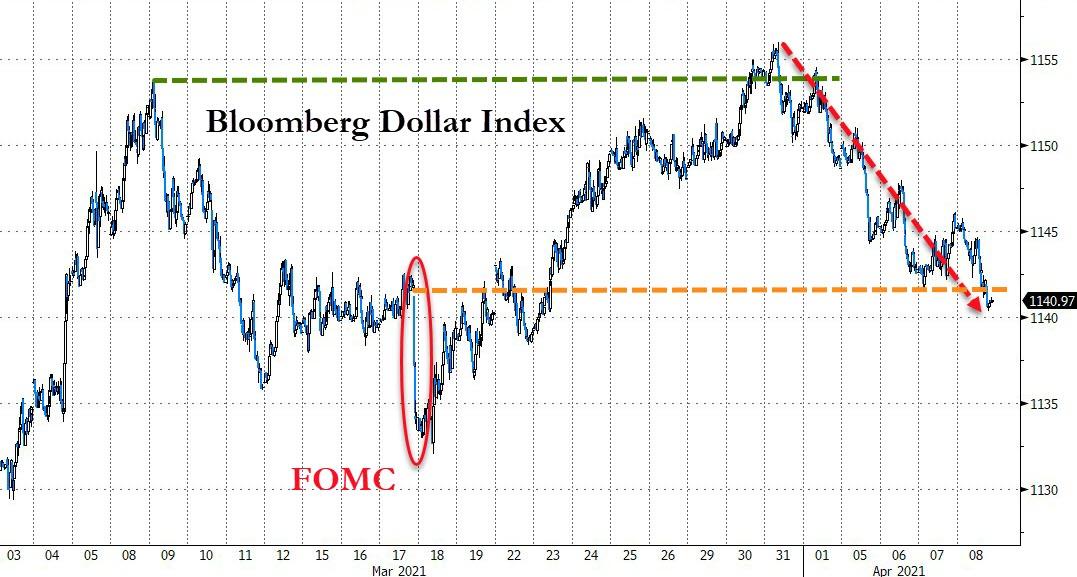
The Dollar resumed its freefall today, back to pre-FOMC plunge levels today…

Source: Bloomberg

…and it’s gone…

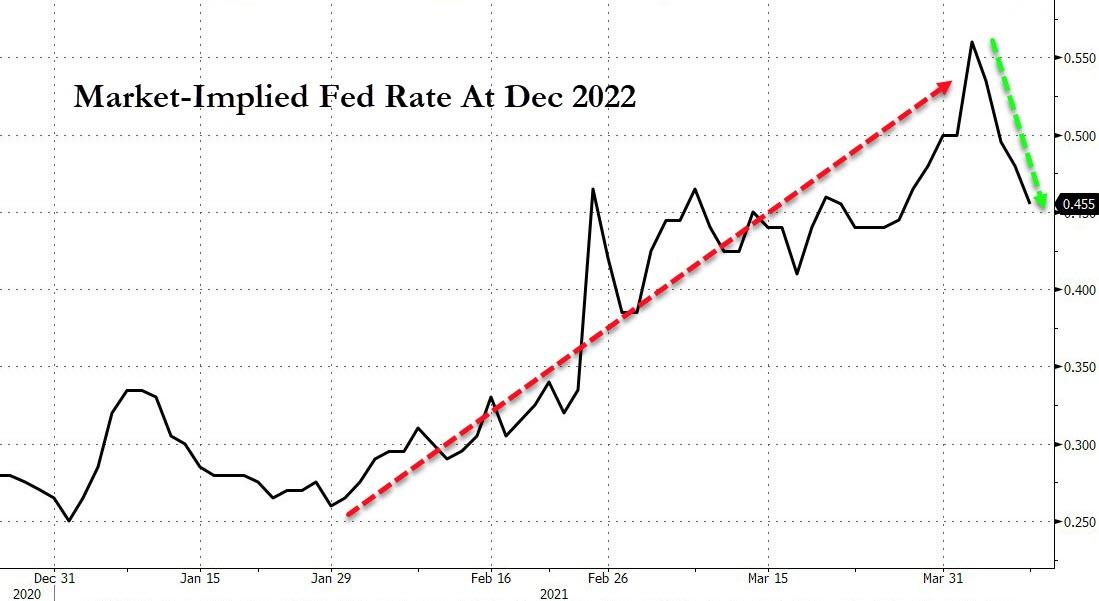
The short-term rates market continued its dovish reversal, now expecting over 10bps less tightening by the end of 2022…

Source: Bloomberg

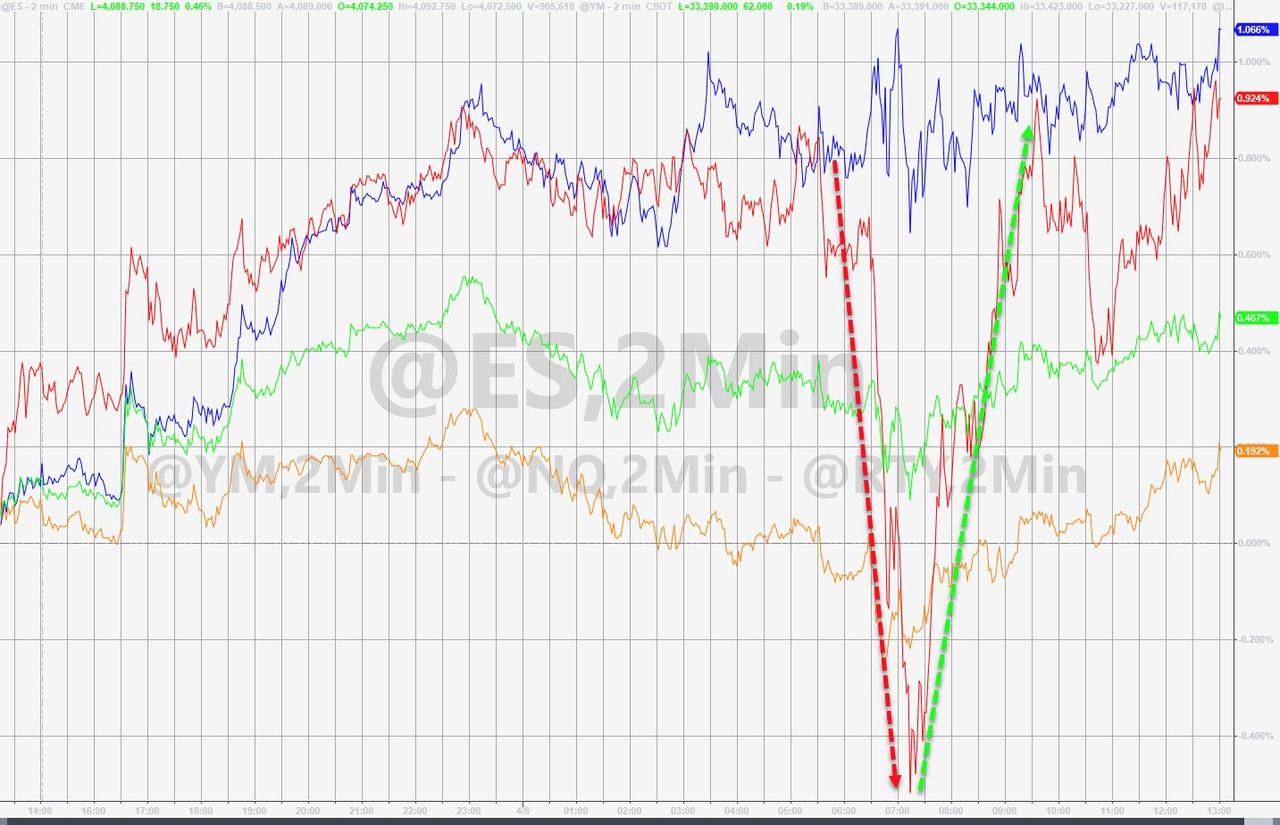
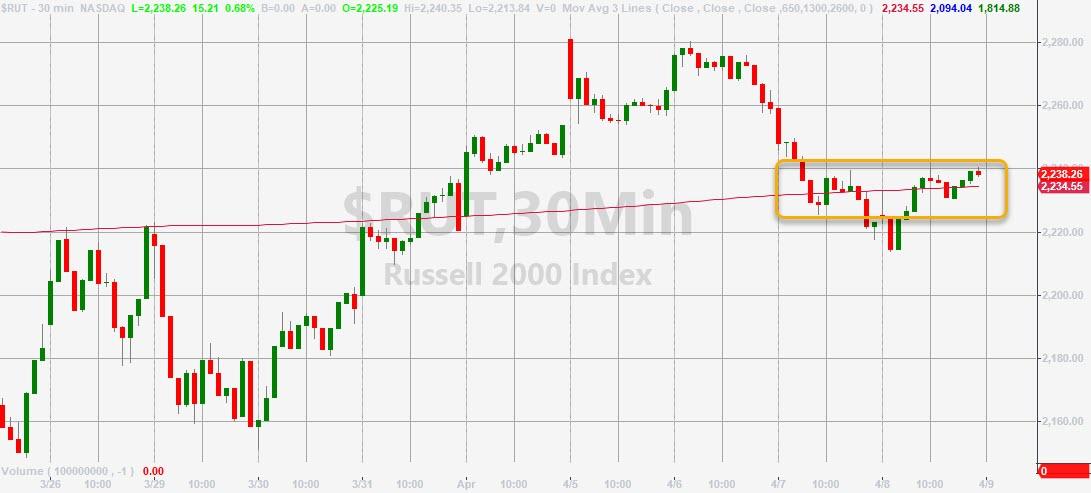
And that helped send the S&P to a new record high (Nasdaq outperformed on the day and Small Caps managed solid gains are plunging at the cash open)…

Small Caps are glued to their 50DMA…

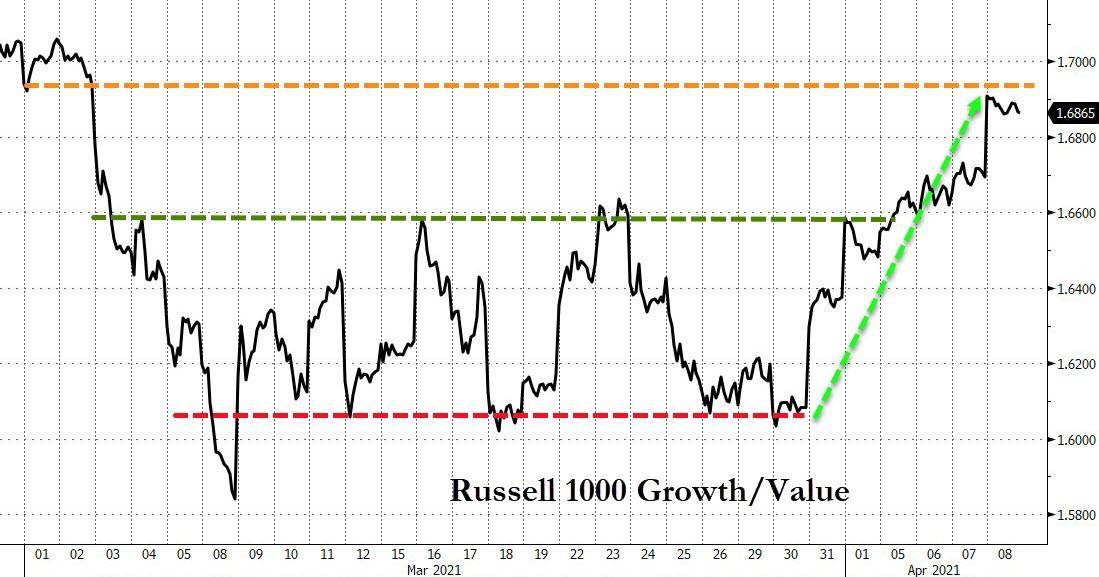
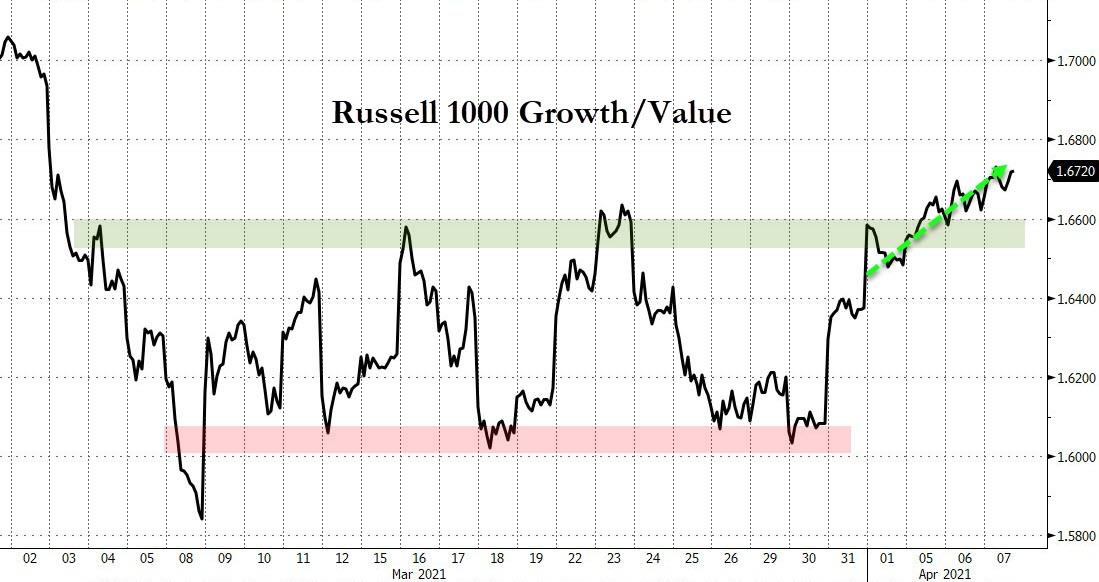
Growth has ripped back, erasing all of its relative weakness to value since the end of Feb…

Source: Bloomberg

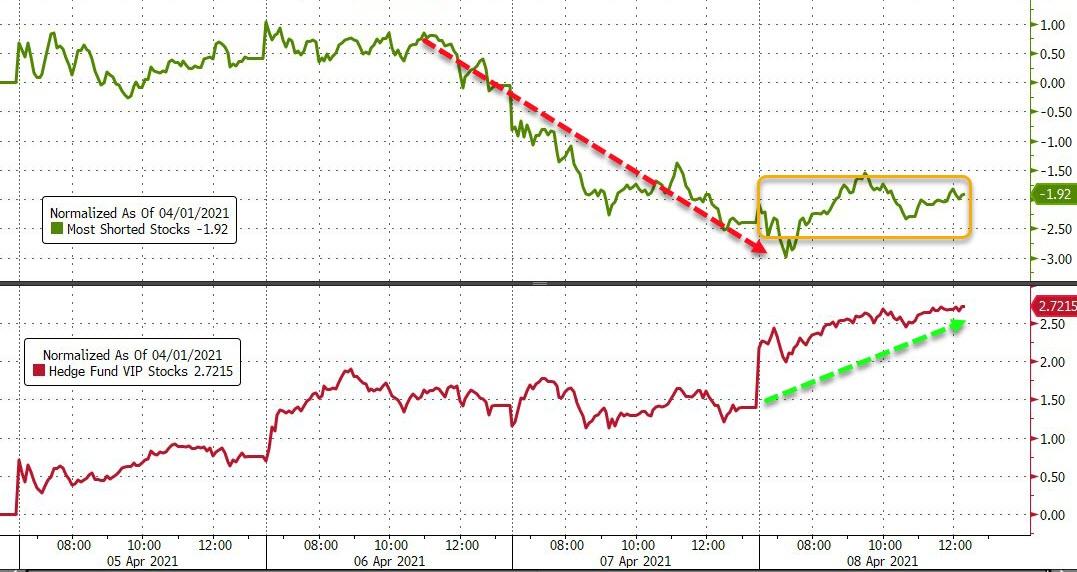
“Most Shorted” Stocks were generally flat today as hedge funds’ favorite stocks ripped…

Source: Bloomberg

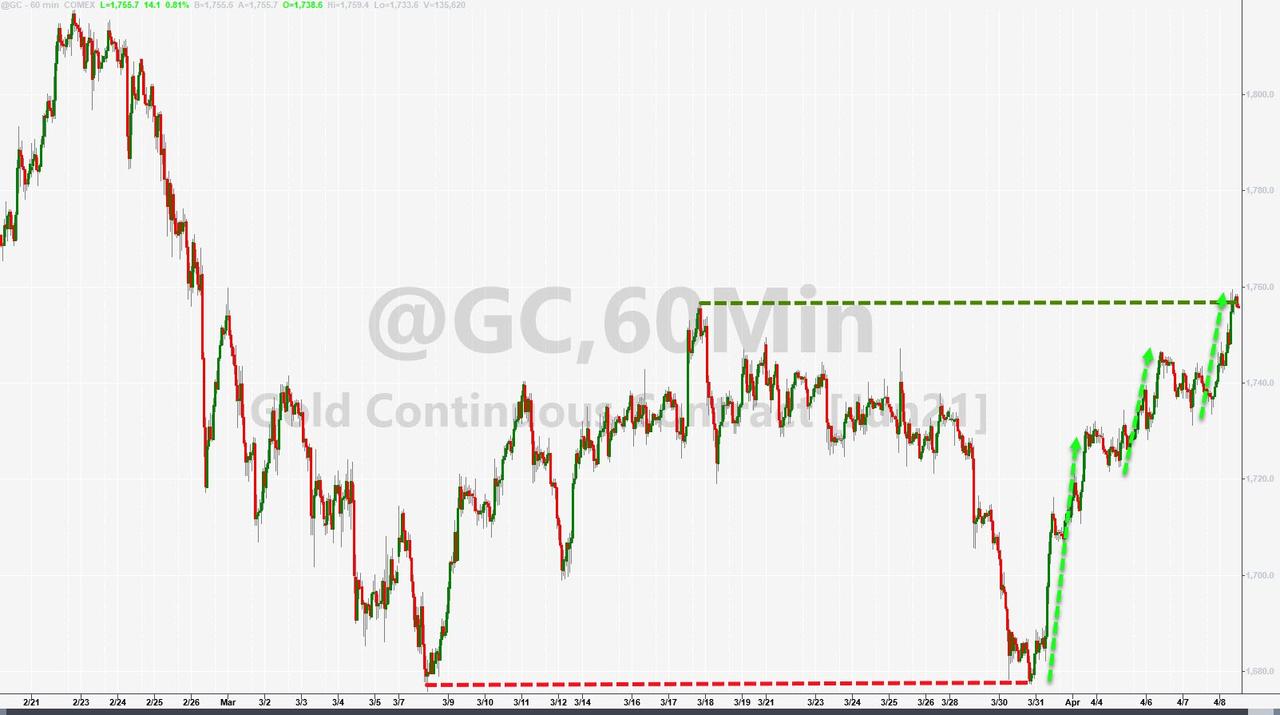
As the dollar dump returns, Gold rallied back above $1750 to its highest since late February today…

Bitcoin ripped back above $58,000 today…

Source: Bloomberg

And Ethereum spiked back above $2050…

Source: Bloomberg

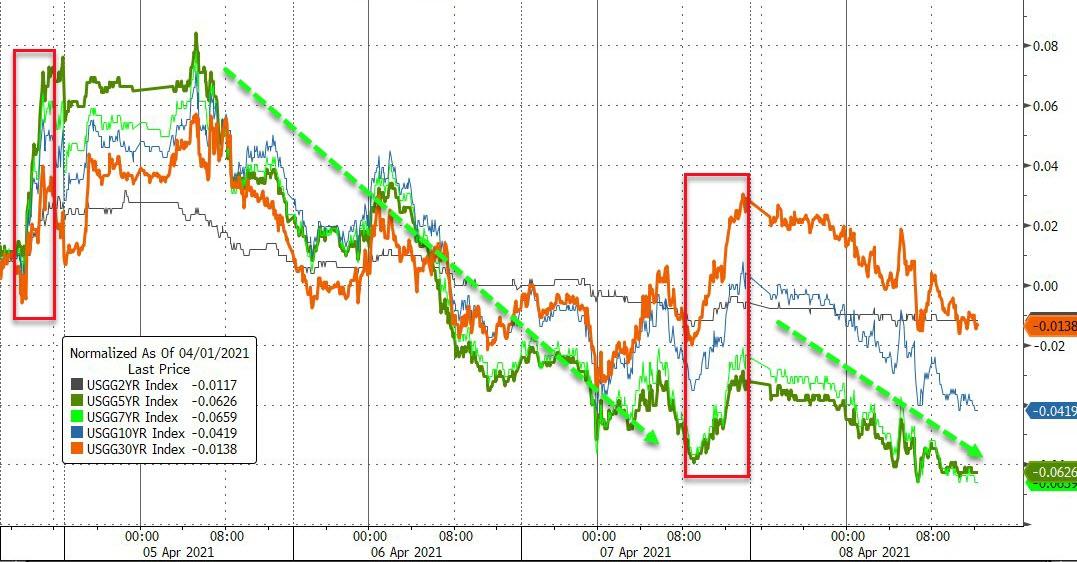
Bonds were bid, pushing 30Y yields lower since the Thursday equity close (remember bonds were open around the payrolls print)…

Source: Bloomberg

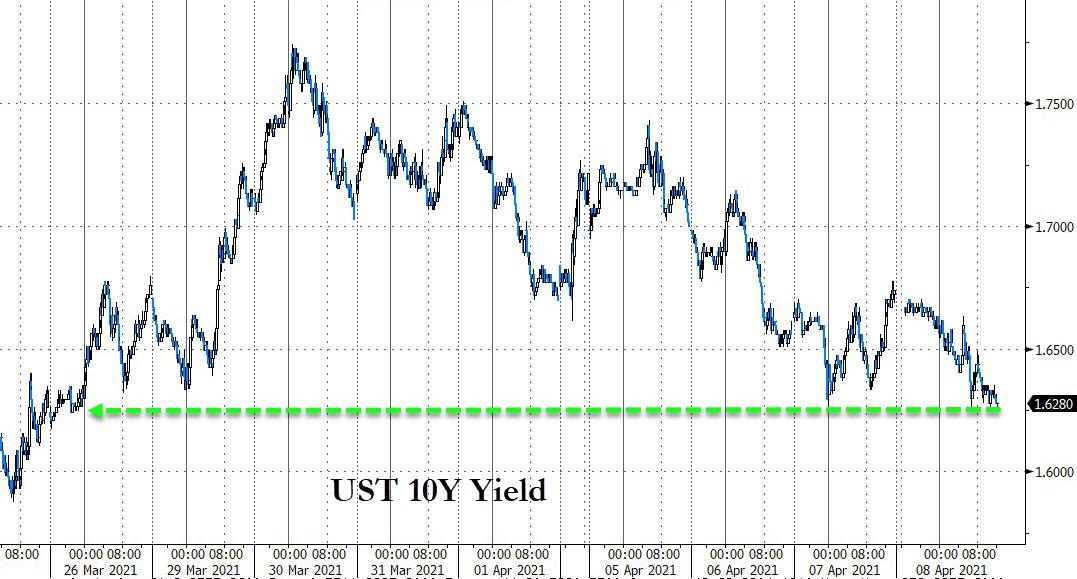
10Y Yield dropped back below 1.65% (so much for the spike in yields from payrolls)…

Source: Bloomberg

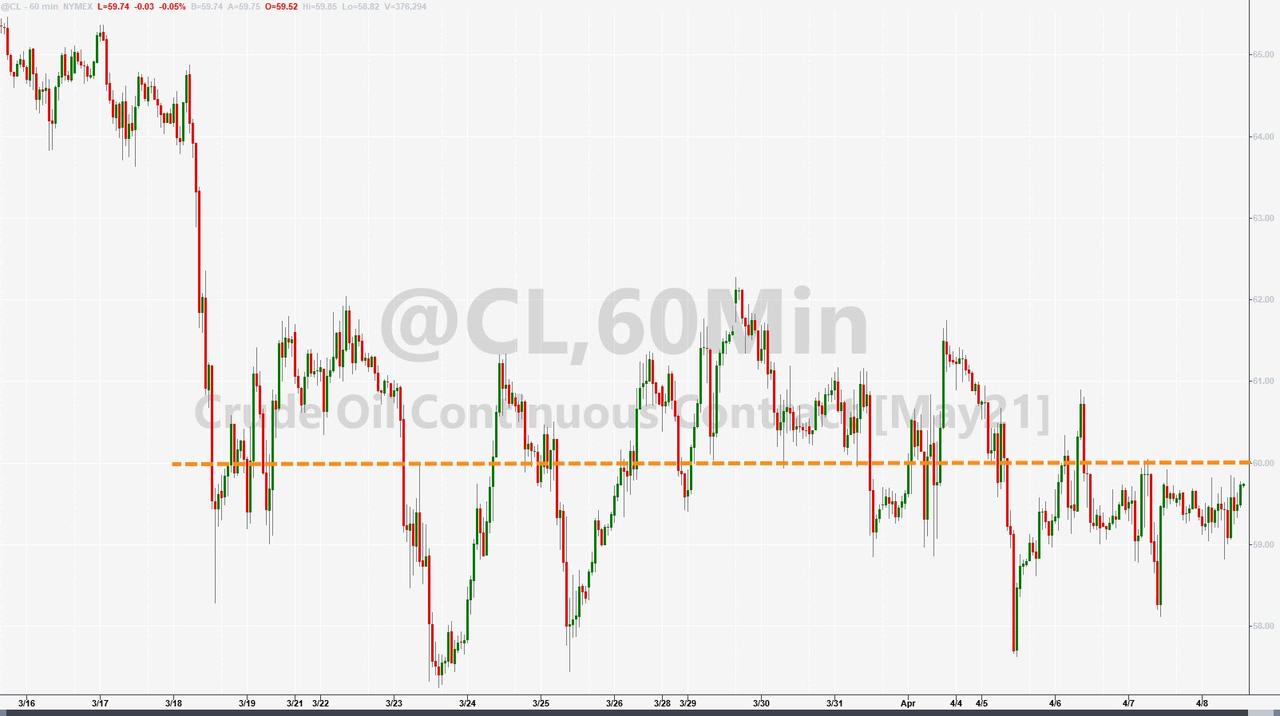
WTI was unable to get back above $60 today, despite the dollar weakness…

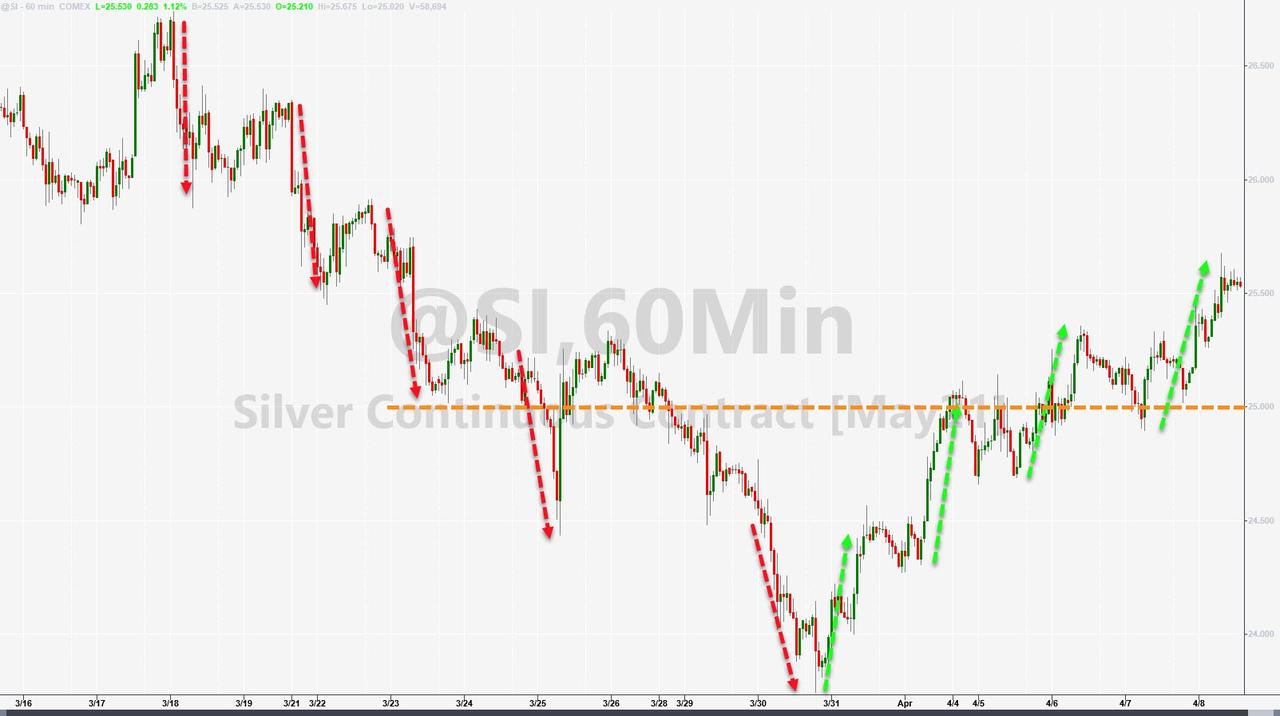
Silver jumped back above $25 this week and is extending gains…

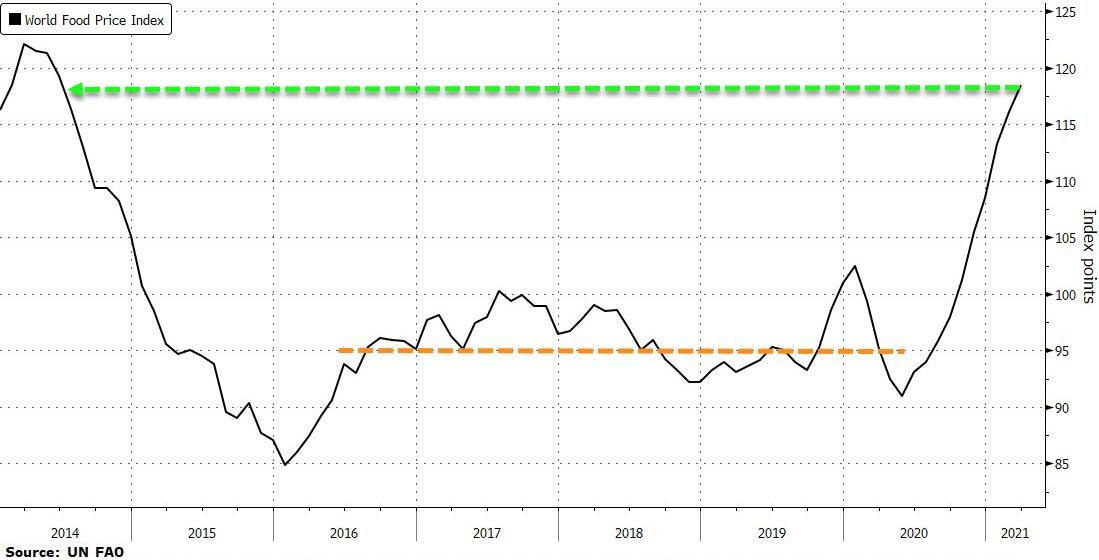
Finally, it’s probably nothing but a United Nations gauge of global food prices climbed for a 10th month in March, driven higher by costlier vegetable oils, meat and dairy. This the highest level since June 2014

Source: Bloomberg

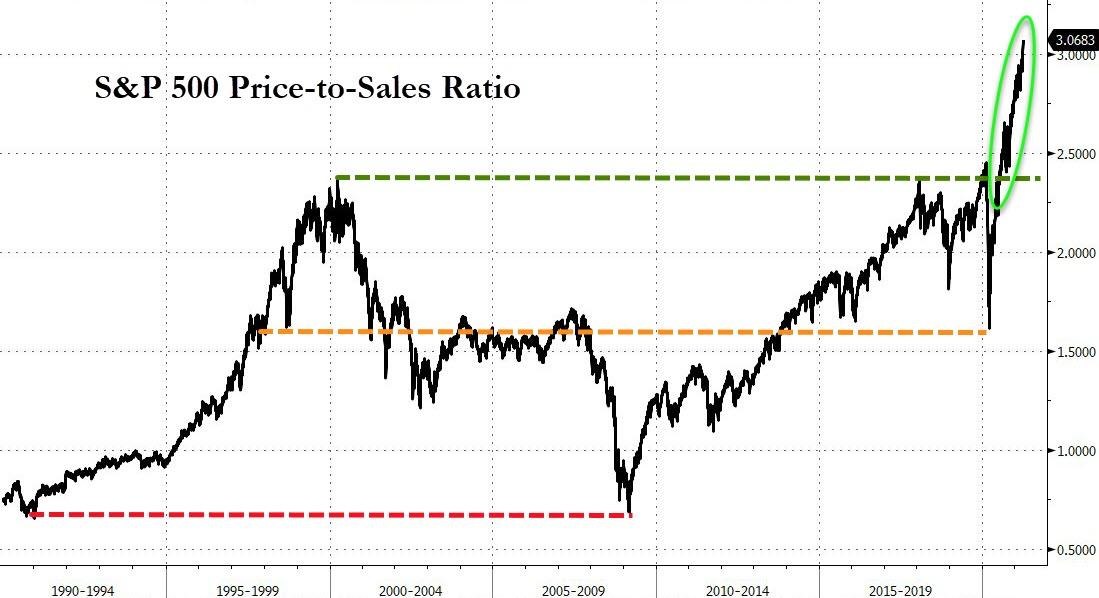
Oh, and don’t pay any attention to this (for the first time ever, the S&P 500 is trading 3x Price-to-Sales)… it’s probably nothing too…

Source: Bloomberg

Oh, and for the first time ever, the US equity market cap is twice that of US GDP

Source: Bloomberg

Tyler Durden
Thu, 04/08/2021 – 16:00

via ZeroHedge News https://ift.tt/3dR5ucx Tyler Durden

“This Is An Unprecedented, Bad Combo”: Why Some Traders See A “Shock” Growth Hit Dead Ahead

“This Is An Unprecedented, Bad Combo”: Why Some Traders See A “Shock” Growth Hit Dead Ahead

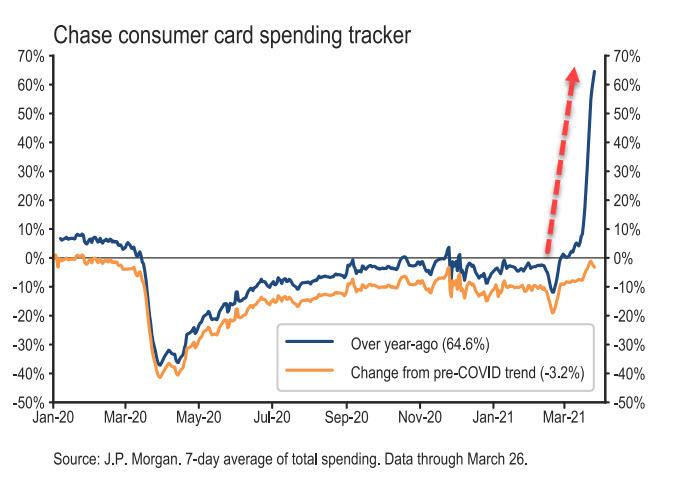
Over the weekend, we explained why both Goldman and JPM expect economic activity in April and May to top “Anything We’ll See In Our Careers”, on the back of four main factors: i) continued stimulus injections, ii)  $1.5tn in ‘excess’ savings, which Goldman expects that to rise to about $2.4tn, or 11% of GDP, iii) a record share of respondents planning to purchase a home in the coming months, and iv)  $4.44 trilion currently sitting in US money market fund.

But what happens then… Will the record stimulus tailwind – and soaring inpuct costs – become a margin-crushing headwind which will hammer the economy in the second half?

As SocGen’s resident permabear Albert Edwards writes in a note today titled “Intoxicated by the fiscal package, investors can’t see what lies dead ahead”, if one reads the financial press “most commentators believe we are set for a repeat of the Roaring Twenties, most especially in the US. “Optimism abounds that the consumer will unleash a wave of pent-up spending as economies reopen, backed by a handy stash of surplus savings. Combined with a new ‘can-do’ (or rather a ‘can-spend’) attitude of the fiscal authorities, all things economic and cyclical look tickety-boo – if not a tad frothy”, Edwards writes.

To be sure, optimism about the economy is backed up by some extraordinarily robust ISM data: as Edwards details, the surge in both the US manufacturing and services ISMs into the mid- 60s has brought them up to levels not seen since 1983 when the US economy charged out of a savage double-dip recession. Even in semi-shutdown Europe, the eurozone PMI output composite has hit its highest level since records began (in 1998). These are robust data indeed. It is therefore understandable then why markets have responded with heady abandon to this flood of strong economic data.

Here, as an aside, the SocGen strategist writes that he always hesitates “to use the words ‘good news’ to describe strong economic data. My own observation from almost four decades in the markets is that when economists and strategists describe ‘good news’, they introduce a behavioural bias into their analysis because they then become reluctant to forecast ‘bad’ news – with some notable exceptions!”

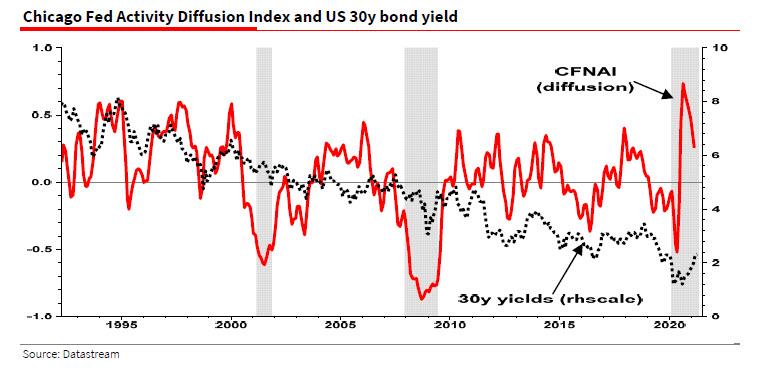
In any case, as a result of this hope of a repeat of the Roaring Twenties (which as Rabobank’s Eric Peters frequently reminds us didn’t end so well) investors are riding a cyclical wave that may now be cresting. Hence, “instead of strong growth and rising bond yields being the main threat to equities, might it be the reverse” Edwards asks rhetorically and to prove his skepticism points not to the ISM but the Chicago Fed National Activity which has shown a remarkable disconnect from some other soaring high-frequency data indicators, to wit:

these blockbuster ISMs should be treated with some caution – because if after an economy has been shut down every respondent thought things were getting even a little better, then the ISMs would register the 100% maximum. Indeed, other more methodical surveys of economic activity tell an alternative story. For example, the highly regarded Chicago Fed National Activity Index collates 85 US economic indicators into an aggregate measure. It is calibrated so that zero represents trend GDP growth. As you can see below, economic activity in February has fallen back to trend – only around 2% or slightly below.

While the SocGen strategist concedes that this data may be an anomaly, he urges readers to “keep a very close eye on this as given the recent rally, the market is now very vulnerable to cyclical disappointment.”

That said, nobody seems to worry for now, with Edwards chiming in that the market believes “we are going to see blockbuster, gangbuster, and perhaps even ghostbuster, GDP data for the next couple of quarters. That is now baked into the cake as is shown by the New York Weekly Economic Index – calibrated to equate to yoy GDP growth.”

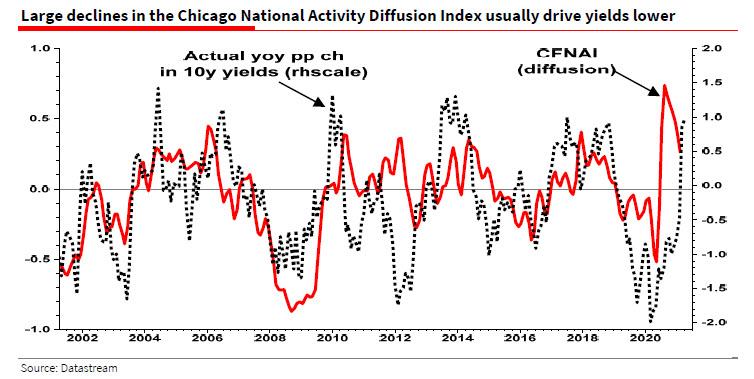
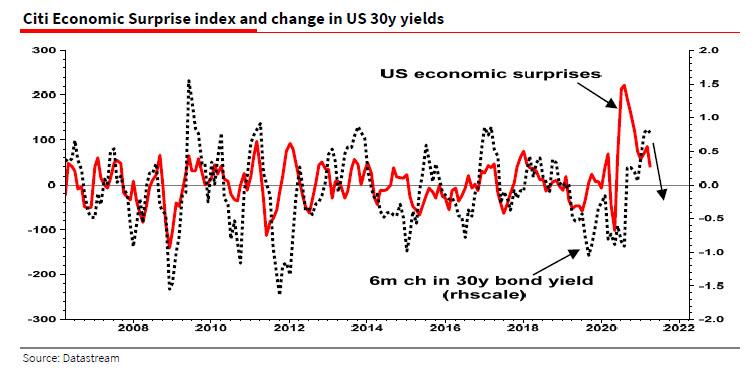
This, however, again brings us back to the question we asked at the top: what happens after the likely strong H1 data? Here, Edwards writes that the slowdown  in the Chicago Fed Activity indicator shown above is confirmed by their own diffusion index of data outturns. This shows a downturn, which if it continues would traditionally trigger a fall in bond yields – even outside of recession (shaded areas).

This can be seen more clearly from this chart which looks at the yoy change in 10y yields.

Commenting on the chart below, Edwards notes that “the surge in stronger than expected economic data has reversed recently and at  the very least this suggests the bond market sell-off might abate or even reverse somewhat.”

The above may explain why 10Y returns, after tumbling by the most on record in Q1, have rebounded strongly in Q2 with 10Y yields sliding. It also why Edwards warns that “investors might be caught out by weaker than expected growth as soon as H2” especially when considering the potential near-term impact of the Biden stimulus which – as Edwards reminds us based on CBO calculations – shows that the headline $1.9tr package or “10% of GDP”, working out to only a moderate 4% of GDP this year.”

To be sure, if it was just Albert Edwards warning about a sharp growth scare in the near-term it would be easy to dismiss it as the repetitive ramblings of a Wall Street permabear. But it’s not just him: one of Wall Street most prominent bulls joins the loud warning.

In his latest Weekly Warm Up note, Morgan Stanley chief equity strategist Michael Wilson picks up where Edwards ends, and also extends on a point he made recently, when he noted that he expects the current cycle to be especially short. It’s why his latest note focuses on what he believes will be a Faster and Sooner than Normal Early to Mid Cycle Transition.” Only unlike Edwards who focuses on growth indicators, Wilson takes aim at the current rampant inflation which many fear could mutate into outright stagflation:

We continue to hear anecdotal evidence that costs are rising for many key inputs for companies – materials, logistics, labor, etc. Last week’s Manufacturing PMIs shed further light on how acute these cost pressures may become over the next few months. While we may be a little early, we believe now is the time to shift one’s portfolio up the quality curve while liquidity remains flush and before these supply/margin issues become more obvious.

Echoing what we said in “”Things Are Out Of Control” – There Is A Shortage Of Everything And Prices Are Soaring“, the Morgan Stanley strategist writes that he continues to see “growing evidence that supply shortages are emerging all over the economy, many of which will lead to either margin pressure or missed sales altogether.”

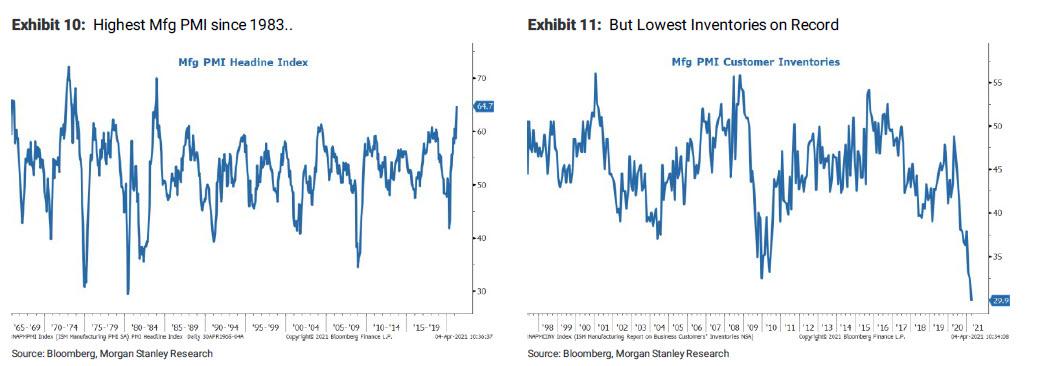
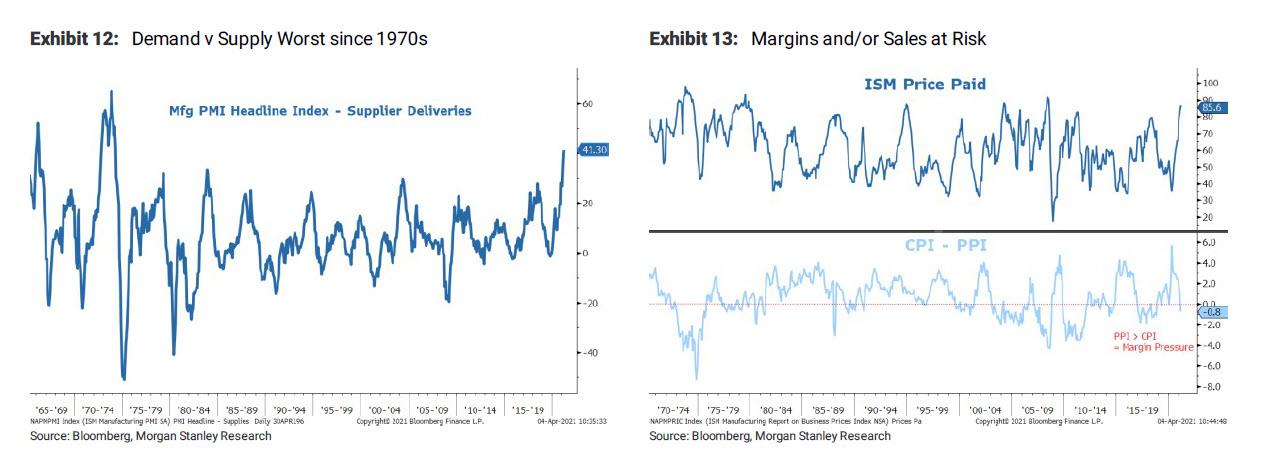
And while Wilson – like Edwards – has little doubt that the economy is ready to boom at this point with March’s Manufacturing Purchasing Manager Index rising to its highest level in 28 years, he cautions that “with this increase we are also seeing some of the highest prices paid and lowest supplier delivery readings as well. This is an unprecedented and potentially bad combo in our view.”

Why is this a bad combo?

Because according to Wilson, this arguing for “a faster shift to mid from early cycle economic and market dynamics” an observation the MS strategist made previously, and which is now further supported by last week’s release of March’s Purchasing Manager survey.

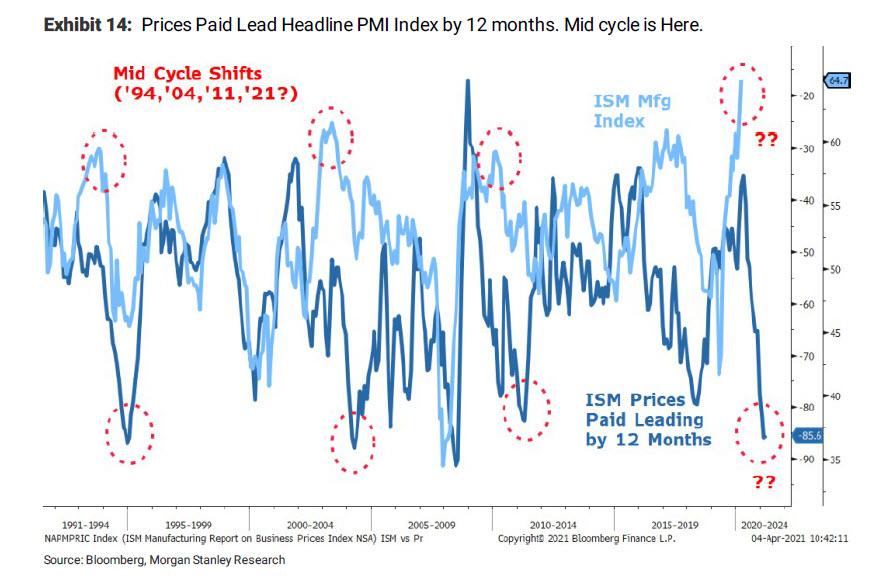
Exhibit 11 is perhaps the best way to illustrate this timing using the PMI. Very simplistically, what it shows is that the prices paid component leads the headline index by approximately 12 months. As Wilson warns, “given the extreme readings in both measures today, there is a good chance the PMI headline index isn’t just peaking but falls significantly over the next 12 months as these higher prices either squash margins or demand or both.”


Another way of putting this divergence in traditional economic terms, the demand vs supply imbalance is now the worst since the 1970s, putting both corporate margins and sales at significant risk. Translation: earnings reports one year from today will be very ugly.

To be sure, this is a normal response after the initial surge from recession–i.e. as we experienced in 1994, 2004 and 2011 in the 3 prior cycles, and to Wilson, there is “no reason why it should be different this time. Surges in prices paid can also be a leading indicator for the end of the cycle like in mid 2018 or early 2000.”

To be clear, we do not think that is the case which suggests this will be a buying opportunity but one worth waiting for despite what the consensus currently believes as we made new highs last week.

Tyler Durden
Thu, 04/08/2021 – 15:50

via ZeroHedge News https://ift.tt/3dNxKMR Tyler Durden

Manhattan Condo Sales Increase For First Time In Four Quarters

Manhattan Condo Sales Increase For First Time In Four Quarters

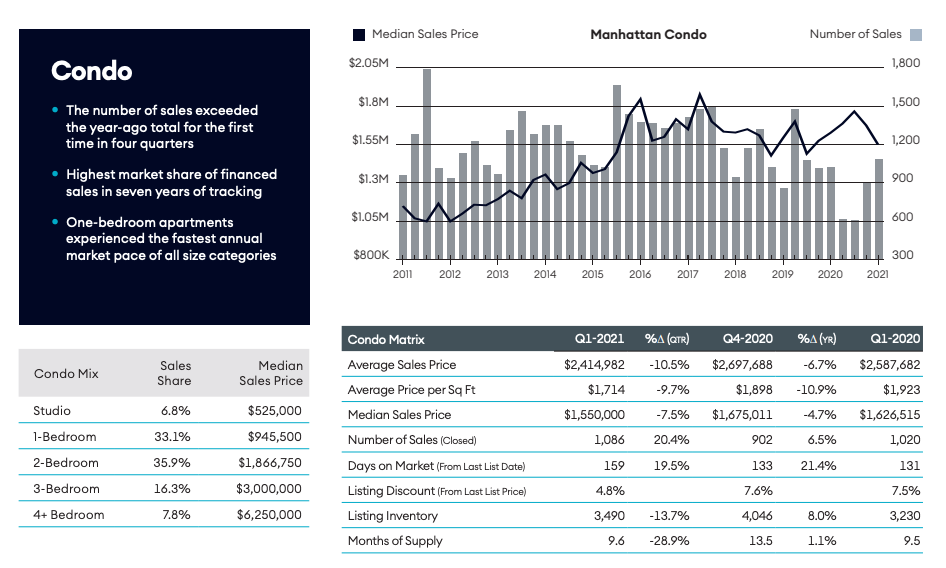
Spring is here, not just in terms of warmer temperatures but also in the Manhattan housing market. Vaccine rollouts are in full effect as people become more comfortable in returning to the borough. Greater housing affordability, coupled with a slump in housing prices and historically low mortgage rates, have increased sales. 

The latest edition of the Elliman Report shows housing sales in Manhattan rose in the first quarter of 2021, exceeding year-ago levels for the first time in four quarters. First-quarter sales were 2,457, which is an increase of 2.1% over the same period last year – when the pandemic paralyzed the metro area.

In a prior report, Jonathan Miller, president and CEO of real estate appraisal firm Miller Samuel and author of the report, said the latest sales rebound should not be viewed as an “imminent recovery.”

Sales in the borough increased last quarter for a multitude of reasons. From historically low mortgage rates to increased affordability due to rising inventory putting downward pressure on prices, those who once thought Manhattan was unaffordable are now searching for deals. 

Over the first quarter, the median condo sale price averaged $1,550,000, or about a 5% decline over the same period last year. 

The first quarter recorded the highest market share of financed sales in seven years, the report said. This means that first-time buyers (who mainly rely on financing) are entering the borough’s real estate market. Studios and one-bedroom apartments saw the fastest annual sales out of all categories. 

With inventory in the borough at near-record highs. Bidding wars for properties dropped to their lowest level in nearly thirteen years. 

Despite inventory much higher than where it was one year ago. Miller doesn’t consider Manhattan housing inventory “bloated.” In fact, he said inventory could soon approach “normal levels. “

Here’s a summary of the report: 

Manhattan sales exceed year-ago levels for the first time in four quarters. The market share of bidding wars fell to its second-lowest level in nearly thirteen years of tracking. Listing inventory continued to see annual increases skewed towards smaller apartments while median sales price for co-ops and condos individually declined year over year. Co-op sales more than doubled since the end of the spring lockdown, and condos saw the highest market share of financed sales in seven years of tracking. All luxury price trend indicators fell short of year-ago levels, seeing larger declines than non-luxury. New development sales below the $3 million threshold surged year over year.

Buyers have been snatching up studios and one-bedroom apartments, even as the upper market remained in turmoil

While more and more people are getting vaccinated and New York City eases virus restrictions, more buyers will return to the borough. Still, with so much inventory overhang, dramatic price increases similar to what is being observed in surrounding suburbs will likely not be seen in the near term. 

Tyler Durden
Thu, 04/08/2021 – 15:29

via ZeroHedge News https://ift.tt/39SShhS Tyler Durden

Watch: Diners Chant “Get Out” As Health Officials Try To Shut Down Restaurant

Watch: Diners Chant “Get Out” As Health Officials Try To Shut Down Restaurant

Authored by Paul Joseph Watson via Summit News,

A video out of Vancouver shows diners chanting “get out!” as health officials try to shut down a restaurant that opened in violation of COVID-19 lockdown laws.

The clip shows a pair of health officials talking to Corduroy Restaurant owner Rebecca Matthews as she tells the bureaucrats they are trespassing before asking them to leave.

At first, the health officials refuse to leave but their behavior soon changes when the rest of the diners begin to chant “get out!”

As the pair begin to exit, customers in the background can be seen hugging each other and cheering.

Under current lockdown rules, restaurants in B.C. are prohibited from opening indoors but Matthews has decided to stay open in defiance of the law.

Health documents show that Corduroy had been ordered to close due to the restaurant being in “contravention of a Provincial Health Officer (PHO) Order issued under Part 4 of the Public Health Act.”

According to Corduroy’s Instagram account, the restaurant is now closed due to having run out of food but Matthews has vowed to reopen this week.

*  *  *

Brand new merch now available! Get it at https://www.pjwshop.com/

*  *  *

In the age of mass Silicon Valley censorship It is crucial that we stay in touch. I need you to sign up for my free newsletter here. Support my sponsor – Turbo Force – a supercharged boost of clean energy without the comedown. Also, I urgently need your financial support here.

Tyler Durden
Thu, 04/08/2021 – 15:15

via ZeroHedge News https://ift.tt/3mD5Qr1 Tyler Durden

Did The “Value Rotation” Just Die Again: Some Market Thoughts From Goldman

Did The “Value Rotation” Just Die Again: Some Market Thoughts From Goldman

In his midday market intel note titled “Like Bull”, Goldman’s Chris Hussey observes that US equities are trending higher amidst the ongoing news vacuum “and a steady march up in stocks that is favoring this week the mega-cap Tech stocks that did so well during the pandemic — and even as we see further evidence that the post-pandemic era is starting to emerge.”

Commenting on today’s maltup, Hussey notes that volatility is down (the VIX has fallen to 17.1) and the rotation trade is on pause this week (for the most part) as Tech leads the S&P 500 higher, with all of this happening “as evidence mounts that the US is finally emerging from a year-long pandemic.”

Growth has broken out of its recent range against value.

As Russell 2000 relative to Nasdaq 100 hit the long-term downtrend and reversed sharply.

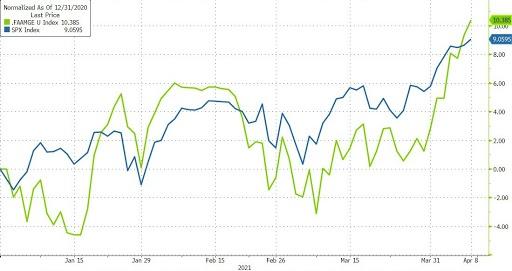
Interestingly, while Tech is leading the index higher this week, the broader index is also quietly marching higher. Unlike in Q1 when tech strength meant weakness in the rest of the market, the S&P 500 is now up almost 2% for the week “a particularly strong gain even in this era of strong stock gains” as Goldman puts it. Also notable, the S&P 500 is achieving these gains the ‘old fashioned’ way, led by mega-cap Tech, with each of the FAAMG stocks up 4%-5%+ on the week. In fact, despite all of the talk of a rotation into pro-cyclicals this year, the average FAAMG stock is now up 11% vs a 9% rise for the S&P 500.

The 11% average ytd gain for FAAMG, however, is coming with considerable variability. At the top, GOOGL has gained 28% as investors lean into a stock that should benefit from an ad spending surge as companies reach out to consumers looking to spend excess savings as they go back outside. And at the bottom of FAAMG performance this year sits AAPL (down 2%) as investors consider the sustainability of iPhone sales and AppleTV growth in a post-pandemic world.

Beyond this week’s trading activity, however, Goldman’s portfolio strategists maintain a preference for stocks with a pro-cyclical tilt over those that trade more defensively.

Tyler Durden
Thu, 04/08/2021 – 14:55

via ZeroHedge News https://ift.tt/39RXSW0 Tyler Durden