Two-Thirds Of Manhattan White-Collar Workers Will Not Return To Office Full-Time, Survey Says

Two-Thirds Of Manhattan White-Collar Workers Will Not Return To Office Full-Time, Survey Says

“Working from home” or at least some sort of the “hybrid” work model (a combination of work-at-home and office) could be the “new normal,” according to a new study of Manhattan’s largest employers. 

Despite COVID-19 vaccine rollouts and virus-related infections, hospitalizations, and deaths declining in recent months, the Partnership for New York City released a survey this week that found 22% of Manhattan’s most prominent employers would require workers to return to the office on a full-time basis. 

About 66% of respondents said they would adopt a hybrid work model, where employees will bounce between home and office during the workweek. 9% of respondents said workers would not be required to return to the office.

Respondents estimate just 45% of Manhattan’s one-million office workers will return by September. Whatever model employers chose, there is no rush to bring employees back to the office. 

In fact, companies are using virus pandemic as an excuse to downsize their corporate footprint in the borough. The latest report from Colliers showed just that. Office rents in Manhattan are plunging amid the glut of available office space has hit the highest on record going back two decades. 

The hybrid work model or even permanent work-at-home accommodations by employers has allowed tens of thousands of white-collar workers to move out of the metro area for suburban life. 

The virus pandemic has deeply scarred New York City’s economy and will have long-lasting effects. Many small and medium-sized firms that rely on office worker consumption continue to see a downward spiral in business. 

A recovery of Manhattan depends on the complete return of office workers back to 2019 levels, something we believe won’t happen. 

Tyler Durden
Sat, 03/20/2021 – 11:50

via ZeroHedge News https://ift.tt/3d6Tx23 Tyler Durden

Supreme Court Judge Rules New York Times Used ‘Deceptive Disinformation’ To Smear Project Veritas

Supreme Court Judge Rules New York Times Used ‘Deceptive Disinformation’ To Smear Project Veritas

A New York Supreme Court Judge last week excoriated the New York Times used “reckless disregard” and “acted with actual malice” when two of their reporters deceptively presented opinions as fact in several articles denigrating whistleblower organization Project Veritas.

What the Times did, as you’ll see below, is similar to countless hit-pieces against Zero Hedge and others; using broad, unsupported brush strokes to slander their ideological opponents. We can only hope this case sets new precedent for future defamation cases.

*  *  *

As The Epoch Times’ Zachary Stieber reports in detail (emphasis ours), writers for the New York Times may have spread deceptive claims about the nonprofit journalism group Project Veritas, a judge ruled this week.

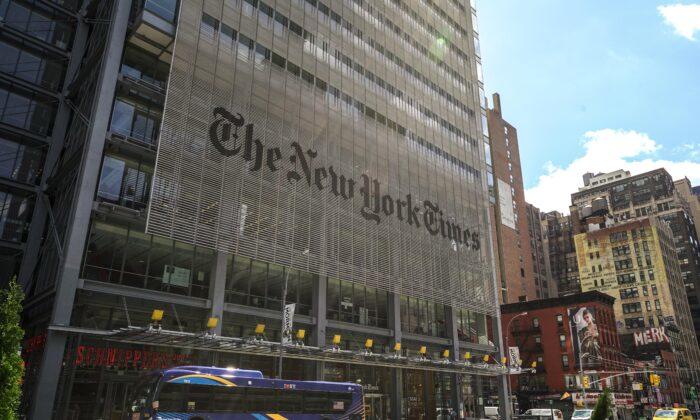
The New York Times building is seen in New York City on April 15, 2020. (Chung I Ho/The Epoch Times)

In stories from 2020 about Project Veritas videos, writers Maggie Astor and Tiffany Hsu inserted sentences that were opinions despite the articles being billed as news, New York Supreme Court Justice Charles Wood said.

“If a writer interjects an opinion in a news article (and will seek to claim legal protections as opinion) it stands to reason that the writer should have an obligation to alert the reader, including a court that may need to determine whether it is fact or opinion, that it is opinion,” Wood wrote in a 16-page decision denying the paper’s request to dismiss a lawsuit from Project Veritas.

“The Articles that are the subject of this action called the Video ‘deceptive,’ but the dictionary definitions of ‘disinformation’ and ‘deceptive’ provided by defendants’ counsel certainly apply to Astor’s and Hsu’s failure to note that they injected their opinions in news articles, as they now claim,” he added.

At issue are five articles that Project Veritas alleges contained false and defamatory information. All five were about a 2020 video report from the journalism group on alleged illegal voting practices in Minnesota.

In one of Astor’s articles, she wrote: “Mr. O’Keefe and Project Veritas have a long history of releasing manipulated or selectively edited footage purporting to show illegal conduct by Democrats and liberal groups.” The source of the statement, and whether it is fact or opinion, is not clear, according to the judge.

Hsu, meanwhile, wrote in part that conservative publications “magnified the reach of a deceptive video released last month by Project Veritas, a group run by the conservative activist James O’Keefe,” adding: “The video claimed without named sources or verifiable evidence that the campaign for Representative Ilhan Omar, a Minnesota Democrat, was collecting ballots illegally.”

Stating that the video is ‘deceptive’ and stating ‘without verifiable evidence’ in a factual way in a news article certainly presents the statement as fact, not opinion,” Wood wrote in his decision. “Further, the Astor and Hsu Articles could be viewed as exposing Veritas to ridicule and harm to its reputation as a media source because the reader may read these news Articles, expecting facts, not opinion, and conclude that Veritas is a partisan zealot group, deceptively editing video, and presenting it as news.”

James O’Keefe, the founder of Project Veritas, is seen in Washington on Oct. 12, 2019. (Samira Bouaou/The Epoch Times)

The judge said he reviewed the total context and tone of the stories and concluded a reader could believe the statements were conveying facts about Project Veritas.

The New York Times had argued that statements describing the video as “deceptive” and “false” were opinions incapable of being judged true or false.

Lawyers for the paper also argued that even if the term “deceptive” could be given objective meaning as a factual statement, writers demonstrated that the video was deceptive, citing other news outlets and so-called fact-checkers, such as Fox News and The Washington Post.

“While this is a lengthy media list, polling does not decide truth nor speak to evidence, and Defendants have not met their burden to prove that the reporting by Veritas in the Video is deceptive,” the judge said. Additionally, Veritas demonstrated in its complaint that Astor did not likely in 63 minutes digest a report from a group that alleged the video was disinformation, review news reports on Minnesota ballot issues, view the video online, obtain a comment from Alex Stamos from the Stanford Internet Observatory, write her own article, submit the article to her editors, and have it posted online.

“The facts submitted by Veritas could indicate more than standard, garden variety media bias and support a plausible inference of actual malice,” the judge wrote.

A lawyer representing the New York Times referred The Epoch Times to the paper. A spokesperson for the paper didn’t respond to a request for comment.

Project Veritas said in a statement: “This ruling means Project Veritas will now be able to put New York Times reporter Maggie Astor and New York Times executive editor Dean Baquet under oath where they will be forced to answer our questions. Project Veritas will record these depositions and expose them for the world to see.”

Follow Zachary on Twitter: @zackstieber

Tyler Durden
Sat, 03/20/2021 – 11:27

via ZeroHedge News https://ift.tt/3eXt9dp Tyler Durden

Erdogan Slams Biden Over “Killer” Putin Comment: “Not Fitting Of A President”

Erdogan Slams Biden Over “Killer” Putin Comment: “Not Fitting Of A President”

Perhaps at least pleased that he himself is not the focus of Joe Biden’s ire at the moment after previously being called an “autocrat” (and after he just fired his second central bank head in a mere 4 months), Turkish President Recep Tayyip Erdogan lashed out at the White House over Biden’s characterizing Vladimir Putin as a “killer” during an ABC News interview days ago.

Erdogan said Biden’s comments were “not fitting of a president” and are “unacceptable” on the world stage. “Mr Biden’s comment about Putin does not suit a head of state,” Erdogan told reporters after Friday prayers in Istanbul.

He then praised Putin for giving a “smart” and “classy response” after Putin made the case on state TV that Biden was engaged in mere psychological projection. Putin quipped of the “killer” slur that it “takes one to know one.” He also wished the US president “good health”. 

Via Anadolu Agency

The Russian leader had also challenged Biden to a live TV debate, which of course the White House shrugged off, saying the two leaders would eventually talk “when the time is right”. 

Ankara and Washington’s relationship is at its lowest point in years, due in large part to Turkey’s procurement of the Russian S-400 anti-air defense system, which drew condemnation from NATO leadership and Brussels.

Despite Turkey being NATO’s second largest military, it was cut off from the US F-35 program over the move, with the US worried its advanced fighter jet would be left vulnerable to Russian spying and infiltration of its systems. 

Biden has also vowed to get tough on Turkey, after it was perceived that Trump had an unusually warm relationship with Erdogan, and batted down Congressional moves to push sanctions. Biden has yet to hold a phone call with Erdogan since taking office.

Meanwhile Erdogan considers Putin a “friend and a strategic partner” after the two within the last few years began cooperating on Syria-related issues, seeing opportunities to thwart Washington designs in various areas of mutual geo-strategic concern. 

Tyler Durden
Sat, 03/20/2021 – 11:00

via ZeroHedge News https://ift.tt/3s4B6kM Tyler Durden

Is Hyperinflation Really A Threat?

Is Hyperinflation Really A Threat?

Authored by Lance Roberts via RealInvestmentAdvice.com,

Is hyperinflation a threat? While I was on vacation this past week, I got into a discussion on the issue.

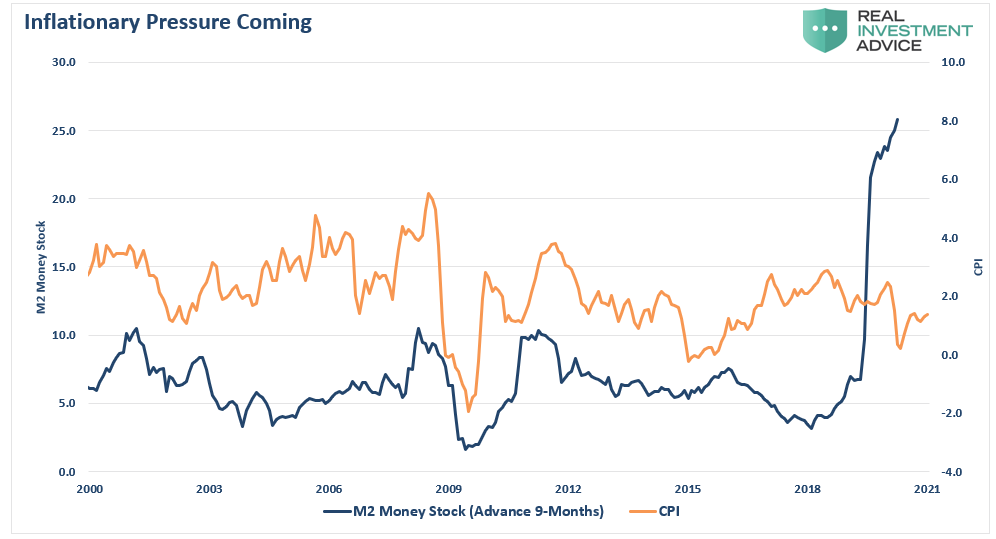
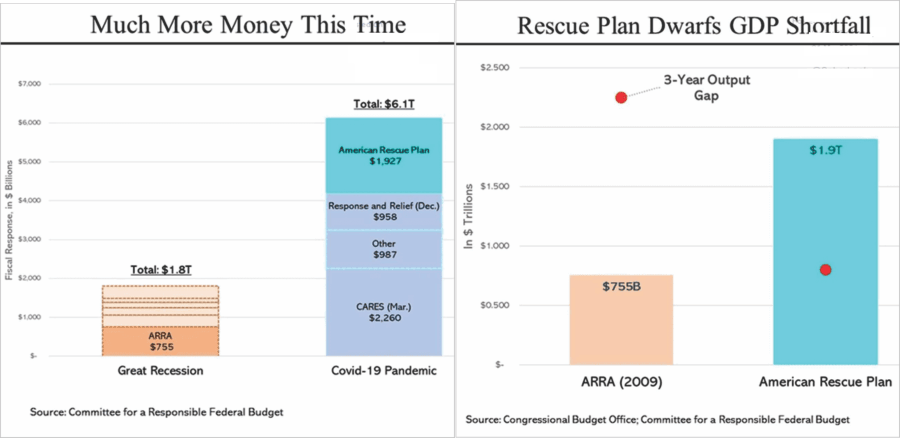
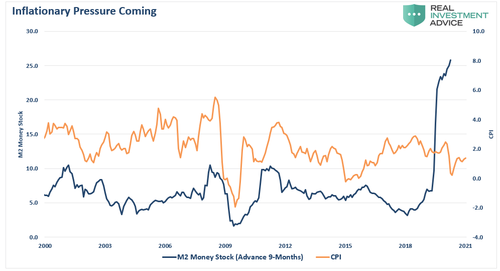
While the discussion ebbed between a broken financial system and capitalism’s failure, the gist was hyperinflation was coming. The measure of money in the system, known as M2, is skyrocketing, which certainly supports his concern. Now, with the Biden administration adding another $1.9 trillion into the economy, those concerns have risen.
In a recent Bloomberg interview, Larry Summers stated:

“There is a chance that macroeconomic stimulus on a scale closer to World War II levels will set off inflationary pressures of a kind not seen in a generation. I worry that containing an inflationary outbreak without triggering a recession could be even more difficult now than in the past.”

Are those concerns valid? Should we worry about a hyperinflationary surge like we saw in the late 70s? Or, are the deflationary pressures on the economy still present?

The Difference Between Inflation & Hyper-Inflation

Let’s start by defining the difference between an inflationary increase and hyperinflation.

Could repeated stimulus into the economy that exceeds the current output gap lead to a rise in inflationary pressures? Absolutely.
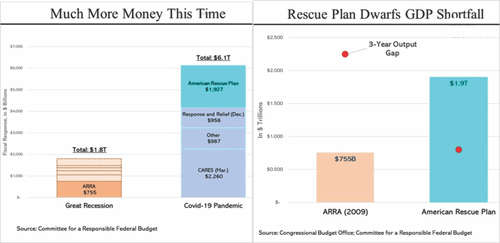
However, “hyperinflation” is not a threat. At least not yet.

“Hyper-inflation comes from a complete loss of faith in a currency from the threat of losing a war (Weimer Republic), an economic collapse, or some other catastrophic event. The U.S., even with all of our economic ills and woes, is still the safest place, in terms of liquidity, depth, and strength, to store excess reserves. The near historic low yield on government treasuries tells the story here.” – Real Investment Show

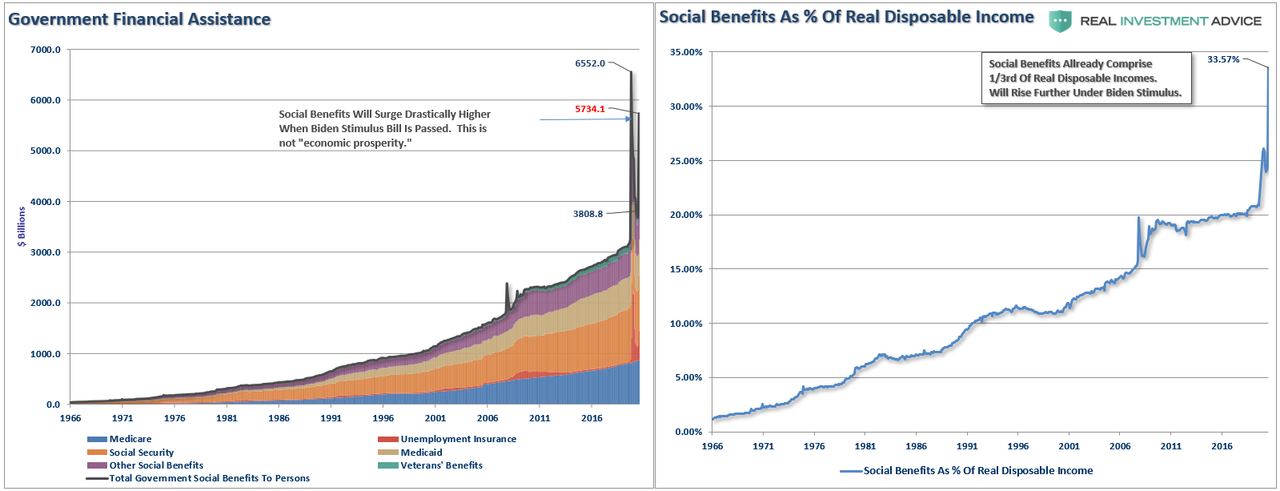
What is important is whether or not inflationary pressures, regardless of where they come from, have reached levels that could impact economic growth. While we see commodity-based inflation, primarily in food and energy, is that alone enough to offset the deflationary pressures we see economically from wages, debts, deficits, and rising dependency on social welfare?
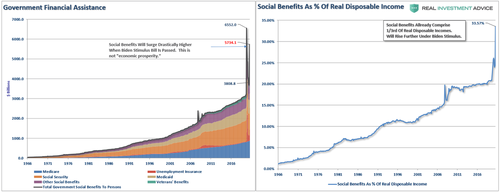
Inflation is a function of three primary components:

  1. The velocity of money,

  2. Wages, and

  3. Commodity prices.

The Velocity of Money
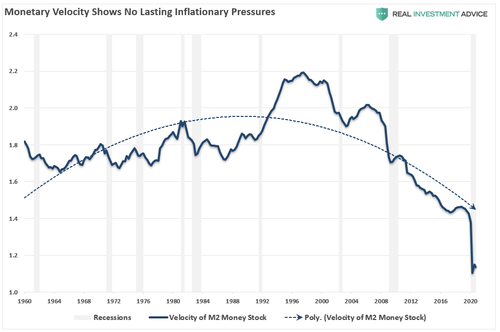
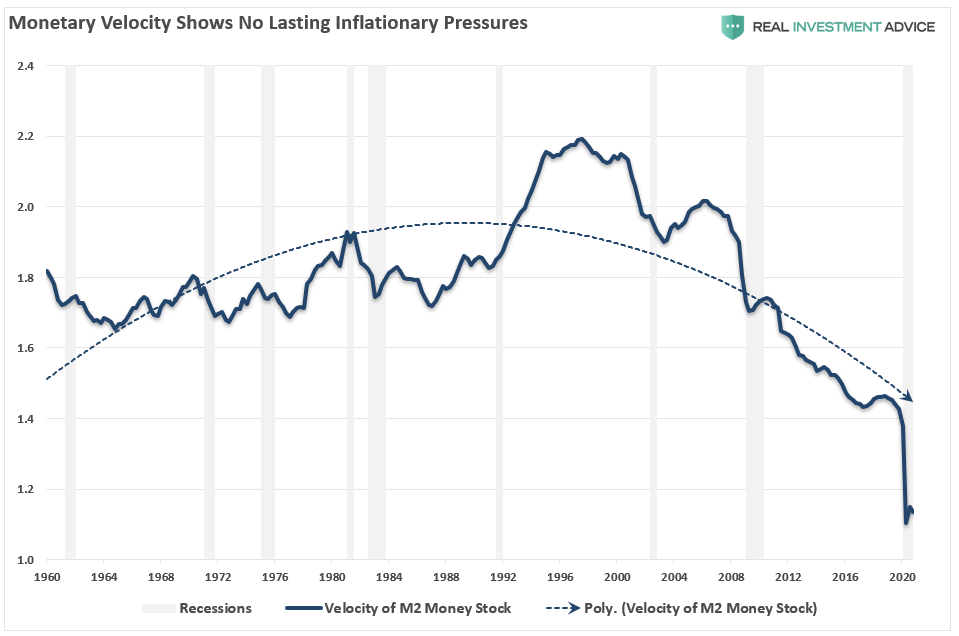
As I discussed in “2021 – A Disappointment Of Growth & Inflation,” monetary velocity is defined as:

“The velocity of money is important for measuring the rate at which money in circulation is used for purchasing goods and services. Velocity is useful in gauging the health and vitality of the economy. High money velocity is usually associated with a healthy, expanding economy. Low money velocity is usually associated with recessions and contractions.”

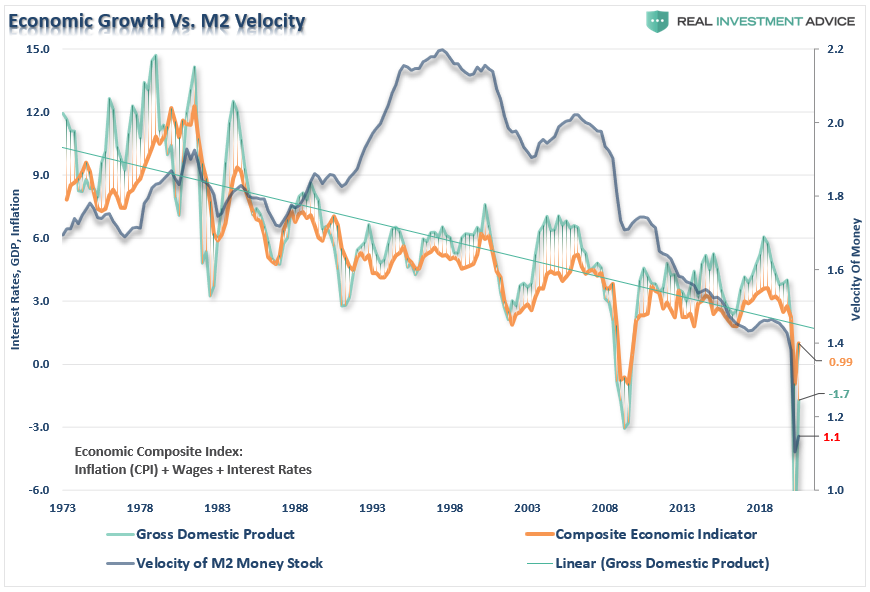
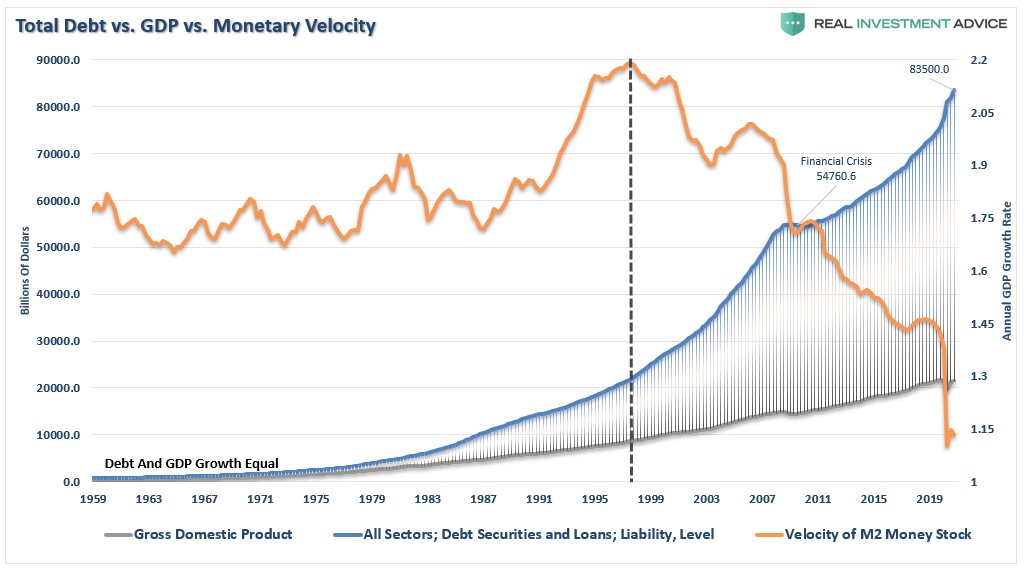
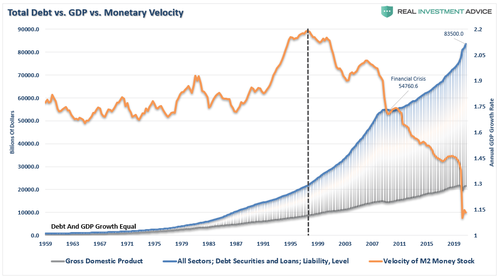
The chart shows what we have known for quite some time: money is not flowing through the system.

While there are many criticisms over this measure’s validity, it is a simplistic representation of demand. For prices across the entire spectrum to rise, there has to be more demand than supply. If the velocity of money is increasing, then “demand” in the system is growing. That increase in demand allows producers to raise prices and pass on costs to consumers.

Currently, companies are absorbing those costs, which eats into profit margins. To offset that increase, we have seen companies continuing to scale back employment, increase automation, and reduce CapEx. The decline in “activity” has worsened post-pandemic.

Wage Inflation

Secondly, to have “sustainable” levels of inflation, wages must be increasing.
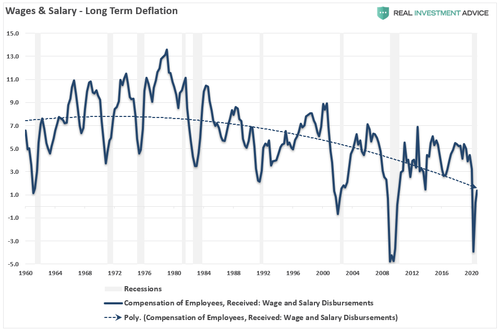
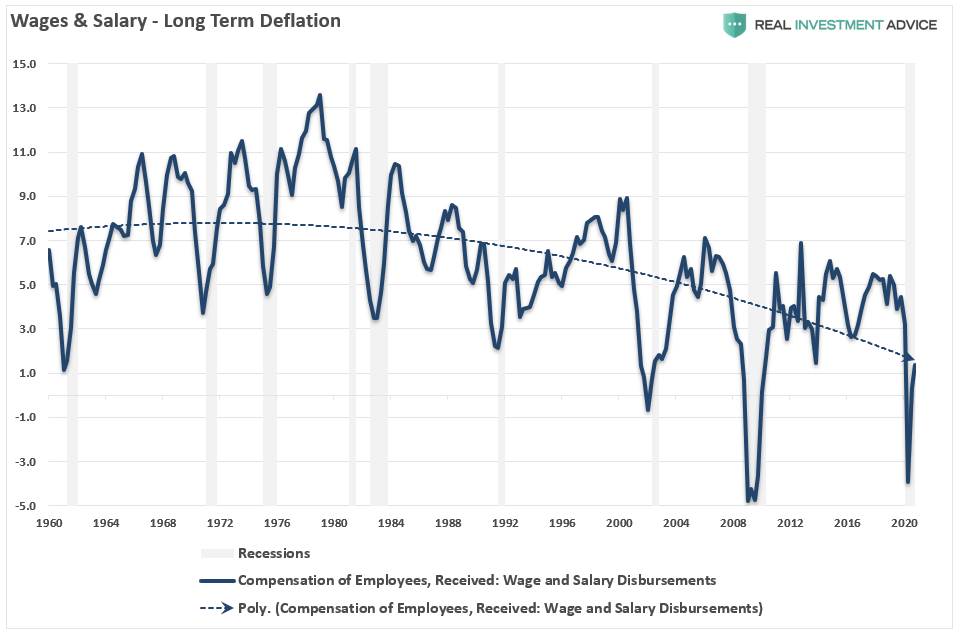
As wages rise, individuals can consume more, increasing aggregate demand, which, as noted above, leads to higher prices. Unfortunately, wage and salary disbursements, on a year over year basis, have been on the decline since 1980. Such remains commensurate with the weaker economic growth and declining monetary velocity.
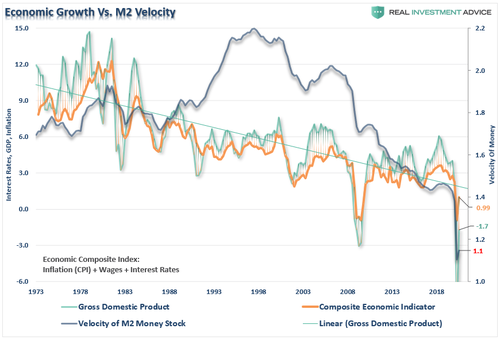
While wages have turned up post the recessionary lows, they are still sharply lower than at the turn of the century. That deterioration in wages, combined with credit constraints, has continued to put pressure on producers’ ability to raise prices. As a consequence, we continue to see more reliance on discounting to move inventories.

Commodity Prices
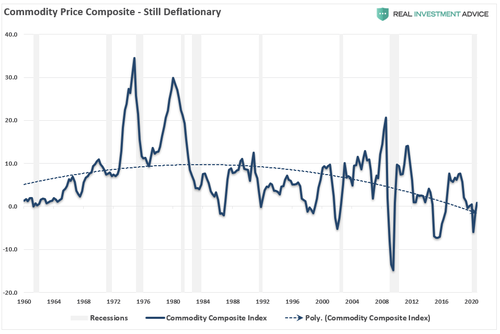
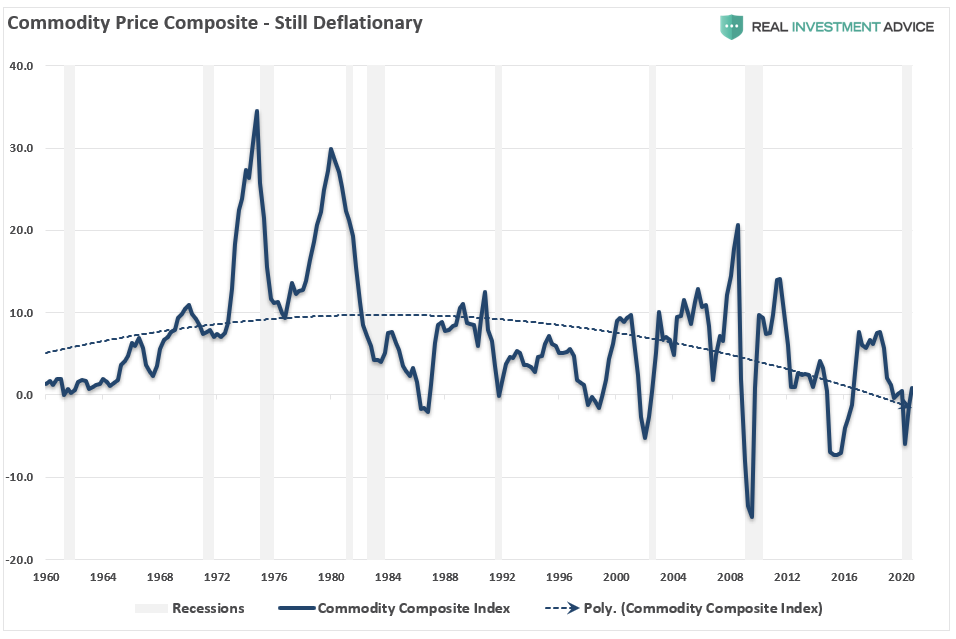
Finally, commodity prices are the headline event that everyone notices. Rising costs of milk, bread, gasoline, and the essentials of survival slap them in the face daily. While deflationary pressures exist in everything from apparel to iPads – these items are not consumed daily, and the psychological impact gets felt far less. Nonetheless, commodity prices are essential in consideration of inflation due to the effect on personal incomes.

Since consumption is roughly 70% of the economic calculation, higher commodity prices, particularly food and energy costs, can have a “psychological” impact on consumers. Such is especially an issue if it occurs quickly. Consumers can adjust to higher prices over time as long as wages rise at a proportional rate; however, that is not the case currently. The increase in commodity prices has been such a focal point with the average “American.”

So, what is the risk of surging inflation?

The High-Inflation Index

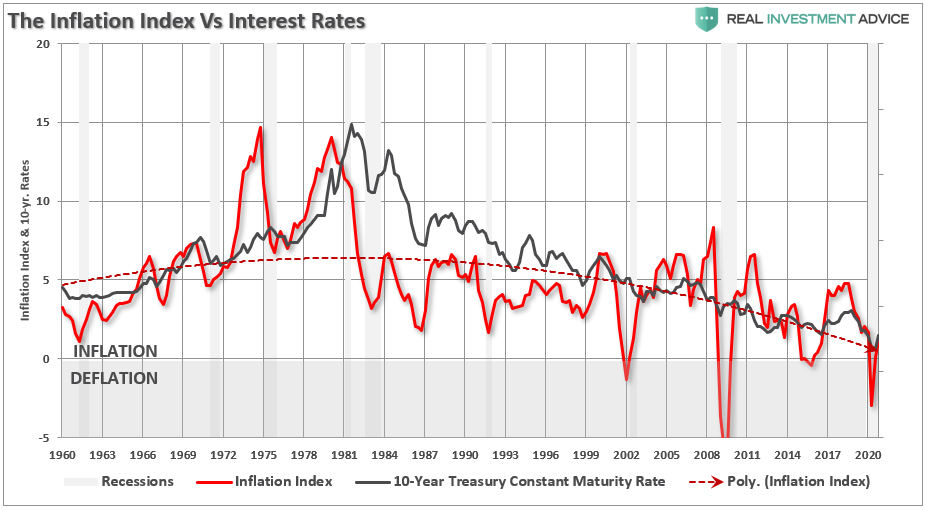
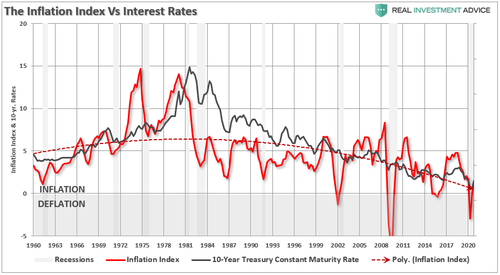
None of these items, individually or collectively, point to hyper-inflation. However, to measure these components’ impact on the overall economy, I created a composite index of wages, commodity prices, and velocity. The index clearly shows the inflationary pressures of the late ’70s, which gives us a confidence level in the assumptions’ validity. The dashed line is the average level of the index since 1959.
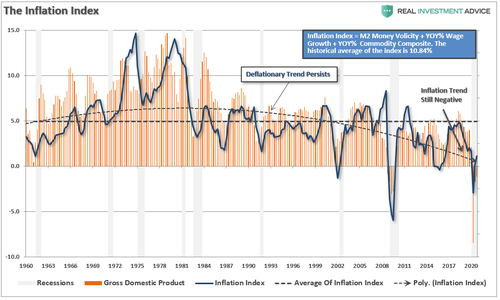
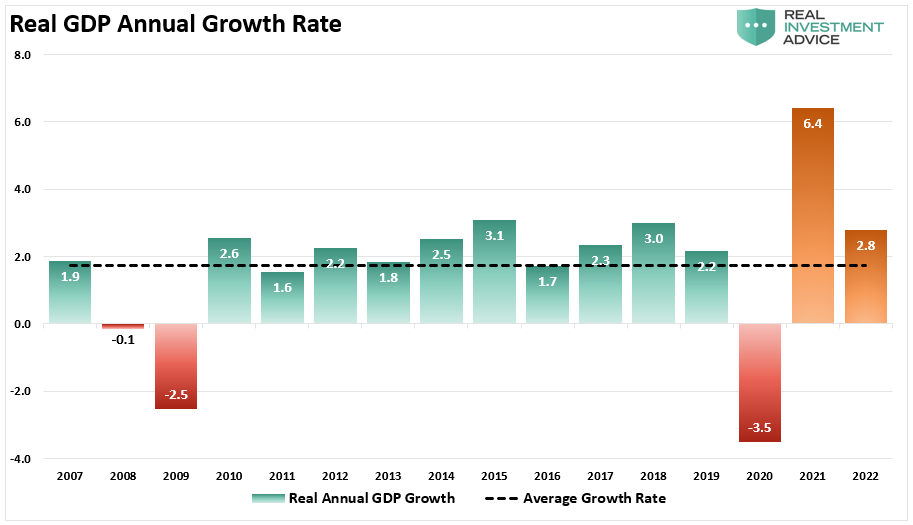
Importantly, there is a high correlation between the rise and fall of the index and overall real GDP growth. When the index has risen above its average level, the economy has begun to weaken or receded into recession. Currently, the inflation index is at 1.12, which well below the long-term average of 4.94.

The reading suggests what we already know. That since 2007, the average economic growth rate has been feeble at just 1.3%, or 1.7%, if we use estimates for 2021.
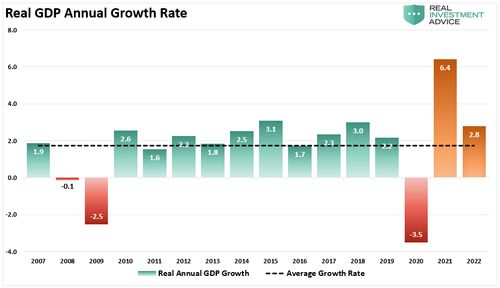
Secondly, while inflationary pressures are indeed rising short-term, we tend to agree with Jerome Powell’s assessment they could be “transient.”

There are three reasons for that statement:

  1. Current inflationary pressures are a function of the stimulus flooding into the system, which is “transient.”

  2. The economy is dependent on zero interest rates and $120 billion in monthly bond purchases, which suggests there is little if any, organic economic growth; and,

  3. The enormous burden of debt continuing to depress economic growth, and notably, monetary velocity.
Conclusion

The threat of hyperinflation remains an outlier due to the economic detractors mounting over the last 40-years.

  • A decline in organic savings that depletes productive investments

  • An aging demographic that is top-heavy and drawing on social benefits at an advancing rate.

  • A heavily indebted economy with debt/GDP ratios above 100%.

  • The decline in exports continues due to a weak global economic environment.

  • Slowing domestic economic growth rates.

  • An underemployed younger demographic.

  • An inelastic supply-demand curve

  • Weak industrial production

  • Dependence on productivity increases to offset reduced employment

While the U.S. economy certainly has its share of problems, the U.S. is still the “cleanest shirt in a pile of filthy laundry.” With the Treasury still the safest source to store foreign currency reserves, at the moment, the likelihood of a complete economic meltdown is minimal.

Furthermore, due to the deflationary pressures that currently exist due to weak wage growth, automation, and mounting debts, it is unlikely that inflation can rise much before it triggers an economic contraction. Since interest rates adjust for inflation, a rise in inflationary pressures is a “double whammy” on consumption.
However, while the fears of a hyperinflationary event are overblown, other factors could be equally devastating to individuals and the economy.

The debt problem remains a massive risk to monetary and fiscal policy. If rates rise, the negative impact on an indebted economy quickly depresses activity. More importantly, the decline in monetary velocity clearly shows that deflation remains a persistent threat.

Tyler Durden
Sat, 03/20/2021 – 10:35

via ZeroHedge News https://ift.tt/3rdKDVv Tyler Durden

Saudi Arabia Confirms New ‘Iran-Backed’ Drone Attack On Aramco Facility

Saudi Arabia Confirms New ‘Iran-Backed’ Drone Attack On Aramco Facility

Saudi Arabia has confirmed a fresh Houthi attack on Saudi Aramco facilities on Friday, for which Riyadh is further pointing the finger at Iran. The kingdom said the continued attacks threaten “the security and stability of the world’s energy supplies”.

The Yemeni Shia group which the US-Saudi coalition has been at war with since 2015 initially claimed responsibility for the Friday attack on the Saudi capital. An Aramco refinery had been hit by what was reported as six-bomb laden drones, resulting in a fire which later came under control without impacting oil supplies at the plant. 

Saudi Aramco file

Later Saudi officials said the projectiles released by the drones were made in Iran. “Missiles used in the attacks on Saudi Aramco facilities, for which Yemen’s Tehran-backed Houthi group has claimed responsibility, were made in Iran, a Saudi minister said,” as cited in Bloomberg.

Minister of state for foreign affairs Adel Al-Jubeir issued a statement saying “All of the missiles and drones that came into Saudi are Iranian-manufactured or Iranian-supplied.”

Suggesting further the attack may have also ‘directly’ involved Iranian operatives such as the IRGC (and not just the Houthis as proxies), he added: “Several of them, as we’ve said, came from the north; several came from the sea.”

Russia alongside others condemned the attack on the oil facilities and urged a halt in violence. It comes after prior such Houthi attacks on Saudi Arabia this month, which saw oil prices rise above $70 a barrel in a first since January 2020.

However, as of Saturday more inbound drones were reported, according to Arab News:

The Arab Coalition said Saturday that it it has intercepted and destroyed an explosive-laden drone launched by the Houthi militia towards the city of Khamis Mushait in Saudi Arabia, according to Al Arabiya TV. 

The coalition said it was taking “all necessary operational measures to protect civilians against terrorist assaults.”

Yemen’s Houthis have long maintained they are responding to the Saudi coalition’s unrelenting aerial bombing of Yemen, which has unleashed what the UN has dubbed the world’s ‘worst humanitarian disaster’ – also as the country is plunged into famine amid a coalition-imposed blockade. 

Tyler Durden
Sat, 03/20/2021 – 10:10

via ZeroHedge News https://ift.tt/3c2X01X Tyler Durden

Visualizing The World’s Deadliest Pandemics By Population Impact

Visualizing The World’s Deadliest Pandemics By Population Impact

Humanity has been battling against disease for centuries.

And while most contagious outbreaks have never reached full-blown pandemic status, Visual Capitalist’s Carmen Ang notes that there have been several times throughout history when a disease has caused mass devastation.

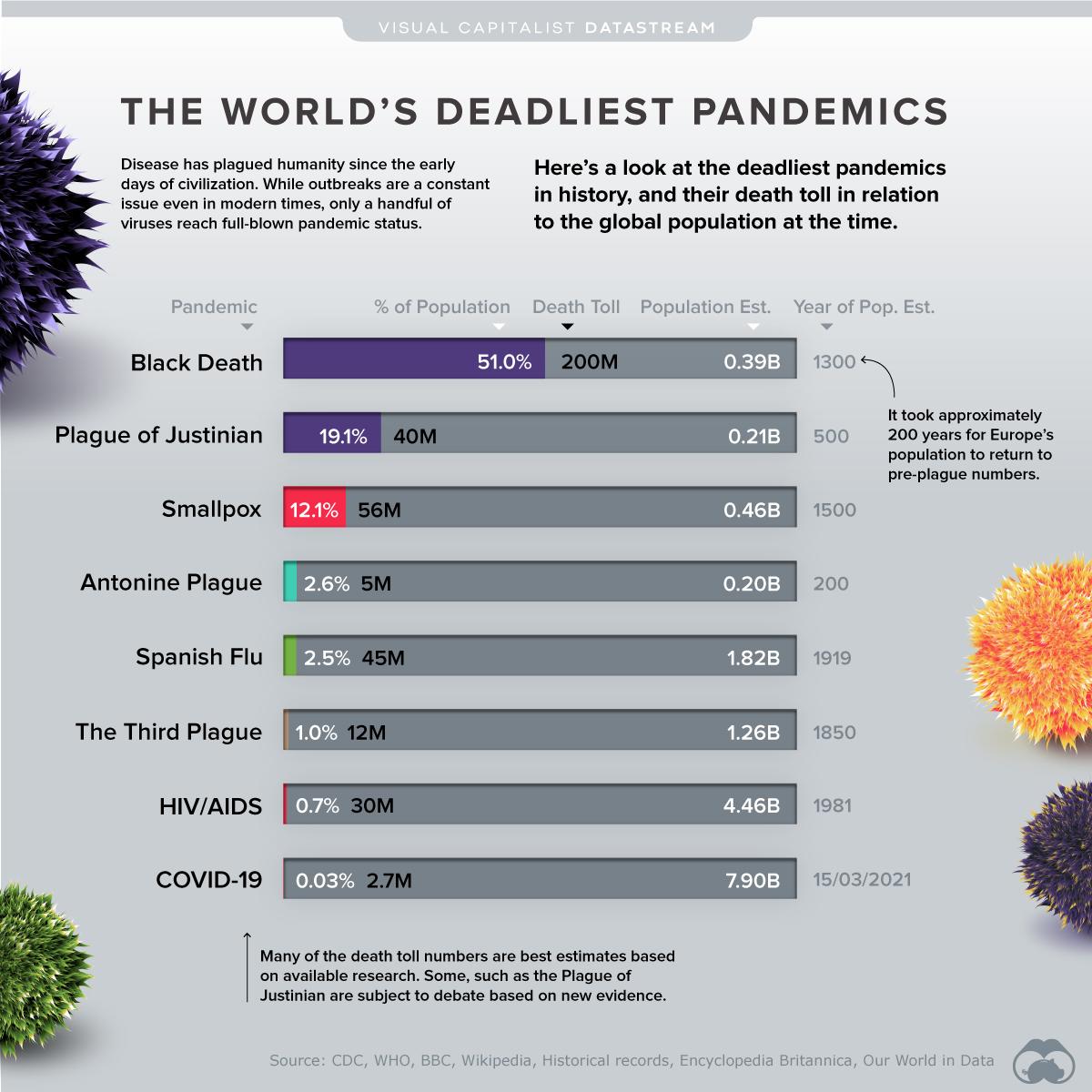
Here’s a look at the world’s deadliest pandemics to date, viewed from the lens of the impact they had on the global population at the time.

Editor’s note: The above graphic was created in response to a popular request from users after viewing our popular history of pandemics infographic initially released a year ago.

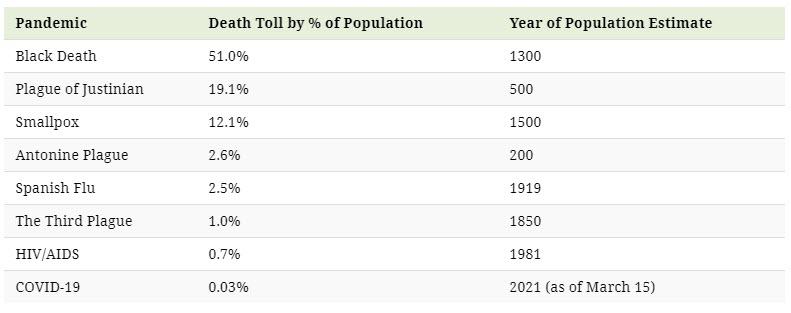
Death Toll, by Percent of Population

In the mid-1300s, a plague known as the Black Death claimed the lives of roughly 200 million people – more than 50% of the global population at that time.

Here’s how the death toll by population stacks up for other significant pandemics, including COVID-19 so far.

The specific cause of the Black Death is still up for debate. Many experts claim the 14th-century pandemic was caused by a bubonic plague, meaning there was no human-to-human transmission, while others argue it was possibly pneumonic.

Interestingly, the plague still exists today – however, it’s significantly less deadly, thanks to modern antibiotics.

History Repeats, But at Least We Keep Learning

While we clearly haven’t eradicated infection diseases from our lives entirely, we’ve at least come a long way in our understanding of what causes illness in the first place.

In ancient times, people believed gods and spirits caused diseases and widespread destruction. But by the 19th century, a scientist named Louis Pasteur (based on findings by Robert Koch) discovered germ theory – the idea that small organisms caused disease.

What will we discover next, and how will it impact our response to disease in the future?

Like this? Check out our full-length article The History of Pandemics

Tyler Durden
Sat, 03/20/2021 – 09:45

via ZeroHedge News https://ift.tt/391G6yZ Tyler Durden

Printing Money In The Age Of COVID

Printing Money In The Age Of COVID

Via AustrianCenter.com,

The coronavirus has dominated all of our lives in recent months. Radical paths were taken by politicians in the form of lockdowns to contain the pandemic.

But we should recognize that even if the coronavirus is a (major) challenge for us, we always have to keep a holistic view of world events. Just as there are epidemiological factors to consider in this crisis, there are also economic, social, cultural, political and other health factors at play.

It is precisely these other factors that are so often forgotten in the panicky reporting, in the constant, manic tracking of the current infection numbers, that we want to take a look at in our series “The Costs of Coronavirus Lockdowns” in the coming weeks.

Monetary policy is the second primary tool, alongside fiscal policy, used by governments to influence economic activity. When a crisis hits, an economy is stimulated either by the state budget – which arises from the taxpayers – or silently through monetary expansion. By either lowering interest rates, issuing government-backed securities, or even purchasing corporate bonds the central banks increase the money supply in the economy. Ever since the beginning of the crisis, the U.S. Federal Reserve has done all of the above.

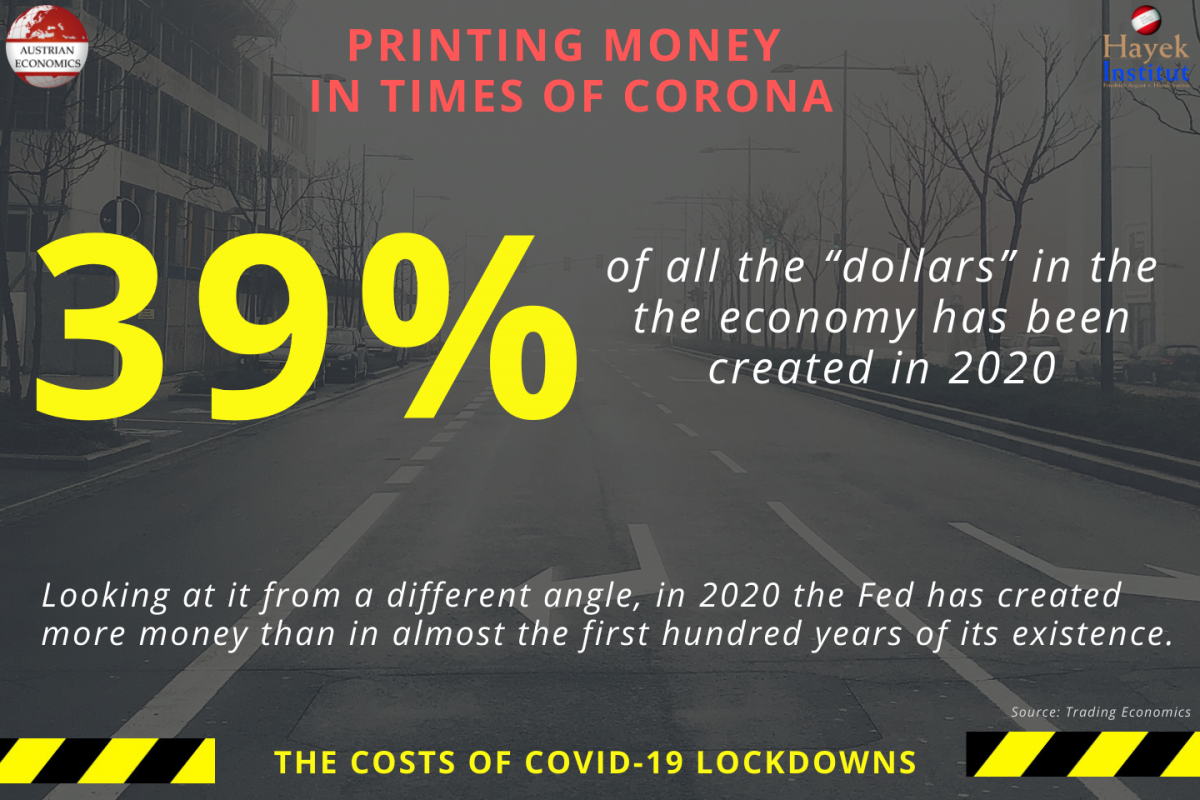
One of the most popular measures of the money supply used by economists is M1. It consists of the most highly liquid assets. In other words, the most easily exchangeable assets are used as payment for goods and services. As Trading Economics data shows, the Fed has created 39% of all the “dollars” in the economy in 2020. To put it on its head, in 2020 the Fed has created more money than in almost a hundred years of its existence.

Monetary policy effectiveness has its boundaries.

As good as it might seem at first glance, creating money “out of thin air” doesn’t bring prosperity.

It is true, inflation still hasn’t start banging on our doors. But looking no further than the asset prices, we can see that the low inflation rate is masked by the asset price inflation. Even with the sharp drop of the GDP and an unemployment rate that stands more than double the rate before the crisis started, the S&P 500 is more than 10% higher than on the day the pandemic rolled around. This also shows who profits from the economic response to the COVID-19 crisis: those with assets, i.e. those already wealthy anyway.

The middle and lower classes, meanwhile, lose out, either having their businesses shut down or stuck in unemployment or short-term work schemes.

Thus, the equality warriors of the political elite continue to increase economic inequality in the fight against the Coronavirus.

Tyler Durden
Sat, 03/20/2021 – 09:20

via ZeroHedge News https://ift.tt/38Zq8Fr Tyler Durden

UK Prepares Antitrust Probe Into Facebook 

UK Prepares Antitrust Probe Into Facebook 

Antitrust probes into Facebook appear to be increasing on both sides of the Atlantic. 

Earlier this week, Rep. Ken Buck, the top Republican on the House Judiciary antitrust subcommittee, said during an antitrust hearing that “Apple, Google, Facebook, and Amazon have reached monopoly status, and their behavior won’t change until Congress acts, the enforcement agencies do their job, and the courts move quickly to rein in their predatory conduct.” 

On Friday, sources told FT that the UK’s Competition and Markets Authority (CMA) is preparing an antitrust investigation into Facebook within the coming months, which is the latest crackdown on Silicon Valley’s big tech dominance. Similar probes were launched into Apple and Google earlier this year. 

Sources said CMA “would take a sweeping look at the way Facebook allegedly uses customer data to squash rivals in social media and online advertising.” 

CMA’s potential investigation into Facebook comes as the government agency recently announced inquiries into Apple’s App Store fees and Google’s privacy settings. 

CMA expects to follow European Union’s antitrust chief Margrethe Vestager’s investigation into Facebook, launched in December. She told lawmakers in Brussels how big tech is increasingly facing more stringent scrutiny around the world.

“It’s a sign that the debate on tech dominance has been shifting over the last couple of years,” Vestager said of the US antitrust move. 

A person close to the CMA said the focus of the upcoming investigation would be on the social media platform’s digital advertising. 

Andrea Coscelli, the CMA’s chief executive, vowed to take on Facebook and other big tech companies with a series of antitrust cases. He’ll be working with lawmakers in Brussels to combat big tech. 

Meanwhile, in the US, Facebook requested a federal judge earlier this month to dismiss landmark antitrust suits against it, claiming that its “innovative free products deliver value” is helpful to users, adding there’s no evidence whatsoever of anti-competitively. 

The Federal Trade Commission and almost every state have filed lawsuits against the social media platform for its market power abuse after acquiring Instagram and WhatsApp. 

A source inside the CMA said: “The CMA cannot reverse past mergers . . . Becoming a monopolist is not against the law, it’s whether [companies] abuse that position once [they] have it.” 

Tyler Durden
Sat, 03/20/2021 – 08:45

via ZeroHedge News https://ift.tt/2NAyEn3 Tyler Durden

Iceland Volcano Erupts After Thousands Of Earthquakes

Iceland Volcano Erupts After Thousands Of Earthquakes

While a powerful 7.0 magnitude earthquake struck off the coast of Ishinomaki, Japan, a city located just 65 miles from Fukushima, on Saturday, there was a more notable volcanic eruption in southwestern Iceland near the capital Reykjavik on Friday night. 

In recent weeks, we published two notes (see: here & here) informing readers about the more than 34,000 quakes that have been recorded on the Reykjanes Peninsula in recent weeks. On Mar. 4, we wrote: such “quake activity has previously preceded volcanic eruptions.” By Mar. 14, the quakes worsened as the country was put on “high alert” for the next volcanic eruption. 

About five days from our latest note and tens of thousands of quakes later, the first volcanic eruption in the Reykjavik Peninsula in 800 years was recorded on Friday night. Here’s a video of the eruption:

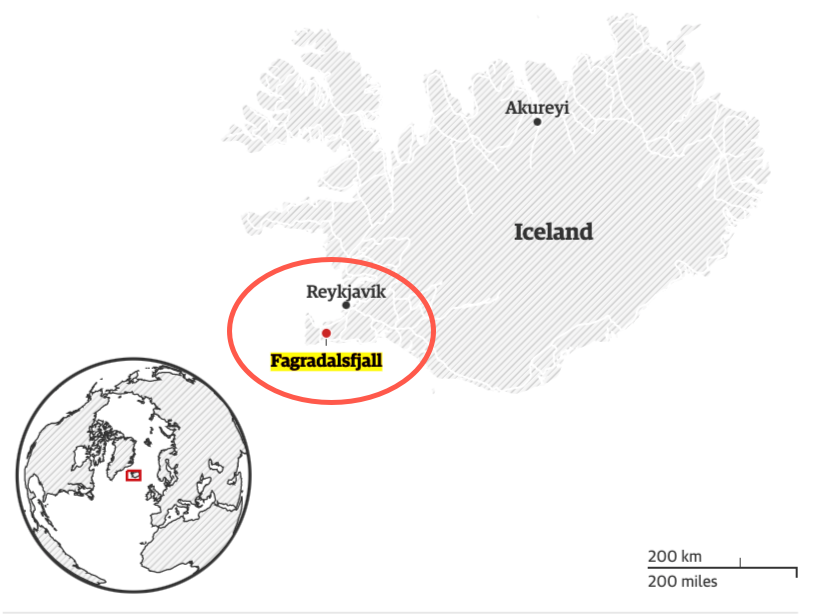
The Icelandic Meteorological Office said the eruption began in Fagradalsfjall around 20:45 GM, about 25 miles from the capital Reykjavik. 

“Volcanic eruption has begun in Fagradalsfjall,” the meteorological office (IMO) tweeted Friday night, referring to a mountain located south-west of the capital.

More video shows streams of red lava pouring out of a fissure vent. 

“The fissure is estimated to be about 200 meters (219 yards) long,” the IMO said.

So far, Fagradalsfjall is not expected to cause havoc in air travel, as did ash from the Eyjafjallajökull eruption in 2010.

Tyler Durden
Sat, 03/20/2021 – 08:08

via ZeroHedge News https://ift.tt/3tFwx0E Tyler Durden

German Researchers Link AstraZeneca Jab To Rare Blood Clots

German Researchers Link AstraZeneca Jab To Rare Blood Clots

One day after the EMA left the door open to the possibility that the AstraZeneca-Oxford COVID jab might have harmful side effects for a small subset of patients, researchers in Germany are claiming to have determined the link between the vaccine and the rare blood clots that have resulted in a handful of deaths.

German public broadcaster Norddeutscher Rundfunk reported that researchers at the Greifswald teaching hospital in northern Germany claimed on Friday to have discovered the cause of the rare blood clotting found in some recipients of the AstraZeneca coronavirus vaccine, most notably a trio of Norwegian health care workers, one of whom died due to complications arising from the condition.

Hours before the EMA released its final safety assessment on Thursday, a top Norwegian government doctor claimed to have found a potential link between the vaccine and the rare reaction.

But some cases also involved a rare thrombosis (ie clots) in the brain. For these cases, the German researchers claimed common medicine could be used to treat the condition when and if it arises.

Germany, along with several other EU member states, suspended the use of the AstraZeneca vaccine on Monday following reports of unusual blood clots, though a dozen states have already re-started vaccinations.

On Friday, the WHO largely confirmed the EMA’s findings. And in the US, officials moved ahead with a program to donate some of the American stock to Canada and Mexico as the FDA looks set to approve the AstraZeneca jab in the near future. The agency added the jab has “tremendous potential” since the jab accounts for 90% of the vaccines distributed through COVAX, the WHO-Gates Foundation scheme to vaccinate the entire world by providing vaccines to poorer countries for free.

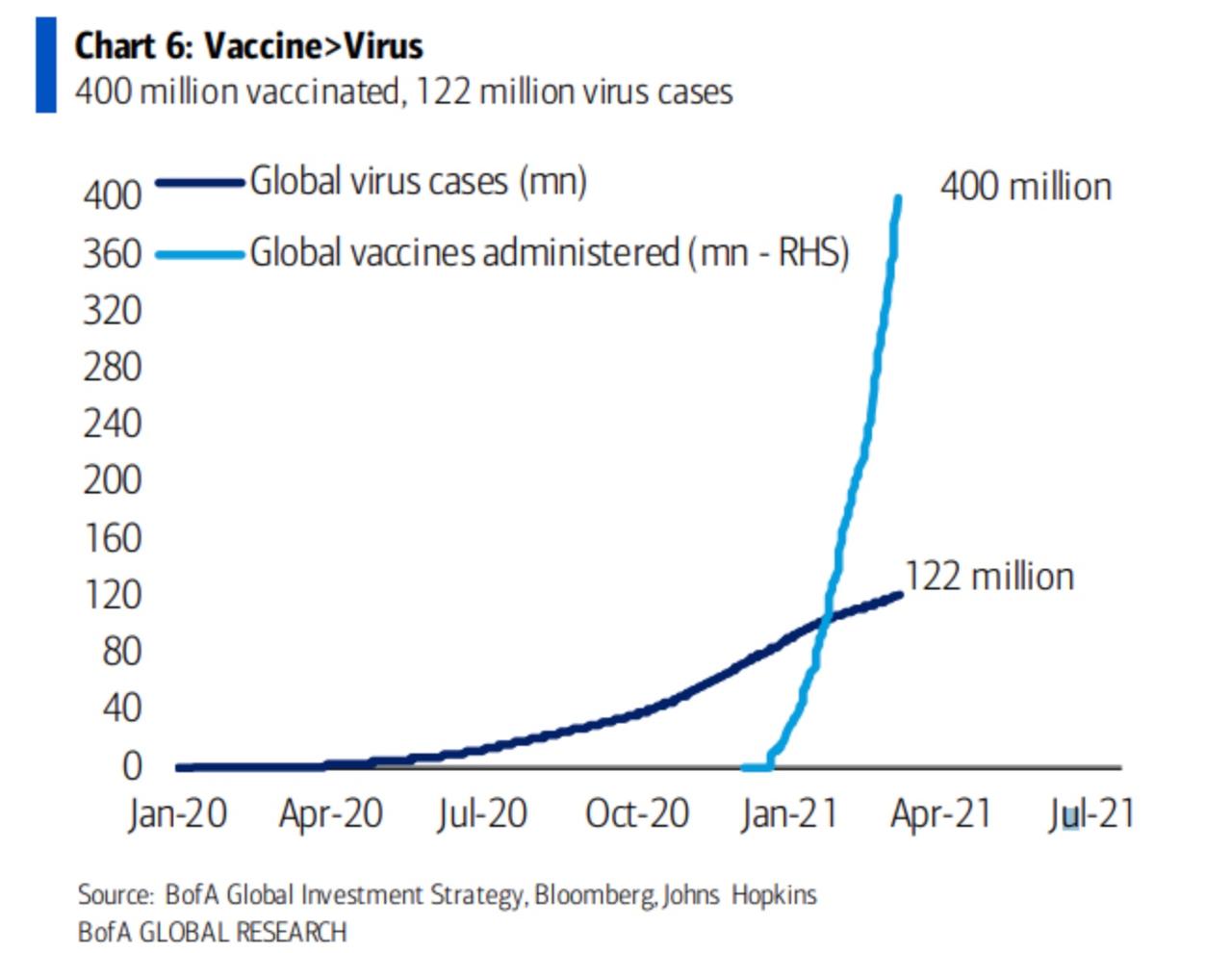
By Thursday, Germany had administered over 10MM doses of COVID-19 vaccines, including the AstraZeneca vaccine. While Europe continues to lag the US and Europe in terms of the percentage of its population who have received the vaccine, the total number of dose distributed in the West now exceeds the total number of confirmed COVID-19 cases several times over.

As for how to identify any potential risk factors, the team said patients exhibiting certain symptoms, like dizziness, for more than three days, should receive another check-up by a doctor. This might further strain health-care systems, but it could help save lives in the rare cases where a reaction may occur.

While a dozen EU countries, including Italy, France and Germany, re-started use of the shot on Friday, Finland was a notable holdout. After halting vaccinations last week, the country pledged to carry out an independent review of two possible cases of blood clots.

Tyler Durden
Sat, 03/20/2021 – 07:35

via ZeroHedge News https://ift.tt/38ZFjid Tyler Durden