Manufacturing company 7-Sigma made headlines when it decided to leave Minneapolis as a result of the company’s plant being burned by rioters. “They don’t care about my business,” 7-Sigma owner Kris Wyrobek old the Star-Tribune. After more than 30 years in the city, the company isn’t staying, nor are any of the company’s fifty jobs.
But the costs of being victimized in protests is just one of many reasons homeowners and businesses may be realizing life and business in central cities has lost its luster. The ongoing threat of more business lockdowns, more riots, higher taxes, and failing schools may induce many Americans to flee, once again, to the suburbs as their parents or grandparents did.
This goes well beyond the fear of the disease many journalists have assumed is behind the observed beginnings of an exodus from cities. Yes, many in the upper classes have fled the cities for their mountain homes and yachts for “health reasons.” But these people are relatively few in number and their thinking quixotic. They can afford to drop everything and leave cities overnight.
But the larger impacts are likely to be felt as middle class homeowners and business owners conclude they’d simply rather avoid the edicts and neglect of mayors and city councils in central cities who thinking nothing of issuing job-destroying “stay-at-home” orders while allowing rioters and vandals free rein.
The real cost to cities is likely to emerge over time. It will come in the form of families and shop owners who decide it’s best to move their businesses ten miles down the road to a neighboring city that will actually do something about rioters. It will come in the form of families which decide their next home will be just a little bit farther from the urban dictator-mayors who have the heaviest hands in enforcing lockdowns and business closures. It will come in the form of potential new business owners and homeowners will be decide to never purchase property to start a business in central cities in the first place.
The Decline of Cities at Mid-Century
We may be seeing something reminiscent what happened in America’s large central cities during the 1970s and 1980s. Many Americans concluded these cities had become unlivable and crime infested. Many concluded these were places that were quite inhospitable to doing business. So they left. (Forced busing for “integration” purposes was a factor as well.)
In some cases, there were dramatic events that illustrated the trend. The late sixties in New York saw several strikes by city workers. Transit and sanitation in the city became a disaster. The 1977 blackout in New York City ended in widespread riots that induced many businesses to pack up and never return. Many households followed.
But for the most part, cities saw an exodus that took many years and slowly hollowed out the finances and tax revenues of big cities. Areas of Detroit fell into ruin. By the mid seventies, New York City was lurching from one fiscal crisis to another.
St. Louis, Cleveland, Buffalo, and Detroit each shrank by more than 20 percent. Vast stretches of urban land were left virtually deserted.
More than half of large cities lost population from 1950 to 1980.
There were other factors at work as well, of course. The central cities were often hit the hardest as the old Rust Belt went into decline after the region was destroyed by labor unions and city and state laws that made business in the region inefficient and uncompetitive. Business owners and workers who possessed any real ambition or entrepreneurial spirit had good reason to leave the region altogether.
City centers, built on an old manufacturing-based working class never recovered.
The situation today is a bit different. During the 1990s, core cities began to recover from their mid-century decline and many officials and intellectuals in these areas began cultivating the so-called ” creative class” (also known as the ” bohemian bourgeoisie “) with the idea that young artists, engineers, architects, and tech workers might be convinced to move into city centers and and revitalize local urban economies. It appears to have worked in many cases.
But in 2020 America the hey day of the new techno-city may be over.
Civil Unrest
The case of the Sigma-7 closure in Minneapolis is just the most famous case of central cities’ hostility to businesses within their borders. We’re not hearing about the many small less-notable businesses that won’t re-open in the wake of riots. In other cities, such as Chicago, city officials are now begging retailers to not leave the city.
Meanwhile, a number of small businesses now within the “CHOP” zone in Seattle is suing the city for abandoning businesses to the whims of the leftist mob.
As reported by the local NBC affiliate, local businesses have been threatened and harassed by the bosses of the “Capitol Hill Occupation Protest” (CHOP) zone in the city. The city government, the plaintiffs have concluded, essentially have abandoned these businesses to the new “government”:
The City’s decision has subjected businesses, employees, and residents of that neighborhood to extensive property damage, public safety dangers, and an inability to use and access their properties.
Minneapolis and Seattle aren’t the only cities the prospect of continued civil unrest. with forty million new unemployment filings in recent months, the US faces a worrisome period of highly elevated unemployment. Many of the worst-affected workers will be lower-income populations living in core cities. This won’t help the prospect of a speedy return to placid city environments.
Regime Uncertainty
As government experts and media pundits emphasize growth in reported COVID-19 cases, the prospect of renewed lockdowns now looms, as well. This is a threat at the state level and in many suburban local governments. But experience strongly suggests that those political jurisdictions controled by political leftists are likely to embrace the longest and harshest lockdowns. In many states, such as Texas and Colorado and California and Pennsylvania, local governments in big cities embraced lockdowns more enthusiastically than the surrounding regions and at the state capitols. “Regime uncertainty”—uncertainty about what business-killing regulations a government might embrace next—appears to be greater in central cities.
Business owners are likely to remember this. In the medium- and long-term, business owners and potential business owners will gravitate to those areas where the threat of harsh lockdowns is smaller.
The Rise of the “Work-at-Home” Trend
If the work-at-home trend persists, core cities will have lost one of their main draws: namely, the prospect of a shorter commute for those who can afford a home close-in to the employment centers. Even if daily commutes are just reduced—say, to a three-days-per-week schedule—the commute-time cost of a home in the suburbs falls dramatically. Without the need to sit in traffic five days per week, more expensive city homes and the congrestion and crime of city centers becomes far less attractive.
Declining Tax Revenue and Urban Blight
On top of it all will come big cuts to city budgets as COVID lockdowns decimated tax revenues. All cities and states will be impacted, but if the most productive taxpayers move out of the core cities, it is these areas that will feel the brunt of revenue shortfalls. In other words, a shift of productivity toward the suburbs and small cities will hollow out big city budgets and school district budgets as well. This will only encourage businesses and families to stay away in even larger numbers. Families will seek to avoid school districts and decline, and employers won’t want to become part of a shrinking tax base where tax increases are frequently eyed by politicians as a way out.
The Beginnings of a Trend?
All of this will take time to play out. Yes, we’ve started to see those with means leave big cities already. The New York Times has reported on numerous former residents of New York City who have left for the surrounding regions. The Times asks “is New York City worth it anymore?” and points out “the pandemic send young New Yorkers packing.”
But these remains a small percentage of the overall population. Most homeowners, families, and business owners need time to move their businesses, sell their properties, and be convinced it’s time to move on.
None of this should be interpreted, however, as a trend away from metropolitan areas overall. There appears to be little risk that large numbers of Americans will be quitting metro areas for rural villages and towns. Some will. But most will notice that metro areas still have most of the jobs, most of the cultural institutions, and most of the health care services. What can’t be said is that core cities have a monopoly on these resources. In recent decades, suburbs and small cities have increasingly become places that host a wide variety of sports teams, museums, convention centers, hospitals, and more. Metro areas are still a good place to be. But old core cities? Not so much.
via ZeroHedge News https://ift.tt/2NAYu6C Tyler Durden
Visualizing The COVID-19 Impact On Advertising Spend Tyler Durden
Fri, 06/26/2020 – 20:05
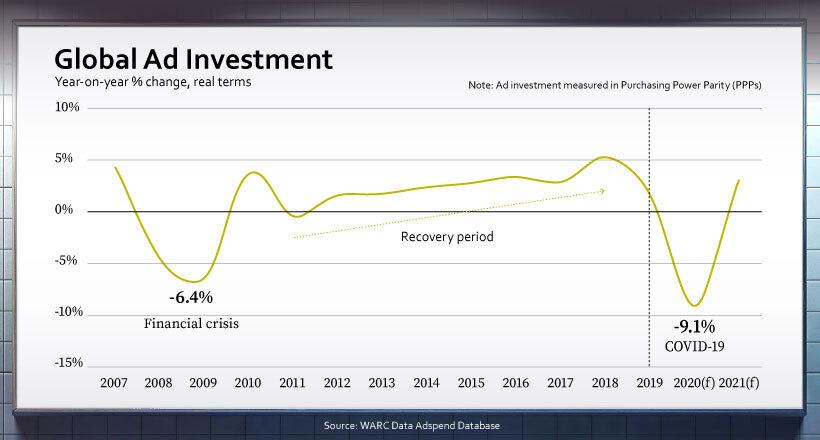
Before the COVID-19 outbreak, global advertising investment was estimated to grow at a 7.1% clip in 2020.
Now, as Visual Capitalist’s Katie Jones notes,global ad spend is estimated to see a brutal contraction of 8.1% – equating to almost $50 billion – as a result of changing consumer behavior. The total loss becomes a bleak $96.4 billion when taking pre-pandemic growth forecasts into account.
Today’s graphic uses data from the World Advertising Research Center (WARC) to visualize the estimated decline in advertising spend by media format and industry.
As advertisers adapt to rising in-home media consumption, the tug-of-war for ad dollars between online and traditional media seems to have a decisive winner.
The Death of Traditional Media
After decades of experts predicting the death of traditional media formats, the COVID-19 pandemic could be the last nail in the coffin.
In fact, spend across every type of traditional media format will see a decline in 2020, while most online media formats are expected to see an increase in spending.
Mid-term, this era will be associated with an accelerant of latent and incremental trends towards more digital consumption, commerce, and thus advertising”
– Dr. Daniel Knapp, Interactive Advertising Bureau Europe
With consumers spending significantly more time at home, brands are allocating more dollars to certain media formats to reflect that. However, when it comes to traditional in-home formats such as TV, consumers are opting for streaming services instead. In fact, they are streaming twice as much online video on services such as Netflix compared to last year.
Spending Estimates, by Category
Almost every industry will see reduced spending. The one category that will buck the trend is “Telecoms & Utilities”, which will experience a 4.3% increase in ad spend throughout the year.
Interestingly, stay-at-home restrictions have increased consumers’ reliance on these services for staying connected with loved ones and working from home.
Moreover, the pandemic has proved to be a turning point for the telecommunications industry, as the importance of faster internet speeds are emphasized and the potential of 5G is realized.
The Road to Recovery?
When inflation and exchange rates are taken into account, the decline in advertising spend is expected to be worse than that experienced during the global financial crisis.
Although 2021 shows signs of recovery, WARC suggests this is reflective of how steep the decline in 2020 will be.
Data shows that global advertising spending growth did not fully recover for eight years following the previous recession, so a swift recovery may be highly unlikely, and returning to pre-pandemic growth rates may not be possible for a number of years.
The Changing Advertising Landscape
As advertisers come to terms with their new reality, they are faced with the uncertainty of changing consumer behavior and the potential for a second wave to tighten quarantine restrictions once more.
Could the pandemic be accelerating the inevitable shift to digital, or is the pain for traditional media only temporary?
via ZeroHedge News https://ift.tt/2YAc68s Tyler Durden
The school closures, stay home orders, shuttering of businesses, banning of elective surgeries, closure of physical entertainment events, blocked flights, and sudden imposition of a central plan – it all happened suddenly from mid-March in the course of only a few days, and to enormous shock on the part of people who had previously taken their freedom and rights for granted.
Despite enormous pressure from Washington, eight states did not lock down or used a very light touch: South Dakota, North Dakota, South Carolina, Wyoming, Utah, Arkansas, Iowa, and Nebraska.
After 100 days, we are in a position for some preliminary analysis of the performance of locked down states versus those that did not lock down. AIER has already published the evidence that lockdown states had higher rates of unemployment.
The Sentinel, a nonprofit news source of the Kansas Policy Institute, confirms our research by reporting the following data: locked down states have overall a 13.2% unemployment rate, while open states have a 7.8% unemployment rate.
But perhaps this better economic performance came at the expense of health?
In terms of health, locked down states have nearly four times the death rate from COVID-19.
The results do not prove that staying open necessarily caused the good outcomes, but should certainly lead us to question the notion that “lockdowns are necessary or else we all are going to die.”
To be sure, many mitigating factors may exist. Open states may have had fewer long-term health facilities housing people with low life expectacies; in every state, these account for roughly half of all deaths from COVID-19. In fact, “deaths among a narrow 1.7% group of the population are greater than deaths from the other 98.3%.”
A routine trope in the media is that people who oppose lockdowns are pushing freedom and wealth over safety and health. But as we can see from this clean examination of the results, the open states experienced less economic pain and less pain from the disease itself.
We are seeing desperate attempts by politicians, public health officials, and media commentators somehow to make sense of why the United States pursued the course it did with the closures, stay-home orders, travel bans, and near-universal quarantine, in violation of every principle that America has celebrated in its civic culture.
With the evidence coming in that the lockdowns were neither economically nor medically effective, it is going to be increasingly difficult for lockdown partisans to marshal the evidence to convince the public that isolating people, destroying businesses, and destroying social institutions was worth it.
via ZeroHedge News https://ift.tt/2BMXSIk Tyler Durden
Senior editor Ash Bennington hosts managing editor Ed Harrison to discuss a day of pain on Wall Street as the coronavirus shows no signs of relenting and the normally cautious Federal Reserve issued an alarming mandate to large-cap banks. Ed and Ash also flesh out their thinking on a potential “double-dip recession” and a second wave of coronavirus. In the intro, Jack Farley looks at COVID-19 data and analyzes the dire results from the Fed’s “stress test” of the banking sector.
via ZeroHedge News https://ift.tt/31mRtP0 Tyler Durden
Coronavirus Causes Weaponized ‘Tentacles’ To Sprout From Infected Cells, Directly Inject Virus Into New Ones Tyler Durden
Fri, 06/26/2020 – 19:25
The virus behind COVID-19 causes infected cells to sprout ‘tentacles’ which allow the virus to attack several nearby cells at once – poking holes which allow the disease to easily transfer inside.
This nightmare fuel was discovered by researchers led by the University of California, San Francisco.
“There are long strings that poke holes in other cells and the virus passes through the tube from cell to cell,” said UCSF’s Director of the Quantitative Biosciences Institute, Professor Nevan Krogan. “Our hypothesis is that these speed up infection.“
The images taken by scientists at the National Institutes of Health (NIH) laboratory in the US and University of Freiburg in Germany will be published in the medical journal Cell on Saturday.
Most viruses do not cause infected cells to grow these tentacles. Even those that do, such as smallpox, do not have as many or the same type of branching as Sars-Cov-2, the virus behind Covid-19. –FT
According to the report, the silver lining is that the tentacle discovery may pave the way for a number of drugs to work against the disease – most of which were previously being used to treat cancer.
“It totally makes sense there’s an overlap in anticancer drugs and an antiviral effect,” said Prof. Krogan, who added that cancers, HIV and SARS-CoV-2 are all searching for the “Achilles heel of the cell.”
Potential drugs include silmitasertib, made by Taiwan-based Senhwa Biosciences – which is working with the NIH on trials in the US. The drug works by inhibiting the CK2 enzyme which is used to build the tubes.
The drug is one of five which were found to be more effective against the virus than Gilead’s remdesivir, including FDA-approved Xospata (aka gilteritinib) made by Japan-based Astellas Pharma, Eli Lily’s FDA-approved abemaciclib (Verzenio) and ralimetinib, and dasatinib, made by Bristol-Meyers Squibb.
Remember, the official narrative is that the virus – which specializes in infecting humans and packs ultra-rare ‘infection tentacles’ – did not emerge from a Chinese biolab located at ‘ground zero’ for the pandemic, where scientists had previously come under international scrutiny for conducting ‘gain of function’ experiments in which chimeric coronaviruses were genetically engineered for the sole purpose of infecting humans.
But we digress.
via ZeroHedge News https://ift.tt/3dxl8HG Tyler Durden
A GLOBAL MAGNETIC ANOMALY: On June 23rd, Earth’s quiet magnetic field was unexpectedly disturbed by a wave of magnetism that rippled around much of the globe. There was no solar storm or geomagnetic storm to cause the disturbance. So what was it?
The Sun today, cue ball blank. Image: NASA SDO
Lately, Earth’s magnetic field has been quiet. Very quiet. The sun is in the pits of what may turn out to be the deepest Solar Minimum in a century. Geomagnetic storms just aren’t happening.
“That’s why I was so surprised on June 23rd when my instruments picked up a magnetic anomaly,” reports Stuart Green, who operates a research-grade magnetometer in his backyard in Preston UK.
“For more than 30 minutes, the local magnetic field oscillated like a sine wave.”
This chart recording shows a magnetic wave rippling through Preston UK on June 23, 2020. Credit: Stuart Green.
Green quickly checked solar wind data from NOAA’s DSCOVR satellite.
“There was nothing – no uptick in the solar wind speed or other factors that might explain the disturbance,” he says.
He wasn’t the only one who noticed. In the Lofoten islands of Norway, Rob Stammes detected a similar anomaly on his magnetometer. “It was remarkable,” he says.
“Our magnetic field swung back and forth by about 1/3rd of a degree. I also detected ground currents with the same 10 minute period.”
What happened? Space physicists call this phenomenon a “pulsation continuous” or “Pc” for short. Imagine blowing across a piece of paper, making it flutter with your breath. Solar wind can have a similar effect on magnetic fields. Pc waves are essentially flutters propagating down the flanks of Earth’s magnetosphere excited by the breath of the sun. During more active phases of the solar cycle, these flutters are easily lost in the noise of rambunctious geomagnetic activity. But during the extreme quiet of Solar Minimum, such waves can make themselves “heard” like a pin dropping in an silent room.
Magnetic observatories around the world detected the wave on June 23, 2020. Credit: INTERMAGNET
Earth’s magnetic field was so quiet on June 23rd, the ripple was heard all around the world.INTERMAGNET‘s global network of magnetic observatories picked up wave activity at the same time from Hawaii to China to the Arctic Circle. There’s even a hint of it in Antarctica.
Pc waves are classified into 5 types depending on their period. The 10-minute wave on June 23rd falls into category Pc5. Slow Pc5 waves have been linked to a loss of particles from the van Allen radiation belts. Energetic electrons surf these waves down into Earth’s atmosphere, where they dissipate harmlessly.
With Solar Minimum in full swing, there’s never been a better time to study these waves. Keep quiet … and stay tuned for more.
Satellite Images Show Huge ‘Permanent’ Chinese Troop Expansion At Site Of India Border Clash Tyler Durden
Fri, 06/26/2020 – 18:45
Even though by the start of this week India and China announced a cooling of tensions along the disputed Galwan Valley Line of Actual Control (LAC) border area, new satellite images have revealed a major military build-up especially by the Chinese side.
What was previously but a small, remote Chinese People’s Liberation Army (PLA) outpost has grown huge in size after the June 15 nighttime clash which left 20 Indian soldiers said, many of them having fallen to their deaths during hand-to-hand combat from a precarious ridge line.
Maxar Technologies/CNN
The satellite images produced by Maxar Technologies were taken Monday, reports CNN, and show that a week after the deadliest India-China border clash in half a century PLA forces had significantly expanded their encampment.
The PLA has reportedly stationed tank and artillery units in the contested border region.
It was a day later on Tuesday that Chinese Foreign Ministry spokesman Zhao Lijian announced that talks between the two sides’ top regional commanders resulted in a positive breakthrough. They “agreed to take necessary measures to promote a cooling of the situation,” Zhao said.
Maxar Technologies/CNN
Below: Before image showing the relatively empty area of what’s dubbed Patrol Point 14 in the Galwan Valley between May 22 and June 22 (compared to apparent build-up in same area shown above).
Maxar Technologies/CNN
“The small outpost … has grown hugely in size,” the analyst at the Australian Strategic Policy Institute who first revealed the images, Nathan Ruser tweeted on Thursday.
“Indian troops aren’t dismantling this one,” he added, emphasizing that the new PLA expanded camp appears permanent.
Satellite imagery from the Galwan Valley on June 22nd shows that ‘disengagement’ really isn’t the word that the government should be using. This gif shows the small outpost that sparked the June 15th clashes. It has grown hugely in size. Indian troops aren’t dismantling this one. pic.twitter.com/8Q78ftr3uW
Though analysts say it’s clearly a PLA encampment, Indian media reports claimed that the Indian Army was in full control of the disputed Galwan Valley area in question.
However, analysts say the new images refute those claims, as CNN reports:
The Maxar satellite photos released this week appear to show China has put a tank company and artillery units at a camp north of Gogra. Another significant base was shown in the Kongka Pass.
Ruser, in an analysis released before the latest satellite photos came out, said previous such photos showed Chinese troops have been regularly crossing the LAC on patrols into Indian territory — although not at the point of the June 15 clash — but that reports of thousands of Chinese troops encamped in Indian territory were unproven.
Analysts examining the new satellite photos further say that while the PLA presence has increased, the Indian Army appears to have drawn down from the immediate area of dispute.
China has reportedly moved about a thousand additional troops into the area after recent hostilities and spiking tensions.
via ZeroHedge News https://ift.tt/2VljbrJ Tyler Durden
A new wave of regulatory fervor is rippling through Congress as representatives and senators alike search for ways to control online content they find offensive. It is all reminiscent of the debate that took place at the birth of the Internet a quarter-century ago, when the same issues of content moderation, privacy, free speech, and the dark side of cyberspace first surfaced.
At that time, James Exon, a little-known senator from Nebraska, advanced a proposal for federal regulation of every user of the Internet — and almost everyone else involved in its architecture and delivery. Dubbed the Communications Decency Act, his legislation would have placed the federal government in the role of speech police, threatening every user of the Internet and Internet service providers alike with fines and prison for posting content that was constitutionally protected. This misguided approach likely would have prevented today’s seemingly infinite variety of user-generated content from ever developing in the first place.
Exon’s bad idea briefly became law in 1996, but thankfully never took effect because the federal courts, and eventually the U.S. Supreme Court, declared it unconstitutional. That should have been the end of the story.
Amid today’s resurgence of support for government regulation of online content, however, the neo-regulators are resurrecting Sen. Exon’s memory, or at least their revisionist version of it. They want to repeal existing federal law known colloquially as “Section 230” that places responsibility on users who post illegal content, and instead shift the blame to the website or social media platform on which it is posted. And they’re invoking Exon’s unconstitutional attempt to restrain free speech on the Internet in support of the effort.
Exon’s Communications Decency Act and Section 230 became law at the same time, even though Section 230 was originally designed as a reproach of Exon. It declared federal regulation of online speech off limits and gave Internet platforms immunity from liability for their own efforts to moderate content. When these two opposite approaches were both included as amendments to a larger bill in a typical Washington backroom political deal, many observers scratched their heads and wondered what Congress was thinking.
But the claim now being made is that the two were actually like legislative epoxy, with one part requiring the other. Since Exon was tossed out, so the argument goes, Section 230 should not be allowed to stand on its own.
In fact, the revisionists contend, the primary congressional purpose back in 1996 was not to give Internet platforms immunity from liability as Section 230 does. Rather, the most important part of their imagined “package” was Exon’s radical idea of imposing stringent liability on websites for the illegal acts of others — an idea that Exon himself backed away from before his amendment was actually passed. Now, a quarter-century after the Supreme Court threw out the Exon bathwater, the neo-speech regulators are urging us to throw out the Section 230 baby along with it.
The reality is far different than this revisionist history would have it. As the original sponsor of Section 230, I know. I was there.
Playing the Porn Card
It was a hot, humid Washington day in the summer of 1996 when the Democratic senator from Nebraska, standing at his desk on the Senate floor, read the following prayer into the record as a prelude to introducing his landmark legislation that would be the first ever to regulate content on the Internet:
Almighty God, Lord of all life, we praise You for the advancements in computerized communications that we enjoy in our time. Sadly, however, there are those who are littering this information superhighway with obscene, indecent, and destructive pornography. … Lord, we are profoundly concerned about the impact of this on our children. … Oh God, help us care for our children. Give us wisdom to create regulations that will protect the innocent.
Sen. James Exon, whose bill banned anything unsuitable for minors from the Internet. United States Senate Historical Office/Public Domain
Immediately following his prayer, Sen. Exon found it had been answered, in the form of his own proposal to ban anything unsuitable for minors from the Internet. His bill instructed the Federal Communications Commission to adopt and enforce regulations that would limit what adults could access online, and could themselves say or write, to material that is suitable for children. Anyone who posted any “indecent” communication, including any “comment, request, suggestion, proposal, [or] image” that was viewable by “any person under 18 years of age,” would become criminally liable, facing both jail and fines.
The Exon dragnet was cast wide: Not only would the content creator — the person who posted the article or image that was unsuitable for minors — face jail and fines, the intent was to make “online services” and even “access software providers” liable as well. Meanwhile, Internet service providers would be exempted from civil or criminal liability for the limited purpose of eavesdropping on customer email in order to prevent the transmission of potentially offensive material.
Like his Nebraska forebear William Jennings Bryan, who passionately defended creationism at the infamous Scopes “Monkey Trial,” James Exon was not known for being on the cutting edge of science and technology. His motivation to protect children from harmful pornography was pure. But his grasp of the rapidly evolving Internet was sorely deficient. He was not alone: A study completed that same week revealed that of senators who voted for his legislation, 52% had no Internet connection.
Unfamiliarity with the new technology they were attempting to regulate had immediate side effects. What many of these senators failed to grasp was how different the Internet was from the communications technologies with which they were familiar and had regulated through the Federal Communications Commission for decades.
Broadcast television had long consisted of three networks; and even with the advent of cable, the content sources were relatively few and all the millions of viewers were passive. Radio, likewise. For years there had been one phone company and now there were but a handful more. The locus of all of this activity was domestic, within the jurisdiction and control of the United States.
None of this bore any relation to the Internet.
On this new medium, the number of content creators — each a “broadcaster,” as it were — was the same as the number of users. It would soon expand from hundreds of millions to billions. It would be an impossibility for the federal government to pre-screen all the content that so many people were creating all day, every day. And there was the fact that the moniker “World Wide Web” was entirely apt, since the Internet functions globally. It was clear to many, even then, that most of the content creation would ultimately occur outside the jurisdiction of federal authorities — and that enforcement of Exon-like restrictions in the U.S. would simply push the sources of the banned content offshore.
Above all, the Internet was unique in that communications were instantaneous: The content creators could interact with the entire planet without any intermediation or lag time. In order for censors to intervene, they would have to destroy the real-time feature of the technology that made it so useful.
Not everyone in the Senate was wild about the Exon bill. The chairman of the Senate Commerce Committee, Larry Pressler, a South Dakota Republican, tried to table it in his committee. Vermont Democrat Patrick Leahy, the ranking Democrat on the Judiciary Committee’s antitrust, business rights and competition subcommittee, opposed it for a prescient reason: the law of unintended consequences. “What I worry about, is not to protect pornographers,” Leahy said. “Child pornographers, in my mind, ought to be in prison. The longer the better. I am trying to protect the Internet, and make sure that when we finally have something that really works in this country, that we do not step in and screw it up, as sometimes happens with government regulation.”
But Exon was persistent in pursuing what he called the most important legislation of his career. He went so far as to lobby his colleagues on the Senate floor by showing them the hundreds of lewd pictures he had collected in his “blue book,” all downloaded from the web and printed out in color. It made “Playboy and Hustler look like Sunday-school stuff,” he warned them. The very day he offered his prayer, the Senate debated whether to add Exon’s legislation to a much larger bill pending in Congress. This was the first significant overhaul of telecommunications law in more than 60 years, a thorough-going revision of the Communications Act of 1934. Though that overhaul was loaded with significance, the pornography debate — broadcast live on C-SPAN, then still a novelty — is what caught the public’s attention.
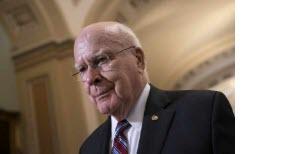
Sen. Patrick Leahy in recent times. More than two decades ago, he worried that Exon’s bill would “screw up” the Internet. Scott Applewhite
During that brief debate, breathless speeches conjuring lurid images of sordid sex acts overwhelmed academic points about free speech, citizens’ privacy rights, and the way the Internet’s packet-switched architecture (which routes data without pre-established paths) actually works. The threat posed to the Internet itself by Exon’s vision of a federal speech police paled into irrelevance.
With millions of people watching, senators were wary of appearing as if they did not support protecting children from pornography. The lopsided final tally on Exon’s amendment to the Telecommunications Act showed it. The votes were 84 in favor, 16 opposed.
The House to the Rescue
When it came to familiarity with the Internet, the House of Representatives was only marginally more technologically conversant than the Senate. While a handful of members were savvy about “high tech,” as it was called, most were outright technophobes quite comfortable with the old ways of doing things. Nothing wrong with paper files in folders, postcards and letters on stationery, and the occasional phone call. The Library of Congress was filled with books, so no need for any additional sources of information. Many of the committee chairs, given the informal seniority system in the House, were men in their 70s.
On the day Exon’s bill passed the upper chamber, more than half of the senators didn’t even have an email address. In the House it was worse: Only 26% of members had an email address. The conventional wisdom was that, with the World’s Greatest Deliberative Body having spoken so definitively, the House would follow suit. And for the same reason: With every House member’s election just around the corner, none would want to appear weak on pornography. The near-unanimous Senate vote seemed dispositive of the question.
While it is often the case that the House legislates impulsively while the Senate takes its time, in this case the reverse happened. As chairman of the House Republican Policy Committee — and someone who built his own computers and had been using the Internet for years — I took a serious interest in the issue. After some study of Exon’s legislation, I had already decided to write my own bill, as an alternative. Fortuitously, I was a member of the Energy and Commerce Committee, which on the House side had jurisdiction over the Telecommunications Act to which Exon had attached his bad idea.
One of the tech mavens in the House at the time was Ron Wyden, a liberal Democrat from Oregon whose Stanford education and activist streak (he’d run the Gray Panthers advocacy group in his home state during the 1970s) made him a terrific legislative partner. The two of us had recently shared a private lunch and bemoaned the deep partisanship in Congress that mostly prevented Democrats and Republicans from writing legislation together. We decided this was due to members flogging the same old political hot-button questions, on which everyone had already made up their minds.
At the conclusion of our lunch, we decided to look for cutting-edge issues that would present novel and challenging policy questions, to which neither we nor our colleagues would have a knee-jerk response. Then, after working together to address the particular issue with a practical solution, we’d work to educate members on both sides, and work for passage of truly bipartisan legislation. It was not much longer afterward that the question of regulating speech on the Internet presented itself, and Ron and I set to work.
In 1996, then-Rep. Ron Wyden teamed with the author to incentivize technologies allowing parents to become the censors in their own households. (AP Photo/Andrew Harnik, Pool)
Shortly thereafter, Time magazine reported that “the balance between protecting speech and curbing pornography seemed to be tipping back toward the libertarians.” It noted that “two U.S. Representatives, Republican Christopher Cox of California and Democrat Ron Wyden of Oregon, were putting together an anti-Exon amendment that would bar federal regulation of the Internet and help parents find ways to block material they found objectionable.”
We named our bill the Internet Freedom and Family Empowerment Act, to describe its two main components: protecting speech and privacy on the Internet from government regulation, and incentivizing blocking and filtering technologies that individuals could use to become their own censors in their own households. Pornographers illegally targeting minors would not be let off the hook: They would be liable for compliance with all laws, both civil and criminal, in connection with any content they created.
To avoid interfering with the essential functioning of the Internet, the law would not shift that responsibility to Internet platforms, for whom the burden of screening billions of digital messages, documents, images, and sounds would be unreasonable — not to mention a potential invasion of privacy. Instead, Internet platforms would be allowed to act as “Good Samaritans” by reviewing at least some of the content if they chose to do so in the course of enforcing rules against “obscene, lewd, lascivious, filthy, excessively violent, harassing, or otherwise objectionable” content.
This last feature of the bill resolved a conflict that then existed in the courts. In New York, a judge had held that one of the then-two leading Internet platforms, Prodigy, was liable for defamation because an anonymous user of its site had claimed that an investment bank and its founder, Jordan Belfort, had committed securities fraud. (The post was not defamatory: Belfort was later convicted of securities fraud, but not before Prodigy had settled the case for a substantial figure. Belfort would achieve further infamy when he became the model for Leonardo DiCaprio’s character in “The Wolf of Wall Street.”)
In holding Prodigy responsible for content it didn’t create, the court effectively overruled a prior New York decision involving the other major U.S. Internet platform at the time, CompuServe. The previous case held that online service providers would not be held liable as publishers. In distinguishing Prodigy from the prior precedent, the court cited the fact that Prodigy, unlike CompuServe, had adopted content guidelines. These requested that users refrain from posts that are “insulting” or that “harass other members” or “are deemed to be in bad taste or grossly repugnant to community standards.” The court further noted that these guidelines expressly stated that although “Prodigy is committed to open debate and discussion on the bulletin boards … this doesn’t mean that ‘anything goes.’”
In the early Internet era, CompuServe chose not to adopt content guidelines, in contrast to its chief competitor, Prodigy. Flickr
CompuServe, in contrast, made no such effort. On its platform, the rule was indeed “anything goes.” As a user of both services, I well understood the difference. I appreciated the fact that there was some minimal level of moderation on the Prodigy site. While CompuServe was a splendid service and serious users predominated, the lack of any controls whatsoever was occasionally noticeable and, I could easily envision, bound to get worse.
If allowed to stand, this jurisprudence would have created a powerful and perverse incentive for platforms to abandon any attempt to maintain civility on their sites. And a legal standard that protected only websites where “anything goes” from unlimited liability for user-generated content would have been a body blow to the Internet itself. Ron and I were determined that good faith content moderation should not be punished, and so the Good Samaritan provision in the Internet Freedom and Family Empowerment Act was born.
In the House leadership, of which I was then a member, there were plenty of supporters of our effort. The new speaker, Newt Gingrich, had long considered himself a tech aficionado and had already proven as much by launching the THOMAS project at the Library of Congress to digitize congressional records and make them available to the public online. He slammed the Exon approach as misguided and dangerous.
“It is clearly a violation of free speech, and it’s a violation of the right of adults to communicate with each other,” Gingrich said at the time, adding that Exon’s proposal would dumb down the Internet to what censors believed was acceptable for children to read. “I don’t think it is a serious way to discuss a serious issue,” he explained, “which is, how do you maintain the right of free speech for adults while also protecting children in a medium which is available to both?”
Dick Armey, then the new House majority leader, joined the speaker in supporting the Cox-Wyden alternative to Exon. So did California’s David Dreier, another Republican, who was closely in touch with the global high-tech renaissance being led by innovators in his home state. They were both Republicans, but my fellow Californian Nancy Pelosi, not yet a member of the Democratic leadership, weighed in as well, noting that Exon’s approach would have a chilling effect on serious discussion of HIV-related issues.
In the weeks and months that followed, Ron and I conducted outreach and education among our colleagues in both the House and Senate on the challenging issues involved. It was a rewarding and illuminating process, during which we built not only overwhelming support, but also a much deeper understanding of the unique aspects of the Internet that require clear legal rules for it to function.
Two months after Sen. Exon successfully added his Communications Decency Act to the Telecommunications Act in the Senate, the Cox-Wyden measure had its day in the sun on the House floor. Whereas Exon had begun with a prayer, Ron and I began on a wing and prayer, trying to counter the seemingly unstoppable momentum of a near-unanimous Senate vote. But on this day in August, the debate was very different than it had been across the Rotunda.
Speaker after speaker rose in support of the Cox-Wyden measure, and condemned the Exon approach. Rep. Zoe Lofgren (D-Calif.), the mother of 10- and 13-year-old children, shared her concerns with Internet pornography and noted that she had sponsored legislation mandating a life sentence for the creators of child pornography. But, she emphasized, “Senator Exon’s approach is not the right way. … It will not work.” It was, she said, “a misunderstanding of the technology.”
Rep. Bob Goodlatte joined the chorus of those warning about the threat posed by Exon-style regulation of the Internet. AP Photo/J. Scott Applewhite
Rep. Bob Goodlatte, a Virginia Republican, emphasized the potential the Internet offered and the threat to that potential from Exon-style regulation. “We have the opportunity for every household in America, every family in America, soon to be able to have access to places like the Library of Congress, to have access to other major libraries of the world, universities, major publishers of information, news sources. There is no way,” he said, “that any of those entities, like Prodigy, can take the responsibility to edit out information that is going to be coming in to them from all manner of sources.”
In the end, not a single representative spoke against the bill. The final roll call on the Cox-Wyden amendment was 420 yeas to 4 nays. It was a resounding rebuke to the Exon approach in his Communications Decency Act. The House then proceeded to pass its version of the Telecommunications Act — with the Cox-Wyden amendment, and without Exon.
Rise and Fall
The Telecommunications Act, including the Cox-Wyden amendment, would not be enacted until the following year. In between came a grueling House-Senate conference that was understandably more concerned with resolving the monumental issues in this landmark modernization of FDR-era telecommunications regulation. During the extended interlude, Ron and I, along with our now much-enlarged army of bipartisan, bicameral supporters, continued to reach out in discussions with members about the novel issues involved and how best to resolve them. This resulted in some final improvements to our bill, and ensured its inclusion in the final House-Senate conference report.
But political realities as well as policy details had to be dealt with. There was the sticky problem of 84 senators having already voted in favor of the Exon amendment. Once on record with a vote one way — particularly a highly visible vote on the politically charged issue of pornography — it would be very difficult for a politician to explain walking it back. The Senate negotiators, anxious to protect their colleagues from being accused of taking both sides of the question, stood firm. They were willing to accept Cox-Wyden, but Exon would have to be included, too.
The House negotiators, all politicians themselves, understood. This was a Senate-only issue, which could be easily resolved by including both amendments in the final product. It was logrolling at its best.
President Clinton signed the Telecommunications Act of 1996 into law in February at a nationally televised ceremony from the Library of Congress Reading Room, where he and Vice President Al Gore highlighted the bill’s paving the way for the “information superhighway” of the Internet. There was no mention of Exon’s Communications Decency Act. But there was a live demonstration of the Internet’s potential as a learning tool, including a live hookup with high school students in their classroom. And the president pointedly objected to the new law’s criminalization of transmission of any “indecent” material, predicting that these provisions would be found violative of the First Amendment and unenforceable.
Almost before the ink was dry and the signing pens handed out to the VIPs at the ceremony, the Communications Decency facet of the new law faced legal challenges. By summer, multiple federal courts had enjoined its enforcement. The following summer the U.S. Supreme Court delivered its verdict with the same spirit that had characterized the House rejection. The court (then consisting of Chief Justice Rehnquist and Associate Justices Stephens, O’Connor, Suiter, Kennedy, Thomas, Ginsburg, and Breyer), unanimously held that “[i]n order to deny minors access to potentially harmful speech, the CDA effectively suppresses a large amount of speech that adults have a constitutional right to receive and to address to one another. That burden on adult speech is unacceptable.”
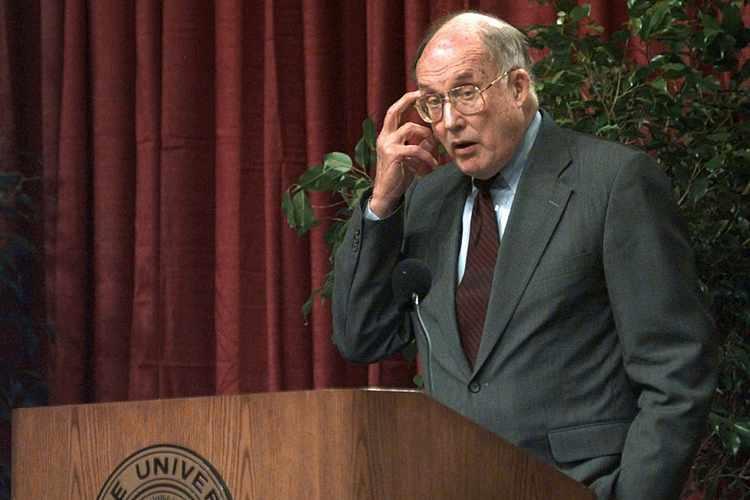
The William Rehnquist-led Supreme Court ruled that the Exon law “effectively suppresses a large amount of speech that adults have a constitutional right to receive.” AP Photo/Charlie Neibergall, File
The court’s opinion cited Pat Leahy’s comment that in enacting the Exon amendment, the Senate “went in willy-nilly, passed legislation, and never once had a hearing, never once had a discussion other than an hour or so on the floor.” It noted that transmitting obscenity and child pornography, whether via the Internet or other means, was already illegal under federal law for both adults and juveniles, making the draconian Exon restrictions on speech unreasonable overkill.
And there was more: Under the Exon approach, the high court pointed out, any opponent of particular Internet content would gain “broad powers of censorship, in the form of a ‘heckler’s veto.’” He or she “might simply log on and inform the would-be discoursers that his 17-year-old child” was also online. The standard for what could be posted in that forum, chat room, or other online context would immediately be reduced to what was safe for children to see.
In defenestrating Exon, the court was unsparing in its final judgment. The amendment was worse than “’burn[ing] the house to roast the pig.” It cast “a far darker shadow over free speech, threaten[ing] to torch a large segment of the Internet community.” Its regime of “governmental regulation of the content of speech is more likely to interfere with the free exchange of ideas than to encourage it.”
With that, Sen. Exon’s bad idea died, hopefully forever. In the Supreme Court, Ron and I won the victory that had eluded us in the House-Senate conference.
One irony, however, persists. When legislative staff prepared the House-Senate conference report on the final Telecommunications Act, they grouped both Exon’s Communications Decency Act and the Internet Freedom and Family Empowerment Act into the same legislative title. So the Cox-Wyden amendment became Section 230 of the Communications Decency Act — the very piece of legislation it was designed to rebuke. Now that the original CDA has been invalidated, it is Ron’s and my legislative handiwork that forever bears Senator Exon’s label.
Exon 2.0?
This history is especially relevant today, as Americans for whom the Internet is a ubiquitous feature of daily life grapple with the same issues of content moderation, privacy, free speech, and the dark side of cyberspace that challenged us then. In Congress, there is a noticeable resurgence of support for government regulation of content, with all that portends.
This neo-regulatory mood is fueled by the same passions and concerns as it was 25 years ago, including protecting children, as well as the more recent trend toward restricting speech that may be offensive to some segments of adults. The New York Times has fired its opinion editor, ostensibly for publishing an op-ed by a sitting Republican U.S. senator on a critical issue of the day. Supporters of the president are inflamed that Twitter is purporting to fact-check and contextualize his tweets, while progressives are inflamed that Facebook is not doing this. Senators and representatives are writing legislation that would settle these arguments through force of law rather than private ordering, including legislation to walk back the now prosaically named Section 230.
In these legislative debates, James Exon’s misguided handiwork is often romanticized by the new wave of speech regulators. Recalling its deep flaws, myriad unintended consequences, and dangerous threats to both free speech and the functioning of the Internet is a worthwhile reality check.
The notion that the Communications Decency Act and Section 230 were conceived together is completely wrong. So is the notion that Exon enjoyed lasting congressional support. By the time the Telecommunications Act completed its tortuous legislative journey, support for the CDA had dwindled even in the Senate, as senators came to understand the mismatch between problem and solution that the bill represented. With the exception of its most passionate supporters, few tears were shed for the CDA at its final demise in 1997. Exon had retired even before his law was declared unconstitutional, leaving few behind him willing to carry the torch. His colleagues made no effort to “fix” and replace the Exon Amendment, after the amendment was unanimously struck down by the Supreme Court.
Meanwhile Section 230, originally introduced in the House as a freestanding bill, H.R. 1978, in June 1995, stands on its own, now as then. Its premise of imposing liability on criminals and tort-feasors for their own wrongful conduct, rather than shifting that liability to third parties, operates independently of (and indeed, in opposition to) Sen. Exon’s approach that would directly interfere with the essential functioning of the Internet.
It is also useful to imagine a world without Section 230. In this alternative world, websites and Internet platforms of all kinds would face enormous potential liability for hosting content created by others. They would have a powerful incentive to limit that exposure, which they could do in one of two ways. They could strictly limit user-generated content, or even eliminate it altogether; or they could adopt the “anything goes” model through which CompuServe originally escaped liability before Section 230 existed.
We would all be very much worse off were this to happen. Without Section 230’s clear limitation on liability it is difficult to imagine that most of the online services on which we rely every day would even exist in anything like their current form.
Not long after his retirement from the Senate, James Exon died in his home state of Nebraska. He was an old-school Democrat who supported lower taxes and a strong national defense, but he was also one of only four Democrats in his chamber to vote against the Martin Luther King holiday, which President Reagan proudly signed into law. When he was governor of Nebraska, the legislature overrode his veto of their bill decriminalizing gay relationships, after he had disparaged this entire population as “homos” and “perverts.” He was not sensitive to the sweeping social and technological changes that shaped the end of the 20th century and could barely have imagined our world in the 21st. In many ways a relic of the past, he was utterly unprepared for the age of the Internet.
Whether Exon’s final bad idea of federal regulation of Internet speech lives beyond him remains to be seen. The continued vitality of the Internet, and the choices we all have to create and access seemingly unlimited information freely and in real time, will depend upon the answer to that question. We can all say a prayer that the answer is no.
* * *
Chris Cox is a former U.S. representative (1988-2005) and co-author, with now-Sen. Ron Wyden, of Section 230.
via ZeroHedge News https://ift.tt/2VmsRCa Tyler Durden
Hamas Says Planned Israeli Annexation A “Declaration Of War” While IDF Vows ‘We’re Ready’ Tyler Durden
Fri, 06/26/2020 – 18:05
In late April Israeli Prime Minister Benjamin Netanyahu shocked the region in declaring he expects that by middle of summer Israel would move to annex broad swathes of the West Bank, including the Jordan Valley, as part of Trump’s “deal of the century” peace plan. The date consistently referenced in Israeli media reports is July 1st.
“President Trump pledged to recognize Israeli sovereignty over the Jewish communities there and in the Jordan Valley,” Netanyahu said. And just this week, Secretary of State Mike Pompeo responded to an urgent United Nations appeal not to go through with it ahead of the July 1 target date by saying the matter issolely up to Israel to decide.
This as senior Trump aides reportedly met this week to hash out the matter of whether the administration should give the final “green light” – given it appears Tel Aviv is awaiting the moment of unambiguous backing before annexation. This is because it is sure to spark conflict on the ground. Hamas on Thursday said that annexation will be “a declaration of war”.
Hamas file image: AFP
Hamas military spokesperson Abu Obeida vowed that Israel will “bitterly regret” such a provocative decision and act of aggressive, Fox News reports. He called it a “declaration of war against the Palestinian people” in a video message directed both at Israel and for supporters. He vowed his Ezzedine al-Qassam Brigades will fight as a “loyal guard in defending the Palestinian people and their lands and holy sites.”
Previously senior Hamas officials also said any hope for political dialogue or settlement would be forever destroyed. “Palestinians would not accept these plans at all. They are going to resist these plans by all means available. Gaza is not excluded from this,” another official, Basem Naim, said.
Already the planned annexation has resulted in large protests this week in West Bank cities and towns.
It also appears the Israeli Defense Forces (IDF) are making ready: “The upcoming events can develop into fighting in Gaza,” IDF Chief of Staff Aviv Kohavi said as Israel braces for a possible new intifada. The IDF has essentially said ‘we’re ready to go’.
Former Army Chief of Staff Benny Gantz and Prime Minister Benjamin Netanyahu have formed a power sharing unity government. Image: JTA-Wikimedia
“I suggest that Hamas leaders remember that they will be the first to pay for any aggression,” Israeli Defense Minister Benny Gantz stated Thursday. Gantz is also serving as ‘alternate PM’ as part of the power-sharing agreement with Netanyahu. He further underscored that Israel “will not accept threats”.
The Palestinians from the start have rejected the Trump peace plan, given it allows Israel to annex up to 30% to 40% of the West Bank, including all of East Jerusalem, and further the Palestinian Authority (PA) has claimed it was never ultimately invited to the table as an equal part to negotiations, but that Israel has gotten everything it wants without sacrificing anything.
via ZeroHedge News https://ift.tt/385qnNC Tyler Durden
The recent economic downturn has created the environment for a new round of bailouts by the government and the Fed. Last time they did this they told us it would be the last one, but anyone who knows our history knew that was not going to stand. Now we are told again that this is an exceptional situation and we must bail out businesses in trouble so that the economy can restart again as quickly as possible. But this is the same argument the government has always made when pushing for a bailout. What is more, every time the government has bailed out businesses, they have promised us that this will not create moral hazard.
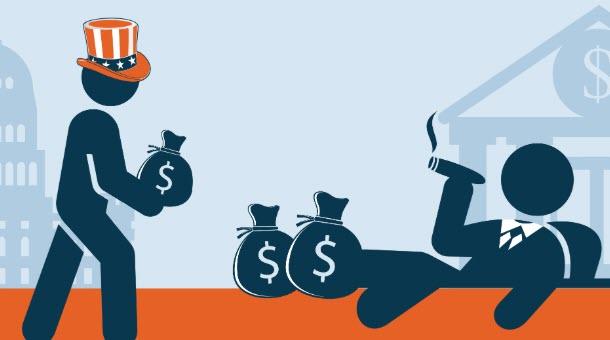
Moral hazard here refers to the ability to take risk without fear of suffering the consequences. As I show below, businesses profit by making bad short-term decisions, and when these bad decisions bring them to the brink of bankruptcy, they are bailed out by taxpayers. So, the owners of these firms and their CEOs benefit from the upside, and taxpayers foot the bill on the downside. In what follows, I review the history of bailouts in the US and argue that we must consider bringing an end to bailouts if we want to have the real and sustainable economic growth we desperately need.
Financial Institutions Bailouts 1.0 and 2.0
After the savings and loan (S&L) industry had struggled for many years, government finally came to the rescue. The federal government, at the time under the leadership of President George H.W. Bush, passed a bailout that cost taxpayers $124 billion ($264 billion in today’s dollars). It is important for our purpose here to keep in mind that in the lead-up to this many of these firms had taken advantage of the booming housing market. Many of these companies lent too much money, and when the economy weakened they could not keep up with the losses. This led L. William Seidman, former chairman of the Federal Deposit Insurance Corporation (FDIC) and the Resolution Trust Corporation, to say that “The banking problems of the ’80s and ’90s came primarily, but not exclusively, from unsound real estate lending.” Hence, these companies were not prudent during the good times and did not plan for a downturn.
This was not the last time financial institutions were bailed out. Banks, along with the artificially low interest rates, were the main cause of the Great Recession. History repeated itself as the federal government stepped in and bailed them out again. We were told that the banks and AIG (American International Group) were “too big to fail” and could not be allowed to go bankrupt because the harm to the economy would be enormous. These bailouts—for AIG, the banks, Fannie Mae, and Freddie Mac—cost the taxpayers $621 billion in today’s dollars, or more than twice the previous bailout. But, aren’t the banks stronger now? one could ask. This is a fair question, yet the banks would be strong if we let them liquidate the parts of their companies that were hit the most. Had we done this we would have a stronger banking system and no moral hazard for the rest of the economy.
Automakers Bailouts 1.0 and 2.0
During the Great Recession the government bailed out the three big automakers in the US. But this was not the first time the government had bailed out a car company. Chrysler had already been bailed out in 1979, when they got $1.5 billion ($5.7 billion in today’s dollars). It is important to point out why Chrysler had needed to be bailed out. Charles Hyde, professor of history at Wayne State University and author of Riding the Roller Coaster: A History of the Chrysler Corporation, had this to say:
Well, in essence they made some very bad product choices throughout the 1970s. They decided to become specialists in large, gas-guzzling cars, and they did that right at the time there were two different Arab oil boycotts and crises with the price of gasoline. And their cars simply didn’t sell. The other problem they had were very serious quality problems. Their cars were probably the worst-built cars in any showrooms anywhere.
Chrysler emerged stronger after this; they made the necessary changes, and it seems that at least for a while they did well. But in 2008 Chrysler and GM both found themselves in trouble. This time around, the bailout was about $100 billion adjusted for inflation, which is about 17.5 times the previous one. And, again, we know these firms had made bad decisions (misallocated resources), since Ford and other car companies did not need a bailout.
The concerned reader may ask, Aren’t the bailouts the price we have to pay to save jobs? The problem is that these companies never really fixed their problems. While low interest rates have helped them, they have also made them more fragile. As I have written elsewhere, the car market is in an unsustainable bubble, and with sales going down and delinquencies that were already rising, another crash and maybe another round of bailouts seem inevitable. In fact, the Fed has already implicitly “bailed out” Ford by promising to buy the fallen angels‘ debt. So, while the bailouts may save some jobs in the short run, they will cause much more trouble in the long run.
Airline Bailout 1.0 and 2.0
Following the attack on 9/11, airline traffic suffered a big hit and the airline firms needed the government’s help “to survive.” The government at the time provided $5 billion in grants and $10 billion in loans (about $22 billion in today’s dollars). After the bailout bill was passed President George W. Bush said:
I commend the Congress for their cooperation and quick action in passing responsible legislation that will improve passenger safety, help the victims and their loved ones, and keep America’s airplanes flying while the airlines develop long-term viability plans.
But as it turns out, airline companies did not develop very good “long-term viability plans.” Recently, the US airlines were hit with the same problem they had after 9/11—a lack of passengers because of the COVID-19 crisis—and they could not have been less prepared for this. One would expect an industry that had experienced a similar situation not so long ago to be better prepared than others, but they clearly were not.
The government stepped in again and has bailed them out by allocating $25 billion in grants (30 percent of which will be repaid as a loan over ten years) and an additional $25 billion in loans.
But again one may ask, Doesn’t this save jobs? The answer to this important question is that this may save some jobs in the short run, yes, but the cost will be very high, since these jobs are not sustainable. What is more, this bailout will lead to lower economic growth, since the necessary resource reallocation will not happen.
Bailouts Lead to Lower Economic Growth
Our history of bailouts shows that we have created tremendous moral hazard. As I have argued above, some industries or firms have been repeatedly bailed out. Hence, these companies have never learned to be prudent and save for a rainy day, which shows that they are incompetent at best or simply care only for short-term profits. Take the airline industry, for instance. In the post–Great Recession period, the airline industry used 96 percent of its profits to buy back stocks and did not plan for a downturn. It is true that it was not easy to predict a situation like the current one caused by COVID-19, but many would disagree that this was ablack swan, including Nassim Taleb himself.
Hence, the bailouts have led to bad use of resources, which can explain, at least in part, the slow economic growth we have experienced post–Great Recession. The issue with bailouts is that the tradeoffs we face are higher unemployment now followed by higher and sustainable economic growth later, or lower unemployment now followed by lower economic growth later. Bailouts are directly connected to productivity, as the graph below shows. This means that the more bailouts we have the lower the economic growth. This makes sense, since economic theory tells us that when a company fails it means that they were not using resources efficiently. If the company goes bankrupt, then either some or all of the resources will be transferred to more prudent investors, which will lead to better use of these resources and higher economic growth. On the other hand, when a company is bailed out, they will continue to make bad decisions and even worse others will get the message that they will not be held responsible by the market if they make bad decisions.
The good news is that some people are starting to speak out against these huge wealth transfers from taxpayers to large corporate shareholders and CEOs. In a recent interview for CNBC, Chamath Palihapitiya argued that companies that were not prudent should be left to go bankrupt. Sadly, many people are convinced that this would lead to massive unemployment, such that we are not bailing out corporations, but are rather helping workers. That is not quite the real story. When companies file for Chapter 11 bankruptcy, it is the shareholders and the speculators who get hurt, not the workers.
Yet the federal government and the Fed are doing anything they can to keep the debt bubble going. This is nothing new, since the federal government and the Fed have brought us to the current situation in concert. The Fed’s low interest rate policy together with the implicit bailout guarantee from the federal government led corporations to borrow too much. This has made the economy so fragile that it could not even handle interest rates at half of what they were before the last crisis started. As the Fed increased interest rates in 2018, the economy started to slow down so fast that they had to reverse and start lowering interest rates in 2019. Now they effectively stand at zero. Low interest rates, along with the many programs the Fed has implemented during the COVID-19 crisis, have led corporations to borrow more than $617 billion in the last two months alone. So, the story of bailouts and low interest rates continues. But until it ends we cannot expect to have the real and sustainable economic growth we desperately need.
via ZeroHedge News https://ift.tt/3dIXx7a Tyler Durden