The post Open Thread appeared first on Reason.com.
from Latest – Reason.com https://ift.tt/ci0P4Kg
via IFTTT
another site
The post Open Thread appeared first on Reason.com.
from Latest – Reason.com https://ift.tt/ci0P4Kg
via IFTTT
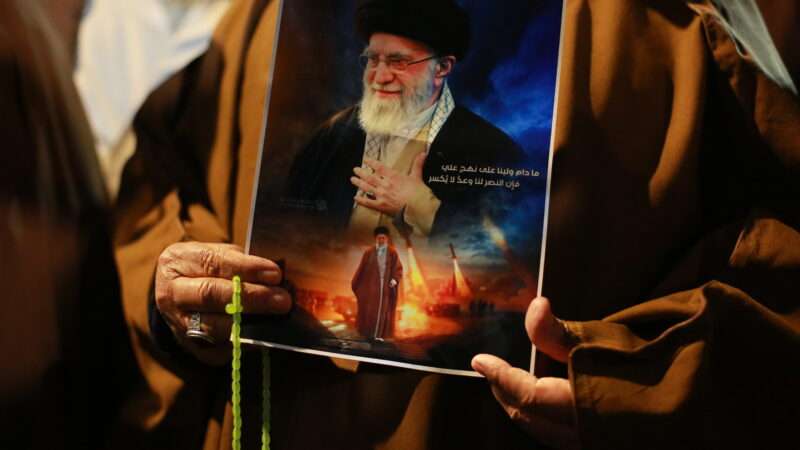
Iranian Ayatollah Ali Khamenei was killed in his palace at the beginning of the U.S.-Israeli war in Iran on Saturday morning, ending 37 years as Iran’s Supreme Leader, U.S. President Donald Trump claimed on Saturday afternoon. Khamenei’s reported death was a culmination of his governing style: stubborn enough to make enemies, but too passive and weak to overcome them. Even as a U.S. armada loomed off the coast of Iran, the autocrat remained a sitting duck in his palace.
Iranian state media is so far denying the report, claiming instead that Khamenei is still “steadfast and firm in commanding the field.”
Though Khamenei is often mistaken for his predecessor, Ruhollah Khomeini, the two are nothing alike. Khomeini was a revolutionary with an air of mystique who built a state from the ground up; Khamenei was a doddering bureaucrat who inherited that state and ran it back into the ground.
The past few years of Khamenei’s reign were marked with escalating waves of unrest and repression, each one more deadly and frequent than the last. From the crackdown on student reformists in 1999, which killed three people, to the uprising and massacres this year, which killed hundreds, Khamenei gradually muscled out his rivals within the Islamic Republic and pushed Iranians to hate that republic. In between each explosion, corruption and nepotism built up within the system. Khamenei focused immense resources into unpopular culture war bugbears, such as mandatory hijab, while neglecting the country’s basic resources.
Meanwhile, the sharks circled from the outside. Khamenei was just scary enough for hawks in the United States to present as an enemy, yet just predictable enough that they could manage the consequences of escalation. He carried out a uranium enrichment program, then insisted that actually building a nuclear bomb would go against his religion. Khamenei raised an army of anti-Israel militias across the Middle East at great cost in blood and treasure, then watched Israel pick them off one-by-one over the past three years.
After all, Khamenei’s own path to power was paved by the same combination of cruelty and incompetence. Khomeini’s successor was originally supposed to be Ayatollah Hussein-Ali Montazeri. In 1988, however, left-wing Iranian rebels joined forces with an invading Iraqi army, and the Islamic Republic responded with mass executions of leftist dissidents. When Montazeri protested the killings, Khomeini dismissed him as successor. After Khomeini’s death, the succession council elevated Khamenei, a yes-man who himself admitted that he was not qualified.
But the system that Khamenei shaped does not necessarily die with him—at least, not in the way that his assassins might have hoped. If Trump was looking for a cost-free Venezuela-style decapitation, Iran did not provide it. Even as Khamenei’s palace lay in ruins and the leader incommunicado, the Iranian military immediately fired back at U.S. forces and partners across the Middle East, and began attempting to blockade oil shipping. The fighting is intense and ongoing.
It remains to be seen who would become the new public face of the system. Before the war, the CIA assessed that Khamenei would be succeeded by a hardline military dictator. An even bigger question is whether Iranians will heed Trump’s call to overthrow the Islamic Republic. History has very few good precedents for regime change under wartime conditions. But one thing seems certain: Khamenei will not be around to see the final, bloody consequences of his rule.
The post Iran's Supreme Leader, Ayatollah Ali Khamenei, Is Reported Dead appeared first on Reason.com.
from Latest – Reason.com https://ift.tt/ojDTHJn
via IFTTT
From his Free Press article; Ferguson is a Senior Fellow at the Hoover Institution, a former Harvard history professor, and a noted author both on historical matters and modern ones:
Since the news of the joint U.S.-Israeli strikes on Iran this morning, I have been thinking a lot about a song in the 2004 movie Team America:World Police. The movie was co-written by the creators of South Park and follows a group of heroic American puppets waging kinetic war on Islamic terrorists, the North Korean dictator Kim Jong Il, and liberal Hollywood, leaving cataclysmic collateral damage (the Eiffel Tower, Cairo, the Sphinx) in their wake. But the real highlight is a song called “America, Fuck Yeah.” Here’s how it goes:
America, fuck yeah
Comin’ again to save the motherfuckin’ day, yeah
America, fuck yeah
Freedom is the only way, yeah
Terrorists, your game is through
‘Cause now you have to answer to …
America, fuck yeah
So lick my butt and suck on my balls
America, fuck yeah
What you gonna do when we come for you now?
It’s the dream that we all share
It’s the hope for tomorrow
Fuck yeahTeam America was an ambivalent movie at the time. That was what made it funny. It simultaneously mocked the liberal opponents of an aggressive foreign policy and the neoconservatives who advocated policies such as regime change in Iraq. The South Park team understood before many commentators that the United States has a track record of coming to save the day and leaving a trail of devastation.
For the habitual critics of U.S. foreign policy in general and Donald Trump’s in particular, the analogy between today’s air raids against Iran and the invasion of Iraq nearly 23 years ago is too obvious to be resisted….
However, Iran 2026 is not Iraq 2003. Back in those days, I shed no tears for Saddam Hussein and had considerable sympathy with the project of covert empire-building, but I was a critic of the Bush administration’s post-invasion nation-building strategy because I believed the U.S. lacked the key structural attributes to make it work.
By comparison with the British Empire, American power in the 2000s had three fateful deficits: a manpower deficit, a fiscal deficit, and an attention deficit. I argued that the occupying force was too small relative to Iraq’s population. The complete destruction of the Ba’athist regime laid the foundations for anarchy and civil war, which swiftly mutated into an insurgency against the U.S.-led coalition. And I came to see that the principal beneficiary of Hussein’s downfall was none other than Iran.
And yet, contrary to the criticism already being aired on both the left and the right, Trump is not reverting to George W. Bush and Dick Cheney’s “regime change” playbook….
Operation Epic Fury differs from Operation Iraqi Freedom—the 2003 invasion of Iraq—in two key respects. Yes, the justification is preemption against a regime intent on acquiring weapons of mass destruction and implicated in international terrorism. But the goal is not to march into Iran and confer, much less impose, freedom on the Iranians. It is to decapitate the Islamic Republic’s political structure and leave the Iranians to take their freedom from the mullahs and their murderous henchmen. As Trump said in his speech this morning, “members of the Islamic Revolutionary Guard, the armed forces and all of the police” can “have complete immunity” if they lay down their weapons….
The real question is: Who rules in Tehran after Khamenei? …
The post My Colleague Niall Ferguson on Iran appeared first on Reason.com.
from Latest – Reason.com https://ift.tt/dalfOwK
via IFTTT
An excerpt from Prof. Goldsmith’s post at Executive Functions:
We’re already seeing a debate about the legality of President Trump’s use of force in Iran. I’ve grown cynical about these debates. Law is the language we use when criticizing presidential war powers—and it has been since the beginning of the nation. But the truth is that there are only political constraints.
As I’ve been saying for a while, there are no effective legal limitations within the executive branch. And courts have never gotten involved in articulating constraints in this context. That leaves Congress and the American people. They have occasionally risen up to constrain the president’s deployment of troops and uses of force—for example, in Vietnam, and in Lebanon in 1983, and in Somalia in 1993. But those actions are rare and tend only to happen once there is disaster.
The Office of Legal Counsel opinions on the presidential use of force are famously promiscuously permissive. Some will now invoke the single acknowledged OLC limitation on unilateral uses of force to criticize the Iran attack. As the opinion justifying the attack on ISIS in 2014 explained: If the “‘anticipated nature, scope, and duration‘ of the planned military operations, analyzed in light of the applicable historical precedent” amount to “war,” the president must secure prior congressional approval.
President Trump in his statement about the attack said: “The lives of courageous American heroes may be lost, and we may have casualties,” and that “that often happens in war.” Does that implicate the OLC limitation and require him to seek congressional approval? It would be very easy for OLC to conclude not.
First, I am not aware of any episode in which this standard was invoked to deny the president the authority to use force. It has been mentioned only in opinions justifying force and it has been fudged in various ways.
Second, OLC made clear in its Libya opinion that the “anticipated nature, scope and duration” test “will be satisfied only by prolonged and substantial military engagements, typically involving exposure of U.S. military personnel to significant risk over a substantial period.” (Emphasis added.) …
None of the above is meant to justify the Iran strikes or endorse them. I’m praying for U.S. troops and for everyone involved, and hoping for the best. But it is hard to be optimistic given the terrible U.S. record with violent military disruptions and regime changes in and around the Middle East in my lifetime. Maybe this time will be different.
My point is that the rhetoric of legal constraint, and debates about the legality of presidential uses of force, are empty. And they deflect attention from Congress’s constitutional responsibility to exercise its political judgment and the political powers that the framers undoubtedly gave it to question, to hold to account, and (should it so choose) to constrain presidential uses of force.
As Walter Dellinger wrote for OLC 30 years ago: “in establishing and funding a military force that is capable of being projected anywhere around the globe, Congress has given the President, as Commander in Chief, considerable discretion in deciding how that force is to be deployed.” Congress in giving the president a gargantuan military, and in its “oversight” and lack of imposed constraint, is as responsible for the use of force against Iran, for better or worse, as the president.
The whole thing is much worth reading.
The post "Law is Irrelevant to the U.S. Attack on Iran," by Prof. Jack Goldsmith (Harvard) appeared first on Reason.com.
from Latest – Reason.com https://ift.tt/Cf75Nlr
via IFTTT

Last night, the US and Israel initiated a large-scale military attack on Iran. This action is blatantly unconstitutional. Its wisdom and morality are are more debatable.
Article I of the Constitution gives Congress the exclusive power to declare war. One can debate the extent to which presidents can initiate relatively small-scale military actions, and such debates have raged for decades. But this attack is very obviously large enough to qualify as a war. Thus, it just as obviously requires congressional authorization. And Trump didn’t get any, and indeed did not even try to do so.
Don’t take my word for the proposition that it’s a war. Take Trump’s! He himself has called it a war, and proclaimed that the objective is regime change.
The closest historical analogue is Barack Obama’s 2011 air campaign against Libya, which was also attempt at regime change carried out with air strikes. For those keeping score, I condemned Obama’s action and repeatedly criticized him for violating the Constitution and the War Powers Act (see also here). But Iran is a larger and more powerful nation than Libya, and thus this is likely to be an even bigger conflict. And, as I have said before, Obama’s illegal actions don’t justify Trump’s (and vice versa).
The wisdom and morality of this action are a closer call. I am no reflexive opponent of military intervention, and I think regime change is sometimes justified. I have long differed on these issues with more dovish/isolationist libertarians.
The Iranian regime is a brutally oppressive dictatorship that recently slaughtered tens of thousands protesters, has a long history of promoting terrorism, and constantly seeks to develop nuclear weapons. For these and other reasons, I would welcome regime change there. Even if the new government is far from ideal, it is likely to less awful than regime of the ayatollahs. But I am skeptical that regime change can be achieved with air and missile strikes alone. And, at this point, it does not not seem like the US and Israel have either the will or the capability of launching a major ground invasion. If the latter is attempted, it might turn out to be too costly to be worth it.
Perhaps airpower could achieve regime changes if coupled with a strong opposition movement within Iran. But Trump waited until after the regime crushed the protests that arose a few weeks ago, in the process slaughtering tens of thousands. It may be difficult or impossible for a strong opposition movement to emerge again, without a ground attack.
War is inherently dynamic, and it would be foolish to make definitive predictions. I have been largely out of the field of security studies for many years now, and thus no longer have much relevant up-to-date expertise. Thus, at this point, I can only say I am skeptical this intervention will achieve the regime change Trump seeks, or any other beneficial result great enough to outweigh the damage done to our constitutional system.
That latter is not just a technical legal issue. The requirement of congressional authorization for the initiation of war is there to ensure that no one person can take the country to war on his own, and that any major military action have broad public support, which can be essential to ensuring that we have the will and commitment needed to achieve victory against difficult opponents.
I will note one clear beneficial consequence of this action that has largely been ignored by the media so far: Iran is a major supplier of weapons to Russia for its war of aggression against Ukraine. As long as Iran is fighting the US and Israel, it is unlikely to continue extensive weapons deliveries to Russia, since it will need those arms for its own use.
But, on balance, it would have been more effective to help Ukraine by simply giving them weapons directly, which Trump has largely stopped doing. And, unlike starting a war without congressional authorization, giving arms to Ukraine doesn’t violate the Constitution, and does not expose US forces to any significant risk.
In sum, this is a blatantly unconstitutional war. Time will tell whether it achieves any beneficial results that outweigh the costs – including the damage to our constitutional system of separation of powers.
The post An Unconstitutional War appeared first on Reason.com.
from Latest – Reason.com https://ift.tt/f1RyjEm
via IFTTT

President Donald Trump banned all federal agencies from contracting with Anthropic after the company refused to remove its restrictions on domestic mass surveillance and fully autonomous weapons systems from its AI model, Claude. Later that same day, OpenAI CEO Sam Altman announced that the Defense Department had agreed to use ChatGPT supposedly subject to the very same restrictions.
The acrimony between the federal government and Anthropic, which had been brewing for two months, reached a boiling point on Tuesday, when Defense Secretary Pete Hegseth and Anthropic CEO Dario Amodei met to discuss the terms of the Defense Department’s contract with Anthropic. Hegseth demanded that Anthropic equip the Pentagon with an AI model “free from usage policy constraints that may limit lawful military applications” or be labeled a supply chain risk and possibly nationalized.
Amodei refused, publishing a public letter Thursday night explaining his constitutional, ethical, and technical concerns about unleashing AI capable of surveilling American citizens at home and executing people abroad according to its own judgment instead of a human being’s.
On Friday evening, Hegseth made good on his promise. Following Trump’s declaration that “EVERY Federal Agency in the United States Government…IMMEDIATELY CEASE all use of Anthropic’s technology,” Hegseth directed the Defense Department to designate Anthropic a supply chain risk to national security. This means that “no contractor, supplier, or partner that does business with the United States military may conduct any commercial activity with Anthropic,” according to Hegeth’s statement.
Mark Dalton, senior director of technology and innovation at the R Street Institute, says the Pentagon is guilty of a glaring contradiction: “consider[ing] Anthropic’s technology so vital to national defense that they thought that invoking the Defense Production Act was justified to retain access” earlier this week, and then “suddenly [designating the company] a supply chain risk.”
Anthropic is such a national security that the president is permitting a six-month window during which federal agencies, including the Pentagon, will continue using Claude.
Dalton warns that “the next time the designation is applied to a company with actual ties to a foreign adversary, the credibility to make that case will be diminished.” Dean Ball, senior fellow at the Foundation for American Innovation, described the designation as “the most damaging policy move I have ever seen USG try to take.”
It’s unclear why Anthropic is just now being deemed a national security threat. The company’s usage policy has explicitly prohibited the use of its AI models for domestic surveillance purposes and to “produce, modify, design, market, or distribute weapons, explosives, dangerous materials or other systems designed to cause harm to or loss of human life” since June 2024, when it began supporting American warfighters. (These provisos are maintained in Anthropic’s current usage policy.) The company received its $200 million Pentagon contract over a year later, in July 2025.
Neither the president nor the secretary of defense were ignorant of these usage conditions.
Trump implied that the Pentagon had stipulated to these terms of services in his Friday Truth Social post: “The Leftwing nut jobs at Anthropic have made a DISASTROUS MISTAKE trying to STRONG-ARM the Department of War, and force them to obey their Terms of Service instead of our Constitution” (emphasis added). Hegseth did likewise, stating that “the Terms of Service of Anthropic’s defective altruism will never outweigh the safety, the readiness, or the lives of American troops on the battlefield.”
Neither Trump nor Hegseth have claimed that Amodei changed Anthropic’s terms of service to commandeer foreign policy and military decisions from the federal government.
Friday night, OpenAI CEO Sam Altman announced that ChatGPT will replace Claude at the Pentagon after he “reached an agreement with the Department of War to deploy our models in their classified network.” Altman claimed that the Defense Department agrees with OpenAI’s “most important safety principles…prohibitions on domestic mass surveillance and human responsibility for the use of force…and we put them into our agreement.”
Such an agreement would be identical to the one for which the Pentagon declared Anthropic a supply chain risk.
About an hour after Altman’s announcement, Under Secretary for Foreign Assistance Jeremy Lewin clarified that the terms of the OpenAI-Pentagon contract flow “from the touchstone of ‘all lawful use’ that DoW has rightfully insisted upon & xAI agreed to.”
In a statement responding to Hegseth’s comments, Anthropic stated that “no amount of intimidation or punishment from the Department of War will change our position on mass domestic surveillance or fully autonomous weapons,” and that the company “will challenge any supply chain risk designation in court.”
The post Anthropic Labeled a Supply Chain Risk, Banned from Federal Government Contracts appeared first on Reason.com.
from Latest – Reason.com https://ift.tt/lOf6apD
via IFTTT
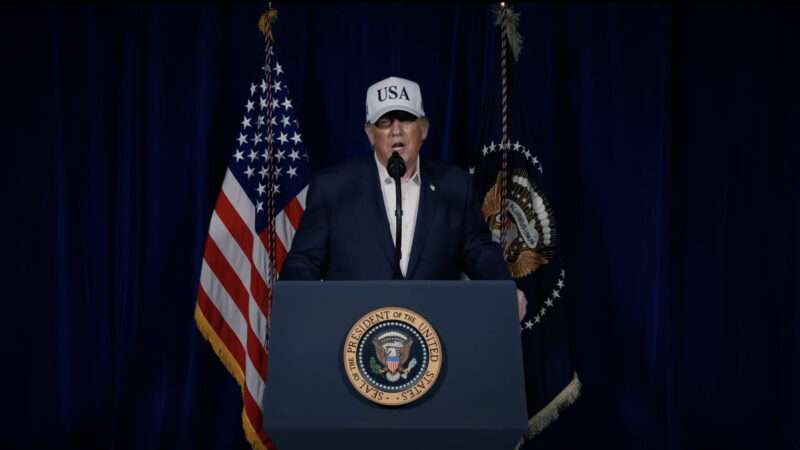
President Donald Trump said on Friday afternoon that he was expecting to sit down with Iran for more negotiations next week. A few hours later, he announced the beginning of “major combat operations” in order to “raze their missile industry to the ground,” “annihilate their navy,” and help Iranians overthrow their government.
“The lives of courageous American heroes may be lost and we may have casualties. That often happens in war,” Trump added. Israeli Prime Minister Benjamin Netanyahu also announced that his country was taking part in “joint operations” in order to “create the conditions for the brave Iranian people to take their fate into their own hands.”
Iran has immediately begun firing back at Israeli territory and U.S. bases in Arab countries, hitting Bahrain, Kuwait, Qatar, the United Arab Emirates, Jordan, and Iraq with missiles and drones in the first few hours. The Iraqi militia Kataeb Hezbollah and the rebel Houthis in Yemen vowed to join the war on Iran’s side. There are about 40,000 U.S. troops stationed around the region.
Fires could be seen rising from the headquarters of the U.S. Navy Fifth Fleet in Bahrain. No U.S. casualties have been reported as of early Saturday morning. At least one bystander was killed in the United Arab Emirates.
Trump and Netanyahu preempted any kind of American public debate, launching their attack a few days before Congress was set to vote on a war powers resolution. An Israeli official told Reuters that the attack was planned months in advance and the date was decided weeks ago. Netanyahu visited Trump in December 2025—before recent Iranian protests began—to discuss attacking Iran, Axios reported at the time.
On Friday night, Omani Foreign Minister Badr Albusaidi, who was mediating U.S.-Iranian talks, told CBS News that a “peace deal is within our reach” and Iran had agreed to give up its stockpile of enriched uranium. Shortly after, Trump claimed that Iran was refusing to give up enriched uranium.
Secretary of State Marco Rubio reportedly informed Speaker of the House Mike Johnson (R–La.), Senate Majority Leader John Thune (R–S.D.), and Senate Intelligence Committee Vice Chairman Mark Warner (D–Va.) before the attack.
In his speech announcing the war, Trump cited a litany of decades-old grievances against Iran, including the takeover of the U.S. Embassy during the 1979 revolution and the bombing of the U.S. Marine barracks in Beirut during the Lebanese civil war in 1983.
Rep. Thomas Massie (R–Ky.), a sponsor of the war powers resolution, decried the strikes as “Acts of war unauthorized by Congress” immediately after the attack. “The American people are tired of regime change wars that cost us billions of dollars and risk our lives,” cosponsor Rep. Ro Khanna (D–Calif.) added in a video message.
“These strikes are a colossal mistake, and I pray they do not cost our sons and daughters in uniform and at embassies throughout the region their lives,” Sen. Tim Kaine (D–Va.), who is sponsoring a similar resolution in the Senate, said. “Every single Senator needs to go on the record about this dangerous, unnecessary, and idiotic action.”
On the other hand, hawkish Sen. Lindsey Graham (R–S.C.) gave a ringing endorsement: “This operation will be massive in scope and has as its goal the elimination of the regime as demanded by the people of Iran.”
The first wave of bombing hit government buildings across Tehran. Iranian state media reported on Saturday morning that President Masoud Pezeshkian, Speaker of Parliament Mohammad-Bagher Ghalibaf, and top military officials are all alive and well. But there was no word on Supreme Leader Ali Khamenei, whose house was bombed.
Axios reports that Israel is targeting Iranian leaders “past, present, and future.” Strangely, that list of targets may include opposition figures who are ready to step into a power vacuum. The opposition Green Movement reported that the airstrikes targeted the house where their leaders, Mirhossein Mousavi and Zahra Rahnavard, have been held under house arrest since 2009.
Whatever comes of the war, civilians are already starting to suffer. Iranian state TV played images of a bombed-out girls’ school in the south of the country, reporting that 57 people were killed. Another video widely circulated on social media shows men, women, and children running out of a bombed-out apartment building. A teenage girl shouts into her phone for her mother to come outside quickly, while another woman shouts, “Why did they hit a home?”
The post Trump and Israel Start the Iran War appeared first on Reason.com.
from Latest – Reason.com https://ift.tt/1Gsjmxh
via IFTTT
2/28/1966: Miranda v. Arizona argued.

The post Today in Supreme Court History: February 28, 1966 appeared first on Reason.com.
from Latest – Reason.com https://ift.tt/zKAoc6P
via IFTTT

New York Mayor Zohran Mamdani is facing a tough reality check. Just a few months into office, the new mayor’s dreams of free buses, free child care, and government-run grocery stores are running into the brick wall of New York City’s massive budget deficit. But when it comes to government food stores at least, the mayor is doubling down anyway.
The city currently faces a $5.4 billion budget gap, which Mamdani has largely blamed on former Mayor Eric Adams. In turn, Mamdani’s primary proposals for closing the gap are to either pressure New York Gov. Kathy Hochul and state legislators into raising taxes on the wealthiest New York City residents and corporations—the mayor’s preferred path—or enacting a 9.5 percent property tax in the Big Apple.
Gov. Hochul has poured cold water on the tax-the-rich route, while an across-the-board property tax increase has unsurprisingly received substantial backlash. The latter would also require the acquiescence of the New York City Council, but City Council Speaker Julie Menin has already dismissed the idea as a “nonstarter.”
Of course, other options beyond raising taxes exist for addressing NYC’s budget mess. Namely, the city could cut spending and exercise fiscal restraint. But if spending cuts seem like a pipe dream for a democratic socialist mayor, one might at least expect a temporary moratorium on expensive new spending items.
No such luck. Despite NYC’s fiscal situation, the New York Post reports that Mamdani plans to earmark $70 million for his central campaign proposal of government-run grocery stores. The funding would supposedly flow to the city’s Economic Development Corporation (EDC), which would be tasked with scouting sites for the five proposed stores across Gotham’s five boroughs, as well as spearheading the construction of the stores.
The $70 million price tag is an escalation from the mayor’s $60 million campaign trail projection, and it’s just the start. The Post confirmed with EDC that the reported $70 million doesn’t even include the cost of a feasibility study for the new grocery stores, the price tag of which remains unknown.
It also doesn’t cover the ongoing cost of running the stores, such as building maintenance or paying the salaries of government employees who may ultimately staff the stores (the mayor has left the operational details unclear so far).
As commentators across the ideological spectrum have pointed out, government-run grocery stores are a particularly bad policy idea. For one, past efforts have met with poor results and have cost cities money that can never be recouped.
There’s also little evidence that they accomplish their intended purpose of helping city residents.
According to NYC’s Deputy Mayor for Economic Justice, Julie Su (who served as President Biden’s former Acting Secretary of Labor), the priority is to target so-called “food deserts” in NYC in order to provide better access to healthy food options. But research has failed to turn up much evidence that government-run stores lead to healthier eating habits among local residents.
Government-run stores would also inevitably inject more politics into the food supply. Food—like everything else—has become increasingly politicized in recent years, and putting the government in charge of stocking store shelves would simply accelerate this trend.
As I wrote about previously in these pages, what constitutes “healthy” eating has been controversial for decades. The federal government, in the form of its dietary guidelines, has vacillated back-and-forth about which food groups are good or bad, embracing recommendations that have arguably contributed to rising American obesity rates over the years.
It’s similarly foolhardy to expect NYC’s government to demonstrate nutritional clairvoyance in what it puts on government-owned shelves. A final lesson can be learned from the experience of state-run liquor stores—still present in 13 states—which have demonstrated that these government-run retailers are engines for corruption and political favoritism.
Mamdani’s government-run grocery stores make neither political nor financial sense. But despite a massive budget shortfall, the mayor remains undeterred in his efforts to run up the grocery bill.
The post Zohran Mamdani's $70 Million Grocery Gamble appeared first on Reason.com.
from Latest – Reason.com https://ift.tt/EDt3wXm
via IFTTT
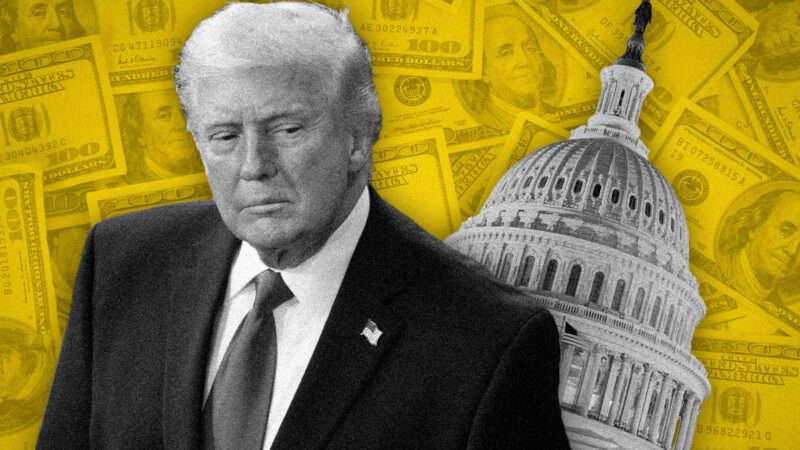
With a few days’ perspective on the State of the Union address, which grows ever closer in spirit and content to outtakes from the prophetic 2006 comedy Idiocracy, it’s worth revisiting one of Milton Friedman’s most enduring insights. “Keep your eye on one thing and one thing only: how much government is spending,” the libertarian Nobel laureate counseled. “That’s the true tax.” Don’t be distracted, he added, by talk about balancing budgets or cutting marginal tax rates. Focus on how much money the federal government spends each year, because that’s the ultimate indicator of how much it costs.
Friedman was talking in the late 1970s, when top marginal income-tax rates were 70 percent and debates were focused on lowering the tax burden and, by implication, government spending. Back then, deficit spending was something that mostly happened during wartime or recessions, rather than being taken for granted the way it has been since Jimmy Carter occupied the White House. If you cut the amount of money the government brought in, went the general argument, you also cut the amount of money it could spend. Friedman was emphasizing that whether spending is paid for in the moment, it is the best proxy for government involvement in everyday life. It has to be paid for eventually, either by raising taxes, reducing services, or by inflating the currency—all actions that make us subordinate to politics and politicians.
In Tuesday’s speech, President Donald Trump reduced fiscal responsibility to a few lines about taming deficits by announcing a “war on fraud,” to be prosecuted by Vice President J.D. Vance. “He’ll get it done,” promised Trump. “And we’re able to find enough of that fraud, we will actually have a balanced budget overnight.” Thus ends nearly half a century of the Republican Party being, at least rhetorically, the party of less spending and smaller government.
Trump’s promise to balance the budget by clamping down on fraud is, to invoke the chief executive Trump replaced, utter malarkey. The barely cold corpse of the Department of Government Efficiency (DOGE) testifies to how surprisingly hard it is, even for wunderkind spreadsheet hotshots with battle names like Big Balls, to realize cost savings in a federal budget that tops $7 trillion. The absolute best-case scenario, wrote Reason‘s Eric Boehm, is that DOGE saved $170 billion rather than the $2 trillion that Elon Musk promised at its outset. (At least, that’s what DOGE finally claimed, but given the agency’s reputation for fudging its numbers, we should take it with a grain of salt or two.) Whatever numbers Vance comes up with should be met with similar skepticism. After all, this is the man who, when called out for circulating unsubstantiated stories of Haitian immigrants grilling pet cats in Springfield, Ohio, told CNN, “If I have to create stories so that the American media actually pays attention to the suffering of the American people, then that’s what I’m going to do.”
When it came to talking about spending in the State of the Union, Trump wasn’t at all tempered. He bragged about the $1 trillion defense budget he signed, the $1,776 “warrior dividends” sent to service members, and his Trump Accounts for babies born between 2025 and 2028, a program estimated to cost taxpayers over $15 billion through 2034.
To the extent he talked about the revenue side, he congratulated himself for instituting “tariffs, paid for by foreign countries,” that brought in “billions of dollars.” As many analyses show, Americans paid upwards of 90 percent of the cost of the tariffs, which were ruled illegal by the Supreme Court and will eventually be refunded. While refusing to acknowledge that tariffs are taxes paid by his countrymen, Trump did boast of last year’s tax cuts:
I urged this Congress to begin the mission by passing the largest tax cuts in American history….And with the great Big Beautiful Bill, we gave you no tax on tips, no tax on overtime, and no tax on Social Security for our great seniors. And we also made interest on auto loans tax-deductible. The first time, but only if the car is made in America.
But, following Friedman, let’s keep our eye on spending, not revenue. The results are as disheartening as they are bipartisan. Here are recent annual outlays, as tallied by the Treasury Department’s FiscalData site. The data are inflation-adjusted in 2025 dollars:
The current estimate from the Congressional Budget Office (CBO) for FY 2026 is $7.4 trillion. That’s for a country that is post-pandemic and not at war (at least not as of when I’m writing this). If we cannot reduce spending now through political means, it will ultimately be reduced through a recession, inflation, or an abrupt cut in government services. Given that the debt held by the public equals the size of our economy, it will be extremely difficult for the government to handle such a crisis.
Decades after Friedman’s initial warning at the start of chronic deficit spending, it’s still the spending, and it keeps getting worse with every passing year.
The post It's the Spending, Stupid! appeared first on Reason.com.
from Latest – Reason.com https://ift.tt/8maGq7l
via IFTTT