Hong Kong Property Prices Plunge For 8 Straight Weeks
A new report from Centaline Property, a research firm providing private data on the property market in Hong Kong, has shown property prices are experiencing their worst downturns since late last year during the global growth scare, which sent global equity markets crashing.
Centaline’s report said property prices in the city have plunged for eight straight weeks, mostly tied to an extreme economic deceleration in the region as macroeconomic headwinds continue to increase.
The Central Plains City Index (CCL) is a monthly leading index that tracks property prices in Hong Kong. Regional investors use CCL to track the changing trend of the Hong Kong property market.
As a whole, the CCL Leading Index has tumbled to 180.32, -.36% w/w, -1.62% m/m, and has recorded the lowest level in 27-weeks.
The CCL Leading Index for Large-Scale housing in Hong Kong printed at 181.44, -.32% w/w, -1.70% m/m, and now at a 28-week low.
The CCL Leading Index for Small and Medium-Sized Units printed 180.26, -.37% w/w, -1.71% m/m, and now at the lowest levels in 27-weeks.
The three major leading indexes for Hong Kong property prices (above) slid for eight consecutive weeks, falling -4.29 %, -4.70%, and -4.54%, respectively.
As shown below, 75% of the top regions in Hong Kong saw the CCL leading index drop, indicating price deceleration continued through late summer into fall.
And with a recession and social unrest expected to deepen in Hong Kong through year-end, it’s likely that CCL’s leading property price indicators will point down into 1H20.
The United States of America emerged victorious from the Second World War, and came out stronger than any other country in the world. The allies- notably the Soviet Union- won the war but emerged much weaker.
They needed to reconstruct their countries and rebuild their economies, with the US demanding huge retrospective payments for its support. The US became a superpower with nuclear bomb capability and an imposing power of dominance. Industrial countries rebuilt in what the Germans called their Wirtschaftswunder and the French les Trentes Glorieuses, the thirty years of post-war prosperity. Meanwhile the US leveraged its prosperity to spread its hegemony around the world.
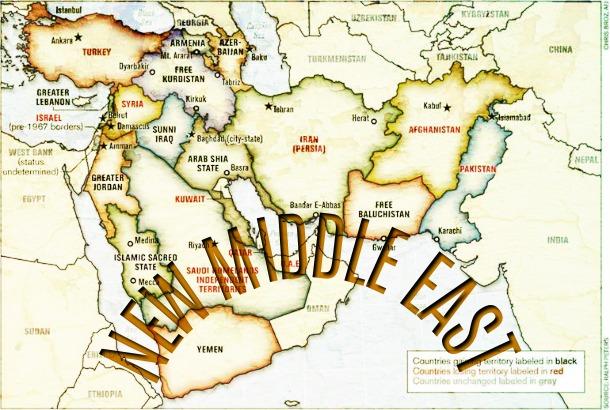
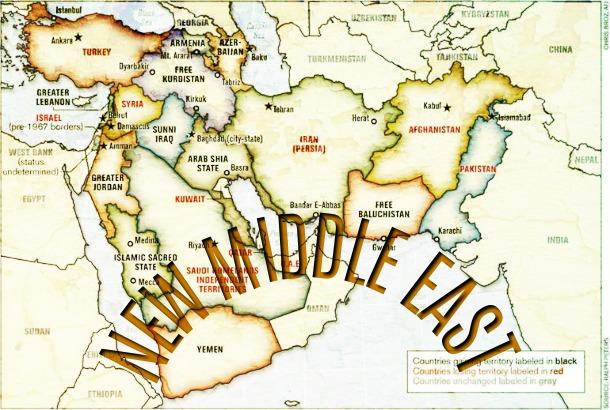
US power was enhanced with the beginning of Perestroika and after the fall of the Soviet Union. In the new millennium the US establishment declared the “War on Terror” as justification to occupy Afghanistan and Iraq, while attempting to subdue Hezbollah in Lebanon, changing the régime in Libya and attempting to destroy Syria, all with the goal of reshuffling and forming a “New Middle East”.
In the Levant, the US has dramatically failed to reach its objectives, but it has succeeded in waking Russia from its long hibernation, to challenge the US unilateral hegemony of the world and to develop new forms of alliance.
Iran has also challenged the US hegemony incrementally since the 1979 “Islamic Revolution”. Iran has planned meticulously, and patiently built a chain of allies connecting different parts of the Middle East. Now, after 37 years, Iran can boast a necklace of robust allies in Palestine, Lebanon, Syria, Iraq, Yemen and Afghanistan– who are all ready, if necessary, to take up arms to defend Iran.
Iran, in fact, has greatly benefited from US mistakes. Through its lack of understanding of populations and leaders around the world, it has universally failed to win “hearts and minds” in every Middle Eastern country where it imposed itself as a potential ally. The arrival of President Donald Trump to power helped US allies and the anti-US camp to discover, together, the limits and reach of US sanctions.
Russia and China took the lead in offering a new, softer model of an alliance, which apparently does not aim to impose another kind of hegemony. The offer of an economic alliance and partnership is especially attractive to those who have tasted US hegemony and wish to liberate themselves from it by means of a more balanced alternative.
During this period of Trump’s ruling, the Middle East became a huge warehouse of advanced weapons from varied sources. Every single country (and some non-state actors) has armed drones- and some even have precision and cruise missiles. But superiority in armaments by itself counts for very little, and its very balance is not enough to shift the weight to one side or another. Even the poorest country, Yemen, has done significant damage to oil-rich Saudi Arabia, a country highly equipped, militarily, and with the most modern US hardware in the Middle East.
US President Trump was informed about the evident failure to change the régime in Syria and the equal impossibility of dislodging Iran from the Levant. He most probably aimed to avoid the loss of lives and therefore decided to abandon the country that his forces have occupied for the past few years. Nonetheless, his sudden withdrawal, even if so far it is partial (because he says, a small unit will remain behind at al-Tanf, to no strategic benefit since al-Qaem border crossing is now operational) – came as a shock to his Kurdish and Israeli allies. Trump proved his readiness to abandon his closest friends & enemies overnight.
Based on the 2006 proposed plan to redrawn the borders of the Middle East by retired Army lieutenant colonel Ralph Peters, which he referenced as “blood borders”.
Trump’s move offered an unexpected victory to Damascus. The Syrian government is now slowly recovering its most important source of food, agriculture and energy. North-East Syria represents a quarter of the country’s geography. The northern provinces have exceptional wealth in water, electricity dams, oil, gas and food. President Trump has restored it to President Bashar al-Assad. This will also serve Trump’s forthcoming election campaign.
Assad trusts that Russia will succeed in halting the Turkish advance and reduce its consequences, perhaps by asking the Kurds to pull back to a 30 km distance from the Turkish borders to satisfy President Erdogan’s anxiety. That could also fit the Turkish-Syrian 1998 Adana agreement (5 km buffer zone rather than 30 km) and offer tranquillity to all parties involved. Turkey wants to make sure the Kurdish YPG, the PKK Syrian branch, is disarmed and contained. Nothing seems difficult for Russia to manage, particularly when the most difficult objective has already been graciously offered: the US forces’ withdrawal.
President Assad will be delighted to trim the Kurds’ nails. The Kurds offered Afrin to Turkey to prevent the Syrian government forces controlling it. The Kurds, in exchange for the State of their dreams (Rojava), supported US occupation and Syria’s enemy, Israel. Prime Minister Benyamin Netanyahu bombed hundreds of targets in Syria, preferring ISIS to dominate the country and pushing Trump to give him the Syrian-occupied Golan Heights as a gift- although the US has no authority over this Syrian territory.
Hundreds of thousands of Syrians were killed, millions of refugees were driven from their homes and hundreds of billions of dollars were spent on destroying Syria. Nonetheless, the Syrian state and President Assad have prevailed. Notwithstanding the consequences of the war, Arab and Gulf countries are eager to return to Syria and participate in reconstruction. Whoever rules Syria, the attempt to destroy the Syrian state and change the existing régime has failed.
Russia is one of the most successful players here, on numerous fronts, and is now in a position President Putin could only have dreamed about before 2015. Numerous analysts and think tanks predicted Moscow would sink into the Syrian quagmire, and they mocked its arsenal. They were all wrong. Russia learned its lesson from the 1979 invasion of Afghanistan. It offered air and missile coverage and brilliantly cooperated with Iran and its allies as ground forces.
President Putin skillfully managed the Syrian war, striking a balance and creating good ties with Turkey, a NATO ally- even after the downing of his jet by Ankara in 2015. Russia wanted to collaborate with the US but was faced with an administration with persistent “Red-Soviet” phobia. Moscow proceeded without Washington to solve the Syrian war and defeat the jihadists who had flocked to the country with support from the West (via Turkey and Jordan) from all over the world.
Russia showed off its new arsenal and managed to sell a lot of its weapons. It has trained its Air Force using real battle scenarios, fought alongside the Syrian and Iranian armies, and a non-state actor (Hezbollah). It defeated ISIS and al-Qaeda 40 years after its defeat in Afghanistan. President Putin has distinguished himself as a trustworthy partner and ally, unlike Trump- who abandoned the Kurds, and who blackmails even his closest ally (Saudi Arabia).
Russia imposed the Astana process instead of Geneva for peace talks, it offered countries to use their local currencies for commerce rather than the dollar, and it is dealing pragmatically with Iran and Saudi Arabia, and with Assad and Erdogan. The Americans, by their recklessness, showed themselves incapable of diplomacy.
Moscow mediated between the Syrian Kurds and the central government in Damascus even when these had been under US control for years. Putin behaved wisely with Israel even when he accused Tel Aviv of provoking the killing of his officers, and stayed relatively neutral in relation to the Iran-Israel struggle.
On the other hand, Tel Aviv never thought Syria would be reunited. Today Damascus has armed drones, precision and cruise missiles from Iran, supersonic anti-ship Russian missiles- and has survived the destruction of its infrastructure and so many years of war.
Israel has lost the prospect of a Kurdish state (Rojava) as an ally. This dream has gone now for many decades to come and with it the partition of Syria and Iraq. The “Deal of the Century” makes no sense anymore and the non-aggression deal with the Arab states is a mirage. Everything that Trump’s close advisor, Prime Minister Netanyahu, wanted has lost its meaning, and Israel now has to deal with the Russian presence in the Middle East and bear the consequences of the victory achieved by Assad, the Russians, and the Iranians.
After the Kurds, Israel is the second biggest loser- even if it has suffered no financial damage and no Israeli lives have been lost in combat. Netanyahu’s ambitions can no longer be used in his election scenario. Israel needs to prepare for living next door to Assad, who will certainly want back Syria’s Golan- a priority for Damascus to tackle once domestic reconstruction is on its way. He has been preparing the local resistance for years, for the day when Syria will recover this territory.
Elon Musk Has Officially Pissed Off Pablo Escobar’s Brother
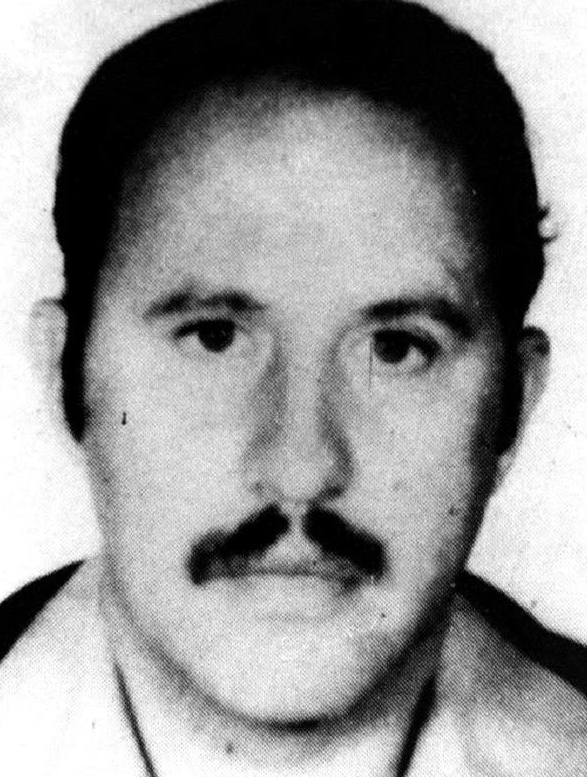
In what is just another normal day of business for the circus over at Tesla, Roberto Escobar, former accountant to his druglord brother Pablo, has now vowed to “take down” Elon Musk, according to the Sun.
The animosity stems from the allegation that Musk stole the idea for his “Not-A-Flamethrower” from Escobar during a visit to the Escobar compound in the summer of 2017.
In January of 2018, Musk’s Boring Company released the large blowtorches that are shaped like guns. He named them “Not-A-Flamethrower” as a result of U.S. customs officials telling Musk they wouldn’t allow the sale of “flamethrowers” nationwide. All 20,000 of the products that were manufactured were sold out within days.
But Escobar says that he was the one who suggested the concept to Musk’s engineer months before they were released, inspired by his brother’s purported habit of burning money to keep warm.
Escobar launched his own flamethrower earlier this year and also threatened to sue Elon Musk for IP theft. Musk glibly jabbed back at Escobar on Twitter, reminding him that “It’s Not A Flamethrower, Mr. Escobar.”
Escobar now seems dead set on legal action. He told the Telegraph:
“We will soon file a $100 million case against him in America, and I will try my best to make sure he loses his stronghold in Tesla Inc. He knows exactly what he has done to us.”
His brother, Pablo Escobar, was one of the most well known Colombian drug lords who monopolized the trade of cocaine into the U.S. in the 1980’s and 1990’s. He was reportedly worth about 45 billion pounds at the time of his death, which made him the “wealthiest criminal in history”.
Robert acted as co-founder of his brother’s cartel and was the organization’s accountant.
But the real question here may lie behind the lede. Tesla skeptic Mark Spiegel astutely asked on Twitter:
The most bizarre thing about this story is that Musk never denied Escobar’s claim that one of his engineers visited Escobar’s compound in the summer of 2017.
Both Tulsi Gabbard and the Green Party of the United States have issued scorching rebukes of Hillary Clinton for baseless accusations the former Secretary of State made during a recent interview claiming that both Gabbard and former Green Party presidential candidate Jill Stein are aligned with the Russian government.
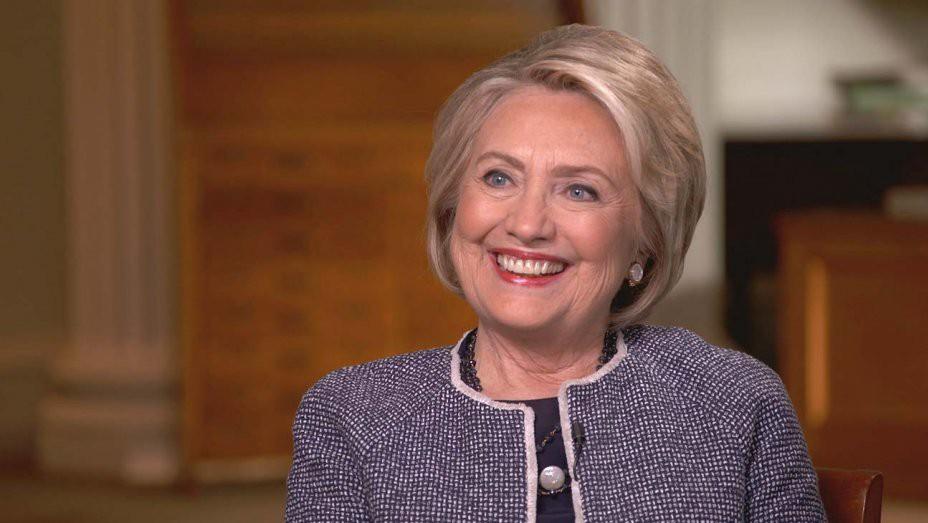
“I’m not making any predictions, but I think they’ve got their eye on somebody who is currently in the Democratic primary and are grooming her to be the third-party candidate,” Clinton said in a transparent reference to Gabbard.
“She’s the favorite of the Russians. They have a bunch of sites and bots and other ways of supporting her so far. And that’s assuming Jill Stein will give it up, which she might not because she’s also a Russian asset.”
Clinton provided no evidence for her outlandish claims, because she does not have any. Gabbard has repeatedlydenied centrist conspiracy theories that she intends to run as a third-party candidate, a claim which establishment pundits have been making more and more often because they know there will never be any consequences when their claims are disproven. There is no evidence of any kind connecting either Jill Stein or Tulsi Gabbard to the Russian government.
Of course, this total lack of evidence hasn’t dissuaded Clintonites from falling all over themselves trying to justify Mommy’s claims anyway.
“Russian ‘assets’ are not formal relationships in the USIC [US Intelligence Community] sense of the word,” CNN analyst and former FBI agent Asha Rangappa explained via Twitter.
“If you are parroting Russian talking points and furthering their interests, you’re a source who is too dumb to know you’re being played to ask for money.”
“It’s important to point out here that a Russian ‘asset’ is not the same thing as a Russian ‘agent’,” tweeted virulent establishment narrative manager Caroline Orr. “An asset can be witting or unwitting; it’s any person or org who can be used to advance Russia’s interests. It’s pretty clear that Tulsi satisfies that criteria.”
“One doesn’t have to be on the Kremlin’s payroll to be a Russian asset. One doesn’t even have to know they are a Russian asset to be a Russian asset. Have you not heard the term ‘useful idiot’ before?”tweeted writer Kara Calavera.
Yep, yeah, that makes perfect sense. One doesn’t have to actually have any formal relationship with the Kremlin to be a Kremlin asset. One doesn’t have to know they’re a Kremlin asset to be a Kremlin asset. The Kremlin doesn’t even need to know one is a Kremlin asset for them to be a Kremlin asset. Nothing has to have happened except the accusation of being a Kremlin asset. It’s just kind of a vague, shapeless nothing thing that doesn’t necessarily have any actual meaning to it at all besides the way it makes people feel inside. It’s more like a religious belief, really.
Isn’t it interesting how that works? Establishment loyalists get a damaging and incendiary tag that they can pin on anyone who disagrees with them, with the sole evidentiary requirement being that disagreement itself.
Author and antiwar activist David Swanson noticed this bizarre intellectual contortion as well, tweeting, “Notice that they carefully define ‘Russian asset’ to mean not necessarily an asset and not necessarily with any connection to Russia.”
Notice that they carefully define “Russian asset” to mean not necessarily an asset and not necessarily with any connection to Russia. https://t.co/Yp6rR1EElh
Establishment narrative managers have been performing this obnoxious trick for years; this is just the most publicly it’s been brought into the spotlight. They claim someone is a Russian asset, then when asked to provide proof that the person is working for Russia, they say they might be an “unwitting” Russian asset, or a “useful idiot”, who does the Kremlin’s bidding without realizing it by sharing ideas and information which the Russian government agrees with. Which is just another way of saying that they hold positions which diverge from the microscopic Overton window of establishment-authorized opinion.
Such positions typically consist of some form of opposition to longstanding US military agendas, such as America’s failed policy of regime change interventionism. Both Jill Stein and Tulsi Gabbard have inserted skepticism of US military policy into mainstream political discourse, which is tremendously inconvenient for the people whose job it is to manufacture consent for new wars and endless military expansionism.
The “Russian asset” smear has given the establishment narrative managers the ability to make incredibly inflammatory and scandalous accusations about anyone who opposes the US establishment foreign policy consensus, without ever having to back them up with facts. It’s no obstacle for me if I can’t prove that you have any connection to the Russian government, because I can still smear you as a Russian asset by saying your views align with Moscow’s interests, or by noting that Russian news media has done news reporting on you as our friend Neera Tanden does here:
Never mind the fact that there are many, many reasons to oppose the US establishment foreign policy consensus which have nothing to do with Russia. Never mind the fact that the US establishment foreign policy consensus has been an unmitigated disaster that has only made the world worse and is pushing the US-centralized power alliance toward a point where a direct military confrontation with Russia, China and their allies becomes inescapable. Never mind the fact that Russia is far from the only country in the world that wishes America would scale back its aggressive military expansionism. It has been firmly established beyond any doubt that it is now literally impossible for an American political figure to vocally oppose US warmongering without being labeled a Russian asset.
In reality, “Russian asset” is nothing more than a completely meaningless noise that war pigs make with their face holes, no more coherent and communicative than the barking of a dog or the chattering of a squirrel. If we were to come up with a definition for that term which reflects the way it is actually being used in modern political discourse, that definition would be something like, “An incantation which magically makes political dissent look like something treasonous and Machiavellian.”
Establishment narrative managers are getting more and more aggressive with the psychological bullying tactics they are using against political dissidents. Applying a ridiculous, meaningless pejorative to anyone who disagrees with mainstream US foreign policy views is just one more ugly tool in their infernal toolbox. It is not normal, healthy or acceptable to accuse someone of being a Russian asset just because they disagree with the authorized commentators of the American political/media class, and when they make such accusations they should be publicly shamed for it.
China Kills Tarantino Movie Over Controversial Bruce Lee Fight Scene
China has killed the distribution of Quentin Tarantino’s film “Once Upon a Time In Hollywood,” one week before its major debut at box offices across the country, reported the Los Angeles Times.
The widespread release of the film was planned for Oct. 25th. Chinese regulators canceled those plans over a controversial fight scene featuring an actor inaccurately portraying legendary Chinese martial arts master, Bruce Lee, said a source familiar with the film.
Chinese film regulators didn’t explain their cancellation decision. But another source familiar with the movie told The Hollywood Reporter that Shannon Lee, Bruce Lee’s daughter, “filed a complaint to China’s National Film Administration” due to the inaccurate portrayal of her late father. She said Tarantino’s film made her late father look “arrogant” and “boastful.”
The decision to prevent the movie from debuting is a massive blow to Sony and the Chinese distributor Bona Film Group, that is because China has the largest box office market in the world.
Shannon Lee, chief executive of Bruce Lee Family Co., said in July Tarantino’s film was a “mockery” of her father.
“The script treatment of my father as this arrogant, egotistical punching bag was really disheartening — and, I feel, unnecessary,” Lee told The Times.
Tarantino responded to Lee’s comments in late summer by saying, “Bruce Lee was kind of an arrogant guy. The way he was talking, I didn’t just make a lot of that up.”
The controversial scene in question involves a fight between Mike Moh, the actor who portrays Bruce Lee, and Brad Pitt’s character, stuntman Cliff Booth, where a fight eventually leads to Moh [Lee] getting bodyslammed into the side of a car.
In an interview with Birth.Movies.Death, Moh, revealed in Aug., that the original script had “major issues” when it came to an accurate portrayal of Bruce Lee.” I’m not going to tell you what the original script had exactly, but when I read it, I was so conflicted because he’s my hero – Bruce in my mind was literally a god. He wasn’t a person to me, he was a superhero. And I think that’s how most people view Bruce.”
A source close to the situation tells The Hollywood Reporter that the auteur is taking a take-it-or-leave-it stance in the wake of Chinese regulators pulling the film.
Tarantino had another run-in with Chinese regulators back in 2012 when he released Django Unchained, which the movie was pulled from theaters after graphic scenes showed excessive nudity and violence.
Django Unchained was re-released after an edit, supervised by Chinese regulators, the movie then flopped, making only $2.7 million, opposed to hundreds of millions of dollars.
The latest distribution debacle comes at a time when tensions between the US and China are at high levels due to an ongoing trade war.
Earlier this month, we reported how China canceled all broadcasts of NBA games due to a now-deleted tweet by Houston Rockets general manager Daryl Morey supporting protestors in Hong Kong.
China’s censorship doesn’t stop at the movies or the NBA. Apple, South Park, and Activision Blizzard, all have recently been targeted by the Chinese government to remove content or face penalties that could result in a denial of access to Chinese markets.
Here’s Why 97% Of Congress Get Re-Elected Each Year
Submitted by Adam Andrzejewski, first published in Forbes
How is 97 percent of Congress able to get re-elected each year even though only 17 percent of the American people believe our representatives are doing a good job?
It’s called an incumbent protection system. Taxpayers have a right to know how it works.
Recently, our auditors at OpenTheBooks.com, mashed up the federal checkbook with the congressional campaign donor database (source: OpenSecrets.org). We found powerful members of Congress soliciting campaign donations from federal contractors based in their districts.
We followed the money and found a culture of conflict-of-interest. The confluence of federal money, campaign cash, private employment, investments, prestigious committee appointments, political power, nepotism, and other conflicts are a fact pattern.
Furthermore, members of Congress own investment stock in, are employed by, and receive retirement pensions from federal contractors to whom they direct billions of taxpayer dollars.
Moreover, members sponsor legislation that affects these contractors. The contractor’s lobbyists then advocate for the legislation that helps the member and the contractor. Oftentimes, the contractor’s lobbyist also donates campaign cash to the member.
Here are five case examples detailing the conflict-of-interest among five powerful members of Congress:
Rep. John Larson (D-CT1): United Technologies (UT) executives, employees, political action committee, and affiliated lobbyists are the #1 campaign donor to Larson’s committee ($377,050). UT collected federal grants (subsidies) $83.8 million and federal contracts $16.1 billion (2014-2018). Mr. Larson owns UT stock 2012-2018 (last disclosure). Larsen is a ranking member on House Ways and Means.
Seven years ago, Larson’s wife got a state job from the wife of a campaign donor, who was also the state insurance commissioner. She beat out 199 other candidates and was the only one to fill out a job application. Since her hiring, she’s earned an estimated $600,000 in cash compensation.
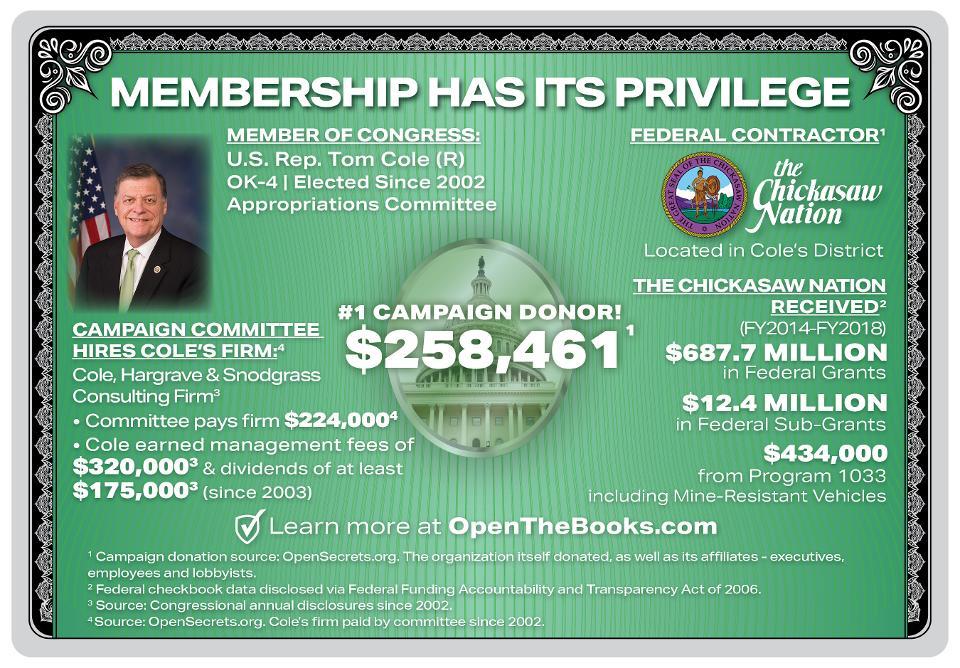
Rep. Tom Cole (R-OK4): The Chickasaw Nation and affiliates are the #1 campaign donor to Cole’s committee ($258,461). The Nation received $700 million in federal grants and $434,000 in surplus military equipment from the Pentagon, including mine-resistant vehicles, night vision goggles, mine-detecting sets, and rifles that shoot .308 rounds. Cole is a ranking member on House Appropriations.
Since 2002, Cole’s campaign committee has hired Cole’s private political consulting partnership: Cole, Hargrave, and Snodgrass. Cole’s campaign has paid his firm a total of $224,000.
Since 2003, Mr. Cole has earned roughly $320,000 in “management fees” from his firm – while also serving in Congress. He’s also disclosed receiving $175,000 – $575,000 in “dividends/capital gains” and his “equity interest” in the firm is listed as between $250,000 – $500,000.
The Chickasaw Nation responded regarding their donations and any perceived conflict-of-interest issues with Rep. Tom Cole:
As an active participant in the political process working to enhance the quality of life of our citizens, we support candidates who have similar policy views.
The Chickasaw Nation spokesperson
Rep. Jim Cooper (D-TN5): Vanderbilt University’s executives and employees are the #1 all-time campaign donor to Cooper’s committee ($135,261) – including $21,500 from just-retired chancellor Nicholas Zeppos. Vanderbilt has received $2.6 billion in federal payments (2014-2018) including grants ($2.3 billion); direct payments ($31.2 million); and contracts ($187 million). Cooper is a ranking member of the Budget committee.
Mr. Cooper was employed by Vanderbilt during the period 2005 through 2017 and disclosed earnings of $250,500 in cash compensation. He made between $20,000 and $23,500 a year teaching a graduate level class in Vanderbilt’s HealthCare MBA program at the Owen Graduate School of Management as an adjunct professor.
Former Rep. – Current Governor Kristi Noem (R-South Dakota): Sanford Health’s executives, employees, and lobbyists are the #1 all-time campaign donor to Noem’s federal committee ($110,462). Top executives provided Noem campaign donations early in her career including $7,500 from CEO Kelby Krabbenhoft.
In 2019, Noem was sworn in as governor of South Dakota. She’s appointed two Sanford executives to head up state agencies. Noem’s transition chief was a Sanford lobbyist.
Governor Noem has proposed aiding the state’s nursing home industry by raising the rate of Medicaid payments and providing $5 million in grants to help innovate facilities. Sanford Health owns 32 nursing homes in South Dakota.
Does Sanford Health really need taxpayer aid? This “nonprofit” organization has annual revenues of $3.7 billion, assets of $2.8 billion, and paid it’s CEO $2.2 million last year.
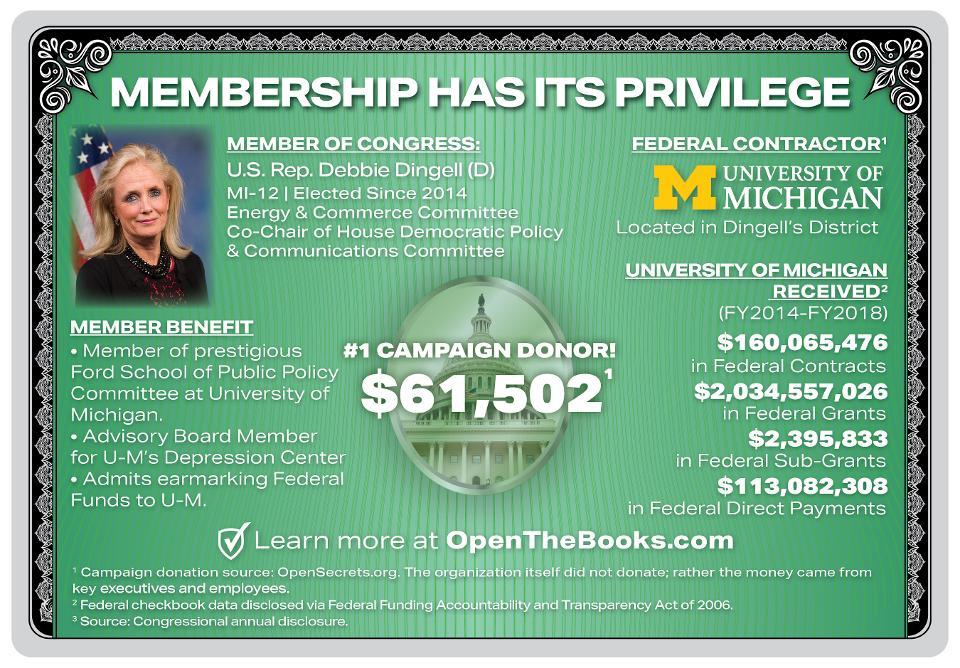
Rep. Debbie Dingell (D-MI12): Although Dingell wasn’t elected to Congress until 2014, a member of the Dingell family has held MI-12 congressional seat for 86 years.
The executives and employees of the University of Michigan (U-M) are the #1 campaign donor to Dingell’s committee ($61,502). This is despite the fact that Dingell sits on two prominent U-M boards: the Ford School of Public Policy and the Depression Center. Trustees and university employees of those boards have donated to her campaign.
One of Dingell’s duties on the board of the Ford School is to help the school raise money and network.
Dingell is a ranking member of the House Energy and Commerce Committee. On March 21, 2019, she signed an earmark letter to the Department of Transportation (USDOT) in support of $7.5 million in grants to U-M and other partners regarding research on self-driving cars. In a press release, Dingell took credit that USDOT authorized the grant in August 2019.
The University of Michigan responded regarding their donations and any perceived conflict-of-interest issues with Rep. Debbie Dingell:
Our employees are free to make personal campaign contributions to any elected official they may wish to support.
University of Michigan spokesperson
Nothing we discovered is illegal. At arms-length, all of the transactions are legal. And that’s the problem.
We polled our subscribers and 1,900 people responded: 96 percent thought it was unethical for a member of Congress to solicit campaign donations from federal contractors based in their districts. Furthermore, 92 percent said it was an important or very important issue.
The American people get it. Members should refuse to accept campaign donations from federal contractors and their affiliates.
Note: A request for comment was sent to all members and contractors mentioned in this piece. No members of Congress responded to our comment requests. Contractor respondents included: The University of Michigan, full comment, here; The Chickasaw Nation, full comment, here. Sanford Health didn’t respond to this request, however, they issued this comment earlier, here.
New Study Shows Humans Think More Efficiently When A Robot Stands Nearby And Insults Them
A study performed by the American Association for the Advancement of science found that the presence of a “threatening humanoid robot” nearby can actually help improve human cognitive performance.
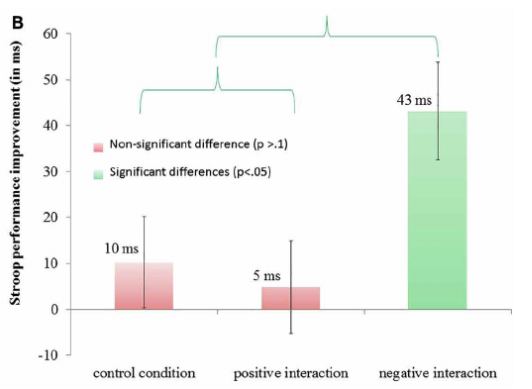
The study set out to learn more about how the presence of humanoid robots would affect human cognition. The study gave humans a simple test, called the Stroop task, in which they were told to identify the color of a word while ignoring the actual word itself. For instance, the test may present the word “BLUE”, but in green text – in that case, the answer would be “green”.
The study tested its hypothesis that the presence of robots may energize additional control from humans by having adults perform the Stroop task twice: once, alone and the other, in the presence of a humanoid robot that would offer either a positive (empathy) or negative (contempt, lack of empathy, negative evaluations about the participant’s intelligence) response.
The robot was animated at a distance using two smartphones for the controls of its gestures and speech. At the end of the session that the robots participated in, participants rated them on personality traits and whether they were positive or negative.
The study found that “individuals’ attentional control improved notably in the presence of the bad robot.” Stroop task performance improved exclusively in the presence of the negative robot, whereas it remained nearly the same in the presence of no one, or the positive robot.
The findings counter previous ideas, that postulated that just the presence of the robot, without the feedback, could facilitate or inhibit performance:
These findings run counter to a purely mechanistic approach that reduces the effects of robotic presence to physical action or noise distraction, which may facilitate or inhibit performance depending on task difficulty (9). According to this approach, both robotic presence conditions—regardless of their emotional tone (positive or negative)— should have resulted in a performance change compared with isolation (all the more so be- cause the robot’s appearance and behavior during task performance were identical in both conditions). Instead, Stroop performance changed exclusively in the bad social robot condition.
Not only that, but the negative robot had the same impact on Stroop performance as in earlier studies with negative human presence. The conclusion is simple: that potentially threatening others “improves the selectivity of attention to relevant information at the expense of competing cues.”
The study concludes that the heightened state of alertness helps energize attentional control:
Therefore, not only can the behavior of robots change humans’ perception of robots during HRI (10), but these attributions are susceptible to making the simple presence of robots likely to affect human cognition as a function of the interaction type. Thus, the present findings constitute evidence that the presence of social robots may energize attentional control, especially when the emotional valence and anthropomorphic inferences associated with the robot being present require a heightened state of alertness.
The real climate debate is not between “believers” and “deniers”.
And not between Republicans and Democrats.
The real debate is certainly not over whether global warming, spurred by increasing greenhouse gases, is a serious problem that must be addressed. Both sides of the real climate debate agree on that.
The real rebate is between two groups:
1. A confident, non-political group that believes technology, informed investments, rational decision making, and the use of the best scientific information will lead to a solution of the global warming issue. An optimistic group that sees global warming as a technical problem with technical solutions. I will refer to these folks as the ACT group (Apolitical/Confident/Technical)
2. A group, mainly on the political left, that is highly partisan, anxious and often despairing, self-righteous, big on blame and social justice, and willing to attack those that disagree with them. They often distort the truth when it serves their interests. They also see social change as necessary for dealing with global warming, requiring the very reorganization of society. I call these folks the ASP group (Anxious, Social-Justice, Partisan).
There is no better way to see the profound difference between these two groups than to watch a video of the testimony of young activists at the recent House Hearing on Climate Change, which included Greta Thunberg, Jamie Margolin, Vic Barrett, and Benji Backer.
Jamie Margolin of Seattle talked about an apocalyptic future, with “corporations making billions” while they destroy the future of her generation. Of feeling fear and despair. Of a planet where the natural environment is undergoing collapse, where only a few years are left before we pass the point of no return, and where only a massive political shift can fix things, including the Green New Deal. Watch her testimony to see what I mean.
Compare Ms. Margolin’s testimony to that of University of Washington senior Benji Backer.
Mr. Backer, leader of the American Conservation Coalition, a conservative/moderate group of young people supporting action to protect the environment, approaches the problem in a radically different way. Instead of despair, there is optimism, recommending more scientific and technical research, a bipartisan attack on the problem, a rejection of an apocalyptic future, the building of new energy industries with potential benefits for the American economy, and a dedication to follow the science and not political expediency. His testimony is here.
Both Ms. Margolin and Mr. Backer care deeply about the environment and want effective measures to deal with global warming. Both their approaches and attitudes could not be more different.
We see the difference between the optimistic ACT group and the despairing ASP folks here in Seattle.
On one hand, there is the Clean Tech Alliance, which brings together technology companies, university researchers, and the business community to develop and apply the technologies that will produce the carbon-free future we look for. Headed by Tom Ranken, the Alliance does a lot, including a highly informative breakfast series where you can learn about fusion power, new battery technologies, the future of solid waste recycling, and much more. Non-political, optimistic, and exciting. These are clearly members of the ACT group.
In contrast, there is Seattle’s 350.org group. They are into climate strikes, staging protests (like their recent blockade of a branch of Seattle Chase Bank), trying to muzzle climate scientists they don’t like, advocating political solutions to greenhouse warming (Green New Deal), pushing divestment of energy companies, and even a Pledge of Resistance to stop energy exports by whatever means necessary. Their “science” page has all kinds of extreme (and unfounded) claims regarding global warming impacts, like a sea level rise of 10 feet in as little as 50 years. ASP group all the way.
I should note that the Seattle 350.org group and their “allies” oppose the Tacoma Liquid Natural Gas (LNG) Facility that will help replace the extraordinarily dirty “bunker fuel” used in ships traversing Puget Sound. LNG will also reduce carbon emissions. Scientists and regulators at the Puget Sound Clean Air Agency support the LNG facility. But facts and protection of the health of Puget Sound residents are not priorities for highly politicized groups like 350.org.
A good example of the differences between the ACT and ASP folks is found in Washington State’s recent carbon initiatives.
Initiative 732 was backed by Carbon Washington, a non-political group whose bi-partisan proposal would have increased the price of carbon fuels but was revenue neutral, giving all the funds collected back to the citizens of the State. Carefully designed and impactful. The work of the ACT group all the way.
But the ASP folks were unhappy. There was no money for their climate justice and political initiatives, so they opposed it, and were joined by Governor Inslee and the environmental left. Unforgivable, nasty attacks were made on Carbon Washington leadership by the ASP folks. 732 lost.
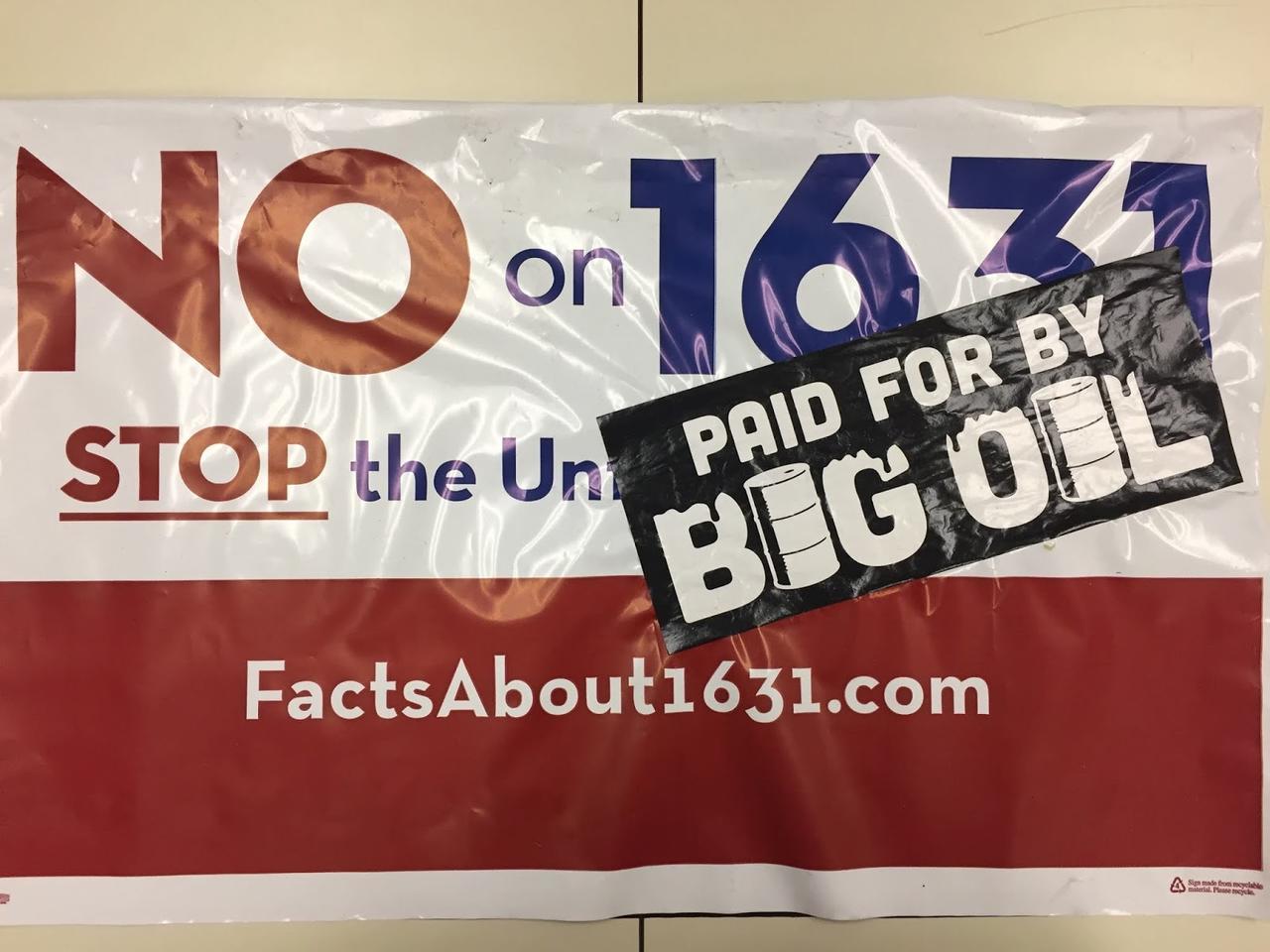
The ASP collective decided it was their turn, so they created a Frankenstein carbon initiative (1631), with a lowered (less effective) carbon fee, but one in which climate justice groups and political allies on the left would have control, and were hardwired for much of the funds. The main advertising line of the 1631 ads: catastrophe was around the corner and the big oil companies were to blame. 1631 was an election day disaster, losing by 13 points, and the ASP folks have probably killed any hope for an effective carbon tax/fee in our state.
What about the media? Which side are they on? ASP or ACT or neither?
Much of the “mainstream” media parrots the message of the ASP side. The Seattle Times is a great case in point, with headlines of massive heat related deaths (750 die per event!) and catastrophic wildfire seasons that have no basis in good science. But there are plenty of others, such as the LA Times and the NY Times. There are some major media outlets that are more balanced (such as the Wall Street Journal). A major issue for the media is the hollowing out of science reporting, with most climate stories being handled by general reporters with neither the time, background, or inclination to get beyond parroting the press releases of activist groups or evaluating the claims of speculative research papers. It has gotten so bad that a recent headline story in the Seattle Times kept on talking about the WRONG GAS (carbon monoxide instead of carbon dioxide).
A Religious Movement
In many ways, the ASP group appears to be a religious movement, not unlike the many millennialist movements of the past. As other groups in the past, they predict an apocalyptic future (including fire and brimstone!) and that one must “believe” in their viewpoint or be rejected as a “denier.” The ASP folks have a holy viewpoint that comes from authority (they claim based on the views of 97% of scientists). There is no debate allowed, the science is “settled.” Sounds like religious dogma.
The ASP movement describes a world that is teetering on the edge, with mankind’s days numbers (10 or 12 years according to several of their leading prophets) unless immediate steps are taken. They constantly repeat that the threat is existential.
They believe it is ok to distort the truth to get folks “to do the right thing.” The ASP group has well defined “enemies” that represent true evil (Trump, Republicans, Big Oil, Koch Brothers) and they support attacking and silencing those they disagree with (my past blog gives you some documented examples of such behavior). ASP has their priests (Al Gore, Bill McKibben, Michael Mann) and even young saints (Greta Thunberg). As in many such movements, members are guided to act in approved and enlightened ways, but the leadership does not need to follow the rules (e.g., many ASP “leaders” have huge carbon footprints from flying). Importantly, ASP sees their work going much further than a technical fix for technical problem, but as a “social justice” movement that will change the very organization of society.
Disturbingly, the ASP folks are against key technologies that could really make a difference, such as nuclear power, and are relatively uninterested in working on adaptation and resilience to climate change. Many do not support dealing with our forests in a rational way (e.g., restoration with thinning and prescribed burning) but would rather blame it all on global warming.
By pushing a highly political agenda the ASP movement is undermining bipartisan efforts–and nothing important will be done unless both sides of the aisle are involved. ASP folks love to say that the Republicans are unwilling to deal with climate change, a totally unfair claim. I have talked personally to leading WA Republicans, like Bill Bryant and Rob McKenna. They acknowledge the seriousness of global warming and the need to act. In my talks in highly Republican eastern Washington, growers and others accept the problem and want to work on solutions. Under a Republican U.S. Congress, funding for climate research has been protected and increased. But partisan attacks by the ASP group is seen as a way to promote group cohesion and the “evil” of the other side. Calling others names is not an effective way to secure their cooperation.
A problem for the ASP group is that their message is so dark, pessimistic and depressing that it tends to turn others off. And it has a terrible psychological effects on its adherents and those that listen. Fear, anxiety, feelings of hopelessness, despair, and rage. There are even classes on dealing with eco-anxiety and climate grief. Greta Thunberg said that the worry ruined her childhood.
And yes, there is President Trump. Much of what he says on climate change is simply nonsensical, and quite frankly he is not part of the debate. Republicans in Congress do not follow his lead. But he is a convenient foil for the ASP folks, who use him for their own purposes.
The Bottom Line
Progress on climate change is being undermined by the efforts of the highly vocal, partisan, and ineffective ASP group. They are standing in the way of bipartisan action on climate change, efforts to fix our forests, and the use of essential technologies. They are a big part of the problem, not the solution.
In contrast to the ASP folks, the ACT group generally tries to stay out of the public eye, quietly completing the work needed to develop the technologies and infrastructure that will allow us to mitigate and adapt to climate change. In the end, they will save us. That is, if the ASP folks don’t get in their way.
Americans Need To Earn $500,000 A Year To Qualify For The ‘1%’
If you’re an American, and you want that precious membership card to the ‘1%’ (in terms of annual income, that is, not overall wealth, but we’ll get more into that later) you’re going to need to work a little bit harder, and earn a little bit more.
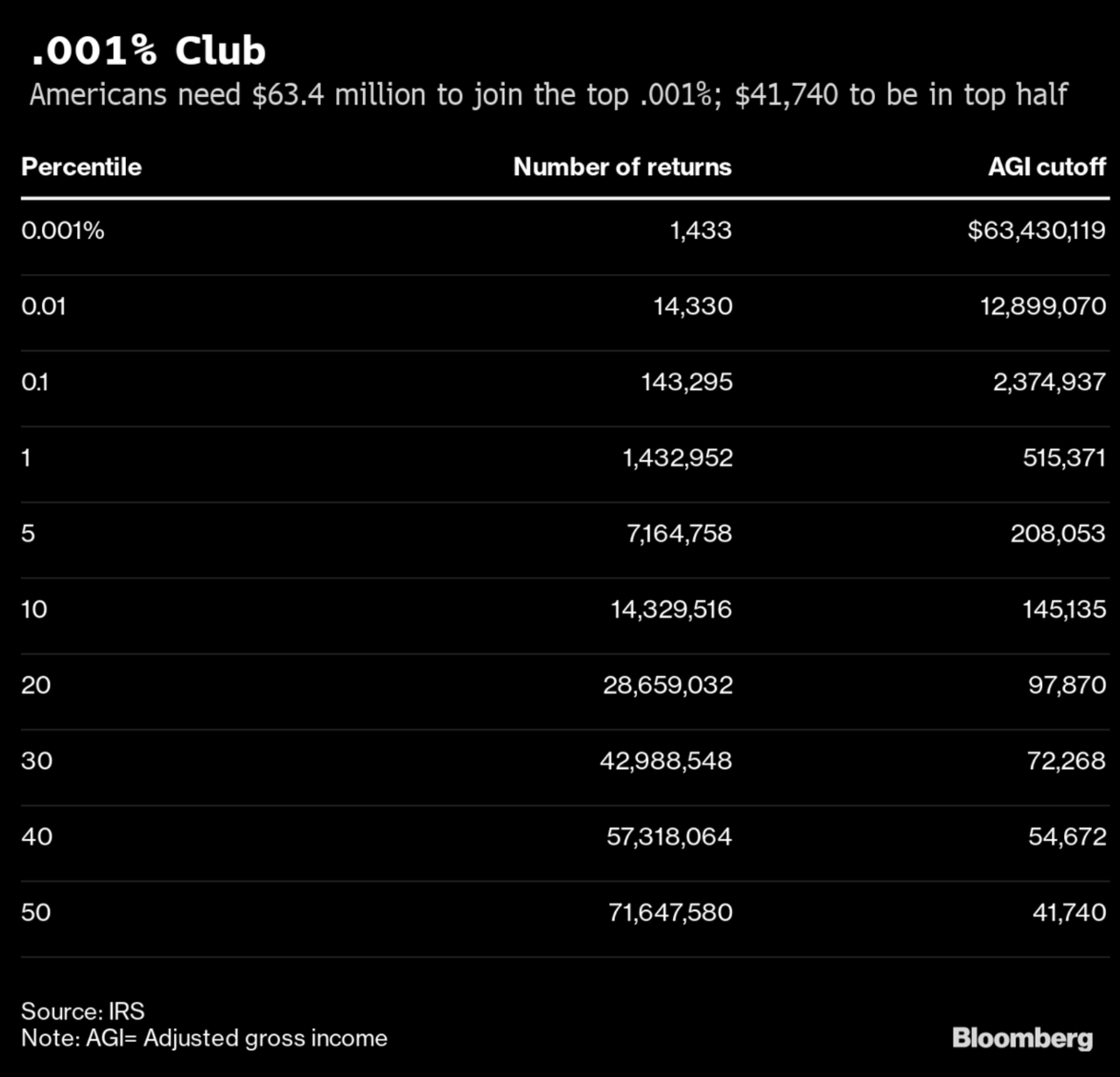
According to Bloomberg’s wealth team, the income needed to enter the top 1% of taxpayers was $515,371 in 2017, according to IRS data released this week. That’s up 7.2% from a year earlier.
Remember, ‘the 1%’ became our modern capitalist boogeyman back in 2011 during the ‘Occupy Wall Street’ movement, when thousands of college students joined forces with criminals and the chronically unemployed to camp out in Lower Manhattan’s Zucotti Park. The park remained the epicenter of the movement for weeks, until Mike Bloomberg finally ordered police to clear the encampment.
Thousands of solidarity rallies were held around the country, and even a few other ‘occupations’ emerged, as dedicated members of the movement gathered in other public grounds in a show of solidarity with their comrades in Zucotti Park (Remember all that news footage of bedraggled-looking young people in beanies carrying signs and shouting slogans like “We are the 99%”?).
The phrase ‘the 1%’ remained embedded in our popular culture long after Occupy fizzled out. Bernie Sanders embraced the term in 2015 as he launched his long-shot campaign for president. Eventually, the lingering class resentments that helped inspire ‘Occupy’ brought about a revival of interest in ‘Democratic’ Socialism’ and hatred for the “1%” who were, according to Sanders, constantly finding strategies to avoid paying their “fair share” in Texas.
A fat lot of good that all did. Because, since the zenith of Occupy in 2011, income inequality has intensified. Now, the threshold to qualify for ‘the 1%’ – that is, the 1% of earners who report the largest amount of taxable income – has itself increased by a staggering 33%.
What’s worse? To join the top 0.1%, you would need have needed to earn $2.4 million in 2017 (the most recent year for which data are available), an increase of 38% since 2011. To join the top 0.01%, the threshold has jumped 46%. Again, this goes by annual earnings, so men like Bill Gates and Warren Buffett, two of the wealthiest men in the world, could stop qualifying for these labels if they decided to stop pulling salaries and started relying solely on their savings.
Meanwhile, the top 0.001%, an elite group of 1,433 taxpayers, pulled in at least $63.4 million each in 2017, up 51% since the Occupy protests. Of course, members of this group – many of whom are wealthy hedge fund billionaires like Ray Dalio – fluctuate often depending on the market, and whether they’re having a good year, or a bad year. Ray Dalio, the Bridgewater Associates founder who earned more than $1 billion last year (that is, in 2018, not 2017) because his firm’s funds were up double-digits, might not make the list some years if his firm loses money (his personal earnings are closely tied with the performance of his firm).
By comparison, the median taxpayer, at the 50th percentile, has seen income rise 20% since 2011.
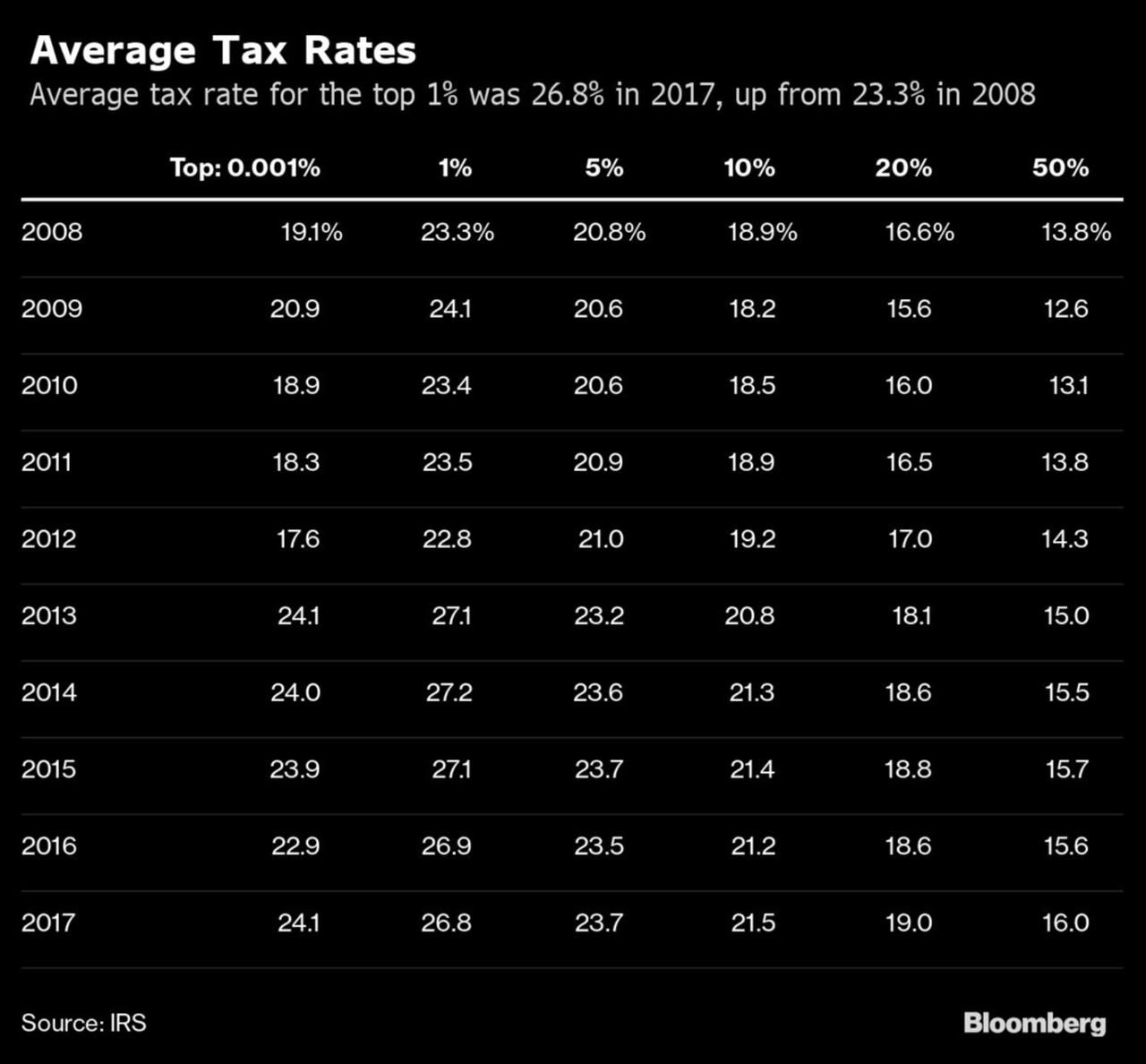
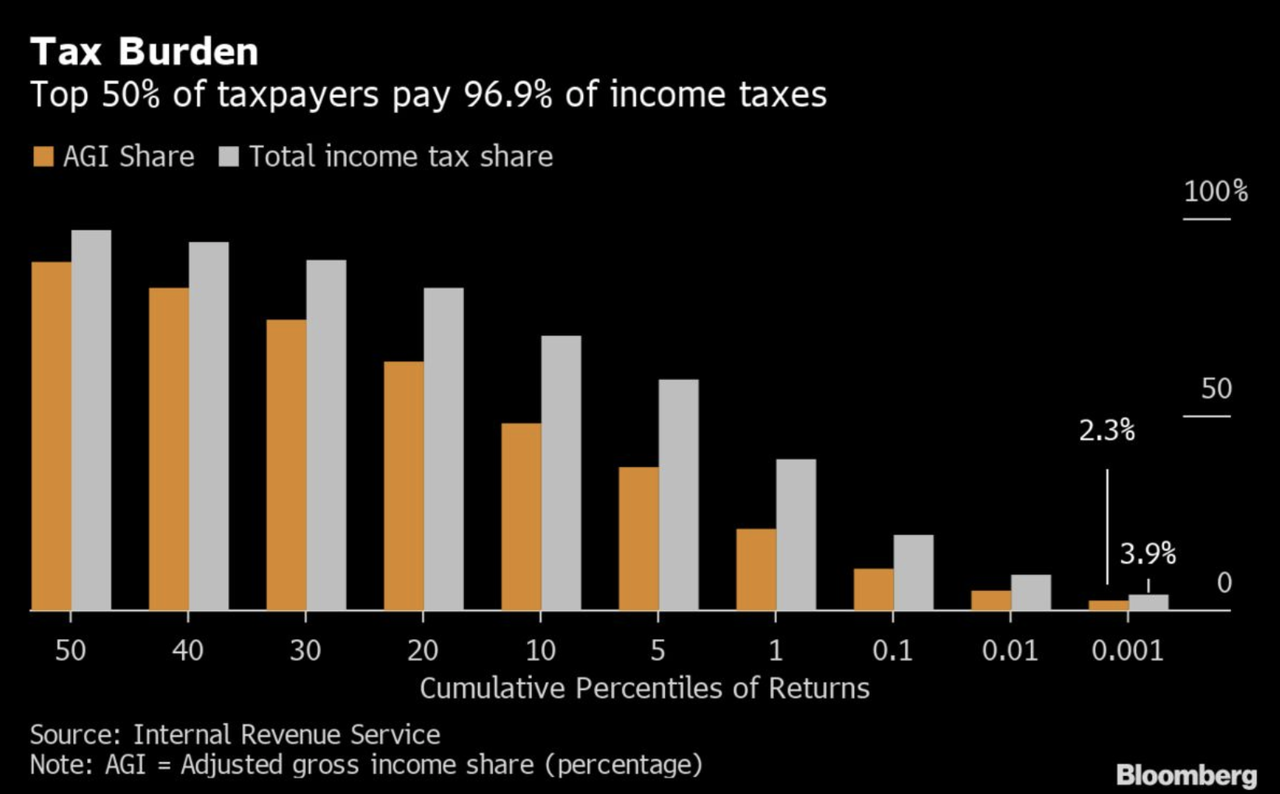
Finally, since BBG is looking at IRS data, the reporters saw fit to remind us that rich people actually do shoulder the largest percentage of the federal government’s tax burden (though they often do pay a lower rate than their working-class…employees). The 1% earned 21% of the total income last year (remember, this doesn’t factor in existing wealth), but paid out 38.5% of their earnings in taxes. The 1% shouldered a larger tax burden than the bottom 90% combined (though remember, as Mitt Romney once said, the bottom 47% of Americans effectively pay $0 in federal income tax).
Though Romney’s made-in-private remark has been widely blamed for him losing to Obama in 2012, as the above data show, he wasn’t wrong: The wealthiest Americans foot most of the bill for financing all of the social welfare programs on which the poor rely.
I hate to say I told you so, but well… as predicted, in the wake of Trump’s commanded military withdrawal from northeast Syria, the once U.S.-backed Kurds cut a deal with the Assad regime. (And Vice President Mike Pence has now brokered a five-day cease-fire.) Admittedly, Trump the “dealmaker” ought to have brokered something similar before pulling out and before the Turkish Army—and its Sunni Arab Islamist proxies—invaded the region and inflicted significant civilian casualties.
One must admit that a single phone call between Trump and President Erdogan of Turkey has turned the situation in Syria upside down in just over a week. The Kurds have requested protection from Assad’s army, Russian troops are now patrolling between the Kurds and invading Turks, and the U.S. is (for once) watching from the sidelines.
The execution has been sloppy, of course—a Trumpian trademark—and the human cost potentially heavy. Nonetheless, the U.S. withdrawal represents a significant instance of the president actually following through on campaign promises to end an endless American war in the Mideast. The situation isn’t simple, of course, and for the Kurds it is yet another fatalistic event in that people’s tragic history.
Still, while the situation in Northeast Syria constitutes a byzantine mess, it’s increasingly unclear that a continued U.S. military role there would be productive or strategic in the long term. After all, if Washington’s endgame wasn’t to establish a lasting, U.S.-guaranteed Kurdish nation-state of Rojava, and it hardly appeared that it ever was, then what exactly could America expect to accomplish through an all-risk, no-reward continued stalemate in Syria?
What’s truly striking, though, and increasingly apparent, is that President Trump possesses – as a foreign policy autocrat, of sorts – the power to derail the Democrats and place 2020 hopefuls in an awkward position of defending U.S. forever wars. It’s already happening, at least among mainstream “liberal” media and political personalities who’ve flooded the networks with anti-Trump vitriol since the Syria withdrawal.
Lest we confuse Donald Trump with a consistent antiwar dove, it’s important to remember that his behavior is erratic and often turns on a dime. Take, for example, his decision to impose sanctions on Turkey right after greenlighting the very invasion he now seeks to punish. He’s also prone to contradictory moves. Also, just as he pulled troops from Syria, he added an even larger number to Saudi Arabia, justifying the move on the grounds that the Saudis will foot the entire bill, making rather official the U.S. military’s gradual transformation into a mercenary force ready to serve the highest bidder. Trump has also surpassed, in his first two years, the number of drone strikes his predecessor Barack Obama launched overseas during the same phase of Obama’s presidency.
Nonetheless, Trump’s Democratic opponents have bet big on using Syria to attack the president without providing any real alternatives to withdrawal. In doing so, they might just hand Trump a winning hand for 2020. In fact, I haven’t seen so much foreign policy coverage of a U.S. war by the establishment media for over a decade, at least since Democrats finally turned against Bush’s failing war in Iraq as a tool for midterm electoral success.
The attention suddenly focused on Syria is rather cynical, of course, with the country’s civil war only receiving notice now because it’s a cudgel used to reflexively attack Trump. It’s not about Kurdish ethnic rights or women’s, rights—and it never was. No, this is all about partisan political advantage. And it might just backfire on the Dems.
Trump isn’t all that scared of criticism on Syria, even from the establishment wing of his own party. Firing back at critics this week, Trump tweeted: “Others may want to come in and fight for one side or the other [in Syria]. Let them!”
See, this president knows what many congressional Republicans do not appear to realize: that the old conservative coalition—which included a powerful hawkish national security wing—is breaking down. The Republican base, well, they’re just about as sick of endless war as is Trump himself. Consider this remarkable turnaround: In recent polls, 56% of Republicans supported Trump’s Syria withdrawal, while 60% of Democrats opposed it.
Which brings us back to the mainstream Democratic machine and the potentially awkward position of even the most progressive of the 2020 presidential hopefuls on the “left.” By flipping the script and demonstrating that Trump and his conservative backers constitute the only serious antiwar coalition, he could expose that establishment Dems—who’ve almost all stood tall with the neocon retreads against Trump’s move—represent little more than Sen. Lindsey Graham lite. He could show that they’re hawks too, opportunistic hawks at that, figures mired in the Washington swamp. Disgust with that bipartisan beltway elite is exactly what got Mr. Trump elected in 2016 (along with a peculiar outdated Electoral College, of course), which is exactly why responding to Trump’s (tentative) war-ending propensity will be sensitive and awkward for Democratic leaders and presidential candidates.
Look, even America’s usually conservative, if (purportedly) apolitical, soldiers and veterans are now against these forever wars that Trump ostensibly seeks to end. A series of polls this summer indicated that nearly two-thirds of post-9/11 vets say they believe the wars in Iraq and Afghanistan and the military engagement in Syria “were not worth it.” This should have been an alarm bell for both major parties, but expect the Democrats to once again squander the opportunity presented by these frustrated, alienated troopers.
By ignoring foreign policy—generally having ceded that political territory to the Republicans since midway through the Cold War—the Dems have ensured that most of these antiwar veterans won’t find a home, or land in the Democratic Party.
I personally know dozens of these sorts of exhausted veterans. Almost none have followed my own journey toward the left. In fact, the vast majority tell me they trust Trump, warts and all, over figures like Hillary Clinton, Joe Biden or any of the other Democratic elites that they find even more corrupt than the reality-TV-star-in-chief. My friends and colleagues may be wrong, may be off-base, but most truly believe it, which ought to worry Democrats. Only it won’t, or at least not in enough time.
So, while I’m cautious about giving sensible advice to Trump (luckily, he doesn’t read Truthdig, or read much at all), I think there’s potential for him to craft a winning strategy for 2020.
Here’s a modest proposal on just how it might go: He could end one of America’s illegal wars, particularly those clearly not covered by the post-9/11 AUMFs [Authorization for Use of Military Force], every three months. Little-to-no warning, ignoring the complaints of senior generals and national security officials; just pick an ill-advised military intervention (there’re plenty to choose from) and announce its end.
Not only would this distract from impeachment, but it would force Trump’s potential 2020 opponents to perform some awkward intellectual gymnastics. They’d be obliged to double-down and promise to end even more wars, even more quickly, than Trump. Or, more likely, they could join the bipartisan swampy establishment and half-heartedly (and disingenuously) defend continuing the very unwinnable wars with which the American people have grown so tired.
I know all of that’s unlikely, but it’s not unthinkable. Trump could even wrap himself in a new brand of patriotism and emphasize his concern for America’s beloved troops. Now, this president isn’t known for his sincerity, but he has previously claimed that signing condolence letters for the families of fallen servicemen “is the hardest thing he does.” So in my fantasy, Trump would address the nation in prime time, and, noting that 18-year-olds have begun to deploy to Afghanistan, assure the people that he intends to end these wars before a kid born after 9/11 dies in one of them.
* * *
Danny Sjursen is a retired U.S. Army Major and regular contributor to Truthdig. His work has also appeared in Harper’s, The LA Times, The Nation, Tom Dispatch, The Huffington Post and The Hill. He served combat tours with reconnaissance units in Iraq and Afghanistan and later taught history at his alma mater, West Point. He is the author of a memoir and critical analysis of the Iraq War, “Ghostriders of Baghdad: Soldiers, Civilians, and the Myth of the Surge.” He co-hosts the progressive veterans’ podcast “Fortress on a Hill.” Follow him on Twitter at @SkepticalVet.