And You Thought Bitcoin Was Volatile…

If you are one of those people living in the Northeast who likes to keep their home temperature above freezing and waking up without frostbite, we have some bad news…

Another sudden bout of cold weather and LNG prices are soaring more than the seasonal norm.

Your heating bill may have just exploded over 300%…

via http://ift.tt/2C9PSjr Tyler Durden

Chilling Footage Shows The Moment A Militant Shot Syrian Army Plane Out Of The Sky

Yesterday, militants stationed in Hama, a governate in northern Syria, shot down a L-39 Albatros fighter belonging to the Syrian army, killing its pilot.

Though details about which militant group carried out the attack and the fate of the pilot remain sketchy, a video has surfaced on social media showing a militant firing what appears to be a shoulder-mounted anti-aircraft gun into the sky.

The projectile appears to strike an object, then, moments later, a plume of smoke rises from the ground in the distance. All the while, machine guns can be heard in the background.


According to Russia Today, it was not immediately clear which militant group was responsible for the attack, but the so-called Free Idlib Army, an offshoot of the Free Syrian Army, claimed responsibility on social media and in a statement to Turkish Anadolu news agency. Reuters also reported that Tahrir al-Sham, an Al-Qaeda affiliate in Syria, had also claimed responsibility.


via http://ift.tt/2BYskPl Tyler Durden

Hussman On The Three Big Delusions: Paper Wealth, A Booming Economy, And Bitcoin

Authored by John Hussman via HussmanFunds.com,

Let us not, in the pride of our superior knowledge, turn with contempt from the follies of our predecessors. The study of the errors into which great minds have fallen in the pursuit of truth can never be uninstructive.”

– Charles Mackay
Extraordinary Popular Delusions and the Madness of Crowds

Delusions are often viewed as reflecting some deficiency in reasoning ability. The risk of thinking about delusions in this way is that it encourages the belief that logical, intelligent people are incapable of delusion. An examination of the history of financial markets suggests a different view. Specifically, faced with unusual or extraordinary price advances, there is a natural tendency (particularly in the presence of crowds, feedback loops, and potential rewards) to look for explanations. The problem isn’t that logic or reason has failed, but that the inputs have been distorted, and in the attempt to justify the advance amid the speculative excitement, careful data-gathering is replaced by a tendency to confuse temporary factors for fundamental underpinnings.

While true psychological delusions are different from financial ones, a similar principle is suggested by psychological research. Delusions are best understood not as deficiencies in logic, but rather as explanations that have been logically reached on the basis of distorted inputs. For example, individuals with delusions appear vulnerable to differences in perception that may involve more vivid, intense, or emotionally-charged sensory input. While those differences might be driven by neurological factors, the person experiencing these unusual perceptions looks to develop an explanation. Maher emphasized that despite the skewed input, the delusions themselves are derived by completely normal reasoning processes. Similarly, Garety & Freeman found that delusions appear to reflect not a defect in reasoning itself, but a defect “which is best described as a data-gathering bias, a tendency for people with delusions to gather less evidence” so they tend to jump to conclusions.

The reason that delusions are so hard to fight with logic is that delusions themselves are established through the exercise of logic. Responsibility for delusions is more likely to be found in distorted perception or inadequate information. The problem isn’t disturbed reasoning, but distorted or inadequate inputs that the eyes, ears, and mind perceive as undeniably real.

Let’s begin by examining the anatomy of speculative bubbles. We’ll follow with a discussion of three popular delusions that have taken hold of the crowd, and the premises that drive them: the delusion of paper wealth, the delusion of a booming economy, and the delusion that is Bitcoin.

The anatomy of speculative bubbles

Across centuries of history, speculative financial bubbles have repeatedly emerged from the seeds of distorted financial environments, where speculative behavior increasingly produces self-reinforcing feedback. Specifically, the speculative behavior of the crowd results in rising prices that both impress and reward speculators, and in turn encourage even greater speculation. The more impressed the crowd becomes with the result of its own behavior, the more that behavior persists, and the more unstable the system becomes, until finally the flapping wings of a butterfly become sufficient to provoke a collapse, launching a self-reinforcing feedback loop in the opposite direction.

The 1929 bubble was built on the foundation of real economic prosperity during the roaring 20’s, but the late stages of that boom were largely fueled by debt and easy money. Observing the persistent market advance, investors largely ignored the contribution of their own speculation in producing that advance. Rather, as traditional valuation measures became increasingly stretched, the first impulse of investors was to try to justify the elevated valuations in novel ways, which gradually became nothing but excuses for continued speculation. As John Kenneth Galbraith wrote decades ago in his book, The Great Crash 1929:

“It was still necessary to reassure those who required some tie, however tenuous, to reality. This process of reassurance eventually achieved the status of a profession. However, the time had come, as in all periods of speculation, when men sought not to be persuaded by the reality of things but to find excuses for escaping into the new world of fantasy.”

Keep in mind that yes, the economy was strong, business was booming, and money was easy. The problem was that investors stopped thinking about stocks as a claim on a very, very long-term stream of discounted cash flows. Valuations didn’t matter. It was enough that the economy was expanding. It was enough that earnings were rising. Put simply, the trend of earnings and the economy, not the actual level of valuation, became the justification for buying stocks. Graham & Dodd described this process:

“During the latter stage of the bull market culminating in 1929, the public acquired a completely different attitude towards the investment merits of common stocks… Why did the investing public turn its attention from dividends, from asset values, and from average earnings to transfer it almost exclusively to the earnings trend, i.e. to the changes in earnings expected in the future? The answer was, first, that the records of the past were proving an undependable guide to investment; and, second, that the rewards offered by the future had become irresistibly alluring.


“Along with this idea as to what constituted the basis for common-stock selection emerged a companion theory that common stocks represented the most profitable and therefore the most desirable media for long-term investment. This gospel was based on a certain amount of research, showing that diversified lists of common stocks had regularly increased in value over stated intervals of time for many years past.


“These statements sound innocent and plausible. Yet they concealed two theoretical weaknesses that could and did result in untold mischief. The first of these defects was that they abolished the fundamental distinctions between investment and speculation. The second was that they ignored the price of a stock in determining whether or not it was a desirable purchase.


“The notion that the desirability of a common stock was entirely independent of its price seems incredibly absurd. Yet the new-era theory led directly to this thesis… An alluring corollary of this principle was that making money in the stock market was now the easiest thing in the world. It was only necessary to buy ‘good’ stocks, regardless of price, and then to let nature take her upward course. The results of such a doctrine could not fail to be tragic.”

– Benjamin Graham & David L. Dodd, Security Analysis, 1934

The 2000 tech bubble featured the same process in a slightly different form. The inputs and premises that investors observed were valid, but incomplete. Economic growth and employment were strong, and money was easy. The internet did indeed have tremendous growth prospects. But again, as the advance became more speculative, investors largely ignored the impact of their own speculation in producing that advance. Instead, their first impulse was again to try to justify the elevated valuations in novel ways (recall “price-to-eyeballs”). By March 2000, on the basis of historically reliable valuation measures, I projected that a retreat to normal valuations would require an -83% plunge in tech stocks. In the 19 months that followed, that estimate turned out to be precise for the tech-heavy Nasdaq 100 Index.

The mortgage bubble leading up to the global financial crisis was built on the same sort of distorted inputs, this time fueled by the insistence of the Federal Reserve to hold interest rates at just 1% after the tech collapse. As yield-starved investors looked for relatively safe alternatives to low-yielding Treasury securities, they turned to mortgage securities, which had to-date never experienced major losses. Wall Street responded to the appetite for more “product” by creating new mortgage securities, which required the creation of new mortgages, and led to the creation of no-doc, zero-down mortgages and the willingness to lend to anyone with a pulse. All of this produced a glorious period of temporary prosperity and rising prices. As usual, instead of recognizing the impact of their own speculation in producing the advance, the first impulse of investors was to try to justify why elevated asset and housing valuations made sense.

As the bubble expanded, Janet Yellen, then the head of the San Francisco Federal Reserve, offered this benign assessment of the risks:

“First, if the bubble were to deflate on its own, would the effect on the economy be exceedingly large? Second, is it unlikely that the Fed could mitigate the consequences? Third, is monetary policy the best tool to use to deflate a house-price bubble? My answers to these questions in the shortest possible form are, ‘no,’ ‘no,’ and ‘no’ … It seems that the arguments against trying to deflate a bubble outweigh those in favor of it. So, my bottom line is that monetary policy should react to rising prices for houses or other assets only insofar as they affect the central bank’s goal variables—output, employment, and inflation.”

Missing from Yellen’s benign assessment was the fact that the speculative distortion and debt buildup enabled by the bubble itself would be the primary driver of the worst economic collapse since the Great Depression. The Fed appears to exclude such risks from its thinking, despite the fact that the worst economic collapses in history have generally gone hand-in-hand with episodes of financial speculation and their inevitable collapse.

In the apparent attempt to bookend her term as Fed Chair by brushing aside the current progression toward financial collapse with an equally benign and milquetoast risk assessment, Janet Yellen observed on December 14, 2017:

“If there were an adjustment in asset valuations, the stock market, what impact would it have on the economy, and would it provoke financial stability concerns? … I think when we look at other indicators of financial stability risks, there’s nothing flashing red there, or possibly even orange.”

Despite risks that I fully expect to devolve into a roughly -65% loss in the S&P 500 over the completion of the current market cycle, it’s absolutely critical to distinguish the long-term effects of valuation from the shorter-term effects speculative pressure. Historically-reliable valuation measures are remarkably useful in projecting long-term and full-cycle market outcomes, but the behavior of the market over shorter segments of the market cycle is driven by the psychological inclination of investors toward speculation or risk-aversion. The most useful measure we’ve found of that psychological inclination is the uniformity or divergence of market internals across a broad range of individual stocks, industries, sectors, and security types (including debt securities of varying creditworthiness). When investors are inclined to speculate, they tend to be indiscriminate about it.

Faced with extreme valuations, the first impulse of investors should not be to try to justify those valuation extremes, but to recognize the impact of their own speculative behavior in producing and sustaining those extremes. It then becomes essential to monitor market conditions for the hostile combination of extreme valuations and deteriorating market internals.

In the recent advancing half-cycle, the speculation intentionally provoked by zero-interest rate policy forced us to elevate the priority of market internals to a far greater degree than was required during the tech and mortgage bubbles. It was necessary to prioritize the behavior of market internals even over extreme “overvalued, overbought, overbullish” features of market action. Those syndromes were effective in other cycles across history, but in the advancing half-cycle since 2009, our bearish response to those syndromes proved to be our Achilles Heel. The process of adaptation was very incremental, and therefore painful in the face of persistent speculation. We’ve adapted our investment discipline so that without exception, a negative market outlook can be established only in periods when our measures of market internals have also deteriorated. A neutral outlook is fine when conditions are sufficiently unfavorable, but establishing a negative outlook requires deterioration and dispersion in market internals.

Faced with extreme valuations, the first impulse of investors should not be to try to justify those valuation extremes, but to recognize the impact of their own speculative behavior in producing and sustaining those extremes. It then becomes essential to monitor market conditions for the hostile combination of extreme valuations and deteriorating market internals. At present, we observe that combination, but would still characterize the deterioration in market internals as “early,” in the sense that it’s permissive of abrupt market losses, but not severe enough to infer a clear shift from speculation to risk-aversion among investors.

The delusion of paper wealth

Across history, the evaporation of paper wealth following periods of speculation has repeatedly taught a lesson that is never retained for long. Unfortunately, the lesson has to be relearned again and again because of what J.K. Galbraith referred to as “the extreme brevity of the financial memory.” Speculation is dangerous because it encourages the belief that just because prices are elevated, they must somehow actually belong there. It encourages the belief that the paper itself is wealth, rather than the stream of future cash flows that investors can expect their securities to deliver over time.

On Saturday, December 16, the St. Louis Fed posted a rather disturbing tweet: “Negative interest rates may seem ludicrous, but not if they succeed in pushing people to invest in something more stimulating to the economy than government bonds.”

This tweet was disturbing because it reflects a strikingly flawed understanding of financial markets. A moment’s reflection should make it obvious that once a security is issued, whether it’s a government bond or a dollar of base money, that security must be held by someone, at every point in time, until that security is retired. The only way to get people to invest in something “more stimulating to the economy” than government bonds is to stop issuing government bonds.

It takes only a bit more thought to recognize that securities, in themselves, are not net wealth. Rather, every security is an asset to the holder, and an equivalent liability to the issuer. If Joe borrows dollars from Mary to buy something from Bob, Joe issues an IOU to Mary, Mary transfers her dollars to Joe, and the dollars end up in Bob’s hands. The IOU is a new security, but it doesn’t represent new economic wealth. It’s just evidence of the transfer of current purchasing power from Mary to Joe, and a claim on the transfer of future purchasing power from Joe to Mary.

Neither the creation of securities, nor changes in their price, create net wealth or purchasing power for the economy. Yes, an individual holder of a security can obtain a transfer of wealth from someone else in the economy, provided that the holder actually sells the security to some new buyer while the price remains elevated. But in aggregate, the economy cannot consume off of its paper “wealth,” because in aggregate, those paper securities cannot be sold without someone else to buy them, and those paper securities must be held by someone until they are retired.

What actually matters, in aggregate, is the stream of cash flows. Specifically, the activity that produces actual economic wealth is value-added production, which results in goods and services that did not exist previously with the same value. Value-added production is what actually “injects” purchasing power into the economy, as well as the objects available to be purchased.

I’ve detailed the mechanics of “stock-flow accounting” in previous commentaries, so it will suffice here to cut to the bottom line. If one carefully accounts for what is spent, what is saved, and what form those savings take (securities that transfer the savings to others, or tangible real investment of output that is not consumed), one obtains a set of “stock-flow consistent” accounting identities that must be true at each point in time:

1) Total real saving in the economy must equal total real investment in the economy;


2) For every investor who calls some security an “asset” there’s an issuer that calls that same security a “liability”;


3) The net acquisition of all securities in the economy is always precisely zero, even though the gross issuance of securities can be many times the amount of underlying saving;


4) When one nets out all the assets and liabilities in the economy, the only thing that is left – the true basis of a society’s net worth – is the stock of real investment that it has accumulated as a result of prior saving, and its unused endowment of resources. Everything else cancels out because every security represents an asset of the holder and a liability of the issuer. Securities are not net wealth.

Conceptualizing the “stock of real investment” as broadly as possible, the wealth of a nation consists of its stock of real private investment (e.g. housing, capital goods, factories), real public investment (e.g. infrastructure), intangible intellectual capital (e.g. education, knowledge, inventions, organizations, and systems), and its endowment of basic resources such as land, energy, and water. In an open economy, one would include the net claims on foreigners (negative, in the U.S. case). A nation that expands and defends its stock of real, productive investment is a nation that has the capacity to generate a higher long-term stream of value-added production, and to sustain a higher long-term standard of living.

Understand that securities are not net economic wealth. They are a claim of one party in the economy – by virtue of past saving – on the future output produced by others. When paper “wealth” becomes extremely elevated or depressed relative to the value-added produced by an economy, it’s the paper “wealth” that adjusts to eliminate the gap.

Several years ago, I introduced what remains the single most reliable measure of valuation we’ve ever developed or tested, easily outperforming popular measures such as the Fed Model, price/forward operating earnings, the Shiller CAPE, price/NIPA profits, and a score of other alternatives. From the above discussion, it shouldn’t be surprising that this measure is based on the ratio of equity market capitalization to corporate gross-value added. Specifically, the chart below shows the market capitalization of U.S. nonfinancial equities, divided by the gross value-added of U.S. nonfinancial companies, including estimated foreign revenues. This measure is shown on an inverted log scale (blue line, left scale). The red line shows actual subsequent S&P 500 average annual nominal total return over the following 12-year period. We prefer a 12-year horizon because that’s where the “autocorrelation profile” of valuations (the correlation between valuations at one point and valuations at any other point) reaches zero. Presently, we estimate negative total returns for the S&P 500 over the coming 12-year period.

MarketCap/GVA and S&P 500 12-year total returns

Among the valuation measures we find best correlated with actual S&P 500 total returns in market cycles across history, the S&P 500 is currently more than 2.8 times its historical norms. Importantly, this estimate of overvaluation is not somehow improved by accounting for the level of interest rates. The reason is that interest rates and economic growth rates are highly correlated across history. Lower interest rates only “justify” higher market valuations provided that the trajectory of future cash flows is held constant. But if interest rates are low because growth rates are also low (which we’ll establish in the next section below), no valuation premium is “justified” at all.

So even given the level of interest rates, we expect a market loss of about -65% to complete the current speculative market cycle. That’s a much different proposition, however, than saying that this collapse will occur right away. If you watch financial television, you’ll hear a great deal of chatter about the “fundamental support” below current prices. But attend carefully, and you’ll find that nearly all of these arguments reduce to a list of factors that make the investment environment feel good at the moment. These feel-good factors are being extrapolated into the future just as surely as Irving Fisher did in 1929 when he proposed that stocks had reached “a permanently high plateau.”

The best place to watch for cracks in this narrative is not valuations; they are already extreme, and are uninformative about near-term outcomes. Rather, it’s essential to monitor the uniformity of market internals across a wide range of individual securities (when investors are inclined to speculate, they tend to be indiscriminate about it). We’ve already observed deterioration in our key measures of market internals, but I would still characterize that deterioration as “early.”

When paper ‘wealth’ becomes extremely elevated or depressed relative to the value-added produced by an economy, it’s the paper ‘wealth’ that adjusts to eliminate the gap.

Extending our focus beyond immediate conditions, the chart below shows the total market capitalization of nonfinancial and financial U.S. corporations, along with three lines. The lowest red line shows total gross-value added (GVA) of U.S. corporations. The green line shows 1.2 times total GVA, representing the pre-bubble norm around which market capitalization has historically traded. That green line is the level historically associated with S&P 500 total returns of roughly 10% annually, though the same level today would be associated with lower expected future returns, because structural economic growth is lower today than in the past. The purple line is essentially the most “optimistic” value-line, in that no bear market in history, including the 2002 low, has failed to reach or violate that level.

Total Market Capitalization and Corporate Gross Value-Added

The upshot is this. At present, U.S. investors are under the delusion that the $37.3 trillion of paper wealth in their equity portfolios represents durable purchasing power. Unfortunately, as in 2000 and 2007, they are likely to observe an evaporation of this paper wealth. Nobody will “get” that wealth. It will simply vanish. If a dentist in Poughkeepsie sells a single share of Apple a dime lower than the previous trade, over $500 million dollars of paper wealth is instantly wiped from the stock market. That’s how market capitalization works. Over the completion of this market cycle, we estimate that between $19.8 and $24.2 trillion in paper “wealth” will evaporate into thin air.

A nation that expands and defends its stock of real, productive investment is a nation that has the capacity to generate a higher long-term stream of value-added production, and to sustain a higher long-term standard of living.

While our immediate market outlook remains only moderately negative, based on the still-early deterioration we observe in market internals, recognize that from a valuation perspective, we are now witnessing the single most offensive speculative extreme in history. The chart below shows my variant of Robert Shiller’s cyclically-adjusted P/E, which substantially improves the correlation with subsequent market returns by accounting for variation in the embedded profit margin. The current extreme exceeds both the 1929 and 2000 highs.

Hussman Margin-Adjusted CAPE

The chart below shows the correlation of our Margin-Adjusted CAPE with actual subsequent S&P 500 total returns, in nearly a century of market history. As we observe with MarketCap/GVA, the Margin-Adjusted CAPE presently implies negative expected S&P 500 total returns over the coming 12-year horizon.

Hussman Margin-Adjusted CAPE and S&P 500 12-year total returns

The delusion of a booming economy

A second delusion, unleashed by exuberance over the prospect of tax reductions, is the notion that U.S. growth has even a remote likelihood of enjoying sustained 4% real growth in the coming years. The most frequent reference is to the years following the Reagan tax cut, followed closely by references to the Kennedy tax cuts. This particular delusion is undoubtedly an example what Garety & Freeman described as “a data-gathering bias, a tendency for people with delusions to gather less evidence.”

The central feature of both the Reagan and Kennedy tax cuts was that they were enacted at points that provided enormous slack capacity for growth. In particular, the Reagan cuts were enacted at a point where the unemployment rate had hit 10%, and an economic expansion was likely simply by virtue of cyclical mean-reversion. The Kennedy tax cuts (which brought the top marginal tax rate down from 90%) occurred as baby-boomers were just entering the labor force, again providing enormous capacity for growth.

Presently, the situation is the reverse. The structural drivers of U.S. economic growth are likely to constrain real U.S. GDP growth to less than 2% annually in the coming years, even in the unlikely event that corporate tax cuts encourage increased gross domestic investment. Corporate profits are already near record levels. The effective U.S. corporate tax rate (taxes actually paid as a fraction of pre-tax income) is already at 20% even without tax cuts. We know from the 2004 repatriation holiday that tax breaks on foreign profits encouraged little but special dividends and share buybacks. Already, the available corporate surplus is being primarily driven into dividend payouts, share buybacks, and mergers and acquisitions, rather than real investment.

Frankly, the notion that corporate tax cuts will unleash some renaissance in U.S. real investment and growth would be laughable if the bald-faced corporate giveaway wasn’t so offensive. The policy not only vastly favors the wealthy, but is even more preferential to wealthy individuals who take their income in the form of profits rather than wages. The current tax legislation isn’t some thoughtful reform to benefit Americans. It’s a quickly planned looting through a broken window in our nation’s character.

On the subject of economic growth, an examination of the structural drivers of economic growth will illuminate the current situation. Real economic growth is the sum of two components: employment growth plus productivity growth. That means growth in the number of employed workers, plus growth in the level of output per-worker.

We can further break employment growth into “structural” and “cyclical” components. The structural part is determined primarily by demographics, particularly population growth and the age distribution of the working-age population. The cyclical part is determined by fluctuations in the unemployment rate (which is equal to 1-civilian employment/civilian labor force). If civilian employment grows faster than the civilian labor force, the unemployment rate falls. If the civilian labor force grows faster than civilian employment, the unemployment rate rises.

Let’s take a look at these components, and how they’ve changed over the decades. You’ll quickly see that while a quarterly pop in GDP growth is always possible, expectations of sustained 4% real GDP growth fall into the category of “delusion.”

The first chart below shows the civilian labor force, on a log scale (so trendlines of different slopes represent different growth rates). For much of the post-war period until about 1980, the growth rate of the civilian labor force averaged about 1.8% annually. That growth slowed to 1.2% until about 2010. That 2010 figure is 1945 plus 65; the year that the first post-war baby-boomers hit retirement age. Since then, the growth rate of the civilian labor force has dropped to just 0.4% annually. That’s demographics.

Civilian Labor Force

Now let’s take a look at productivity growth. In the early years of the post-war era, labor productivity increased at a rather explosive 2.6% annual growth rate. Growth then gradually slowed to about 1.9% annually, though in fits and starts, until about 2003. Over the past 14 years, U.S. productivity growth has slowed to just 0.6% annually.
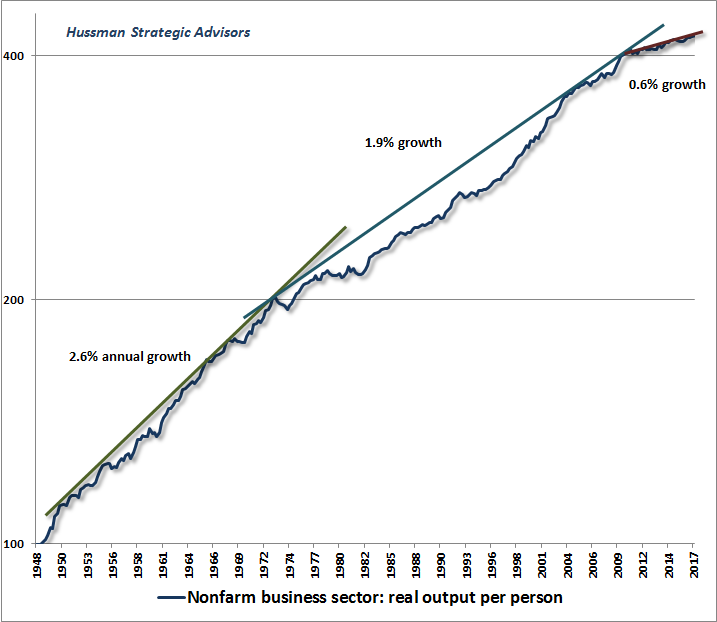
U.S. Labor Productivity

One of the core drivers of long-term productivity growth is expansion in net U.S. domestic investment (in excess of depreciation). As a general rule, booms in real U.S. investment are closely associated with deterioration in the trade deficit, because we export securities to foreigners in order to finance the boom. Because payments have to balance, this means we also export fewer goods for any given level of imports. The bottom line is that investment booms tend to be associated with larger trade deficits, so not surprisingly, booms in U.S. real investment typically emerge from a position of near-balance or surplus in the U.S. current account.

Now, add the current 0.4% growth rate in the civilian labor force to 0.6% growth in productivity, and you get the current “structural” growth rate of the U.S. economy; that is, the growth rate we would observe in the absence of changes in the unemployment rate. That structural growth rate has deteriorated to just 1% annually. The labor force component of structural growth is largely baked in the cake due to demographics, which in the absence of a substantial increase in the rate of immigration, leaves productivity growth as the main factor that could raise structural U.S. growth.

Still, given civilian labor force growth of just 0.4%, even a steep acceleration of productivity growth from the current rate of 0.6% to the 1972-2008 rate of 1.9% would still produce only 2.3% structural economic growth. Anything greater than that would have to be driven by a decline in the unemployment rate from the already low level of 4.1%.

It’s worth noting that U.S. economic growth has expanded at a rate of 2.1% annually in the 7-year period since 2010 (I’ve chosen a 7-year period to confine growth to the recent expansion, without including data from the global financial crisis). What’s remarkable about this is that nearly half of this growth is attributable to a decline in the U.S. unemployment rate, which is a wholly cyclical factor.

The chart below shows what’s going on. The blue line shows actual 7-year real growth in U.S. GDP across history. The red line shows the “structural” component of GDP growth, excluding the effect of changes in the unemployment rate. The green line shows the contribution to 7-year growth from changes in unemployment. Put simply, in the absence of further declines in the U.S. unemployment rate, U.S. real GDP growth is likely headed toward 1% annually, not 4% annually.

Structural and Cyclical Components of U.S. GDP Growth

If our policy makers are interested in boosting long-term structural U.S. GDP growth, they should be providing direct and targeted tax incentives for real investment, education, research & development, and other factors that could, over time, increase our nation’s productive capacity. Instead, they’ve opted for a giveaway to corporations and wealthy individuals, which will likely expand the deficit while doing virtually nothing for economic growth. Since 1950, the U.S. unemployment rate has been below 4.5% about 20% of the time. Over the following 5-year period, real federal tax revenues grew at an average rate of less than 1% annually. Given current structural economic constraints, and barring a further decline in the unemployment rate from an already low 4.1%, there’s a significant likelihood that government revenues will actually contract in the coming years.

The current tax legislation isn’t some thoughtful reform to benefit Americans. It’s a quickly planned looting through a broken window in our nation’s character.

The delusion of Bitcoin

“We find that whole communities suddenly fix their minds upon one object, and go mad in its pursuit; that millions of people become simultaneously impressed with one delusion, and run after it, till their attention is caught by some new folly more captivating than the first”
– Charles Mackay

With regard to Bitcoin, my view is that the Blockchain algorithm itself is brilliant. Bitcoin itself, however, is just one application of Blockchain, and a rather awkward one. It’s not unique, meaning that other competing “cryptocurrencies” can be established just as easily. It’s not fiat, meaning that no country requires it to be used as legal tender. But beyond anything else, its inefficiency is so mind-boggling that the continued operation of the Bitcoin network could plausibly contribute to global warming. So be careful to distinguish Blockchain from Bitcoin. The Blockchain algorithm will undoubtedly become a useful component of validating transactions, tracking supply chain movements, and all sorts of other applications, but Bitcoin itself is likely to become the same thing to cryptocurrencies as Visicalc was to spreadsheets, or if you’re younger, what MySpace was to social networking.

Bitcoin essentially uses a decentralized network of computers (anyone can join) that “listen” for transactions that are broadcast over the network. Each computer can accept and attempt to validate any “block” of transactions, which is done by discovering a particular “hash” for those transactions. The hash is a long string of ones and zeros corresponding to the input, and has to satisfy the current level of “difficulty” (specifically, a certain number of leading zeros). The difficulty is set so that only one block of transactions is validated every 10 minutes or so, across the entire network. The maximum size of a Bitcoin transaction block is 1MB, which is about 2000 transactions. That’s the total number of Bitcoin transactions that can be processed worldwide in any 10-minute interval.

When you’re trying to validate a block of transactions, an extra transaction is included which designates a reward to your own account if you’re successful. Whoever discovers a hash that validates their block gets a reward, in Bitcoin. That’s what “mining” means. The validated block is added to the Blockchain – essentially a running ledger of every transaction ever made. The header for the next block has to contain the hash of the previously validated block (which is what creates the block “chain”).

But here’s the thing. Every time a block is validated, a single node in the network gets a reward, and everyone else’s computing time is completely wasted. Those required computations already absorb the same amount of energy as the entire country of Denmark. Some people will get mad at that statement, arguing that it may only be half of Denmark. Ok. Ireland, along with more than 150 other countries. We can wait a few months to include Denmark.

So ultimately, the Bitcoin features a combination of breathtaking inefficiency and constrained scalability. The system already features a rather steep cost per transaction, and hardly any of those transactions are for the purchase of goods and services. I’ve regularly observed that the value of a currency is essentially the present value of the stream of “services” that the currency can be expected to deliver over time, either by serving as a means of payment or as a store of value. That depends greatly on the willingness of other individuals to hold it and accept it into the indefinite future. My sense is that, as with all speculative bubbles, buyers are conflating “rising price” with “store of value.” Meanwhile, there’s little evidence to suggest that Bitcoin will ever be an efficient means of payment for ordinary goods and services.

Episodes of speculation can persist for some time, so there may be some speculative profit potential in Bitcoin yet. Looking over the very long-term, it may also be worth something in the future, because value is always ascribed to things that have some combination of scarcity and usefulness. To the extent that Bitcoin is assured to have a limited supply, and is undoubtedly being used for money-laundering already, I doubt that the future value of Bitcoin will be identically zero, assuming governments refrain from any regulatory effort. There will likely be numerous alternative cryptocurrencies launched in the future, each one constructed to first enrich its originator with a large number of units, and then released in the hope that it will catch on. In evaluating these alternatives, efficiency and scalability will be worth considering.

A final note

While I have little to offer in support of speculative delusions about paper wealth, improbable growth expectations, or Bitcoin, I’d be remiss to write a commentary without acknowledging the many things that can be fully embraced. From an investment standpoint, every market cycle in history has ended at valuations consistent with prospective future market returns of at least 8% annually, and more often well above 10% annually. Even if the future will be permanently different, and even 8% return prospects will never ever be seen again, the prospect of negative 12-year returns is likely to be resolved in far fewer than 12 years (as similarly poor prospects were within 2 years of the 2000 market peak).

The strongest expected market return/risk classifications we identify emerge when a material retreat in valuations is joined by an early improvement in market action. While we can’t identify when that opportunity will occur, I expect that the cumulative market return between now and that point will be negative, because even a gradual 2-year improvement in prospective 12-year S&P 500 returns to just 4% would require a market loss of more than 20% over that 2-year period. In my view, a defensive posture here is an optimistic stance, because it recognizes the likelihood that prospective returns will again be positive before too long. I actually expect a much more substantial improvement in prospective market returns, but as in 2000 and 2007, that would require much deeper market losses than investors seem to contemplate.

So if there is something in the financial markets to be optimistic about, it’s the prospect of opportunities that will evolve over the completion of the current market cycle. Despite extreme valuations in this cycle, we’ve learned to limit negative market outlooks to periods featuring deteriorating and divergent market internals. We observed that shift last month, but I’d still call it “early” deterioration; permissive of abrupt losses but not yet encouraging aggressive downside expectations. We’ll respond to market conditions as they change.

Of course, there are so many more things to fully embrace, particularly this holiday season. To be alive, breathing, sharing humanity with others we love on this little blue and green rock, spinning around a star, floating through a vast infinity, is miracle enough to demand no delusions at all.

Wishing you the joy that comes from recognizing all of your blessings. With gratitude to so many of you, who are among mine.

via http://ift.tt/2lgAK9i Tyler Durden

Frontrunning: December 27

  • Post-Holiday Rush: Homeowners Line Up to Prepay Tax Bills (WSJ)
  • World stocks rise as metals surge mitigates iPhone X woes (Reuters)
  • White House Considers Former Bush-Era Economists for Fed No. 2 Job (WSJ)
  • More lawsuits over slowing down of older iPhones (Reuters)
  • Barclays Takes $1.3 Billion Hit From U.S. Tax Bill (BBG)
  • Shell, Barclays Detail Billions in Tax-Linked Charges (WSJ)
  • North Korean defectors may have been exposed to radiation, says South (Reuters)
  • China Snares Innocent and Guilty Alike to Build World’s Biggest DNA Database (WSJ)
  • Oil Slips From Highest Since Mid-2015 as Trading Volume Muted (BBG)
  • World’s Wealthiest Became $1 Trillion Richer in 2017 (BBG)
  • Russia accuses U.S. of training former Islamic State fighters in Syria (Reuters)
  • Leon Black’s Tax-Overhaul Dilemma Could Alter Wall Street Model (BBG)
  • What Makes Cities Safer (WSJ)
  • Traders Bent on Bludgeoning Dollar Ignore Bond Market Signals (BBG)
  • Many Comments Critical of ‘Fiduciary’ Rule Are Fake (WSJ)
  • Copper Rallies to Three-Year High as China Plant Halts Output (BBG)
  • Yield-Starved Investors Bow to Bond Sellers’ Demands (WSJ)
  • Huawei’s China smartphone sales chief detained for suspected bribe-taking (Reuters)
  • How One Mysterious Startup Is Riding the Bitcoin Wave (BBG)
  • In Pakistan, questions raised over GE’s flagship power turbines (Reuters)
  • Iron Ore Beholden to China’s Great Clean-Up as Quality Wins (BBG)
  • Library of Congress stops full-Twitter archiving at 2017’s end (CNET)

Overnight Media Digest

WSJ

– Mitsubishi UFJ Financial Group Inc said it planned to take a majority stake in a midsize Indonesian bank in a deal likely to top $4 billion. on.wsj.com/2l18g4f

– Elon Musk teased details for a pickup truck in comments posted Tuesday on Twitter saying the truck would come after the electric-car maker Tesla Inc releases a new compact sport-utility vehicle, which could hit the road as soon as 2019. on.wsj.com/2l194Gj

– Three U.S. cities filed a federal lawsuit Tuesday to force the Pentagon to properly report dishonorable discharges to a federal gun background-check system after a court-martialed Air Force veteran killed 26 people in a Texas church last month. on.wsj.com/2l4PgSg


FT

There were fewer Boxing Day shoppers on UK streets this year, according to retail intelligence provider Springboard, leaving retailers to pin their hopes for the Christmas season on higher online sales and overseas visitors.

Britain’s eavesdropping agency GCHQ is trying to speed-up the screening process for new recruits by increasing the number of officers responsible for vetting new talent, after it failed to hit personnel targets last year in the face of intense competition for talent from banks and tech companies.

Small and medium-sized companies are ending 2017 reasonably confident about performing strongly in 2018, in spite of concerns about the economic slowdown, but a survey by the Institute of Directors found significantly less optimism than this time last year.


NYT

– In the last months of his life, Steve Jobs authorized an Apple research team to develop a noninvasive glucose reader with technology that could potentially be incorporated into a wristwatch. nyti.ms/2l3lPQG

– After employees at online media company Vox Media announced plans to form a union last month, German Lopez, a senior reporter at the company’s general news website Vox.com, posted a thread on Twitter that inspired a heated debate more than 1,000 comments in length. nyti.ms/2l3m126


Canada

THE GLOBE AND MAIL
** A deadly derailment on the west coast of the United States this month underlines the need to have voice and video recorders in trains to improve safety on Canada’s rail lines, the Canada’s Transport Minister Marc Garneau has said. tgam.ca/2DXNb2i

** Some Vancouver residents are contributing funds to help pay for legal action against the city over the approval of a temporary modular-housing development for the homeless on Vancouver’s south side. tgam.ca/2BXxECq

** Brookfield Infrastructure on Tuesday announced the sale of its 27.8-per-cent stake in Chile’s main electricity provider to China Southern Power Grid International for $1.6-billion. tgam.ca/2DkNbIR

NATIONAL POST
** U.S. trade policy and the timing of Donald Trump’s long-awaited tax reforms are helping to form a hazy outlook for Canada, but the domestic economy and, in turn, the loonie should be better equipped to deal with any negative developments in 2018 after putting a solid year of growth under their belt. bit.ly/2l4OViL


Britain

The Times

– A thousand high-value manufacturing jobs are set to be lost in UK’s Midlands because of the government’s continuing failure to decide whether to support tidal lagoon marine power. bit.ly/2zy0OlE

– The UK government has been told by the British Chambers of Commerce that it must strike a deal with Brussels that minimises barriers to trade because Europe will remain the main market for British companies for at least the next three years. bit.ly/2BEcqW3

The Guardian

– Tesco Plc, the UK’s largest retailer, has apologised after being hit with a series of complaints about the condition of its Christmas turkeys. bit.ly/2Dfl5i3

– Philip Hammond has come under pressure to publish another set of hidden documents relating to how a series of possible Brexit outcomes, including no deal, will impact on the economy. bit.ly/2ldkbeq

The Telegraph

– Ministers have been privately accused by Britain’s top retailers of helping fuel a sharp rise in shoplifting after it emerged that a 200-pound ($267.44) threshold for pursuing criminals has been quietly introduced. bit.ly/2C9gjDy

– Biotech start-up Faron Pharmaceuticals Oy is preparing itself for a pivotal year in 2018 after poaching an executive from FTSE 100 giant AstraZeneca. bit.ly/2CcwxOz

Sky News

– Four preserved foetuses were among human remains found when the FBI raided the warehouse of a man accused of running a fraudulent body-parts business. bit.ly/2l2MTzt

– Retailers saw a quieter than expected start to the post-Christmas sales as footfall declined, according to a snapshot of high street and shopping centre visits across the country. bit.ly/2ldsZ44

The Independent

– Sir Martin Sorrell, the chief executive of WPP Plc , suggests the xenophobic tone of the 2016 referendum campaign did serious harm that needs to be repaired and that Theresa May’s Brussels deal on 8 December over European Union citizens’ rights was merely the necessary first step. ind.pn/2lfzKlY


via http://ift.tt/2CbwFh5 Tyler Durden

Gold, Bitcoin and the Blockchain Replaces the Banks – Realists Guide To The Future

Gold, Bitcoin and the Blockchain Replaces the Banks – Realists Guide To The Future

– Futurist guide to 2028 shows a world of uncertainty and disruption
– One scenario suggests cybersecurity attacks will result in bitcoin and blockchain’s dominance of financial systems
– Cybersecurity threat will still loom large and wreak havoc. Gold, silver and other real assets will benefit.
– Adoption of cryptocurrencies and blockchain will send gold price soaring
– Use of cryptocurrencies to take advantage of world systems will see investors turn to safe havens such as gold bullion and coins

The media is filled with predictions for 2018. Will Trump survive another year? How will Brexit negotiations play out? Can bitcoin recover from its recent fall? What fake news will create the next disruption to the apparent status quo?

No one knows the answers to any of theses questions. If the past year to eighteen months has taught us anything it is that the polls and predictions are almost a waste of time. Arguably it is better to look further into the future and at a range of scenarios so one can consider the opportunities and threats that may lie ahead.

Bloomberg has done just this, with their ‘Pessimists Guide to 2028‘. In it the authors consider eight scenarios. Each scenario could very easily begin to take place in 2018, but the full impact will play out over the following decade.

The scenarios put forth are:

Scenario 1
Trump wins second term

Scenario 2
Fake news kills Facebook

Scenario 3
Bitcoin replaces the banks

Scenario 4
North Korea launches an attack

Scenario 5
Corbyn makes socialism great again

Scenario 6
Generational Warfare Destroys Europe

Scenario 7
China begins a trade war

Scenario 8
Electric Cars end the oil era

Below we bring you the Scenario 3: Bitcoin replaces the banks

Each scenario is deserving of attention in its own right but it is the third one which we believe is the most pertinent and arguably realistic. This is the assumption that bitcoin will replace the banks and gold will benefit. Arguably gold would benefit as a result of many of the scenarios put forward. But, given the interest in bitcoin this year it is an important reminder that both bitcoin’s growth and weaknesses will see gold and other real assets shine.

2018
A U.S. regional lender announces that its systems have been taken down in a cyberattack and all its deposits have vanished. Regulators around the world reassure account holders that their deposits are safe. Bitcoin jumps to $40,000 as deep fears set in about the safety of the financial system. Gold surges too, but by less.


2021
China’s Alibaba adopts its own cryptocurrency for use inside its vast e-commerce network, establishing the mass-market viability of digital money. Following Venezuela’s lead, Greece and a few African countries adopt bitcoin, which hits $100,000.

2023
Rogue coders inside a regulatory-compliance software company inject a Trojan malware program called Worm Hole into scores of banks around the world. Undetected, it siphons data and cash from accounts in fractional increments.
2026
A 10-year-old schoolgirl in Pittsburgh discovers Worm Hole and exposes it on social media, triggering a run on the global banking system. Shares in Old Wall Street crash as major central banks embrace blockchain technology, bypassing the banks, and issue digital money directly to households.
2028
Many commercial lenders break apart. The global financial system gives way to a fragmented patchwork of digital currencies and payment systems dominated by such players as Alipay and Amazon.com. Bitcoin hits $1 million.

In light of this scenario’s end, Bloomberg offers Nightberg’s advice for the investor:

Vanished bank deposits would likely drive a major disbelief in all things digital, even bitcoin. Owning real physical assets, such as gold, luxury real estate for high net worth individuals, artwork, and safety vault producers in general as individuals seek to store more of their wealth within their private residences. The cyber-insurance sector would benefit as the world would scramble to find a solution to decimated trust in the financial sector. Nightberg macro research.

Bloomberg’s analysis and Nightberg’s conclusion bring up a fear which is not just for the future but is a very real one today: cybersecurity attacks. the scenario begins because of a cybersecurity attack and it this issue is still not resolved ten years into the future.

Cyber attacks are not something which can be overcome by cybersecurity. Like any form of attack there will be new approaches and strategies. The year of 2017 has been a very serious wake-up call as to how cyber power can flip the status quo on its head. Consider the apparent meddling by Russia in Western politics or North Korea’s (occasionally successful) attempts to steal bitcoin.

The invisible threat is very much on our doorstep.

This Christmas weekend HMS St Albans was forced to shadow a Russian warship in the North Sea. According to reports the warship was showing interest in ‘areas of national interest’. What is there apart from oil? The UK’s communication cables.

Air Chief Marshal Sir Stuart Peach, the chief of the UK’s defence staff, has recently expressed concerns over the security of the cables. Should they be cut (or service disrupted) then the damage would “immediately and potentially catastrophically” hit the economy.

Prepare for uncertainty, not the rise of bitcoin 

This weekend’s posturing by the Russians or Bloomberg’s scenario planning should serve as a timely reminder as to what can and will survive such times. Physical gold cannot be made to disappear at the touch of a few buttons or by the cutting of cables.  Should there be a global cyberattack on the financial system, the primary wealth would no longer be primarily digital (bitcoin, cash, stocks and bonds etc).

Gold and silver allocated and segregated bullion is important because of both its tangible nature and its role as a safe haven in times of geopolitical upset. Bitcoin, or any other cryptocurrency, cannot be considered safe when cyberattacks are a daily reality. They are also new and still untrusted by the majority of the system.

When seeking to diversify your portfolio in order to protect from uncertain scenarios you should consider the risks posed to digital gold providers who do not allow clients to interact and trade on the phone and are solely reliant for pricing and liquidity from online portals and online trading platforms.

Those who have outright legal ownership of physical gold and silver coins and bars outside the banking system will be far better prepared for cybersecurity attacks and uncertain times.

You can read more on the other seven scenarios here. Whilst reading them it is worth reminding oneself of how easily the world can change and how uncertain we are as to whether they may or may not happen.

Related reading

http://ift.tt/2pG4fqz…

http://ift.tt/2pInFey…

http://ift.tt/2pGijjL…

News and Commentary

Gold eases from 3-week top as dollar holds steady (Reuters.com)

Gold Miners ETFs Set to Bounce Back in 2018 (ETFTrends.com)

Bitcoin $1 million, Amazon $1 trillion: Bold calls of 2017 are worth watching now (MarketWatch.com)

Oil prices slip away from 2015 highs, but market remains tight (Reuters.com)

Apple and its suppliers weigh on Wall Street (Reuters.com)


Source: Bloomberg

First English gold coin worth just a penny will sell for unbelievable amount (Mirror.co.uk)

Sudan sharply devalues its pound against U.S. dollar (Xinhuanet.com)

Israeli regulator seeks to ban cryptocurrency firms from stock exchange (Reuters.com)

Let regions go bankrupt, Chinese central bank official says (Bloomberg.com)

World’s Wealthiest Became $1 Trillion Richer in 2017 (Bloomberg.com)

Gold Prices (LBMA AM)

27 Dec: USD 1,285.40, GBP 958.78 & EUR 1,081.54 per ounce
22 Dec: USD 1,268.05, GBP 947.74 & EUR 1,069.85 per ounce
21 Dec: USD 1,265.85, GBP 945.97 & EUR 1,065.09 per ounce
20 Dec: USD 1,265.95, GBP 944.27 & EUR 1,068.21 per ounce
19 Dec: USD 1,263.10, GBP 944.93 & EUR 1,070.10 per ounce
18 Dec: USD 1,258.65, GBP 943.11 & EUR 1,067.71 per ounce
15 Dec: USD 1,257.25, GBP 937.41 & EUR 1,065.52 per ounce

Silver Prices (LBMA)

27 Dec: USD 16.50, GBP 12.30 & EUR 13.87 per ounce
22 Dec: USD 16.18, GBP 12.08 & EUR 13.65 per ounce
21 Dec: USD 16.15, GBP 12.08 & EUR 13.61 per ounce
20 Dec: USD 16.19, GBP 12.09 & EUR 13.67 per ounce
19 Dec: USD 16.16, GBP 12.08 & EUR 13.68 per ounce
18 Dec: USD 16.09, GBP 12.04 & EUR 13.64 per ounce
15 Dec: USD 15.99, GBP 11.93 & EUR 13.55 per ounce


Recent Market Updates

– Goldnomics Podcast – Gold, Stocks, Bitcoin in 2018. Everything Bubble Bursts?
– What Peak Gold, Interest Rates And Current Geopolitical Tensions Mean For Gold in 2018
– New Rules For Cross-Border Cash and Gold Bullion Movements
– ‘Gold Strengthens Public Confidence In The Central Bank’ – Bundesbank
– WGC: 2018 Set To Be A Positive Year For Price of Gold and Investors
– Year-end Rate Hike Once Again Proves To Be Launchpad For Gold Price
– UK Stagflation Risk As Inflation Hits 3.1% and House Prices Fall
– Buy Gold, Silver Time After Speculators Reduce Longs and Banks Reduce Shorts
– Bitcoin – Plan Your Exit Strategy Now – Maybe With Gold
– Gold Demand Increases Along with Uncertainty Thanks to Trump, Brexit and North Korea
– UK Pensions Risk – Time to Rebalance and Allocate to Cash and Gold
– Bailins Coming In EU – 114 Italian Banks Have NP Loans Exceeding Tangible Assets
– Silver’s Positive Fundamentals Due To Strong Demand In Key Growth Industries

via http://ift.tt/2pIKRcz GoldCore

The Buck Stops Over There: New at Reason

After he won what he erroneously described as an Electoral College “landslide,” Donald Trump explained away his failure to attract the support of most voters by conjuring “millions of people who voted illegally”—a massive fraud that somehow went completely undetected by election officials throughout the country. A few days after taking office, Trump revived that fantastical claim, setting a pattern for the excuse making and blame shifting that would mark the first year of his presidency. Jacob Sullum reviews some of the highlights.

View this article

from Hit & Run http://ift.tt/2lh9Heb
via IFTTT

New Trump Executive Order Targets Lobbyists, Clinton-Linked Individuals And Perhaps Uranium One

The Trump Administration quietly issued an Executive Order (EO) last Thursday which allows for the freezing of US-housed assets belonging to foreign individuals or entities deemed “serious human rights abusers,” along with government officials and executives of foreign corporations (current or former) found to have engaged in corruption – which includes the misappropriation of state assets, the expropriation of private assets for personal gain, and corruption related to government contracts or the extraction of natural resources. 

Furthermoreanyone in the United States who aids or participates in said corruption or human rights abuses by foreign parties is subject to frozen assets – along with any U.S. corporation who employs foreigners deemed to have engaged in corruption on behalf of the company.

In fact, anyone in the world who has “materially assisted, sponsored, or provided financial, material or technological support for, or goods or services” to foreigners targeted by the Executive Order is subject to frozen assets.  

The EO, based on the 2016 Global Human Rights Accountability Act, immediately added 13 foreign individuals to a list of “Specially Designated Nationals” (SDN) maintained by the Office of Foreign Assets Control (OFAC) – several of whom have ties to the Clintons, the Clinton Foundation, or Clinton associates (details below). Moreover, the Treasury Department sanctioned an additional 39 people,  for a total of 52 under the new order – including the son of Russia’s prosecutor general. 

The Order reads: 

I, DONALD J. TRUMP, President of the United States of America, find that the prevalence and severity of human rights abuse and corruption that have their source, in whole or in substantial part, outside the United States, such as those committed or directed by persons listed in the Annex to this order, have reached such scope and gravity that they threaten the stability of international political and economic systems.

Last Week’s Executive Order could have serious implications for D.C. lobbyists who provide “goods and services” (e.g. lobbying services) to despots, corrupt foreign politicians or foreign organizations engaging in the crimes described in the EO. “Virtually every lobbyist in DC has got to be in a cold sweat over the scope of this EO,” said an attorney consulted in the matter who wishes to remain anonymous. 

And because the phrase “person” means “an individual or entity” in the order – any US organization which merely employs a foreigner engaging in the listed offenses is also subject to frozen assets. “Consider, what would happen if Apple, say employed a foreign national who bribed a PRC official for government approvals? How about a hypothetical case of a company like Northrop or Boeing where an employee, or consultant, who is a foreign national bribes a Saudi official to direct government purchases of airplanes and military equipment? At least some or all of their assets could be frozen.”

Now consider that if reports from The Hill are accurate – an FBI mole deep within the Russian uranium industry uncovered evidence that “Russian nuclear officials had routed millions of dollars to the U.S. designed to benefit former President Bill Clinton’s charitable foundation during the time Secretary of State Hillary Clinton served on a government body that provided a favorable decision to Moscow (the Uranium One approval)” – a deal which would eventually grant the Kremlin control over 20 percent of America’s uranium supply right around the time Bill Clinton also collected $500,000 for a Moscow speech, as detailed by author Peter Schweitzer’s book Clinton Cash and the New York Times in 2015. 

The Russians were compromising American contractors in the nuclear industry with kickbacks and extortion threats, all of which raised legitimate national security concerns. And none of that evidence got aired before the Obama administration made those decisions,” a person who worked on the case told The Hill, speaking on condition of anonymity for fear of retribution by U.S. or Russian officials. –The Hill

The same FBI informant claims to have video evidence showing Russian agents with briefcases full of bribe money related to the controversial Uranium One deal:

In a report by Tucker Carlson, a former long-time executive of now-defunct D.C. lobbying firm, The Podesta Group – who has been interviewed extensively by FBI special counsel Robert Mueller, claims that Tony Podesta was “basically part of the Clinton Foundation,” frequently meeting with the charity to discuss the Uranium One deal. Meanwhile, Tony’s DNC operative brother John Podesta reportedly recommended that the Podesta Group hire David Adams – Hillary Clinton’s chief adviser at the State Department, giving them a “direct liaison” between the group’s Russian clients and Hillary Clinton’s State Department.

Hypothetically, if the Uranium One deal is deemed corrupt by the Trump administration, and “Russian nuclear officials” indeed routed millions of dollars to the Clinton Foundation, and Tony Podesta lobbied on behalf of the deal for the Clinton Foundation – it stands to reason that this Executive Order could freeze the US-housed assets of quite a few individuals. Of note, assets can be frozen with no prior warning, as trump has declared a national emergency due to the “scope and gravity” of the threat posed by said individuals. 

To simplify this complicated legal document a bit, keep in mind:

Section 1. (a)(i-ii) outlines all foreigners the Executive Order applies to: 

Section 1. (a)(iii) defines U.S. Citizens who have assisted foreigners in any of the crimes described above:


Note: The above section (iii)(A)(3) means any foreign person engaging in “serious human rights abuses” or listed forms of corruption on behalf of a U.S. entityAlso of note – Attorney General Jeff Sessions rolled back a series of Obama-era curbs on civil-asset forfeiture over the summer, strengthening the federal government’s ability to seize cash and property from Americans without criminal charges. That said, this Executive Order only freezes assets, it does not allow the government to take custody of them.  

In regards to the 13 listed individuals targeted by this order – several of whom have ties to the Clintons, the Clinton Foundation or Clinton associates – we find the following:

—-

Goulnara Islamovna Karimova, 45, daughter of former Uzbekistan leader Islam Karimov, headed a powerful organized crime syndicate that leveraged state actors to expropriate businesses, monopolize markets, solicit bribes, and administer extortion rackets.

In early 2016, Amsterdam-based telecom giant VimpelCom (now VEON) admitted to a conspiracy in which they paid millions in bribes to Karimova for entry into the Uzbek telecom market. In a series of related cases, the U.S. Justice Department has sought the forfeiture of $850 million in bribe money from various bank accounts across Europe. In July, Uzbek officials arrested Karimova for fraud, money laundering, bribery, and embezzlement and a variety of other claims. 

In 2009, a WikiLeaks cable notes that Karimova set her sights on Bill Clinton to gain access to then-Secretary of State, Hillary Clinton.

(WikiLeaks, 7/31/2009)

Three years later, Karimova co-sponsored a 2012 Clinton Foundation fundraiser in Monaco. Hillary Clinton’s State Department was asked to weigh in on Bill Clinton’s contacts with Karimova. Pictured below with Bill Clinton at an AIDS charity event in Cannes, France. 

Goulnara Karimova and Bill Clinton

Dan Gertler is an Israeli billionaire mining magnate revealed by the Paradise Papers to be chief negotiator between the Democratic Republic of the Congo (DRC) and his primary business partner – mining company Glencore, founded by Marc Rich – who was pardoned for corruption by Bill Clinton on his last day in office after his wife gave $450,000 to the Clinton Library foundation. 

Glencore immediately cut ties with Gertler following Trump’s Executive Order.

Dan Gertler

In 2001 Gertler gave $20m in cash to DRC President Joseph Kabila to use to buy weapons and fund his war against rebels to consolidate his grip on power. In exchange, Gertler’s company IDI was granted a monopoly on the DRC diamond trade, worth hundreds of millions a year. In 2013, Gertler sold the DRC rights to mine oil for $150 million, a 300x increase on an asset he   purchased from President Kabila 7 years prior for just $500,000.  

In 2012, Kabila offered Bill Clinton $650k for a speech in the DRC – for which Clinton sought State Department approval – only to have his speaking agency recommend against the appearance which would require photos with the dictator. 

Gertler’s family foundation is also linked to John McCain – sharing a seat on the board of directors of “Operation Smile” with Cindy McCain for a period of time. 

Yahya Jammeh is the former President of Gambia who came to power in 1994 and stepped down in 2017. He has a long history of serious human rights abuses and corruption – creating a terror and assassination squad called the Junglers that answered directly to him.


Yahya and Zeinab Jammeh with Barack and Michelle Obama, 2014

Jammeh was installed as President during a 1994 CIA-led coup in Gambia authorized by the Clinton administration, and in 2014, the Obama administration effectively sidelined an attempted coup. Indeed, Jammeh appears to have been a friend to both the Clinton and the Obama Administrations. 

Angel Rondon Rijo; Dominican Republic – Sanctioned for funneling a $92 million bribe from Brazilian conglomerate Odebrecht to Dominican Republic officials as kickbacks. Odebrecht Donated $50-$100k to the Clinton Foundation.

Benjamin Bol Mel; Sudan – Financial Advisor to South Sudanese President Salva Kiir and president of ABMC construction company accused of corruption. Hillary Clinton pushed for a waiver from the Obama Admin on the prohibition of military aid due to the use of child soldiers in South Sudan. 

Artem Yuryevich Chayka; Russia – Son of Russia’s Prosecutor General, Yuri Chayka (Chaika) – used father’s connections to win state owned contracts. Curiously, Russian Attorney Natalia Veselnitskaya met with Yuri Chayka before her involvement in the infamous Trump Tower meeting arranged by Fusion GPS associate Rob Goldstone – a meeting many believe was one of several schemes used by the Obama administration to justify wiretapping the Trump campaign. Of note – Donald Trump Jr. reportedly shut down the Trump tower meeting when Natalia Veselnitskaya began discussing lifting sanctions under the Magnitsky act – the very legislation Trump’s Executive Order is now leveraging against Artem Chayka.  

Mukhtar Hamid Shah; Pakistan – surgeon specializing in kidney transplants, believed to be involved in kidnapping, wrongful confinement, and the removal of and tracking in human organs from Pakistani laborers

The rest of the 13 individuals have engaged in a variety of corruption and human rights abuses ranging from a Serbian arms dealer believed to be linked to a $95 million deal with Yemen, to government officials who ordered journalists murdered, to several instances of serious human rights violations. (h/t @HNIJohnMiller)

One wonders if perhaps the purpose of this Executive Order addressing serious human rights abusers and corruption – a national emergency, was intended to ensure the much talked about swamp renovation comes in ahead of schedule and under budget. We’ll know for sure if Treasury Secretary Steve Mnuchin starts freezing bank accounts after the holidays.

via http://ift.tt/2C08TFC Tyler Durden

Global Stocks Rise, Copper Soars In Thin Holiday Volumes

European stocks are steady in post-Christmas trading if struggling for traction after a mixed session in Asia, amid trading thinned by a holiday-shortened week and ongoing worries about the tech sector; however a strong rally in commodities – including copper and oil – buoyed expectations for a strong 2018 and helped offset concerns over the technology sector triggered by reports of soft iPhone X demand. 

The dollar weakened against most G-10 peers as investors await the release of U.S. consumer-confidence data, with much of the spotlight falling on commodity currencies; the OZ dollar holds onto gains as copper surges to a three-year high; oil retreats after reaching the highest close in more than two years following a pipeline explosion in Libya on Tuesday. Treasuries and core European core bond yields are a touch lower.

The Stoxx Europe 600 Index edged lower, with tech stocks hit for the third day amid rumors of weak iPhone demand and leading the decline as chipmakers slumped after analysts lowered iPhone X shipment projections, sending the Nasdaq Composite Index lower overnight. While mining and oil stocks strengthened due to a surge in copper prices to a 3.5 year high (see below), the European STOXX 600 index slipped 0.1% as European tech stocks tumbled on reports that demand for Apple’s iPhone X may be weaker than expected. The equity benchmark index is poised for an annual gain of 8.1%, the best advance in four years. Elsewhere, Volvo rose as China’s Geely bought Cevian’s stake in the truckmaker, making it Volvo AB’s largest stakeholder. IWG surged the most since 2009 after confirming it has received a a non-binding takeover offer from a consortium backed by Brookfield Asset Management and Onex.

U.S. equity-index futures nudged higher.

In Asia earlier Japanese equity benchmarks posted slight gains, Australian stocks were flat and China’s domestic shares dropped.  Asian shares climbed 0.3% to near a recent one-month high, though it was more of a mixed picture in European stock markets. Shares of China’s new-energy automakers surged after the government announced it will extend purchase-tax exemption for another three years, through Dec. 31, 2020. BYD climbed as much as 5.9% on the mainland to the highest since Nov. 24; Zhongtong Bus & Holding Co. rises by 10% daily limit.

As the chart below shows, the recent dip in Emerging Asian stocks has been largely bought, and the selloff gap has been mostly filled.

In commodities, oil and copper prices rocketed to multi-year highs, pushing the MSCI world equity index 0.1% higher. While oil prices were strengthened largely because of an attack on a crude pipeline in Libya, the surge in copper was particularly eye-catching as the metal is seen as a proxy for global growth. Miners gained as copper climbed to a three-year high after China ordered its top producer to halt output to combat winter pollution.

“The rally in copper supports expectations that 2018 is going to be a strong year for synchronised global growth,” said Greg McKenna, chief strategist at AxiTrader. That, or at least until the artificial production shortage is resolved.

Meanwhile, rising oil prices – WTI hit $60 a barrel for the first time since mid-2015 – boosted currencies that trade in line with commodities prices.

In currencies, the dollar eased against a basket of currencies and fell against the euro on Wednesday in thin holiday trading, while a rally in commodity prices helped push the Canadian and Australian dollars to their highest levels in two months. The EUR/USD made a session high after London came into the market, with the pair remaining above the 21-DMA; the USD/JPY is little changed while USD/JPY cross- currency basis swaps hit widest spread in more than a year. Cable rose to a one-week high amid broad dollar weakness while Aussie extended opening gains buoyed by flows against kiwi, which itself rose on outright short-covering against the U.S. dollar; traders report that ranges extended on thinning year-end liquidity.

As Reuters points out, while world stocks were up on the day, there was still an undercurrent of nervousness in the market which saw some safe haven flows into high-rated euro zone government bonds, pushing their yields a touch lower. “Geo-political risks have notched a little higher, supporting rates markets,” said Mizuho’s head of rates Peter Chatwell, referring in particular to a renewal in tensions around North Korea.

The United States announced sanctions on two North Korean officials behind their country’s ballistic missile program on Tuesday after the U.N. Security Council unanimously imposed new sanctions on North Korea last week. “The North Korean statement that U.N. sanctions are an act of war is, as tends to be the case, an exaggeration, but nevertheless the market has no choice but to price it. Some safe haven positioning is a natural reaction,” said Chatwell.

Today investors await the release of U.S. consumer-confidence and pending home sales data.

Market Snapshot

  • S&P 500 futures up 0.07% to 2,689
  • US 10Y yield down 0.1 bp to 2.47%
  • STOXX Europe 600 down 0.02% to 390.22
  • German 10Y yield fell 1.4 bps to 0.406%
  • Euro up 0.2% to $1.1880
  • Brent Futures down 1% to $66.37/bbl
  • Italian 10Y yield rose 0.6 bps to 1.645%
  • Spanish 10Y yield unchanged at 1.473%
  • Brent Futures down 1% to $66.37/bbl
  • Gold spot up 0.2% to $1,285.23
  • U.S. Dollar Index down 0.1% to 93.13
  • MSCI Asia Pacific up 0.3% to 172.69
  • MSCI Asia Pacific ex Japan up 0.3% to 562.82
  • Nikkei up 0.08% to 22,911.21
  • Topix up 0.2% to 1,829.79
  • Hang Seng Index up 0.07% to 29,597.66
  • Shanghai Composite down 0.9% to 3,275.78
  • Sensex down 0.3% to 33,905.60
  • Australia S&P/ASX 200 unchanged at 6,069.87
  • Kospi up 0.4% to 2,436.67

Overnight Media Digest

  • Copper in London surged to the highest level since 2014 after China ordered its top producer to halt output to combat winter pollution, adding further impetus to a rally that’s been driven by optimism about demand as well as supply disruptions at mines
  • ETFs linked to raw materials attracted about $450 million this month as of Dec. 21, on track for a third straight annual inflow, as investors are betting on synchronized global growth to improve the outlook for commodities from copper to natural gas in 2018
  • Recent economic data offer a “warning for 2018” now that Chinese leaders are less motivated to prop up growth in the wake of their Congress in October, according to the China Beige Book
  • German Social Democratic Party won’t agree to renew coalition with Chancellor Angela Merkel unless she backs EU reform, acting Foreign Minister Sigmar Gabriel quoted as saying in interview with Bild newspaper
  • Spain November seasonally adjusted retail sales rose 2% y/y vs est. +0.8% y/y
  • The United States imposed sanctions Tuesday on two North Korean officials who are considered key to their country’s development of ballistic missiles.
  • A pipeline blast in Libya and a bullish budget forecast in Saudi Arabia boosted crude prices to levels not seen since mid-2015.
  • Recent economic data offer a “warning for 2018” now that Chinese leaders are less motivated to prop up growth in the wake of their Congress in October, according to the China Beige Book.
  • Fitch Downgrades AXA Financial, Inc.; Removes Ratings from Watch
  • Daily Mail & General Trust Cut to Junk by S&P

In Asian markets, Japanese equity benchmarks posted slight gains, Australian stocks were flat and China’s domestic shares dropped.  Asian shares climbed 0.3% to near a recent one-month high, though it was more of a mixed picture in European stock markets. Shares of China’s new-energy automakers surged after the government announced it will extend purchase-tax exemption for another three years, through Dec. 31, 2020. BYD climbed as much as 5.9% on the mainland to the highest since Nov. 24; Zhongtong Bus & Holding Co. rises by 10% daily limit. 

Top Asian News

  • Nomura Says Japanese Investors Should Buy Unhedged Dollar Bonds
  • India Is Said to Propose Easing Rules on Debt Default Disclosure
  • China to Discuss Changing Constitution for First Time Since 2004
  • WeWork’s Chinese Rival Nixes ‘UrWork’ Label in Global Makeover
  • Prosecutors Affirm Push for Samsung Heir to Get 12-Year Sentence
  • DBS Hires Andy Yung as Vice President at Loans Team in Hong Kong
  • 1MDB Makes Final Payment to IPIC in $1.2 Billion Settlement

In Europe, the Stoxx Europe 600 Index edged lower, with tech stocks hit for the third day amid rumors of weak iPhone demand and leading the decline as chipmakers slumped after analysts lowered iPhone X shipment projections, sending the Nasdaq Composite Index lower overnight. While mining and oil stocks strengthened due to a surge in copper prices to a 3.5 year high (see below), the European STOXX 600 index slipped 0.1% as European tech stocks tumbled on reports that demand for Apple’s iPhone X may be weaker than expected. The equity benchmark index is poised for an annual gain of 8.1%, the best advance in four years. Elsewhere, Volvo rose as China’s Geely bought Cevian’s stake in the truckmaker, making it Volvo AB’s largest stakeholder. IWG surged the most since 2009 after confirming it has received a a non-binding takeover offer from a consortium backed by Brookfield Asset Management and Onex

Top European News

  • IWG Soars After Bid Approach From Canada’s Onex, Brookfield
  • Russia Nuclear Power Output Reaches Post-Soviet Record This Year
  • Bank of Spain Sees Growth Continuing But Losing Intensity
  • Norway Oil Fund Says Taxes Should Be Paid Where Value Generated

In FX, the Bloomberg Dollar Spot Index decreased 0.2 percent to the lowest in almost two weeks, in thin holiday trading, while a rally in commodity prices helped push the Canadian and Australian dollars to their highest levels in two months. The EUR/USD made a session high after London came into the market, with the pair remaining above the 21-DMA and advancing 0.2% to $1.1884, the strongest in almost four week; the USD/JPY is unchanged at 113.25 per dollar, the strongest in more than a week while the USD/JPY cross- currency basis swaps hit widest spread in more than a year. Cable rose to a one-week high amid broad dollar weakness while Aussie extended opening gains buoyed by flows against kiwi, which itself rose on outright short-covering against the U.S. dollar; traders report that ranges extended on thinning year-end liquidity.

In commodities, WTI dropped 0.6% to $59.59 a barrel, the first retreat in more than a week and the biggest dip in two weeks.  Gold increased 0.2% to $1,286.01 an ounce, hitting the highest in more than four weeks with its sixth consecutive advance. LME copper advanced 0.8 percent to $7,185.00 per metric ton, reaching the highest in about four years on its ninth consecutive advance and the biggest gain in a week.

US Event Calendar

  • 10pm: U.S. Conf. Board Consumer Confidence, Dec., est. 128, prior 129.5; Present Situation, Dec., no est., prior 153.9; Expectations, Dec., no est., prior 113.3
  • 10pm: U.S. Pending Home Sales MoM, Nov., est. -0.5%, prior 3.5%; NSA YoY, Nov., no est., prior 1.2%

via http://ift.tt/2l5Uuxi Tyler Durden

To Avoid Liquidation Panic, HNA Assures Deutsche Shareholders It’s A “Long-Term Investor”

The notoriously acquisitive Chinese conglomerate HNA – which recently had a sharp falling out with Beijing resulting in a margin call "shocksave" – is facing a serious cash crunch in 2018 as nearly a quarter of its $100 billion in debt – a large chunk of which was accumulated during a multi-year buying spree that saw it become a major shareholder in Deutsche Bank, Hilton Worldwide and a large portfolio of international holdings – comes due.

But even as the company resorted to loaning out shares and entering into arcane derivative financing agreements to finance its debt-service payments, it is quickly finding that traditional avenues of financing are disappearing or becoming too costly.

Despite being one of China’s largest conglomerates, HNA has been shut out of stock and bond markets as lenders worry about its outsized debt load, forcing the company to pledge some of its core holdings as collateral for short-term loans, as the Wall Street Journal reported earlier this month.

This has forced the conglomerate to explore other options. To wit, the bank recently pledged some of its Deutsche Bank shares to UBS as collateral for a loan worth roughly $117. It also executed an options strategy known as a collar. This strategy involves purchasing out-of-the-money puts to protect against a large drop in the stock while simultaneously selling out-of-the money calls to offset the cost of the puts.

On Dec. 20, HNA’s unit entered into a new series of collar transactions with Swiss bank UBS Group AG, and pledged its Deutsche Bank shares to UBS in exchange for a total of 2.36 billion euros (US$2.8 billion) in net financing. It also has a margin loan from UBS and ICBC Standard Chartered PLC. In all, the new total amount of financing was about 99 million euros (US$117.6 million) higher than what was disclosed in a similar filing in May.


The additional collar financing disclosed this week should help protect HNA’s position in Deutsche Bank shares from margin calls in the future, according to people close to the companies. The new collar financing extends to 2020, longer than before, and gives HNA additional protection against volatility in Deutsche Bank shares, they said.

With memories of last fall’s dramatic plunge in Deutsche Bank shares still fresh – a selloff that was triggered by the DOJ’s decision to slap the already shaky German lender with a $14 billion fine – HNA assured its fellow shareholders that it is a “long-term investor” in Germany’s largest bank.  The comment is, of course, self-serving: Though it has purchased downside protection to protect against a large drop in DB’s shares, a substantial decline in the company’s valuation could be the straw that pushes the conglomerate into bankruptcy, and potentially triggers China’s "Minsky moment."

For context, HNA owns about $4 billion in DB shares, roughly equivalent to a 10% stake, as shown in the Bloomberg chart below and according to Reuters.

Concerns about HNA’s financial position intensified since it issued a bond last year with less than one year to maturity. The bond carried the extortionately high coupon of 9%, prompting us to wonder if the demise of one of China’s “Big Four” conglomerates might be rapidly approaching.

HNA has borrowed $40 billion since 2015 to finance its world-wide buying spree. But in some cases, it’s already getting buyers remorse. About a month ago, its chief executive acknowledged a shift in strategy, saying HNA was looking to sell assets it deemed noncore. For example, it is exploring a group of foreign commercial properties it owns.

As reported by Reuters, Alexander Schuetz, HNA’s representative on DB’s board, made the comments during an interview with German newspaper Handelsblatt. The comments were later picked up by Reuters and Bloomberg. Schultz specifically emphasized that HNA has “no interest in a sale” of its DB holdings.

Schuetz sought to dismiss any lingering speculation that HNA would sell its stake in the German lender, which is just under 10 percent and valued at around 3.3 billion euros ($3.9 billion). “We want to show that this is totally wrong,” he was quoted as saying.


HNA’s $50 billion worth of deal-making over the past two years has sparked intense scrutiny of its opaque ownership and use of leverage.


In the interview, Schuetz pointed to a new financing structure with derivatives – with a three-year maturity – that insure against a drop in the bank’s share price. “This shows that HNA is focused on the long-term and has no interest in a sale,” Schuetz said.

Late last month, S&P downgraded HNA’s credit rating by one notch from B+ to B, five notches below investment grade as a result of its “aggressive financial policy” and tightening liquidity amid looming debt maturities. Even before that, some of the conglomerate’s largest subsidiaries were issuing bonds with interest rates far higher than their credit ratings would seem to suggest.

To be sure, despite its reassurances, if HNA is still struggling to raise the capital needed to make its $28 billion debt-service payment at the end of June, it’s likely even core assets might be put on the chopping block.

via http://ift.tt/2pFIKWT Tyler Durden

Scientists Discovered North Korean Defector Carried Anthrax Antibodies

As we’ve reported here and here, there have been several high-profile defections this year involving Korean soldiers sprinting across the heavily fortified border between the two Koreas – a feat that had not been previously accomplished since 2007. In the first incident, the soldier was shot seven times as he staged a daring escape that ended with him being dragged to safety by American and South Korean forces. That incident was caught on video, which can be viewed below.

In the second incident, a North Korean soldier simply walked across.

Two other soldiers also escaped in incidents that apparently weren’t picked up by the western media.

Now, doctors examining one of the soldiers have reportedly discovered that he possesses antibodies to Anthrax – a potent chemical weapon that was notoriously used in the 2001 Anthrax attacks in the US. According to the New York Post, a South Korean intelligence official who spoke on condition of anonymity did not say which of the four soldiers who fled the hermit kingdom this year had the antibodies in his system. But the discovery is causing concern in Seoul because, once the bacterium is released, it can kill 80% of those infected within 24 hours unless antibiotics are taken or vaccination is available.

And while the US has stockpiles of the vaccine, South Korea has yet to produce it.

Defense Ministry spokeswoman Choi Hyun-soo said an anthrax “vaccine is expected to be developed by the end of 2019,” but likely not before then.

The restive North Korean regime has been suspected of developing biological weapons after publicizing the works of the Pyongyang Biological Technology Research Institute in 2015. The institute is run by the North Korean army.

Pyongyang claimed the facility specializes in pesticide research, but analysts have said its dual-use equipment suggests biological weapons are being manufactured in North Korea.

North Korea’s neighbors fear Pyongyang is conducting illegal biological weapons tests to see if anthrax-laden warheads can be loaded onto its missiles, the Sun of the UK reported. Media reports earlier this year suggested that North Korea had begun to test loading anthrax onto them.

The report said the US is aware of the tests, which are meant to ascertain whether the anthrax bacteria could survive reentry into the Earth's atmosphere – as we pointed out last week.

Seoul believes North Korea has a chemical weapons stockpile of up to 5,000 tons and can produce biological warfare agents such as anthrax and smallpox. Also last week, the White House pointed to the dangers posed by North Korea in the National Security Strategy released by President Trump.

"North Korea – a country that starves its own people – has spent hundreds of millions of dollars on nuclear, chemical and biological weapons that could threaten our homeland," read the report.

"[North Korea is] pursuing chemical and biological weapons which could also be delivered by missile."

Pyongyang denied the Asahi report through the state media Korean Central News Agency.

"As a state party to the Biological Weapons Convention (BWC), [North Korea] maintains its consistent stand to oppose development, manufacture, stockpiling and possession of biological weapons," the KCNA reported.

via http://ift.tt/2l65mLI Tyler Durden