Did Flynn’s Plea Deal Just Disprove Election Collusion

Submitted by iBankCoin

This whole charade with former National Security Advisor Mike Flynn reeks of desperation and makes clear that Mueller's team has an empty hand. To summarize the plea agreement from the FBI Special Counsel’s “Statement of the Offense”:

  • On December 29, 2016, Flynn called a senior official of the Presidential Transition Team to discuss whether or not to talk to the Russians about recent U.S. sanctions imposed by Obama.
  • Flynn got the go-ahead from someone (does not name Trump) and called the Russian Ambassador, requesting that Russia not escalate the situation – asking that they only respond to the U.S. sanctions in a reciprocal manner.
  • On or about December 30 – the next day, Russian President Vladimir Putin released a statement indicating that Russia would not take retaliatory measures in response to U.S. sanctions.
  • Flynn lied about this on January 24 in a voluntary interview with the FBI
  • Flynn also lied to the FBI about calls he made to the Russian Ambassador and other countries to try and influence a UN resolution submitted by Egypt regarding Israeli settlements, stating he only asked the countries’ positions on the vote

ABC news takes it a step further, reporting from an anonymous source that “Donald Trump directed him to make contact with the Russians, initially as a way to work together to fight ISIS in Syria.” – though NBC News reports it was Trump's son-in-law and advisor Jared Kushner.

Observation and takeaways

  • The fact that Flynn spoke with the Russians in December, well after the election, has been known since February.
  • Mueller’s “Statement of Offense” establishes is that there wasn’t an existing backchannel between the Trump campaign and Russia – at least through Flynn, as it pertains to pre-election collusion. 
  • It’s perfectly reasonable to expect an incoming President to instruct his incoming National Security Advisor to establish a dialogue with a country like Russia over recent and contentious sanctions, as well as fighting ISIS in Syria.
  • If Flynn’s contact with Russia was related to “collusion” in regards to election meddling, he would be pleading guilty to an espionage conspiracy, not the “process crime” of lying to the FBI..
  • If Flynn were to now drop some new bombshell about greater Russian collusion, he would have lied to the FBI twice.

As Andrew McCarthy of the National Review points out;

when a prosecutor has a cooperator who was an accomplice in a major criminal scheme, the cooperator is made to plead guilty to the scheme. This is critical because it proves the existence of the scheme. In his guilty-plea allocution (the part of a plea proceeding in which the defendant admits what he did that makes him guilty), the accomplice explains the scheme and the actions taken by himself and his co-conspirators to carry it out. This goes a long way toward proving the case against all of the subjects of the investigation. That is not happening in Flynn’s situation. Instead, like Papadopoulos, he is being permitted to plead guilty to a mere process crime.

So why lie?

Why would Flynn lie about his contact with the Russians in late January, five days after the Inauguration? Was it because the nation had been whipped into an anti-Russia frenzy? Or, as some have suggested, does the rabbit hole go much deeper and there are aspects of the Trump-Russia story that haven’t been made public yet? Again, if that were known, Flynn would be pleading guilty to a much more serious crime.

That said, Flynn is facing a whopping six months in prison and a fine of up to $9,500 for lying to the Special Counsel.

Who’s next?

President Trump’s son-in-law and senior advisor, Jared Kushner, told the Senate Intelligence Committee that he asked Russia’s Ambassador whether the Trump transition team could use Russia’s embassy to communicate with Moscow about Syria.

The meeting with the ambassador, Sergey Kislyak, “occurred in Trump Tower, where we had our transition office, and lasted twenty [to] thirty minutes,” Kushner wrote in an 11-page statement detailing his contacts with Russian nationals during the election and transition period.


“Lt. General Michael Flynn (Ret.), who became the President’s National Security Advisor, also attended … I stated our desire for a fresh start in relations.”


Kushner said Kislyak, whose tenure in the US ended this past weekend, asked whether there was “a secure line in the transition office to conduct a conversation” about the US’s Syria policy.


“General Flynn or I explained that there were no such lines,” Kushner wrote. But he said he went on to ask whether the Russian Embassy “had an existing communications channel … we could use where they would be comfortable transmitting the information they wanted to relay to General Flynn.” –Business Insider

And now it emerges that Kushner allegedly asked Flynn to contact the Russian Ambassador…

So – unless there’s more than meets the eye, it appears that the coverup is far greater than the crime in regards to Flynn’s decision to lie to the FBI. And whatever the outcome, the hard bounce in the S&P 500 would seem to suggest this is perhaps another nothingburger and not quite the end of Drumpf.

via http://ift.tt/2zW6oDi Tyler Durden

GOP Releases All 479 Pages Of The Tax Reform Bill – “Vote-A-Rama” Begins

The Senate tax bill is headed for a potentially unlimited series of decisions on possible amendments – known as “vote-a-rama” – as the full text of the revised bill has just been released.

As Bloomberg reports, it’s unclear how long that process might take, though we do note that unlike Obamacare, Senators will at least get to see what’s in the bill before they vote on it.

Democrats could spend hours offering numerous amendments meant to highlight any flaws they believe the bill contains.

Full Text:

via http://ift.tt/2npzO78 Tyler Durden

VIX Futures (Don’t) Breakout: a Slinky’s Story of Epic Failure

Volatility Index Futures (VX)


VIX futures spiked up to 13.47 during the session before reversing 12% lower and closing back down at 11.88.  Today’s 13.47 intraday high was just:

  • 0.03 lower than the 11/15 swing high of 13.50, which is…
  • 1.15 lower than the 10/25 swing high of 14.65, which was…
  • 3.85 lower than the 9/05 intraday spike up to 18.50, which was…
  • 0.50 lower than the 8/29 intraday spike up to 19.00, which was…
  • 0.75 lower than the 8/11 swing high of 19.75, which was…
  • 0.45 lower than the 6/29 intraday spike up to 20.20, which was…
  • 1.75 lower than the 5/18 swing high of 21.95, which was…
  • 1.55 lower than the 4/17 swing high of 23.50


fibozachi super rsi vix


Drawing trendlines from each Lower Low provides future resistance at several levels.  After another failed breakout attempt, the only thing noteworthy for VIX bulls is that the Super RSI™ has registered consecutive bullish divergences as the RSI has made higher lows while price has made lower lows.


fibozachi super rsi vix daily resistance levels


A good way to get an early ‘heads up’ that VIX futures may be ready for a true breakout is to draw the trendlines on the RSI’s plot values.  We can see that the RSI value is turned up and poised to break above the trendline from the August highs, but true confirmation of a long-term VIX bottom will require a break above the trendline connecting the two major swing highs from 4/17 and 8/11. 


fibozachi super rsi vix trendline levels


Check out Fibozachi.com to learn about modern technical analysis and trading indicators that actually work.

via http://ift.tt/2zIEGFN Fibozachi

“We Need To Find That Guy”: New Docs Reveal FBI Focus On Leaker In Clinton-Lynch Tarmac Meeting

Back on June 29, 2016, Obama’s Attorney General, Loretta Lynch, tried to convince us that the following ‘impromptu’ meeting between herself and Bill Clinton at the Phoenix airport, a private meeting which lasted 30 minutes on Lynch’s private plane, was mostly a “social meeting” in which Bill talked about his grandchildren and golf game.  It was not, under any circumstances, related to the statement that former FBI Director James Comey made just 6 days later clearing Hillary Clinton of any alleged crimes related to his agency’s investigation.

Now, newly released FBI emails obtained via FOIA by Judicial Watch, reveals that, in the days following Loretta Lynch and Bill Clinton’s brazen display of government corruption, the FBI seemingly made no attempt to ascertain whether that meeting might have been conducted in an effort to undermine an ongoing investigation of Hillary Clinton but rather focused on tracking down the whistleblower, allegedly a member of the Phoenix Police Department, for leaking details of the outrageous meeting. 

Per the following email chain sent on July 3, 2016, a pair of FBI agents discuss who might be responsible for alerting reporters of the now-infamous tarmac meeting with one of the agents saying “we need to find that guy and bring him [in].”

Meanwhile, another email chain goes so far as to label the leaker as a “security threat”…guess there is a fine line between “security threat” and “whistleblower”…and determining on which side of that line you fall just may depend on your political affiliation.

And here is an even larger blast, which appears to go to every FBI field office, that chastises agents for “violating the trust” of the Attorney General “in our team”…what if the Attorney General violates the trust of the entire American public by undermining an ongoing criminal investigation solely for political purposes?  Is that not an issue for the FBI?

And here is more targeting…

Of course, in light of all the leaks that have occurred since President Trump moved into the White House, we do wonder whether the FBI is pursuing each of them with the same vigor as they apparently pursued this Phoenix police officer…

Here is the full FOIA dump from Judicial Watch for your reading pleasure:

via http://ift.tt/2zGXhCi Tyler Durden

Editor Apologizes For Running “White Death” Opinion Piece

Authored by Rob Shimshock via The Daily Caller,

An editor for a student paper apologized for an op-ed a student journalist asserted that “white death will mean liberation for all,” according to a Wednesday report.

Rudy Martinez, a Texas State University student journalist for The University Star, wrote an article entitled “Your DNA Is An Abomination,” referring to the DNA of white people, reported The College Fix.

“The original intent of the column was to comment on the idea of race and racial identities,” said Denise Cervantes, The University Star’s editor-in-chief, in a statement.


“We acknowledge that the column could have been clearer in its message and that it has caused hurt within our campus community.


We apologize and hope that we can move forward to a place of productive dialogue on ways to bring our community together.”

The publication removed Martinez’s article from its website, but the writer still insists that the piece was not racist.

“Ontologically speaking, white death will mean liberation for all,” said Martinez in his column.


“Accept this death as the first step toward defining yourself as something other than the oppressor. Until then, remember this: I hate you because you shouldn’t exist. You are both the dominant apparatus on the planet and the void in which all other cultures, upon meeting you, die.”


“Was the piece racist? Nope; racist attitudes come from a position of power,” said Martinez to The College Fix.


“The only group who have ever held true power in this nation are those who call themselves ‘white.'”

The writer noted that his language, specifying the part where he claimed to have only met “12 decent white people” in his life, “could be deemed as hyperbolic (just barely),” but said that it started a dialogue and outed racists.

“The column’s central theme was abhorrent and is contrary to the core values of inclusion and unity that our Bobcat students, faculty, and staff hold dear,” said Denise M. Trauth, president of Texas State.

Martinez has published seven other posts on The University Star, the first of which was titled “100 Years Onward, The Russian Revolution Continues To Inspire.”

via http://ift.tt/2nkg5Wo Tyler Durden

How Trump Mercilessly Trolls The Media In Five Simple Steps

Almost every morning Americans wake up to yet another Trump tweet storm that sends MSNBC’s ‘Morning Joe’ hosts and guests into an absolute frenzy that begins with modest expressions of ‘outrage’ and ends with Joe Scarborough once again offering up his ‘professional’ medical opinion on Trump’s mental health just before calling for his immediate impeachment.

Of course, as Axios points out today, that daily ‘Morning Joe’ meltdown is all part of Trump’s simple 5-step plan to manipulate the media into covering precisely what he wants them to cover.  Here’s how it works…

Step 1: Throw an early morning Twitter bomb, usually but not always timed to “Fox & Friends” fodder or reinforcement. The Tweet-bomb frequently hits “fake news” or some social topic with racial undertones.


  • Within minutes, thousands of Trump’s Twitter followers retweet it, and the sparks fly in response. Trump knows this and has bragged to staff about the storm he’s stirring as he hits “publish.”


  • The data: As president, Trump has tweeted about fake news 124 times, mostly before 9 a.m., and his tweets about fake news average more retweets and likes.


Step 2: The outrage machine kicks in. The first hour of “Morning Joe” is consumed by reaction to either that morning’s or yesterday’s tweet bomb. But the real action unfolds on Twitter, with scores of journalists and activists howling in protest.


  • “He exerts a deeper level of control simply through his ability to bait hostile media at will with his every seemingly nutty utterance,” conservative columnist Bret Stephens smartly noted Thursday in the New York Times.


Step 3: The cable beast awakens. MSNBC/CNN/Fox are basically 24/7 politics now, and the reporters who uncorked on Twitter sit alongside the hosts to dissect/condemn the Twitter bomb. They tweet the highlights. The rage builds. The cycle speeds.


  • One result: “A political opposition that is exhausting itself — and much of the public — with its perpetual state of moral apoplexy,” Stephens writes.

Trump

…meanwhile, by mid-afternoon ‘Morning Joe’s’ outrage has been countered by numerous online media outlets that ramp up the rhetoric to a whole new level just in time for Rachel Maddow and Sean Hannity to offer their final remarks late in the evening…

Step 4: The fringes foment. Breitbart belts out a stream of stories, usually supporting Trump or mocking cable hysteria on the left. It pumps its greatest hits through Facebook, where both sides game the algorithm to play to their team’s emotional response. Twitter wars usually ensue.


  • The data: Many of the most engaging politics and news pages on Facebook in October were hyper-partisan political pages, according to social analytics company NewsWhip, and the most popular reaction to them is the “angry face” emoji.


Step 5: Opinions fly. By nighttime, MSNBC goes hard left, Fox hard right, peaking with their highest-rated champions (Maddow on the left and Hannity on the right) tucking like-minded people in with soothing stories of why they were so right today.


  • The data: Hannity averages more than 3.1 million viewers a night over the last two months, and Maddow averaged 2.6 million.

…then we all sleep, rinse and repeat.

via http://ift.tt/2ANhLxh Tyler Durden

Goat Yoga Gets Baaaaaa-nned: New at Reason

Good, old-fashioned goats and the ancient Hindu practice of yoga are two things that don’t seem to go together.

And yet, last year, a small farm in Corvallis, Oregon started offering classes that combined the two. Goat yoga is exactly what it sounds like: the practice of yoga in the presence of goats.

Watch the video to find out what happened when the unstoppable force of goat yoga locked horns with the immovable object of the Washington, D.C. Department of Health. When Congressional Cemetery Director Paul Williams applied for a livestock permit in the District of Columbia, he was greeted by four lawyers “ready to throw every curve ball they possibly could at me to prevent goat yoga.”

Subscribe to our YouTube channel.

Like us on Facebook.

Follow us on Twitter.

Subscribe to our podcast at iTunes.

from Hit & Run http://ift.tt/2zVBnzp
via IFTTT

Stockman: Debt, Taxes, Growth, And The GOP Con Job

Authored by David Stockman via Contra Corner blog,

During more than four decades in Washington and on Wall Street it is quite possible that we never picked up any useful skills. But along the way we did unavoidably acquire what amounts to a survival tool in those fair precincts – namely, a nose for the con job.

And what a doozy we have going now as a desperate mob of Capitol Hill Republicans attempts to enact something—anything— that can be vaguely labeled tax reform/tax cut. And for a reason that lies only slightly below the surface.

In a word, they are scared to death that the political train wreck in the Oval Office will put them out of business for years to come. So they are attempting to erect a shield of legislative accomplishment that can be sold in 2018 as the work of the GOP Congress, not the unhinged tweet-storm in the White House.

To be sure, some element of political calculus always lies behind legislation. For instance, the Dems didn't pass the Wagner Act in 1935, the Voting Rights Act of 1965 or the Affordable Care Act of 2010 as an exercise in pure civic virtue—-these measures targeted huge constituencies with tens of millions of votes at stake.

Still, threadbare theories and untoward effects are just that; they can't be redeemed by the risible claim that this legislative Rube Goldberg Contraption is being jammed through sight unseen (in ACA redux fashion) for the benefit of the rank and file Republican voters—and most especially not for the dispossessed independents and Dems of Flyover America who voted for Trump out of protest against the failing status quo.

To the contrary. The GOP tax bill is of the lobbies, by the PACs and for the money. Period.

There is no higher purpose or even nugget of conservative economic principle to it. The battle cry of "pro-growth tax cuts" is just a warmed over 35 year-old mantra from the Reagan era that does not remotely reflect the actual content of the bill or disguise what it really is: Namely, a cowardly infliction of more than $2 trillion of debt on future American taxpayers in order to fund tax relief today for the GOP's K-Street and Wall Street paymasters.

On a net basis, in fact, fully 97% of the $1.412 trillion revenue loss in the Senate Committee bill over the next decade is attributable to the $1.369 trillion cost of cutting the corporate rate from 35% to 20% (and repeal of the related AMT). All the rest of the massive bill is just a monumental zero-sum pot stirring operation.

For instance, the new $2000 child credit will cost $584 billion over the decade (nearly $700 billion with the Rubio amendment to give rebates to taxpayers who don't owe anything!).

But that is offset by the $1.22 trillion gain from repealing the current $4,050 personal exemption; the $134 billion gain from short-sheeting the indexing mechanism that protects taxpayers from inflationary bracket creep; and the $978 billion gain from eliminating the SALT (state and local taxes) deduction along with some other minor loopholes such as interest on home equity lines, non-disaster casualty losses and tax preparation expenses.

Then again, going in the other direction the bill will cost $737 billion owing to doubling the standard deduction to $24,000 per household and will further deplete Uncle Sam's revenue collections by $1.17 trillion via rejiggering the current seven rate brackets.

But when all the zigging and zagging is done on the personal income tax side, what you get over 2018-2027 is a $1.20 trillion net reduction in personal income taxes.

But $83 billion of that goes to the estates of 5,500 dead people per year owing to doubling the estate deduction to $20 million per couple; and another $769 billion goes to about 5 million wealthy taxpayers (3.5% of filers) who are assessed the Alternative Minimum Tax (AMT) .

The latter is designed to catch taxpayers with unusually heavy use of tax deductions, exemptions and deferrals such as depreciation on personal property and real estate.

In the one year for which the Donald's tax returns that have been leaked, for example, he paid $38 million in Federal income tax. But $31 million of that was snagged by the AMT owing to his obvious heavy use of deductions for depreciation and local taxes on property and real estate income.

We happen to agree that the AMT is a tax code monstrosity that should be repealed forthwith—having been afflicted by it ourselves. But we are also quite certain that it has nothing to do with supply-side incentives and economic growth and jobs.

No one who pays the AMT is going to work any harder or invest any more capital on account of its long overdue repeal. In fact, they actually will hire fewer people and pay lower wages and salaries—-that is, AMT payers will fire the legions of tax attorneys, accountants and consultants they employ to cope with it.

So aside from dead people and rich people, what you have left is a tiny $352 billion tax cut for the balance of 145 million tax filers over the entire next decade.

That computes to just 1.7% of CBO's baseline revenue estimate of $21.1 trillion for the individual income tax (excluding AMT) collections over 2018-2027; and even that is written in disappearing ink, as the entire individual income tax section of the bill sunsets after 2025—save for the $32 billion per year tax increase owing to short-sheeting the inflation index.

But as they say on late night TV: Wait—there's more!

To wit, fully 102% of this tiny $352 billion cut (i.e. more than all of it) is accounted for by the Senate's small business "pass-thru" provisions, which allows 17% of eligible business income to be deducted at a cost of $362 billion over the period.

Again, we have no objection to cutting taxes on the unincorporated small businesses and entrepreneurs who create most of the nation's new jobs. The fact remains, however, that the overwhelming share of the benefit from this provision will not go to the enterprising homemaker who hit the jackpot selling especially tasty cupcakes over the internet—nor any of the other earnest small business people being featured in the K-Street ads pumping the bill on TV.

In fact, more than half of "pass thru" business income is earned by the top 1%. And given that they would ordinarily be in the Senate bill's new 38.5% bracket, they will get upwards of 80% of the estimated $362 billion of tax savings from this new deduction.

So there you have it. When you peel the onion back just a few layers on the individual side what you get is a giant pool of approximately 145 million taxpayers (excluding the top 1% and AMT payers) who in the aggregate will get tax relief of zip, zero, nichts and nada, too!

To be sure, there will be a lot of random careening shots within the total pool of individual income taxpayers. The Tax Policy Center's distributional analysis, for instance, shows that in 2025 (the year before sunset), taxpayers in the middle quintile (incomes of $53,000 to $92,000) will get an average "cut" totaling the grand sum of $16.92 per week—-or enough to go to Starbucks every other day for a cappuccino and banana.

But inside that pool of about 30 million tax filers, 85% will actually get a cut of $24 per week, while the other 15% will experience a tax increase of $23 per week. Still, for the pool as a whole—-which is the heart of the middle class—-the total cut will amount to a mere 1.2% gain in after-tax income.

Technically, you might call that a "tax cut" because it does involve a tiny minus sign. But it is also undoubtedly the smallest, not the biggest, individual tax cut in history; and given the facts essayed above, it will not move the needle one single bit when it comes to the issue of growth, jobs and revenue reflows.

Stated differently, save for the business income tax cuts for corporate and pass-thru entities the Senate bill's Laffer Curve is as flat as the restaurant table it was purportedly drawn on: You positively do not get an incentive effect from NOT cutting taxes!

So that gets us to the bill's $1.7 trillion of business rate cuts—of which nearly 80% is due to cutting the corporate rate to 20%.

On the tax policy point, we wish to be very clear. The corporate income tax is a dysfunctional, obsolete relic that generates comparative meager Federal revenues ($324 billion or 9% of the $3.69 trillion revenue base in 2018)—-even as it fosters monumental and costly tax avoidance shenanigans in corporate America and heavy, costly but futile enforcement efforts at the IRS.

So call it a $3.9 trillion tax policy blight and nuisance over the next decade that should indeed be fixed. But a nation heading into a demographic twilight era with $31 trillion of public debt already built in by 2027, and saddled with a sputtering economy to boot, cannot prudently fix a nuisance by massive borrowing to get rid of it.

The right thing to do would be to cut Uncle Sam's $53 trillion spending baseline over the next decade by the 7.5% that would be need to offset the revenue loss from repealing the corporate income tax; or better still, replacing it with a VAT or other consumption tax—- since trillions of spending cuts will be needed anyway to prevent the structural deficit from exploding later in the next decade.

In short, eliminating some or all of the corporate income tax with a "payfor" w0uld be a constructive endeavor. But borrowing $1.37 trillion to cut the rate to 20% under the nation's current dire fiscal circumstances is an act of sheer madness; and to pretend that it will pay for itself in whole or part is one of the greatest con jobs every perpetrated in the Imperial City.

The fact is, in today's central bank falsified financial system, corporate executives and other decision makers do not operate on anything which resembles the Laffer Curve, wherein a lower rate of tax ostensibly incentivizes a higher rate of output and the revenue flow-back therefrom.

The overwhelming reason for that proposition is that the central banks have made debt and equity capital dirt cheap and almost infinitely abundant. For instance, the average after-tax cost of debt capital carried by the big US corporations today is 2% or even less, and the earnings yield on equity capital for the S&P 500 is hardly 4%.

In all of modern history, there has never been lower return on capital barriers to business investment and output expansion.

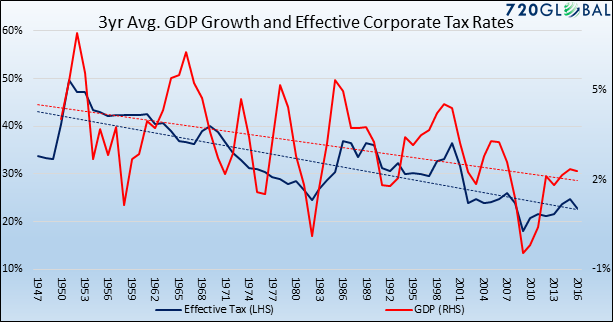
Indeed, if the corporate income tax were responsible for recent tepid economic growth, as GOP politicians loudly declaim, then the chart below couldn't exist. The path of the red line (3-year rolling GDP growth) and the blue line (effective corporate tax rate) are plain and simply a smoking gun.

In a word, the effective corporate tax rate, which is what companies actually pay after all of their tax planning and avoidance maneuvers, has dropped from 50% during the Korean War era to hardly 22% today; and aside from recession caused fluctuations, the trend (dotted blue line) has been steady downward for more than a half century.

And so has the dotted red line—-the trend rate of GDP growth. And that parallel path is fundamental to the GOP tax con job.

If there is no evidence that the corporate tax has accounted for the sinking trend of economic growth—especially since the late 1980s—-then it cannot logically be expected that a reduction of the statutory rate will generate the opposite; and as we show tommorrow, it would take a tsunami of extra growth to pay for the corporate rate reduction.

That's especially the case because all of the propaganda in favor of the big corporate tax cut is essentially a Keynesian argument based on enhanced after-tax cash flow to corporate treasuries, not the marginal rate incentive effect from supply side theory.

For instance, IBM most recently reported an effective tax rate of 11%, which is a far cry from the statutory rate. We have no idea what it would do with its winnings from the Senate bill, if any (we suspect it would buyback more stock on top of the $100 billion it has purchased in the last decade).

But clearly its calculus would start from 11%, not 35%. Not a single decision-maker in Armonk has thought about the statutory tax rate for decades, let alone made an investment decision based upon it.

The problem on that score is that as the GOP tax writers struggled with a limited $1.5 trillion deficit envelope they perforce needed to broaden the business tax base in order to reduce the net cost of the rate cuts.

On the pass-thru side, for example, the Senate bill effectively lowers the rate on qualifying business income to 31% via the 17% deduction. But the $362 billion cost is partially offset by a $137 billion 10-year increase in revenue due to a new provision that would drastically curtail the ability of essentially the same taxpayers to deduct active losses in excess of $500,000.

So the net tax cut on pass-thru businesses is actually just $225 billion.

Likewise, the corporate rate cut costing $1.36 trillion is offset by base broadeners and loophole closers totaling $690 billion over the period. Foremost among these is a limit on interest deductions to 30% of adjusted taxable income, which alone is estimated to raise $308 billion over 10-years.

So on an after-tax cash flow basis, the viewpoint of advocates, the net tax cut on corporate income would amount to $682 billion or just half of the pure rate cut (and AMT) provisions in the Senate Committee bill. And for all US businesses— including pass-thrus—-the net tax savings over the decade is $907 billion.

To be sure, we don't think that's chopped liver, but it's actually a big number that must be compared to a far bigger one. To wit, the CBO baseline for total domestic business pretax profits (corporate and pass-thru) is $18.2 trillion over the period.

Accordingly, the net gain in after tax cash flow embedded in the Senate bill amounts to just 5% of profits. Even if American businesses were starved for capital—-which is hardly the case—such a modest release of pre-tax earnings is hardly going to incite a tsunami of investment, output, jobs, wages and tax revenues.
In fact, however, we think the overwhelming share of this 5% gain in after-tax cash flow will go to owners and shareholders in the form of dividends, stock buybacks and other forms of capital return, including LBOs.

There is absolutely nothing wrong, of course, with business owners and equity investors getting bigger returns and more money in their bank accounts. That is, so long as Uncle Sam doesn't borrow the money to make it happen—-exactly as does the Senate tax bill.

In this context, we offer two charts which we think nail the case that nearly all of the net $900 billion of business cuts will end up flowing to the top 1% and 10% who own most of the business equity in the US.

On the one hand, US business has been borrowing in the bond markets like there is no tomorrow.  It appears that total corporate issuance this year will hit nearly $1.8 trillion, which is triple the turn of the century level, and nearly 165% of the pre-crisis borrowing peak in 2007.

There flat-out is no scarcity of capital or economic barrier to corporate investment in the US.

Chart 1

At the same time, net investment in real plant, equipment and technology is still 35% lower than it was at the turn of the century. Funding has exploded, but investment in real productive assets—after allowing for current year depreciation on the existing stock— has effectively imploded.

12-08-16_chart11

There is no mystery, however, as to where all the borrowed cash went—to say nothing of the trillions of internally generated business cash flow. To wit, it went into $15 trillion of financial engineering—stock buybacks, M&A deals, unearned dividends and LBOs—-over the last decade.

We have demonstrated ad nauseum that the Fed's Bubble Finance regime has turned the C-suites of corporate America into financial engineering joints and stock market speculation arenas.  The data for stock buybacks alone is dispositive.

Recall that in honest free market capitalism the purpose of equity markets first and foremost is to raise new capital; and the purpose of trading on the secondary market is to create liquidity for existing stocks and to provide a forum for honest price discovery.

The chart below belies that presumption completely. Wall Street runs a continuous movable feast of equity liquidation, not new capital raising.

US corporations have been incentivized by essentially one-way, central bank supported casinos— which masquerade as stock markets—-to convert their cash flows and balance sheets into massive stock purchases.

Give US companies an additional $900 billion over the next decade and the main result will simply be even longer blue bars in the chart above.

Nevertheless, tax bill advocates keep arguing that notwithstanding the overwhelming evidence above, that US business would invest more at home if the business income tax rate were lowered relative to those abroad. That is to say, capital has never been cheaper at home, but purportedly it is even cheaper on an after-tax basis abroad.

That's exactly what 100 prominent conservative economists recently argued in the flowing missive:

In today’s globalized economy, capital is mobile in its pursuit of lower tax jurisdictions. Yet, in that worldwide race for job-creating investment, America is not economically competitive. Here’s why: Left virtually untouched for the last 31 years, our chart-topping corporate tax rate is the highest in the industrialized world and a full fifteen percentage points above the OECD average. As a result of forfeiting our competitive edge, we forfeited 4,700 companies from 2004 to 2016 to cheaper shores abroad. As a result of sitting idly by while the rest of the world took steps to lower their corporate rates, we lowered our own workers' wages by thousands of dollars a year.

We will complete our debunking of the GOP tax con tomorrow, but for the moment consider the case of the world's single greatest company—-Apple Inc. It starkly illustrates why the above claim that 4,700 companies have moved production abroad owing to high tax rates is just plain nonsense.

For purposes of simplification, Apple has a product sourcing department and a tax planning department. The former has moved production and jobs abroad for economic reasons that will not change owing to the GOP tax bill; and the latter department has moved the company's tax books to low rate havens in Ireland and elsewhere for, well, tax avoidance reasons.

Since Apple's effective tax rate owing to the aggressive and creative work of its tax planning department is already about 20%, the new GOP tax regime will have little effect except to extract a one-time 5% levy from the $185 billion of notional cash that Apple has stashed in off-shore tax books (actually most of the actual cash is in New York and other US based banks). The whole thing is a pure paper chase.

On the other hand, Apple's sourcing department contracted-out virtually all of its massive gadget production to Foxconn, which produces exclusively in China and employs upwards of 1.1 million workers. And the reason for that is labor rates which are perhaps 10% of the fully loaded cost (including payroll taxes and fringe benefits) of producing iPhones and iPads in California, Arizona or Wisconsin.

Needless to say, the Senate will not change this massive labor cost gap, either. Apple will only bring jobs back to the US if some state government is foolish enough to pay them a giant subsidy to close the gap.

In short, US companies have off-shored their tax books because they can. Thanks to favorable tax rulings over the years this has been made all the easier by blatant but legal sheltering devices—-such as having an Irish subsidiary own the technology patents and charge the US tax entity a stiff royalty for using them.

But as we will show tomorrow, Apple is no outlier. The overwhelming share of production and jobs which have been off-shored—such as IBM's 130,000 workers in India—have happened for economic reasons which far outweigh any impact of the statutory tax rate.

At the end of the day, the GOP tax bill boils down to borrowing more than $1 trillion from the American public in order to pay higher dividends to wealthy private stockholders.

And that's a real con job.

via http://ift.tt/2AB2FdI Tyler Durden

What Is Behind China’s Bond Rout?

Until a modest dip in Chinese bond yields in the past two days, 10y CGB and 10y policy bank bond yields soared by 40bps and 70bps, respectively, over the last 2 months. In fact, Chinese government notes are headed for the worst selloff since 2013, with the 10-year yield surging 86bps this year to 3.92%, and the yield of 10y CDB bonds rose above 5%. This bond rout and sharp spike in rates, caught the market by surprise, as the economic growth actually slowed in October and inflation is still below 2%.

What happened to drive up interest rates so sharply?

The most likely answer is also the simplest one: after years of aggressive debt expansion, leading up to October’s Party Congress, China finally unleashed a sharp, aggressive deleveraging, which has finally been appreciated by the market in recent weeks, resulting in the biggest plunge in many local stocks in the past year, as well as a flurry of recent crashes in both Hong Kong and the mainland.

How to determine if this is correct? As Deutsche Bank observes, financial sector leverage can be measured by the gap between broad credit and M2 growth. The gap has narrowed significantly, reflecting the ongoing deleveraging process (Figure 1). More importantly, the inverted credit-M2 gap is a good leading indicator for bond yield, with a lag of about 3 months (Figure 2).

The next question is what’s the link between financial sector leverage and bond yield? The answer is that when the financial sector leveraged up, smaller banks (city and rural commercial banks) aggressively expanded their balance sheet through wholesale funding, and increased holdings of longer term safe assets. The shadow banking sector also increased exposure to bonds, mainly through asset management funds. Small banks and fund houses together accounted for 82% of the incremental holdings in CGBs and policy bank bonds between 2014 and 2017 (Figure 3). In the deleveraging process, small banks and asset management funds become less expansionary (Figure 4).

Small banks further reduced bond purchases in late 2016 and early 2017, a period when bond prices fell and yields rose, in some cases violently, which in turn prompted the PBOC to aggressively inject liquifity ahead of the October Congress. However, with the Congress now in the past, last week China released new regulation on asset management products, which is leading to another round of reduced bond purchases by asset management funds, and which in turn pushed up bond yields. This is precisely what we discussed last week in “A New Era In Chinese Regulation Means Turmoil For $15 Trillion In China’s “Shadows

It is likely that interest rates may also reflect rising inflation expectations. While nonfood CPI inflation has been rising steadily (Figure 5) as it did in 2011, the benign headline CPI inflation has been largely masked by lower than expected food prices, such as pork (Figure 6). And, as in 2011, all it took was one sudden food price spike to unleash a sharp Chinese tightening, which sent shockwaves around the globe and resulted in the second and most acute wave of the Europen sovereign debt crisis, and eventually QE3 in the US and QE in Europe.

Ominously, lately food prices appears to have stabilized, and CPI inflation could rise further if food prices bottom out. In fact, according to Deutsche Bank, CPI inflation could reach 3% in early 2018 around the Chinese New Year. If inflation stays elevated in Q2, DB concludes that “investors and policy makers will likely become more concerned” – translation: China is about to launch another financial crisis.

But while the reason for the selloff may be known, what isn’t is how much further will Beijing allow the rout to last, before it halts the deleveraging process – the same way it did in 2013/2014 – with the realization that like everywhere else, interest rates simply can not rise without bringing the entire financial system crashing down. Look for hints in the local press as to when Beijing – terrified of a middle-class insurrection – finally throws in the towel.

* * *

There is another, more whimsical if less realistic explanation. As Bloomberg pointed out overnight, “short sellers may be aggravating China’s bond selloff” and although China’s debt market has no official measure of short sales, “analysts say a surge in bond lending has been partially fueled by rising bearish bets.” Bloomberg cites a record 1.82 trillion yuan ($274 billion) of notes has been lent out this year, 18 percent more than the total for all of last year, according to clearinghouse ChinaBond. Short sellers profit from falling bond values by selling borrowed notes and buying them back after prices fall.

There may be some validity to this as it “creates a vicious feedback loop – when institutions think bonds will fall, they borrow and sell, causing a plunge in the securities, which then drags futures down, and thus there’s more shorting,” said Wang Wenhuan, an analyst at Huachuang Securities Co. in Shanghai. “As investors are still quite cautious, there will likely be more bond borrowing in the near term as yields climb.”

As part of this recent jump in shorting, traders have borrowed 960 billion yuan of sovereign bonds and 710 billion yuan of policy bank notes this year.  The amount of overall bond lending started picking up late last year, when policy makers began intensifying their deleveraging campaign. Financial institutions borrowed 170 billion yuan of notes every month on average in the past year, compared with 92 billion yuan in 2015, when the bond market was stronger.

That said, not all bond borrowing is for shorting. It’s also used by traders in repo markets seeking financing when cash supply is tight. For example, a financial institution could lend out its corporate bonds in exchange for more liquid government notes, then pledge them in the repo market for funding, according to Becky Liu, head of China macro strategy at Standard Chartered Plc.

To be sure, while hardly the cause, it is likely that shorting did exacerabte the recent rout:

On Nov. 22, when the yield on China Development Bank’s 10-year debt surged to a high of 5.04 percent for the year, traders more than doubled their borrowing of policy bank bonds from the previous day. A similar jump in borrowing occurred amid a selloff of sovereign notes on Oct. 30.


The increase in bond borrowing undoubtedly shows the market expects the yields to climb further,” ANZ’s Qu said. “We still think the yields will rise, so against this background, the transaction volume of borrowing could continue to climb, accelerating the drop in bonds and even resulting in some overshooting.”

However, like in the case of Europe (and US in 2008) the fact that shorting is still allowed in China is the best indicator that the worst is yet to come, and the authorities haven’t freaked out just yet. Because once Beijing bans shorting – and shortly thereafter, selling – in China’s gargantuan corporate bond market, that will be when the panic liquidations truly begin. Until then, enjoy the gradual levitation in yields until something does finally snap.

via http://ift.tt/2AkSjOW Tyler Durden

Michael Flynn Flips, Tillerson Sticks Around, and Quebec Cracks Down on People Saying Hi: P.M. Links

  • Michael FlynnFormer National Security Advisor Michael Flynn has plead guilty to lying to the FBI, and has said that he will cooperate in the ongoing Russia inquiry. Read Reason‘s coverage of the news here.
  • Trump says Secretary of State Rex Tillerson is keeping his job for now, calls reports to contrary fake new.
  • Quebec’s provincial legislature passed a motion instructing all shopkeepers to greet customers with the French ‘bonjour’, not the English-French ‘bonjour-hi’ used by many.

from Hit & Run http://ift.tt/2i9ho4O
via IFTTT