Balloons & Flash Drives: How A Private Organization Is Trying To Incite Rebellion In North Korea

Authored by Anders Hagstrom via The Daily Caller,

The U.S.-based Human Rights Foundation (HSF) has worked with North Korean defectors to smuggle flash drives and other tools into their dictatorial homeland to counter the regime’s propaganda throughout 2017.

HSF director Alex Gladstein claims that his organization has successfully smuggled up to 10,000 flash drives into the country containing documentaries countering state narratives, according to The Telegraph.

The organization also uses massive hydrogen balloons plastered with news bulletins to float across the border into North Korea in hopes that citizens will realize their true situation and bring the country down from within.

“This is to liberate minds,” Gladstein told the paper.


“We’re creating little windows to the outside world so that the North Korean people can make decisions for themselves about what they want to do with their lives.”

HSF’s “Flash Drives for Freedom” campaign sees volunteers go to great risk smuggling USB sticks through black markets on the China-North Korea border. The majority of North Koreans have devices that can read the flash drives, and since the program began, HSF has smuggled in 2 million hours of footage and 48 million hours of reading material, reaching an estimated 1.1 million North Koreans. According to HSF’s website, the flash drives contain ebooks as well as an offline version of Korean wikipedia.

HSF began the program in 2013 by simply filling hydrogen balloons with DVDs and leaflets and floating them across the border. High level North Korean defectors have said that causing the general population to question their living conditions is one of the most effective ways to attack Kim Jong Un’s regime.

“Given the history of Eastern Europe, I hope that people can think about the potential of information rather than reckless conflict and provocation and totally failed diplomacy,” Gladstein said.


“There is nothing the government can do with information, they can’t manipulate it. It’s a very powerful thing.”

Thae Yong-ho, who was once second in command at North Korea’s U.K. embassy before defecting in 2016, calls the general population of North Korea Un’s “Achilles heel.”

“We cannot change the policy of terror of the Kim Jong-un regime,” he said. “But we can educate the North Korean population to stand up by disseminating outside information.”

via http://ift.tt/2lccplc Tyler Durden

Brent Jumps After Explosion At Major Oil Pipeline In Libya

After a quiet overnight session, the price of Brent Crude spiked following news of an explosion at a Libyan crude oil pipeline that feeds the Es Sider sea terminal – home of the largest oil depot in Libya – a source from the Libyan National Army told The Libya Times Tuesday. The blast happened near 30km northwest of Marada, the source said.

At the same time, the source accused militants from the Benghazi Defense Brigades of the blast. While the reasons for the explosions haven’t been determined yet, media reports are suggesting that it was possibly a terrorist attack.

Meanwhile, the Akhbar Libya news outlet reported that the gas pipeline belonged to the al-Waha oil company. The group’s press service claimed that the explosion could have been caused by a terrorist attack, adding that the communication with an engineering crew working on the scene had been lost.

The media outlet added that the group had sent its forces to the explosion site, located between Es Sider port and an oil field.

While there is still no official update on what impact the explosion could have on Libyan oil output, Brent is higher about 40 cents on the news…

… with Bloomberg reporting that Libya’s Waha output is said to drop 60-70kbpd after the explosion.

via http://ift.tt/2CbxczA Tyler Durden

Trump Slams “Crooked Hillary Pile Of Garbage”-Funded “Bogus” Dossier

Having taken a shot at The FBI on Christmas Eve Eve…

President Trump took to Twitter early on this Boxing Day with a very direct shot across the bow of all his DC-swamp adversaries…

As a reminder, we know three things for sure:

(1) The Steele dossier was a Clinton campaign product. If it was used by the FBI and the Obama Justice Department to obtain a FISA warrant, that would mean law-enforcement agencies controlled by a Democratic president fed the FISA court political campaign material produced by the Democratic candidate whom the president had endorsed to succeed him. Partisan claims of egregious scheming with an adversarial foreign power would have been presented to the court with the FBI’s imprimatur, as if they were drawn from refined U.S. intelligence reporting. The objective would have been to spy on the opposition Republican campaign.


(2) In June of this year, former FBI director James Comey testified that the dossier was “salacious and unverified.” While still director, Comey had described the dossier the same way when he briefed President-elect Trump on it in January 2017. If the dossier was still unverified as late as mid 2017, its allegations could not possibly have been verified months earlier, in the late summer or early autumn of 2016, when it appears that the FBI and DOJ used them in an application to the FISA court.


(3) The dossier appears to contain misinformation. Knowing he was a spy-for-hire trusted by Americans, Steele’s Russian-regime sources had reason to believe that misinformation could be passed into the stream of U.S. intelligence and that it would be acted on — and leaked — as if it were true, to America’s detriment. This would sow discord in our political system. If the FBI and DOJ relied on the dossier, it likely means they were played by the Putin regime.

Manifestly, the DOJ and FBI were favorably disposed toward Steele and Fusion GPS. I suspect that these good, productive prior relationships with the dossier’s source led the investigators to be less exacting about corroborating the dossier’s claims.

But that is just the beginning of the bias story.

At a high level, the DOJ and FBI were in the tank for Hillary Clinton. In July 2016, shortly before Steele’s reports started floating in, the FBI and DOJ announced that no charges would be brought against Mrs. Clinton despite damning evidence that she mishandled classified information, destroyed government files, obstructed congressional investigations, and lied to investigators. The irregularities in the Clinton-emails investigation are legion: President Obama making it clear in public statements that he did not want Clinton charged; the FBI, shortly afterwards, drafting an exoneration of Clinton months before the investigation ended and central witnesses, including Clinton herself, were interviewed; investigators failing to use the grand jury to compel the production of key evidence; the DOJ restricting FBI agents in their lines of inquiry and examination of evidence; the granting of immunity to suspects who in any other case would be pressured to plead guilty and cooperate against more-culpable suspects; the distorting of criminal statutes to avoid applying them to Clinton; the sulfurous tarmac meeting between Attorney General Lynch and former President Clinton shortly before Mrs. Clinton was given a peremptory interview — right before then–FBI director Comey announced that she would not be charged.

The blatant preference for Clinton over Trump smacked of politics and self-interest. Deputy FBI director McCabe’s wife had run for the Virginia state legislature as a Democrat, and her (unsuccessful) campaign was lavishly funded by groups tied to Clinton insider Terry McAuliffe. Agent Strzok told FBI lawyer Page that Trump was an “idiot” and that “Hillary should win 100 million to 0.” Page agreed that Trump was “a loathsome human.” A Clinton win would likely mean Lynch — originally raised to prominence when President Bill Clinton appointed her to a coveted U.S. attorney slot — would remain attorney general. Yates would be waiting in the wings.

The prior relationships of trust with the source; the investment in Clinton; the certitude that Clinton would win and deserved to win, signified by the mulish determination that she not be charged in the emails investigation; the sheer contempt for Trump. This concatenation led the FBI and DOJ to believe Steele — to want to believe his melodramatic account of Trump-Russia corruption. For the faithful, it was a story too good to check.

The DOJ and FBI, having dropped a criminal investigation that undeniably established Hillary Clinton’s national-security recklessness, managed simultaneously to convince themselves that Donald Trump was too much of a national-security risk to be president.

*  *  *

As we previously concluded, while there is a dearth of evidence to date that the Trump campaign colluded in Russia’s cyberespionage attack on the 2016 election, there is abundant evidence that the Obama administration colluded with the Clinton campaign to use the Steele dossier as a vehicle for court-authorized monitoring of the Trump campaign — and to fuel a pre-election media narrative that U.S. intelligence agencies believed Trump was scheming with Russia to lift sanctions if he were elected president. Congress should continue pressing for answers, and President Trump should order the Justice Department and FBI to cooperate rather than — what’s the word? — resist.

via http://ift.tt/2BC3C2P Tyler Durden

The Bitcoin Effect, Gold and Silver Report 24 Dec 2017

Merry Christmas to our American friends. Happy Christmas to the rest of the Anglosphere. Felicem natalem Christi to our Latin-speaking audience, and góðr jól to those who are reviving Old Norse as a great language!

Let’s address two themes about the gold price trend that are increasingly in popularity the past few months—as the price of gold has been falling. Blame bitcoin. And blame rising interest rates.

There is no direct mechanism—no arbitrage—that pushes up bitcoin and down gold. As there is, for example, with changes in relative palladium or platinum demand if diesel engines gain or lose market share from gasoline engines.

Nor do we give truck to the idea that the dollar has been pushed from ?1.00 to ?0.000053 (we don’t think even the bitcoin bugs who say it, really believe it). What are you going to believe: a B.S. theory, or your own lying eyes?

There is arguably an indirect bitcoin-gold price connection mechanism. Those who own gold for the price appreciation may be attracted to bitcoin. While gold does not seem to be going up, bitcoin obviously is. If someone wants to make dollars quick, bitcoin sure seems to be a better vehicle to ride than gold.

However, we think bitcoin’s effect on the gold price is likely, if anything, to be in the other direction. For everyone selling gold to buy bitcoin, there are surely two who made big bucks in bitcoin and want to diversify into gold. With the price up so much, many people are sitting on 20X gains (or more). In order for new people to buy, SOMEone has to be selling. We think it is likely the diversification trade. It certainly is not anyone saying to himself, “well now that bitcoin has hit my price target, it is fully valued and I am out.”

Gold would be the logical diversification asset, for those seeking anti-Fed money. Once someone becomes aware of the problem with the dollar, which most bitcoin owners are, he will not become unaware. He will be looking for other alternatives. Gold is not only not a dollar, but it is not the wild ride of bitcoin either. For that portion someone wants to take off the table, gold’s stability is a feature, not a bug. The more that bitcoin rises, the more people have more capital to take off the table.

One could call this a kind of reflexivity, where bitcoin’s rising price tends to drive a rising price of gold. And this is likely a ratchet; a bitcoin crash does not seem likely to cause selling of gold to buy bitcoin.

It is a fact that the gold price has been in a downtrend since September (though the price picked up the last week and a half). If not bitcoin, what is the driver?

We have written a number of pieces on the topic of interest rates and the gold price (bottom line: there is no clear correlation). Let’s not forget that the gold price was rising in the 1970’s while the rate was rising, and again in the 2000’s while it was falling. Here is a graph of the Fed Funds Rate and the gold price from 1970.

There looks like a correlation while the Fed Funds Rate was rising in the 1970’s. But it is hard to argue that they’re correlated during the big run up in price from 2000 through 2011. This could mean that rising rates causes a rising price, while falling rates do not cause a falling price. Or it could mean something else.

At this point, many would say it’s not the nominal but the real rate. If you add apples, oranges, rent, fuel, etc. you get a hypothetical measure of consumer prices. No one agrees on what should go in to the basket, or the weights given to each item (some people eat more apples than others). But change in consumer prices gives us inflation. So we use hypothetical inflation to adjust the actual rate at which lending occurs. The adjusted number, is called the real rate, apparently without intending any irony.

Perhaps people buy gold when the real rate is rising or falling or too high or too low?

We think that real rate is the wrong concept. The inflation number is rather arbitrary, and it’s invalid to subtract consumer prices from interest. It’s wrong to ignore the rate at which actual lending occurs in favor of a rate at which lending does not occur. And finally, it’s wrong to try to measure money (or even irredeemable currency) in consumer prices. Do feel free to try this at home. How many rubber bands long is your child’s plastic yard stick?

However, there’s a grain of truth in that, which should be identified explicitly. Time preference is that grain of truth. Central banks can manipulate the market interest rate. For proof, just look at a long-term historical chart of the interest rate on the 10-year Treasury bond. There is an obvious difference between pre- and post-Fed.

However, central banks cannot manipulate the time preference of the people.

In a normal world, interest must be greater than or equal to time preference. Central banks turn normalcy upside down, literally. They can invert the time preference – interest spread.

Time preference, by the way, can change too. Not by central planners’ diktats, but in response to changes in the market. For example, people who have little debt in a market of skyrocketing consumer prices will increase their time preference. Whereas people who are loaded up with debt in a lethargic or falling market decrease their time preference.

The upshot of this is that interest at 10% might, at one time, be totally insufficient. And another time, interest of 2% might be more than enough. One would be hard-pressed to plot a graph showing time preference against interest. It’s certainly much easier to plot interest – inflation.

We would suggest that people are impelled to buy gold much more when their time preference is violated by too-low interest rates. And less inclined (or even induced to sell) when interest is above time preference.

Well, today, we have rising rates (at least short-term rates, the long bond is a different story). And yet debt saturation is not changing any time soon. It could be that the Fed is now giving people an inducement to give up their gold: restoring some interest to paper, even if only a small amount.

If so, then we are obliged to mention that we offer A yield on gold, paid in gold.


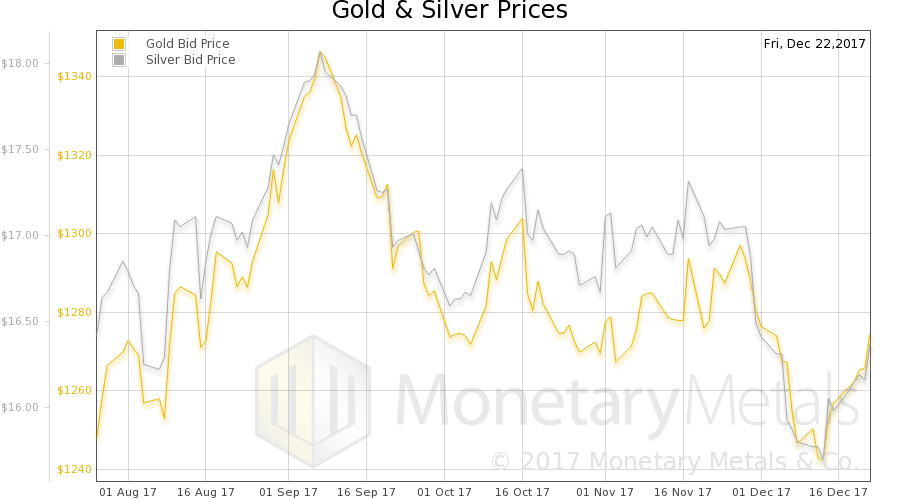
The prices of the metals moved up $29 and $0.34 respectively. As typically occurs, the price of silver moved more in proportion.

Let’s look at the only true picture of the supply and demand fundamentals of both gold and silver. But first, here are the charts of the prices of gold and silver, and the gold-silver ratio.

Next, this is a graph of the gold price measured in silver, otherwise known as the gold to silver ratio. The ratio dropped.

In this graph, we show both bid and offer prices for the gold-silver ratio. If you were to sell gold on the bid and buy silver at the ask, that is the lower bid price. Conversely, if you sold silver on the bid and bought gold at the offer, that is the higher offer price.

For each metal, we will look at a graph of the basis and cobasis overlaid with the price of the dollar in terms of the respective metal. It will make it easier to provide brief commentary. The dollar will be represented in green, the basis in blue and cobasis in red.

Here is the gold graph showing gold basis and gold price on Friday, as there was some interesting price action.

What a nice correlation between price and basis (until late in the day). We hold our breaths, waiting for conspiracy theorists to argue that this is manipulation. Whether it is, or isn’t, it is buying of futures and it pushed up the price of gold.

Despite the rise in market price, our Monetary Metals Gold Fundamental Price fell $35 this week, to $1239.

Now let’s look at silver.

We see the same thing. A beautiful correlation between price and basis. Yessiree, it’s the naked longs buying silver futures on leverage, planning to make dollars when the price rises.

The Monetary Metals Silver Fundamental Price dropped 25 cents from last week, to $16.12.


© 2017 Monetary Metals

via http://ift.tt/2DUuOLK Monetary Metals

Frontrunning: December 26

  • Analysts Cut iPhone X Shipment Forecasts, Citing Lukewarm Demand (BBG)
  • North Korea likely to pursue talks, says South (Reuters)
  • The quiet probe into Clinton email investigation could be a landmine for Robert Mueller (USA Today)
  • Bitcoin rises 10 percent, recovers from last week’s brutal selloff (Reuters)
  • U.S. Retailers Feel Christmas Cheer After a Tough Year (WSJ)
  • Kremlin Sees ‘Unbearable’ Risk to U.S. Ties in New Sanctions (BBG)
  • Murder in America: What Makes Cities More Dangerous (WSJ)
  • Venezuelans scramble to survive as merchants demand dollars (Reuters)
  • College-Educated Women Are Moving Away From the GOP (WSJ)
  • The Next Big Trade for Bond Investors Is Betting on U.S. Homeowners (BBG)
  • Rural Businesses Face Dwindling Pool of Lenders (WSJ)
  • Hugh Hefner, Roger Ailes, David Rockefeller: The Year in Deaths (BBG)
  • What Ever Happened to Donald Trump’s Wall? It’s in Pieces, in the Desert (BBG)
  • Uber to Sell U.S. Auto-Leasing Business to Startup Fair.com (WSJ)
  • U.S. IPOs Bounce Back: Five Key Measures of 2017’s Listings (BBG)
  • China to Overtake U.S. Economy by 2032 as Asian Might Builds (BBG)
  • QuickTakes Explain the Year Ahead (BBG)
  • November’s Swiss Watch Exports Show That China Is Once Again Red Hot (BBG)
  • China Signals Slower Growth Is Acceptable to Tackle Debt, Smog (BBG)

Overnight Media Digest

WSJ

– Regulators in the Trump administration are proposing to roll back safety measures put in place after the 2010 Deepwater Horizon oil spill, a revision that would reduce the role of government in offshore oil production and return more responsibility to private companies. on.wsj.com/2lccvZN

– A unit of investment manager Neuberger Berman, Dyal Capital Partners LP purchased a minority stake in the credit business of Cerberus Capital Management LP. The deal signed Friday values Cerberus Business Finance at about $2 billion. on.wsj.com/2lauMXB

– The Saudi government in recent days has released at least two dozen high-profile suspects held in a wide-ranging crackdown on corruption, a sign that those accused of illegally amassing wealth are increasingly agreeing to settle as authorities push to expedite the investigation process. on.wsj.com/2lcezRx


NYT

– Steven Cohen, the billionaire investor whose career was nearly derailed by a government crackdown on insider trading, is days away from once again being able to manage other people’s money, as the two-year ban that barred Cohen from running a hedge fund expires at year’s end. nyti.ms/2kYKgyw


Canada

THE GLOBE AND MAIL
** Small-business advocates in Alberta are raising concerns about new provincial employment standards that take effect on Jan. 1, rules they say will bring added costs and regulatory burdens to businesses. (tgam.ca/2C62Ps3)

** Foreign Affairs Minister Chrystia Freeland says the Venezuelan ambassador to Canada and another senior diplomat are no longer welcome in the country, biting back at Venezuela’s decision to expel the top Canadian envoy from Caracas over the weekend. (tgam.ca/2C5d8iD)

** Manulife Financial Corp is preparing to take two charges worth C$2.9 billion in its fourth quarter as U.S. tax reforms and a new investment strategy reshapes the business. (tgam.ca/2DgzzxU)

NATIONAL POST
** Rogers Communications Inc, BCE Inc and Telus Corp sparked a flurry of demand last weekend with unprecedented deals offering 10 gigabytes of data for C$60 per month for customers in Ontario, Alberta and B.C. that brought their own phones. (bit.ly/2piOiGS)

via http://ift.tt/2C6AuBY Tyler Durden

The Vicious Cycle Approaches: “We’ll Regress To (And Through) The Mean”

Authored by Adam Taggart via PeakProsperity.com,

Whether or not you've had time yet to plow your way through David Collum's excellent 2017 Year in Review, our annual podcast with Dave always brings additional color to light — and this year's is no exception.

My model going forward predicts the next recession is going to be a real butt-kicker. That's why the Feds are so terrified. I think they realize that we're going to end up with a vicious cycle kicking into gear that the Feds aren't going to be able to control. They've already proven that they can't do much for the economy: someone tallied the annual GDP growth from 1930 to 1939 and then they tallied GDP growth from 2007 to 2016 and they're identical when annualized. So we've been tracking the Great Depression in terms of GDP growth.


So, you can be thrilled about the fact your 401K has appreciated — but it's sitting on a pocket of air because nothing is improved underneath the surface.


Over-valuation is appreciation pulled forward. And undervaluation is appreciation deferred. Once you're 2X overvalued, no matter how many more gains you get, you're just pulling form the future — and you're going to give them all back, either by price or by time or a combination of the two. You're going to regress to the mean.


You can pretend you're never going to die. But it's simply not avoidable. We will regress to and through the mean at some point. And when you're 2X overvalued, that means it is going to take either 30 years like with the Nikkei (in Japan), or massive, massive price adjustments. Neither one appeals to me. 

Click the play button below to listen to Chris' interview with David Collum (72m:36s).

via http://ift.tt/2lbyxvW Tyler Durden

Yes, governments CAN go bankrupt. And no, it’s NOT impossible…

[Editor’s Note: As we’re coming up on the end of the year, we thought it would be appropriate to republish some of our most popular articles. Today’s was originally published on March 13, 2017]

In the year 1517, one of the most important innovations in financial history was invented in Amsterdam: the government bond.

It was a pretty revolutionary concept.

Governments had been borrowing money for thousands of years… quite often at the point of a sword.

Italian city-states like Venice and Florence had been famously demanding “forced loans” from their wealthy citizens for centuries.

But the Dutch figured out how to turn government loans into an “investment”.

It caught on slowly. But eventually government bonds became an extremely popular asset class.

Secondary markets developed where people who owned bonds could sell them to other investors.

Even simple coffee shops turned into financial exchanges where investors and traders would buy and sell bonds.

In time, the government realized that its creditworthiness was paramount, and the Dutch developed a reputation as being a rock-solid bet.

This practice caught on across the world. International markets developed.

English investors bought French bonds. French investors bought Dutch bonds. Dutch investors bought American bonds.

(By 1803, Dutch investors owned a full 25% of US federal debt. By comparison, the Chinese own about 5.5% of US debt today.)

Throughout it all, debt levels kept rising.

The Dutch government used government bonds to live beyond its means, borrowing money to fund everything imaginable– wars, infrastructure, and ballooning deficits.

But people kept buying the bonds, convinced that the Dutch government will never default.

Everyone was brainwashed; the mere suggestion that the Dutch government would default was tantamount to blasphemy.

It didn’t matter that the debt level was so high that by the early 1800s the Dutch government was spending 68% of tax revenue just to service the debt.

Well, in 1814 the impossible happened: the Dutch government defaulted.

And the effects were devastating.

In their excellent book The First Modern Economy, financial historians Jan De Vries and Ad Van der Woude estimate that the Dutch government default wiped out between 1/3 and 1/2 of the country’s wealth.

That, of course, is just one example.

History is full of events that people thought were impossible. And yet they happened.

Looking back, they always seem so obvious.

Duh. The Dutch were spending 68% of their tax revenue just to service the debt. Of course they were going to default.

But at the time, there was always some prevailing social influence… some wisdom from the “experts” that made otherwise rational people believe in ridiculous fantasies.

Today is no different; we have our own experts who peddle ridiculous (and dangerous) fantasies.

Case in point: this week, yet another debt ceiling debacle will unfold in the Land of the Free.

You may recall the major debt ceiling crisis in 2011; the US federal government almost shut down when the debt ceiling was nearly breached.

Then it happened again in 2013, at which point the government actually DID shut down.

Then it happened again in 2015, when Congress and President Obama agreed to temporarily suspend the debt ceiling, which at the time was $18.1 trillion.

That suspension ends this week, at which point a debt ceiling of $20.1 trillion will kick in.

There’s just one problem: the US government is already about to breach that new debt limit.

The national debt in the Land of the Free now stands at just a hair under $20 trillion.

In fact the government has been extremely careful to keep the debt below $20 trillion in anticipation of another debt ceiling fiasco.

One way they’ve done that is by burning through cash.

At the start of this calendar year in January, the federal government’s cash balance was nearly $400 billion.

On the day of Donald Trump’s inauguration, the government’s cash balance was $384 billion.

Today the US government’s cash balance is just $34.0 billion.

(Google has twice as much money, with cash reserves exceeding $75 billion.)

This isn’t about Trump. Or even Obama. Or any other individual.

It’s about the inevitability that goes hand in hand with decades of bad choices that have taken place within the institution of government itself.

Public spending is now so indulgent that the government’s net loss exceeded $1 trillion in fiscal year 2016, according to the Treasury Department’s own numbers.

That’s extraordinary, especially considering that there was no major war, recession, financial crisis, or even substantial infrastructure project.

Basically, business as usual means that the government will lose $1 trillion annually.

Moreover, the national debt increased by 8.2% in fiscal year 2016 ($1.4 trillion), while the US economy expanded by just 1.6%, according to the US Department of Commerce.

Now they have plans to borrow even more money to fund multi-trillion dollar infrastructure projects.

Then there’s the multi-trillion dollar bailouts of the various Social Security and Medicare trust funds.

And none of this takes into consideration the possibility of a recession, trade war, shooting war, or any other contingency.

This isn’t a political problem. It’s an arithmetic problem. And the math just doesn’t add up.

The only question is whether the government outright defaults on its creditors, defaults on promises to its citizens, or defaults on the solemn obligation to maintain a stable currency.

But of course, just like two centuries ago with the Dutch, the mere suggestion that the US government may default is tantamount to blasphemy.

Our modern “experts” tell us that the US government will always pay and that a debt default is impossible.

Well, we’re living in a world where the “impossible” keeps happening.

So it’s hard to imagine anyone will be worse off seeking a modicum of sanity… and safety.

Source

from Sovereign Man http://ift.tt/2n0yvtF
via IFTTT
Japan’s Largest Bank Is Preparing A Contingency Plan For A Bitcoin Exchange Collapse

The February 2014 collapse of Tokyo-based bitcoin exchange Mt. Gox was, for more than 24,000 investors around the world, a traumatic event. It also ushered in a two-year crypto bear market that saw the price of a single bitcoin plunge from a peak of $1,200 to a low of around $200 before the torrid bull market of the present day began. And as the bankruptcy and legal issues surrounding the collapse continue to wend through the Japanese legal system, none of these investors have received a single crypto cent of remuneration – despite the ballooning valuation of the exchange’s remaining assets.

Many market observers believe that one of the biggest risks to the current rally would be a similar incident unfolding across another major exchange like Bitfinex or CoinBase’s GDAX.

So in a move that could go a long way toward legitimizing the burgeoning crypto market, Japanese banking behemoth Mitsubishi UFJ Financial Group which is  Japan's largest financial group and the world's second largest bank holding company – through its trust and banking unit – is preparing to launch a service that will allow individual investors to secure their bitcoins in the event an exchange should fail again, according to Nikkei Asia Review.

MUFG isn't the only major global bank seeking to build up its cryptocurrency franchise: Goldman Sachs is reportedly in the process of launching a crypto trading desk. Of course, as observed recerntly, Japan is one of bitcoin’s biggest markets, and its largest exchange, Bitflyer, accounts for nearly 40% of global exchange-based trading.

MFUG’s new trust service would help mitigate what has, in the past, proven to be one of the biggest threats to the crypto market. It will also help Japanese regulators cement their position at the vanguard of crypto’s integration with traditional markets.

Mitsubishi UFJ Trust and Banking is preparing a scheme for protecting holders of cryptocurrencies if the exchanges they use fail – a risk that veteran fans here know all too well.


This highlights how Japan's finance industry seeks to make the most of the opportunities associated with virtual currencies, which the country has taken to in a big way, accounting for around 40% of global bitcoin trading.


Japan was also the epicenter of one of the digital currency's biggest shocks — the 2014 collapse of Mt. Gox, the largest bitcoin exchange at the time.


Mitsubishi UFJ Trust will offer a way to keep exchange customers' cryptocurrency holdings separate from the entrusting exchange's assets. This will make it the first trust arrangement of its kind in the world, according to the Mitsubishi UFJ Financial Group member, which recently applied for patent protection.

Per Nikkei, the service could launch as early as April, when Japan's Financial Services Agency is expected to recognize cryptocurrencies as an asset that can be placed in trust, like real estate or securities.

While the market value of major cryptocurrencies has ballooned to $300 billion, bitcoin and its peers have remained remain decentralized creations without an oversight body like a central bank – a core component of their appeal. But as the usage and valuation of digital currencies grows, these exchanges, which are often overwhelmed and under-staffed by the flurry of new accounts, they’re increasingly becoming targets for state-sponsored hackers like the North Korea linked Lazarus Group.

As Nikkei explains, Mitsubishi UFJ Trust will maintain the same records as its exchange clients. In the event that the exchange operator fails to safeguard its customers’ assets, Mitsubishi UFJ will use these records to compensate investors for their losses.

Of course, this service won’t protect customers from violent plunges in the valuation of bitcoin, like the selloff that occurred over the weekend during the runup to the Christmas holiday.

Using an arrangement like Mitsubishi UFJ Trust's would entail a fee that would be shouldered by individual investors. But "customers will feel peace of mind knowing that a trust bank is managing their assets," said CEO Noriyuki Hirosue of Tokyo-based exchange Bitbank. After all, the big banks have never violated their fiduciary duty to their clients – therefore, they’re implicitly more trustworthy than crypto startups with few resources and little to no track records.

To use the service, exchange customers will opt in when they start trading. Mitsubishi UFJ Trust will monitor the accounts of those who do for suspicious activity and examine pending transactions in detail as needed. A late-night sale of a huge amount of bitcoins, for instance, would get flagged for inspection instead of being processed immediately.

While regulators in the US have expressed skepticism about digital currencies, Japan established itself as a leader in building a regulatory framework when nearly two years ago, it passed a law clearing the way for financial institutions to become involved in the crypto market.

The Japanese recognize the adoption of cryptocurrencies and blockchain technologies as a competitive advantage, and they're right. The FSA began registering cryptocurrency exchanges in earnest this past autumn.

Offering this service will help establish one of Japan’s largest financial institutions as a key player in an increasingly contested global market, which has seen a surge of institutional interest in the trading of cryptocurrencies in recent months.

via http://ift.tt/2l9n53U Tyler Durden

Goldnomics Podcast – Gold, Stocks, Bitcoin in 2018. Everything Bubble Bursts?

Goldnomics Podcast – Gold, Stocks, Bitcoin in 2018. Everything Bubble Bursts? 

Click here to listen to podcast

In this our first GoldNomics podcast we take a look at the major financial market themes of 2017 and delve into the outlook in 2018. GoldCore CEO Stephen Flood and GoldCore’s Research Director and world renowned precious metals commentator Mark O’Byrne are interviewed by Dave Russell.

Macro-economic and geo-political developments are considered in an attempt to assess the risks of a global financial shock in the coming year and the outlook for bitcoin, stocks and gold. We cut through the financial markets jargon and look at the risks to your investment portfolio and financial wellbeing that are largely ignored in the mainstream media.

Watch, listen and subscribe below


Skip directly to one of the following discussion points on YouTube
2:20 What had the biggest impact on financial markets in 2017
6:12 What we need to watch for in 2018
6:25 Is a sharp correction on the cards for financial markets?
6:59 “The Everything Bubble! … bursts”
8:30 The effect of zero percent interest rates
8:45 The effect of “Algos” – algorithmic trading
9:35 Markets awash with liquidity. Bubbles in stocks, bonds, property & bitcoin
10:40 Turning away from fundamentals – stopping the markets pricing risks
11:20 Why investors now have to second guess central bankers
12:10 The markets are running blind because of the official sector
12:19 The effect of passive trading on the market
13:30 Is gold still capable of playing the role of Canary in the coalmine.
Why is it not reacting to the increases in risk?
15:00 We are no longer creating the same level of return in the form of GDP growth
15:50 What is going to be the banana skin for the bull market
16:00 The brewing trouble with Italian banks – what no one is talking about
17:40 The search for yield driving markets higher
18:00 The rise of populism – will the trend continue
19:25 The need for central banks to raise rates – running out of tools
21:10 The rise of corporatism – and the continued rise of inequality
21:30 The political manipulation of money
22:20 Central Banks reaching the end point?
23:02 Bitcoin and the impact on the monetary system
24:25 Bitcoin and the search for yield
25:15 Importance and the impact of the blockchain, the technology behind Bitcoin
26:35 Is there a tulip bulb style mania in Bitcoin? How high will it go, when will it crash?
29:25 Why the psychology of bubbles may suggest that bitcoin early stages of a bubble
30:55 State backed cryptographic currencies
31:55 Where are precious metals going in 2018? What will break this sideways cycle?
32:40 What are the reasons to continue to hold gold bullion in 2018
33:25 What the smart money is doing
34:40 The nature of gold as financial insurance
35:25 The paradigm shift of China and its impact on the gold price
37:45 The production costs of gold as a floor to the gold price
38:55 Why diversified investors hope the price of gold falls
40:10 Stephen, Mark and Dave’s ones to watch for 2018!

Make sure you don’t miss a single episode… Subscribe to Goldnomics Podcasts on iTunes or on YouTube

via http://ift.tt/2BTzoN4 GoldCore

Asian Stocks Slide On iPhone X Demand Fears; US Futures Flat In Thin Holiday Trading

For the second day in a row, most Asian markets – at least the ones that are open – were dragged lower by tech stocks and Apple suppliers, with the MSCI Asia Pacific Index down 0.2% led by Samsung Electronics and Taiwan Semiconductor Manufacturing in response to the previously noted report that Apple will slash Q1 sales forecasts for iPhone X sales by 40% from 50 million to 30 million. Most Asian equity benchmarks fell except those in China. European stocks were mixed in a quiet session while U.S. equity futures are little changed as markets reopen after the Christmas holiday.

Away from Asia, stocks remained closed across the large European markets, as well as in parts of Asia including Australia, Hong Kong, Indonesia, the Philippines and New Zealand. Japanese benchmarks slipped from the highest levels since the early 1990s, helping to pull the MSCI Asia Pacific Index down, while shares in Dubai, Qatar and Russia were among the big losers in emerging markets. S&P 500 futures were flat as those for the Dow Jones slipped. The euro edged lower with the pound – although there were no reverberations from Monday’s odd EURUSD flash crash which was only observed on Bloomberg feeds, while Reuters ignored it even if the FT did note it… 

… while the Russian ruble, South African rand and South Korean won were the notable gainers. Gold extended its recent advance as silver also jumped.

In a continuation of Monday’s muted action, Apple’s Asian suppliers again responded to the biggest market news of the week and fell after Taiwan’s Economic Daily reported on Monday that Apple will slash its sales forecast for the iPhone X in the quarter to 30 million units, down from 50 million units originally. Some analysts have also flagged disappointing demand. U.S.-based JL Warren Capital is predicting shipments of just 25 million units as consumers baulk at the “high price point and a lack of interesting innovations”.  “Our work continues to suggest the March and June quarters will have a significant amount of iPhone X make-up shipments,” Chicago-based Loop Capital said in a note last week, forecasting shipments of 40-45 million units in the first quarter of 2018, up from an estimated 30-35 million units in the current quarter. Analysts at Jefferies have also forecast around 40 million iPhone X sales for the first quarter.

Apple suppliers that were most hit included Genius Electronic Optical Co Ltd which dropped 2.4 percent on Tuesday to take its losses this week to 11.4 percent. Pegatron Corp also fell on both days, losing 3.2 percent this week.

Meanwhile, China stocks closed higher on Tuesday as an advance by construction machinery makers and financials offset a drop by consumer staples. Hong Kong’s markets will reopen on Wednesday after a two-day holiday break. The Shanghai Composite Index rose 0.8% to 3,306.13, its highest level since Dec. 11 while the blue-chip CSI 300 Index added 0.3%, erasing earlier drop of 0.7%.

Still, as Bloomberg notes, traders are finding little to get excited about as the stellar year for risk assets crawls to its end, with the possible exception of the cryptocurrency roller coaster, where bitcoin was once again trading above $15,000 this morning. Traders may be opting to enjoy the relative calm as tensions continue to simmer between the U.S. and Russia, Italy’s parliament is set to be dissolved for a risky European election, and big decisions on the American debt ceiling were merely kicked down the road. That has set up a potentially eventful 2018.

In rates, U.S. 10-year Treasury yield hovers under last week’s high, and in overnight trading it climbed less than one basis point to 2.48%.

In currencies, the Bloomberg Dollar Spot Index holds two weeks of declines, as most major currencies trade in narrow ranges and volumes remain low heading into the year-end. The yen headed toward a six-week low against the dollar as policy divergence and optimism over the strength of the U.S. economy supported the greenback. Japan’s currency fell against most G-10 peers after the central bank kept its loose monetary policy stance last week and inflation data Tuesday showed prices are still rising at less than half its targeted pace. Passage of U.S. tax reforms and expected interest-rate hikes by incoming Federal Reserve Governor Jerome Powell next year could add to the pressure on the yen, according to FX Prime by GMO Corp. “If Powell confirms the pace of rate increases next year and if Trump unveils more specifics about infrastructure investment, that would support the dollar,” said Hiroshi Yanagisawa, chief analyst at FX Prime by GMO in Tokyo. “USD/JPY will become a bit top-heavy around 113.50, while support is seen firm around 112.50.”

While the yen slid, the South Korean won rose to the strongest in more than two years while most other Asian currencies were little changed as local markets reopened after the Christmas Day holiday. The positive correlation between strong U.S. stocks and Asian currencies remains in play, said Wu Mingze, a foreign-exchange trader at INTL FCStone in Singapore. “The only question is whether the rally in U.S. equities can continue early next year, while there isn’t any bullish factor left. Failure for stocks to climb higher may result in safe-haven currencies regaining strength.”

Elsewhere, the British pound dipped 0.1 percent to $1.3364. South Africa’s rand rose 0.2 percent to 12.5835 per dollar, the strongest in nine months. The Russian ruble jumped 0.4 percent to 57.7458 per dollar, hitting the strongest in two months with its eighth consecutive advance.

In commodities, moves were likewise subdued, with WTI holding above $58 a barrel as trading resumed following the Christmas holiday and after U.S. explorers refrained from adding rigs for a second week. Brent edged lower towards $65 a barrel on Tuesday, but remained within sight of its highest level since mid-2015, as the looming restart of a key North Sea oil pipeline offset support from OPEC-led supply cuts. The North Sea Forties pipeline, which plays an important role in the global oil market, is being tested following repairs and full flows should resume in early January, its operator Ineos said on Monday.

Bitcoin rallied as the biggest cryptocurrency has filled the gap from last week’s dramatic selloff.  Gold increased 0.2 percent to $1,278.34 an ounce, hitting the highest in more than three weeks with its fifth consecutive advance. Silver gained 0.6 percent to $16.43 per ounce, the highest in more than three weeks.

Economic data expected today include Richmond Fed Reserve Manufacturing Survey.

Market Snapshot

  • S&P 500 futures up 0.02% to 2,686.50
  • STOXX Europe 600 down 0.1% to 390.28
  • MSCI Asia Pacific down 0.2% to 172.31
  • MSCI Asia Pacific ex Japan down 0.2% to 561.44
  • Topix down 0.3% to 1,827.01
  • Hang Seng Index up 0.7% to 29,578.01
  • Australia S&P/ASX 200 up 0.2% to 6,069.71
  • Kospi down 0.5% to 2,427.34
  • German 10Y yield unchanged at 0.42%
  • Euro down 0.06% to $1.1863
  • Brent Futures down 0.2% to $65.10/bbl
  • Italian 10Y yield rose 0.6 bps to 1.645%
  • Spanish 10Y yield unchanged at 1.472%
  • Brent Futures down 0.2% to $65.10/bbl
  • Gold spot up 0.3% to $1,277.80
  • U.S. Dollar Index up 0.04% to 93.30

Top Overnight News from Bloomberg

  • The United Nation’s latest sanctions on North Korea are more likely to hurt ordinary people in the isolated nation than slow Kim Jong-Un’s push to develop missiles capable of hitting the U.S. with nuclear weapons.
  • Japanese inflation unexpectedly picked up in November but prices are still rising at less than half the rate targeted by the central bank. The tightest job market in decades got even tighter.
  • Early Monday morning in New York, the euro currency tumbled about 3 percent against the dollar in a matter of minutes. Given the limited Christmas Day volume, along with a lack of much market-moving news, the sudden plunge could’ve been sparked by computer-driven trading — a suspicion touted by the ZeroHedge website.
  • The Kremlin is “concerned” about the possibility the U.S. might further expand sanctions on Russia, presidential spokesman Dmitry Peskov said.
  • China can achieve a goal of doubling the size of its economy by 2020 even if annual expansion slows to 6.3 percent, according to a senior Communist Party official, signaling a greater willingness to tackle debt and pollution at the expense of growth.

In Asia, the MSCI Asia Pacific Index fell 0.2% led by declines in tech stocks including Samsung Electronics Co. and Taiwan Semiconductor Manufacturing Co. Main equity benchmarks in the region fell except those in China. Markets were closed for a second day in Australia, Hong Kong, Indonesia, the Philippines and New Zealand. The market had a muted reaction to data released early on Tuesday which showed that Japan’s core consumer prices rose for the 11th straight month, up 0.9 percent year-on-year, and household spending jumped in November. China stocks closed higher on Tuesday as an advance by construction machinery makers and financials offset a drop by consumer staples. Hong Kong’s markets will reopen on Wednesday after a two-day holiday break.  Shanghai Composite Index rises 0.8% to 3,306.13, its highest level since Dec. 11. CSI 300 Index adds 0.3%, erasing earlier drop of 0.7%. Shenzhen Composite Index +0.4%; ChiNext Index +0.2% after falling as much as 0.8%. XCMG Construction Machinery Co. surges by 10% daily limit as best performer on big-cap CSI 300 measure; Sany Heavy Industry Co. jumps 7.3%, the most this month; Zoomlion Heavy Industry Science and Technology Co. advances 5.2%, the most since March 2016.

Top Asian News

  • China’s Fosun Is Said to Explore Sale of Hollywood Studio Stake
  • Japan Stocks Fall in Thin Trade as Technology Shares Drag Index
  • China Stocks Rise to Highest in 2 Weeks as Machinery Makers Gain
  • Indian Bonds Erase Losses After Recap Debt Report, Trader Says
  • Reliance Communications Surges Ahead of ‘Important Announcement’

Across Europe, most financial markets are shut on Tuesday. The euro inched down 0.1 percent to $1.1869. The single currency gave up some ground last week after Catalan separatists won a regional election, deepening Spain’s political crisis in a sharp rebuke to Prime Minister Mariano Rajoy and European Union leaders who backed him.

Top European News

  • Euro May Rise Into Year-End If German CPI is Strong: FX Prime
  • Kuka’s CEO Plans for Robot Domination in China and Your Garage
  • Russia Harvested 85.8m Tons of Wheat in 2017: Statistics Service
  • France Sees EU1b Extra Corporate Tax Revenue for 2017: Les Echos
  • Bank of Russia Sells 14.3b Rubles in March 2018 KOBR Bills

In currencies, The Bloomberg Dollar Spot Index climbed less than 0.05 percent. The euro declined 0.1 percent to $1.186, the weakest in a week. The British pound dipped 0.1 percent to $1.3364. South Africa’s rand rose 0.2 percent to 12.5835 per dollar, the strongest in nine months. The Russian ruble jumped 0.4 percent to 57.7458 per dollar, hitting the strongest in two months with its eighth consecutive advance.

US Event Calendar

  • 9am: S&P CoreLogic CS 20-City MoM SA, est. 0.6%, prior 0.52%
  • 10am: Richmond Fed Manufact. Index, est. 21.1, prior 30
  • 10:30am: Dallas Fed Manf. Activity, est. 20, prior 19.4

via http://ift.tt/2pAn5zz Tyler Durden