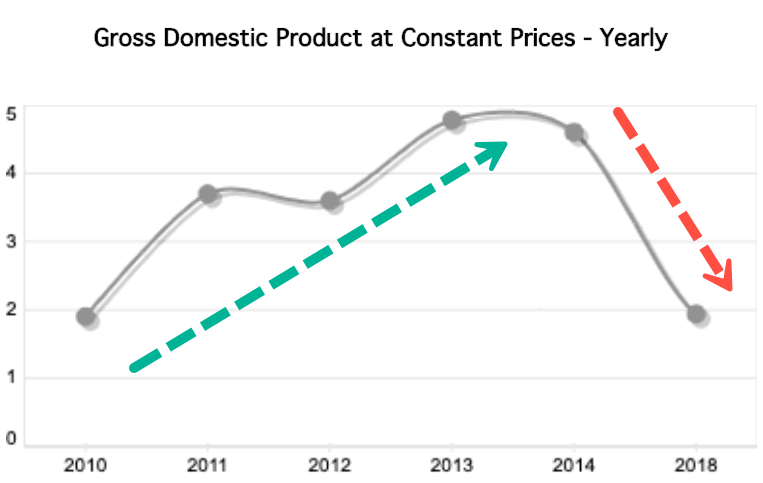
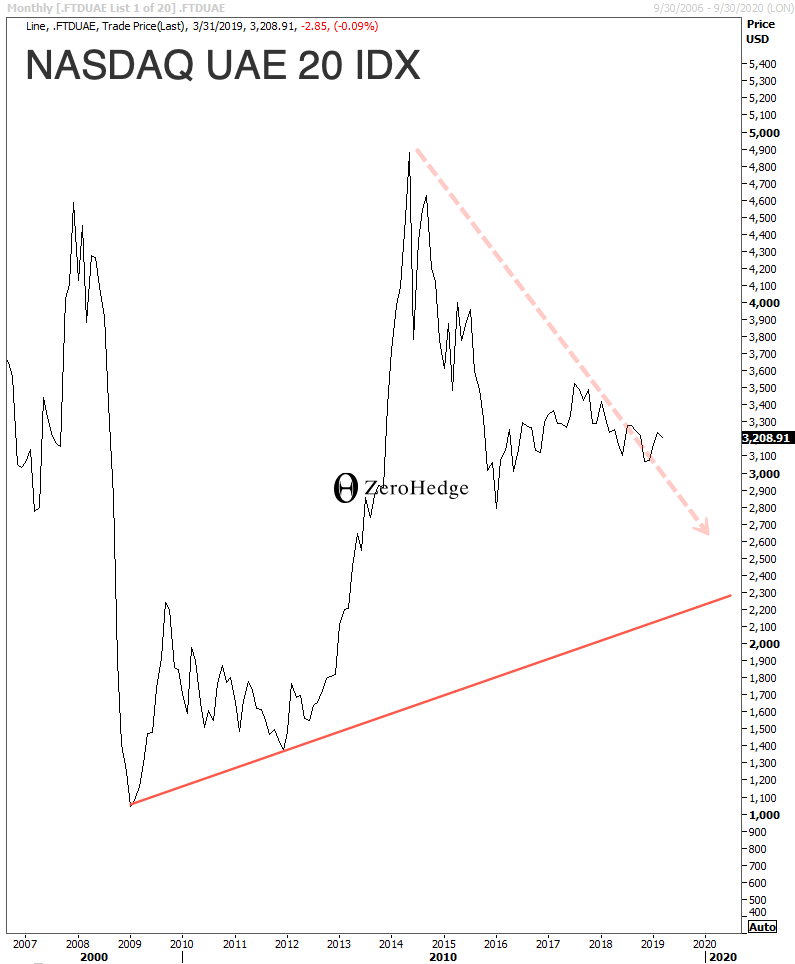
Investors earlier this week were shocked when Dubai’s long-awaited economic growth printed sub 2% — the slowest since 2009, and a sign that the country’s property sector could be in grave danger, reported Reuters.
Data released by the Dubai Statistics Center on Tuesday showed gross domestic product grew 1.9% in 2018, a steep fall from 3.1% the previous year.
“A weakening external backdrop, a strong U.S. dollar and the ongoing correction in the property market are headwinds for a number of vital sectors,” said Monica Malik, chief economist at Abu Dhabi Commercial Bank.
Real estate prices in Dubai have dropped by more than 25% from their 2014 peak. S&P’s latest assessment of the market shows prices could fall by 10% in the coming quarters, before a potential trough in 2020.
The last time property prices crashed in Dubai; the government asked for a $20 billion bailout from oil-rich Abu Dhabi in 2009.
Analysts believe the economy could recover ahead of 2020 when the city hosts the World Expo event, but judging by the rapid global slowdown in Europe, Asia, and the U.S., one year from now seems far fetched.
Government data revealed GDP growth was driven by trade-related activities, which rose by 1.3% in 2018 from a year earlier, representing 18.1% of total growth last year. In 2017, wholesale and retail trade increased by 0.9%.
Data showed that real estate increased by 7% in 2018 and accounted for 25% of total economic growth.
Growth in the transport and storage industries came to a screeching halt to 2.1% last year from a revised 8.4% in 2017.
London-based Capital Economics said real estate in the city would remain under pressure while a slowdown in the global economy will weigh on Dubai’s manufacturing and transport industries.
Capital Economics is forecasting GDP growth of 3.8% for 2019 before accelerating to 4.5% (considering global economic growth has slowed already in 1Q19 – the assessment could be too optimistic).
The independent macroeconomic research firm warned there are significant risks to the country’s outlook from long-standing debt problems, citing IMF data that show the debt of Dubai’s government-related entities (GREs) – which is the reason why a debt crisis formed in 2009 – is back to crisis levels, amounting to $60 billion or 50% of Dubai’s GDP.
“Debt restructurings in 2014 have masked the problems in recent years. But around half of GRE debt is due to mature between now and 2021,” said Jason Tuvey, senior emerging markets economist at Capital Economics.
“We’ve warned before that the risk of overcapacity after the World Expo means that the GREs could face weaker-than-expected revenues, harming their ability to service these debts,” he said.
Reuters said Abu Dhabi could roll over for the second time, $20 billion of debt, due sometime this month, that was injected into Dubai during the financial crash a decade ago.
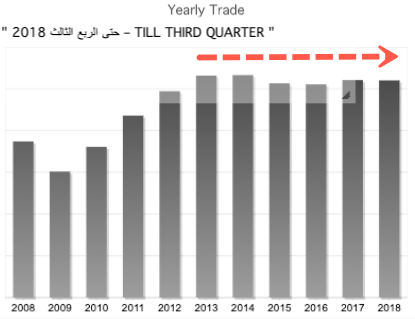
Dubai’s downturn indicates broad stress across the global economy. Western manufacturers have spent decades integrating supply chains into the city’s top ports. So, it’s not surprising that Dubai is a coal mine canary for Western economies-now showing a trade recession could be immient.
via ZeroHedge News https://ift.tt/2V1g1qF Tyler Durden
Dick Cheney’s Global War on Terror (GWOT) is back, metastasized as a hybrid mongrel.
But GWOT would not be GWOT without a Wild West scarecrow. Enter Hamza bin Laden, son of Osama. On the same day the State Department announced a $1 million bounty on his head, the so- called “UN Security Council IS and Al-Qaeda Sanctions Committee” declared Hamza the next al-Qaeda leader.
Since January 2017, Hamza has been a Specially Designated Global Terrorist by the State Department – on par with his deceased Dad, back in the early 2000s. The Beltway intel community “believes” Hamza resides “in the Afghanistan-Pakistan region.”
Remember these are the same people who “believed” former Taliban leader Mullah Omar resided in Quetta, Baluchistan, when in fact he was safely ensconced only a few miles away from a massive U.S. military base in Zabul, Afghanistan.
Considering that Jabhat al-Nusra, or al-Qaeda in Syria, for all practical purposes, was defined as no more than “moderate rebels” by the Beltway intel community, it’s safe to infer that new scarecrow Hamza is also a “moderate”. And yet he’s more dangerous than vanished fake Caliph Abu Baqr al-Baghdadi. Talk about a masterful example of culture jamming.
Show Me The Big Picture
A hefty case can be made that the Empire of Chaos currently has no allies; it’s essentially surrounded by an assortment of vassals, puppets and comprador 5thcolumnist elites professing varied degrees of – sometimes reluctant – obedience.
The Trump administration’s foreign policy may be easily deconstructed as a crossover between The Sopranos and late-night comedy – as in the whole episode of designating State Department/CIA regime change, lab experiment Random Dude as President of Venezuela. Legendary cultural critic Walter Benjamin would have called it “the aestheticization of politics,” (turning politics into art), as he did about the Nazis, but this time it’s the Looney Tunes version.
To add to the conceptual confusion, despite countless “an offer you can’t refuse” antics unleashed by psychopaths of the John Bolton and Mike Pompeo variety, there’s this startlingnugget. Former Iranian diplomat Amir Moussavi has revealed that Trump himself demanded to visit Tehran, and was duly rebuffed. “Two European states, two Arab countries and one Southeast Asian state” were mediating a series of messages relayed by Trump and his son-in-law Jared “of Arabia” Kushner, according to Moussavi.
Is there a method to this madness? An attempt at a Grand Narrative would go something like this: ISIS/Daesh may have been sidelined – for now; they are not useful anymore, so the U.S. must fight the larger “evil”: Tehran. GWOT has been revived, and though Hamza bin Laden has been designated the new Caliph, GWOT has shifted to Iran.
When we mix this with the recent India-Pakistan scuffle, a wider message emerges. There was absolutely no interest by Prime Minister Imran Kahn, the Pakistani Army and the Pakistani intelligence, ISI, to launch an attack on India in Kashmir. Pakistan was about to run out of money and about to be bolstered by the U.S., via Saudi Arabia with $20 billion and an IMF loan.
At the same time, there were two almost simultaneous terrorist attacks launched from Pakistan – against Iran and against India in mid-February. There’s no smoking gun yet, but these attacks may have been manipulated by a foreign intelligence agency. The Cui Bono riddle is which state would profit immensely from a war between Pakistan and Iran and/or a war between Pakistan and India.
The bottom line: hiding in the shadow of plausible deniability – according to which what we understand as reality is nothing but pure perception – the Empire of Chaos will resort to the chaos of no-holds-barred Hybrid War to avoid “losing” the Eurasian heartland.
Show Me How Many Hybrid Plans You Got
What applies to the heartland of course also applies to the backyard.
The case of Venezuela shows that the “all options on the table” scenario has been de facto aborted by Russia, outlined in an astonishing briefing by Maria Zakharova, spokeswoman of the Russian Foreign Ministry, and then subsequently detailed by Russian Foreign Minister Sergey Lavrov.
Lavrov: (Wikimedia Commons)
Meeting with Chinese Foreign Minister Wang Yi and Indian Foreign Minister Sushma Swaraj at a crucial RIC (part of BRICS) summit in China,Lavrov said,“Russia keeps a close eye on brazen US attempts to create an artificial pretext for a military intervention in Venezuela… The actual implementation of these threats is pulling in military equipment and training [US] Special Forces.”
Lavrov explained how Washington was engaged in acquiring mortars and portable air defense systems “in an East European country, and mov(ing) them closer to Venezuela by an airline of a regime that is… rather absolutely obedient to Washington in the post-Soviet space.”
The U.S. attempt at regime change in Venezuela has been so far unsuccessful in several ways.
Plan A – a classic color revolution -has miserably failed, in part because of a lack of decent local intelligence.
Plan B was a soft version of humanitarian imperialism, with a resuscitation of the nefarious, Libya-testedresponsibility to protect (R2P); it also failed, especially when the American tale that the Venezuelan government burnt humanitarian aid trucks at the border with Colombia was a lie exposed, no less, than byThe New York Times.
Plan C was a classic Hybrid War technique: a cyberattack, replete with a revival of Nitro Zeus, which shut down 80 percent of Venezuela’s electricity.
That plan had already been exposed by WikiLeaks, via a 2010 memo by a U.S.-funded, Belgrade-based color revolution scam that helped train self-proclaimed “President” Random Dude, when he was just known asJuan Guaidó. The leaked memo said that attacking the Venezuelan power grid would be a “watershed event” that “would likely have the impact of galvanizing public unrest in a way that no opposition group could ever hope to generate.”
But even that was not enough.
That leaves Plan D – which is essentially to try to starve the Venezuelan population to death via viciously lethal additional sanctions. Sanctioned Syria and sanctioned Iran didn’t collapse. Even boasting myriad comprador elites aggregated in the Lima group, exceptionalists may have to come to grips with the fact that deploying the Monroe doctrine essentially to contain China’s influence in the young 21stcentury is no “cakewalk.”
Plan E—for extreme—would be U.S. military action, which Bolton won’t take off the table.
Show Me the Way to the Next War Game
So where do all these myriad weaponizations of chaos theory leave us? Nowhere, if they don’t follow the money. Local comprador elites must be lavishly rewarded, otherwise you’re stuck in hybrid swamp territory. That was the case in Brazil – and that’s why the most sophisticated hybrid war case history so far has been a success.
In 2013, Edward Snowden and WikiLeaks revealed how the NSA was spying on Brazilian energy giant Petrobras and the Dilma Rousseff government beginning in 2010. Afterwards, a complex, rolling judicial-business-political-financial-media coup ended up reaching its two main objectives; in 2016, with the impeachment of Rousseff, and in 2018, with Lula thrown in jail.
Now comes arguably the juiciest piece of the puzzle. Petrobras was supposed to pay $853 million to the U.S. Department of Justice for not going to trial for crimes it was being accused of in America. But then a dodgydeal was struck according to which the fine will be transferred to a Brazilian fund as long as Petrobras commits to relay confidential information about its businesses to the United States government.
Mattis: Wrote on hybrid war in 2005.
Hybrid war against BRICS member Brazil worked like a charm, but trying it against nuclear superpower Russia is a completely different ball game. U.S. analysts, in another case of culture jamming, even accuse Russia itself of deploying hybrid war – a concept actually invented in the U.S. within a counter-terrorism context; applied during the occupation of Iraq and later metastasized across the color revolution spectrum; and featuring, among others, in an article co-authored by former Pentagon head James “Mad Dog” Mattis in 2005 when he was a mere lieutenant general.
At a recent conference about Russia’s military strategy, Chief of General Staff Gen. Valery Gerasimov stressed that the Russian armed forces must increase both their “classic” and “asymmetrical” potential. In the U.S. this is interpreted as subversion/propaganda hybrid war techniques as applied in Ukraine and in the largely debunked Russia-gate. Instead, Russian strategists refer to these techniques as “complex approach” and “new generation war”.
Santa Monica’s RAND Corporation still sticks to good ol’ hot war scenarios. They have been holding “Red on Blue” war games simulations since 1952 – modeling how the proverbial “existential threats” could use asymmetric strategies. The latest Red on Blue was not exactly swell. RAND analyst David Ochmanek famously said that with Blue representing the current U.S. military potential and Red representing Russia-China in a conventional war, “Blue gets its ass handed to it.”
None of this will convince Empire of Chaos functionary Gen. Joseph Dunford, chairman of the Joint Chiefs of Staff, who recently told a Senate Armed Services Committee that the Pentagon will continue to refuse a “no first use” nuclear strategy. Aspiring Dr. Strangeloves actually believe the U.S. can start a nuclear war and get away with it.
Talk about the Age of Hybrid Stupidity going out with a bang.
via ZeroHedge News https://ift.tt/2OuA6U5 Tyler Durden
According to a survey by tech and business newsletter The Hustle, drunk Americans spend approximately $45 billion per year, with an average annual spend of $444 per drunk shopper.
Most common? Clothing and shoes, while Amazon remains the shopping platform of choice.
The findings are based on a survey of 2,174 alcohol-consuming readers between March 11-18 of this year. The average respondent was 36-years-old, and has an income of $92,000 per year, more than double the national average. Thus, The Hustle‘s wealthier readers may skew the results when extrapolated – but we’re having fun with this one.
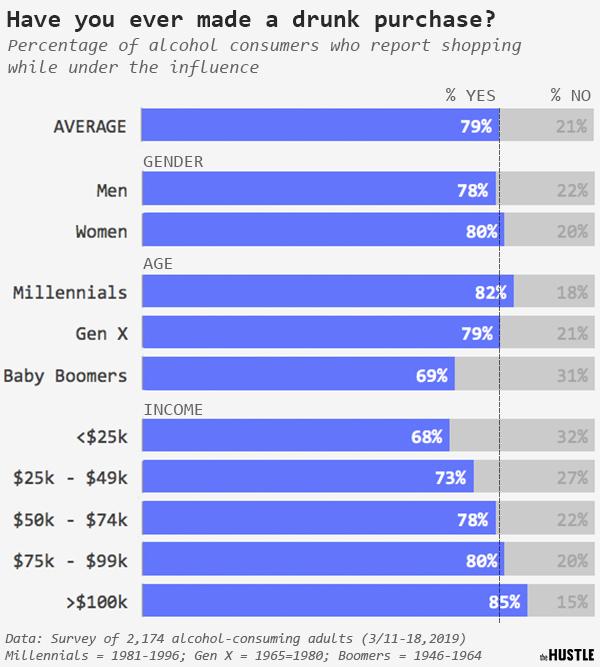
Overall, 79% of all alcohol-consuming respondents have made at least one drunken purchase in their lifetime — though this varies a bit based on demographics. –The Hustle
Women (80%) are slightly more likely than men (78%) to drunk shop. This makes sense since women generally shop more than men — especially online.
Drunk shoppers also tend to be younger. Millennials outrank baby boomers by 13%, which might be attributed to the rise of e-commerce (we’ll get to this later).
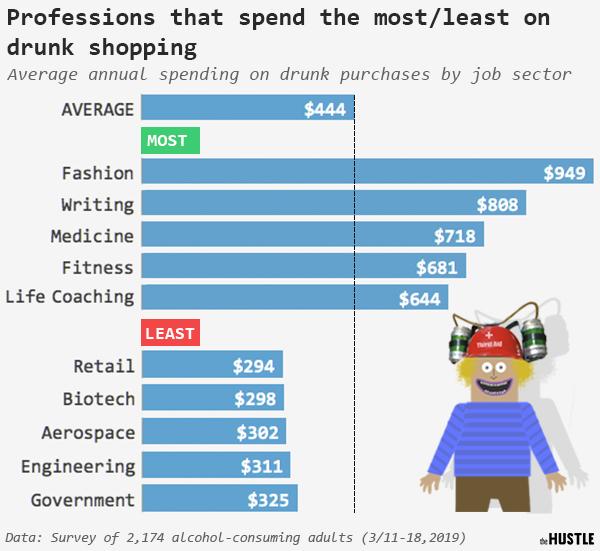
Certain professionals also seem to be more inclined to shop drunk than others. We limited our data to jobs with the highest response rates then parsed out the 5 industries that are most and least likely to shop under the influence. –The Hustle
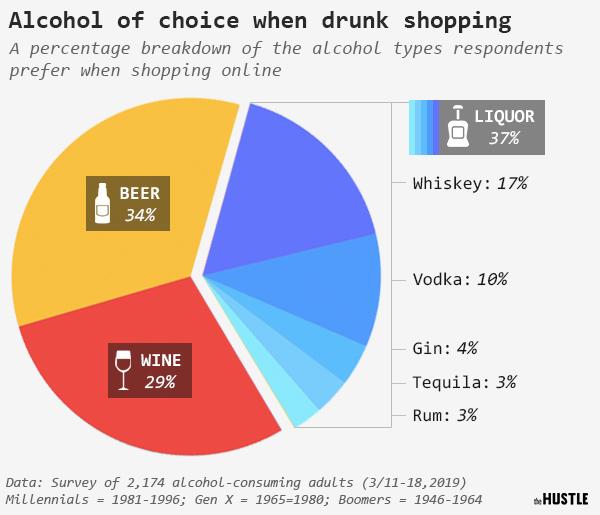
What’s the alcohol of choice while drunk shopping? Beer, followed by wine, followed by whiskey.
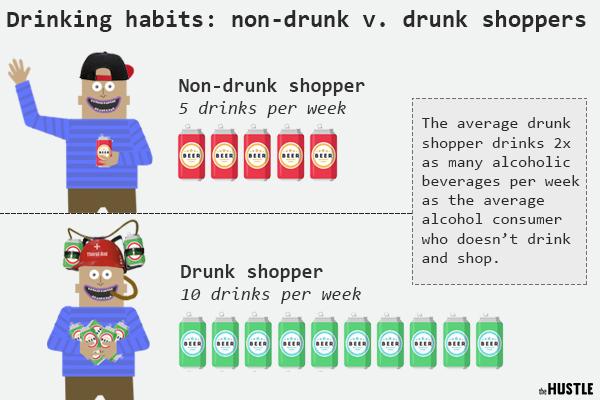
Another interesting metric is that people who shop while drunk have around 10 drinks per week, while those who typically shop sober consume half as much.
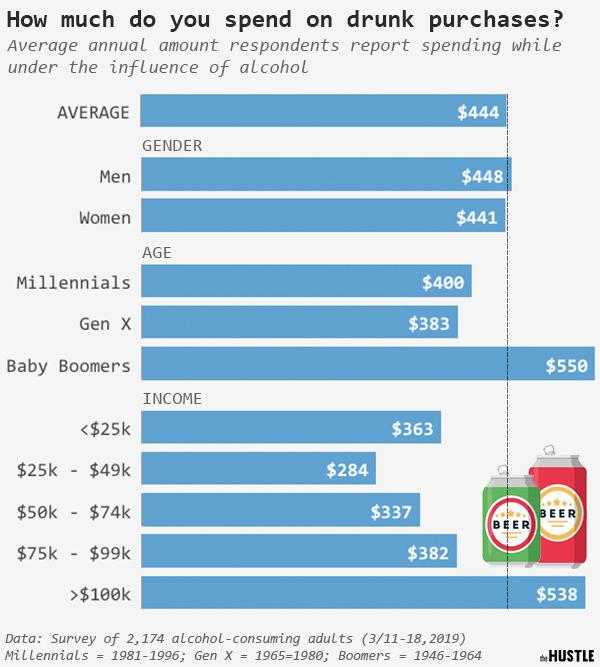
As far as average spent per year:
Our average respondent reports dropping $444 per year on drunk purchases — from life-size cut-outs of Kim Jong-un to 30-pound bags of Idaho potatoes.
A little back-of-the-napkin math gives us a rough estimate of the drunk shopping market at large: There are ~130m alcohol-consuming adults in the US. In our survey findings, 79% of alcohol-consuming adults shop drunk at an average annual spend of $444. Assuming these rates hold true at a national level (purely speculative), drunk shopping is a ~$45B per year market.
Extrapolating this further, we determined the average lifetime spend on drunk purchases is $4,187 — good for a total drunken expenditure of nearly half a trillion dollars.
When it comes to drunk shopping by profession, those in the fashion industry are the biggest, richest drunks – at an average of $949 spent per year, followed by writers, medical professionals and those in the fitness industry.
Who spends the least while shopping drunk? Government workers, engineers and – in last place, those working in retail.
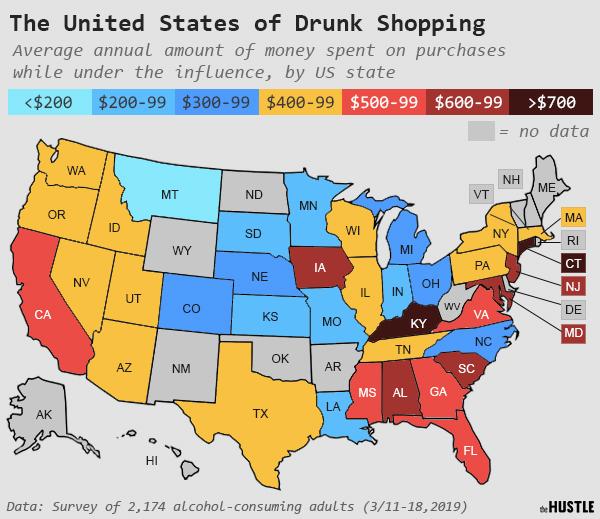
Geographically speaking Kentucky is oddly at the top along with Connecticut. Though, the survey may have had one really rich respondent in each state that skewed the results. Who knows.
Kentuckians top the charts with a $742 annual spend. In fact, the entire South — a region known for its fine bourbon — is a blanket of red. California, the country’s wine capital, is the lone over-achiever on the otherwise mediocre West Coast.
This bears little semblance to the CDC’s analysis of the heaviest binge-drinking states (in fact, it’s almost opposite). But it shows that the economics of drunk shopping is a more complex matter than simply parsing out where people drink the most.
As far as platform of choice, Amazon leads the pack, followed by Ebay, Etsy, Target and Walmart. At least two of those are worth an intervention if you ever catch your friends drunk shopping at Walmart, for example.
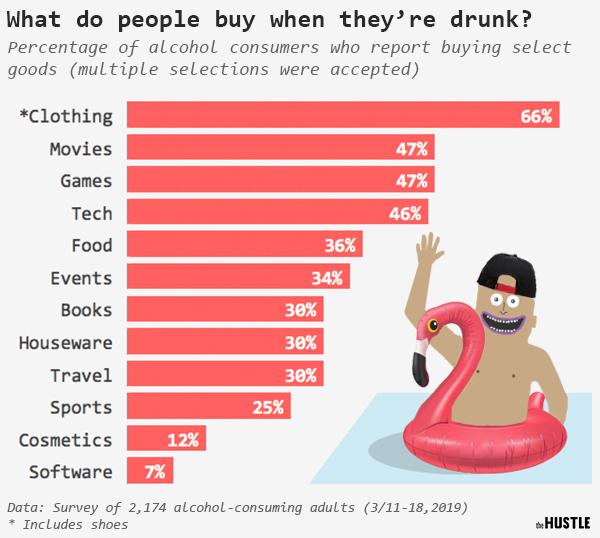
Clothing and shoes are the goods of choice while drunk.
Studies have shown that people who base their self-worth on appearance are more likely to imbibe alcohol, so there is some tenuous linkage here. But this also ties in with the rapid rise of the direct-to-consumer fashion industry.
Entertainment (movies, games) and tech gadgets are also popular choices — though the party train seems to abruptly halt at software (if you’ve purchased a copy of Microsoft Excel drunk, we need to talk.)
Weirdest purchases, according to The Hustle‘s readers?
200 pounds of fresh, 10-foot tall bamboo
A World War 2-era bayonet
A full-size inflatable bouncy castle (“For my living room”)
A breast pump (“I’m a dude”)
A splinter that was removed from the foot of former NBA Star, Olden Polynice
The same vest Michael J. Fox had on in Back to the Future
A $2,200 pair of night vision goggles
Tons of international fights (Azerbaijan, Iceland, Ukraine, Tunisia)
An NRA membership
A trilogy of Satanic religious books
Who could regret $2,200 night vision goggles?
via ZeroHedge News https://ift.tt/2FHYhvs Tyler Durden
In 1969, the salad days of New Left activism, a writer named Carol Hanisch penned an essay that the editor called “The Personal Is Political.” She was seeking to explain the ethos of the women’s therapy sessions she was running. The point was not to improve psychological well being. The point was “political therapy;” that is to motivate people to political action. The idea is that one’s own grievances ought to be turned into political action. “There are no personal solutions at this time,” she wrote. “There is only collective action for a collective solution.”
Let’s leave aside the case for or against her brand of politics. The slogan itself was fire. It spread to every cause, every group, every nook and cranny of life. If you experience dissatisfaction in your life, don’t look within for a personal solution; get active, join a collective, and demand a political solution. Think of this as the left-wing application of the Schmittian principle that only through politics do we find meaning (the very opposite point that has become the main theme of Jordan Peterson’s work).
Fifty years later, I’ve been following the meltdown of a number of “social justice” organizations and causes over the past months, as they turn in on themselves, purge themselves of their own self-defined evil and ultimately crumble based on their own inner contradictions. This happenedto the Women’s March. It has happened to the US Congress. It has happened to the most well-funded social justice activist organization in the country. It’s happened in Hollywood, which faces the problem that the more it complies with the identitarian code, the less profitable are its films.
There seems to be no end to the feeding frenzy caused by the politicization of every personal tick. A new entrant into the Democratic Party presidential race cannot even give a public speech without spending the week wailing mea maxima culpa for all the ways in which he violated the canon, however inadvertently. There are no penances sufficient to put one back in the good graces of the moral police of the left.
There are other absurdities, such as the candidate Elizabeth Warren’s alarming dalliance with genetic testing to verify family lore that she is part Native American and thus entitled to sympathy as a victim of oppression. The test not only failed to verify her lore; it produced outrage among tribal groups who clarified that their collective identity is cultural and social, not genetic.
When politics becomes so driven by personal identity that candidates imagine that DNA testing can garner them votes, we’ve reached not a moral high but a low that compares with some of the worst political experiments of the past (see Eugenics).
What’s happening here? The attempt to turn every subjectively felt personal issue into a collective cause with a collective action has hatched a brutal form of identity politics that has generated no end to social conflict, with vast carnage along the way.
The Theory Went Wrong
There are many problems with the slogan “the personal is the political” but two stand out. First, personal experience is as diverse as the people on the planet; surely not every personal experience can become a political cause without infinite clashes and contradictions. Second, the plan results in all-consuming state power to the point that you can’t speak, act, or even breathe without bumping into a cop – or a screaming mob.
Both problems have reached their boiling point sometime in the last two years. Surely you have noticed. In the name of justice, equity, and fairness, people are being fired from jobs for utterances or writings from decades ago. The wrong word or look can result in a mob attack and the loss of a career, no matter how successful one happens to be. The spotting of evil is endless and so fast-moving that it is impossible to keep up. Words and phrases that were the height of political compliance just five years ago (“his or her”) are now denounced as oppressively binary.
And the howling attacks against anyone and everyone who dissents is shutting down debate. One dares not take issue with, for example, the pummeling of a prominent person in absence of evidence for fear of doxing and flogging from howling moralists who will exact retribution against you. This explains the many strange pockets of silence on certain topics in the Twittersphere.
Impossible Ideals
The moral system being constructed by those who made “personal is political” their mantra has become infinitely complex to the point of being nonoperational. They once said that discrimination is wrong and many people agreed. The trouble is that the law is not a mind reader and so it uses proxies for what it deems to be discriminatory. That means racial and sexual quotas at the least but that’s only the beginning.
To achieve an absolutely even balance in every profession, at every level, not only in position but also in salary, is inconsistent with the actual choices of individuals. So what if those individuals are conscripted by outside observers into a group that the experts believe to be more decisive than mere choice? Instead of mere non-discrimination, the new demand became mandatory diversity.
But a diversity of what? That depends on how you want to slice and dice up the human family based on identity. There is race, sex, age, religion, physical ability, and also sexual preference, language, accent, gender identity, geography, class, and educational background. Maybe you think the diversity mandate should stop at physical biology alone but those too are in dispute (there is no pure race and, more recently, biological sex itself is said to be malleable).
The new additions to the canon include anti-harassment rules based on any of the above categories but that term has no clear definition, no evidentiary rules, no guidelines for compliance, and no statute of limitations. What it means in practice is to have as little human contact with others as possible, especially in a business environment. Literally, anyone can be accused and play-it-safe companies would rather toss out the targetted employee rather than risk bad public relations and an unwinnable lawsuit. The toll adds up daily.
Do Not Appropriate
Then most recently the architects of the identitarianism have added another impossible-to-keep law to its canon: you may not appropriate another culture. The intuition here stems from a genuine appreciation for the contributions of a people who deserve some kind of social credit for having made them. But does this mean that no one else may imitate, or be influenced by, another culture for the purpose of celebrating it? Hard to know for sure: we’d better ask official representatives of the culture to tell us. They will probably say no, and accuse you of theft.
The crucial theoretical problem with appropriation theory is that culture is at once malleable and infinitely reproducible at least in its outward appearance. Culture is not inextricably attached to a certain people however you want to identify those collective people, the members of which may or may not appreciate the identification. The crucial historical problem is that it is impossible to think of any point of progress in history that did not depend on appropriating cultural traits from beyond the experience of a small tribe. Follow this logic through far enough and you have to end in condemning all of human experience as inherently exploitative – and many do exactly this
Endless War
So let’s put all this together. The demand that we politicize every personal grievance presumes that people only exist as part of groups and those groups must be defined politically and such groupings can be infinitely complex as intersectionality theory demonstrates. One group’s winnings come at the expense of everyone else, and thus does every advance create the conditions for more oppression, disgust, outrage, condemnation, activism, and power grabbing, even as those groups are constantly changing in composition depending on political influence. There is no safety for anyone under this moral code; there is only fear and dread of exposure, and a miserable life overall.
Consider the old code of civic norms that all of this complexity of identity is designed to replace. As regards the law, it is simple: compulsion should only be deployed in the case of attacks on life and property. A wall exists that separates the use of state power from that which should be dealt with personally and in cooperation with others. The courts of manners and taste govern the rest. Keep your promises. Cultivate good relationships with others. Be empathetic. Admit failings when appropriate. Forgive when necessary. Respect the dignity of others. Do what you can to make others comfortable. Seek to live a good life but never at others’ expense.
This old code made a distinction between the personal and the political, with full knowledge that once you politicize anything, you create a zero-sum environment in which compulsion and bureaucracy rule. It is for this reason that the old code sought to restrain the state and empower society to be the primary venue for the development and cultivation of everything we call civilization. This is the code that brought to the world peace, prosperity, and understanding. Any “activism” that seeks to achieve social good should be animated by that ideal.
What we are seeing in our time are the results of a mandate that all personal problems must and should be channeled to political solutions demanded by a collective activist army, with the goal of constructing an apparatus of coercion and compulsion that knows no limits to its power. The results are pouring in: division, vituperation, personal destruction, and no end to the carnage. The implosion of the individuals and institutions that have professed fealty to the creed is a testament to its unworkability in real life.
via ZeroHedge News https://ift.tt/2OyfJVZ Tyler Durden
Since QuadrigaCX first started having “liquidity issues” late last year, aggrieved clients of the crypto exchange have been subjected to one wild twist after another, all of which have supported the conclusion that the roughly $150 million in customer deposits (estimates of the total sum vary) has mysteriously vanished, and will likely never be recovered.
In January, the exchange revealed that its co-founder and CEO, Gerald Cotten, had died suddenly from complications related to Crohn’s disease during a vacation in India. Cotten was responsible for the exchange’s day-to-day operations, and in a bankruptcy filing, his widow claimed that he had taken the keys to the exchange’s ‘cold storage’ wallets to his grave. Efforts to infiltrate the wallets proved futile, and according to the exchange, it appeared that customers’ coins would be trapped forever.
But as amateur sleuths and the auditing firm retained by the exchange dug deeper, inconsistencies began to emerge. The exchange refused to reveal the public addresses of these wallets. And when the auditors finally got them, they found that six wallets that were supposed to hold nearly $100 million in coins had been emptied months before Cotten’s death.
Gerald Cotten
Weeks later, Bloomberg reported that a co-founder of the exchange who eventually quit had once been jailed for fraud.
All of this came as a shock to the exchange’s clients. At one point, Quadriga had been the largest crypto exchange in Canada. And according to a regulatory attorney who had been retained by the firm during its early days, at one time, Cotten had been on the path to building the most transparent and secure exchange in Canada, if not the world. Quadriga had four law firms advising it. It hired an auditor, and even secured insurance for its cold-storage deposits.
Then one day, he suddenly broke bad, fired all the outside advisors and auditors, and decided to go it alone, according to Christine Duhaime, a lawyer who had been working with the firm. Duhaime shared her experience with Quadriga during a lengthy essay published earlier this week on CoinDesk.
As Duhaime put it, Cotten wanted to get rid of all the “‘law and order’ folks.”
The QuadrigaCX story is by no means over but our bit of the story ended abruptly one morning when its CEO, Gerald Cotten, made the decision that he no longer wanted QuadrigaCX to be a listed company.
On that day, he terminated the professionals that were, in his mind, the “law and order” folks – the accountant, the auditor and me, the regulatory attorney.
From that moment onwards, Mr. Cotten solely took over QuadrigaCX and operated the exchange as if it had no investors, no shareholders, no regulatory agencies and no law that applied to it – no corporate law, no securities law, no anti-money-laundering law and no contract law. I don’t know why Mr. Cotten decided to eschew regulatory law but I never spoke with him after that day. (In January of this year, QuadrigaCX announced he had died a month earlier.)
From there, Duhaime’s story gets even stranger. According to the essay, she was never privy to the motivations behind Cotten’s decision. Though a few months before her firm was brought on, Quadriga separated into three separate companies, allowing it to take on a raft of new shareholders, many of whom hadn’t been vetted.
Why is this relevant? Duhaime can’t say for sure, but while she was working on Quadriga’s account, she came to believe that the whole Quadriga team fell under the impression that the company had unwittingly stumbled into a “Vancouver pump-and-dump scheme”. Duhaime doesn’t provide any more details about this supposed scheme, saying only that the team consisted of tech professionals who were unfamiliar with the vicissitudes of financial markets.
No story of QuadrigaCX is complete without understanding one more fact – six months before we were retained, it had gone through a court-approved plan of arrangement and become three companies, and as a result, it inherited a slew of new shareholders it knew nothing about. (A fourth company was later set up.)
It is my belief that the whole QuadrigaCX team came to believe that the company may have unwittingly become involved in a Vancouver pump-and-dump scheme. Whether it had been drawn into a pump-and-dump is not for me to say because it was before my time, but I can say that QuadrigaCX was run by tech geeks, who were competitive, ambitious and smart but who were unfamiliar with the capital markets ecosystem in Vancouver.
Though most of her essay focuses on the team’s good intentions, the fact that Cotten made this abrupt, unexplained change may suggest that whatever issues resulted in the loss of its customers’ coins – assuming it wasn’t outright theft by Cotten or his associates – Cotten may have tried to conceal it for years.
Customers have been impacted to varying degrees. One Canadian software engineer lost his entire life savings. Another crypto trader lost $75,000 due to one ill-timed trade. And while it’s likely they will never recover their money, we can only guess what the next Quadriga-related bombshell might reveal.
Bit unusual, but why not. I was reading British press earlier, trying to figure out what the fcuk is going on in London two days before March 29, and in an article in the Guardian I saw this comment, and thought it should be saved for posterity.
Since the article is/was one of those live updates ones, which tend to get very long, and moreover at the point I read it it already had well over 11,000 other comments, posting it here seemed to be the way to go to achieve that.
It was posted by someone who named themselves Tintenfische (German for squid, octopus?!), and that’s all I know about this person(s), who imagines a speech someone should stand up and deliver in the house. I think it says exactly what needs to be said, what politicians should say, in Britain where civil unrest is much closer than anyone wants to see, in the US where very similar scenarios are playing out, and in many other countries.
The failure of party politics is everywhere to be seen.
Tintenfische: Speech I wish someone would have the courage to give.
As I stand in Parliament today I see the faces of friends and colleagues I’ve worked alongside, struggled alongside, triumphed and lost alongside. Good men and women all from both sides of the house.
We and the parties we represent have fought for our beliefs and battled for our constituents for centuries. We’ve done what we believed to be right, we’ve fought battles we believed should be fought and shown the people across the globe how democracy when at its best is the only route to freedom. In this place too I’m confronted with history. It was here that our predecessors decided to stand up to fascism, where we ended slavery and wrote into law that no man or woman, no matter their race, colour, who they fall in love with or who they pray to is less than any other of us. We declared as a house that injustice must be fought, that evil opposed and democracy triumphed.
Great things have been done in this place, great things by great men, great women and even greater parties. However my friends that legacy is now at an end.
We have failed.
We have failed and our failure has broken this house and the institution we love. We have failed and with that too comes the failure of party politics.
None of us can run from that reality, none of us can hide, deny or challenge that reality. We have through partisan means on both sides of this house broken government of this once united nation. I could list the decisions, the politics, the loyalties which delivered this rupture. I could name names, point out lies and tell of moments when through advantage, greed or idiocy we decided to do what was best for our parties rather than our country, what was best for us rather than our constituents. I could list all those many many occasions when we as servants of the people failed the people, but what would be the point?
The truth is none of us are innocent, none of us escape blame. We as the leaders of this country could have stopped a collapse but we all chose this place and control over it as being more important than those outside. We chose ourselves and our parties ahead of our people.
But what else could we do? We could have stood up, we could have protested, we could have denied our own leaders but to what end? We all believe that we and the parties we represent are best placed to do what is right for this country. We all think that the shared policies, morals and ethics of ourselves and our parties are the right way for a country to be run. If we didn’t believe we knew best we wouldnt be here. But there’s the problem, circumstance has shown this not to be the case. Now we stand atop of a divided, fractured nation one which may never be able to be reformed and that has happened because of us. It is our fault. By following those certainties of righteousness and rightness both of ourselves and of our parties we have precipitated this collapse. We are now the problem.
So what’s to be done? We could just carry on, we could just continue down this same path which every day makes this country more divided, more ungovernable, more leaderless. We certainly could do that and looking around this room it’s easy to see so many of us already resigned to the path of destruction. Resigned to a rapid decline because we’re all too Cowed too timid to say no.
But we could also say no. We could as one house say to the country “I’m sorry but no. We can’t make these decisions, we’re not good enough. We can’t do anything but fail you or your future from here on in”. The people elected us to represent them it is true but we’re no longer capable of that, our parties are no longer capable of that. It is no longer in the national interest that we continue to represent the people when we can’t even govern ourselves.
We need to change ladies and gentlemen, we need to be better. We need to be greater than the sum of our parts. Each and everyone of us needs to decide who and what we are, who we represent. We need to turn away from the safety and comradeship of party loyalty and act and vote on what we believe to be right, what we believe to be in the best interests of our nation, not what our leaders tell us is best because if we’ve failed then our leaders are double damned by their double failure.
What I’m asking is extreme, I’m asking you my fellow members to destroy the parties you all represent. I’m asking you for the sake of the nation to walk away from rosette loyalty and remember your oaths. I’m asking you to do the right thing.
We are no longer able to govern, we cannot lead and we cannot decide. We must return the question of our place in the world back to the people and once that’s done we must dissolve this house and our parties and a new slate be mined because right now not one of us is fit to stand in this place and claim leadership of this disunited kingdom.
via ZeroHedge News https://ift.tt/2FykPNJ Tyler Durden
Could the next great Chinese advanced missile threat come disguised as an innocuous looking shipping transport vessel? A new report in The Washington Free Beacon suggests so, as it details China’s new long-range cruise missile which can be launched directly from a shipping container device, which is meant to conceal detection of the threat right up until the moment of launch.
Alarmingly, it’s already being flight tested, according to analysts cited in the report, which further finds the technology “could turn Beijing’s large fleet of freighters into potential warships and commercial ports into future missile bases.” If cruise missiles can be hidden in international shipping containers, China could be a major threat to western targets simply as it moves millions of tons of goods every year.
A Russian previously unveiled a similar weapon system in the international arms market called the Club K cruise missile system.
Rick Fisher, a senior fellow at the International Assessment and Strategy Center, told the Free Beacon, “Shipping container missile launchers can be smuggled through ports or via highway ports of entry and stored for years in a climate-controlled building within range of U.S. military based and taken out when needed for military operations.”
“Potentially, Chinese missile launching containers could be stored near the Port of Seattle, waiting for the day they can launch an electromagnetic pulse warhead-armed missiles over the Bangor nuclear ballistic missile submarine base,” he speculated.
The concealed nature of a launch-ready long-range missile also presents the nightmare scenario of ease of proliferation to rogue actors such as Iran or North Korea. “Containerized missiles give China, Russia, and its rogue state partners new options for directly or indirectly for attacking the United States and its allies,” Fisher added.
However, it should be noted that a defense company in Russia appears to have been the first to develop and market shipping container weapons nearly a decade ago. Yet even at that time analysts began to worry of that Russian private sector defense technology development, “Unless sales are very tightly controlled, there is a danger that it could end up in the wrong hands.”
The new missile being developed as part of the container-launch device program is said to be a variant of an advanced anti-ship missile called YJ-18C, according to US defense officials cited in the report.
Israel has also for years been developing a similar container launch system for a short range ballistic missile, called the “LORA”.
One career US military officer and former Pacific Fleet intelligence chief described how a container concealed Chinese cruise missile could be a game changer in terms of assessing threats near US waters and ports:
Retired Navy Capt. Jim Fanell, a former Pacific Fleet intelligence chief, said a containerized YJ-18 anti-ship cruise missile would add a significant threat to the Navy given the volume of Chinese container ships that enter U.S. ports on the west and east coast, well within range of the vast majority of the U.S. fleet.
“If this capability is confirmed, it will require a completely new screening regime for all PRC flagged commercial ships bound for U.S. ports,” Fanell said.
Additionally the container-launched missiles could be targeted in foreign ports used by Chinese-flagged merchant vessels.
On that front, Washington military planners say there is much to be concerned about. One adviser and research professor at the US Army War College described China’s military activities in Latin America and the Caribbean as “extensive”.
A Russian company had previously simulated how its “container weapons” systems would operate.
Professor R. Evan Ellis said that during a conflict, “China’s substantial commercial base, its access to ports, and its military-to-military contacts in the Caribbean might prove useful,” as cited in the Free Beacon.
“All of these add up to growing Chinese influence in a region located close to the U.S. as well as its most important Atlantic coast military facilities,” he added.
The report noted that Israel has also for years been developing a similar container launch system for a short range ballistic missile, called the “LORA”.
via ZeroHedge News https://ift.tt/2JL8J9q Tyler Durden
Recently, an American colleague commented to me, “We no longer live in a democracy but a dictatorship disguised as a democracy.”
Is he correct?
Well, a dictatorship may be defined as “a form of government in which absolute authority is exercised by a dictator.”
The US today is not be ruled by dictatorship (although, to some, it may well feel that way.)
But, if that’s the case, what form of rule does exist in the US?
At its formation, the founding fathers argued over whether the United States should be a republic or a democracy. Those founders who later formed the Federalist Party felt that it should be a democracy – rule by representatives elected by the people. Thomas Jefferson, who created the Democratic Republican Party, argued that it should be a republic – a state in which the method of governance is democracy, but the principle of governance is that the rights of the individual are paramount.
He argued that, “Democracy is nothing more than mob rule, where fifty one percent can vote away the rights of the other forty nine.”
At that time, Benjamin Franklin has been credited as saying, “Democracy is two wolves and a lamb voting on what to have for dinner.”
Very well stated.
As Americans still legally vote, and it may well be that the voting is not altogether rigged, the US could be regarded as a democracy. Of course, to be accurate, it could also be defined as a bureaucracy – rule by officialdom, and/or a plutocracy – rule by the very rich. Both of these descriptions are undeniably accurate.
Another question that’s hotly debated is what sort of “ism” the US is living under. There’s a visible trend in new candidates to openly promote socialism. Historically, socialism has always been an excellent way to gain votes, as the socialist promises largesse to the average man that government will provide by robbing the rich. Not surprisingly, the average voter would find this prospect very attractive.
Socialist candidates in the US today base their argument for socialism on the premise that “capitalism has failed,” and that premise is providing them with great headway. They claim that prosperity for the American people is almost non-existent; that the middle class is shrinking and the small upper class is growing ever-richer.
These claims are undeniably true… but not because capitalism has failed.
Vladimir Lenin stated that “Fascism is capitalism in decay.” He was quite correct. Fascism is a slow cancer that eats away at an economy. It transfers wealth to the largest, most politically influential corporations. Yet, the concept of fascism is greatly misunderstood today. Most anyone who decries fascism will describe symptoms such as jackboots and swastikas, but fail to offer an actual definition.
For a definition, we might ask Benito Mussolini, the father of national fascism. He stated, “Fascism should more properly be called corporatism, since it is the merger of state and corporate power.”
By defining the term, we can conclude that the US is no longer a capitalist country and hasn’t been one for a long time. The US began its slide into fascism in a major way around the time that income tax and the Federal Reserve were created – in 1913. These measures were the brainchild of the largest bankers of the day and the Fed still remains under the power of the major banks.
Over the last century, the Deep State, which is corporatist in origin, has grown and has done a first rate job of introducing a combination of socialism and fascism, a bit at a time. This has slowly destroyed the economy, education and the national moral compass, not to mention achieving the utter corruption of the political system.
By contrast, capitalism is a free-market system, in which the economy, unfettered by the interference of governments, finds its own level at any given time. It fluctuates naturally, based upon supply and demand, each correcting the other with regularity.
But government edicts operate with force and permanence, constricting the natural flow of money, goods and services. Over time, regulations pile on top of regulations until the system becomes dysfunctional.
Socialism, by its very nature, is a central restrictive force on the free market. Its logical conclusion is very visible in Venezuela today, where government regulation has produced such a stranglehold on the economy that it’s broken down in every way, resulting in dire poverty and even starvation.
But, as stated above, in the US, the Deep State has been thorough in its presentation of the US economy as a capitalist economy. In doing so, they’ve provided the encouragement of full socialism in the political realm.
In the near future, the economy will begin to collapse under the weight of growing fascism and socialism. However, the blame will be laid at the feet of capitalism.
In my belief, the majority of Americans will be fooled into thinking that capitalism is the problem and that socialism will save the day. During the coming financial crisis, they’ll dive in with both feet.
Voters, even many of those who are moderate, will support socialist candidates. The first national election that occurs after the crisis has begun will result in an overwhelming victory for socialist and other leftist candidates. The next president will provide a plethora of socialist “solutions” to counter “the damage done by capitalism.”
But such a prediction does not require a crystal ball. This has happened many times before. The Athenian Republic ran into the same problem. The Roman Republic also deteriorated in this manner. As stated by Aristotle, “Republics decline into democracies and democracies decline into despotisms.”
Quite so. It’s a natural progression.
And so, it shouldn’t be surprising if the more imaginative American were to observe, worriedly, “Toto, I don’t think we’re in Kansas anymore.”
He would most certainly be correct. Like the flag in the image above, the founding principles have been turned upside down and the rights of Americans have been shredded. “America,” as a concept, no longer exists in the USA. Its vestiges remain, but soon, they too will be on the way out.
Liberty always exists somewhere in the world, but it does tend to change location from time to time.
Perhaps a final quote from late eighteenth century America would be of benefit – one from Thomas Paine.
“My country is wherever liberty lives.”
* * *
Clearly, there are many strange things afoot in the world. Distortions of markets, distortions of culture. It’s wise to wonder what’s going to happen, and to take advantage of growth while also being prepared for crisis. How will you protect yourself in the next crisis? See our PDF guide that will show you exactly how. Click here to download it now.
via ZeroHedge News https://ift.tt/2HYhc6z Tyler Durden
Even though the Federal Reserve has been raising its benchmark interest rate somewhat consistently – it at small increments – most accounts are still not earning meaningful interest. In fact, as the chart below from Bloomberg shows, accounts at traditional money centers banks are earning next to nothing: Citigroup is paying 0.04% and JP Morgan is paying just 0.01% interest, despite rates rising.
This is mostly a result of clients not caring about getting paid more – they continue to deposit new money, so banks haven’t felt pressure to raise rates. It goes to show how attitude on yield for your money in this country has shifted significantly from a focus on interest-bearing accounts to deploying capital in investments like stocks and bonds. It’s almost as if, due to insane low rate Fed policy, the country has forgotten that depositors are supposed to be “rewarded” for saving and putting their capital in a bank’s hands.
But we digress. Because while the big banks, drowning in trillions of excess reserves don’t care about the incremental liquidity provided by deposits, that doesn’t mean that there aren’t a rising number of banks out there, hungry for new cash, that are eager to lure depositors with higher rates. Online “banks” at American Express and Goldman’s new Marcus consumer unit, are offering savings account rates of 2% or more.
Historically, this isn’t a lot, but when compared to the Fed’s benchmark rate, which is now at 2.5%, and the 2.4% you would get on a US 10 year treasury, it isn’t bad, especially in a “low inflation” economy. As a result, some investors are taking notice and deposit growth at many of these online banks is accelerating.
The flows into these new banks aren’t of such a significant magnitude that they are having a tangible effect on the nation’s largest banks, but some regional banks are feeling pressure as a result. For example, Citizen’s Financial Group and US Bancorp have both said in recent weeks that they’re finding it harder to attract deposits due to the rates that competitors are offering (maybe Citizen’s and USB should consider raising their own deposit rates).
Allen Tischler, an analyst at Moody’s said that “First-quarter results probably will show a continued rise in deposit costs. Even if the Fed’s on pause and rates aren’t necessarily rising, not all depositors have taken advantage of rates that are higher today than they were a year ago. So there probably will be continued catch-up, particularly on the consumer side.”
Across all depositor institutions, the average rate on a checking account is just 0.29%, up from just 0.24% or year ago. Ray Montague, Informa’s director of deposit-product research told Bloomberg: “It went from really, really bad rates to just really bad rates.”
But ultimately, rates haven’t been high enough for consumers to want to move their cash. Somebody with $1000 in savings would see a difference of about $22 between a bank offering 0.05% and 2.25% for the year. Then the question becomes whether or not it is worth it to move the money.
RBC Capital analyst Gerard Cassidy said: “Is it worth it for $20 to move your money? The answer is no. If you have $100,000, it’s worth it. I think what you’re finding with Marcus and these other products is the average deposit is quite large because it is that money that is moving to higher rates.”
Meanwhile, banks continue to be the beneficiary of the Fed’s rate hikes, which allows them to capture the spread between what they charge on loans and what they give out on deposits, also known as the net interest margin. Deposits at banks like JPMorgan continue to rise, despite the low rates. That said, after the latest curve inversion, it is generally expected that bank interest income is about to take a major hit.
Thasunda Duckett, who leads consumer banking at JPMorgan, said: “The incremental deposits we acquired in this time alone would be enough to create the seventh largest U.S. bank. We’ve been successful because we’ve won at both acquiring new relationships and satisfying existing ones.”
Ironically, this perhaps best indicates that despite Americans’ ongoing complaints about low interest rates, when rates do go up, few savers actually take advantage. And now, that more are finally starting to take advantage of better deposit conditions the Fed is preparing to start cutting rates again.
via ZeroHedge News https://ift.tt/2U2js41 Tyler Durden
With the recent second verdict where a jury ruled that Roundup weedkiller contributed to a man’s cancer, controversial pesticides, herbicides and fungicides are once again in the news.
These chemicals, particularly the herbicide glyphosate (the active ingredient in Roundup) have long played a role in American agriculture, but their health risks are only now being understood. As a result, thousands of cancer lawsuits have been filed against Monsanto, the company that invented Roundup, and Monsanto’s new parent company, Bayer AG.
Along with Priceonomics customer WeedKillerCrisis We decided to analyze data to uncover which states in the United States had the most and least exposure to pesticides, herbicides and other agricultural chemicals, with a particular focus on glyphosate, the active ingredient that is in the news right now. We looked at data from the U.S. Geological Survey (USGS) to see which compounds were most popular and which locations had the highest usage levels of these chemicals.
By a significant margin, the most popular herbicide in the United States is glyphosate, which is four times more popular than the second most popular chemical. Not surprisingly, large agricultural states like California, Washington, and Illinois use the most pesticides.
However, some states that use a lot of these chemicals see very little glyphosate usage, while others nearly exclusively use the compound. In California for example, only 6 percent of pesticide usage is glyphosate, while in Montana, 52 percent of such usage is from glyphosate
Methodology
Before diving into the results, it’s worth spending a moment on the methodology and data source. We looked at data from the Pesticide National Synthesis Project published by the USGS, a division of the Department of the Interior that estimates pesticide, herbicide, and fungicide usage in agricultural operations throughout the 48 continental states. Some of these compounds (like glyphosate) are technically herbicides, but for the purposes of this article, we’re using the term pesticide to cover all such chemicals, as the USGS data does. We looked at the most recent data that was available for all states (2016) and used the high-end estimates provided.
The USGS counts over 400 pesticides as part of its survey, but the top 20 pesticides make up 80 percent of all pesticide usage. The chart below shows the estimated usage of these pesticides by kilogram:
By a significant margin, glyphosate is the most popular pesticide used in American agriculture. Over 130 million kilograms were used in 2016, which was approximately four times more than the second-place pesticide, Atrazine.
In total, just over 544 million kilograms of pesticides were used in the U.S. in 2016, and 24 percent of that was glyphosate. It’s hard to overestimate just how pervasive Roundup and glyphosate are this country.
In general, where are pesticides most common in the United States? The next chart shows kilograms of all pesticides used in each state measured by the USGS data.
Agricultural states with large swaths of land use the most pesticides, and as a result, California uses the most pesticides by far. California makes up 11.6 percent of all pesticide usage nationally and uses nearly twice as much as the second-ranking state, Washington. As would be expected, states with smaller land masses and less agriculture, such as much of New England, use the least pesticides.
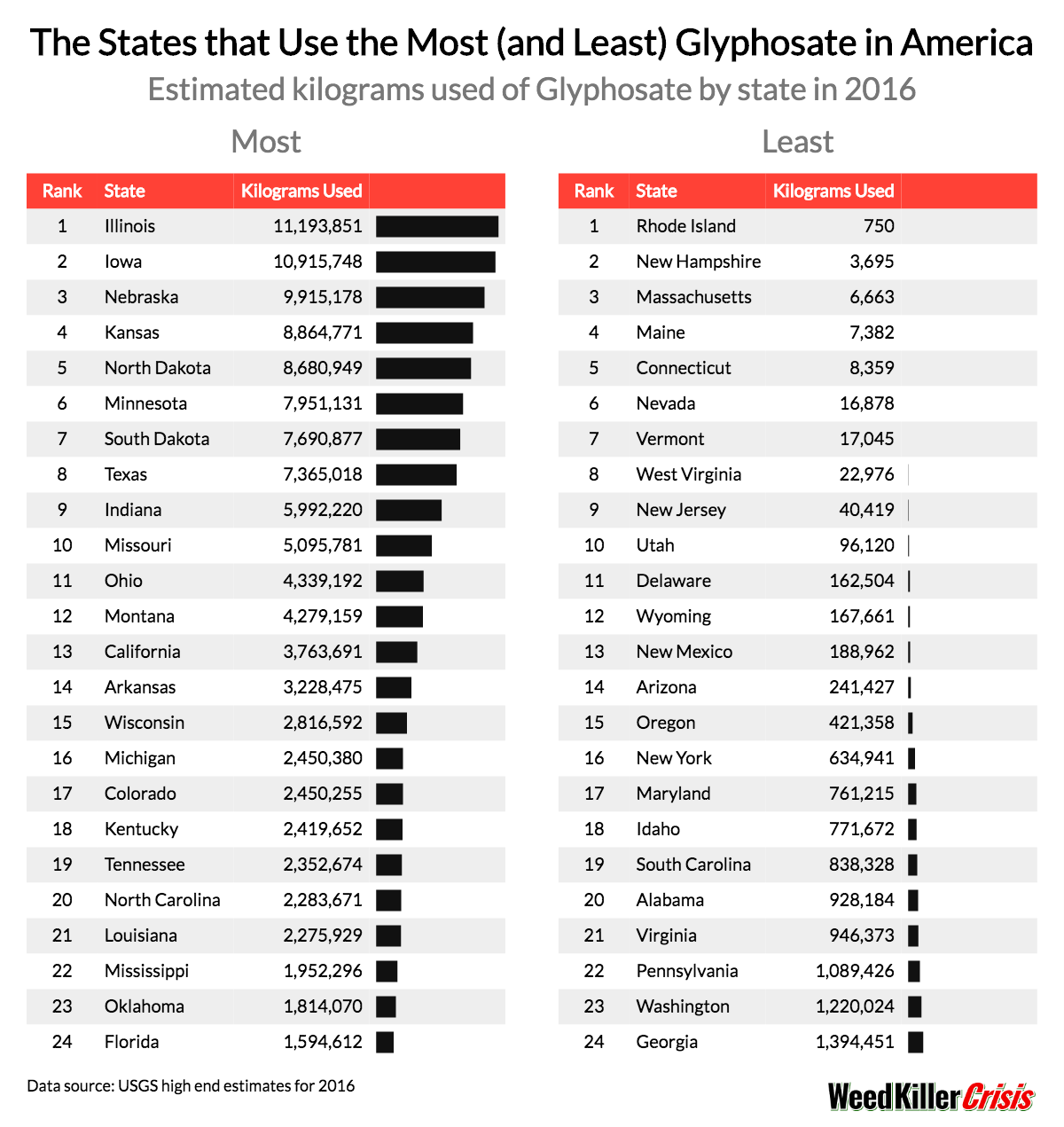
Which states use the most and least glyphosate, the compound that’s currently making headlines for causing cancer? The next chart shows kilograms of glyphosate used in each state.
Interestingly, the states that use a lot of glyphosate are not necessarily the ones that use a lot of pesticides in general. The states with the highest volume of glyphosate are Illinois, Iowa, Nebraska, and Kansas, which weren’t the ones that use the most pesticides overall. Neither California nor Washington (the two largest users of pesticides in general) make the top 10 states for glyphosate usage.
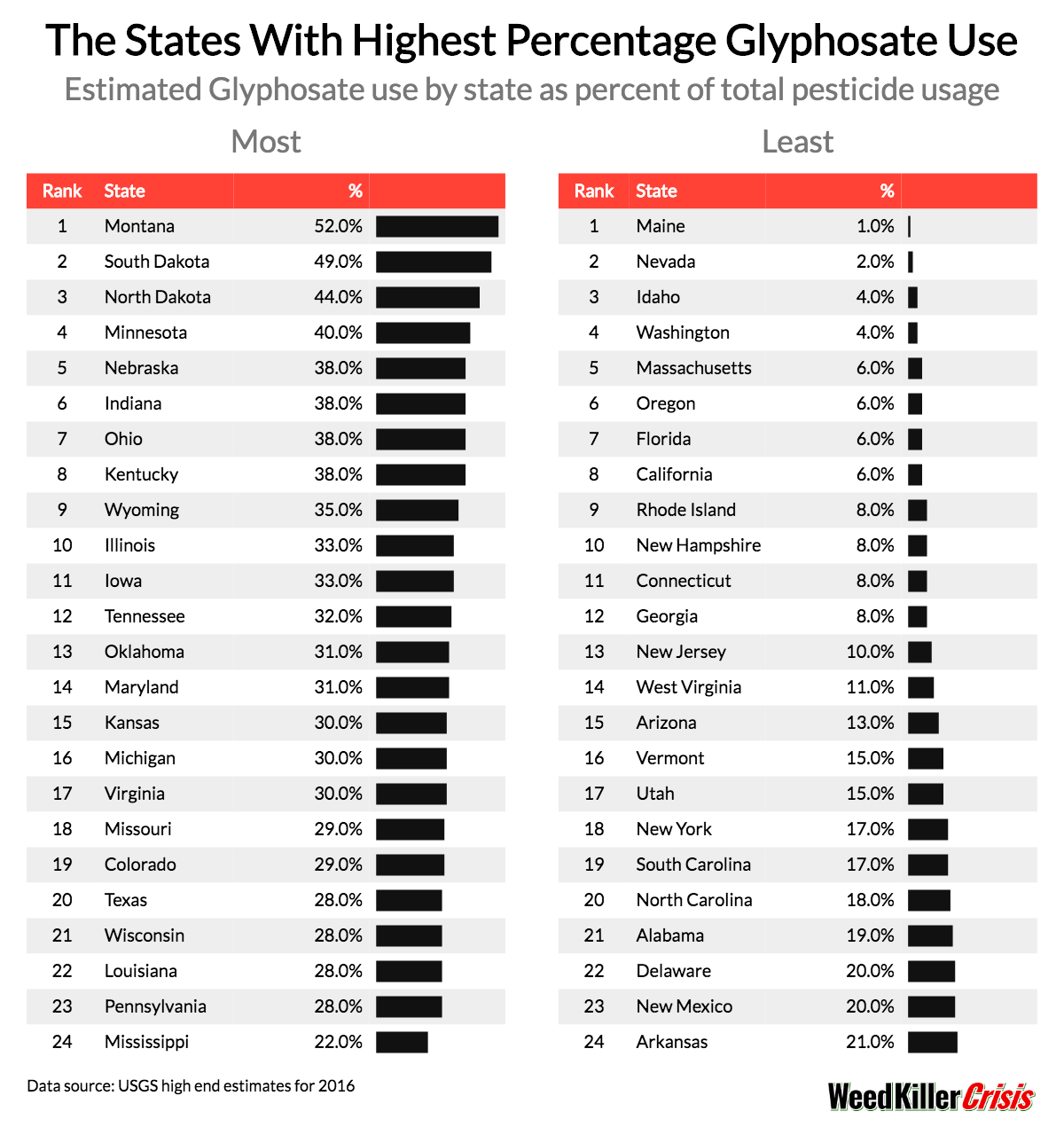
It’s worth noting that just because a state has a lot of agriculture or uses a lot of pesticides, that doesn’t necessarily mean that glyphosate is the favored pesticide in farming throughout the state. The chart below shows the percentage of pesticide usage by state for glyphosate versus all pesticides:
For states like Montana and South Dakota, approximately 50 percent of pesticide usage is for glyphosate. In general, states in the Great Plains and Midwest dominate the list of areas that are most reliant on glyphosate-based treatments, which can largely be traced to what is grown in those regions.
According to the USGS, corn and soybeans are the crops that are most frequently treated with glyphosate, and these crops are more common in these geographies. For instance, Illinois and Iowa are the top two glyphosate-using states, and they’re also the top-producing states for both corn and soybeans. On the other hand, California sees than 6 percent of pesticide usage from glyphosate-based products, while in Maine and Nevada less than 2 percent of pesticide usage is for glyphosate.
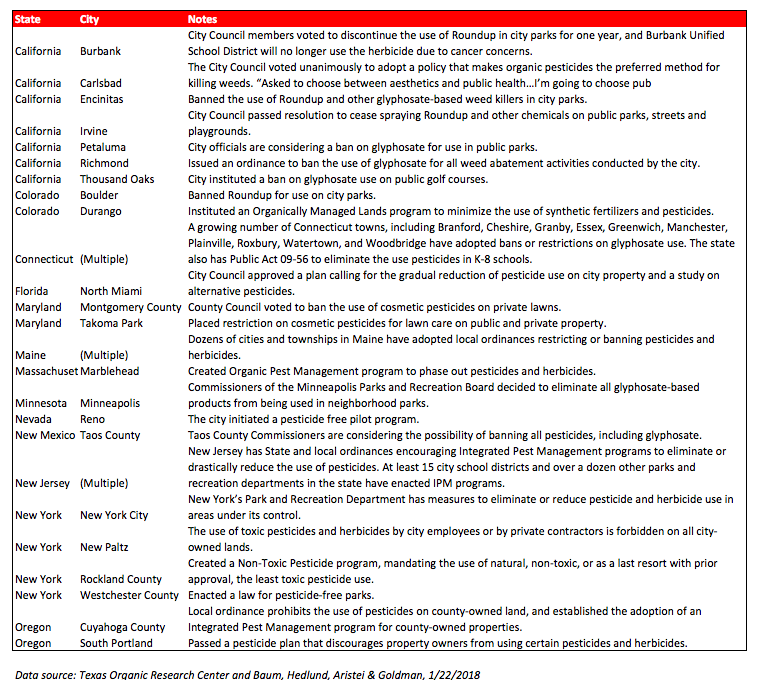
Where Is Glyphosate Banned in America?
Lastly, a number of places in America have banned glyphosate or are making efforts to severely limit the use of pesticides, herbicides and other similar chemicals. The chart below, via the Texas Organic Research Center, shows a list of some bans currently underway or being considered:
With the recent Roundup verdicts, it’s likely that the number of glyphosate-related legal cases will only continue to increase. Pesticide usage is most common in large agricultural states like California, but that doesn’t mean those states use a lot of glyphosate-based products. For example, in California only 6 percent of its pesticide usage is glyphosate, where as in Montana that number is 52%.
States in the Great Plains and Midwest tend to use glyphosate at the highest rate, while a number of locations (mostly on the coasts) are starting to ban the chemical. As glyphosate continues to dominate the news and the health effects are better understood, it’s likely these bans may keep accelerating.
via ZeroHedge News https://ift.tt/2YGDArg Tyler Durden