Doug Casey: Why Modern Monetary Theory Will Destroy Money…

Authored by Doug Casey via InternationalMan.com,

MMT centers around the notion that the economy in general, and money in particular, should be the creatures of the State.

It’s not a new idea – the meme has been around in one form or another since at least the days of Marx.

MMT basically posits that the wise and incorruptible solons in government should create as much currency as they think is needed, spend it in areas they like, and solve any problems that occur with more laws and regulations.

It’s nothing new. Just a more radical version of the economic fascism that’s dominated the U.S. since at least the days of the New Deal. It’s just another name for an old, and very stupid, set of economic ideas. By stupid I mean, “showing an inability to predict the indirect and delayed consequences of actions.”

Won’t Work

Politicians are now talking about the supposed benefits of MMT. Pseudo-economists are doing their abstruse and incomprehensible mathematical computations about how it might affect the economy.

The public will easily be convinced they’ll get something for nothing.

But what we should be talking about here is moral principle. It’s not a question of whether MMT will work or not work. It won’t. It will work about as well as the economic policies of Venezuela and Zimbabwe. Or Argentina, where I am at the moment.

These schemes have never worked in all of history. They result in a vastly lower standard of living, along with social strife. MMT is about radically increased government control. The argument shouldn’t be over whether MMT will “work” or not. The argument should be about whether it’s moral and proper for people in the government – whether elected or appointed – to print money to change the economy into something that suits them better.

What Money Is

Money represents the hours of your life that you spent earning it. That’s the basic principle here. It represents concentrated life – all the things you want to have and do for yourself, and provide for others in the future.

When these people destroy the value of money, they’re destroying part of your life.

“Inflation” isn’t caused by greedy butchers, bakers, and gasoline makers. It’s caused by an excess of purchasing media. MMT will give the State total control of its quantity and quality.

If the government increases the money supply by, say, 10 times, general prices will go up by 10 times. The value of your dollar savings will drop 90% – perhaps most Americans won’t care, because they have no savings, just debt.

In any event, some people will get hold of a lot more of that 10x increase than others. And they’ll get hold of it earlier, before prices really take off.

Who? Inevitably cronies.

Moral Question

Look, absolutely every government intrusion into the economy – whether it’s taxes or regulations or inflation – always benefits the people in and around the government. And damages society as a whole.

But they’re sold to the voters, to the hoi polloi, to the “head count,” as something that will put them on easy street. Which is a lie, of course.

But that’s not what the argument should be about. The average guy doesn’t understand economics; he doesn’t think, he feels.

Furthermore, nobody talks about whether cockamamie ideas like MMT are morally right or wrong. Instead, they have pointless and ridiculous arguments about whether it works or not. Well, it doesn’t work. But that’s a distraction.

This matter is essentially a moral question, not a technical question. Does somebody in government have a right to determine your economic destiny? Or not?

The fact that Alexandria Ocasio-Cortez [AOC] – an ambitious, terminally ignorant, morally crippled 29-year-old Puerto Rican bartender – is setting the tone for this whole discussion tells you how degraded the U.S. has become. It’s well on its way to turning into a giant welfare and police state.

But, as you know, I always look on the bright side. Which is that – if you give yourself a little psychological distance – this is all a comedy.

AOC, The Donald, Bolton, Bernie Sanders, Pocahontas, Hillary, Kamala, etc., etc. They’re all dangerous megalomaniacs. But the chimpanzees listen to them, choose teams, hang on to their every word, support them, and are easily incited to hoot and pant at each other.

The American public is going to get exactly what it deserves. I have no sympathy for them. Or about as much as I would have had for the Romans in the fifth century, when the empire was collapsing.

*  *  *

Clearly, there are many strange things afoot in the world. Distortions of markets, distortions of culture. It’s wise to wonder what’s going to happen, and to take advantage of growth while also being prepared for crisis. How will you protect yourself in the next crisis? See our PDF guide that will show you exactly how. Click here to download it now.

via ZeroHedge News https://ift.tt/2HH4Mkc Tyler Durden

Manhattan Luxury Market Takes Big Hit With 19% Drop In Contracts: Report

Last week, Zerohedge readers learned that Manhattan’s luxury residential market continued to deteriorate, as homes sold in February stayed on the market for the most extended period since 2012. Now, a new report from Olshan Realty gives us insight into sluggish sales, which data cited from the report reveals demand continues to plunge.

Olshan Realty told The Real Deal that total luxury Manhattan sales for 2019 are 229. The report said the number represents a 19% drop versus the same period in 2018 when 282 properties went under contract, which was 15% lower than 2017 sales.

It appears that sellers in the market are not reducing their asking prices quickly enough to meet the demand of buyers. Most likely explaining why 1Q19 days on the market surged to 516, up from 469 in 2018 and 390 in 2017.

“In my opinion, the luxury market continued to scream: OVERPRICED!!!!!” wrote, Donna Olshan, the President and sole owner of Olshan Realty Inc. She added that the plunge in interest rates might generate some sales but doesn’t think the market will recover in 2Q.

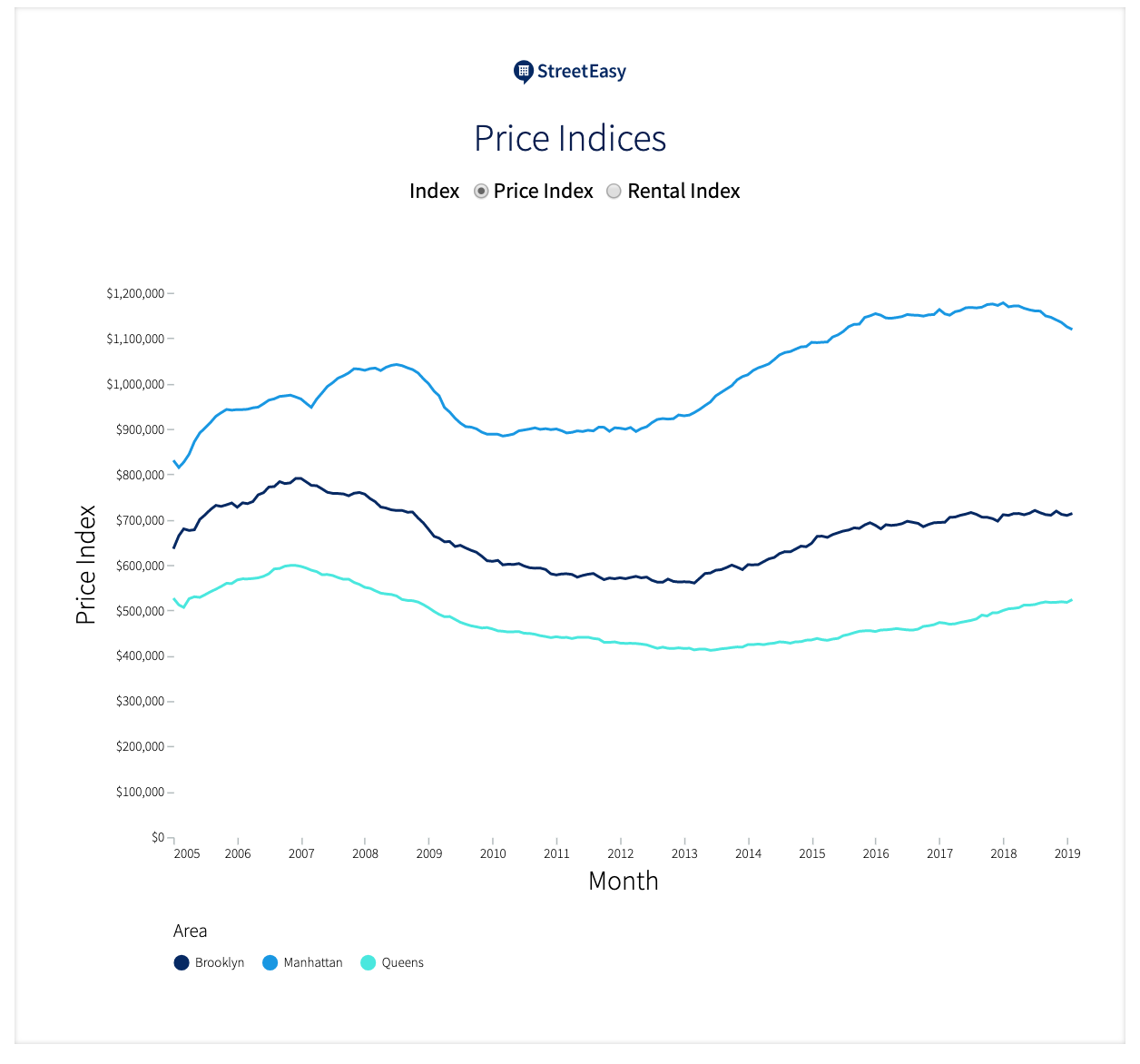
The index of Manhattan home values, which is compiled using closed purchases, was down 4.3% from February 2018 – a change that is “eyebrow-raising” according to Grant Long, the senior economist at StreetEasy.

“With a strong economy and home-shopping season right around the corner, plenty of New Yorkers are well-positioned to buy this spring. However, many are willing to walk away from deals that just aren’t financially attractive and continue renting instead — creating a market poised to punish sellers who don’t price their homes sensibly. When the inevitable wave of new inventory hits the market this spring, interested buyers should expect to see an uptick in price cuts as the market forces ambitious sellers to accept reality.”

Long also expects inventory which is up 12% from last year, to reach a record this spring, telegraphing even stricter times for sellers in the quarter ahead.

Recall, we reported in early January that the 2018 trend of tumbling Manhattan home prices was extending into the new year.

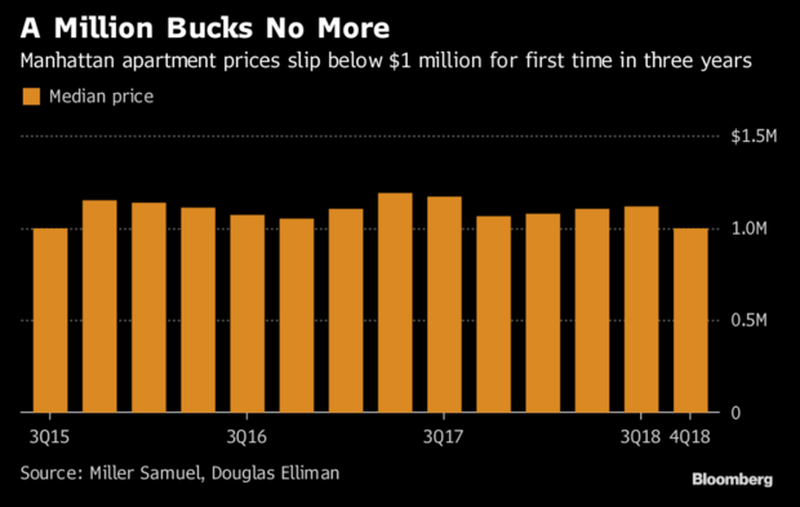
After Manhattan real estate closed 2018 as the worst year since the Great Recession, the median sales price for Manhattan apartments continues to decline into 2019, with price tumbling below $1 million for the first time in three years, as sellers are forced to discount price amid a flood of inventory.

To simply condense all the information above, the Manhattan residential real estate market is experiencing a turning-point that could point to much lower prices in the coming quarters.   

via ZeroHedge News https://ift.tt/2CGsBVn Tyler Durden

Just Before The Great Recession, Mountains Of Unsold Goods Piled Up In Warehouses…And Now It Is Happening Again

Authored by Michael Snyder via The Economic Collapse blog,

When economic conditions initially begin to slow down, businesses continue to order goods like they normally would but those goods don’t sell as quickly as they previously did. 

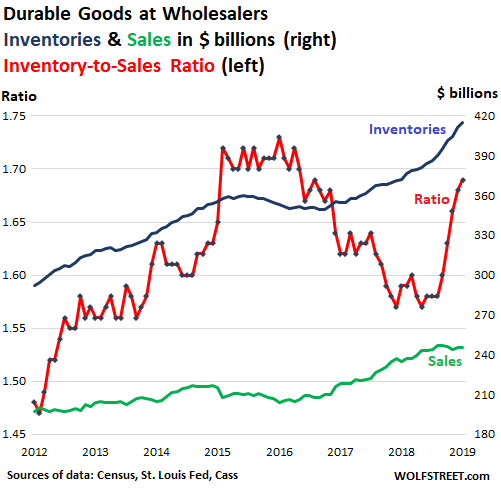
As a result, inventory levels begin to rise, and that is precisely what is happening right now.  In fact, the U.S. inventory to sales ratio has risen sharply for five months in a row

This is mirroring the pattern that we witnessed just prior to the financial crisis of 2008, and it is exactly what we would expect to see if a new recession was now beginningIn recent weeks, I have been sharing number after number that indicates that a serious economic slowdown is upon us, and many believe that what is coming will eventually be even worse than what we experienced in 2008.

And even though I write about this stuff every day, I was stunned by how rapidly inventory levels have been rising recently.  The following numbers come from Peter Schiff’s website

This comes on the heels of the largest gain in wholesale inventories in more than five years in December.

Inventories rose 7.7% from a year ago in January. Meanwhile, sales only rose by 2.7%. Overall, total inventories were $669.9 billion at the end of January, up 1.2% from the revised December level.

The increase in durable goods inventories at the wholesale level was even starker. These inventories were up 11.7% from January a year ago, and are up 17% from January two years ago, hitting $415 billion, the highest ever.

Businesses don’t like to have excess inventory, because carrying excess inventory is expensive and cuts into profits.  So they try very hard to manage their inventories efficiently, but if the economy slows down unexpectedly that can catch them off guard

There are few indications of economic slowing that are more convincing than an unwanted build in inventories — and that apparently is what’s underway in the wholesale sector.

When inventory levels get too high, businesses often start reducing the amount of stuff they are ordering from manufacturers.

So we would expect the numbers to indicate that manufacturing output is down, and that is precisely what we have witnessed over the last couple of months

U.S. manufacturing output fell for a second straight month in February and factory activity in New York state hit nearly a two-year low this month, offering further evidence of a sharp slowdown in economic growth early in the first quarter.

If manufacturers are making and sending less stuff to businesses, and if businesses are selling less stuff to their customers, then we would expect to see less stuff moved around the U.S. by truck, rail and air.

And wouldn’t you know it, the numbers also tell us that this has been happening too.  The following comes from Wolf Richter

Now it’s the third month in a row, and the red flag is getting more visible and a little harder to ignore about the goods-based economy: Freight shipment volume in the US across all modes of transportation – truck, rail, air, and barge – in February fell 2.1% from February a year ago, according to the Cass Freight Index, released today. The three months in a row of year-over-year declines are the first such declines since the transportation recession of 2015 and 2016.

So there you have it.  Anyone that tries to tell you that the U.S. economy is “booming” is simply not being accurate.

And when you throw in the fact that we just witnessed one of the worst disasters for U.S. agriculture in all of U.S. history, it is easy to understand why the economic outlook for the remainder of 2019 is rather bleak.  One agribusiness company just announced that it will have “a negative pretax operating profit impact of $50 million to $60 million for the first quarter” as a result of all the flooding…

Already suffering from low crop prices and the U.S.-China trade war, Mother Nature has delivered yet another blow to the beleaguered American farmer. Growers in the heartland this year have seen arctic cold blasts, been blanketed by snow and just in the last week were inundated by floods. Archer-Daniels-Midland Co., one of the world’s biggest agribusinesses, said Monday that it expects weather disruptions to have a negative pretax operating profit impact of $50 million to $60 million for the first quarter.

Korth said he fears the worst for local farmers, citing a friend who lost 85 cows to flooding and another who sells seeds and has already seen order cancellations.

“It’s going to put a lot of people out of business,” Korth said. “It’s just a terrible deal.”

Unfortunately, the flooding in the middle portion of the country is just getting started.  According to the National Weather Service, we are going to see more catastrophic flooding for the next two months.

As you can see, the elements for a “perfect storm” are definitely coming together, and I encourage everyone to get prepared for rough times ahead.

But many people are not that concerned about a new crisis, because they remember that global central banks were able to pull us out of the fire last time around.

Unfortunately, they may not be able to do it this time.  Just consider the words of the deputy director of the IMF

Major financial institutions may be powerless to prevent the next global economic downturn from tuning into a full-blow recession, the International Monetary Fund has warned.

In a speech on the future of the eurozone, the IMF’s deputy director David Lipton, warned of the depleted power of central banks and governments to combat another sharp economic shock.

“The bottom line is this: the tools used to confront the global financial crisis may not be available or may not be as potent next time” he said.

But I am sure that global central banks will try to patch the system back together again, and at certain moments it may even look like they are having some success.

In the end, however, they will not be able to stop the “Bubble To End All Bubbles” from completely bursting.

It has taken decades of exceedingly foolish decisions to get us to this point, and there is simply no way that we can avoid the day of reckoning that is coming.

What could go wrong?

via ZeroHedge News https://ift.tt/2JKOo4d Tyler Durden

Mystery Trader Bets Huge That Market Is Wrong On Fed Rate-Cuts

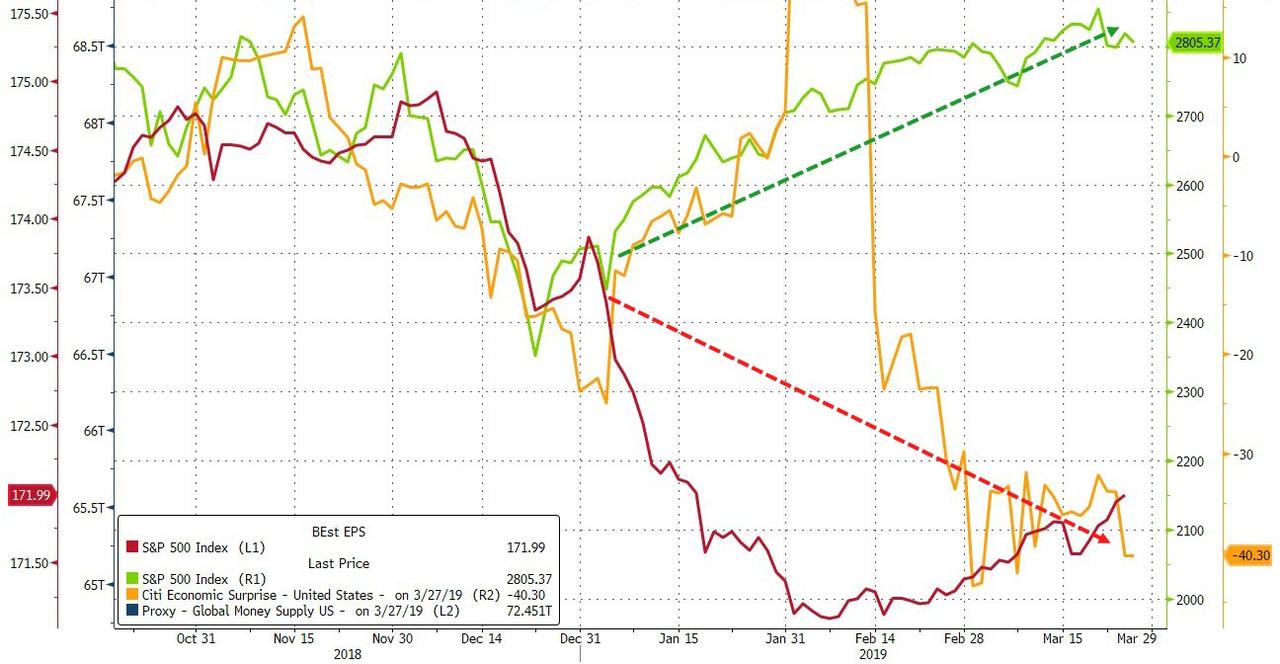
The US stock market has soared back from its December ‘Mnuchin Massacre’ lows, floating higher, blissfully ignoring the collapse in earnings expectations and macro-economic data.

The enabler of that blissful ignorance is simple – same as it has been for a decade – an ever-increasing hope that The Fed stands ready to do ‘whatever it takes’ to maintain the wealth (and inequality) driver of the new normal and the only policy prescription there is – the US stock market.

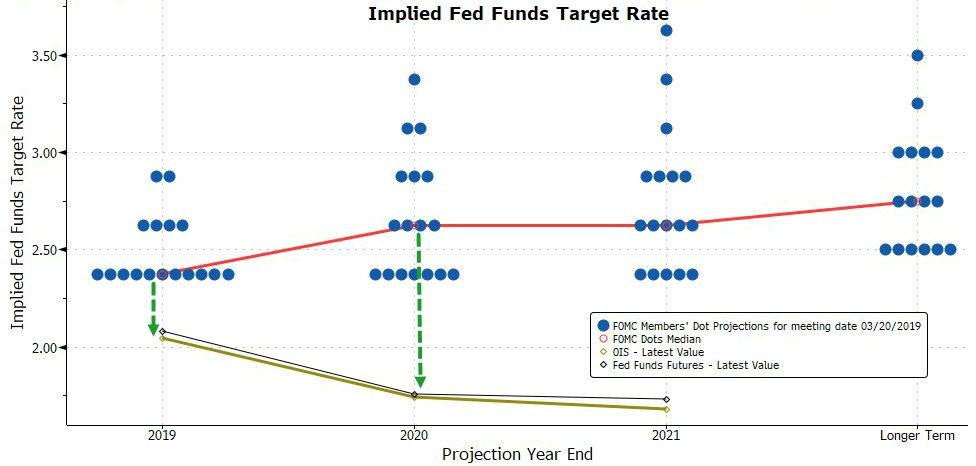
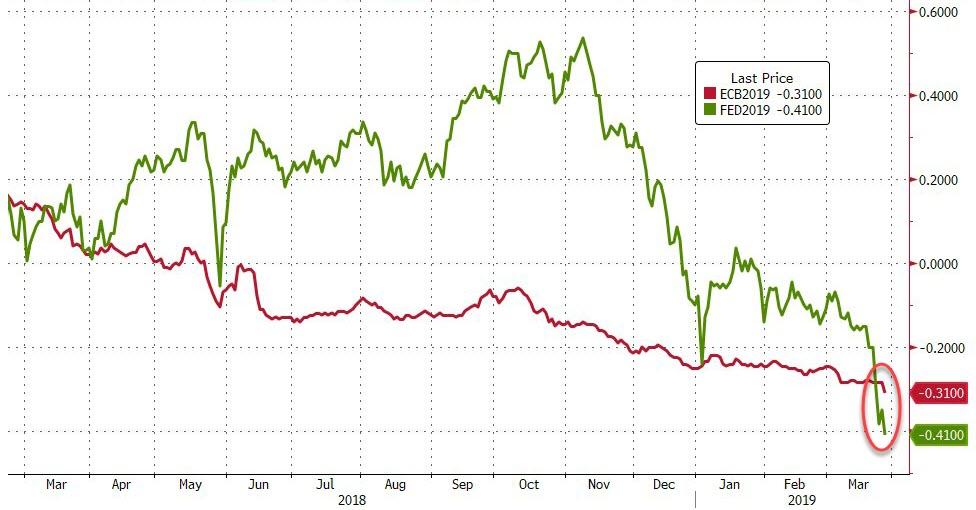
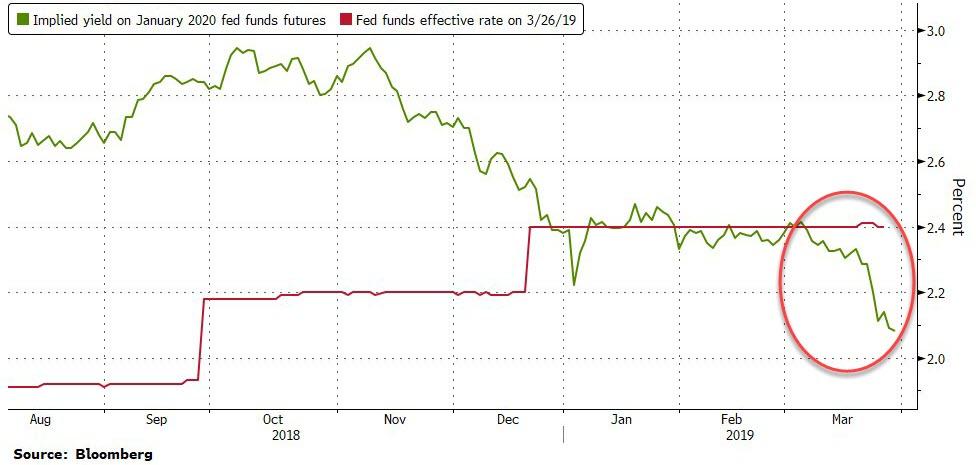
However, the market has seemingly got a little over its skis in recent weeks as it has priced in over 40bps of rate-cuts in 2019 – while The Fed just told the market to expect no rate-changes in 2019.

In fact, the market is now pricing in The Fed as being more dovish than The ECB in 2019…

And now, the divergence between the market and The Fed has got so wide that one trader has placed a huge bet that the market is wrong.

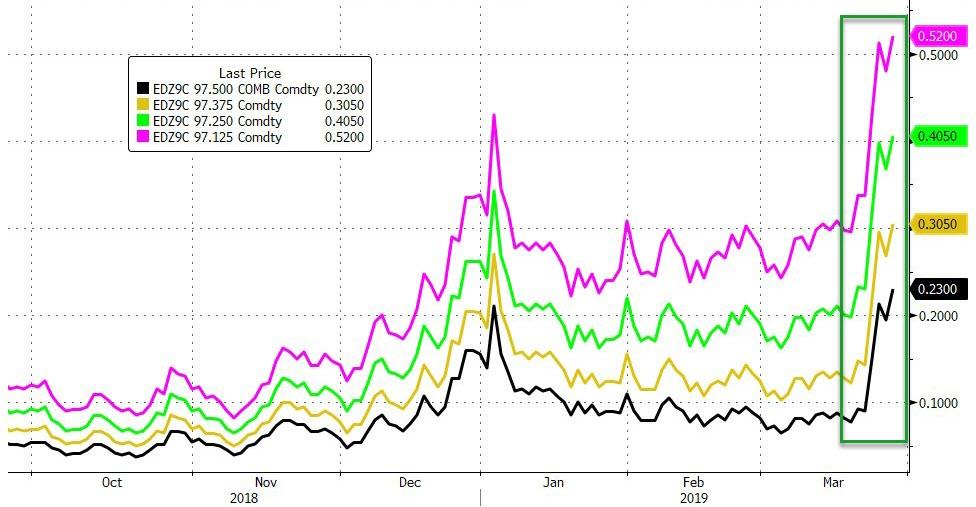
As Bloomberg reports, there is a new eurodollar whale in town. About $30 million has been plowed into an options bet that the market has gone too far in pricing in Federal Reserve cuts this year.

The eurodollar put condor across four December 2019 strikes continued to dominate options activity today following heavy-buying on Tuesday (175k to 200k EDZ9 97.50/97.375/97.25/97.125 put condor bought at 4 ticks according to U.S. based traders).

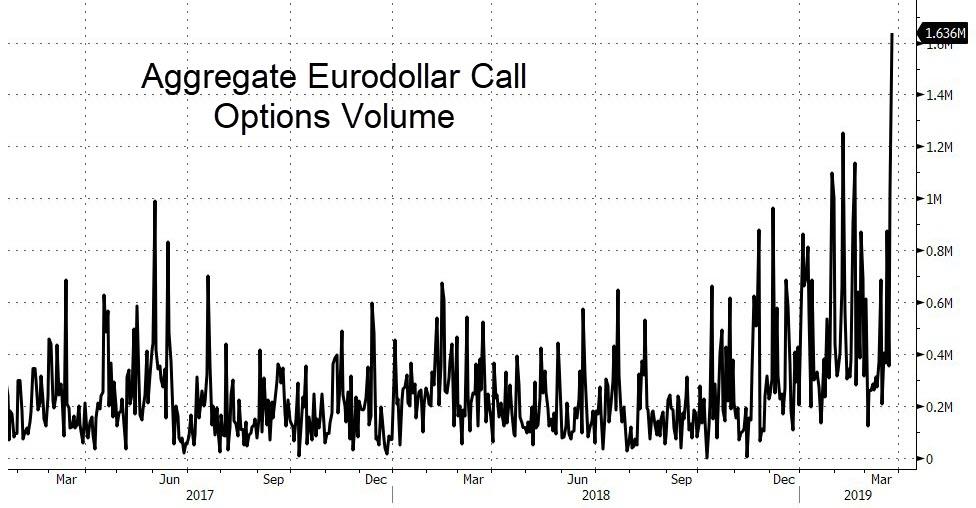
Eurodollar options volume this week has been dramatic and as Bloomberg notes, the ‘eurodollar whale’ position accounted for over half an average trading day’s options volume on its own.

Binky Chadha, a strategist at Deutsche Bank AG, has indicated that the move in yields and rate-cut bets may have its limits.

“In the absence of very negative data or worsening of any of the long list of well known risks, the market is unlikely to take a strong view on further rate cuts,” which argues for a potential rebound in 10-year Treasury yields, he wrote in a note.

The options mature on the Monday following the final (December 11th) FOMC meeting of the year, therefore also capturing any potential year-end funding issues.

Should the bet prove right, it would also likely have negative implications for a stock market drunk of Powell-Put kool-aid, and if today’s 5-year note auction (not well received) is anything to go by, perhaps – as usual – the market has run too far too fast in favor of the Powell-pivot (unless of course, things are so bad economically that The Fed is forced to move so aggressively).

via ZeroHedge News https://ift.tt/2CCajUX Tyler Durden

Did Mueller Leave A Trap For Trump?

Authored by Graham Noble via LibertyNation.com,

As everyone waits for special counsel Robert Mueller’s final report on his Russia investigation to be made available, all attention is on the four-page letter by Attorney General William Barr summarizing Mueller’s conclusions. While the special counsel found no evidence that President Donald Trump or anyone associated with him conspired or cooperated with Russians, Democrats have seized upon one specific sentence in the letter. Mueller’s motive for including this particular sentence in his report is worth analyzing, since it will surely mold the way the president’s enemies use the report once they receive it.

The attorney general’s summary quotes the special counsel as saying: “While this report does not conclude that the president committed a crime, it also does not exonerate him.” The statement applies specifically to the question of whether President Trump obstructed justice. Mueller came to this conclusion after a “thorough factual investigation,” as Barr’s summary quotes the report.

Mueller Oversteps His Prosecutorial Duty?

The special counsel declined to make a “traditional prosecutorial judgment” in this matter and left it to the Department of Justice to decide if the president’s actions met the standards for an obstruction-of-justice charge. Barr and Deputy Attorney General Rod Rosenstein determined that “the evidence developed during the Special Counsel’s investigation is not sufficient to establish that the president committed an obstruction-of-justice offense.”

Mueller and his team investigated obstruction  – and all other matters within the scope of their authority – as prosecutors. Their task was to gather and analyze evidence, interview witnesses, and make recommendations on who should face charges and for what. Otherwise, they make declination decisions, recommending that no charges be brought.

These decisions — prosecution or declination — are based purely on the available evidence and as such do not require any clarifying statements, such as “this report … does not exonerate [Trump].” It simply was not necessary to make this observation. Prosecutors either recommend charges, or they do not, without adding judgmental statements.

Former FBI Director James Comey found himself in hot water when he announced, in 2016, that Hillary Clinton would face no charges but included in his public statement that the former presidential candidate had been “extremely careless” in her handling of classified information. Protocol dictates that an individual who will not be charged with a crime should not have his or her character besmirched. Comey was not acting as a prosecutor, though, and found himself in the frustrating position of having to exonerate Clinton because he knew that the Justice Department had no intention of charging her.

Leaving Open The Door For Impeachment

By choosing to point out that his report does not exonerate the president in the matter of obstruction, Mueller similarly has overstepped. The mere fact that he chose to defer to the DOJ demonstrates that he was unable to make a firm declination decision, even though he did not believe he had enough evidence to recommend a charge. By definition, then, he was not exonerating the president – so why put that in writing?

It is probably misjudging Mueller to suggest that he decided to emphasize his non-exoneration purely out of pique, that he was taking a swipe at Trump in retaliation for all the times the president had disparaged Mueller’s motives and his special counsel team.

The more likely answer is that Mueller purposefully included this sentence in his report in order to leave the door open for the impeachment of the president. It is entirely possible that Mueller knew the DOJ would not find sufficient cause to determine that Trump had obstructed justice. Mueller himself was unable to do so, after all.

The word “exonerate” is loaded, though, and Mueller clearly could not bring himself to apply it to Trump because it would have closed the book, so to speak. In legal terms, exoneration means a suspect is discharged of all liability – thus, in effect, proven innocent.

Is a person innocent until proven guilty beyond a reasonable doubt? Mueller was unable to conclude that Trump was guilty of obstruction beyond a reasonable doubt but stopped short of declaring him innocent. In doing so, Mueller has ensured that Democrats retain a reason to doubt the president’s innocence. Even though the attorney general has cleared the president, congressional Democrats have been handed by Mueller the key to a potential article of impeachment.

Until the full Mueller report – or as much of it as can be made public – is available to read, it is difficult to speculate if more will come of it. Mueller had an opportunity to put a long and highly damaging episode in the past. With a single sentence, he chose to keep this national wound open and further the divisiveness that continues to afflict the nation.

via ZeroHedge News https://ift.tt/2TGY53r Tyler Durden

War Economy: U.S. Army Orders 167,195 Assault Rifles

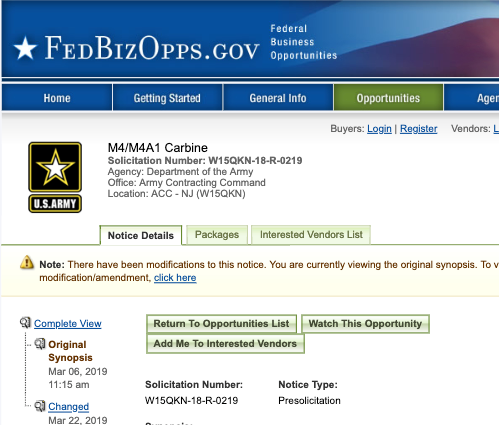
The Army Contracting Command-New Jersey (ACC-NJ) has issued a pre-solicitation to the defense industry, on behalf of Project Manager Soldier Weapons (PM-SW), for the request to procure 167,195 M4/M4A1 Carbines to be manufactured exclusively within the United States or its Territories.

The M4/M4A1 carbines provide a shorter and lighter variant of the M16A2 assault rifle to the United States Armed Forces. The lightweight assault rifle fires 5.56×45mm NATO ammunition from a 30-round magazine and has semi-automatic and three-round burst firing modes.

To meet this requirement for FY 2020 through 2024 deliveries, the Department of Defense (DoD) intends to award two fixed pricing contracts.

Defense Blog said the “M4 delivers superior performance and accuracy for the joint coalition forces conducting the most challenging combat missions. The performance of M4 has been proven across the world in military operations, including combat actions in Afghanistan and Iraq.”

The Army has spent several decades acquiring more than 500,000 M4/M4A1 carbines. The M4 has also been exported to allied forces and NATO countries as part of foreign military sales.

In another development of modernization efforts by the DoD, the Army has contacted defense companies about how to develop prototypes of the Next Generation Squad Weapon (NGSW), using a particular 6.7mm round. The NGSW in the next several years is expected to replace the M249 squad automatic weapon and M4/M4A1 carbines.

As the war economy marches forward, the DoD is stocking up on M4/M4A1 carbines and even expects to field an NGSW in the near term. This is more evidence that Cold War 2.0 with China and Russia is well underway. 

via ZeroHedge News https://ift.tt/2uBttpz Tyler Durden

Actual Putin Puppets: Moscow Pitting Climate Activists Against American Energy Industry

Authored by Michael Walker via The Center for Security Policy,

Is Moscow funding climate-change activists to damage the American energy industry around the world?

In an effort to slow down US natural gas production, the Russian government backed the anti-fracking movement in the United States. Moscow even funded US anti-fracking activists.

Now, with US climate change activists working to have ExxonMobil banned from addressing the European Parliament, and as Germany builds the Nord Stream 2 gas pipeline from Russia, it’s time to ask if Moscow is trying to push American energy companies out of Europe.

Cast of characters

The cast of characters raises questions about whether Russia may be behind an effort to deny an American company access to EU decision-makers. They are:

  • Molly Scott Cato, Member of the European Parliament (MEP), Green party. The Greens were formed in the 1980s to counter the United States in Germany, and have spread across the continent. The Greens’ political themes reflected Soviet active measures against United States interests in Europe. The Greens are strongly pro-EU, but have always been a problem for NATO.

  • Certain members of the Rockefeller family who accuse the company that made them rich, ExxonMobil, of covering up global warming and climate change, and who have a 28 year-old, $500,000,000 investment operation in Putin’s Russia.

  • Harvard-MIT scholar-activist Geoffrey Supran, who takes Rockefeller money to attack ExxonMobil and deny it the right to lobby the European Parliament.

  • Nord Stream 2, a German-Russian gas company run by a former East German Stasi officer. Nord Stream 2 is heavily tied to the Putin regime in Russia and to German politicians and political parties.

Former NATO chief: Russia works with activists to keep Europe dependent on gas

“Russia is secretly working with environmental groups campaigning against fracking in an attempt to maintain Europe’s dependence on energy imports from Moscow,” the Telegraph reported in 2014, citing then-NATO Secretary General Anders Fogh Rasmussen.

“Russia, as part of their sophisticated information and disinformation operations, engaged actively with so-called non-governmental organizations – environmental organizations working against shale gas – to maintain dependence on imported Russian gas,” Rasmussen said.

Greenpeace and other activist groups denounced Rasmussen’s comments as “preposterous.” However, it is known that Moscow’s intelligence services have exploited Western environmental activists since at least the 1980s.

Russian anti-fracking sponsorship

The Kremlin funded and provided propaganda support to American anti-fracking movements for years. “Buried within the U.S. intelligence community’s report on Russian activities in the presidential election is clear evidence that the Kremlin is financing and choreographing anti-fracking propaganda in the United States,” Newsweek reported in 2017. “By targeting fracking, Putin hopes to increase oil and gas prices, destabilize the U.S. economy and threaten America’s energy independence.”

“The Russian government, which relies heavily on energy exports for revenues, is concerned ‘about the impact of fracking and U.S. natural gas production on the global energy market,’ according to the intelligence report. Increased U.S. gas exports, the report continues, creates ‘potential challenges’ for the profitability of Gazprom, Russia’s state-owned oil and gas monopoly,” according to Newsweek.

Moscow openly supported American environmental activists leading the anti-fracking fight through the Russia Today propaganda vehicle known as RT.

In the 1980s, at least 15 to 20 West German Green Party members actively collaborated with the East German Stasi secret police, according a study that the Greens themselves commissioned.

EU to impose censorship on US company as Nord Stream 2 proceeds

The attacks on ExxonMobil are escalating as Russia’s Nord Stream 2 pipelineconstruction continues beneath the Baltic Sea to flood Germany with Russian natural gas. The Putin regime is banking heavily on Nord Stream 2 to circumvent land-based pipelines through Ukraine by delivering Germany the gas by the Baltic undersea pipeline.

ExxonMobil is part of competing natural gas pipelines to Europe that circumvent Russia.

Putin’s gas supply would, in turn, pump tens of billions in hard currency to prop up Russia’s sagging economy, while holding Germany and NATO hostage to Russian gas embargoes.

ExxonMobil is under attack for not sending a witness to an EU parliament hearing on climate change denial. Now, some European Parliament members, egged on by a Harvard-MIT scholar-activist, want to ban ExxonMobil from having any representation at all in Brussels.

“The ban request is being submitted by the Green MEP Molly Scott Cato,” the Guardian of London reported March 22. Cato said: ‘This is the company that denied the science, despite knowing the damage their oil exploitation was causing; which funded campaigns to block action on climate and now refuses to face up to its environmental crimes by attending today’s hearing. We cannot allow the lobbyists from such corporations free access to the corridors of the European parliament. We must remove their badges immediately.’”

Harvard-MIT scholar-activist Geoffrey Supran has built a case alleging that ExxonMobil has funded climate change research that came to conclusions he doesn’t like.

“It is the overwhelming consensus of experts studying the history of fossil fuel funding that companies, including ExxonMobil, have orchestrated, funded and perpetuated climate misinformation to mislead the public and politicians, and stifle action. Unfortunately, they largely succeeded,” Supran said in the Guardian.

Enter the Rockefellers and Russia

The Rockefeller family made its fortune from Standard Oil, which became Exxon Mobil. Some Rockefeller heirs blame their family legacy on climate change, and have been pumping money into anti-ExxonMobil research and activism.

They have been trying to force ExxonMobil to admit that it knew all along about the company’s role in man-made climate change.

The Rockefeller Family Fund paid for Supran’s questionable Harvard studies. Supran testified last week before the European Parliament in what seems to be a coordinated effort to attack the American company.

And there’s a Russia connection.

“Two of the family’s philanthropic organizations which they still run, the Rockefeller Brothers Fund and the Rockefeller Family Fund, have used family money to fund research that showed ExxonMobil knew about climate change early no and chose not to address it – instead producing advertising that criticized scientific research on the issue,” the Daily Mail reported in 2016.

Valerie Rockefeller Wayne is one of the rebellious family members. She is daughter of former US senator Jay Rockefeller. She is a trustee and chair of the Rockefeller Brothers Fund.

For years, she lived in Russia, where her husband, Steve Wayne, is founder and owner of a venture capital firm, the Jensen Group, which he has operated in St. Petersburg since 1991. Russian leader Vladimir Putin visited a Jensen Group projectin 2010. Wayne was a board member of Rockefeller Philanthropy Advisors from 2013-15.

None of this suggests that the Rockefeller family members are acting as Putin’s agents to fund energy activism in the United States. But to prosper in Putin’s hometown for 28 years, one must be careful to please the Big Man.

And so we ask the question: Is there any connection between Russian funding of the anti-fracking campaigns in the US, and the anti-ExxonMobil campaign in Europe?

via ZeroHedge News https://ift.tt/2uxFblj Tyler Durden

Lyft Lifts IPO Target, Will Be Third Highest Pricing Public Offering Since 2001

The US equity market’s inexorable march higher has seemingly stalled out as the S&P 500 has struggled to stay above the 2,800 line of resistance, and the IPO calendar so far this year has been littered with last-minute pullouts citing “unfavorable market conditions” a shortage of willing buyers, but apparently, when it comes to unprofitable ride-sharing startups, investors are willing to make an exception.

In a twist that has surprised even the company’s underwriters, demand for Lyft Inc.’s shares has been so robust that the company on Wednesday raised the price range to between $70 and $72 a share, cementing Lyft’s status as the most hotly anticipated IPO of the year, despite warnings in the financial press advising retail traders to stay away.

Lyft

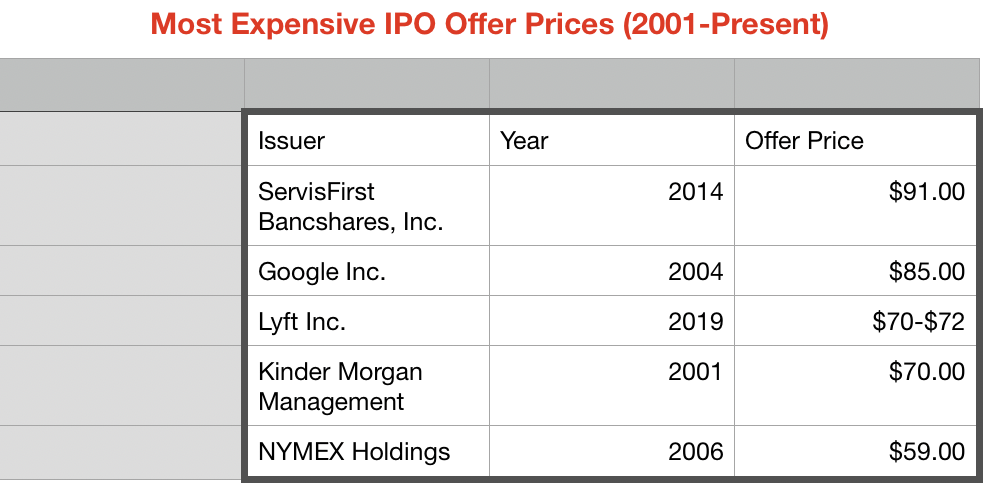
The Lyft offering, expected to be the largest US IPO since Alibaba, was already heavily oversubscribed just two days into its roadshow. Previously, it had been expected to price between $62 and $68. If it prices near the higher end of its new range ($72), Lyft would be the third biggest IPO since 2001. With a market cap just under $20.5 billion, it would be slightly more valuable than Snapchat was at its 2017 IPO.

IPO

But readers who have been paying close attention to the market conditions so far this year may notice that something seems out of place here, particularly with an economic slowdown, deteriorating corporate credit conditions and the ever-present trade war risk menacing markets.

As we’ve noted (and recent price action appears to confirm), during much of the torrid rally that has left Q1 on track to be the best start of the year for equities since 2012, institutions, hedge funds and retail investors have been conspicuously absent, choosing to stay on the sidelines, according to BAML’s fund flows report.

Today, the only reliable buyers are corporations – and they are only interested in buying back their own shares (buybacks in 2019 are expected to smash last year’s record announced spend of more than $1 trillion). Well, corporations, and shorts being forced to cover.

Last year, Lyft pulled in $2.16 billion, double the previous year’s revenue, and far higher than $343 million in 2016. However, it posted a loss of $911 million, even larger than the $688 million it lost in 2017, according to Reuters.

But that doesn’t change the fact that Lyft is a shiny Silicon Valley unicorn. And if the past is any guide, investors are often willing to overlook flaws like a lack of clarity surrounding the company’s path to profitability for the chance to get in early. What’s more, Lyft is at the vanguard of a wave of unicorn IPOs, which is expected to include its much-larger (and more valuable) rival Uber next month, followed later on by Pintrest, Airbnb and even mattress company Casper.

Still, if the offering is a flop, expect these others to rethink their plans, and possibly even shelve their own offerings until a time when “market conditions” have improved.

via ZeroHedge News https://ift.tt/2WsDkdg Tyler Durden

Facebook Bans Pro-White Groups, Discussions

Facebook on Wednesday announced that it will begin banning “praise, support and representation of white nationalism and separatism” on both Facebook and Instagram. 

“Based Stickman” via Facebook

The company had already been blocking users from sharing messages which glorify white supremacy – while civil rights advocates have long argued that white nationalism and white separatism are the same thing. 

Facebook claimed in a Wednesday blog post that “people will still be able to demonstrate pride in their ethnic heritage,” they will “not tolerate praise or support for white nationalism or separatism.” 

[O]ver the past three months our conversations with members of civil society and academics who are experts in race relations around the world have confirmed that white nationalism and separatism cannot be meaningfully separated from white supremacy and organized hate groups. Our own review of hate figures and organizations – as defined by our Dangerous Individuals & Organizations policy – further revealed the overlap between white nationalism and separatism and white supremacy. Going forward, while people will still be able to demonstrate pride in their ethnic heritage, we will not tolerate praise or support for white nationalism and separatism. –Facebook

In May of last year, internal training materials leaked to Motherboard revealed that Facebook treated the terms differently – allowing the “praise, support and representation” of white nationalism and white separatism “as an ideology,” according to the Washington Post

Civil rights groups applauded the move. “There is no defensible distinction that can be drawn between white supremacy, white nationalism or white separatism in society today,” Kristen Clarke, president and executive director of the Lawyers’ Committee for Civil Rights Under Law, said Wednesday in a statement.

The organization had pushed Facebook for months to change its policies, pointing to pages such as “It’s okay to be white,” which has more than 18,000 followers and has regularly defended white nationalism. Another, called “American White History Month 2,” often posted white-supremacist memes, according to the Lawyers’ Committee. A cached version of the page from late February showed it had more than 258,000 followers before it went offline. –WaPo

Facebook’s move has some wondering where exactly they draw the lines, and whether they plan to do anything about non-white race-based supremacy groups.

via ZeroHedge News https://ift.tt/2usRoHY Tyler Durden

GDP Data Tells You Nothing About Recession Risk 

via ECRI

Real-time GDP data can be highly misleading around business cycle turning points. This is especially true in the lead-up to recessions.

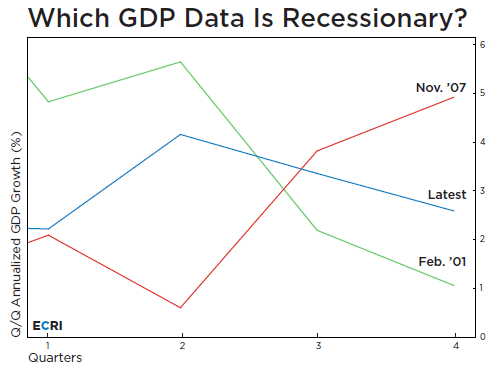
On the verge of the 2001 recession, in February 2001, the real-time data showed GDP growth declining to 1.1% (green line). But with the Fed cutting rates, the S&P 500 saw a one-and-a-half-month 19% spurt in April-May, even as the recession tightened its grip.

And in November 2007, on the cusp of the Great Recession, real-time data showed GDP growth surging to 4.9% (red line). Only in the years following the recession did revisions cut it down to less than half that initial reading.

The point is that, at least in real time, the strength of GDP growth does not tell us whether a recession is about to hit. It is only long after the fact, following repeated revisions, that the GDP data becomes more informative about the timing of the recession.

While the current cycle’s recent 2.6% GDP growth print – tracking right in-between the 2001 and 2007 trajectories – was well received by many economic prognosticators (blue line), by no means does it rule out a looming recession. 

In principle, GDP is a coincident indicator of the economy, with no real predictive value. But because more than half of the initial GDP estimate is based on survey data and the extrapolation of recent trends, the initial vintages of GDP are often misleading, especially around business cycle turning points.

This helps explain why it is often only well after a recession has begun that revisions to GDP data show an economic contraction in progress. Until then, the consensus may be wrongly persuaded that the coast is clear.

This is a key reason why good leading indexes are so valuable. Unlike GDP, ECRI’s leading indexes avoid major revisions over time, most crucially with regard to their cyclical timing and directional calls. Consequently, we were able to call the 2001 recession and Great Recession on a timely basis.

*  *  *

Click here to review ECRI’s recent real-time track record. For information on ECRI professional services please contact us. Follow @businesscycle on Twitter.

via ZeroHedge News https://ift.tt/2HJwzR4 Tyler Durden